
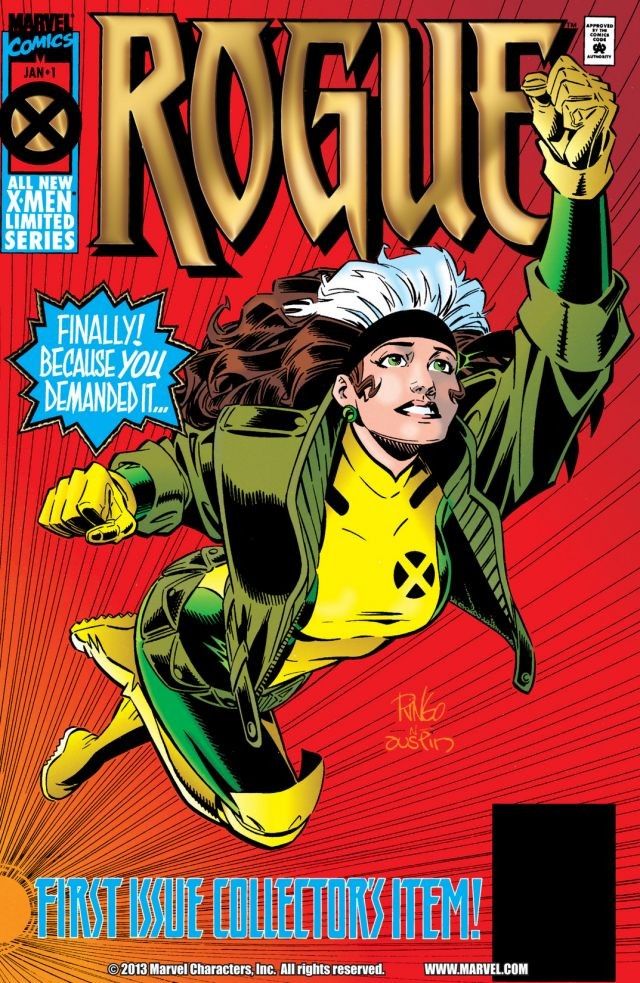
Rogue #1
Rogue #1 (1995) holds a clear structural distinction in Marvel publishing history: it is the first solo series ever to place Rogue at the center as the title character, a milestone for one of the X-Men's most enduringly popular members. The story deliberately foregrounds the emotional core that had always defined her — the involuntary psychic coma she inflicted on her childhood sweetheart Cody Robbins the first time her powers manifested — and builds a villain-driven plot directly around that guilt, giving the character an interior dramatic arc that ensemble X-Men books rarely had room for. The series also arrived at the height of the animated X-Men boom, when Rogue's profile on the Saturday-morning cartoon had made her a household name well beyond the comics readership, meaning the first issue landed at exactly the right cultural moment to capitalize on that audience. As the opening chapter of Rogue's solo publishing history, it set a precedent for subsequent limited series and eventually her 2004 ongoing, all of which grappled with the same themes of untouchability and longing that Mackie established here.
ComicBooks.com Value
Show all 22 grades ▾
More listings for this title
- Arcane Comics · Shoreline, WA3 on eBay ↗
- The 616 Comics LLC · Mantua Township, NJ2 on eBay ↗
- Diverted Comics · Bakersfield, CA1 on eBay ↗
Read it digitally
Sell my copy
Have this issue — or a whole collection? Get a fair offer from us, skip the marketplace fees and the hassle.
We Buy Collections ▸History
The limited series was produced under the Marvel method — meaning the artist plotted pages from a loose outline before the full script was written — and was explicitly conceived as a companion piece and narrative sequel to Howard Mackie's own 1993 Gambit limited series, picking up threads about the Assassins Guild and the External Candra left dangling there. Editor Lisa Patrick shepherded the project under group editor Bob Harras and editor-in-chief Tom DeFalco. Crucially, the series served as Mike Wieringo's debut work for Marvel Comics; he was paired with longtime Uncanny X-Men inker Terry Austin, whose clean line gave the book a polish that belied its status as Wieringo's maiden Marvel assignment. The first issue shipped with a gold foil cardstock cover, consistent with a mid-1990s Marvel promotional practice applied to several contemporaneous limited-series launches.
Trivia · 8 facts
- First solo comic series ever headlined by Rogue as the main character — the debut issue of Rogue Vol. 1, a four-issue limited series with a cover date of January 1995 (released November 1994).
- Written by Howard Mackie, pencilled by Mike Wieringo, inked by Terry Austin, colored by Dana Moreshead, and lettered by Richard Starkings/Comicraft; edited by Lisa Patrick under Editor-in-Chief Tom DeFalco.
- Marks the first Marvel Comics work by artist Mike Wieringo, who went on to become one of the most celebrated superhero artists of the 1990s–2000s before his death in 2007.
- First appearances of four Assassins Guild members: Questa, Gris-Gris, Fifolet, and Singer — all introduced as antagonists in this issue.
- First physical appearance of Cody Robbins — Rogue's childhood boyfriend, previously only mentioned in earlier X-Men issues (first mentioned in Uncanny X-Men #185) — who is revealed to have been in a coma since the moment Rogue's absorption powers first manifested during their first kiss.
- Functions as a direct sequel to Mackie's own Gambit (1993) limited series, continuing plot threads about Candra, the Guilds' pact, and Rogue having previously absorbed Bella Donna's memories while she was comatose in Gambit #3.
- Issue #1 features a gold foil-enhanced cardstock cover, a production technique Marvel applied to several limited-series launches of the period.
- The complete four-issue run was collected alongside Gambit (1993) #1–4 in the trade paperback X-Men: Gambit & Rogue (ISBN 9781302902483), and individual issues were also reprinted in Gambit Classic (2009–2013) Vol. 2 and in the French anthology Un Récit Complet Marvel #49 (1996).
Full credits
Reprints
Reprinted in Rogue #[nn] (1995), Un Récit Complet Marvel #49 (1996), Marvel Mix #1 (1996), Gambit Classic #2 (2013), X-Men: Gambit and Rogue #[nn] (2016), Marvel Superhelden #67
Variants (1)
Reviews
Reader reviews
No reader reviews yet.