
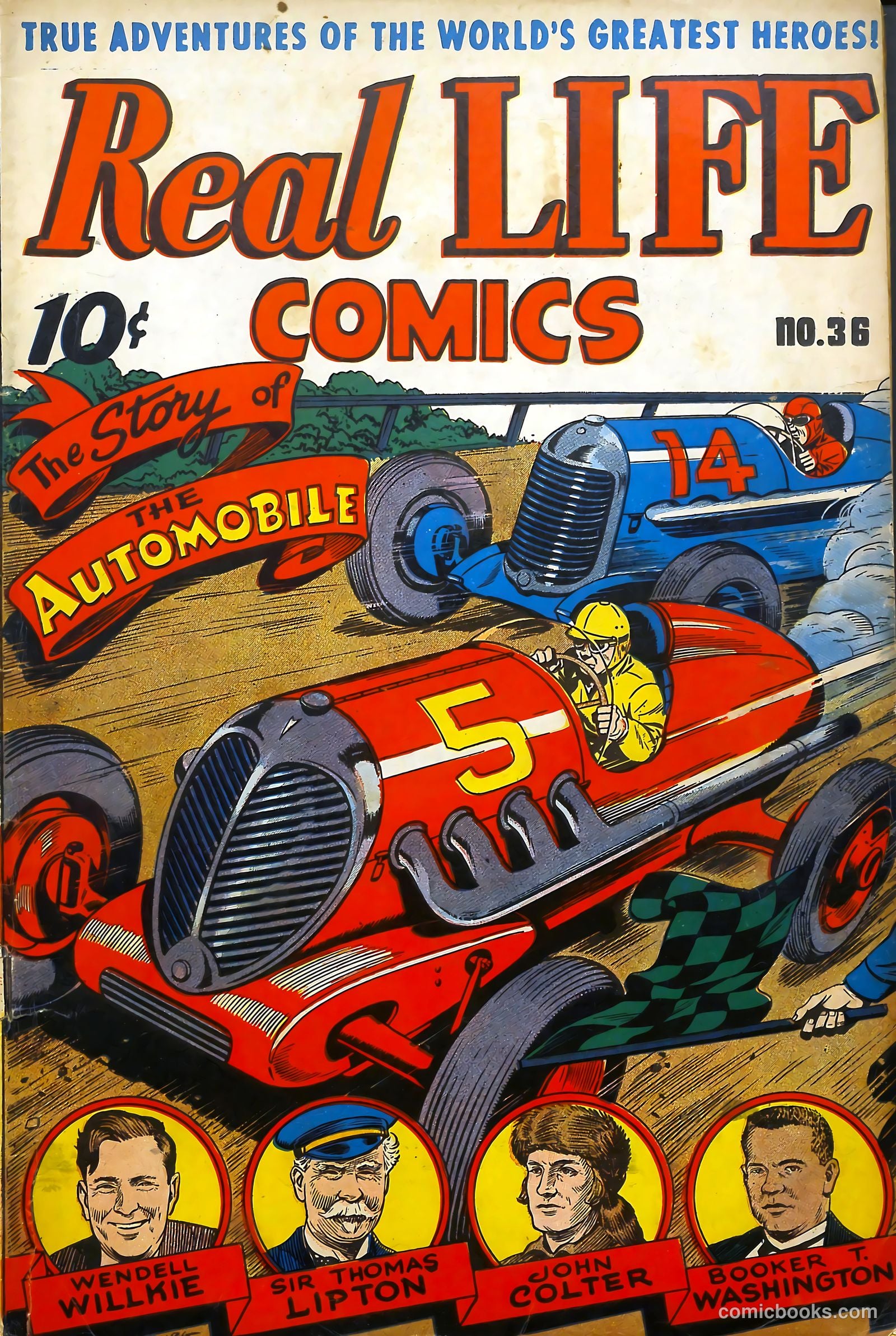
Real Life Comics #36
☆ Be the first to review + Add to your collection — Join freeThe issue features "The Story of the Automobile," chronicling innovations in transportation from early manufacturing through World War II and beyond. The narrative covers the development of Massachusetts industry, the growth of cities and infrastructure, and concludes with profiles of great American figures including John Adams, Benjamin Franklin, Ralph Waldo Emerson, Daniel Webster, Horace Mann, and Calvin Coolidge. A secondary story depicts the historical skepticism surrounding John Stevens' prophecy about steamboats and railroads, showing how early detractors doubted such innovations would ever work, particularly contrasting with the later success of the Pennsylvania Railroad.
Wendell Willkie—a lawyer, businessman, and champion of the common man whose ancestors fled Prussian tyranny—rises from his idealistic Indiana boyhood to become the Republican presidential nominee in 1940, campaigning on a vision of global freedom and human dignity. As the world fractures under fascism, Willkie embarks on a crusade to unite the free peoples against tyranny, traveling to England, Russia, and China to rally support for the fight ahead. This is the stirring story of a man who believed one world—and freedom for all its people—was the only path to survival.
At nineteen, Gene Gilbert turns a casual conversation about teen fashion into a legitimate business opportunity—launching Gilbert Teen-Age Services in 1945 Chicago with just twenty dollars and an audacious idea to survey young people about their actual clothing preferences. Rather than selling directly, Gilbert pivots to advising department stores on what teenagers actually want to wear, combining market research with trend forecasting to build a growing enterprise. It's a true story of youthful entrepreneurship that proves a teenager's insight into his own generation can be unexpectedly valuable.
Born enslaved in 1859, Booker T. Washington fought his way from bondage through education and determination, eventually founding the Tuskegee Institute in Alabama—a beacon of learning built by the students themselves. From teaching night classes to building an institution that would stand as a monument to freedom, Washington devoted his life to opening doors of opportunity for his people. This is the remarkable true story of a man who transformed hardship into lasting change.
A young Virginian named John Colter joins the Lewis and Clark expedition in 1804 with dreams of exploring the uncharted American West, and over the following years becomes a legendary trapper and guide whose knowledge and diplomacy—particularly his peace-making with the Crow Indians—prove as valuable as his survival skills. When a harrowing encounter with hostile Blackfeet forces Colter to flee for his life across miles of wilderness, his escape adds to his growing legend as the buckskinned adventurer who would map routes and gather intelligence that later pioneers would depend on to settle the frontier.
Sir Thomas Lipton arrives in America as a penniless Irish cabin boy with only sixpence in his pocket, and through determination and ingenuity—including his discovery that advertising can transform a business—he returns to Britain to build a trading empire and eventually earn his knighthood. His rise from rags to riches is marked by his legendary competitive spirit and sportsmanship, first on the merchant seas and later as the builder of the famous "Shamrock" racing yachts, all while his charitable acts and commercial vision earn him enduring respect on both sides of the Atlantic.
ComicBooks.com Value
Show all 12 grades ▾
Find on ebay
Read it digitally
Sell my copy
Have this issue — or a whole collection? Get a fair offer from us, skip the marketplace fees and the hassle.
We Buy Collections ▸Full credits
Key issues in Real Life Comics
Variants (1)
Reviews
Reader reviews
No reader reviews yet.