
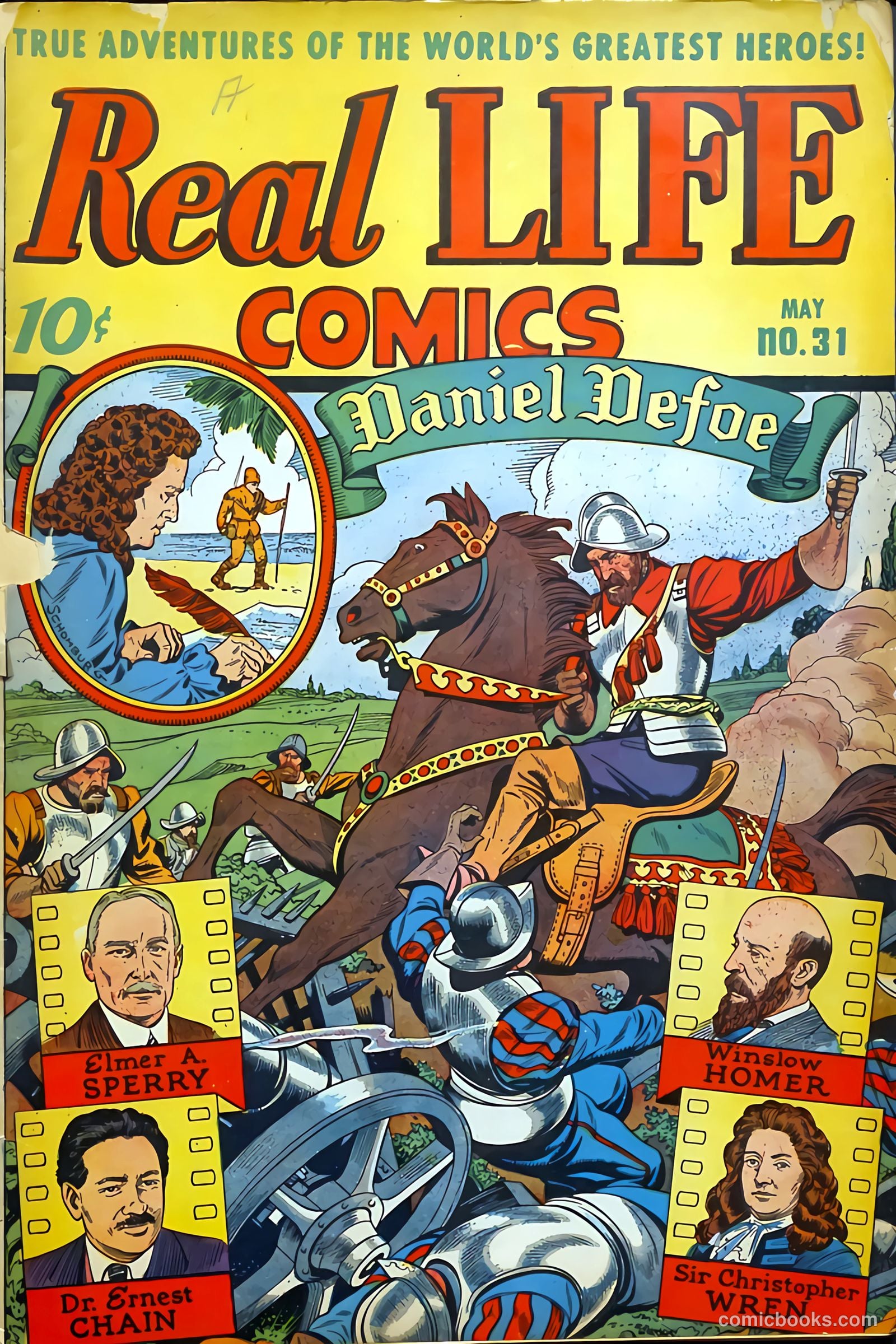
Real Life Comics #31
☆ Be the first to review + Add to your collection — Join freeReal Life Comics #31 is an anthology featuring historical biographies of notable figures. The issue includes "Benjamin Thompson's" account of discovering energy conversion and founding the Royal Institution in London, inspired by his scientific experiments with cannons and heat; "The Epoch-Making Discovery of Penicillin," which chronicles Dr. Ernst Chain's escape from Nazi Germany and his subsequent collaboration with Dr. Howard Florey at Cambridge University to develop the antibiotic drug penicillin; and "Sir Christopher Wren," depicting the young scholar's early ambitions in mathematics and chemistry before his later architectural achievements, including his design of St. Paul's Cathedral following the Great Fire of London in 1666.
Daniel Defoe lived a life nearly as tumultuous as the adventures he'd later chronicle—a soldier of fortune caught up in rebellion, a political writer whose clever satire nearly cost him his freedom, and a man perpetually hunted by enemies. When he meets a shipwrecked sailor named Selkirk in 1718 and hears the remarkable tale of survival on a remote island, Defoe finds the spark of inspiration that will transform personal hardship into literary immortality.
On October 21, 1944, Private Ernest Alvia "Smoky" Smith of the Seaforth Highlanders faces relentless German attacks at the Savio River bridgehead in Italy, where his unit must hold a crucial position against Nazi tanks and infantry. Through grit and quick thinking under fire, Smith and his fellow soldiers stand their ground as waves of enemy forces press in, inspiring his comrades to match his resolve. This is the true story of an ordinary infantryman whose courage in a few decisive hours exemplified the steel that won the war.
Benjamin Thompson rises from a nineteen-year-old officer accused of loyalist sympathies during America's War of Independence to become an adventurer spanning two continents and multiple professions. After his military career takes him from America to England to Vienna, where he serves the King of Bavaria, Thompson turns his restless intellect toward science—conducting pioneering ballistics experiments and investigating the nature of heat through ingenious friction tests. His groundbreaking work ultimately reveals one of nature's fundamental principles and reshapes scientific thought worldwide.
Joseph Petrosino, a courageous Italian-American detective, takes charge of a special plainclothes squad tasked with crushing the Black Hand extortion ring that terrorizes New York's immigrant neighborhoods in the early 1900s. Through fearless undercover work and dogged investigation, Petrosino dismantles the operation piece by piece, earning the trust of the Italian community—but his conviction that the real source of the criminal plague lies overseas drives him to take a fateful journey to confront the gangs at their origin. This is the remarkable true story of a police force hero who dedicated his life to protecting his fellow Italian-Americans from organized crime.
Ambrose Swasey believed that treating workers and metals with respect could transform manufacturing—and when a tragic airplane accident sparked his investigation into metal fatigue, the Cleveland factory owner became determined to share his breakthrough with the world, even at great cost to his own company. Watch as Swasey's radical commitment to training master craftsmen and advancing scientific knowledge shapes not just his business, but America's industrial future during the critical years ahead.
Elmer Sperry witnesses the chaos of rough seas aboard a ship and sets out to harness the principle of a spinning gyroscope to stabilize vessels—a quest that draws in his two sons and catches the attention of the U.S. Navy. From naval compasses and autopilot systems to aviation instruments, Sperry and his family pioneer breakthrough safety devices that transform travel on water and in the air. Their relentless pursuit of innovation becomes a legacy that extends far beyond the workshop, reshaping how humanity navigates the world.
Winslow Homer began as a young artist in Boston with a pencil and an eye for drama, eventually building a career as an illustrator and war correspondent before settling into his true calling—capturing the power and beauty of the American coast and sea. This biography follows his journey from a seventeen-year-old apprentice earning his way through wit and talent, through his Civil War sketches that brought him national fame, to his solitary decades in a cliffside studio in Maine, where he created the masterpieces that would define his legacy. A portrait of an unflinching genius who knew that the truest art lay in simplicity, restraint, and an unshakeable devotion to his subject.
Sir Christopher Wren rises from a brilliant young mathematician to become England's greatest architect, his genius spanning astronomy, engineering, and design across decades of achievement. When London's Great Fire of 1666 destroys the city, Wren seizes the opportunity to draw plans for the magnificent St. Paul's Cathedral—a monumental work that will consume the rest of his life and cement his legacy. Watch as this versatile mind transforms from academic to visionary builder, creating not just a cathedral but a testament to both artistic brilliance and scientific precision.
ComicBooks.com Value
Find on ebay
Read it digitally
Sell my copy
Have this issue — or a whole collection? Get a fair offer from us, skip the marketplace fees and the hassle.
We Buy Collections ▸Full credits
Key issues in Real Life Comics
Reviews
Reader reviews
No reader reviews yet.