
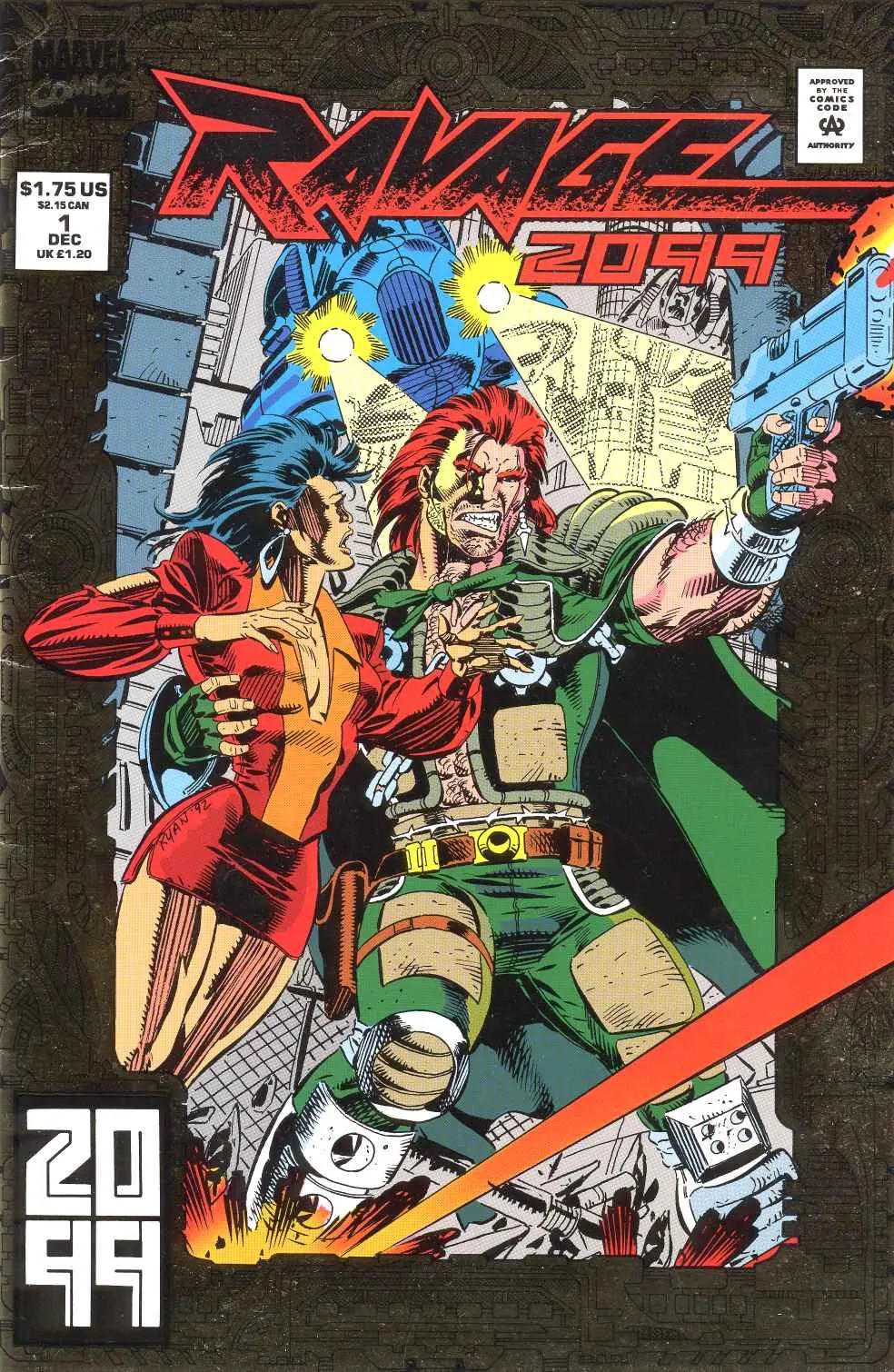
Ravage 2099 #1
☆ Be the first to review + Add to your collection — Join freeRavage 2099 #1 holds a singular place in the Marvel 2099 launch because Paul-Phillip Ravage was the only wholly original superhero among the imprint's founding four titles — while Spider-Man, Doom, and Punisher 2099 were all futuristic reinventions of pre-existing characters, Ravage was built from scratch, making this issue the sole debut of a brand-new Marvel hero in that foundational wave. The book also marks Stan Lee's return to scripting an ongoing monthly series, something he had stepped back from decades earlier, and his decision to wrap environmental corruption and anti-corporate satire into a distant-future superhero framework gave the 2099 line its most politically pointed title at launch. Ravage #1 simultaneously introduced the corporate mega-villain Alchemax — the dystopian conglomerate that would become the connective tissue of the entire Earth-928 universe across multiple series — alongside supporting cast members Dack and Tiana Sikoski, whose first appearances are catalogued here. As the anchor of Marvel's deliberate, staggered 2099 rollout strategy, this issue represents both the commercial ambition and the creative risk-taking that defined one of Marvel's most distinctive 1990s imprint experiments.
ComicBooks.com Value
Show all 11 grades ▾
This exact issue on ebay
CGC 9.8 ▾ $59–$99.99 4 listings
CGC 9.6 ▾ $74.95–$400 2 listings
CGC 9.4 ▾ $48.99–$125 2 listings
Raw — NM ▾ $2–$99.99 11 listings
Raw — VF/NM ▾ $1–$5.98 6 listings
Raw / ungraded ▾ $1–$300 48 listings
More listings for this title
Read it digitally
Sell my copy
Have this issue — or a whole collection? Get a fair offer from us, skip the marketplace fees and the hassle.
We Buy Collections ▸History
The Marvel 2099 line was originally conceived by Stan Lee and announced in his 'Stan's Soapbox' column as a single title called 'The Marvel World of Tomorrow,' developed in partnership with John Byrne before evolving into a full imprint under editor Joey Cavalieri, who favored a gradual character rollout to avoid the stumbles of the earlier New Universe initiative. Ravage itself had a turbulent pre-publication history: John Byrne was initially attached as artist but departed due to creative differences, and Tom DeFalco subsequently arranged for Steve Ditko — Lee's Spider-Man co-creator — to meet with Lee about the penciling role, a reunion that reportedly went warmly but ended with Ditko declining over philosophical disagreements with the series' premise. Paul Ryan then stepped in after DeFalco contacted him, and Ryan developed the character's look through multiple rejected design passes before calling Lee directly; the two hashed out the final design over a phone call, with Ryan sketching in real time as Lee described his vision, then faxing the results for approval. Lee scripted the series himself through issue #7, plotted issue #8 alongside Pat Mills and Tony Skinner, and then handed the book off entirely — making his run on Ravage his most sustained original scripting effort in the Marvel monthly format in many years.
Trivia · 8 facts
- First appearance of Paul-Phillip Ravage (Earth-928), the only completely original superhero character among the four titles that launched the Marvel 2099 imprint in 1992.
- First appearances of supporting cast Tiana Sikoski and Dack, as well as villains Anderthorp Henton and Dethstryk, and the debut of Eco Central and the Mutroids as concepts within Earth-928.
- Written by Stan Lee and penciled by Paul Ryan, with inks by Keith Williams (and assists by Steve Alexandrov); edited by Joey Cavalieri under editor-in-chief Tom DeFalco.
- Released with an on-sale date of October 13, 1992, and a cover date of December 1992; the series ran for 33 issues, concluding with a cover date of August 1995.
- The issue exists in three editions: a direct-edition with a gold foil-stamped card-stock cover by Paul Ryan, a newsstand edition, and an Australian edition.
- The issue includes preview illustrations of forthcoming Marvel 2099 titles, serving as a promotional showcase for the broader imprint at launch.
- Lee deliberately structured Ravage's origin so the protagonist does not gain superpowers until the end of issue #4, an unusually slow build for a superhero debut that Lee described as a conscious creative choice.
- Ravage 2099 #15 was later reprinted in two collected formats: the Spider-Man 2099 Classic Vol. 3 trade paperback (2015) and the X-Men 2099 Omnibus (2024), both tied to the 'Fall of the Hammer' crossover — the only issues of the series to receive physical collected reprints as of available records.
Full credits
Reprints
Reprinted in 2099 #1 (1993), 2099 Special #0 (1994)
Key issues in Ravage 2099
Variants (2)
Reviews
Reader reviews
No reader reviews yet.