
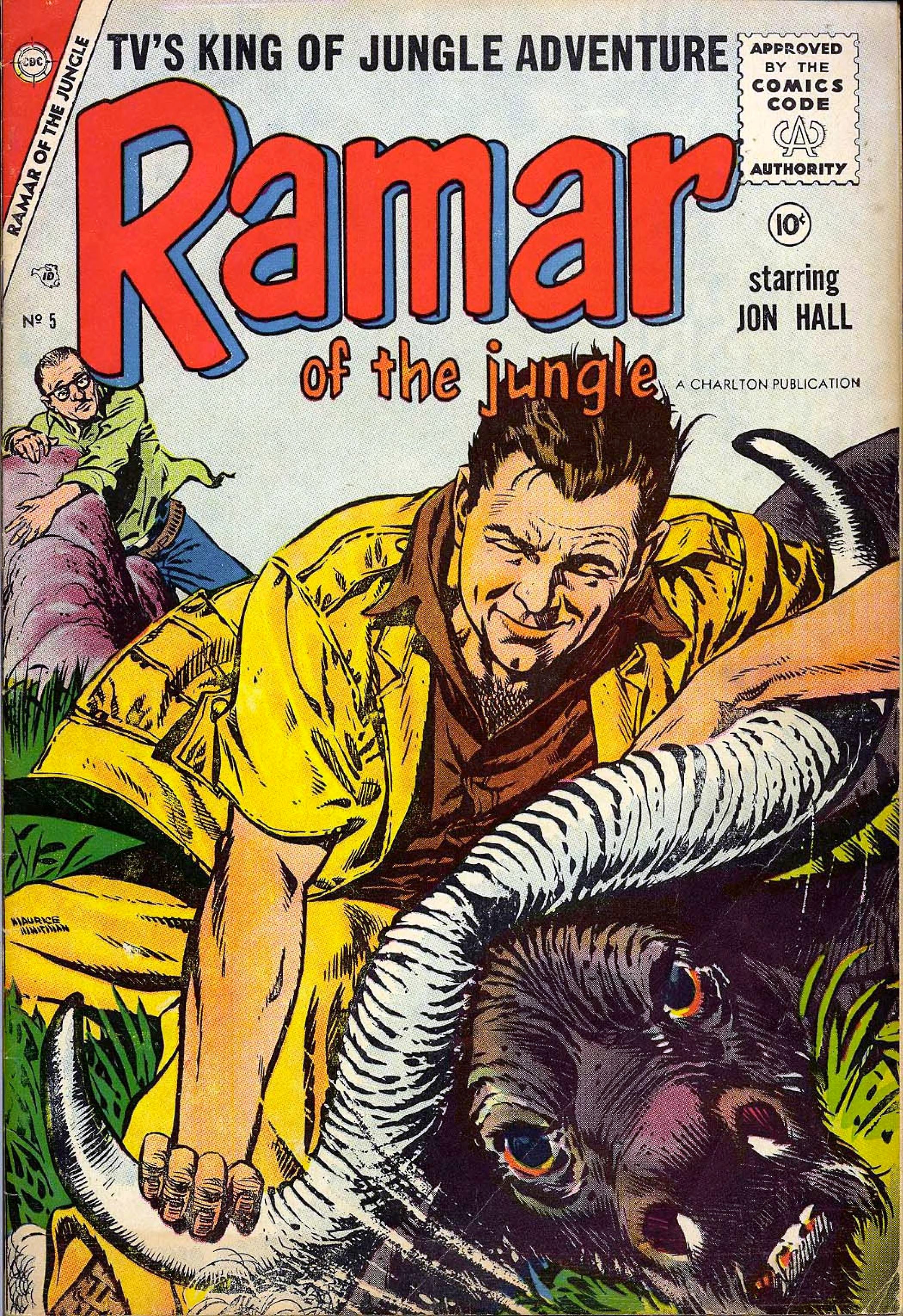
Ramar of the Jungle #5
☆ Be the first to review + Add to your collection — Join free# Ramar of the Jungle #5 This issue contains two stories. In the main "Ramar of the Jungle" story, Dr. Ramar leaves a disconcerted reception and makes his way to a diamond mine, where he encounters a booby trap at the entrance. After narrowly surviving, Ramar reports to a commissioner that some natives have apparently been hoodwinked into joining a terrorist society led by a phony "Fire Dragon," a situation he considers serious enough to warrant his immediate return to the jungle to investigate. In the backup story "The Jungle People," readers learn about various African animals, including the rhinoceros (described as an aggressive and dangerous creature), the warthog (noted for its backward but dangerous charge and curved tusks), and comparisons to elephants and other wildlife.
Ramar of the Jungle races to solve the mystery of the "little dancing people" when a white hunter arrives at camp fevered and terrified after encountering a bizarre troupe performing a grotesque ritual in the jungle. As Ramar and his companion Charlie track the hunter's trail into the Makingu District, they uncover a sinister plot that threatens the peaceful Masai tribe. It's a tale of jungle deception that will test Ramar's wits against both supernatural-seeming mystery and very real danger.
Dr. Tom Reynolds, known to the natives as Ramar the white witch doctor, arrives at the Kawanda diamond mine to conduct routine insurance examinations—but a sabotaged booby trap at the entrance and the mine superintendent's hostile reception suggest something far more sinister is afoot. When Ramar discovers the superintendent's strange fear of fire, he uses it to expose a scheme of exploitation and theft that's been preying on the exhausted workers. A clever bit of jungle medicine unmasks the corruption lurking beneath the mine's operations.
When Ramar's companion Charlie is ambushed by masked natives in the jungle, the doctor discovers a hidden temple where a terrorist society called the Fire Dragon has been using ancient rituals and superstition to control the local population. Racing against time to stop the conspiracy before it destabilizes the entire district, Ramar infiltrates the temple to confront the mysterious leader behind the scheme.
This 1956 installment of "It's a Fact That..." presents a trio of remarkable natural wonders: giant clams in tropical seas that can trap unwary divers, a cormorant bird trained by Asian fishermen to dive and catch fish—kept honest by a clever neck ring that prevents it from swallowing its catch—and the elephant's trunk, an organ of astounding strength and delicate precision despite containing 40,000 muscles. A short, fact-focused exploration of nature's engineering marvels, each stranger than fiction.
Raised by an African tribe since childhood after her parents' murder, Mary Morton has waited eight years for the killer to return—and when ivory trader George Cooper arrives, she's certain he's the man she's been seeking. As Mary grapples with her vow of vengeance and an unexpected love for her prisoner, she faces a harrowing choice when a man-eating lion threatens them both during a hunt. This tale of mistaken identity and second chances unfolds in the jungle depths, where Mary must confront what revenge really costs.
Doctor Tom Reynolds, known throughout the jungle as Ramar, finds himself and his companions under siege when the ruthless Abe Nason and his men barricade his home, demanding gold that Chief Manawa entrusted to him in confidence. With escape impossible and Nason's grip tightening, Ramar must rely on his deep understanding of the jungle and the bonds he's forged with its people to break free from the trap closing in around him.
This non-fiction feature introduces readers to the Ituri, the pygmy peoples of Central Africa's equatorial jungles, exploring their remarkable hunting prowess with bow, arrow, spear, and blowgun—weapons often laced with potent herbal poisons. Living deep in the jungle and famously reserved around outsiders, these skilled hunters maintain peaceful relations with neighboring African tribes despite their reputation for shyness and wariness of outsiders. A fascinating glimpse into one of Africa's least-known indigenous peoples.
ComicBooks.com Value
Find on ebay
Read it digitally
Sell my copy
Have this issue — or a whole collection? Get a fair offer from us, skip the marketplace fees and the hassle.
We Buy Collections ▸Full credits
Reprints
Reprinted in Ramar of the Jungle #4 (1959), Jungle Tales of Tarzan #3 (1965), Un Faux Livre #2 (2018)
Reviews
Reader reviews
No reader reviews yet.