
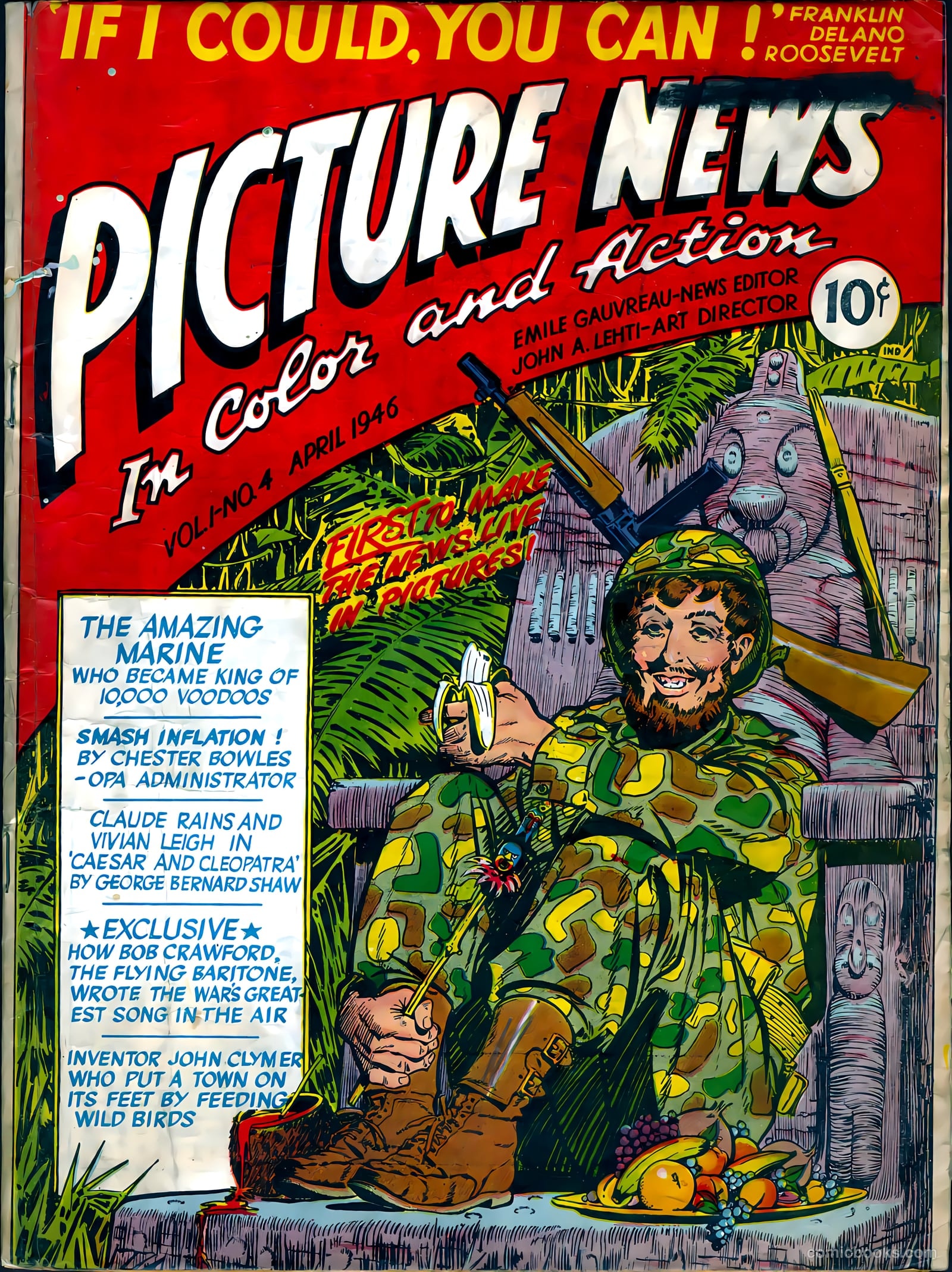
Picture News #4
☆ Be the first to review + Add to your collection — Join freePicture News #4 is an anthology publication combining news-oriented educational comics with fiction stories. Featured stories include "Smash Inflation! by Chester Bowles, OPA Administrator," which warns about the dangers of post-war price inflation and its potential to devastate the American economy; "Claude Rains and Vivian Leigh in 'Caesar and Cleopatra' by George Bernard Shaw," a dramatic adaptation depicting political intrigue in ancient Egypt; and "The Amazing Marine Who Became King of 10,000 Voodoos," along with features on inventor John Clymer and Bob Crawford's wartime songwriting. The issue also includes lighter entertainment content such as a college contest determining the ten most beautiful words in English.
Franklin Delano Roosevelt recounts his personal battle with infantile paralysis in this inspiring biographical account, sharing how he refused to surrender to disability despite losing his former freedom to move and pursue the active life he'd known. Drawing strength from the example of other remarkable figures who achieved greatness despite their own handicaps, Roosevelt's message to the wounded veterans returning from World War II becomes a testament to the power of determination and inner victory. "If I Could — You Can!" presents his own hard-won triumph as proof that physical limitations need not define a person's reach or accomplishments.
When a Mitchell bomber crashes into the Empire State Building on a foggy July morning in 1945, elevator operator Betty Lou Oliver is caught in the disaster—her car plummets 70 stories, leaving her with a fractured spine, broken bones, and severe burns. Trapped in the wreckage and facing months of grueling recovery at Bellevue Hospital, Betty Lou refuses to surrender to her injuries, driven by determination and the support of her husband, a Navy torpedoman on emergency leave from the Pacific. This is the true story of one woman's remarkable struggle to reclaim her life after one of New York's most catastrophic accidents.
In this urgent 1946 educational piece, Chester Bowles of the OPA lays out the dangers facing postwar America: runaway inflation threatens to repeat the economic devastation that followed World War I, when unchecked prices devastated families and triggered the crash of 1920. Through vivid snapshots of that earlier catastrophe—families unable to afford rent, shoes, or groceries; hundreds of thousands of businesses collapsing; millions losing their jobs—Bowles argues that price controls remain essential to protecting working Americans and preventing another depression. The story calls on citizens to support the OPA's efforts and take simple steps to keep inflation at bay.
Captain Robert Crawford, Alaska-born pilot and golden-voiced composer, juggled two passions—flying and music—before World War II gave him the chance to combine them. Drafted into the Army Air Transport Command to deliver bombers to far-flung fronts, Crawford composed "The Army Air Corps," which became the official service tune, and continued writing stirring songs for homesick servicemen across the globe. His wartime contributions earned him promotion to Major and consideration for the Legion of Merit, proving that courage and creativity fly on the same wings.
When inventor John Clymer stumbles upon an idea for handmade bird feeders in a magazine article, he and his wife craft their first prototype in the garage—and discover they've tapped into something special. Word spreads quickly, orders multiply, and what began as a personal passion soon transforms into a thriving business that puts the whole town of Point Pleasant, Pennsylvania to work. This 1946 true story celebrates how one man's love of nature and honest dealings turned a financial struggle into a thriving enterprise built on trust and integrity.
Four Army chaplains—Lt. Clarke V. Poling, Lt. George L. Fox, Lt. John P. Washington, and Lt. Alexander D. Goode—demonstrate extraordinary faith and sacrifice when their troopship, the Dorchester, is torpedoed in the North Atlantic, insisting that G.I.s take the life belts while guided by their shared belief in one God. This 1946 account honors their courage and the enduring legacy they left behind.
When Julius Caesar invades Egypt and encounters the young Queen Cleopatra by the Sphinx, he sets her on the throne—but their alliance grows complicated as his duties as a general consume him. Cleopatra's ambitions and Caesar's pragmatic mercy clash with the schemes of Egyptian leaders who want him gone, leading to a deed that tests Caesar's tolerance and threatens both their fates. This Picture News adaptation brings George Bernard Shaw's famous story to life through the drama of power, loyalty, and the cost of empire.
Tom Breneman, a Pennsylvania-born entertainer, trades his early vaudeville and singing ambitions for a chance at radio after moving to Los Angeles in 1930—and a chance conversation with an idea man at a Hollywood restaurant sparks the concept that would change his career. What begins as "Breakfast at Sardis" becomes a hugely popular daytime radio variety show broadcast from Breneman's own restaurant, where he entertains millions of housewives across the country with unrehearsed guests and good-natured humor. Now heard on over 160 coast-to-coast stations, Breneman has become America's favorite breakfast companion—proof that sometimes the best shows come with a side of eggs and coffee.
When a Flying Fortress pilot's faithful dog Thunderbolt waited two years for his missing master, he nearly gave up hope—until a determined effort by military officials and loved ones made an ocean crossing possible. This true story follows the devoted mascot's journey from an English airbase through his master's capture and imprisonment, to a long-awaited reunion with the pilot's wife in New York. Thunderbolt's unwavering loyalty proves that some bonds survive even war's cruelest separations.
Hildegarde, the glamorous NBC Raleigh Room hostess, shares her essential beauty philosophy for teenagers in this practical fashion guide. She emphasizes that true sophistication means dressing appropriately for the occasion—relaxed for informal settings, romantic (never eccentric) for formal ones—and keeping makeup and hairstyles soft and face-framing to enhance natural youthful charm. Her key advice: match your look to the moment, and let subtlety, not extremes, be your signature.
A pictorial review of Andrew Roth's "Dilemma in Japan," this three-page story traces how Japan's ruling clans and business elite shaped the nation from the 1868 Meiji Restoration through World War II, examining their claims of powerlessness against the military fanatics who drove the war machine. Roth argues that these so-called "moderates"—the zaibatsu businessmen and nobles—worked hand-in-hand with the military to control the population through state religion, suppression of dissent, and imperial propaganda, leaving impoverished peasants vulnerable to promises of conquest. The piece cuts through the post-war excuses of Japan's leadership to reveal a deeper complicity in the nation's path to aggression.
Cartoonist Milt Gross takes a satirical look at the absurd news stories of the day in this three-page humor piece, from a duck-raised chick causing neighborhood chaos to an Alcatraz prisoner with a paratroop-induced phobia. Each vignette—whether it's a baby-faced criminal, a subway beautification scheme gone hilariously wrong, or a college contest to find the most beautiful words in English—skewers the earnest reporting of postwar America with Gross's characteristic irreverent wit. It's a rapid-fire romp through the ridiculous headlines that had people shaking their heads in 1946.
"People's College" offers a visual tour of our solar system and beyond, explaining how planets orbit the sun, how comets and meteors behave, and revealing that our galaxy is just one of countless others scattered across the cosmos. This 1946 educational feature breaks down the essential facts of astronomy—from the comparative sizes of the planets to the nature of starlight—in clear, accessible diagrams and captions designed to expand your understanding of the known universe.
Al Jennings, America's notorious train robber, recounts his flight to Latin America with his brother and their dramatic encounter with a Spanish Don—an incident that would unexpectedly bind him to O. Henry, destined to become one of the nation's greatest short story writers. After their capture and imprisonment, Jennings finds himself reunited with his former acquaintance behind bars, where both men confront the consequences of their pasts in ways neither could have predicted.
Jackie Robinson, baseball's first Negro player signed by organized baseball, rises from a childhood in Pasadena through college stardom and military service to become the center of a historic moment when Branch Rickey signs him to the Brooklyn Dodgers organization in 1945. This non-fiction account, written by sports authority Charles Wessell, traces the athlete's remarkable journey and the mixed but ultimately hopeful reaction from the sporting world to his groundbreaking entry into professional baseball.
ComicBooks.com Value
Show all 11 grades ▾
Find on ebay
Read it digitally
Sell my copy
Have this issue — or a whole collection? Get a fair offer from us, skip the marketplace fees and the hassle.
We Buy Collections ▸Full credits
Reprints
Reprinted in The Complete Milt Gross Comic Books and Life Story #[nn] (2010)
Key issues in Picture News
Reviews
Reader reviews
No reader reviews yet.