
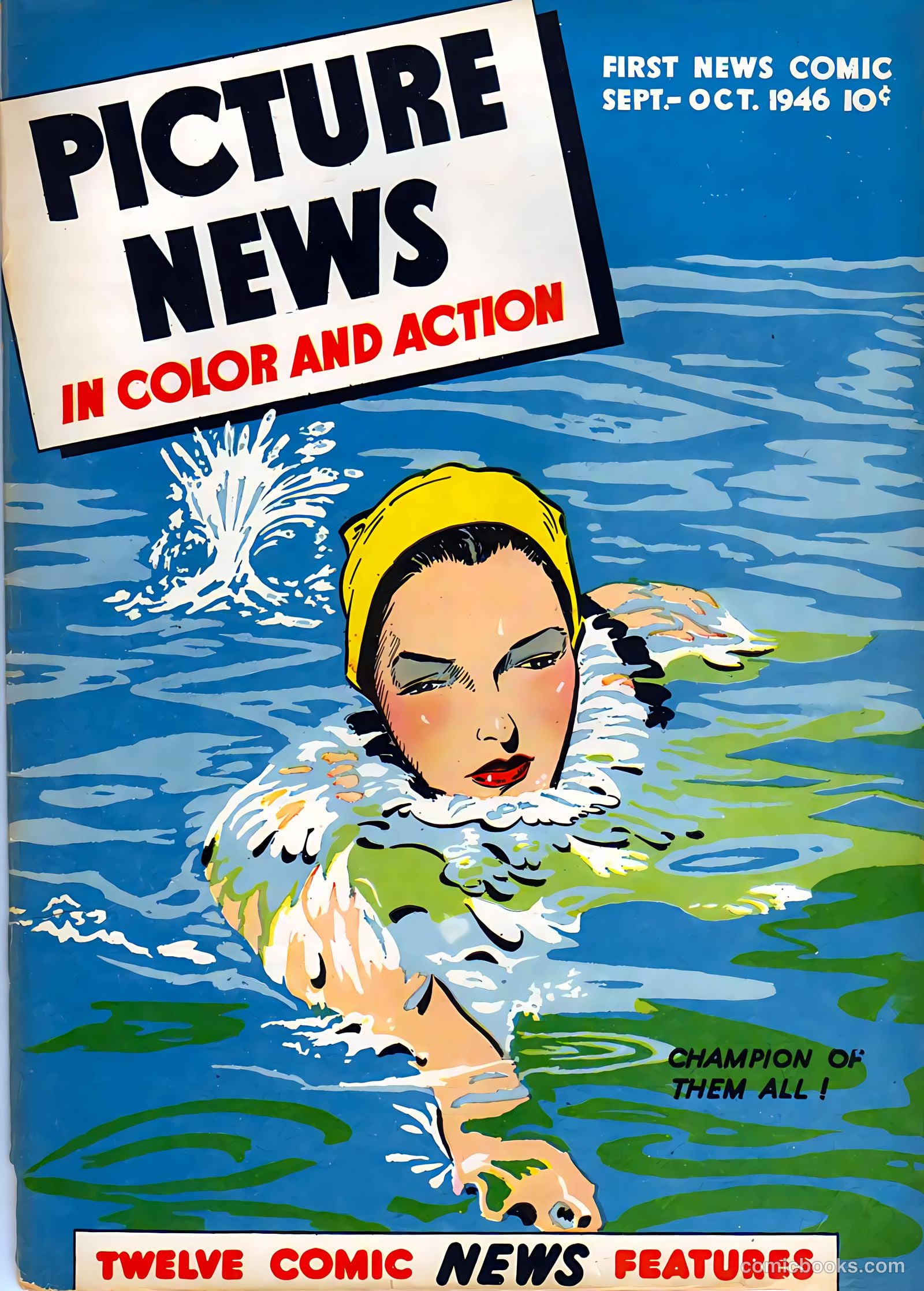
Picture News #8
☆ Be the first to review + Add to your collection — Join freePicture News #8 is a notable artifact of the immediate postwar Golden Age moment when publisher Leigh Danenberg and his team attempted something genuinely experimental: a full comic-book format devoted entirely to illustrated non-fiction, blending the visual grammar of sequential art with the editorial instincts of journalism. Its July 1946 cover date places it squarely in the anxious atmosphere of early de-Nazification, and the issue's frank examination of the persistence of Nazi ideology after Hitler's death — rendered in comic-strip form for a mass audience — represents an unusually direct engagement with political reality for a medium that was still largely associated with superheroes and fantasy. As one of only ten issues in a short-lived series, it stands as an early, under-appreciated proof-of-concept for comics journalism, predating by decades the form's later literary recognition.
Picture News #8 is an anthology comic featuring educational and action-oriented stories presented in color. The visible stories include a Western tale in which Monte Hale protects Bonnie Garth and her uncle's ranch from a man trying to prevent them from shooting grizzly bears that threaten their cattle, culminating in a fight that teaches respect for the U.S. Forestry Service; an informational story about bee hives and honey production, explaining the structure of modern hives and the life cycle of bees; and a historical narrative about Jesse James's early criminal career, depicting his involvement in robbing poor farmers and redistributing stolen money to help victims of railroad land seizures and tax disputes.
A young girl's picnic outing takes a terrifying turn when her sister gets trapped on a railroad trestle just as a train rounds the bend, forcing her to make a split-second choice between safety and saving her sibling. This is the true account of Constance Ayres of Peoria, Illinois—a real-life moment of courage that earned her Picture News' first-place prize in their readers' life experience contest.
Pete Gray defied the odds after losing his right arm in a childhood accident, refusing to let doctors' doubts stop him from pursuing his dream of playing professional baseball. Through years of rejection and relentless practice—developing a revolutionary technique to catch, juggle, and throw with one arm—he earned his shot with the Memphis team and eventually signed with the St. Louis Browns, becoming a living inspiration to wounded soldiers everywhere. This is the remarkable true story of how determination and an unshakeable belief in himself transformed a one-armed kid into a big league ballplayer.
Monte Hale, a Forestry Service agent, arrives at the Grizzly Garth Ranch to investigate reports of bears killing cattle—only to find himself caught between Garth's commitment to preserving wild game and his niece Bonnie's determination to protect her livestock. When a scheming drifter named Dan Long secretly orchestrates a deadly frame-up to turn the ranchers against Garth and seize the land, Monte must expose the truth before a mob of angry cattlemen destroys the preserve. A tense showdown reveals who's really responsible for the slaughter, and Monte fights to set things right.
Ann Curtis rises from washing dishes in her mother's San Francisco boarding house to become one of swimming's brightest young talents—but after two years of racing without breaking records, self-doubt nearly ends her dreams. With the help of coach Charley Sava and a grueling six-month training regimen, Ann must overcome both her weight disadvantage and her deepest fear of failure to claim her place among the sport's elite.
A carpenter in Tinicum, Pennsylvania named Herman Lerch discovered a practical path to steady income when he took over a friend's struggling bee operation in 1923—and found that the honey his colonies produced could sell for top dollar while bringing health benefits to his neighbors. This Picture News feature walks you through the fundamentals of bee-keeping, from the three types of bees that make up a thriving colony to the remarkable mechanics of how these insects gather nectar, produce honey, and keep themselves organized. Whether you're looking for a side hustle or just curious how a working beekeeper actually runs his operation, Lerch's real-world example shows why an intelligent young person can genuinely profit from keeping bees at home.
Margaret O'Brien, the nine-year-old MGM sensation earning $3,000 a week, has captivated Hollywood and audiences alike with her natural talent and professionalism on set. Picture News follows her rise from a determined young performer to a star in her own right, showcasing her work in films like *Journey for Margaret* and *Meet Me in St. Louis*, and tracing how she's won over everyone from seasoned actors to devoted fans. Beyond the cameras, we meet the real Margaret—a girl who loves drawing and skipping rope, whose charm and instinctive understanding of her craft have made her one of the most talked-about child performers in cinema.
A series of humorous news vignettes offers quick laughs across Portland, Brooklyn, San Pedro, and beyond—from a tuna mishap to a case of mistaken identity, a canine champion's triumph, and a barefoot boy's unexpected comeuppance. These bite-sized gags capture the absurd moments that might've made the papers in 1946 if anyone were paying attention to the funny side of the news.
Driven from home after the Civil War and branded an outlaw by authorities despite his innocence, Jesse James turns to robbery with a purpose—stealing back mortgage money to save a widow's farm, then using his ill-gotten gains to help poor farmers cheated out of their land by railroads. This 1946 account presents the outlaw's early exploits as acts of justice against the merciless forces grinding down Missouri's common folk, beginning a career that would define his legend.
This 1946 pictorial review warns that Germany's dangerous ideology didn't die with Hitler—tracing a pattern of militaristic conquest from Bismarck through Kaiser Wilhelm to Hitler and the German people, the story argues that the threat of fascism persists both in former Nazi operatives hiding within Germany and in extremists spreading propaganda within America itself. Drawing lessons from a Warner featurette, it calls for vigilance against those who would exploit disillusionment to install a new authoritarian leader, while highlighting the United Nations' emerging efforts to prevent future wars through international cooperation and shared security.
War correspondent Dick Holt witnesses firsthand how electronics and radar technology save lives in the Pacific theater, from locating a downed pilot to guiding naval gunfire during enemy attack. Back home after the war, Holt becomes fascinated with the science behind these innovations and pursues formal study in electronics, even as he discovers how the technology promises to transform everyday peacetime life—from television broadcasts to kitchen appliances. This story, part of the "Exploring the Unknown" radio program, traces how a soldier's wartime experience sparks a lifelong passion for applied science and its boundless future applications.
ComicBooks.com Value
Find on ebay
Read it digitally
Sell my copy
Have this issue — or a whole collection? Get a fair offer from us, skip the marketplace fees and the hassle.
We Buy Collections ▸History
Picture News was conceived by Leigh Danenberg, publisher of the Bridgeport (Connecticut) Sunday Herald, who partnered with veteran journalist Emile Gauvreau as executive editor to present real-world news events in comic-strip technique — with illustrated panels and word balloons — a format described in a 1946 issue of Editor & Publisher. The series launched in January 1946, printed by the Lafayette Color Press in Bridgeport, with comic-book veteran Jack Lehti (John A. Lehti) serving as art director; Lehti was already well-known in the industry for co-creating the Crimson Avenger in the 1930s. By issue #8, the editorial credits listed Leigh Danenberg as editor, John Milligan as assistant art director, and Lehti still in the art director role, with individual story art contributed by Nat Edson, Harry Anderson, and others identified via the Jim Vadeboncoeur Jr. index.
Trivia · 8 facts
- Published bi-monthly by Lafayette Street Corporation (indicia publisher: News in Color and Action Inc.); on-sale date of July 10, 1946, confirmed by the U.S. Copyright Office's 1946–1947 Periodicals records.
- 52-page issue with a 10-cent cover price, consistent with the standard Golden Age comic-book format.
- Editorial staff for this issue: editor Leigh Danenberg, art director Jack Lehti (John A. Lehti), and assistant art director John Milligan.
- Contains a comic-illustrated biography of one-armed Major League Baseball outfielder Pete Gray, whose 1945 season with the St. Louis Browns made him a prominent human-interest figure in the immediate postwar period.
- Features a multi-part biography of Jesse James and his brother Frank — depicting the origins of their criminal careers — with the story explicitly continued in issue #9.
- Includes an editorial piece examining how Nazi ideology persisted in the world after Hitler's death, a topical and politically pointed subject for a July 1946 publication.
- Contains a biography of child actress Margaret O'Brien, then at the peak of her Hollywood fame following films like 'Meet Me in St. Louis' (1944).
- Includes an adaptation of a true Navy electronics story originally dramatized on the radio program 'Exploring the Unknown,' illustrating the series' cross-media editorial approach.
Full credits
Reviews
Reader reviews
No reader reviews yet.