
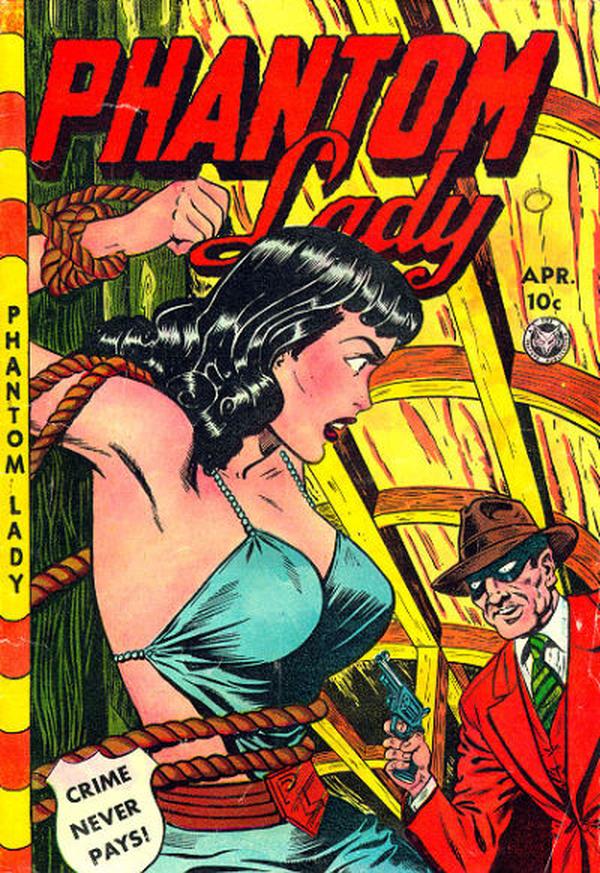
Phantom Lady #23
☆ Be the first to review + Add to your collection — Join freePhantom Lady #23 (April 1949) holds a specific place in Golden Age history as the final issue of Fox Feature Syndicate's eleven-issue run starring Sandra Knight — the last chapter of the most culturally charged incarnation of one of comics' earliest female superheroes. The Fox series, defined almost entirely by Matt Baker's draftsmanship, became the definitive example of 'good girl art,' a visual style so provocative that Dr. Fredric Wertham cited the run extensively in his 1954 polemic Seduction of the Innocent, directly fueling the Congressional hearings that produced the Comics Code Authority. By closing the Fox run, issue #23 marks the end of the pre-Code era for this character, after which the title itself transformed into a romance comic — a shift that encapsulates the broader industry pivot away from superhero content in the late 1940s. The issue's interior art credited to both Matt Baker and Jack Kamen, along with a bondage-themed cover, exemplifies the full-throttle aesthetic that made the Fox Phantom Lady a flashpoint in debates over comics' cultural influence.
In "The Indian Tiger Murders...", the Phantom Lady, presumed dead after a crash into the harbor, becomes the unlikely star of a ghostly hoax. When the Grin enlists fake mediums to send coded messages from beyond, the hero returns to expose the deception. Written by Ruth Roche and illustrated with sharp, expressive flair by Jack Kamen, this 1949 Fox comic delivers a classic mystery with a supernatural twist—no grave, no ghosts, just a clever sleuth and a cover by Kamen that captures the tension perfectly.
In "The Adventure of the Jade Maiden," Jo takes on a dangerous assignment guarding a priceless Manchu Dynasty jade figurine at Griben & Gray Jewelers, only to find himself caught in a web of deception. When the theft is orchestrated to frame him, Phantom Lady swoops in to unravel the scheme before the real criminals vanish.
In "The Saturnalia of Sin!", the Phantom Lady, presumed dead after a crash into the harbor, becomes the unlikely star of a ghostly hoax. The Grin enlists fake mediums to send eerie messages from beyond, manipulating the police and the public. When the real Phantom Lady returns to expose the ruse, she’s forced to untangle a web of deception that’s already spun too far.
In "The True Story of Walt Stevens," a man haunted by paranoia hires a private detective after believing his wife and chauffeur conspired to end his life. As suspicion turns to dread, the investigation reveals a chilling twist—just as the truth emerges, the guilty parties begin to unravel each other.
ComicBooks.com Value
Show all 20 grades ▾
Find on ebay
- JAF Comics · Bethlehem, PA3 on eBay ↗
- CollegeComix.com · Athens, GA2 on eBay ↗
- The Time Capsule · Seekonk, MA2 on eBay ↗
Read it digitally
Sell my copy
Have this issue — or a whole collection? Get a fair offer from us, skip the marketplace fees and the hassle.
We Buy Collections ▸History
Phantom Lady originated at the Eisner & Iger Studio — the prominent Golden Age packaging shop co-founded by Will Eisner and Jerry Iger — for Quality Comics' Police Comics #1 (August 1941), where artist Arthur Peddy first depicted Sandra Knight, daughter of Senator Henry Knight, using a black-light projector to fight crime. After Quality's run ended with Police Comics #23 (October 1943), the now-solo Iger Studio reassigned the feature to Victor Fox's Fox Feature Syndicate, where Matt Baker redesigned the character's costume into its red-and-blue, far more revealing configuration — a version generally but not definitively credited to writer Ruth Roche working under the pseudonym 'Gregory Page.' The Fox title itself inherited a mid-run issue number (#13) from a canceled humor comic, Wotalife Comics, and ran uninterrupted through issue #23, after which the masthead was immediately converted to My Love Secret — reflecting both Fox's declining superhero line and the industry's rapid embrace of romance comics by 1949.
Trivia · 8 facts
- Cover date: April 1949; published by Fox Feature Syndicate under executive editor Victor A. Fox.
- Final issue of the Fox Phantom Lady series (issues #13–#23, 1947–1949); the title continued as My Love Secret with the very next issue.
- Interior art by Matt Baker and Jack Kamen — Baker having been the defining artist of the entire Fox run; the cover is a bondage-themed 'good girl art' composition.
- The lead story is titled 'The Indian Tiger Mystery'; a backup feature in the issue concerns H.H. Holmes, America's first widely recognized serial killer, showing the Fox title's drift toward true-crime content alongside its superhero lead.
- Sandra Knight (Phantom Lady) is the sole superhero character featured, using her signature Black-Light Ray as throughout the Fox run.
- The Fox Phantom Lady run as a whole — with #23 as its final entry — was directly cited in Fredric Wertham's 1954 Seduction of the Innocent and helped precipitate the creation of the Comics Code Authority.
- Stories from the Fox run, including material from issue #23, were later reprinted in black-and-white in Ajax-Farrell's second Phantom Lady series (The Phantom Lady #2, 1955), and the Fox stories have also appeared in various public-domain reprint collections.
- Matt Baker, the artist most associated with this run, was one of the first known African-American artists to achieve mainstream success in the comic-book industry and was posthumously inducted into the Will Eisner Comic Book Hall of Fame in 2009.
Cast · 3 characters
Full credits
Reprints
Reprinted in Martin Kane, Private Eye #2 (1950), Great Action Comics #9 (1958), The Phantom Lady #2 (1979), Golden-Age Greats Spotlight #1 (2003), Golden Titans #2 (2009), Roy Thomas Presents Classic Phantom Lady Softee #2 (2013), Phantom Lady #11
Reviews
Reader reviews
No reader reviews yet.