
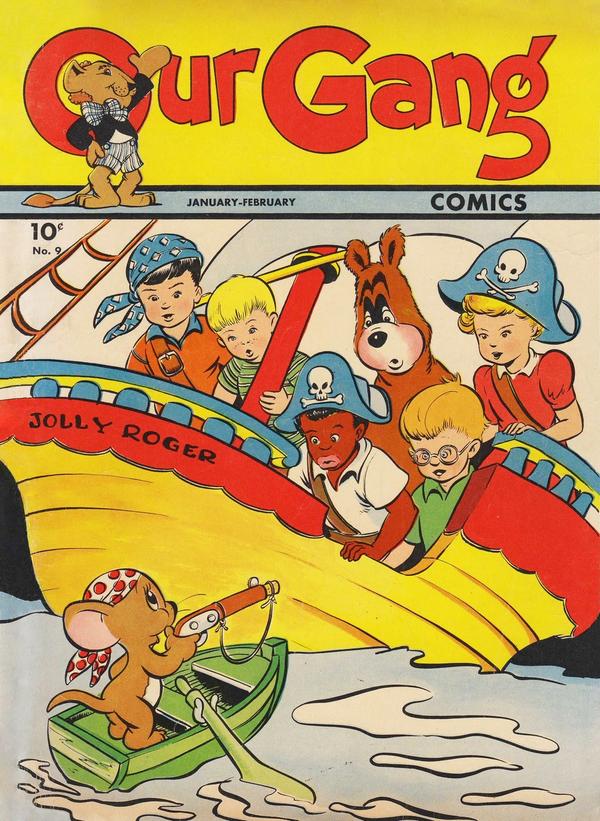
Our Gang Comics #9
☆ Be the first to review + Add to your collection — Join freeOur Gang Comics #9 (January–February 1944, Dell) holds a firm place in Golden Age history as the comic-book debut of Happy Hound — the character the world would come to know as Droopy — written and drawn by Carl Barks in his first-ever Happy Hound story, months before Barks even knew the dog had a name in MGM's animation department. The issue is equally notable as a snapshot of Dell's extraordinary editorial experiment: a single bi-monthly anthology where three titans of mid-century American cartooning — Walt Kelly, Carl Barks, and John Stanley — contributed stories simultaneously, making it a remarkable convergence of talent in one package. Because the MGM film series was winding down at precisely this moment (its final shorts released in spring 1944), the comic was already beginning its transition from licensed tie-in to a creative enterprise that would outlive the films by five years, driven almost entirely by the cartoonists' own inventiveness.
In "Mamma Mouse," a 1944 Dell gem, Carl Barks crafts a lighthearted yet tense chase as Happy’s quiet day fishing is upended by a prison escapee. The story unfolds with playful misdirection and clever timing, as Happy keeps running into the crook despite his best efforts to stay out of trouble. With Barks handling every aspect of the interior art and lettering, and Walt Kelly’s sharp, expressive cover capturing the chaos, this issue stands as a classic early example of Barks’ storytelling flair.
In "The Escaped Prisoner," Happy’s quiet fishing day takes a turn when a clever crook slips out of Alca-Sing Prison on his day off. No matter how hard Happy tries to avoid trouble, the fugitive keeps showing up in the most inconvenient places—just as he’s about to cast his line, or when he’s finally settled by the lake.
In "The Mountain Goat," Benny finds himself in a remote mountain landscape, where a playful game of follow-the-leader with a curious little mountain goat takes a sudden turn when a sneeze triggers a snow slide—sending them both tumbling into the unexpected shadow of a wolf’s cave.
ComicBooks.com Value
Show all 19 grades ▾
Find on ebay
Read it digitally
Sell my copy
Have this issue — or a whole collection? Get a fair offer from us, skip the marketplace fees and the hassle.
We Buy Collections ▸History
Dell's Our Gang Comics was launched in 1942 under the editorship of Oskar Lebeck after MGM licensed the franchise to the publisher, pairing the child characters of the Little Rascals films with MGM's stable of animated stars — Tom and Jerry, Barney Bear, and others. By the time issue #9 went to press, Barks had already contributed a Benny Burro story to issue #8 and was immediately asked back; according to Barks's own recollection in a 1968 interview, the editorial office sent him a model sheet for 'a nameless dog' alongside the assignment for issue #9, and he christened the character Happy Hound himself, only discovering the dog was MGM's Droopy after seeing a theatrical short later. The Our Gang lead stories were steered by Walt Kelly, who had arrived in comic books after leaving Walt Disney Studios in 1941 following a labor dispute, and the title served as one of his primary creative outlets throughout the decade alongside his concurrent work on Animal Comics.
Trivia · 8 facts
- Published January–February 1944 by Dell Publishing Co., 56 pages, full color — one of the larger page counts in the run before wartime paper restrictions reduced the format.
- Contains the first comic-book appearance of Happy Hound (Droopy), written and drawn by Carl Barks; Barks named the character himself from an MGM model sheet and was unaware of the character's existing cartoon identity until after publication.
- The Happy Hound story pits the perpetually serene detective against a wolf prisoner — the same wolf antagonist who appeared as Droopy's opponent in multiple Tex Avery MGM cartoon shorts.
- Walt Kelly wrote and drew the lead Our Gang story, featuring the characters Janet, Froggy, Happy, Mickey, and Buckwheat in an adventure involving a movie crew and a villain called Deadlight Dan; the script's authorship carries some scholarly uncertainty and may have been Kelly's or another hand's.
- John Stanley (future Little Lulu writer-artist) contributed the Tom and Jerry segment, titled 'Mamma Mouse,' crediting both pencils and letters to Stanley per Frank M. Young's 2012 bibliography.
- The issue also features standalone backup stories for Barney Bear, Benny Burro, Major, and Flip 'n' Dip, reflecting Dell's anthology strategy of bundling multiple MGM-licensed properties into one package.
- The Our Gang lead story from this issue was reprinted in Fantagraphics' Walt Kelly's Our Gang Vol. 2 (2007), which collected material spanning 1944–1945.
- Issue #9 is the immediate precursor to the landmark issue #11, where Barks — after writing Benny Burro solo again in #10 — was asked to combine Barney Bear and Benny Burro into a regular team feature, a pairing he himself described as an editorial directive that became one of his most enduring Golden Age contributions.
Full credits
Reprints
Reprinted in Barks Bear Book #[nn] (1979), Tom & Jerry #7/1983 (1983), Tom & Jerry #10/1983 (1983), Barks Classics - Barney Bear und Benny Burro #1 (1991), Tom & Jerry 50th Anniversary Special #1 (1991), Walt Kelly's Our Gang #2 (2007)
Key issues in Our Gang Comics
Reviews
Reader reviews
No reader reviews yet.