
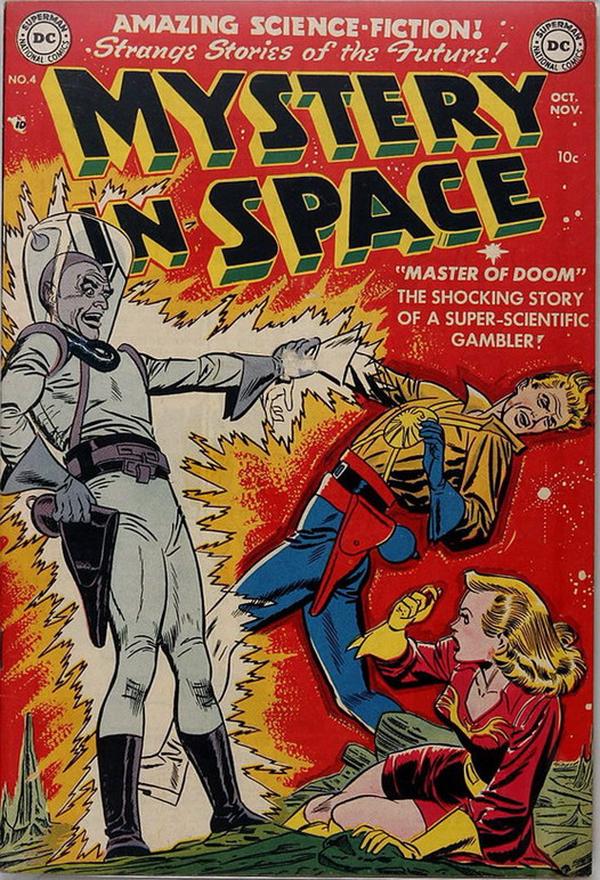
Mystery in Space #4
Mystery in Space #4 is a representative entry in DC's early Golden Age science-fiction anthology program, demonstrating the editorial ambition that would eventually make the title one of the most celebrated SF comics of the 1950s–60s. The issue is notable for carrying a Joe Simon and Jack Kirby two-page feature—reprinted from Real Fact Comics #1 (1946)—alongside original work by Edmond Hamilton, John Broome, Robert Kanigher, and Carmine Infantino, making it a remarkable snapshot of the talent DC was deploying in the genre. The Captain Tootsie promotional strip inside also documents how branded advertising comics were fully woven into the editorial fabric of mainstream Golden Age periodicals, with characters like Rollo and Marybelle appearing in those pages. Together, the issue illustrates DC's strategy of mixing anthology short fiction, a serialized space-hero feature, and cross-promotional content in a single package aimed squarely at the early-'50s public appetite for science fiction.
In "Master of Doom!", Dr. John Arden, a brilliant inventor, finds himself on the run after creating a device that lets him vibrate through solid matter—only to be accused of a string of crimes he didn’t commit. With the police closing in, he claims his former assistant, Rand Nortell, stole the invention and is using it to commit the crimes. Written by Robert Starr and illustrated with sharp precision by Gil Kane, inks by John Giunta, this 1951 DC mystery blends science fiction intrigue with a classic chase, all wrapped in a striking cover by Carmine Infantino and Bernard Sachs.
In "The End of the World," Dr. Hull Vurrel warns his colleague Lance that atomic energy—though currently serving humanity—carries a hidden danger that could one day unravel civilization. As their debate unfolds, the weight of progress and peril hangs in the air, leaving only the question of what comes next.
In "The Man Who Walked Through Walls!", Dr. John Arden finds himself on the run after inventing a device that lets him vibrate through solid matter—only to be accused of a string of crimes he didn’t commit. With the police closing in, he claims his former assistant, Rand Nortell, stole the device and is now using it to commit the very crimes he’s being blamed for.
ComicBooks.com Value
Show all 18 grades ▾
This exact issue on ebay
Raw / ungraded ▾ $2.99–$195 2 listings
More listings for this title
Read it digitally
Sell my copy
Have this issue — or a whole collection? Get a fair offer from us, skip the marketplace fees and the hassle.
We Buy Collections ▸History
Mystery in Space launched in April–May 1951 under the official editorial credit of Whitney Ellsworth, though Julius Schwartz and Mort Weisinger functioned as the actual co-editors shaping the book's content. The title of the series had itself been suggested by Ellsworth to Schwartz, and it was modelled on the recently successful Strange Adventures. Issue #4, placed on sale August 8, 1951, continued the anthology template established from the first issue: a Knights of the Galaxy lead feature scripted by Robert Kanigher under the house pseudonym 'Dion Anthony' with Carmine Infantino pencils, supplemented by standalone science-fiction stories from writers like Edmond Hamilton and John Broome (writing as 'Robert Starr'). The Simon and Kirby piece in this issue was not new work but a deliberate reprint of their 'The Rocket Lanes of Tomorrow' from DC's Real Fact Comics #1 (1946), reflecting the editorial practice of recycling prestige material from the publisher's back catalog.
Trivia · 8 facts
- Published with a cover date of October–November 1951; actual on-sale date was August 8, 1951, per copyright registration records.
- Lead story is 'Knights of the Galaxy: Master of Doom,' scripted by Robert Kanigher under the pseudonym 'Dion Anthony,' with pencils attributed to Carmine Infantino—part of the ongoing Knights of the Galaxy serial that ran across Mystery in Space #1–8.
- Includes 'The End of the World,' scripted by Edmond Hamilton, and 'The Man Who Walked Through Walls!,' scripted by John Broome under the pseudonym 'Robert Starr,' with Murphy Anderson art also present in the issue.
- Features a two-page reprint of 'The Rocket Lanes of Tomorrow' with art and script by Joe Simon and Jack Kirby, originally published in Real Fact Comics #1 (1946).
- Cover pencils by Carmine Infantino, inks by Bernard Sachs; officially edited by Whitney Ellsworth, with Julius Schwartz and Mort Weisinger serving as actual co-editors.
- Contains a one-page Tootsie Roll promotional comic strip titled 'Linda Wins for Captain Tootsie,' drawn by Bill Schreiber—the version of the Captain Tootsie ad feature that ran in DC comics after Schreiber took over the strip from C.C. Beck around 1950.
- Captain Tootsie was originally created in 1943 by C.C. Beck (the Shazam/Captain Marvel artist) as a candy advertisement character; his kid-sidekick group the Secret Legion includes Rollo and the character listed variously as Marybelle or Maybelle.
- Mystery in Space ran for 110 issues (1951–1966) and won Alley Awards in 1962 and 1963; issue #4 is a Golden Age anthology entry predating the better-known Adam Strange era that began with issue #53 in 1959.
Cast · 3 characters
Full credits
Reprints
↩ Reprints Real Fact Comics #1 (1946)
Reprinted in Strange Adventures #232 (1971)
Key issues in Mystery in Space
Reviews
Reader reviews
No reader reviews yet.