
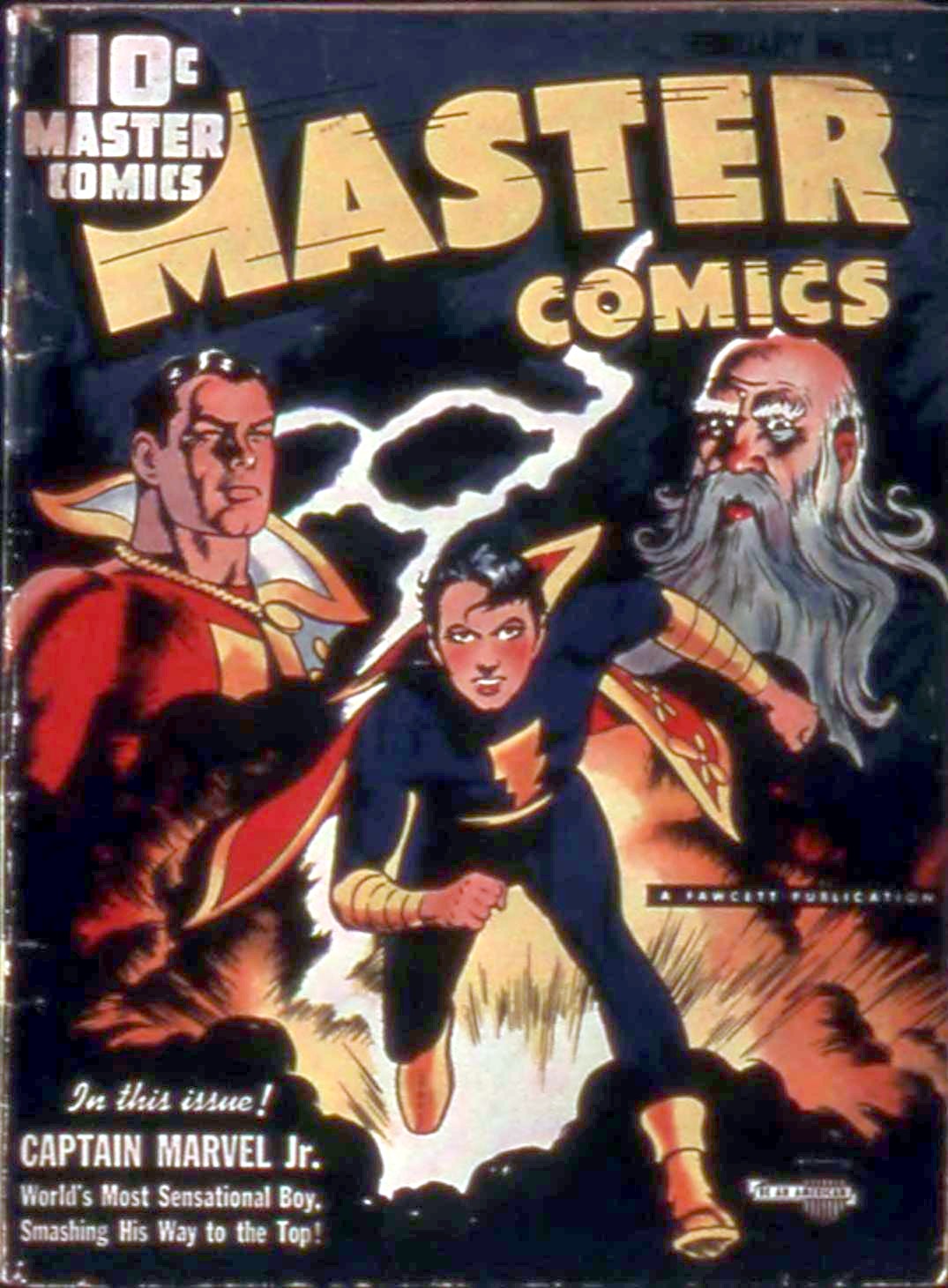
Master Comics #23
☆ Be the first to review + Add to your collection — Join freeMaster Comics #23 (February 1942) marks the moment the long-running Fawcett anthology settled into its permanent identity as the flagship home of Captain Marvel Jr., cementing a creative partnership between writer Ed Herron and artist Mac Raboy whose photorealistic, Alex Raymond-influenced style stood in striking contrast to C.C. Beck's cartooning on the senior Captain Marvel title. The same issue delivers a second landmark debut: the Bulletman story 'The Weeper' introduces Mortimer Gloom, the emotionally conflicted Bulletman arch-villain who cries for his own victims — a conceptually unusual Golden Age antagonist whose thematic DNA was later echoed in later fictional weeping villains and who survived into modern animated adaptations. Together, the two debuts give this single issue an outsized footprint in Fawcett's publishing history.
In "The Weeper," Captain Nazi moves swiftly through wartime shadows, eliminating a British agent and infiltrating a covert meeting before turning his sights on the U.S. President. With Mac Raboy handling both the interior art and cover, this 1942 Fawcett classic delivers tense, wartime intrigue, all drawn in the bold, dynamic style that defined the era.
In this 1942 tale from *Master Comics* #23, Captain Nazi moves swiftly through the shadows—first eliminating a British agent, then attending a clandestine meeting, before turning his sights on the U.S. President. As the clock ticks, Captain Marvel Jr. races to intercept him, but the stakes have never felt so immediate.
In "The Weeper," the Flying Detectives track down a disgraced circus performer once known as the Crying Clown or Weeping Willie, now driven to vengeance after being fired for dishonesty. The story unfolds as the former entertainer turns to crime, turning his past performances into something far darker—though the true extent of his new mission remains shrouded in mystery.
ComicBooks.com Value
Show all 20 grades ▾
More listings for this title
Read it digitally
Sell my copy
Have this issue — or a whole collection? Get a fair offer from us, skip the marketplace fees and the hassle.
We Buy Collections ▸History
The issue arrived on newsstands January 7, 1942, just weeks after the United States entered World War II following Pearl Harbor, which gave its wartime storyline — Captain Nazi attempting to assassinate President Franklin D. Roosevelt — immediate cultural resonance. Editorial duties are attributed to Ed 'France' Herron, though GCD notes the credit was unconfirmed for this specific issue; from issue #24 onward, Herron's editorship is listed without qualification. Mac Raboy handled the cover and the Captain Marvel Jr. interior, continuing work he had begun on the title in the preceding issue (#22), while the Bulletman story was handled by the Binder Studio (with Henry Perkins credited by GCD as the Weeper's specific creator). The 68-page anthology format allowed Fawcett to showcase multiple heroes — including Minute Man and El Carim — under one cover.
Trivia · 8 facts
- Cover date: February 1942; on-sale date: January 7, 1942; published by Fawcett Publications Inc. at 68 pages.
- First appearance of The Weeper (Mortimer Gloom), the signature arch-villain of Bulletman and Bulletgirl, in the story titled 'The Weeper: The Murderer Who Mourns His Victims!' — a former circus 'Crying Clown' fired for dishonesty who turns to revenge crime while weeping for his victims.
- The Captain Marvel Jr. lead story 'Captain Nazi's Assassination Plot' features Captain Nazi targeting President Franklin D. Roosevelt; this issue also establishes Freddy Freeman's civilian identity as a newsboy for the first time.
- Mac Raboy provided cover art and interior art for the Captain Marvel Jr. feature; his photorealistic, heavily feathered style — influenced by Alex Raymond's Flash Gordon — visually defined the character for the entire Fawcett run and reportedly inspired Elvis Presley's signature caped jumpsuits.
- Starting with this issue (following #22), Master Comics transitioned from a multi-hero anthology led by Bulletman into the permanent home of Captain Marvel Jr., a role it held through issue #133 (1953).
- The issue contains five separate features: Captain Marvel Jr., Bulletman, Minute Man ('The Walking Dead Man'), El Carim ('Set the Freaks Free'), and Buck Jones Frontier Marshal ('Arizona Bound', based on the film of the same name).
- The Captain Marvel Jr. story was reprinted in DC's Shazam! Family Archives Vol. 1 (November 2006) and again in Hit Comics #13 (ilovecomics, 2023); the Bulletman/Weeper story was reprinted in Three Aces Comics #v3#2 (March 1944), Men of Mystery Comics #74 (2008), and Golden-Age Greats Spotlight #20 (2020).
- The Weeper later appeared in the animated series Batman: The Brave and the Bold (voiced by Tim Conway) and a version of the character appeared in Season 4 of The CW's The Flash.
Full credits
Reprints
Reprinted in Three Aces Comics #2 (1944), The Shazam! Family Archives #1 (2006), Men of Mystery Comics #74 (2008), Golden-Age Greats Spotlight #20 (2020), Hit Comics #13 (2023)
Key issues in Master Comics
Reviews
Reader reviews
No reader reviews yet.