
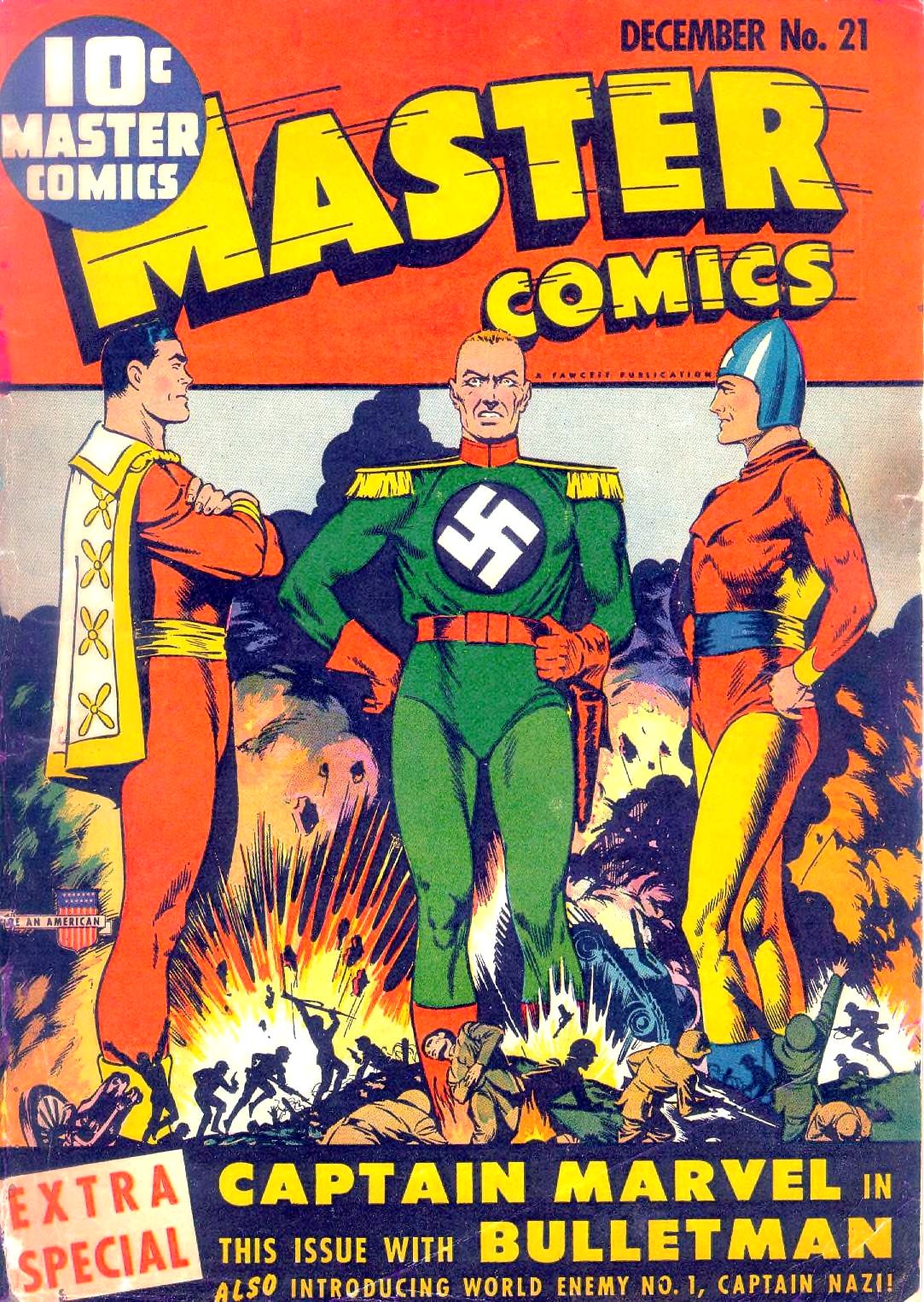
Master Comics #21
☆ Be the first to review + Add to your collection — Join freeMaster Comics #21 marks the first appearance of Captain Nazi (Albrecht Krieger), one of the most brazenly designed Axis villains of the Golden Age, and simultaneously kicks off a three-part inter-title crossover that was remarkably uncommon for 1941 — a storyline explicitly engineered to jump from one Fawcett anthology to another. The issue is also the narrative engine that makes Captain Marvel Jr. possible: the chain of events Captain Nazi sets in motion here, culminating in Whiz Comics #25, directly produces Freddy Freeman's transformation and gives the Marvel Family its most enduring junior member. Cover-dated December 1941 and on newsstands just weeks before Pearl Harbor, the issue captures the exact cultural moment when American superhero comics stopped treating the war as a background threat and made it the foreground story. The cross-title structure — where Captain Nazi literally taunts Captain Marvel in a note at the end of the issue and dares him to come find him in a different magazine — anticipates the shared-universe storytelling mechanics that mainstream comics would not fully embrace for another two decades.
In "The Coming of Captain Nazi," Fawcett's Master Comics #21 (1941) introduces a chilling new threat as Hitler unleashes Captain Nazi—a fanatically loyal agent sent to dismantle America's so-called "weakling heroes." Written by Bill Woolfolk and brought to life with sharp, dynamic art by Mac Raboy, the story sets a tense stage for a battle of ideologies, all rendered in the bold, energetic style of wartime comic book storytelling.
In the shadow of war, Hitler unleashes Captain Nazi upon America—a villain engineered to crush the nation’s so-called "weakling heroes." Sent to infiltrate and destroy, Captain Nazi’s arrival marks a dangerous escalation in the battle between good and evil.
ComicBooks.com Value
Show all 22 grades ▾
This exact issue on ebay
CGC 5 ▾ $4,950–$5,250 3 listings
CGC 2.5 ▾ $4,200–$4,300 2 listings
CBCS 1 ▾ $1,660 2 listings
Read it digitally
Sell my copy
Have this issue — or a whole collection? Get a fair offer from us, skip the marketplace fees and the hassle.
We Buy Collections ▸History
The lead story, 'The Coming of Captain Nazi,' was written by Bill Woolfolk and drawn by Mac Raboy, who was already the primary cover and interior artist on the Bulletman feature in Master Comics. Editorial credit is unconfirmed but attributed across multiple sources to Ed 'France' Herron, who — according to the Comics Alliance tribute to Raboy — also proposed the concept of a youthful Captain Marvel spin-off hero and specifically recommended Raboy's more illustrative, Alex Raymond-influenced style to distinguish him from C.C. Beck's work on the original Captain Marvel. The issue was published monthly by Fawcett Publications, and its cover price was ten cents for 68 full-color pages — a standard Golden Age anthology format that also included Minute Man, El Carim, Captain Venture, and Buck Jones backup strips alongside the headline crossover feature.
Trivia · 8 facts
- First appearance of Captain Nazi (Albrecht Krieger), created by writer Bill Woolfolk and artist Mac Raboy, cover-dated December 1941.
- Captain Nazi is depicted as a genetically enhanced super-soldier dispatched by Adolf Hitler to eliminate American superheroes — the story opens with Hitler himself presenting his new weapon to his generals.
- The issue features a crossover between two separate Fawcett anthology titles: the story begins in Master Comics #21 and concludes in Whiz Comics #25 (same cover month), with Captain Nazi leaving an in-story note challenging Captain Marvel to follow him into the other magazine — an extremely rare narrative device for Golden Age comics.
- Captain Marvel guest-stars in the Bulletman feature — itself an unusual inter-title appearance — and together Bulletman and Captain Marvel fight Captain Nazi to a standstill before he escapes.
- This issue is Part 1 of the three-part origin arc for Captain Marvel Jr.: Captain Nazi's actions in Whiz Comics #25 cripple Freddy Freeman and kill his grandfather Jacob Freeman, leading Captain Marvel to share his power and create the new hero.
- Bulletgirl (Susan Kent) appears only in her civilian identity; Spy Smasher (Alan Armstrong) and Minute Man (Jack Weston) appear in image only within the lead story, shown as the American heroes Hitler wants neutralized.
- The issue also includes a Minute Man backup story ('The Black Dragon Society') illustrated by Charles Sultan, plus contributions from George Tuska, Otto Binder, and Rafael Astarita on other anthology features.
- The lead Captain Nazi story has been reprinted in Flashback #18 (DynaPubs, 1974), The Shazam! Archives Vol. 4 (DC, 2004), Men of Mystery Comics #80 (AC Comics, 2009), and Take That, Adolf!: The Fighting Comic Books of the Second World War (Fantagraphics, 2017).
Cast · 12 characters
Full credits
Reprints
Reprinted in Flashback #18 (1974), The Shazam! Archives #4 (2004), Men of Mystery Comics #80 (2009), L'histoire des super-héros #[nn] (2016), Take That, Adolf!: The Fighting Comic Books of the Second World War #[nn] (2017)
Key issues in Master Comics
Reviews
Reader reviews
No reader reviews yet.