
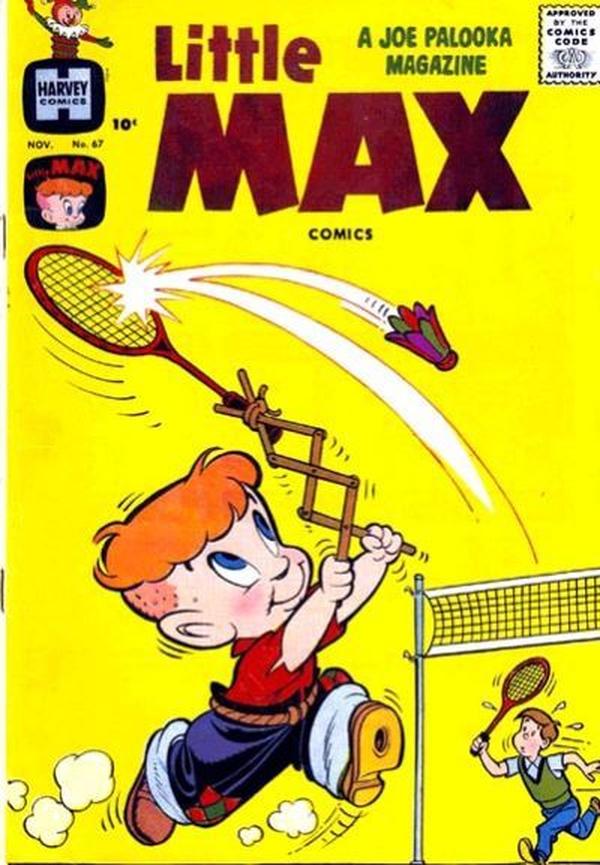
Little Max Comics #67
☆ Be the first to review + Add to your collection — Join freeLittle Max Comics #67 (November 1960) sits at a pivotal moment in Harvey history: it is one of the earliest issues of the long-running Little Max series to feature Richie Rich — a character who had debuted in 1953 in Little Dot but only received his own standalone title in 1960, the very same year as this issue. The presence of Richie Rich here, alongside the Joe Palooka–universe cast, illustrates how Harvey used its anthology-style humor titles as a cross-pollination engine, testing and growing characters across multiple books simultaneously. That editorial strategy directly enabled Richie Rich to become, as documented across multiple sources, Harvey's most popular character and the star of over fifty separate titles. The issue also preserves in a single package virtually the entire ecosystem of Harvey's pre-superhero funny-animal and humor lineup — Little Max, Humphrey Pennyworth, Joe Palooka, Rags Rabbit, Pesty Rabbit, Lotta Plump, and Gloria Glad — making it a useful snapshot of the publisher's Silver Age humor output at full flower.
In "null," Rags dreams of winning $500 in a photo contest, so he and Pesty set up their camera for a series of shots—only to realize too late that the camera never had film. The story captures their quiet panic with a perfectly timed punchline that lingers just beyond the last panel.
In "Sweet and Powerful," Lotta’s sweet tooth leads her to sample a new batch of chocolates from a candy factory representative—only to discover the treats give her surprising bursts of strength. As she effortlessly lifts heavy objects and performs feats no one expected, the factory workers watch in stunned amazement, wondering what’s behind her sudden power.
In "The Picnic," Gloria invites Richie to a park outing with a basket her mother has packed, but Richie’s dread of standard picnic fare—ham sandwiches and hard-boiled eggs—leads him to enlist Jeeves to swap the meal for a gourmet feast prepared by the Rich chefs. When Gloria finds out about the switch, she’s determined to make Richie taste her mother’s original picnic food—right away.
ComicBooks.com Value
This exact issue on ebay
Read it digitally
Sell my copy
Have this issue — or a whole collection? Get a fair offer from us, skip the marketplace fees and the hassle.
We Buy Collections ▸History
The Little Max Comics series launched in October 1949, built around Little Max, the mute child sidekick of Ham Fisher's heavyweight boxing strip Joe Palooka, which at its peak ran in over 900 newspapers. Harvey Comics licensed the character and, with artists including Warren Kremer and Art Helfant, expanded the cast into a standalone humor anthology; the series ran 73 issues through 1961, with issue #67 appearing in November 1960. By that point Ham Fisher had died (1955) and the newspaper strip had passed to artist Tony DiPreta, but Harvey continued publishing original Little Max material alongside reprints. The series functioned as a nursery for Harvey's own homegrown humor characters, and writer/editor Sid Jacobson — who edited Little Max — later acknowledged that Little Max's famously silent personality directly influenced how he wrote Richie Rich's companion Pee-Wee.
Trivia · 8 facts
- Published November 1960 by Harvey Comics (Harvey Publications, Inc.) as issue #67 of the Little Max Comics series, which began in October 1949 and ran 73 issues total.
- Little Max originated as the speechless child sidekick of Ham Fisher's Joe Palooka newspaper comic strip, one of the most widely syndicated strips in American history, peaking at over 900 papers.
- Joe Palooka, Humphrey Pennyworth, and Little Max all trace directly to Ham Fisher's strip; Harvey Comics licensed and expanded all three characters into their own standalone series.
- Richie Rich — created by Alfred Harvey and Warren Kremer, debuting in Little Dot #1 (September 1953) — appears in this issue, making it one of the early cross-over appearances of the character in the same year his own flagship title launched (1960).
- Gloria Glad, Richie Rich's classmate and recurring foil, also appears; her first appearance was in Little Dot #33, establishing her as the character who challenges Richie's wealth-centric worldview.
- The series featured art and scripts by Warren Kremer and Art Helfant across its run; Kremer went on to become Richie Rich's most celebrated and prolific illustrator.
- Sid Jacobson, who edited Little Max, has stated that Little Max's silent characterization directly inspired the decision to make Richie Rich's friend Pee-Wee a non-speaking character.
- Little Max Comics #73 (1961) is documented as the final issue of the series, meaning issue #67 falls in the last stretch of the run, a period when Richie Rich guest appearances were becoming increasingly common across Harvey's humor lineup.
Cast · 8 characters
Reprints
↩ Reprints Little Max Comics #8 (1950), Family Funnies #5 (1951), Harvey Comics Hits #61 (1952)
Reviews
Reader reviews
No reader reviews yet.