
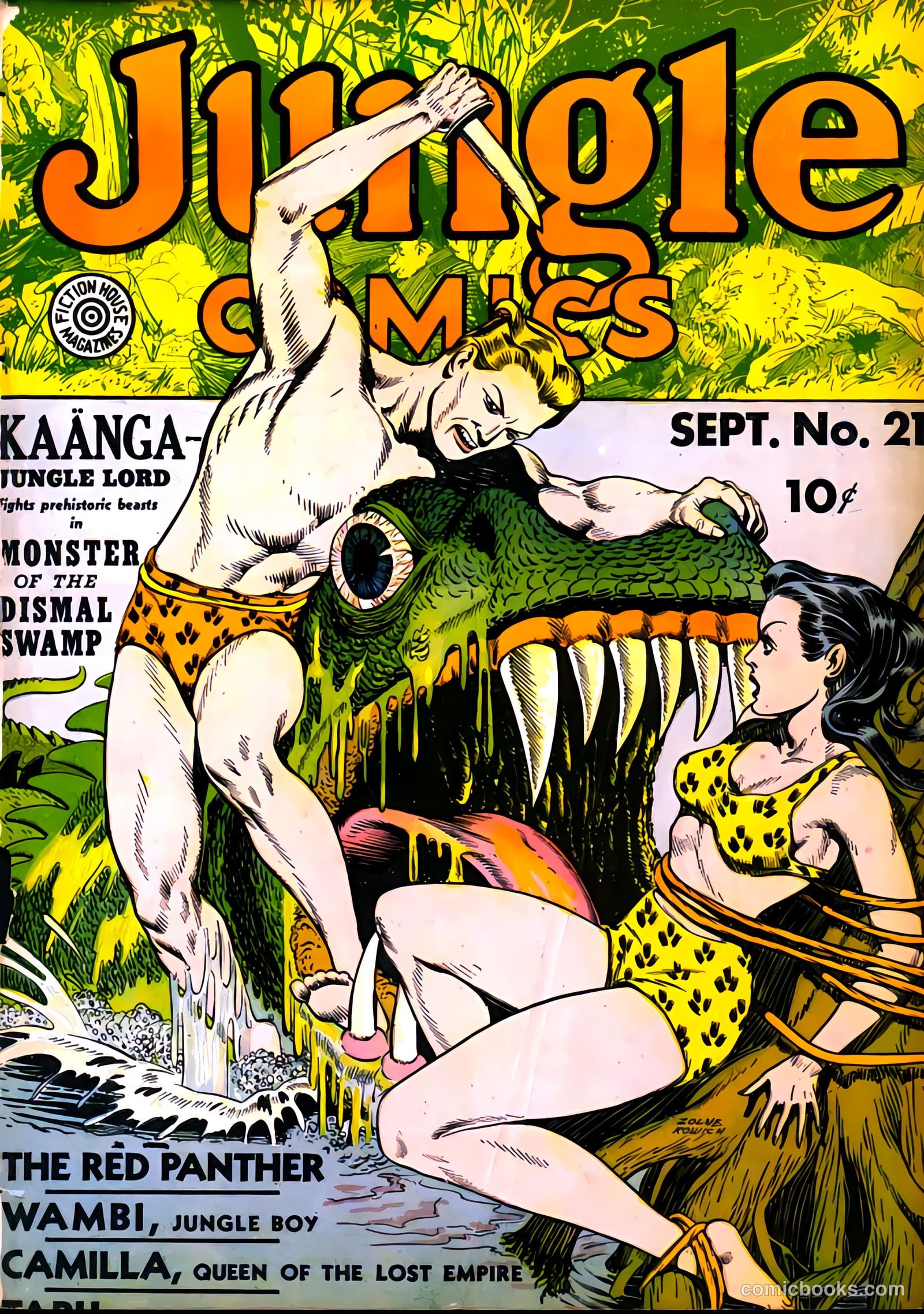
Jungle Comics #21
☆ Be the first to review + Add to your collection — Join freeJungle Comics #21 (September 1941) stands as a representative high-water mark of Fiction House's genre-defining anthology format, packing an unusually dense roster of continuing Golden Age characters — Kaänga, Fantomah, Tabu, The Red Panther, and Wambi — into a single issue at a moment when the jungle-adventure genre was near its commercial and creative peak. The Fantomah installment is historically notable as part of the character's post-Fletcher-Hanks era, in which subsequent writers shifted her from her surrealist African origins into broader globe-trotting adventure (here, India and cobra cultists), illustrating how quickly the comics industry repurposed and diluted an unusual early superheroine concept once its creator departed. The cover, by Dan Zolnerowich, exemplifies what collectors and historians have identified as one of the most consistent and visually ambitious cover runs of the entire Golden Age, placing the issue within a body of work that influenced the 'good girl art' aesthetic that would define Fiction House's identity for more than a decade.
In "Monster of the Dismal Swamp," Fantomah—still reeling from her capture and journey to India—finds uneasy refuge with Kalat and his people, only to be ensnared once more by the sinister cobra cultists. With her life hanging in the balance in a pit of venomous snakes, she invokes Damballah, the serpent god, in a moment of desperate faith. The transformation that follows is both eerie and unexpected. Cover by Dan Zolnerowich, with interior art by Richard Case, this 1941 issue delivers a potent mix of jungle mystery and supernatural tension.
In this 1941 tale from Jungle Comics #21, Fantomah, after escaping her captors in India, finds unlikely aid in Kalat, a native whose village is under siege by fanatical cobra cultists. When both are captured and Fantomah is thrown into a pit of venomous snakes, she invokes Damballah, the serpent god, triggering a miraculous transformation. The story unfolds with tense mystery and mythic flair, as ancient forces rise to confront the cult's dark rituals.
In this 1941 Jungle Comics tale, Roy and his friend Art venture into the wilds of the Crocodile Marsh, where Art’s reckless ambition to film the legendary swamp puts them at odds with the wary Tutan tribe. When Art’s provocation escalates, Roy steps in—using the film camera’s mysterious glow to convince the natives it’s a powerful weapon, setting off a tense game of perception and survival.
ComicBooks.com Value
Show all 16 grades ▾
Find on ebay
Read it digitally
Sell my copy
Have this issue — or a whole collection? Get a fair offer from us, skip the marketplace fees and the hassle.
We Buy Collections ▸History
Jungle Comics was launched in January 1940 by Fiction House — itself a pulp-magazine publisher that had pivoted aggressively into comics — using content packaged largely through the Eisner & Iger Studio and its successor, the Iger Shop, under editor Jerry Iger. By the time issue #21 reached newsstands in September 1941, the studio pipeline was well established, with Dan Zolnerowich — a Pratt Institute-trained artist who had come up through the Eisner & Iger Shop — serving as the primary cover artist and contributing interior Kaänga art as well. The anthology format, common to Fiction House titles of the period, meant that issue #21 was assembled from multiple creative teams working on parallel strips, with Al Gabriele on The Red Panther and Al Walker on Wambi, reflecting the shop-system production model of the era rather than a single auteur vision.
Trivia · 8 facts
- Published September 1941 by Fiction House as part of a series that ran continuously from January 1940 through March 1954, totaling 163 issues.
- Cover art and the lead Kaänga story ('Monster of the Dismal Swamp') are by Dan Zolnerowich, who ultimately produced over 100 credited covers for Fiction House across multiple titles.
- The Kaänga lead story sees the jungle lord end human sacrifices made to appease a creature called the 'Storm Monster' — a theme of debunking false idol worship that recurred throughout the series.
- The Red Panther story, illustrated by Al Gabriele, features the character rescuing a geologist and pilot from pygmies and helping them locate a radium deposit.
- The Fantomah segment depicts her being kidnapped by slavers and transported to India, where she encounters cobra cultists — a significant setting shift away from her established African jungle home and a hallmark of the post-Fletcher-Hanks handling of the character.
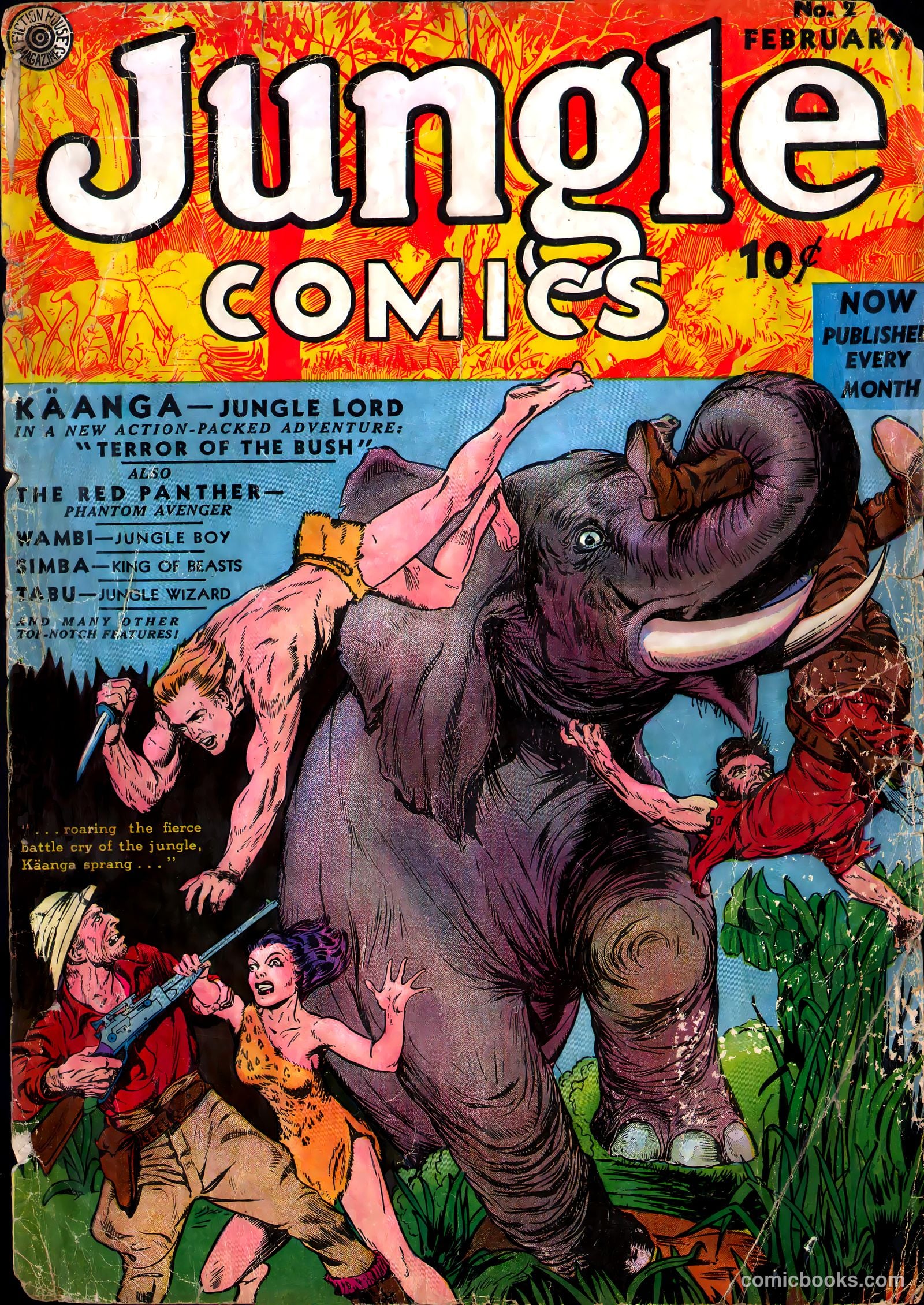
- Fantomah had originally been created by Fletcher Hanks (writing as 'Barclay Flagg') beginning in Jungle Comics #2 (February 1940); Hanks departed the character after issue #15 (March 1941), making issue #21's installment firmly within the character's creative second phase.
- Wambi the Jungle Boy's story, illustrated by Al Walker, involves Wambi rescuing a hunter's son from a gorilla — a self-contained adventure typical of the character's format.
- The issue was produced via the Fiction House/Iger Shop package system, a studio-production model in which multiple artists and writers contributed discrete strips assembled into a unified anthology, rather than a single creative team producing the whole book.
Full credits
Reprints
Reprinted in Men of Mystery Comics #85 (2011)
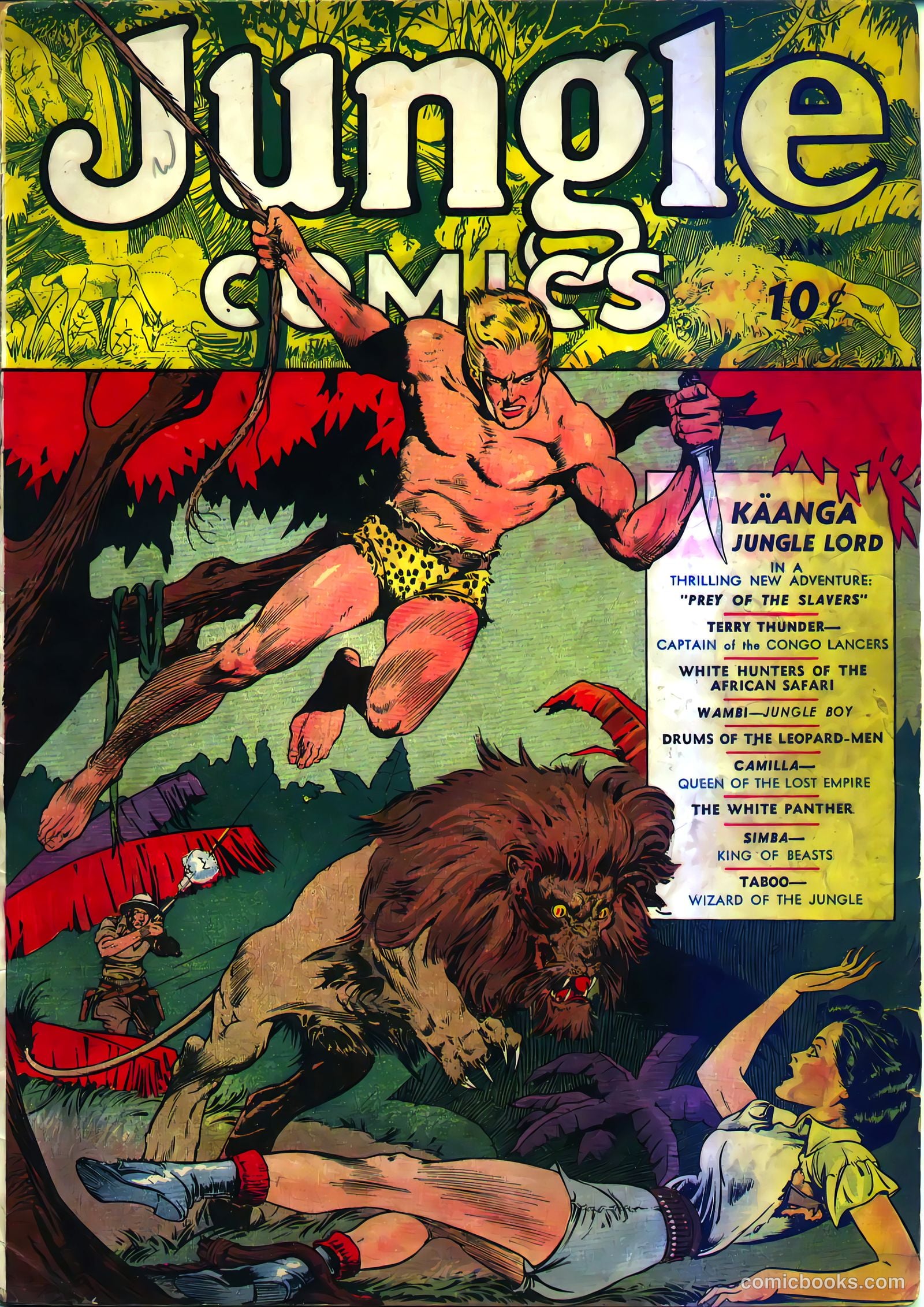
Key issues in Jungle Comics
Reviews
Reader reviews
No reader reviews yet.