
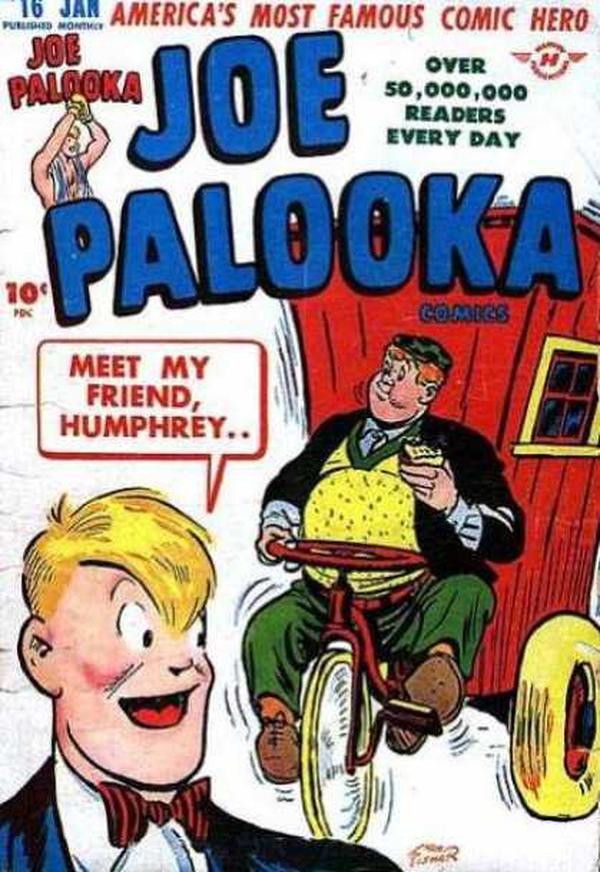
Joe Palooka Comics #16
☆ Be the first to review + Add to your collection — Join freeJoe Palooka Comics #16 (January 1948, Harvey) marks the first comic book appearance of Humphrey Pennyworth — the enormously strong, sweetly dim country bumpkin introduced here in a story literally titled 'Introducing Humphrey' — a character who proved so popular with readers that Harvey spun him off into his own title the same year. The issue arrived at the precise cultural moment when the Joe Palooka newspaper strip, then reaching an estimated 50 million daily readers, ranked among the five most popular comic strips in America, making the Harvey comic book a direct extension of one of the Golden Age's most widely consumed pop-culture properties. Humphrey's debut also signals a deliberate editorial expansion of the Palooka universe beyond boxing adventure: Harvey was building an ensemble cast of memorable supporting players whose individual comic appeal could carry standalone humor stories alongside the main sports-drama continuity. The story materials from this issue proved durable enough that Harvey reprinted them as late as 1957 in the relaunched Joe Palooka series (issues #116 and #117), and an Australian edition (Magazine Management, 1952) drew on #16 content as well.
ComicBooks.com Value
Show all 8 grades ▾
This exact issue on ebay
Raw / ungraded ▾ $160–$380 2 listings
More listings for this title
Read it digitally
Sell my copy
Have this issue — or a whole collection? Get a fair offer from us, skip the marketplace fees and the hassle.
We Buy Collections ▸History
Harvey Publications had held the Joe Palooka comic book license since 1945 — making it the first newspaper comic strip licensed by Harvey — with Ham Fisher retaining creative oversight and receiving a cover credit throughout the run. By the time #16 went to press in early 1948, the production workflow involved Fisher alongside a stable of studio hands: the interior credits for adjacent issues name Kirk Stiles, Al Zere, Vic Herman, and Bob Powell as contributing artists, reflecting the collaborative ghost-shop model Fisher had operated since the mid-1930s when he first brought on assistants including a young Al Capp. The Grand Comics Database notes that future Marvel artist Don Heck worked in Harvey's production department during 1949–1952 cutting and pasting strip art for comic-book reformatting, illustrating how deeply the series was embedded in the broader Golden Age production ecosystem.
Trivia · 8 facts
- Published January 1948 by Harvey Publications (Joe Palooka Comics, 1945 series, #16); cover price 10 cents, 48 pages, full color.
- First comic book appearance of Humphrey Pennyworth, introduced in the story 'Introducing Humphrey' — Knobby Walsh discovers the pear-shaped, super-strong country bumpkin when his car breaks down in West Wokkington Falls.
- Humphrey is depicted as a comedic foil with near-invulnerability and exceptional physical strength, one of the few characters who can regularly match Joe Palooka in a fight.
- The issue also features Little Max backup stories ('Little Max Goes Into Business') and two prose adventures of the early female superhero Black Cat — a regular format feature of the Harvey Palooka books.
- A science-fiction backup story, 'Atoma,' appears in this issue, in which a 20th-century boy named Dusty travels 500 years into the future and encounters a leisure-based society ruled by fascist tyrants.
- Ham Fisher is credited on the cover; interior stories and art are attributed to Fisher alongside Kirk Stiles, Al Zere, Vic Herman, and Bob Powell.
- Content from this issue was reprinted in at least three later publications: Joe Palooka #116 (Harvey, April 1957), Joe Palooka #117 (Harvey), and a Magazine Management Australian edition (#33, 1952 series).
- Humphrey Pennyworth went on to receive his own Harvey spin-off series, Humphrey Comics, launched in 1948 — a direct consequence of the character's introduction in this issue and the surrounding period.
Full credits
Reprints
Reprinted in Fun Parade #38 (1948), Hello Buddies #38 (1948), Joe Palooka Comics #63 (1951), Joe Palooka Comics #83 (1954), Joe Palooka #33 (1955), Joe Palooka #116 (1960), Joe Palooka #117 (1960)
Reviews
Reader reviews
No reader reviews yet.