
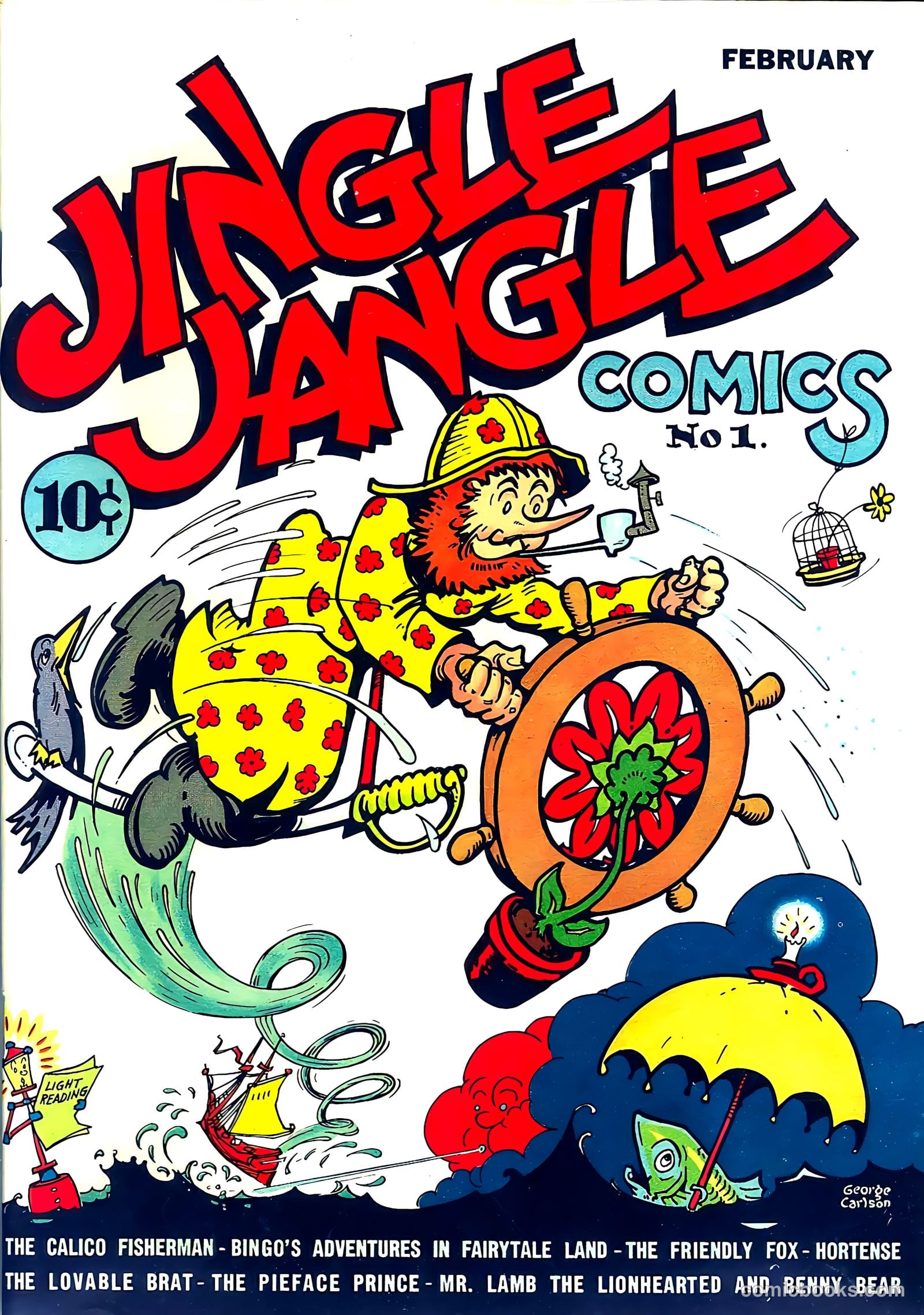
Jingle Jangle Comics #1
☆ Be the first to review + Add to your collection — Join freeJingle Jangle Comics #1 stands as the first appearance of George Carlson's two signature features — 'Jingle Jangle Tales' and 'The Pie-Face Prince of Pretzelburg' — which together represent one of the most formally inventive bodies of work in Golden Age children's comics. Carlson's approach, layering wordplay, burlesque, and fairy-tale surrealism within a single children's anthology, had no direct contemporary equivalent on newsstands and was later championed by critic Harlan Ellison as a 'comic of the absurd,' placing Carlson in conversation with literary absurdists well beyond the comics medium. The issue also debuts 'Gup and His Gremlins,' one of the earliest uses of the gremlin concept in American popular fiction, a culturally resonant subject given the wartime context of 1942–43. Decades on, Art Spiegelman, Ellison, and other tastemakers have cited Carlson's Jingle Jangle work as a precursor to avant-garde comics, cementing issue #1 as a foundational artifact of the form.
A whimsical tale unfolds in "The Calico Fisherman and the Left-Handed Clay-Pipe," a charming oddity from Jingle Jangle Comics #1, where a fisherman’s peculiar catch leads to a mystery as tangled as his nets. Written and illustrated entirely by George Carlson, the story blends quirky humor and gentle absurdity, set against the backdrop of a small coastal town. The cover, also by Carlson, captures the tale’s playful spirit with a vivid, hand-drawn splash of the fisherman’s curious encounter.
A calico fisherman yearns for his lost left-handed clay-pipe, and when his son ventures into the world to seek his fortune, the boy's journey leads him to unexpected companions and peculiar encounters. Through George Carlson's delightfully absurd tale, father and son pursue their separate paths across a landscape of surreal obstacles, quirky characters, and impossible logic—all converging toward a reunion that just might restore what was lost.
A young fox learns he's got hunting season to worry about, so his father sets out to teach him the survival skills he'll need—but Junior's got his own ideas about friendship and kindness in the forest. When a dangerous chase puts both father and son in the path of real hounds, the boy's unconventional approach just might save the day.
When Mr. Lamb's own shadow springs to life as his protector, a cowardly little fellow finds himself swept into an adventure far beyond his wildest dreams—tangling with an evil swami, a magical island, and a wishing elephant whose power may be his only ticket home. Created by Douglas, this wild 1943 romp bounces Mr. Lamb from perils at sea to encounters with talking trees and giant snakes, all while his shadow fades in and out at the most inconvenient moments. A charming blend of slapstick, exotic danger, and the kind of scrappy persistence that turns a timid character into an unlikely hero.
Benny Bear heads north to visit his polar bear cousins at the North Pole, eager to experience ice and snow for the first time—but his unfamiliar ways quickly land him in trouble when the local kids invite him to join their wintery games. From slipping on ice to tangling with a walrus, Benny's vacation becomes a wild series of mishaps that test whether this country cousin can keep up with life at the top of the world.
ComicBooks.com Value
Show all 22 grades ▾
Find on ebay
Read it digitally
Sell my copy
Have this issue — or a whole collection? Get a fair offer from us, skip the marketplace fees and the hassle.
We Buy Collections ▸History
Eastern Color — the same publisher behind Famous Funnies, the widely recognized first successful American comic book — launched Jingle Jangle Comics under its Famous Funnies, Inc. imprint, edited by Steven Douglas and built substantially around George L. Carlson as principal artist. Carlson arrived at the project already a veteran of children's book illustration, puzzle-making, and newspaper-strip ghosting, and had previously attempted 'Jingle Jangle Tales' both as a children's book and as an unsuccessful Sunday newspaper page before the comic book format gave his material its ideal home. The indicia of issue #1 carries a copyright year of 1942 while the cover reads February, and cross-referencing the internal advertisements — including issues of Famous Funnies and Heroic Comics known to have shipped in late 1942 — points to a late-1942 on-sale date with a February 1943 cover date, a common Golden Age dating convention. Carlson personally handled writing, pencils, inks, and often lettering and coloring for his features, an unusually complete degree of authorial control for the era.
Trivia · 8 facts
- Published by Eastern Color Printing Co. under the Famous Funnies, Inc. imprint; cover-dated February 1943, with cross-referenced internal ads suggesting a late-1942 on-sale date.
- First appearance of 'Jingle Jangle Tales,' George Carlson's flagship surrealist fairy-tale feature, which ran in nearly every one of the series' 42 issues through December 1949.
- First appearance of 'The Pie-Face Prince of Pretzelburg' (also styled 'Pretzleburg'), Carlson's continuing comic fantasy series about the pie-faced Prince Dimwitri, which anchored the book for its entire run.
- Debut of 'Gup and His Gremlins,' noted as an early appearance of the 'gremlin' concept in American popular fiction, coinciding with peak wartime gremlin folklore.
- Issue includes a wartime public service announcement ('What Did You Do Today…for Freedom?'), grounding the children's fantasy anthology firmly in its World War II publishing context.
- George L. Carlson was already a celebrated commercial illustrator in his mid-fifties when the series launched; his prior credits included the first-edition dust jacket for Margaret Mitchell's Gone with the Wind and ghosting the newspaper strip Reg'lar Fellas.
- Harlan Ellison's influential essay 'Comic of the Absurd,' published in the 1970 anthology All in Color for a Dime, was a key catalyst for critical reappraisal of the series, comparing Carlson to Beckett, Pinter, and Pirandello.
- Carlson's Jingle Jangle work was collected and studied in Fantagraphics' 2014 hardcover Perfect Nonsense: The Chaotic Comics and Goofy Games of George Carlson, edited by Daniel F. Yezbick, the first career retrospective of the artist; Gwandanaland Comics also reprinted the George Carlson material from issues #1–18 in a dedicated volume.
Full credits
Reviews
Reader reviews
No reader reviews yet.