
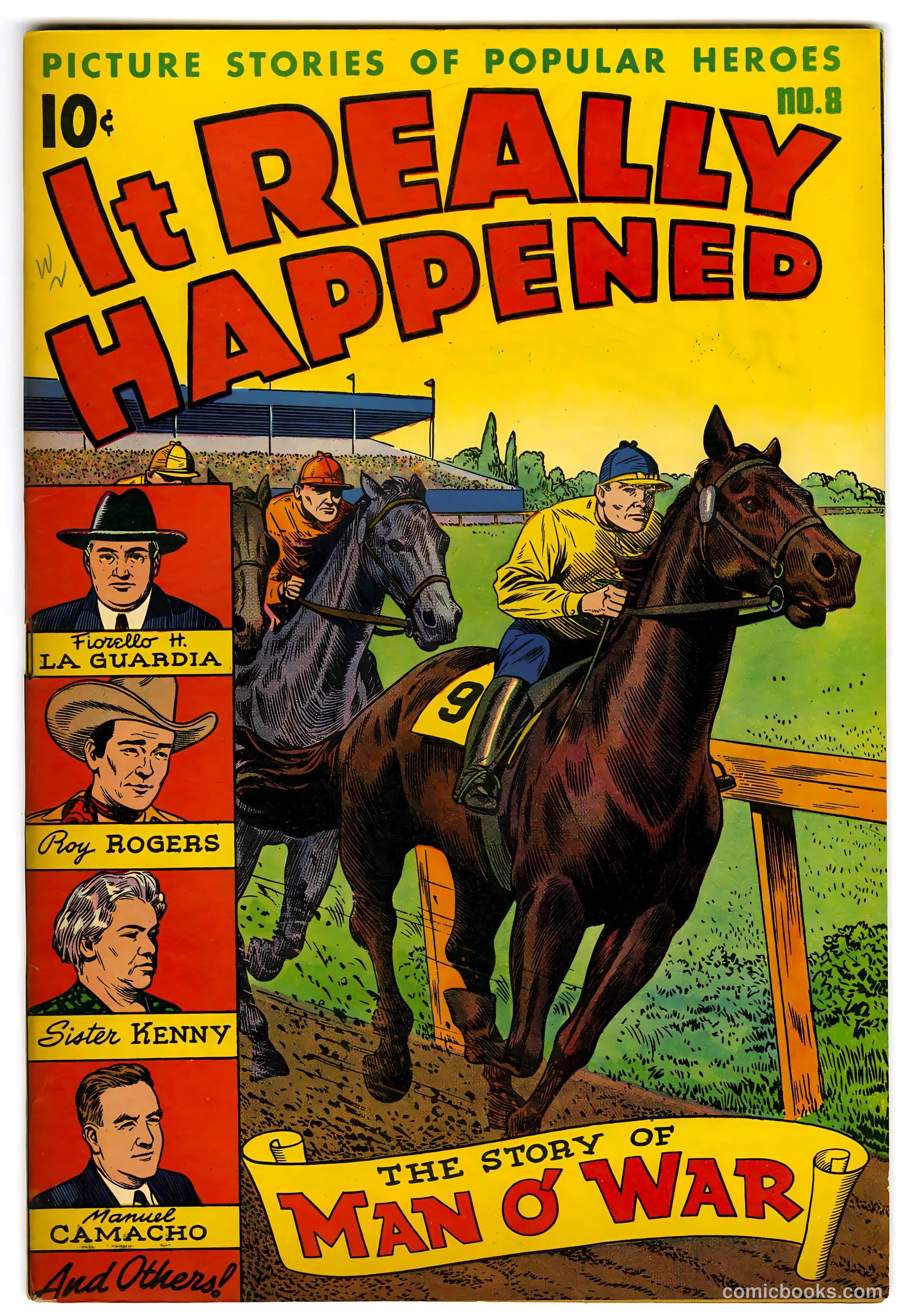
It Really Happened #8
☆ Be the first to review + Add to your collection — Join freeAn anthology of historical fact-based tales featuring "Angel of Mercy," about Sister Elizabeth Kenny treating infantile paralysis in the Australian bush in 1910; "The Story of Man o' War," depicting the legendary racehorse's triumphs on the track; a story involving journalists Jimmy Hare and others covering President McKinley's assassination and documenting the tragedy with photographs; and "Good Neighbor," recounting Manuel Avila Camacho's rise as a hard-riding Mexican rebel who fought illiteracy and corruption to become Mexico's distinguished president in 1940.
Meet Fiorello H. LaGuardia, the fiery New York politician known as "The Little Flower," whose rise from interpreter and young lawyer to congressman, decorated World War I pilot, and twelve-term mayor showcases a life of relentless drive and public service. Witness how a man of modest stature and boundless courage tackled corruption, gangsters, and urban decay—taking on everything from sewer contracts to wartime civilian defense—while personal tragedy and professional setbacks only strengthened his resolve to serve the city he loved.
Roy Rogers, born Leonard Slye, traded his life as a hill-billy musician for the silver screen when a movie scout heard him sing with the Tumblin' Tumbleweeds and offered him a screen test. Within months, the charismatic cowboy—and his talented palomino Trigger—captivated American audiences, turning Rogers into one of the nation's biggest box-office draws and the unlikely king of a modern Western revival. This is the true story of how a young performer from Ohio became a genuine phenomenon, complete with fan mail by the tens of thousands.
Sister Elizabeth Kenny takes on infantile paralysis—a disease with no known cure—armed only with hot packs, massage, and unwavering determination in the Australian outback and beyond. From her early days as a nurse in the remote bush country through her tireless work treating paralyzed children, she develops a revolutionary treatment method that faces fierce skepticism from the medical establishment, first in her native Australia and later in America. Through patient perseverance and undeniable results, she transforms the lives of countless children, proving that courage and compassion can challenge what doctors believed impossible.
In 1918, owner Samuel D. Riddle purchased a promising colt named Man O' War at a Kentucky yearling sale, and the chestnut horse quickly proved worthy of the investment with dominant performances as a two-year-old. Though a bad start cost him one early race, "Big Red" roared back as a three-year-old to string together victories after victory, including a stunning match race against Sir Barton and a thrilling showdown with John P. Grier at the Dwyer Stakes. This is the story of how Man O' War earned his place as racing's greatest champion and left a legacy that would inspire champions for generations to come.
Dr. Patricia O'Connor is America's only woman zoo doctor, and at Staten Island Zoo she tends to an endless parade of animal patients—from monkeys with colds to tigers with tooth trouble to bears with heart problems. This 1947 story follows a day in her life as she juggles veterinary emergencies, protective equipment, and muscular assistants to keep the zoo's creatures healthy. Through dental extractions, splinting, and detective work to solve a chimpanzee's mysterious stomachache, we see how this former farm enthusiast balances her calling as a doctor with her roles as mother and housewife.
Lieutenant Colonel Gregory Boyington earned his nickname "Pappy" through a flying career that began with reckless daring at the Marines and escalated into legendary combat heroics. From his days with the Flying Tigers in China through his command of Marine squadrons in the Pacific, he became known for his fearless dogfighting and commanding presence—a pilot who craved action and inspired his men. This is the remarkable true story of how a hot-shot aviator became one of America's most celebrated war heroes.
From his days leading rebels through persuasion rather than gunfire to his rise through Mexico's military ranks, Manuel Avila Camacho proved that words could accomplish what bullets could not. When he became president in 1940, his commitment to democracy, literacy, and strengthening ties with the United States—symbolized by Vice-President Wallace's attendance at his inaugural—positioned Mexico as a steadfast ally and reformer. This is the story of how a young soldier's belief in dialogue over violence shaped a nation's path toward progress and stability.
Donald Coleman Bailey, a young engineer from Yorkshire, England, channels his boyhood inventiveness into designing a revolutionary portable bridge during World War II—one that can be assembled quickly under fire and prove itself in combat. As the military tests and refines his creation across multiple theaters of war, Bailey's ingenious design transforms from a sketched idea into an essential tool for Allied forces advancing toward victory. The story celebrates how wartime necessity sparked an invention that would outlive the conflict itself, finding new purpose in peacetime reconstruction.
ComicBooks.com Value
Find on ebay
Read it digitally
Sell my copy
Have this issue — or a whole collection? Get a fair offer from us, skip the marketplace fees and the hassle.
We Buy Collections ▸Full credits
Reviews
Reader reviews
No reader reviews yet.