
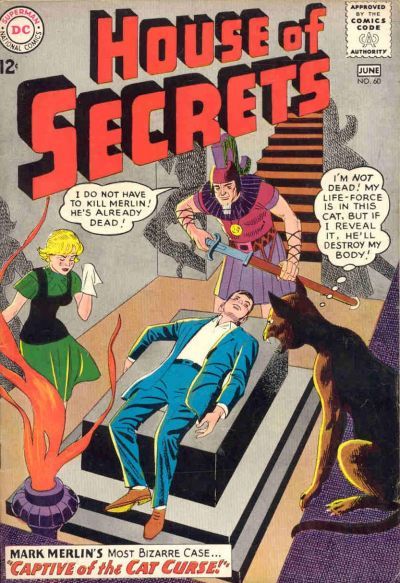
House of Secrets #60
☆ Be the first to review + Add to your collection — Join freeHouse of Secrets #60 (May–June 1963) marks a decisive creative turning point in Mark Merlin's long-running feature: it is the issue in which Merlin acquires the ancient Egyptian cat charm and, with it, the ability to project his mind into the body of his black cat Memakata — transforming him from a straightforward occult detective into a character with a genuine superpower. That shift mattered structurally for DC's anthology strategy at a moment when superhero titles were eating into mystery-book readership, and it set the stage directly for the very next issue's debut of Eclipso, making #60 the quiet hinge between the old Merlin formula and the more action-oriented era that would follow. The cat-charm ability proved durable enough to carry forward through Merlin's eventual transformation into Prince Ra-Man and to resurface in later DC continuity, including a 1981 DC Comics Presents story that finally resolved Memakata's role in the mythos.
In "Captive of the Cat Curse," Mark accidentally activates a mystical charm that transfers his consciousness into the body of a black cat, forcing him to navigate a world of shadows and secrets to uncover a sinister plot. With his mind trapped in feline form, he must use his new senses and agility to expose the danger before it's too late.
ComicBooks.com Value
Show all 16 grades ▾
This exact issue on ebay
Raw / ungraded ▾ $12.99–$49.99 6 listings
Read it digitally
Sell my copy
Have this issue — or a whole collection? Get a fair offer from us, skip the marketplace fees and the hassle.
We Buy Collections ▸History
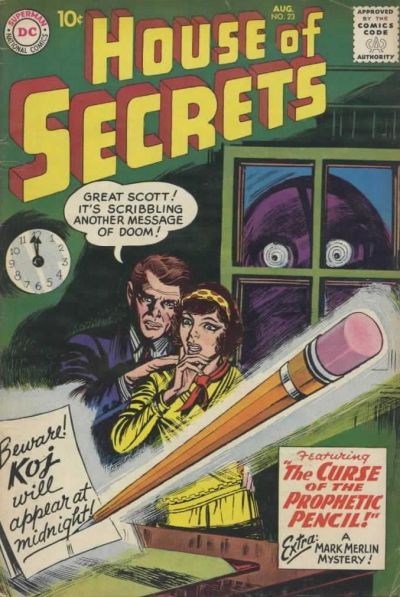
Mark Merlin had debuted in House of Secrets #23 (August 1959), created by artist Mort Meskin and writer Jack Miller as a blue-suited occult sleuth operating out of an inherited mansion called Mystery Hill in the hamlet of Cloister, with secretary-fiancée Elsa Magusson at his side. By the early 1960s DC was nudging its anthology features toward more superhero-adjacent concepts to compete with Marvel's rising readership, and issue #60's Egyptian tomb plot — in which Merlin and Elsa investigate a string of mysterious accidents near a newly uncovered pharaoh's burial site — was the vehicle chosen to give Merlin his signature supernatural ability. Specific writer and penciler credits for #60 itself are not firmly established in the publicly accessible GCD index entry, which is consistent with the era's general practice of leaving anthology story credits off the indicia.
Trivia · 8 facts
- House of Secrets #60 was cover-dated May–June 1963 and published by National Periodical Publications (DC Comics) at the standard Silver Age cover price of twelve cents.
- The issue introduces the cat charm and the black cat Memakata: while exploring the tomb of a pharaoh bearing the cat's name, Mark Merlin discovers a hidden cat-headed amulet that allows him to transfer his consciousness into Memakata's body.
- Merlin names the cat Memakata after the pharaoh of the same name whose tomb they were investigating, and he subsequently adopts it as a household pet and emergency escape route.
- Elsa Magusson, Merlin's secretary and fiancée, accompanies him throughout the tomb investigation, cementing her role as a supporting fixture of the feature.
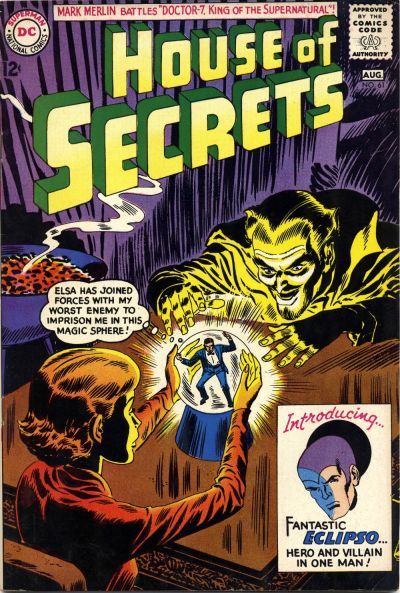
- The issue sits immediately before House of Secrets #61 (July–August 1963), which introduced Eclipso — meaning #60 is the last chapter of the pre-Eclipso, pre-superpower era of the book.
- Mark Merlin was originally created by Mort Meskin (art) and Jack Miller (script), debuting in House of Secrets #23 (August 1959); the cat-charm power introduced in #60 became a permanent part of his toolkit.
- Memakata and the cat-charm amulet remained in DC continuity long after the Silver Age: a 'Whatever Happened To…' backup story in DC Comics Presents #32 (April 1981) resolved the characters' fates by finally revealing to Elsa the full truth about Mark Merlin's connection to Prince Ra-Man, with Memakata's body central to the plot.
- Clark Kent and Superman are indexed as appearing in this issue; given standard DC anthology practice, their presence most likely reflects a house advertisement or filler feature rather than a story crossover — no narrative source corroborates a story-level appearance of those characters in #60.
Cast · 4 characters
Full credits
Reprints
Reprinted in Five-Score Comic Monthly #64 (1963), Relatos Fabulosos #50 (1963), Flash #1 (1970), The Phantom Stranger #19 (1972), Skrekk Magasinet #2/1975 (1975)
Key issues in House of Secrets
Reviews
Reader reviews
No reader reviews yet.