
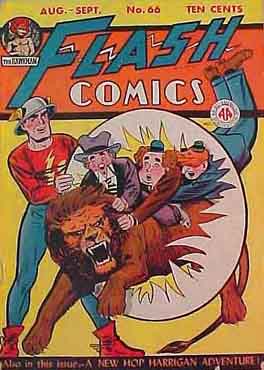
Flash Comics #66
☆ Be the first to review + Add to your collection — Join freeFlash Comics #66 earns its place in Golden Age history primarily as the debut of Neptune Perkins, a water-adapted DC character created by Gardner Fox and Joe Kubert — one of the period's quietly original takes on aquatic superheroism, predating DC's deeper investment in underwater characters and later resurrected by Roy Thomas as a cornerstone of Young All-Stars. The issue is also a genuine literary curiosity: its lead Flash story was scripted by Robert Bloch, the horror and crime writer who would later pen Psycho, making it one of the few Golden Age superhero scripts attributable to a major American literary figure. Together the two stories capture Flash Comics at a creative high-water mark — Kubert's rapidly maturing Hawkman artwork and Hibbard's assured Flash pages appearing in the same 52-page package.
In "The Flash and the Black Widow!", Jay Garrick stumbles upon a bizarre mystery when the Three Dimwits encounter a talking chimp at the zoo—only to see it vanish into the hands of mysterious kidnappers. Written by Gardner F. Fox and illustrated by E. E. Hibbard, this 1945 adventure blends classic superhero action with a touch of the uncanny, as the Flash races to uncover a threat that defies logic. The cover by E. E. Hibbard captures the moment of intrigue, a 10-cent comic from a golden age of pulp excitement.
In "The Flash and the Black Widow!" from Flash Comics #66 (1945), the Three Dimwits stumble upon a talking chimp at the zoo—only to see it snatched by mysterious thugs. When Jay Garrick steps in to investigate, he uncovers a threat far more sinister than any prank or circus act.
In "The Dweller in the Sea," a mysterious infant born on a coastal town’s edge defies nature, requiring constant saltwater infusions to survive—unbeknownst to the townsfolk, his existence ties directly to the ancient secrets beneath the waves. As Hawkman investigates the strange occurrences, he finds himself drawn into a mystery far older than the sea itself.
ComicBooks.com Value
Show all 18 grades ▾
This exact issue on ebay
Read it digitally
Sell my copy
Have this issue — or a whole collection? Get a fair offer from us, skip the marketplace fees and the hassle.
We Buy Collections ▸History
The issue carried a cover date of August 1945 and was registered for copyright with an on-sale date of June 11, 1945, published under the J. R. Publishing Co. indicia as an All-American Publication. Editorial oversight was shared by Sheldon Mayer (the credited editor) alongside uncredited story editors Julius Schwartz and Ted Udall — the same editorial structure that governed much of the All-American line at the time. Bloch's Flash script was originally published under Gardner Fox's byline, a ghostwriting or house-name arrangement common in the industry; the actual attribution was later established by comics historian Jerry Bails.
Trivia · 8 facts
- Cover date: August 1945; on-sale date (from copyright registration): June 11, 1945; publisher: J. R. Publishing Co. / All-American Publications (DC).
- First appearance of Neptune Perkins in the Hawkman story 'The Dweller in the Sea' (story 3), written by Gardner Fox with art by Joe Kubert — Neptune is a marine biologist born with a sodium deficiency requiring constant seawater immersion, giving him webbed hands and feet and extraordinary swimming ability.
- Neptune Perkins made only one additional Golden Age appearance (Flash Comics #81, 1947) before Roy Thomas revived him in All-Star Squadron #33 (1984) and cast him as a lead character in Young All-Stars (1987–1989), where Thomas also dramatically expanded his origin using Edgar Allan Poe's Narrative of Arthur Gordon Pym and Jules Verne's Twenty Thousand Leagues Under the Seas.
- The lead Flash story, 'The Flash and the Black Widow,' was scripted by Robert Bloch — later famous as the author of Psycho — and drawn by regular Flash artist E. E. Hibbard; in the original printing it was credited to Gardner Fox, with the true authorship established afterward by historian Jerry Bails.
- The issue features three main strips: the Jay Garrick Flash story, a Hawkman story (introducing Neptune Perkins), and a guest appearance by Hop Harrigan (normally a feature of All-American Comics).
- Editors on the issue were Sheldon Mayer (credited) with Julius Schwartz and Ted Udall serving as uncredited story editors — the same editorial trio overseeing the broader All-American superhero line.
- The Flash story 'The Flash and the Black Widow' was later reprinted in The Greatest Flash Stories Ever Told hardcover (1991) and its paperback edition (1992), both with cover art by Carmine Infantino.
- Flash Comics #25–104 — including this issue — have not been collected in DC's Archive or Finest hardcover reprint series, making the original comics the only readily accessible format for most of these stories.
Full credits
Reprints
Reprinted in Land of the Lost Comics #3 (1946), Picture Stories from American History #2 (1946), Dandy Comics #1 (1947), International Comics #1 (1947), The Greatest Flash Stories Ever Told #[nn] (1991), The Greatest Flash Stories Ever Told #[nn] (1992)
Key issues in Flash Comics
Reviews
Reader reviews
No reader reviews yet.