
Flash Comics #64
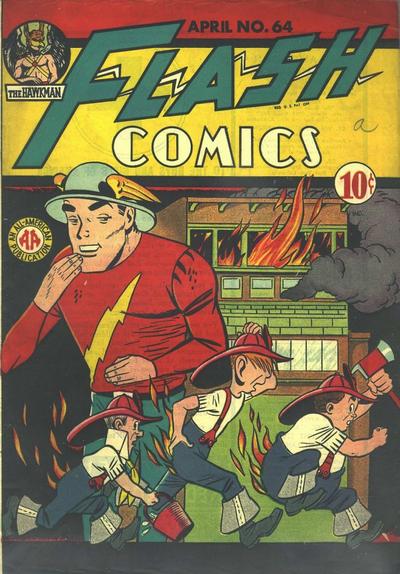
☆ Be the first to review + Add to your collection — Join freeFlash Comics #64 holds a firm place in Golden Age history as the debut of the Monocle, Jonathan Cheval, one of Hawkman's earliest recurring adversaries and a character whose DNA — a wronged civilian who weaponizes his own profession for revenge — anticipates a storytelling archetype that would persist throughout DC's Silver and Bronze Age villain design. The issue also showcases the creative momentum of the Hawkman feature just two issues into Joe Kubert's tenure on the strip, cementing what would become one of the most celebrated artist-character partnerships of the Golden Age. As a mid-run anthology number, it captures Flash Comics at its most industrious: two fully realized, tonally opposite stories sharing a single package, one comedic and one darkly moralistic, demonstrating the range editors demanded of Golden Age anthology titles.
In "The Fire Bandits!", honest optics businessman Jonathan Cheval, wronged by criminal schemers, turns his expertise in light and invisible rays into a high-tech revenge scheme using energy-emitting monocles. As he targets his former enemies, his plans take a dangerous turn when Hawkman intervenes and captures him, leaving him imprisoned with the last of the bandits. Written by Gardner Fox and illustrated with sharp precision by Joe Kubert, this 1945 Flash Comics tale blends pulp intrigue with early superhero ingenuity, all framed by Martin Naydel’s dynamic cover art.
In "The Fire Bandits!" from Flash Comics #64, the Three Dimwits take a bizarre turn, declaring their ambition to become firemen—much to the Flash’s dismay. As chaos erupts from their well-meaning but clueless antics, an anonymous tipster begins predicting fires, turning the city’s safety into a game of shadows and smoldering suspicion.
In "The Man with the Magic Monocles," Jonathan Cheval, a once-honest optician, turns to vengeance after criminals destroy his business. Using his expertise in optics and the hidden properties of atmospheric rays, he crafts a set of magical monocles that fire powerful energy beams. Now a masked vigilante, he targets the two who betrayed him—only to be captured by Hawkman and imprisoned with the third.
ComicBooks.com Value
Show all 16 grades ▾
This exact issue on ebay
Read it digitally
Sell my copy
Have this issue — or a whole collection? Get a fair offer from us, skip the marketplace fees and the hassle.
We Buy Collections ▸History
Both stories in the issue are scripted by Gardner Fox, the prolific writer who co-created Jay Garrick and anchored the Flash Comics anthology across most of its run. The Hawkman feature — 'The Man with the Magic Monocles' — was drawn by Joe Kubert, who had only joined the Hawkman strip with Flash Comics #62 (February 1945), making #64 one of his earliest contributions to a character he would eventually help define for decades. The Flash lead story, 'The Fire Bandits,' featuring the Three Dimwits comedy trio, was a product of the well-established Fox formula for that feature, with the Dimwits serving as reliable comic-relief catalysts throughout this period of the title.
Trivia · 7 facts
- First appearance of the Monocle (Jonathan Cheval), a Hawkman villain, in the story 'The Man with the Magic Monocles' — his debut marks one of the earliest tech-based, revenge-motivated antagonists in DC's Golden Age Hawkman rogues gallery.
- The Monocle was created by writer Gardner Fox and artist Joe Kubert, the same team that had just begun their Hawkman collaboration two issues earlier in Flash Comics #62 (February 1945).
- Cheval's origin in the story — an honest optician cheated out of his business by corrupt financiers who turns his lens-crafting expertise into energy-beam weapons — is a morality-play structure typical of Fox's Golden Age scripts.
- The Flash lead story, 'The Fire Bandits,' is written by Gardner Fox and features the Three Dimwits (Winky, Blinky, and Noddy), the Three Stooges-inspired comedy trio co-created by Fox and E.E. Hibbard who served as recurring comic-relief companions to Jay Garrick throughout Flash Comics #46–#79.
- The Monocle went on to join the Ultra-Humanite's Secret Society of Super Villains decades after his debut, crossing over into Justice Society and Justice League stories — an unusual longevity for a character introduced in a single mid-run Golden Age story.
- The Monocle received a nod in the video game Batman: Arkham Knight, where a storefront named 'Cheval's' appears as an in-universe Easter egg referencing his civilian identity.
- Cover date is April 1945; the issue is part of Flash Comics' 104-issue run (January 1940 – February 1949), published by All-American Publications under the DC/National umbrella.
Full credits
Reprints
Reprinted in Picture Stories from American History #2 (1946), International Comics #3 (1947), Picture Stories from American History #4 (1947), Tiny Tot Comics #7 (1947)
Key issues in Flash Comics
Reviews
Reader reviews
No reader reviews yet.