
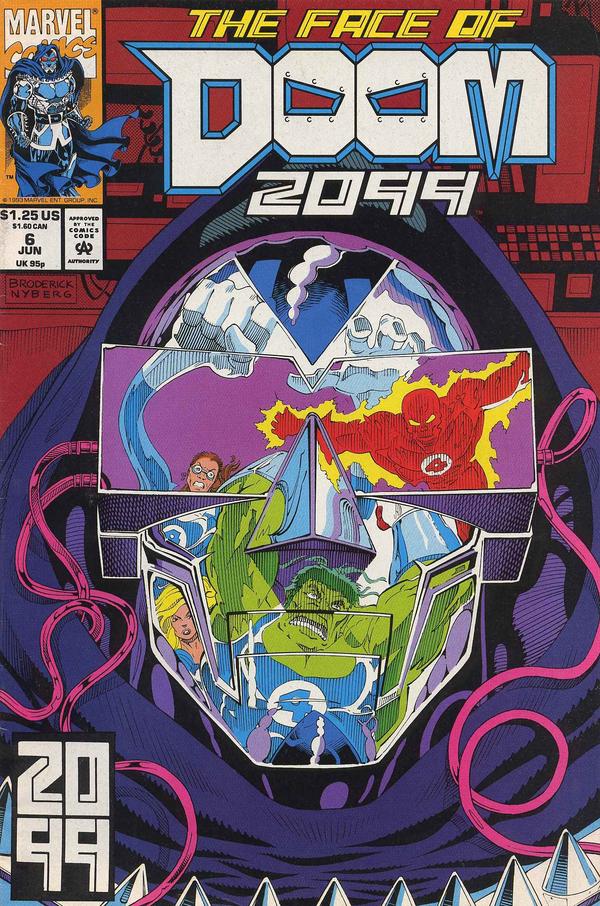
Doom 2099 #6
☆ Be the first to review + Add to your collection — Join freeDoom 2099 #6 opens the series' extended cyberspace arc, a storyline that proved to be one of John Francis Moore's most ambitious narrative experiments within the Marvel 2099 line — transplanting the armored despot into a fully virtual battleground and exploring questions of identity, memory, and control that ran as undercurrents throughout the book's first half. The issue introduces Fever, a contracted cyberspace assassin deployed by Pixel Corporation head Eduardo Devargas, whose rivalry with Doom would ripple across multiple subsequent issues; it also marks the first appearance of Duke Stratosphere, the legendary 'Netglider' who becomes a recurring figure across the entire 2099 shared universe. By pushing Doom into an arena where physical power is meaningless and wit and adaptability determine survival, Moore and Broderick used #6 to deepen the series' larger argument that this amnesiac, unscarred Doom was something more morally complex than a villain — a figure whose suitability as the closest thing the corporate dystopia of 2099 had to a hero was tested on entirely unfamiliar ground.
ComicBooks.com Value
This exact issue on ebay
Raw — MINT ▾ $2.99–$6.99 2 listings
Raw — NM ▾ $1.99–$13.17 9 listings
Raw — VF/NM ▾ $1.99–$7 5 listings
Raw — VF ▾ $1.5–$8 12 listings
Raw — FN ▾ $3.5–$4.98 5 listings
Raw / ungraded ▾ $1–$18.79 38 listings
More listings for this title
Read it digitally
Sell my copy
Have this issue — or a whole collection? Get a fair offer from us, skip the marketplace fees and the hassle.
We Buy Collections ▸History
Doom 2099 was created by writer John Francis Moore and artist Pat Broderick as a flagship title of Marvel's 2099 imprint, which launched in 1992–1993 to explore a dystopian far-future Marvel universe. Moore drove the series through its first two years, building a mythology around a Doom who awakened with fragmented memories and an unscarred face, leaving readers uncertain whether he was truly Victor Von Doom — a mystery the series did not definitively resolve until issue #25. Issue #6, titled 'Tripping the Light Fantastic' and released with a cover date of June 1993, was edited by Joey Cavalieri and features inks by John Nyberg over Broderick's pencils, maintaining the core creative team that established the book's visual language from the outset.
Trivia · 8 facts
- Issue title: 'Tripping the Light Fantastic'; cover date June 1993, release date April 20, 1993; published by Marvel Comics.
- Script by John Francis Moore; pencils and cover by Pat Broderick; inks by John Nyberg; edited by Joey Cavalieri.
- First appearance of Duke Stratosphere — an elite 'Netglider' and recurring figure across the 2099 line, who appears here in cyberspace and, in a morally compromised move, leads Doom and Wire directly into Fever's trap to settle his own old debt.
- First appearance (or among earliest) of Fever — a cyberspace-based assassin contracted by Pixel Corporation's Eduardo Devargas to kill Doom; Fever becomes the primary antagonist of the extended cyberspace arc running through issues #6–#9.
- The story launches Doom's multi-issue journey into cyberspace alongside his Romani companion Wire, a plotline that also brings in an alternate-universe virtual-reality version of the Fantastic Four as adversaries.
- Characters listed in this issue include Doom, Wire, Fortune, Poet, Pixel, Fever, Haze, and Duke Stratosphere, as well as an alternate-universe Fantastic Four — a roster that reflects the series' worldbuilding density at just six issues in.
- The series of which this issue is a part ran for 44 issues (January 1993–August 1996); Moore wrote the first two years, with Warren Ellis taking over for the final year in a run later collected as 'Doom 2099: The Complete Collection by Warren Ellis' (Marvel, 2013).
- The broader identity mystery threaded through the book's first half — was this Doom truly Victor Von Doom, given his youth, unscarred face, and fragmented memories? — was not definitively resolved until issue #25, giving issues like #6 extra dramatic weight in retrospect.
Full credits
Reprints
Reprinted in 2099 #7 (1994), Fantastic Four / Doom 2099 Omnibus #[nn] (2025)
Variants (2)
Reviews
Reader reviews
No reader reviews yet.