
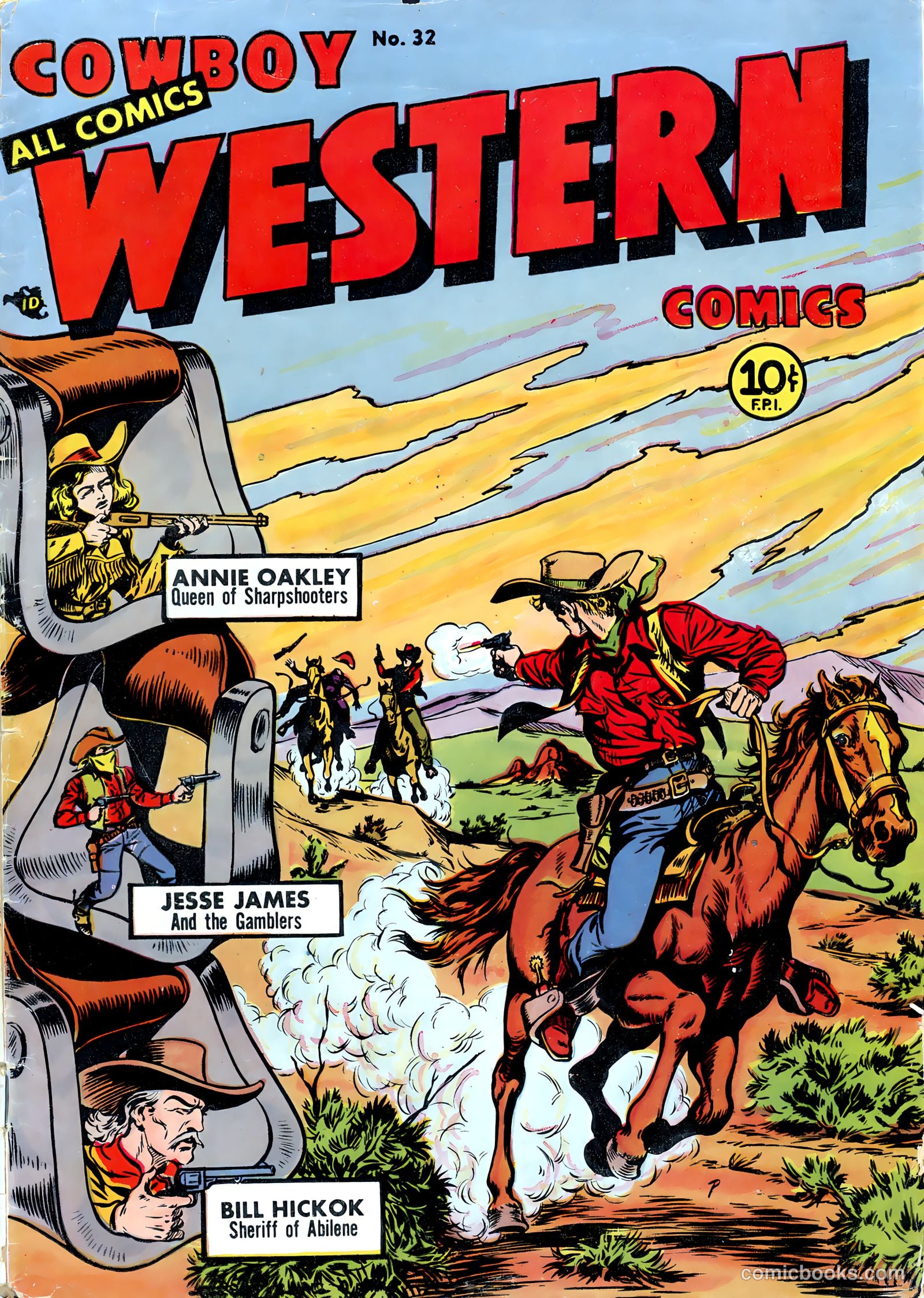
Cowboy Western Comics #32
☆ Be the first to review + Add to your collection — Join freeThis anthology issue contains three Western stories: "Annie Oakley, Queen of Sharpshooters" depicts Annie using a mirror to deflect a bullet aimed at Sitting Bull, saving his life and earning his gratitude as an adopted daughter of the Sioux tribe. "Legends of Paul Bunyan" recounts how the legendary lumberjack's practice of setting massive log fires each morning became folklore among loggers. "The Dead Man's Hand" tells the historical account of Wild Bill Hickok's famous poker hand—aces and eights—which fell to the floor when Jack McCall shot him in the back of the head in Deadwood on August 2, 1876, making it forever known as the Dead Man's Hand.
The transcribed text is almost entirely about Frank and Jesse James in a California mining town—a gunfight erupting over a poker game accusation—and does not describe the story promised by the title "The Poker Hand That Won a Ranch." The opening pages mention the Four 6's brand and Mrs. Katie Barr, but the bulk of the OCR text covers an unrelated James Boys narrative. Since the actual plot of the titled story is not present in this transcription, I cannot write an accurate synopsis. SKIP
A grudge-holding cowboy bent on revenge for his brother tracks down Sitting Bull at Buffalo Bill's Wild West Show, but he hasn't counted on the sharp aim and sharper loyalty of Annie Oakley. When violence erupts and the vengeful gunman makes his move, Annie steps in to protect her friend and prove that some bonds run deeper than old hatreds. This tale of friendship forged through mutual respect shows that even in the rough-and-tumble Wild West, there's room for honor between unlikely allies.
Annie catches a glimpse of danger in her mirror—a cowboy drawing a gun on Sitting Bull—and acts fast to stop him, taking a bullet to her hand in the process. Grateful for saving his life, Sitting Bull adopts Annie into the Sioux tribe and gives her an Indian name that honors her quick thinking and marksmanship.
Just before the Civil War, the U.S. Army experimented with camels as pack animals across the Western deserts, believing their endurance without food and water would make them superior to mules. While the camels' soft, padded feet worked well in sandy terrain, they proved ill-suited to the rough, rocky landscape of the American West. This short feature explores why a promising desert solution ultimately couldn't take the place of the hardy mule.
When a young listener asks his grandfather about the digging near Twin Mounds, the old-timer spins a tale of the Civil War era—of Chief Opothle-Yahola and his band of Indians fleeing north with a fortune in gold coin, pursued by Confederate Rangers across what would become Oklahoma. As battle erupts near those two historic hills on a November night in 1861, the gold is hidden by the Chief's sub-chiefs, but their secret dies with them in the fighting, leaving treasure seekers searching for decades. Now the mounds keep their mystery, though some swear they hear phantom laughter on dark nights—the last guardians of buried wealth.
Wild Bill Hickok arrives in Deadwood carrying a formidable reputation, and on August 2, 1876, he joins a poker game with friends—breaking his own habit by sitting with his back to the door. In a moment that would become legend, a fateful shot changes everything, leaving behind a card hand that would echo through frontier gambling lore forever after.
When Wild Bill Hickok accepts the job of city marshal in 1860s Abilene, Kansas—a lawless frontier town plagued by gunfighters and outlaws—he's immediately confronted by Phil Cole and his ruthless gang, who swagger into town with a deadly challenge. What unfolds is a test of Wild Bill's legendary draw and nerve as he faces down the most dangerous killers the West has to offer.
When Chuckwagon Gus and Slim get into a friendly debate about which animal is the luckiest, Gus insists a cat's nine lives make it unbeatable—until Slim springs a clever twist on the old saying that leaves Gus speechless. It's a quick, punchy joke that captures the easygoing humor of a 1951 cowboy comic, where even the smallest critters can outsmart a know-it-all trail cook.
ComicBooks.com Value
This exact issue on ebay
More listings for this title
Read it digitally
Sell my copy
Have this issue — or a whole collection? Get a fair offer from us, skip the marketplace fees and the hassle.
We Buy Collections ▸Full credits
Reprints
Reprinted in Cowboy Western #51 (1954), Cowboy Western #52 (1954), Gabby Hayes #54 (1955), Cody of the Pony Express #8 (1955), Star Western #1 (2000), Star Western #3 (2000)
Reviews
Reader reviews
No reader reviews yet.