
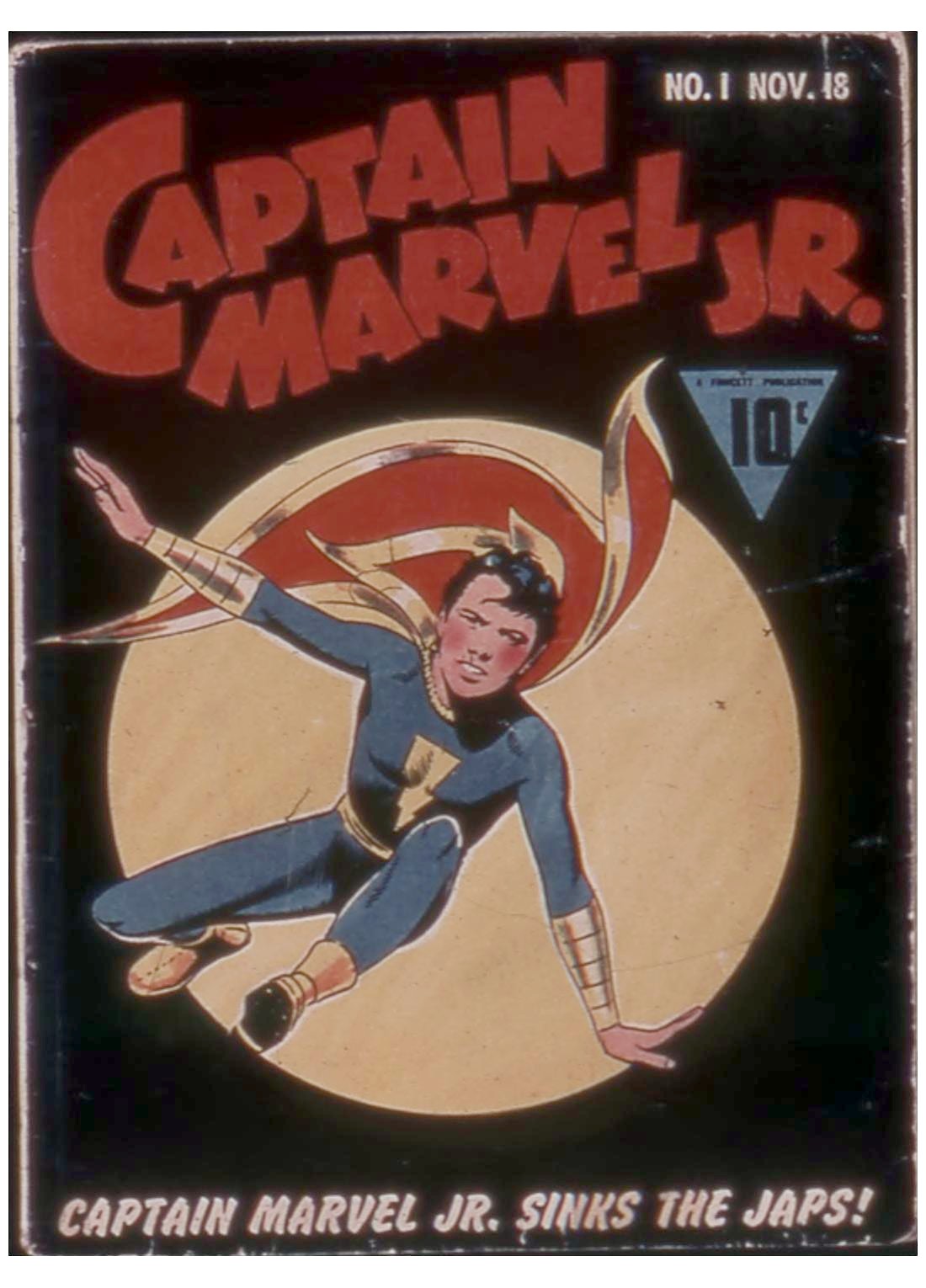
Captain Marvel Jr. #1
☆ Be the first to review + Add to your collection — Join freeCaptain Marvel Jr. #1 formalized the solo publishing life of one of Golden Age comics' most emotionally distinctive heroes — a working-class disabled teenager whose dual existence (crippled newsboy in civilian life, blue-costumed powerhouse when transformed) gave Freddy Freeman a pathos rare for the era. The issue brought Mac Raboy's strikingly realistic illustration style, deliberately opposed to C.C. Beck's whimsical cartooning on the senior Captain Marvel title, to a dedicated showcase where it could set the tone for a decade's worth of grittier, socially grounded wartime adventure. By retelling the character's origin — how Captain Marvel channeled some of his own Shazam-derived power into a dying boy to create an entirely new kind of Marvel — the premiere issue also crystallized the concept of a hero whose magic word is his mentor's name, a narrative device that doubled as a cross-promotional reminder to readers and gave Captain Marvel Jr. a permanent, poignant limitation: he is incapable of speaking his own superhero name without reverting to Freddy Freeman. That cultural footprint eventually extended far beyond comics; Elvis Presley grew up reading this very series, and scholars have traced his signature haircut, cape-and-jumpsuit stage aesthetic, and lightning-bolt TCB emblem directly back to Freddy Freeman's look.
Freddy Freeman’s quiet day fishing takes a dark turn when his grandfather saves a captured Captain Nazi—only to be murdered and Freddy left injured. Taken in by Captain Marvel, the boy is brought before Shazam, who grants him a portion of the Mighty Mortal’s power, transforming him into Captain Marvel Jr.
In "Wings Over Dazaggar!!" from Captain Marvel Jr. #1 (1942), the young hero Jo races to the African frontier to stop Captain Nazi’s sinister scheme, where towering, winged castles threaten to launch an invasion of the Western Hemisphere. With the fate of the world hanging in the balance, Jo must confront the enemy in a high-stakes battle across the savannah.
In "The Shadow That Walked!", Captain Marvel Jr. takes on the mysterious criminal known as The Walking Shadow, a figure whose shadowy presence fuels a rising crime wave. With the legendary Dumont Treasure said to be the key to becoming the King of Crime, the hero must unravel the truth behind the shadow’s power before the city falls to its dark influence.
In "The Case of the Cripple Kidnappers," Captain Marvel Jr. takes on a sinister scheme where young disabled individuals are drugged and manipulated into staged accidents—each designed to extort money from unsuspecting victims. The story unfolds with a sharp focus on justice and compassion, as the hero races to expose a criminal network preying on vulnerability.
In "The Cracked Safecracker," Captain Marvel Jr. rushes to save an elderly couple from a speeding car, only to learn they face eviction to a poorhouse unless their missing son can be found. When the hero recognizes the son’s face from a wanted poster—revealing him to be a notorious safecracker—he must navigate the tension between justice and family. The story unfolds with heart and a touch of moral complexity, as a long-lost reunion begins to reshape two lives.
ComicBooks.com Value
Show all 21 grades ▾
This exact issue on ebay
Raw / ungraded ▾ $70–$330 3 listings
Read it digitally
Sell my copy
Have this issue — or a whole collection? Get a fair offer from us, skip the marketplace fees and the hassle.
We Buy Collections ▸History
The character had been conceived in the fall of 1941 by Fawcett editor Ed Herron, who wanted a spin-off that would remain a teenager rather than transform into an adult, differentiating the new hero from Captain Marvel himself; Fawcett staff artist Mac Raboy then designed the visual identity, deliberately departing from Beck's cartoon idiom in favor of a more painterly, dramatic line. The debut appearance unfolded across a three-issue crossover between Whiz Comics and Master Comics in late 1941, after which Captain Marvel Jr. took over the headlining slot in Master Comics with issue #23 (February 1942). Writer Otto Binder — who would go on to shape the Marvel Family's mythology across the decade — scripted the interior stories of issue #1, while Raboy supplied the cover and interior pencils and inks were handled by Al Carreno; editor Rod Reed oversaw the title. The solo series launched on-sale October 16, 1942 (cover-dated November 1942), approximately nine months after the character anchored Master Comics, confirming that the junior franchise had earned its own masthead.
Trivia · 8 facts
- First solo issue of Captain Marvel Jr. (Freddy Freeman), cover-dated November 1942, on-sale October 16, 1942, published by Fawcett Publications; the series ran for 118 issues, concluding in 1953.
- Cover art by Mac Raboy; interior story art by Al Carreno; written by Otto Binder; edited by Rod Reed — confirmed across GCD and GoCollect records.
- The lead story, 'The Origin of Captain Marvel Jr. Retold,' recaps how Captain Marvel's battle with Captain Nazi left Freddy Freeman near death, prompting Captain Marvel to bring the boy to the wizard Shazam, who transferred a portion of the Mighty Mortal's powers into Freddy — Freddy transforms into Captain Marvel Jr. by speaking the name 'Captain Marvel,' making him the only Golden Age superhero unable to say his own name aloud while in powered form.
- Unlike Captain Marvel (Billy Batson), who transforms into an adult, Freddy Freeman remains a teenager in his superpowered state, while his civilian form retains a permanent limp requiring a crutch — a deliberate character choice by creator Ed Herron to differentiate the spin-off.
- A second story in the issue, 'Wings Over Dazaggar!!,' sends Captain Marvel Jr. to Africa to stop Captain Nazi (Albrecht Krieger) from deploying giant 'winged castles' to invade the Western Hemisphere — an early example of the title's wartime globe-trotting action.
- The issue also contains an early appearance of Willie Wynn (identified in GCD records as his second appearance) and introduces the villain known as The Walking Shadow (Yvonne Sergo/Yvonne Blake), a ventriloquist crime boss, who dies within the same issue.
- The issue was reprinted in Flashback #17 (DynaPubs Enterprises, 1974) and in The Shazam! Family Archives Vol. 1 (DC Comics, November 2006), making the origin accessible to modern readers.
- Elvis Presley was a devoted reader of the Captain Marvel Jr. series that began with this issue; multiple sources document that he modeled his signature hairstyle, cape-and-jumpsuit stage costumes, and lightning-bolt TCB emblem on Freddy Freeman's design — a cultural influence later acknowledged within the comics themselves.
Cast · 18 characters
Full credits
Reprints
Reprinted in Grand Slam Comics #3 [15] (1943), Flashback #17 (1974), The Shazam! Family Archives #1 (2006)
Reviews
Reader reviews
No reader reviews yet.