
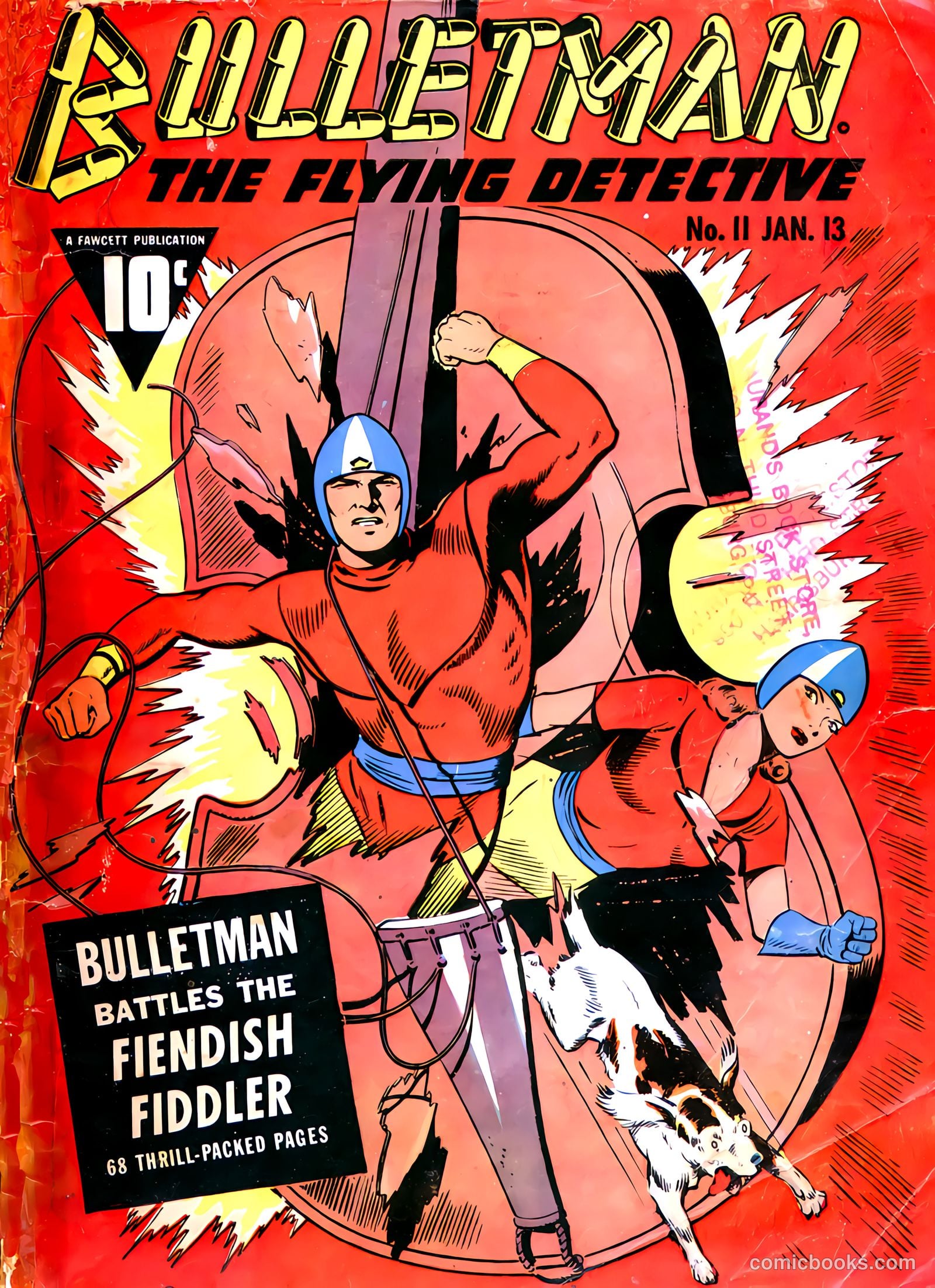
Bulletman #11
☆ Be the first to review + Add to your collection — Join freeBulletman #11 (cover-dated January 1943) holds a notable place in Golden Age history as the comic that carried one of the earliest promotional appearances of the newly assembled Marvel Family — Captain Marvel, Captain Marvel Jr., and Mary Marvel — together in a single Fawcett house advertisement, just weeks after Mary Marvel's debut in Captain Marvel Adventures #18. That war-bonds ad, also featuring Captain Midnight and Spy Smasher, offered early readers their first consolidated look at Fawcett's growing roster of Shazam-connected heroes as a unified promotional front. The issue also advances the ongoing Bulletman mythos in a meaningful way, revealing — in a quiet but resonant moment — that Sergeant Kent already knows the secret identities of Bulletman and Bulletgirl, a plot thread that deepens the supporting cast and adds dramatic irony to every subsequent scene involving him. As Fawcett's second most popular franchise after Captain Marvel, the Bulletman series was a crucial pillar of the publisher's Golden Age output, and issue #11 captures that shared-universe energy at its early peak.
The main story features Bulletman battling the Fiendish Fiddler, a criminal who employs a diminutive henchman named Cecil Sissy. The plot involves the villain's scheme to use a boxing match and shorts with special properties as part of his criminal operation. Bulletman, aided by his flying abilities and partner, confronts the Fiddler and Cecil Sissy while they attempt to execute their plan, ultimately working to thwart their criminal enterprise.
When Dr. Clever and his gang use a fake Santa Claus disguise to pull off a series of holiday robberies, Bulletman, Bulletgirl, and their loyal companion Bulletdog pick up the trail to stop the arch-criminal's yuletide crime spree. As the crime-fighters pursue Dr. Clever through hidden tunnels and across the city, they discover the villain has been exploiting Christmas symbols as cover for his schemes—but a clever dog's keen instincts may prove to be the key to bringing him to justice.
In "The Fiendish Fiddler," a sinister violinist wields a chilling power: his music can bend minds, turning listeners into obedient puppets. With his eerie tunes, he orchestrates a string of bank robberies—until Bulletman and Bulletgirl step in to stop the symphony of crime.
In "Keyhole Karlos," the town's most dangerous gossip-monger uses his web of secrets to manipulate everyone—including Bulletman and Bulletgirl—threatening to expose their identities unless he gets his way. Written by a mysterious hand and illustrated with sharp, period-perfect flair, this 1943 tale turns the spotlight on a villain who doesn’t need superpowers, just the truth.
Ambitious Armbruster needs to scrape together $18.75 for his monthly war bond quota, so when he stumbles into a gymnasium looking for work, he jumps at a sparring partner gig—only to find himself tangling with the formidable Champ Anzee and later the mysterious Cecil Sissy. As Armbruster bounces from one athletic assignment to the next, he'll need all his wits (and quick feet) to survive long enough to earn that bond money.
In "The Case of the Flying Corpse!" from Bulletman #11 (1943), the duo investigates a murder tied to a corrupt moneylender named Shylocke, only to find Bulletgirl trapped in a deadly trap with a ticking clock. As Bulletman races against time, the mystery deepens—especially when the victim’s body seems to defy the laws of physics.
ComicBooks.com Value
Show all 15 grades ▾
This exact issue on ebay
Read it digitally
Sell my copy
Have this issue — or a whole collection? Get a fair offer from us, skip the marketplace fees and the hassle.
We Buy Collections ▸History
The Bulletman series was published by Fawcett Publications from 1941 through 1946, running fifteen issues in total and skipping number thirteen. By issue #11, the creative workload on Fawcett's titles was largely handled by writer Otto Binder and artist Nathaniel Nitkin, who were central to the Bulletman solo series during this period. The cover was by Jack Binder, who handled several issues of the series around this time. The stories in this issue were later reprinted with scripts adapted for the Canadian market in Anglo-American Publishing's Three Aces Comics (November 1943) and collected decades later in Gwandanaland Comics #117 — The Complete Bulletman Volume 2 (April 2017).
Trivia · 7 facts
- Cover-dated January 1943, published by Fawcett Publications; cover art by Jack Binder.
- A Fawcett house advertisement inside the issue promotes war-bond purchases and features Captain Marvel, Captain Marvel Jr., Mary Marvel, Captain Midnight, Spy Smasher, and Bulletman together — one of Mary Marvel's earliest appearances in any Fawcett publication, as she had debuted only in Captain Marvel Adventures #18 (cover-dated December 1942), just weeks prior. Key Collector identifies this as the first appearance of the Marvel Family together in one issue.
- First and only appearance of the villain Keyhole Karlos, a blackmailer who has collected damaging secrets on nearly everyone in town and threatens to expose the secret identities of Bulletman and Bulletgirl.
- Sergeant Kent — father of Susan Kent (Bulletgirl) — is promoted to Lieutenant in this issue, and in a reader-only reveal, is shown to already know the secret identities of both Bulletman and Bulletgirl.
- Bulletdog appears as a supporting character alongside Bulletman and Bulletgirl.
- The villain of 'The Fiendish Fiddler' is a hypnotist who uses his violin music to compel people to commit crimes — a single-appearance foe stopped by Bulletman and Bulletgirl.
- Multiple stories from this issue were reprinted: scripts adapted in Three Aces Comics v2#10 (Anglo-American Publishing, November 1943) and the full issue collected in Gwandanaland Comics #117 — The Complete Bulletman Volume 2 (April 2017).
Cast · 18 characters
Full credits
Reprints
Reprinted in Three Aces Comics #10 (1943), Gwandanaland Comics #117 (2017)
Reviews
Reader reviews
No reader reviews yet.