
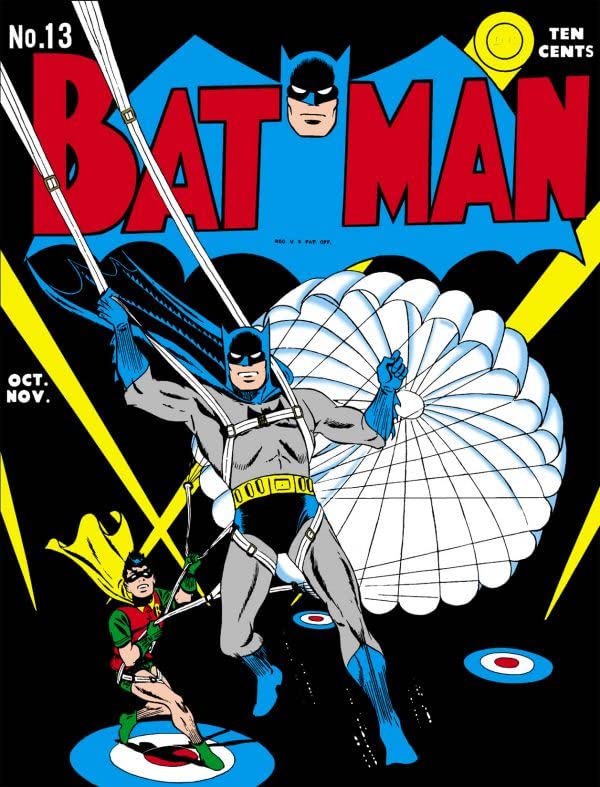
Batman #13
Batman #13 (cover-dated November 1942) is a rich anthology snapshot of the Golden Age Batman at his peak creative momentum, packing four complete stories into a single issue and featuring what is one of the most delightfully strange Joker plots of the era — a scheme built around making people cry. Its deepest cultural distinction is the 'Comedy of Tears' story, in which Dick Grayson, undercover as an autograph hunter while tracking the Joker, secures signatures from two of mid-century America's most recognizable celebrities: baseball legend Joe DiMaggio and Superman co-creator Jerry Siegel — a crossover of comics and popular culture that speaks volumes about how fully Batman had embedded himself in the mainstream imagination by 1942. The issue also introduces the villain the Thumb in its lead story, a minor but documented addition to the Golden Age rogues' gallery, and presents the emotionally resonant 'Batman Plays a Lone Hand,' in which Bruce Wayne feigns rejection of Robin to shield the boy from a death threat — an early, earnest articulation of the protective bond at the heart of the Dynamic Duo's partnership.
In "The Batman Plays a Lone Hand!", Batman takes on a dangerous case when a pair of disguised criminals—posing as a doctor and nurse—board a train to assassinate a condemned man during his transfer to the gas chamber, using an iron lung as their weapon. Written by Don C. Cameron and brought to life by Bob Kane’s iconic art, with inks by Jerry Robinson and George Roussos, this 1942 classic showcases the Dark Knight at his most solitary and determined. The cover, also by Jerry Robinson, captures the tension of the moment with sharp, dynamic lines.
In "The Batman Plays a Lone Hand!" from Batman #13 (1942), Bruce Wayne’s sudden and harsh dismissal of Dick leaves the Boy Wonder reeling—only to uncover a chilling truth: the Thumb has taken Dick hostage, forcing Batman to go it alone. The stakes are personal, the tension razor-sharp, as Batman must navigate a dangerous game where every move could cost Dick his life.
In "The Story of the Seventeen Stones!" from Batman #13 (1942), former mob enforcer Rocky Grimes—once jailed for twenty years on a rock pile after losing his memory—turns to a strange, calculated revenge using seventeen mysterious stones. With no past to guide him and a mind full of buried grudges, he begins targeting the men who betrayed him, one stone at a time.
In "Destination Unknown!" from Batman #13 (1942), a pair of criminals posing as a doctor and his nurse hijack a train bound for a death row transfer, their sinister plan hidden beneath a veneer of medical authority. As the journey unfolds, Batman must unravel the deception before the condemned man becomes a victim of a twisted execution inside an iron lung.
ComicBooks.com Value
Show all 20 grades ▾
Find on ebay
Read it digitally
Sell my copy
Have this issue — or a whole collection? Get a fair offer from us, skip the marketplace fees and the hassle.
We Buy Collections ▸History
The issue was published on August 8, 1942, with a cover by Jerry Robinson, whose inked work also appears throughout the interior stories alongside pencils credited to Bob Kane. Story credits inside the issue were revised by later scholarship: 'Comedy of Tears' was confirmed to have been scripted by editor Jack Schiff (not Bill Finger, as previously believed), while 'The Batman Plays a Lone Hand' was reassigned to writer Don C. Cameron — revisions verified by Schiff himself and researcher Martin O'Hearn respectively. Inking throughout is confirmed by Robinson and George Roussos, with Roussos also handling lettering; Jack Burnley contributed art to at least one story. The issue appeared just as the Batman title's growing bimonthly pace was increasing pressure on Kane's studio, prompting a collaborative ghost-artist system that would define the series for years.
Trivia · 8 facts
- Published August 8, 1942; cover-dated November 1942; 68 pages; published by DC Comics under editor Whitney Ellsworth.
- Cover art by Jerry Robinson; interior story art by Bob Kane (signed), Jerry Robinson (inks), George Roussos (inks/backgrounds/letters), and Jack Burnley.
- Contains four complete stories: 'The Batman Plays a Lone Hand,' 'Comedy of Tears,' 'The Story of the Seventeen Stones,' and 'Destination Unknown.'
- Introduction of the Thumb, a villain who threatens Robin's life to force Batman to work alone — his sole appearance in the lead story 'The Batman Plays a Lone Hand,' scripted by Don C. Cameron.
- 'Comedy of Tears,' scripted by Jack Schiff, features in-story cameo appearances by baseball star Joe DiMaggio and Superman co-creator Jerry Siegel; Dick Grayson obtains Siegel's autograph, with the story explicitly identifying him as 'the creator of Superman.'
- Writer credits for multiple stories in this issue were long misattributed to Bill Finger; revised credits were later verified by Schiff himself (for 'Comedy of Tears') and researcher Martin O'Hearn (for 'The Batman Plays a Lone Hand').
- In 'Destination Unknown,' Dick Grayson goes undercover selling comic books on a train; two of the comics visible in-story are World's Finest Comics and Batman #12 — a playful piece of self-referential meta-fiction.
- Reprinted in the hardcover collection Batman: The Dark Knight Archives Vol. 4 (which collects Batman stories from October 1942 through April 1943) and in Batman: The Golden Age Vol. 4.
Cast · 6 characters
Full credits
Reprints
Reprinted in Batman: The Dark Knight Archives #4 (2003), Batman: Cover to Cover #[nn] (2005), The Batman Chronicles #7 (2009), Batman: The War Years 1939-1945 #[nn] (2015), Batman: The Golden Age Omnibus #2 (2016), Batman: The Golden Age #4 (2018)
Key issues in Batman
 ★
★ ★
★ ★
★ ★
★ ★
★ ★
★ ★
★ ★
★Reviews
Reader reviews
No reader reviews yet.