
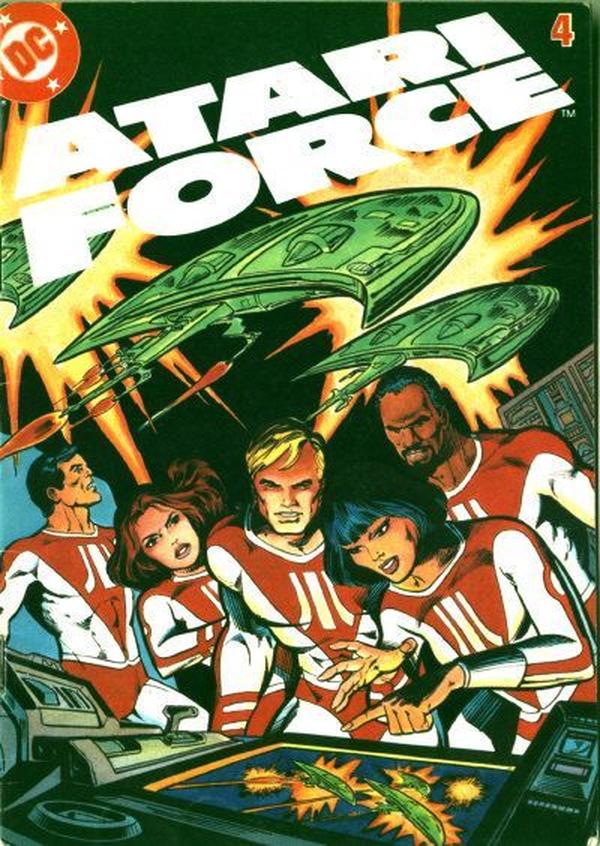
Atari Force #4
☆ Be the first to review + Add to your collection — Join freeAtari Force #4 occupies a genuinely singular spot in comics history as part of the first sustained collaboration between a major comic publisher and a video game company — a direct precursor to the multimedia cross-promotional model that the industry now takes for granted. The issue's story, centered on a desperate mission against the alien Malaglon armada, proved generative far beyond its stapled pages: Atari adapted it directly into the 1982 arcade game Liberator (officially branded 'Atari Force: Liberator'), making this one of the earliest cases of a comic book narrative becoming the explicit source material for a commercial arcade release. Its brief, tightly paced 20-page format — a notable departure from the 52-page structure of the series' first three issues — also demonstrates how DC and Atari were actively adjusting the editorial scope of the experiment mid-run. As part of the five-issue mini-comic arc that seeded a full monthly DC series, a standalone graphic novel, and ongoing character mythology, issue #4 is a concrete link in the chain that helped legitimize video-game storytelling as a vehicle for serious science-fiction comics.
ComicBooks.com Value
This exact issue on ebay
Raw — FN ▾ $3.99–$5.6 3 listings
Raw / ungraded ▾ $1.95–$25 24 listings
Read it digitally
Sell my copy
Have this issue — or a whole collection? Get a fair offer from us, skip the marketplace fees and the hassle.
We Buy Collections ▸History
The entire Atari Force mini-comic series was conceived as a marketing partnership between two Warner Communications subsidiaries — DC Comics and Atari, Inc. — with writers Gerry Conway and Roy Thomas and artists Ross Andru, Gil Kane, Dick Giordano, and Mike DeCarlo producing all five pack-in issues. Issue #4's story had an unusually visible pre-publication life: a version titled 'Liberator Mission: Freedom Or Death' was previewed as an insert in two mainstream DC titles, New Teen Titans #1-27 and DC Comics Presents #53, before being reworked for the Phoenix pack-in — with the ship's name changed from Liberator to Phoenix to match the cartridge, and the Malaglon aliens redesigned from a frog-like appearance to a more menacing reptilian one. That retooled story was then repurposed again when Atari released the Liberator arcade cabinet using Martin Champion and the Atari Force name, giving the issue an unusually tangled production and adaptation history for a promotional comic.
Trivia · 8 facts
- Packaged as a free insert with the Atari 2600 port of the arcade game Phoenix in 1982, tying its narrative directly to that cartridge's alien-shooter premise.
- Written by Gerry Conway and Roy Thomas, with art by Ross Andru and Dick Giordano — the same creative pool that produced the full five-issue mini-comic run.
- Featured characters include mission commander Martin Champion, pilot Lydia Perez, security officer Li-San O'Rourke, flight engineer Mohandas Singh, and medic Dr. Lucas Orion, as well as civilian pilots Bob and David Marcus and the antagonist alien species the Maglaglon/Malaglon.
- At 20 pages, the issue is significantly shorter than the first three issues of the series, each of which ran approximately 52 pages — representing a deliberate mid-series format reduction.
- The issue's story was pre-published in a different form — titled 'Liberator Mission: Freedom Or Death' — as a preview insert in New Teen Titans Vol. 1 #27 and DC Comics Presents #53, before being revised for the Phoenix pack-in.
- Key differences between the preview and the final version include the renaming of the heroes' ship from Liberator to Phoenix and a redesign of the Malaglon aliens from a frog-like to a more sinister reptilian appearance.
- The story served as the direct narrative basis for Atari's 1982 arcade game Liberator, which was officially branded 'Atari Force: Liberator' and featured Commander Martin Champion.
- The Atari Force mini-comic series as a whole — of which this is the fourth issue — is widely cited as one of the earliest examples of a sustained comic book/video game cross-promotional franchise, predating the multimedia tie-in model that became standard practice in both industries.
Full credits
Reprints
Reprinted in DC Comics Presents #53 (1983), The New Teen Titans #27 (1983)
Reviews
Reader reviews
No reader reviews yet.