
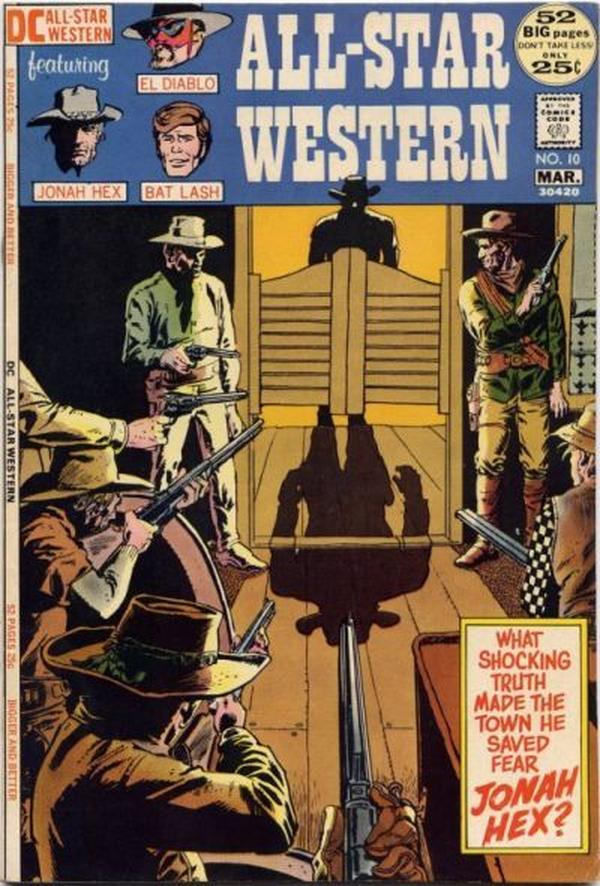
All-Star Western #10
All-Star Western #10 (February–March 1972) marks the first full story appearance of Jonah Hex, DC's most enduring Western character — a morally ambiguous, scarred bounty hunter who broke sharply from the clean-cut cowboy heroes that had defined the genre for decades. At a moment when the Western comic was nearly extinct, writer John Albano and artist Tony DeZuniga's debut story, 'Welcome to Paradise,' immediately framed Hex not as a redeemable hero but as a cold, calculating loner rejected by the very town he saved — a subversive premise that gave the Western genre a second life on the stands. The issue also carries significance beyond its pages: DeZuniga was the first Filipino artist whose work was accepted by a major American publisher, and his success on this very title prompted DC editorial to scout talent in the Philippines, triggering the broader 'Filipino Wave' that reshaped the look of 1970s mainstream comics. The character launched here would sustain nearly uninterrupted publication across five decades, multiple solo series, Vertigo miniseries, animated appearances, and a live-action film.
In "My Name Is... Bat Lash! Part 2," Bat Lash confronts the man who betrayed his family, leading to a deadly reckoning. After being arrested for the killing, he recounts the truth to the sheriff—how Rickett's fraud destroyed his parents, forced him to flee with his sister and fiancée, and how they found refuge in a convent. Now free, Bat Lash seeks out Melissa and Bitsy, only to learn they’ve chosen to take vows and remain at the convent.
ComicBooks.com Value
Show all 22 grades ▾
This exact issue on ebay
CGC 8.5 ▾ $985–$1,000 2 listings
CGC 8 ▾ $679–$875 2 listings
CGC 5.5 ▾ $399–$400 2 listings
Raw / ungraded ▾ $3.99–$2,500 6 listings
More listings for this title
Read it digitally
Sell my copy
Have this issue — or a whole collection? Get a fair offer from us, skip the marketplace fees and the hassle.
We Buy Collections ▸History
The second volume of All-Star Western had been running since September 1970 as a bimonthly anthology mixing new stories with reprints of characters like El Diablo, Bat Lash, and historical Western figures, edited by Joe Orlando. By 1972, the title had expanded to a 52-page giant format that allowed room for both new material and backup reprints — it is in this expanded slot that writer John Albano and artist Tony DeZuniga debuted their new bounty hunter. DeZuniga, who had entered the U.S. market at DC only in 1970, had already established himself under editor Joe Orlando; it was his insistence that Orlando travel to Manila in 1971 to scout Filipino talent, a trip that predated the publication of this very issue. DeZuniga has described the visual genesis of Hex's bilateral disfigurement as inspired by a medical anatomy chart he saw at his doctor's office — the image of a figure split exactly in half, one side healthy and one side skeletal, became the template for Hex's split face. The series would be retitled Weird Western Tales beginning with issue #12, with Hex immediately established as its headliner.
Trivia · 7 facts
- First full story appearance of Jonah Hex, written by John Albano and drawn by Tony DeZuniga, in the story titled 'Welcome to Paradise.'
- The issue also contains an El Diablo story by Bob Kanigher with art by Gray Morrow, and a Bat Lash reprint ('My Name is Bat Lash!' Part 2) scripted by Sergio Aragonés and Denny O'Neil with art by Nick Cardy and Mike Sekowsky; editor was Joe Orlando.
- Tony DeZuniga also provided the cover art for the issue; he is credited as the first Filipino comic book artist whose work was accepted by major American publishers, and his success at DC directly led to a wider recruitment of Filipino artists to U.S. comics in the early 1970s.
- The Jonah Hex debut story presents the character as a bounty hunter hired to clear outlaws from a town called Paradise Corners; after succeeding, he is coldly rejected by the townspeople — establishing from the outset his status as an outcast antihero rather than a conventional Western hero.
- The title was renamed Weird Western Tales beginning with issue #12 (July 1972), with Hex immediately becoming its lead feature through issue #38, before graduating to his own self-titled series in 1977 that ran for 92 issues.
- DC reprinted the issue as part of its Millennium Edition line in April 2000, recognizing it as a key historical issue; 'Welcome to Paradise' has since been reprinted in Showcase Presents: Jonah Hex Vol. 1 (2005/2006), Jonah Hex: Welcome to Paradise (2010), and Weird Western Tales: Jonah Hex (2020), among other collections.
- A DC house advertisement previewing Jonah Hex — containing two comic-strip panels not used in the actual story — appeared in various November/December 1971 DC titles including Batman #237 before the issue itself was on sale, making those ads technically the first published images of the character.
Full credits
Reprints
↩ Reprints Bat Lash #6 (1969)
Reprinted in Tomahawk #8/1972 (1972), Tomahawk #8/1972 (1972), Tomahawk #9/1972 (1972), Tomahawk #9/1972 (1972), Tomahawk #11/1972 (1972), Jonah Hex #5 (1977), Tomahawk #8/1979 (1979), Tomahawk #6/1979 (1979), Jonah Hex #5 (1982), Heróis em Ação #5 (1984), Millennium Edition: All-Star Western 10 #[nn] (2000), Showcase Presents: Jonah Hex #1 (2006), Showcase Presenta Jonah Hex #1 (2009), Jonah Hex: Welcome to Paradise #[nn] (2010), Showcase Presents: Jonah Hex #2 (2014), Weird Western Tales: Jonah Hex #[nn] (2020), Hopalong Cassidy #217
Key issues in All-Star Western
Reviews
Reader reviews
No reader reviews yet.