
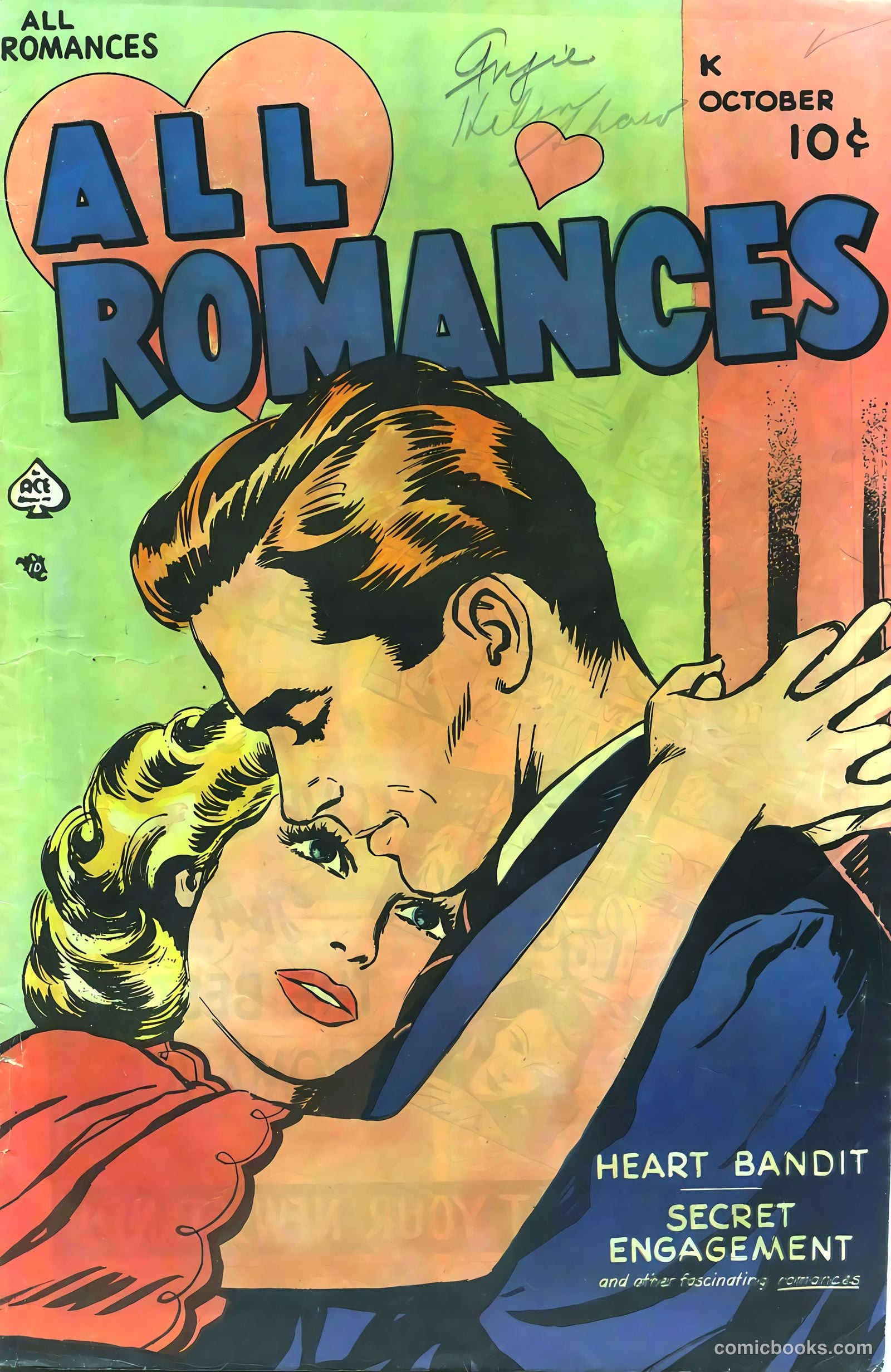
All Romances #2
☆ Be the first to review + Add to your collection — Join freeAll Romances #2 is a concrete artifact of one of the most consequential genre shifts in American comics history: the romance explosion of 1949, when publishers across the industry rushed to capitalize on the runaway success of Simon & Kirby's Young Romance (1947). Ace Magazines, which had previously concentrated on superheroes and pulps, pivoted hard into romance that year, launching All Romances as part of a broad new line aimed squarely at young female readers. The series — and issue #2 in particular, arriving in October 1949 at the height of the genre boom — represents Ace's early, line-drawn phase of romance publishing before the publisher refined its approach with the painted glamour covers that would later distinguish its longer-running titles. As one of only six issues in a short-lived run, every number in the series is a compact time capsule of how second-tier Golden Age publishers adapted storytelling conventions lifted from pulp romance magazines into the comics format.
In "Menace to Our Marriage," Barbara finds herself drawn to a mysterious stranger browsing jewelry, but his sudden appearance coincides with a robbery that shakes her world. Written and illustrated by Chuck A. Winter, this 1949 tale from Ace Magazines unfolds with quiet tension, leaving readers wondering if the man she's falling for is the one behind the crime. The cover, by Alice Kirkpatrick, captures the moment's suspense in sharp, expressive detail.
When Sue's old best friend Madge arrives for a recuperative visit, Sue is thrilled—but her husband George's growing attention to the charming houseguest soon has Sue wondering if her friend's interest in him is more than friendly. As Madge's mysterious "tiredness" conveniently vanishes each evening while Sue finds herself doing all the housework, Sue must figure out whether she's imagining a threat to her marriage or if her instincts about Madge's true intentions are all too correct.
When Leslie Blaine's mother marries Ross Kirby's wealthy father, it sets off a chain of suspicion and conflict that pulls Leslie and Ross apart just as they're getting to know each other. But when Jim Kirby's unexpected will leaves his estate to Leslie's mother—with a condition that Ross must stay at Kirby House for two years to claim his inheritance—Leslie finds herself caught between her growing feelings for Ross and his conviction that she and her mother are scheming gold diggers. As tensions simmer and old family wounds resurface, Leslie struggles to prove her family's true intentions while Ross grows increasingly certain of the worst.
In "Heart Bandit," Jo, a jewelry store clerk, finds herself drawn to a quiet, enigmatic man who wanders in one evening. As she watches him browse the display, her heart quickens—until a sudden robbery erupts, leaving her wondering if the man she’s fallen for is the thief.
Janie works as a cigarette girl at the Old Barn Club, secretly engaged to Freddie Hale, the orchestra leader—a ring she must hide to protect his career and popularity. When the sultry singer Elayne Daye lands a Hollywood screen test and decides to take Freddie along as her musical director, Janie faces a painful choice between her love for him and her loyalty to his dreams. As the two prepare to leave for California, Janie must decide whether to speak up or let him go.
ComicBooks.com Value
Find on ebay
Read it digitally
Sell my copy
Have this issue — or a whole collection? Get a fair offer from us, skip the marketplace fees and the hassle.
We Buy Collections ▸History
Ace Magazines — operating through a web of affiliated imprints including AA Wyn, Ace Periodicals, and Humor Publications — launched All Romances in August 1949 and ran it for six issues through June 1950, published under the AA Wyn / Ace Periodicals and Humor Publications imprints. The title arrived just as the newsstand was flooded with romance imitators following Simon & Kirby's genre-defining work, with publishers like Quality, Fawcett, Fox, and Timely all entering the field at roughly the same moment. Ace's early romance covers, including those on All Romances, were described by period historians as 'lackluster line-drawn' efforts before the company later distinguished itself with pulp-style painted covers on its longer-lived titles. L. B. Cole, who contributed to at least one issue of the All Romances series during its 1949–1950 run, was among the artists associated with Ace's romance output at this time, though which specific issue(s) he worked on has not been independently confirmed for issue #2.
Trivia · 7 facts
- Published by Ace Magazines (under AA Wyn / Ace Periodicals & Humor Publications imprints) as issue #2 of a six-issue run (August 1949 – June 1950).
- Cover-dated October 1949, placing it squarely within the peak of the Golden Age romance comics boom.
- The series ran for exactly six issues (#1–#6), making it one of Ace's shorter romance titles compared to the publisher's longer-lived Real Love and Glamorous Romances.
- All Romances was part of Ace Magazines' aggressive 1949 pivot into romance comics — a genre the company would dominate as a significant second-tier publisher through 1956.
- L. B. Cole, a prolific Golden Age artist known for striking cover work across horror and romance titles, had at least one credit across the All Romances series during its run, per League of Comic Geeks records.
- The series predates Ace's later shift to painted glamour covers; early issues including #2 featured line-drawn cover art in the style typical of the genre's first wave.
- A modern reprint of All Romances #2 was produced by Golden Age Reprints (via CreateSpace) and made available in print and digital formats, indicating enough collector/historian interest to justify reproduction.
Full credits
Reprints
Reprinted in Love at First Sight #25 (1953), Love Experiences #25 (1954), Golden Comics #2 (2009)
Reviews
Reader reviews
No reader reviews yet.