
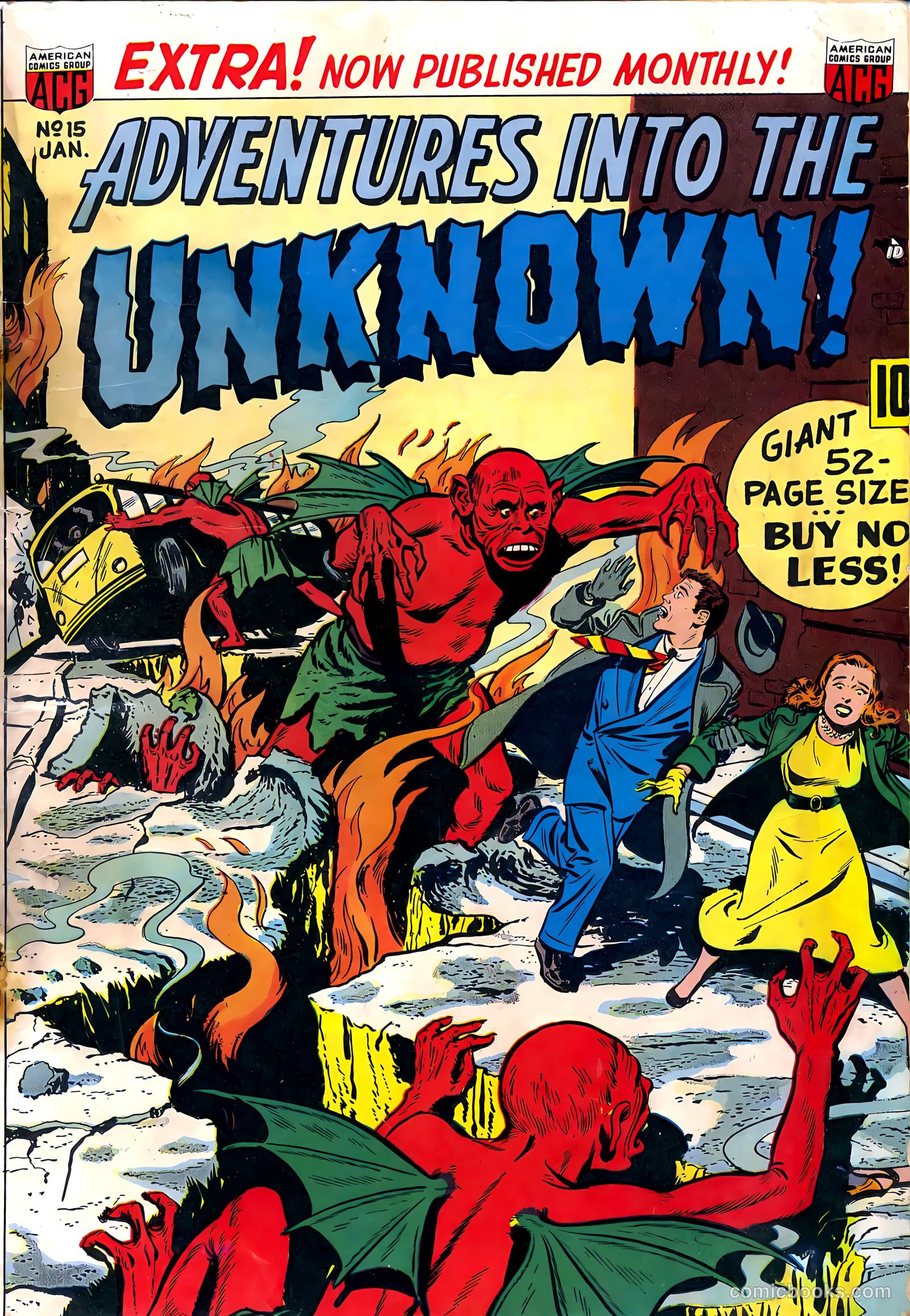
Adventures into the Unknown #15
☆ Be the first to review + Add to your collection — Join freeAdventures into the Unknown #15 is a mid-run chapter of what historians recognize as the comic book medium's first ongoing horror anthology title — a distinction the series held well over a year before EC Comics entered the horror genre. The issue exemplifies ACG's pre-Code formula at full stride: a diverse slate of supernatural short stories packaged in a visually arresting Ogden Whitney cover, demonstrating that the series had solidified its identity and stabilized its creative team by early 1951. The series as a whole weathered the anti-comics hysteria of the early 1950s and the restrictive Comics Code that drove competitors like EC out of horror altogether, making each surviving pre-Code issue a document of that contested cultural moment. Issue #15 sits in this durable run as representative evidence of how ACG — unlike many rivals — built an anthology that could outlast censorship and run continuously for nearly two decades.
This issue contains at least two distinct supernatural horror tales. In one story, a man discovers an ancient phonograph record bearing a cursed rune that, when played, summons a malevolent voice from Gothic times; he attempts to destroy the record to break the spell. In another tale, a couple encounters a mysterious woman who transforms into a monstrous half-ape creature; they discover she is an ancient being who has lived for centuries in an underground tunnel, kept alive by cosmic rays, and she ultimately disintegrates when exposed to sunlight.
When explorers Arthur and Sylvia encounter the dying Professor Simon McBane in an uncharted jungle, he entrusts them with a mysterious seed—one he claims will allow his spirit to live on after death. Back home in their Maryland greenhouse, they follow his cryptic instructions to the letter, but Sylvia's secret sabotage threatens to destroy the experiment entirely, with terrifying consequences when the plant finally blooms.
When Charles Wentworth travels to the Danish boglands to study an ancient runic monument at Professor Gustav Thorvaldsen's request, he and his wife Blanche discover far more than they bargained for—the carved warnings aren't mere superstition, and reading the runes aloud awakens something that's been sleeping for fifteen centuries. A ghostly army of Goths emerges from the dead with a singular, terrible purpose: to hunt down the man who desecrated their sacred stone and bring an ancient curse to life. Written by the artists of Adventures into the Unknown, "The Ghostly Goths" blends historical dread with supernatural vengeance in this 1951 tale.
When Don Pearson inherits his estranged relatives' charity dreams along with a modest sum from their late grand-uncle D.P., he accepts an invitation to stay at the decaying Braxton Hall—only to find himself haunted by a ghostly presence his cousins Harvey and Alma have no intention of acknowledging. As Don's grip on sanity begins to slip under the weight of supernatural encounters, a deeper mystery emerges: the phantom may have designs of its own that run counter to his cousins' scheme. In "The Ghost That Didn't Die," writer and interior artist spin a tale where greed, haunting, and hidden purpose collide in the dusty corridors of an old sea captain's mansion.
Professor Joel Hollister and his fiancée Fern Prescott journey to Gibraltar to investigate a strange captured creature—neither fully man nor ape—that may be the legendary missing link. When the beast mysteriously disintegrates before their eyes, they uncover ancient cave drawings and legends pointing to a hidden submarine tunnel and a supernatural being called Melor, who has kept an immortal colony of these creatures as slaves for centuries. As they explore the concealed passage beneath the Mediterranean, they discover far more than a scientific mystery waiting in the darkness below.
When Gail Mason finds a mysterious ring in the park on her way to a masquerade party, she has no idea it carries the mark of Anubis, the ancient Egyptian god of the dead—and wearing it draws her into a terrifying supernatural influence beyond her control. As Steve Blake races to understand what's happening to his fiancée, he must uncover the connection between the cursed ring and Mustapha Ahmed's antique shop before Gail is lost to forces far older and darker than the modern world can explain. Written and illustrated by the creative team at ACE Comics, "The Bride of Anubis" weaves 1950s mystery with genuine occult dread across seven unforgettable pages.
ComicBooks.com Value
Show all 20 grades ▾
Find on ebay
Read it digitally
Sell my copy
Have this issue — or a whole collection? Get a fair offer from us, skip the marketplace fees and the hassle.
We Buy Collections ▸History
The issue was published in January 1951 by the American Comics Group (ACG), a publisher co-founded in 1943 by Harry Donenfeld and Benjamin W. Sangor, with Richard E. Hughes — whose real name was Leo Rosenbaum — serving as the driving editor and prolific behind-the-scenes writer throughout the title's run. Hughes, who used a rotating battery of pseudonyms, is credited by comic historians with establishing ACG's unusually high editorial standards across the horror and fantasy genres. By issue #15 the cover and interior art duties had fallen substantially to Ogden Whitney, who would become the artist most associated with ACG's visual identity through the 1950s and into the 1960s.
Trivia · 8 facts
- Published January 1951 by American Comics Group (ACG); cover-dated the same month, placing it firmly in the pre-Code Golden Age horror era.
- Part of Adventures into the Unknown, recognized as the comic book medium's first ongoing horror anthology title, which launched in Fall 1948 — more than a year before EC Comics debuted its own horror line.
- Cover art by Ogden Whitney depicts demonic or gargoyle-like creatures clawing up from a crack in the earth, menacing human figures — a striking example of early horror cover design.
- Interior stories confirmed for this issue include: 'The Monstrous Plant,' 'The Ghostly Goths' (also illustrated by Ogden Whitney), 'The Ghost That Didn't Die' (art by Ogden Whitney), 'Goddess of the Beasts' (art by Fred Guardineer), and 'The Bride of Anubis.'
- Edited throughout its run by Richard E. Hughes (real name Leo Rosenbaum), who wrote scripts under numerous pen names and is credited by scholars as the primary creative force behind ACG's consistent quality.
- Interior art contributors for #15 include Ken Bald, Edvard Moritz, Ogden Whitney, and Fred Guardineer — a stable of ACG workhorse artists active across the early 1950s issues.
- The parent series ran for 174 issues (Fall 1948 – August 1967), surviving both the 1954 Senate Subcommittee on Juvenile Delinquency hearings and the implementation of the Comics Code, which forced EC Comics to abandon horror entirely.
- The series, including the era covering issue #15, has been collected in hardcover archive editions by PS Artbooks (later also Dark Horse), with issues 1–83 gathered in the ACG Collected Works series, making these early issues accessible to modern readers.
Full credits
Reprints
Reprinted in Crypt of Horror #18 (2013), Adventures into the Unknown Archives #4 (2015), Golden Comics #4, Tales of Torment #2, Weird Planets #23
Key issues in Adventures into the Unknown
Reviews
Reader reviews
No reader reviews yet.