
A ComicBooks.com exhibition
Women Who Drew the Funnies
The early comics page belonged to men. A few women drew their way onto it anyway — and one of them built a merchandising empire out of a fat-cheeked cherub. This is what survives of their work.
The women who got in
Open a newspaper comics section from 1905 and you are looking at a room full of men. The strip, the editorial cartoon, the syndicate that sold them — all of it drawn and run by men, and the trade press wrote as if that were simply the nature of the thing. A few women got in anyway, and the three at the center of this room did more than get in. They set styles the rest of the page copied.
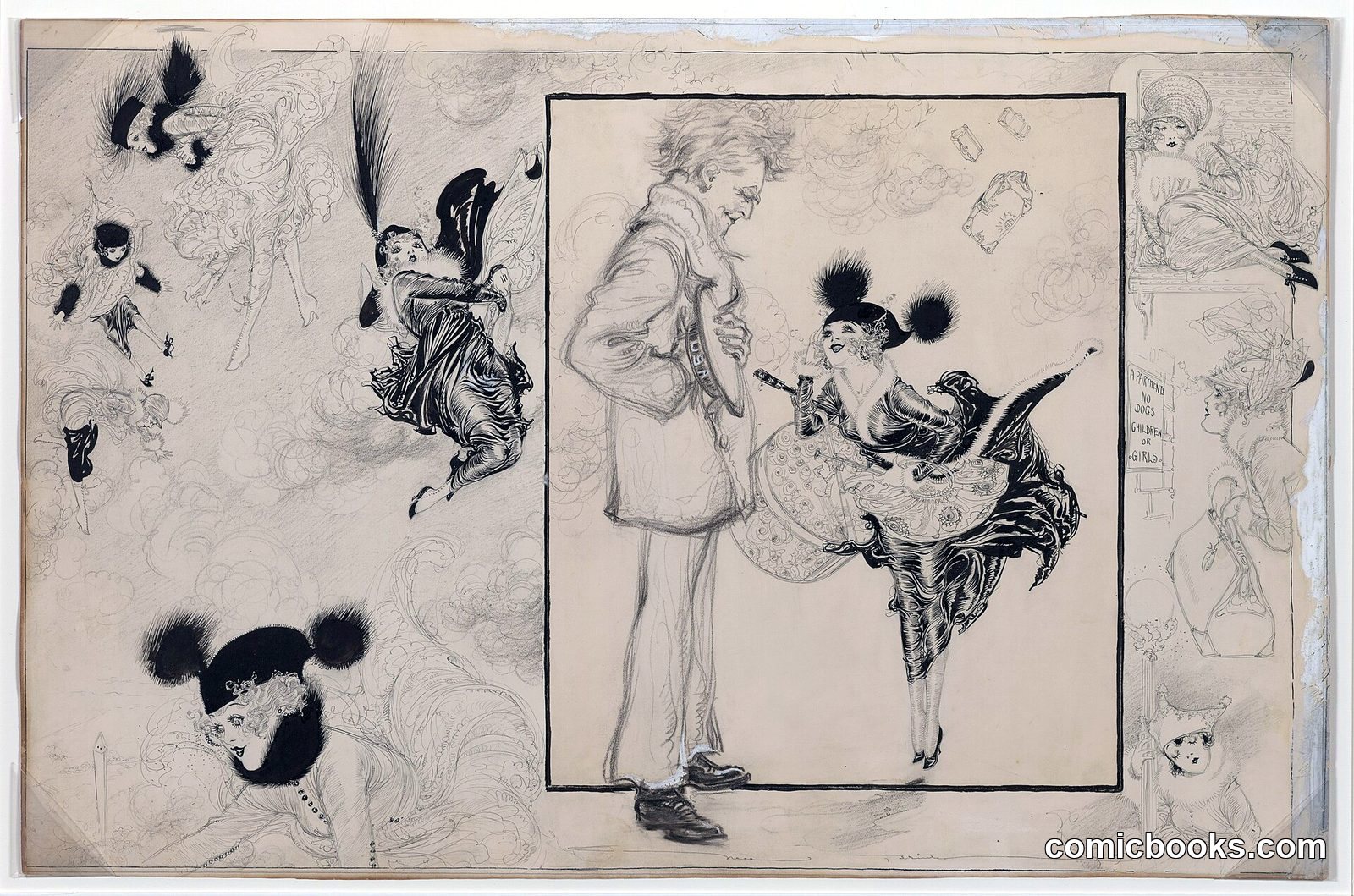
Rose O'Neill (1874–1944) was the first American woman to make a full living as an illustrator. In 1909 she introduced the Kewpies, plump topknot babies who grew into one of the earliest licensed-character empires — dolls, soap, china, cut-out pages — and who also, in her hands, marched under banners reading VOTES FOR WOMEN. Nell Brinkley (1886–1944) became William Randolph Hearst's star while barely out of her teens; her feathery pen-and-ink "Brinkley Girl" serials sold papers, dictated hairdos, and surfaced as a Ziegfeld number. Grace Drayton (1877–1936) was among the first syndicated women cartoonists, inventor of the Campbell Soup Kids and creator of the dimpled-girl strip.
Here is the uncomfortable part. Set their fame beside what survives in the public domain and the shelf is nearly bare. Most of their output was advertising, postcards, and next-day newspaper pages — made to be printed cheaply, used, and discarded, and often published under a monogram or no name at all. The scarcity isn't an accident of storage. It is what happens when an industry treats a body of work as disposable, and the women who made it as interchangeable. The thinness of this record is not a footnote to their story. It is the story.
A timeline
- 1896Rose O'Neill is working as a magazine illustrator in New York, among the very few women earning a place in the trade.
- 1904Grace Drayton, signing as Grace Gebbie Wiederseim, draws the round-cheeked children who become the Campbell Soup Kids.
- 1907Nell Brinkley joins the Hearst papers in New York; the "Brinkley Girl" quickly makes her a household name.
- 1909Rose O'Neill introduces the Kewpies in the Ladies' Home Journal.
- 1913The first Kewpie dolls go into production, launching one of the earliest licensed-character empires.
- 1915O'Neill draws Kewpies for the suffrage campaign, including "The Spirit of '76 — Votes for Women."
- 1920The Nineteenth Amendment passes; the cause O'Neill's Kewpies marched for is won.
- 1929Grace Drayton launches the newspaper strip Dottie Dimple, still working the dimpled-child character she had drawn for decades.
Look at the range one more time. The same women moved from a suffrage postcard to a Venetian society portrait to a railroad ad for oranges, and did it because versatility was the price of steady work when the byline was rarely yours to keep. O'Neill funded a bohemian life on a cartoon baby and gave that baby a politics. Brinkley drew a girl so alive that readers restyled their hair to match, then sat for a photograph the record kept while much of her art slipped away. Drayton's cleanest surviving portrait reached us because it traveled to Havana and got printed under her full name. None of them were curiosities or lucky exceptions. They were professionals who built the look of a young medium and then watched a good deal of it get thrown out. What is left is enough to argue from, and nowhere near enough.