
A complete issue · 18 pages · 1879
The Wasp — October 18, 1879

I can see this is a test/calibration page from *The Wasp* magazine, not an actual cartoon or article page. The image shows two Oregon Rule Co. measurement scales (one vertical, one horizontal) and a standard grayscale color reference chart on a black background—tools used in photographic reproduction and archival documentation. This appears to be a technical page included in the publication for quality control purposes during printing and preservation, rather than satirical or editorial content. Without actual cartoon artwork or article text visible, I cannot identify political figures, social references, or satirical intent. If you have a different page from *The Wasp* with actual editorial content, I'd be happy to analyze that instead.
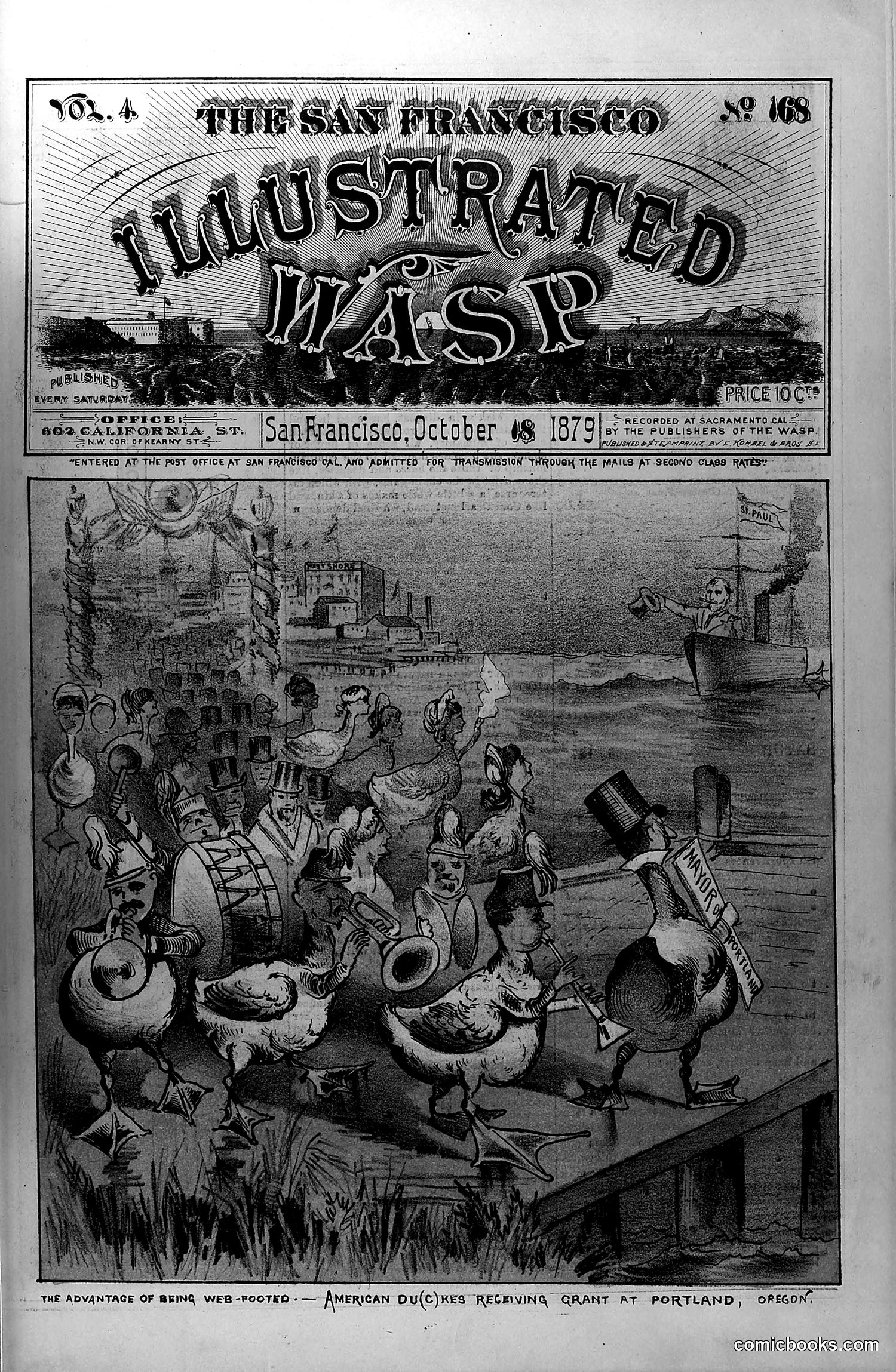
The cartoon's caption reads "The Advantage of Being Web-Footed: American Dukes Receiving Grant at Portland, Oregon." This satirizes American wealthy men (called "dukes" mockingly) who are depicted as anthropomorphic ducks. The joke appears to reference the reception given to Ulysses S. Grant during his post-presidential world tour, which included Portland, Oregon in 1879. The "web-footed" reference likely mocks both: 1. Portland's wet climate and association with water/ducks 2. American industrialists as mere waterfowl—stupid, superficial creatures engaged in foolish socializing rather than serious business The satirical intent suggests criticism of wealthy elites and their pretentious gatherings, using animal caricature as a degrading comparison.
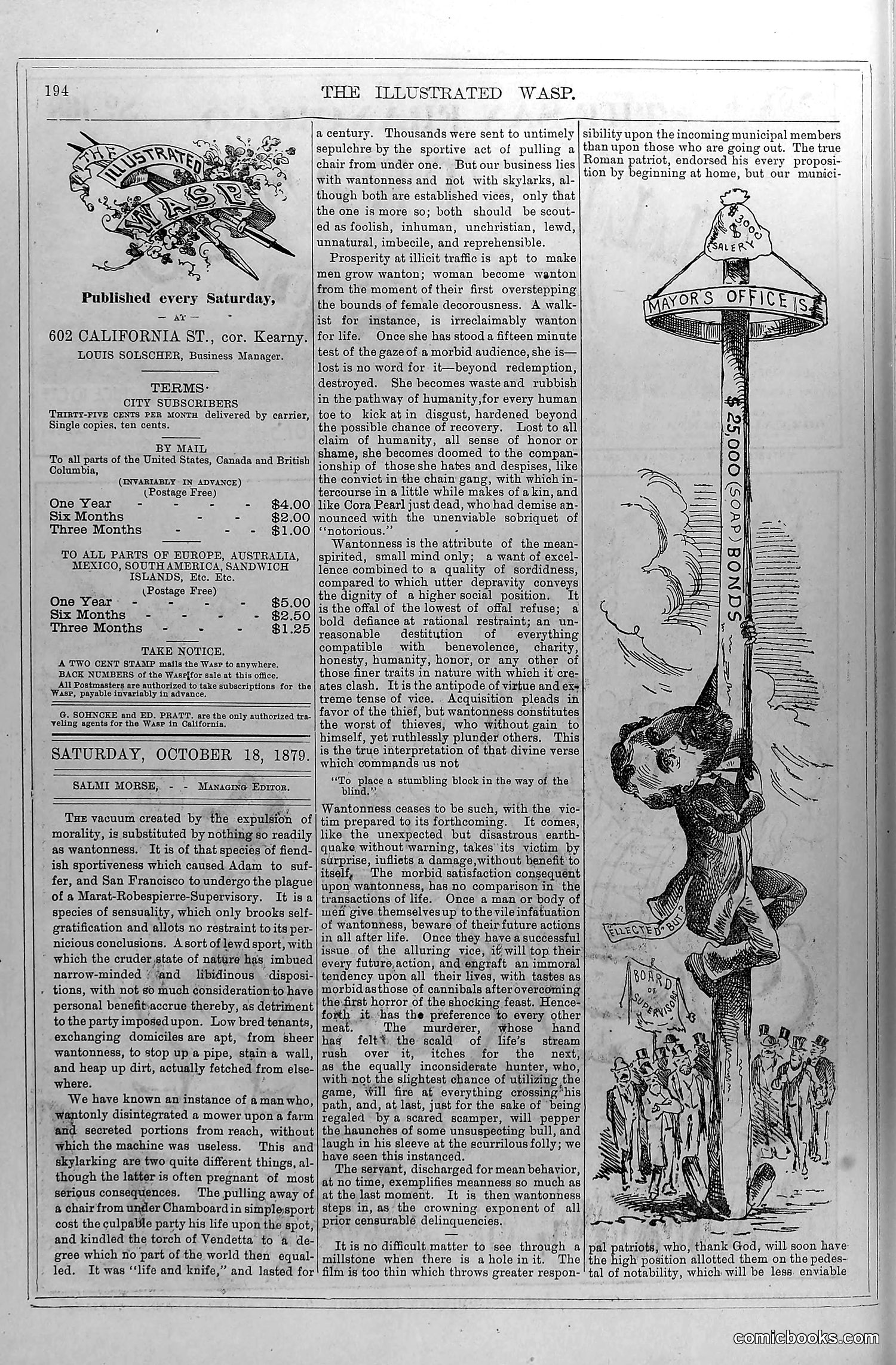
The main illustration depicts a figure labeled "MAYOR'S OFFICE" being used as a signpost or hitching post—literally degraded to street furniture. This is a satire of San Francisco's mayor, suggesting municipal leadership has become useless or corrupt, reduced to a public mockery. The accompanying article by "Salmi Morse" discusses wantonness and moral decay, using the metaphor of a "Marat-Rockespiere-Supervisory" species of "semantic" woman who causes social ruin. The text attacks women who abandon respectability after minor social transgressions, arguing they become public menaces equivalent to criminals. The satire conflates municipal corruption (the mayor as object) with anxieties about women's morality and social status—typical 1870s themes of urban disorder.
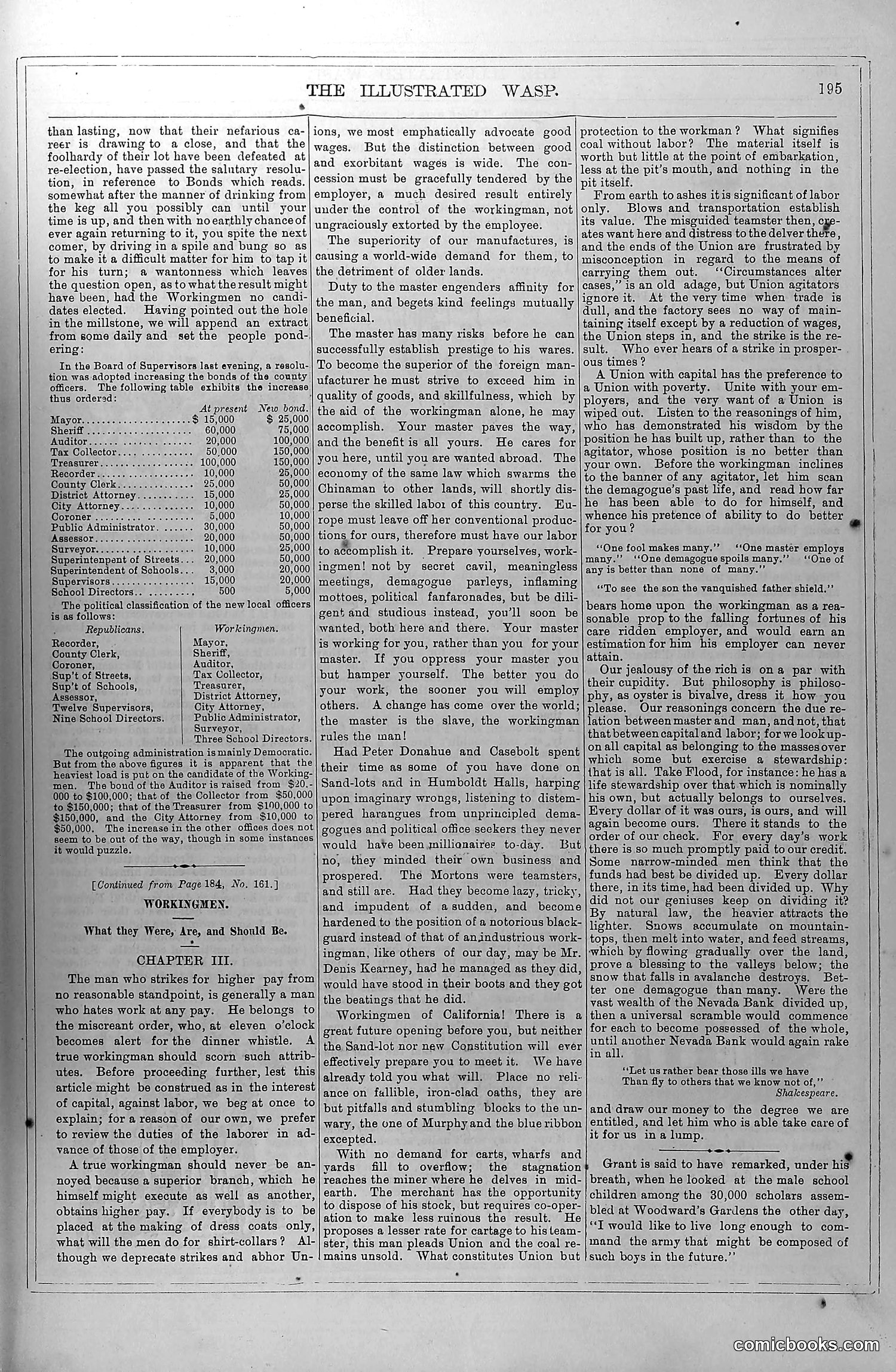
This page consists primarily of text rather than illustrations. It's Chapter III of an article titled "Workingmen: What they Were, Are, and Should Be," discussing labor conditions and worker advocacy. The content addresses strikes for higher wages, criticizing both workers who "hate work at any pay" and employers who exploit labor. It references specific California issues, including the Sand-lot movement and recent Nevada Bank troubles. The article advocates for worker organization and fair wages while cautioning against destructive tactics. It mentions historical figures like the Mortons (apparently labor agitators) and discusses practical economic concerns: fair distribution of profits, worker dignity, and capital versus labor relations. The tone is reformist rather than revolutionary—seeking negotiated improvements rather than radical change.
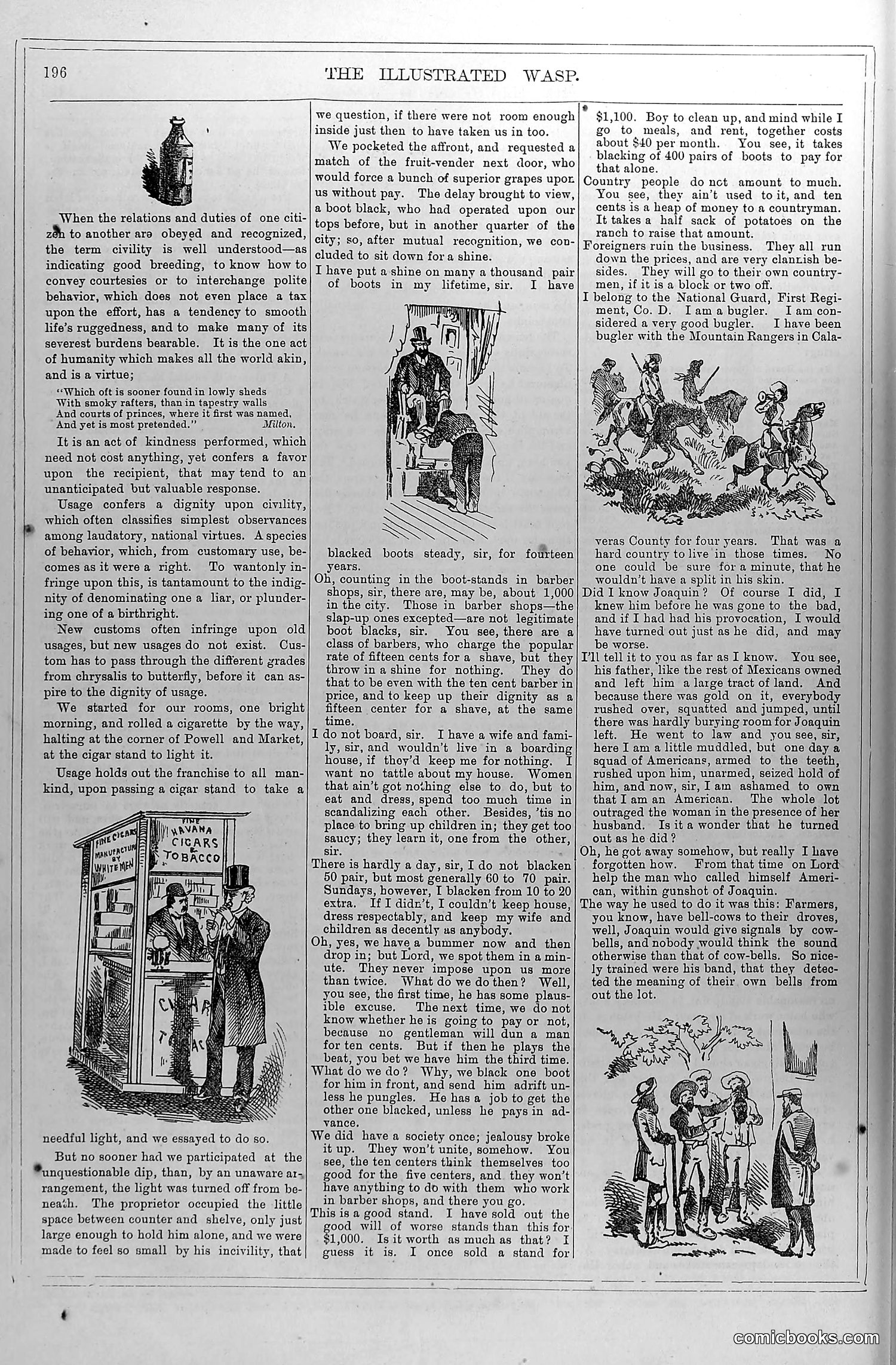
This page contains satirical commentary on urban labor and class relations rather than a single political cartoon. The main illustrated panels show: 1. **A cigar stand scene** (lower left): Depicts working-class commerce and the "ten-center" barber shops mentioned in the text—establishments offering cheap services to poorer customers. 2. **Street scenes** (right side): Show working-class figures and social interactions. The accompanying text mocks the pretensions of civility among different social classes while describing the economic struggles of laborers—boot-makers, barbers, and ranch workers. It satirizes how workers rationalize poor wages and exploitative conditions, suggesting they accept low pay ($40/month, ten-cent haircuts) as inevitable. The humor targets both the exploitative system and workers' resigned acceptance of it.
This page contains educational rather than satirical content. The main article discusses how gas is produced for use at "our Wondering Fair" (likely a reference to a contemporary exposition). The text explains the chemical process of gas creation from combusted hydrocarbons, discussing how carbon and hydrogen combine to produce illuminating gas. There's discussion of how this gas illuminates fairgrounds more efficiently than other light sources. The accompanying diagram shows a simple wheel mechanism, apparently related to gas production or distribution equipment. The article is instructional in nature, aimed at explaining contemporary industrial technology to general readers—typical of Victorian-era popular science journalism rather than political satire or humor.
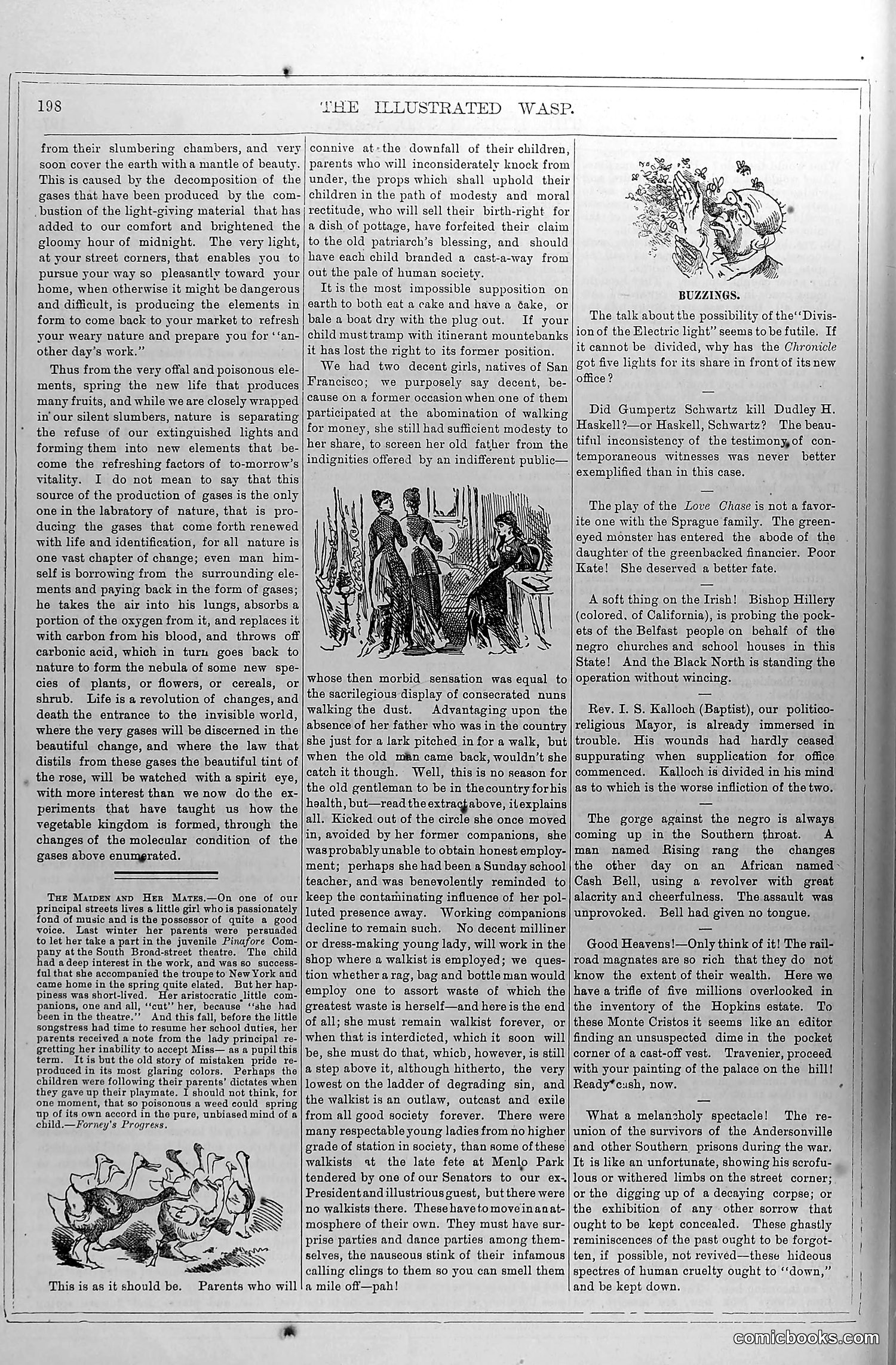
This page contains social commentary rather than political cartoons. The text discusses several topics: **"Buzzings"** (top right): A brief note about the "Division of the Electric Light" and the Chronicle newspaper's coverage. **Main articles** critique various social issues: a story about two "decent girls" from San Francisco participating in a charity "cake and lemonade" fundraiser; commentary on a woman's labor activism and unfair working conditions; and discussion of Irish Bishop Hillery's efforts supporting African American churches and schools in the North. **Bottom section** includes satirical pieces on Southern racism ("The gorge against the negro is always coming up in the Southern throat") and criticism of wealthy landowners hoarding resources. The cartoons show working-class figures and appear to illustrate these social commentary pieces, though specific identities are unclear from the image alone.
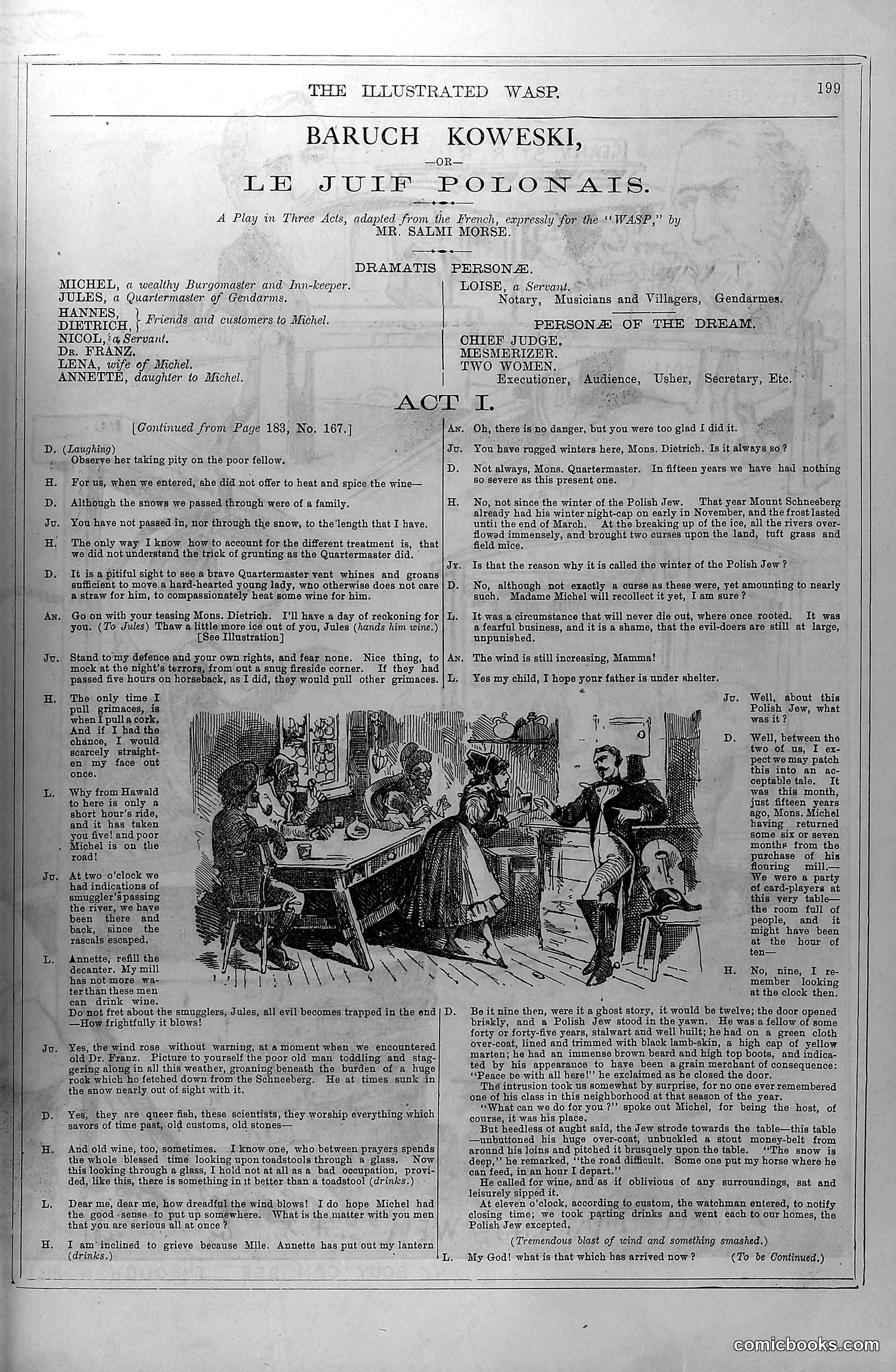
This page presents a three-act play adapted from French, featuring a scene of working-class figures gathered around a table in what appears to be a modest inn or tavern. The dialogue concerns a harsh Polish winter, hardship, and survival. The title "Le Juif Polonais" (The Polish Jew) and character names like Michel (an innkeeper) suggest this is a period piece depicting Jewish life in Poland. The satire appears directed at European stereotypes and theatrical representations of Jewish characters and Eastern European poverty rather than contemporary politics. The illustration shows common people in period dress engaged in casual conversation, emphasizing the play's focus on everyday hardship and social conditions rather than high society.
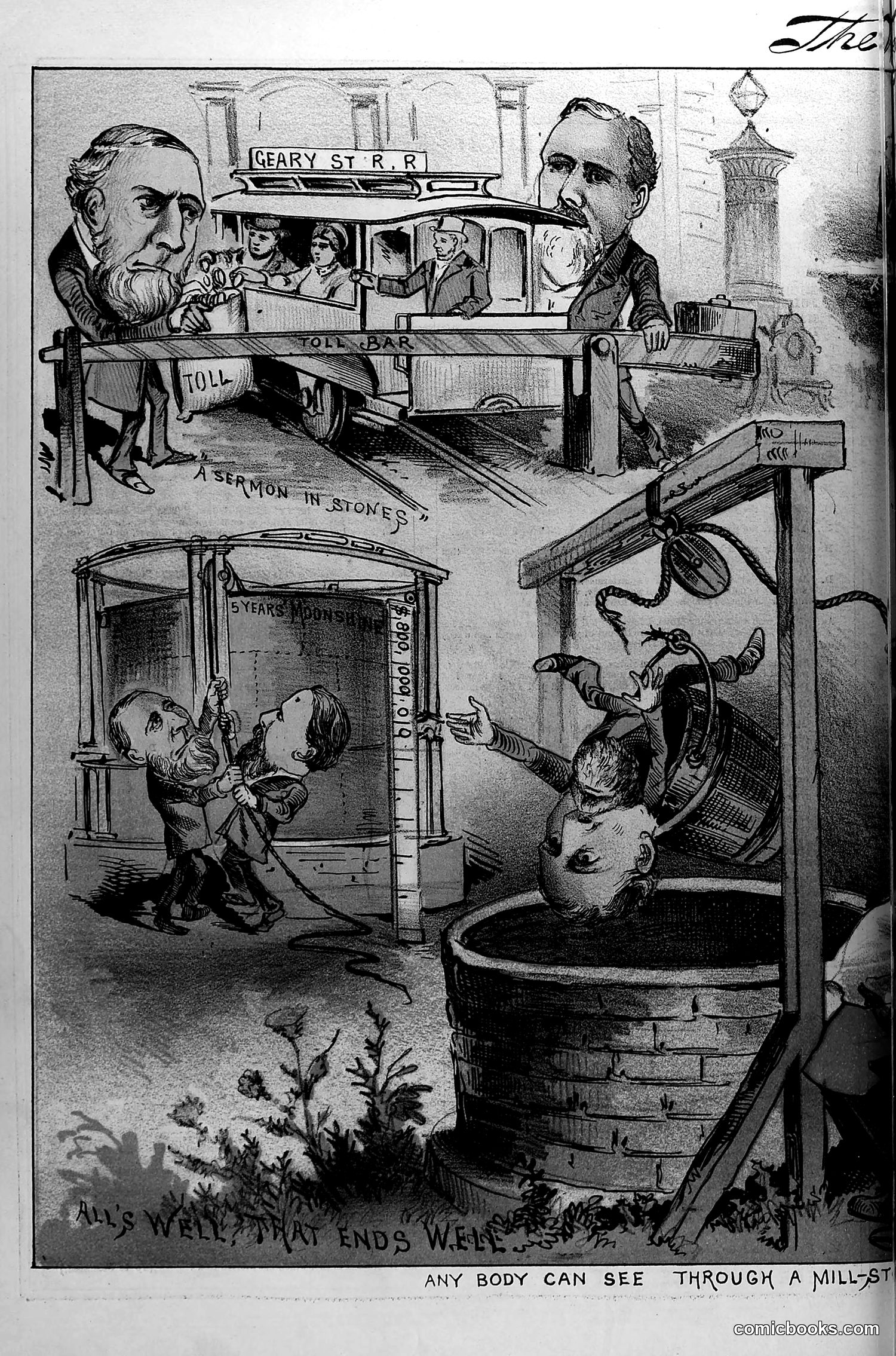
This appears to be a satirical multi-panel cartoon from *The Wasp* magazine criticizing railroad or transit practices. The top panel shows two large caricatured figures (likely prominent businessmen or politicians) overseeing a "Geary St. R.R." (Geary Street Railroad) toll operation, with passengers boarding. The caption reads "A Sermon in Stones." The bottom panels depict smaller figures at what appear to be toll booths or collection points, with text referencing "All's well that ends well" and "Any body can see through a mill-st[one]." This suggests the cartoon mocks the transparency of corrupt toll-collection schemes or the obvious exploitation of public transit users through excessive fees—the "sermon" being that greed is plainly visible to all observers.
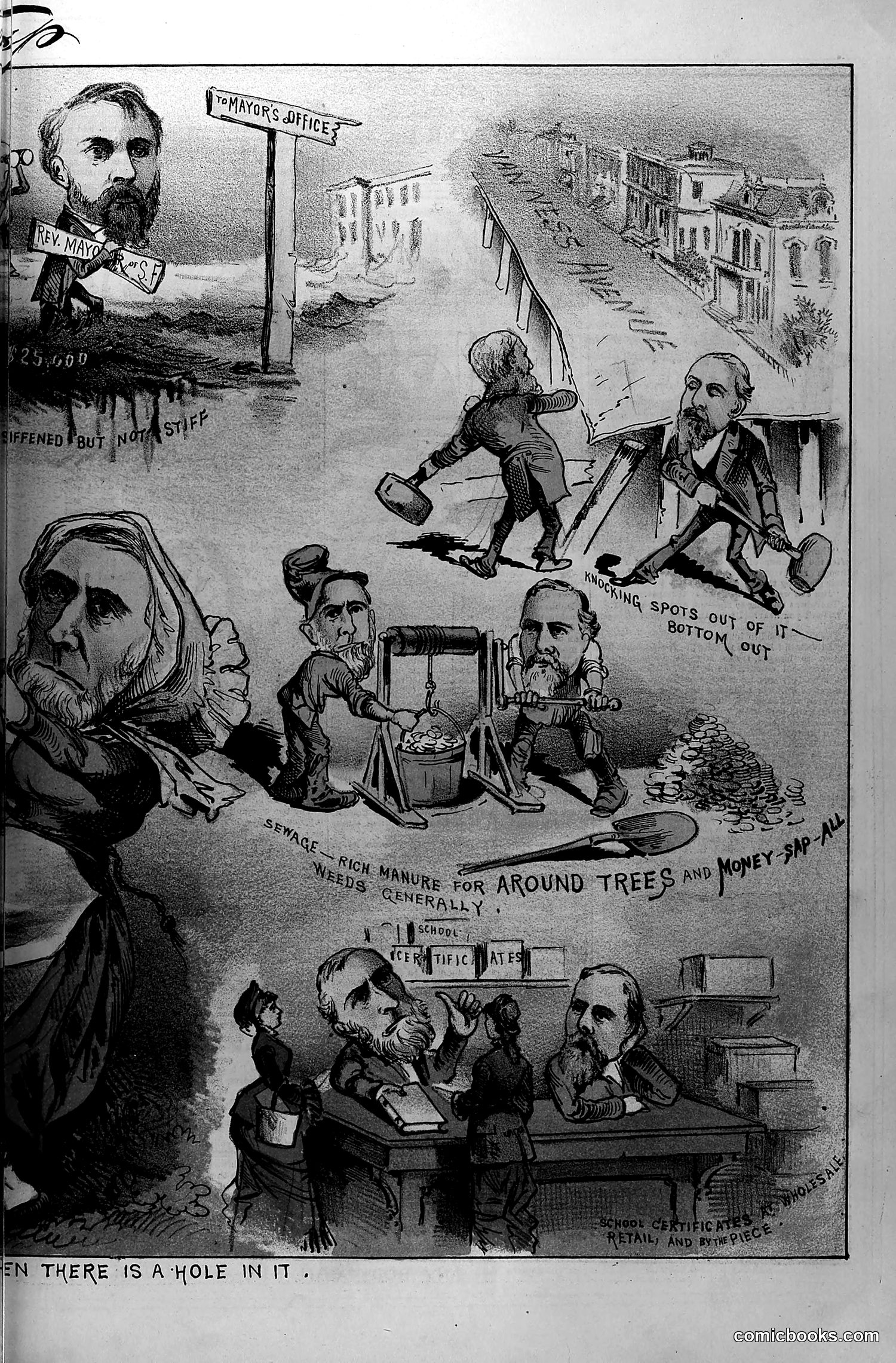
This page attacks a Mayor (identified in upper left) through multiple vignettes showing municipal corruption. The top scene depicts officials "knocking spots out of it / Bottom out" — suggesting embezzlement or mismanagement. The middle section shows figures around a cauldron labeled "Sewage—Rich Manure for Around Trees and Money Sap All"—satirizing how municipal contracts funnel public resources to connected politicians. The bottom panel shows "School Certificates" being distributed "Retail, and by the Piece"—mocking the sale of fraudulent educational credentials, suggesting the mayor's office peddles fake qualifications for profit. The large profile portrait (left) represents the mayor himself. The overall message: the administration converts public services (sewage, schools) into personal profit schemes through systematic corruption.
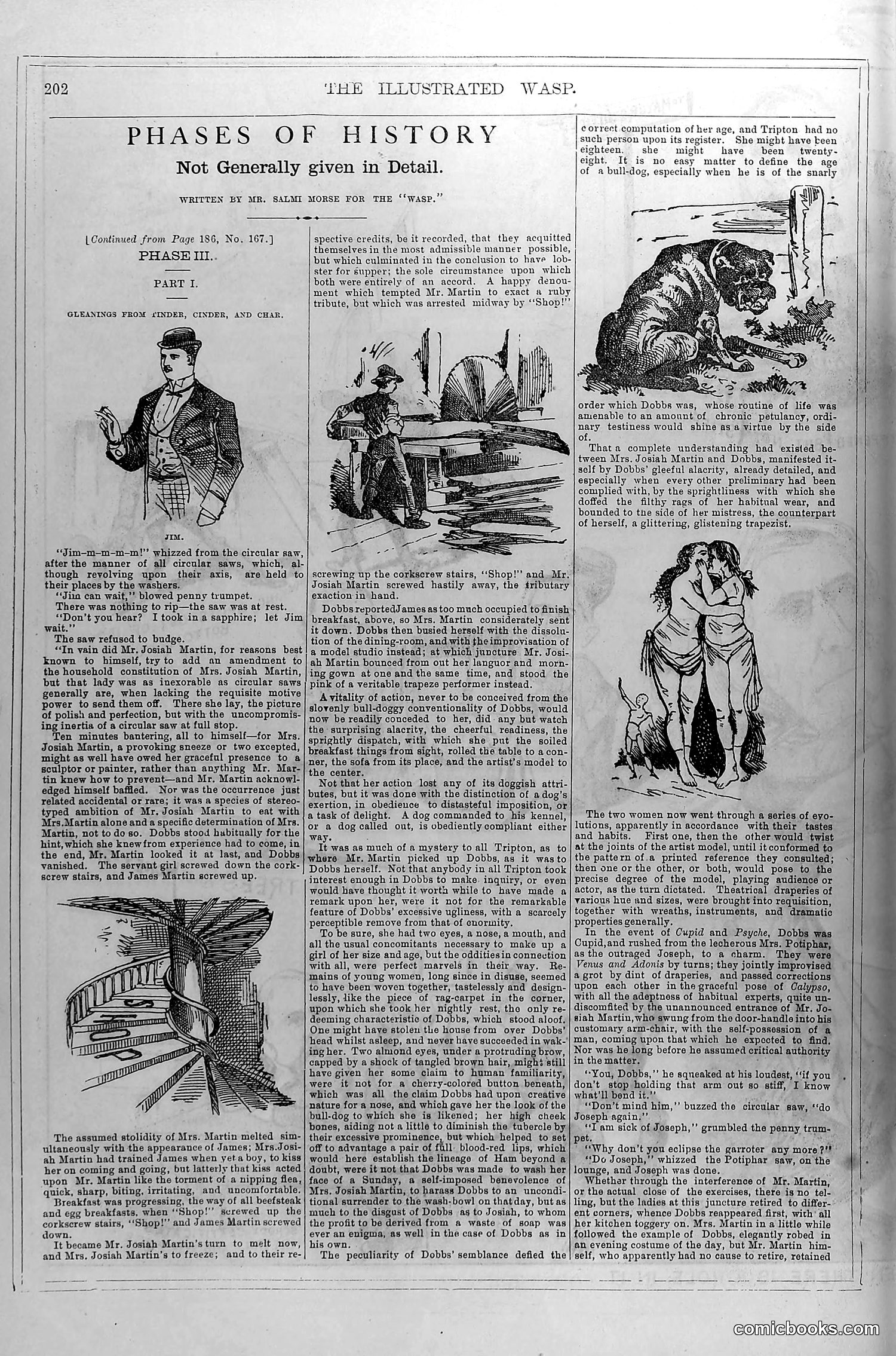
This page from *The Wasp* satirical magazine presents a serialized story titled "Phases of History" by Salmi Morse, continued from a previous issue. The narrative focuses on social satire involving characters named Dobbs, Mrs. Martin, and Josiah Martin. The illustrated vignettes depict domestic and social scenes, with text describing disputes over propriety and social standing. The satire appears to target middle-class pretension—particularly Mrs. Martin's attempts to maintain respectability while engaging in questionable artistic and social behavior. The cartoon character "Jim" (shown left) represents a working-class perspective critiquing circular saws and labor conditions. Overall, the page satirizes Victorian-era social hypocrisy, class anxiety, and the gap between public propriety and private conduct among aspiring middle-class figures.
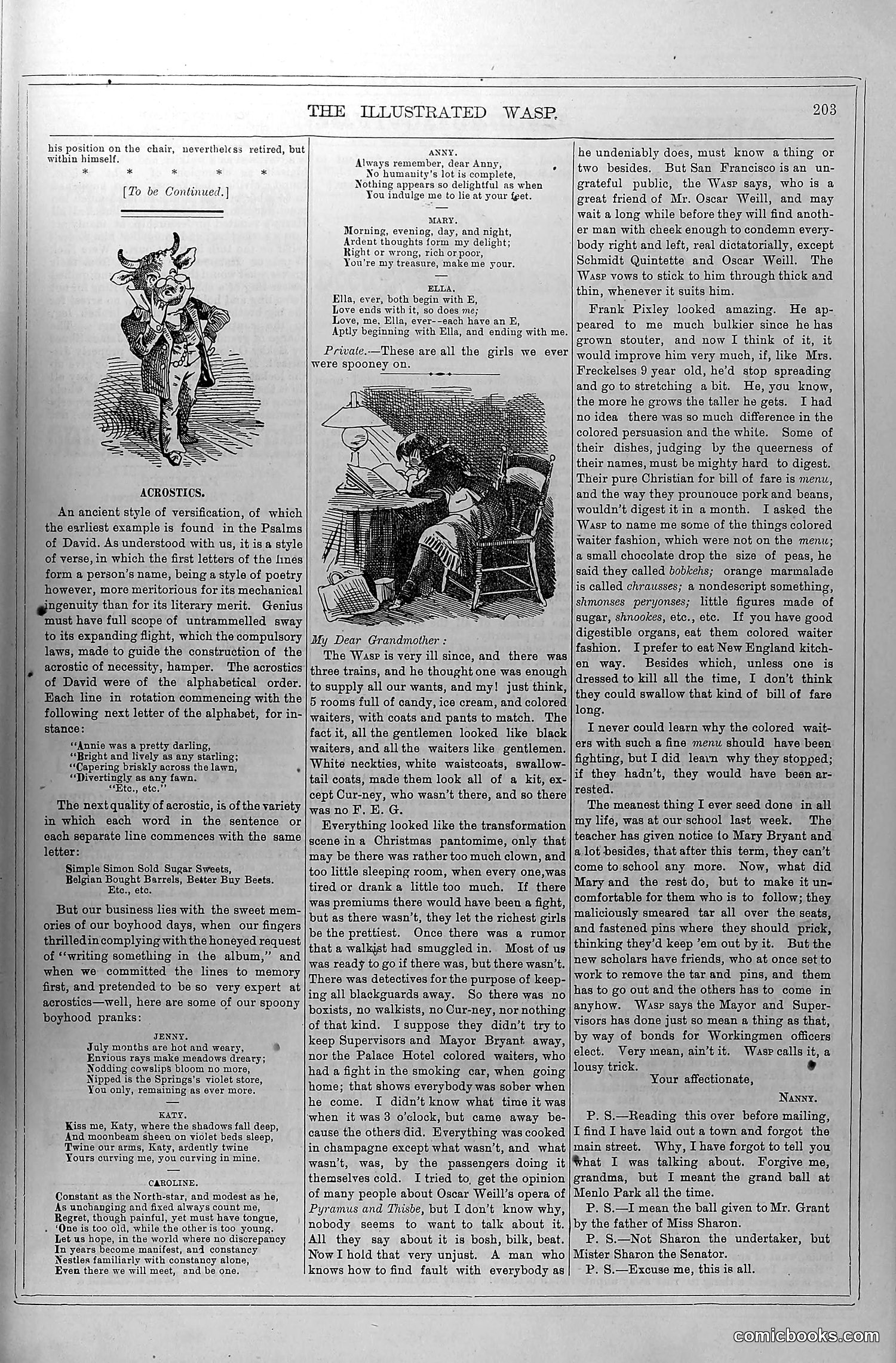
This page contains primarily **literary content rather than political cartoons**: poems attributed to various writers (Anne, Mary, Ella, Caroline), acrostic verse, and personal correspondence/advice columns. The two illustrations are **decorative Victorian engravings** unrelated to satire—one showing a cow in fancy dress, another depicting a domestic scene with a woman at a table. The readable content includes gossip-style letters discussing social matters like colored waiters in restaurants, school scandals involving Mary Bryant and a teacher, and mentions of local San Francisco figures (Oscar Weill, Mayor Bryant, Supervisors). The satire here is **social rather than political**—mocking Victorian propriety, class pretensions, and local scandals through the advice-column format rather than through caricature or editorial cartooning.
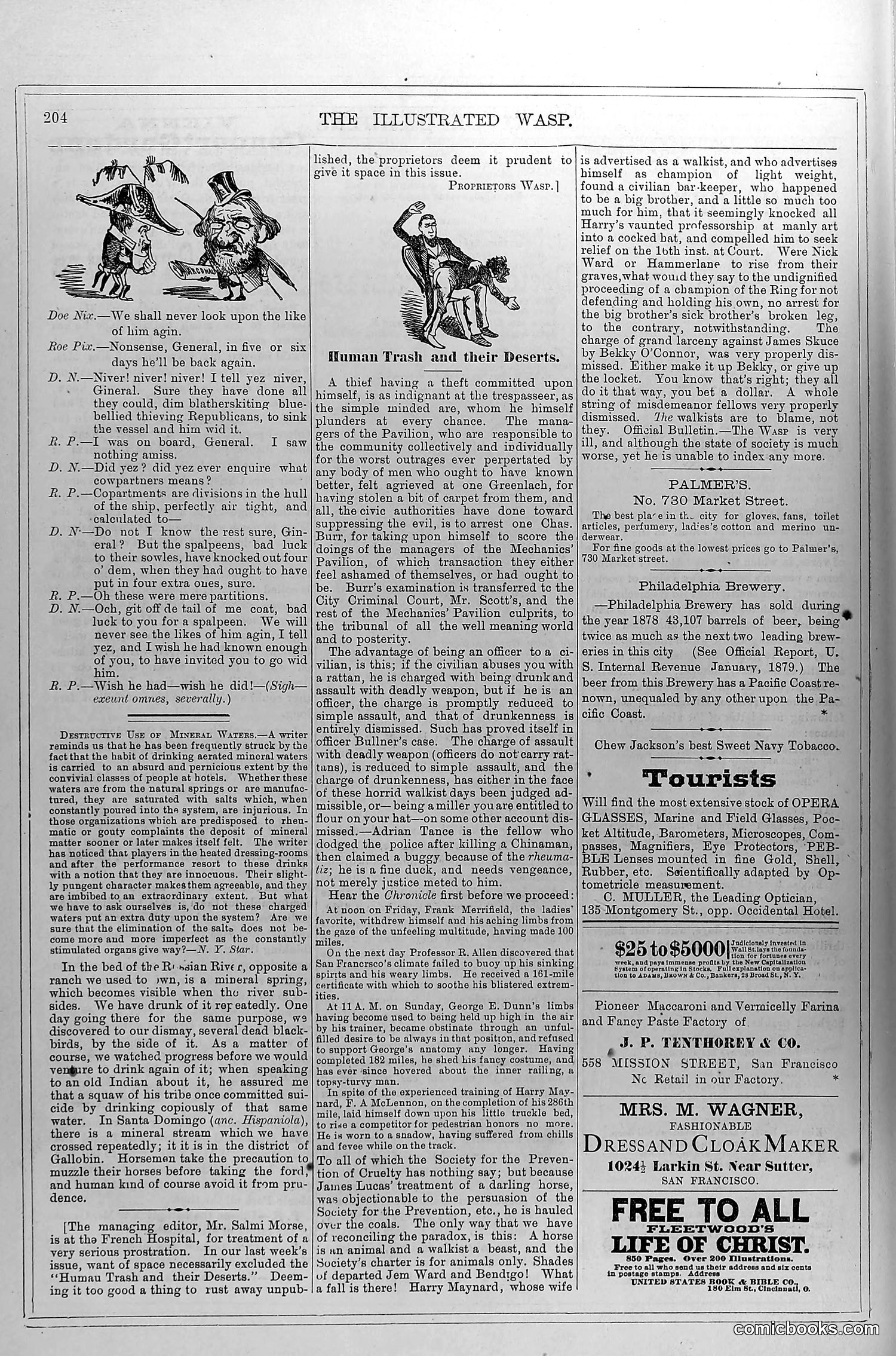
This page is primarily **text-based satire** with minimal illustration. The cartoon at top-left shows crude caricatures of figures labeled "Dog Nix," "Roe Pix," and others in conversation. The main article mocks various **San Francisco civic figures** accused of misconduct: a thief claiming innocence, a Pavilion manager stealing carpets, officer Burr accused of drunken assault, and others. The satire suggests these individuals deserve public exposure and legal consequences—their "deserts" (what they deserve). The piece exemplifies *The Wasp*'s role as a **muckraking publication** targeting local corruption and hypocrisy. The remainder of the page consists of advertisements, indicating this was a commercial publication combining satire with paid notices.
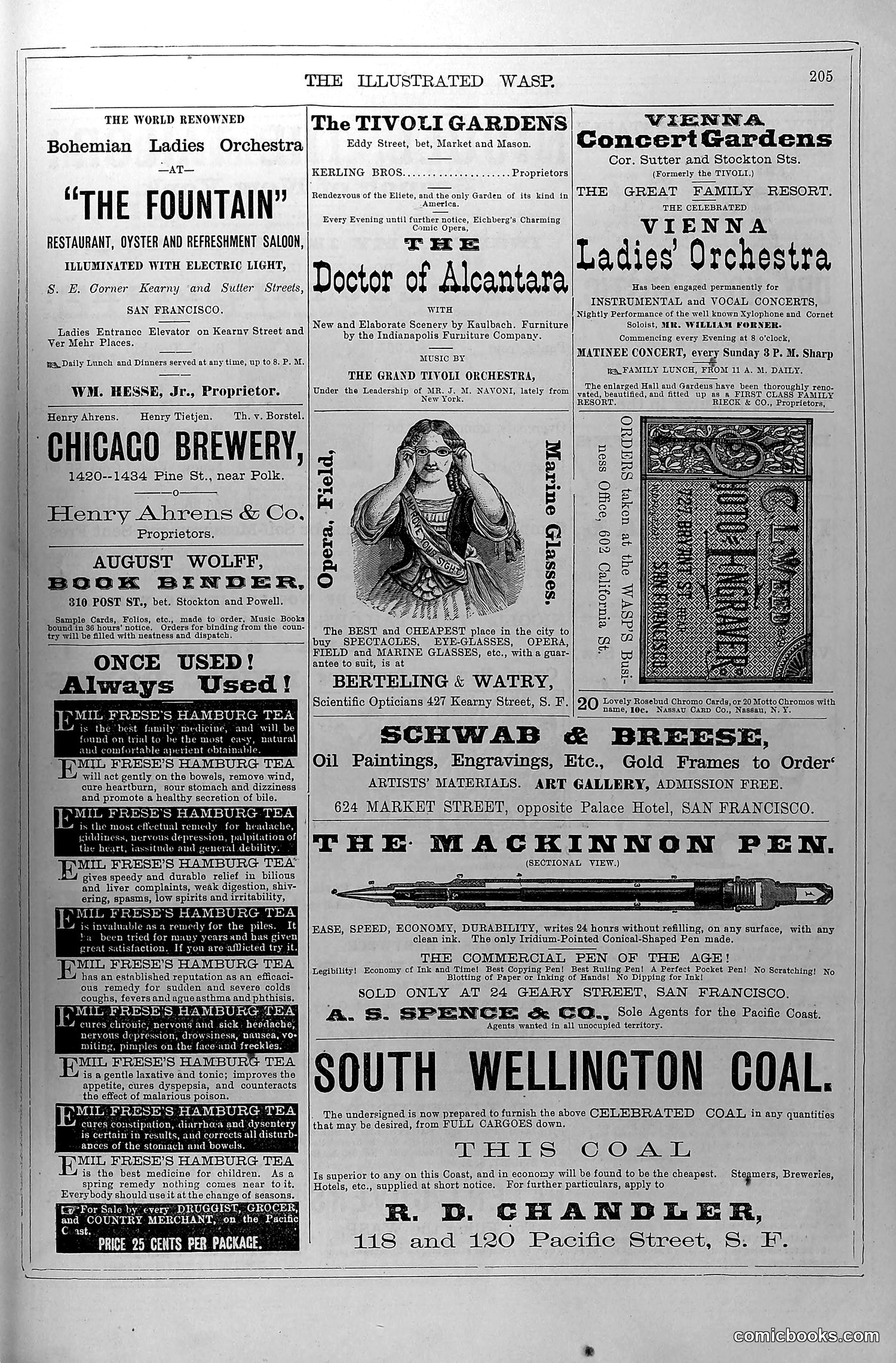
This is primarily an **advertising page** from *The Wasp* magazine (page 205), not a political cartoon or satirical content page. The page features commercial advertisements for San Francisco businesses including: - The Fountain restaurant - Chicago Brewery - August Wolff's brass band - Emil Frese's Hamburg Tea (with extensive medical claims) - Schwab & Breese art gallery - The Mackinnon Pen - South Wellington Coal There is **one illustration**: a portrait of a woman labeled "Marie Glassow" advertising opera field glasses and marine glasses at Berteling & Watry. The advertisements reflect late 19th-century patent medicine marketing and commercial culture. No political satire or commentary is evident on this page—it represents the magazine's revenue model through paid advertisements rather than editorial content.
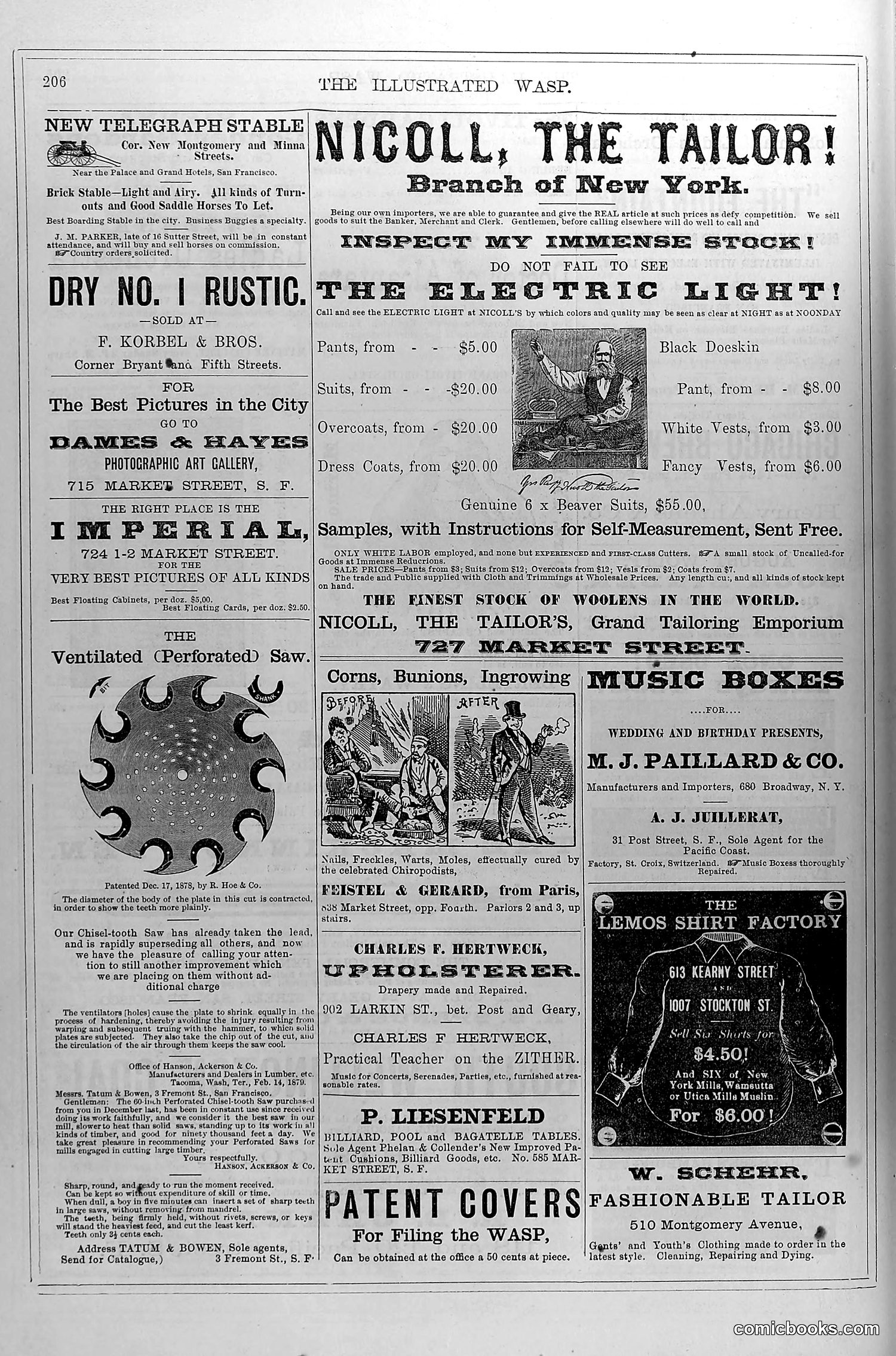
This is primarily an **advertising page** from *The Wasp*, a San Francisco satirical magazine. The dominant feature is a large advertisement for **Nicoll, the Tailor** (a branch of a New York establishment), promoting their clothing and services with an illustration of a well-dressed man. The page includes numerous other commercial advertisements for local San Francisco businesses: photographic galleries, furniture, saws, musical boxes, shirt factories, and tailoring services. There is **no political cartoon or satirical content** visible on this page. The small illustration accompanying the Nicoll ad appears to be a generic gentleman figure used for marketing purposes rather than social commentary. This page demonstrates how *The Wasp* funded itself through advertising while maintaining its satirical editorial content elsewhere in the publication.
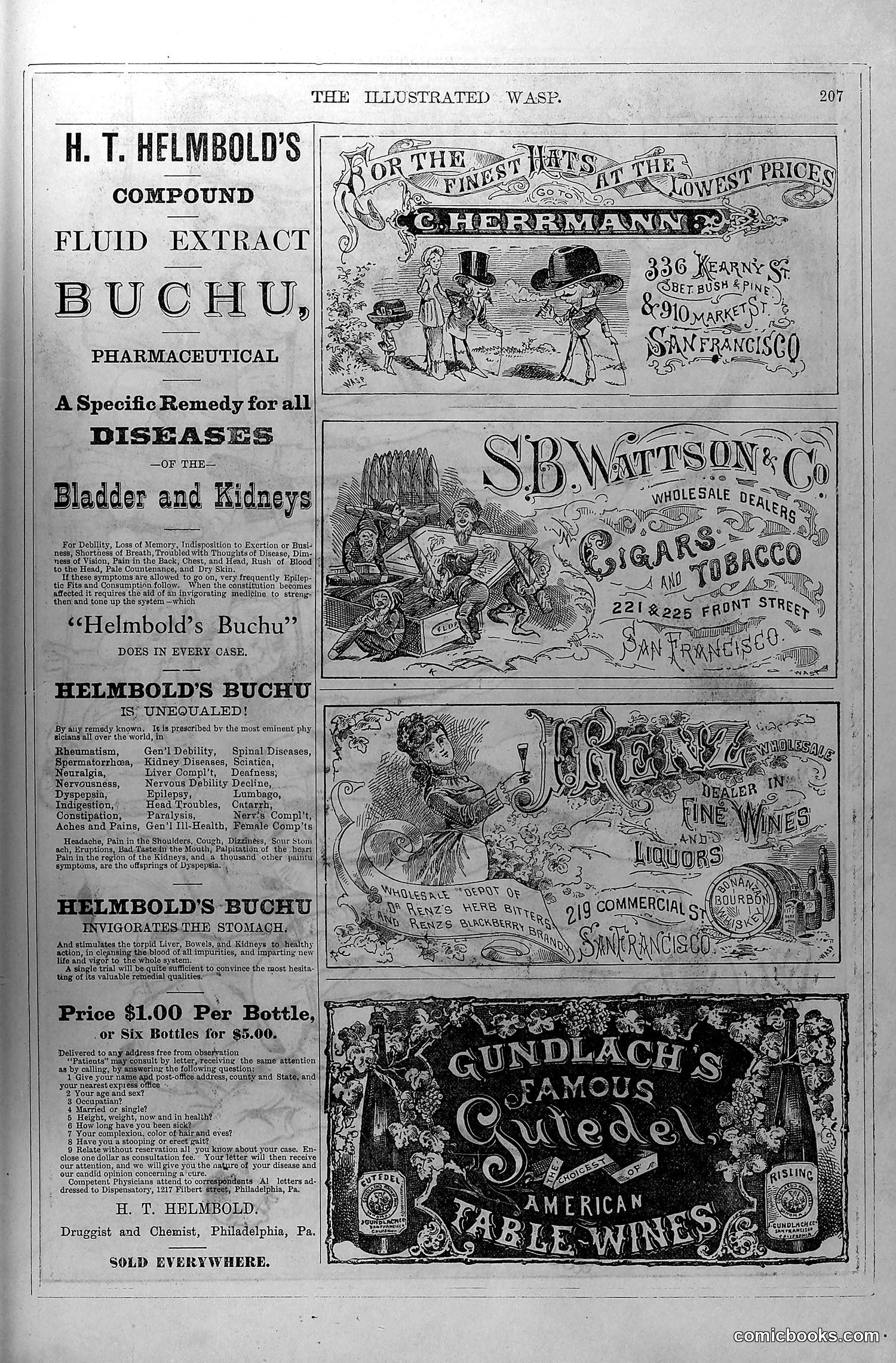
This page is **primarily advertising**, not political satire. It contains five commercial advertisements from late 19th-century San Francisco: 1. **Helmbold's Buchu** - A patent medicine claiming to cure bladder and kidney diseases, priced at $1.00 per bottle 2. **C. Herrmann & Co.** - A hat shop advertisement with illustrated figures 3. **S.B. Wattson & Co.** - Wholesale cigars and tobacco dealers 4. **J. Krug** - A wine and liquors dealer 5. **Gundlach's Famous Sauterne** - American table wines The page reflects *The Wasp*'s business model: satirical content subsidized by advertisements. The illustrated vignettes accompanying the ads are decorative rather than satirical. No political figures or social commentary are evident—this is simply a commercial page from a San Francisco periodical.
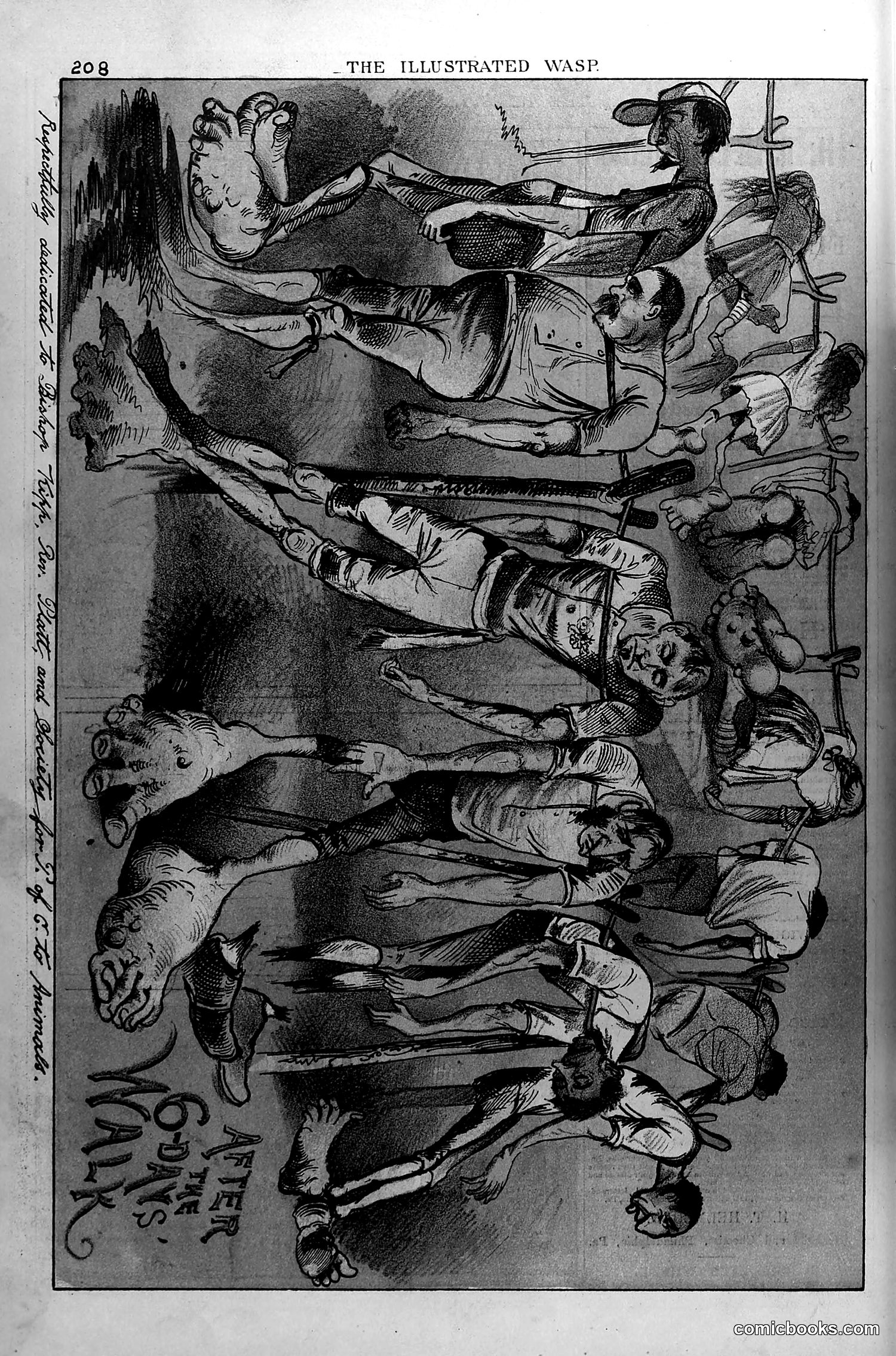
This appears to be a satirical illustration shown upside-down (as printed), depicting multiple figures in what seems to be a chaotic political or social scene. The page is from *The Wasp*, a San Francisco-based satirical magazine known for sharp social commentary. The drawing style and composition suggest this is political satire, likely commentary on contemporary events or public figures, but the inverted orientation and image quality make specific identifications difficult. The crowded, tumultuous arrangement of bodies and expressions suggests mockery of confusion, corruption, or conflict among political or social elites. Without clearer visibility of individual faces or accompanying caption text, I cannot confidently identify specific figures or the exact target of this satire.

I can see this is a test page or calibration image from The Wasp magazine, featuring a grayscale color checker chart (the grid of squares in varying tones from dark to light) positioned next to measurement rulers. This appears to be a technical documentation page rather than actual satirical content—likely used for printing quality control or reproduction standards. The checkerboard pattern and calibrated ruler measurements suggest this was included to help printers ensure accurate color reproduction and scaling when reproducing The Wasp's satirical cartoons. Without visible cartoon imagery, political figures, or OCR text content describing a specific satire or joke, I cannot identify the intended social or political commentary this page was meant to support.