ComicBooks.com Register / Loginit's free!

A complete, restored issue of The Wasp from 1889 — all 450 pages of chromolithograph political cartoons and West Coast satire, free to page through at ComicBooks.com.

On the cover: I can see this is a measurement/documentation page from *The Wasp* magazine, featuring Oregon Rule Co. rulers and a grayscale reference chart used for photographic reproduction. However, the image shows primarily technical documentation rather than satirical cartoon content. The page appears to be a calibration or reference sheet—likely used during the magazine's printing process to ensure consistent image reproduction. The rulers establish scale, and the grayscale patches allow printers to verify tonal accuracy across different shades from white to black. This is documentary/technical material rather than editorial satire. Without visible cartoon illustrations or accompanying satirical text, I cannot identify specific political figures or social commentary on this particular page.

🖼️ Every page has a plain-English note on what you’re looking at — the figures, the references, the point of the satire.

← Back to The Wasp All exhibitions

HomeExhibitionThe WaspRead

A complete issue · 450 pages · 1889

The Wasp — 1889
1889 · Free to read

The Wasp — 1889 — page 1 of 450
1 / 450
What you’re looking at · open this page on its own ↗

I can see this is a measurement/documentation page from *The Wasp* magazine, featuring Oregon Rule Co. rulers and a grayscale reference chart used for photographic reproduction. However, the image shows primarily technical documentation rather than satirical cartoon content. The page appears to be a calibration or reference sheet—likely used during the magazine's printing process to ensure consistent image reproduction. The rulers establish scale, and the grayscale patches allow printers to verify tonal accuracy across different shades from white to black. This is documentary/technical material rather than editorial satire. Without visible cartoon illustrations or accompanying satirical text, I cannot identify specific political figures or social commentary on this particular page.

The Wasp — 1889 — page 2 of 450
2 / 450
What you’re looking at · open this page on its own ↗

I can see this is a page from *The Wasp* magazine with "comicbooks.com" visible in the lower right corner, but the image quality is too degraded for me to reliably read the OCR text or discern specific cartoon content, figures, or captions. The page appears predominantly black with scattered grain/noise that obscures details. To provide accurate historical analysis, I would need either: - A clearer image where text and illustrations are legible - Confirmation of the publication date - More readable OCR output I cannot responsibly identify political figures, references, or satirical meaning from an image this illegible, as doing so would risk inventing details rather than interpreting what's actually present. If you have a clearer version of this page, I'd be happy to analyze it properly.

The Wasp — 1889 — page 3 of 450
3 / 450
What you’re looking at · open this page on its own ↗

I can see this is a library label from the California State Library dated April 1891, with an accession number and barcode. However, the actual page content—any cartoon, illustration, or satirical material from The Wasp magazine—is not visible in this image. The photograph shows only the back or cover of the document with archival information. To analyze the political cartoons or satirical content you're asking about, I would need to see the actual printed page featuring illustrations and text from the magazine itself. If you have an image of the front side or the actual cartoon page, I'd be happy to provide historical context and interpretation.

The Wasp — 1889 — page 4 of 450
4 / 450
What you’re looking at · open this page on its own ↗

I can see this is a page from *The Wasp* magazine, but the image quality is too degraded for me to reliably read the OCR text or identify specific figures in the cartoon(s). The page appears to contain satirical content typical of the publication, with what looks like two dark vertical elements that could be caricatures or illustrations, but I cannot make out sufficient detail to accurately identify who they represent or what political/social commentary they're making. To provide accurate historical analysis as you've requested, I would need either a clearer image or confirmation of the publication date and the OCR text. I don't want to speculate about identities or meanings I cannot clearly discern from the source material.

The Wasp — 1889 — page 5 of 450
5 / 450
What you’re looking at · open this page on its own ↗

I can see this is a page from *The Wasp*, a satirical magazine, but the image quality is too degraded for me to read the OCR text clearly or discern specific cartoon details, figures, or caricatures. The page appears to show a grainy, low-contrast illustration with some darker spots or marks scattered across it, but I cannot reliably identify: - Specific political or social figures being caricatured - The subject matter or event being satirized - Whether this is a single cartoon or multiple pieces - The intended joke or political commentary To provide an accurate historical explanation, I would need either a higher-resolution image or confirmation of the text content. I cannot responsibly guess at identities or meanings without clear visual evidence.

The Wasp — 1889 — page 6 of 450
6 / 450
What you’re looking at · open this page on its own ↗

I can see this is a title/credits page from *The Wasp*, a 19th-century satirical magazine, digitized by the Internet Archive in 2012. However, the image shows only the institutional library emblem and publication information—no actual cartoon content or satirical material is visible on this page. To analyze the political satire and historical context you're asking about, I would need to see the actual editorial cartoon(s) or illustrated content from *The Wasp*. This particular page contains only metadata and doesn't include the artwork or text necessary to identify figures, explain references, or interpret the satire's meaning for modern readers. Do you have a different page from the publication to analyze?

The Wasp — 1889 — page 7 of 450
7 / 450
What you’re looking at · open this page on its own ↗

I can see this is a page from *The Wasp*, a satirical magazine, but the image quality is too degraded for me to reliably read the OCR text or identify specific cartoons, figures, or caricatures. The page appears to be mostly grayscale with scattered dark marks and spots that could be illustrations, text, or image artifacts. Without being able to clearly discern the visual content or verify the OCR'd text against what's actually depicted, I cannot accurately explain what political or social commentary this page contains, who might be caricatured, or what the satire references. To provide accurate analysis meeting your accuracy-over-completeness standard, I would need a higher-resolution or clearer version of this page.

The Wasp — 1889 — page 8 of 450
8 / 450
What you’re looking at · open this page on its own ↗

I appreciate your detailed instructions, but I must be honest: this image is too degraded and low-contrast for me to reliably read either the OCR text you've provided or discern specific cartoon details, figures, or caricatures with confidence. The page appears to be from a historical satirical publication, but I cannot make out: - Distinct character features or identifiable figures - Cartoon compositions or their subjects - Text clearly enough to connect OCR content to visual elements - Specific political or social references the satire targets To provide accurate historical analysis per your "accuracy over completeness" rule, I must acknowledge these limitations rather than speculate. If you have a clearer version of this page, I'd be better equipped to identify the figures, references, and satirical intent.

The Wasp — 1889 — page 9 of 450
9 / 450
What you’re looking at · open this page on its own ↗

I can see this is a page from *The Wasp*, a satirical publication, but the image quality is too degraded for me to reliably read the OCR text or identify specific figures, caricatures, or cartoons with confidence. The page appears to show a grainy, heavily textured black and white surface with what might be a diagonal line or fold, but I cannot discern clear cartoon illustrations, text blocks, or identifiable subjects. To provide accurate historical context about the political or social satire intended, I would need a clearer image where the cartoon artwork and accompanying text are legible. I cannot responsibly guess at the identities of figures or references without being able to see them clearly.

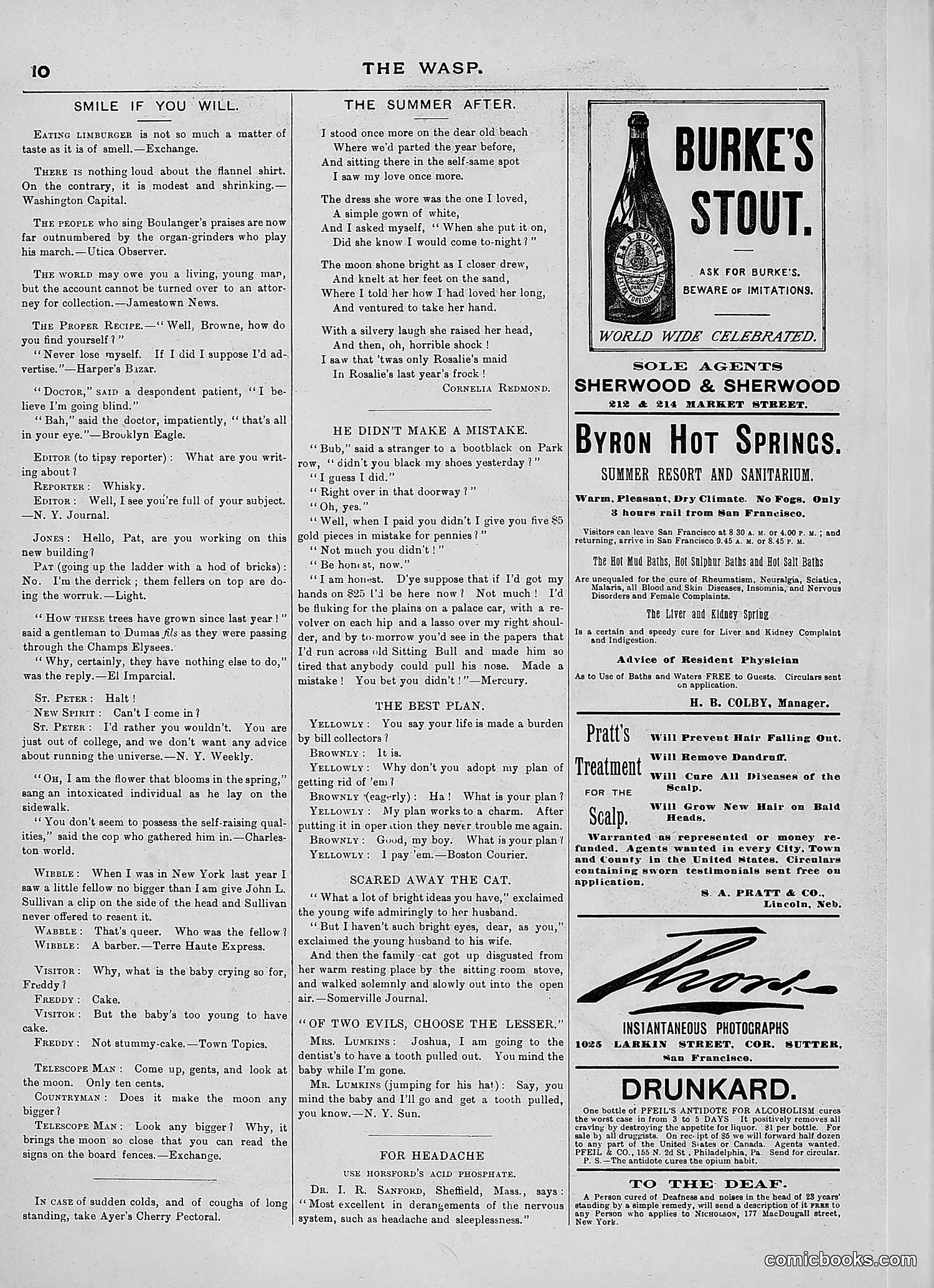
The Wasp — 1889 — page 10 of 450
10 / 450
What you’re looking at · open this page on its own ↗

I can see this is a page from *The Wasp*, a satirical magazine, but the image quality is quite poor. While I can make out what appears to be some illustrated content on the right side of the page—possibly showing a profile of a face with facial features—the details are too unclear for me to confidently identify specific figures, caricatures, or political references. The OCR text provided is blank or unreadable, which would normally help clarify the cartoon's subject and satirical intent. Without legible text or clearer visual details, I cannot accurately explain what political/social commentary this page contains or identify who is being caricatured. A higher-resolution image would be needed for proper analysis.

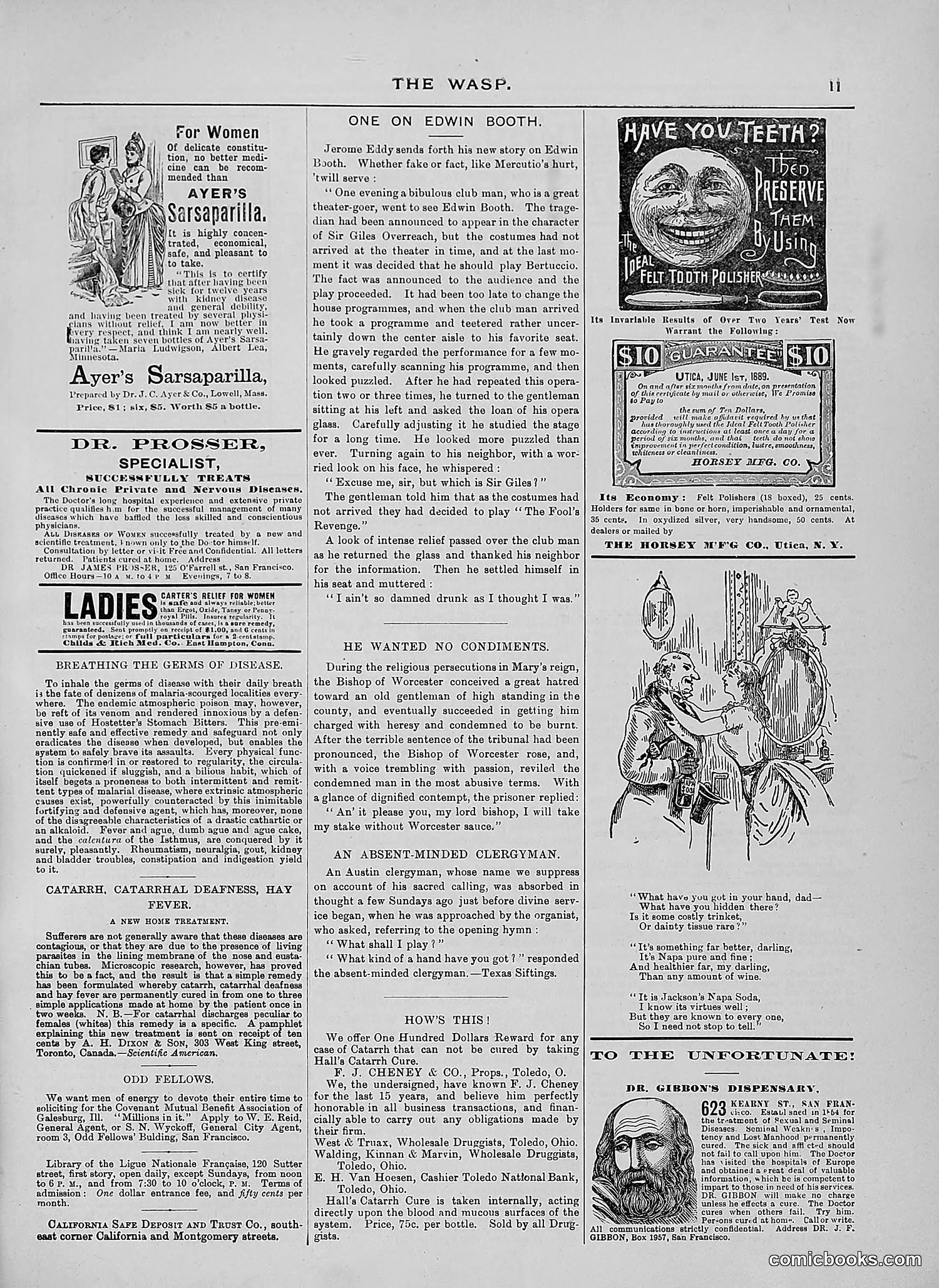
The Wasp — 1889 — page 11 of 450
11 / 450
What you’re looking at · open this page on its own ↗

I appreciate your detailed instructions, but I'm unable to provide the analysis you've requested. The image quality is too degraded for me to discern specific cartoon figures, text, or visual details with confidence. While I can see this is a historical document with a grainy, aged appearance consistent with period satirical publications, I cannot reliably identify: - Specific caricatured figures or individuals - Political or social references depicted - The satirical point or joke being made - Whether this is editorial content or advertising To provide accurate historical analysis per your rules (prioritizing accuracy over completeness), I must acknowledge these limitations rather than guess at details. A higher-resolution scan would be necessary for proper interpretation.

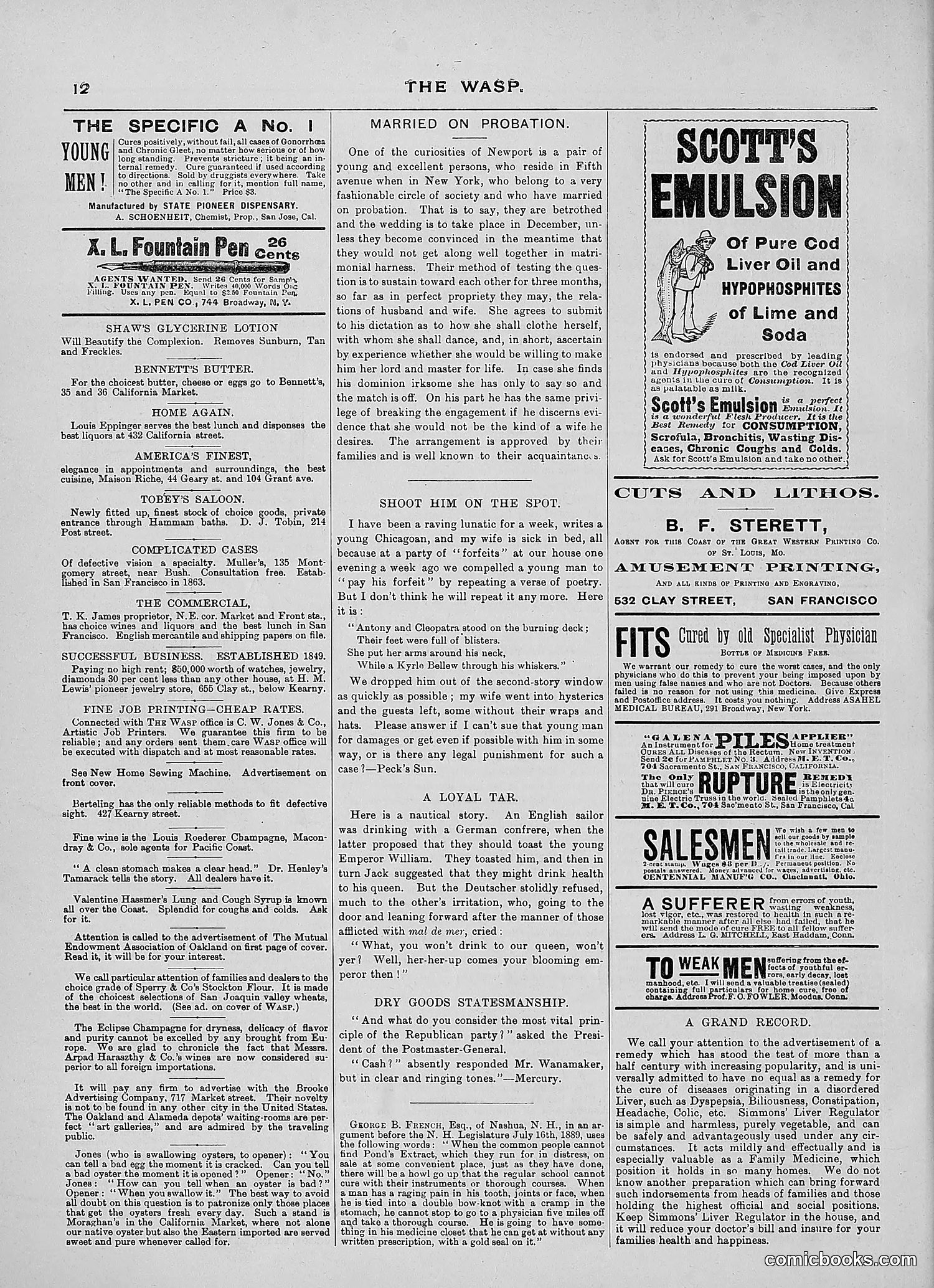
The Wasp — 1889 — page 12 of 450
12 / 450
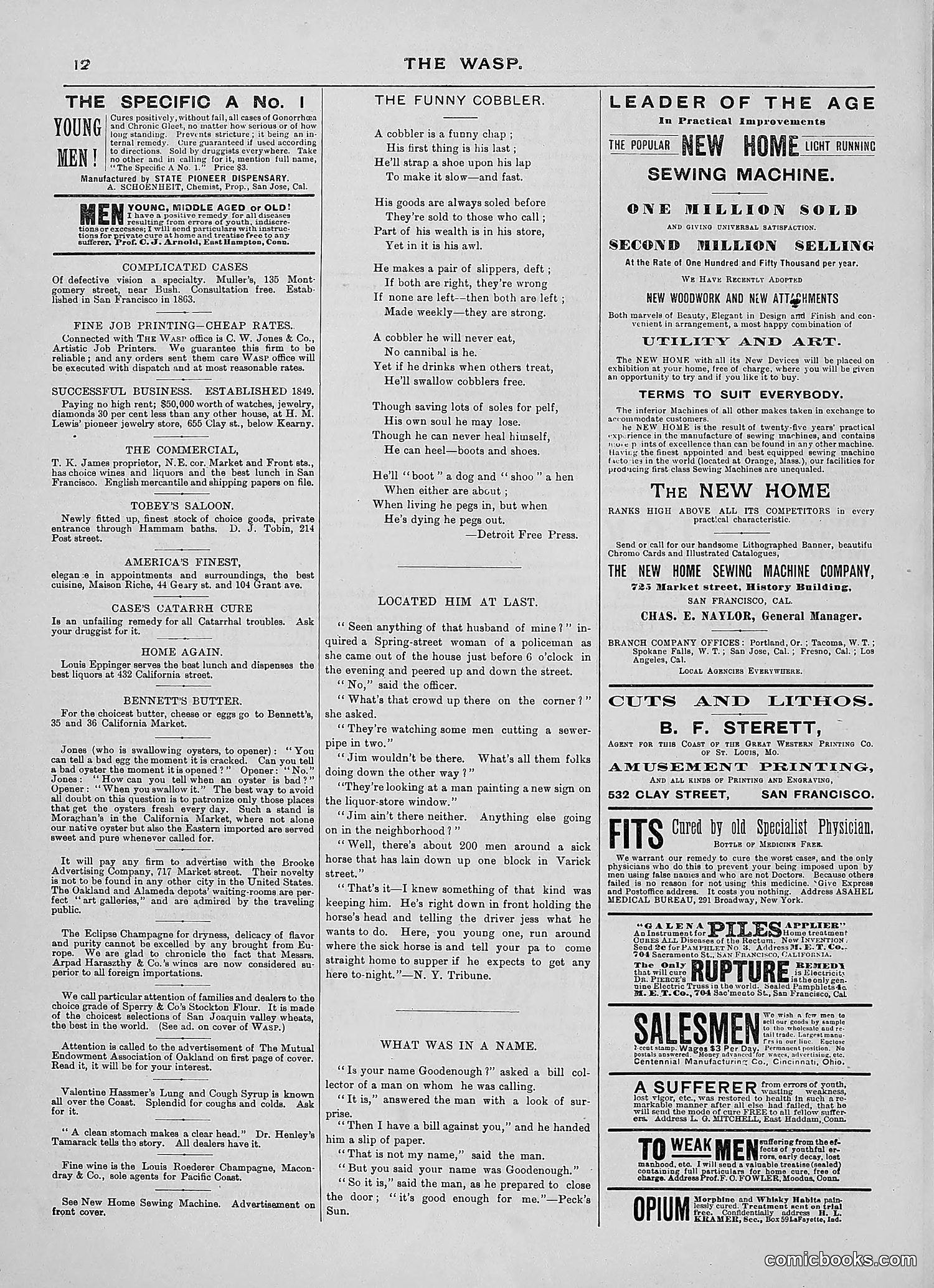
What you’re looking at · open this page on its own ↗

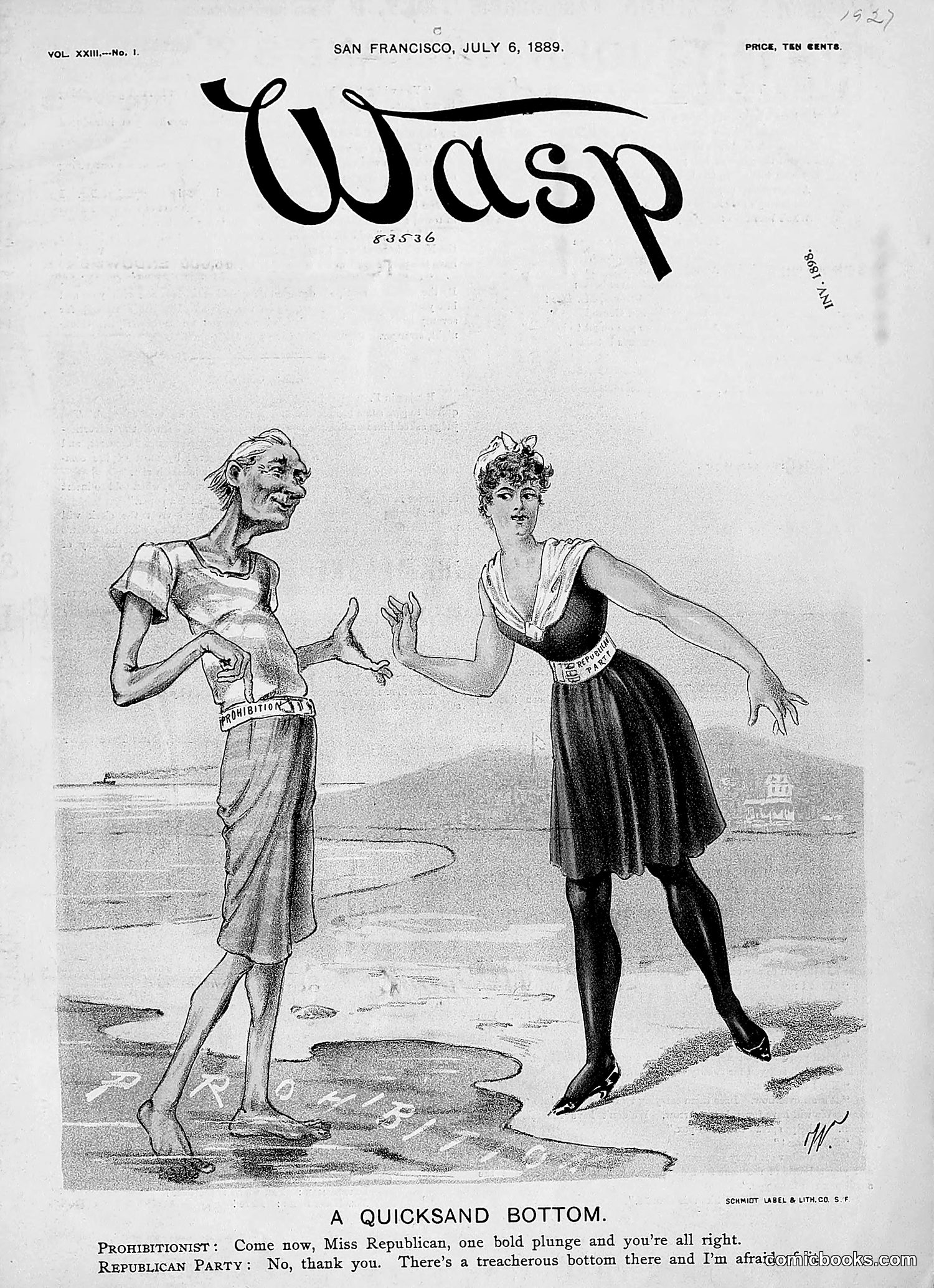
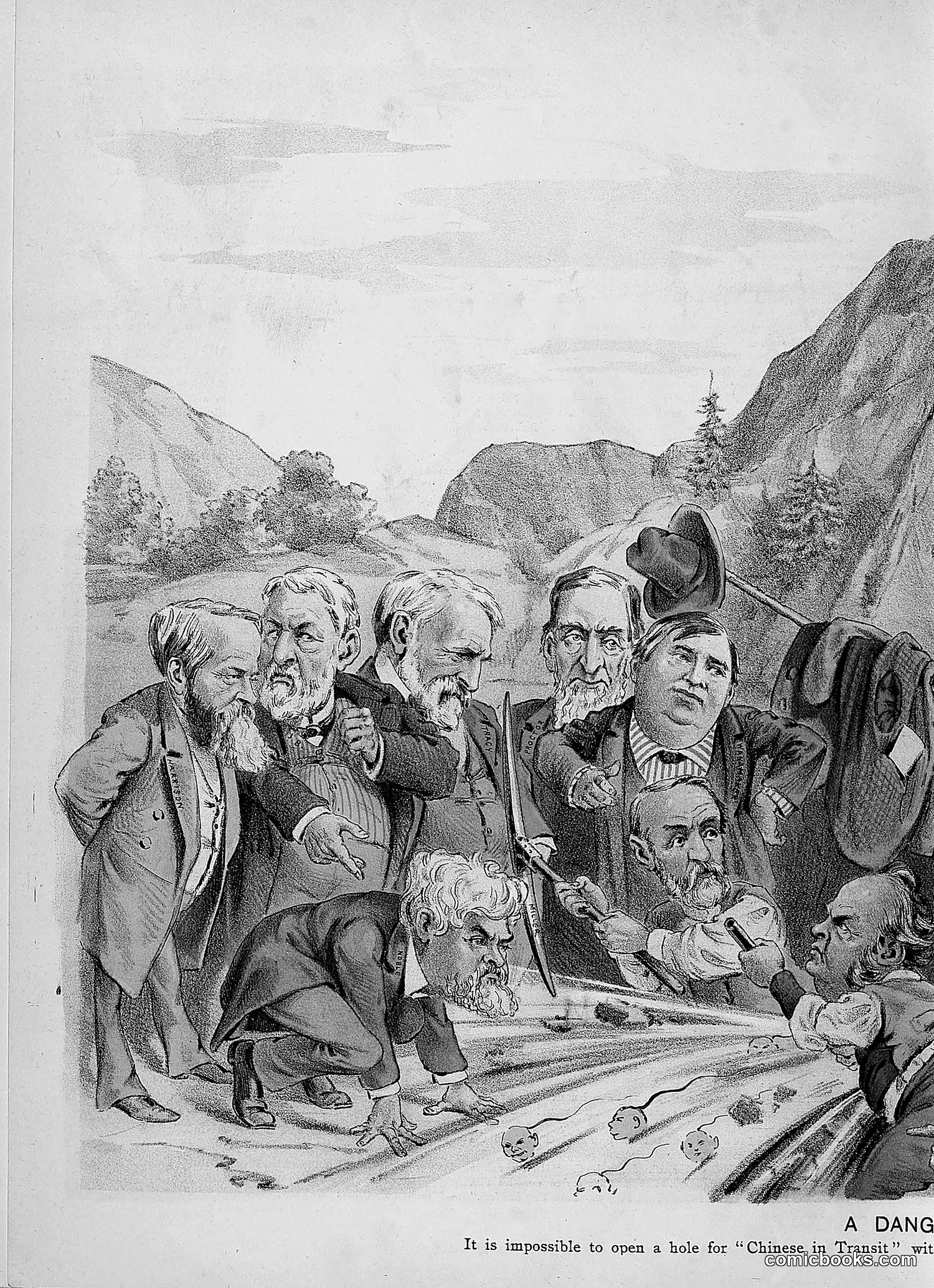
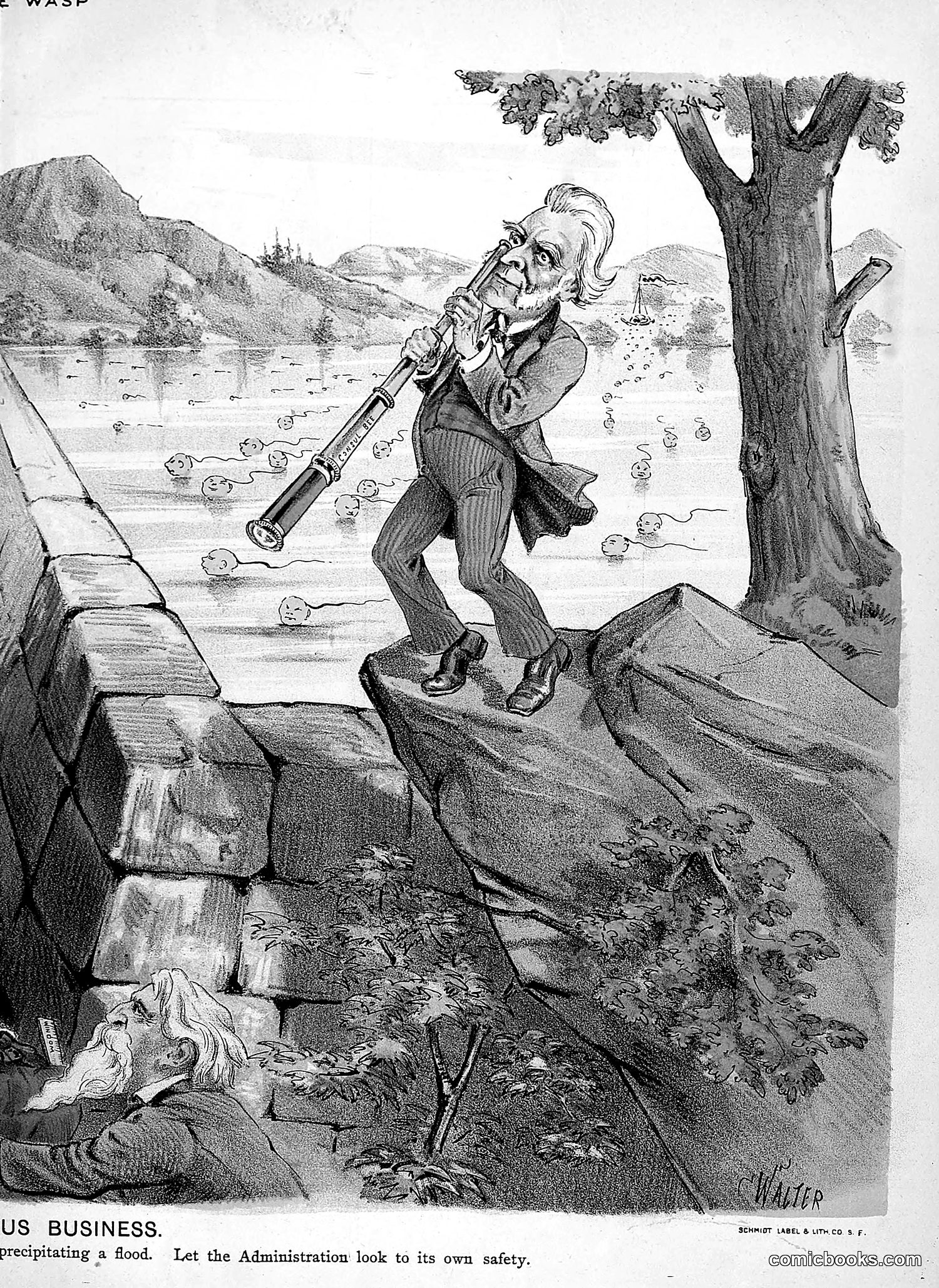
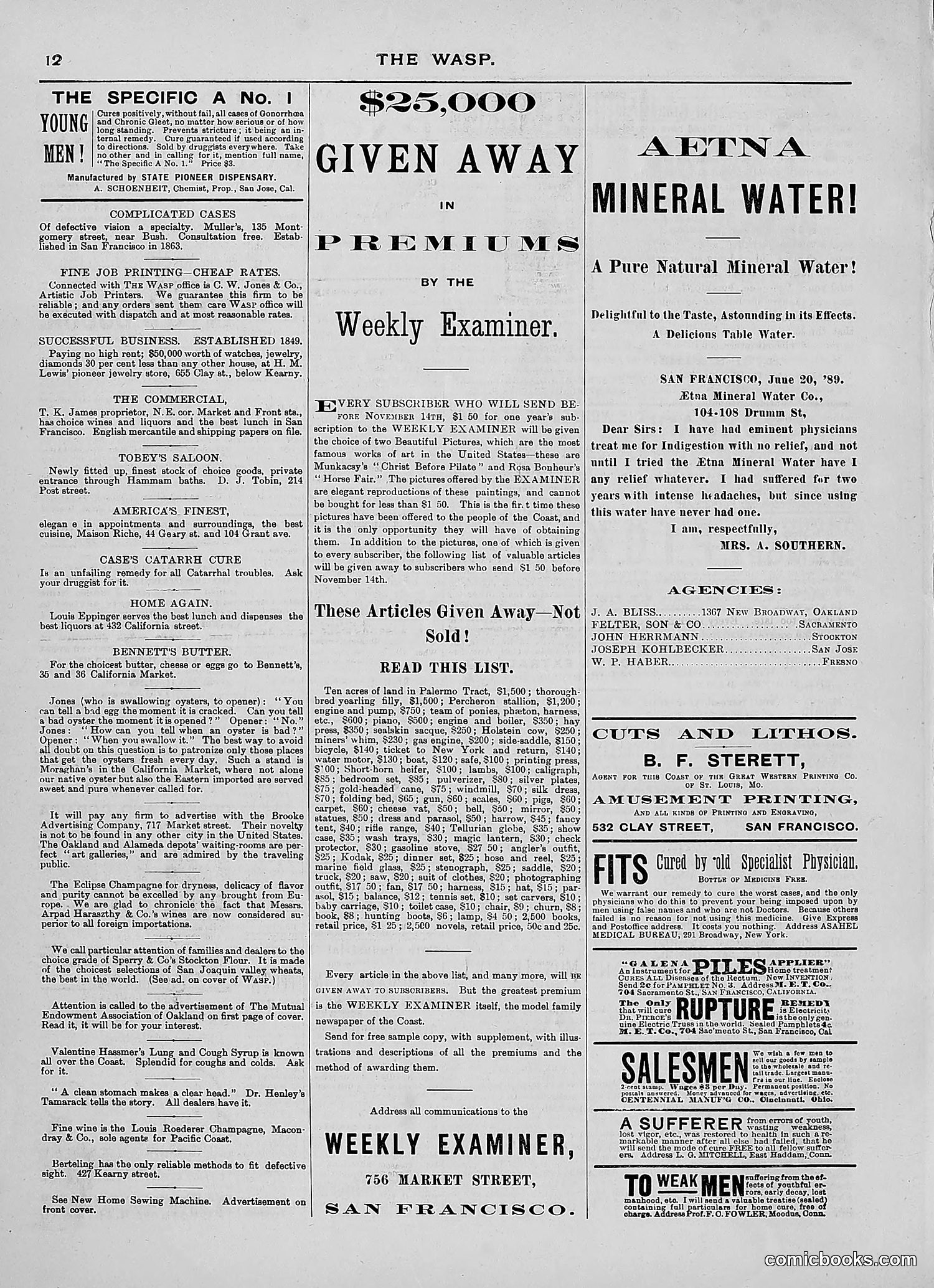
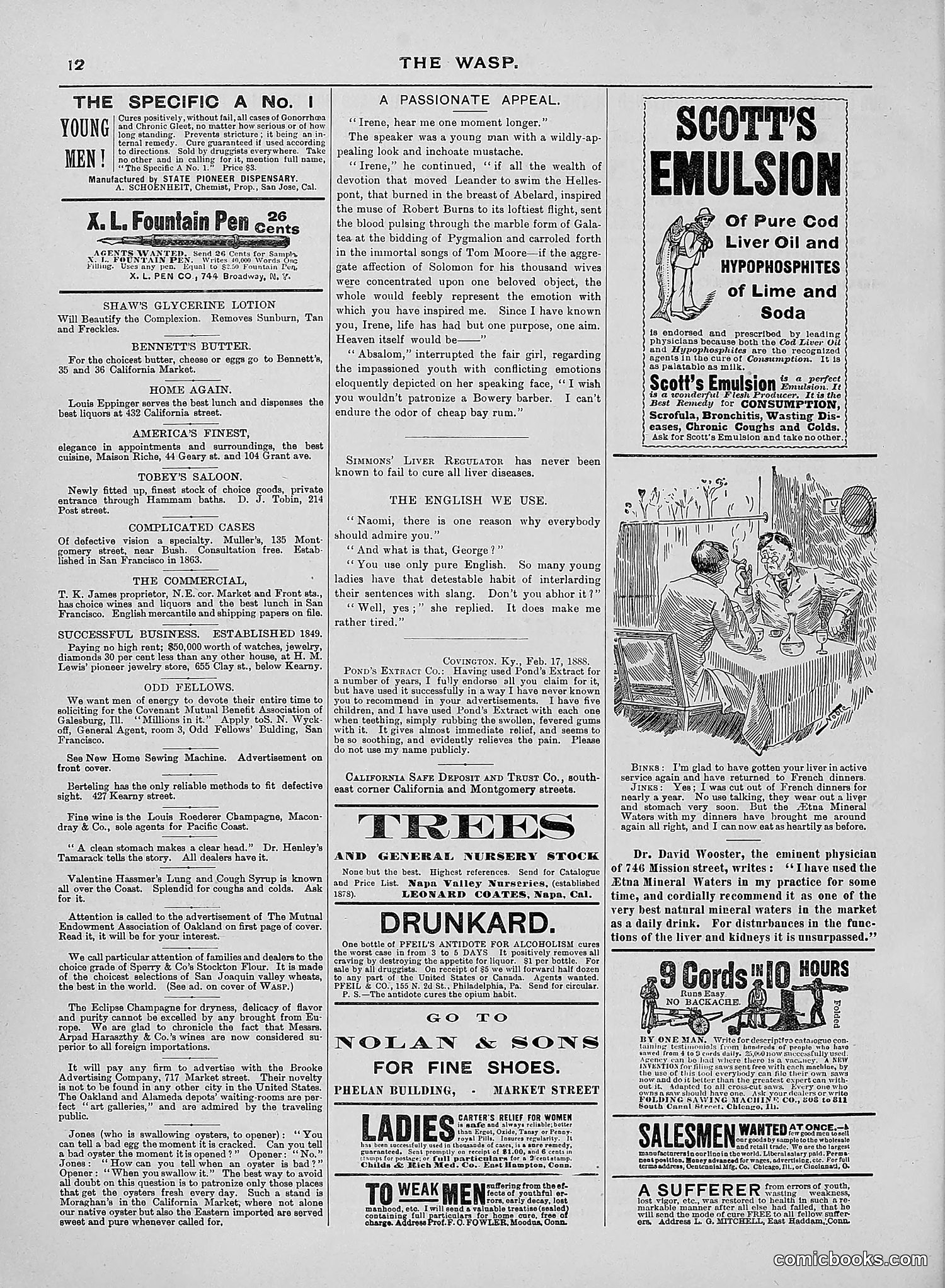
This political cartoon depicts two figures on a beach: a gaunt, caricatured figure labeled "Prohibition" and a woman representing the "Republican Party." The prohibitionist urges the Republican to take a bold plunge into what appears to be quicksand, but the Republican declines, warning of "a treacherous bottom." The cartoon satirizes the tension between prohibition advocates and the Republican Party circa 1889. It suggests that while prohibitionists pressured Republicans to fully embrace alcohol prohibition, the party viewed the issue as politically dangerous—a "quicksand" that could trap them. The cartoon mocks prohibition as an extreme position that Republicans rightly feared would harm their electoral prospects.

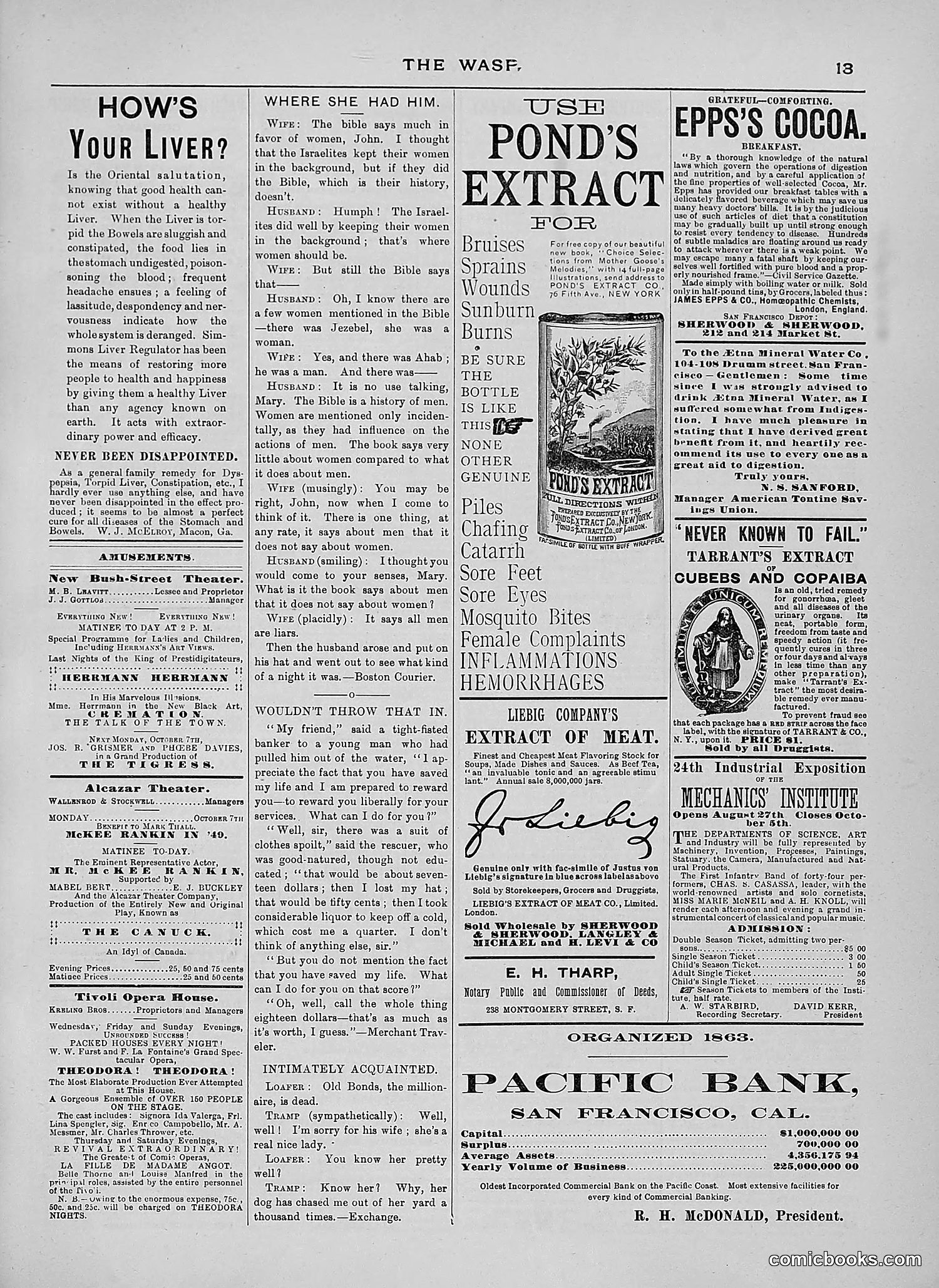
The Wasp — 1889 — page 13 of 450
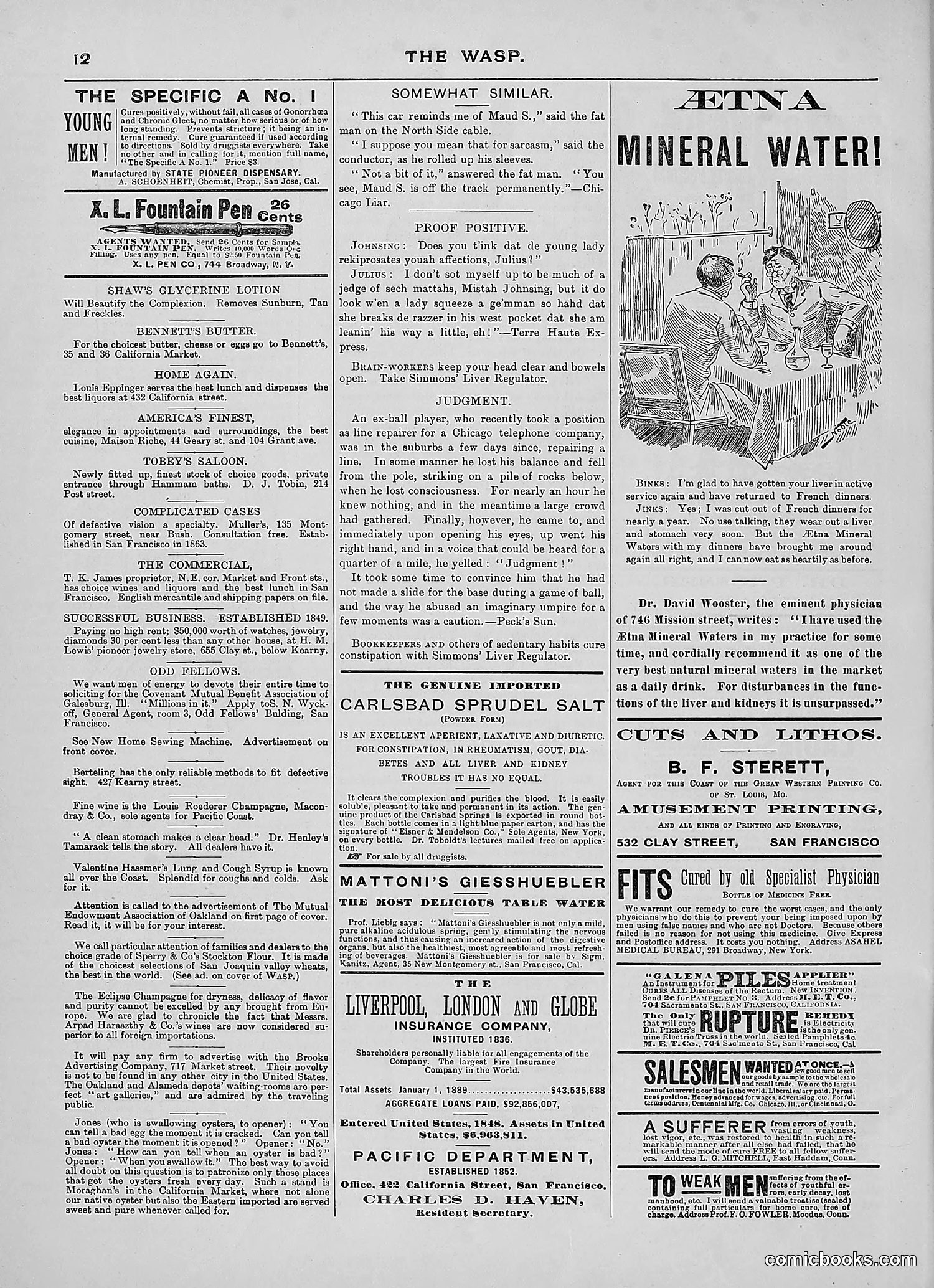
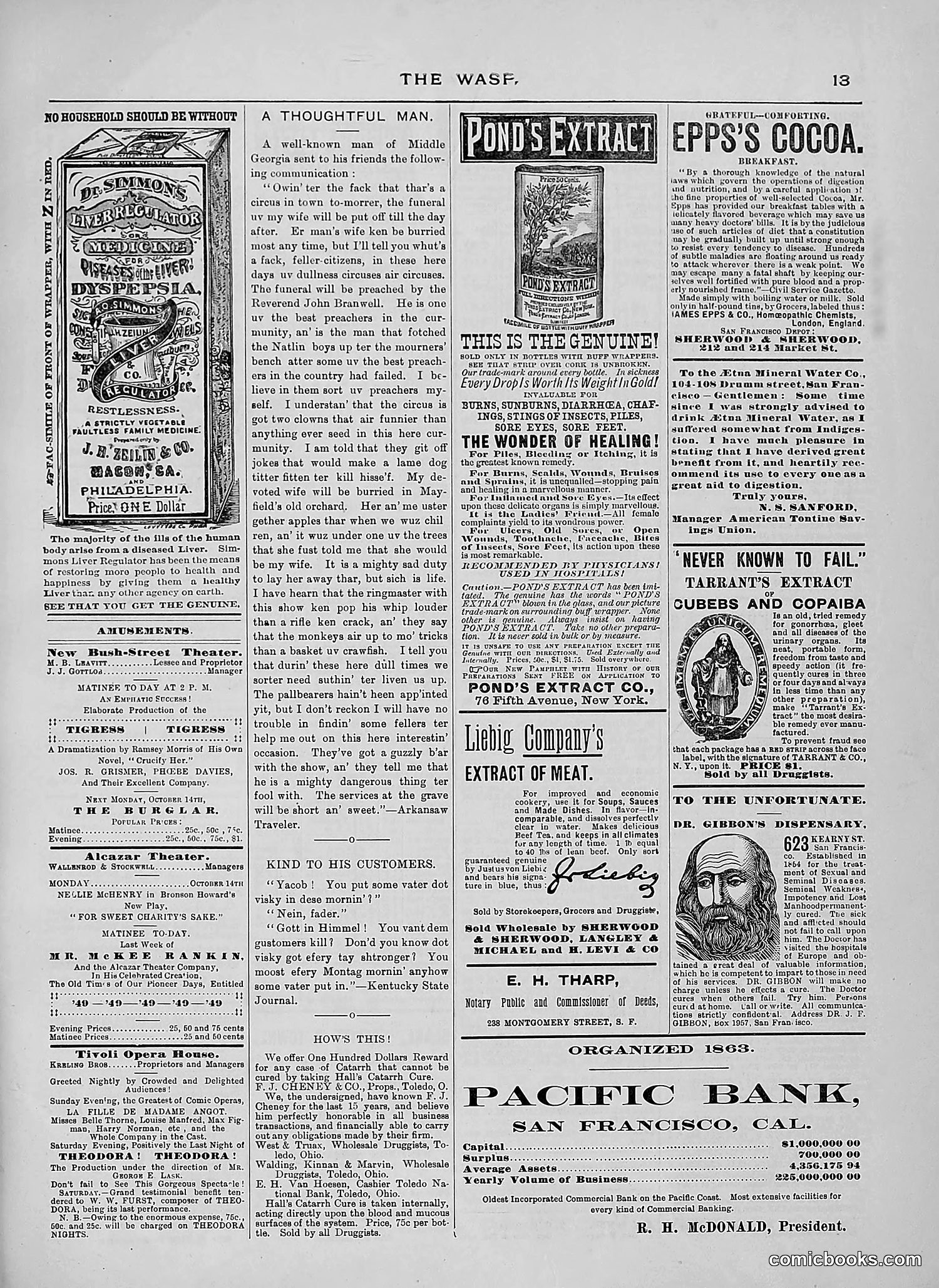
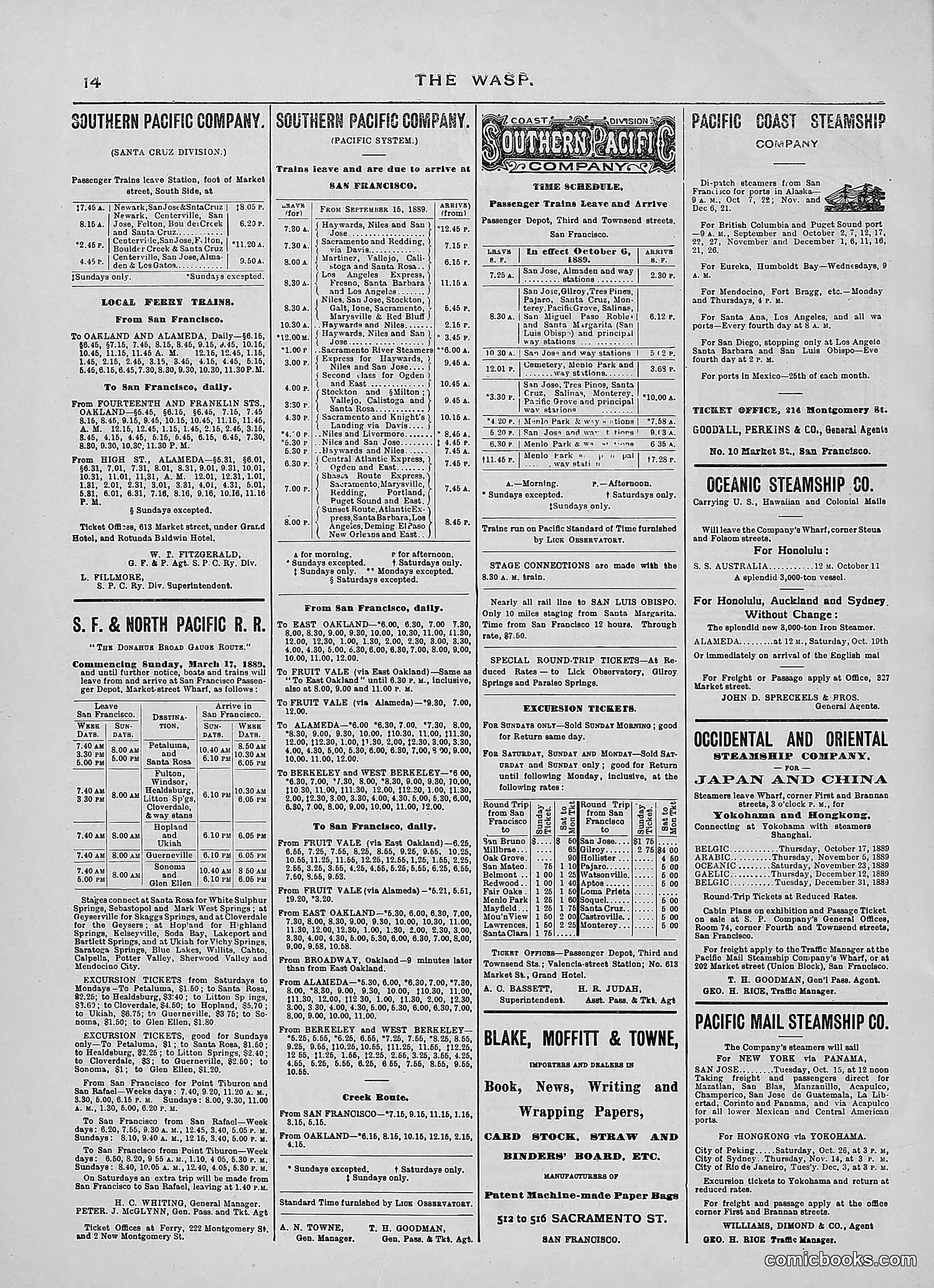
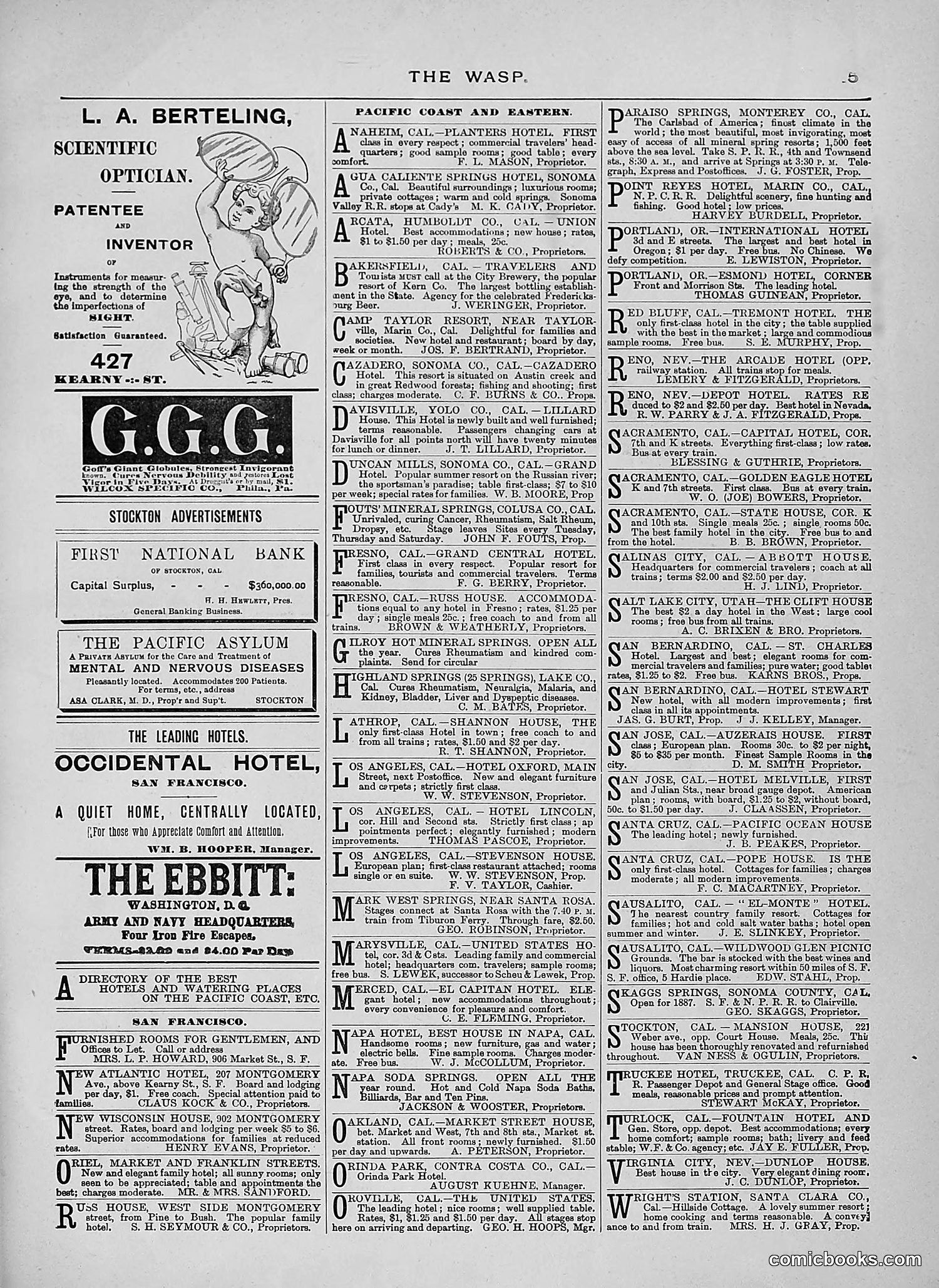
13 / 450
What you’re looking at · open this page on its own ↗

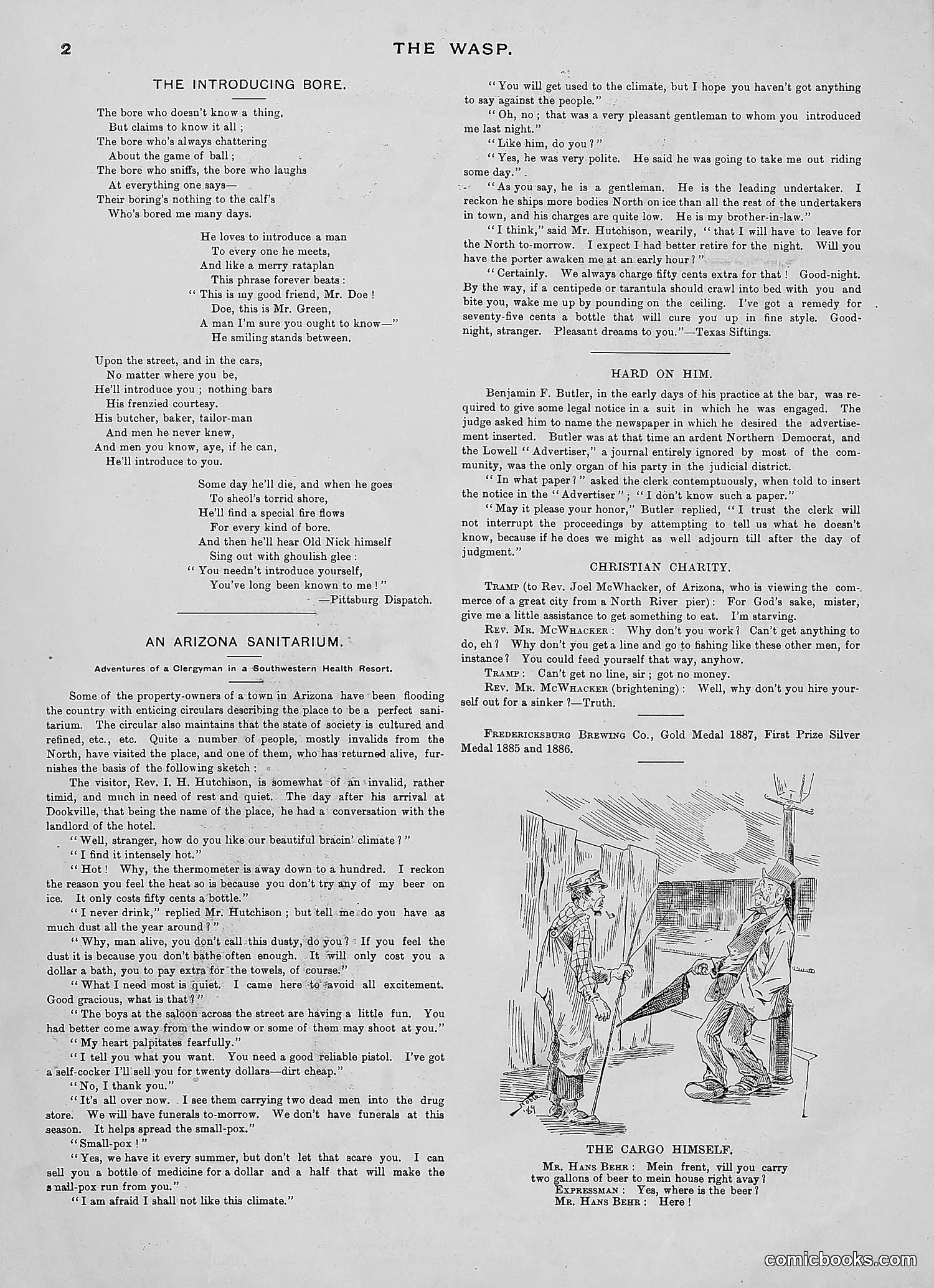
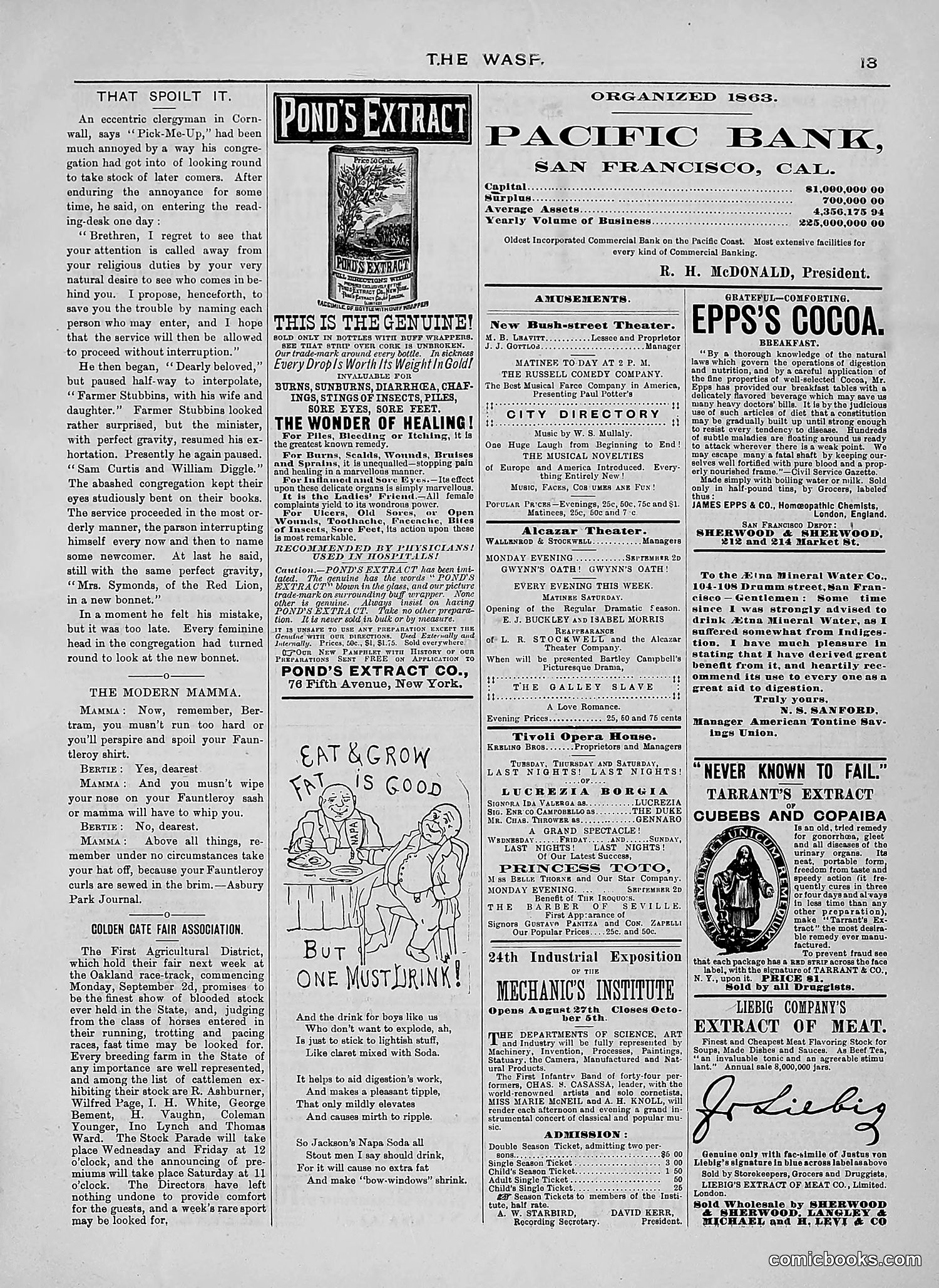
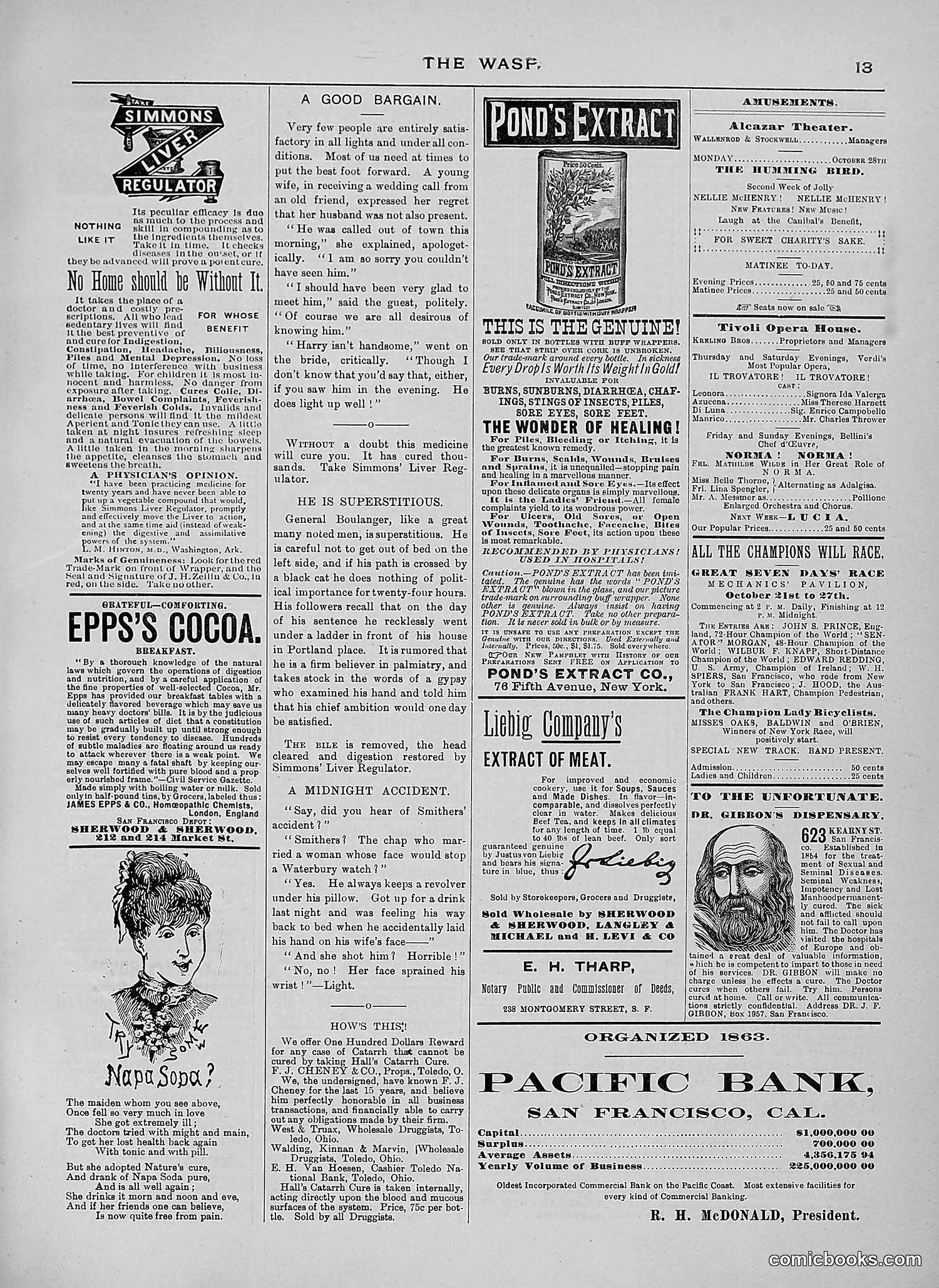
The cartoon depicts a man labeled "MR. HANS BEER" at the center, shown as a cargo container being transported. An expressman asks where the beer is going, and Hans Beer replies "Here!" — the joke being that Hans Beer *is* himself the cargo. This appears to be ethnic satire typical of late 19th-century American humor, playing on German immigration and German names. The visual pun treats a German-named person as a literal beer shipment, reducing him to a commodity. The cartoon mocks both the prevalence of German immigrants and associations between Germans and beer production/consumption in American culture of that era. The surrounding text discusses Arizona sanitariums and social commentary, unrelated to the cartoon's humor.

The Wasp — 1889 — page 14 of 450
14 / 450
What you’re looking at · open this page on its own ↗

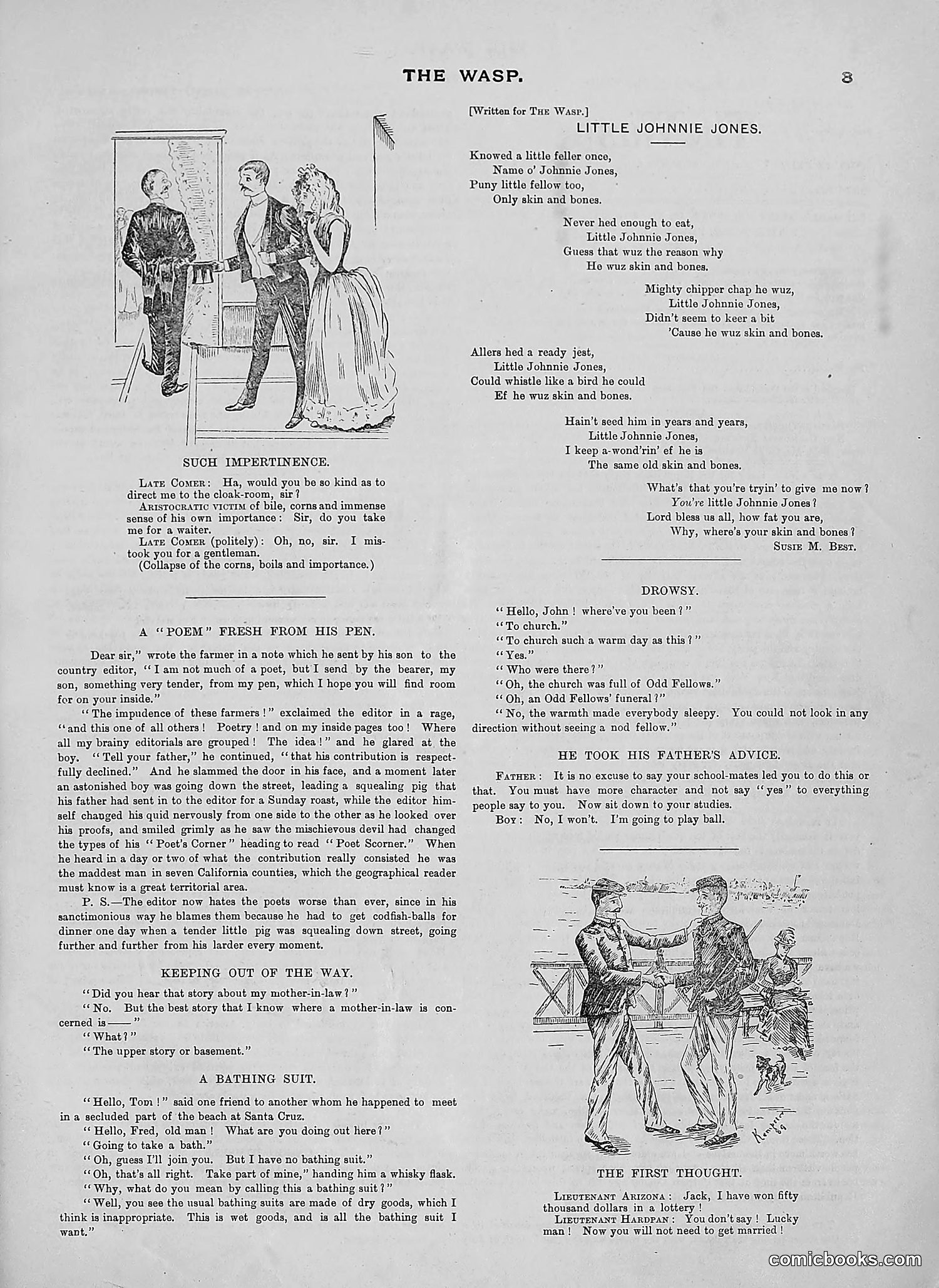
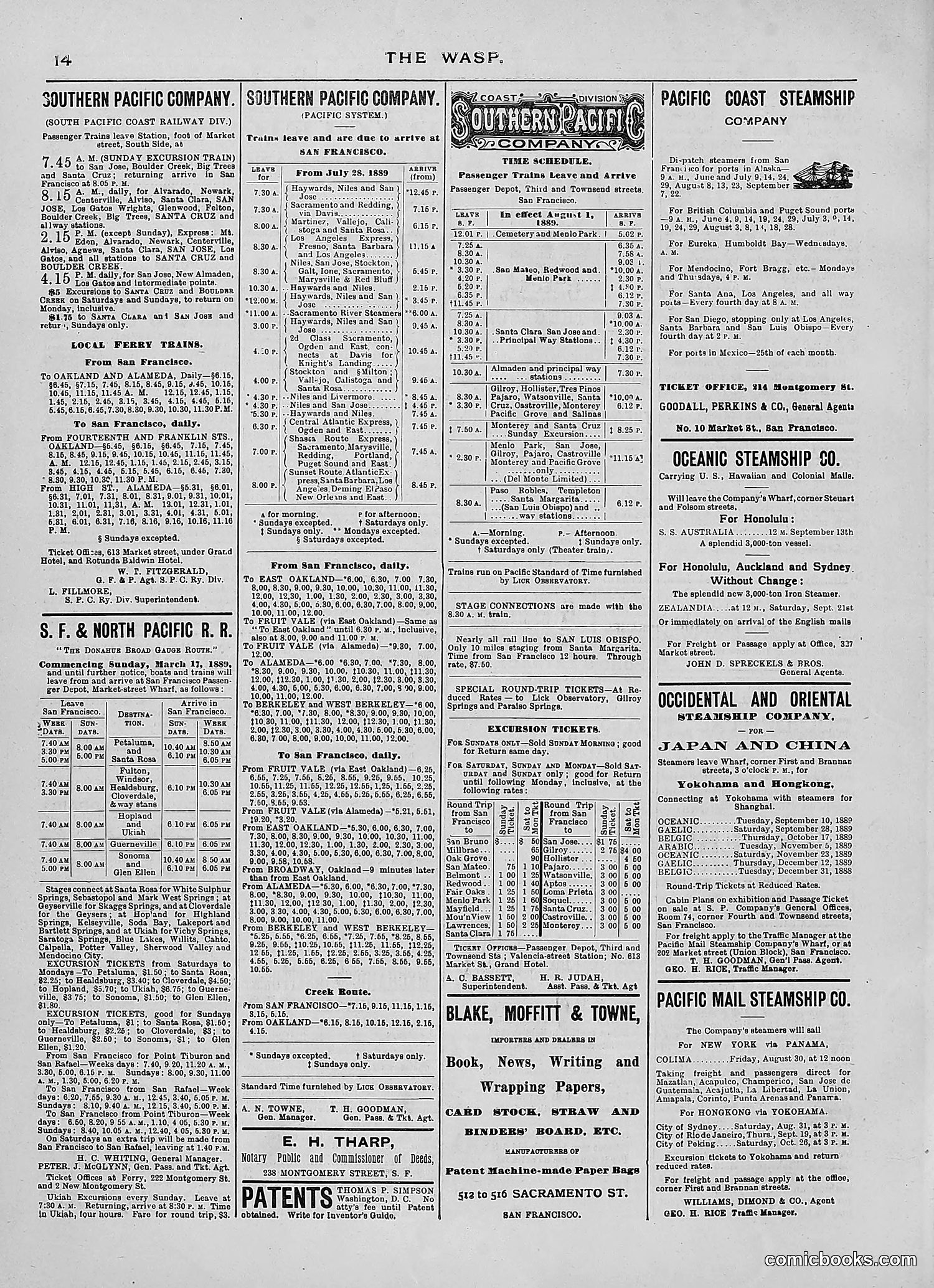
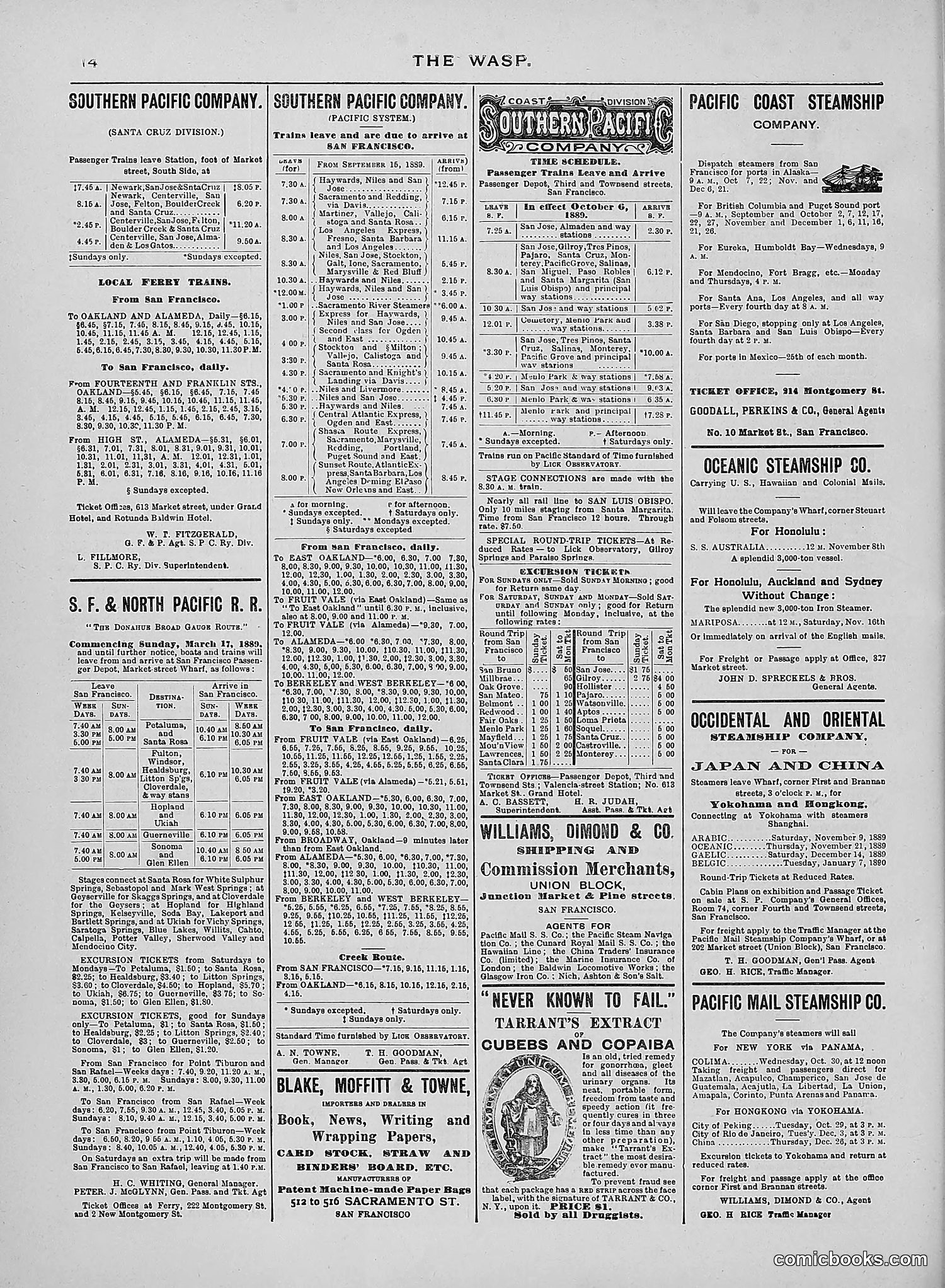
This page contains several satirical pieces and jokes rather than a single unified political cartoon. **"Such Impertinence"** depicts a wealthy aristocrat dismissing a "Late Comer" of obvious importance, highlighting class pretension—the joke being the snob's miscalculation of his visitor's status. **"A Poem Fresh from His Pen"** mocks rural contributors to newspapers, ridiculing farmers who submit poetry, with the editor sarcastically praising their work while clearly despising it. The remaining sections—"Drowsy," "He Took His Father's Advice," "Keeping Out of the Way," and "A Bathing Suit"—are brief comedic dialogues poking fun at everyday social situations: church attendance, parental authority, gossip, and masculine mishaps. The illustration "The First Thought" shows a romantic/social scenario, likely accompanying one of these jokes, though the specific reference is unclear from the visible text.

The Wasp — 1889 — page 15 of 450
15 / 450
What you’re looking at · open this page on its own ↗

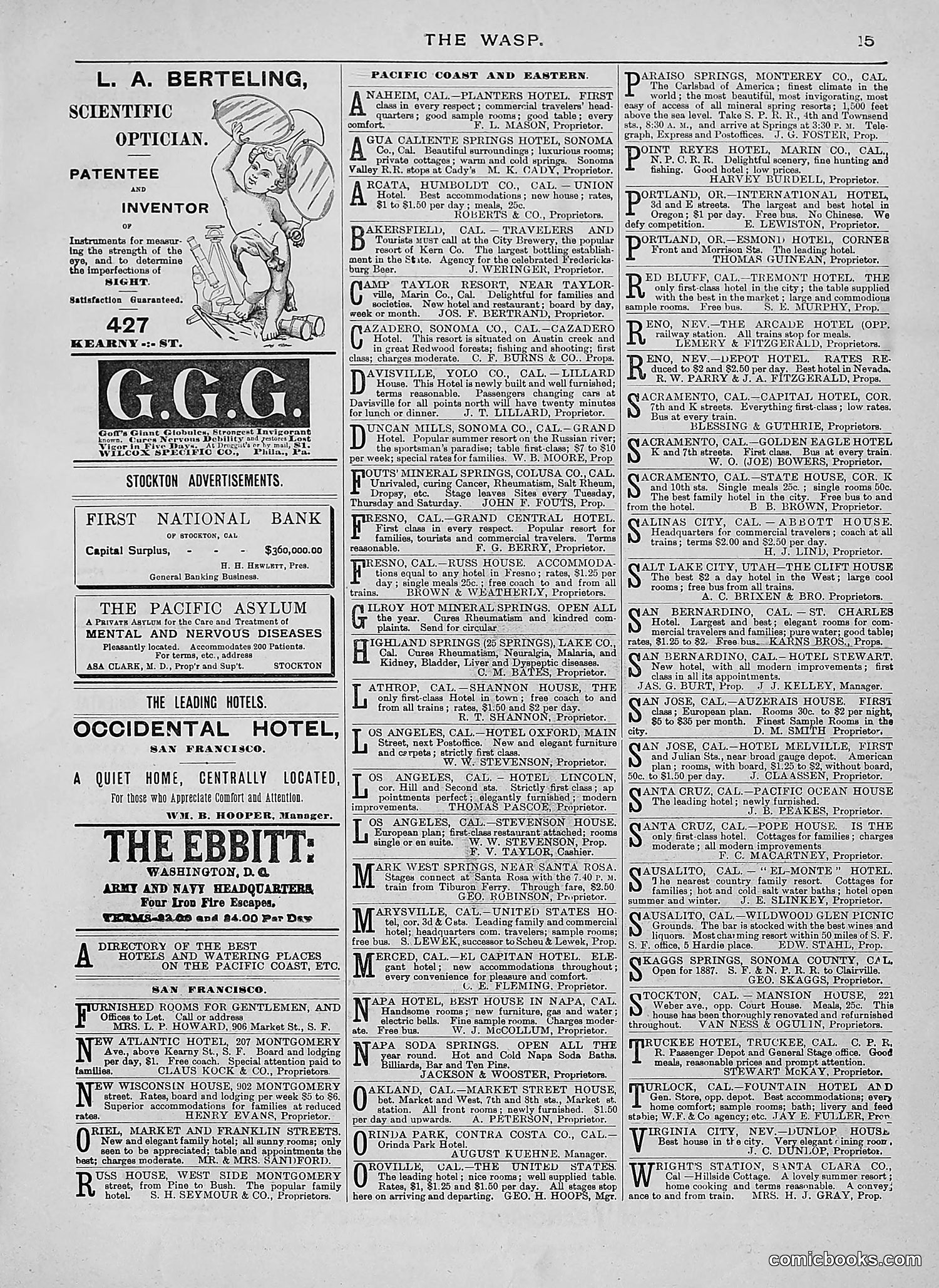
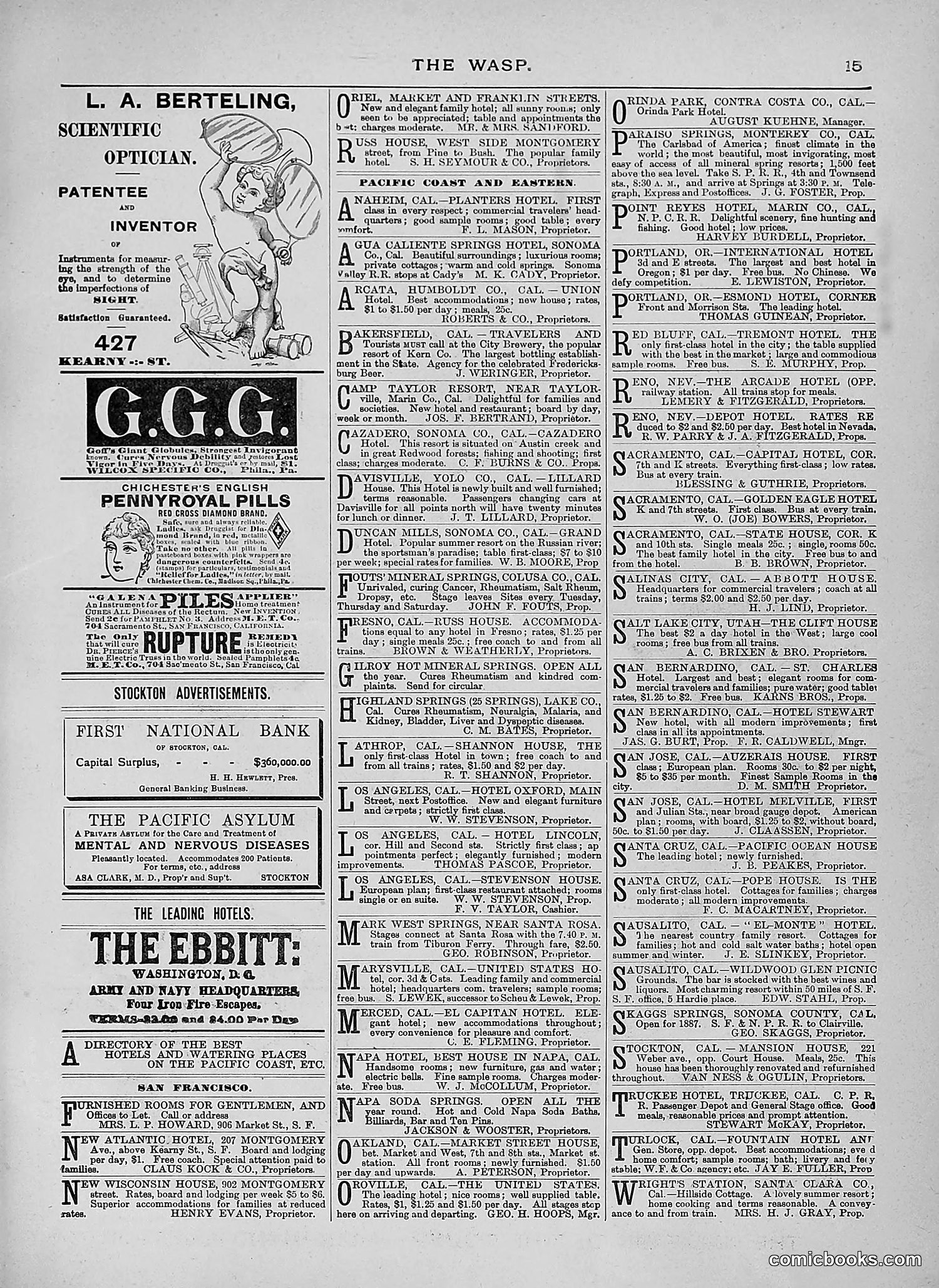
This is the masthead and opening editorial page of *The Wasp*, a San Francisco satirical weekly. The visible content is primarily **text-based political commentary** rather than illustrated cartoons. The editorials critique: 1. **Republican Party politics** - discussing internal divisions over prohibitionist amendments and the 1884 election aftermath 2. **Naval policy** - Secretary of the Navy's plan to paint warships white instead of black 3. **Regional politics** - South Carolina's scandals and Louisiana's gubernatorial race 4. **International affairs** - Bismarck's foreign policy and American diplomacy at the Berlin Conference The writing style is dense, satirical commentary aimed at politically-engaged readers. **No cartoon illustrations are visible on this particular page.**

The Wasp — 1889 — page 16 of 450
16 / 450
What you’re looking at · open this page on its own ↗

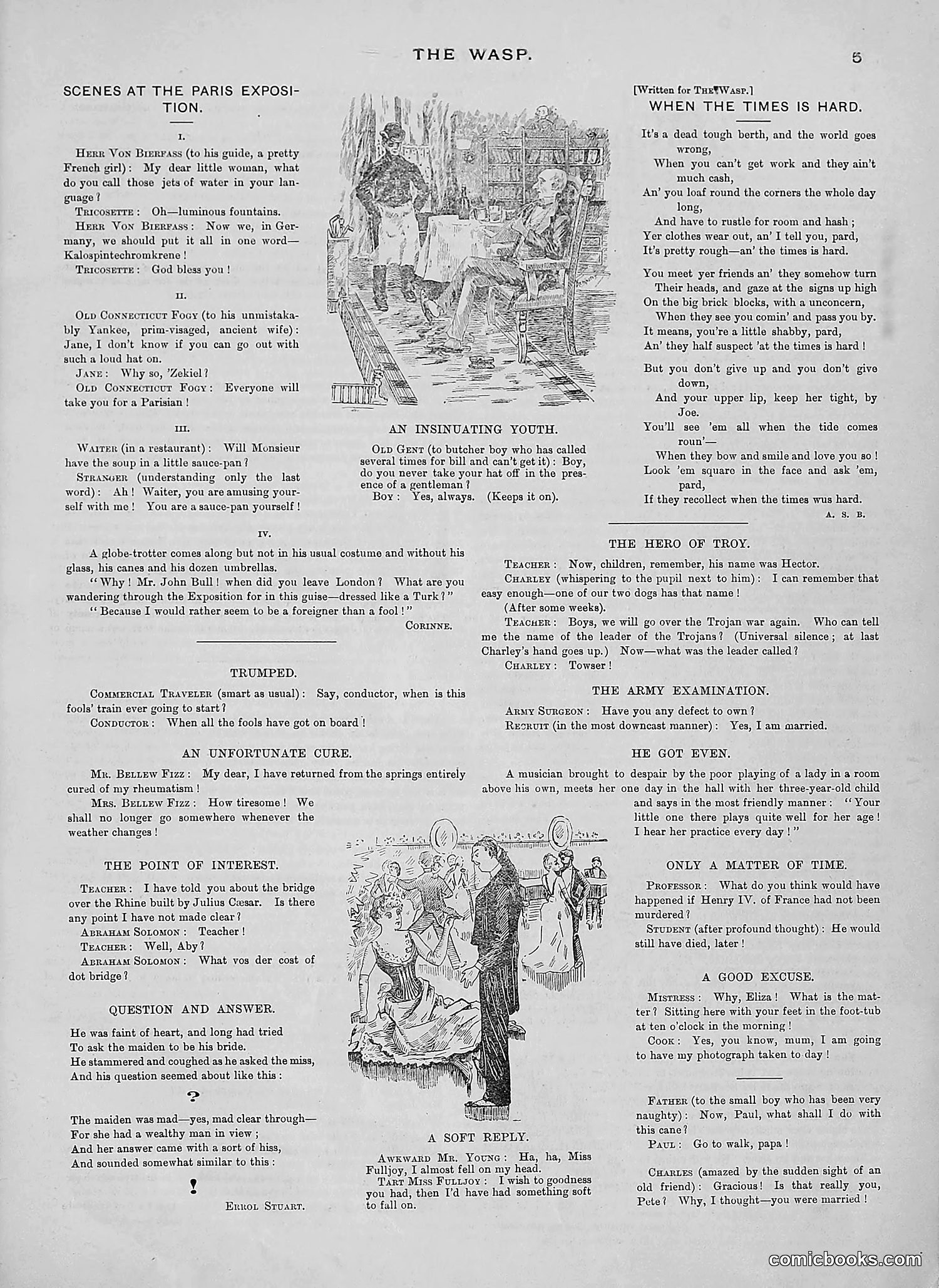
This page contains multiple short humorous sketches and poems rather than a single cartoon. The content includes: **"Scenes at the Paris Exposition"** — depicts tourists at the 1889 Paris World's Fair, mocking both pretentious foreign visitors (Herr Von Bierplass, a German) and American tourists' gullibility and poor behavior abroad. **Various brief comedic dialogues** satirizing everyday situations: a restaurant misunderstanding, an Army examination where a recruit admits to being married, and domestic scenes. **"When the Times is Hard"** — a poem about economic hardship and perseverance, likely referencing contemporary economic conditions. **"The Hero of Troy"** — appears to be a classroom joke about the Trojan War. The overall tone mocks social pretension, class differences, and American behavior relative to European culture, typical of The Wasp's satirical approach to 1880s-90s society.

The Wasp — 1889 — page 17 of 450
17 / 450
What you’re looking at · open this page on its own ↗

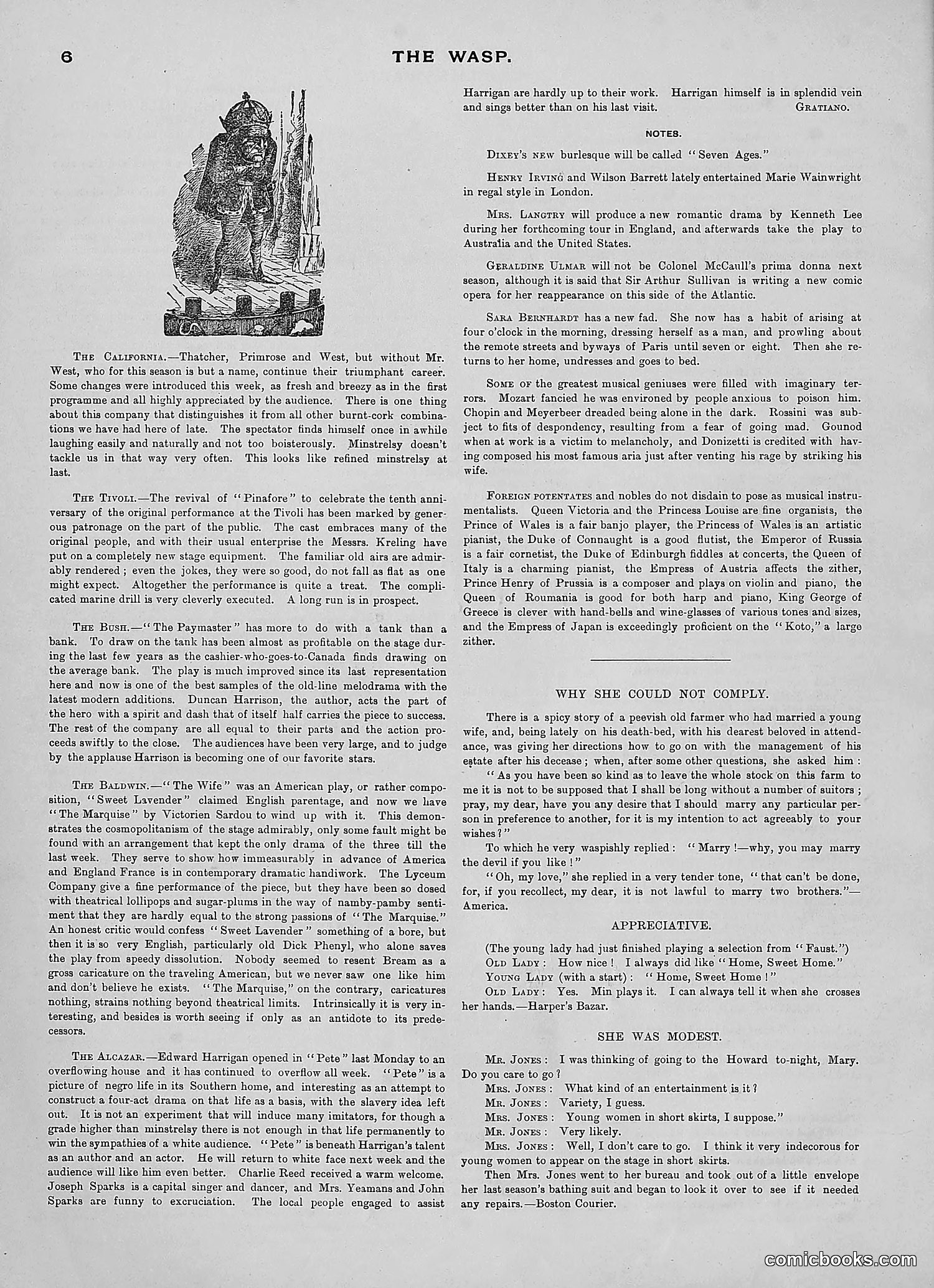
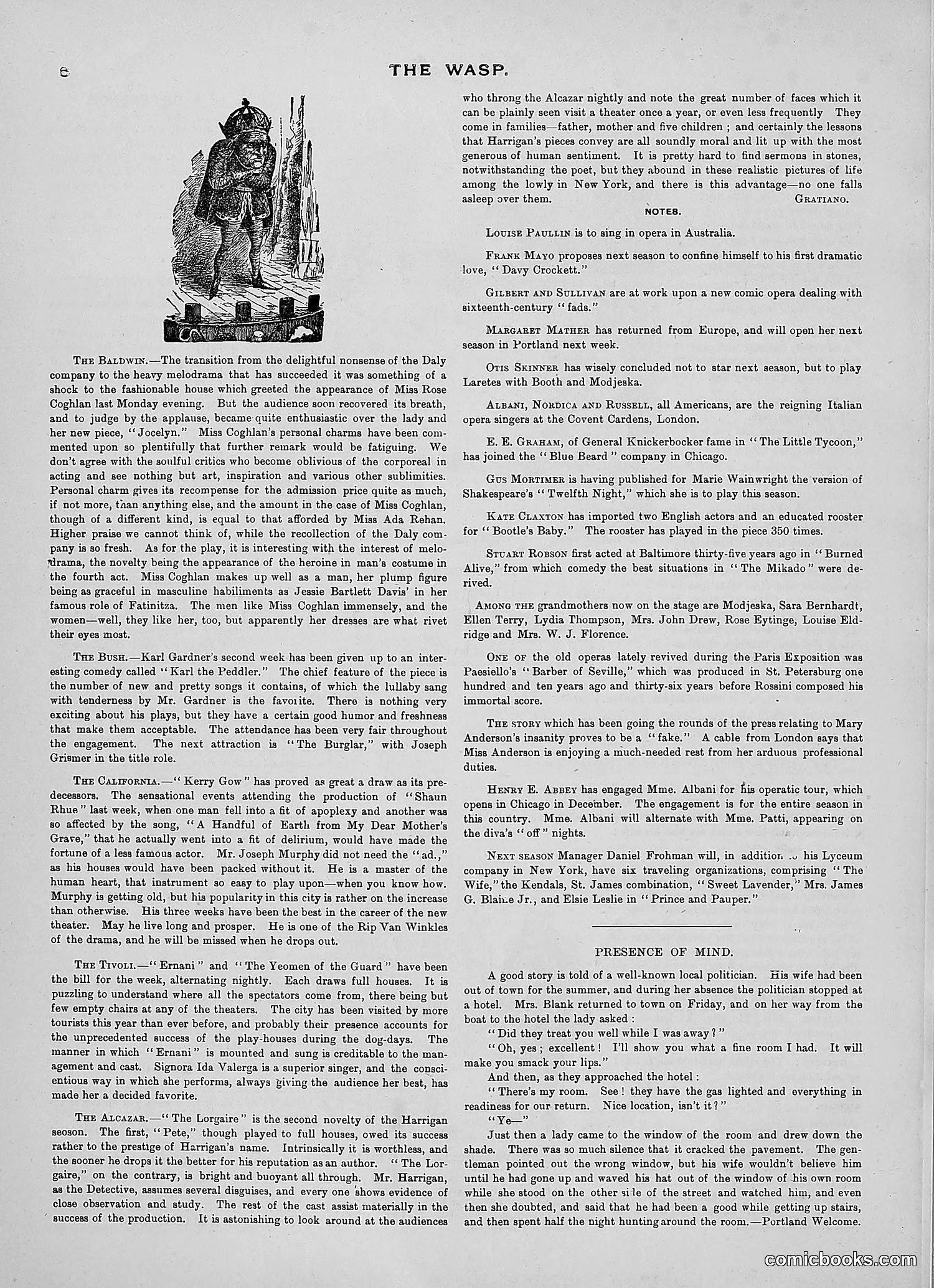
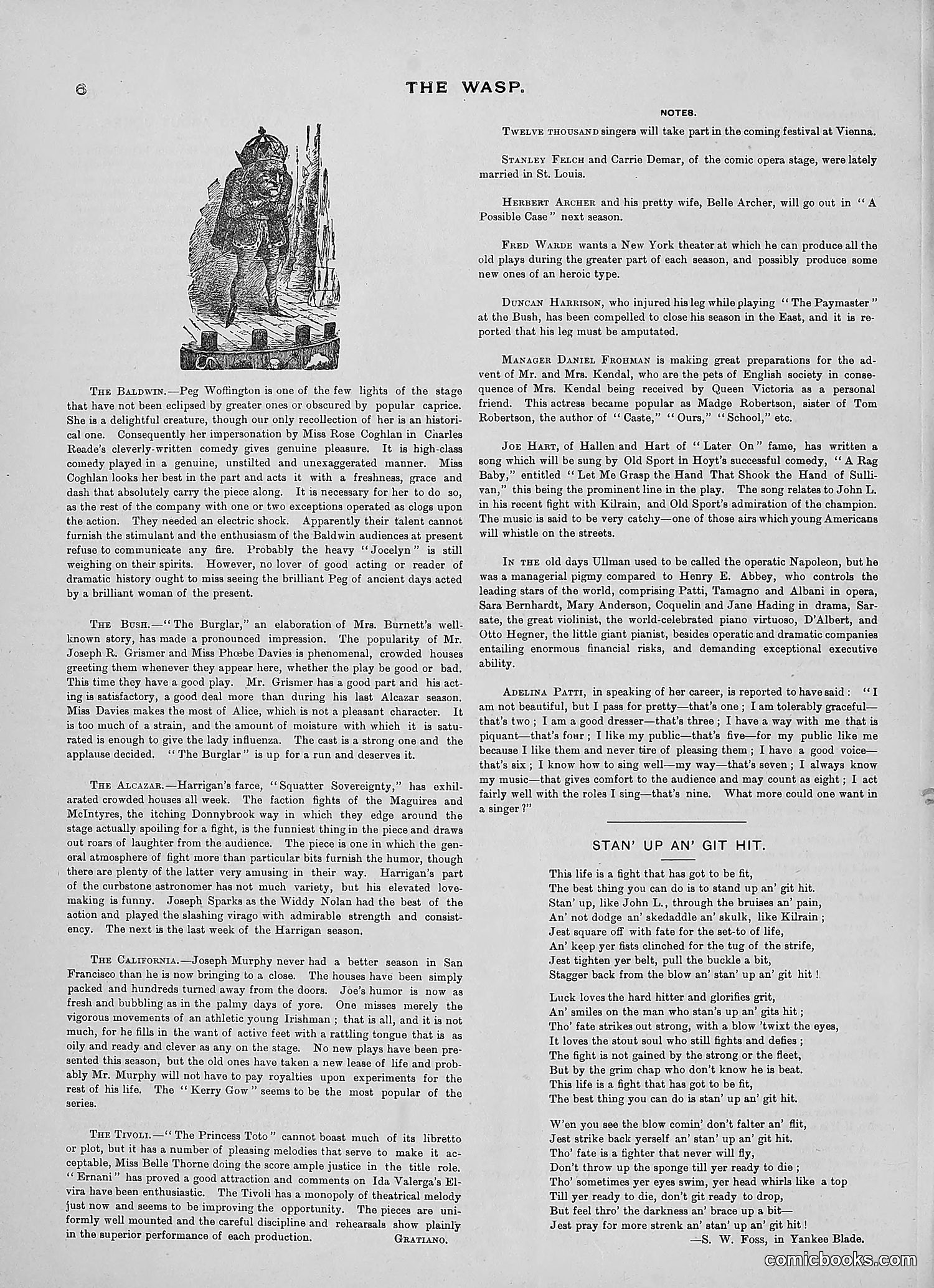
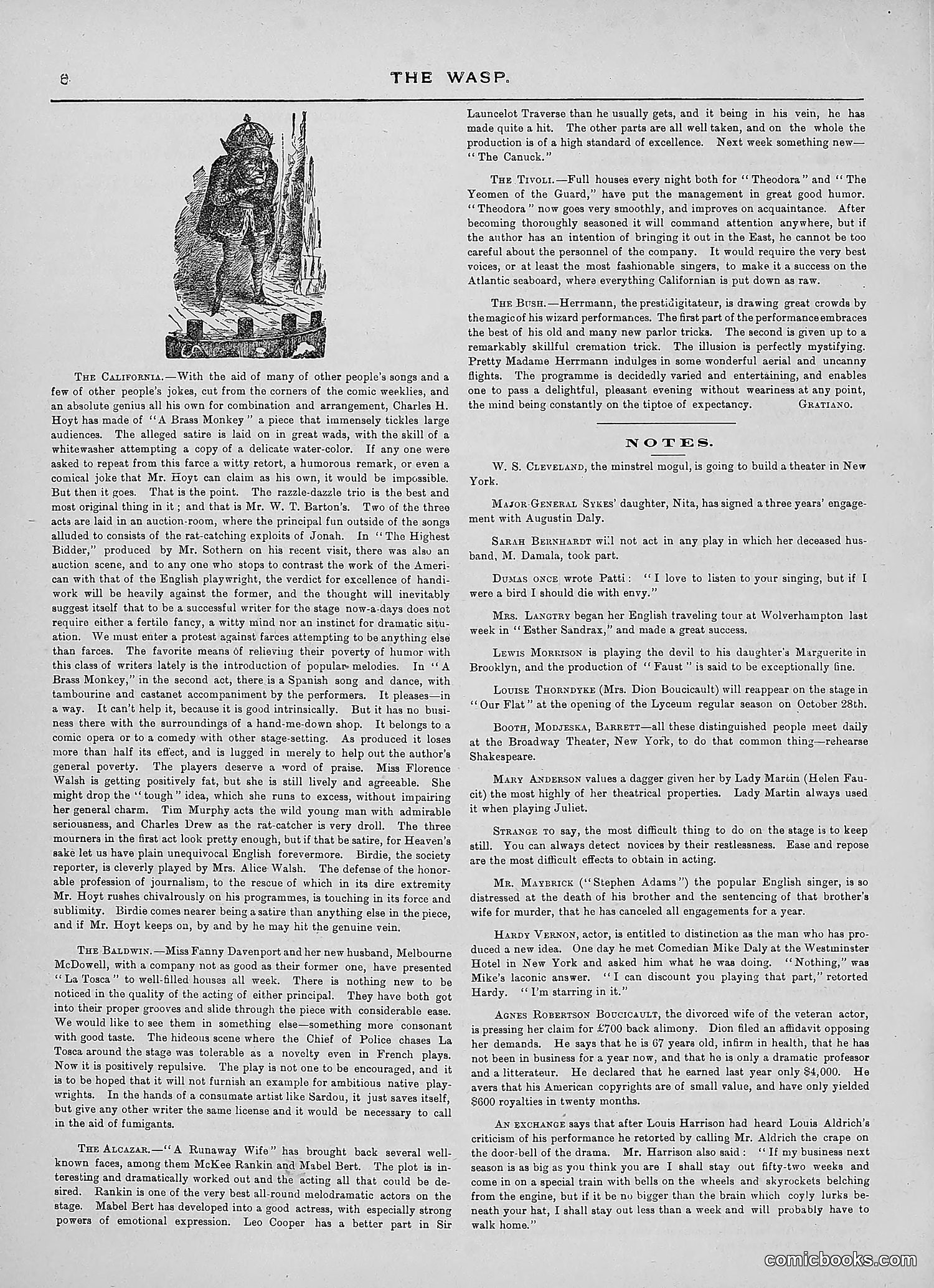
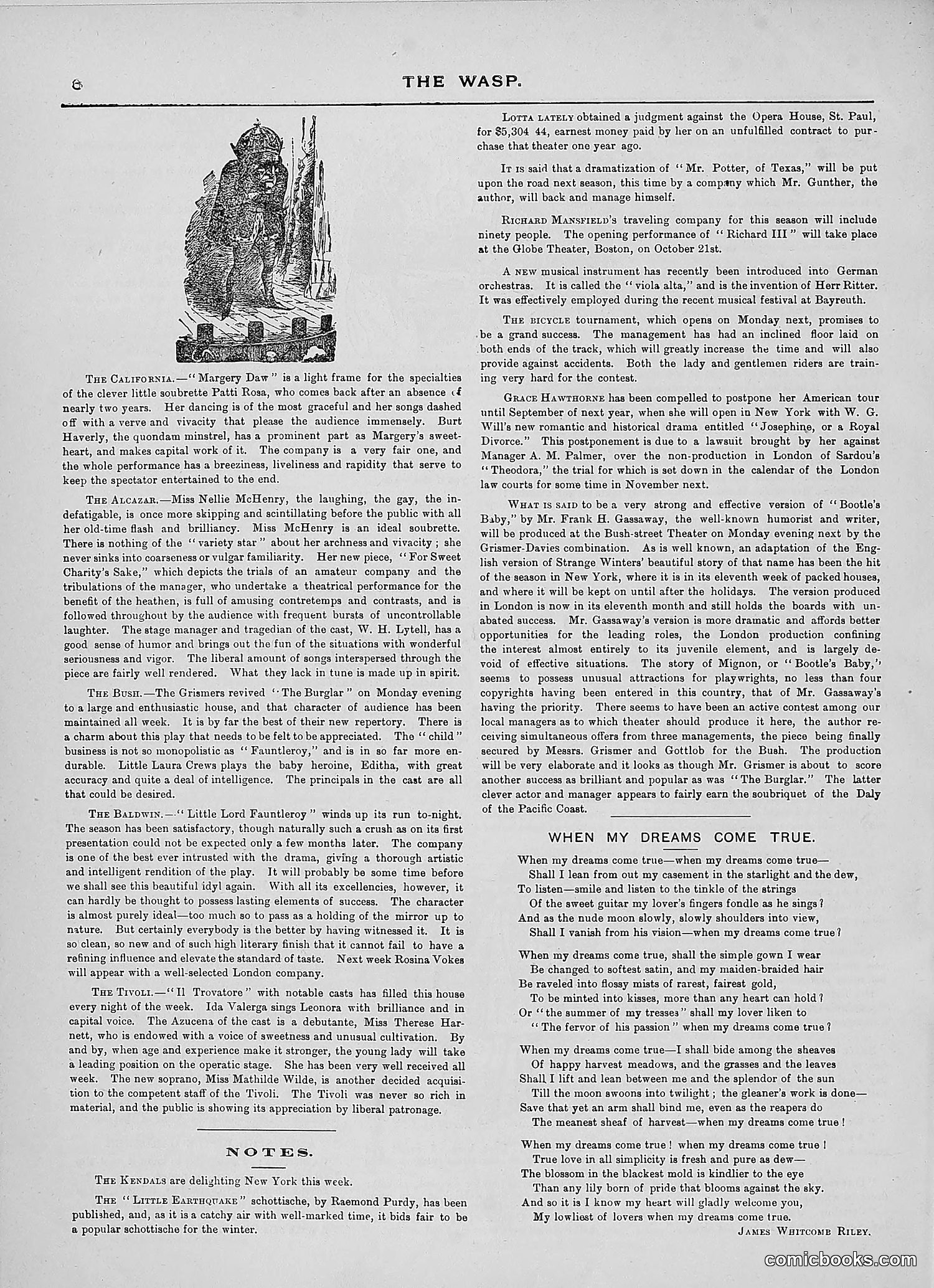
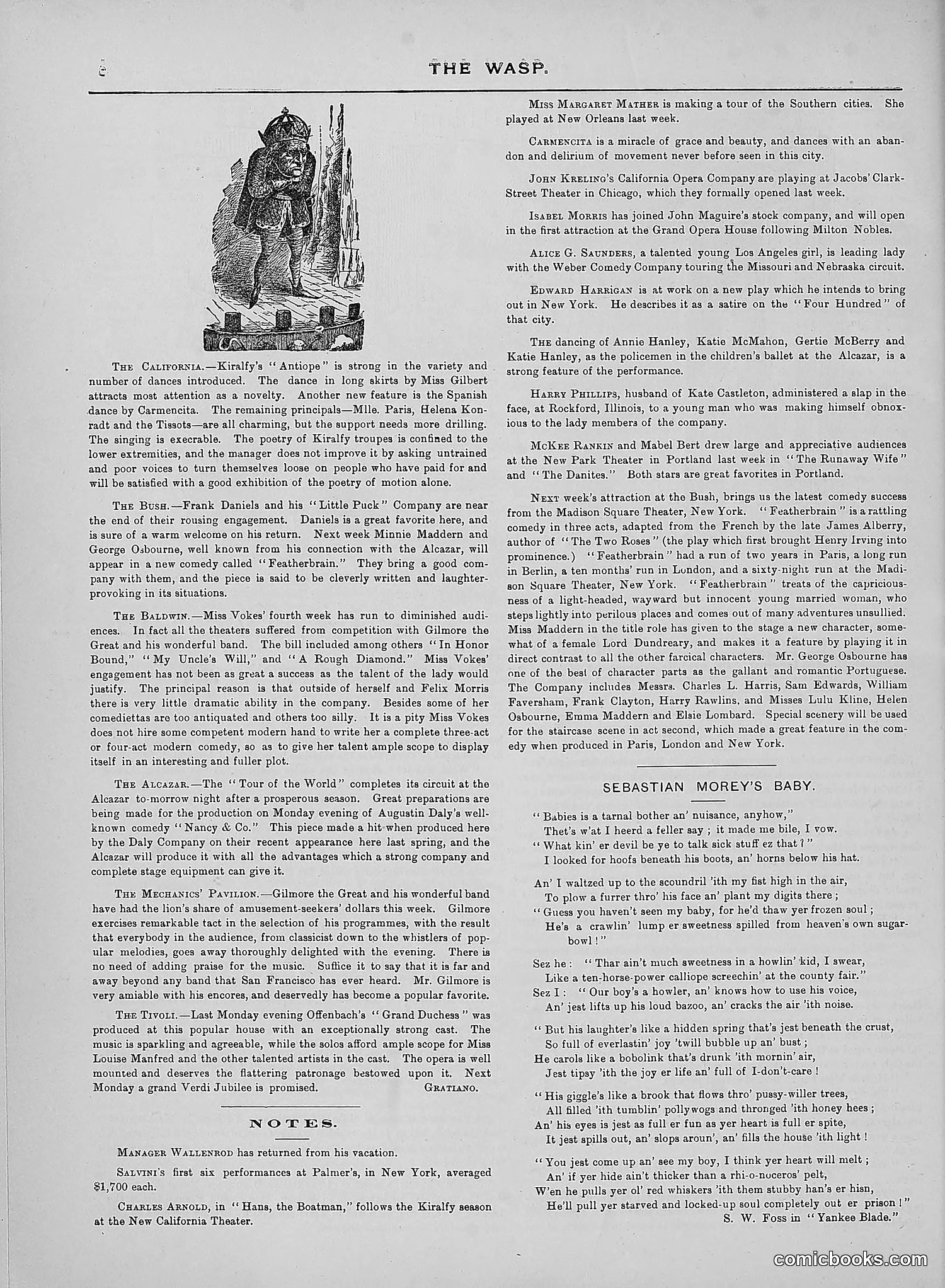
This page from *The Wasp* (a San Francisco satirical magazine) contains theatrical reviews rather than political cartoons. The illustration shows what appears to be a California bear or similar creature climbing—likely referencing the California Theatre. The text reviews contemporary stage performances, including "The California" (featuring Thatcher, Primrose and West), "The Tivoli" (reviving "Pinafore"), "The Bush," "The Baldwins," and "The Alcazar." The reviews are theatrical criticism written in witty, gossipy prose—typical of *The Wasp*'s style. Several anecdotes about performers and opera singers follow, including humorous observations about musical ability among foreign nobility. The page concludes with lighter entertainment items: a story about a farmer's wife and various theatrical gossip. This represents *The Wasp*'s coverage of San Francisco's entertainment scene rather than political satire.

The Wasp — 1889 — page 18 of 450
18 / 450
What you’re looking at · open this page on its own ↗

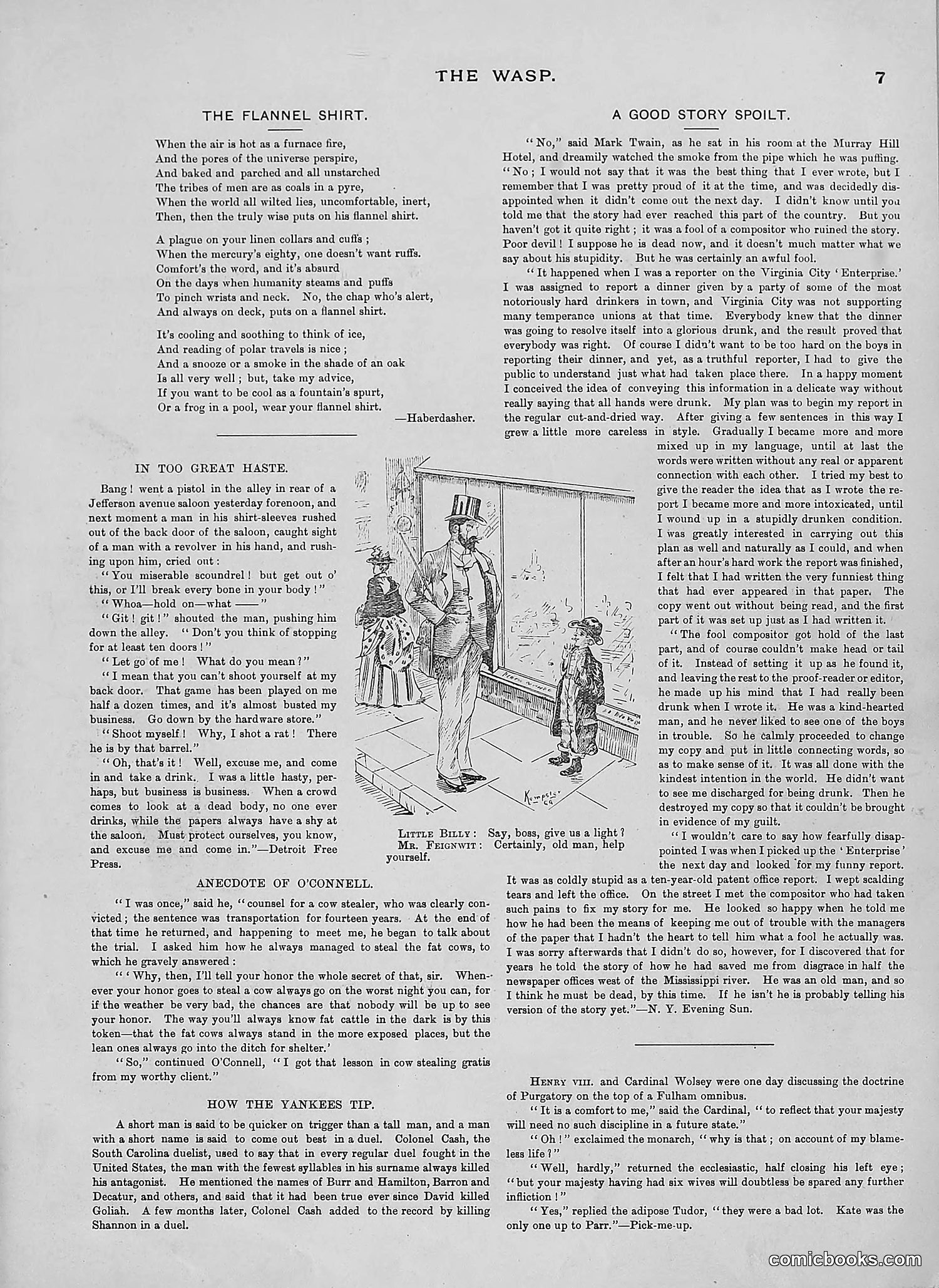
The page contains several satirical pieces rather than a single cartoon. The main illustrated item shows "Little Billy" asking a man (labeled "Ms. Phrowit") for a light, depicting a humorous street encounter. The text pieces include: - "The Flannel Shirt" (poem about practical workwear) - "A Good Story Spoilt" (Mark Twain anecdote about a bungled newspaper report of a drunken dinner) - "In Too Great Haste" (brief story about a saloon shooting) - "Anecdote of O'Connell" (advice about cow stealing) - "How the Yankees Tip" (brief note on regional shooting accuracy) - "Henry VIII and Cardinal Wolsey" (philosophical exchange about discipline) The content mixes lighthearted social commentary with humorous fictional anecdotes. The satirical focus targets human folly, journalistic incompetence, and regional stereotypes rather than specific political figures or events.

The Wasp — 1889 — page 19 of 450
19 / 450
What you’re looking at · open this page on its own ↗

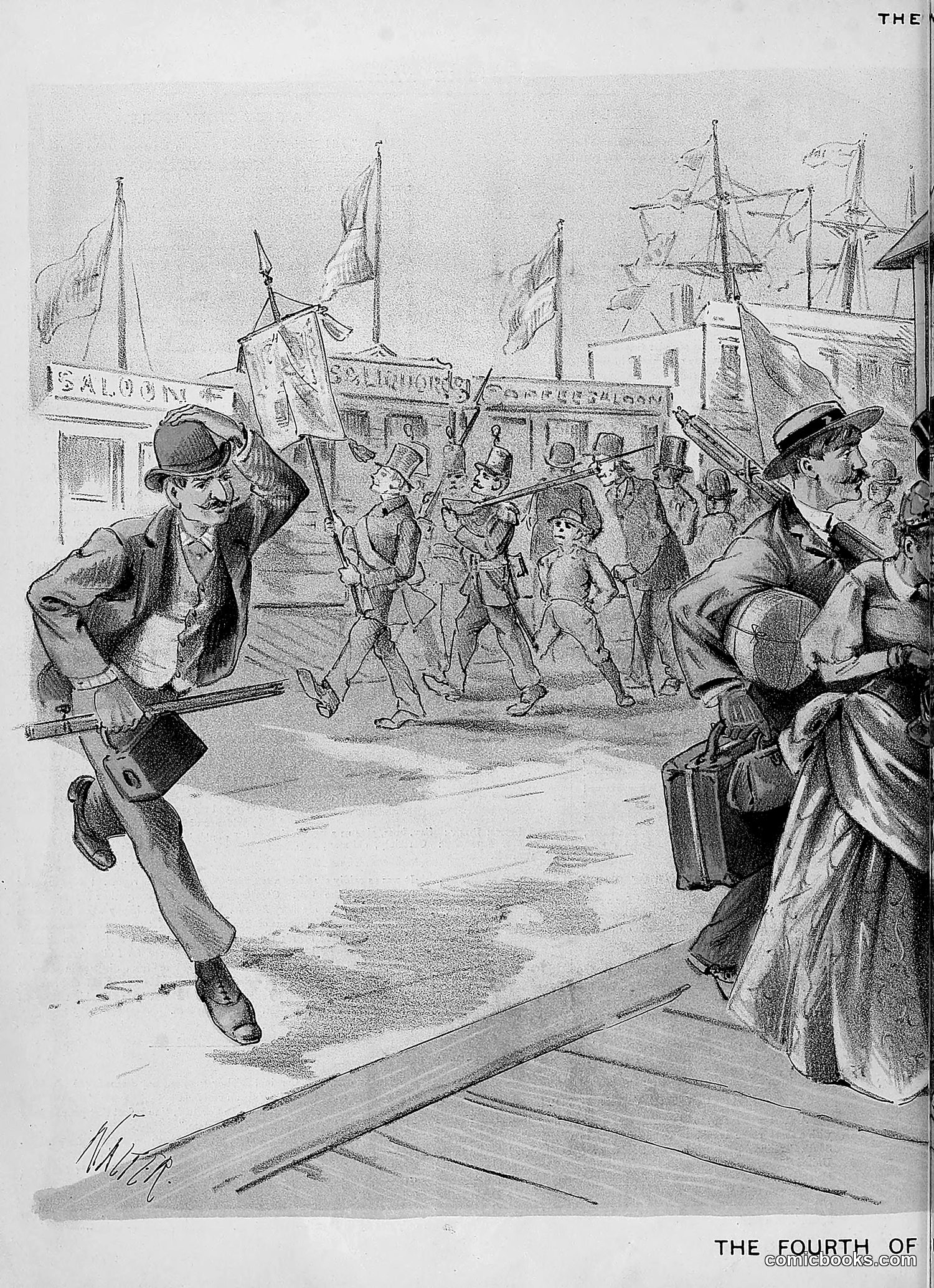
This satirical illustration depicts a chaotic Fourth of July celebration at what appears to be a waterfront saloon district. The cartoon shows figures engaged in rowdy, violent behavior—a man on the left wielding an axe or hatchet, others fighting or running in the background, amid sailing ships and saloon buildings. The satire likely critiques how working-class Americans, particularly immigrant communities in urban areas, "celebrated" Independence Day through drunkenness and violence rather than civic reflection. The Wasp magazine frequently mocked such perceived social disorder. The exaggerated caricatures and emphasis on chaos suggests commentary on urban lawlessness and the contrast between patriotic ideals and actual street-level behavior in gilded-age America.

The Wasp — 1889 — page 20 of 450
20 / 450
What you’re looking at · open this page on its own ↗

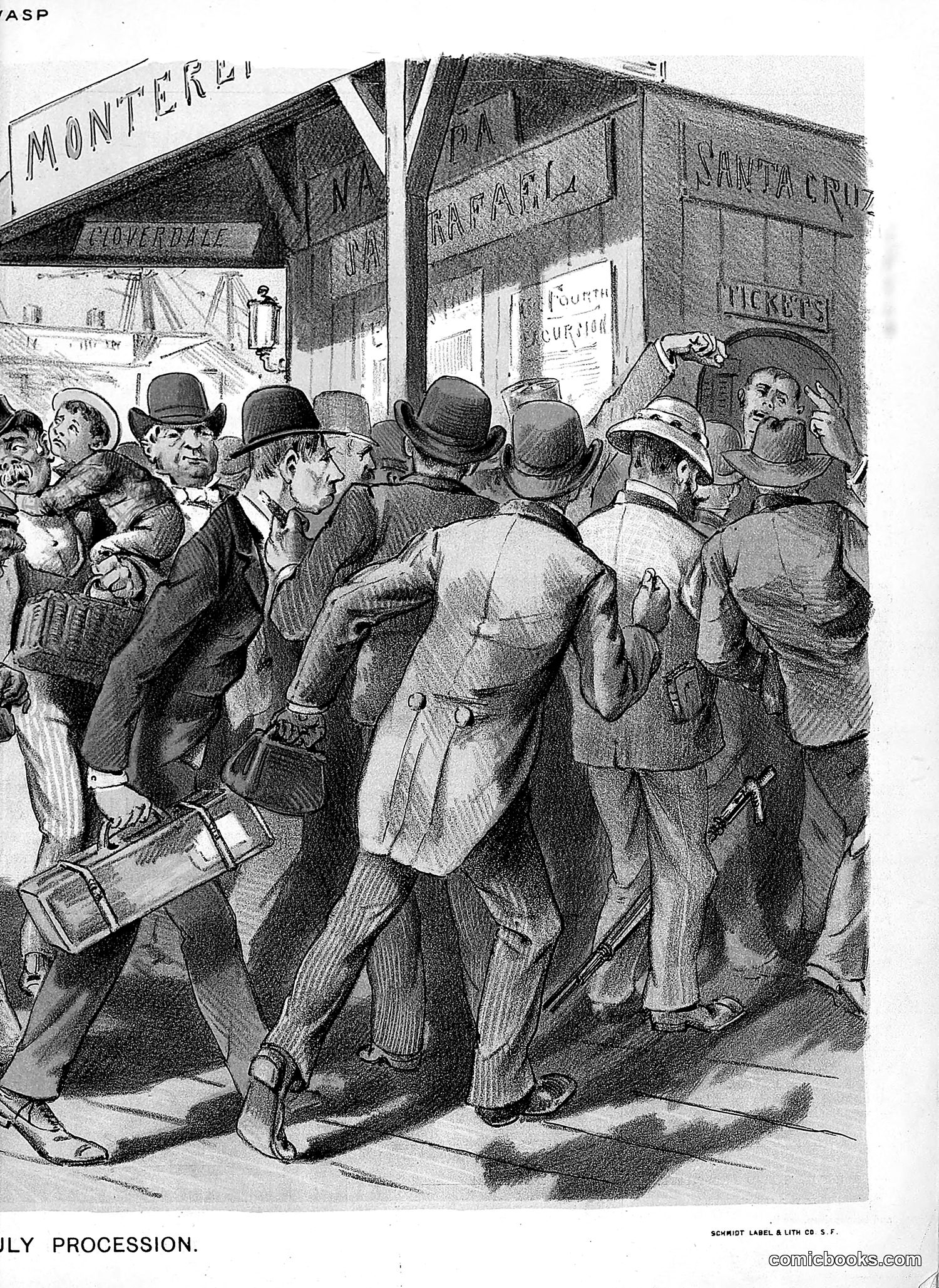
This satirical cartoon depicts a crowded street scene outside what appears to be ticket offices (visible signs read "CLOVERDALE," "KATARIA," "SANTA CRUZ," and "TICKETS"). The image shows well-dressed men in Victorian-era clothing and hats pressing urgently toward the building, suggesting a frantic rush. The caption "JULY PROCESSION" implies this depicts the competitive scramble for travel tickets during July—likely the height of summer vacation season. The satire mocks the undignified, chaotic behavior of these respectable gentlemen as they abandon decorum in their desperation to secure passage. The caricatured expressions and packed crowd emphasize the absurdity of civilized society's mad rush for holiday travel. *The Wasp* uses this scene to humorously critique both consumer behavior and the pretensions of the era's middle class.

The Wasp — 1889 — page 21 of 450
21 / 450
What you’re looking at · open this page on its own ↗

This page is primarily **advertising and humor columns rather than political cartoons**. The visible content includes: **Main sections:** - "Going to a Picnic" — a domestic humor piece about a wife preparing for an outing - "Flying Jokes" — miscellaneous short jokes and quips on various topics - "Circumstances Alter Cases" — anecdotes about human behavior - "War Rumors" — brief satirical dialogue about WWI gossip **Advertisements:** Burke's Stout, Dr. Salfield's Rejuvenator, Byron Hot Springs resort, and instantaneous photographs dominate the right column. The humor is lighthearted and social rather than sharply political. References to "war rumors" suggest this was published during or near WWI, but the satirical focus is on everyday foolishness and social absurdities rather than specific political figures or events.

The Wasp — 1889 — page 22 of 450
22 / 450
What you’re looking at · open this page on its own ↗

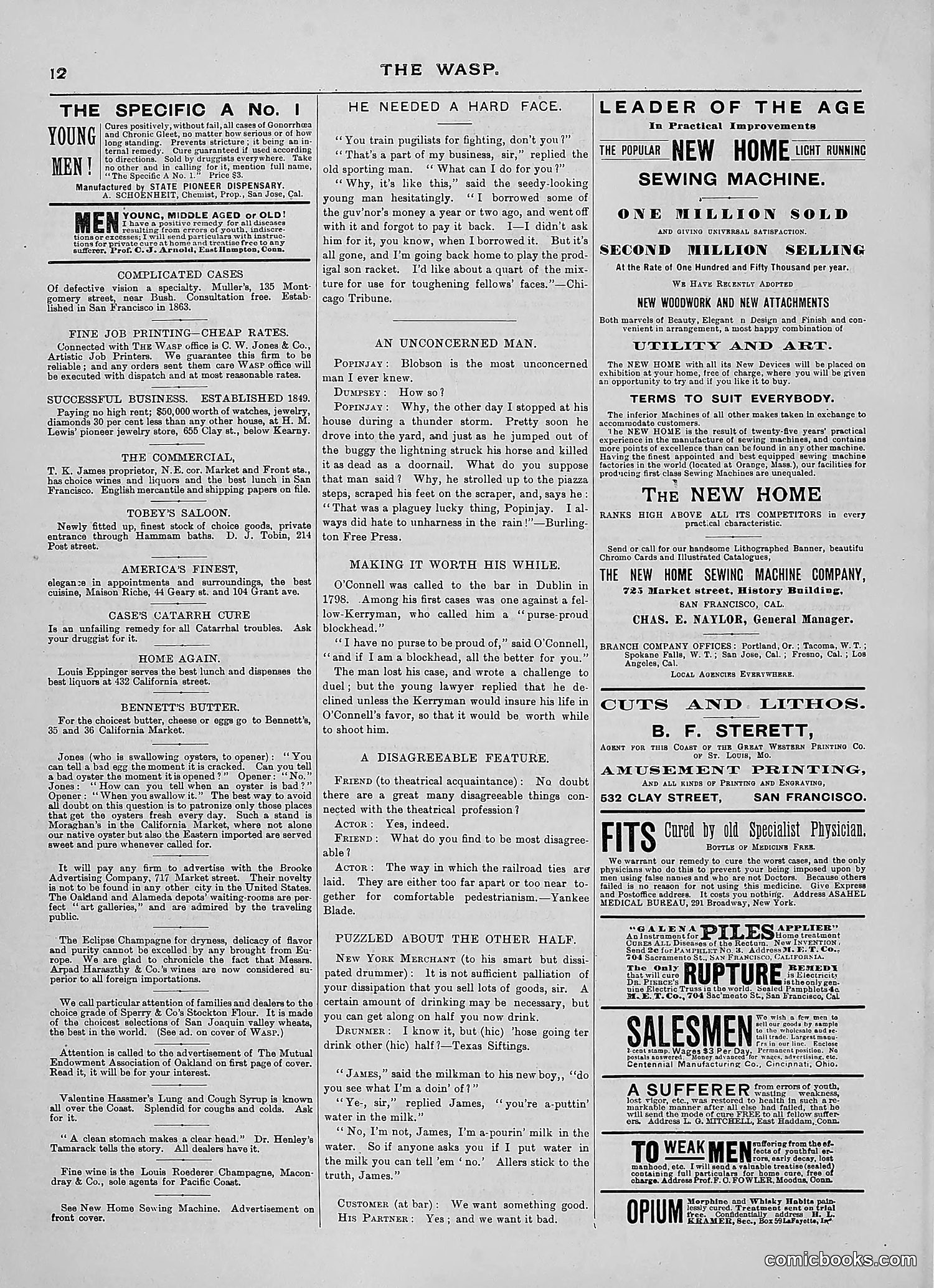
This page is primarily **advertising and editorial content**, not political cartoons. The main feature is a biographical article about **Charles N. Fox**, recently appointed to fill a vacancy on the California Supreme Bench. The text praises his qualifications—his legal expertise, railroad experience, and character—while noting Governor Waterman's "sagacity" in the selection. The page also includes a humorous anecdote titled "He Could Talk," poking fun at someone's talkative nature, and brief joke items like "An Inferior Ball" and "Orinda Park." The remainder consists of advertisements for hair vigor, memory aids, aluminum products, and gentlemen's furnishings. This appears to be a standard magazine issue mixing news, humor, and commerce rather than focused political satire.

The Wasp — 1889 — page 23 of 450
23 / 450
What you’re looking at · open this page on its own ↗

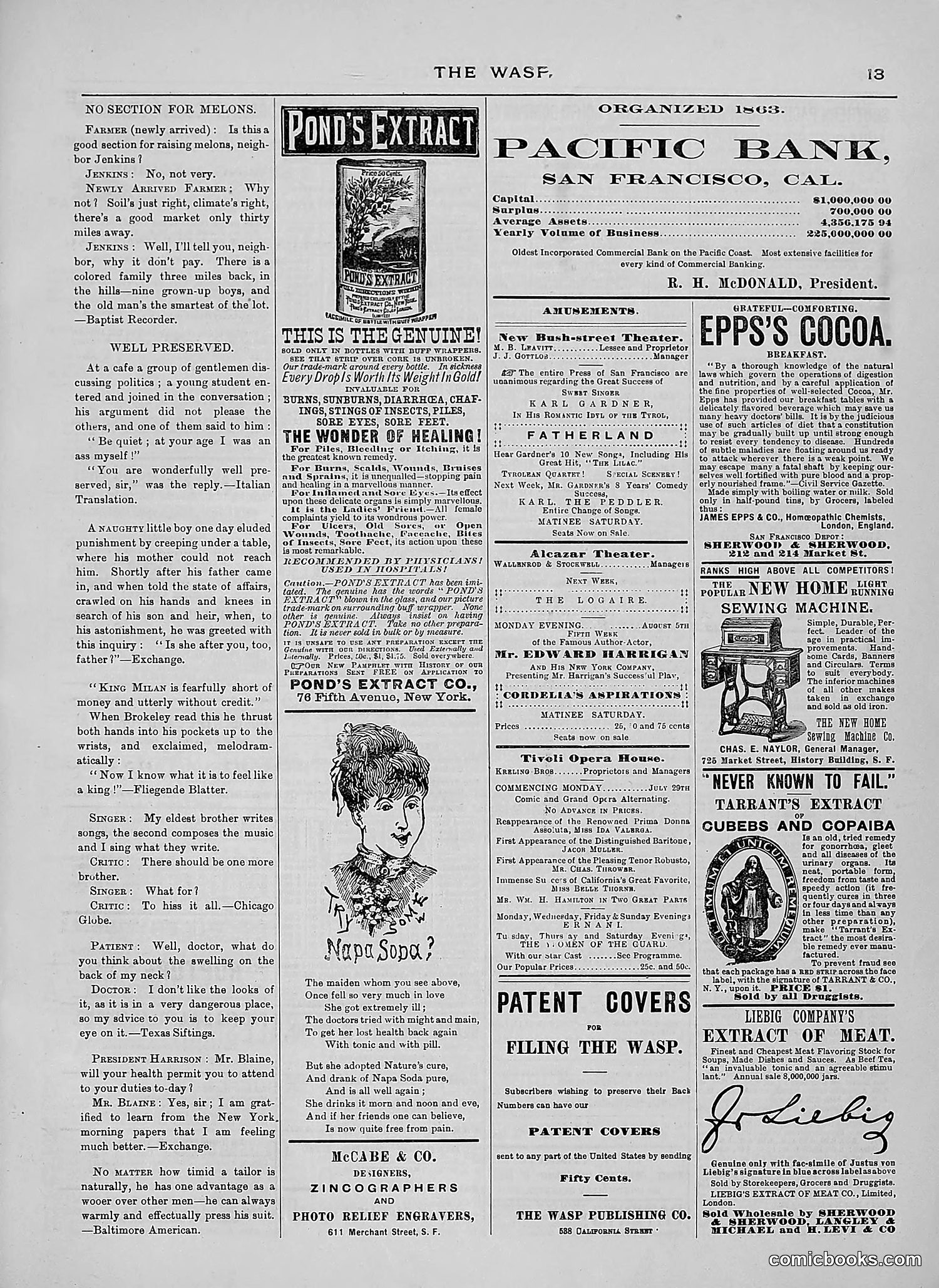
This page is primarily **advertising and promotional content** rather than satirical cartoons. It features multiple commercial advertisements for products and services available in San Francisco during what appears to be the late 19th century, including: - Bartlett Springs (a health resort) - The "New Home" sewing machine - Patent medicines for various ailments - Commercial businesses and services The advertisements employ common period marketing tactics—exaggerated health claims, testimonials, and promises of cures. While The Wasp was known for satire, **this particular page lacks significant political or social commentary**. Instead, it represents the magazine's revenue model through paid advertising, which was typical for 19th-century publications. The ads themselves reflect contemporary attitudes toward medicine and consumer culture of that era.

The Wasp — 1889 — page 24 of 450
24 / 450
What you’re looking at · open this page on its own ↗

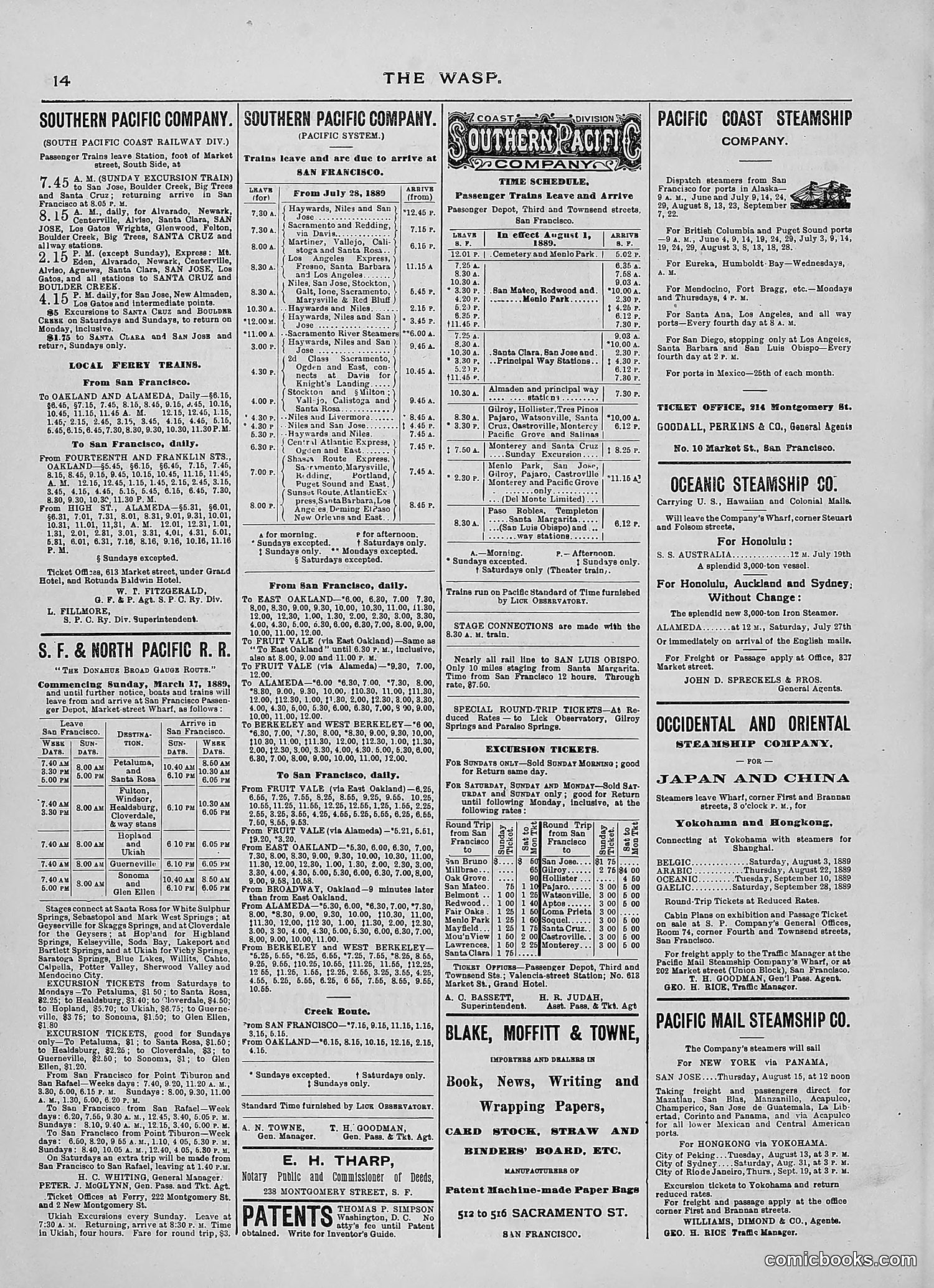
This page is primarily **advertising and entertainment listings** from *The Wasp*, a San Francisco satirical magazine. The cartoons visible include a humorous sketch labeled "The Kid" depicting a child in various situations with captions about honey and bears—a simple visual gag without political content. The main satirical content appears in dialogue snippets like "The Duke's Response" and "Cute Business Man," which mock pretentious wealthy figures through exaggerated speech patterns and ridiculous situations (arguing about gin, discussing business schemes). The bulk of the page comprises **theatrical advertisements** and product promotions typical of 1880s publications, including Pond's Extract and patent medicines. These ads were common revenue sources for satirical magazines, often contradicting their editorial mockery of consumer culture itself.

The Wasp — 1889 — page 25 of 450
25 / 450
What you’re looking at · open this page on its own ↗

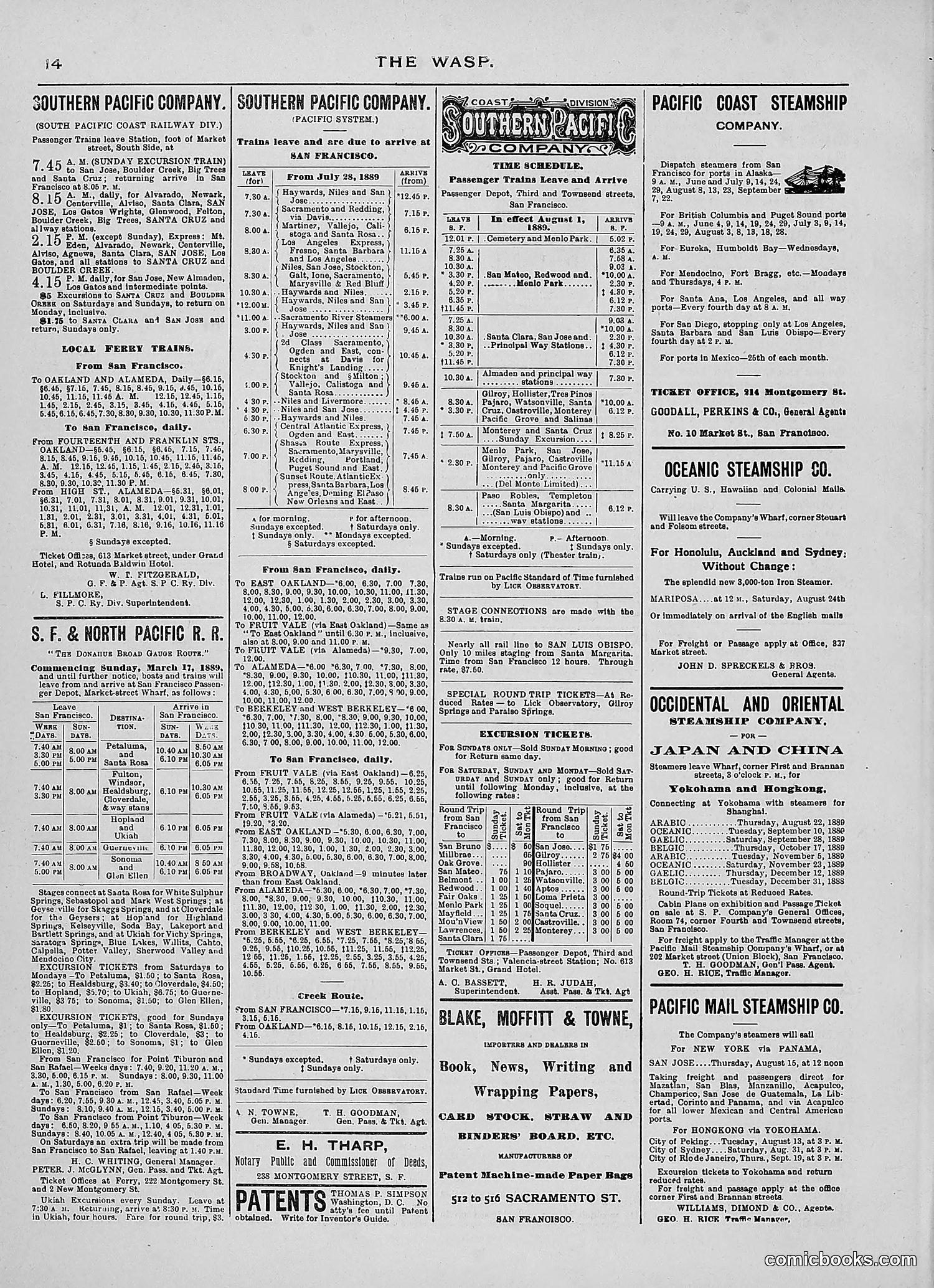
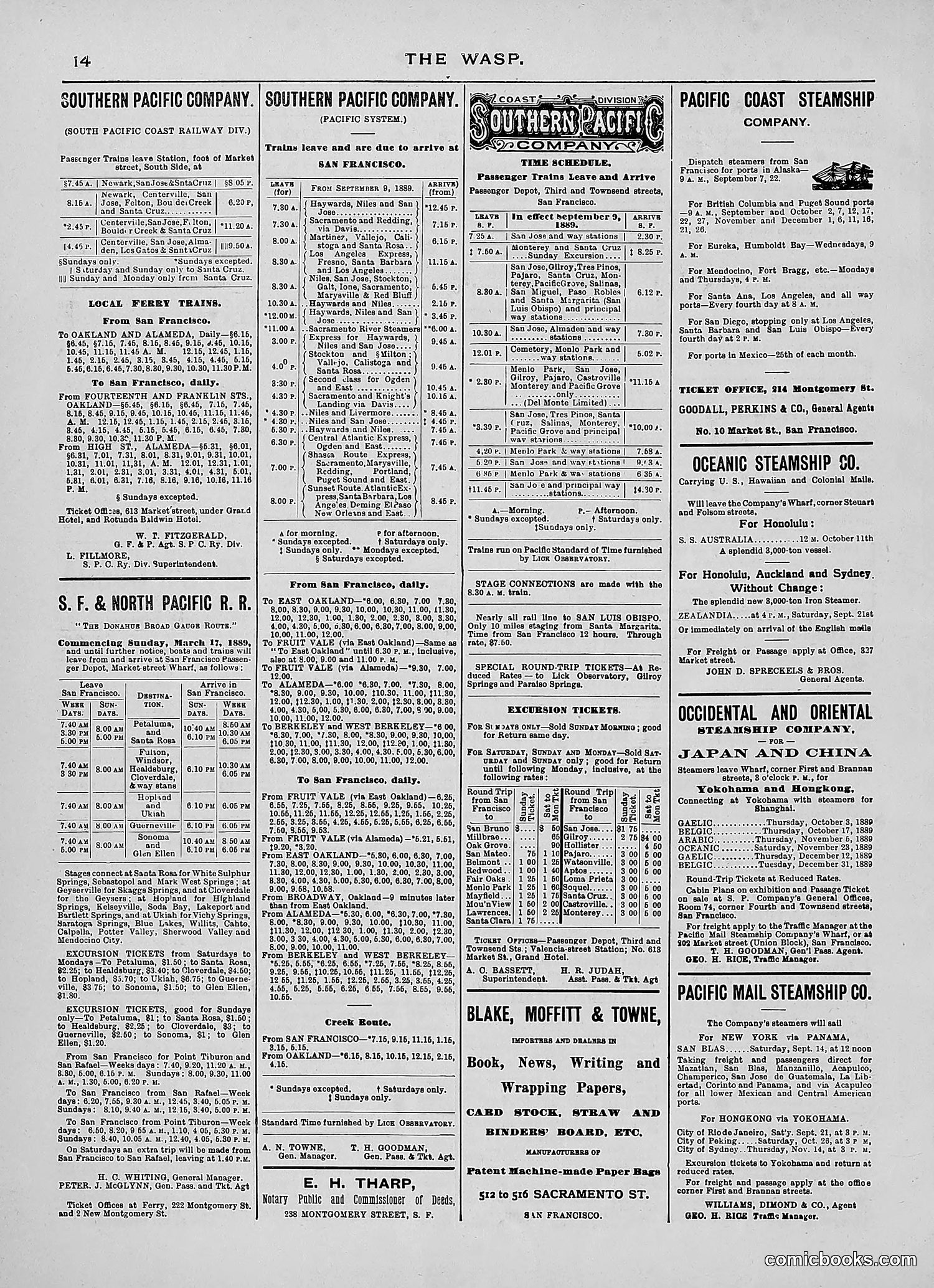
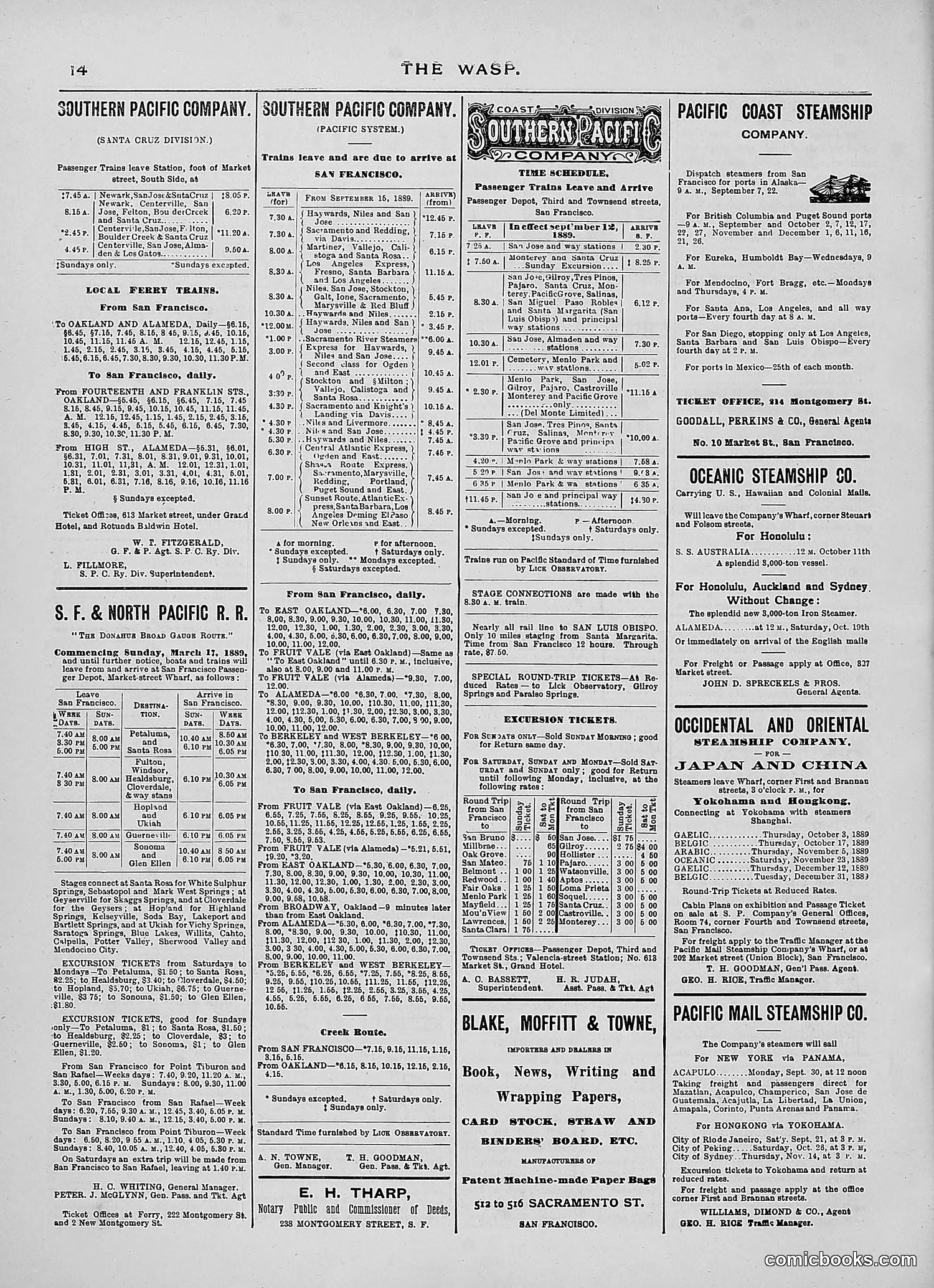
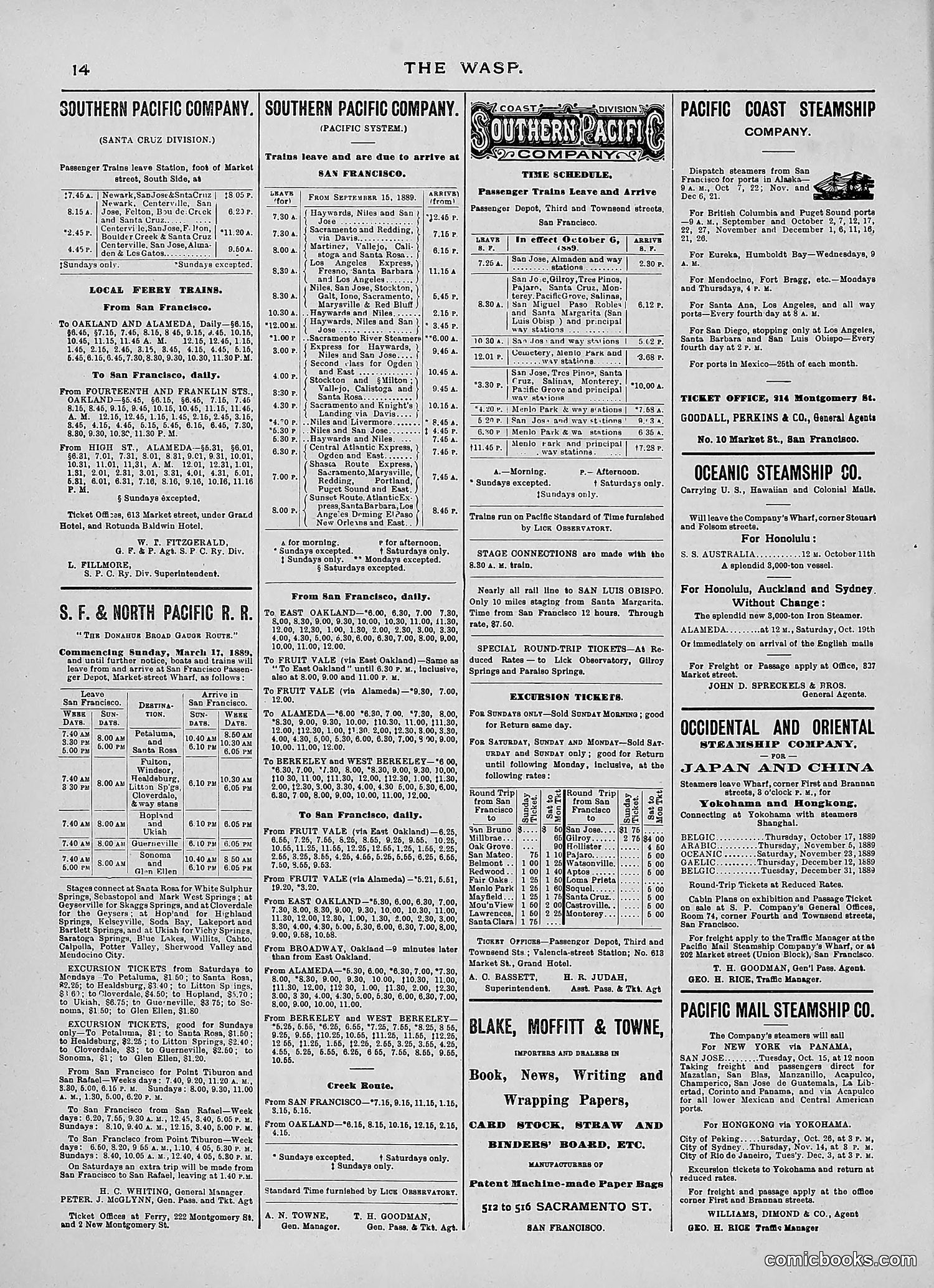
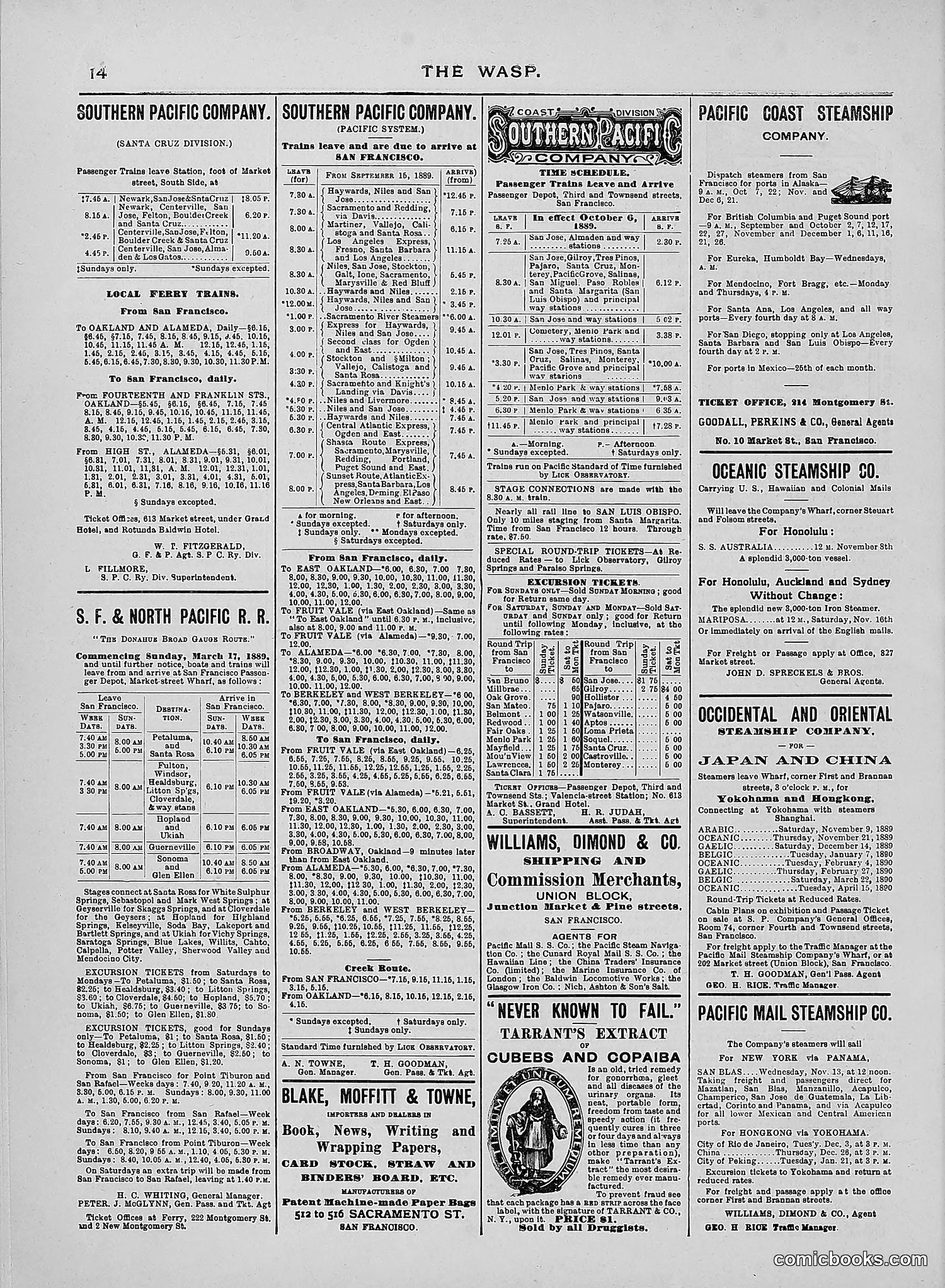
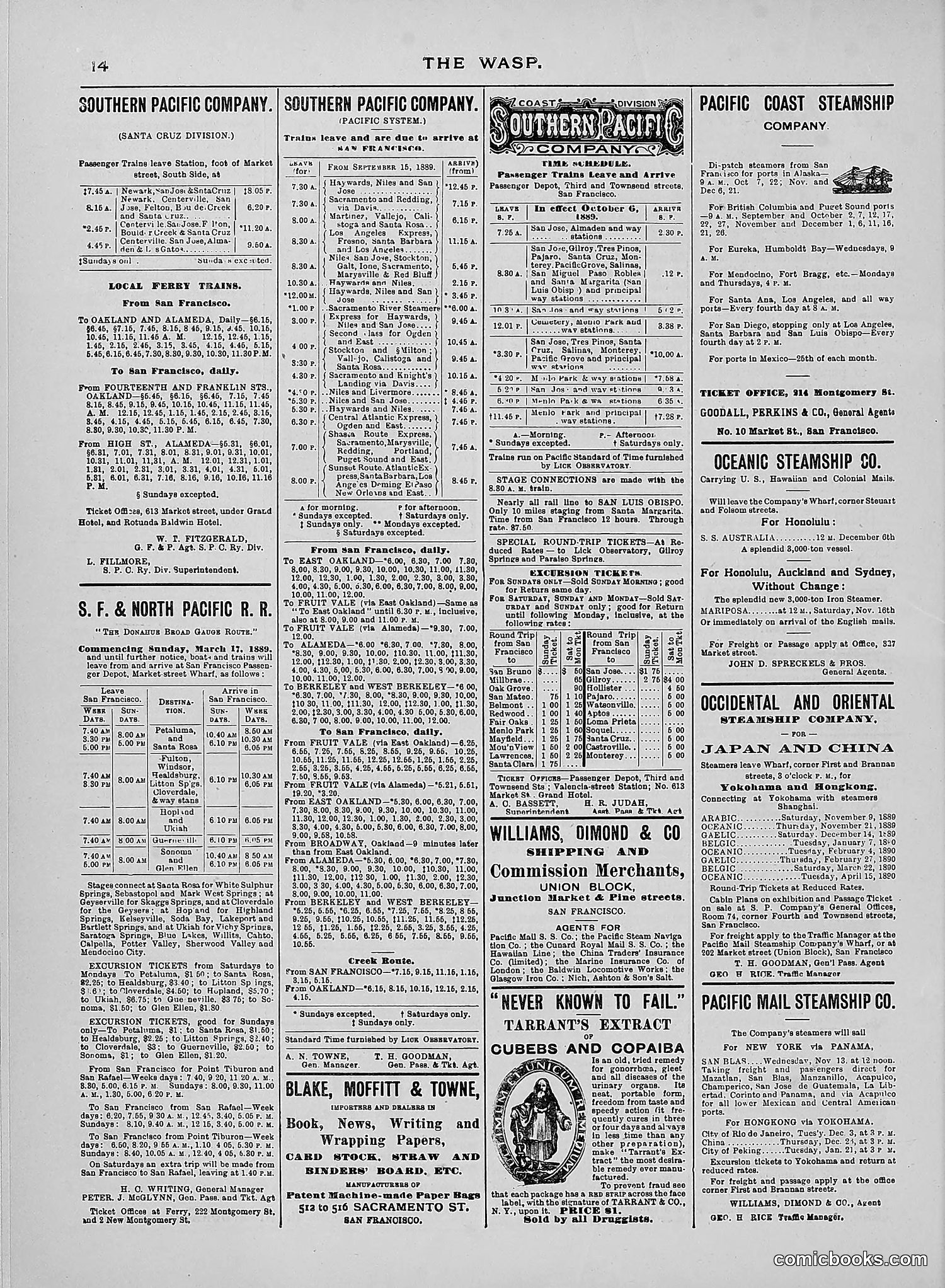
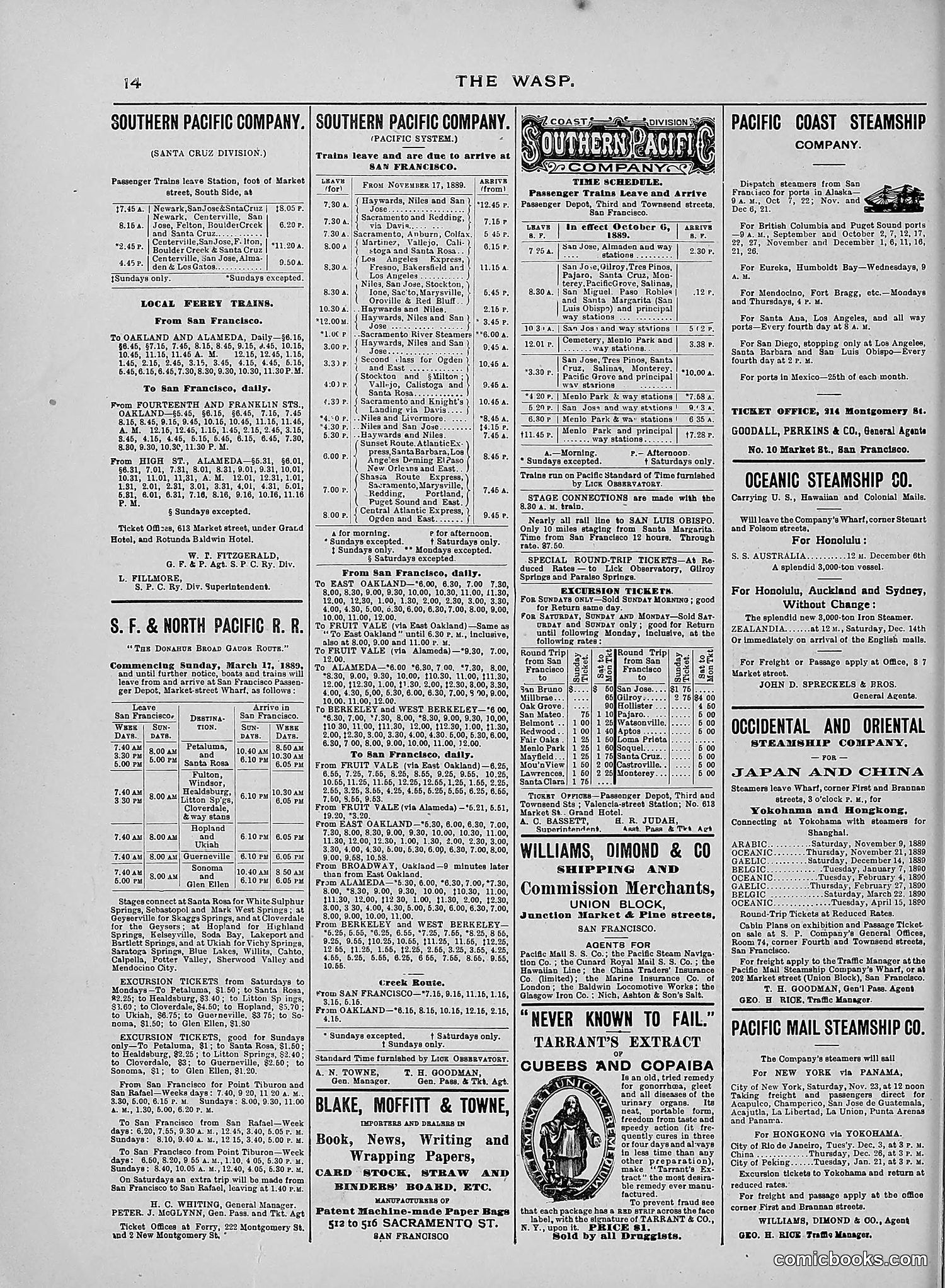
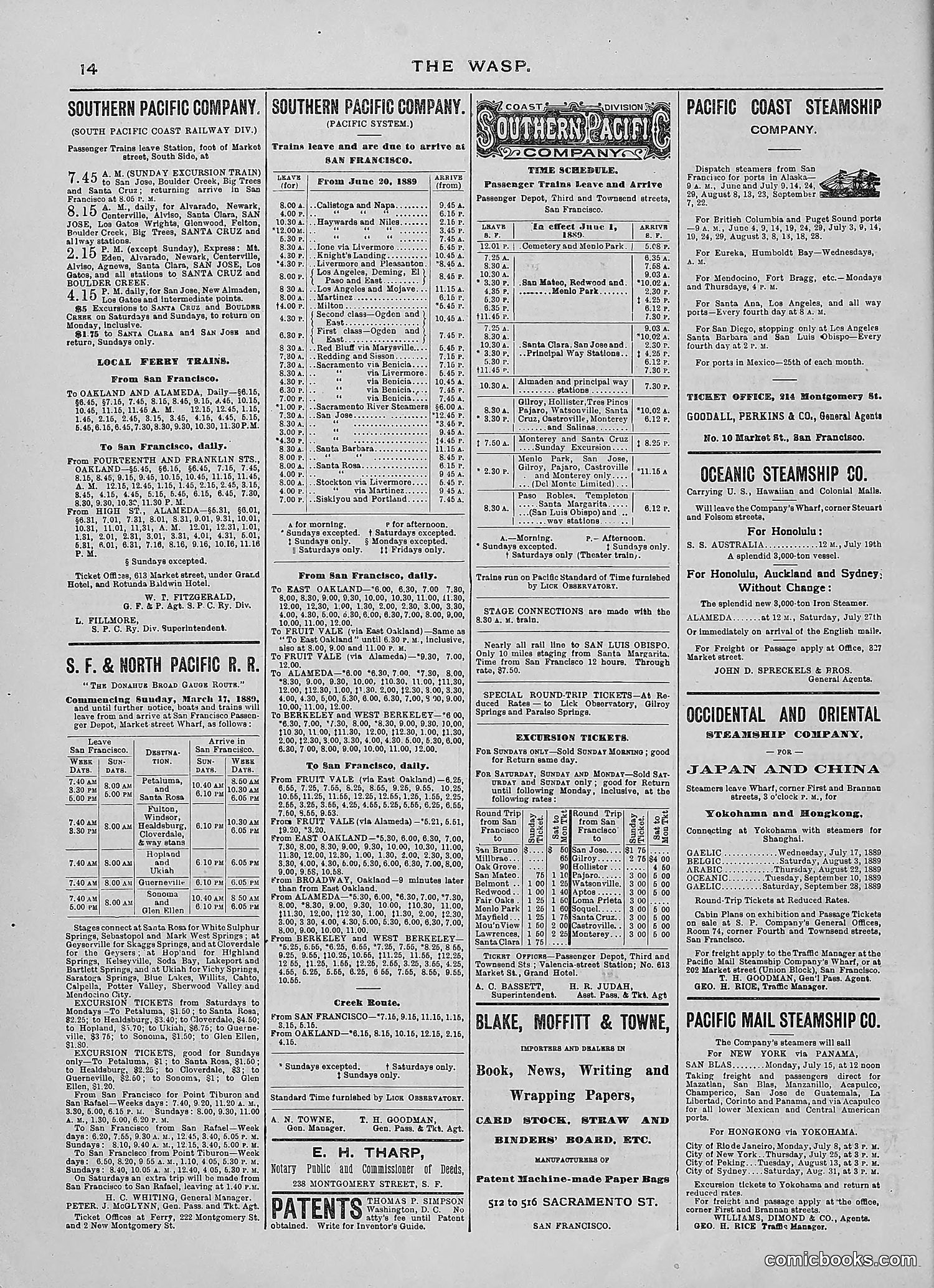
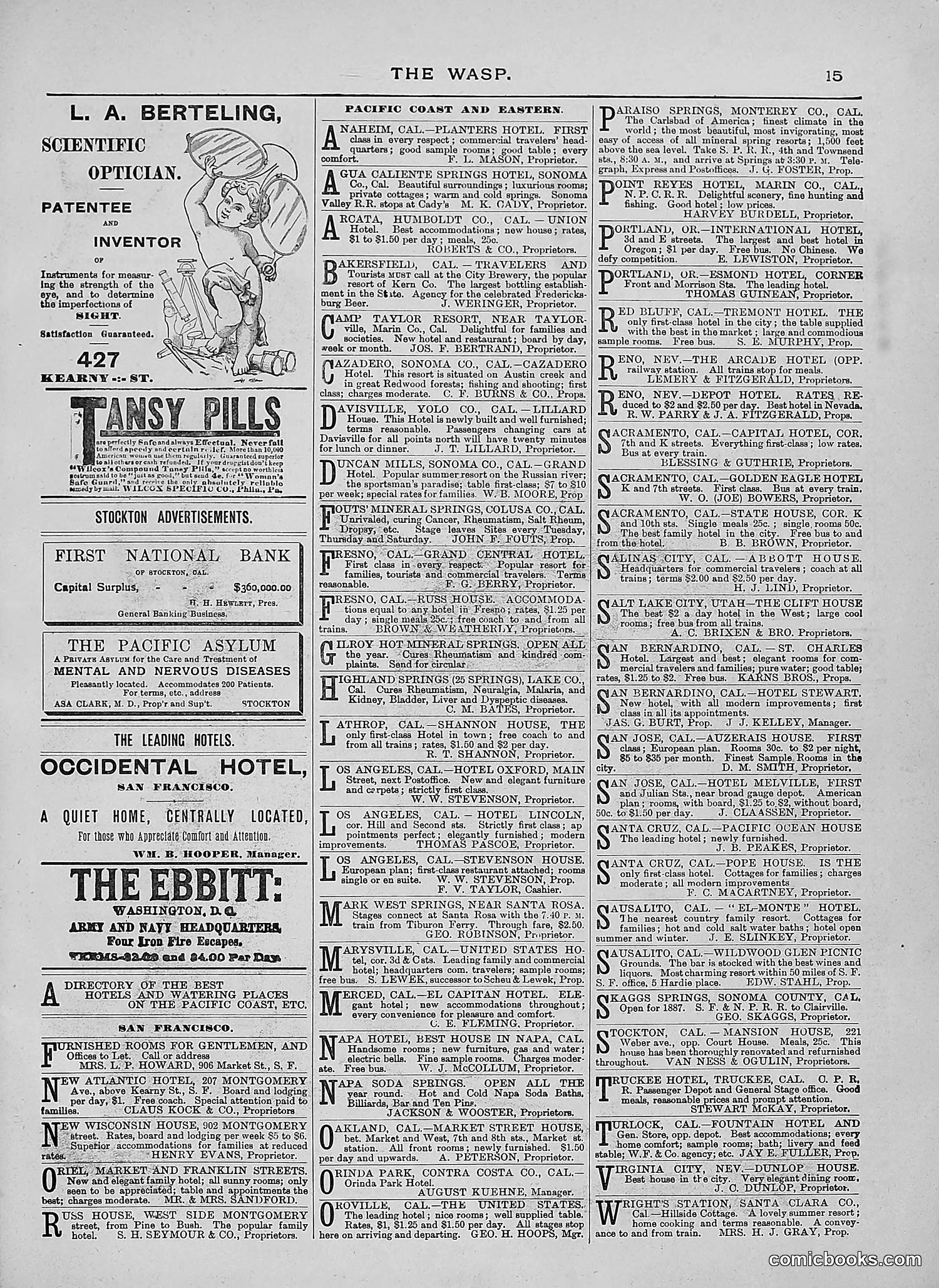
This page is predominantly **advertising and transportation schedules** rather than political cartoons or satire. It contains: - Train and ferry schedules for Southern Pacific Company and related transit services in California - Steamship schedules for Pacific Coast routes and connections to Hawaii, Japan, and China - Business advertisements for shipping, printing, and patent services There is **no visible political cartoon or satirical content** on this page. The only illustrative element is a small steamship company logo/header. The page represents typical turn-of-the-century commercial publication filler—transit information and paid advertisements that subsidized the magazine's operation alongside its satirical editorial content elsewhere in the publication.

The Wasp — 1889 — page 26 of 450
26 / 450
What you’re looking at · open this page on its own ↗

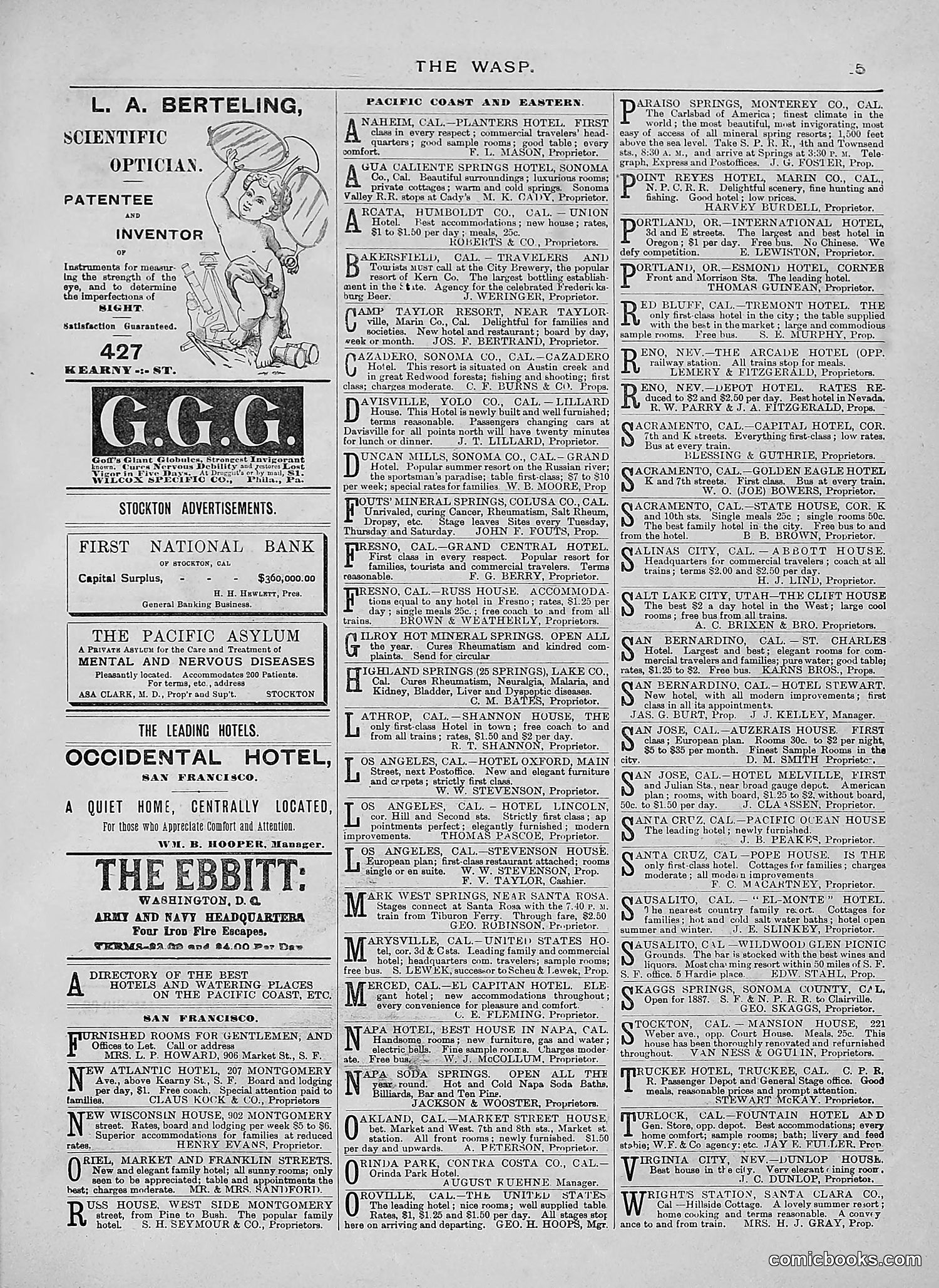
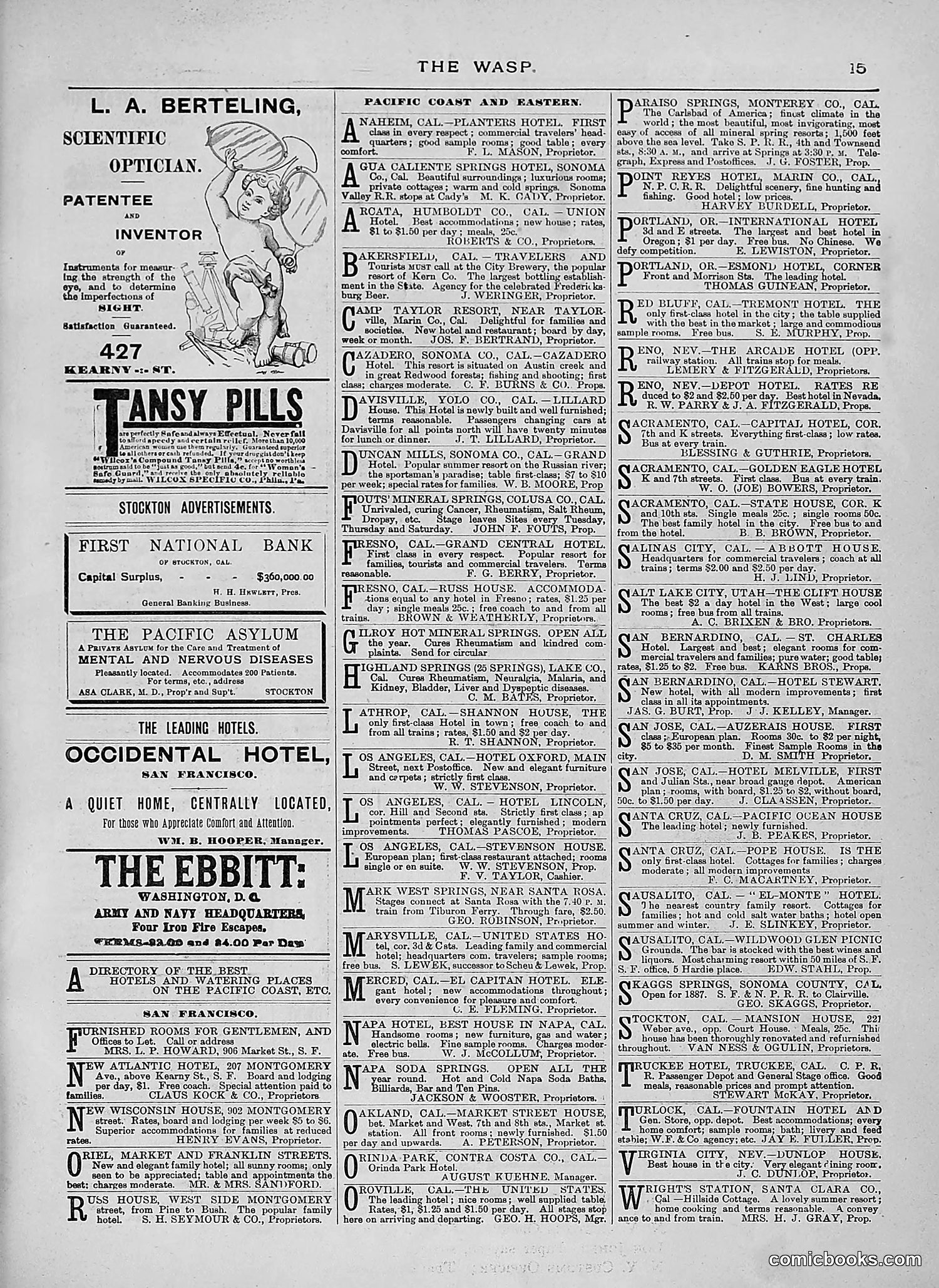
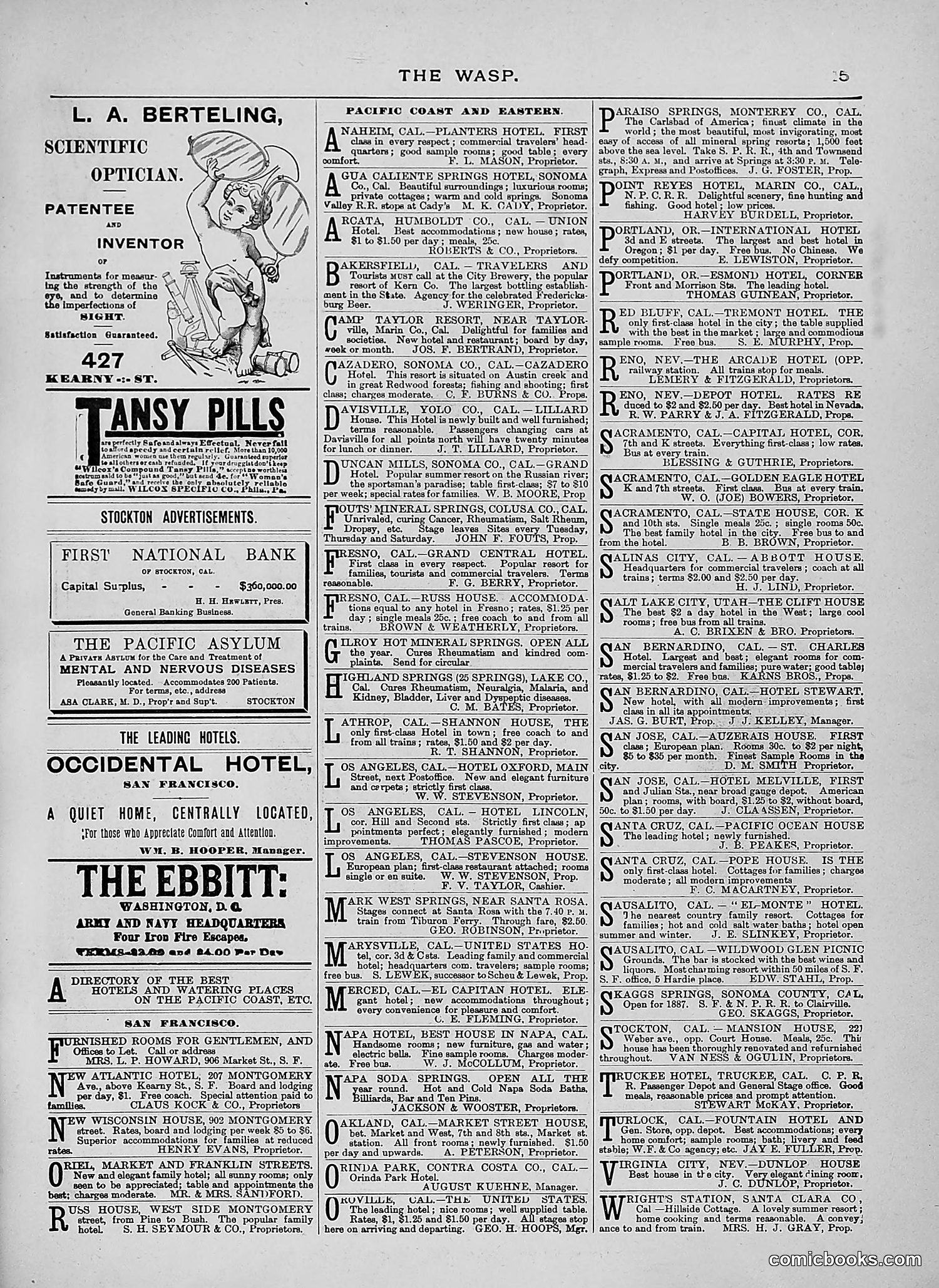
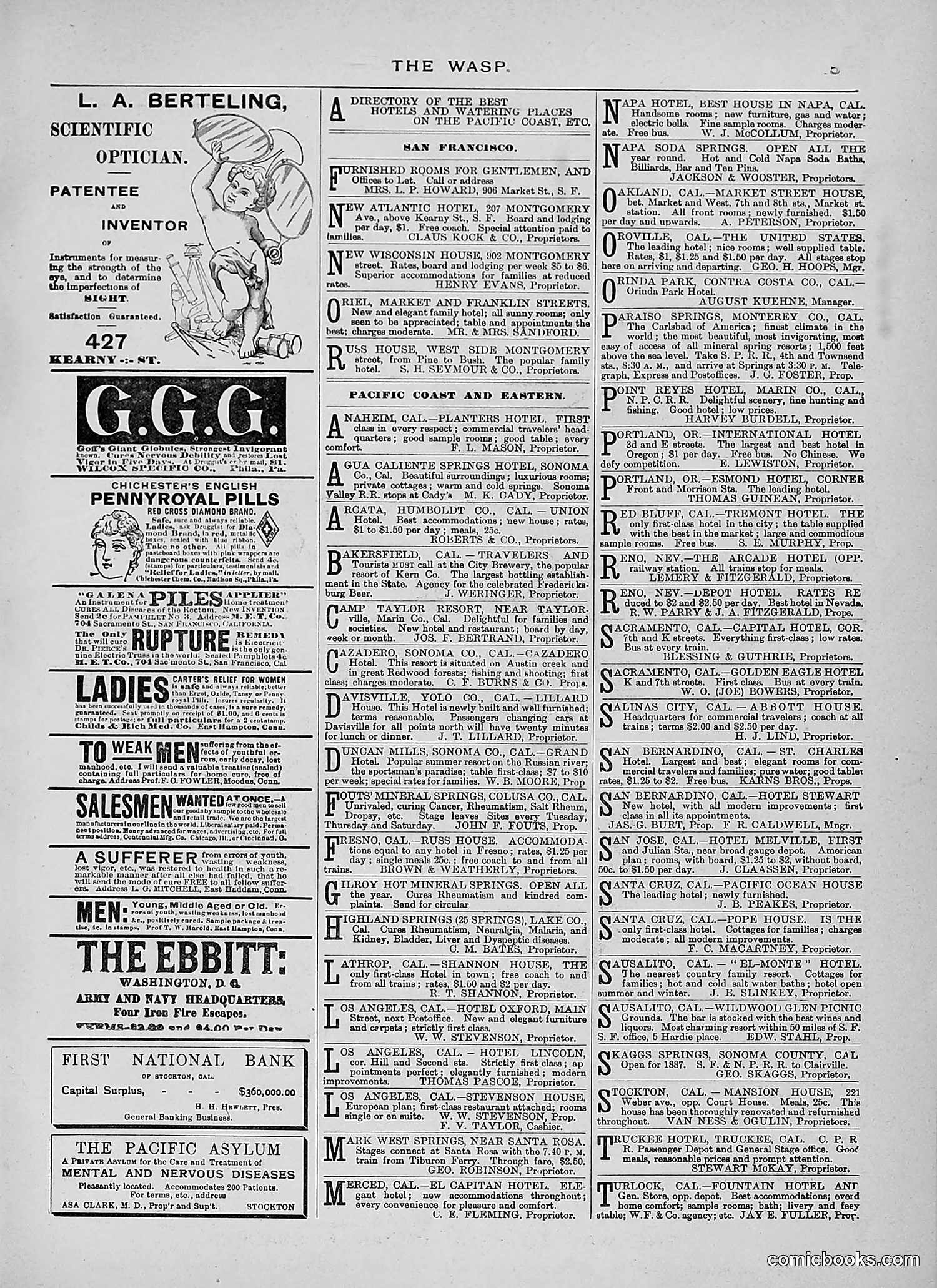
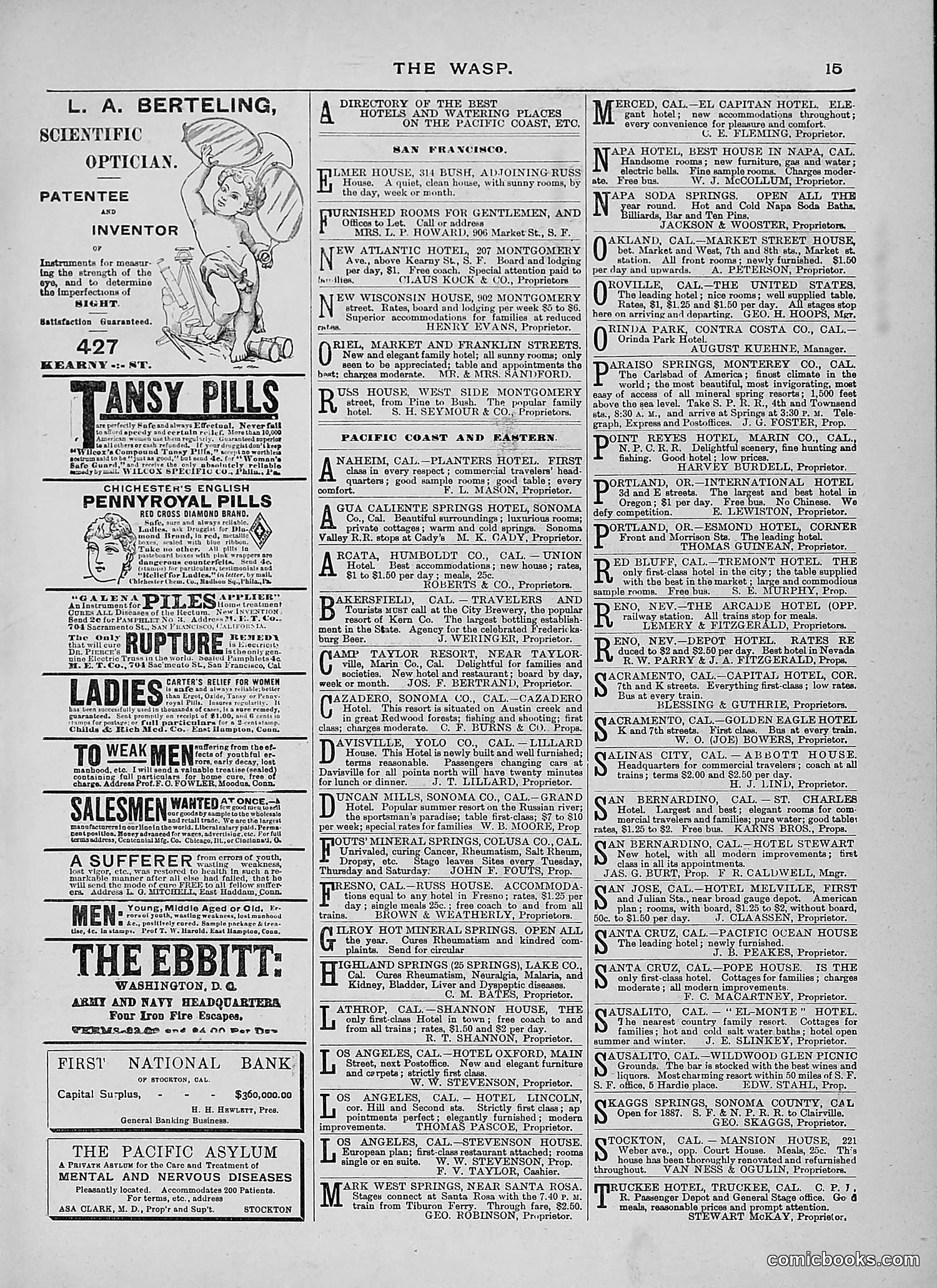
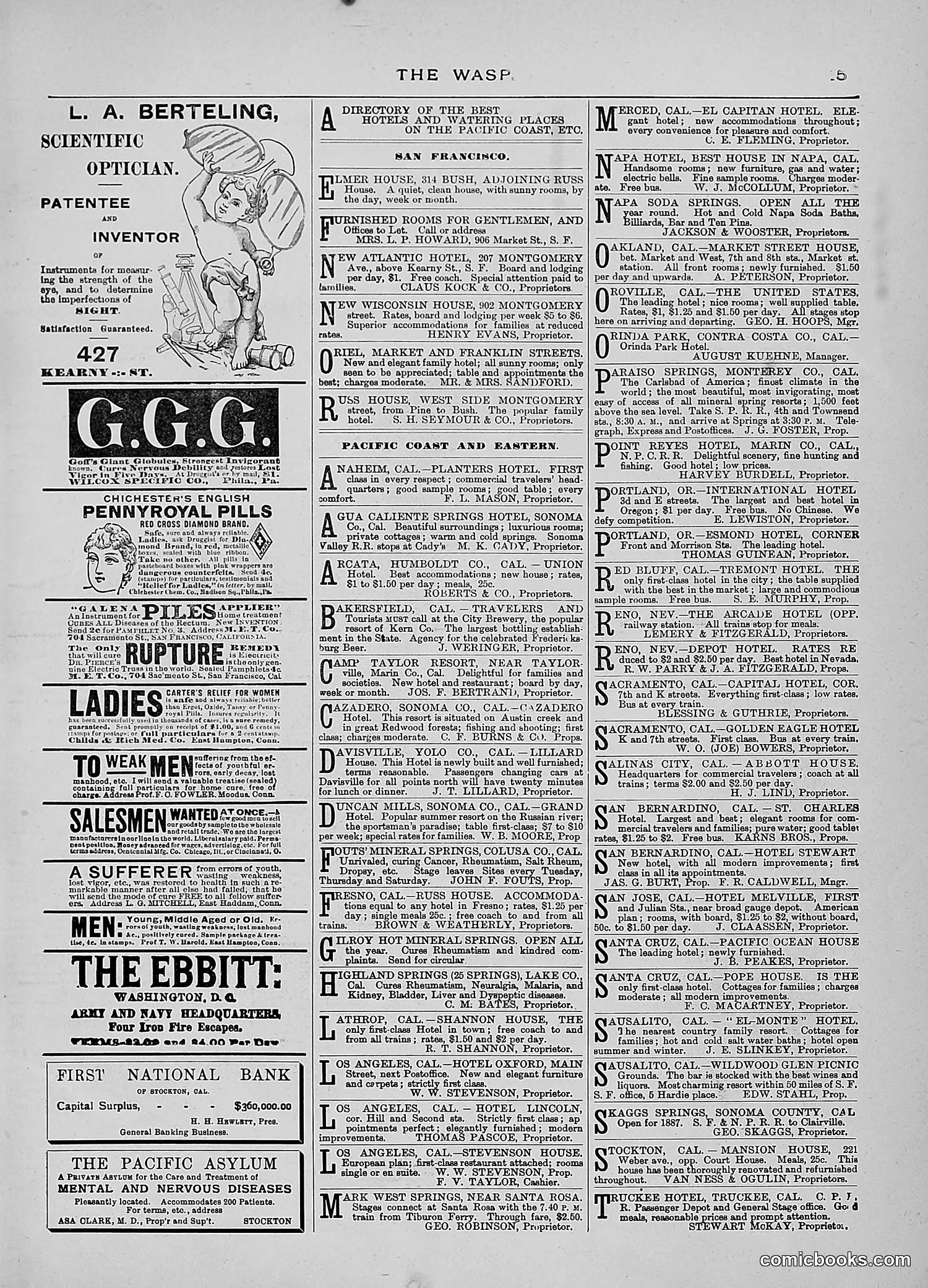
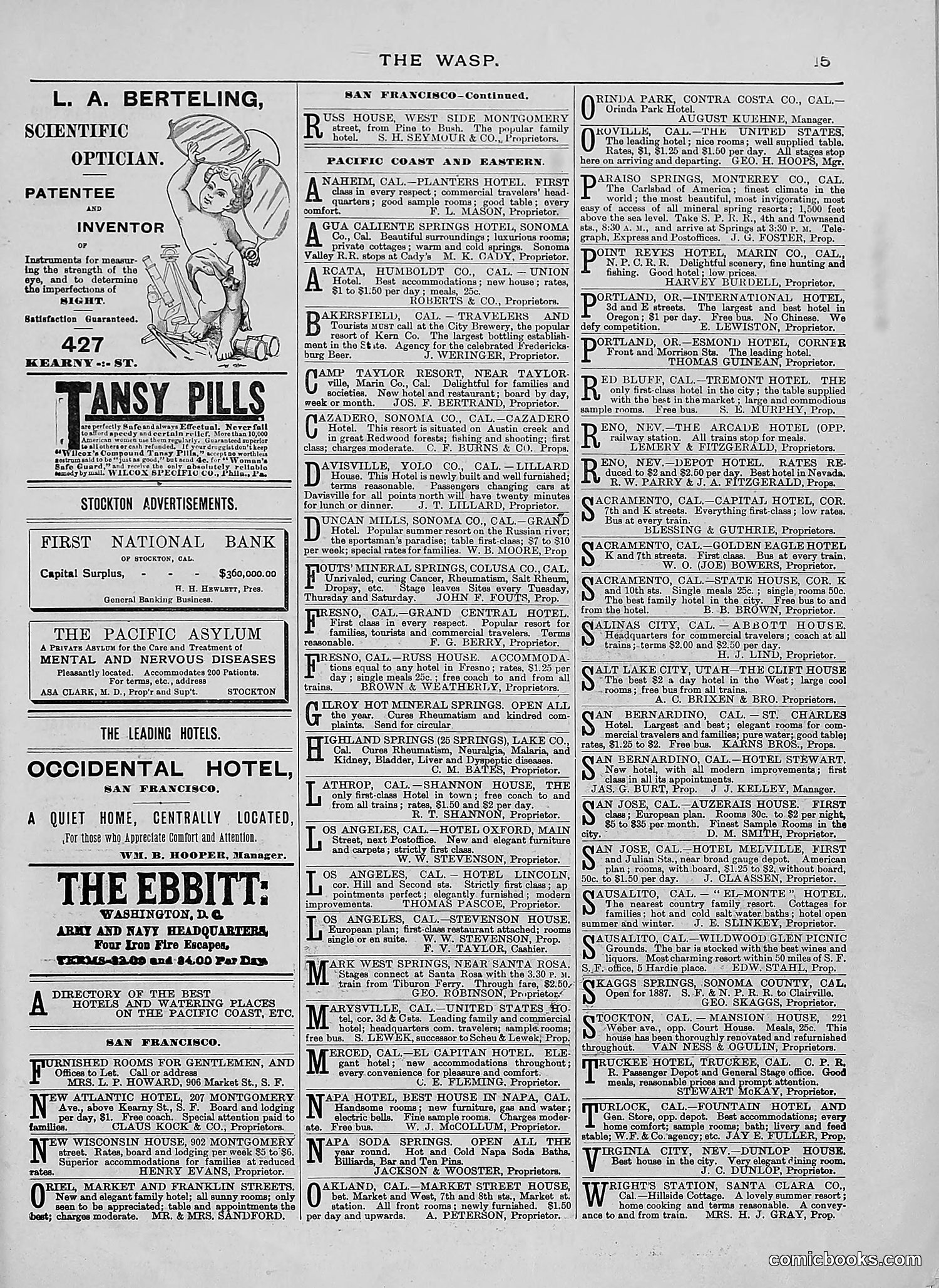
This page is primarily **advertising and directory listings**, not satirical cartoons. The visible illustration shows "L.A. Berteling, Scientific Optician" with a caricatured face wearing glasses—appearing to be a self-promotional image for his eyeglasses business rather than political satire. The bulk of the page consists of hotel and business advertisements for San Francisco Bay Area establishments (Occidental Hotel, The Ebritt, Pacific Asylum, etc.) and a directory of "the best hotels and watering places on the Pacific Coast." **There is no clear political or social satire visible on this page.** It represents the typical commercial content that sustained satirical publications like *The Wasp*—advertising revenue subsidized editorial work. The optician's exaggerated facial features appear to be commercial caricature rather than satirical commentary.

The Wasp — 1889 — page 27 of 450
27 / 450
What you’re looking at · open this page on its own ↗

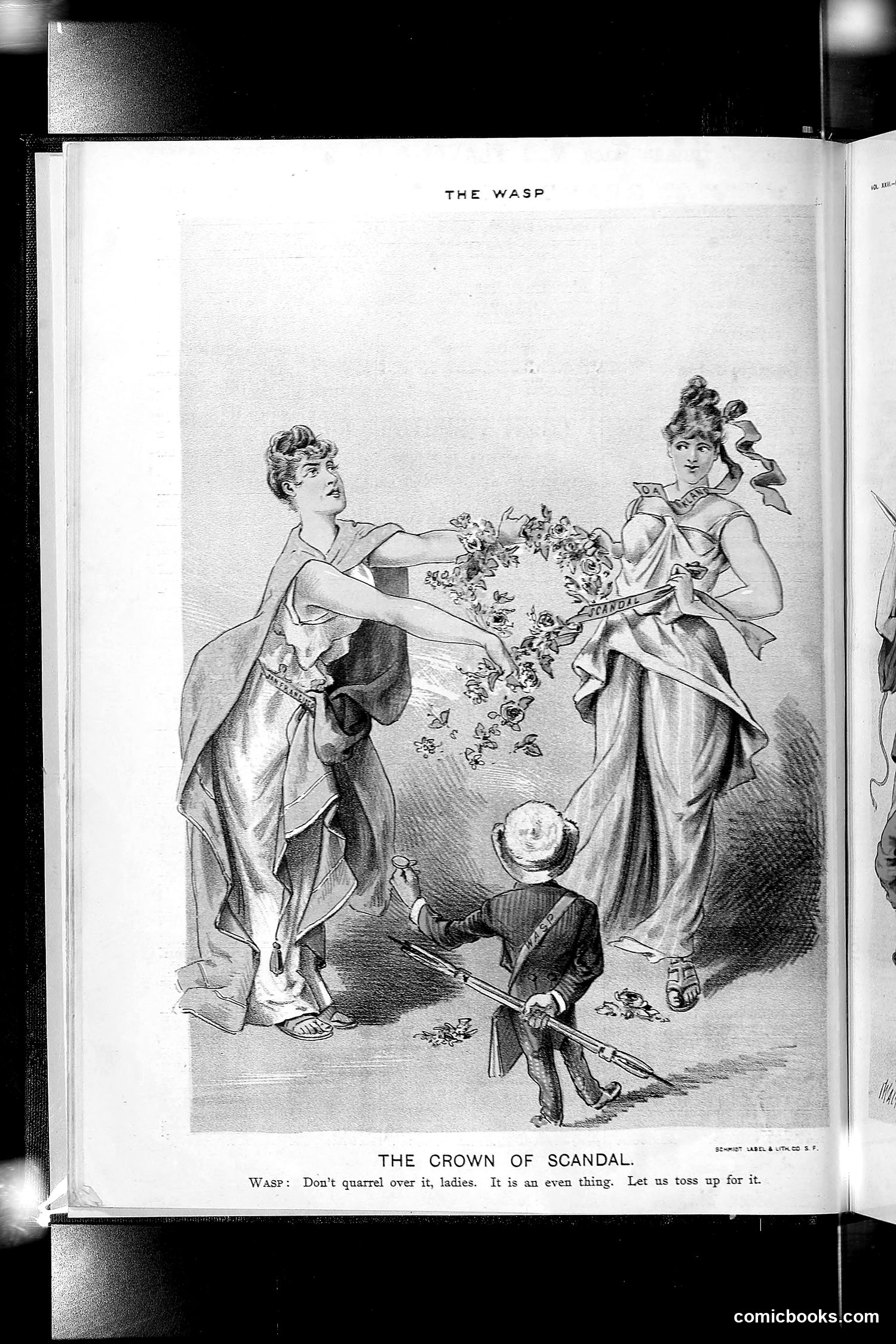
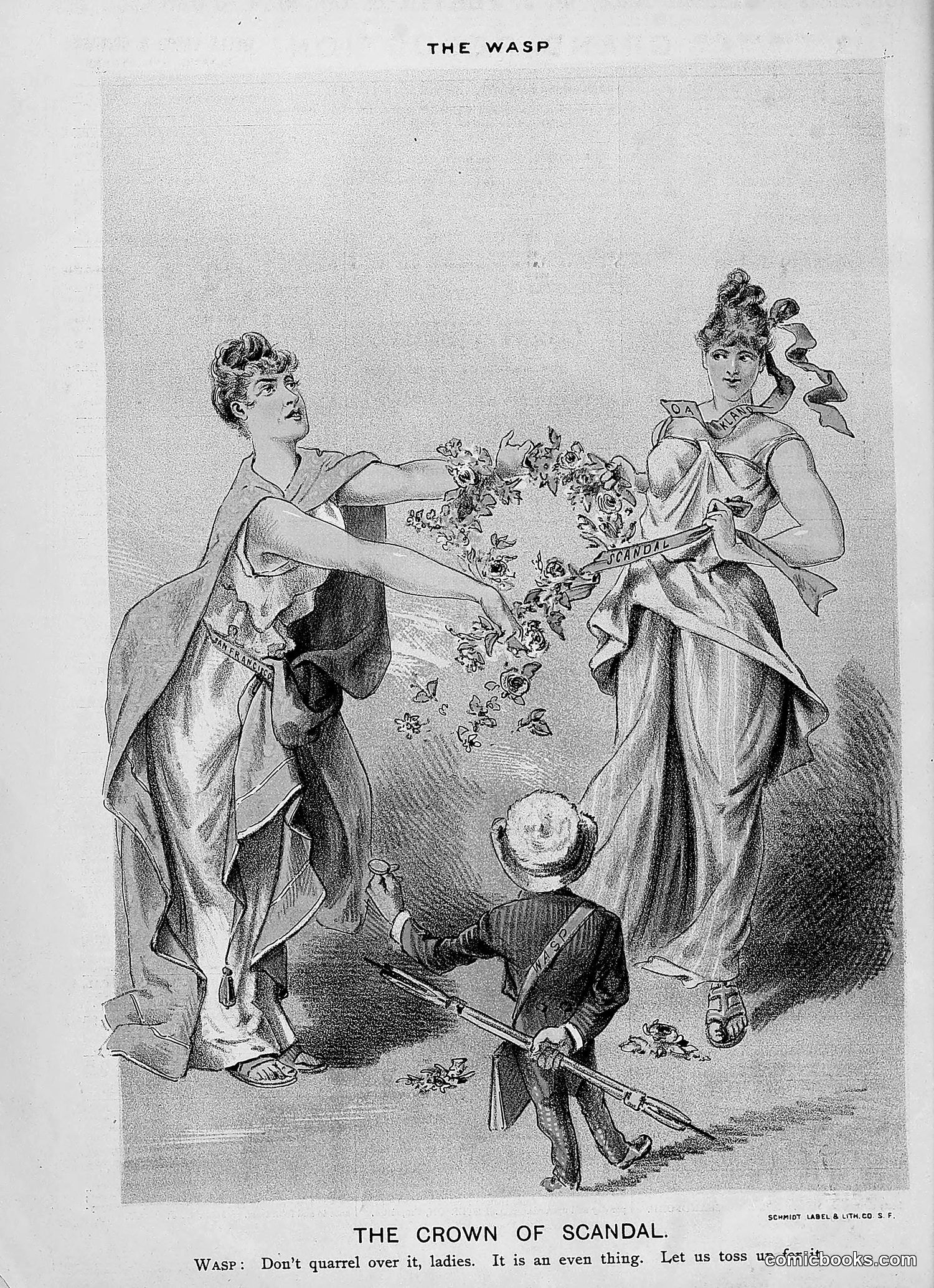
This cartoon from *The Wasp* satirizes conflict between two prominent women over a scandal. Two elegantly dressed women quarrel over flowers—representing scandal or reputation—while a child (likely representing the public or a political figure) sweeps up the debris with a broom. The wasp character mediates, suggesting both women share blame equally and proposing they "toss up for it." The satire critiques how society's elite women engage in public disputes over reputational matters, treating serious scandals casually as something to gamble over. The child figure implies these disputes affect broader society or vulnerable parties. Without specific dates or names visible, the exact scandal referenced remains unclear, but the cartoon mocks aristocratic women's petty quarreling over social standing.

The Wasp — 1889 — page 28 of 450
28 / 450
What you’re looking at · open this page on its own ↗

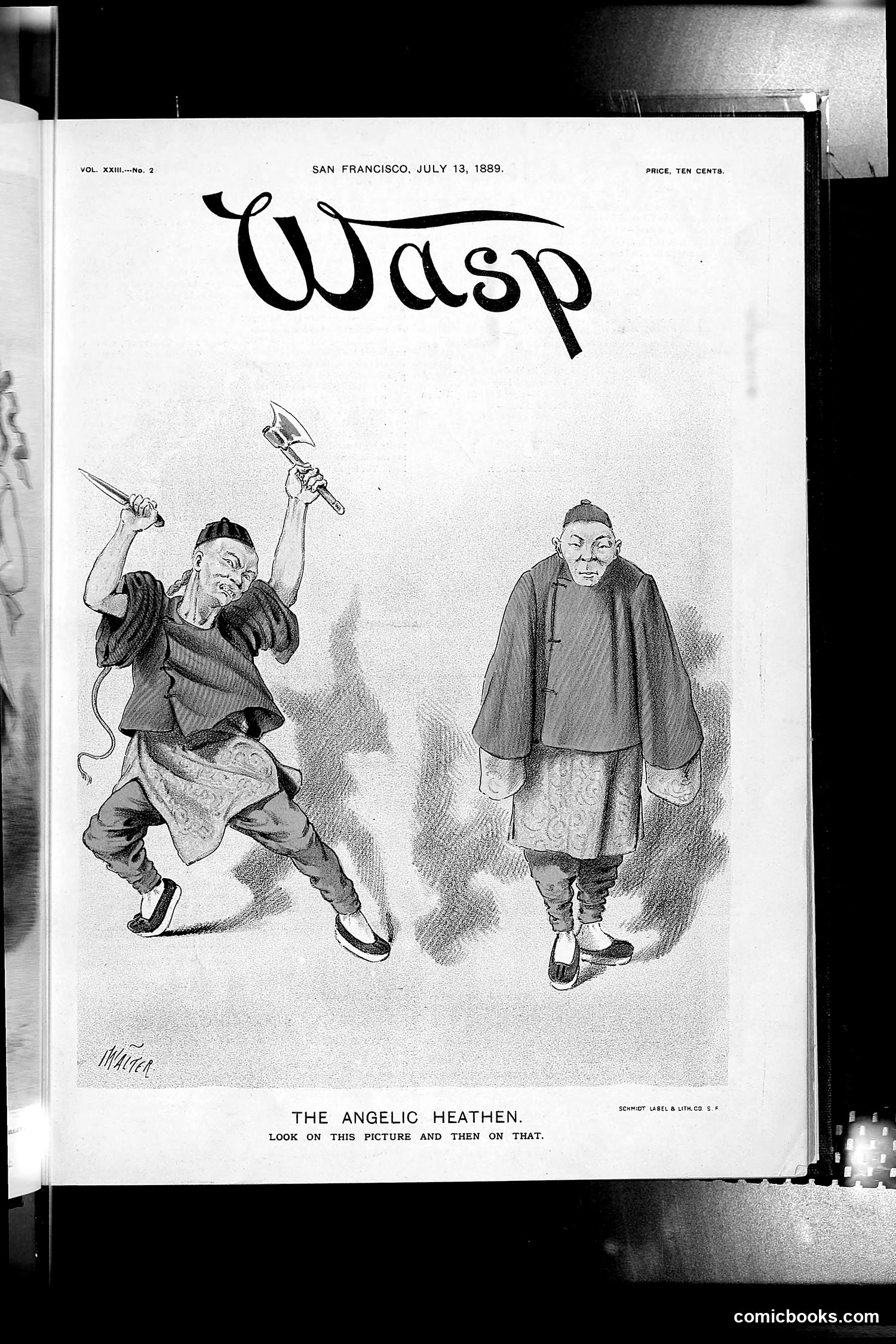
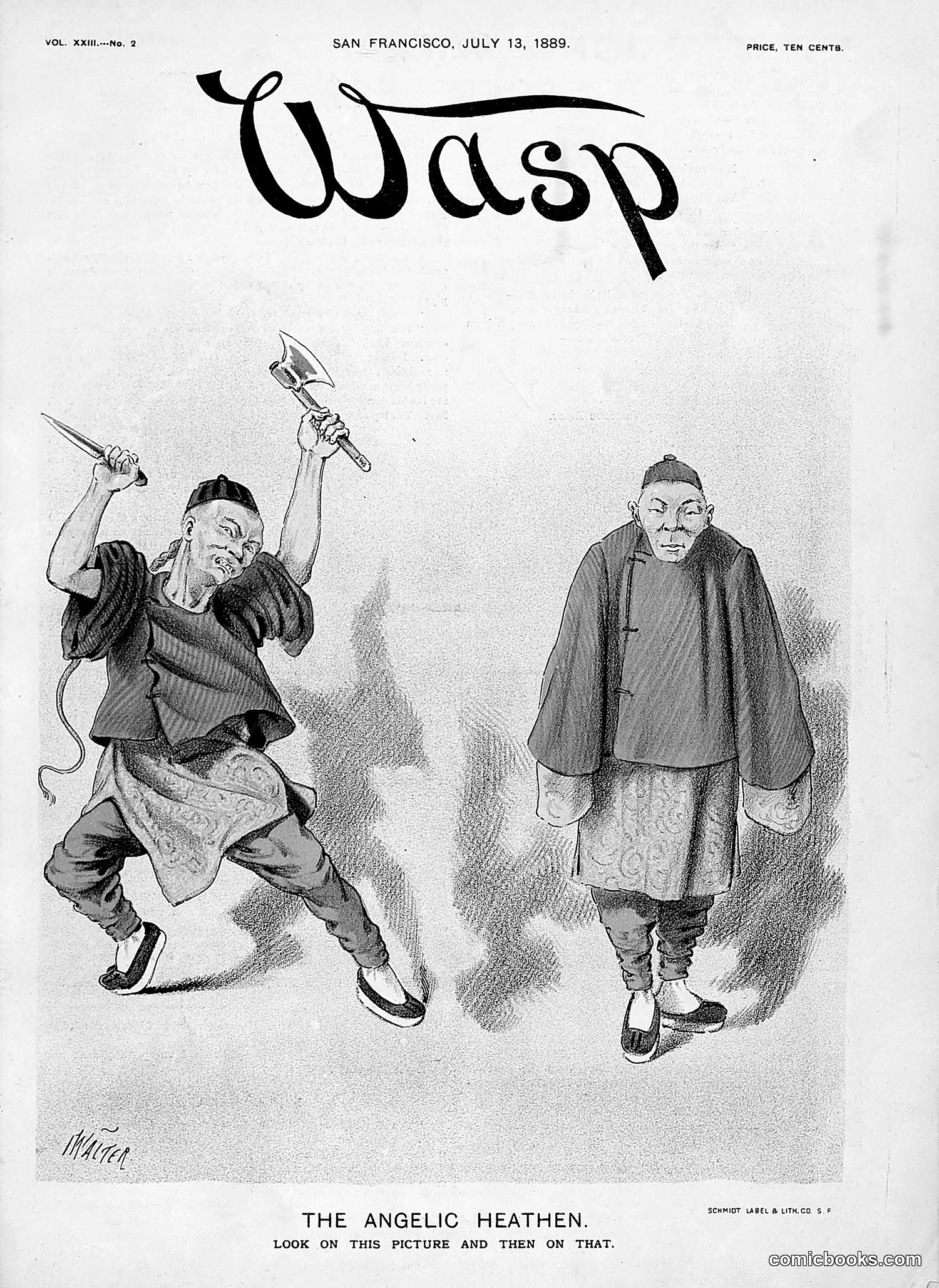
This cartoon contrasts two figures with exaggerated Asian features. The left figure, depicted as violent and menacing, wields weapons with a fierce expression. The right figure appears docile and submissive, dressed in traditional clothing. The title "The Angelic Heathen" and caption "Look on this picture and then on that" suggest the cartoon is making a commentary on Chinese immigrants in California—likely comparing Chinese laborers' portrayed "docility" with fears about violence or "heathen" behavior. This reflects late-1880s anti-Chinese sentiment, when The Wasp frequently published xenophobic content. The cartoon appears designed to stoke fears about Chinese immigrants, though the specific political context or incident referenced remains unclear without additional documentation.

The Wasp — 1889 — page 29 of 450
29 / 450
What you’re looking at · open this page on its own ↗

This satirical cartoon from *The Wasp* depicts two elegant women quarreling over a garland of flowers while a small boy (likely representing a scandal or public controversy) sits between them holding a rifle, appearing to mediate. The title and Wasp's caption—"Don't quarrel over it, ladies. It is an even thing. Let us toss"—suggests the cartoon satirizes prominent women engaged in a public dispute over some social scandal. The "crown of scandal" is the garland being contested. Without identifying the specific women or incident, the cartoon mocks how society's elite women become embroiled in petty quarrels over reputational matters while treating serious issues (represented by the armed boy) as mere entertainment or trivial wagers.

The Wasp — 1889 — page 30 of 450
30 / 450
What you’re looking at · open this page on its own ↗

This cartoon contrasts two figures presented as Chinese immigrants. The left figure, depicted with exaggerated caricature features, wields weapons (sword and axe) in a violent pose—representing the "heathen" stereotype of the period. The right figure stands calm and composed in traditional dress. The caption "Look on this picture and then on that" invites comparison between the two representations. The title "The Angelic Heathen" appears to use irony, likely commenting on contemporary anti-Chinese sentiment and immigration debates in 1880s San Francisco. The satire may criticize either the xenophobic caricatures themselves or specific incidents involving Chinese immigrants. The exaggerated, dehumanizing visual style was typical of period satirical publications, though deeply offensive by modern standards.

The Wasp — 1889 — page 31 of 450
31 / 450
What you’re looking at · open this page on its own ↗

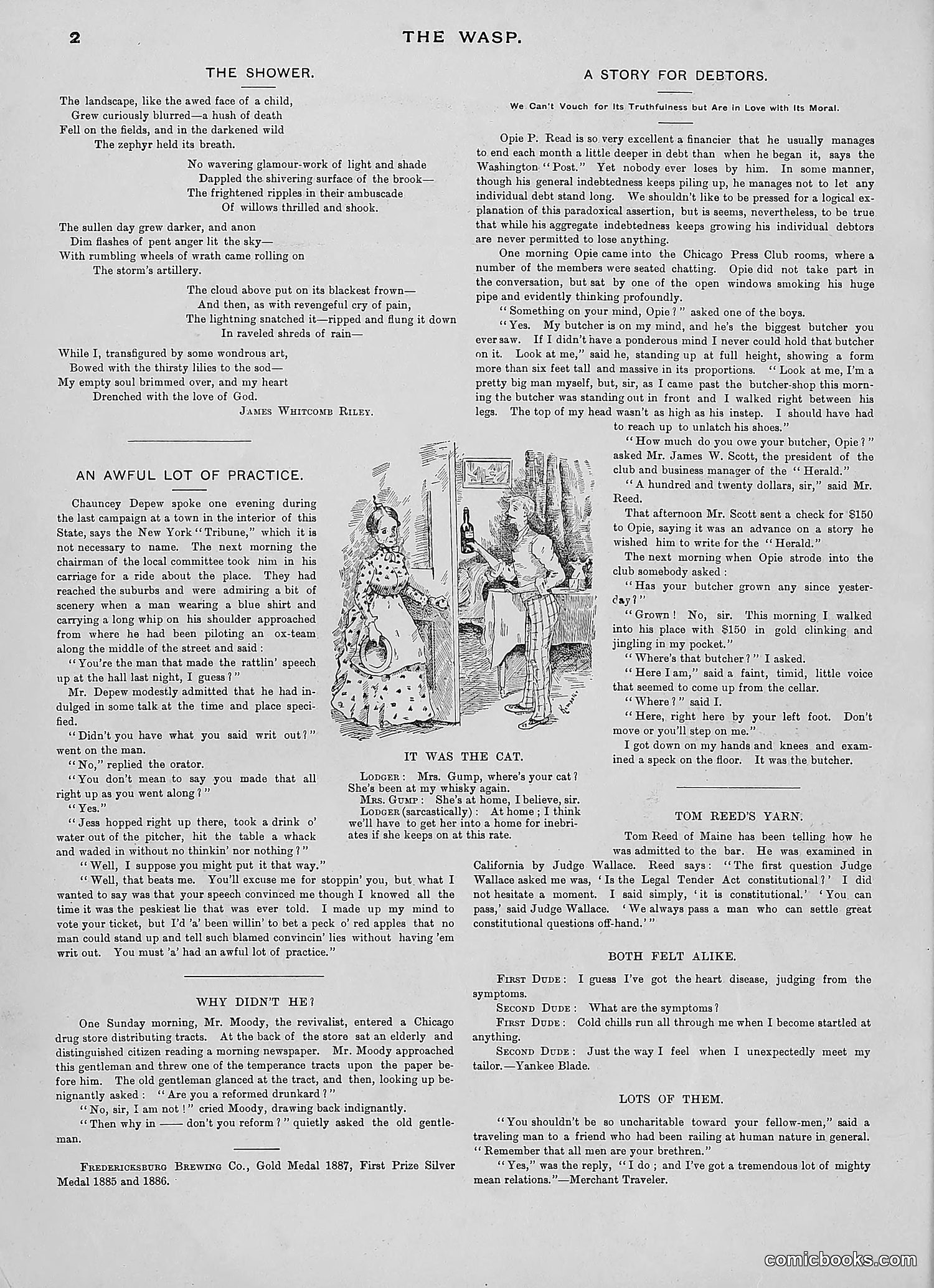
This page contains multiple short stories and humorous anecdotes rather than political cartoons. The central illustration labeled "IT WAS THE CAT" depicts a domestic scene where a woman questions a man about a cat's whereabouts. The featured content includes: - **"A Story for Debtors"**: A narrative about Opie Read, a financier who manages debts, and an encounter where he apparently owes money to a butcher - **"An Awful Lot of Practice"**: An anecdote about orator Chauncey Depew making an unsolicited political speech - **"Why Didn't He?"**: A brief story about a revivalist and a drunk man in a drugstore - **"Tom Reed's Yarn," "Both Felt Alike," and "Lots of Them"**: Additional short humorous pieces The content is satirical commentary on everyday social situations—debt, oratory, drunkenness—rather than specific political figures or events.

The Wasp — 1889 — page 32 of 450
32 / 450
What you’re looking at · open this page on its own ↗

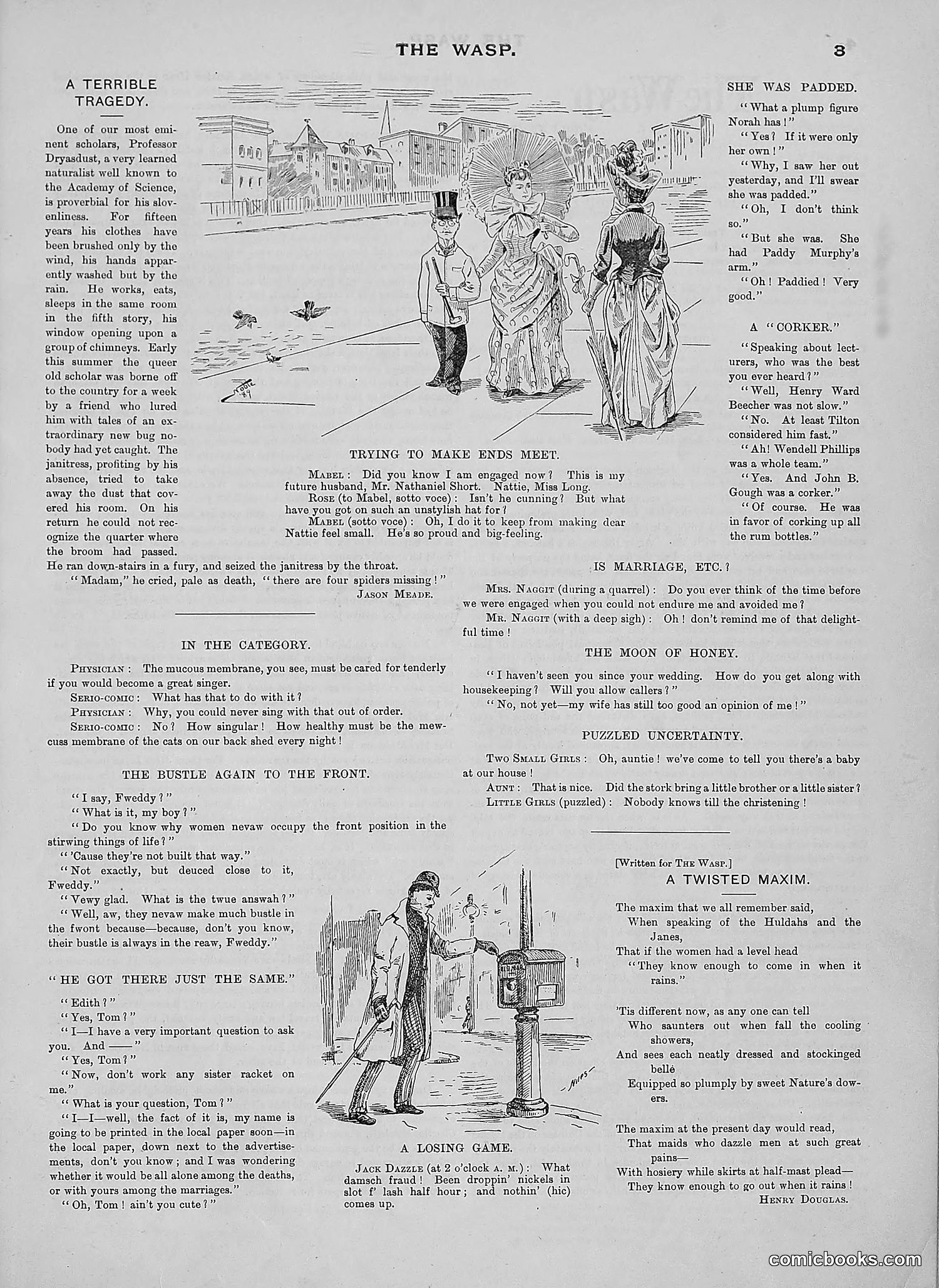
This page contains several unrelated comic sketches and dialogues: **"Trying to Make Ends Meet"** depicts a poorly-dressed scholar (Professor Dryasdust) confronting well-dressed figures, satirizing academic poverty versus society's wealth. **"She Was Padded"** is a brief dialogue joke about padding in women's clothing, a common Victorian-era fashion satire. **"A Losing Game"** shows Jack Dazzle at 2 o'clock A.M., apparently gambling or in financial trouble ("Been droppin' nickels"). **"A Twisted Maxim"** offers social commentary comparing women's practical dress during rain to the fashionable attire of Huldah and Jane, mocking women's impractical fashion choices. The sketches target academic underemployment, women's fashion, gambling/debt, and gender-based social expectations—typical late 19th-century American satirical concerns.

The Wasp — 1889 — page 33 of 450
33 / 450
What you’re looking at · open this page on its own ↗

This is primarily a **text-heavy editorial page** rather than a cartoon page. The masthead identifies this as Volume XXIII, Number 2 of *The Wasp*, a San Francisco satirical weekly. The main content discusses several topics: 1. **Miss Gwendolen Caldwell's marriage** to a French prince—satirizing wealthy American heiresses marrying European nobility 2. **Chinese theater violence**—mocking a shooting at a Jackson Street Chinese theater and critiquing Eastern attitudes 3. **Prizefighting/boxing**—commentary on a fight involving someone named Sullivan and a fighter named Mitchell The tone is acerbic social commentary typical of 1880s satirical journalism, attacking hypocrisy among the wealthy, racial stereotypes, and sensationalism in newspapers. Without visible illustrations, the satire relies entirely on written wit and editorial voice.

The Wasp — 1889 — page 34 of 450
34 / 450
What you’re looking at · open this page on its own ↗

This page from *The Wasp* contains several short humorous dialogues and sketches satirizing Victorian social conventions. **"The Dress Paradox"** mocks the contradiction between women's stated values and their behavior—a woman claims not to love dressing fashionably, yet she wears expensive garments and judges others harshly for theirs. The sketch satirizes feminine hypocrisy regarding materialism and fashion. The other brief dialogues ("Above Suspicion," "A Dreadful Disaster," "Will Stockton Sign Her?," "Proof Positive") appear to be generic social humor about romantic misunderstandings, domestic situations, and class pretensions rather than topical satire. The accompanying illustrations show typical Victorian domestic and social scenes. Without additional context, the specific individuals depicted aren't identifiable as public figures—these appear to be generic character types meant to represent common social situations recognizable to period readers.

The Wasp — 1889 — page 35 of 450
35 / 450
What you’re looking at · open this page on its own ↗

This page contains theater reviews and gossip rather than political cartoons. The single illustration shows "The Alcazar," depicting crowded houses attending Edward Harrigan's play "Waddy Googan." The reviews discuss contemporary theatrical productions and performers, including mentions of: - Harrigan's comedic talents and stage innovations - "The Paymaster" at the Bush Theater - "Monbars," a melodrama adaptation - "The Wife" and "Sweet Lavender" - "Pinafore" (likely Gilbert & Sullivan's H.M.S. Pinafore) The page also includes unrelated humor pieces about legal proceedings and a brief anecdote about horse medicine, typical of The Wasp's satirical miscellany format. This reflects 1880s American theater culture and entertainment journalism rather than political satire.

The Wasp — 1889 — page 36 of 450
36 / 450
What you’re looking at · open this page on its own ↗

The central illustration depicts two men in period dress having a conversation on a street. One asks the other, "Say, Mr. Pice-pleas'man, where'll Miss Jill live?" This appears to be satirical commentary on urban life and social pretension. The humor likely targets either misdirected information-seeking or the absurdity of people giving false addresses to avoid unwanted visitors. The formal dress and street-corner setting suggest commentary on working-class or immigrant city life in late 19th-century America. The page also contains "Stage Conundrums"—riddle-format jokes about theatrical conventions and acting—and brief humorous anecdotes about everyday situations ("Somewhat Too Witty," "Placing Him"). These represent typical satirical magazine filler content mocking social behavior and communication.

The Wasp — 1889 — page 37 of 450
37 / 450
What you’re looking at · open this page on its own ↗

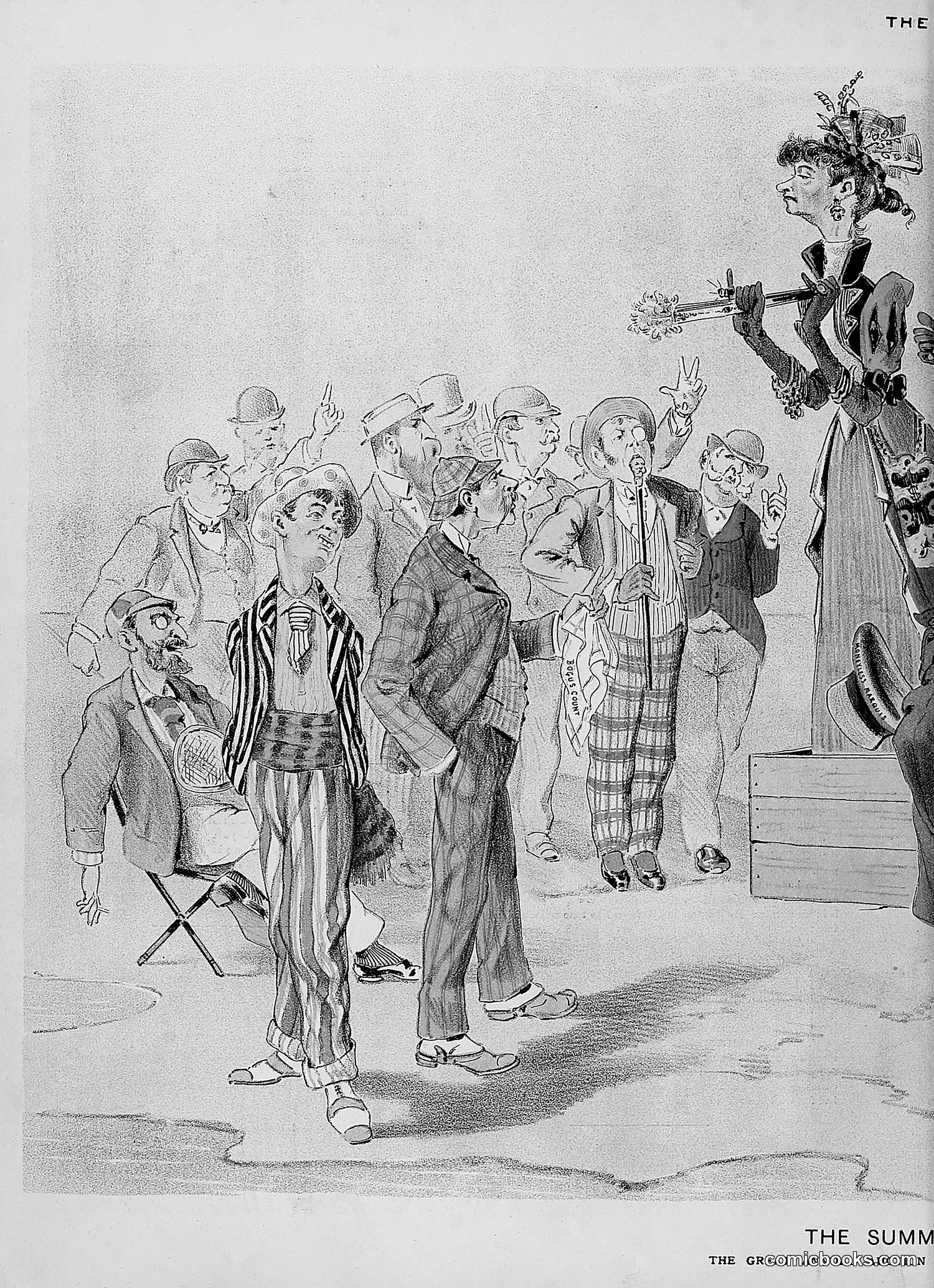
This appears to be a satirical illustration from *The Wasp* magazine showing a performance or public gathering. A tall, elaborately dressed woman with extravagant feathered headpiece stands elevated on the right, playing a flute or pipe instrument while addressing a crowd of men below wearing bowler hats and period clothing (likely late 19th century). The cartoon likely satirizes either a specific public figure—possibly a performer, socialite, or political personality—who commanded public attention through spectacle or oratory. The crowd's rapt, somewhat foolish expressions suggest mockery of mass appeal or susceptibility to showmanship. The exaggerated costume and elevated position emphasize vanity or pretension. Without the full caption or publication date, I cannot definitively identify the subject or specific event being ridiculed.

The Wasp — 1889 — page 38 of 450
38 / 450
What you’re looking at · open this page on its own ↗

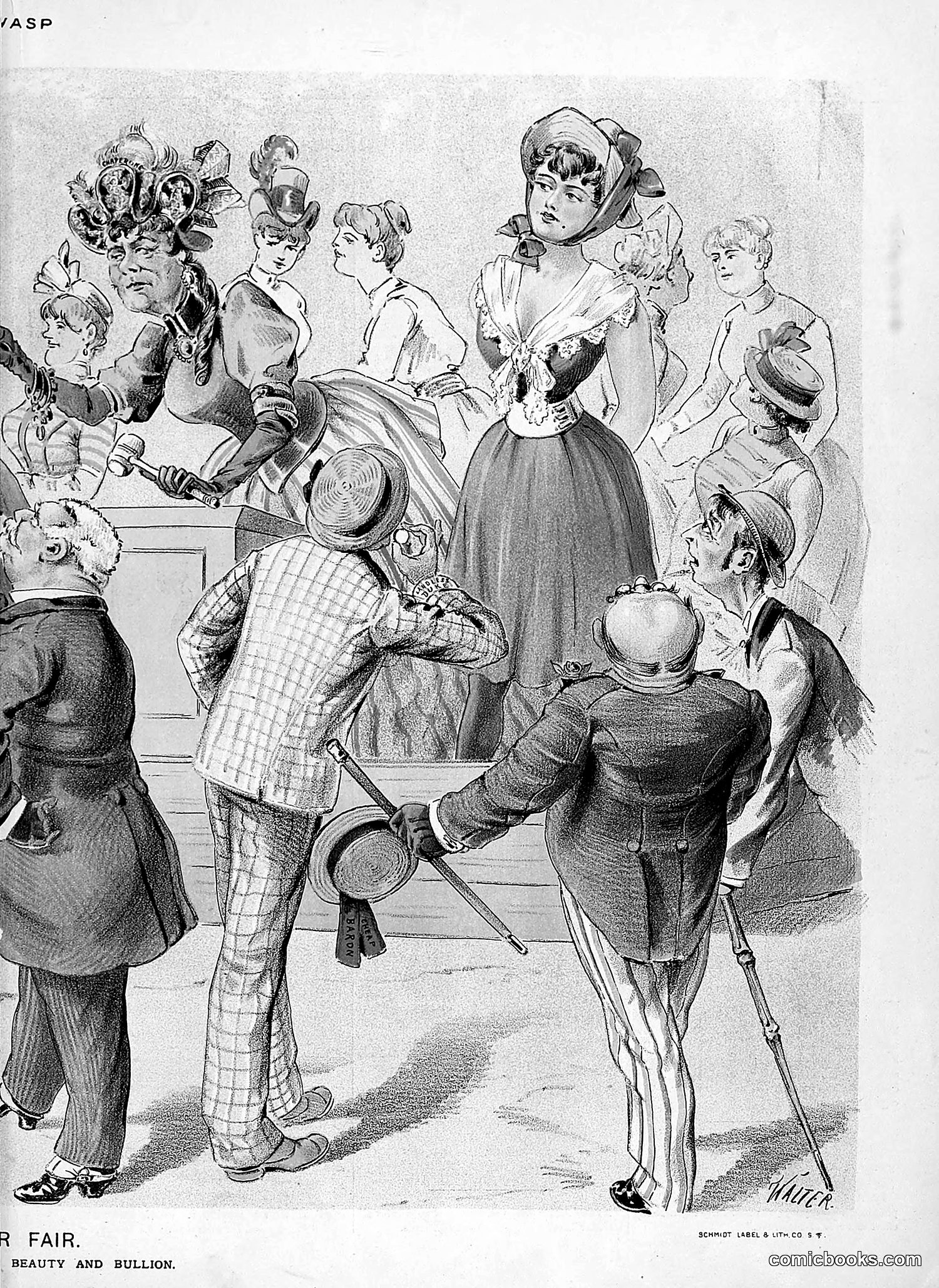
This satirical cartoon depicts a social scene centered on a wealthy woman (center, elaborate bonnet) who appears to be the object of competitive male attention. The caption "Beauty and Bullion" suggests the satire targets the mercenary nature of courtship among the wealthy class. The men surrounding her—wearing formal attire and carrying canes—seem to be vying for her favor, implying they're motivated by her money ("bullion") rather than genuine attraction to her "beauty." One man wears a checkered suit (lower left), another displays obvious eagerness. The illustration mocks how wealth determines social status and romantic interest in high society, suggesting that a woman's financial assets matter more than her actual appearance or character—a critique of materialistic values in the Gilded Age social scene.

The Wasp — 1889 — page 39 of 450
39 / 450
What you’re looking at · open this page on its own ↗

This page is primarily **advertising and humor columns** rather than political cartoons. The left side contains three humorous anecdotes: 1. **"A Growing Sailor"** – a joke about a man who purchased oversized trousers, expecting to "grow into them," only to be ridiculed by the tailor about this logic. 2. **"He Took No Chances"** – involves a domestic dispute where a husband denies paternity, referencing a photograph as evidence. 3. **"For Sunstroke"** – an endorsement for Horsford's Acid Phosphate as a medical cure. The center column, **"Witty Scraps,"** collects brief comedic snippets on everyday topics (names, children, marriage, employment). The right side features **product advertisements** for Burke's Stout, Salfield Rejuvenator, Byron Hot Springs resort, and instantaneous photographs. This page reflects **late 19th/early 20th-century American humor** emphasizing domestic situations, class observations, and commercial pitches rather than political satire.

The Wasp — 1889 — page 40 of 450
40 / 450
What you’re looking at · open this page on its own ↗

This page is primarily **advertising and editorial content** rather than political cartoons. The visible advertisements include: - **Ayer's Sarsparilla** (patent medicine) - **Ideal Felt Tooth Polisher** - **Drunkard** (alcohol antidote cure) - **Equitable Life Assurance** (insurance) - **Catarrh treatment** products The main editorial content discusses **Bancroft's Histories**, a multi-volume work on Mexican and Texas history. The text reviews the sixteenth volume's coverage of Texas from 1800 onward, chronicling conflicts, Mexican governance, and the Texas Revolution. The page reflects late 19th-century *The Wasp* content: a mix of patent medicine ads (common for the era's magazines) and serious historical discussion. No clear political satire or caricatures are evident on this particular page—it's primarily a commercial and informational layout typical of period periodicals.

The Wasp — 1889 — page 41 of 450
41 / 450
What you’re looking at · open this page on its own ↗

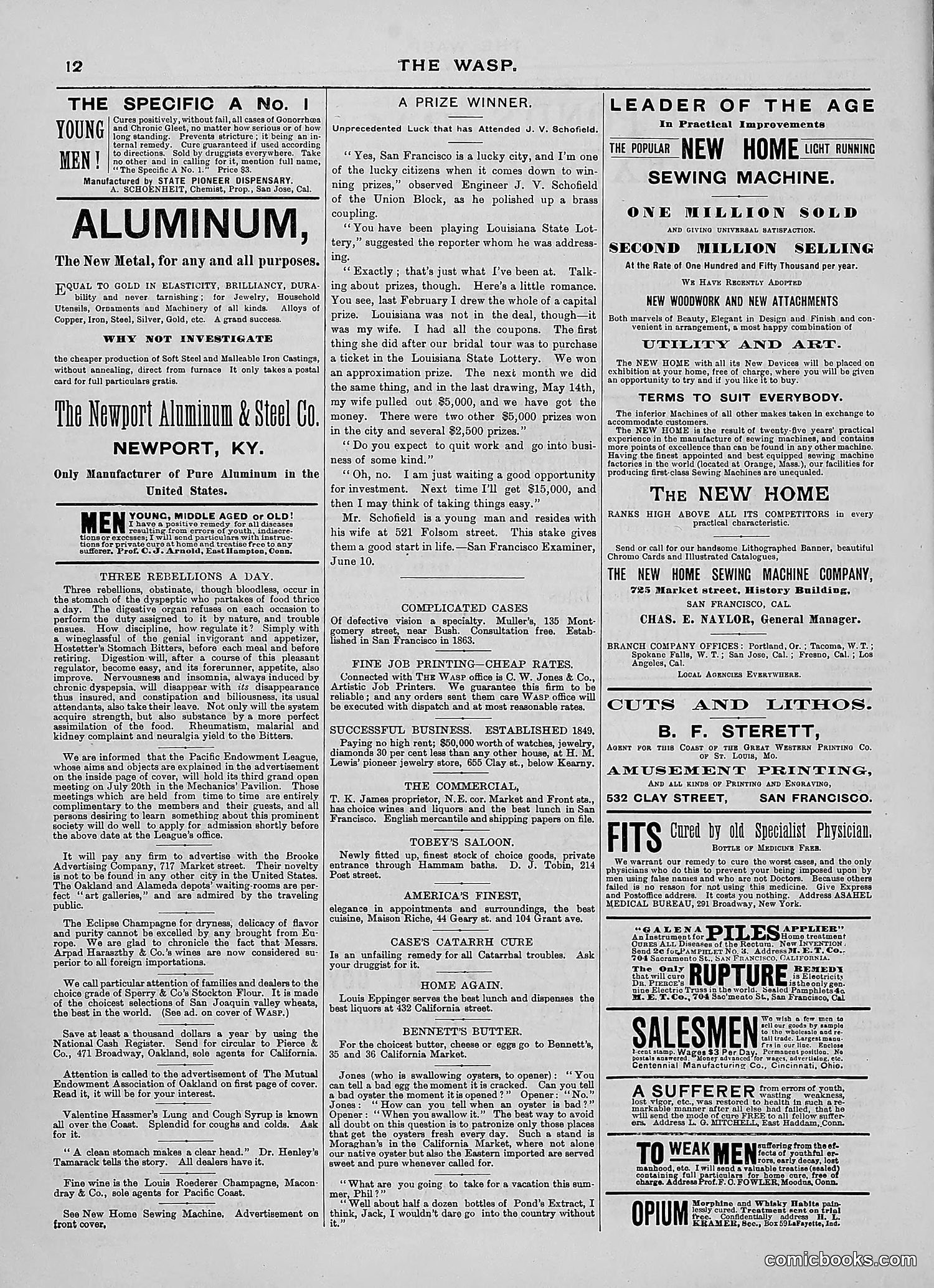
This page is primarily **advertising and classifieds** rather than political satire or cartooning. The visible content includes: - Multiple product advertisements (aluminum, sewing machines, printing services) - Patent medicine ads (remedies for vision problems, catarrh, weak men, rupture) - A brief anecdote about winning a Louisiana lottery prize - Business notices and classified listings There is **no identifiable political cartoon** or satirical illustration visible on this page. The only substantive editorial content is "A Prize Winner"—a short story about a San Francisco engineer's lucky lottery winnings—which illustrates The Wasp's typical humor through narrative rather than visual satire. The page reflects late 19th-century magazine culture, mixing legitimate journalism with the patent medicine advertising that was standard and often deceptive for the era.

The Wasp — 1889 — page 42 of 450
42 / 450
What you’re looking at · open this page on its own ↗

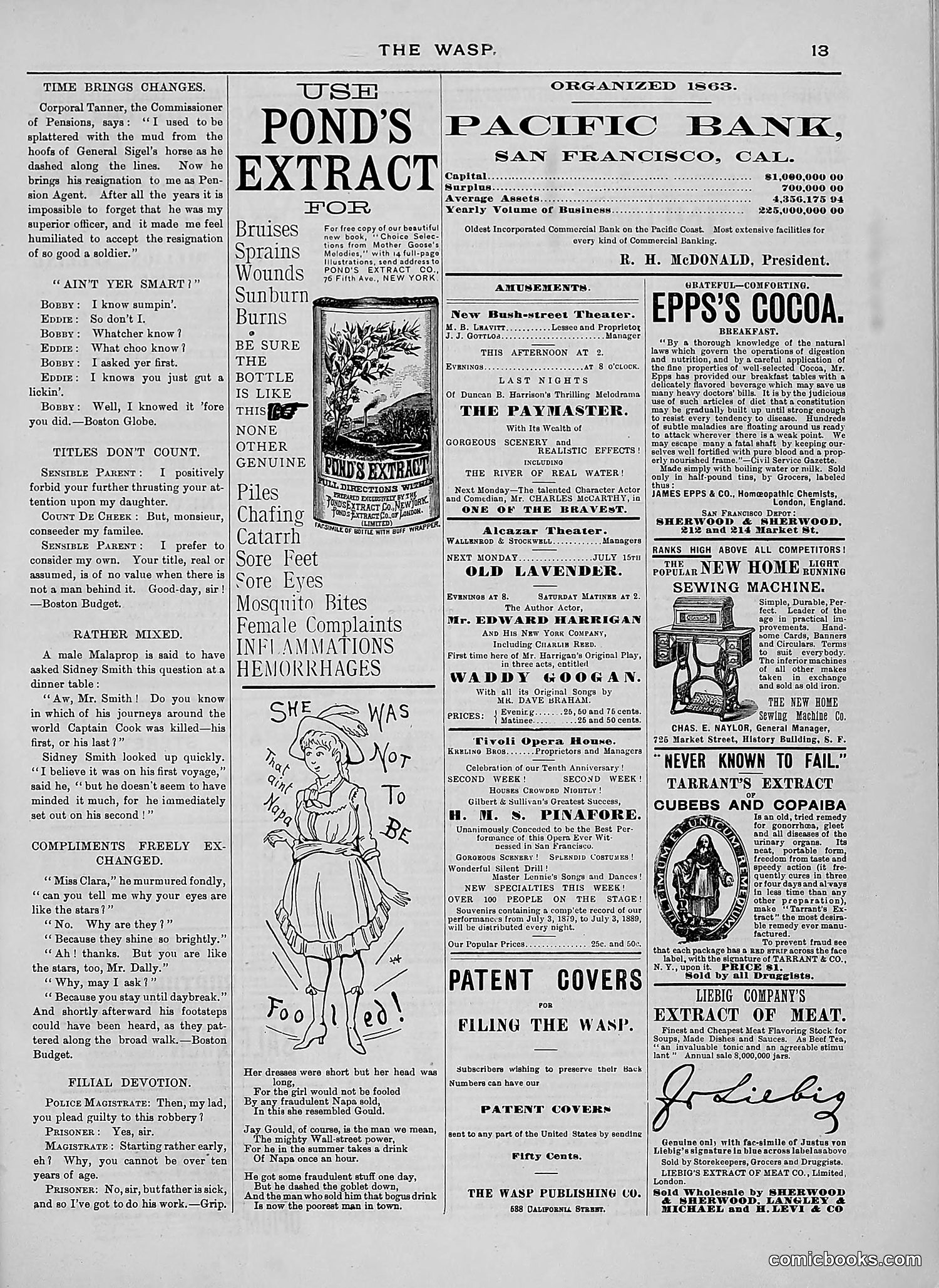
This page is primarily **advertising and humor content** rather than political satire. The dominant feature is a large advertisement for Pond's Extract, a popular 19th-century medicinal product claiming to treat bruises, sprains, wounds, and various ailments. The illustrated cartoon shows a woman labeled "She Was Not Fooled," depicting her rejecting a suitor's advances—likely satirizing courtship and romance conventions of the era. The remaining content consists of short humorous anecdotes and advertisements for theaters, patent medicines, and other commercial products typical of period magazines. The page reflects how satirical publications like *The Wasp* supported themselves through advertising while delivering entertainment and light social commentary to readers.

The Wasp — 1889 — page 43 of 450
43 / 450
What you’re looking at · open this page on its own ↗

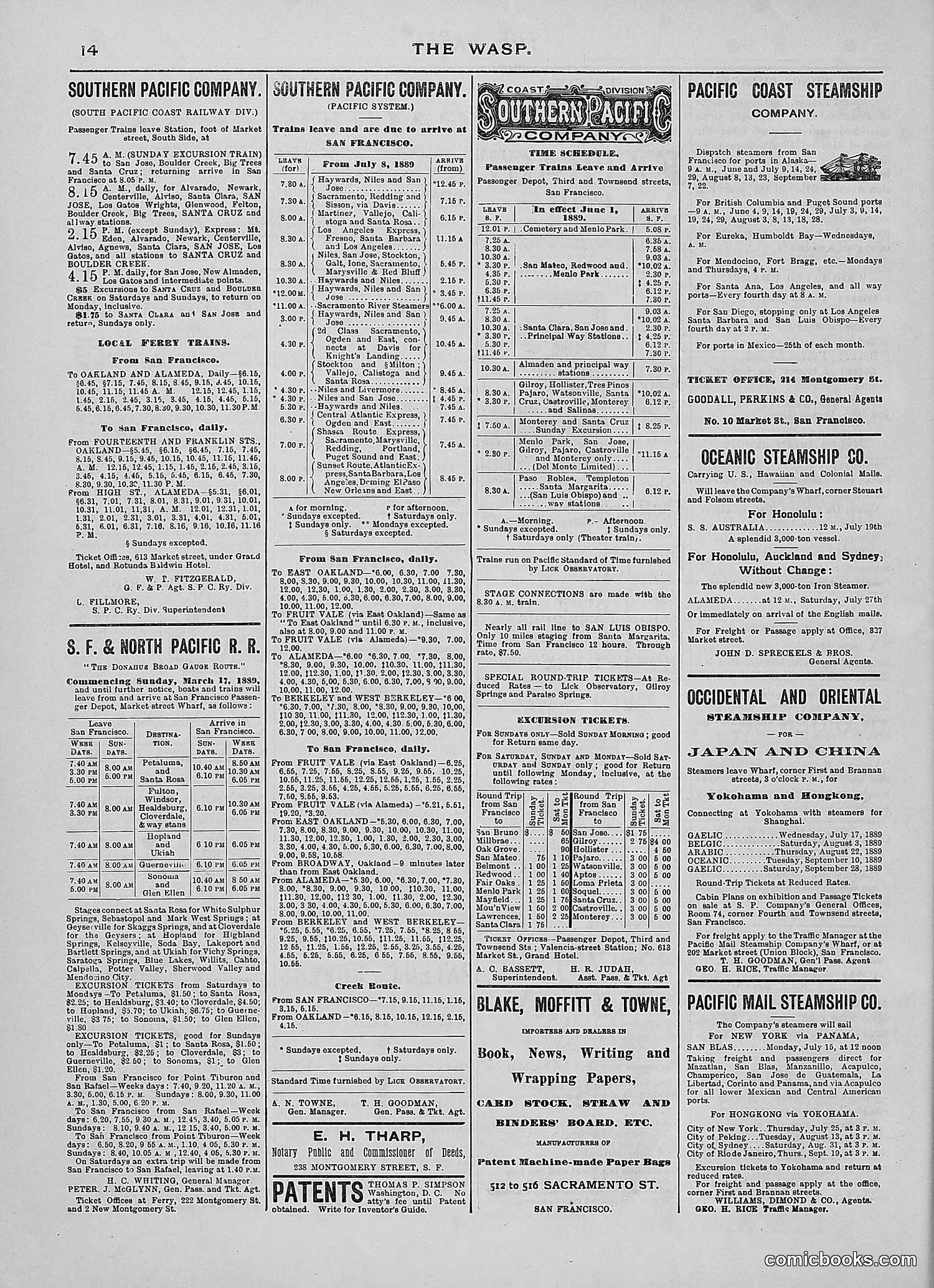
This page is primarily **advertising and transportation schedules**, not satirical content. It contains: - Multiple railroad and steamship company advertisements (Southern Pacific Company, Pacific Coast Steamship Company, Oceanic Steamship Company, etc.) - Detailed train and boat timetables with departure/arrival times - Ticket office information - Business directory listings for various transportation and commercial services There are **no visible political cartoons or satirical illustrations** on this page. The only images appear to be small company logos or emblems associated with the steamship lines. This represents the commercial advertising section typical of late 19th-century magazines, where *The Wasp* generated revenue. The actual satirical content would appear on other pages of the publication.

The Wasp — 1889 — page 44 of 450
44 / 450
What you’re looking at · open this page on its own ↗

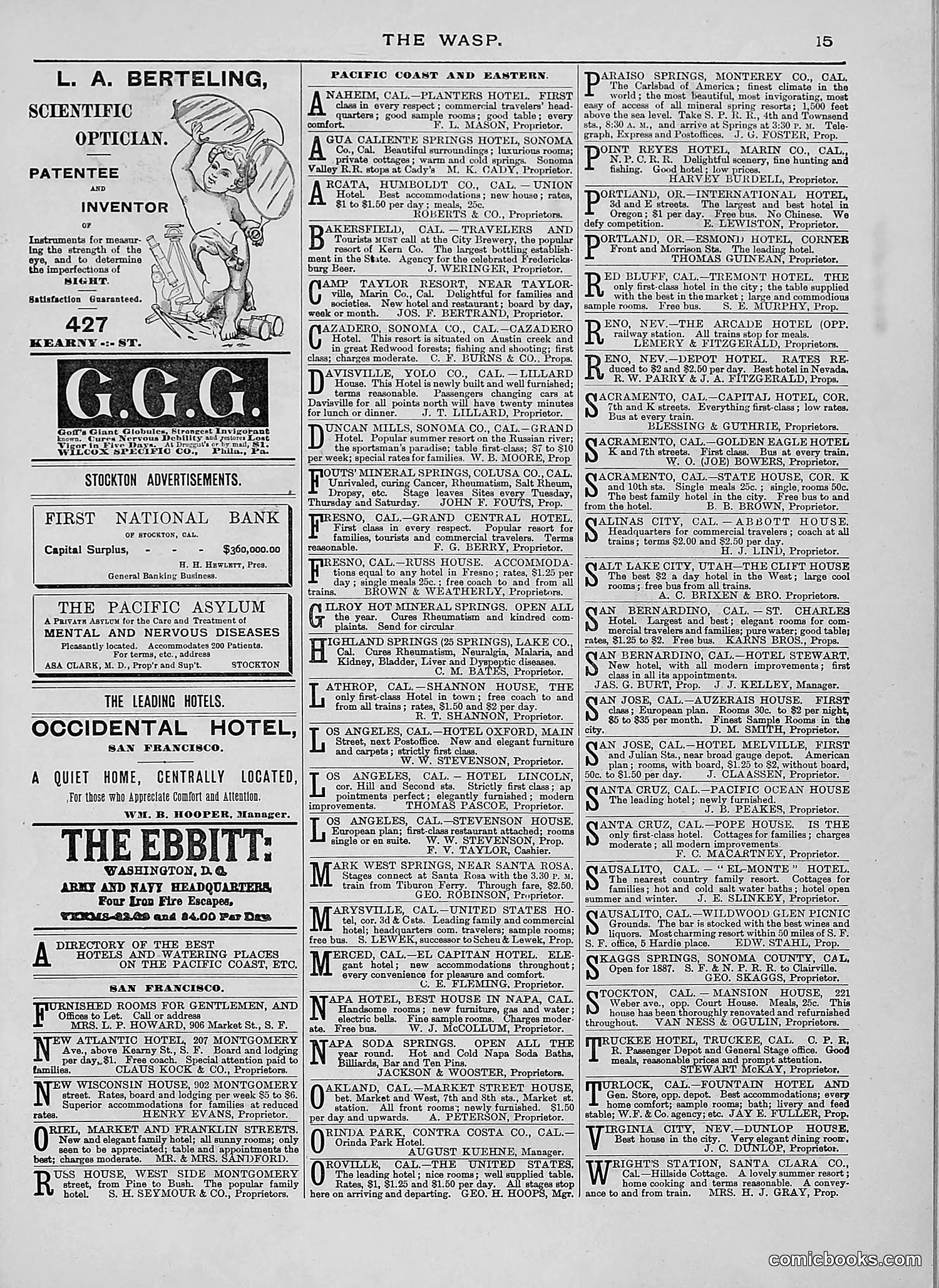
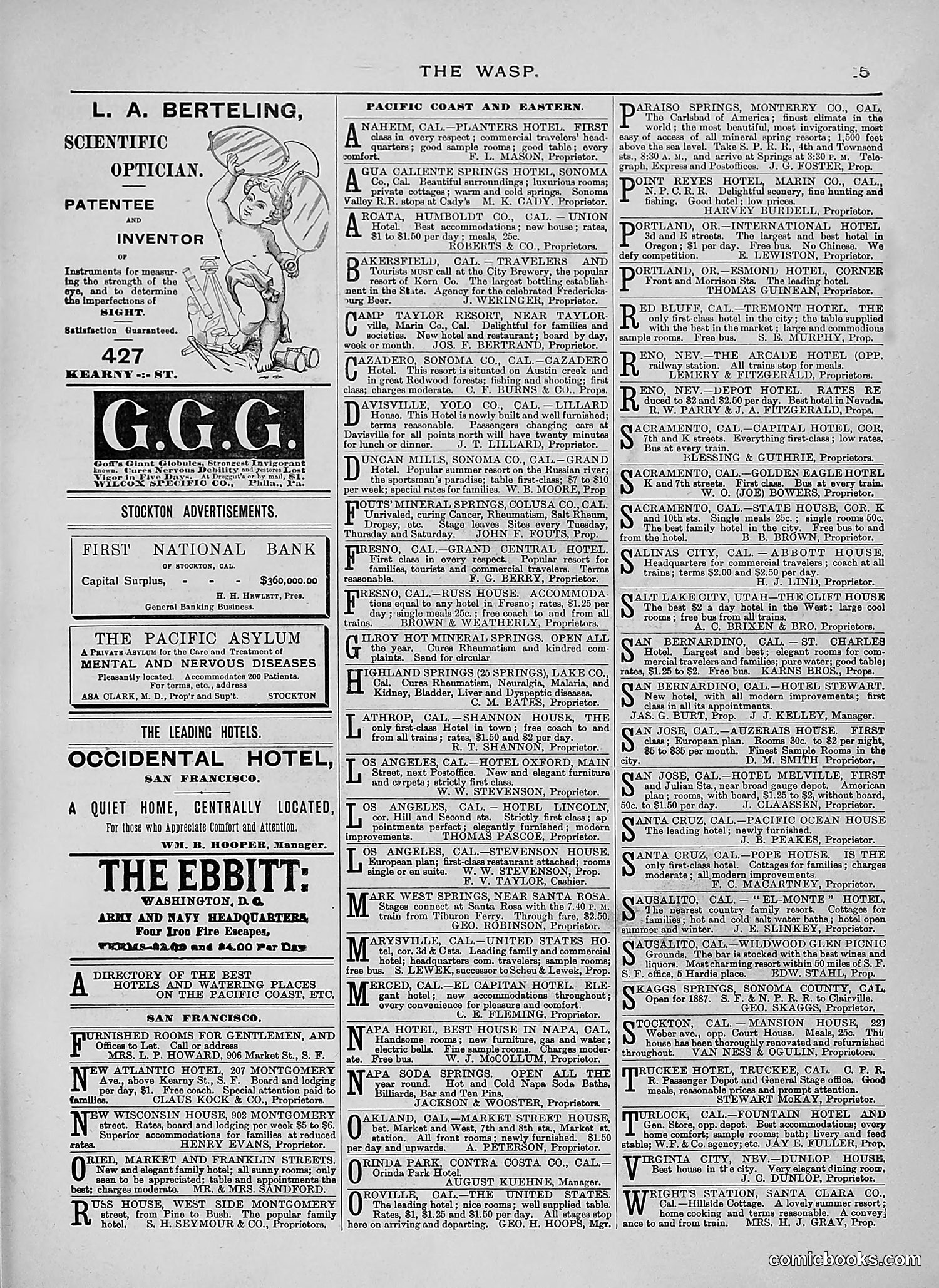
This page is primarily **advertising**, not editorial content or satire. It contains hotel and business listings for the Pacific Coast and Eastern regions, typical of *The Wasp* magazine's commercial sections. The only illustration is a decorative header featuring **L. A. Berteling, Scientific Optician and Patentee**, showing an ornate design with what appears to be optical instruments. This is a straightforward advertisement, not political satire. The page includes directory listings for hotels, banks, and businesses (the Occidental Hotel, First National Bank of Stockton, The Ebbitt in Washington D.C., etc.), along with smaller hotel advertisements from various California and Nevada locations. No political cartoon, caricature, or satirical commentary is present on this page.

The Wasp — 1889 — page 45 of 450
45 / 450
What you’re looking at · open this page on its own ↗

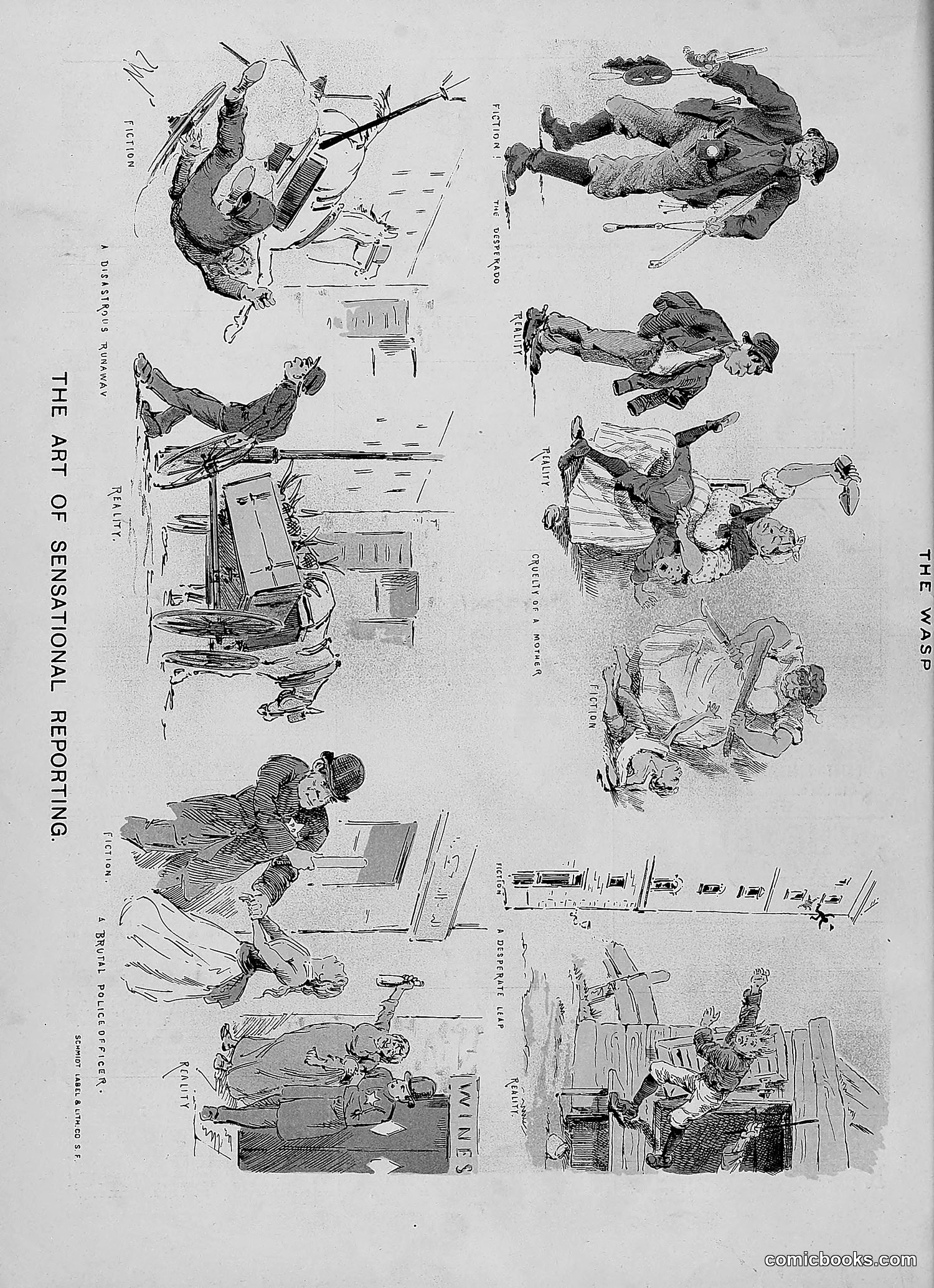
This page from *The Wasp* satirizes yellow journalism and sensationalist newspaper practices. The cartoon sequence depicts various dramatic scenarios—accidents, violence, human interest stories—that would have appealed to sensation-hungry readers of the era. The title "The Art of Sensational Reporting" indicates the satire targets how newspapers exaggerated or fabricated dramatic content to boost circulation. The multiple vignettes show different "types" of sensational stories: industrial accidents, crime scenes, domestic disputes, and street incidents. The cartoon mocks both newspapers' willingness to exploit tragedy for profit and the public's appetite for such sensationalism. This reflects genuine Progressive-era criticism of "yellow journalism"—a practice where outlets prioritized shocking headlines over accurate reporting, a major public concern in late 19th/early 20th-century America.

The Wasp — 1889 — page 46 of 450
46 / 450
What you’re looking at · open this page on its own ↗

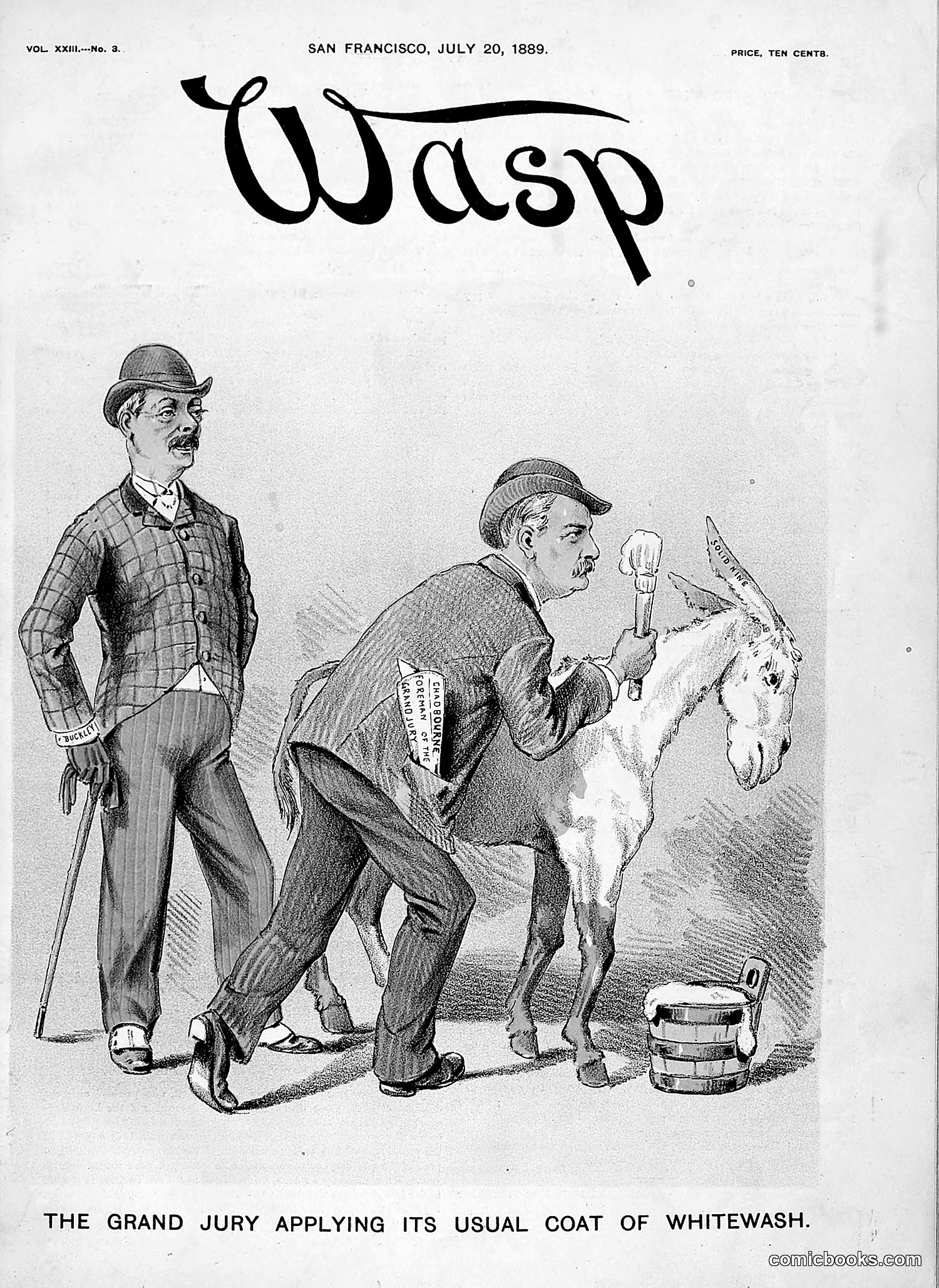
This *Wasp* cartoon from July 20, 1889 satirizes the Grand Jury's practices through the metaphor of "whitewashing"—covering up or concealing wrongdoing. The image shows two men: one stands formally on the left (appearing to supervise), while another actively applies whitewash to a goat on the right, with buckets nearby. The caption reads "THE GRAND JURY APPLYING ITS USUAL COAT OF WHITEWASH." The satire suggests that San Francisco's Grand Jury systematically concealed or exonerated wrongdoers rather than pursuing genuine justice. The goat likely represents corruption or guilty parties being deliberately obscured from accountability. By depicting whitewashing as the jury's "usual" practice, the cartoon criticizes what it presents as systematic corruption or malfeasance in the judicial system.

The Wasp — 1889 — page 47 of 450
47 / 450
What you’re looking at · open this page on its own ↗

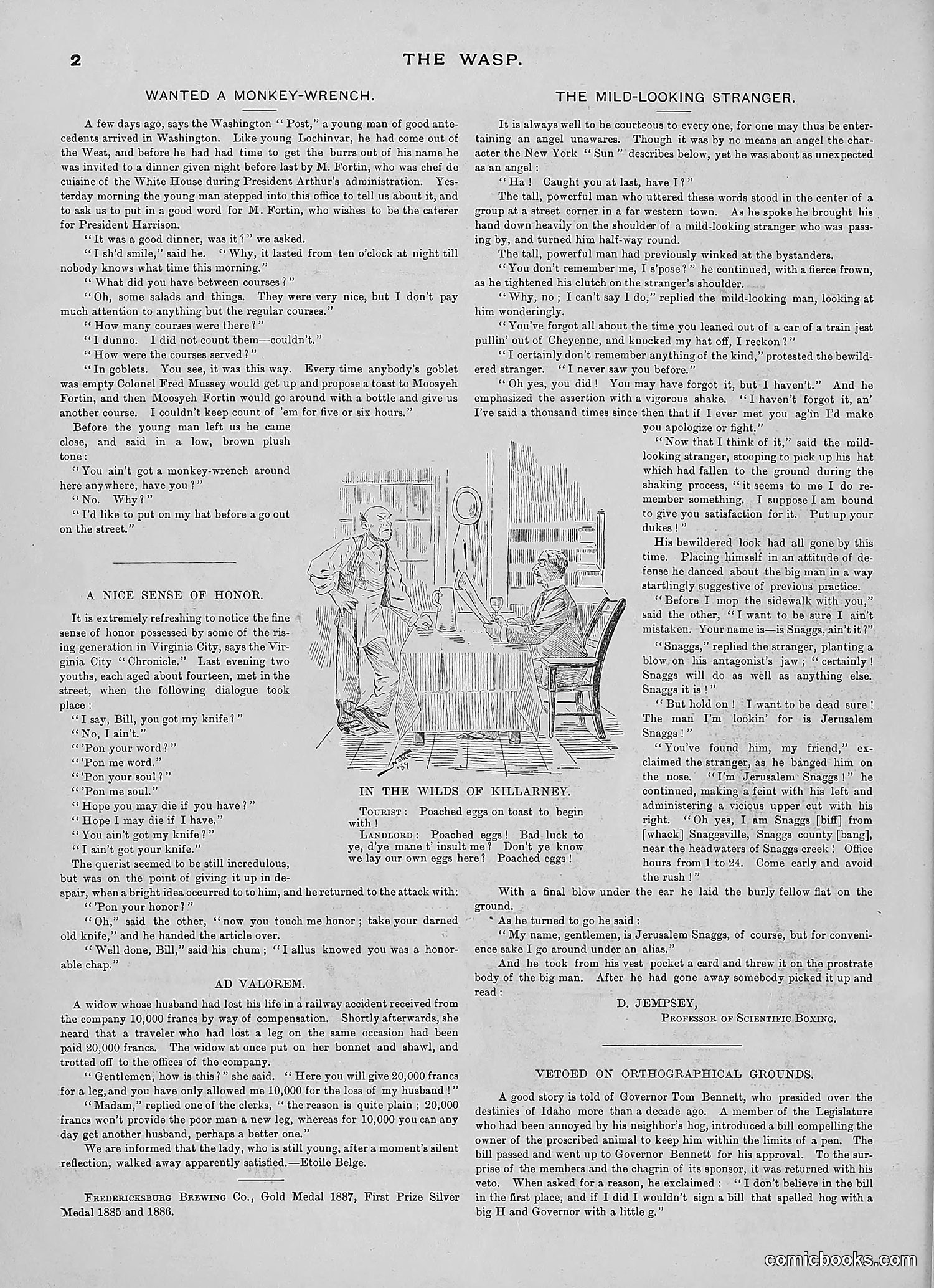
The main illustration titled "IN THE WILDS OF KILLARNEY" depicts two men in what appears to be a comedic confrontation. Based on the surrounding text, this illustrates a humorous anecdote about poached eggs on toast—a seemingly mundane culinary topic treated with exaggerated dramatic tension. The page primarily consists of satirical short stories and anecdotes rather than political cartoons. These include "A Nice Sense of Honor" (a dialogue between youths about knives), "Wanted a Monkey-Wrench" (about a young man visiting Washington), and "The Mild-Looking Stranger" (involving a character named Snaggs). The content targets social pretensions, honor codes among working-class men, and everyday absurdities through humor rather than explicit political commentary. The Wasp used comic narratives and illustrations to satirize American social conventions.

The Wasp — 1889 — page 48 of 450
48 / 450
What you’re looking at · open this page on its own ↗

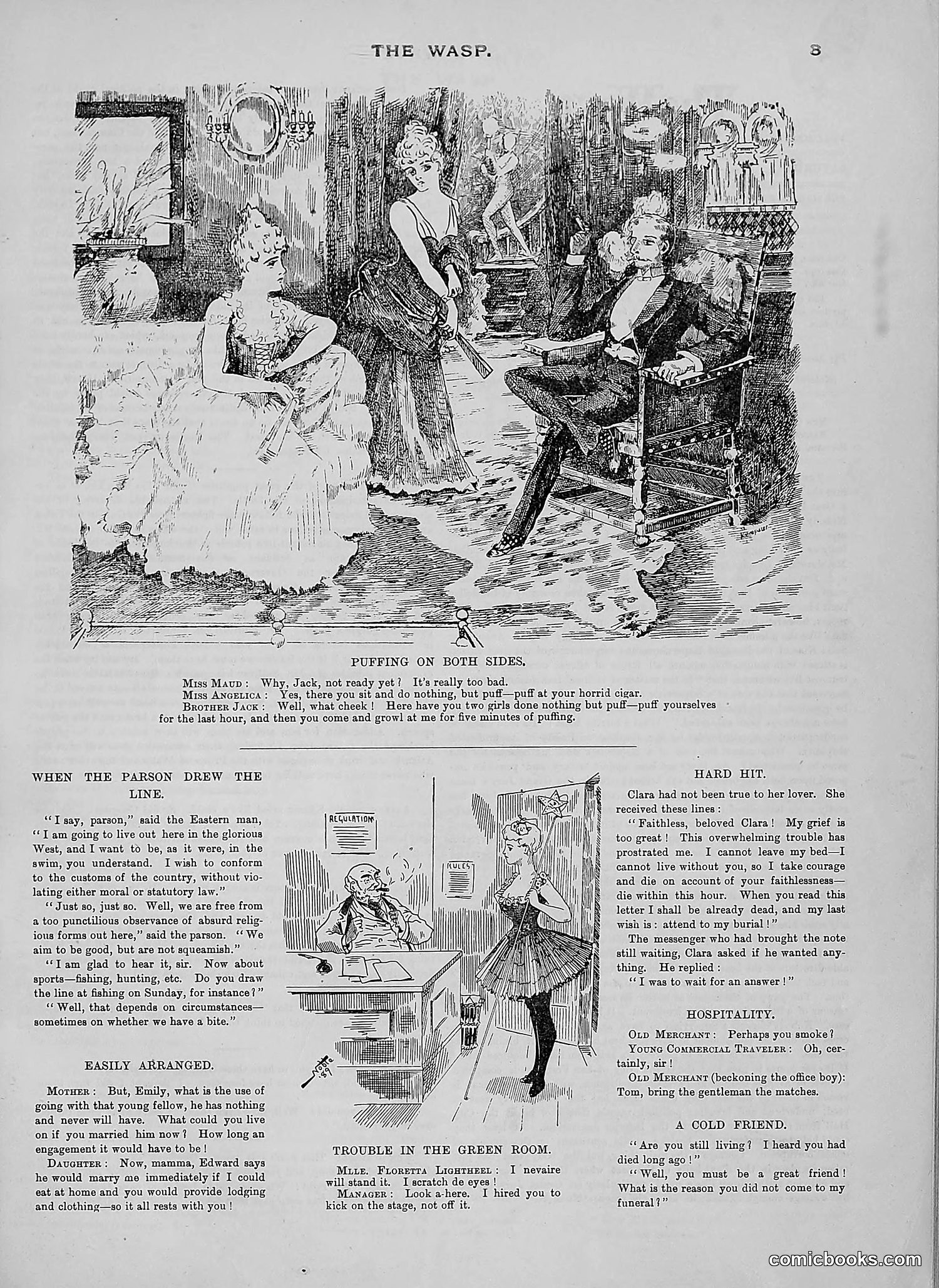
This page contains multiple brief satirical sketches and comic scenarios rather than a single unified cartoon: **"Puffing on Both Sides"** depicts social hypocrisy around cigar smoking—women criticizing men for smoking while secretly indulging themselves. **"When the Parson Drew the Line"** shows a conversation between an Eastern man and a Western parson about regional customs, apparently satirizing differing moral standards between regions. **Other sketches** ("Hard Hit," "Hospitality," "A Cold Friend," "Trouble in the Green Room," "Easily Arranged") appear to be brief comedic vignettes about everyday social situations—romantic entanglements, business dealings, and social awkwardness. The humor relies on observational comedy about Victorian-era manners and hypocrisy rather than political commentary. Without clearer context identifying specific public figures, the precise satirical targets remain unclear beyond general social critique.

The Wasp — 1889 — page 49 of 450
49 / 450
What you’re looking at · open this page on its own ↗

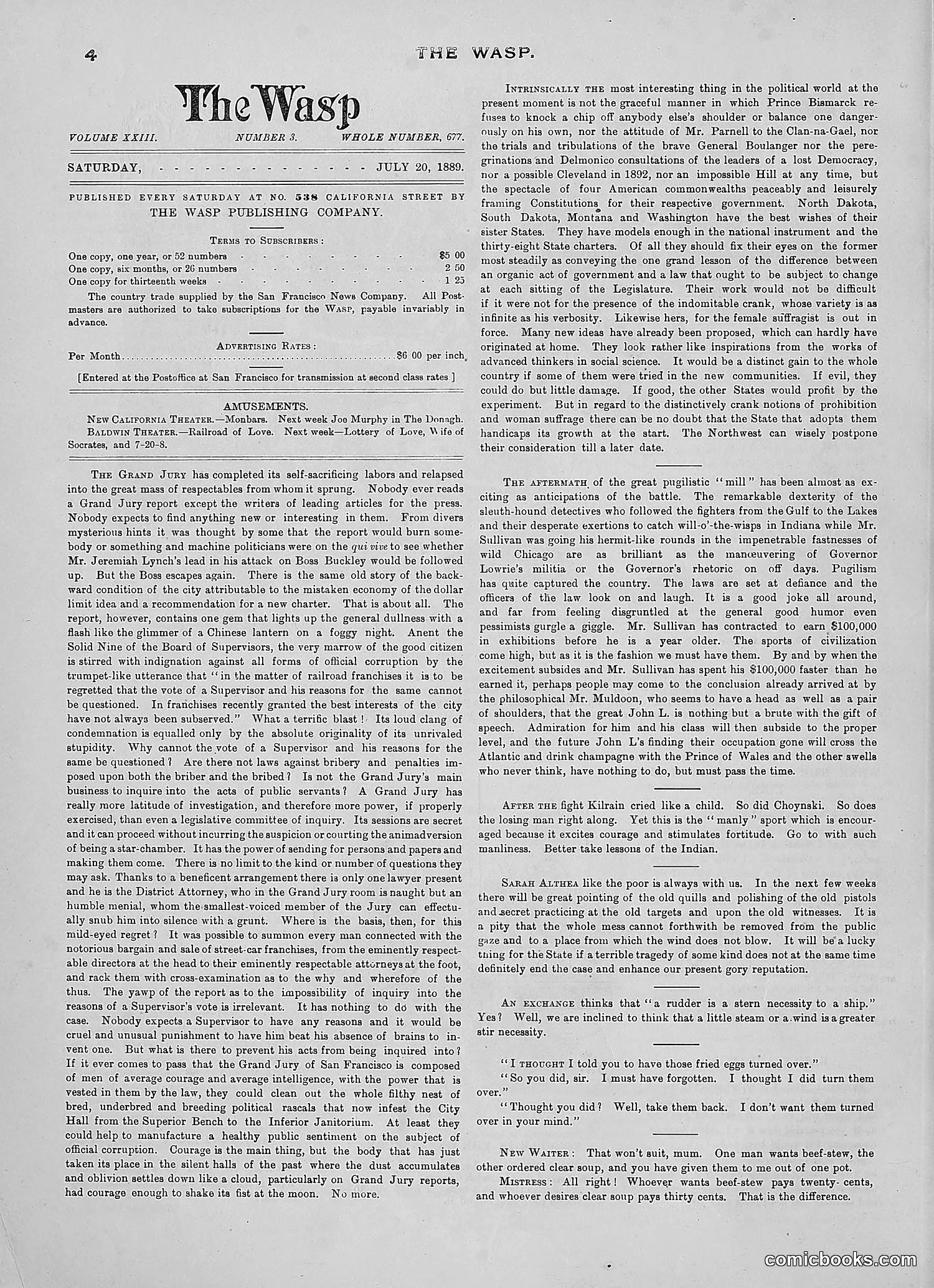
This is primarily a **title page and masthead** for the San Francisco satirical weekly, with subscription information, advertising rates, and several short humor pieces rather than illustrated political cartoons. The visible content includes brief satirical commentary on contemporary issues: the Grand Jury's investigative powers, railroad franchise corruption, and social observations about prohibition and women's suffrage. The humor pieces at bottom mock conversational absurdities—exchanges about fried eggs and beef stew between characters labeled "New Waiter," "Mistress," and others. **No prominent political figures or caricatures are visible** in the image shown. The page functions as a textual satire publication rather than relying on visual cartooning.

The Wasp — 1889 — page 50 of 450
50 / 450
What you’re looking at · open this page on its own ↗

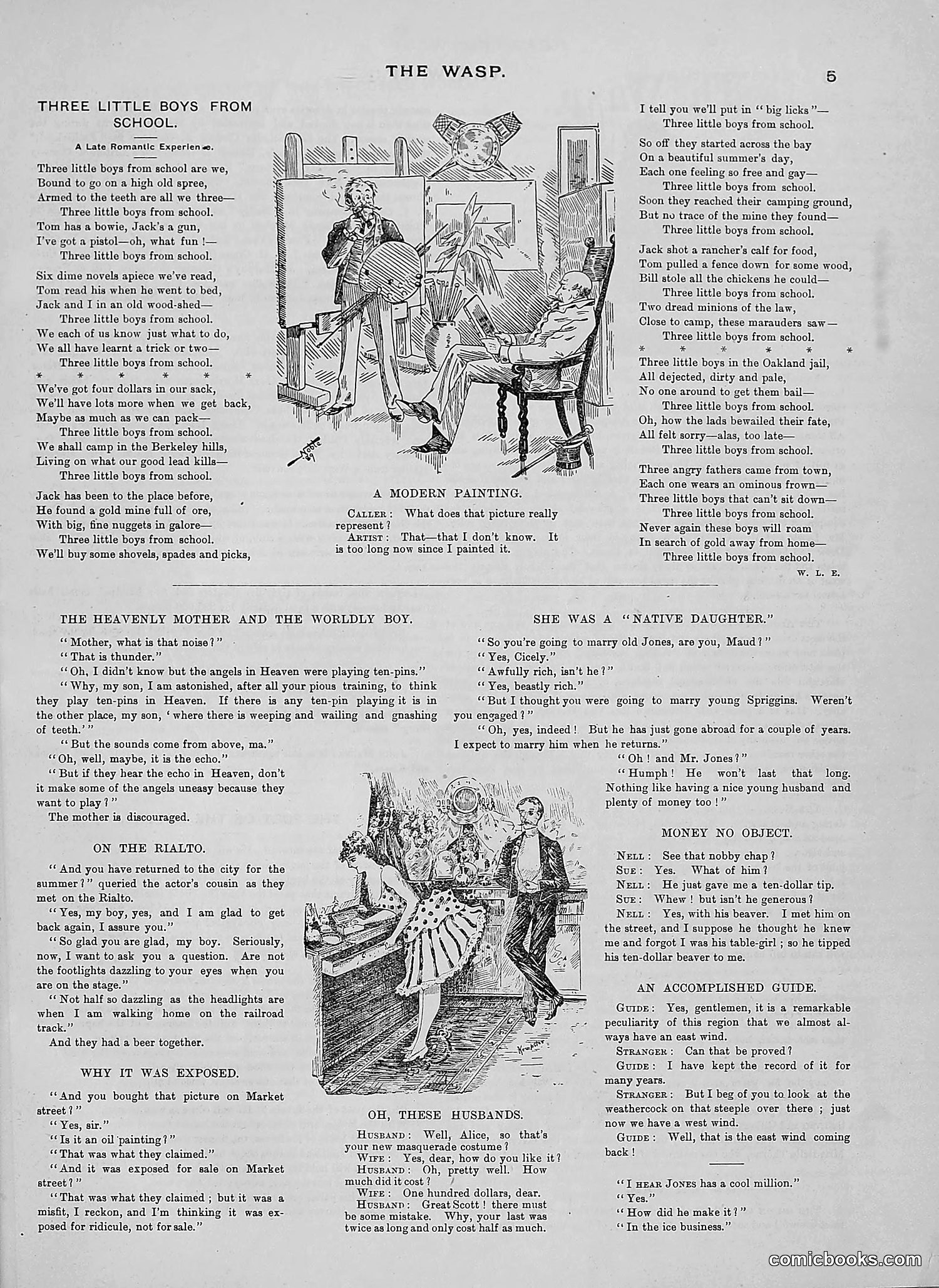
This page contains several satirical pieces and illustrations typical of late 19th-century American humor magazines. **"Three Little Boys from School"** is a humorous poem about schoolboys' mischievous adventures, with a satirical illustration showing boys causing chaos at what appears to be a ranch or farm. **"A Modern Painting"** is a brief joke mocking contemporary art—a caller asks an artist what an abstract painting represents, and the artist admits he doesn't know because he painted it so long ago. This satirizes the growing incomprehensibility of modernist art to general audiences. The remaining pieces—"The Heavenly Mother," "On the Rialto," "Why It Was Exposed," and various domestic humor sections—are conversational sketches and jokes about everyday life, relationships, and social pretension, representing typical Victorian-era satirical content.

The Wasp — 1889 — page 51 of 450
51 / 450
What you’re looking at · open this page on its own ↗

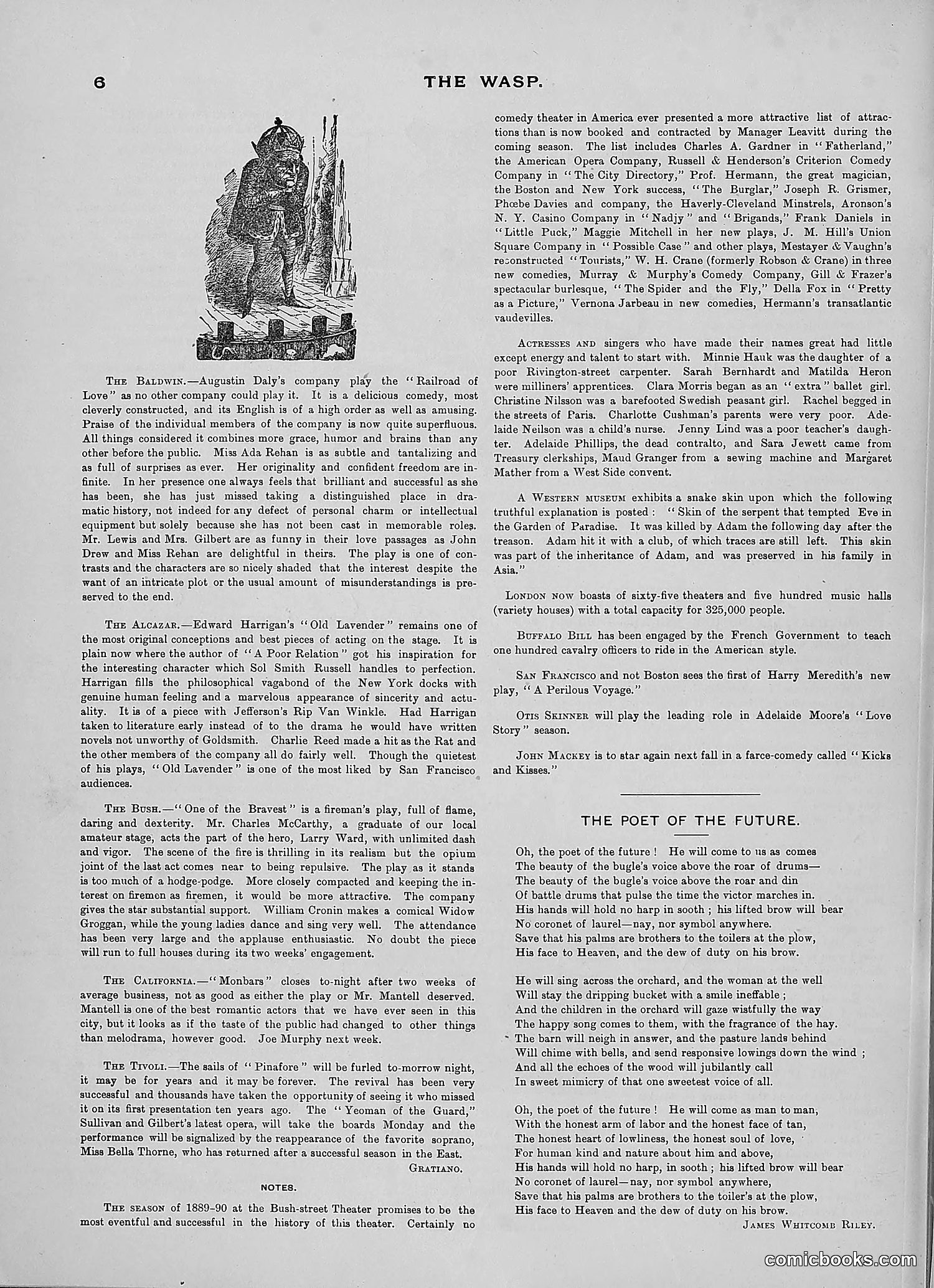
This page is primarily **text content rather than satirical cartoons**. It contains theater reviews and entertainment notes from what appears to be the 1889-90 season. The only visual element is a woodcut illustration labeled "**THE BALDWIN**" at the top left, depicting what appears to be a classical or theatrical figure/statue. The text discusses various theatrical productions, actors, and performances of the era, including reviews of plays like "Railroad of Love" and "Old Lavender." It also includes a poem titled "**The Poet of the Future**" by James Whitcomb Riley. The page functions as **entertainment journalism** rather than political satire—it's showcasing San Francisco's theater scene and notable performers of the period. Without identifying specific individuals in the reviews, the content reflects late-Victorian theatrical culture and American performance traditions.

The Wasp — 1889 — page 52 of 450
52 / 450
What you’re looking at · open this page on its own ↗

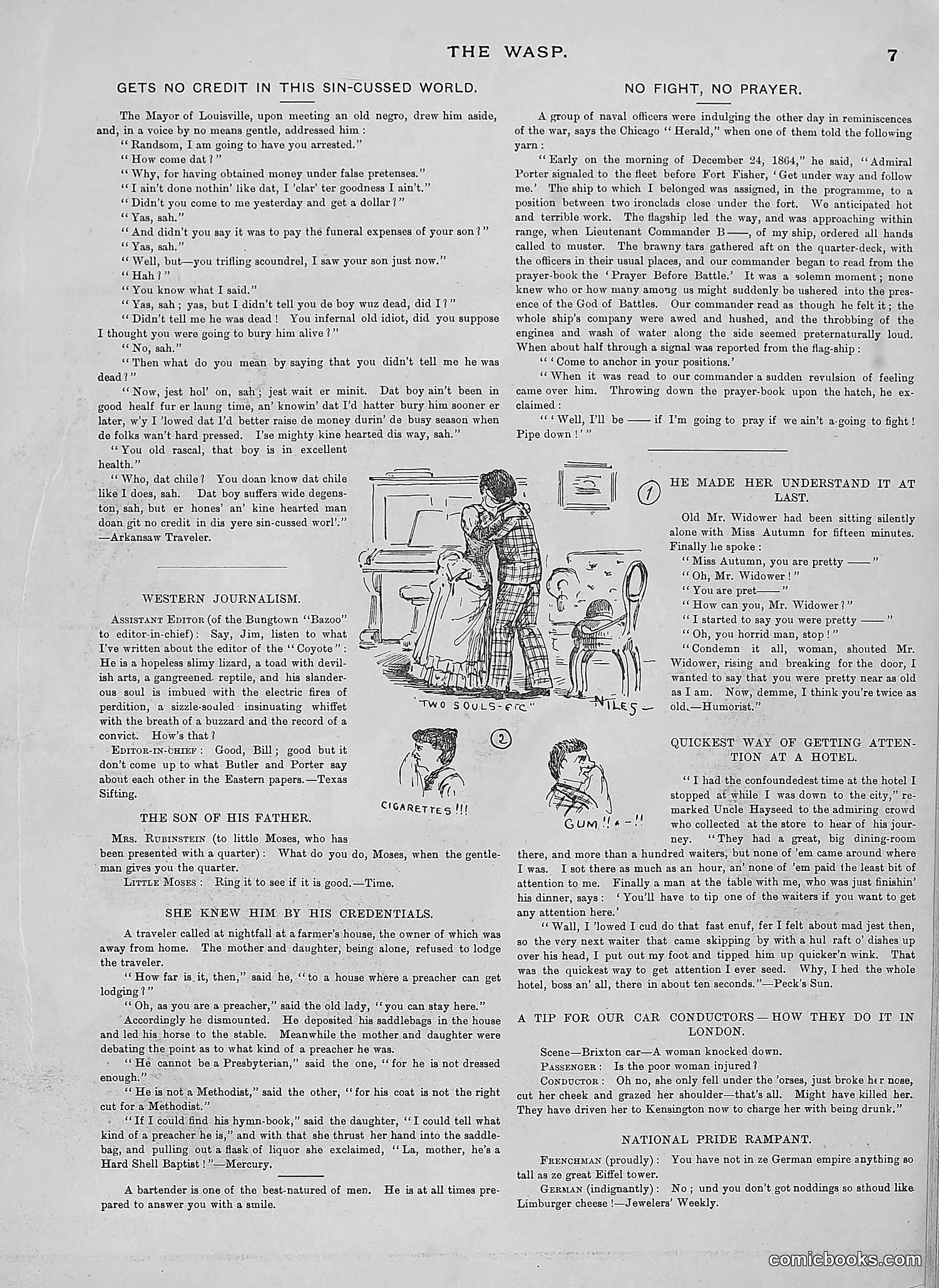
This page contains several satirical sections rather than a single cartoon. The main illustrated piece labeled "Two Souls Etc." depicts an interaction between an elderly man (Mr. Widower) and a young woman (Miss Autumn), illustrating a section titled "He Made Her Understand It at Last." The caption suggests a romantic or flirtatious encounter being gently mocked. Other sections include "Western Journalism" (criticizing newspaper editors), "No Fight, No Prayer" (about naval officers), and brief humorous anecdotes. The satirical targets appear to be social pretension, journalistic practices, and human behavior rather than specific political figures. The humor relies on wordplay and character observations typical of 19th-century American satire magazines.

The Wasp — 1889 — page 53 of 450
53 / 450
What you’re looking at · open this page on its own ↗

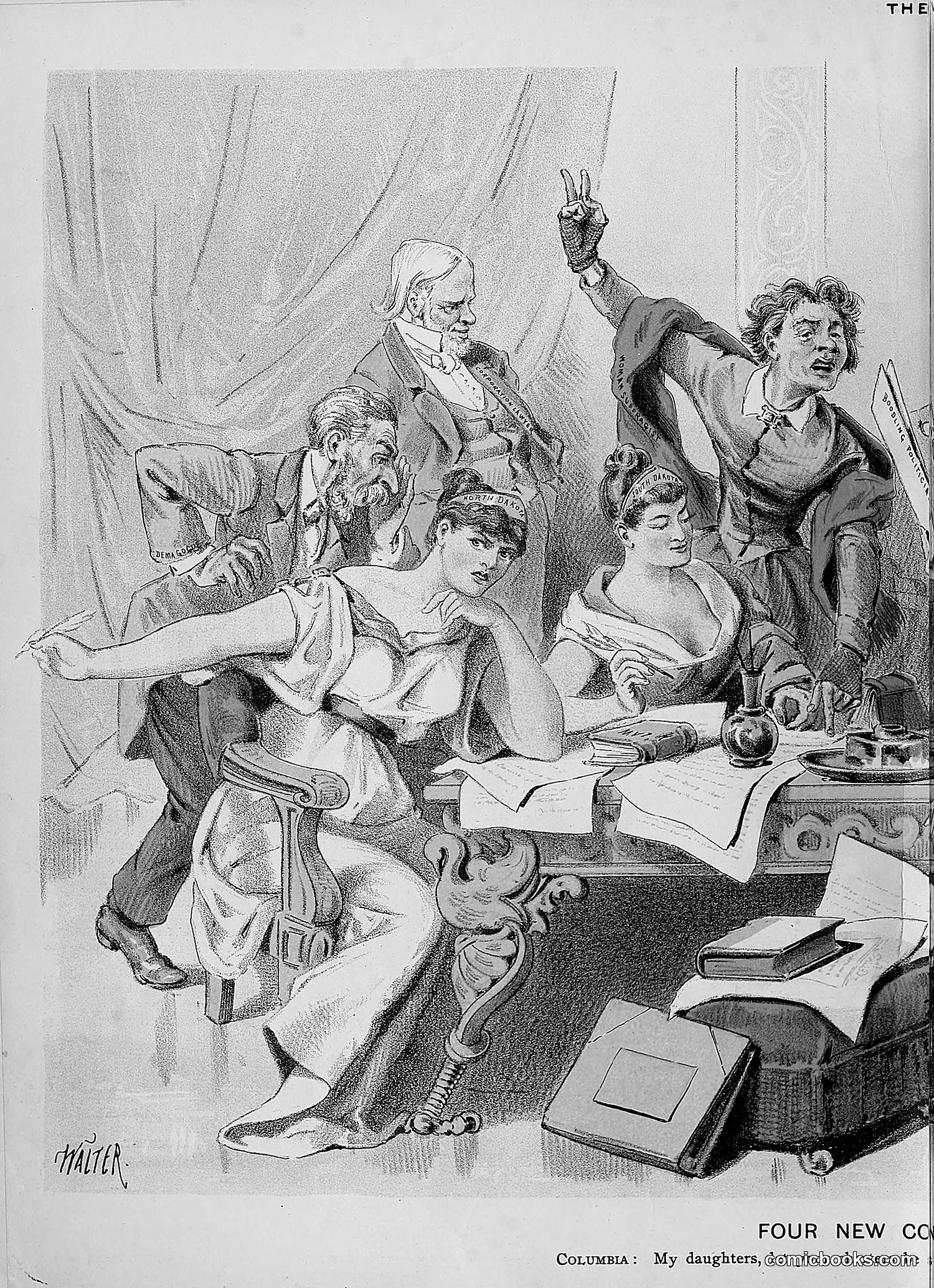
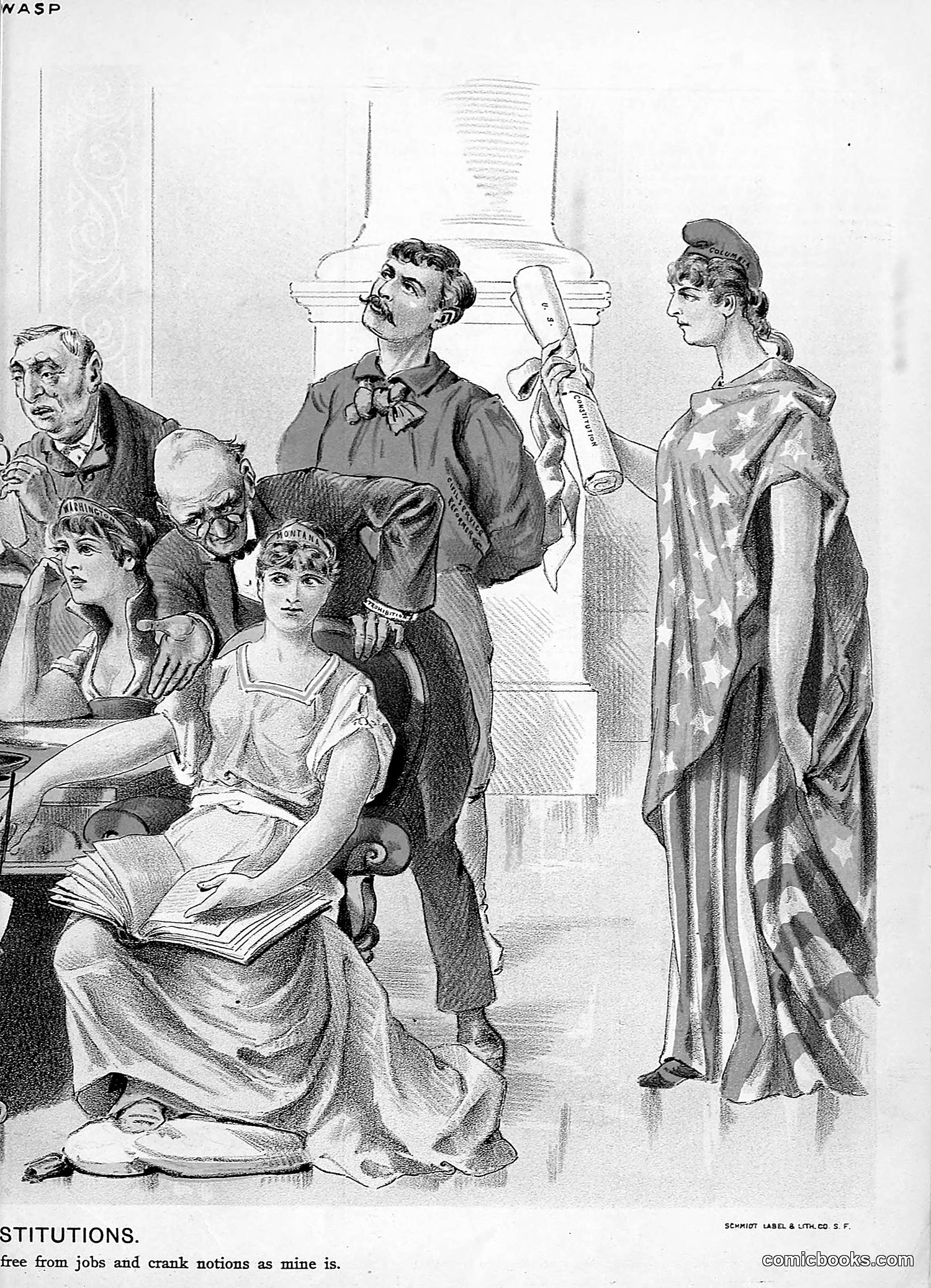
This satirical cartoon depicts Columbia (the female personification of America) presenting her "daughters" to what appears to be a group of male political or business figures. The men are caricatured with exaggerated features typical of 19th-century satirical art. The satire likely concerns American territorial expansion or the addition of new states/territories to the Union. Columbia—shown as a proud mother figure—is literally presenting new regions as her "daughters," suggesting they are being offered up or incorporated into the nation. The men's expressions range from interest to skepticism, possibly satirizing political debates over expansion, colonial ambitions, or the integration of new territories. Without the full caption and date, the specific historical reference remains unclear, though this format was common in *The Wasp* during periods of American expansionism.

The Wasp — 1889 — page 54 of 450
54 / 450
What you’re looking at · open this page on its own ↗

This satirical cartoon from *The Wasp* critiques what appears to be a legal or institutional proceeding. The visible text reads "free from jobs and crank notions as mine is," suggesting commentary on employment, institutional bias, or nepotism. The scene depicts several figures in what looks like a courtroom or official setting, with a prominent woman seated holding documents, several men observing, and a robed figure on the right (likely representing Justice or judicial authority). The composition implies the cartoon mocks how institutions operate—perhaps showing favoritism, corruption, or the disconnect between stated ideals and actual practice. Without clearer context or publication date, the specific political figures remain unclear, but the satire clearly targets institutional hypocrisy.

The Wasp — 1889 — page 55 of 450
55 / 450
What you’re looking at · open this page on its own ↗

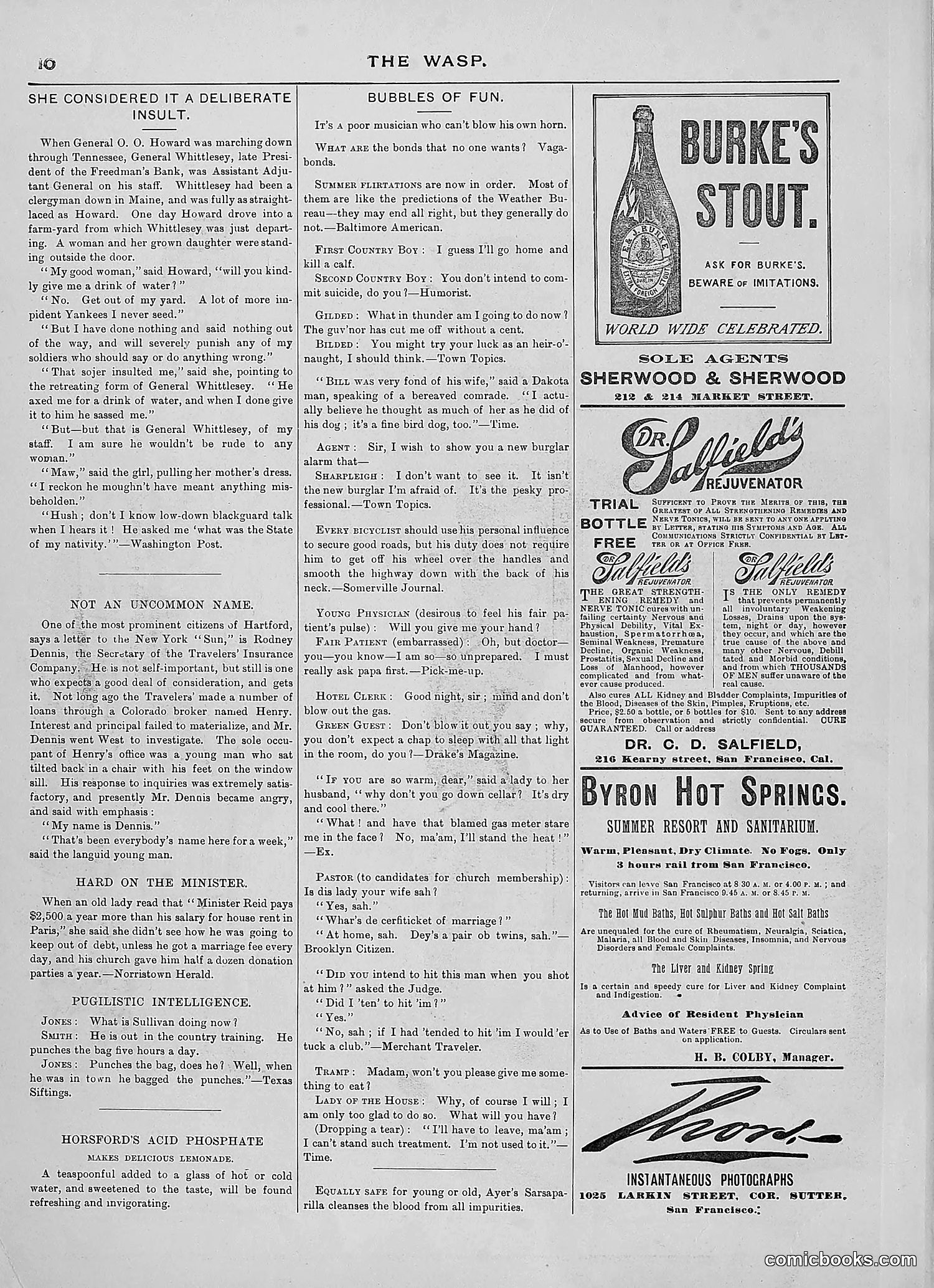
This page is primarily **advertising and humor columns**, not political cartoons. The visible content includes: **Main features:** - Multiple brief anecdotes and jokes under headings like "Bubbles of Fun" and "Hard on the Minister" - A story titled "She Considered It a Deliberate Insult" about General O.O. Howard and a soldier's disrespectful water request - Advertisements for Burke's Stout, Palsfield's Rejuvenator, Byron Hot Springs, and other products **The humor** relies on wordplay and social situations rather than political satire—jokes about musicians, country boys, and ministers. The Howard anecdote appears to mock military hierarchy and subordinate insolence. This represents *The Wasp's* typical format: a mix of satirical commentary, genteel humor, and commercial advertising appealing to Victorian-era readers.

The Wasp — 1889 — page 56 of 450
56 / 450
What you’re looking at · open this page on its own ↗

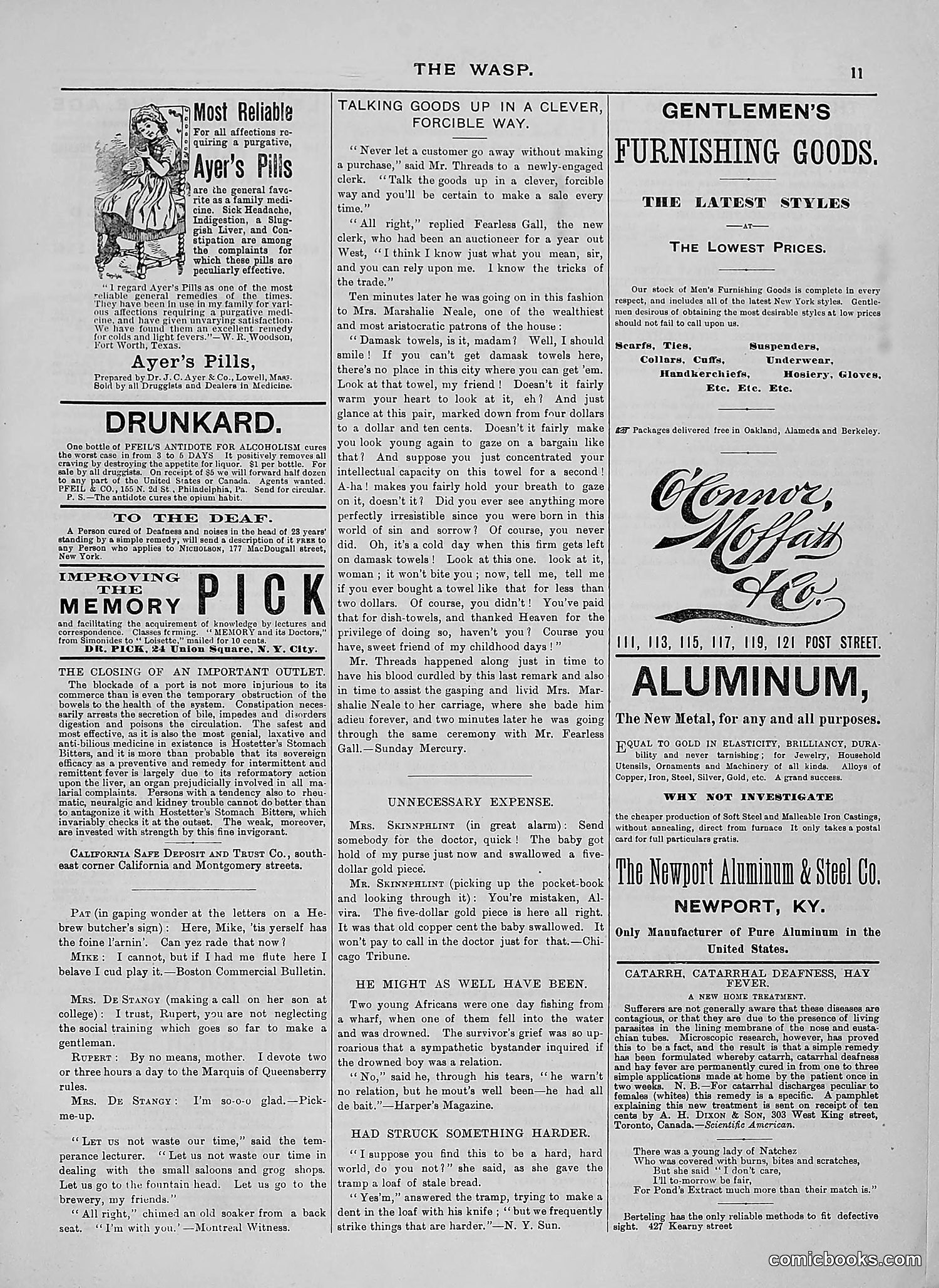
This page is primarily **advertising and commercial content** rather than political satire. The visible sections include: - **Ayer's Pills** advertisement (left column) - a patent medicine pitch - **Drunkard** treatment ad and "Memory" improvement course listings - Several humorous anecdotes about everyday life (towels, baby coins, etc.) - brief comedic sketches - Multiple product advertisements: **Alcohol/liquor**, **Aluminum products**, and medical treatments The small comic pieces focus on domestic and commercial humor—people haggling over prices, misunderstandings about purchases—rather than political commentary. This appears to be a **humor and advertising publication** typical of late 19th/early 20th-century American magazines, mixing satirical content with revenue-generating advertisements.

The Wasp — 1889 — page 57 of 450
57 / 450
What you’re looking at · open this page on its own ↗

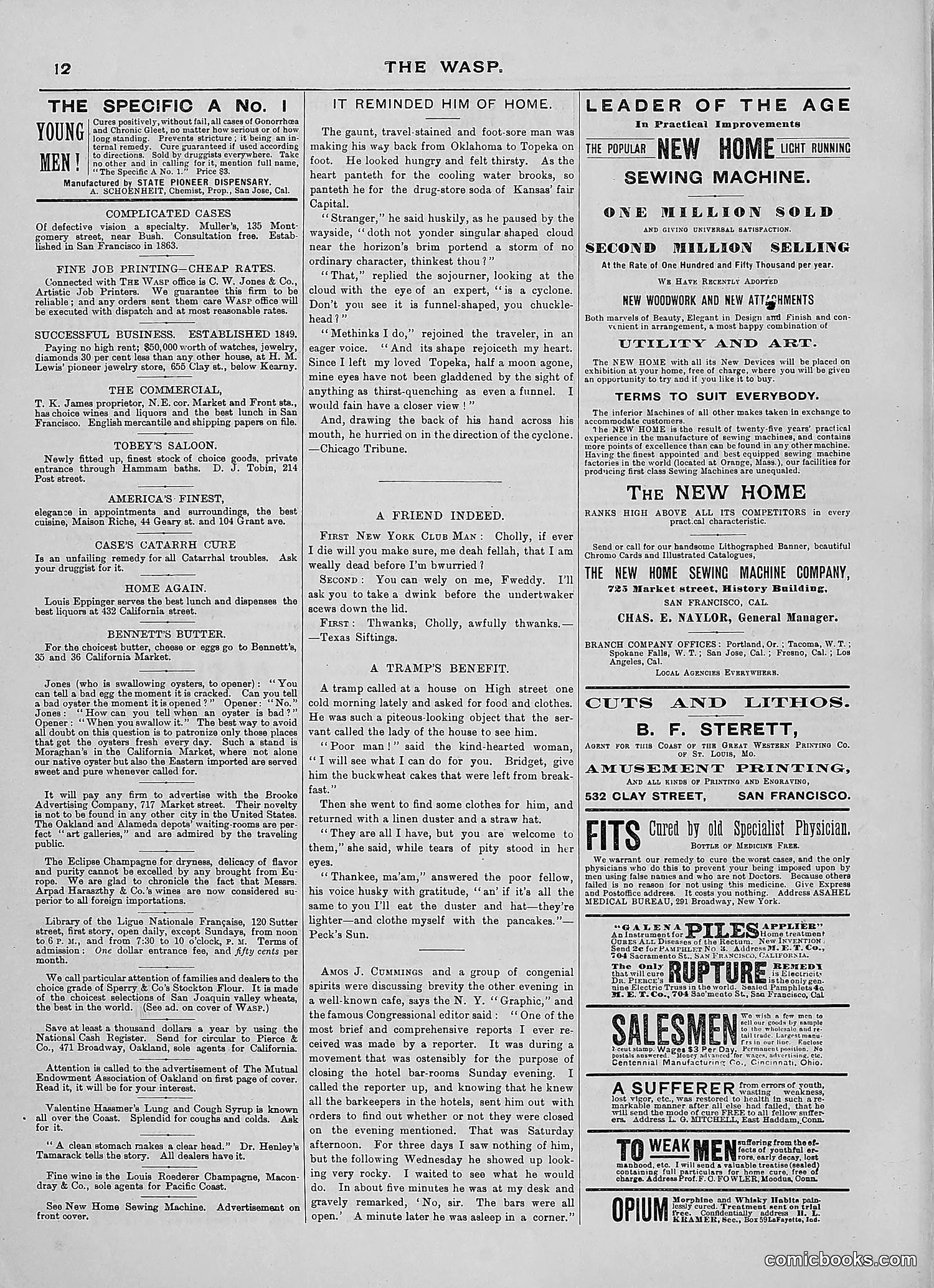
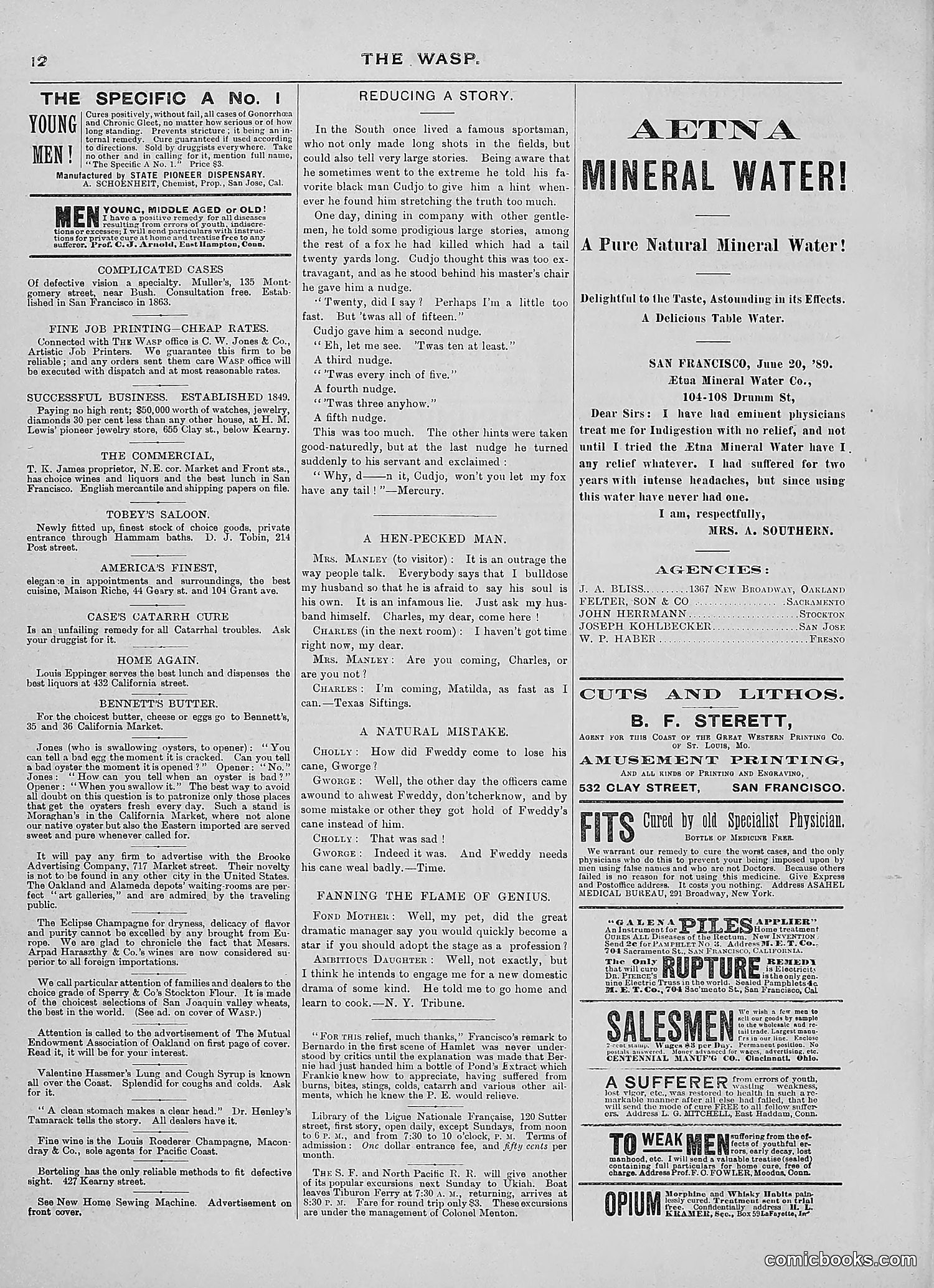
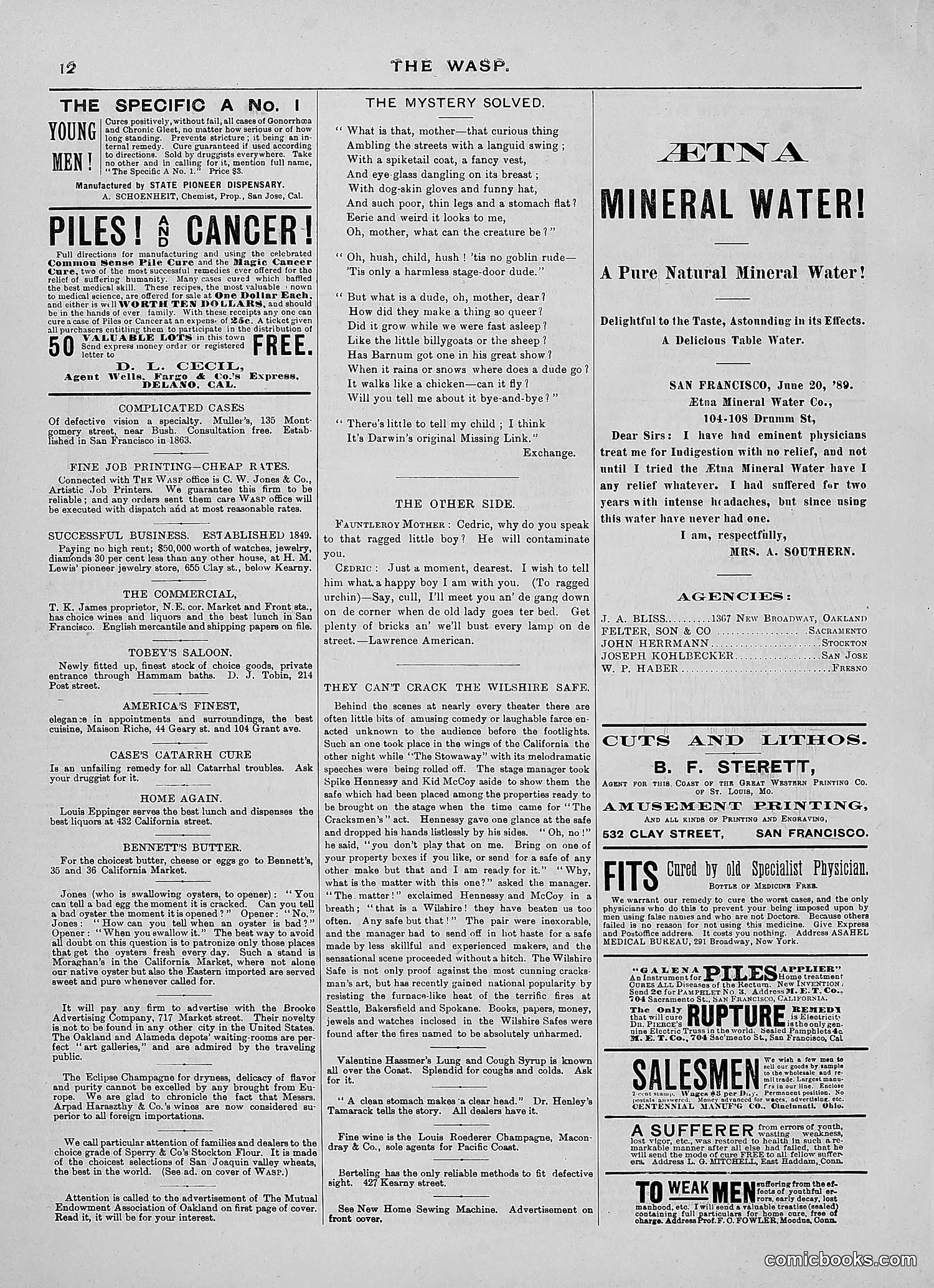
This page is primarily **advertising and miscellaneous content** rather than political satire or editorial cartoons. The Wasp masthead appears at top, but the bulk of the page consists of classified advertisements and product promotions typical of late 19th/early 20th-century publications. Notable advertisements include: - **"The Specific A No. 1"** for treating gonorrhea and syphilis - The **"New Home" sewing machine** claiming one million sold - Various patent medicines (Gabe's Catargh Cure, remedies for piles and weak men) - Job printing and jewelry services The only narrative content—brief stories like "It Reminded Him of Home" and "A Tramp's Benefit"—are human interest pieces, not political commentary. This appears to be a filler/advertising page rather than the satirical editorial content The Wasp was known for.

The Wasp — 1889 — page 58 of 450
58 / 450
What you’re looking at · open this page on its own ↗

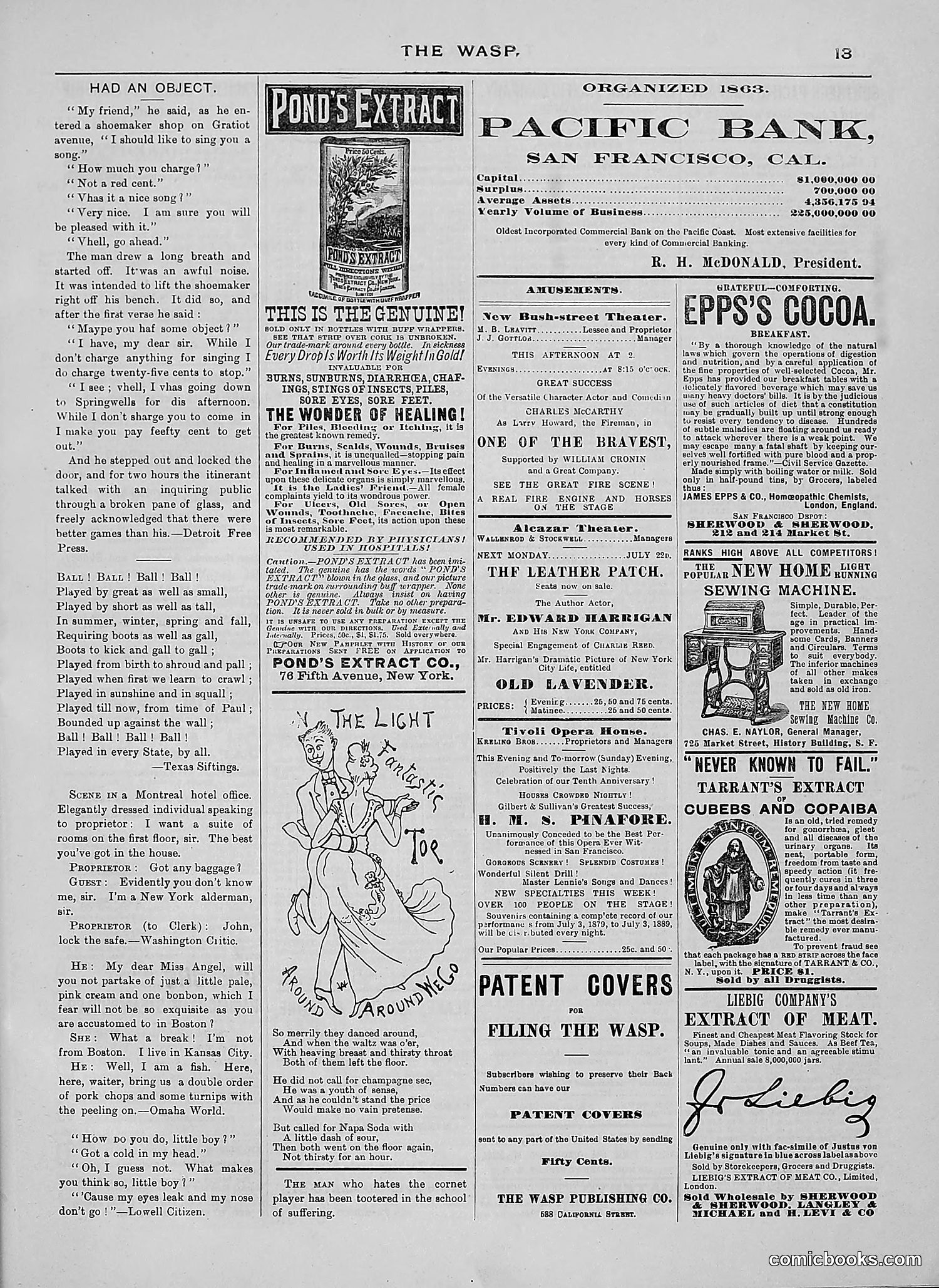
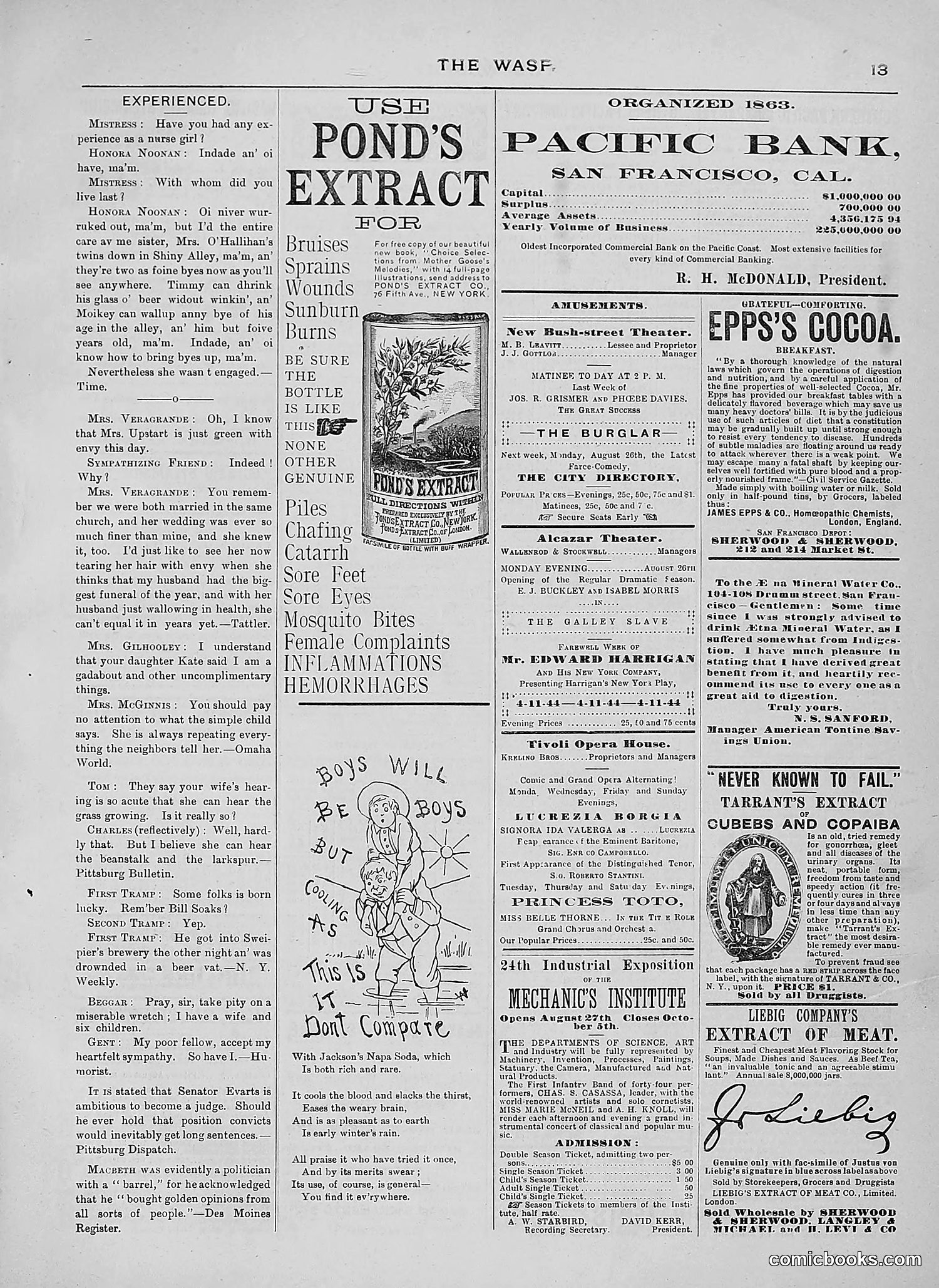
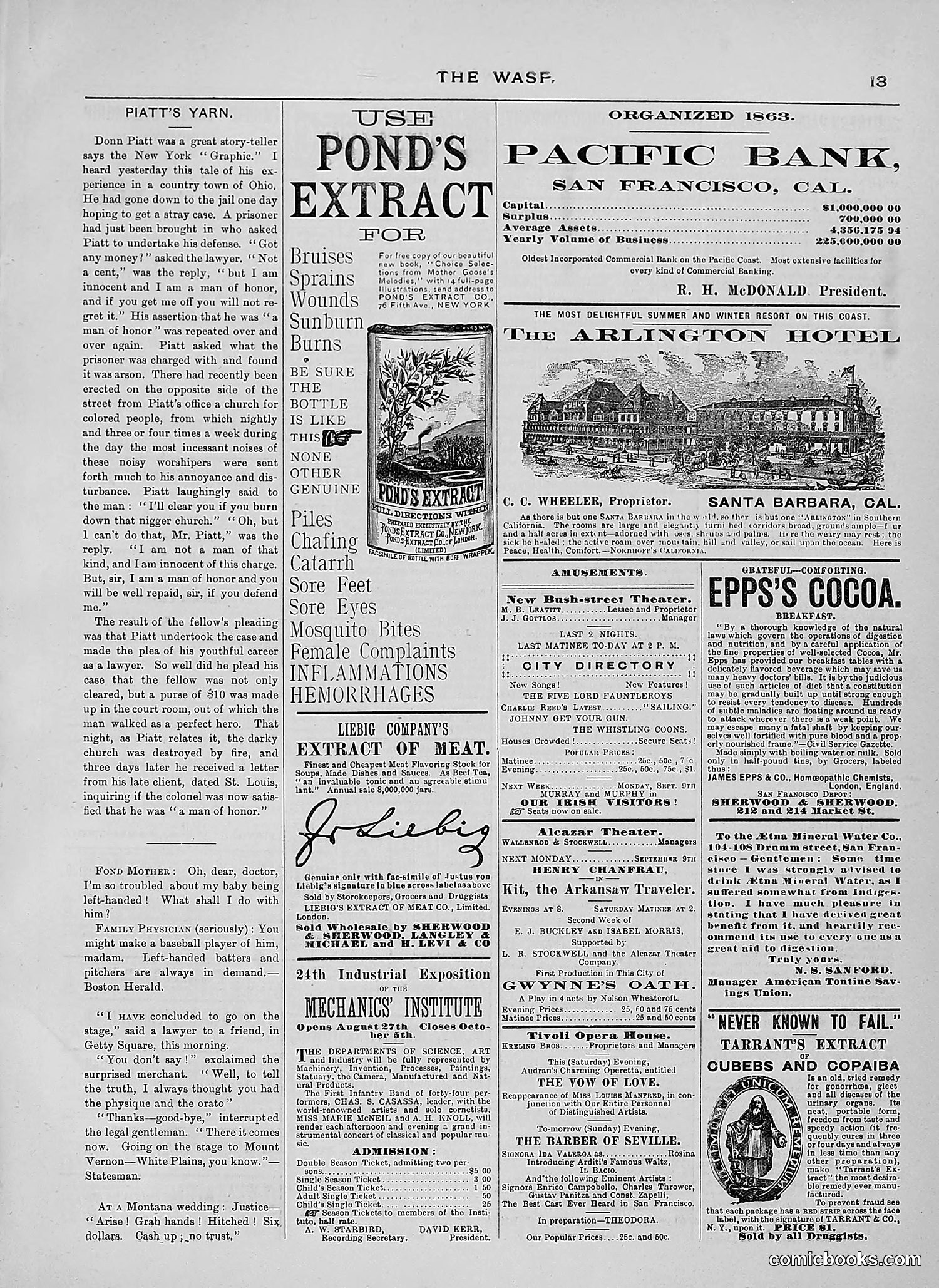
This page is primarily **advertising and miscellaneous content** rather than political satire. The visible cartoon shows a figure labeled "THE LIGHT" dancing or prancing with what appears to be a theatrical or whimsical theme—likely promoting an opera house production or theatrical entertainment. The drawing style is playful rather than satirical. The remainder of the page contains: - Patent cover advertisements for filing documents with The Wasp Publishing Co. - Theater listings (New Bush-street Theater, Tivoli Opera House, etc.) - Product advertisements (Pond's Extract, Epps's Cocoa, patent sewing machines) - Liebig's Extract of Meat advertisements There is no clear political commentary or satirical target visible on this particular page. It appears to be a standard issue page mixing editorial cartoon content with commercial advertisements—typical for 19th-century American magazines.

The Wasp — 1889 — page 59 of 450
59 / 450
What you’re looking at · open this page on its own ↗

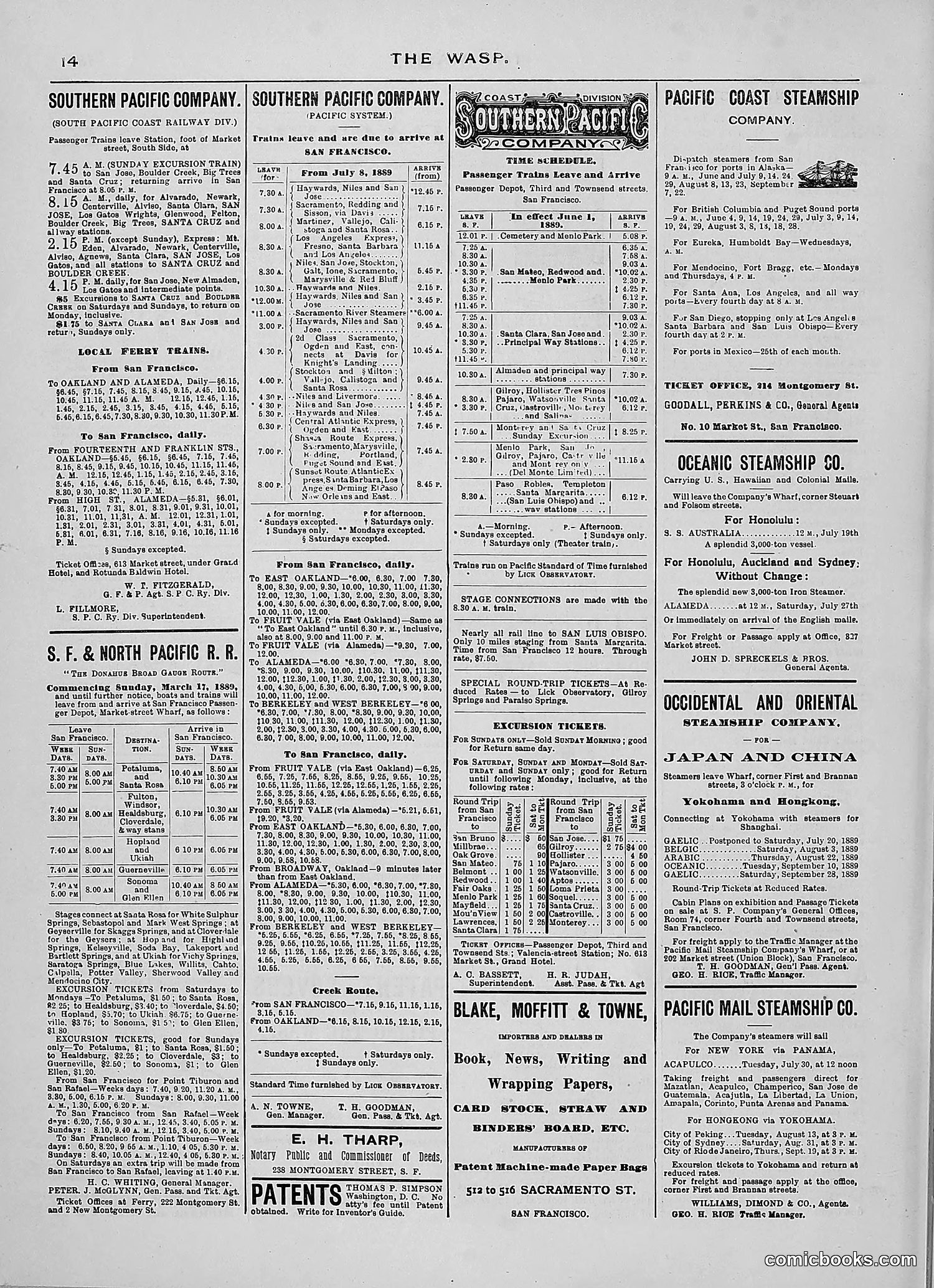
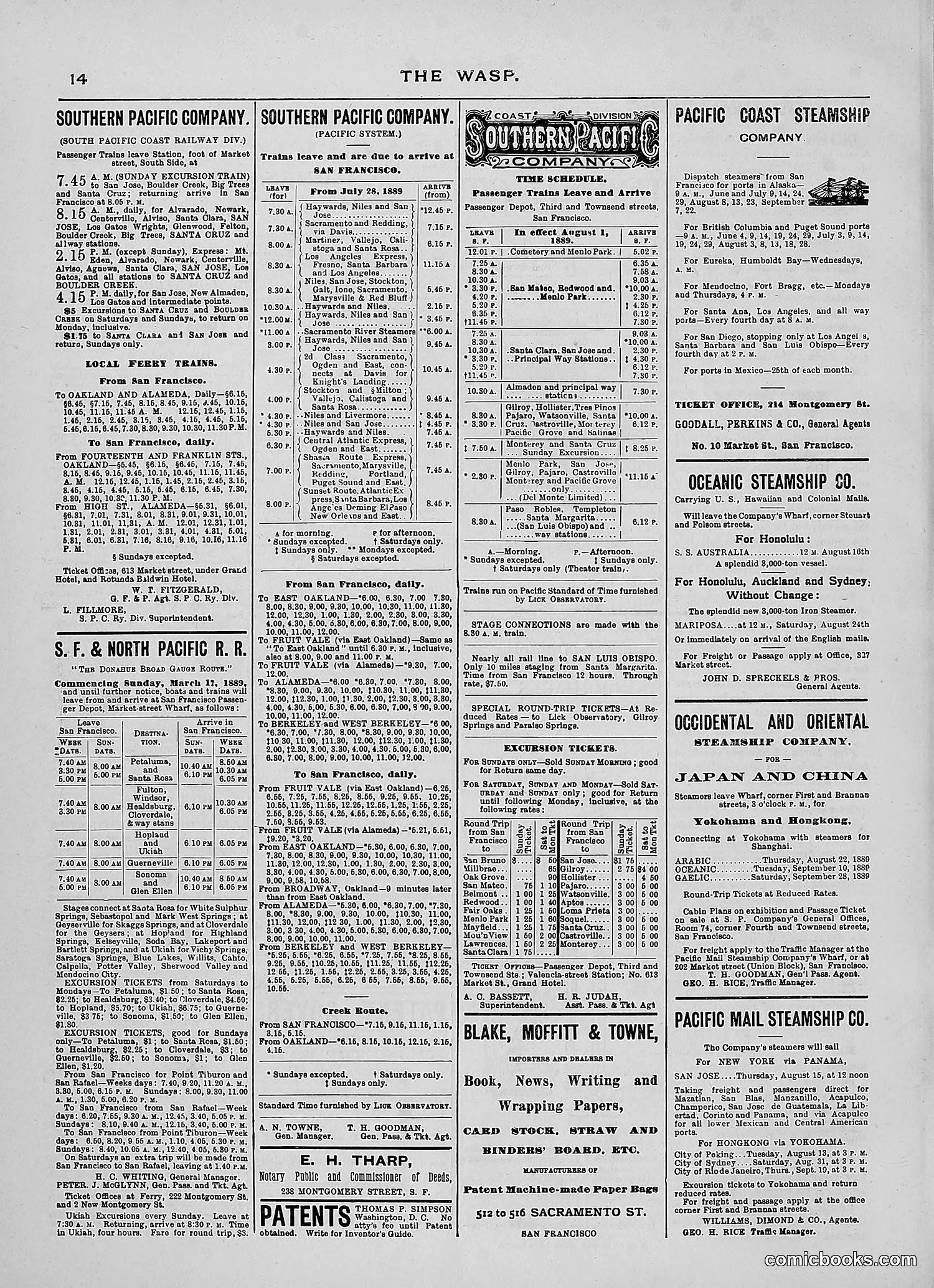
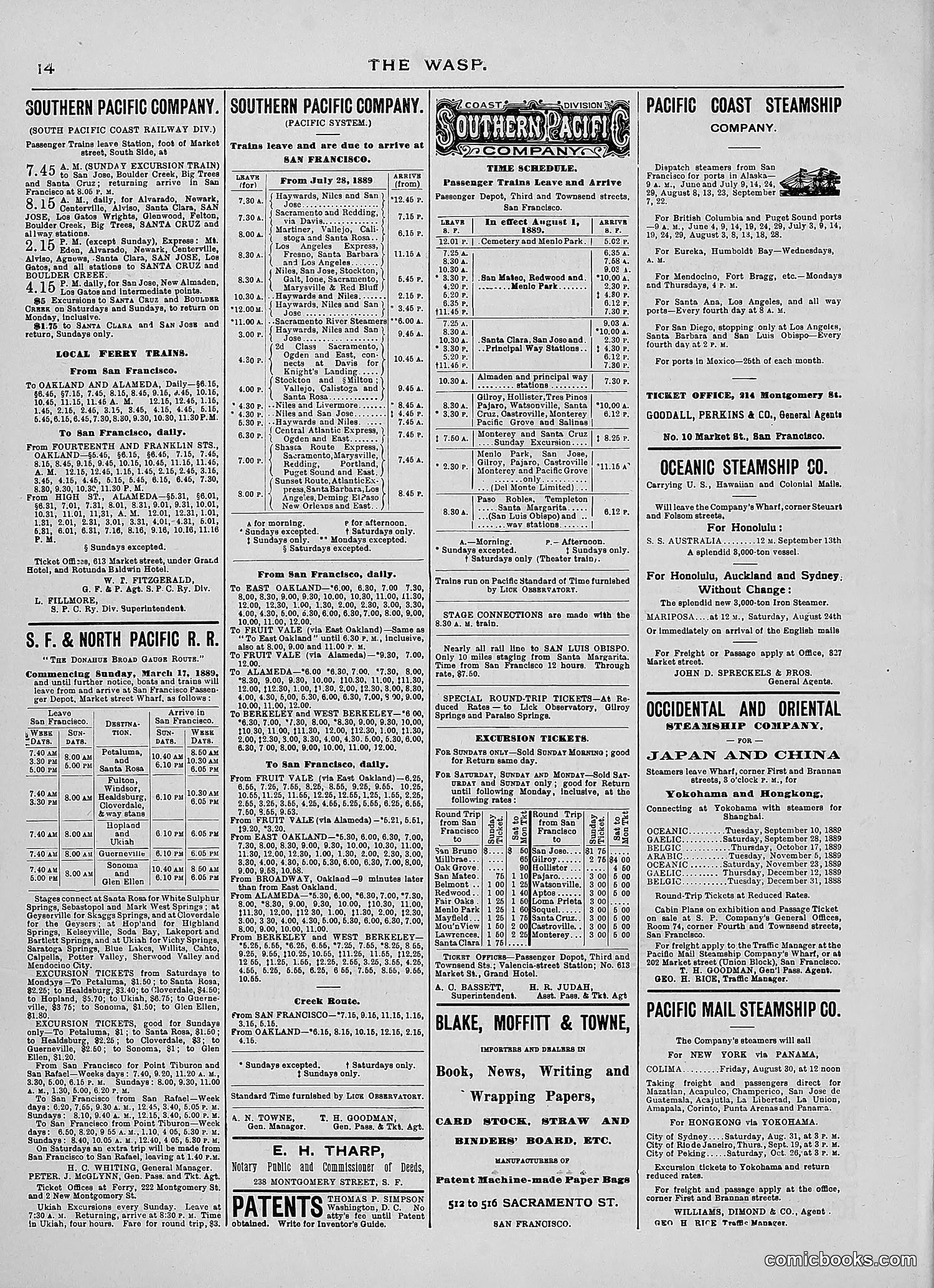
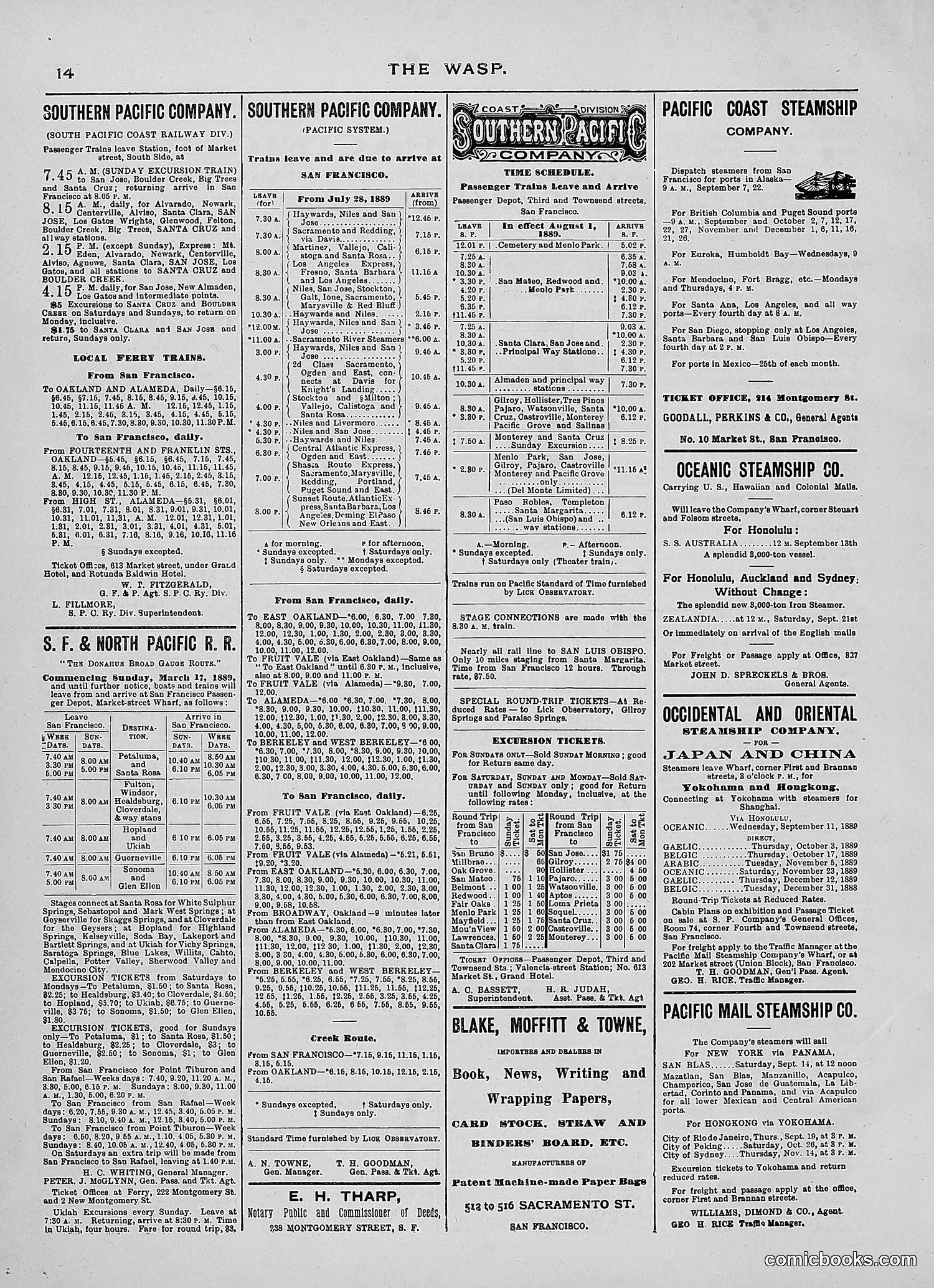
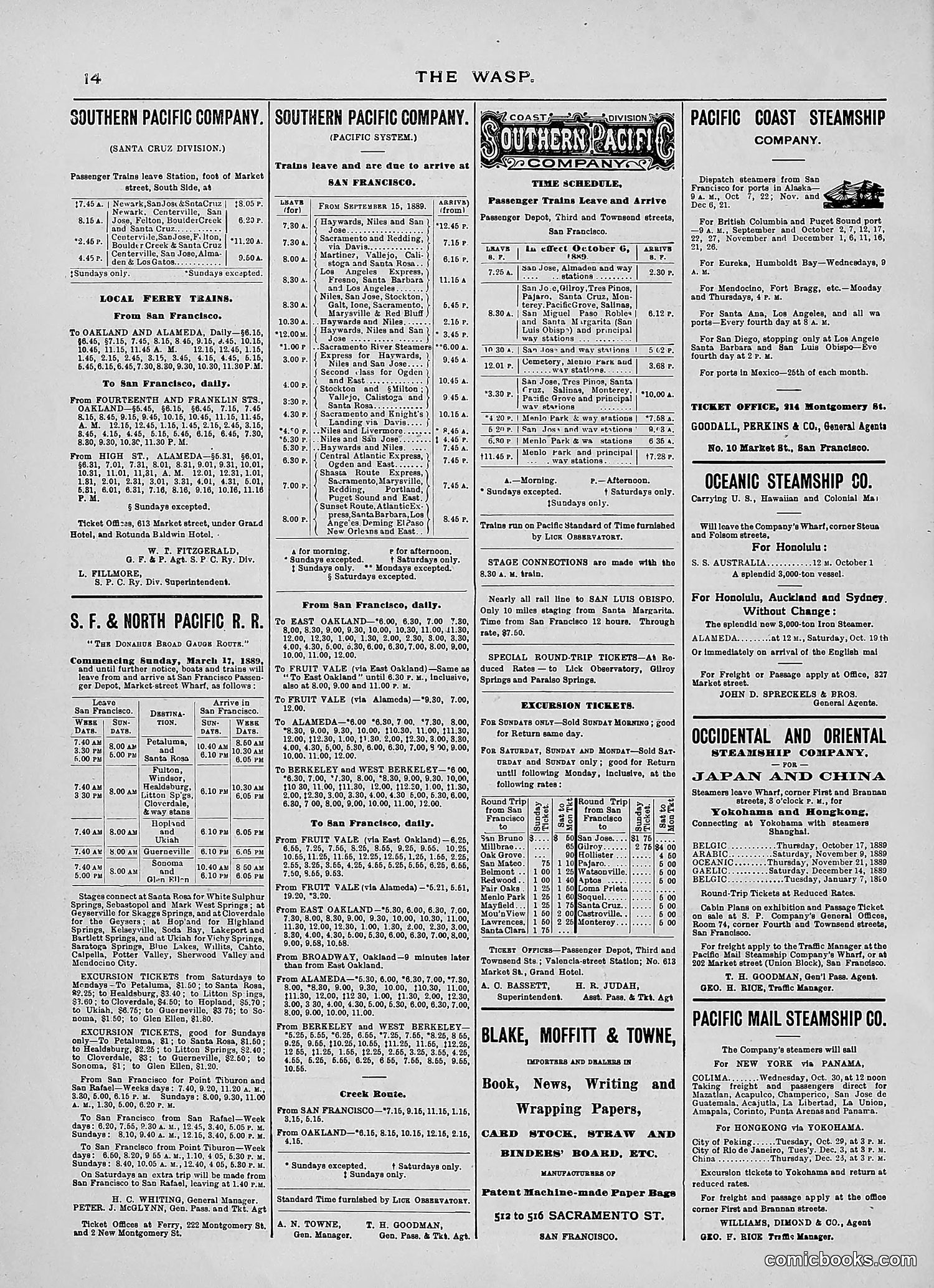
This page is primarily **advertising and transportation schedules** for late 19th-century San Francisco and California. It contains no visible political cartoons or satirical content. The advertisements cover: - Railroad services (Southern Pacific Company, S.F. & North Pacific R.R.) - Ferry schedules from San Francisco - Steamship companies (Pacific Coast, Oceanic, Occidental and Oriental) - Local businesses (Blake, Moffitt & Towne - paper goods; E.H. Tharp - real estate) The page functions as a commercial directory typical of period publications, listing departure times, routes, and ticket information for transportation and shipping services. While *The Wasp* was known for satire, this particular page contains straightforward commercial listings rather than editorial commentary or cartoon content.

The Wasp — 1889 — page 60 of 450
60 / 450
What you’re looking at · open this page on its own ↗

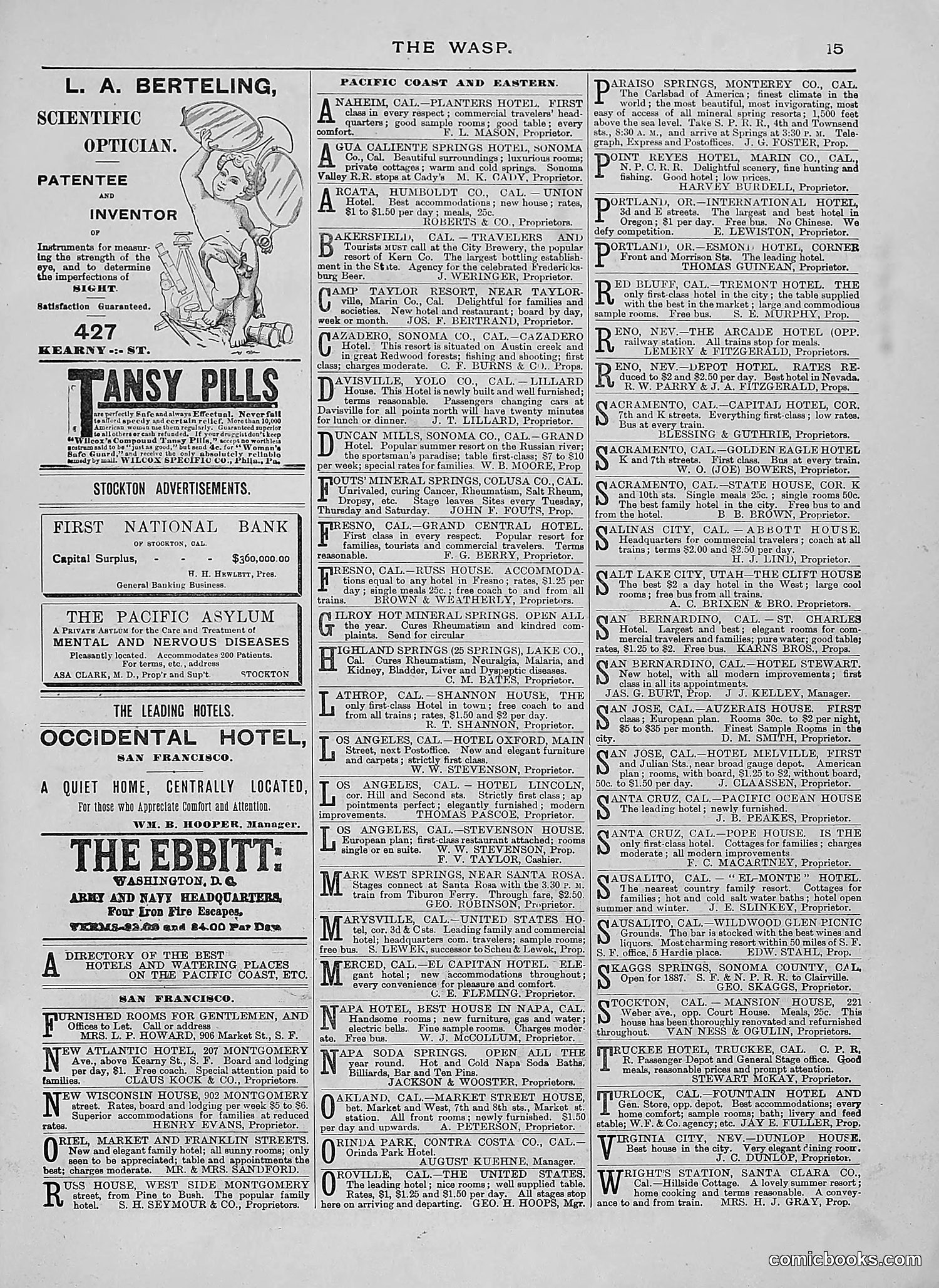
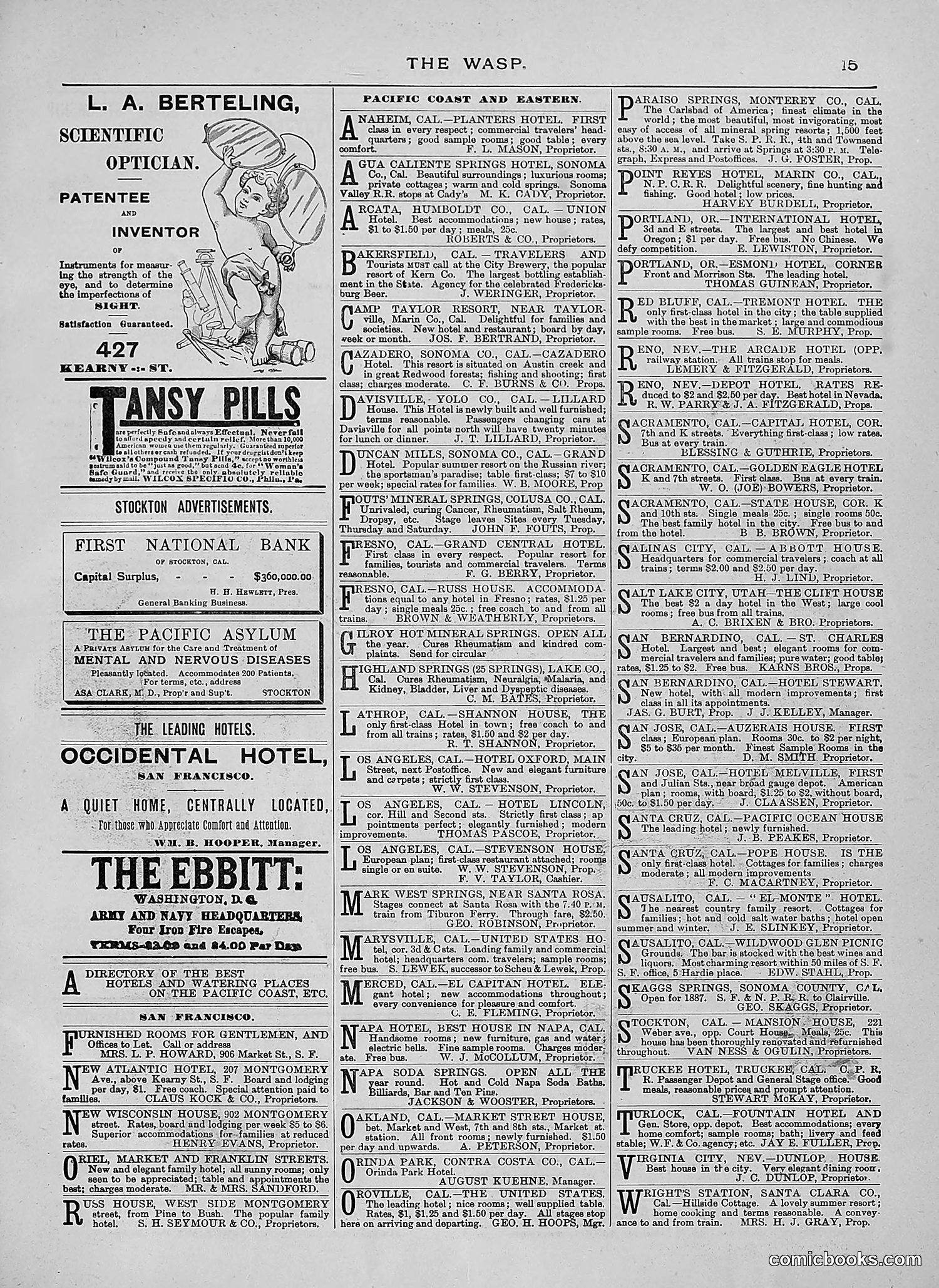
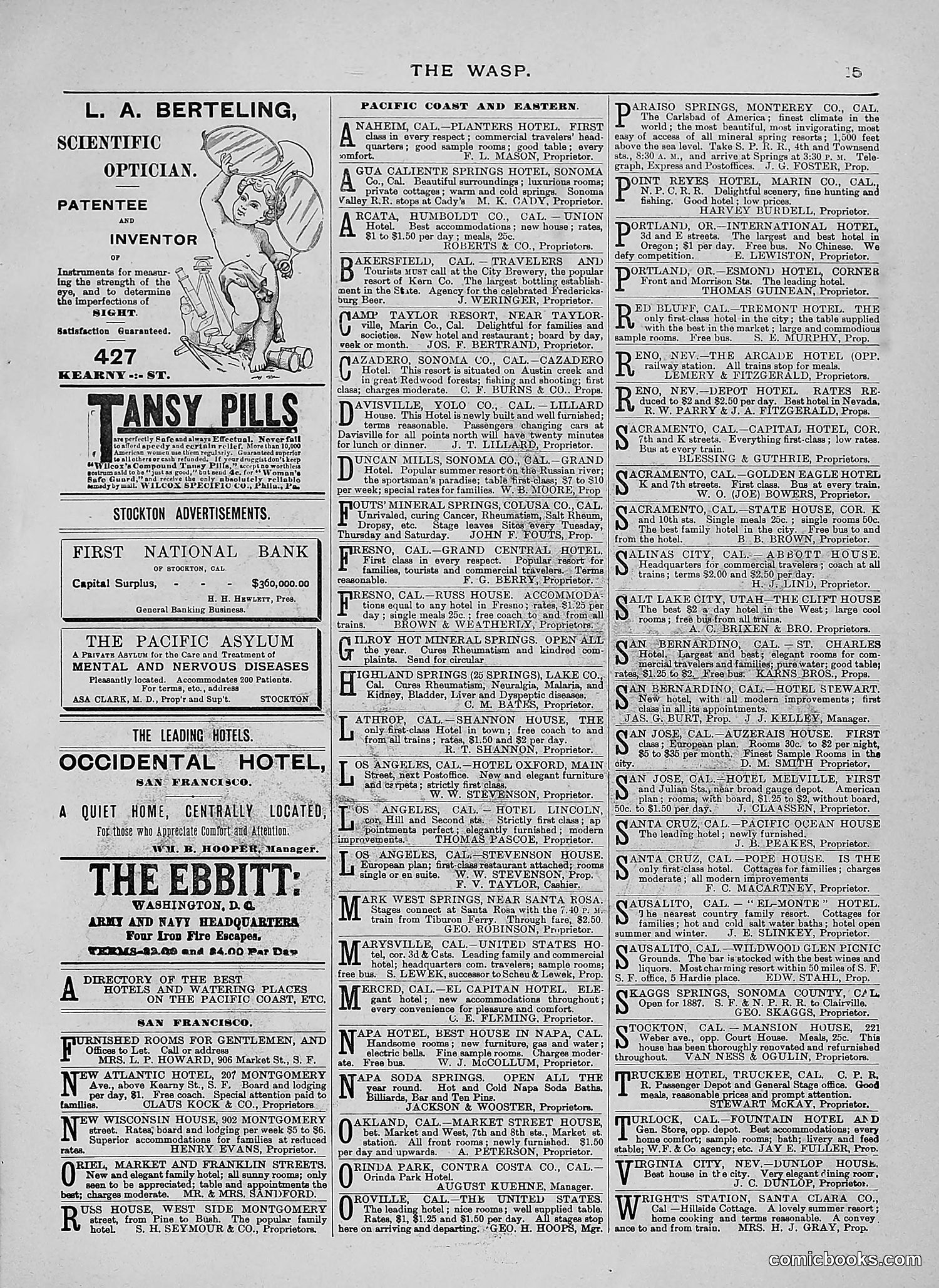
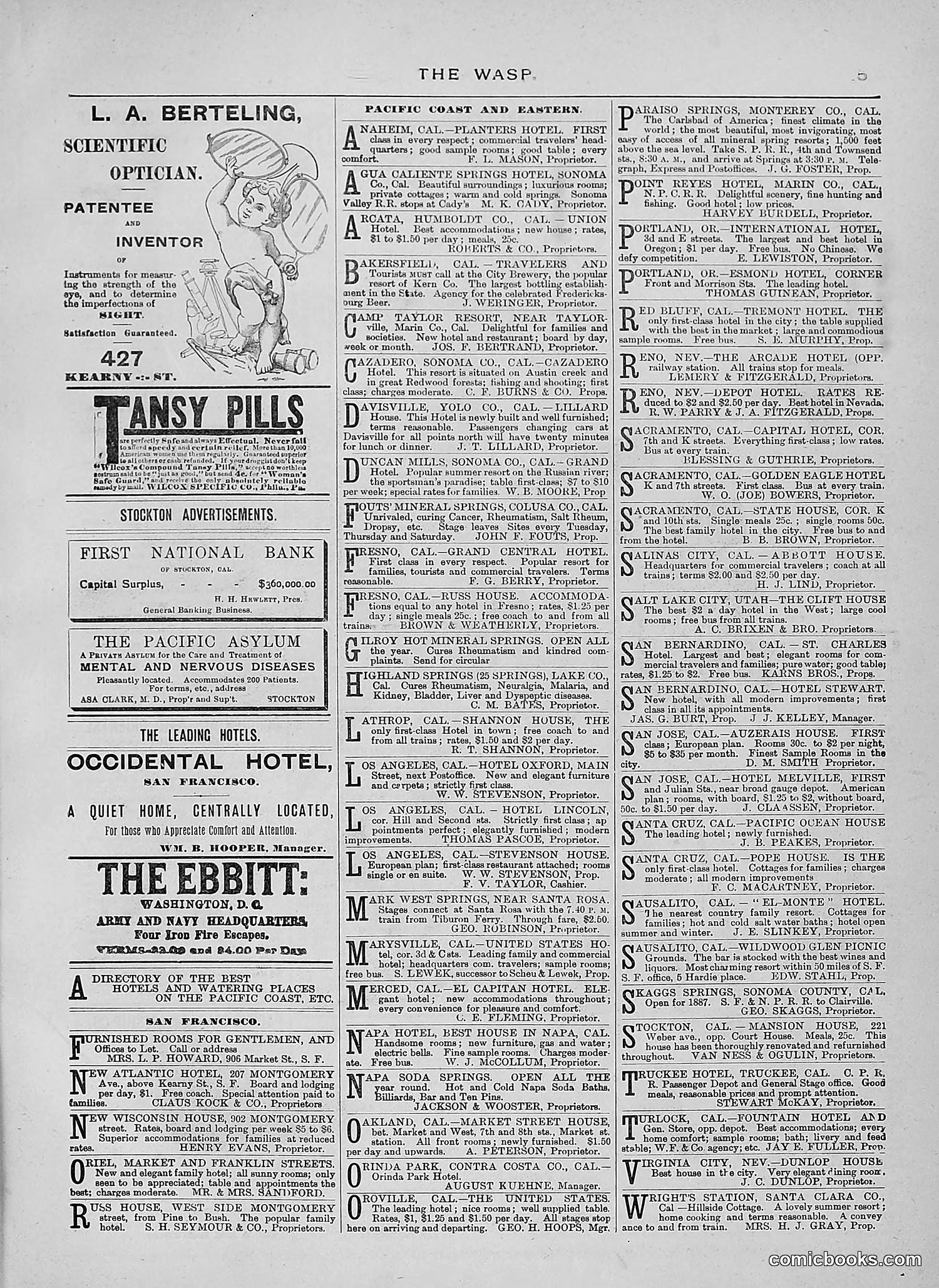
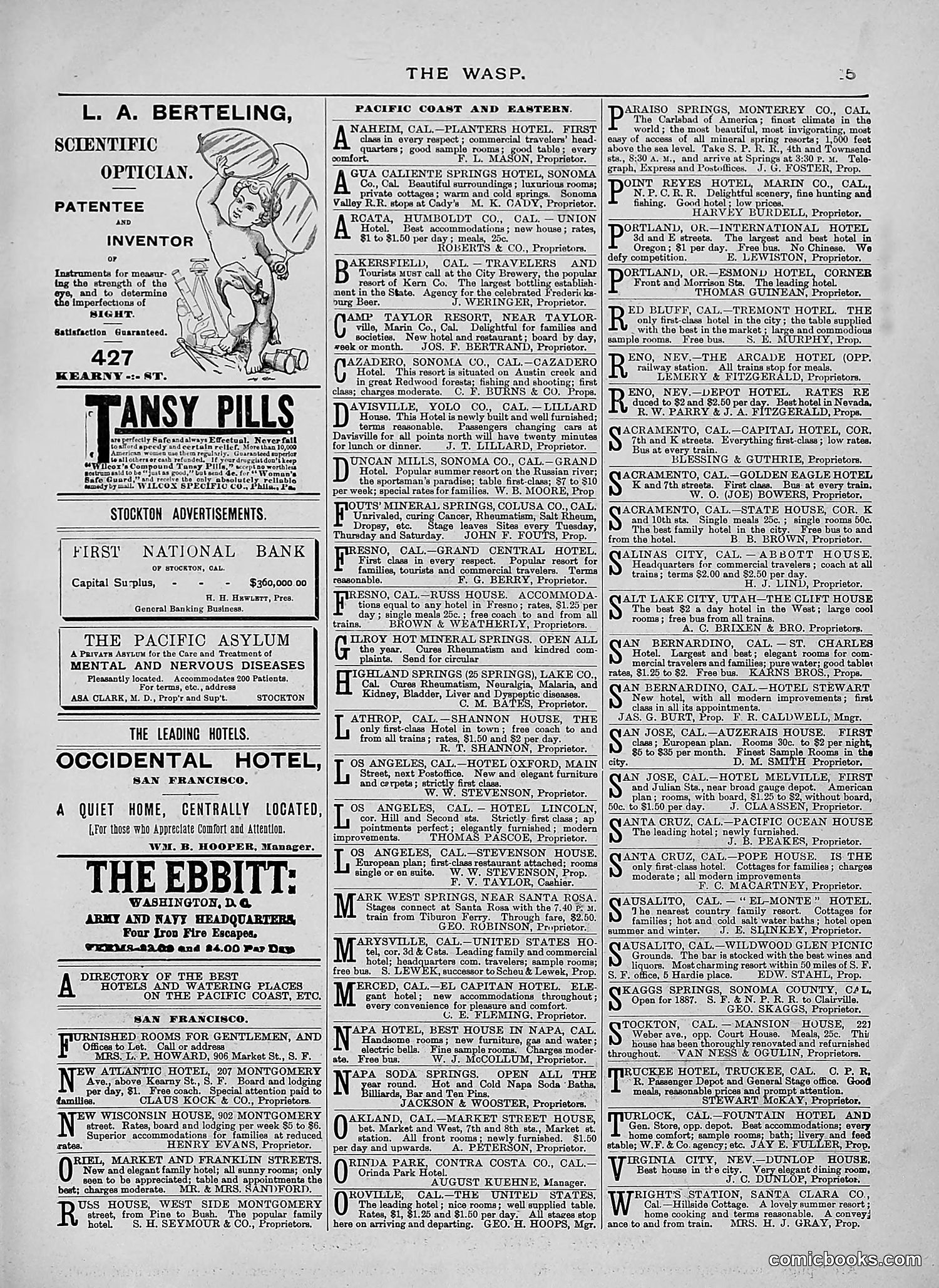
This page is primarily **advertising**, not satire or political commentary. The left side features an advertisement for **L.A. Berteling, Scientific Optician** with a decorative illustration of a person using optical equipment. Below that is an ad for **Tansy Pills** (a patent medicine) and "Stockton Advertisements" section listing various hotels and businesses. The rest of the page consists of hotel and lodging advertisements organized alphabetically—establishments across California and the West Coast, including the Occidental Hotel in San Francisco, The Ebbitt in Washington D.C., and numerous small-town hotels and boarding houses. This is a commercial listings page typical of period magazines, containing no discernible political cartoons or satirical content.

The Wasp — 1889 — page 61 of 450
61 / 450
What you’re looking at · open this page on its own ↗

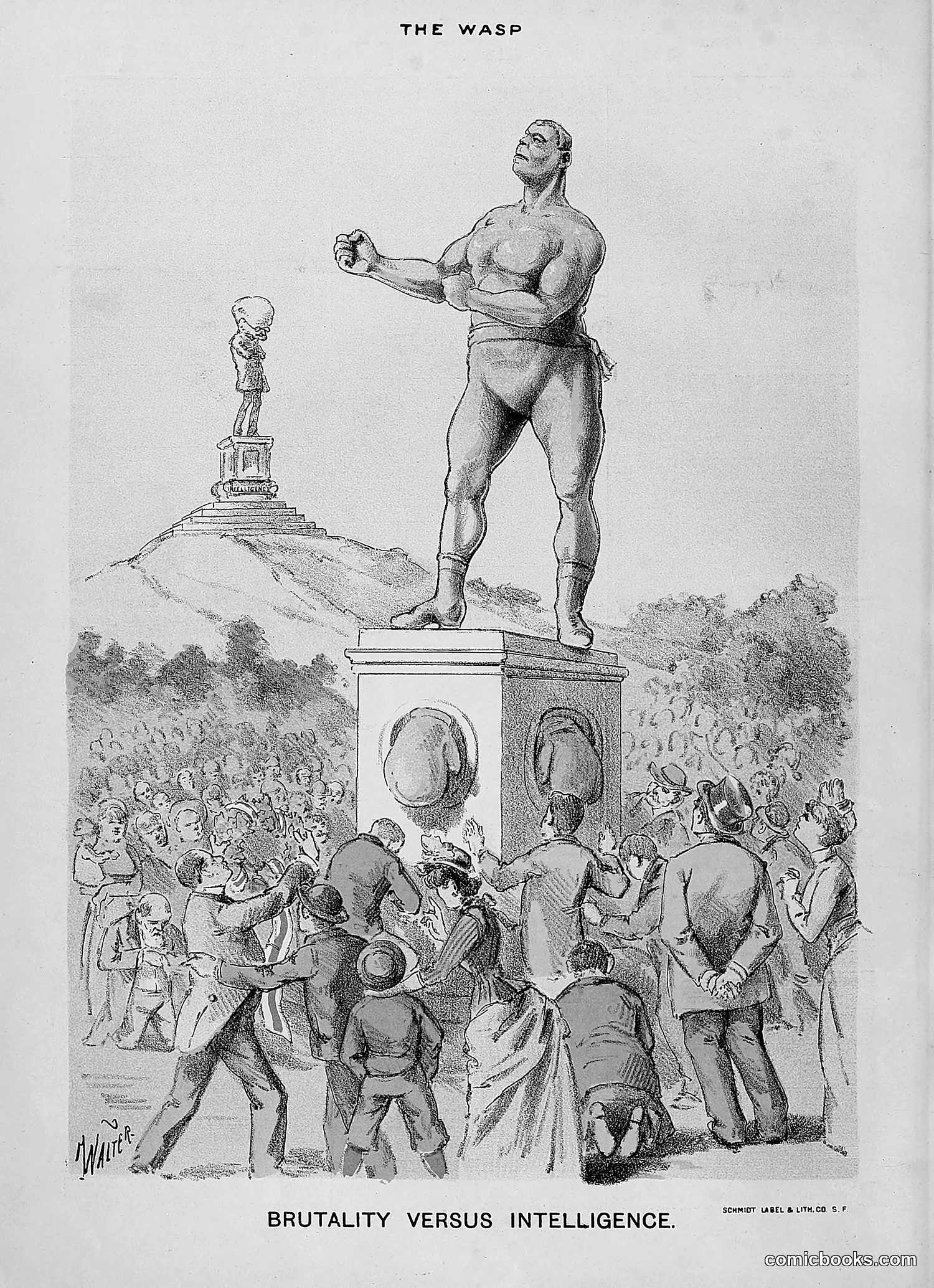
This satirical cartoon depicts a muscular, brutish figure standing atop a pedestal, towering over a crowd of educated or refined citizens below. A small intellectual figure sits on a distant hilltop, apparently ignored or marginalized. The caption "Brutality Versus Intelligence" frames this as social commentary: physical strength and aggression (represented by the imposing statue) are being celebrated or dominating public spaces, while intellectual achievement (the distant, smaller figure) goes neglected. This likely critiques late 19th-century American culture—possibly commenting on glorification of violence, prize-fighting culture, or how society prioritizes physical dominance over intellectual merit. The gathered crowd suggests public complicity in this value system, making this a biting commentary on misplaced societal priorities.

The Wasp — 1889 — page 62 of 450
62 / 450
What you’re looking at · open this page on its own ↗

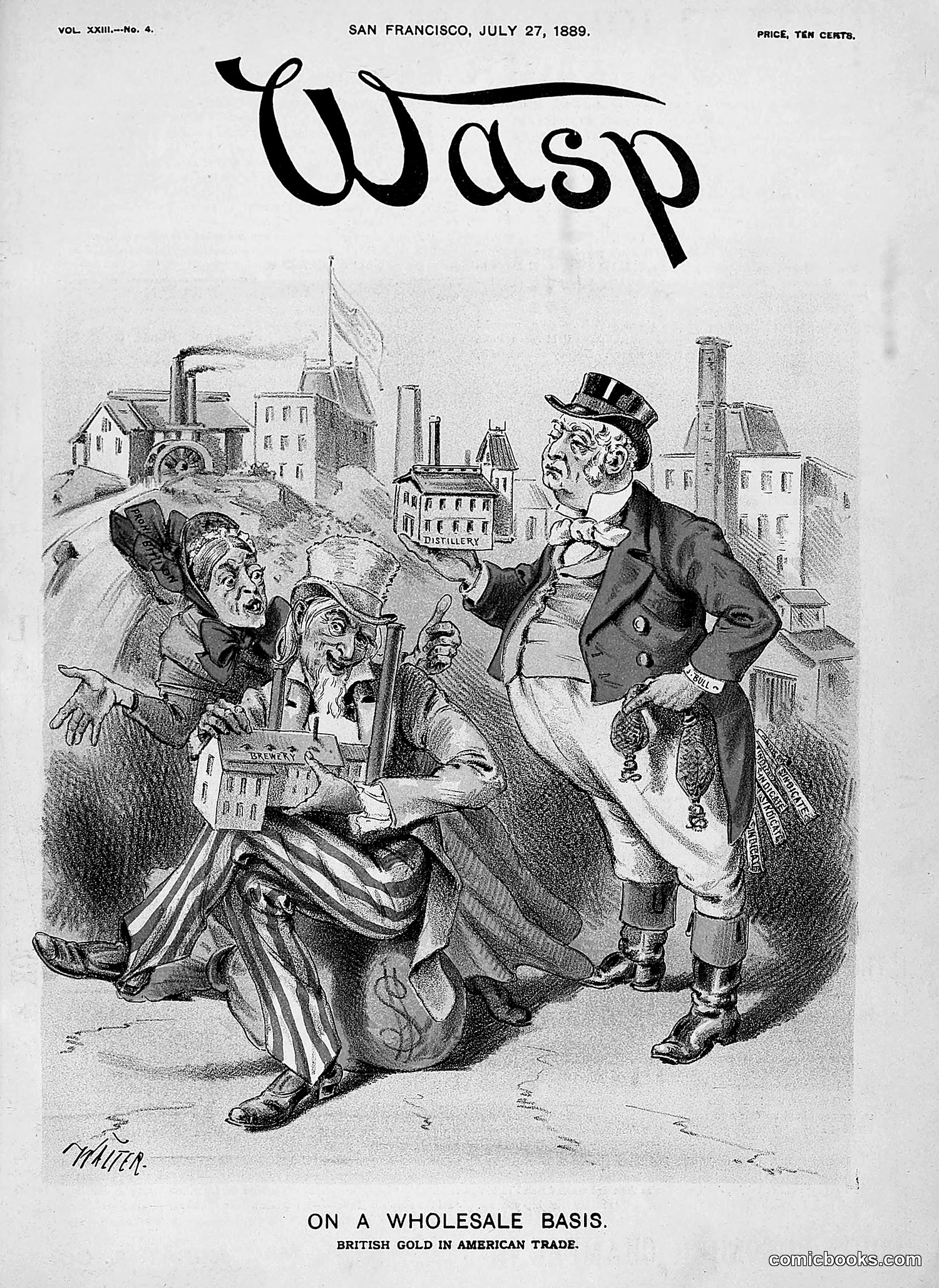
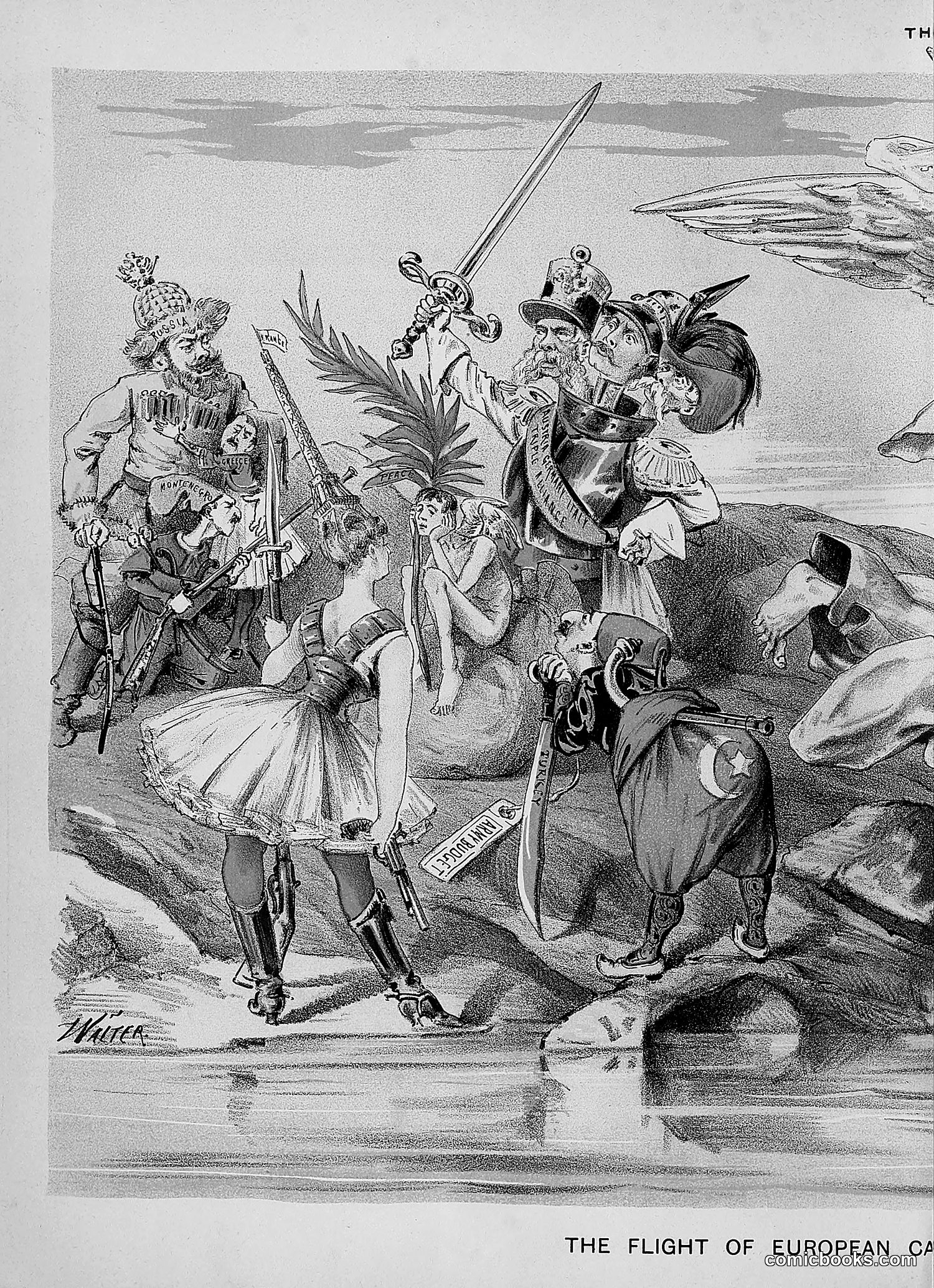
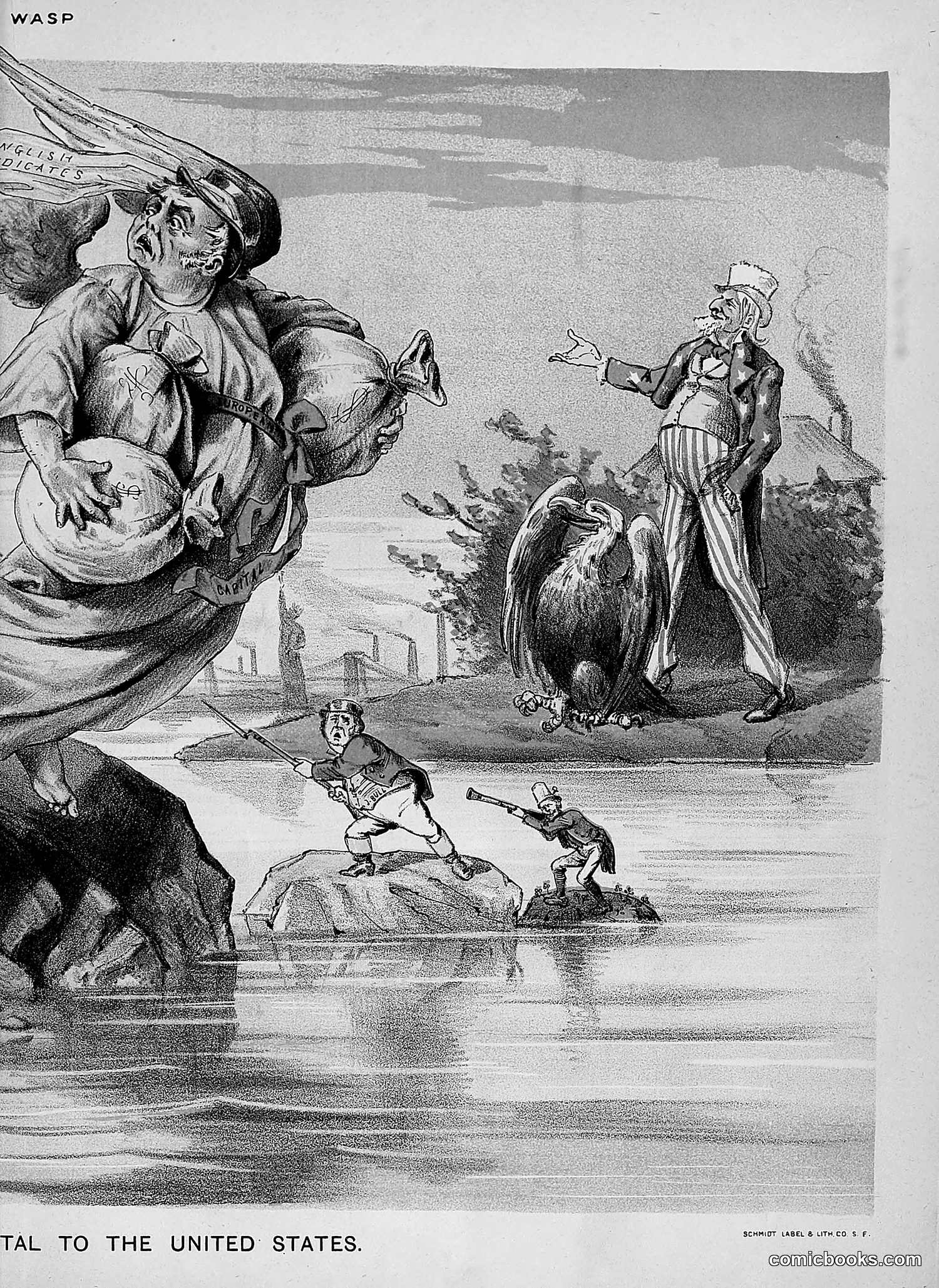
This 1889 *Wasp* cartoon satirizes British gold entering American trade on a "wholesale basis." The caricatured figures appear to be British merchants or financiers (depicted with exaggerated, grotesque features typical of period satirical art) presenting American industrial infrastructure—represented by the distillery and factory buildings in the background—as goods for sale. The figure on the right, dressed formally in top hat and morning coat, seems to represent British capital or commercial interests. The American flag draped over the goods suggests the cartoon criticizes foreign ownership or control of American industry and resources during this period of industrial growth. The satire protests British economic influence over American manufacturing and trade, reflecting contemporary anxieties about foreign investment in U.S. business.

The Wasp — 1889 — page 63 of 450
63 / 450
What you’re looking at · open this page on its own ↗

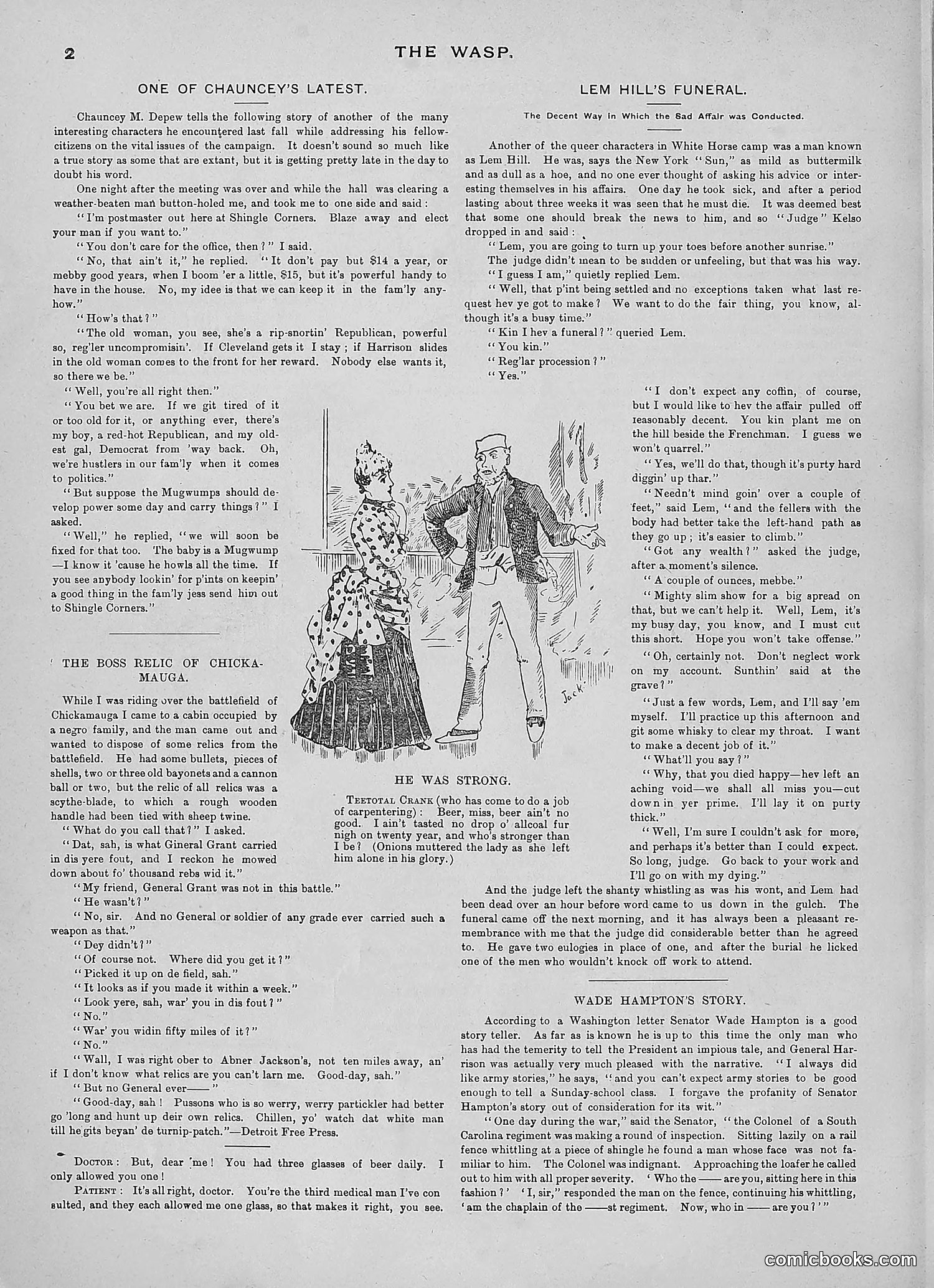
This page contains three satirical articles with one illustration. The central cartoon depicts "He Was Strong" — showing a woman in a polka-dot dress gesturing toward a man in formal attire holding a cane. The articles mock political and social figures: 1. **"One of Chauncey's Latest"** satirizes Chauncey Depew, a well-known Republican politician, regarding women's political involvement and voting rights—a contentious issue of the era. 2. **"Lem Hill's Funeral"** presents a comedic account of a man's burial arrangements, focusing on class distinctions and work ethic. 3. **"Wade Hampton's Story"** references Senator Wade Hampton discussing army anecdotes, suggesting he may exaggerate or embellish tales. The overall tone is irreverent political commentary typical of Gilded Age satirical magazines, targeting prominent figures and contemporary social debates.

The Wasp — 1889 — page 64 of 450
64 / 450
What you’re looking at · open this page on its own ↗

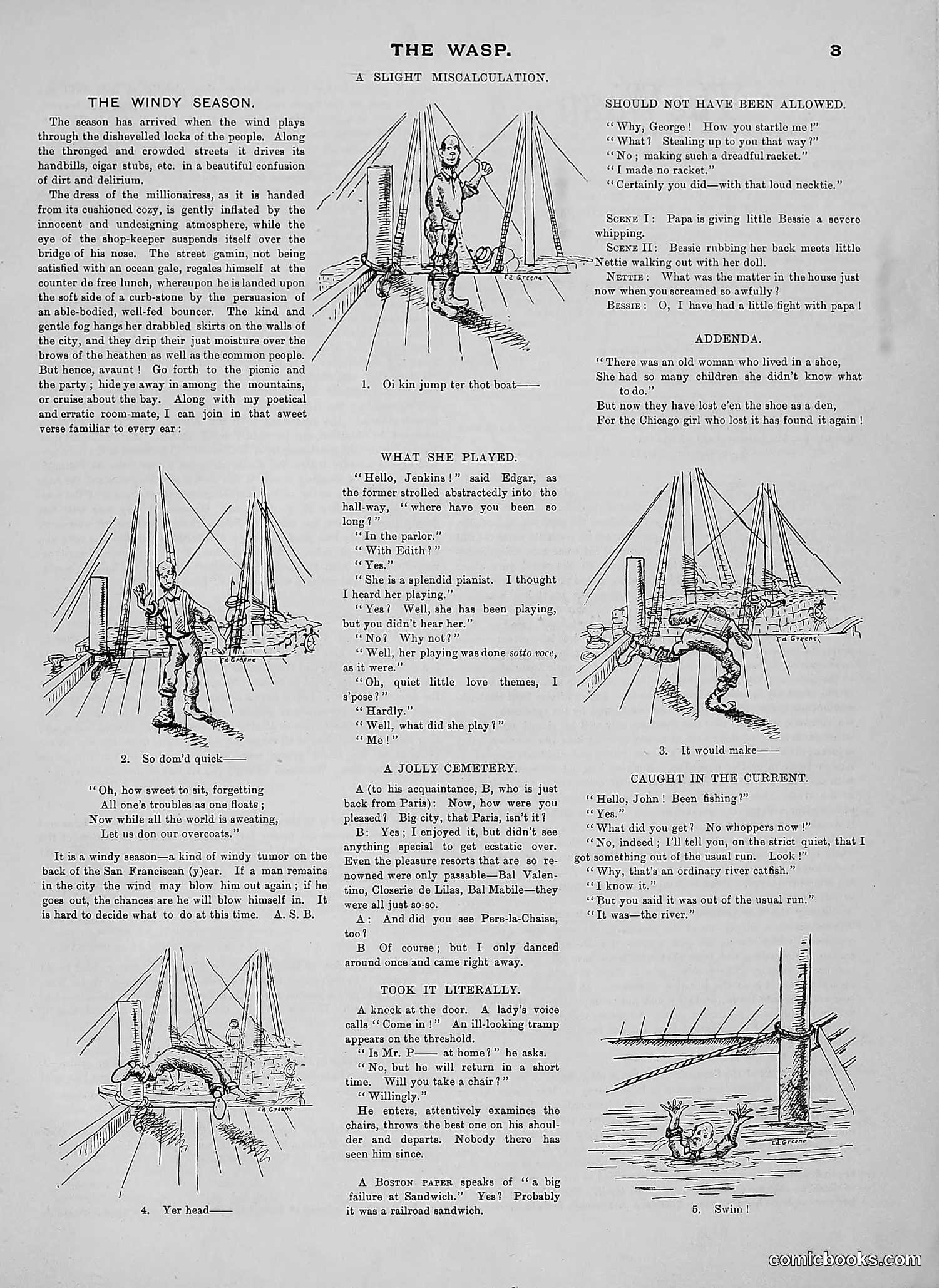
This page contains several humorous short pieces and illustrations rather than a unified political cartoon. "The Windy Season" opens with satirical commentary on San Francisco's notorious winds, describing how they scatter debris and dishevel the wealthy. The piece uses wind as social commentary—leveling class distinctions by making even millionaires undignified. The remaining sketches ("What She Played," "A Jolly Cemetery," "Took It Literally," "Caught in the Current") appear to be comedic vignettes with dialogue, showing everyday absurdities and misunderstandings. These are genteel humor pieces rather than political satire. The illustrations show Victorian-era figures in various situations—on boats, in conversation, in water—matching the anecdotal texts. The overall tone is light social satire focused on manners and everyday life rather than serious political critique.

The Wasp — 1889 — page 65 of 450
65 / 450
What you’re looking at · open this page on its own ↗

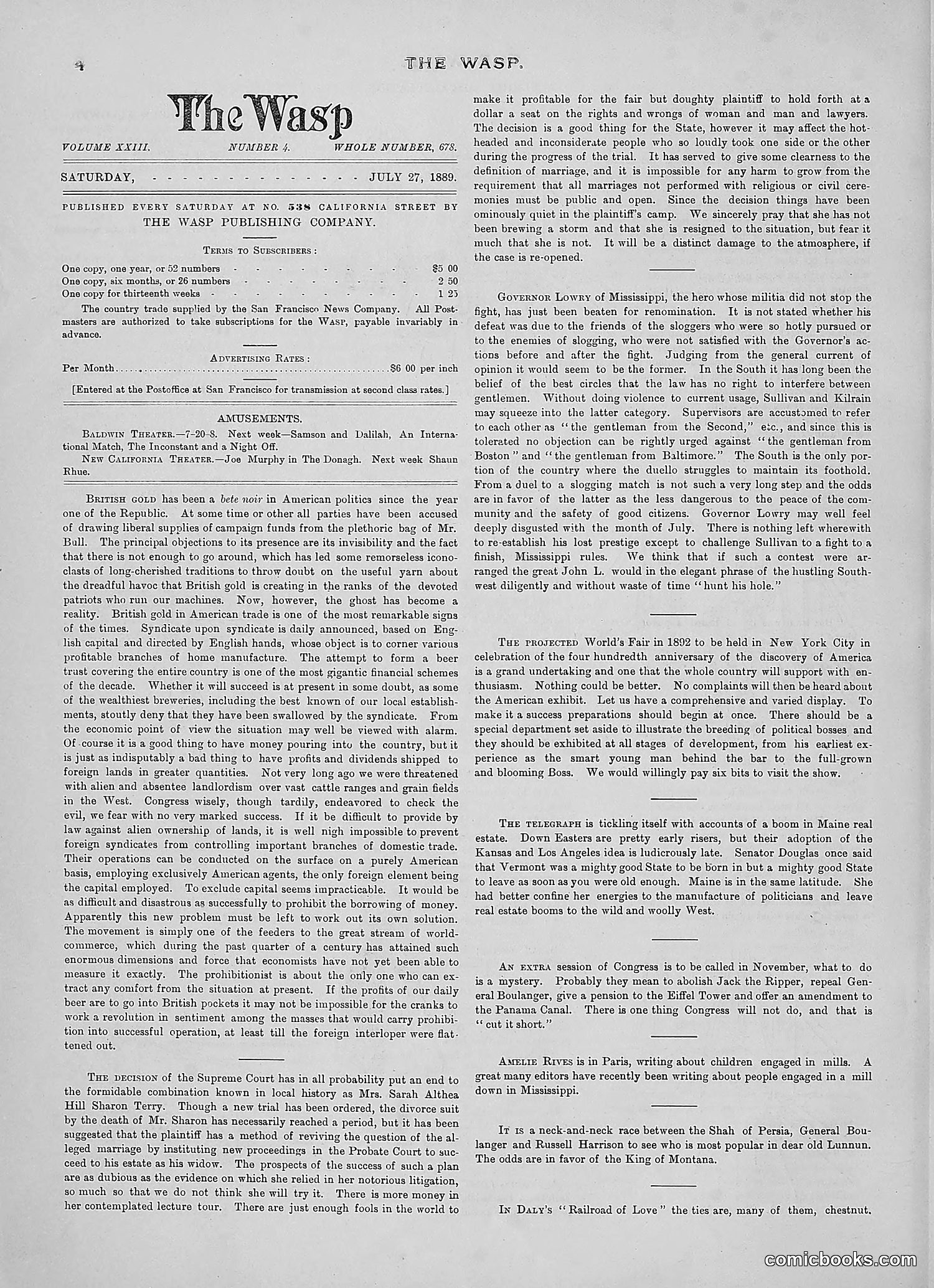
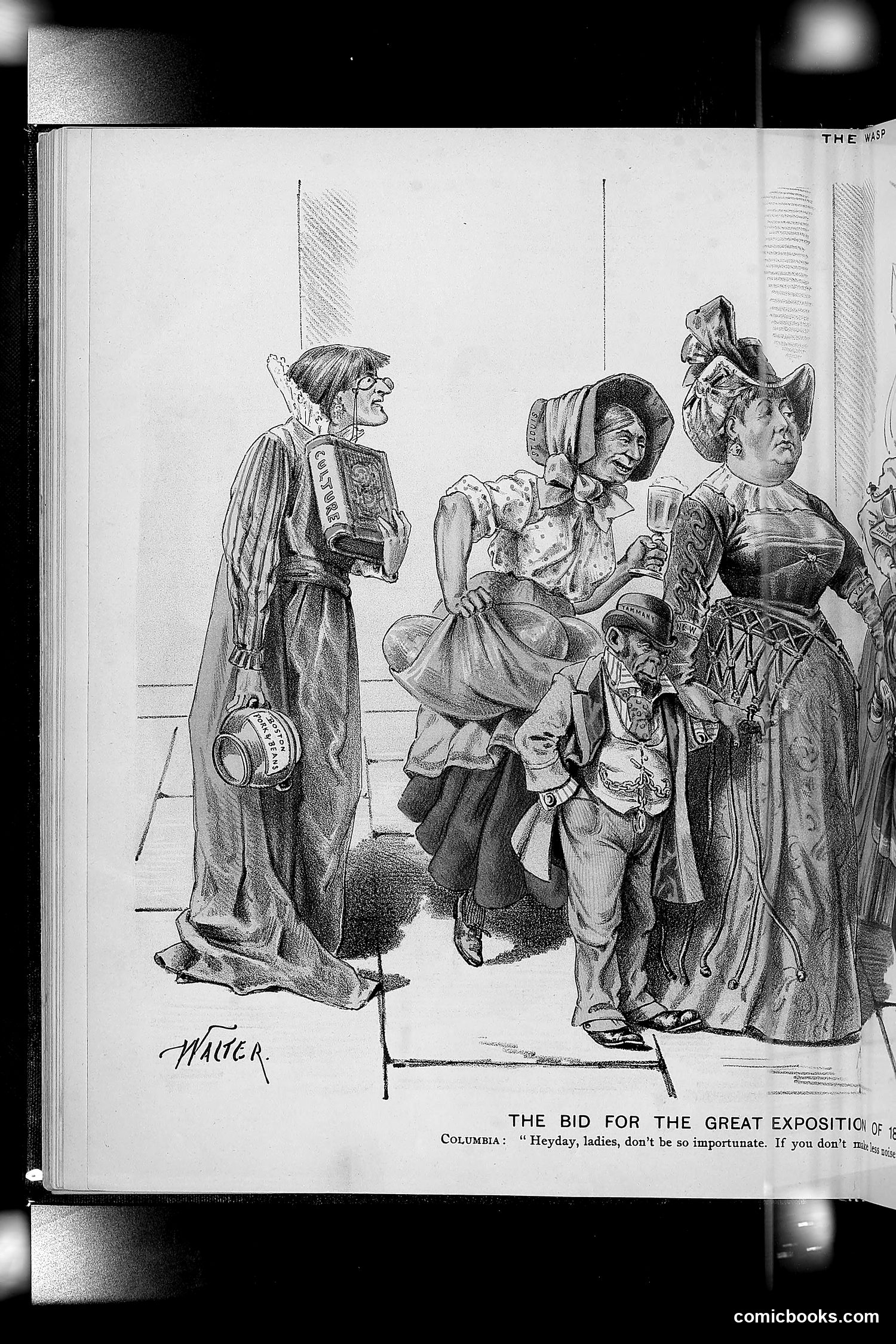
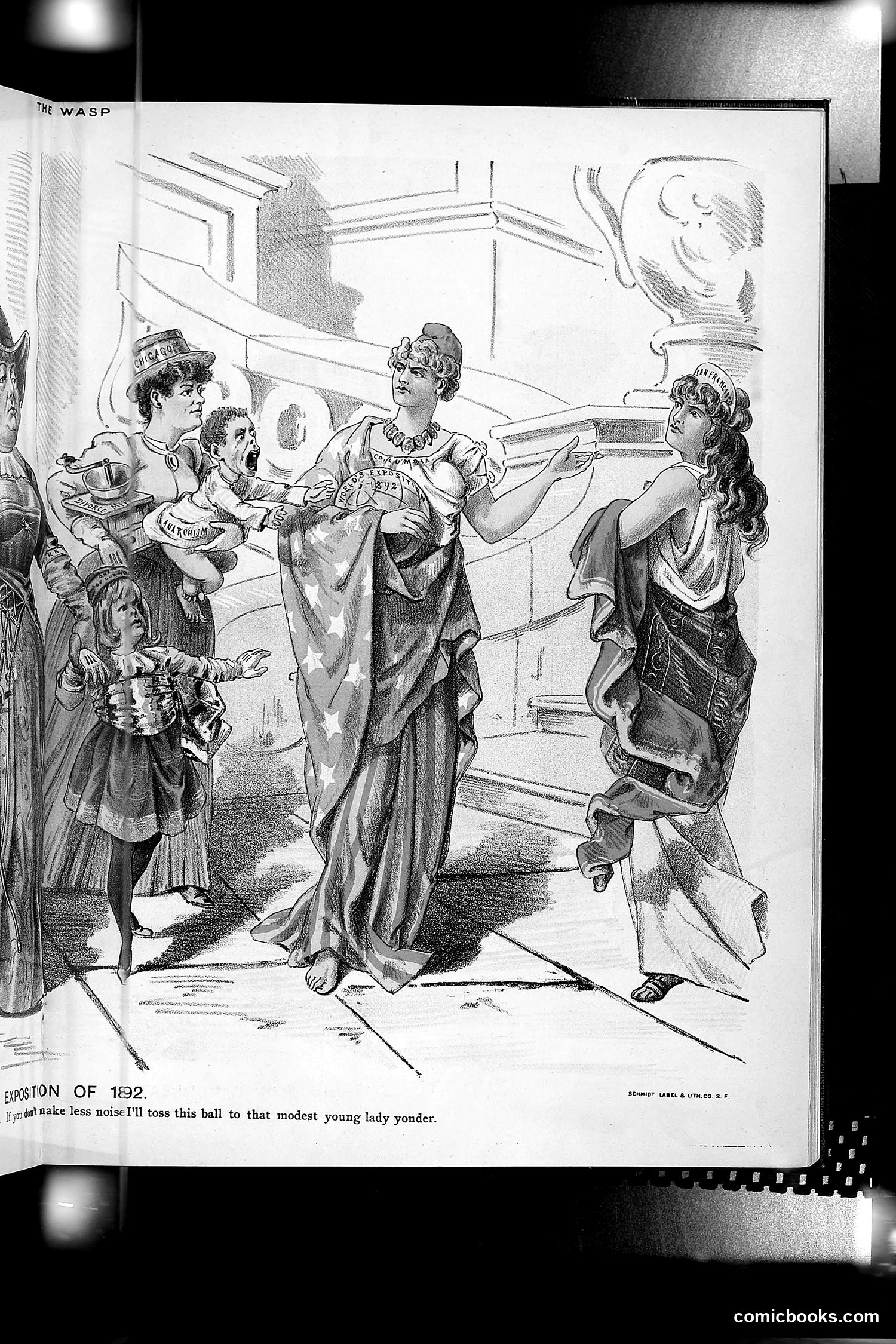
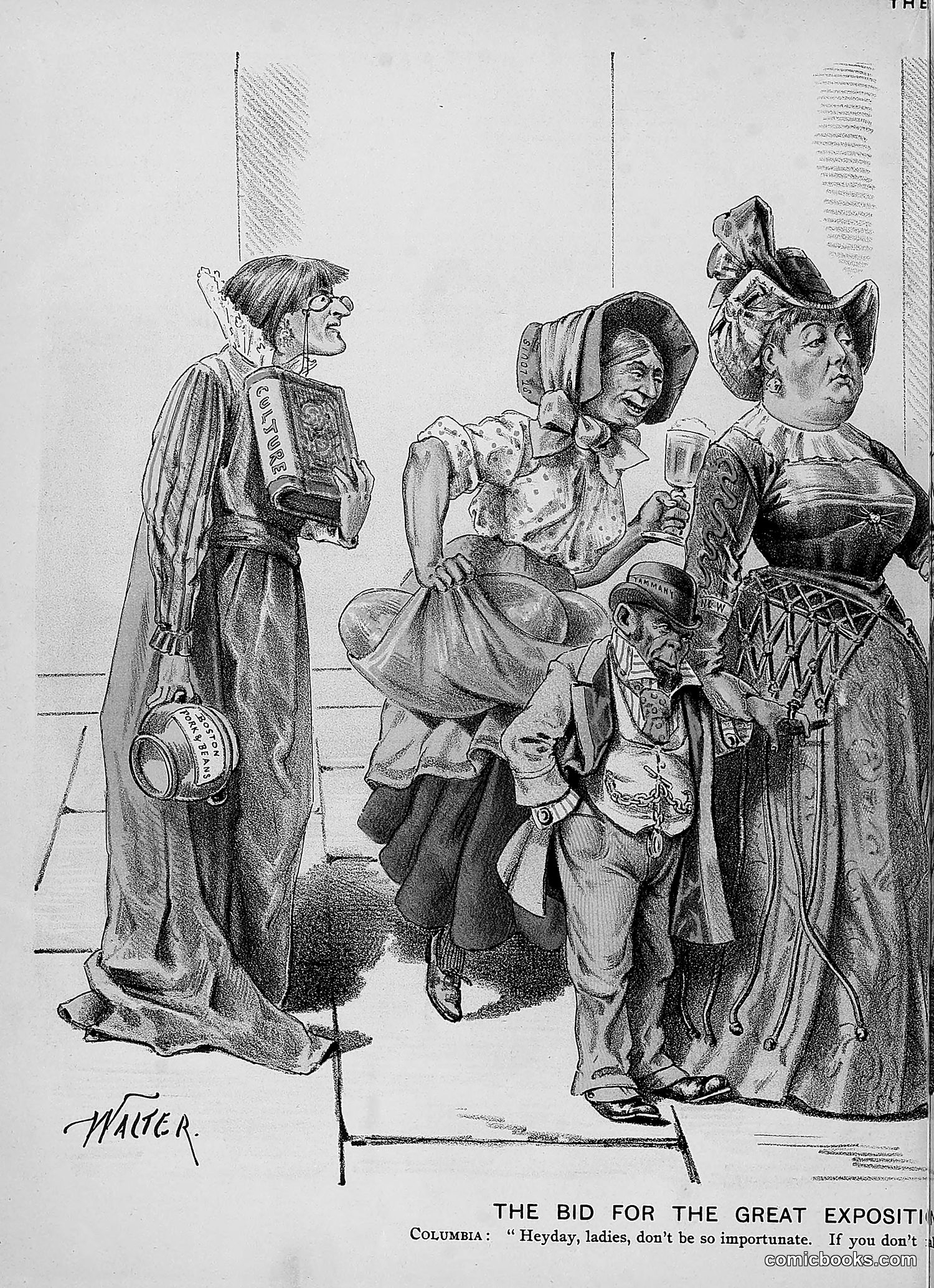
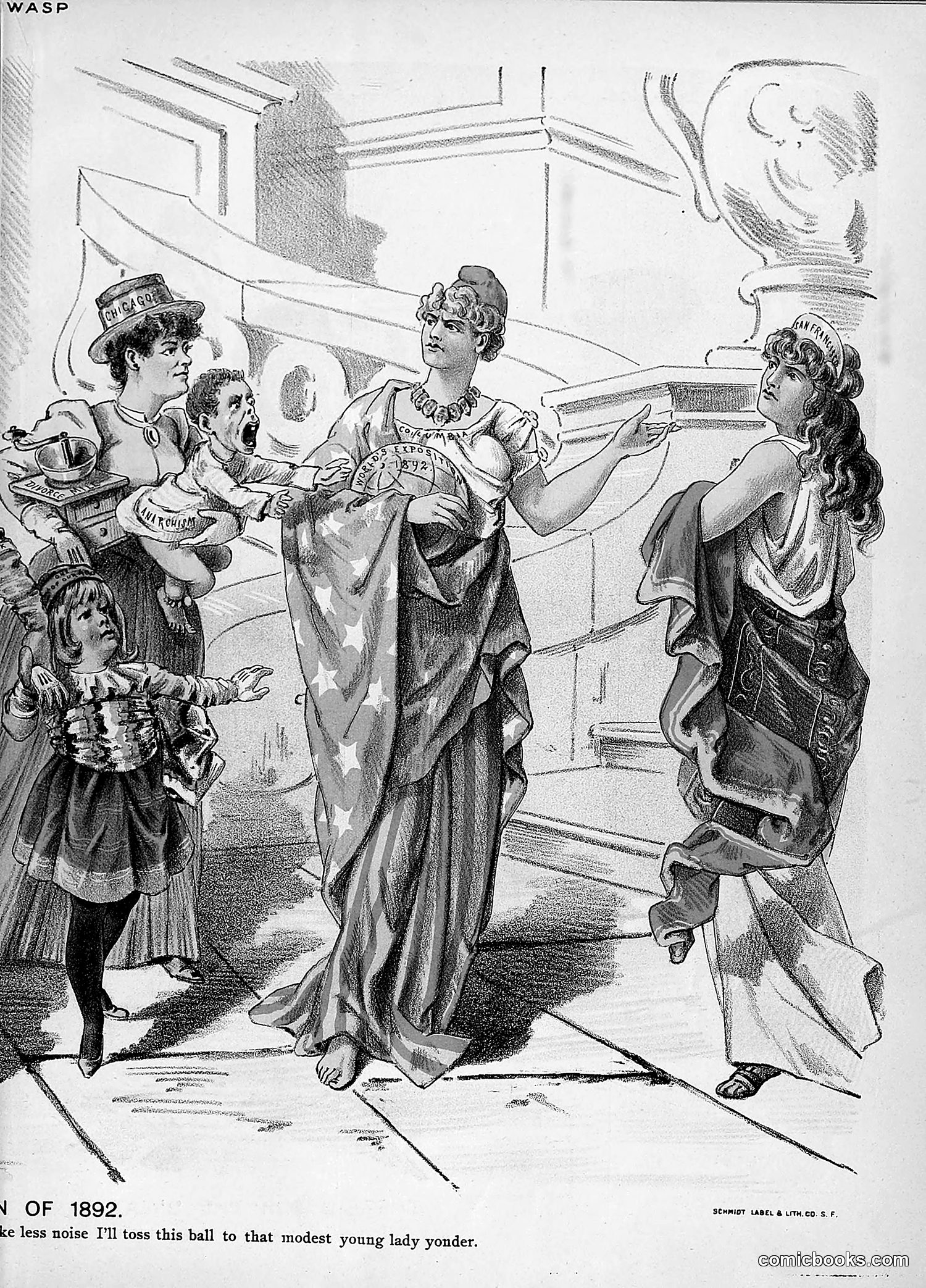
This page is primarily **text-based editorial content** from *The Wasp* (July 27, 1889), with no visible political cartoons or illustrations on the reproduced section. The editorials discuss: 1. **British Gold in American Politics** – criticizing foreign investment in U.S. politics and syndicates controlling domestic trade 2. **Governor Lowry of Mississippi** – commenting on his defeat for renomination, likely due to conflicts with political factions over dueling and violence 3. **The 1892 World's Fair** – proposing New York City host it, with political exhibits showing the contrast between political corruption and American achievement 4. Brief notes on **Maine real estate booms**, **Congressional sessions**, **mill workers in Paris**, and **Persian/Burmese political rivalries**. The satire targets **political corruption, foreign financial influence, and regional American conflicts** typical of Gilded Age journalism.

The Wasp — 1889 — page 66 of 450
66 / 450
What you’re looking at · open this page on its own ↗

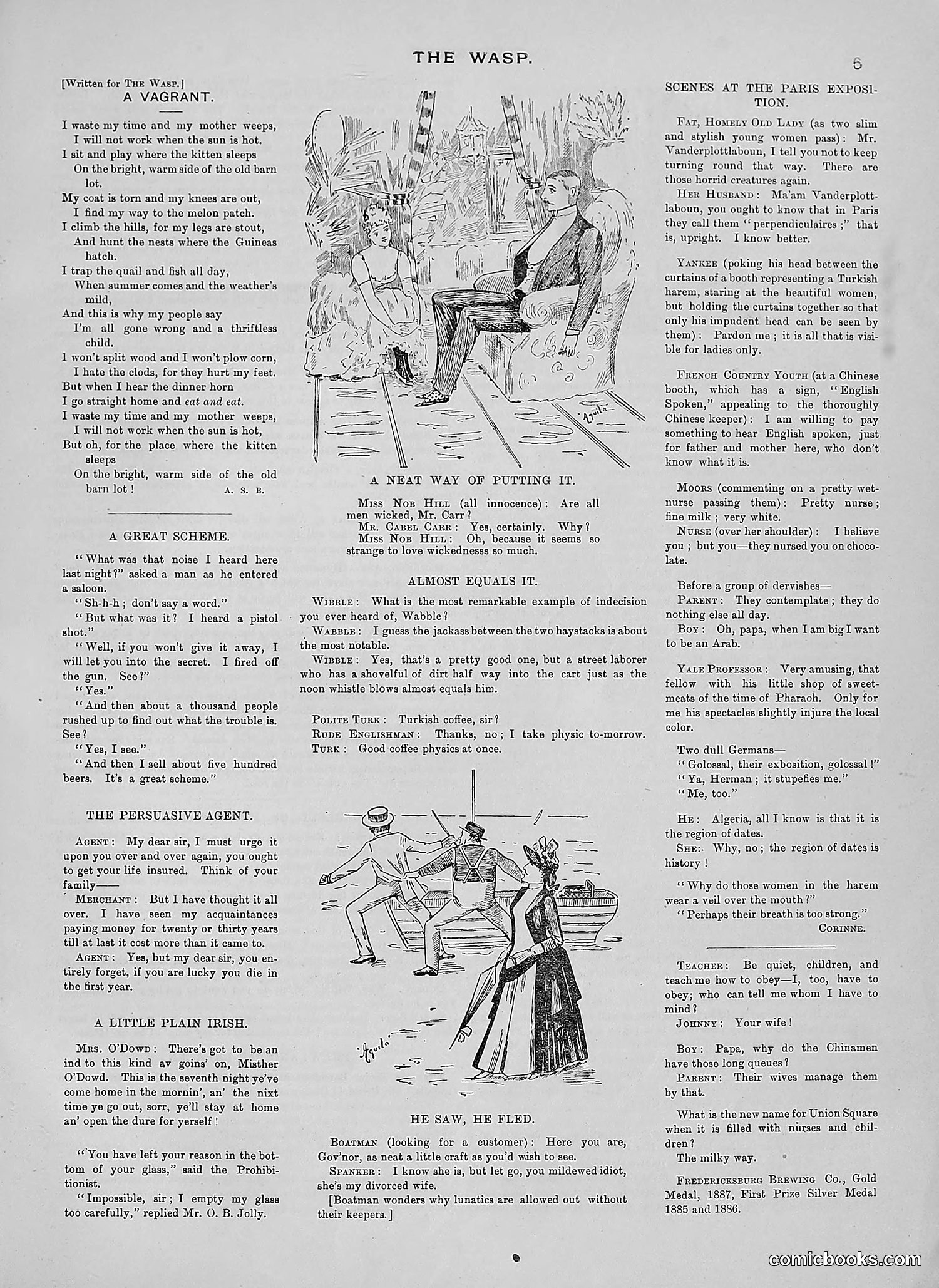
This cartoon satirizes **indecision and evasion in business dealings**. The image shows a well-dressed man sitting precariously on a plank balanced between two haystacks—a visual metaphor for being caught between two unstable positions with no solid ground. The accompanying dialogue features characters named **Wibble and Wobble** debating "the most remarkable example of indecision"—a street laborer with "a shovelful of dirt half way into the cart just as the noon whistle blows almost equal him." The satire mocks those who hedge their bets, avoid commitment, or remain suspended between choices. The plank setup humorously illustrates this precarious middle ground, suggesting that such indecision is ultimately unstable and foolish.

The Wasp — 1889 — page 67 of 450
67 / 450
What you’re looking at · open this page on its own ↗

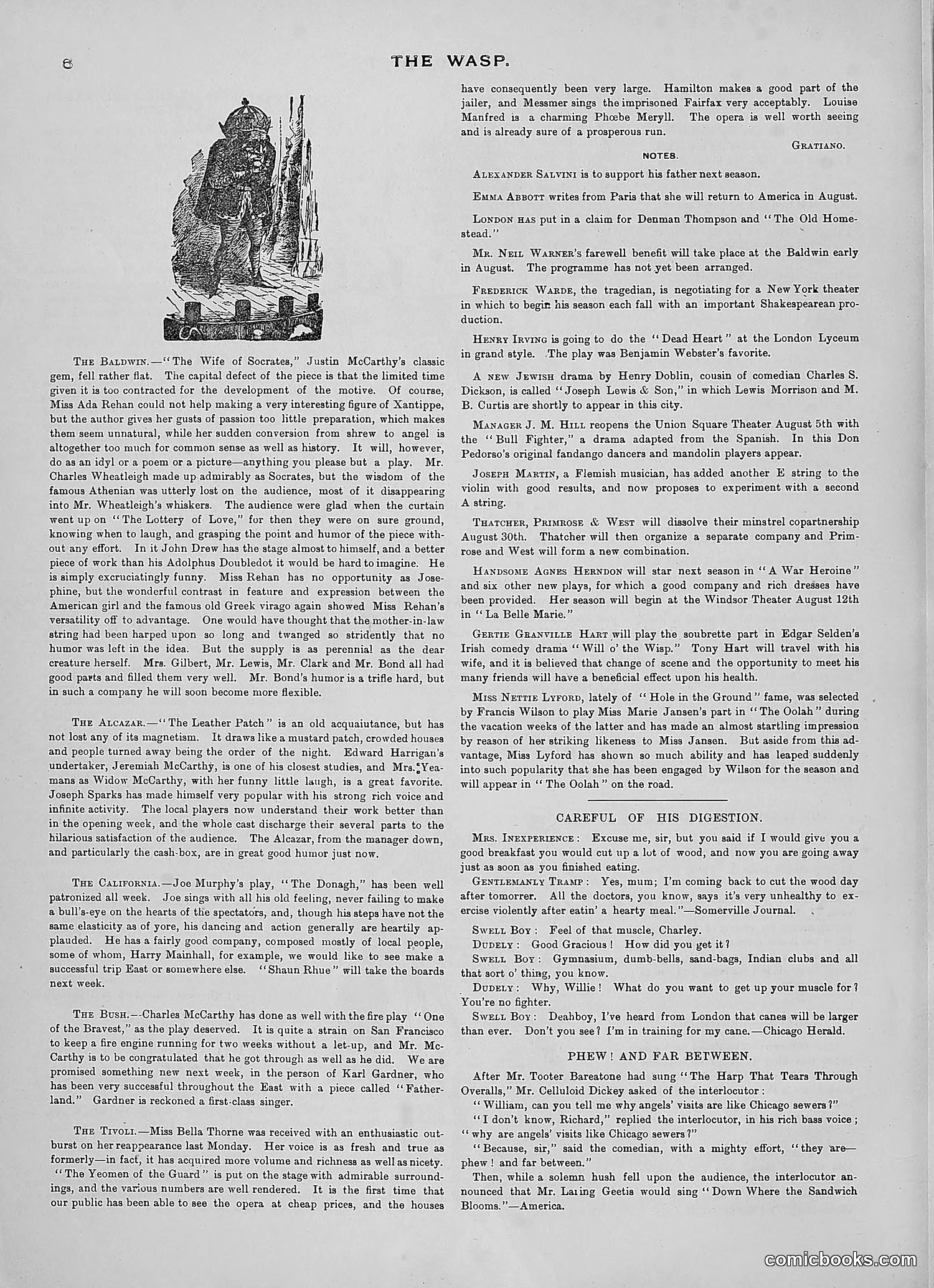
The page features theater/entertainment reviews rather than political cartoons. The prominent illustration shows a wasp on a branch—the magazine's mascot/logo. The reviews discuss current theatrical productions and performances from what appears to be mid-to-late 19th century San Francisco. Notable mentions include: - **The Baldwin Theater's** production of "Serious" with Louisa Manfred as "Phoebe Meryll" - **The Alcazar's** staging of "The Leather Patch" - **Joe Murphy's** play "The Donagh" - Various actor notes (Charles McCarthy, Miss Bella Thorne, etc.) The content is primarily theatrical criticism and gossip—casting news, performer evaluations, and upcoming productions. A humor section titled "Phew! and Far Between" includes jokes about health and digestion. This is entertainment journalism rather than political satire, reflecting *The Wasp's* broader satirical approach beyond just political cartooning.

The Wasp — 1889 — page 68 of 450
68 / 450
What you’re looking at · open this page on its own ↗

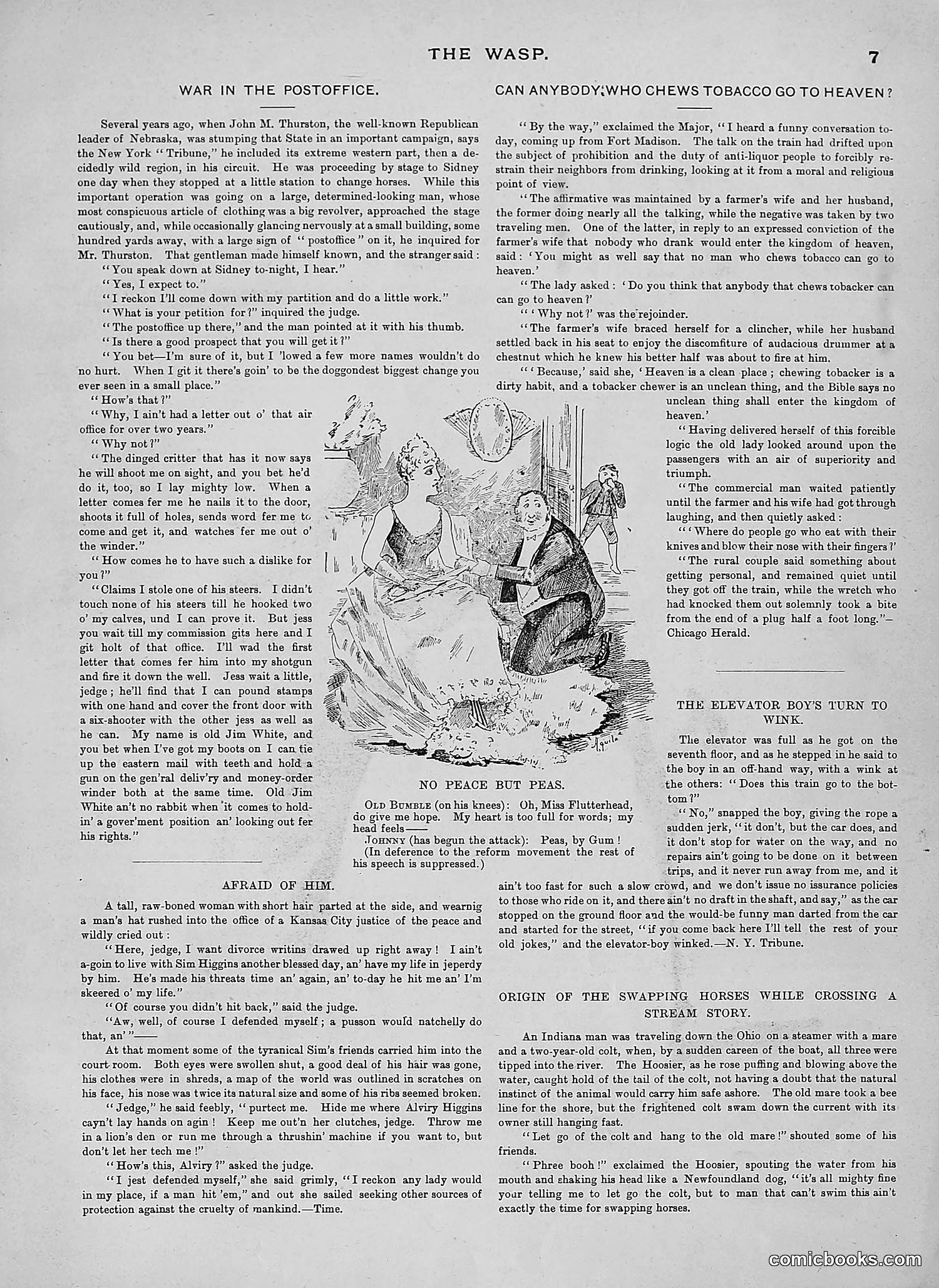
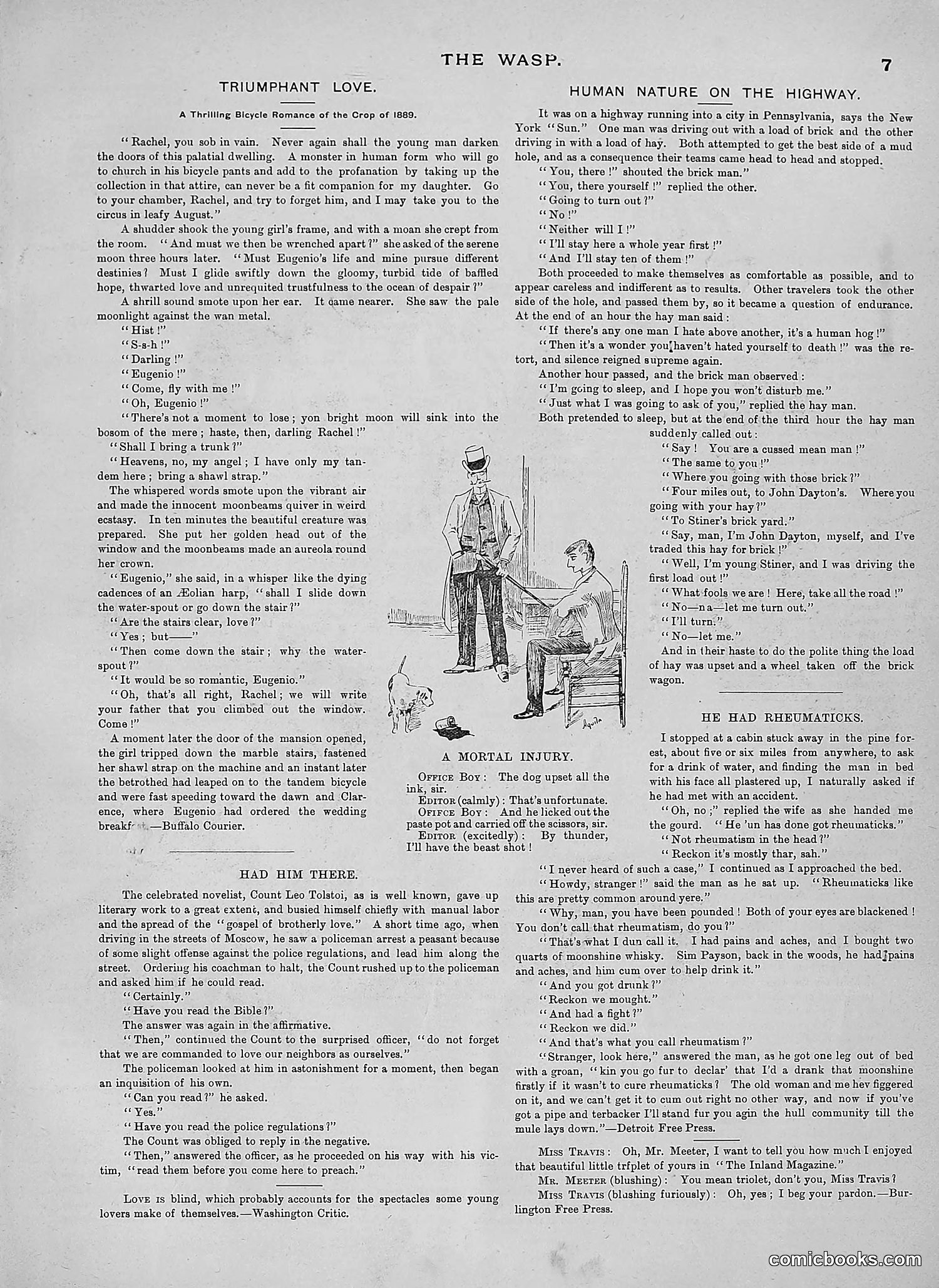
This page contains several satirical anecdotes and one illustration rather than a single cohesive political cartoon. The main illustrated story, "No Peace But Peas," depicts what appears to be a rural couple on a train. The satire concerns a farmer's wife's rigid moral objection to tobacco chewing—she insists "no man who chews tobacco can go to heaven." Her husband humorously counters by noting that heaven is "a clean place," so even tobacco chewers might enter. The joke mocks rigid religious moralism and domestic disagreements. Other brief stories mock legal absurdities (a woman's divorce petition, a judge's ruling about steers) and document humorous incidents from train travel and everyday life. The content reflects late-19th-century American rural life, religious attitudes, and social tensions rendered as comedic anecdotes rather than pointed political satire.

The Wasp — 1889 — page 69 of 450
69 / 450
What you’re looking at · open this page on its own ↗

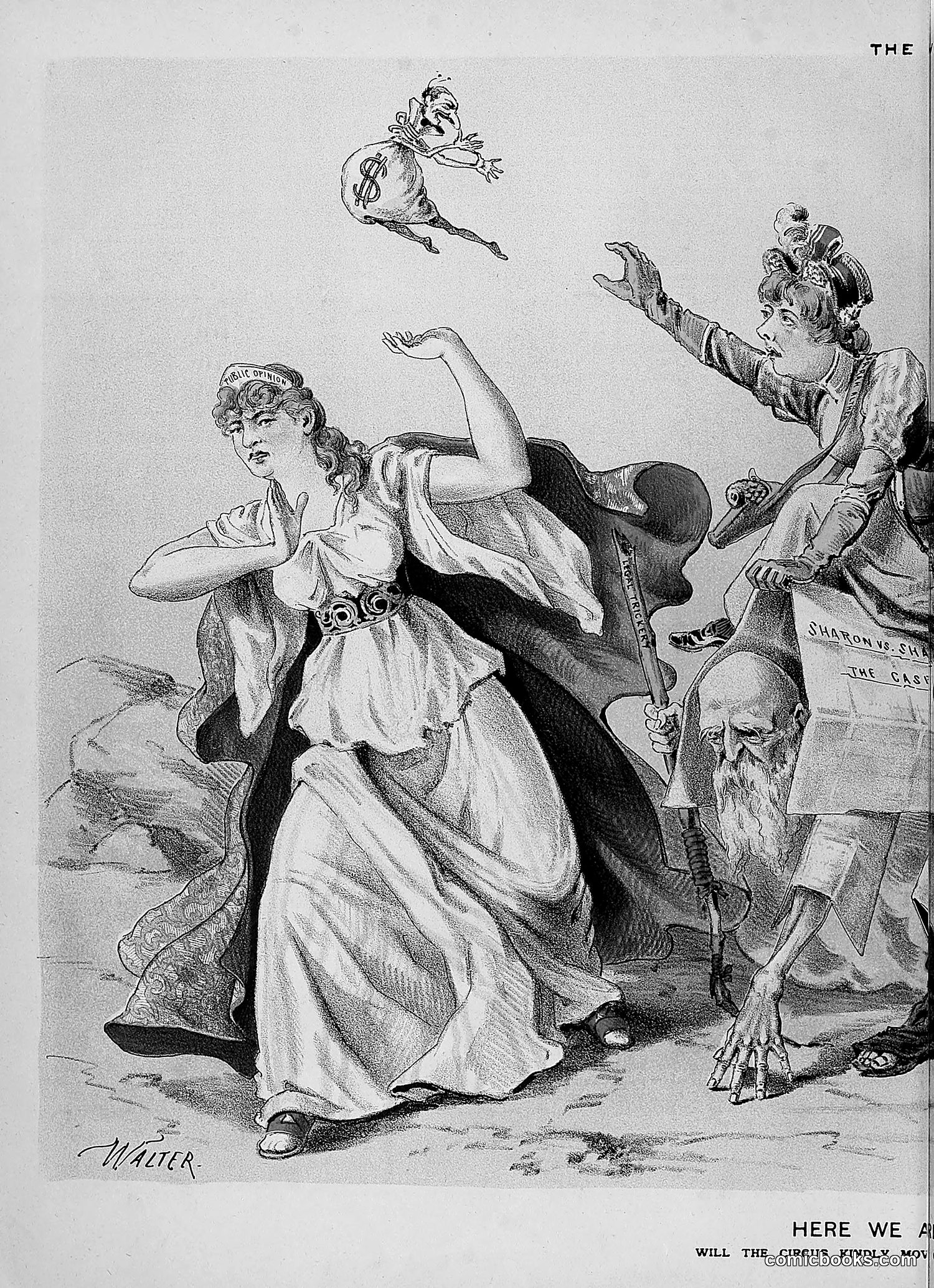
This political cartoon from *The Wasp* (a 19th-century satirical magazine) depicts a classical allegorical female figure—likely representing Justice, Liberty, or a similar civic virtue—in dramatic pose with flowing robes and a snake at her feet. She's surrounded by several male figures, including what appears to be a bearded older man (possibly representing established authority or the legal system) and others in period dress. The partially visible text references "Sharon vs. [someone]" and "The Case," suggesting this satirizes a specific legal dispute or lawsuit of the era. The woman's dismissive gesture and the comic positioning of the male figures suggest the cartoon mocks either the legal proceedings themselves or how justice/law is being administered. Without the complete caption, the exact target of the satire remains unclear.

The Wasp — 1889 — page 70 of 450
70 / 450
What you’re looking at · open this page on its own ↗

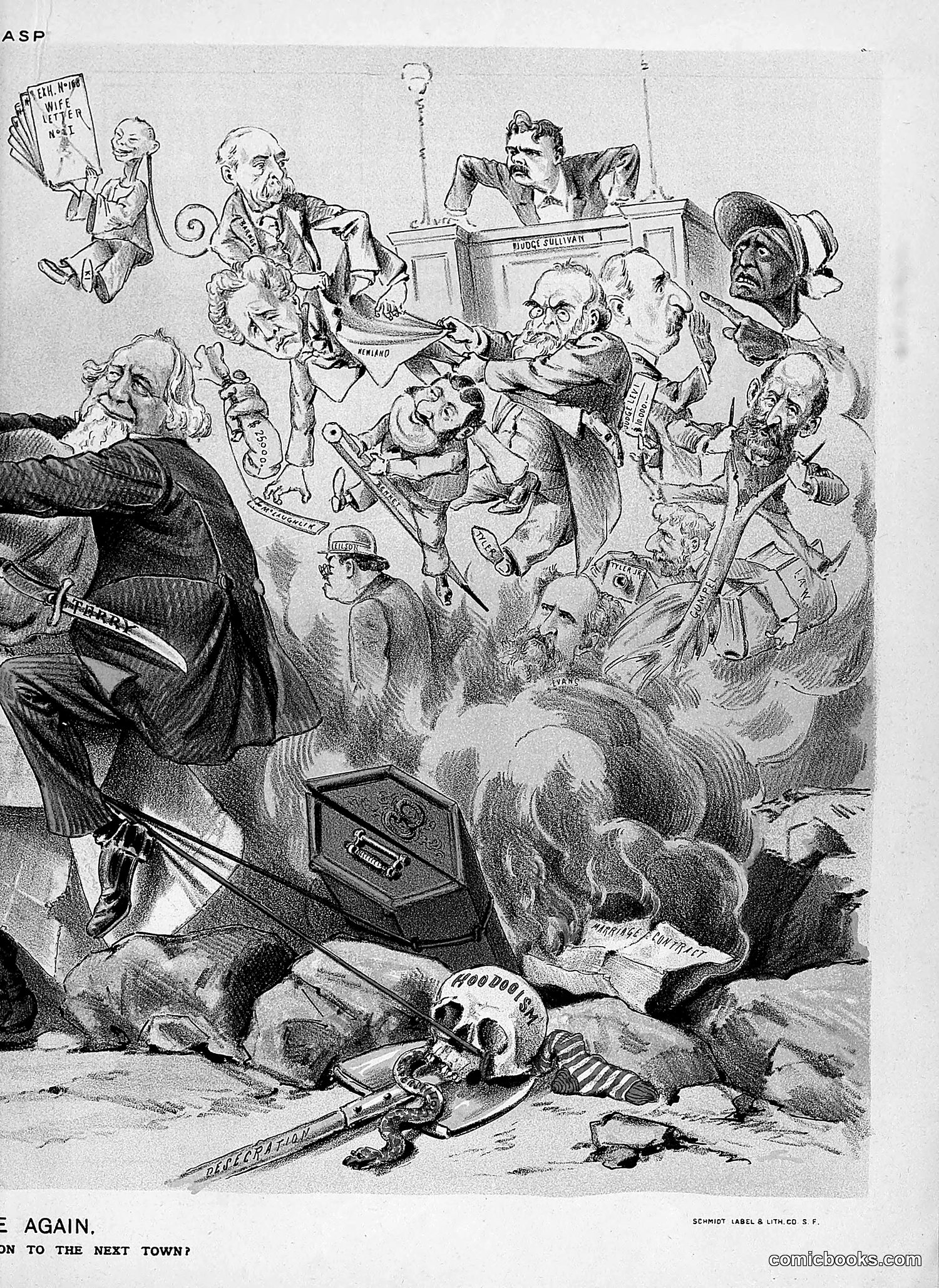
This satirical cartoon from *The Wasp* depicts a chaotic courtroom or official proceeding presided over by "JUDGE SULLIVAN" (visible on the bench). The scene shows numerous caricatured figures engaged in tumultuous activity—some fighting, arguing, or gesturing wildly around a central dispute. The cartoon appears to criticize judicial corruption or incompetence, with exaggerated facial features typical of late 19th-century satirical art. A large figure on the left observes the mayhem, while various smaller figures struggle in the background. The anarchic composition suggests a legal system in disarray. Without additional context about specific San Francisco events, the exact political targets remain unclear, though the cartoon clearly mocks the justice system's dysfunction during this period.

The Wasp — 1889 — page 71 of 450
71 / 450
What you’re looking at · open this page on its own ↗

This page is primarily **advertising and humor columns** rather than political cartoons. The left side contains several short comedic anecdotes and satirical observations about contemporary life—including jokes about clergymen, travelers, and domestic situations. These reflect turn-of-century American humor styles. The right side features **commercial advertisements** for products like Burke's Stout beer, aluminum products, and Byron Hot Springs resort. The humor appears **socially observational** rather than overtly political—mocking Victorian proprieties, family dynamics, and advertising claims. One notable piece satirizes medicinal cure-alls (common patent medicine fraud of the era), while another pokes fun at pretentious travelers and their exaggerations. No identifiable political figures or specific dated events appear on this page.

The Wasp — 1889 — page 72 of 450
72 / 450
What you’re looking at · open this page on its own ↗

This page is primarily **advertising and humor columns** rather than political satire. The visible cartoon shows a woman with children and appears to advertise "Ayer's Cherry Pectoral," a cough remedy. The humor pieces are social satire—brief anecdotes mocking everyday situations: a lawyer questioning a witness about children, a man praising his horse, disputes between couples over money and cooking, and commentary on social pretense and domestic life. The advertisements promote various products (tooth polish, memory aids, cough medicine, furnishing goods) typical of late 19th-century publications. **No specific political figures or events are referenced.** This is general-interest satirical humor targeting common human foibles and domestic situations, not contemporary politics.

The Wasp — 1889 — page 73 of 450
73 / 450
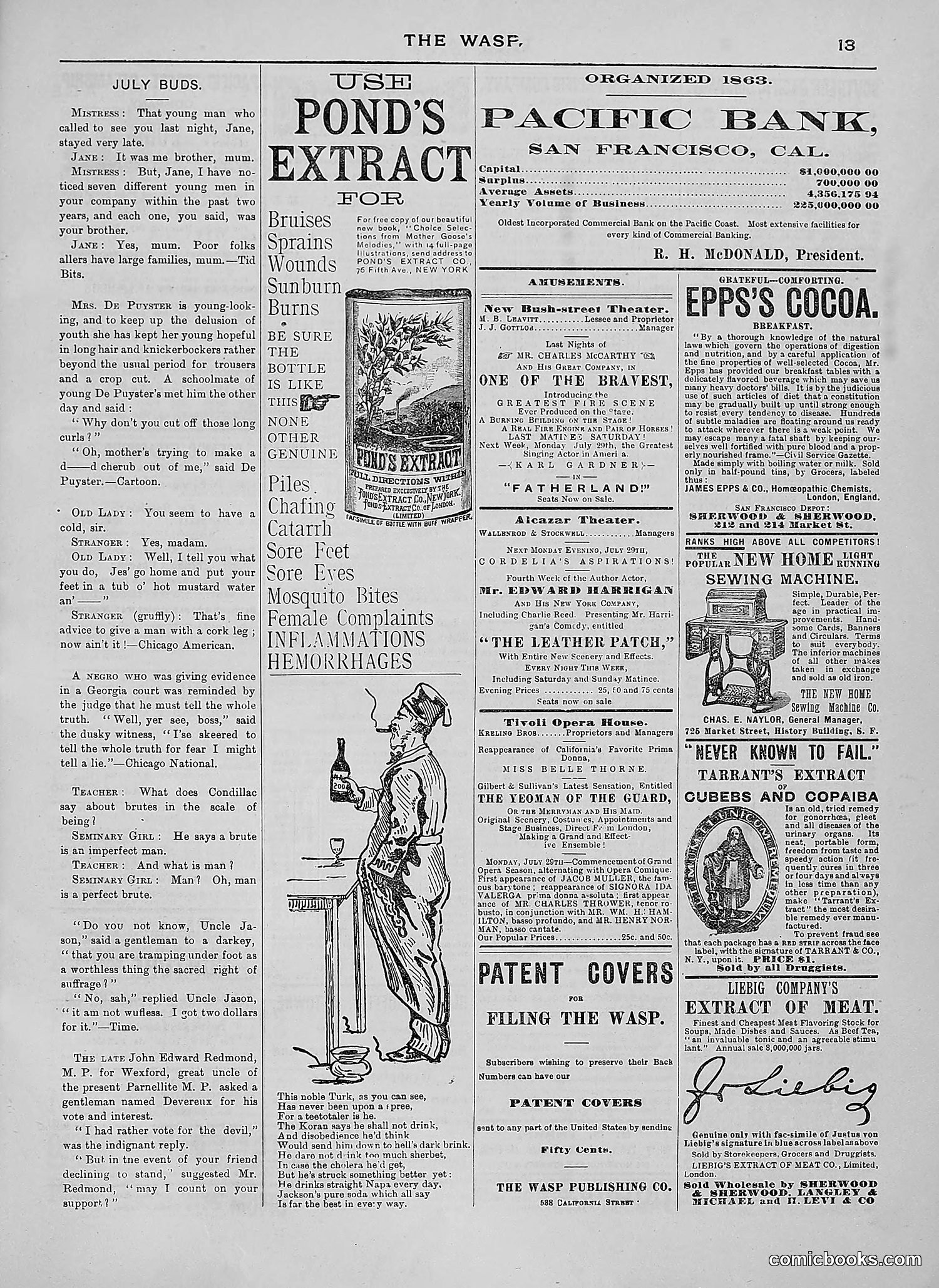
What you’re looking at · open this page on its own ↗

This page is primarily **advertising and commercial notices** rather than political satire or editorial cartooning. The content includes ads for: - Patent medicines and remedies (for gonorrhea, catarrh, weak men, piles) - The "New Home" sewing machine (prominently featured) - Printing and lithography services - Various San Francisco businesses and saloons There is one brief **humorous poem titled "The Funny Cobbler"** about a shoemaker's financial struggles, and a short anecdote "Located Him at Last" involving a policeman and a Spring Street woman—light humor rather than political satire. The page reflects late 19th-century American advertising culture: patent medicine claims (many fraudulent by modern standards), gender-targeted ads, and local business notices. There are no identifiable political cartoons or caricatures of public figures on this particular page.

The Wasp — 1889 — page 74 of 450
74 / 450
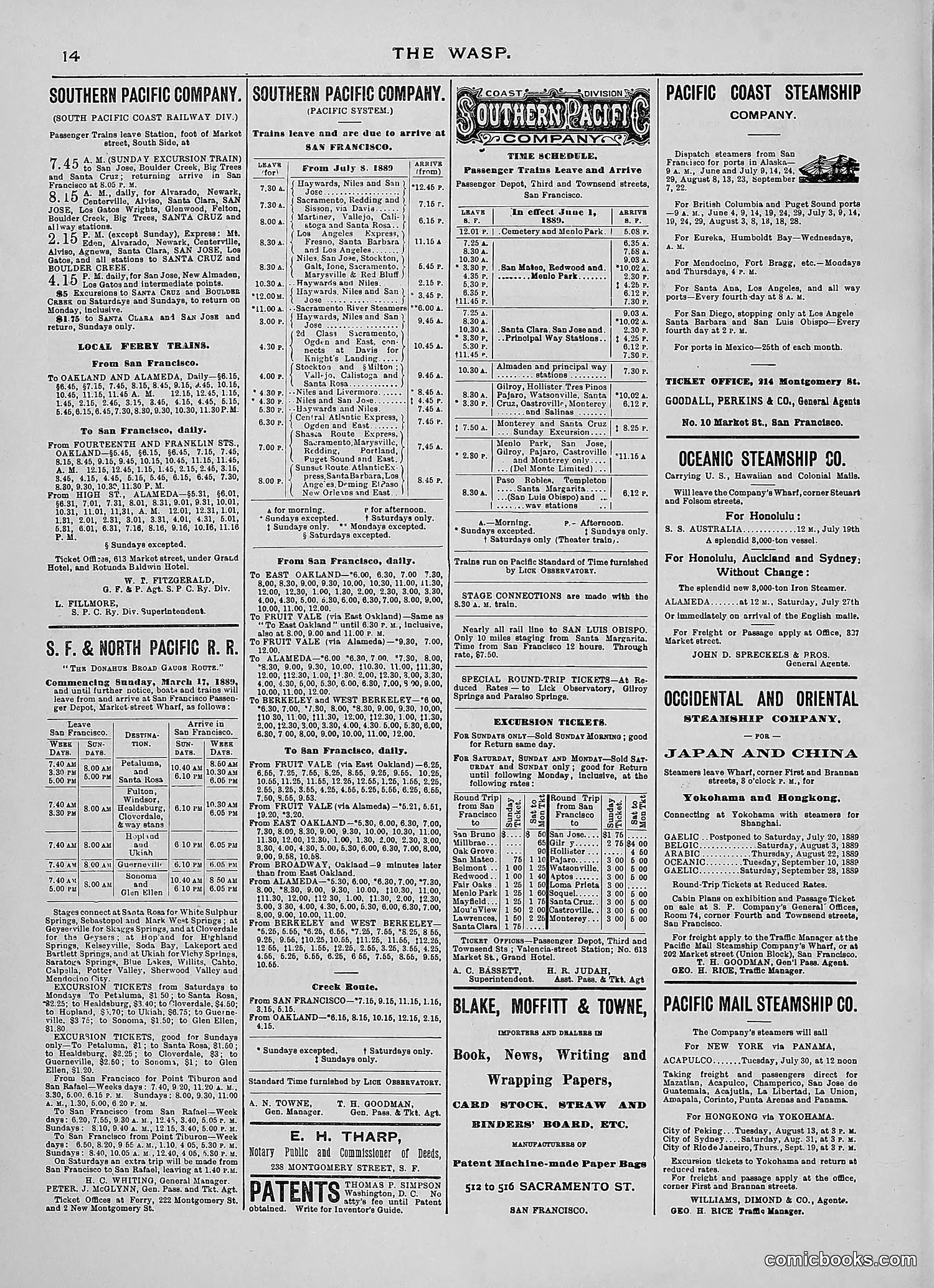
What you’re looking at · open this page on its own ↗

This page is primarily **advertising and amusements listings** rather than political satire. The main content includes: **Advertisements:** - Pond's Extract (prominent, with illustration of a bottle and classical female figure) - Pacific Bank, San Francisco - Epps's Cocoa - Various theatrical venues and performances - Patent covers for filing The Wasp - Liebig Company's Extract of Meat **Humor Section ("July Buds"):** A small jokes column featuring mild social satire about courtship, class, and gender relations—typical period humor about mothers trying to make matches, servile behavior toward superiors, and ethnic stereotypes. **The Illustrations:** The Pond's Extract bottle features classical imagery; a separate sketch shows what appears to be a Turkish figure or servant—likely reflecting period Orientalist aesthetics common in advertising. This is primarily a **commercial page**, not a political cartoon critique.

The Wasp — 1889 — page 75 of 450
75 / 450
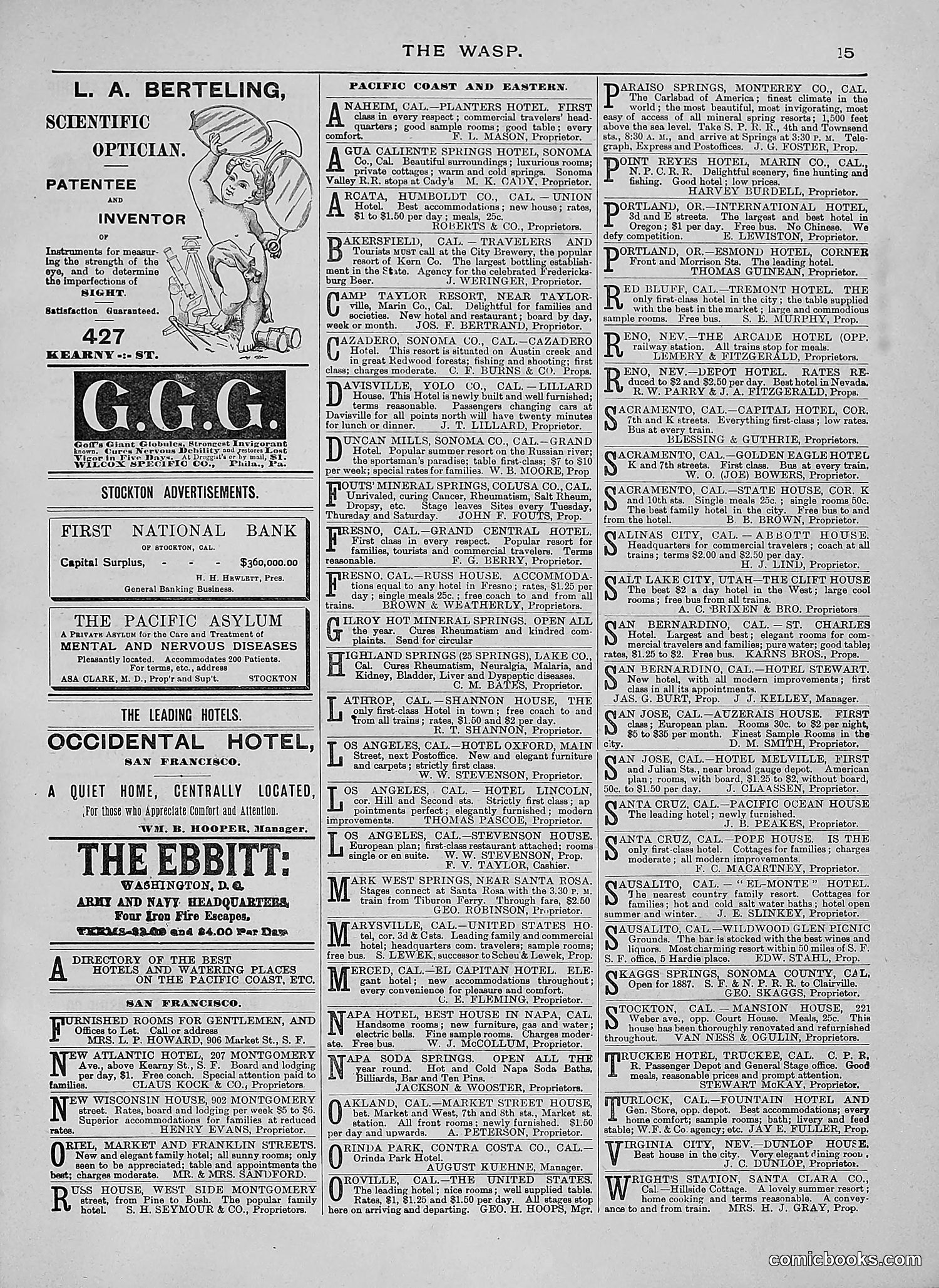
What you’re looking at · open this page on its own ↗

This page is primarily **advertising and transportation schedules** for the Southern Pacific Company and related steamship and railroad services in late 19th-century California and Hawaii. The content includes: - Train departure/arrival times from San Francisco to various California destinations - Steamship schedules to Hawaii, China, and Japan - Business advertisements (patent services, printing, stationery) **No political cartoons or satirical content is visible** on this page. The Wasp magazine's satirical material does not appear here—this is a commercial/informational section typical of period periodicals, which relied heavily on advertising revenue. The page reflects the era's transportation infrastructure and commercial networks connecting California to Pacific destinations.

The Wasp — 1889 — page 76 of 450
76 / 450
What you’re looking at · open this page on its own ↗

This page is primarily **advertising and business listings** for San Francisco Bay Area hotels, springs resorts, and services, typical of late 19th-century trade publications. The only notable cartoon appears in the upper left: a caricatured figure labeled **"L. A. BERTELING, SCIENTIFIC OPTICIAN"** depicted as an inventor with exaggerated features, promoting his patent for "strengthening the strength of the eyes and to determine the imperfections of SIGHT." The satire here likely mocks patent-medicine-style marketing or dubious optical remedies common to the era. The remainder consists of legitimate business advertisements for hotels (Occidental Hotel, The Ebbit), the First National Bank, and The Pacific Asylum for mental health treatment—standard commercial content rather than political satire.

The Wasp — 1889 — page 77 of 450
77 / 450
What you’re looking at · open this page on its own ↗

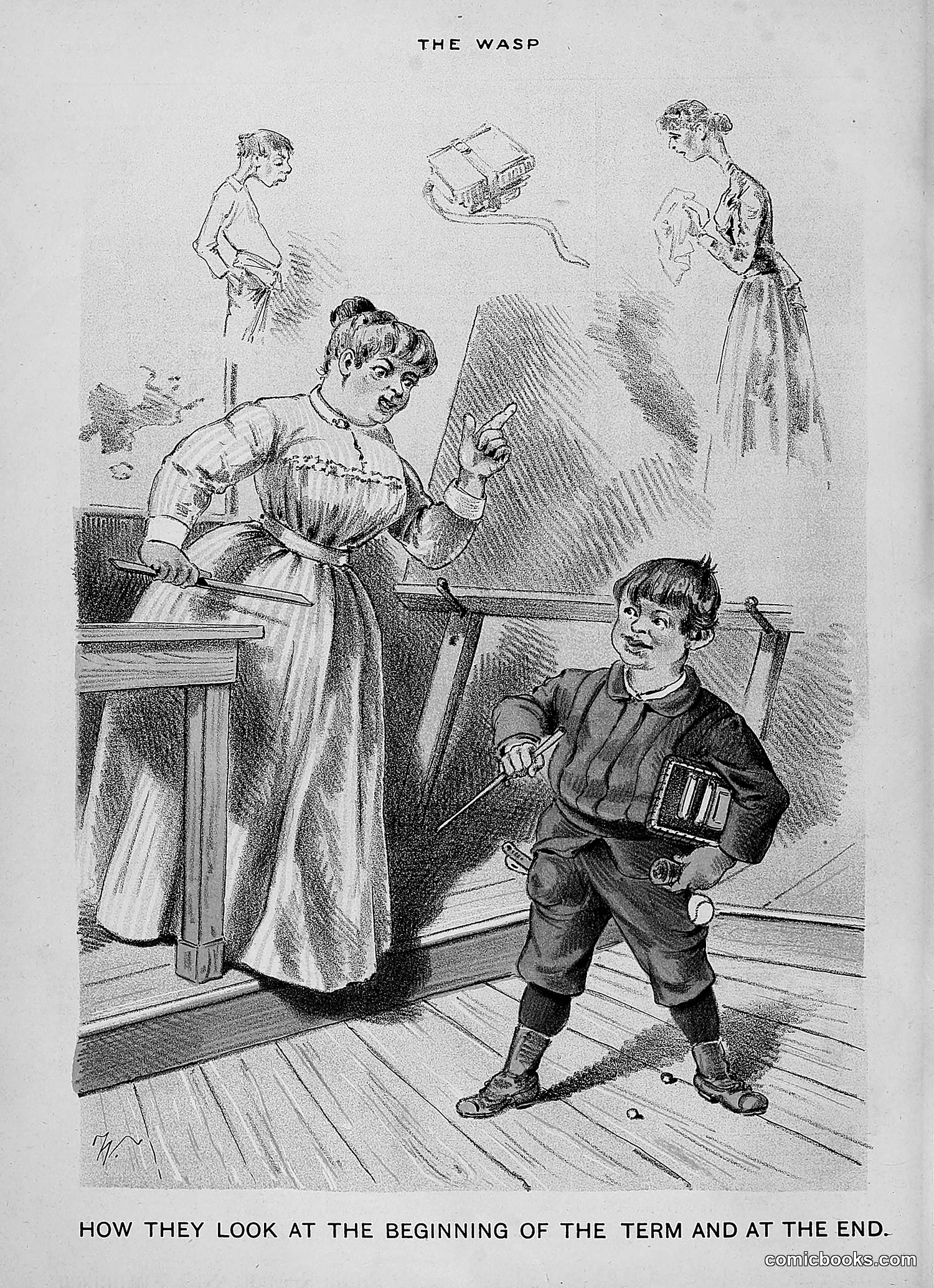
This cartoon satirizes the physical and mental deterioration of schoolchildren over an academic term. The central image shows a plump, well-dressed woman (likely a teacher or matron) comparing a child at the beginning versus end of term. The boy appears energetic and robust at the start, but exhausted and diminished by the term's end—depicted holding books and looking depleted. The background figures suggest the broader school environment and its taxing effects on students. The satire critiques the demanding nature of Victorian-era schooling, suggesting that educational institutions wore down children rather than nurturing them. "The Wasp" magazine frequently targeted social institutions and practices deemed harmful or absurd, making this a typical example of their satirical commentary on contemporary education.

The Wasp — 1889 — page 78 of 450
78 / 450
What you’re looking at · open this page on its own ↗

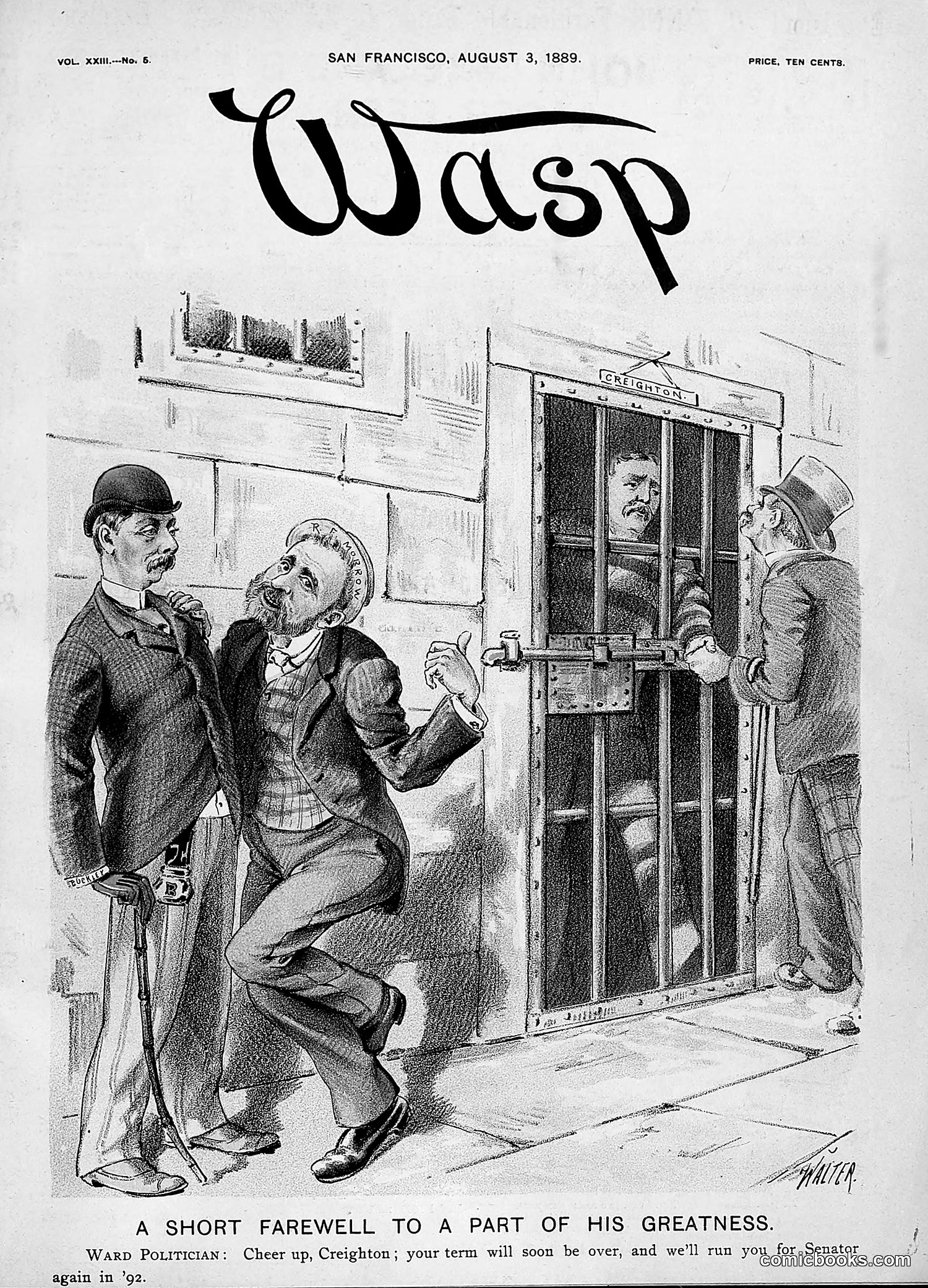
This 1889 *Wasp* cartoon depicts a prisoner behind bars labeled "Creighton" being visited by two men outside the cell. The caption reads: "A SHORT FAREWELL TO A PART OF HIS GREATNESS," with dialogue from a "Ward Politician" stating Creighton's term will soon end and they'll run him for Senator again in '92. The satire mocks Creighton (likely a San Francisco political figure) by suggesting his imprisonment is merely temporary and that corrupt ward politics will restore him to power. The cartoon criticizes the cynical political machine—implying that criminal conviction poses no obstacle to political rehabilitation. The "greatness" in the title is deeply sarcastic, suggesting his notoriety rather than genuine achievement.

The Wasp — 1889 — page 79 of 450
79 / 450
What you’re looking at · open this page on its own ↗

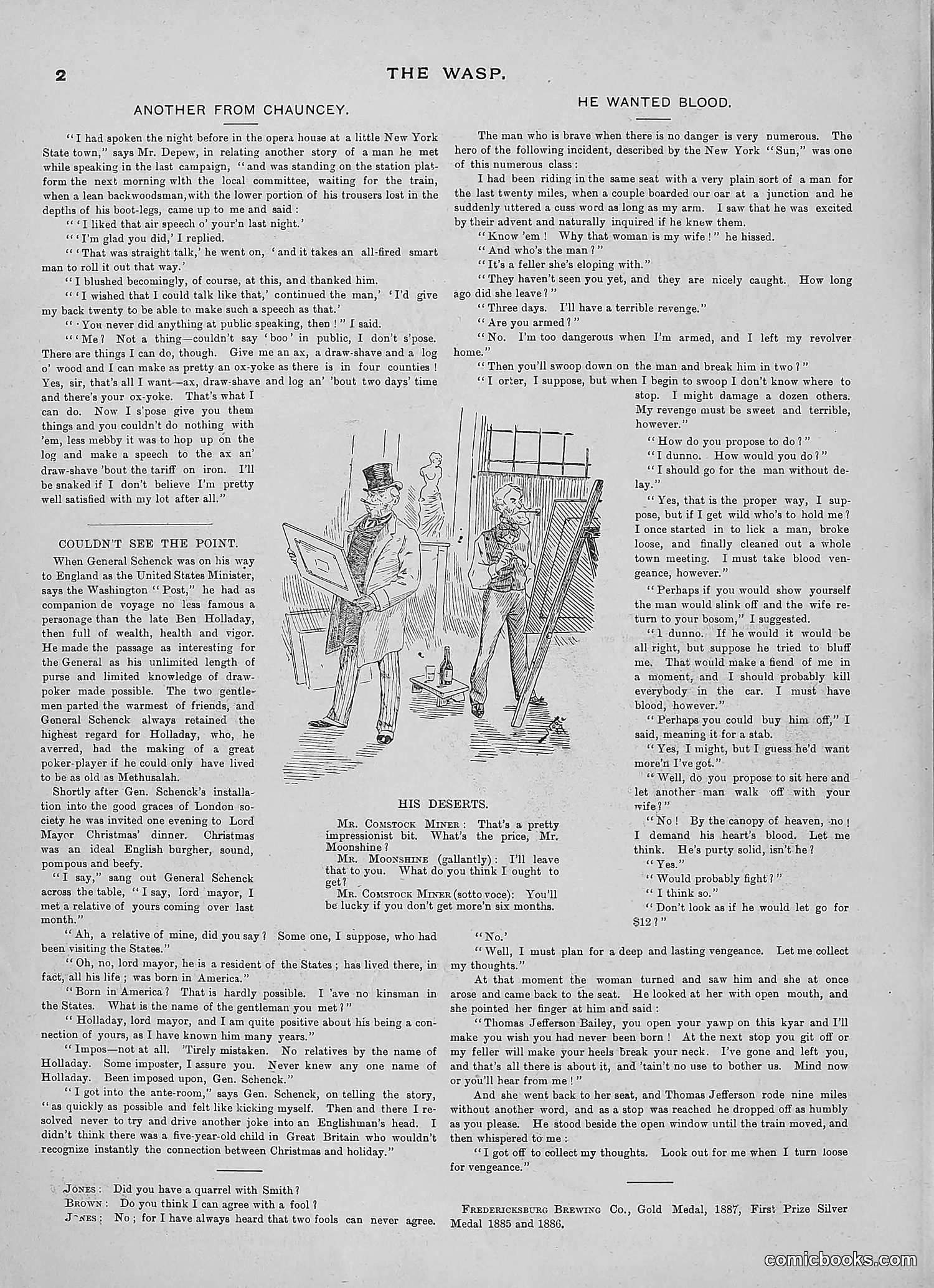
This page contains two distinct sections: **"Another from Chauncey"** (upper left) presents a dialogue mocking an unnamed general's tedious anecdote about an ox-based speech. The satire targets verbose, self-important military figures who bore audiences with pointless stories. **"Couldn't See the Point"** (middle) ridicules General Schenck's verbose writing style during his diplomatic mission to England. The text suggests Schenck was an untalented writer whom the British considered incompetent—a jab at American diplomatic representation. **"His Deserts"** (right) depicts a melodramatic confrontation where an angry man confronts his unfaithful wife, threatening revenge. This appears to be fictional entertainment content rather than political satire, showcasing The Wasp's broader editorial mix of humor and serialized stories. The overall page reflects late-19th-century American skepticism toward pompous public figures.

The Wasp — 1889 — page 80 of 450
80 / 450
What you’re looking at · open this page on its own ↗

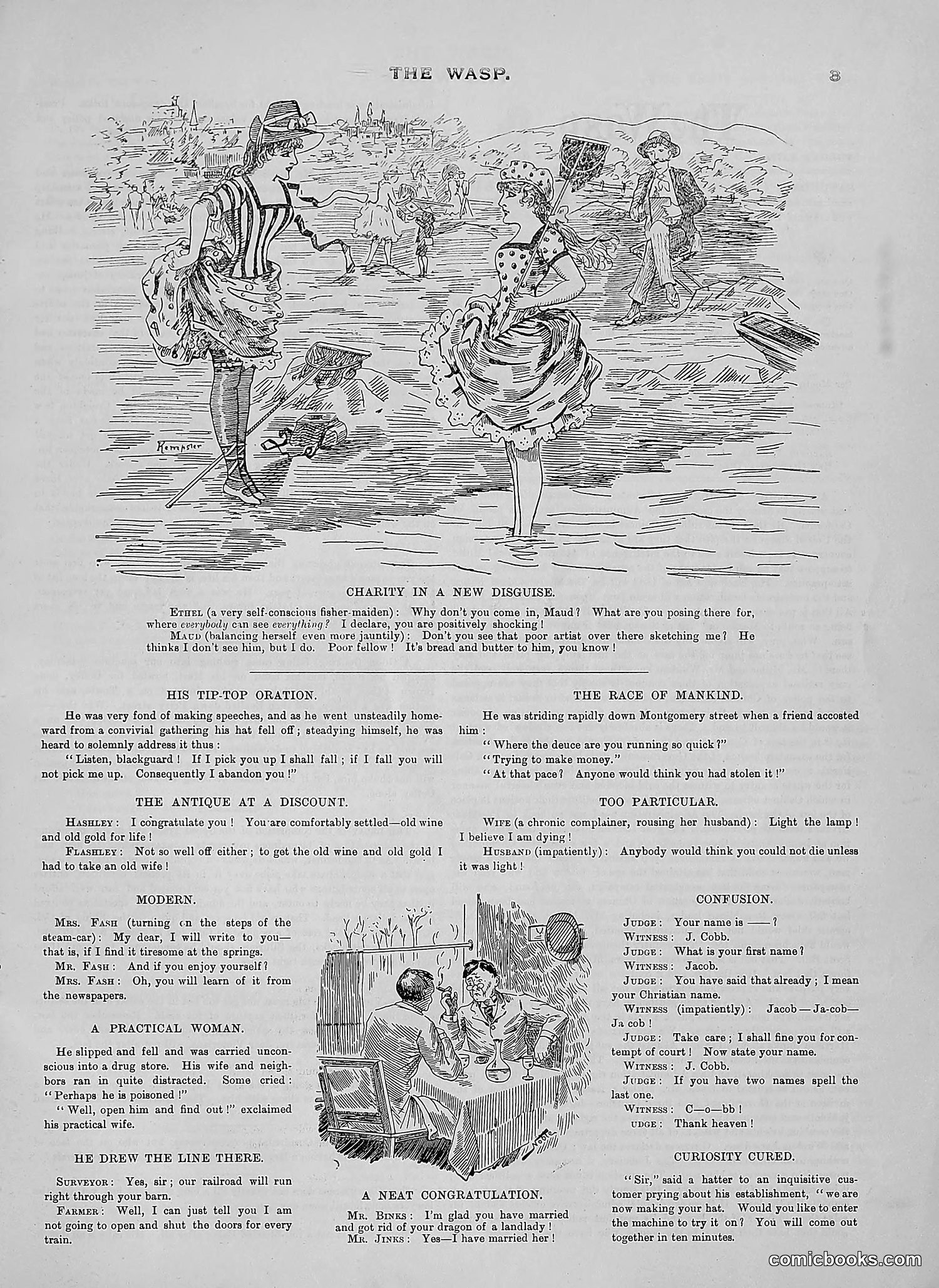
This page from *The Wasp* contains multiple short satirical pieces and jokes rather than one unified cartoon. **The main illustration** ("Charity in a New Disguise") depicts a well-dressed man at the beach confronting a woman, with onlookers present. The dialogue suggests he's criticizing her for posing while pretending to be charitable—the satire targets performative or hypocritical charity. **The remaining pieces** are brief comic dialogues mocking various social types: a verbose speech-maker, a social climber obsessed with money, a wife blaming poor lighting for household complaints, a woman learning about fashion from newspapers, and others. The humor relies on recognizing common contemporary social pretenses—wealth anxiety, domestic complaints, false modesty—rather than specific political figures or events. It's general social satire typical of 1890s American humor magazines.

The Wasp — 1889 — page 81 of 450
81 / 450
What you’re looking at · open this page on its own ↗

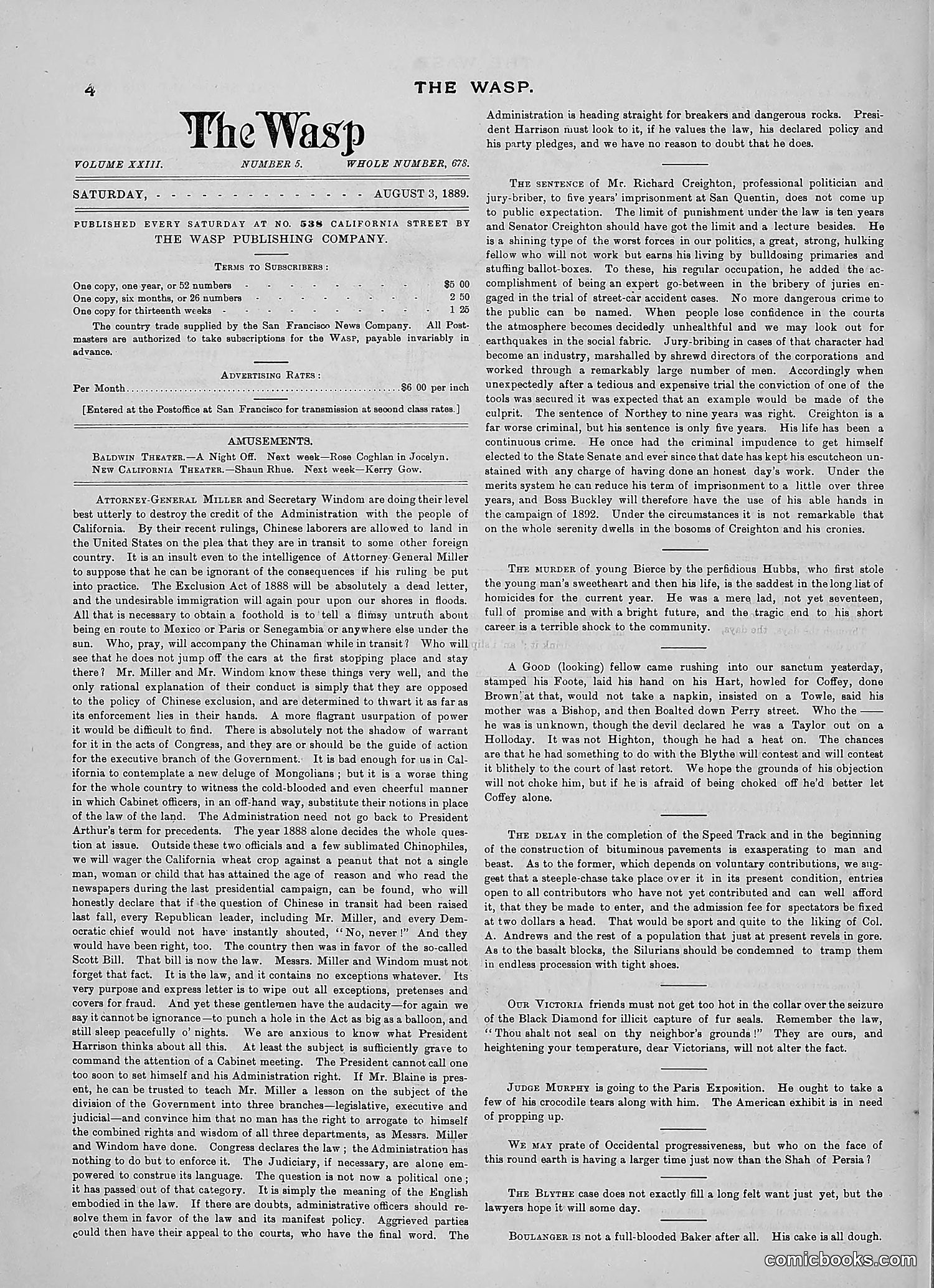
This is primarily a text-heavy editorial and opinion page rather than a cartoon page. The main content consists of political commentary attacking California Attorney General Miller and Secretary Windom for attempting to undermine the Harrison Administration's credibility regarding Chinese exclusion policy. The piece argues Miller and Windom are sabotaging enforcement of the 1888 Exclusion Act through legal maneuvering. It also critiques Senator Creighton's lenient five-year sentence for a jury-briber at San Quentin, and briefly discusses the murder of a young man named Bierce by someone named Hubbs. The tone is sharply satirical and accusatory toward these political figures.

The Wasp — 1889 — page 82 of 450
82 / 450
What you’re looking at · open this page on its own ↗

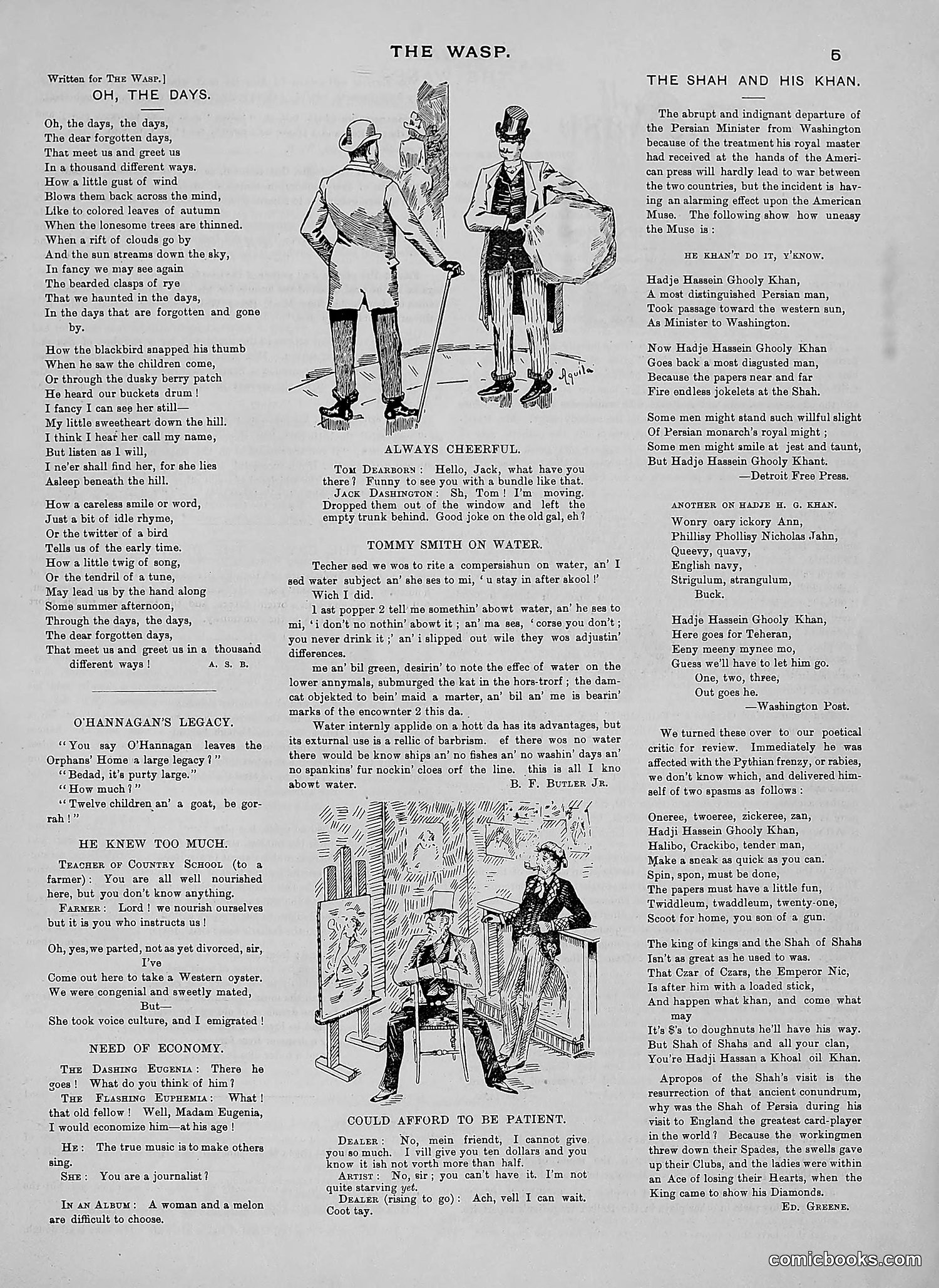
This page features satirical poetry and illustrations mocking Persian-American diplomatic tensions. The headline "THE SHAH AND HIS KHAN" references an incident where a Persian Minister departed Washington abruptly, allegedly due to poor treatment by the American Muse (representing America itself). The illustrated cartoon "ALWAYS CHEERFUL" depicts two figures—apparently Tom Dashwood and Jack Dashwood—joking about dropping someone "out the window," a dark humor reference to the diplomatic snub. Below, "TOMMY SMITH ON WATER" contains naval humor, while "COULD AFFORD TO BE PATIENT" shows a dealer and artist negotiating over money, typical The Wasp satire about American commercialism and art. The Persian Khan material appears designed to ridicule both foreign diplomacy and American treatment of foreign dignitaries.

The Wasp — 1889 — page 83 of 450
83 / 450
What you’re looking at · open this page on its own ↗

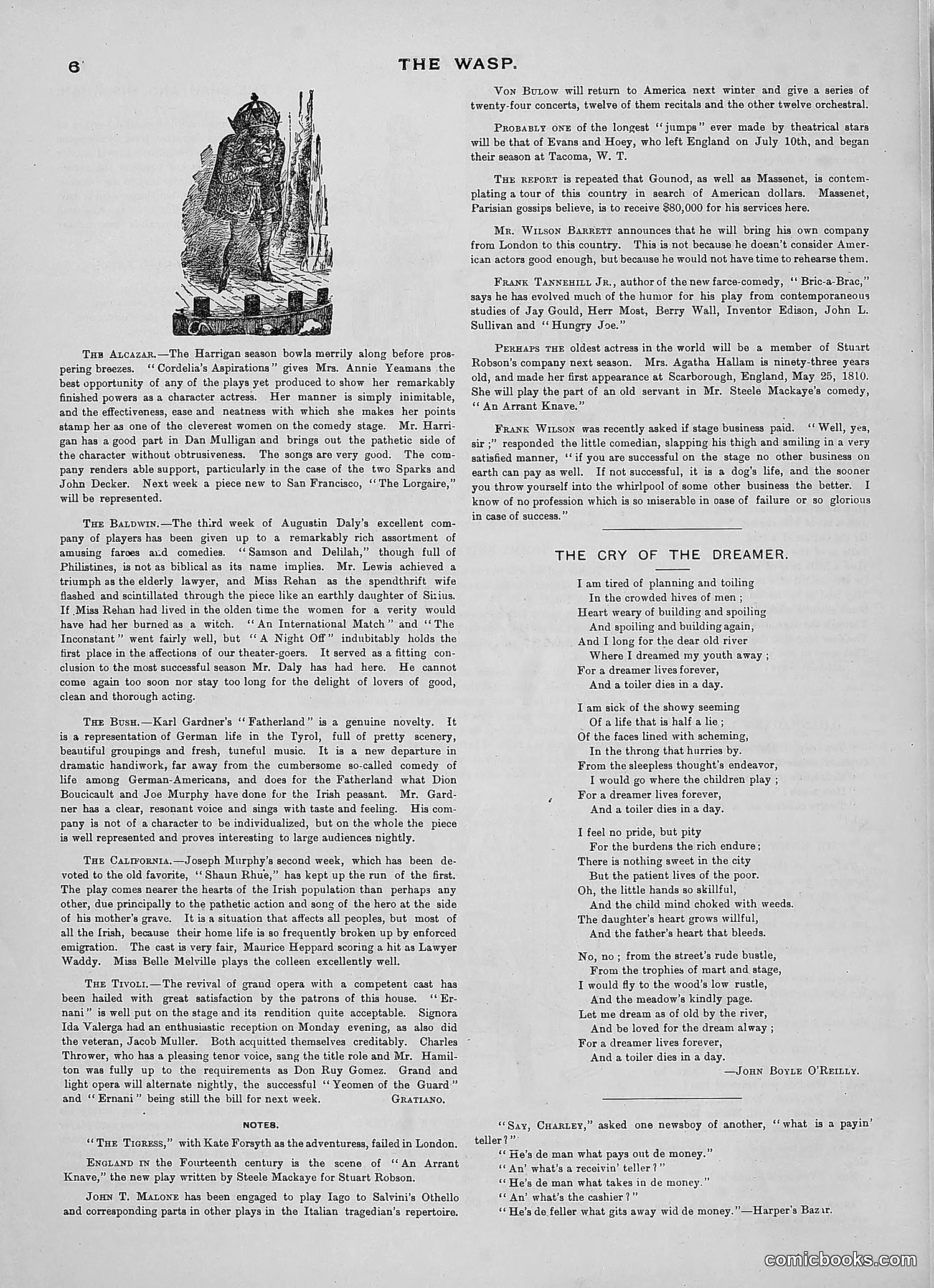
The page is primarily **theatrical gossip and reviews**, not political satire. The engraving at top-left depicts **a wasp on wood**, serving as the magazine's masthead illustration. The text covers stage news: Vox Bilow's American concert tour, Evans and Hoey's theatrical season, rumors about Gounod and Massenet seeking American dollars, and reviews of plays including "Cordelia's Aspirations," "The Baldwin," and "Fatherland." **"The Cry of the Dreamer,"** a poem by John Boyle O'Reilly, occupies the right column—a sentimental piece about escapism and poverty, unrelated to satire. The page concludes with light dialect humor about money-lenders. This is **entertainment journalism with minor comic relief**, not political commentary.

The Wasp — 1889 — page 84 of 450
84 / 450
What you’re looking at · open this page on its own ↗

This page contains three distinct humor sections rather than a political cartoon. **"Didn't Like the Game"** features Uncle Pete criticizing baseball as confusing and poorly organized—a satire of the sport's complex rules and early professionalization era. **"Sam Jones Answered"** describes a humorous anecdote about a man claiming descent from heaven and hell, met with sardonic replies. The joke targets religious pretension and genealogical boasting. **"The Nickle Story"** reviews a boys' adventure magazine, satirizing pulp fiction's implausible train-chase scenarios with exaggerated speeds and impossible physics. The cartoonish illustration shows what appears to be a horse-related incident, though its connection to the adjacent text is unclear from the OCR'd content visible.

The Wasp — 1889 — page 85 of 450
85 / 450
What you’re looking at · open this page on its own ↗

This cartoon from *The Wasp* satirizes President Harrison's administration regarding California and the Chinese Exclusion Act. The text indicates Harrison "won't deal" with repealing the Exclusion Act. The bearded man in the center appears to represent President Harrison or an administration official. On the right stands a figure in classical/allegorical dress (possibly representing California or Lady Liberty), shown in an exaggerated, unflattering caricature style typical of the era's satirical art. The cartoon criticizes the administration's refusal to repeal Chinese exclusion legislation—a politically contentious issue in California, which had significant Chinese immigration and anti-Chinese sentiment. The satirist suggests the administration's inaction disappoints those (represented by the allegorical figure) seeking policy change.

The Wasp — 1889 — page 86 of 450
86 / 450
What you’re looking at · open this page on its own ↗

This *Wasp* cartoon satirizes U.S. immigration policy and government hypocrisy regarding Chinese immigrants. Two well-dressed men—one identified as the Attorney-General—hold a document labeled "Chinese in Transit." The cartoon depicts them as duplicitous: they publicly claim adherence to "form, policy and your own promises" while children (representing future citizens or vulnerable populations) surround the ship scene above. The satire attacks the contradiction between official statements opposing Chinese immigration and actual enforcement practices. The ship setting references the literal transit of Chinese laborers. The caricatured exaggerated features reflect the period's racist imagery. The cartoon appears to mock government officials for making public anti-Chinese statements while permitting continued immigration through bureaucratic loopholes or selective enforcement.

The Wasp — 1889 — page 87 of 450
87 / 450
What you’re looking at · open this page on its own ↗

This page is primarily **advertising and humor columns**, not political cartoons. The left side contains several "Try Your Best" humor sections—short joke exchanges between characters like a customer and new boy, a bride and groom, and various domestic situations. These are light comedy sketches poking fun at common social situations. The right side features **product advertisements** for Burke's Stout beer, aluminum products from the Newport Aluminum & Steel Company, and Byron Hot Springs resort. There's also an ad for instantaneous photographs by Larkin Street in San Francisco. The page reflects late 19th/early 20th-century American humor conventions: mild domestic comedy, class-conscious jokes, and regional advertising. No significant political satire is present.

The Wasp — 1889 — page 88 of 450
88 / 450
What you’re looking at · open this page on its own ↗

This page is primarily **advertisements and miscellaneous content** rather than political satire. The visible sections include: - **Hair Vigor advertisement** (top left): promoting a hair restoration product with testimonials - **Drunkard cure advertisement**: promoting "Pfeil's Antidote for Alcoholism" - **Memory improvement ad**: "Pick" supplement - **Medical advertisements**: Dr. Prosser's nerve treatments, catarrhal deafness cure The only editorial content is **"He Marched with the Boys"** — a poem about a soldier who participated in combat but maintained his dignity and duty despite hardship and fear. This appears to be patriotic verse rather than satire. The remainder comprises joke sections and restaurant advertisements (Gannon & Gohali, Catarrhil Deafness treatment). This issue functions primarily as a **commercial and entertainment publication** rather than political commentary.

The Wasp — 1889 — page 89 of 450
89 / 450
What you’re looking at · open this page on its own ↗

This page is primarily **advertising and classified notices** rather than political satire or editorial cartoons. The visible content consists of: - Small business advertisements (sewing machines, butter, flour, oysters) - Classified ads for various products and services - Humorous short anecdotes and jokes scattered throughout (about an "unconcerned man," railroad passengers, a milkman) The satirical elements are **minimal and apolitical** — brief comedic dialogues poking fun at everyday situations rather than targeting specific political figures or events. For example, one joke involves a man claiming to put water in milk; another describes railroad discomforts. There are **no identifiable political cartoons or caricatures** on this page. The Wasp's satirical function appears secondary here to its function as a revenue-generating vehicle for advertisements.

The Wasp — 1889 — page 90 of 450
90 / 450
What you’re looking at · open this page on its own ↗

This page is primarily **advertising and notices**, not political satire. The main content includes: - **Pond's Extract advertisement** (prominent, top-left) promoting a commercial product - **Pacific Bank** listing (San Francisco, 1863) - **Theater announcements** for local San Francisco venues (Bush-Street Theater, Tivoli Opera House, etc.) - **Various product advertisements** (Epps's Cocoa, patent covers, sewing machines, etc.) - **Scattered anecdotes and jokes** in the margins—brief humorous exchanges about everyday topics like melons, poverty, and doctor visits The page layout reflects typical 19th-century magazine design: dense advertising mixed with editorial content. While *The Wasp* was satirical, **this particular page contains little political commentary**—it's dominated by commercial notices relevant to San Francisco readers of the 1880s era.

The Wasp — 1889 — page 91 of 450
91 / 450
What you’re looking at · open this page on its own ↗

This page is primarily **advertising and schedule information** for transportation and shipping companies operating in San Francisco and California during what appears to be the late 1880s. The content includes: - Southern Pacific Company train schedules and fares - Local ferry train routes - S.F. & North Pacific Railroad timetables - Steamship company advertisements (Pacific Coast Steamship Co., Oceanic Steamship Co., etc.) - Business advertisements for printing, paper goods, and other services **There are no visible political cartoons or satirical illustrations on this page.** This appears to be a standard advertising section from *The Wasp* magazine, focusing on commercial transportation and business services available in San Francisco at that time. The satirical content, if present in this issue, appears on other pages.

The Wasp — 1889 — page 92 of 450
92 / 450
What you’re looking at · open this page on its own ↗

This page is primarily **advertising content** for hotels, banks, and services along the Pacific Coast and in Eastern locations. The only illustration is a small cartoon in the upper left showing a figure labeled "L. A. BERTELING, SCIENTIFIC OPTICIAN" holding what appears to be optical equipment. The cartoon appears to be a **promotional advertisement** rather than political satire. It depicts Berteling as an inventor/optician, emphasizing his patented instruments for measuring eye strength and determining proper vision correction. The illustration uses exaggeration typical of period advertising to draw attention to his optical services. The remainder of the page consists entirely of hotel listings, banking advertisements, and business directories—standard commercial content rather than satirical commentary.

The Wasp — 1889 — page 93 of 450
93 / 450
What you’re looking at · open this page on its own ↗

This satirical cartoon depicts two gentlemen in formal dress encountering each other on a street. The caption identifies the first as a "Forlorn Creature" who greets the second, saying "Good morning, brother; I am the Bituminous Pavement. Who are you?" The joke appears to reference San Francisco infrastructure problems, likely complaints about poor street conditions. The "bituminous pavement" (asphalt roads) represents a city infrastructure failure, and the two figures "condole" (sympathize) as if both are suffering the same misery. The caricatured faces suggest these may represent specific local figures or conditions, though the exact identities remain unclear without additional historical context about The Wasp's 19th-century San Francisco satirical targets.

The Wasp — 1889 — page 94 of 450
94 / 450
What you’re looking at · open this page on its own ↗

This August 1889 *Wasp* cartoon satirizes efforts to repeal the **Chinese Exclusion Act** through what appears to be casual, backroom dealing. The image depicts five men (likely politicians or lobbyists) casually discussing the repeal of Chinese immigration restrictions—shown as a document labeled "CHINESE EXCLUSION ACT"—while one figure holds up what appears to be a laurel wreath or victory symbol. The title's irony suggests the cartoonist is mocking how easily congressmen might overturn significant legislation through informal negotiation, implying corruption or insufficient democratic process. The caricatured figure on the left uses stereotypical "Chinese" visual depiction, typical of 1880s-90s xenophobic imagery. The satire criticizes both those seeking repeal and the perceived ease of legislative manipulation.

The Wasp — 1889 — page 95 of 450
95 / 450
What you’re looking at · open this page on its own ↗

This political cartoon depicts two men in Victorian dress meeting in a park setting. The caption identifies the figure on the left as "First Forlorn Creature," who claims to be "the Bituminous Pavement," while the right figure appears to be "the Gas Pipes" (text partially obscured). The satire appears to target San Francisco infrastructure problems—likely referring to disputes over street paving materials and gas pipe installation. By personifying these municipal systems as miserable characters "condoling" (sympathizing) with each other, the cartoon mocks the city's infrastructure failures or the bureaucratic conflicts surrounding their maintenance and implementation. The exaggerated facial expressions and body language emphasize the complaint and commiseration, suggesting widespread public frustration with these essential services.

The Wasp — 1889 — page 96 of 450
96 / 450
What you’re looking at · open this page on its own ↗

This 1889 *Wasp* cartoon satirizes efforts to repeal the **Chinese Exclusion Act** of 1882. The illustration shows four well-dressed white men gathered around a Chinese immigrant (depicted with exaggerated racist caricature), who holds a document labeled "CHINESE EXCLUSION ACT." One figure holds wheat, another gestures dismissively—the "easy work" of the title appears sarcastically to mock the notion that repeal could happen smoothly. The cartoon's tone suggests the cartoonist views repeal advocates as foolish or naive, treating the exclusion of Chinese workers as a settled matter. This reflects the fierce anti-Chinese sentiment prevalent in late 19th-century California, where *Wasp* was published.

The Wasp — 1889 — page 97 of 450
97 / 450
What you’re looking at · open this page on its own ↗

This page contains three separate humorous articles with one illustration titled "The Paternal Rebuke." The illustration depicts a domestic scene where a father appears to be scolding children, likely referencing parental discipline and family dynamics—a common satirical subject of the era. The articles include "Going to See a Man" (about a popular slang phrase from 1865), "Bixby's Experiment" (mocking a child's destructive behavior in a home), and several brief anecdotes about courtroom testimony and absurd situations. The content reflects Victorian-era humor emphasizing domestic life, linguistic peculiarities, and social awkwardness rather than explicit political satire. The magazine appears focused on general social commentary and wordplay rather than partisan politics on this particular page.

The Wasp — 1889 — page 98 of 450
98 / 450
What you’re looking at · open this page on its own ↗

This page contains satirical sketches and humorous commentary typical of 19th-century American magazines. The main elements include: **"The Answered Prayer"** — A three-act tragedy illustrated with crude woodcuts depicting domestic/romantic scenes, likely mocking melodramatic theater or sentimental literature. **"His Danger"** — A dialogue between "Little Tot" and "Mother" making jokes about a thin man and a whistling musician being vaccinated, referencing contemporary medical practices. **"Scenes at the Paris Exposition"** — Four brief satirical vignettes poking fun at international visitors' behavior and attitudes at what appears to be a world's fair, including stereotypes about Japanese, Spanish, and English tourists. The cartoons use exaggerated characterization and class-based humor typical of period satire, though specific political references remain unclear without additional historical context.

The Wasp — 1889 — page 99 of 450
99 / 450
What you’re looking at · open this page on its own ↗

This is primarily a **text-based editorial and opinion page**, not a cartoon page. The main article critiques Attorney-General Miller's actions regarding Chinese exclusion and deportation enforcement. The key arguments satirized: 1. **Miller's inconsistency**: He's accused of selectively enforcing anti-Chinese laws while ignoring precedents set by previous administrations and the Supreme Court. 2. **The deportation scheme**: The piece mocks Miller's plan to transport Chinese immigrants via train with detectives, suggesting guards could be bribed and certificates forged. 3. **Border control hypocrisy**: Miller claims to prevent Chinese from reaching America through Canada, yet the author argues this responsibility belongs to the border itself, not internal policing. The satire attacks governmental overreach and the impracticality of exclusion enforcement rather than targeting individuals directly.

The Wasp — 1889 — page 100 of 450
100 / 450
What you’re looking at · open this page on its own ↗

This page contains multiple short humor pieces and dialogues rather than political cartoons. The content includes: **"The Little Flea"** — A poem celebrating fleas' boldness and freedom, likely satirizing something through this unusual praise. **"The Wasp"** — A central illustration showing a domestic scene, referenced by several dialogue pieces below it about social situations. **Social Satire Pieces:** Short dialogues mock various Victorian-era social types: a pompous bar-keeper disputing an honest claim, a teacher and student debating education, theater gossip, landlord-tenant disputes, and marital disagreements about smoking and promises. The humor targets everyday hypocrisy—people contradicting themselves about morality, marriage, and social obligations. Without identifying specific individuals or events, the satire appears to ridicule general middle-class pretension and domestic tensions typical of late 19th-century American society.

The Wasp — 1889 — page 101 of 450
101 / 450
What you’re looking at · open this page on its own ↗

This page consists primarily of **theater and opera reviews and gossip** rather than political satire. The left side features a single illustration—a caricatured figure in dramatic pose labeled "The Baldwin." The content discusses various theatrical productions and performers of the era, including Miss Rose Coghlan's performance in a play, Karl Gardiner's comedy "Karl the Peddler," and opera singers performing at venues like the Tivoli and Covent Gardens. The "Presence of Mind" anecdote at the bottom is a humorous short story about a politician's wife testing hotel accommodations. **This is entertainment criticism and gossip, not political commentary.** The satire, if any, targets theatrical pretension and dramatic personalities rather than political figures or events.

The Wasp — 1889 — page 102 of 450
102 / 450
What you’re looking at · open this page on its own ↗

This page contains three separate fictional stories rather than political cartoons: 1. **"Triumphant Love"** — a serialized bicycle romance from 1889, featuring characters Rachel and Eugenio in a melodramatic tale. 2. **"A Mortal Injury"** and **"Human Nature on the Highway"** — anecdotal stories about brick-wagon accidents and disputes. 3. **"He Had Rheumatics"** — a humorous dialogue between a cabin visitor and a man suffering from rheumatism, treated comically. The page includes one small illustration showing what appears to be a policeman and civilian. The content emphasizes *The Wasp's* role as a general-interest satirical magazine mixing serialized fiction, humor columns, and commentary rather than solely political cartooning.

The Wasp — 1889 — page 103 of 450
103 / 450
What you’re looking at · open this page on its own ↗

This satirical cartoon depicts European military and political leaders in chaotic retreat, likely responding to 19th-century revolutionary upheaval or military conflict. The elaborate uniforms, plumed hats, and regalia identify these as high-ranking European officials or monarchs. The scene shows them abandoning their positions—fleeing across water with belongings and weapons scattered about. The satire mocks European aristocratic leadership as incompetent and cowardly, literally running away rather than maintaining authority. The title "Flight of European Capitals" suggests major European powers are abandoning their seats of government, presumably due to popular uprisings or military defeats. The exaggerated, grotesque caricatures emphasize the cartoonist's contempt for these figures and their governance.

The Wasp — 1889 — page 104 of 450
104 / 450
What you’re looking at · open this page on its own ↗

This satirical cartoon from *The Wasp* depicts a scene labeled "TAL TO THE UNITED STATES" (likely "CAPITAL TO THE UNITED STATES"). The image shows caricatured figures engaged in what appears to be a hostile confrontation near water. On the left, a large grotesque figure (possibly representing a foreign power or corrupt entity) looms menacingly. On the right, Uncle Sam (identifiable by his characteristic starred hat and striped clothing) stands with what appears to be an eagle, confronting the threat. The smaller figures in the water appear to be armed combatants or soldiers, suggesting military conflict or invasion. The overall composition conveys a warning or alarm about some external threat to American interests. Without clearer context or caption text, the specific historical event referenced remains uncertain, though the imagery suggests xenophobic or nationalist sentiment typical of late 19th-century American political satire.

The Wasp — 1889 — page 105 of 450
105 / 450
What you’re looking at · open this page on its own ↗

This page is primarily **advertisements and miscellaneous humor columns** rather than political cartoons. The left side contains anecdotal jokes and brief stories under headings like "Favored by Fortune" and "Reformation Goes Bravely On." The right side features commercial advertisements for **Burke's Stout** (beer), **Aluminum** products, **Byron Hot Springs** resort, and photography services. The humor pieces are light social satire—anecdotes about lottery winners, mishaps with tailors and servants, and domestic disputes. They mock **upper-class pretension** and **absurd human behavior** rather than targeting specific political figures or events. The page reflects *The Wasp*'s general approach: mixing gentle satirical commentary with advertisements, targeting no particular ideology but rather poking fun at universal human foibles.

The Wasp — 1889 — page 106 of 450
106 / 450
What you’re looking at · open this page on its own ↗

This page is primarily **advertisements and miscellaneous content** rather than political satire. The main cartoon titled "When You Know" depicts two men in period dress discussing Ayer's Sarsaparilla, a patent medicine. The joke appears to be that one man recommends the product to the other, though the satire is mild—likely poking fun at the ubiquity of sarsaparilla advertising and inflated health claims of patent medicines popular in the era. The bulk of the page consists of **commercial ads** (Ayer's Sarsaparilla, Drunkard treatment, memory courses, Dr. Prosser), humor columns with anecdotes, and a display ad for **Clown's Notab Co.** furnishing goods. The "Short Time Ago" anecdote about an escaped prisoner appears to be light humor rather than political commentary.

The Wasp — 1889 — page 107 of 450
107 / 450
What you’re looking at · open this page on its own ↗

This page is primarily **advertising and commercial content** rather than political satire or comics. It contains numerous classified ads and product advertisements typical of a late 19th or early 20th-century American magazine, including: - The "New Home" sewing machine (prominently featured) - Tooth polisher products - Various patent medicines and remedies - Business services and local San Francisco establishments The only substantive editorial content is a brief dialogue piece titled "Are Mustaches Contagious?" — a humorous social commentary about women adopting mustaches, presented as dialogue between characters discussing fashion trends. The page reflects The Wasp's business model: mixing satirical commentary with revenue-generating advertisements for local San Francisco merchants and patent medicines.

The Wasp — 1889 — page 108 of 450
108 / 450
What you’re looking at · open this page on its own ↗

This page is primarily **advertising and notices** rather than political cartoon content. The main illustrations are commercial product advertisements: Pond's Extract (a popular patent medicine for bruises, wounds, and ailments), Epps's Cocoa, a sewing machine, and Liebig's Extract of Meat. The only satirical content appears to be brief comedic dialogues ("A Liberal Discount" and "A Clincher") featuring frontier/rural characters negotiating prices. These mock unsophisticated negotiating tactics and regional dialect humor typical of 19th-century American comic writing. The page reflects **The Wasp's** mixed revenue model—relying on patent medicine and consumer product advertising alongside satirical content to remain financially viable.

The Wasp — 1889 — page 109 of 450
109 / 450
What you’re looking at · open this page on its own ↗

This page is primarily **advertising and transportation schedules**, not editorial content or cartoons. It contains listings for: - Southern Pacific Company train schedules and routes - S.F. & North Pacific Railroad timetables - Pacific Coast Steamship Company departures - Oceanic Steamship Company schedules - Various other shipping and transit services - Small advertisements for businesses like Blake, Moffitt & Towne (books/stationery) and E.H. Tharp (patents) There are no visible political cartoons or satirical illustrations on this page. The only images are small company logos/emblems. The page serves as a practical directory for late 19th-century San Francisco transportation options rather than satirical commentary.

The Wasp — 1889 — page 110 of 450
110 / 450
What you’re looking at · open this page on its own ↗

This page is primarily **advertising**, not editorial content or satire. It contains hotel and business advertisements for California locations (Fresno, Sacramento, San Jose, Los Angeles, etc.) and services like banks and asylums. The only cartoon visible is in the upper left: **L.A. Berteling, Scientific Optician**—a humorous illustration showing a character with an enormous eye, advertising optical instruments and services at "427 Kearny St." The exaggerated eye is a straightforward visual pun about an optician's profession. Below that is a "Tansy Pills" advertisement making dubious medical claims. The page represents typical late 19th/early 20th-century magazine advertising practice, mixing legitimate businesses with patent medicines and quack remedies now recognized as fraudulent.

The Wasp — 1889 — page 111 of 450
111 / 450
What you’re looking at · open this page on its own ↗

This political cartoon depicts Uncle Sam (representing the United States) refusing to purchase seal-skin for Miss Canada (personified Canada). The caption states: "No, Miss Canada; you may need a new seal-skin, but we can't afford it. Pretty soon the price will be a $1,000 each." The cartoon satirizes American reluctance to support Canadian interests, likely regarding trade or resource access. The "seal-skin" reference suggests a commercial dispute over seal hunting or fur trade—commodities valuable to Canada's economy. By depicting Canada as a woman requesting luxury goods Uncle Sam cannot "afford," the cartoonist mocks American fiscal constraints while implying Canada's dependence on American economic support or trade cooperation.

The Wasp — 1889 — page 112 of 450
112 / 450
What you’re looking at · open this page on its own ↗

This political cartoon satirizes **John Bull** (the personified British Empire, shown as the figure with the exaggerated features on the right) and his relationship to colonial wealth. The caption reads: "THE HEN WITH THE GOLDEN EGGS—BUT IT IS JOHN BULL WHO HAS TO GILD THEM." The cartoon depicts Bull examining or managing a hen that lays golden eggs—a metaphor for profitable colonies. The figure on the left (carrying a sack labeled "CHICKEN FEED") appears to be another national power providing resources or investments. The satire suggests Britain must continuously invest in ("gild") its colonial possessions to maintain their profitability, rather than simply reaping easy rewards. It critiques the hidden costs of empire—that colonial wealth requires constant maintenance and resource expenditure.

The Wasp — 1889 — page 113 of 450
113 / 450
What you’re looking at · open this page on its own ↗

This page contains two illustrated anecdotes from *The Wasp*, a satirical magazine. The main cartoon titled "Early and Late" depicts a creditor confronting an old man (Uncle Taylor) about an unpaid boot debt from twenty years prior. The cobbler threatens to extract payment from the debtor's hide—a humorous play on words since boots are made from leather. The satire mocks both the persistence of old debts and the debtor's failed excuses. Below, "She Lived to Spite Him" presents a biographical sketch of a woman engaged twice who never married, despite societal pressure. The text mocks her defiance of matrimonial expectations and the old lady's vindication in outliving her suitor. The remaining text consists of dialogue snippets and social commentary, including exchanges about a visit to Washington and dining at the White House—likely satirizing pretension or social climbing.

The Wasp — 1889 — page 114 of 450
114 / 450
What you’re looking at · open this page on its own ↗

This page contains several satirical vignettes rather than a single political cartoon. The humor targets everyday social situations: **"The Progressive Heathen"** depicts a Mission Street Railway car, satirizing missionary work's contradiction—preaching morality while transporting a diverse, possibly disreputable crowd. **"In the Blooming Summer"** presents a sentimental reunion dialogue between former lovers, mocking melodramatic sentiment and romantic clichés popular in period literature. The remaining sections ("A Preventive to Drowning," "The Brainful Dude," etc.) are brief comedic dialogues poking fun at foolish characters—a half-blind museum visitor, someone with an absurdly long cane, and various socially awkward types. The overall tone is light, domesticated satire focusing on manners and human folly rather than serious political critique. The included illustrations support these humorous social observations.

The Wasp — 1889 — page 115 of 450
115 / 450
What you’re looking at · open this page on its own ↗

This is primarily a text page with no visible political cartoons. The content includes: **Editorial commentary** on several scandals: Dr. Brown-Séquard's claims about rejuvenation through animal extracts; the Wilcox uprising in Hawaii; and the death of David S. Terry (former California Chief Justice) during an assault on Stephen J. Field (sitting Supreme Court judge). **Brief satirical items** mocking John Bull's financial troubles, Emperor William's visit to England, and various social follies. **Humorous dialogue exchanges** about debt, cooking incompetence, and foolishness. The page serves as editorial opinion and society commentary rather than visual satire, typical of a text-heavy satirical magazine of this era.

The Wasp — 1889 — page 116 of 450
116 / 450
What you’re looking at · open this page on its own ↗

This page contains primarily humorous short pieces and jokes rather than political cartoons. The visible illustrations show: 1. **"With One Stroke"** - A sketch of a man in period dress (appears to be a dandy or fashionable gentleman) in an exaggerated pose, likely satirizing affected mannerisms of the upper class. 2. **"Overheard on Mission Street"** - A street scene showing what appears to be a beggar or working-class figure confronting a well-dressed gentleman, suggesting class commentary through their interaction. The text consists of satirical dialogues and one-liners mocking various targets: pretentious speech patterns, fashion affectations, social climbing, and class distinctions. The humor relies on wordplay and observational comedy about San Francisco society and behavior. Without additional context about specific contemporary figures or events, the satire appears directed at general social types rather than particular political targets.

The Wasp — 1889 — page 117 of 450
117 / 450
What you’re looking at · open this page on its own ↗

This page contains theater notes and criticism rather than political cartoons. The only illustration is a detailed engraving of a wasp on a branch at the top left. The "Notes" section discusses theatrical performers and productions of the era—including mentions of opera singers, comic performers like Stanley Filch and Carrie Demar, and productions like "The Burglar" and "Squatter Sovereignty." The text critiques acting quality and theatrical trends. Below is a poem titled "Stan' Up An' Git Hit," seemingly about perseverance and fighting through hardship—likely a humorous or inspirational piece for readers. The page represents *The Wasp's* focus on San Francisco entertainment criticism and cultural commentary rather than strictly political satire. Without additional context about specific performers or productions referenced, the full satirical intent remains unclear to modern readers.

The Wasp — 1889 — page 118 of 450
118 / 450
What you’re looking at · open this page on its own ↗

This page contains several satirical anecdotes and jokes rather than a single cartoon. The central illustration depicts a chaotic scene at what appears to be a clock store or repair shop, visualizing the story "Always Dangerous" about a man trying to steal a clock. The humor throughout is primarily situational rather than politically targeted. Stories mock human behavior: a traveler's dispute over a stolen trunk, a farmer's failed scheme to poison crows with whiskey-soaked corn, and exchanges about dependent husbands. The page reflects late 19th/early 20th-century American vernacular humor—emphasizing dialect, foolish schemes, and marital dynamics. There's no clear political commentary visible; instead, it represents *The Wasp*'s role as a general-interest humor publication mixing tall tales with domestic comedy.

The Wasp — 1889 — page 119 of 450
119 / 450
What you’re looking at · open this page on its own ↗

This satirical cartoon depicts what appears to be a medical procedure being performed on a military or political figure (center, in uniform with checkered pattern). The title "An Injection" suggests forcible administration of policy or ideology. The surrounding figures—dressed in formal 19th-century attire—appear to be politicians or officials overseeing or administering this "injection." Their varied expressions suggest differing attitudes toward the procedure. The specific identities and political context remain unclear without additional publication details (date, issue number). However, the cartoon likely comments on controversial government policies being imposed upon military leadership or a particular political faction, using the "injection" metaphor to suggest unwilling or forced implementation. The artist signature reads "WALTER."

The Wasp — 1889 — page 120 of 450
120 / 450
What you’re looking at · open this page on its own ↗

This political cartoon satirizes corruption in San Francisco's municipal services. The central figure appears to be a naive or innocent "lamb" (labeled as such in the caption) being victimized by corrupt officials and institutions. The men in suits and hats represent city departments—visible labels include "School Dept. Refresher," "Street Dept. Reviver," and "Police Dept. Whiskey"—suggesting these agencies used public funds for personal indulgence rather than public service. The bottles and various implements scattered about reinforce accusations of systematic graft and misuse of public money. The smaller figure being manipulated represents how ordinary citizens ("the lamb") were exploited by corrupt city governance. The cartoon's message: honest citizens don't thrive under such corruption.

The Wasp — 1889 — page 121 of 450
121 / 450
What you’re looking at · open this page on its own ↗

This page is primarily **humorous quotations and advertisements** rather than political cartoons. The left column contains short, witty remarks on topics like love, marriage, cold weather, and social behavior—typical of Victorian-era satirical humor magazines. The advertisements dominate the right side, promoting products like Burke's Stout beer, aluminum products, and Byron Hot Springs resort. These ads reflect late 19th/early 20th-century consumer goods. The few identifiable references include mentions of "Moneybags" (a generic wealthy character in a conversation about forgetting old friends) and various humorous observations about contemporary life. No specific political figures or events are clearly satirized on this particular page.

The Wasp — 1889 — page 122 of 450
122 / 450
What you’re looking at · open this page on its own ↗

This page is primarily **advertising and advice columns** rather than political satire. The main content includes: **Left column:** Advertisement for Ayer's Hair Vigor (hair product) with an illustrated woman, plus ads for alcohol cures and memory improvement courses. **Center:** Humorous advice columns and anecdotes—"A Civil Service Examination" (mocking an Indian father's questions to his son), "Wanting a Confident Rival" (poker joke), "An Impulsive Mayor" (Cincinnati mayor anecdote), and workplace humor involving pudding and arms. **Right column:** Gentlemen's furnishing goods advertisement and medical specialist advertisements. The "humor" pieces rely on period stereotypes and slapstick rather than sharp political commentary. This appears to be a typical late-19th-century satirical magazine page mixing editorial cartoons with commercial content and light comic fiction.

The Wasp — 1889 — page 123 of 450
123 / 450
What you’re looking at · open this page on its own ↗

This page is primarily **advertising and editorial content** rather than political cartoons. The dominant feature is a large advertisement for "The New Home" sewing machine, claiming "ONE MILLION SOLD" and positioned as the "LEADER OF THE AGE In Practical Improvement." The upper portion contains a humorous dialogue between literary figures—**Wordsworth, Lamb, and Dumas**—debating writing styles and literary merit. This appears satirical commentary on pretentious literary criticism rather than political satire. The remainder consists of various classified advertisements and commercial notices typical of 1890s periodicals: patent medicines (piles remedies, rupture cures), business services, and goods. **No identifiable political cartoons are visible on this page.** The content reflects The Wasp's mixed format of satirical commentary alongside commercial advertising.

The Wasp — 1889 — page 124 of 450
124 / 450
What you’re looking at · open this page on its own ↗

This page is primarily **advertising and entertainment listings** rather than political satire. The main cartoon depicts a horse race with text reading "THE RACE IS NOT ALWAYS TO THE SWIFT SO IT AIN'T!" — a humorous play on the biblical phrase "the race is not to the swift" (Ecclesiastes 9:11), suggesting that effort doesn't guarantee success. The page features ads for patent medicines (Pond's Extract, Epps's Cocoa, Tarrant's Extract), theaters, and banks. The accompanying anecdotes are brief humor pieces about working-class characters and everyday situations — a hotel clerk's scheme, an Italian nobleman selling titles — typical of late 19th-century satirical magazine filler. **This is largely a commercial/entertainment page rather than political commentary.**

The Wasp — 1889 — page 125 of 450
125 / 450
What you’re looking at · open this page on its own ↗

This page consists almost entirely of **transportation and shipping advertisements** rather than satirical cartoons or political content. The ads promote: - Southern Pacific Railway passenger trains and schedules - Local ferry services in San Francisco - S.F. & North Pacific Railroad - Various steamship companies (Pacific Coast, Oceanic, Occidental and Oriental, Pacific Mail) The only non-advertisement content visible appears to be a small header/masthead for "The Wasp" at the top, but the bulk of the page is dedicated to detailed travel schedules, fares, and routing information. **This is a commercial advertising page**, not a vehicles for satire or political commentary. It reflects late 19th-century San Francisco's importance as a major transportation hub.

The Wasp — 1889 — page 126 of 450
126 / 450
What you’re looking at · open this page on its own ↗

This page is primarily a **directory of hotels and advertisements**, not a satirical cartoon or editorial content. The only illustrated element is an advertisement in the upper left for "L. A. Berteling, Scientific Optician" featuring a caricatured face wearing spectacles. The image appears to be a standard commercial advertisement rather than political satire. The rest of the page consists of hotel listings (many California establishments like the Occidental Hotel, Ebbitt in Washington D.C., and various Pacific Coast properties) and business advertisements including the First National Bank of Stockton and The Pacific Asylum. **This is essentially a classified advertising and business directory page**, not a satirical or editorial section of the magazine.

The Wasp — 1889 — page 127 of 450
127 / 450
What you’re looking at · open this page on its own ↗

This page from *The Wasp* satirical magazine shows a political cartoon titled "Playing at Revolution" (visible on left margin). The image depicts multiple figures in military and civilian dress appearing to tumble or fall chaotically, suggesting incompetence or farce. The text references "the other dodge kindhearted and cunning of an idle and quarrelsome set of boors," indicating mockery of specific political figures or groups attempting revolution. The cartoon likely satirizes a failed or bungled political uprising or coup attempt, portraying the participants as bumbling rather than threatening. The exaggerated poses and chaotic composition suggest the cartoonist viewed these events as comedic theater rather than serious political action. Without clearer identification of specific individuals or the exact historical moment, the precise targets remain unclear, though the overall message is contemptuous ridicule of revolutionary pretenders.

The Wasp — 1889 — page 128 of 450
128 / 450
What you’re looking at · open this page on its own ↗

This political cartoon satirizes San Francisco's detective force, depicting five men sheltering under a large umbrella labeled "Wasp." The caption reads: "THE MYSTERY REMAINS A MYSTERY. OUR BRILLIANT DETECTIVES CAN NOW GO TO SLEEP AGAIN." The cartoon mocks local detectives for failing to solve some unspecified case—"the mystery" suggests a high-profile unsolved crime. The figures appear to represent San Francisco's law enforcement officials, portrayed as incompetent and indifferent, now comfortable enough to rest despite their failure. The satirical tone suggests The Wasp's readers were frustrated with police bungling. The umbrella metaphor may indicate the magazine itself provides shelter or criticism of official incompetence. Without identifying the specific case referenced, the cartoon's point is clear: it's ridiculing detective work deemed inadequate or abandoned.

The Wasp — 1889 — page 129 of 450
129 / 450
What you’re looking at · open this page on its own ↗

This page from *The Wasp* contains several brief humorous stories rather than political cartoons. The main illustrated piece, captioned "AND THEY HAD JUST BEEN DANCING," shows a couple—a woman in a dress and a man in formal attire—in an apparently awkward moment, likely depicting a romantic or social mishap. The text pieces are anecdotes about everyday absurdities: a merchant's dubious drug remedy, frontier justice in Michigan, a man's excuse involving a train and a cart, and a joke about Lord Lonsdale's large family. These represent typical *Wasp* humor—satirizing common social pretensions, incompetence, and minor scandals rather than addressing major political events. The humor targets middle-class foolishness and provincial manners rather than prominent public figures.

The Wasp — 1889 — page 130 of 450
130 / 450
What you’re looking at · open this page on its own ↗

This satirical cartoon depicts a man with an exaggerated face peering out from a building window, positioned beneath "Help Wanted" signs that explicitly state "No Irish Need Apply." The imagery illustrates the prevalent anti-Irish employment discrimination in late 19th-century America. The man's dejected expression and the repetition of identical "Help Wanted / No Irish" signage emphasize how systematically Irish immigrants were excluded from jobs. The accompanying text about "Old Mr. Baldgate" sleeping during office hours suggests hypocrisy—employers rejected qualified Irish workers while tolerating laziness in favored employees. This was a widespread practice; such discriminatory hiring notices were common in American newspapers and storefronts during this era, reflecting severe prejudice against Irish immigrants competing for scarce work.

The Wasp — 1889 — page 131 of 450
131 / 450
What you’re looking at · open this page on its own ↗

This is primarily a **text-heavy editorial page** rather than a satirical cartoon page. The main article discusses **Canadian commercial expansion** into American territory, expressing concern that Canadian railways and shipping lines are encroaching on U.S. markets without reciprocal American access to Canadian routes. The piece argues the U.S. government should reciprocate by granting American companies similar commercial privileges in Canada, warning that without action, Canada will dominate North American trade. The page also contains brief notices about theatrical amusements and a criminal case involving Dr. Milton Bowers (accused of poisoning). The satire is **political-economic** rather than visual, targeting perceived inequities in U.S.-Canadian trade relations.

The Wasp — 1889 — page 132 of 450
132 / 450
What you’re looking at · open this page on its own ↗

This page contains several satirical pieces and illustrations typical of late 19th-century American humor magazines. **"A FIEND INCARNATE"** depicts what appears to be a wealthy man (caricatured stealing from a house on Geary Street). The satire targets urban theft and class inequality—the criminal is portrayed as someone who steals "bank bills, gold watches, railroad bonds," suggesting organized crime among the privileged classes rather than petty theft. **"HIS DESCENT"** and related pieces mock legal hypocrisy and the justice system, with references to court cases and sentencing. The illustrated vignettes feature exaggerated character types common to satirical journalism: foolish gentlemen, scheming lawyers, and working-class figures. The humor relies on social commentary about crime, legal corruption, and class disparities—issues readers would recognize from contemporary San Francisco society.

The Wasp — 1889 — page 133 of 450
133 / 450
What you’re looking at · open this page on its own ↗

This is primarily a **text-based editorial page** rather than a cartoon page. The Wasp (dated August 24, 1889) contains publication information, subscription rates, and advertising for local theaters (Baldwin Theater, California Theater). The bulk of the page consists of **political commentary** on several issues: 1. **Canadian railroad competition** - criticizing unfair trade advantages given to Canadian Pacific Railway 2. **Secretary Windom's Chinese policy** - arguing he's been too soft on excluding Chinese immigrants 3. **Dr. Milton Bowers case** - discussing a poisoning accusation and failed detective work 4. **Canadian seal fishing** - commenting on Canadian activities in Pacific waters The satire targets **government incompetence and favoritism** rather than specific individuals through visual caricature. No visible political cartoons appear on this particular page.

The Wasp — 1889 — page 134 of 450
134 / 450
What you’re looking at · open this page on its own ↗

This page contains humor sketches and brief satirical pieces rather than a unified political cartoon. The content includes: **"Lui et Elle"** and **"One of the Million-airs"**: Short comedic dialogues about romantic and social situations, with no clear political reference. **The central illustration** appears to show a domestic scene, possibly satirizing social pretension or family dynamics, though specific figures aren't identifiable. **"A Friend Incarnate"** and other pieces** mock everyday situations—a man stealing stairs during construction, baseball players, fashionable but poor gentlemen. The overall tone targets **middle-class social affectations and absurdities** rather than specific political figures or events. These are observational humor pieces about manners, ambition, and social climbing typical of satirical magazines of this era. Without dated context, the specific references remain unclear.

The Wasp — 1889 — page 135 of 450
135 / 450
What you’re looking at · open this page on its own ↗

This page is primarily **theatrical gossip and reviews** rather than political satire. The content discusses stage productions and performers of the era, including commentary on plays like "Conflict," "The California," and "The Alcazar." The only illustration—a detailed engraving at top left—appears to be **The Baldwin**, likely depicting a scene or character from a theatrical production, though the specific reference is unclear from the visible text. The page concludes with "Thoughts for a Discouraged Farmer," a **poem offering philosophical consolation** to struggling agricultural workers facing crop failures and hardship. This reflects The Wasp's occasional turn toward social commentary on rural economic distress, a significant issue of the period. The content is primarily **entertainment and agricultural commentary** rather than partisan political satire.

The Wasp — 1889 — page 136 of 450
136 / 450
What you’re looking at · open this page on its own ↗

This page contains several short satirical pieces and anecdotes rather than a single unified political cartoon. The main illustration labeled "A Bright Idea" depicts what appears to be a domestic scene—a man speaking to a seated woman holding a baby. The accompanying dialogue suggests the man is proposing a solution to their situation, likely involving leaving or traveling, while the woman expresses concern about the baby. The other sections—"Talk About Slow Trains," "Starting a Balky Horse," "A Cautious Darkey," and "The Diary of a Baccanalian"—are humor pieces exploiting common late-19th-century American stereotypes: slow rural railroads, balky animals, and racial caricatures. These represent typical Wasp content: satirizing everyday American life and social situations through period-specific humor.

The Wasp — 1889 — page 137 of 450
137 / 450
What you’re looking at · open this page on its own ↗

This illustration satirizes American railroad expansion and its relationship to westward settlement and commerce. The cartoon depicts a vertical cross-section showing three transportation layers: ships in a harbor below, railroad trains in the middle landscape, and what appears to be Native Americans or frontier settlers on the right side observing the development. The text headline "How can American railroads, fette[d]..." (incomplete in the OCR) suggests criticism of railroad regulations or limitations. The stacked cargo cars labeled with various goods indicate the commercial exploitation of resources and trade routes during westward expansion. The overall composition critiques how railroads simultaneously colonized the landscape, displaced indigenous peoples, and consolidated corporate economic power—a common satirical theme in Gilded Age publications like The Wasp.

The Wasp — 1889 — page 138 of 450
138 / 450
What you’re looking at · open this page on its own ↗

This Wasp cartoon satirizes American railroad competition with Canadian lines. The illustration depicts an American Railroad (marked "AMERICAN R.R.") operating in what appears to be a frontier or developing territory, with shipping vessels and infrastructure visible. The partially visible text at bottom references Canadian competitors receiving "heavy subsidies"—the cartoon's central complaint. The American railroad operation is shown as a modest, struggling enterprise compared to what would be well-funded Canadian rivals. The satire critiques perceived unfair competition: Canadian railroads allegedly received government financial support that American companies couldn't match, creating unequal market conditions. This reflects late 19th/early 20th-century debates over protectionism, industrial subsidies, and cross-border economic rivalry during North American railroad expansion.

The Wasp — 1889 — page 139 of 450
139 / 450
What you’re looking at · open this page on its own ↗

This page is primarily **advertisements and humor columns** rather than political cartoons. The visible content includes: **Advertisements:** Burke's Stout beer, aluminum products, Byron Hot Springs resort, and instantaneous photography services dominate the right side. **Humor Sections:** The left side contains brief joke columns with titles like "Try Hard," "A Very Suspicious Cuss," and "Grant as a Wood-Cutter." These are short anecdotes poking fun at various professions and social types—grave-diggers, physicians, clergymen, and others—using gentle ridicule typical of turn-of-the-century American satirical magazines. **Historical Context:** Without specific political figures named, these appear to be general social satire rather than commentary on particular events or politicians. The tone is light and comedic rather than sharply political.

The Wasp — 1889 — page 140 of 450
140 / 450
What you’re looking at · open this page on its own ↗

This page is primarily **advertising and advice columns** rather than political satire. The notable content includes: - **"Born That Way"** and **"A Little Mixed"** — brief anecdotal humor columns poking fun at domestic situations and regional dialects - Multiple commercial advertisements for patent medicines (Ayer's Sarsparilla, Drunkard cure), dental products, and a self-defense guide - **Dr. Prosser's medical advertisement** claiming to treat chronic diseases The only visual cartoon shows a bearded man advertising "Ideal Tooth Polisher" — standard product promotion rather than political commentary. The page reflects late 19th-century publishing: mixing editorial humor with heavy advertising revenue. No clear political satire or identifiable public figures are present. It's representative of how satirical magazines supplemented content with commercial notices.

The Wasp — 1889 — page 141 of 450
141 / 450
What you’re looking at · open this page on its own ↗

This page is primarily **advertising and classified notices** rather than satirical cartoons. The Wasp's masthead appears at top, but the majority of the page contains: - Patent medicine ads (Aetna Mineral Water, "FITs Cured by old Specialist Physician," remedies for piles, rupture, weak men) - Business advertisements (printing, saloon, butter, oysters) - A brief humorous anecdote titled "Reducing a Story" about a Southern sportsman exaggerating hunting tales - Smaller pieces like "A Hen-pecked Man" and "A Natural Mistake" The only satirical content is the short anecdotes mocking boastfulness and marital dynamics—typical period humor rather than political commentary. This appears to be a **revenue page** where The Wasp filled space with paid advertisements and filler content, common in 19th-century magazines.

The Wasp — 1889 — page 142 of 450
142 / 450
What you’re looking at · open this page on its own ↗

This page is primarily **advertisements and theater listings** rather than political satire. The main cartoon, titled "Boys Will Be Boys But Coming Men Don't Compare," appears in the lower-left section and shows crude, mischievous children. The accompanying text references "Jackson's Napa Soda" as superior product. The page includes ads for Pond's Extract (medical), Epps's Cocoa, Pacific Bank, and various San Francisco entertainments. Several gossip-style columns occupy the upper portion, featuring anonymous anecdotes about marriage, servants, and social behaviors—typical period humor rather than political commentary. Without clearer identifying features or headlines, the specific satirical targets of individual items remain unclear, though the overall tone reflects 1863 San Francisco social commentary.

The Wasp — 1889 — page 143 of 450
143 / 450
What you’re looking at · open this page on its own ↗

This page is primarily **advertising and transportation schedules**, not satirical content. It contains multiple railroad and steamship timetables and advertisements from companies including: - Southern Pacific Company (passenger trains) - Pacific Coast Steamship Company - S.F. & North Pacific R.R. - Oceanic Steamship Co. - Occidental and Oriental Steamship Company - Pacific Mail Steamship Co. There are also ads for Blake, Moffitt & Towne (book/stationery suppliers), E.H. Tharp (patents), and various other commercial services. **No political cartoons or satirical illustrations are visible on this page.** The content reflects late-19th century San Francisco commerce and transportation infrastructure rather than editorial commentary.

The Wasp — 1889 — page 144 of 450
144 / 450
What you’re looking at · open this page on its own ↗

This page is primarily **advertising rather than editorial content**. It features hotel and business advertisements for California locations (Sacramento, San Francisco, Stockton) and Washington D.C., typical of late 19th-century trade publications. The only cartoon visible is the masthead illustration in the upper left: a caricatured figure with an exaggerated face wearing what appears to be a wasp costume or hat. This likely serves as **The Wasp's logo/mascot** rather than political commentary. The page reflects the magazine's dual function as both satirical publication and commercial advertising vehicle. Without editorial cartoons or articles visible here, the satirical content—if present—would appear elsewhere in the issue. The bulk of this particular page documents period commercial establishments rather than social or political critique.

The Wasp — 1889 — page 145 of 450
145 / 450
What you’re looking at · open this page on its own ↗

This satirical cartoon titled "The Joker Makes His Appearance Once More" depicts several caricatured figures struggling to balance wooden planks labeled with legislation: "America," "Scott's Exclusion Act," and "Union Act." A woman's head emerges from the top plank, labeled "Non Admittance to Merchants' Wives Arriving the First Time." The cartoon appears to satirize competing political interests and trade restrictions of the era. The figures seem to represent different political factions attempting to maintain unstable legislative compromises. The woman's exclusion likely references discriminatory policies affecting merchants' wives, possibly related to Chinese Exclusion Act-era restrictions. The overall metaphor suggests political chaos—the "joker" disrupting careful legal balancing acts. Without The Wasp's publication date visible, the specific legislative moment remains unclear, though the Chinese Exclusion context seems likely.

The Wasp — 1889 — page 146 of 450
146 / 450
What you’re looking at · open this page on its own ↗

This 1889 *Wasp* cartoon satirizes government subsidies to shipping companies. The central well-dressed man appears to be a congressman or government official, while the bound woman represents the U.S. government or taxpayers being exploited. The dialogue reveals the satire's point: Congressman Morrow asks how to free this "pretty lady," and "Old Salt" (the sailor figure) responds that other governments pay shipping lines "liberally" as subsidies. The cartoon criticizes U.S. politicians for considering similar subsidies—essentially wasteful government spending that benefits private steamship companies at public expense. The woman's bondage symbolizes how such subsidies enslave American fiscal resources, making it a critique of corporate welfare and government corruption.

The Wasp — 1889 — page 147 of 450
147 / 450
What you’re looking at · open this page on its own ↗

This page contains three separate humorous stories rather than political cartoons. The illustrations appear to be character vignettes: 1. **"The Stub-Tailed Cow"** and **"General Sherman and the Hotel Clerk"** are anecdotal humor pieces about Lincoln-era figures and military personalities, typical of 19th-century American magazines. 2. **"His First Appearance"** features a dialogue about a character named "Jack Frontier" and interactions with "Miss Dazzler," appearing to satirize frontier types and Victorian social pretensions. 3. **"Out of the Profesh"** and **"Made Him Down-Hearted"** are brief comic vignettes about ordinary people—a con artist, farm life, and rural characters. The page represents *Wasp*'s satirical humor focused on American character types, frontier culture, and social absurdities rather than explicit political commentary.

The Wasp — 1889 — page 148 of 450
148 / 450
What you’re looking at · open this page on its own ↗

This page contains satirical sketches and humorous commentary typical of late 19th-century American humor magazines. The main illustration titled "A Modern Group" depicts people at a beach or seaside, with Miss Maud instructing girls to attract the attention of three named men: Charles Gilder, Freddy Fortune, and Willie Wimple. The page includes various satirical pieces: a poem "Dedicated to the Dude" mocking fashionable young men; sections labeled "A Noted Crook," "A Colored Light," and "Chief of the Fire Department" (suggesting satirical character sketches); and social commentary on topics like tourism in Paris, artist pretension, and marriage dynamics. The humor targets upper-class social conventions, courtship rituals, and contemporary urban types—typical subjects for *The Wasp's* satirical agenda.

The Wasp — 1889 — page 149 of 450
149 / 450
What you’re looking at · open this page on its own ↗

This page is primarily **text-based editorial content** rather than illustrated cartoons. The main articles discuss: 1. **Chinese immigration policy** — debating whether the U.S. exclusion act is justified and critiquing both political and humanitarian arguments around it. 2. **Foreign commerce subsidies** — advocating for American merchant marine support to compete with British-subsidized shipping lines. 3. **San Francisco fire preparedness** — noting recent conflagrations and calling for better equipment and measures. 4. **The London Times' criticism** of American seal hunting practices. The page ends with two brief **humorous sketches**: "His Head Was Level" (a romantic misadventure) and "The Proper Caper" (a domestic joke). These are short comic dialogues, not visual cartoons, representing typical Victorian-era magazine filler humor.

The Wasp — 1889 — page 150 of 450
150 / 450
What you’re looking at · open this page on its own ↗

The top cartoon depicts a woman standing while a man sits sprawled in a chair, legs up. The caption quotes "Swelldom" complaining about falling, with a "First Charmer" correcting his language as unfit for ladies. The "Second Charmer" explains this is merely illustrating scripture—Adam before the fall. This is a joke about gender dynamics and decorum in wealthy society ("Swelldom"). The satire mocks both the man's crude behavior and the woman's affected propriety. The biblical reference to Adam's pre-fall state sarcastically compares the man's undignified posture to humanity's original innocence, suggesting that "falling" (moral decline) is inevitable—a commentary on social pretense among the wealthy classes and their hypocritical standards of respectability.

The Wasp — 1889 — page 151 of 450
151 / 450
What you’re looking at · open this page on its own ↗

This page contains theatrical reviews and commentary rather than political cartoons. The illustration shows "The Baldwin"—Miss Margaret Mather—depicted in what appears to be a Shakespearean role, likely Juliet based on the accompanying text's discussion of her performance. The content critiques San Francisco's theater scene, reviewing performances at various playhouses (The Alcazar, The California, The Tivoli). The reviews discuss acting quality, staging, and audience reception, written in the satirical tone characteristic of *The Wasp*. The bottom section includes a poem titled "Mouth and the Man I Sing" and a comedic dialogue called "In Close Quarters," typical of the magazine's satirical humor format. This appears to be an entertainment/culture section rather than political satire.

The Wasp — 1889 — page 152 of 450
152 / 450
What you’re looking at · open this page on its own ↗

This page contains several satirical pieces rather than a single cartoon. The main illustration shows two figures in conversation, labeled "ON THE ECONOMICAL PLAN." The illustrated dialogue appears to mock cheap or stingy behavior—one figure (appearing well-dressed) converses with another in what seems to be commentary on penny-pinching or cost-cutting measures. The surrounding text includes various satirical articles and anecdotes about Pacific City development, whisky, and social behavior. Notable sections include "HE PROVED HIS CASE," debating whether human nature is sensitive, and "STRICTLY BUSINESS-LIKE," a brief exchange between business partners about workplace conduct. The overall tone targets hypocrisy and pretension in business and social interactions of the era, though specific contemporary references remain unclear without additional historical context.

The Wasp — 1889 — page 153 of 450
153 / 450
What you’re looking at · open this page on its own ↗

This 19th-century satirical cartoon critiques American hostility toward Chinese immigration. The caption reads: "It is impossible to open a hole for 'Chinese in Transit' wit[hout consequences]" (text appears cut off). The cartoon depicts bearded white men in suits and hats examining or discussing Chinese figures shown as small caricatured heads on the ground. The mountainous landscape setting suggests a railroad or mining context—industries where Chinese laborers worked during this era. The satire appears to mock American political leaders debating Chinese immigration policy, portraying them as dismissively examining Chinese people like objects rather than as human beings deserving dignity. This reflects the era's widespread anti-Chinese sentiment and restrictive immigration policies that culminated in legislation like the Chinese Exclusion Act (1882).

The Wasp — 1889 — page 154 of 450
154 / 450
What you’re looking at · open this page on its own ↗

This political cartoon depicts a man in formal dress playing a large pipe or horn by a riverbank, apparently causing or exacerbating flooding. The figure appears to be a business leader or politician, while another man sleeps or lies unconscious below on the bank—possibly representing the sleeping public or government. The satire criticizes how business practices (represented by the pipe-playing figure) are "precipitating a flood"—creating economic or social disaster—while warning that "the Administration" should protect itself from the consequences. The cartoon suggests that unchecked business activity poses a danger that the government should address before the situation becomes catastrophic. The sleeping figure implies public unawareness of the threat.

The Wasp — 1889 — page 155 of 450
155 / 450
What you’re looking at · open this page on its own ↗

This page from *The Wasp* is primarily **advertising and humor miscellany**, not political cartooning. The "SHORT HITS" section contains brief satirical quips on various social topics—etiquette, men's fashion (flannel shirts), racial attitudes, and gender relations. These are generic observations rather than targeting specific figures or events. The longer humor pieces ("REFLECTION ON HER AMIABILITY," "MAKING TIME," "FACTS") are conversational comedies about everyday situations: marital dynamics, train travel, and animal intelligence. They mock pretension and human folly in general terms. The right column consists entirely of **period advertisements** for Burke's Stout, aluminum products, and hot springs resorts—typical commercial content for such magazines. No identifiable political figures or specific historical events are referenced or caricatured on this page.

The Wasp — 1889 — page 156 of 450
156 / 450
What you’re looking at · open this page on its own ↗

This page is primarily **advertising and advice columns** rather than political satire. The main cartoon visible shows "Our Grandsires" - a historical illustration promoting Ayer's Pills as a traditional remedy. The advertisements include patent medicines (Ayer's Pills, Pratt's treatment for baldness, Dr. Prosser's disease treatments) and photography services, typical of 1880s magazines. A reader's letter titled "A Tired Subscriber" complains humorously about the paper's quality, claiming even the "Bassoon" section contains money-making advice rather than genuine content. The editor responds dismissively. The Golden Gate Agricultural Fair advertisement dominates the right column with racing and livestock event details. Overall, **this is a commercial page** showcasing the magazine's revenue model through patent medicine ads and reader correspondence, rather than political commentary.

The Wasp — 1889 — page 157 of 450
157 / 450
What you’re looking at · open this page on its own ↗

This page is **primarily advertising and business notices** rather than satirical content or political cartoons. The layout features classified advertisements and promotional notices for various San Francisco businesses and patent medicines circa 1889, including: - Patent remedies (Aetna Mineral Water, "Galena Piles Applier") - Business services (printing, jewelry) - Dubious medical treatments ("Fits Cured," remedies for rupture and weak men) The prominent central feature is a $25,000 giveaway promotion by the *Weekly Examiner* newspaper offering premium items to subscribers—a common circulation-building tactic of the era. **No identifiable political figures, caricatures, or satirical cartoons appear on this page.** It represents the magazine's revenue model: mixing satirical content with advertisements for patent medicines and questionable treatments typical of late-19th-century publications.

The Wasp — 1889 — page 158 of 450
158 / 450
What you’re looking at · open this page on its own ↗

This cartoon depicts two rotund figures feasting at a table laden with food. The accompanying verse promotes eating well while emphasizing that drinking is essential—specifically "the drink for boys like us / Who can't beat to economical al." The joke appears to target working-class or immigrant men, suggesting that hearty eating alone is incomplete without alcohol consumption. The cartoon likely satirizes contemporary attitudes about masculine nutrition and drinking culture, presenting excessive eating and drinking as normal, even necessary practices. The verse's tone is promotional rather than critical, suggesting *The Wasp* may be mocking those who genuinely believed in this lifestyle philosophy, or alternatively endorsing it for their readership. The crude, jovial style reflects late 19th-century attitudes toward consumption and masculinity.

The Wasp — 1889 — page 159 of 450
159 / 450
What you’re looking at · open this page on its own ↗

This page is **primarily advertising and railroad/steamship schedules** rather than satirical cartoon content. It consists almost entirely of transportation timetables and commercial advertisements for: - Southern Pacific Company train schedules - Local ferry services to Oakland and Alameda - S.F. & North Pacific Railroad routes - Various steamship companies (Pacific Coast Steamship Co., Oceanic Steamship Co., Pacific Mail Steamship Co.) - Commercial services including Blake, Moffitt & Towne (book dealers and patent agents) There are no visible political cartoons or satirical illustrations on this page. The header reads "THE WASP" (page 14), confirming this is from the satirical magazine, but this particular page functions as an **advertising and schedule directory** rather than editorial or comic content.

The Wasp — 1889 — page 160 of 450
160 / 450
What you’re looking at · open this page on its own ↗

This page is primarily **advertising content** rather than political satire or cartoons. It consists of hotel and business advertisements for the Pacific Coast and Eastern regions, organized alphabetically by location. The only visual element is a **small decorative illustration** in the upper left showing a wasp (the magazine's mascot), accompanying an advertisement for "L. A. Berteling, Scientific Optician." Below that is a "G.G.G." logo for what appears to be a patent medicine or commercial product. The bulk of the page lists hotels, resorts, and services across California and other western locations, with details about rates, amenities, and proprietors. There is no discernible political commentary or satirical content visible—this appears to be a standard advertising section from the magazine.

The Wasp — 1889 — page 161 of 450
161 / 450
What you’re looking at · open this page on its own ↗

This political cartoon from *The Wasp* depicts Chief Scannell warning an allegorical female figure (representing San Francisco or California) of an approaching danger. The woman in classical dress appears serene or unaware, while Scannell points urgently toward a threatening wasp-like or demonic figure descending from above—the title's metaphor. The caption reads: "Will you take warning of her approach and enable us to fight her?" This appears to be commentary on a threat or danger approaching San Francisco after affecting another location. Without additional context about the publication date and Chief Scannell's specific role, the exact nature of the threat remains unclear—it could reference disease, political upheaval, labor unrest, or another contemporary crisis the magazine's readers would have recognized.

The Wasp — 1889 — page 162 of 450
162 / 450
What you’re looking at · open this page on its own ↗

This 1889 *Wasp* cartoon satirizes "Boss Buckley," a political figure shown offering patronage protection. The caption reads: "Don't cry, Miss Republican; you need not look for another protector, I will take you under my wing." The cartoon depicts four figures: a woman labeled "Miss Republican" (left), a man in a top hat (center-left, likely Buckley himself), a bearded man gesturing from above, and another woman (right). The satire suggests that Buckley—apparently a Democratic political boss—is opportunistically extending protection to Republicans, implying corrupt machine politics and backroom deals rather than genuine principle. The "accommodating" title ironically suggests Buckley's willingness to work across party lines for personal or political advantage.

The Wasp — 1889 — page 163 of 450
163 / 450
What you’re looking at · open this page on its own ↗

This page contains **three separate short humorous anecdotes** rather than political cartoons. The central illustration depicts "An Even Thing" — a domestic scene where a man interrupts his wife kissing another man, establishing marital infidelity as the joke's premise. The three stories mock: 1. **General Sherman's trained eye** — a soldier's tall tale about Sherman recognizing a deserter 2. **Plain Prince Bismarck** — the Prussian chancellor's plainspoken manner and diplomatic bluntness 3. **An Even Thing** — illustrated marital discord played for comedy The bottom section includes anecdotes about theatrical manager John Stetson, theatrical casting, and General Grant in Japan. These are **social humor pieces** targeting recognizable figures and everyday situations, typical of 19th-century American satirical magazines focused on local personalities and social foibles rather than electoral politics.

The Wasp — 1889 — page 164 of 450
164 / 450
What you’re looking at · open this page on its own ↗

This page contains several satirical pieces and cartoons typical of 19th-century American humor magazines: **"Give Him Rope Enough"** depicts a tall, thin figure (appearing to be a man) being given rope by a smaller figure—likely satirizing someone given freedom to expose their own foolishness or guilt. **"An American's Adventure in Paris"** mocks American tourists abroad, specifically a man's awkward encounter with a Parisian woman over her veil—poking fun at American naiveté regarding European customs and gender propriety. The remaining sections—"A Corn-(S)-Talk," "Dew and Tears," and "The Difference"—are humorous prose pieces and puns typical of satirical magazines, using wordplay and social commentary rather than visual satire. The page reflects 19th-century American attitudes toward European sophistication and domestic courtship customs.

The Wasp — 1889 — page 165 of 450
165 / 450
What you’re looking at · open this page on its own ↗

This appears to be a **title/masthead page** rather than a cartoon page. The Wasp was a San Francisco satirical weekly magazine. The visible content includes: - **Subscription rates** and **advertising information** - Several **brief satirical articles** and commentary pieces on current events - References to political topics: Republican infighting in San Francisco following Boss Higgins's death; Chinese exclusion debates; race troubles in the South; international incidents involving U.S. naval vessels and Canadian sealers The short items are written in sharp, mocking satirical prose typical of late-19th-century American political magazines. Without seeing the actual cartoons/illustrations on this page, I cannot identify specific figures or visual satire present.

The Wasp — 1889 — page 166 of 450
166 / 450
What you’re looking at · open this page on its own ↗

This page contains satirical vignettes rather than a single cartoon. The main illustration, titled "The Clothes and the Man," depicts a social scene where Mr. De Mashem has allegedly exchanged clothing with a woman while bathing—a scenario implying impropriety. The satire mocks both the man's embarrassment and the woman's (Miss Swellington's) casual dismissal of the incident. Below are separate humorous pieces: "Unconscious Proof" mocks a professor's character analysis based on handwriting, "Always Dry" presents linguistic observations, and brief anecdotes about theater-goers and wealthy individuals. The humor targets Victorian social pretensions, amateur psychology, and human absurdities rather than specific political figures.

The Wasp — 1889 — page 167 of 450
167 / 450
What you’re looking at · open this page on its own ↗

This page is primarily **theater and entertainment gossip**, not political satire. The main illustration shows a figure in elaborate costume, likely referencing a theatrical production. The "Notes" section discusses stage news: E.H. Sothern's upcoming England tour, contract renewals for various actors, and farewell performances. Several items mention specific theatrical pieces like "The Barber" and "The Cavalier." Notable mentions include Den Thompson's retirement to a Swansey farm and Mark Twain's "Prince and Pauper" (written for actress Elsie Leslie). The page concludes with theater company updates and an anecdote about an accident at Theater Royal, Leeds. **This is entertainment journalism**, not political commentary—typical content for The Wasp's theatrical coverage section rather than satirical editorial material.

The Wasp — 1889 — page 168 of 450
168 / 450
What you’re looking at · open this page on its own ↗

This page contains several satirical sketches and humorous anecdotes rather than a single political cartoon. **"Governor Lowry and Sullivan"** depicts a comedic search for three missing railway trains and 3,000 men—likely referencing a real historical incident involving Mississippi Governor Lowry, though the specific event is unclear without additional context. **"The Drummer Abroad"** satirizes an American traveling salesman in England who boasts about American commerce and prosperity, using exaggerated claims about wealth and invitations. **"The Course of Evolution"** is a brief Darwin-themed joke about human descent from monkeys. The remaining items are humorous anecdotes ("A Deep Joke," "Not Square," "He Needed No Second") featuring wordplay and social commentary typical of 1880s-90s American humor magazines.

The Wasp — 1889 — page 169 of 450
169 / 450
What you’re looking at · open this page on its own ↗

This political cartoon depicts four elderly gentlemen in formal dress standing in a California landscape. The caption reads "CALIFORNIA: Gentlemen, these—" though the sentence appears incomplete. The cartoon is signed by Walter (likely Thomas Walter, a prominent Wasp cartoonist of the era). The four figures' exaggerated facial features—particularly their long beards and stern expressions—suggest they represent specific California political or business leaders, though the incomplete caption prevents certain identification. The "nearsighted" reference in the title implies these figures lack vision or perception regarding some contemporary issue. The mountainous background and sparse landscape emphasize California's geography, suggesting the satire concerns state-level politics or policy. Without the full caption, the specific target remains unclear.

The Wasp — 1889 — page 170 of 450
170 / 450
What you’re looking at · open this page on its own ↗

This political cartoon depicts three allegorical female figures on a beach overlooking ships and colonial development. The leftmost figure wears elaborate armor and a feathered headdress, suggesting she represents military or imperial power. The middle figure appears to represent a classical or nationalistic ideal, while the rightmost represents progress or civilization. The text fragment "ings of my progress in the future. Foster them" suggests themes of national expansion and development. Given *The Wasp's* focus on California politics and the maritime/colonial setting with ships in the background, this likely satirizes American imperial ambitions or westward expansion rhetoric of the late 19th/early 20th century. The specific identities of these allegorical women and the exact historical context remain unclear without additional page context.

The Wasp — 1889 — page 171 of 450
171 / 450
What you’re looking at · open this page on its own ↗

This page is primarily **advertising and humor columns** rather than political cartoons. The visible content includes: **Advertisements:** - Burke's Stout (beer) - Byron Hot Springs resort - Pratt's Hair Treatment - Instantaneous Photographs service - "Improve the Memory" book - Hosford's Acid Phosphate (health remedy) - A deaf communication service **Humor Columns:** Multiple short anecdotes and jokes addressing class dynamics, marriage, employment, and domestic life. Examples include exchanges about lazy employees, marital tensions, and social awkwardness. The page reflects late 19th/early 20th-century American sensibilities: class consciousness, gender roles, and the promotion of patent medicines typical of the era. No specific political figures or major satirical targets are evident on this particular page.

The Wasp — 1889 — page 172 of 450
172 / 450
What you’re looking at · open this page on its own ↗

This page is primarily **advertising and editorial content** rather than political satire. The main visual element—a large illustration labeled "The Aged"—depicts an elderly woman, likely accompanying the adjacent Ayer's Sarsparilla advertisement, which was a patent medicine marketed to treat various ailments associated with aging. The accompanying text titled "English Bulls" recounts anecdotes about Sergeant Arabian, a court official, demonstrating criminal justice proceedings and character judgment through vivid storytelling rather than political commentary. The page represents typical late-19th/early-20th-century magazine layout: **medical advertisements mixed with entertainment content**, reflecting how patent medicines were sold through narrative and testimonial rather than scientific evidence.

The Wasp — 1889 — page 173 of 450
173 / 450
What you’re looking at · open this page on its own ↗

This page is primarily **advertising and editorial content** rather than political cartoons. The main feature is "The Mystery Solved," a humorous poem mocking a character called a "dude"—a fashionably-dressed, affected man ridiculed for his feminine appearance and mannerisms (fancy vest, eye glass, dog-skin gloves, thin legs). The poem's humor relies on contemporary class and gender anxieties about masculine identity. The page is dominated by **advertisements** for patent medicines (piles/cancer cures), printing services, and mineral water—typical turn-of-century commercial messaging often found in satirical magazines. The Ætna Mineral Water ad includes a testimonial claiming health benefits, reflecting period skepticism about such products that satirical publications like The Wasp often targeted in their editorial content.

The Wasp — 1889 — page 174 of 450
174 / 450
What you’re looking at · open this page on its own ↗

This page is primarily **advertising and announcements** rather than political satire. The dominant content includes: - Multiple product advertisements (Pond's Extract, Epps's Cocoa, Tarrant's Extract) - Theater listings and entertainment notices - Hotel promotions (The Arlington Hotel, Santa Barbara) - Bank advertisement (Pacific Bank, San Francisco) The only narrative content is "Piatt's Yarn" — a brief anecdote about a lawyer named Donn Piatt telling a story about a man who was innocent of arson charges. The story emphasizes themes of honor and legal defense, but appears to be lighthearted rather than pointed satire. No clear political cartoons or caricatures are visible on this page. It represents typical late 19th-century magazine layout mixing editorial content with commercial advertisements.

The Wasp — 1889 — page 175 of 450
175 / 450
What you’re looking at · open this page on its own ↗

This page is primarily **advertising and transit schedules**, not satirical content. It contains extensive railroad and steamship timetables and ticket information for the Southern Pacific Company, S.F. & North Pacific R.R., and various shipping lines serving San Francisco, Hawaii, and international ports. The page includes: - Train departure times from San Francisco - Passenger steamer schedules - Excursion ticket prices - Travel agent contact information There are no visible political cartoons or satirical illustrations on this page. It represents The Wasp's commercial advertising section rather than editorial satire. The publication apparently supplemented satirical content with substantial revenue from transportation and tourism advertising.

The Wasp — 1889 — page 176 of 450
176 / 450
What you’re looking at · open this page on its own ↗

This page is primarily **advertising and directory listings** for California hotels and businesses, with minimal satirical content. The only cartoon visible is a small illustration in the upper left for **L.A. Berteling, Scientific Optician**, showing a caricatured figure examining an eye through an optical device. This appears to be a straightforward business advertisement rather than political satire. The bulk of the page consists of hotel advertisements across California—from San Francisco to Santa Cruz—along with notices for banking services and other establishments. These ads emphasize amenities like "free coach," "hot and cold water," and "first class" accommodations, reflecting late 19th/early 20th-century tourism marketing. **Conclusion**: This is a commercial page with minimal editorial content or satire.

The Wasp — 1889 — page 177 of 450
177 / 450
What you’re looking at · open this page on its own ↗

This political cartoon satirizes Reconstruction-era violence in the American South. Uncle Sam (left, labeled) questions why Mississippi residents only engage in fighting. The central figure—a bearded man in striped pants—appears to represent the South or a Southern leader, surrounded by armed men in military dress on the right and a woman in a bonnet on the left. The satire critiques how violence and militarism have become the dominant "example" or culture in the post-Civil War South. The cartoon suggests that Southern society has been so shaped by conflict that fighting is now its primary characteristic or method of problem-solving, rather than peaceful reconstruction. The "force of example" title ironically comments on how violence perpetuates itself.

The Wasp — 1889 — page 178 of 450
178 / 450
What you’re looking at · open this page on its own ↗

This political cartoon satirizes **court fixing**—the corrupt practice of bribing judges or court officials to manipulate legal outcomes. The scene depicts five men in what appears to be a laboratory or office, conducting what looks like a chemical experiment or scheme, suggesting that "fixing" court cases is treated as a systematic, manufactured process. The caption's chorus—"It wasn't me. It was the other feller"—mocks how those involved in corruption deny responsibility and blame others. One figure is labeled "MARTIN KELLY" (unclear without additional context whether this identifies a specific corrupt official or represents a typical perpetrator). The cartoon critiques San Francisco's judicial corruption as an established "profession" with practitioners who operate openly and without consequence.

The Wasp — 1889 — page 179 of 450
179 / 450
What you’re looking at · open this page on its own ↗

This page contains four separate humorous anecdotes rather than political cartoons. The main illustration titled "HE WAS IN DANGER" depicts a man confronting a goose, accompanying a joke about a donkey's supposed prophetic abilities. The stories include: - **"Barnum's Joke"**: About showman P.T. Barnum and friend Paul Smith debating hotel quality and grocery purity - **"The Prophetic Donkey"**: A politician's donkey supposedly predicts bad weather by refusing duties - **"Ethan Allen's Honesty"**: Revolutionary War hero Allen's integrity regarding a debt note - **"He Gets There At Last"**: A brief joke about travel directions These are satirical moral tales rather than political commentary, typical of 19th-century American humor magazines that mixed entertainment with gentle social criticism.

The Wasp — 1889 — page 180 of 450
180 / 450
What you’re looking at · open this page on its own ↗

This page contains several short satirical sketches and humorous dialogues typical of 19th-century American comic magazines. The illustrated sketches include: **"He Was Satisfied"** - Shows a large wheel mechanism, likely satirizing mechanical inventions or industrial complexity. **"They Met and Parted"** - Features another wheel illustration, apparently depicting an encounter between a "Lone Robber" and a "Stranger," suggesting social commentary on crime or class conflict. The text pieces include wordplay and domestic humor: a farmer "loaded both ways" with wheat (Henry Douglass), workplace disputes, and marital squabbles. One sketch mocks a shopkeeper's wife accusing her husband of flirting, while another features insurance agent complaints. The humor relies on puns, misunderstandings, and exaggerated social situations—typical of period comedy without specific contemporary political references identifiable from this page alone.

The Wasp — 1889 — page 181 of 450
181 / 450
What you’re looking at · open this page on its own ↗

This appears to be primarily a **text-based editorial and humor page** rather than a visual cartoon page. The content includes: **Main Articles:** - A lengthy editorial criticizing the selection of a World's Exposition site (debating between San Francisco and other cities) - Commentary on alleged bribery in Police Court cases - Criticism of John L. Sullivan (likely the boxer) and politicians' treatment of him **Humor Sections:** Short comedic pieces titled "A Delightful Gift" (a lawyer joke about a stolen watch) and "An Angel" (a joke about a daughter displeasing her mother regarding a painting). The page demonstrates *The Wasp's* satirical approach: mixing serious political critique with lighter social humor to comment on civic corruption and public figures.

The Wasp — 1889 — page 182 of 450
182 / 450
What you’re looking at · open this page on its own ↗

This cartoon depicts a domestic scene where a wife consoles her drunk husband (Mr. Augustus Smallbottle) who has come home intoxicated. He complains about losing money at his club, while his wife reassures him that her own loss—presumably from infidelity or an affair lasting 24 hours—was worse. The satire mocks both marital infidelity and male hypocrisy: the husband feels entitled to complain about his vices (gambling, drinking) while his wife's transgressions are treated as equally valid. The cartoon critiques Victorian double standards regarding gender and moral conduct, suggesting wives had legitimate grievances against their husbands' dissolute behavior.

The Wasp — 1889 — page 183 of 450
183 / 450
What you’re looking at · open this page on its own ↗

The cartoon depicts what appears to be a figure in naturalistic or primitive dress positioned among foliage. According to the accompanying text, this illustrates a theatrical production titled "Our Irish Visitors," described as "a badly constructed variety affair" that relies on "specialty business" rather than genuine dramatic merit. The satire critiques how the play uses stereotypical Irish characters as mere window dressing for vaudeville acts. The text suggests the production forces characters into awkward situations to showcase specialty acts, requiring distortion of the narrative itself. This reflects period theatrical criticism mocking productions that prioritized entertainment spectacle over coherent storytelling, particularly regarding ethnic stereotyping in popular entertainment.

The Wasp — 1889 — page 184 of 450
184 / 450
What you’re looking at · open this page on its own ↗

This page contains several short satirical stories rather than political cartoons. The main illustrations support narratives about rural/frontier deception and social mishaps: **"How Romulus White Was Deceived"** depicts a man tricked into marrying a woman he didn't truly know, exposing naive courtship practices of the era. **"A Baseball Romance"** shows a baseball player and woman, satirizing the romanticization of professional athletes and gender dynamics in sports culture. **"A Lack of Courtesy Somewhere"** illustrates a railroad conductor's rudeness toward a passenger, likely critiquing poor service standards on American railways. The illustrations use caricature and rustic settings typical of late 19th-century American humor magazines. The satire targets male gullibility, class pretension, and service industry failures rather than specific politicians or events.

The Wasp — 1889 — page 185 of 450
185 / 450
What you’re looking at · open this page on its own ↗

This cartoon, titled "The Bid for the Great Exposition," appears to satirize competition between American cities to host a major world's fair. The caption begins "Heyday, ladies, don't be so importunate. If you don't m[ind]..." suggesting competing female figures representing different cities making their pitches. The figures wear period dress with elaborate hats and carry symbolic items—one holds what appears to be a barrel or container, suggesting regional products or resources each city might offer. The exaggerated facial features and caricature style typical of *The Wasp* satirize the aggressive self-promotion and rivalry between municipalities seeking the prestigious (and profitable) honor of hosting a major exposition. The artist's signature "Waiter" is visible at bottom left.

The Wasp — 1889 — page 186 of 450
186 / 450
What you’re looking at · open this page on its own ↗

This satirical cartoon from *The Wasp* appears to comment on the 1892 World's Columbian Exposition in Chicago. The central figure is a woman in classical robes (likely representing Lady Liberty or the fair itself), surrounded by well-dressed attendees. The caption reads: "If you'll make less noise I'll toss this ball to that modest young lady yonder." The satire likely critiques the fair's pretensions to gentility and progress while mocking the boisterous, aggressive behavior of attendees or exhibitors competing for attention. The "ball" may reference the social events or competitive exhibitions. The classical aesthetic contrasts with the unruly crowd, suggesting hypocrisy between the exposition's high-minded ideals and the vulgar reality of public spectacle and commercialism surrounding it.

The Wasp — 1889 — page 187 of 450
187 / 450
What you’re looking at · open this page on its own ↗

This satirical cartoon depicts **Columbia** (the female personification of America, on the left) observing several women competing for hosting rights to a major international exposition. The caption shows Columbia dismissing their concerns: "Heyday, ladies, don't be so importunate. If you don't..." The cartoon mocks cities bidding to host a "Great Exposition"—likely the 1893 World's Columbian Exposition in Chicago, which faced competition from other American cities. The female figures represent these competing cities or their civic boosters, depicted with exaggerated features characteristic of period caricature. Columbia's indifference suggests the bids are unseemly or excessive. The satire critiques the desperation and undignified competition surrounding major international expositions.

The Wasp — 1889 — page 188 of 450
188 / 450
What you’re looking at · open this page on its own ↗

This cartoon depicts a central female figure in classical dress (representing Columbia or America) surrounded by figures making demands. The text fragment reads: "...ke less noise I'll toss this ball to that modest young lady yonder." The satire appears to address competing political or social interests vying for America's attention and resources during an election year (1892). The classical allegorical presentation of "Columbia" suggests commentary on national priorities. The figures around her—including what appear to be representatives of different factions or interests—are portrayed as clamoring and disruptive, while someone suggests tossing matters to a "modest young lady," likely a dismissive or sarcastic reference to a political figure or emerging movement. The specific political context remains partially unclear without additional page content.

The Wasp — 1889 — page 189 of 450
189 / 450
What you’re looking at · open this page on its own ↗

This page is primarily **advertising and humor columns** rather than political cartoons. The main content consists of: **Advertisements**: Burke's Stout beer, Byron Hot Springs resort, Pratt's hair treatment, and other patent medicines dominate the right side. **Humor Sections**: The left contains brief satirical anecdotes ("Small Cracker," "He Wasn't a Bunco Man," "Getting It Down Fine") featuring unnamed characters in everyday situations—con artists, racing enthusiasts, customers—poking fun at common human folly and social pretension. **No identifiable political figures** appear. The satire targets universal human behaviors: greed, vanity, marital discord, and commercial deception. This reflects The Wasp's focus on social rather than political satire, typical of late 19th-century American humor magazines.

The Wasp — 1889 — page 190 of 450
190 / 450
What you’re looking at · open this page on its own ↗

This page is primarily **advertisements and advice columns** rather than political satire. The visible content includes: - **"Your Toilet" advertisement** for Ayer's Hair Vigor (a hair restoration product) - **"Gordon's Great Luck"** — a humorous anecdote about a man who won a Louisiana State Lottery ticket worth $5,000 - **"The Butcher's Blunder"** — a comedic dialogue between a butcher and customer - Multiple classified ads and medical/pharmaceutical promotions - A cartoon of "Old Louie Astona Alphonse La Martine," described as a jolly character The page reflects late 19th-century American print culture: patent medicine ads, lottery references, and light humor targeting everyday situations rather than political figures. No significant political satire is evident on this particular page.

The Wasp — 1889 — page 191 of 450
191 / 450
What you’re looking at · open this page on its own ↗

This page is primarily **advertising and miscellaneous notices** rather than political cartoons. The left column contains classified ads and business announcements (printing services, jewelry, saloons, butter, etc.). The right side features advertisements for **Ætna Mineral Water** and various patent medicines and treatments ("Fits," "Piles," "To Weak Men"), which were common in late 19th-century publications—many making dubious health claims. The center contains brief comedic anecdotes ("Overheard on the Beach," "Why He Became a Bachelor," "Col. Jimmams Comes Home") presenting humorous domestic and social situations typical of period humor, but without clear political satire. **No identifiable political figures or cartoons appear on this visible page.**

The Wasp — 1889 — page 192 of 450
192 / 450
What you’re looking at · open this page on its own ↗

This page is primarily **advertising and notices** rather than political cartoons. The main content includes: - **Pond's Extract** advertisement (top) promoting a patent medicine claiming to cure hemorrhoids, burns, and other ailments - **Pacific Bank** of San Francisco (financial institution ad) - **The Arlington Hotel** in Santa Barbara (resort advertisement) - **Theater listings** (New Bush-street Theater, Alcazar Theater, Tivoli Opera House) - **Mechanical Institution Industrial Exposition** announcement - Various other commercial advertisements The only satirical content appears to be brief humorous dialogue pieces like "A Pillar Interpretation" and "His Grievance"—short comedic vignettes rather than visual cartoons. This appears to be a typical late-19th-century magazine page mixing advertisements with light comedic filler content.

The Wasp — 1889 — page 193 of 450
193 / 450
What you’re looking at · open this page on its own ↗

This page is **primarily advertising and transportation schedules**, not satirical content. It contains: - Multiple railroad and steamship company timetables (Southern Pacific, Pacific Coast Steamship Company, Oceanic Steamship Co., Pacific Mail Steamship Co., etc.) - Ferry schedules from San Francisco - Ticket office information - Business advertisements for Blake, Moffitt & Towne (book and paper suppliers) and E. H. Tharp (notary and commissioner) There are **no visible political cartoons or caricatures** on this page. While *The Wasp* was known for satirical content, this particular page serves as a directory of commercial services and transit information for San Francisco-area residents in what appears to be the 1880s, based on the date references and transportation methods listed.

The Wasp — 1889 — page 194 of 450
194 / 450
What you’re looking at · open this page on its own ↗

This page is primarily **advertising content** rather than editorial satire or political cartoons. It consists almost entirely of hotel and business advertisements for California locations (Anaheim, Fresno, Sacramento, Los Angeles, San Francisco, etc.), along with notices for banks and other services. The only illustrated element appears to be a small decorative cartoon in the upper left corner showing "L. A. BERTELING, Scientific Optician" — depicting a figure with optical equipment. This is a commercial advertisement rather than political satire. The page header identifies it as being from **The Wasp** magazine, but this particular issue page functions as a classified advertisements section rather than containing the satirical political cartoons The Wasp was known for.

The Wasp — 1889 — page 195 of 450
195 / 450
What you’re looking at · open this page on its own ↗

**The Cartoon:** This satirical illustration depicts a man in formal attire operating what appears to be a mechanical contraption or device, with various mechanical parts and wheels visible. The caption reads: "THE WAY JOHN L. WILL DELIVER HIS MAIDEN SPEECH IN CONGRESS." **The Subject:** "John L." likely refers to a political figure of the era (The Wasp was a San Francisco publication), though the specific identity is unclear without additional context. **The Satire:** The joke suggests this person's congressional speech will be artificially constructed or mechanically "delivered" rather than genuinely spontaneous—implying he's an artificial, inauthentic, or unintelligent speaker requiring mechanical assistance. The elaborate machinery satirizes his reliance on preparation or manipulation rather than natural oratory skill. The crude mechanism suggests incompetence or absurdity in his speaking abilities.

The Wasp — 1889 — page 196 of 450
196 / 450
What you’re looking at · open this page on its own ↗

This *Wasp* cartoon from September 21, 1889, depicts three figures: a war-like character on the left (representing the Eastern United States) brandishing weapons and covered in newspaper stock-ticker tape, a classical female figure in the center (personifying California), and a gentleman on the right (likely representing a California businessman, possibly Scott, mentioned in the caption). The satire critiques Eastern resentment of California's economic prosperity. The Eastern figure's aggressive posture and newspaper-laden costume suggest financial rivalry and jealous reaction to Western success. The caption—"Never mind these things, Mr. Scott; your work speaks for itself"—reassures California that its accomplishments need no defense against Eastern hostility. The cartoon reflects late 19th-century regional economic competition between established Eastern and rising Western American interests.

The Wasp — 1889 — page 197 of 450
197 / 450
What you’re looking at · open this page on its own ↗

This cartoon depicts two figures in conversation. The caption identifies them as **Miss Blossom** and **Mr. Van Quick**, discussing a suit of clothes. Ms. Blossom compliments the suit's style; Mr. Van Quick replies he doesn't know—his tailor hasn't used the pattern yet. The satire likely mocks **fashionable pretension and social climbing** in Gilded Age society. Van Quick's response suggests he wears cutting-edge styles so new that even tailors haven't adopted them—a humorous exaggeration of wealthy individuals obsessing over exclusive, ahead-of-the-curve fashion to distinguish themselves socially. The joke targets vanity and the competitive display of wealth through clothing.

The Wasp — 1889 — page 198 of 450
198 / 450
What you’re looking at · open this page on its own ↗

This page contains two illustrations accompanying humorous anecdotes and social commentary typical of The Wasp's satirical style. The first cartoon shows a waiter being questioned about why restaurant staff carry their noses high. The joke plays on class pretension—suggesting waiters adopt affected, snobbish mannerisms. The second illustration depicts a woman in elaborate Victorian dress, captioned "Then his inventive genius asserted itself," accompanying a story about a man who lost his horses and wagon. The satire mocks either his dubious "ingenuity" in solving the problem or the woman's conspicuous consumption and artificiality. The surrounding text contains brief humorous anecdotes about urban life, society gossip, and absurd incidents, including references to Berlin Commissioner Kasson and various scandalous situations—typical Wasp fare mocking American social pretensions and follies.

The Wasp — 1889 — page 199 of 450
199 / 450
What you’re looking at · open this page on its own ↗

This page is primarily **text-based editorial content** rather than illustrated cartoons. The main article discusses **Corporal Tanner's removal as Commissioner of Pensions** under President Harrison's administration. The satirist criticizes Tanner for administrative misconduct—specifically unauthorized pension increases and financial irregularities. The piece suggests Tanner's departure improves Harrison's prospects but warns that the "silent" new Commissioner will face scrutiny. A secondary article addresses **Chinese immigration concerns** and border control, reflecting late-19th-century anti-Chinese sentiment prevalent in California. The page concludes with a humorous poem titled "**An Awful Warning**" about a maid and baking mishap—typical light verse filler for satirical magazines. The content reflects Republican political infighting and Western immigration anxieties of 1889.

The Wasp — 1889 — page 200 of 450
200 / 450
What you’re looking at · open this page on its own ↗

The main cartoon, titled "WHERE IT WAS NEEDED," depicts a social scene where a man (labeled "CARRY") criticizes a woman for her boots, suggesting she employ a boot-cleaner instead of a gentleman. The woman retorts that she "keeps a better gentleman to clean my boots"—implying the man's social status is questionable. The satire mocks class pretensions and social hierarchy of the era. The elaborate clothing and park setting suggest upper-class aspirations, but the exchange reveals anxieties about who qualifies as a "gentleman." The joke targets both the man's presumption and the woman's caustic dismissal of his gentility. Below are various satirical snippets about restaurant service, social etiquette, and contemporary observations—typical of *The Wasp's* format of brief social commentary mocking Victorian manners and pretension.

The Wasp — 1889 — page 201 of 450
201 / 450
What you’re looking at · open this page on its own ↗

The page contains primarily **theater and entertainment gossip** rather than political satire. The main illustration shows **a large wasp or insect** (the magazine's mascot), likely serving as a decorative header. The "Notes" section discusses theatrical performances and scandals: Mayor Grant's approval of Augustine Daly's glass awning, tenor Herr Vogl's contract terms, Buffalo Bill's Paris breakfast guests, and the London Gaiety Company's financial losses. A separate poem titled **"The King's Dust"** appears at bottom—a philosophical verse about mortality and royal death, seemingly unrelated to contemporary politics. This issue focuses on **entertainment industry gossip and cultural commentary** rather than political cartoons or satire of public figures or events.

The Wasp — 1889 — page 202 of 450
202 / 450
What you’re looking at · open this page on its own ↗

This page contains several satirical pieces rather than a single cartoon. The visible illustration depicts what appears to be a frontier court scene, accompanying "Running a Court on Business Principles"—a story mocking informal frontier justice where a makeshift judge arbitrarily rules on disputes. Other text sections include "Settled His Bill" (about a man named Ben refusing to pay a newspaper debt), "Didn't Want Him" (dialogue between Willie and his mother about an unwanted visitor), "Colorado Cure" (a conversation about someone's medical treatment), and "A Difference of Opinion" (brief commentary on condemned prisoners). The satire targets frontier lawlessness, debt avoidance, and social attitudes of the American West. The overall tone is comedic critique of uncivilized behavior and irregular legal proceedings.

The Wasp — 1889 — page 203 of 450
203 / 450
What you’re looking at · open this page on its own ↗

This satirical cartoon depicts what appears to be a military or political figure being "extinguished" by multiple caricatured men using various implements (telescopes, tubes, and other tools). The caption references "Corporal Tanner finally extinguished," suggesting this is about a specific public figure's downfall or removal from power. The exaggerated facial features and the coordinated effort to eliminate the central figure indicate *The Wasp* is mocking either a military officer or political leader whose influence the magazine opposed. The fantastical, mechanical nature of the "extinguishing" emphasizes satirical absurdity rather than literal events. Without additional context about the publication date or clearer identification of "Corporal Tanner," the specific political/military reference remains unclear, though the cartoon clearly celebrates this figure's defeat.

The Wasp — 1889 — page 204 of 450
204 / 450
What you’re looking at · open this page on its own ↗

This cartoon depicts an "Administration" being operated like a mechanical device. A military or political figure in a spiked helmet (appearing to be German, based on the Prussian-style headgear) stands on a platform labeled "ADMINISTRATION," manipulating controls while two subordinate figures operate levers below him. A head on the left side appears distressed or suffering. The satire suggests that government administration is being artificially controlled or "puppeteered" by an outside force—likely critiquing foreign influence (possibly German) over American governance. The mechanical imagery implies the administration lacks genuine independence or organic function, instead operating as a manipulated system serving external interests. The text reference to "all parties" doing "it" suggests bipartisan complicity in this arrangement, a common critique in early 20th-century American political satire.

The Wasp — 1889 — page 205 of 450
205 / 450
What you’re looking at · open this page on its own ↗

This page is primarily **advertising and humor columns** rather than political cartoons. The left side contains humorous anecdotes and witty observations about social customs (tea kettles, lemon parties, dancing, railway officials), typical of satirical magazines' "jokes and jottings" sections. The right side features commercial advertisements for Burke's Stout beer, Byron Hot Springs resort, Pratt's hair treatment, and other products—standard late 19th/early 20th-century magazine content. The middle includes three brief comic dialogues ("A Little Wind," "A Good Idea," "An Insult to the Cloth") depicting everyday absurdities, likely aimed at middle-class readers. These are gentle social satire rather than pointed political commentary.

The Wasp — 1889 — page 206 of 450
206 / 450
What you’re looking at · open this page on its own ↗

This page is primarily **advertising and miscellaneous content** rather than political satire. The main elements include: **Advertisements**: Ayer's Sarsaparilla (a patent medicine), Dr. Prosser (a medical specialist), Ideal Tooth Polisher, Horsey Mfg. Co., and Dr. Gibbon's Dispensary dominate the layout. **Editorial content**: Brief humorous anecdotes about social situations—a Parisian hostess silencing a guest, a schoolmaster's awkward introduction to a colonel, and observations about smiling at babies and diplomacy. **One cartoon** (lower left) depicts a domestic scene with a woman showing something to a man, likely illustrating one of the humor pieces. The page reflects **late 19th-century American magazine culture**, mixing medical quackery advertisements with genteel humor aimed at middle-class readers. No specific political figures or events are caricatured here.

The Wasp — 1889 — page 207 of 450
207 / 450
What you’re looking at · open this page on its own ↗

This page is predominantly **advertisements and classifieds** rather than political satire or editorial cartoons. It contains various San Francisco-area business ads from circa 1889 (visible date: "JUNE 20, '89"). The main content includes ads for: - Patent medicines and health products (Aetna Mineral Water, remedies for indigestion and rupture) - Local businesses (saloons, restaurants, printing services) - Personal services (seamstresses, physicians) The only narrative content is "HE HAD FAITH"—a folksy story about an old man discussing an elixir, likely meant to humorously promote patent medicine. **No identifiable political figures or social satire appear on this page.** It represents The Wasp's primary revenue source: paid advertising mixed with light humor.

The Wasp — 1889 — page 208 of 450
208 / 450
What you’re looking at · open this page on its own ↗

This page is primarily **advertising and entertainment listings** rather than political satire or comics. The dominant content includes: - **Pond's Extract** advertisement (upper center) - a patent medicine claiming to treat bruises, sprains, wounds, sunburn, and various ailments - **Pacific Bank** announcement (San Francisco) - **The Arlington Hotel** resort advertisement (Santa Barbara) - **Theater listings** for multiple venues (Bush-street Theater, Alcazar Theater, Tivoli Opera House) - **Liebig Company's Extract of Meat** advertisement - Various other business ads and notices The left column contains brief humorous anecdotes (labeled "A Generous Father," "The Effect of Cold," "He Was Bullet-Proof," "All Put On," "Baldwin Hotel") but these are disconnected joke pieces rather than unified political cartoons. **No clear political satire or identifiable caricatures are visible.** This appears to be a standard magazine page mixing entertainment notices with commercial advertising.

The Wasp — 1889 — page 209 of 450
209 / 450
What you’re looking at · open this page on its own ↗

This page is primarily **advertising content** rather than satirical cartoons or political commentary. It consists of transportation and commercial advertisements for: - Southern Pacific Company (railway schedules) - S.F. & North Pacific R.R. - Pacific Coast Steamship Company - Oceanic Steamship Co. - Occidental and Oriental Steamship Company - Pacific Mail Steamship Co. - Various ticket offices and travel agents There is one small publisher's notice at the bottom for "E. H. THARP, Notary Public and Commissioner of Deeds" (513-516 Sacramento St., San Francisco). The page contains **no visible political cartoons or satirical commentary**—it functions as a classified advertising section typical of late 19th-century publications, featuring transportation schedules and commercial services available in San Francisco and surrounding regions.

The Wasp — 1889 — page 210 of 450
210 / 450
What you’re looking at · open this page on its own ↗

This page is **primarily advertising**, not satirical editorial content. It features: **Main Advertisement (Left):** A prominent ad for "Tansy Pills," a patent medicine claiming to treat various ailments. The illustrated figure appears to be a woman, though the ad's text is largely illegible in the image. **Other Advertisements:** The bulk of the page consists of hotel and business listings for California and Nevada locations, including establishments like the Occidental Hotel, Pacific Asylum, and various springs resorts. **Historical Context:** As a page from a satirical magazine, it likely relied on advertising revenue to sustain publication. The patent medicine ads were common in period publications, though many such products were later revealed as ineffective or dangerous. The page contains **no visible political cartoons or social satire**—it's a standard advertising section typical of 19th-century periodicals.

The Wasp — 1889 — page 211 of 450
211 / 450
What you’re looking at · open this page on its own ↗

This satirical cartoon from *The Wasp* depicts a customs inspection scene mocking immigration and ethnic stereotyping. A New York Customs Officer examines a man in elaborate Spanish dress—complete with ornate jacket and decorative accessories—whose papers identify him as a "Spaniard." The joke plays on the officer's acceptance: the man's appearance matches the paperwork, so he's admitted without question, despite the implication that he may not actually be Spanish. The cartoon likely satirizes either: 1. Lax customs enforcement and fraudulent documentation, or 2. Ethnic disguise and assimilation practices to circumvent immigration restrictions The exaggerated caricature styling suggests commentary on how unreliable visual identification and paperwork were for verifying immigrants' true origins during this era.

The Wasp — 1889 — page 212 of 450
212 / 450
What you’re looking at · open this page on its own ↗

This political cartoon satirizes conflict between California wine producers and middlemen distributors. The central figure appears to be a wine-grower being squeezed by three men representing different commercial interests—likely a jobber (wholesaler), a crank (perhaps a corrupt official or manipulative businessman), and possibly a retailer or speculator. The caption states: "Between the jobber and the crank it is not a happy one"—suggesting wine-growers were trapped between exploitative wholesale buyers and unscrupulous dealers who controlled distribution and pricing. The fallen hat and distressed positioning emphasize the grower's powerlessness. This reflects 1889 agricultural tensions when producers felt victimized by market intermediaries controlling their access to customers and profits.

The Wasp — 1889 — page 213 of 450
213 / 450
What you’re looking at · open this page on its own ↗

This page contains multiple distinct items: two articles ("The True Inwardness of a Toot" and "A Story About Reid"), several satirical maxims, and a central illustration labeled "A Pretty State of Affairs." The main cartoon depicts what appears to be a conductor or official figure at a podium/desk. The accompanying text discusses General Whitclaw Reid's conduct during the Civil War, specifically criticizing his journalistic integrity and behavior. The satire appears to mock Reid's hypocrisy and self-importance. The various "Modified Maxims" sections offer cynical observations on marriage, behavior, and self-made men—typical Wasp fare targeting social hypocrisy and pretension. Without more specific historical context about Reid's actions or contemporary events referenced, the exact political target remains partially unclear, though the general tone attacks dishonesty and social climbing.

The Wasp — 1889 — page 214 of 450
214 / 450
What you’re looking at · open this page on its own ↗

This page contains several short satirical pieces and a central cartoon titled "A Plausible Excuse." The cartoon depicts a social scene with well-dressed figures, likely mocking Victorian-era courtship or social etiquette. The surrounding text pieces—"A Coward," "A Sharp Child," "A Modest Request," and "Too Much Good"—are brief satirical dialogues critiquing social behaviors: cowardice, precocious children, photographers' requests, and excessive virtue. The longest piece, "Oh, Why?" offers editorial commentary on contemporary novelists who portray heroes committing dishonest acts, questioning why literature romanticizes such behavior among "noble and high-minded" characters. It's social criticism targeting literary trends of the era. The page concludes with "The Treachery of the Pun," a humorous anecdote about wordplay. Overall, the content reflects genteel social satire typical of 19th-century American magazines.

The Wasp — 1889 — page 215 of 450
215 / 450
What you’re looking at · open this page on its own ↗

This is primarily a text-based editorial page rather than a cartoon page. The main articles discuss: 1. **French politics** - Commentary on the French Republic's stability after recent elections and internal conflicts. 2. **Chinese immigration** - A significant debate about proposed Chinese exclusion policies and retaliation threats, arguing that while Chinese workers present economic concerns, expelling them entirely would be unjust and harm American credibility. 3. **Samoa/Germany** - Discussion of German diplomatic maneuvering in Samoa, with skepticism about Bismarck's intentions toward American interests. 4. **Brief news items** - Including a prize-fighter's death in Georgia and Czar Nicholas II receiving a liver preparation from an American exhibitor. The page reflects late-19th-century American anxieties about immigration, foreign diplomacy, and economic competition.

The Wasp — 1889 — page 216 of 450
216 / 450
What you’re looking at · open this page on its own ↗

This page contains several short satirical sketches rather than a single cartoon. The central illustration depicts a hammock scene, accompanying a piece titled "In the Hammock" about romantic dalliance. Other sketches mock various targets: a tramp asking for money in a bar ("Consistency is Trumps"), an awkward dancing situation ("Amy Coquette"), military pretension ("The Hot Weather and Hard Times"), and various newspaper anecdotes about a divorced woman remarrying, a toy terrier weighing seventeen ounces, and a bank cashier's embezzlement in Grandville, Indiana. The humor relies on social commentary about class, gender behavior, and absurd news items typical of Gilded Age satire. Without identifying specific individuals, the content targets general hypocrisy and human folly rather than particular political figures.

The Wasp — 1889 — page 217 of 450
217 / 450
What you’re looking at · open this page on its own ↗

This page contains theatrical reviews and gossip rather than political cartoons. The single illustration shows **"The California,"** a statue or monument, though its specific reference is unclear from the image alone. The text consists of brief reviews of San Francisco theater productions, including "The Canuck," "Theodora," and "The Bush." It also includes a "Notes" section with gossip about theatrical performers and their personal affairs—engagements, deaths, tours, and scandals. The satire is theatrical rather than political: critics mock performers' abilities, productions' quality, and backstage drama. References to specific actors like W.S. Cleveland and Sarah Bernhardt would have been recognizable to contemporary San Francisco audiences, but require additional research to fully contextualize for modern readers.

The Wasp — 1889 — page 218 of 450
218 / 450
What you’re looking at · open this page on its own ↗

This page contains three distinct sections: a humorous narrative about riverboat life ("A Tough Yarn"), a dialogue between two Black characters named Julius and Moses ("Toeing the Scratch"), and a section titled "Nothing Like It" discussing eccentric Yankee character types. The main cartoon shows a man being thrown from a horse, illustrating the riverboat narrative. The "Toeing the Scratch" section appears to be comedic dialect humor typical of 19th-century publications, depicting working-class Black characters in a boxing-related argument. The final section provides social commentary on American regional character types, specifically discussing peculiar Yankee traits and the story of Abraham Lincoln's interaction with Ward's book of humor—suggesting Lincoln found certain humor chapters lacking in wit.

The Wasp — 1889 — page 219 of 450
219 / 450
What you’re looking at · open this page on its own ↗

This political cartoon depicts what appears to be a labor or industrial safety allegory. A man operates machinery labeled with terms like "SLAVE TRADE," "BARBARISM," and "FRAUDULENT" while another man watches nervously. The operator wears a cap marked "PRIOR RESIDENT," suggesting a former officeholder. Books at the machine's base include "CHINESE" and "PERJURY." The cartoon warns that certain political figures or policies—particularly regarding Chinese immigration and labor practices—constitute a "dangerous machine" producing harmful social outcomes. The "Prior Resident" label likely references a previous U.S. president whose policies are being criticized as perpetuating exploitative labor systems. The satire suggests these policies threaten American society through corruption and inhumane treatment.

The Wasp — 1889 — page 220 of 450
220 / 450
What you’re looking at · open this page on its own ↗

This appears to be a satirical cartoon from *The Wasp* magazine showing what looks like a warning or cautionary scene. A woman points toward machinery (possibly a lathe or industrial equipment) while addressing a group of men—some wearing hats and period clothing suggesting late 19th or early 20th century. The visible text warns: "...achine, boys; it may cut off your fingers" and references "ONE TO FOOL WITH" and "HIRERS CORPUS" (likely "Habeas Corpus"). The cartoon seems to satirize either labor conditions, industrial safety warnings, or possibly legal/political issues related to workers' rights, given the habeas corpus reference. The woman's cautionary gesture and the machinery suggest commentary on workplace dangers or governmental intervention in labor matters, though specific figures remain unclear.

The Wasp — 1889 — page 221 of 450
221 / 450
What you’re looking at · open this page on its own ↗

This page is primarily **advertising and humor columns** rather than political cartoons. The left column contains "Humorous Waifs"—brief satirical quips on various social topics: removing weeds (marrying widows), self-made men, record-keeping, grass/hay, bumpers, moon-light, husbands, burglars, debates, and tobacco horror. The right side features **product advertisements**: Burke's Stout beer, Byron Hot Springs resort, Pratt's hair treatment, Drunkard (a patent medicine for alcoholism), and Hosford's Acid Phosphate nerve tonic. The humor reflects late 19th/early 20th-century American concerns: class anxiety, gender relations, temperance debates, and patent medicine marketing. The "Drunkard" ad is notably ironic—advertising a cure for alcoholism on a page also promoting beer. This reflects the era's contradictory attitudes toward drinking and sobriety.

The Wasp — 1889 — page 222 of 450
222 / 450
What you’re looking at · open this page on its own ↗

This page is primarily **advertisements and advice columns** rather than political satire. The visible content includes: - **Ayer's Pills ad** (patent medicine) - **Dr. Prosser's medical practice** announcement - Multiple **advice columns** with humorous fictional letters about money lending, romantic misunderstandings, and relationship problems - A section titled **"That Fetched Him!"** — a brief anecdote about a young woman rejecting a man's advances on a bridge, suggesting satirical commentary on courtship customs - **Dr. Gibbon's Dispensary** medical advertisement The cartoon illustration shows what appears to be a **doctor's office consultation**, depicting the typical professional interaction referenced in "An Anecdote with a Moral" text section above it. The page reflects 19th-century concerns: patent medicines, professional credibility, romantic etiquette, and gender relations—presented through humor rather than direct political critique.

The Wasp — 1889 — page 223 of 450
223 / 450
What you’re looking at · open this page on its own ↗

This page is primarily **advertising and humorous anecdotes** rather than political cartoons. The visible content includes: **Main features:** - Brief comedic stories ("He Won the Prize," "A Premium," "Resenting an Insult," "Kept in Suspenders," "A Lucky Oregonian") — typical satirical humor of the era - Extensive classified advertisements for patent medicines, business services, and consumer goods - Notable ads include Aetna Mineral Water, Shaw's Glycerine Lotion, and various medical "cures" **Historical context for modern readers:** The patent medicine ads reflect the 1880s-90s era when unregulated medical claims were common. References to "specialist physicians" and remedies for vague complaints ("indigestion," "weakness") typify pre-FDA regulation marketing. The anecdotes employ period humor: mistaken identities, wordplay, and tales of rural characters ("A Lucky Oregonian"). These represent mainstream 19th-century American magazine humor. No specific political figures or major social commentary are evident on this particular page.

The Wasp — 1889 — page 224 of 450
224 / 450
What you’re looking at · open this page on its own ↗

This page is primarily **advertising and announcements** rather than political satire. The dominant content includes: - Multiple product advertisements (Pond's Extract, Epps's Cocoa, Liebig's Extract of Meat) - Theater listings for San Francisco venues (New Bush-Street Theater, Alcazar Theater, Tivoli Opera House) - Financial information about Pacific Bank - A small humor section titled "A Pretty Sure Sign" featuring a brief comedic dialogue between characters named Tommy and Paper about mistaking a lion for a lioness The humor is gentle wordplay rather than political commentary. The page reflects late 19th-century San Francisco commercial life, with considerable advertising revenue supporting the publication. No significant political figures or satirical commentary are visible on this particular page.

The Wasp — 1889 — page 225 of 450
225 / 450
What you’re looking at · open this page on its own ↗

This page is **primarily advertising and transportation schedules**, not political satire. It contains: - Multiple steamship and railroad company advertisements (Southern Pacific Company, Pacific Coast Steamship Company, Oceanic Steamship Co., etc.) - Detailed train and ferry schedules for San Francisco Bay Area transit - Ticket office information and excursion ticket pricing - Business advertisements for book dealers, paper manufacturers, and shipping agents The only editorial content visible is a small section header "THE WASP" at the top, but no actual political cartoon or satirical content appears on this page. This appears to be a revenue-generating advertising section rather than the magazine's editorial or cartooning pages. The satirical content The Wasp was known for would appear elsewhere in the publication.

The Wasp — 1889 — page 226 of 450
226 / 450
What you’re looking at · open this page on its own ↗

This page is primarily **advertising content** rather than political satire. The bulk of the page consists of hotel and business directory listings for the Pacific Coast and Eastern regions, organized alphabetically. The only cartoon visible is in the upper left corner—a small illustration labeled "L. A. BERTELING, SCIENTIFIC OPTICIAN" depicting what appears to be a caricatured figure with exaggerated features. This is a business advertisement for an optician and inventor (patent holder) rather than political commentary. The page represents *The Wasp*'s commercial function as a periodical supporting itself through paid listings and advertisements while maintaining its satirical editorial content elsewhere in the publication.

The Wasp — 1889 — page 227 of 450
227 / 450
The Wasp — 1889 — page 228 of 450
228 / 450
What you’re looking at · open this page on its own ↗

This political cartoon satirizes efforts to break up the "Sugar Trust." The central bearded figure wearing a crown (likely representing sugar industry monopoly power) is being attacked by two smaller figures wielding hammers and tools—appearing to represent anti-trust reformers or government enforcement officials. The caption explicitly states the cartoon's meaning: "A thrust into the Sugar Trust that may split it wide open." The "entering wedge" metaphor suggests these initial legal or political attacks are meant to fracture the monopoly's control. This reflects late-1880s American anxiety about industrial trusts and combines that dominated markets. The crowded composition and violent imagery emphasize the high stakes of trust-busting efforts during the Progressive Era.

The Wasp — 1889 — page 229 of 450
229 / 450
What you’re looking at · open this page on its own ↗

This page contains two separate stories rather than political cartoons. "General Gibbon's Ducking" features an illustration of a woman confronting a military officer near water, depicting a dispute over fishing rights on private property. The General dismisses her concerns, and the narrative culminates in him being pushed into a stream—a physical comeuppance for his arrogance. "The Joke Was on Dr. Depew" tells of a stranger's failed attempt to entertain a group with a song, leading to awkward questioning about differences between turkeys and men. The final section, "Honor Saved," describes a duel between Frenchmen with a humorous twist on injury. These appear to be humorous anecdotes rather than topical political satire, typical of *The Wasp's* varied content mixing social humor with occasional commentary.

The Wasp — 1889 — page 230 of 450
230 / 450
What you’re looking at · open this page on its own ↗

This page contains humorous advice columns and satirical commentary rather than political cartoons. The illustrations show domestic scenes depicting social awkwardness—a man struggling with a woman's bustle (a framework under skirts), and a man receiving "private sympathy" after losing something. The humor targets Victorian-era social conventions: a correspondent asks how to discreetly tell a woman her bustled dress shows through her outer layer; another discusses a missing sock from laundry; a third provides advice on addressing servants who've made mistakes. The "Answers to Correspondents" section addresses readers' questions about etiquette, lost items, and social propriety. The satire mocks the rigid formality and social anxieties of upper-middle-class Victorian society, particularly around clothing, domestic help, and proper behavior.

The Wasp — 1889 — page 231 of 450
231 / 450
What you’re looking at · open this page on its own ↗

This appears to be primarily a text-based editorial page from *The Wasp* (October 5, 1889) rather than a cartoon page. The visible content consists of several opinion columns discussing contemporary political and social issues. The articles address: Chinese immigration policy and Eastern newspapers' coverage of it; a libel case involving James H. Barry, editor of the *Star*, and questions about press freedom versus contempt of court; election results favoring Republicans; and California's success at the Paris Exposition. Without visible cartoon imagery on this particular page, I cannot identify specific caricatures or visual satire. The page functions as opinion journalism rather than visual comedy, though *The Wasp's* typical format would have included illustrations elsewhere in the issue.

The Wasp — 1889 — page 232 of 450
232 / 450
What you’re looking at · open this page on its own ↗

This page contains humorous sketches and short comic dialogues typical of Victorian-era satirical magazines, rather than political cartoons. The main illustrated pieces include: 1. **"New Parlor Magic"** - Instructions for magic tricks to entertain at social gatherings, with an accompanying sketch of performers and audience. 2. **"Not Specific Enough"** - A dialogue between a proprietor and fisherman about fishing grounds, likely poking fun at vague directions or miscommunication. 3. **"A Neat Counter"** and other brief comedic exchanges featuring working-class figures (a stage driver, old monkey-keeper, dock workers) and their witty responses to upper-class inquiries. The content emphasizes social humor, wordplay, and gentle mockery of both class interactions and everyday absurdities rather than targeting specific political figures or events.

The Wasp — 1889 — page 233 of 450
233 / 450
What you’re looking at · open this page on its own ↗

This page contains theater reviews and entertainment gossip rather than political cartoons. The single illustration shows **an alcazar** (a type of theater), not a satirical cartoon. The text discusses contemporary stage productions including "The Canauck" (a frontier drama), "La Tosca" (an intense thriller), and "The California" (featuring "The Brass Monkey"). Reviews mention performers like Miss Davenport and Mr. McDowell. Notable items include gossip about actor Stuart Robson's Chicago appearance and Sol Smith Russell's contract with Dion Boucicault. The page concludes with a poem titled "An Autumn Thought." This appears to be an **entertainment/gossip section** of The Wasp rather than satirical political commentary. The humor is theatrical rather than political.

The Wasp — 1889 — page 234 of 450
234 / 450
What you’re looking at · open this page on its own ↗

This page satirizes Colonel W., a pompous politician elected to the Legislature and former County Court Judge. The central cartoon depicts two men arguing over an ox labeled "Big Brindle"—the Colonel's prized but notoriously wild and vicious animal. The satire mocks the Colonel's pretension: Mr. Allen has impounded the ox after it caused damage, but the Colonel refuses to acknowledge the beast is dangerous, instead blaming Allen's animal-management skills. The dialogue reveals the Colonel's absurd defensiveness about his property and status. The surrounding text provides comedic anecdotes establishing the Colonel as ridiculous and easily provoked—perfect fodder for *The Wasp*'s satirical attacks on California's self-important elites during this era.

The Wasp — 1889 — page 235 of 450
235 / 450
What you’re looking at · open this page on its own ↗

I can see this is a page from *The Wasp* magazine titled "The Wasp," but the image quality and orientation make it difficult to read the specific text clearly or identify the particular figures and political references with confidence. The page appears to contain multiple sketched scenes depicting domestic or social situations, rendered in the magazine's satirical style. There are what appear to be two figures shown in one scene and various household items or furniture depicted in other panels. Without being able to reliably read the accompanying text or identify the specific caricatures and their labels, I cannot accurately explain the political or social commentary intended. To provide accurate historical context for a modern reader, I would need a clearer image or legible OCR text that identifies the subjects and their references.

The Wasp — 1889 — page 236 of 450
236 / 450
What you’re looking at · open this page on its own ↗

This satirical cartoon from *The Wasp* depicts several caricatured figures in what appears to be a domestic interior scene. The caption "Come Home to Them at Last" suggests the cartoon addresses political figures returning or being forced to confront consequences. The image shows exaggerated facial features typical of period caricature, with multiple figures arranged in a theatrical composition. Without clearer identification of specific individuals or visible dates, the precise political reference remains uncertain. However, the tone suggests criticism of politicians or public figures facing some form of judgment, comeuppance, or unwanted domestic responsibility. The drawing style and setting are consistent with late 19th or early 20th-century American political satire, when *The Wasp* was actively publishing such commentary.

The Wasp — 1889 — page 237 of 450
237 / 450
What you’re looking at · open this page on its own ↗

This page contains primarily **advertisements and humor columns** rather than political cartoons. The left column features "Smile If You Will," a collection of short jokes and witty exchanges on mundane topics (eating limburger, flannel shirts, job interviews). The middle section includes poems and humorous anecdotes, including "The Summer After" (romantic verse) and "He Didn't Make a Mistake" (a joke about mistaken payment). The right side displays **period advertisements**: Burke's Stout beer, Byron Hot Springs resort, Pratt's hair treatment, and other commercial products typical of early 20th-century magazines. There are **no identifiable political figures or satirical cartoons** on this particular page. It's a standard issue page mixing light humor with advertising.

The Wasp — 1889 — page 238 of 450
238 / 450
What you’re looking at · open this page on its own ↗

This page is primarily **advertising and editorial content** rather than political cartoons. The main elements include: **"One on Edwin Booth"** — a humorous anecdote about theater-goer confusion. Someone mistook actor Edwin Booth for Sir Giles Overreach (a theatrical character), creating social awkwardness at the theater. **Advertisements** dominate: Ayer's Sarsaparilla (patent medicine), Dr. Piosser (disease specialist), Carter's Relief for Women, and various remedies for ailments like malaria and catarrh—typical of 1880s medical advertising. **Small illustrations** include a tooth polish advertisement with an exaggerated grinning face and a scene depicting clergy or religious figures. The page reflects late-19th-century American publishing: mixing light social commentary with aggressive patent medicine marketing targeting women's health and male virility concerns.

The Wasp — 1889 — page 239 of 450
239 / 450
What you’re looking at · open this page on its own ↗

This page is primarily **advertising and miscellaneous content** rather than political satire or comics. The visible material includes: - **Advertisement section** featuring various 1890s products: fountain pens, glycerin lotion, butter, lunch establishments, and printing services - **Short humorous anecdotes** under headers like "Shoot Him on the Spot," "A Loyal Tar," and "Dry Goods Statesmanship"—brief jokes about domestic disputes, sailor stories, and Republican politics - **Patent medicine ads** (Scott's Emulsion, remedies for "fits" and "rupture") The only political reference is a brief joke about Republican principles, but it contains no identifiable caricatures or sustained satire. The page functions primarily as a revenue source through advertisements rather than as a vehicle for editorial cartooning.

The Wasp — 1889 — page 240 of 450
240 / 450
What you’re looking at · open this page on its own ↗

This page is primarily **advertising and theater listings** rather than political satire. The dominant content includes: - A "How's Your Liver?" health column with conversational banter between a husband and wife debating biblical references to women - Multiple product advertisements (Pond's Extract, Epps's Cocoa, Liebig's Extract of Meat) - Theater announcements for local San Francisco venues - Bank information for Pacific Bank The only potential satirical element is the opening dialogue about women in the Bible, which appears to mock conventional attitudes through exaggerated marital banter, but it's relatively mild commentary positioned within a health/lifestyle context rather than sharp political satire. The page reflects *The Wasp*'s mixed editorial approach, blending social humor with commercial content.

The Wasp — 1889 — page 241 of 450
241 / 450
What you’re looking at · open this page on its own ↗

This page is primarily **advertising and schedules** rather than satirical content. It contains timetables and ticket information for: - Southern Pacific Company trains and ferry services - Pacific Coast Steamship Company routes - S.F. & North Pacific Railroad schedules - Various steamship lines (Oceanic, Oriental and Occidental, Pacific Mail) The advertisements promote transportation services to destinations like Sacramento, Oakland, Honolulu, Sydney, and Japan. There are also ads for businesses like Blake, Moffitt & Towne (book and paper suppliers) and Williams, Dimond & Co. (shipping agents). **No political cartoons or satirical content appears on this page.** It functions as a practical commercial directory for turn-of-the-century San Francisco transportation and services.

The Wasp — 1889 — page 242 of 450
242 / 450
What you’re looking at · open this page on its own ↗

This page is primarily **advertising**, not satirical content. It features hotel listings and business advertisements for late 19th/early 20th century California establishments (Sacramento, San Francisco, Los Angeles, etc.). The only illustration is a **head-and-shoulders caricature** in the upper left advertising "L. A. Berteling, Scientific Optician" and his patented eye-strength measuring instrument. The figure has exaggerated facial features typical of period advertising art. The bulk of the page consists of classified-style hotel and business listings representing the Pacific Coast and Eastern United States, suggesting *The Wasp* served as a commercial directory alongside its satirical content. **No political satire or social commentary is evident on this particular page.**

The Wasp — 1889 — page 243 of 450
243 / 450
What you’re looking at · open this page on its own ↗

This satirical cartoon depicts a "Chicago Detective" as a skeletal death figure approaching "his gullible game"—a group of frightened children and small figures on a city street. The detective holds a sign reading "I AM A DETECTIVE / HAS ANYBODY SEEN / A MASCOT OR A / LOST CHILD?" The imagery suggests dark satire about Chicago police practices, likely referencing corruption, incompetence, or violence. The death's-head figure represents the detective as a threat rather than protector. The "gullible game" implies the police prey upon vulnerable populations—children and the innocent—rather than serving them. The cartoon criticizes Chicago law enforcement as predatory, using horror imagery to condemn what The Wasp viewed as dangerous or corrupt policing practices in the era.

The Wasp — 1889 — page 244 of 450
244 / 450
What you’re looking at · open this page on its own ↗

This 1889 *Wasp* cartoon satirizes Chinese immigration circumventing U.S. restrictions. The image shows caricatured figures at a dock labeled "U.S." with ships in background. A Chinese figure appears to be sneaking through a "back door" while officials (wearing hats marked with national symbols) stand guard at the formal entrance. The satire critiques how Chinese immigrants were entering America illegally via Canada's northern border, bypassing the Chinese Exclusion Act (passed 1882). The "wily Chinese" figure embodies xenophobic stereotypes prevalent in 1880s America, while the cartoon suggests government enforcement failures. The harbor setting emphasizes smuggling routes and illegal entry methods during this period of intense anti-Chinese sentiment on the West Coast.

The Wasp — 1889 — page 245 of 450
245 / 450
What you’re looking at · open this page on its own ↗

This page contains three distinct pieces of political humor and anecdotes rather than a single cartoon. **"Sunset" Cox's Humor** recounts witticisms from deceased Congressman Samuel Sullivan Cox, a political figure known for sharp remarks between 1802 and his death. **"A Victim of Ingratitude"** depicts a man (Bill Bugg of Buggyville) repeatedly rejected when seeking a government position from President Benjamin Harrison, despite claimed patriotic service. The satire targets political patronage denial. **The central illustration** shows a figure at a barrel, likely representing everyday American life or labor. **Other sections** include anecdotes about Irish immigrants, French diplomacy, and legal proceedings—typical satirical fare mocking social pretension, political corruption, and ethnic stereotypes characteristic of 1880s American humor magazines. The overall tone is cynical toward political establishments and social hierarchies.

The Wasp — 1889 — page 246 of 450
246 / 450
What you’re looking at · open this page on its own ↗

This page contains satirical humor columns and a small cartoon rather than political commentary. The top cartoon shows a character named "Jack" discovering wasps in baskets, illustrating the magazine's mascot. The main content includes humor sections: "Some New Definitions" (satirical dictionary entries mocking abstract concepts), "Wisdom of Mike O'Hara" (Irish-accented folk wisdom), and various short anecdotes poking fun at social situations—an overly-detailed party invitation, a conductor's romantic encounter, and a shopkeeper's transaction. The humor targets bourgeois pretension, romantic misunderstandings, and everyday absurdities rather than specific political figures or events. The overall tone is light social satire typical of late-19th-century American humor magazines, emphasizing wordplay and situational comedy over editorial commentary.

The Wasp — 1889 — page 247 of 450
247 / 450
What you’re looking at · open this page on its own ↗

This page is primarily **text-based editorial content** rather than illustrated cartoons. The Wasp (October 12, 1889) publishes several short pieces and notices. The main articles address: 1. **Pan-American Congress and Chinese immigration** — criticizing Canadian restrictions on Chinese laborers and calling for U.S. legislative action to exclude Chinese immigrants 2. **Insurance industry debate** — discussing whether mutual insurance companies can operate legally in California under corporate liability rules 3. **Brief satirical notices** — including a jab at Secretary Blaine as an impractical dreamer, commentary on Democratic political hypocrisy, and gossip items about local figures (Chauncey Depew, Frank Russell, Virginia politics) The humor relies on **political references and insider knowledge** rather than visual satire. Without illustrations visible, the page functions as a political opinion magazine with acerbic commentary on contemporary events.

The Wasp — 1889 — page 248 of 450
248 / 450
What you’re looking at · open this page on its own ↗

This page contains several satirical articles and illustrations typical of 19th-century American humor magazines, rather than a single political cartoon. The main pieces include: - "Hannah, Where's Your Hair?" - a poem mocking a woman's changed appearance - "He Was Merciful" - a humorous anecdote about a hotel clerk and cab driver - "New Parlor Magic" - instructions for stage magic tricks - Various brief comedic exchanges in "Answers to Correspondents" The illustrations show Victorian-era social scenes: a woman returning home (accompanying the Hannah poem) and what appears to be magicians or performers demonstrating tricks. The satire targets everyday social pretensions, absurd explanations for physical changes, and gullible audiences for parlor entertainment—typical Wasp content mocking middle-class Victorian manners and vanities rather than specific political figures or events.

The Wasp — 1889 — page 249 of 450
249 / 450
What you’re looking at · open this page on its own ↗

This page is primarily **theater and entertainment news**, not political satire. The main illustration shows **"The Bush,"** described as a character from a play, depicted as a small, furry creature in rough attire—appearing to be a comedic or fantastical stage character rather than a political figure. The text discusses various theatrical productions and performances, including "The Tigers," "The Alcazar," "The California," and "The Tivoli." There's also a substantial article about **"Stock vs. Mutual Fire Insurance,"** detailing a dispute between insurance companies over underwriting practices and financial reserves. The page functions as **entertainment reporting and industry commentary** rather than political cartooning. It's essentially a theatrical trade journal section mixed with insurance industry criticism.

The Wasp — 1889 — page 250 of 450
250 / 450
What you’re looking at · open this page on its own ↗

This page contains three distinct pieces: a short story titled "The Colonel Withdrew," a central illustration depicting a dining scene, and anecdotes about Alexandre Dumas' books. The main cartoon shows what appears to be a social gathering around a dinner table with exaggerated facial expressions typical of 19th-century satirical art. The accompanying text references a confrontation between a Colonel and a Yankee (someone from the North), with dialogue about insults and honor—likely satirizing the pretensions and absurdity of formal dueling culture or military etiquette. The bottom sections are literary commentary rather than political satire, discussing Dumas' novels and including humorous domestic dialogues between husbands and wives. These appear designed to entertain rather than critique specific political figures or events.

The Wasp — 1889 — page 251 of 450
251 / 450
What you’re looking at · open this page on its own ↗

This cartoon depicts "Uncle Sam" (representing the United States) welcoming various figures at a "Europe" sign, likely referencing a Pan-American conference or diplomatic initiative. The figures appear to represent European powers or their representatives, depicted with exaggerated facial features and military/formal dress typical of 19th-century satirical caricature. The Spiked Prussian helmet on one figure suggests German representation. The satire appears to criticize American diplomatic efforts toward Europe or Latin America—the caption "Welcome, you're the visiting..." is incomplete but suggests ironic hospitality. The crowded, somewhat chaotic scene implies skepticism about whether these international gatherings would prove productive or genuine. Without the publication date, the specific historical context remains unclear, but this reflects period anxieties about American involvement in international affairs.

The Wasp — 1889 — page 252 of 450
252 / 450
What you’re looking at · open this page on its own ↗

This cartoon from *The Wasp* depicts a scene labeled "IN CONGRESS" showing three figures near a tree by water. A man in formal dress stands central, appearing to make a deal or agreement with a woman in elegant clothing. A smaller figure lurks on the left side. The partially visible caption reads: "...I won't kidnap you, nor will I let those fellows over there do it!" This appears to be satirizing Congressional corruption or backroom dealing, likely referencing a specific political controversy involving coercion, threats, or improper influence. The "kidnapping" reference suggests either literal threats or metaphorical political coercion. Without additional context about the publication date and specific political events, the identities of these figures remain unclear, though the cartoon critiques corrupt negotiations within Congress.

The Wasp — 1889 — page 253 of 450
253 / 450
What you’re looking at · open this page on its own ↗

This page is primarily **advertisements and business notices** rather than political satire or comics. The visible cartoon illustration shows two figures (appearing to be a man and woman) in period dress, likely advertising Aetna Mineral Water. The text snippets include brief humorous dialogues—such as a conversation about a woman resembling "Maud S." (possibly referencing a notable person of the era) and another about an ex-ball player's mishap. However, these appear to be filler jokes rather than sustained satirical commentary. The dominant content consists of product advertisements for items like fountain pens, butter, saloons, mineral water, and medical treatments—typical of 19th-century magazine revenue models. Without clear political figures or events identified, the satirical intent, if any exists, remains unclear from this particular page.

The Wasp — 1889 — page 254 of 450
254 / 450
What you’re looking at · open this page on its own ↗

This page is primarily **advertising and entertainment listings** rather than political satire. The dominant content includes: **Advertisements:** Patent medicines (Simmons Liver Regulator, Pond's Extract, Epps's Cocoa), banks, theaters, and various commercial services typical of late 19th-century publications. **Theater listings:** Multiple theaters advertised shows, including the New Bush Street Theater and Tivoli Opera House. **Classified notices:** Including a "Reward" for a runaway person named Catarih and various business announcements. The page contains **no identifiable political cartoons or satirical commentary**—it functions as a commercial section of the magazine rather than editorial content. The advertisements themselves reflect period attitudes toward patent medicines and services, but represent typical marketplace promotion rather than satire.

The Wasp — 1889 — page 255 of 450
255 / 450
What you’re looking at · open this page on its own ↗

This appears to be primarily a **late 19th-century transportation and shipping advertisement page** from *The Wasp* magazine, rather than a satirical cartoon page. The content consists almost entirely of railroad and steamship schedules and ticket information—listings for the Southern Pacific Company, Pacific Coast Steamship Company, S.F. & North Pacific Railway, and various ocean shipping lines serving San Francisco and routes to Hawaii, Asia, and other ports. There is **no visible political cartoon or satirical content** on this page that would require historical context to decode. The page functions as a commercial directory or classified advertising section, typical of period newspapers and magazines that used such revenue-generating content alongside editorial matter.

The Wasp — 1889 — page 256 of 450
256 / 450
What you’re looking at · open this page on its own ↗

This page is primarily **advertising content** rather than editorial cartoon material. It consists of hotel and business advertisements typical of late 19th-century American periodicals. The single illustrated element is a small decorative header featuring "G.G." with an ornate design, likely a publisher's mark or advertiser logo—not a political cartoon. The advertisements promote establishments across California and the western United States (San Francisco, Sacramento, Los Angeles, etc.), reflecting The Wasp's circulation area. Notable are frequent mentions of "first class" accommodations and mineral springs resorts, indicating the page targets travelers and tourists. The masthead identifies **L.A. Berteling** as a "Scientific Optician" and patent holder, though his relevance to The Wasp's satirical mission remains unclear from this page alone. No political satire or recognizable caricatures appear on this particular page.

The Wasp — 1889 — page 257 of 450
257 / 450
What you’re looking at · open this page on its own ↗

This political cartoon satirizes opposition to a proposed treaty with Hawaii. The title suggests the controversy is much smaller than it appears. A tall, distinguished gentleman (likely representing a political figure supporting the treaty) stands elevated, holding a child-like figure. Below him, several Indigenous Hawaiian figures appear agitated and distressed, with exaggerated features typical of period racist caricature. The cartoon mocks treaty opponents by depicting them as overreacting—creating a "tempest in a teapot" (a minor fuss). The positioning suggests the cartoonist favored the Hawaii treaty and viewed resistance as unreasonable or hysterical. The work reflects late 19th-century American expansionism and the problematic racial attitudes embedded in such political discourse. The exact date and specific treaty remain unclear from the visible text.

The Wasp — 1889 — page 258 of 450
258 / 450
What you’re looking at · open this page on its own ↗

This 1889 *Wasp* cartoon satirizes the Chinese Exclusion Act and its consequences. The figure labeled "CHINA RETALIATES" depicts a Chinese man sweeping away American goods (labeled "TRADE"), while Uncle Sam peers over the "CHINESE EXCLUSION ACT" wall behind him. The satire's point is stated in the caption: "Your retaliation injures yourself more than it does me!" The cartoon critiques American protectionist policy—specifically, how excluding Chinese immigration and trade harmed American commercial interests as much as it harmed China. The broom represents China's economic response to American exclusionary laws. The caricature relies on period racist imagery, but the underlying argument criticizes U.S. policy as economically self-defeating.

The Wasp — 1889 — page 259 of 450
259 / 450
What you’re looking at · open this page on its own ↗

This page shows a caricatured figure in military dress with a pointed hat, appearing menacing or aggressive, looming over a smaller, distressed figure in a jester's or fool's costume. The larger figure's exaggerated facial features and military garb suggest satirical commentary on military authority or imperialism. The title "THE WASP" at the top confirms this is from the satirical magazine. The composition—with the military figure dominating the smaller, vulnerable character—suggests the cartoon critiques an imbalance of power, likely commenting on either military overreach, imperial aggression, or authoritarian control over common people during the magazine's publication period. Without more visible context or text, the specific historical reference remains unclear.

The Wasp — 1889 — page 260 of 450
260 / 450
What you’re looking at · open this page on its own ↗

The main illustration titled "END OF THE SEASON" depicts two figures in water—likely a satirical commentary on summer's conclusion. The accompanying text sections include dialogue-based humor, including "AN INDIGNATION MEETING" and "A PESSIMIST," which appear to be short comedic sketches mocking various social types. The sketches mock pretension and hypocrisy through character exchanges: a wife nagging her husband about medicine, a gentleman-lodger complaining about a dog's noise, and a critic dismissing a poet's commercial prospects. These are typical late 19th-century *Wasp* satirical targets—marital discord, class tensions, artistic pretension, and social climbing. The broader point seems to be gentle mockery of recognizable Victorian social situations and personality types rather than specific political figures, focusing on domestic and cultural absurdities of the era.

The Wasp — 1889 — page 261 of 450
261 / 450
What you’re looking at · open this page on its own ↗

This page contains four humorous anecdotes rather than political cartoons. The illustrations are small vignettes accompanying stories: 1. **"How He Gestured"**: Senator Spooner of Wisconsin makes exaggerated hand gestures while speaking, eventually striking his wife with a handkerchief. The satire mocks overly theatrical oratory common among politicians. 2. **"Where the Big Fight Was"**: A barber from Gettysburg discusses the Civil War battle, claiming personal involvement. The joke concerns local boasting and misremembered history. 3. **"Which Was Which"**: A drunk politician cannot remember his actions the previous night, illustrating political irresponsibility through alcohol. 4. **"Great Hopes Vanish"** and **"Just as Glad to See an Actor"**: Brief satirical dialogues about military rank confusion and social pretension. The page satirizes political pomposity, drunkenness, and social affectation rather than addressing specific contemporary events.

The Wasp — 1889 — page 262 of 450
262 / 450
What you’re looking at · open this page on its own ↗

This page contains several satirical sections rather than a single cartoon. The main illustrated piece, "Popular Tales Illustrated," shows a woman doing laundry—a domestic scene captioned "As in a looking-glass!" The satire appears to mock idealized domestic imagery by presenting the unglamorous reality of housework. "Our Stenographer" is a lengthy complaint about a female office worker who allegedly disrupted the workplace by rushing outdoors, creating chaos. The piece sarcastically lists absurd job requirements for her replacement, satirizing both the unrealistic expectations placed on women workers and the author's obvious frustration. The "Answers to Correspondents" section provides humorous advice on various topics, typical of satirical magazines of the era. Overall, this page mixes domestic and workplace satire targeting gender roles and labor expectations in late 19th/early 20th-century America.

The Wasp — 1889 — page 263 of 450
263 / 450
What you’re looking at · open this page on its own ↗

This is primarily a text-heavy editorial page from *The Wasp* (October 19, 1889) rather than a cartoon page. The content discusses several political and economic issues of the era: 1. **China trade tensions**: An editorial warns that excluding Chinese labor will harm American commerce if China retaliates by rejecting U.S. machinery and goods. 2. **Silver coinage debate**: Commentary on congressional efforts to increase silver circulation and government silver purchases, framed as economically misguided. 3. **King Matafa of Samoa**: References the recent election and suggests Bismarck's refusal to recognize him threatens German imperial interests. 4. **English beer syndicate**: Notes rising beer prices despite falling brewing costs, attributing this to monopolistic practices. The page reflects 1889 concerns about protectionism, monetary policy, and international imperial competition.

The Wasp — 1889 — page 264 of 450
264 / 450
What you’re looking at · open this page on its own ↗

This page contains miscellaneous humor columns and two small cartoons rather than a unified political satire. The text sections include jokes about: baseball umpires and their authority, medical students, marriage troubles, optimism, and various brief comedic scenarios. One cartoon depicts a domestic scene (Mrs. Stantleton and Jeems discussing a turkey), while another shows what appears to be street characters in winter clothing. The humor is largely social rather than political—focusing on marriage disputes, class differences (servants, doctors, workers), and everyday absurdities. The "Negro Doctor" section uses period racial stereotypes common to 1890s-era publications. Overall, this represents The Wasp's lighter miscellaneous content rather than its hard-hitting political cartooning. The jokes target universal human foibles rather than specific political figures or events.

The Wasp — 1889 — page 265 of 450
265 / 450
What you’re looking at · open this page on its own ↗

This page is primarily theatrical and literary commentary rather than political satire. The main illustration depicts **Patti Rosa**, described as a "clever little soubrette" (a comic supporting actress), returning after a two-year absence. The text praises her stage presence, vivacity, and ability to entertain audiences—she "never sinks into coarseness or vulgarity." The page reviews several theatrical productions including "Richard III," "The Bronze," and "Little Lord Fauntleroy," offering critical commentary on performances and management decisions. At bottom, there's a poem titled "When My Dreams Come True" by James Whitcomb Riley. The "NOTES" section briefly mentions entertainment news: New York's Kendals and Raymond Purdy's "Little Earthquake" schottische. This appears to be entertainment journalism rather than political cartoon satire.

The Wasp — 1889 — page 266 of 450
266 / 450
What you’re looking at · open this page on its own ↗

The main illustration shows a couple in a carriage during what appears to be a train tunnel—the husband looks shocked while the wife seems pleased. This illustrates "The Tunnel Joke," a humorous anecdote about newlyweds where the husband expects the bride to be modest but she behaves boldly in the darkness of the tunnel. The page contains several satirical pieces mocking prominent figures. "The Grand Old Party" satirizes anti-poverty party politics. "Throw Him Out" appears to reference General Melikoff and political maneuvering regarding the "Third Section" (likely Russian secret police). Other segments include "One of Eli Perkins' Stories" about General Sheridan and Dr. Bliss, and "A Change of Manoeuvre," seemingly critiquing military or political strategy. The overall tone is lighthearted social satire typical of 19th-century American humor magazines.

The Wasp — 1889 — page 267 of 450
267 / 450
What you’re looking at · open this page on its own ↗

This cartoon satirizes monetary policy through allegorical female figures representing different nations or economic interests. The prominent "Canada" figure on the left appears to be addressing a gathering of women in formal dress, likely representing nations or economic powers. The text box references putting "every silver dollar into circulation" for "prosperity"—a reference to late 19th-century American monetary debates over free silver coinage. The bottom caption mentions "Will Secretary Blaine perform this instructive exercise," referencing James G. Blaine, a prominent political figure of that era. The satire likely mocks free-silver advocates by depicting the policy as an ineffective spectacle performed for an audience of indifferent or skeptical onlookers. The cartoon criticizes the supposed economic benefits promised by silver advocates.

The Wasp — 1889 — page 268 of 450
268 / 450
What you’re looking at · open this page on its own ↗

This satirical cartoon from *The Wasp* depicts a charlatan demonstrating what appears to be a fraudulent "prosperity machine" to credulous observers. The setup parodies pseudo-scientific demonstrations of the era. **Key elements:** - A large bottle labeled "GENERAL AMERICAN PROSPERITY" serves as the apparatus's base - The central figure operates equipment labeled "SILVER" and "MINT," suggesting manipulation of currency/monetary policy - A chart labeled "MONROE DOCTRINE" hangs behind, invoking foreign policy - Multiple men observe, appearing convinced or skeptical - A young boy sits at left, possibly representing the public The cartoon likely satirizes contemporary political claims about economic prosperity—suggesting politicians were using rhetorical sleight-of-hand and pseudo-scientific arguments to convince Americans that prosperity could be manufactured. The reference to silver coinage suggests debate over monetary policy during the late 19th century.

The Wasp — 1889 — page 269 of 450
269 / 450
What you’re looking at · open this page on its own ↗

This page is primarily **advertising and editorial content** rather than political cartoons. The dominant elements are commercial advertisements for products like Burke's Stout beer, Pratt's hair treatment, Dr. Prosser's medical services, and Drunkard patent medicine. The substantive text includes excerpts from "Bancroft's History of Utah" discussing Mormon history and theological mysteries, plus literary passages about life and death ("The Two Mysteries"). There are **no identifiable political cartoons or caricatures** on this page. The imagery consists of product advertisements (beer bottle, medical heads) rather than satirical illustrations of political figures or events. This appears to be a typical late 19th-century magazine page mixing editorial content with revenue-generating advertisements.

The Wasp — 1889 — page 270 of 450
270 / 450
What you’re looking at · open this page on its own ↗

This page is primarily **advertising and miscellaneous content** rather than political satire. The main cartoon, titled "The Aged," depicts an elderly woman receiving accolades for her "many infirmities" and "great relief" — likely satirizing patent medicine culture by mocking how seniors are targeted with dubious remedies. The page features **advertisements for Ayer's products** (Sarsaparilla, pills), Scott's Emulsion (cod liver oil), and other patent medicines typical of the era. Additional humor sections include "Reserved for Men" (jokes about gender and behavior) and "He Had Grit" (a brief comedic exchange). The "Old Ebenezer Johnson" verse appears to be light verse humor. Overall, this reflects **late 19th/early 20th-century American satirical publishing**, mixing ads with gentle social comedy rather than hard political content.

The Wasp — 1889 — page 271 of 450
271 / 450
What you’re looking at · open this page on its own ↗

This page is primarily **advertising and commercial content** rather than political satire. It contains multiple product advertisements from late 19th/early 20th-century America, including: - Patent medicines (Shaw's Glycerine Lotion, purgatives) - Writing instruments (X.L. Fountain Pen) - Dental products ("Ideal Felt Tooth Polisher") - Cigars and business services The one clearly illustrated advertisement features "**No Polished Gentleman Can Afford to Be Without the Ideal Felt Tooth Polisher**"—showing a well-dressed man, emphasizing that dental hygiene was becoming a marker of respectability and class status. The text includes commentary on cigar manufacturing economics and industry conditions, suggesting this issue addresses San Francisco's commercial interests. Overall, this represents *The Wasp*'s revenue model rather than its satirical editorial content.

The Wasp — 1889 — page 272 of 450
272 / 450
What you’re looking at · open this page on its own ↗

This page is primarily **advertising and advice columns** rather than political satire. The main content includes: **"A Doctor"** column offering medical advice about digestive issues and liver problems, recommending Epps's Cocoa as a remedy. **"The Wrong Man"** anecdote depicts a countryman mistaking another man for someone he knew, illustrating a case of mistaken identity. **Multiple product advertisements** dominate the page: Pond's Extract (a popular patent medicine), Tarrant's Extract, Dr. Gibbon's Dispensary, and Pacific Bank. The satirical element appears minimal here. **The Wasp** typically featured political cartoons, but this particular page focuses on contemporary commercial advertisements and health advice—reflecting how 19th-century magazines mixed editorial content with lucrative paid advertising.

The Wasp — 1889 — page 273 of 450
273 / 450
What you’re looking at · open this page on its own ↗

This page is primarily **advertising and transportation schedules**, not political satire. It contains: - Multiple railroad and steamship company advertisements (Southern Pacific Company, Pacific Coast Steamship Company, Oceanic Steamship Co., etc.) - Detailed train and ferry schedules from San Francisco to various destinations - Ticket office information and passenger route details - Business advertisements for Blake, Moffitt & Towne (book, news, and writing supplies) The only visible decorative element is the Southern Pacific Company logo featuring their company name in ornate lettering. No political cartoons, caricatures, or satirical commentary appear on this page. It functions as a practical commercial directory for late 19th-century San Francisco travelers and businesses.

The Wasp — 1889 — page 274 of 450
274 / 450
What you’re looking at · open this page on its own ↗

This page is primarily **hotel and business advertisements** rather than political satire or editorial cartoons. The visible illustration shows **L. A. Berteling, a scientific optician and patent inventor**, depicted with an eye-testing device—advertising his optical services and eye-strength measurement instruments. The bulk of the page consists of classified ads for California hotels, resorts, and lodging establishments (Anaheim, Agua Caliente Springs, Sacramento, etc.), plus banking and medical service advertisements. There's also a small ad for "Tansy Pills," a patent medicine. No significant political satire or cartoon commentary is evident on this page. It represents the commercial advertising content that supported *The Wasp* magazine's publication.

The Wasp — 1889 — page 275 of 450
275 / 450
What you’re looking at · open this page on its own ↗

This satirical cartoon from *The Wasp* depicts exaggerated caricatures of what appear to be circus or sideshow performers—likely "freak show" attractions—being carefully guarded or managed. The caption asks whether "pugs" (a derogatory term for certain groups, though the specific reference is unclear from context alone) are "becoming so scarce that extraordinary precautions are necessary to preserve them." The satire appears to mock either the exploitation of people with physical differences for entertainment, or concerns about their scarcity/preservation. The elaborate security and attention shown suggests ironic commentary on how such performers were treated as valuable commodities in popular entertainment venues of the era. The crude caricatural style was typical of period satirical publications.

The Wasp — 1889 — page 276 of 450
276 / 450
What you’re looking at · open this page on its own ↗

This political cartoon satirizes financial manipulation and corruption. The image shows a military or official figure (left) and a woman in elaborate dress (right) blowing bubbles—likely representing inflated financial schemes or false prosperity. A small child between them appears trapped or constrained, possibly symbolizing the common people harmed by these schemes. The bubbles and the title "An Official Drawing" suggest a critique of government or official endorsement of fraudulent economic practices. The woman's ornate dress and jewelry, combined with the money visible on the child's clothing, emphasize themes of greed and wealth disparity. The cartoon warns readers that official authority was being used to legitimize financial deception that victimized ordinary citizens.

The Wasp — 1889 — page 277 of 450
277 / 450
What you’re looking at · open this page on its own ↗

This page contains three satirical articles with accompanying illustrations rather than political cartoons. **"Sunset Cox and Webster-Clay Whisky"** mocks historical anecdotes about 19th-century politicians Henry Clay and Daniel Webster, portraying them as heavy drinkers. The humor relies on readers' familiarity with these figures' reputations. **"Herrmann's Joke"** describes magician Herrmann's encounter with a Chinese peddler who became ill from disappointment over unsold oranges. The satire targets both the magician's callousness and possibly anti-Chinese sentiment of the era, portraying the peddler as emotionally fragile. **"Destroying the Illusion"** and other brief humor pieces follow. The page demonstrates The Wasp's blend of political/social commentary through anecdotes and jokes rather than visual caricature, relying heavily on period context and contemporary reputation.

The Wasp — 1889 — page 278 of 450
278 / 450
What you’re looking at · open this page on its own ↗

The main cartoon depicts a caricatured woman seated prominently, labeled "The Wasp," pointing to a document while gesturing toward men in the background. The accompanying text, "Very Observing Politician," quotes a man claiming that while people think they understand politics, most don't know what's happening in their own families. This appears to be satirizing political commentators and their claimed expertise. The woman's exaggerated features and central positioning suggest she represents *The Wasp* magazine itself—using sharp social observation (the "wasp" sting) to critique pretentious political discourse. The page also contains humorous poetry and dialogue pieces mocking contemporary inventions, society figures, and domestic situations, typical of satirical magazines' mixed-content format.

The Wasp — 1889 — page 279 of 450
279 / 450
What you’re looking at · open this page on its own ↗

This is primarily a text-heavy editorial page rather than a cartoon page. The visible content consists of several satirical columns critiquing contemporary issues: **Key targets include:** - **President Harrison's** administrative policies and military spending - **Senator Stanford** and California philanthropy - **Grover Cleveland** as a potential 1892 Democratic candidate - **German Emperor** and European militarism - **San Francisco Police Department** corruption, specifically criticizing the "Little Louisiana Lottery" scheme operating within the department - **Municipal pound policies** for handling stray dogs The satire employs heavy sarcasm throughout, attacking institutional hypocrisy, political corruption, and what the editors view as unjust or wasteful government practices. No cartoon illustrations are prominently visible on this particular page.

The Wasp — 1889 — page 280 of 450
280 / 450
What you’re looking at · open this page on its own ↗

This page contains satirical humor pieces and illustrations rather than political cartoons. The main illustrated items include: 1. **"The Question Before the House"** - shows a dog and figures at a table, with the caption "Is he going to swallow the bone?" The joke appears to be about someone's intentions or commitment. 2. **"Between Doctors"** - depicts two medical practitioners in conversation about patient locations, satirizing doctors' practices or bedside manner. 3. Various short humorous anecdotes labeled "Stray Hoots," "A Clear Case," "Not on the Bill," and "Ethics of the Chippy" that mock lawyers, landlords, social pretensions, and everyday behavior. The satire targets professional incompetence, social hypocrisy, and human foibles rather than specific political events or figures. The humor relies on wordplay and ironic observations about Victorian-era society.

The Wasp — 1889 — page 281 of 450
281 / 450
What you’re looking at · open this page on its own ↗

This page is primarily **theater criticism and entertainment gossip** rather than political satire. The main article discusses a play called "The Bush" ("Booties' Baby"), praised as a well-turned dramatization adapted from a Strand Magazine serialization by Frank Gasaway. The page includes reviews of various theatrical productions and performers, including Miss Rosina Vokes in comedies and Nellie McHenry at the Alcazar theater. The illustration titled **"Woman and Her Power!"** at page bottom appears to be a satirical commentary on gender dynamics, showing a woman with children, though the specific social critique isn't entirely clear from the image alone. The content reflects late 19th/early 20th-century American theatrical culture and entertainment journalism.

The Wasp — 1889 — page 282 of 450
282 / 450
What you’re looking at · open this page on its own ↗

This page is primarily **advertising and miscellaneous content** rather than political satire. The main elements include: - **Advertisement sections** for Ayer's Cherry Pectoral (cough remedy), Burke's Stout beer, Pratt's Hair Treatment, and various patent medicines - **Short humorous anecdotes** about domestic life and bureaucratic encounters, typical of satirical magazines of this era - A piece on **Carlsbad Springs** mineral water, promoting its supposed medical benefits - Small illustrations accompanying advertisements The humor focuses on everyday social situations (wife-husband exchanges, legislative committee absurdities) rather than specific political figures or events. The page reflects late-19th/early-20th-century American satirical magazine conventions: mixing light social commentary with extensive patent medicine advertising, which was the primary revenue source.

The Wasp — 1889 — page 283 of 450
283 / 450
What you’re looking at · open this page on its own ↗

This satirical cartoon depicts what appears to be a corrupt political machine resisting civil service reform. The central well-dressed figure in the bowler hat likely represents a political boss or establishment figure, while the caricatured figures around him—including what appear to be patronage appointees or hangers-on—cling to him desperately. The octopus-like tentacles emerging above symbolize the reach and control of corruption or political influence. The woman kneeling appears to represent either Lady Liberty or the public interest being compromised. The scattered documents suggest bureaucratic patronage being disrupted. The cartoon critiques how entrenched political interests resist civil service reforms designed to eliminate nepotism and corruption in government appointments. The artist (signed "Walter") emphasizes the resistance to meritocratic reform.

The Wasp — 1889 — page 284 of 450
284 / 450
What you’re looking at · open this page on its own ↗

This political cartoon depicts five well-dressed men in formal 19th-century attire reacting with alarm to something off-page (left). The caption states "THE S ARE OUT" with partial text reading "a much different complexion." The "S" likely refers to a political faction or group—possibly Socialists or a similar movement that threatened the establishment figures shown. The men's exaggerated facial expressions and body language convey panic and dismay at this group's emergence or success. The cartoonist uses caricature and satire to mock the alarm felt by respectable businessmen or politicians when confronted with radical or working-class political movements. The visual comedy stems from their undignified reactions to perceived social/political threat. Without additional context or visible dates, the precise historical event referenced remains unclear.

The Wasp — 1889 — page 285 of 450
285 / 450
What you’re looking at · open this page on its own ↗

This satirical cartoon from *The Wasp* criticizes **Civil Service Reform** (visible in the incomplete caption). The image shows well-dressed gentlemen and women boarding or near a ship, suggesting political figures or job-seekers embarking on some venture. The satire appears to mock the implementation of civil service reform—likely suggesting that despite reform rhetoric, the same types of people (caricatured with exaggerated features typical of period satirical style) continue to benefit from government positions. The ship imagery may reference the "political machine" or patronage system. Without the complete caption and publication date, the specific political figures cannot be identified with certainty, but the cartoon clearly expresses skepticism about whether civil service reform actually changed corrupt hiring practices.

The Wasp — 1889 — page 286 of 450
286 / 450
What you’re looking at · open this page on its own ↗

This satirical cartoon from *The Wasp* depicts several well-dressed men being forcibly ejected from a room, with papers scattering. The title "ARE OUT" and partial text "much different complexion" suggest political figures losing power or influence. The scene shows what appears to be an eviction or removal from office. The men's exaggerated facial features and formal dress indicate they're meant as recognizable political figures, though specific identities require additional historical context beyond the visible image alone. The cartoon likely comments on a significant political shift—possibly a change in administration, loss of legislative seats, or scandal-driven removals. The theatrical nature of the ejection emphasizes the dramatic reversal of fortune these figures experienced. Without additional dating or labeling, the exact historical event remains unclear.

The Wasp — 1889 — page 287 of 450
287 / 450
What you’re looking at · open this page on its own ↗

This page is primarily **advertising**, not satire or political commentary. It features a large engraving of an ornate Victorian-era building (the Guaranty Loan and Trust Company's headquarters) located at Junction Market, McAllister and Jones Streets in San Francisco. The advertisement lists loan amounts available monthly ($6,000 to $3,000 on the left side; $10,000 to $3,000 on the right), promoting the company's lending services across major North American cities. The text emphasizes accessibility—applications can be made through agents nationwide or by mail for a one-dollar charge. The company solicits agents and invites visitors to their offices at 1236 Market Street. This represents standard late-19th/early-20th-century financial services advertising rather than satirical content.

The Wasp — 1889 — page 288 of 450
288 / 450
What you’re looking at · open this page on its own ↗

This page is **primarily a financial advertisement**, not a political cartoon or satirical content. The page shows a "Guaranty Loan & Trust Co." listing from San Francisco (October 21, 1889) displaying winning lottery or certificate numbers organized in columns. The header notes these official lists "will be published in the San Francisco, Chicago and Boston daily papers each month." At the bottom, there's text indicating "Loans aggregating $53,000 will be made regularly on the 29th day of each month" and soliciting agents and applications. **This is a commercial/financial document** rather than satirical editorial content. While *The Wasp* was a satirical publication, this particular page served an advertising function for the loan company, using the magazine's circulation to distribute official financial notices to a wide audience.

The Wasp — 1889 — page 289 of 450
289 / 450
What you’re looking at · open this page on its own ↗

This page is primarily **advertisements and classifieds** rather than satirical cartoons. The visible illustration titled "THE ENGLISH WE USE" appears to show a domestic or social scene with multiple figures in conversation, likely satirizing English language usage or dialect among Californians—a common theme in 19th-century American humor magazines. The page includes ads for patent medicines (Scott's Emulsion, Simmons' Liver Regulator), shoes, nurseries, and various services typical of 1880s San Francisco. One ad warns against "CHEAP BAY RUM," suggesting concerns about alcohol quality. Without clearer political or satirical content visible, this appears to be a standard issue mixing light humor with commercial advertisements—the typical revenue model for satirical publications of this era.

The Wasp — 1889 — page 290 of 450
290 / 450
What you’re looking at · open this page on its own ↗

This page is primarily **advertising and notices**, not political satire. The main content includes: - Product advertisements (Simmons Liver Regulator, Epps's Cocoa, Pond's Extract) - Theater listings for the Alcazar Theater - A small illustration labeled "Napa Sopa?" depicting a woman's face, accompanying a patent medicine advertisement for a cathartic cure - Banking and business notices (Pacific Bank, E.H. Tharp's notary service) - Various classified notices The single cartoon appears to be **medical/patent medicine satire** rather than political commentary. The "Napa Sopa" figure mocks the era's widespread quack remedies promising cure-alls, a common target of satirical magazines. The page reflects typical 19th-century magazine content mixing entertainment, commerce, and social commentary.

The Wasp — 1889 — page 291 of 450
291 / 450
What you’re looking at · open this page on its own ↗

This appears to be primarily a **transportation and shipping advertisement page** rather than a satirical cartoon page. The content consists almost entirely of classified advertisements for: - Railroad schedules (Southern Pacific Company, S.F. & North Pacific R.R.) - Steamship lines (Pacific Coast Steamship Company, Oceanic Steamship Co., Williams, Dimond & Co.) - Shipping services to Hawaii, China, and Japan The page includes detailed timetables, ticket information, and freight services. A small extract advertisement for "Tarrant's Extract" (appears to be a patent medicine) is embedded among the shipping ads, featuring an illustration claiming the product "Never Known to Fail" for treating cubebs and copaiba conditions. **There are no political cartoons or satirical commentary visible on this page.** It functions as commercial directory content for late 19th-century San Francisco transportation services.

The Wasp — 1889 — page 292 of 450
292 / 450
What you’re looking at · open this page on its own ↗

This page is primarily a **directory of hotels and lodging establishments** on California's Pacific Coast, with accompanying advertisements for banks, the Pacific Asylum, and various businesses in Stockton. The upper left contains an advertisement for **L.A. Berteling, Scientific Optician**, featuring a cartoon illustration of a man adjusting eyeglasses. The image suggests optical correction—a visual pun appropriate for an optician's ad. Below that are advertisements for **G.G.G.** (appears to be a patent medicine or tonic), **Galena Pills**, and **Rupture** treatments—typical patent medicine ads common to 19th-century publications. The majority of the page lists California hotels alphabetically with brief descriptions and proprietor names. This appears to be a travel guide section rather than satirical political content. No significant political commentary or caricature is evident on this particular page.

The Wasp — 1889 — page 293 of 450
293 / 450
What you’re looking at · open this page on its own ↗

This satirical cartoon from *The Wasp* depicts a heated dispute among several men (appearing to be politicians or officials) arguing over a dog with a human face—likely a caricatured political figure. The men hold papers labeled with text too small to read clearly, suggesting official documents or petitions. The dog-headed figure stands elevated above them, seemingly the subject of their contention. The title's wordplay ("dog-matic") indicates this concerns a disputed political position or office (the "pound" likely referring to a place of confinement or authority). The cartoon satirizes bureaucratic conflict and competing claims over political power or patronage, with the caricatured dog-figure representing the contested position everyone seeks to control.

The Wasp — 1889 — page 294 of 450
294 / 450
What you’re looking at · open this page on its own ↗

This political cartoon depicts "Minister Mizner" (a government official) with a woman, captioned "Minister Mizner Has Wounded Her Feelings." The sketch satirizes what appears to be a diplomatic or social scandal involving Mizner, shown as an older, well-dressed gentleman in striped trousers. A woman stands beside him in an elaborate dress with a veil, appearing distressed or offended. The artist's treatment suggests Mizner has caused some sort of public embarrassment or social injury to this woman—likely through an insult, rejection, or improper behavior. Without additional context about Mizner's specific actions in 1889, the cartoon's precise reference remains unclear, but it clearly mocks both the minister and comments on his conduct toward women.

The Wasp — 1889 — page 295 of 450
295 / 450
What you’re looking at · open this page on its own ↗

This page contains three separate pieces of satirical content. The main illustration shows three men by water—one standing in it holding what appears to be flasks, captioned "Country Boy: Steve! Steve! Look at that! He is drinking out of two flasks!" The joke satirizes excess drinking, likely referencing contemporary concerns about alcohol consumption. The text includes theatrical anecdotes about Victoria Vokes's debut and stories about theatrical figures named Forepaugh and Brother Chauncey. A section titled "Talmage and the Bunco Steerer" recounts a con artist encounter, apparently mocking someone's gullibility. The small comic dialogue "A Little Previous" depicts men discussing drinking and domestic life—typical period satire on working-class behavior and marital relations. These pieces reflect late 19th-century American satirical humor targeting social vices and theatrical personalities.

The Wasp — 1889 — page 296 of 450
296 / 450
What you’re looking at · open this page on its own ↗

This page contains two separate illustrations and satirical commentary rather than a single unified political cartoon. The upper illustration shows a man in a field encountering what appears to be a fire, with dialogue about "Fire away!" and "Fallers like you hit 'em better when you don't see 'em at all!"—likely satirizing carelessness or recklessness. The lower illustration depicts women at what's labeled "Advance in Electrical Science," showing a woman with an "electrical eye" at six feet distance in a park setting—mocking new technological claims or women's safety gadgets of the era. The page also contains "Answers to Correspondents," offering mock advice on marriage failures, poetry, and brick-making—typical satirical humor of the publication's social commentary. Without clearer identification of specific contemporary figures or events referenced, the exact political targets remain somewhat unclear.

The Wasp — 1889 — page 297 of 450
297 / 450
What you’re looking at · open this page on its own ↗

This is primarily a text-heavy editorial/news page rather than a cartoon page. The content discusses California politics, particularly **Boss Buckley**, a political machine operator whom the editor criticizes for controlling both Republican and Democratic election boards. The piece argues Buckley exploits this dual power to manipulate voting outcomes across social classes. Other political commentary addresses **Prince Murat** (who apparently miscalculated in some romantic/financial scheme), **Queen Victoria's** concerns about the Prince of Wales's health, and various municipal issues in New York and San Francisco regarding electric wires and public safety. The page concludes with brief humorous dialogue about fathers and a street-level anecdote. No prominent political cartoons are visible on this particular page.

The Wasp — 1889 — page 298 of 450
298 / 450
What you’re looking at · open this page on its own ↗

This page contains multiple satirical sketches and commentary pieces typical of 19th-century American humor magazines. The main cartoon depicts two figures labeled "TRAMP LOGIC"—a dialogue between what appears to be a vagrant and a gentleman about work obligations. The satire mocks the era's debates over labor, poverty, and social responsibility. "AT LAWN TENNIS" features a cartoon of a well-dressed man in formal attire at what was then an elite sport, likely satirizing the pretensions of upper-class recreation. Other brief pieces mock contemporary issues: marital relations ("A MATRIMONIAL BULLETIN"), academic pomposity ("THE LEARNED PROFESSOR"), and government bureaucracy ("THE HAND OF STATE"). The overall tone reflects 1880s-90s American satirical humor—poking fun at social class divisions, Victorian propriety, and institutional absurdity. Without dating information visible, the exact historical context remains unclear.

The Wasp — 1889 — page 299 of 450
299 / 450
What you’re looking at · open this page on its own ↗

This page from *The Wasp* is primarily a notes section discussing theatrical productions and performances rather than featuring political cartoons. The only illustration is a small engraving of a wasp on a plant stem at the top left. The "Notes" section discusses various theatrical performances: Dion Boucicault Jr.'s role in "Shaughraun" in Australia, Fanny Davenport's financial success with "La Tosca," and reviews of productions including "The Oolan" (Francis Wilson's comic opera) and plays at various theaters. The page includes commentary on California insurance companies and ends with a humorous poem titled "Uncle Seth and the Crowned Heads" satirizing European royalty's follies and pretensions—a common *Wasp* theme mocking foreign monarchies.

The Wasp — 1889 — page 300 of 450
300 / 450
What you’re looking at · open this page on its own ↗

This page contains three separate short stories/articles rather than political cartoons. The main illustration shows a ragged man sitting in a chair, captioned "Repenting at Leisure." The accompanying story "A Tale of a Tourist" humorously describes a beggar soliciting charity from a well-dressed woman and her vegetarian husband who refuses to help. The satire appears to target hypocrisy—the man's moral superiority about not eating meat contrasts with his indifference to human suffering. The other stories include "An Awful Crisis Averted" (domestic marital humor) and "At the Hod-Carriers' Banquet" (working-class social commentary with Irish dialect characters). The page's satire targets class pretension, vegetarian ethics, and marriage dynamics rather than specific political figures or events.

The Wasp — 1889 — page 301 of 450
301 / 450
What you’re looking at · open this page on its own ↗

This political cartoon satirizes the mechanics of political power, depicting a large ship labeled "Political Machine" being prepared for operation. A well-dressed man in a top hat (likely representing a political boss or party leader) stands centrally, observing as workers—possibly representing party operatives or politicians—make adjustments to the machinery. The cartoon's title and imagery suggest criticism of how political parties function as mechanical systems, controlled by elite figures who manipulate their operations for power. The satire critiques the behind-the-scenes orchestration of politics, suggesting that democratic processes are merely theatrical operations controlled by invisible handlers. The "machine" metaphor implies politics operates impersonally and corruptly, with ordinary citizens unaware of the actual mechanisms controlling outcomes.

The Wasp — 1889 — page 302 of 450
302 / 450
What you’re looking at · open this page on its own ↗

This political cartoon depicts what appears to be a military or industrial machine being operated by caricatured figures wearing headbands labeled "NEWARK" and "MILANO" (possibly referencing Newark, New Jersey and Milan). A larger figure stands elevated, operating controls like a puppet master or engineer. The machinery itself—with its prominent boiler and mechanical components—suggests industrial production or war preparation. The exaggerated facial features and ethnic caricatures typical of period satire indicate this critiques specific political or immigrant groups' roles in upcoming electoral campaigns. The title "For the Next Campaign" confirms this addresses election strategy. Without additional historical context from The Wasp's publication date, the exact political figures and issues targeted remain unclear, though the machinery metaphor suggests criticism of organized political manipulation.

The Wasp — 1889 — page 303 of 450
303 / 450
What you’re looking at · open this page on its own ↗

This page is primarily **advertising and humor columns** rather than political cartoons. The left side contains "Little Drops of Humor"—brief comic anecdotes mocking various figures: a puglist climbing to fame, a husband curing his wife's coffee addiction, a prisoner escaping through a chimney, and other domestic/social absurdities. These appear to be general satirical jabs at Victorian-era social conventions rather than targeting specific political figures. The right side features period advertisements for Burke's Stout beer, hair treatment products, photography services, a nursery, shoe retailers, and patent medicines—typical of late 19th-century magazines. **No identifiable political cartoons are visible on this page.** The content represents The Wasp's standard mix of light social satire and commercial advertisements.

The Wasp — 1889 — page 304 of 450
304 / 450
What you’re looking at · open this page on its own ↗

This page is primarily **advertising and miscellaneous content** rather than political satire. Notable sections include: **Advertisements:** - Ayer's Sarsaparilla (patent medicine) - Jackson's Napa Soda - Simmons' Liver Regulator - Etna Mineral Waters - Various other products **Editorial content:** - "How to Get a Pass" — a satirical letter about railroad passes, likely mocking corporate favoritism and political connections in 1880s America - "A Prima Facie Case, at Least" — a humorous dialogue about mental soundness and smoking - "A Confusion of Terms" — wordplay about a typewriter **The cartoon** ("Eat & Grow Fat") shows figures drinking and eating, with minimal political commentary visible. The page reflects late 19th-century concerns: railroad corruption, patent medicine marketing, and class/political access.

The Wasp — 1889 — page 305 of 450
305 / 450
What you’re looking at · open this page on its own ↗

This page is primarily **advertising and miscellaneous content** rather than political cartoons. The main items include: - **Patent medicine ads** (Scott's Emulsion for consumption/cough, Johann Hoff's Malt Extract) - **Business notices** (Horsey Manufacturing Company tooth polisher, Mattoni's Giesshuehler mineral water) - **Small humor pieces** featuring exchanges between barbers and customers, a tenant viewing a house, and anecdotes about misunderstandings regarding Spanish names and children The satirical content is **light and domestic** rather than political—jokes about dialect humor, social awkwardness, and domestic life. The page reflects late 19th/early 20th-century American satirical magazine format, mixing advertising revenue with brief comedic sketches targeting everyday social situations and immigrant communities.

The Wasp — 1889 — page 306 of 450
306 / 450
What you’re looking at · open this page on its own ↗

This page is primarily **advertising and humor columns** rather than political satire. The main content includes: **Advertisements**: Pond's Extract (a popular patent medicine), Epps's Cocoa, the Home Benefit Life Association, and the Pacific Bank dominate the page. **Humor Pieces**: Several short comedic sketches appear, including "How's Your Liver?" (playing on Oriental health concepts), "A Great Scheme" (Irish characters in a bar-room), and "A Pressing Invitation" (about someone wanting to be put under a clothes press). **Social Commentary**: The jokes target minor vices—drinking, dishonesty, and hypochondria—rather than major political figures. The tone is lighthearted rather than cutting. The page reflects *The Wasp's* mix of advertising revenue with satirical content, though this particular issue emphasizes commercialism over substantive political commentary.

The Wasp — 1889 — page 307 of 450
307 / 450
What you’re looking at · open this page on its own ↗

This page is primarily **advertising content**, not satirical cartoons. It contains transportation and shipping company advertisements from late 19th-century San Francisco, including: - Railroad schedules (Southern Pacific Company, S.F. & North Pacific R.R.) - Steamship services (Pacific Coast Steamship Company, Oceanic Steamship Co.) - Stage coach routes - Shipping merchants (Williams, Dimond & Co.) The only non-advertisement item is a patent medicine ad for **Tarrant's Extract** and **Gubbe's and Copaiba**, typical of period publications. The page reflects San Francisco's role as a major transportation hub, with numerous shipping lines serving routes to Hawaii, Asia, and other Pacific destinations. No political satire or caricature appears on this particular page.

The Wasp — 1889 — page 308 of 450
308 / 450
What you’re looking at · open this page on its own ↗

This page is primarily **advertising and directory listings** rather than political satire. The bulk of the content consists of hotel advertisements and business notices for California establishments (San Francisco, Oakland, Napa, etc.). The left side features advertisements for patent medicines and medical services typical of the era—"Tansy Pills," "Pennyroyal Pills," and remedies for ailments like weak men and suffering. There's also an ad for "The Ebbutt" military headquarters in Washington, D.C. The only notable illustrated element is a small cartoon at top-left showing **L.A. Berteling, a "Scientific Optician"** depicted with an exaggerated head, likely mocking his profession or appearance for humorous effect. Overall, this appears to be a commercial/business-focused issue rather than one centered on political commentary.

The Wasp — 1889 — page 309 of 450
309 / 450
What you’re looking at · open this page on its own ↗

This satirical cartoon depicts a tall, imposing Native American figure (likely representing an Indian tribe or indigenous peoples) surrounded by four smaller women in classical dress, each wearing winged headpieces suggesting allegory or personification. Two older men above appear to be scheming or arguing—one with a long beard in formal dress, the other appearing menacing. The setting suggests a parlor or official space. The caption "Who Will Be His Guardian?" implies a question about who should control or protect the central figure. Given *The Wasp's* satirical nature and the classical female figures, this likely comments on debates over Native American guardianship, policy control, or representation during the late 19th/early 20th century—when such questions were contentious political issues. The exact historical reference remains unclear without additional context.

The Wasp — 1889 — page 310 of 450
310 / 450
What you’re looking at · open this page on its own ↗

This satirical cartoon depicts what appears to be a pawn shop or disreputable dealer selling noble titles and honors. A well-dressed shopkeeper stands behind a counter displaying various coats of arms and heraldic crests, while customers—including women in fashionable dress—browse and haggle over "titles for sale." Visible signs advertise merchandise like "Job lot of 2nd-rate Great Bargains!" and "Ex-King, Retired Sheik at Cost for Cash." The satire targets the commodification of aristocratic rank and titles, suggesting that nobility and honors have become mere merchandise to be bought and sold to the wealthy or socially ambitious. This mocks both the devaluation of traditional aristocratic status and the vanity of those willing to purchase such pretensions.

The Wasp — 1889 — page 311 of 450
311 / 450
What you’re looking at · open this page on its own ↗

This page contains several distinct satirical sections rather than a single cartoon: **"Colonel Ike Hill"** and **"Will Carleton's Ready Answer"** are literary anecdotes mocking military pretension and political ambition, respectively. The central illustration appears to show a man at a desk or table, likely depicting someone in an official or bureaucratic role, though specific identity is unclear from the image alone. **"Cruel Punishment"** mocks Lord Stanley of King James I era through historical anecdote. **"A New System"** contains railroad/business commentary. The smaller sections labeled **"Offended"** and others are editorial responses to readers' complaints about prior coverage. The page functions primarily as satirical commentary on politics, social pretension, and business practices rather than presenting unified cartoons. Without additional context about The Wasp's publication date and specific targets, precise modern explanation of certain references remains unclear.

The Wasp — 1889 — page 312 of 450
312 / 450
What you’re looking at · open this page on its own ↗

This page contains several unrelated satirical pieces and humor columns rather than a single political cartoon. **"At Monterey"** depicts what appears to be a romantic or flirtatious encounter, with characters named Adolphus and Flora discussing courtship. The remaining content consists of humorous dialogue and verse sections: "Dear Old Beans" (a nostalgic poem about Boston baked beans), "The Base Ball Fiend" (office humor), "Latest News from College" (academic satire), and "The Melancholy Season" (domestic comedy about a husband and wife). These pieces mock everyday American life—college culture, domestic relationships, regional food traditions, and workplace absurdities—rather than targeting specific political figures or events. The humor relies on observational comedy and wordplay familiar to the magazine's audience.

The Wasp — 1889 — page 313 of 450
313 / 450
What you’re looking at · open this page on its own ↗

This appears to be primarily a **text-based editorial and opinion page** rather than a cartoon page. The main content consists of political commentary on recent elections (Tuesday's results mentioned), with critical discussion of Republican and Democratic party failures. Key topics addressed: - Election results in Iowa and Ohio disappointing Republicans - Criticism of both parties' handling of patronage and office distribution - Complaints about "cranks" (extremists) influencing Republican politics - Commentary on prohibition and Sunday law controversies - Brief miscellaneous notes mocking political figures ("Put a nickel in the slot and hear General Mahone swear") The page contains **no visible political cartoons or caricatures**—it's an editorial section focused on satirical written commentary about 1889 American politics.

The Wasp — 1889 — page 314 of 450
314 / 450
What you’re looking at · open this page on its own ↗

This page contains several satirical pieces and a central illustration showing what appears to be a church or religious setting with figures in period dress. **"Church Matters"** mocks a character named Smith about attending the Methodist Church, suggesting class-consciousness about religious affiliations. **"In the Sanctum"** discusses Judge West of Needles and Chimehueva tribe members, with a sarcastic note about "G-string" guitar tuning. **"St. Peter Knows the Country"** is the primary satirical piece, featuring dialogue between St. Peter and a "Southern California boomer" character. The satire targets exaggerated frontier boasting and promotional claims about California's climate and resources—common 19th-century migration rhetoric. The newcomer makes increasingly absurd claims, which St. Peter challenges with gentle ecclesiastical skepticism. The humor relies on deflating California promotional myths of that era.

The Wasp — 1889 — page 315 of 450
315 / 450
What you’re looking at · open this page on its own ↗

This page is primarily **theatrical gossip and entertainment news**, not political satire. The masthead illustration shows "The Alcazar" — likely a theater or entertainment venue. The content covers: - Theater productions and cast changes (E.J. Buckley, various operas) - Touring shows and company movements - Performer gossip and financial disputes - Notes on Chicago's "Chaff" weekly newspaper The bottom section, "De Possum," is a humorous dialect poem about possum meat as food — using phonetic African American vernacular common to period humor. **This is entertainment journalism**, not political cartooning. The Wasp here functions as a theatrical trade publication with light cultural commentary, typical of 19th-century American satirical magazines that mixed politics with show-business coverage.

The Wasp — 1889 — page 316 of 450
316 / 450
What you’re looking at · open this page on its own ↗

This page contains three separate satirical pieces rather than one unified cartoon: 1. **"Serious Objections"**: A letter criticizing Chicago and the World's Fair, complaining about ruffians and undesirable elements in the city. 2. **"Teddy O'Toole's Six Bulls"**: A humorous dialogue about counting bulls at a party, featuring Irish-character dialect humor typical of the era. The accompanying illustration shows a well-dressed man surrounded by labeled bottles and equipment, appearing to be part of this comedic story. 3. **"The Bixby Papers"** and other sections: Additional satirical commentary pieces. The page represents typical late-19th-century American satirical magazine content: social criticism, ethnic humor, and illustrated anecdotes. Without clearer visual identification of specific caricatured figures, I cannot definitively identify targeted individuals or precise historical events beyond the general references to Chicago and the World's Fair.

The Wasp — 1889 — page 317 of 450
317 / 450
What you’re looking at · open this page on its own ↗

This satirical cartoon depicts a chaotic scene labeled "THE ZOOLOGICAL" (visible at bottom). The drawing shows various human figures with exaggerated, animalistic features—some depicted with literal animal heads or bodies—mixed among actual animals in what appears to be a zoo setting. This is a political satire using the common 19th-century caricature technique of depicting rival politicians or public figures as animals to suggest they are base, bestial, or intellectually inferior. The specific identities of the figures are unclear without additional context or captions, but the satire's point is evident: it presents certain contemporaneous political or social figures as belonging in a zoo rather than positions of authority or respectability. The animalization technique was standard practice in period satirical magazines.

The Wasp — 1889 — page 318 of 450
318 / 450
What you’re looking at · open this page on its own ↗

This satirical cartoon from *The Wasp* depicts a demonic or grotesque figure presiding over a gathering of caricatured men with exaggerated facial features. The title "Magical Garden" and reference to "ribution as a starter" (likely "contribution") suggest this criticizes some form of corrupt financial scheme or patronage system. The central bearded figure appears to be a malevolent authority figure directing subordinates or petitioners below. The grotesque styling and animal-like characteristics of the surrounding figures indicate satirical mockery of specific political or business figures engaged in what the cartoonist views as corrupt practices. Without clearer contextual information or visible labels identifying the specific individuals, the precise target remains unclear, though the overall message condemns what appears to be organized graft or exploitation.

The Wasp — 1889 — page 319 of 450
319 / 450
What you’re looking at · open this page on its own ↗

This appears to be a satirical illustration titled "The Zoo" from *The Wasp* magazine. The cartoon depicts human figures with exaggerated, animalistic features interacting with actual goats and other creatures. The grotesque caricatures—particularly the distorted facial features of the human subjects—suggest the artist is mocking specific individuals or groups by portraying them as bestial or subhuman. Without visible text identifying the figures, I cannot definitively state who is being lampooned. However, this style of dehumanizing caricature was common in 19th-century satirical publications, often targeting political figures, ethnic groups, or social rivals. The title "The Zoo" reinforces the dehumanizing comparison. The exact satirical point requires additional context about *The Wasp's* publication date and contemporary controversies.

The Wasp — 1889 — page 320 of 450
320 / 450
What you’re looking at · open this page on its own ↗

This appears to be a satirical cartoon titled "The Zoological Garden" with the subtitle "Contribution as a Starter." The image depicts various animal-headed human figures in what seems to be a garden or outdoor setting, with an elderly bearded man (possibly representing a naturalist or authority figure) observing them from a tree. The partial OCR text references "Silician" practice and "mineral waters in the market," suggesting this satirizes a contemporary medical or commercial trend—possibly quack remedies or spa treatments being marketed as cure-alls. The animal-headed caricatures likely represent different social types or nationalities being mocked for gullible consumption of dubious health products or practices. Without clearer context or complete text, the specific political targets remain unclear, though the satire targets both practitioners and consumers of fraudulent "natural" remedies.

The Wasp — 1889 — page 321 of 450
321 / 450
What you’re looking at · open this page on its own ↗

This page is primarily **advertising and humor sections** rather than political cartoons. The main content includes: **"Sullivan in Congress"** — A satirical poem mocking John Sullivan's congressional ambitions. The repeated refrain "John Sullivan, my jo, John" (borrowing from a Scottish folk song) ridicules his political aspirations, boxing background ("blows dealt fairly"), and suggests he's unfit for office—portraying him as crude and unsuitable for legislative work. **Advertisements** dominate the right side, including Burke's Stout, Pratt's hair treatment, and other period products. The humor sections feature brief jokes and quips about everyday life—misunderstandings between employers and workers, marital banter, and social observations typical of satirical magazines of this era. The page reflects **late 19th-century American working-class satire**, using folk references and direct mockery of local political figures.

The Wasp — 1889 — page 322 of 450
322 / 450
What you’re looking at · open this page on its own ↗

This untitled cartoon depicts **fairies or supernatural creatures dancing around a maypole** in a whimsical, Art Nouveau style. The caption reads "So merrily they danced around, / And when the waltz was o'er, / With heaving breast and thirsty throat / They called for something more." The joke appears to reference **drinking and revelry**—the magical creatures, after dancing, demand alcohol ("something more"). This satirizes either Victorian pretense about supernatural beings or contemporary social groups' drinking habits masked in fantastical language. The cartoon's placement alongside advertisements and humor pieces suggests it's social commentary wrapped in fairy-tale imagery, typical of *The Wasp's* satirical approach. The specific target remains unclear without additional context about when this issue was published.

The Wasp — 1889 — page 323 of 450
323 / 450
What you’re looking at · open this page on its own ↗

This page is primarily **advertising and humor columns** rather than political cartoons. The content includes: **Main sections:** - "Rather Too Smart" — a humorous dialogue between a smart boy and a dry-goods customer haggling over glove prices, satirizing clever salesmanship - "A Heavenly Vision" — a comedic anecdote about a man's drunken vision of St. Peter - "His Claim Badly Spoiled" — a joke about a railroad employee caught with stolen goods - Various advertisements for patent medicines, pens, and commercial services **The satire** targets everyday social absurdities: commercial dishonesty, drunkenness, and petty crime. These are not political cartoons but rather **humor pieces typical of 19th-century American satirical magazines**, which mixed social commentary with practical advertisements and vaudeville-style jokes for general amusement.

The Wasp — 1889 — page 324 of 450
324 / 450
What you’re looking at · open this page on its own ↗

This page is primarily **advertising and entertainment listings** rather than political satire. The main content includes: - **Patent medicine ads** (Desimmons' Liver Regulator, Epps's Cocoa, Pond's Extract) typical of 19th-century publications - **Theater announcements** for San Francisco venues (Bush-street Theater, Alcazar Theater, Tivoli Opera House) - **Bank advertisement** for Pacific Bank, San Francisco - **Miscellaneous business ads** (McCabe & Co. printers, E.H. Tharp real estate) The page includes some **short humorous anecdotes** ("The Grand Rush," "He Heard the Poet," "Thought She Was Safe") with mild social commentary about human behavior, but these are generic jokes rather than pointed political satire. The only **illustrated element** appears to be Dr. Gibson's portrait in an advertisement, promoting his medical services. This is essentially a **commercial/entertainment page** from a satirical magazine, not a political cartoon page.

The Wasp — 1889 — page 325 of 450
325 / 450
What you’re looking at · open this page on its own ↗

This page is primarily **advertising and transportation schedules** rather than satirical content. It contains detailed railway and steamship timetables for the Southern Pacific Company, Pacific Coast Steamship Company, and various other transit services operating from San Francisco in the late 1800s. The only apparent satirical element is a small advertisement for **"Tarrant's Extract"** featuring what appears to be a patent medicine remedy claiming to be "Never Known to Fail." This was typical of the era—satirical magazines often mocked dubious medical products through mock-endorsements and exaggerated claims. The rest of the page consists of practical transportation information and legitimate business advertisements, suggesting this issue prioritized commercial content alongside satire.

The Wasp — 1889 — page 326 of 450
326 / 450
What you’re looking at · open this page on its own ↗

This page is primarily **advertising and directory listings** for hotels, springs, and services across California and the Pacific Coast, rather than political satire or cartoons. The only cartoon visible is a small **decorative advertisement** in the upper left for "L. A. Berteling, Scientific Optician," featuring an illustrated face with exaggerated features—likely a generic humorous image to promote his eyeglass business, not political commentary. The rest of the page contains hotel advertisements (Napa Hotel, Reno Hotel, Rinda Park, etc.), patent medicine ads, and business listings. There is **no identifiable political satire or social commentary** on this particular page. It appears to be a typical late 19th-century satirical magazine's revenue-generating content page rather than editorial material.

The Wasp — 1889 — page 327 of 450
327 / 450
What you’re looking at · open this page on its own ↗

This satirical cartoon from *The Wasp* critiques the Secretary of War's distant military policy. The central caricatured figure, labeled as being sent "to the front," appears to be a military or government official fleeing in panic—suggested by his disheveled appearance and frantic pose. The two smaller cherub-like figures above likely represent satirical commentary on the absurdity of the proposed solution. The caption's sarcasm is clear: sending the Secretary of War himself to the frontier, rather than actual troops or effective policy, is presented as the ridiculous "solution" to Indian massacres. The cartoon mocks government ineffectiveness and detachment from frontier violence, suggesting that those making decisions about warfare should personally experience its consequences. This reflects late-19th-century tensions over Indian wars and government accountability.

The Wasp — 1889 — page 328 of 450
328 / 450
What you’re looking at · open this page on its own ↗

This November 1899 *Wasp* cartoon satirizes three powerful figures controlling San Francisco or California politics through a "triumvirate" (rule of three). The three caricatured men are depicted as armed, aggressive figures—one wielding a large rifle, another holding what appears to be weapons or tools of power, the third in a combative stance. A broken bottle lies at their feet, suggesting violence or chaos. The specific identities of these three political bosses are unclear from the image alone, but the cartoon criticizes their consolidated power and apparent willingness to use force or intimidation to maintain control. The exaggerated facial features and aggressive poses convey *Wasp*'s satirical message that these men rule through coercion rather than democratic principle.

The Wasp — 1889 — page 329 of 450
329 / 450
What you’re looking at · open this page on its own ↗

This page contains humorous anecdotes and satirical vignettes rather than a single political cartoon. The central illustration shows two men in period dress at a doorway, labeled "NOT RETURNABLE." The text includes several sections mocking American exaggeration and Confederate attitudes ("Why, down in Mississippi we knock a bombshell off a blacksmith's anvil at three hundred yards"). There's humor about Californian fireflies and cooking. A section called "A NEW TERM FOR IT" discusses Francis Wilson, a comedian performing in a baseball play. Other segments satirize real estate agents, General Whiteley (likely a military figure), and various civilian types. The humor relies on period-specific references to the Civil War, American regionalism, and contemporary social pretensions. Without additional context about specific historical figures mentioned, the exact targets of some satire remain unclear.

The Wasp — 1889 — page 330 of 450
330 / 450
What you’re looking at · open this page on its own ↗

This page contains several humorous short pieces and sketches rather than a unified political cartoon. The content includes: **"She Was Green"**: A poem with illustration about a country girl on a ferry who mistakes cannon balls for pumpkins—satirizing rural naiveté about urban/industrial objects. **"Nothing to Prevent It"**: A brief exchange mocking someone's editorial claim about an "unobstructed passage," countered with "Calf's brains on toast"—appears to be wordplay satire. **"A Reminder"**: Verse about Madeline, likely social commentary on romantic promises. **"Wanted a Show"**: Anecdote about a man who deposits money in a savings bank, then demands to see it—satirizing banking practices or customer skepticism. **Bottom illustration**: Depicts what appears to be a domestic scene, likely commentary on Mrs. Pepperly's request for a new robe, with social commentary on fashion or household relationships. The overall tone is light, humorous satire of everyday American life rather than serious political critique.

The Wasp — 1889 — page 331 of 450
331 / 450
What you’re looking at · open this page on its own ↗

This appears to be the masthead and editorial/opinion page of *The Wasp*, a San Francisco satirical weekly. The page contains no visible political cartoons, but rather text-based commentary and social satire. The editorials mock San Francisco's infrastructure improvements (bituminous pavements), critique President Díaz of Mexico's consolidation efforts, and satirize local figures including Judge Shafter and Senator Stanford. There's particular ridicule aimed at wealthy Californians displaying pretentious status symbols—"Peter Jackson of California" collecting fine horses and coats like a British aristocrat. The humor is mostly character-based ridicule rather than visual caricature, typical of 19th-century satirical journalism. The page functions as opinion and commentary rather than pictorial satire.

The Wasp — 1889 — page 332 of 450
332 / 450
What you’re looking at · open this page on its own ↗

The top cartoon depicts a domestic scene where a woman stands at a doorway while a man sits at a desk. The caption involves dialogue about the man's wife having "talked about me" and discussed his "information, your wife knowledge, your mastery of six languages and all that." The satire appears to mock male vanity and intellectual pretension—the husband is apparently proud of his accomplishments, but the joke suggests his wife finds him insufferable and has mocked his self-importance to others. The cartoon style and composition suggest this is social satire targeting middle-class domestic relations and masculine ego. Without additional context about the specific individuals depicted, the humor relies on the universal theme of spousal embarrassment and deflated male pride.

The Wasp — 1889 — page 333 of 450
333 / 450
What you’re looking at · open this page on its own ↗

This page from *The Wasp* contains theatrical and entertainment news rather than political satire. The prominent woodcut illustration depicts "The California" — likely referencing Kiraly's "Antiope," a theatrical production noted for its novelty acts, Spanish dances, and "Millo, Trixia, Helena Komnadi, and the Tisciotto" performers. The text discusses touring performers and theatrical productions across American cities (New Orleans, Chicago, New York). The right column features "Sebastian Morey's Baby," apparently a humorous poem about a child's mischievous behavior, written by S.W. Foss from "Yankee Blade." This appears to be an entertainment/culture section rather than political commentary, covering stage performances and theatrical gossip typical of the era's satirical magazines.

The Wasp — 1889 — page 334 of 450
334 / 450
What you’re looking at · open this page on its own ↗

This page contains three separate satirical pieces rather than a unified political cartoon. **"The Gambler's Last Stake"** and **"Deacon Dudley's Squash"** are humorous anecdotes about gambling and farm life, respectively. The accompanying sketch shows what appears to be a large, detailed squash or gourd. **"Fun in a Street Car at Night"** depicts a comedic interaction aboard a San Francisco streetcar (referenced as "Western avenue"), where a conductor deals with a woman's complaints about the cars being crowded. **"A Nice Plaything for Children"** is a brief dialogue between Mrs. Bandbox and a Ticket Agent about train schedules—likely satirizing either railway service inefficiency or parental absent-mindedness. These are light, domestic humor pieces typical of late 19th-century American magazines, lacking overt political commentary.

The Wasp — 1889 — page 335 of 450
335 / 450
What you’re looking at · open this page on its own ↗

This cartoon depicts Uncle Sam (representing the United States) confronting "Miss Spanish America" — personified as a woman holding a large platter or plate. The caption reads: "UNCLE SAM: MISS SPANISH AMERICA, YOU HAVE SOME EXTENSIVE BACK WITH YOU AND LOSE THEM?" The satire concerns American imperial ambitions in Latin America, likely referencing U.S. territorial acquisitions or interventions in Spanish-American colonies. "Lose them" suggests Uncle Sam is offering to take Spanish American territories off Spain's hands — or implying the U.S. should acquire them. The well-dressed gentlemen in the background appear to be European powers or diplomats observing this transaction, suggesting international competition for colonial control. This reflects late 19th/early 20th-century debates about American expansionism and imperialism in the Western Hemisphere.

The Wasp — 1889 — page 336 of 450
336 / 450
What you’re looking at · open this page on its own ↗

This *Wasp* cartoon depicts a confrontation over representative Americans. The caption reads: "TAKE PLACES; WILL YOU KINDLY TAKE THESE REPRESENTATIVE AMERICANS" (text partially visible). The image shows several caricatured figures in 19th-century dress, including men wearing military/official attire and what appears to be an immigrant or working-class figure (center, in disheveled clothing). The exaggerated facial features and caricature style suggest ethnic or national stereotyping typical of period satire. The cartoon likely critiques either immigration policy or debates about who represents "true" America—possibly contrasting respectable citizens with caricatured immigrants or working-class individuals. *The Wasp* was a San Francisco publication known for anti-immigrant, particularly anti-Chinese sentiment. Without additional context on the specific date and political moment, the precise target remains unclear.

The Wasp — 1889 — page 337 of 450
337 / 450
What you’re looking at · open this page on its own ↗

This page is primarily **advertising and humor columns** rather than political cartoons. The visible content includes: **Humor sections** ("Forced Smiles," "A Wail of Despair," "A Soft Answer") containing brief jokes about social situations—marriages, honeymoons, overcoats, and everyday interactions. These are mild satirical observations on domestic and commercial life typical of late 19th-century American humor magazines. **Advertisements** dominate the page: Burke's Stout beer, Pratt's hair treatment, instantaneous photographs, trees/nursery stock, shoe company (Nolan & Sons), and Drunkard's Cure medicine—reflecting contemporary consumer products and patent medicines. The overall tone is light, domestic satire without apparent political commentary. The page represents *The Wasp's* mix of social humor and commercial content rather than pointed political cartooning.

The Wasp — 1889 — page 338 of 450
338 / 450
What you’re looking at · open this page on its own ↗

This page is primarily **advertisements and short humor pieces** rather than political satire. The main content includes: **Advertisements:** - Ayer's Sarsparilla (patent medicine) - K.L. Fountain Pen - Horsford's Acid Phosphate (digestive remedy) - Ideal Felt Tooth Polisher **Humor Pieces:** - "Reconciliation" — dialogue between an old man and woman ending a quarrel - "Left Her Feet Behind" — anecdote about a Scottish minister visiting a widow - "Rather Cool" — brief joke about a French soldier - "Illustrating an Old Adage" — exchange about drinking - "For Dyspepsia" — testimonial for Horsford's Acid Phosphate - "Ill Winds" — brief medical commentary The page reflects late 19th-century commercial magazine culture, mixing genteel humor with patent medicine promotion—common during an era of unregulated health products.

The Wasp — 1889 — page 339 of 450
339 / 450
What you’re looking at · open this page on its own ↗

This page is primarily **advertising and miscellaneous content** rather than political cartoons. The visible advertisements include: - Scott's Emulsion (a patent medicine for colds/consumption) - Johann Hoff's Malt Extract - Mattoni's Giesshuehler (mineral water) - Pacific Coast Blood Horse Association racing announcement - Various local San Francisco businesses The only editorial content is a brief dialogue titled "An Ill Wind" between an Easterner and Western Minister, poking gentle fun at a cyclone that damaged a church. The page reflects late-19th-century American publishing: heavy reliance on patent medicine advertising (many containing questionable ingredients) mixed with local announcements. No clear political satire is evident here.

The Wasp — 1889 — page 340 of 450
340 / 450
What you’re looking at · open this page on its own ↗

This page is primarily **advertising and miscellaneous content** rather than political satire. The dominant features are: 1. **Pond's Extract advertisement** - A large product placement featuring the patent medicine with illustrated uses (bruises, sprains, wounds, etc.) 2. **Multiple commercial ads** - For theaters (Bush-street, Alcazar), Epps's Cocoa, McCabe & Co. (photo engravers), Dr. Gibbon's Dispensary, and banks/financial institutions 3. **Column titled "A Doctor"** - A satirical piece about a young barrister's first case defending "deep-paled villains," but this is brief editorial content amid extensive advertising The page reflects late 19th-century San Francisco publishing, where satirical magazines heavily relied on paid advertisements to sustain operations. The actual satirical content is minimal on this particular page.

The Wasp — 1889 — page 341 of 450
341 / 450
What you’re looking at · open this page on its own ↗

This page is primarily **advertising and transportation schedules** for San Francisco Bay Area services in 1889, not a political cartoon. The content includes: - Ferry and train schedules for Southern Pacific Company, Pacific Coast Steamship Company, and other carriers - Ticket office locations - Shipping company advertisements (Oceanic Steamship Co., Williams, Dimond & Co.) The only substantive non-advertising content appears to be a small advertisement for "Tarrant's Extract" and patent medicine notices at the bottom. **There are no visible political cartoons or satirical illustrations** on this page that would require historical context explanation. This appears to be a typical page of commercial listings from *The Wasp* magazine's classified/business section.

The Wasp — 1889 — page 342 of 450
342 / 450
What you’re looking at · open this page on its own ↗

This page is primarily **advertising and directory content** rather than satirical editorial material. The left side features advertisements for various patent medicines and remedies popular in this era—"Tansy Pills," "Chichester's English Pennyroyal Pills," "Galena Pills," and others—products that often made dubious health claims and were common targets of later consumer-protection advocates. The main content is a "Directory of the Best Hotels and Watering Places on the Pacific Coast," listing establishments in San Francisco, California, and other western locations. The only illustration is L.A. Berteling's advertisement for himself as a "Scientific Optician" and patent inventor, featuring a caricatured face. This appears to be a typical **commercial page** from The Wasp rather than a satirical commentary page, dominated by period advertising and business listings.

The Wasp — 1889 — page 343 of 450
343 / 450
What you’re looking at · open this page on its own ↗

This *Wasp* cartoon satirizes American immigration policy regarding Chinese workers. The central figure appears to be Uncle Sam (identifiable by stars-and-stripes clothing), depicted as a wasp attacking or excluding smaller figures labeled "China" and other nations, along with what appear to be Chinese workers or immigrants. The "Scott's Exclusion Act" reference visible on the door indicates this comments on Chinese Exclusion legislation. Various small figures crowd the scene, some appearing distressed or excluded, suggesting the cartoon critiques restrictive immigration policies. The satirical point appears to mock either the harshness of exclusion laws or their ineffectiveness—the cartoon treats serious policy as absurdly violent or aggressive. The *Wasp* magazine's satirical nature suggests this likely criticized anti-Chinese sentiment or discriminatory legislation prevalent in late 19th-century America.

The Wasp — 1889 — page 344 of 450
344 / 450
What you’re looking at · open this page on its own ↗

This November 23, 1889 *Wasp* cartoon satirizes a recent political upheaval in South America. The caption reads "The Last of Monarchy in South America: The most gentlemanly revolution on record." The image depicts five well-dressed gentlemen in formal attire seemingly conducting an orderly, civilized transition of power—one figure gestures expansively while others appear to be carefully handling documents or regalia. The satire appears to mock the notion that this revolution was "gentlemanly" or peaceful by showing the elite managing the change in an almost comically polite manner, suggesting the power transfer was orchestrated among the wealthy rather than representing genuine popular upheaval. This likely references Brazil's November 1889 bloodless coup that abolished the monarchy and established a republic.

The Wasp — 1889 — page 345 of 450
345 / 450
What you’re looking at · open this page on its own ↗

This cartoon satirizes American immigration policy regarding Chinese immigrants. A large figure representing Uncle Sam (identified by stars-and-stripes clothing) stands amid numerous small Chinese figures. He holds "Scott's Exclusion Act" — likely referencing the Chinese Exclusion Act of 1882 — which appears to be crushing or excluding the Chinese people depicted below and around him. The cartoon criticizes the exclusionary policy, portraying it as heavy-handed and oppressive. Labels visible include references to different Chinese groups or regions ("British," "Canada," "Peking," "Chinese"). The satirical point appears to be that despite legal restrictions, Chinese immigration persists, or that the policy itself is unjust and burdensome. The title indicates this was a recurring political controversy in late 19th-century America.

The Wasp — 1889 — page 346 of 450
346 / 450
What you’re looking at · open this page on its own ↗

This November 1889 *Wasp* cartoon satirizes the final overthrow of monarchy in South America. The caption promises "the most gentlemanly revolution on record." The image depicts well-dressed gentlemen formally presenting a deposed monarch (the bearded figure in center, wearing royal regalia) with documents, likely abdication papers. The man on the right gestures expansively, suggesting theatrical politeness. Figures on the left and right hold official seals and documents. The satire mocks the "gentlemanly" framing of what was actually a forceful political overthrow—treating a monarch's removal like a polite business transaction between civilized gentlemen rather than acknowledging the power and coercion involved. The irony lies in the contradiction between the formal, courteous presentation and the violent reality of revolution.

The Wasp — 1889 — page 347 of 450
347 / 450
The Wasp — 1889 — page 348 of 450
348 / 450
What you’re looking at · open this page on its own ↗

This page contains three distinct pieces: 1. **"The Winter Season at Coronado"** (top illustration): A satirical sketch of wealthy socialites at the Coronado resort in San Diego. The dialogue between "Miss Mud Fogo" and "Mr. Cabel Carr" mocks upper-class pretensions and social scheduling rituals—invitations to dinner at five o'clock, affected mannerisms. The caricatured figures in elaborate dress represent the leisure class on display. 2. **"Thanksgiving"** (poem): A verse by Jours S. Partridge satirizing the Thanksgiving holiday through ironic juxtaposition—farmers selling turkeys, the market-price mentality, household complaints, and church attendance. It mocks how commercialism and domestic discord undermine holiday sentiment. 3. **"In Golden Gate Park"** and **"Postscripts"** (right column): Humorous social commentary on park behavior and various anecdotes about medical colleges, Chicago fashion, and merchant life. The tone is gossip-column irreverent mockery of contemporary urban society.

The Wasp — 1889 — page 349 of 450
349 / 450
What you’re looking at · open this page on its own ↗

This is primarily a **text-based editorial page** rather than a cartoon page. The content discusses political matters of 1889, including: - Commentary on **Dom Pedro** (Brazil's emperor) and potential Canadian annexation schemes - Discussion of **General Boulanger, General Mahone, and General Bambarger** allegedly plotting to rehabilitate a Brazilian throne - Satire about Dom Christopher Buckley potentially accepting money to sail to Fiji - Criticism of political bosses and Republican governance The text suggests *The Wasp's* typical approach: **mocking political figures and schemes** through editorial commentary rather than visual satire. References to congressional proceedings and 19th-century American politics indicate this addressed contemporary readers' concerns about corruption and monarchical interference in republican governments.

The Wasp — 1889 — page 350 of 450
350 / 450
What you’re looking at · open this page on its own ↗

This page contains humorous social commentary rather than political cartoons. The top illustration shows three figures at an outing club, with a joke about introducing friends. The "Dinghoeffer Chaperone" section satirizes an absurd patent invention—a hollow rubber figure resembling "an antique maiden lady or matron, of severe facial aspect" that can be packed in a trunk. It's designed to serve as a chaperone at social events, with mechanical features including glass eyes and a clockwork head that nods periodically. The satire mocks both overly cautious social conventions requiring chaperones and the tendency of inventors to patent ridiculous contraptions. Below are miscellaneous jokes and observational humor about society, language, and human behavior. The "Encouragement" section at bottom presents a brief theatrical exchange. This is typical *Wasp* satirical content mocking contemporary social customs and pretensions.

The Wasp — 1889 — page 351 of 450
351 / 450
What you’re looking at · open this page on its own ↗

This page is primarily **theater criticism and entertainment notes**, not political satire. The main illustration shows what appears to be a figure in classical or dramatic costume, likely referencing theatrical productions reviewed in the text. The content discusses several stage productions: "A Noble Rogue," "Nancy & Co.," and "The Bohemian Girl." The reviews praise Stuart Robson's acting ability and comment on various theatrical performances at San Francisco venues like the Alcazar and Tivoli. The page includes a poem titled "The Old-Fashioned Schoolma'am" and various theater notes about performers and upcoming shows. This is **entertainment journalism** typical of satirical magazines, focusing on cultural criticism rather than political commentary. The satirical element lies in theatrical wit and social observation about Victorian-era performance culture.

The Wasp — 1889 — page 352 of 450
352 / 450
The Wasp — 1889 — page 353 of 450
353 / 450
What you’re looking at · open this page on its own ↗

This page contains theatrical reviews and entertainment notices rather than political cartoons. The visible illustration depicts "The Baldwin"—a figure climbing or scaling what appears to be a building or structure, likely referencing a stage production or performer of that name. The page discusses various theatrical productions including "A Noble Rogue," "Featherlight," "The California," and "The Bohemian Girl," along with cast members and performance details. There's also a poem titled "The Old-Fashioned Schoolma'am" and brief entertainment notes at the bottom. This appears to be a cultural/entertainment section of *The Wasp* rather than political satire, focusing on San Francisco's theater scene and performers of that era.

The Wasp — 1889 — page 354 of 450
354 / 450
What you’re looking at · open this page on its own ↗

This page contains several short stories and anecdotes rather than political cartoons. The visible illustration shows two figures at a doorway in what appears to be a domestic scene. The stories include "He Met a Man with a Load of Corn" (a dialogue about selling produce), "A Great Inventor" (about Mr. Stabbers and his anti-sneak-thief lock invention), "A Kentucky Suicide" (documenting a court case verdict), and "A New Machine" (a brief humorous dialogue). These appear to be satirical fiction pieces typical of 19th-century American humor magazines, using everyday situations and eccentric characters for comedic effect. Without clearer context about specific historical figures or events referenced, the satire targets general human foibles rather than particular political figures or contemporary events.

The Wasp — 1889 — page 355 of 450
355 / 450
What you’re looking at · open this page on its own ↗

This appears to be a satirical illustration from *The Wasp* magazine depicting a crowd scene at a castle or fortified structure. Several figures wear sashes with text (though the specific labels are difficult to read clearly in this image quality), suggesting they represent particular political or social figures or factions of the era. The cartoon likely satirizes political divisions or conflict, with the castle setting possibly symbolizing government authority or a contested institution. The caricatured faces and exaggerated features typical of period satire suggest mockery of specific public figures. However, without clearer legibility of the sashes' text and additional context about *The Wasp's* publication date, I cannot definitively identify the specific political event, figures, or positions being criticized here.

The Wasp — 1889 — page 356 of 450
356 / 450
What you’re looking at · open this page on its own ↗

This satirical cartoon depicts wealthy, corrupt figures (labeled with terms like "Trust," "Monopoly," and "Fraud") presiding over a luxurious pavilion while common citizens—women and children—below appear desperate and impoverished, reaching upward. The imagery critiques **economic inequality and corporate corruption** in the Gilded Age. The contrast between the comfortable elite above and struggling masses below illustrates how monopolies and trusts enriched a few while harming ordinary Americans. The labeled vices ("Fraud," "Bribery") suggest these fortunes were built dishonestly. The title "The Republic" carries bitter irony—suggesting the democratic ideal has been corrupted by concentrated wealth and power. This reflects Progressive Era concerns about unregulated capitalism and corporate dominance of American politics.

The Wasp — 1889 — page 357 of 450
357 / 450
What you’re looking at · open this page on its own ↗

This page is primarily **advertising and humor columns**, not political cartoons. The left side contains "November Sprouts"—brief humorous anecdotes and quips on topics like drinking, farming, and tariffs. The right side is dominated by commercial advertisements for products like Burke's Stout beer, Pratt's hair treatment, and various other goods. The only identifiable satirical content appears to be "A Farmer's View of Preaching"—a poem mocking verbose sermons. The dialogue sections labeled "Political Chaff" contain brief, unclear political jabs, but specific figures aren't clearly identified in the visible text. Overall, this represents *The Wasp*'s typical formula: mixing light satire with substantial advertising revenue.

The Wasp — 1889 — page 358 of 450
358 / 450
What you’re looking at · open this page on its own ↗

This page contains three distinct stories with accompanying illustrations rather than political cartoons: 1. **"How Forgetful"** - A anecdote about the Count de Brancas absent-mindedly throwing a child's beloved book into a fire, then forgetting he'd attended the funeral of the friend whose book it was. 2. **"Gone Astray"** - A humorous tale of a peasant borrowing a donkey from his cousin, which the donkey then refuses to enter back into its owner's house. 3. **"The Prayers Were Needed"** - A story about a clergyman praying with an afflicted drunk who subsequently reforms. The page is primarily devoted to these satirical anecdotes mocking human folly and absent-mindedness rather than political commentary. The right side contains advertisements, including a Pacific Coast Blood Horse Association racing announcement for San Francisco's Bay District Track.

The Wasp — 1889 — page 359 of 450
359 / 450
What you’re looking at · open this page on its own ↗

This page is primarily **advertising and editorial content** rather than political cartoons. The visible material includes: **Advertisements:** Burke's Stout beer, Pratt's hair treatment, photography services, tree nurseries, shoe retailers, and medical remedies dominate the layout. **Editorial Content:** The left column contains brief satirical comments and jokes about contemporary issues—drinking, farming practices, and tariff politics. There's a dialogue mocking a politician's vague stance on tariffs, and a lengthy anecdote about the "Duke of Wellington" and an unpaid washerwoman's bill, presenting Wellington as reluctant to settle debts. **No clear political cartoon** is visible on this page. The satire is text-based rather than visual, targeting general social follies and political evasiveness typical of 1880s American satirical magazines.

The Wasp — 1889 — page 360 of 450
360 / 450
What you’re looking at · open this page on its own ↗

This page contains three unrelated satirical stories and advertisements rather than a unified political cartoon. The main content includes: **"How Forgetful"**: A humorous anecdote about a Count de Brancas who absentmindedly threw his newborn child into a fire instead of a book, forgetting the infant was on his lap. The accompanying illustration shows the comedic domestic scene. **"Gone Astray"**: A rural comedy about a man whose donkey escapes, with dialogue between neighbors discussing the missing animal. **"The Prayer Wished"**: A brief moral tale about a clergyman attempting to reform a drunk through prayer, which fails. The page also features period advertisements for Ayer's Pills, X.L. Fountain Pens, and a Pacific Coast Blood Horse Association racing announcement. These are primarily domestic humor pieces rather than political satire.

The Wasp — 1889 — page 361 of 450
361 / 450
What you’re looking at · open this page on its own ↗

This page is primarily **advertising and miscellaneous content** rather than political cartoons. The visible material includes: - Multiple commercial advertisements (Scott's Emulsion, Bennett's Butter, various San Francisco businesses) - A section titled "Wrote for the Bible" containing an anecdote about English comedian Mr. Toole visiting Shakespeare's house in Stratford-on-Avon - A "Gentle Hint" dialogue about mending/repair services - An article warning against "Dangerous Use of Strong Purgatives" - Various other notices and business listings There are **no identifiable political cartoons or caricatures** on this visible page. The satirical content appears limited to brief humorous anecdotes rather than visual political commentary. The page primarily served The Wasp's advertising revenue function.

The Wasp — 1889 — page 362 of 450
362 / 450
What you’re looking at · open this page on its own ↗

This page is predominantly **advertisements and theater listings** rather than political cartoons. The main content includes: **Visible advertisements:** - Simmons Liver Regulator (patent medicine) - Pond's Extract (multi-purpose remedy) - McCabe & Co. (zincographers/photo engravers) - Dr. Gibbon's Dispensary - Liebig Company Extract of Meat - Epp's Cocoa - Pacific Bank **Editorial content** includes snippets titled "I'm the Man," "He Was Deaf," and "Not a Friend Left"—brief satirical anecdotes rather than cartoons. The page reflects late 19th-century American print culture: advertisements dominate space, patent medicines make exaggerated health claims, and theater notices compete for reader attention. No specific political figures or events are clearly identifiable on this page.

The Wasp — 1889 — page 363 of 450
363 / 450
The Wasp — 1889 — page 364 of 450
364 / 450
What you’re looking at · open this page on its own ↗

This page is primarily a **directory and advertisement section** rather than editorial or satirical content. It lists hotels and boarding houses across California (San Francisco, Pacific Coast, and Eastern locations), interspersed with advertisements for medical remedies and services typical of the era. The left column contains ads for **patent medicines** (Pennyroyal Pills, Rupture Remedy) and services (The Ebbitt hotel in Washington D.C., banking services), reflecting common late 19th/early 20th-century commercial practices. A small **illustration** appears showing a figure in formal dress, but the context and subject are unclear from this reproduction quality. This appears to be a **commercial/business page** rather than political satire, suggesting *The Wasp* supplemented its editorial content with substantial advertising revenue.

The Wasp — 1889 — page 365 of 450
365 / 450
What you’re looking at · open this page on its own ↗

This page is primarily **transportation and commercial advertising** from a historical American periodical. It contains no visible political cartoons or satirical comic content. The page features timetables and promotional advertisements for: - **Southern Pacific Company** (railroad schedules) - **S.F. & North Pacific R.R.** (ferry and rail routes) - **Pacific Coast Steamship Company** (maritime services) - **Williams, Dimond & Co.** (shipping/commission merchants) - **Oceanic and Oriental Steamship Company** - **Pacific Mail Steamship Company** - Various other transportation and business services The layout is densely packed with departure times, fares, and route information typical of late 19th-century travel guides. No satirical commentary or caricatures are present on this particular page.

The Wasp — 1889 — page 366 of 450
366 / 450
What you’re looking at · open this page on its own ↗

This page is primarily **advertising and business listings** for hotels, springs, and services throughout California and the Pacific Coast, with some patent/medical ads mixed in. The only illustration is a **masthead cartoon** in the upper left: a caricatured head of a wasp wearing a top hat, labeled "L. A. BERTELING, SCIENTIFIC OPTICIAN." This appears to be a business advertisement rather than political satire. The bulk of the page consists of hotel advertisements (San Francisco, Oakland, Sacramento, Los Angeles, Sonoma, etc.), mineral springs resorts, and patent medicine ads for common ailments ("Pent Royal Pills," "Ladies," "Weak Men"). **There is no identifiable political cartoon or social satire** on this page—it functions as a commercial directory and classified advertising section, which was typical for late 19th-century American magazines that mixed editorial content with paid notices.

The Wasp — 1889 — page 367 of 450
367 / 450
What you’re looking at · open this page on its own ↗

This political cartoon from *The Wasp* satirizes indifference toward a conflict involving Scottish Highlanders. The image shows a figure (likely representing British political leadership or the establishment) being groomed or prepared by another character, with various implements scattered below—suggesting manipulation or superficial treatment of serious matters. The caption's rhetorical question implies that those in power dismiss Highland concerns as unworthy of attention. The caricatured faces and exaggerated features typical of period satirical art suggest these are recognizable public figures of the era, though specific identities cannot be confirmed from the image alone. The satire criticizes political negligence toward Scottish regional issues.

The Wasp — 1889 — page 368 of 450
368 / 450
What you’re looking at · open this page on its own ↗

This satirical cartoon depicts a romantic scenario with the caption "It Is Only A Question Of Time." The illustration shows two women presenting flowers to a man through a doorway while another figure reacts dramatically in the background (left). The cartoon appears to be social satire about courtship and marriage prospects. The women's confident presentation of flowers to the man, combined with the caption suggesting inevitability, satirizes either: - Women's increasing assertiveness in courtship (reversing traditional gender roles) - The man's eventual surrender to romantic pursuit - Marriage as an inescapable social outcome Without additional context about specific 1889 figures or events, the exact targets remain unclear, but the piece mocks contemporary gender dynamics and romantic conventions through exaggerated characterization.

The Wasp — 1889 — page 369 of 450
369 / 450
What you’re looking at · open this page on its own ↗

This page contains several short humorous pieces rather than a unified cartoon. **"The Back of Bowron's Head"** mocks someone named George Bowron, leader of the Columbia orchestra, for his appearance. The joke involves him cashing a check at a bank—the cashier recognizes "the back of his head" rather than his face, suggesting he's unremarkable or forgettable looking. **"He Was Polite"** describes a circus that visited Montgomery, Alabama after the war (likely Civil War era), featuring a hot air balloon ascension. The humor derives from racial caricature and the absurdity of an escaped slave unable to catch a runaway horse. The remaining sections are brief anecdotes mocking various figures through dialect humor and physical description, typical of period satirical magazines. The overall tone targets both public figures and social stereotypes common to 1880s American humor.

The Wasp — 1889 — page 370 of 450
370 / 450
What you’re looking at · open this page on its own ↗

This satirical illustration depicts a domestic scene where a woman (Adelaide) sits at a writing desk while a man (Adolphus) stands nearby. The caption reveals the joke: Adelaide burns all her letters from Harry, a "rising literary man," fearing their correspondence—particularly with other celebrated authors—might be published and damage her reputation if discovered. The satire mocks both literary pretension and Victorian social anxiety about privacy. The "wise precaution" ironically suggests that prominent literary figures' intimate correspondence was so valuable (or scandalous) that it risked public exposure. This reflects period concerns about authors exploiting private letters for publication, a real practice that threatened Victorian respectability and personal privacy during an era of growing literary celebrity culture.

The Wasp — 1889 — page 371 of 450
371 / 450
What you’re looking at · open this page on its own ↗

This is primarily a text page from the satirical magazine *The Wasp*, not a cartoon page. The content consists of editorial commentary and announcements. The main article discusses a controversy between General W. H. L. Barnes and Colonel Stuart M. Taylor regarding General Ben Butler. The piece criticizes their public dispute, suggesting both parties are making dubious claims about Civil War history—specifically about the "Rebellion" and competing narratives of military events. Other content includes theater listings, advertising for a Christmas supplement featuring François Millet's painting "The Angelus," and brief satirical notes on political figures like Boss Buckley and Charles H. Jackson. The page demonstrates *The Wasp*'s typical approach: using written satire and political commentary rather than visual cartoons to critique public figures and events.

The Wasp — 1889 — page 372 of 450
372 / 450
What you’re looking at · open this page on its own ↗

The cartoon depicts a tall, thin preacher or orator standing on a platform, gesturing dramatically to an absurdly small congregation—just two tiny figures below him. This satirizes the gap between ambitious public speakers and their actual audience. The accompanying text references a Pittsburgh church that "dares not announce anything in a church stew," suggesting the satire targets religious institutions making grand announcements or claims that don't match their actual influence or attendance. The humor lies in the visual contrast: an elaborately posed, self-important speaker addressing virtually nobody, mocking pretension and empty rhetoric in public discourse—particularly religious preaching of the era.

The Wasp — 1889 — page 373 of 450
373 / 450
What you’re looking at · open this page on its own ↗

This page contains **theater news and reviews** rather than political satire. The main illustration shows what appears to be a classical figure or statue. The text discusses various opera and theatrical performances of the era—including "Henrietta" at the Baldwin theater, "A Noble Rogue" at the Alcazar, and upcoming productions. The coverage is gossipy, reporting on performers' engagements, retirements, and company movements. The right side features an "Autumn Reverie" poem using rural/pastoral imagery, followed by an advertisement for H.P. Boecker & Co., a merchant offering leather goods and accessories. This reflects **The Wasp's mix of satirical commentary with entertainment coverage**, targeting San Francisco's theater-going audience with current industry news and cultural criticism.

The Wasp — 1889 — page 374 of 450
374 / 450
What you’re looking at · open this page on its own ↗

This page contains two distinct narrative pieces rather than political cartoons. "The Engineer's Story" depicts a railroad worker recounting workplace incidents to a judge, including a dramatic account of an engine malfunction. The accompanying illustration shows two men in period dress, apparently during the anecdote. Below that, "She Caught Him" presents an anecdote about Ex-Governor Cornell of New York, satirizing his claim of frugality. The humor targets Cornell's hypocrisy: while pretending financial restraint, he actually spent lavishly on personal items. "Had Letters of Introduction" is a third sketch about a Utican hunter and farmer encountering a trespasser, playing on rural social dynamics and class assumptions. These pieces exemplify 19th-century American satirical humor focused on character exposure and workplace/social mishaps rather than partisan politics.

The Wasp — 1889 — page 375 of 450
375 / 450
What you’re looking at · open this page on its own ↗

This satirical cartoon depicts a grotesque giant beast labeled "SOLID NINE" being served as a feast to city supervisors. The accompanying text mocks the supervisors' appetite for this "feast," sarcastically suggesting it "cannot, to say the least, / Another twelve-month last." The cartoon appears to critique municipal corruption or mismanagement by San Francisco's Board of Supervisors. The "Solid Nine" likely refers to a voting bloc or faction controlling the board. The beast represents either wasteful spending, corruption, or malfeasance that supervisors continue to consume/enable despite public knowledge of the problem. The reference at page bottom ("BOSS BUCKLEY'S TH...") suggests connection to a prominent political figure, likely Boss Chris Buckley, who dominated San Francisco politics in the 1880s-90s.

The Wasp — 1889 — page 376 of 450
376 / 450
What you’re looking at · open this page on its own ↗

This is a political cartoon titled "Thanksgiving Dinner" from *The Wasp*, a San Francisco satirical magazine. The figure depicts a man in Elizabethan costume (feathered hat, ruff collar, period clothing) seated at a dining table with a plate and utensils. Labels visible include "Patronage," "Buckley," "Fraud," and what appears to be "Extortion." The cartoon satirizes corruption and dishonest dealings, likely targeting a specific political figure or corrupt official of the era. The Elizabethan costume suggests ironic nostalgia or mockery—perhaps implying the subject's outdated methods or pretensions. The "Thanksgiving Dinner" title combined with labels of fraud and extortion suggests the figure is feasting improperly on ill-gotten gains at the public's expense. The specific political context and identity of "Buckley" would require historical research into *The Wasp*'s publication period and San Francisco politics.

The Wasp — 1889 — page 377 of 450
377 / 450
What you’re looking at · open this page on its own ↗

This page is primarily **advertising and humor columns** rather than political cartoons. The visible content consists of: 1. **Jokelets column**: Brief humorous anecdotes about everyday life—relationships, food, poverty—typical of period satire magazines. 2. **"Only a Kiss" poem**: A sentimental romantic verse about love's sweetness and confusion. 3. **Advertisements**: Including Burke's Stout beer, a photography studio (Henck), tree nursery, shoe store, and patent medicines (Drunkard remedy, Catarrh cure, dyspepsia treatment). The advertisements reveal period health concerns and consumer culture. No identifiable political figures or events appear on this page. The humor targets general social foibles rather than specific politicians or current events.

The Wasp — 1889 — page 378 of 450
378 / 450
What you’re looking at · open this page on its own ↗

This page contains **primarily advertisements and short humorous stories** rather than political cartoons. The advertisements include: - **Ayer's Cherry Pectoral** (cough medicine) - **X.L. Fountain Pen** - **Felt Tooth Polisher** - **Pacific Coast Blood Horse Association** racing event announcement The text sections feature brief anecdotes, including "Mr. Blenkins' Report" (a domestic humor piece about a wife correcting her husband's drinking), "Joaquin Miller's Story" (about a house on wheels in Chicago), and "Not Guilty" (a dialogue joke about drinking habits). A small illustration shows a woman scolding or disciplining a man, accompanying one of the stories. **This appears to be a typical mid-page spread from a satirical magazine mixing light social commentary with commercial advertising.**

The Wasp — 1889 — page 379 of 450
379 / 450
What you’re looking at · open this page on its own ↗

This cartoon satirizes penny-pinching frugality taken to absurd extremes. The scene depicts a Chicago streetcar passenger, "Jobbie," who has become obsessed with saving trivial amounts of money. He boasts of economizing by getting shaved for five cents at Lake View (versus ten cents elsewhere), then spending the savings on streetcar fare—negating the savings entirely. The joke mocks middle-class anxieties about financial management and the self-deluding logic of false economy: spending money to save money, or congratulating oneself on minor savings while remaining fundamentally wasteful. The dialogue reveals Jobbie's pride in his "cleverness" despite his obvious foolishness, satirizing misguided notions of thriftiness common among ordinary working men of the era.

The Wasp — 1889 — page 380 of 450
380 / 450
What you’re looking at · open this page on its own ↗

This page is primarily **advertising and advice columns** rather than political satire. The main content includes: - **"How's Your Liver?"** — a health advice column promoting liver remedies, reflecting Victorian-era patent medicine marketing - **"The Other Side"** — humorous letters to the editor with domestic complaints - **Multiple advertisements** for patent medicines (Pond's Extract, Wilson's Vaporizing Inhaler, Liebig's Extract of Meat, Epps's Cocoa) and local San Francisco businesses The **sole illustration** appears to be a bearded man's portrait, likely advertising patent medicine. The page reflects late 19th-century American journalism: mixing genuine advice columns with aggressive medical product marketing that made dubious health claims. The "liver complaint" was a common Victorian health concern, often treated with commercial remedies of questionable efficacy.

The Wasp — 1889 — page 381 of 450
381 / 450
What you’re looking at · open this page on its own ↗

This page is primarily **advertising and business listings** from *The Wasp* magazine, not satirical content. It contains: - Railroad and steamship schedules (Southern Pacific Company, S.F. & North Pacific R.R., Pacific Mail Steamship Co.) - Shipping and commission merchant advertisements - A small advertisement for "Tarrant's Extract" (a patent medicine) - Various business service listings The only clearly visible illustration is a **trademark or logo for Tarrant's Extract** showing what appears to be a classical or religious figure, typical of 19th-century patent medicine advertising. No political cartoons or satirical commentary are evident on this page. It represents the commercial content that sustained satirical magazines financially.

The Wasp — 1889 — page 382 of 450
382 / 450
What you’re looking at · open this page on its own ↗

This appears to be primarily an **advertising page** rather than editorial content. The page is dominated by patent medicine and health product advertisements typical of late 19th/early 20th-century publications. Notable ads include: - **L.A. Berteling's Scientific Optician** (top left, with illustrated face) - **Tansy Pills, Pennyroyal Pills** (women's health products) - **Various "cure-all" remedies** for conditions like rupture, weak men, and nervous disorders - A **First National Bank** advertisement - **The Pacific Asylum** for mental/nervous diseases The page also contains a **directory of Pacific Coast hotels and resorts** (right column). The satirical context likely lies in *The Wasp's* publication of these dubious patent medicines—many were ineffective or harmful—which itself served as social commentary on medical fraud prevalent in the era. The magazine may have been highlighting these advertisements ironically.

The Wasp — 1889 — page 383 of 450
383 / 450
What you’re looking at · open this page on its own ↗

This page is primarily **advertising and business listings**, not satirical content. It contains: - **Railroad schedules** (Southern Pacific Company, S.F. & North Pacific R.R.) - **Steamship advertisements** (Pacific Coast Steamship Company, Oceanic Steamship Co., Williams, Dimond & Co.) - **Local ferry information** - **Business directory entries** for various San Francisco services The only notable illustrated advertisement is at bottom: **"Never Known to Fail: Tarrant's Seltzer Aperient,"** featuring a robed figure (possibly meant to evoke medical authority or classical imagery) promoting this patent medicine/laxative. No political cartoons or satirical commentary appear on this page. It represents The Wasp's revenue model: mixing editorial content with paid commercial notices targeting San Francisco's business and traveling classes in the late 1880s.

The Wasp — 1889 — page 384 of 450
384 / 450
What you’re looking at · open this page on its own ↗

This page is primarily a directory of hotels and watering places along the Pacific Coast, with various commercial advertisements interspersed. The main satirical element appears in the upper left: a caricatured figure labeled "L. A. BERTELING, SCIENTIFIC OPTICIAN, PATENTEE AND INVENTOR" with exaggerated facial features suggesting mockery of his appearance or claims. The accompanying text notes his "Instruments for measuring defects of the V's" and determining "their respective correction," though the exact nature of his invention remains unclear from the visible text. The satire likely targets either dubious medical claims or the man's personal appearance. The remainder of the page consists of hotel advertisements and patent medicine ads typical of period publications, offering limited additional satirical content.

The Wasp — 1889 — page 385 of 450
385 / 450
What you’re looking at · open this page on its own ↗

This satirical cartoon depicts three figures engaged in combat, shown upside-down to emphasize chaos. The title suggests these are historical or political figures repeatedly involved in warfare. The exaggerated caricatures and violent poses mock their tendency toward conflict. Without clearer identification of the specific individuals, I cannot definitively name them. However, the cartoon's structure implies The Wasp is criticizing certain public figures for their persistent involvement in military conflicts or aggressive political disputes during this period. The "at War Again" phrasing suggests cyclical, recurring conflicts these figures perpetually initiate. The upside-down perspective and crude rendering style are typical of satirical magazines aiming to ridicule and demean their targets through visual distortion and undignified portrayal.

The Wasp — 1889 — page 386 of 450
386 / 450
What you’re looking at · open this page on its own ↗

This *Wasp* cartoon from December 7, 1889, satirizes financial speculation, likely referencing the contemporary "gold bug" debate—a term for those obsessed with the gold standard and gold speculation during the late 19th century's monetary controversies. The illustration shows three figures around a large soup pot, appearing to stir or fish in it, with a goblin-like creature emerging from the pot. The cartoon suggests that gold-obsessed speculators are creating chaos and disorder in the economy (represented by the soup—suggesting a mess or muddled situation). The grotesque figure in the pot likely represents the consequences of reckless financial speculation or the destabilizing effects of gold-driven monetary policy on ordinary people's economic security.

The Wasp — 1889 — page 387 of 450
387 / 450
What you’re looking at · open this page on its own ↗

This page contains three separate satirical pieces rather than a unified cartoon: 1. **"Duel with Potatoes"** — A Kentucky anecdote about preacher Bill Bowman's fight with a desperado using potatoes as ammunition, mocking rural frontier dueling culture. 2. **"Mr. Depew's Chairs"** — The central illustrated piece shows a furniture salesman and officer discussing chairs "Sold to Chauncey M. Depew." The satire targets Chauncey Depew (a prominent railroad executive and politician) through implication that his name was used fraudulently in a furniture transaction—a dig at corporate corruption or questionable business practices. 3. **"Went Down on the Other Side"** and **"A Tough Chicken"** — Brief dialogue sketches satirizing pretension and absurdity. The magazine uses humor to critique Gilded Age business ethics and public figures.

The Wasp — 1889 — page 388 of 450
388 / 450
What you’re looking at · open this page on its own ↗

**"A Literary Butcher"** (top cartoon): A retired butcher proudly shows a visitor his library. The joke satirizes working-class social pretension—the butcher boasts about book bindings while admitting he personally "killed all them calves myself what furnished the leather." The humor mocks those who acquire books as status symbols while lacking genuine literary cultivation. **Poetry and prose pieces below** include "A Camp Flapjack" (by C.R. Moffet), "The Untamed Chudda," and "A Lost Hope"—miscellaneous satirical or humorous verses typical of The Wasp's content. The page appears to be from the 1920s-1930s era, given references to "flapjacks" and general styling. It represents typical American satirical magazine humor targeting class differences and social pretension.

The Wasp — 1889 — page 389 of 450
389 / 450
What you’re looking at · open this page on its own ↗

This appears to be primarily a **title/contents page** rather than featuring political cartoons. The page displays: - **Masthead and subscription information** for The Wasp publishing company - **Theater listings** (Baldwin, California, Alcazar, Grand Opera House) - **Editorial commentary** on contemporary issues: the proposed World's Fair location, Peter Jackson (the boxer), and criticism of Judge Shafter's courtroom conduct - **Advertisement for a Christmas supplement** featuring "The Angelus" by François Millet, a famous painting being exhibited in New York The editorial tone criticizes government handling of various matters and appears satirical regarding local San Francisco issues, but **no political cartoons are visible** on this particular page.

The Wasp — 1889 — page 390 of 450
390 / 450
What you’re looking at · open this page on its own ↗

This page contains miscellaneous satirical content rather than a unified political cartoon. Notable sections include: **"The Cold Facts"** mocks a story about M. Carnot (likely French President Sadi Carnot) and a German Ambassador's wife at a piano. The anecdote describes Carnot stabbing a young man who insulted France, suggesting satirical commentary on national pride and diplomatic tensions. **"Theatrical Items"** and **"Leaders"** offer brief humorous definitions of various social types (church leaders, typographical leaders, newspaper leaders, etc.) — typical magazine filler humor. **"A Light Part"** and **"A Heavy Part"** are theatrical sketches with accompanying illustrations showing dramatic poses. The remaining sections contain various jokes and satirical commentary on social behavior, including pieces on "misanthropic catechism" and overheard conversations at balls.

The Wasp — 1889 — page 391 of 450
391 / 450
What you’re looking at · open this page on its own ↗

This page from *The Wasp* contains theatrical reviews and entertainment gossip rather than political cartoons. The single illustration shows a bush or shrub labeled "Kleptomanía" by Mark Milford—apparently a theatrical production reviewed favorably despite some plot weaknesses. The text discusses various opera and theater productions: Russell's opera company, acrobatic burlesques, and operas like "The Mikado" at the Tivoli. The satirical content appears in anecdotes, particularly "It Didn't Descend"—a humorous account of a preacher attempting to recite scripture about the Holy Ghost descending "like a dove," but a ventrilator releasing a stuffed bird's head instead, creating an absurd theatrical mishap. The page reflects *The Wasp*'s focus on San Francisco entertainment culture and theatrical humor rather than political satire.

The Wasp — 1889 — page 392 of 450
392 / 450
What you’re looking at · open this page on its own ↗

This page contains several humor pieces and illustrations rather than a unified political cartoon. The main illustrated section titled "NO DEPTH" shows a well-dressed couple (labeled "Miss Angele" and "Brother Jack") in conversation. The satire appears to mock shallow social interaction—Miss Angele compliments Brother Jack's appearance, and he responds dismissively that "It isn't that deep. It don't go through the powder," suggesting her beauty is merely superficial makeup. The surrounding text includes various humorous anecdotes and satirical commentary on everyday incidents—a soldier's story, observations about conscience and honor, and social criticism. The overall tone targets human vanity, pretension, and social hypocrisy typical of The Wasp's satirical approach. No specific political figures are identifiable on this page.

The Wasp — 1889 — page 393 of 450
393 / 450
What you’re looking at · open this page on its own ↗

This political cartoon from *The Wasp* satirizes Brazil's admission to a group—likely the Monroe Doctrine nations or Western powers—through caricature. The central seated figure represents Brazil (labeled "MEXICO" on a bag, suggesting confused Latin American identity). She's being welcomed or initiated by Uncle Sam (top right, in characteristic hat) and other figures representing established nations. The satire mocks Brazil's newfound status through exaggeration: the figure is depicted in a compromised, undignified pose surrounded by powerful nations. The cartoon suggests skepticism about Brazil's true independence or equal standing, implying the country is being patronized or absorbed into a Western sphere of influence rather than genuinely elevated.

The Wasp — 1889 — page 394 of 450
394 / 450
What you’re looking at · open this page on its own ↗

This political cartoon satirizes the Republican Party during the Reconstruction era (likely 1870s-1880s). The central figure—a well-dressed gentleman holding a scroll labeled "Manifest"—represents Republican leadership. He appears distressed, shielding his face as if troubled by the party's direction. The two women at right, depicted in poverty-stricken conditions, likely represent the struggling Southern states or the African American population that Republicans claimed to champion during Reconstruction. The sign reading "Canada" on the right suggests emigration or escape, implying that even Republican constituents were abandoning the party. The cartoon's message appears critical: Republicans promised much (the "Manifest") but failed to deliver prosperity or protection to those they claimed to serve, making them a hypocritical "family" in disarray.

The Wasp — 1889 — page 395 of 450
395 / 450
What you’re looking at · open this page on its own ↗

This page is primarily **advertising and humor columns** rather than political cartoons. The left side contains "Random Hits"—brief satirical quips about everyday life (mules, maids, Russia, drunkenness, marriage). These are generic social observations typical of early 20th-century humor magazines. The center features "The Old Rocking Chair," a sentimental poem about grandparents, entirely non-political. The right side consists of local **San Francisco advertisements**: Burke's Stout beer, photography services, a nursery, shoe shops, and medical treatments (vaccination, deafness cures, alcoholism treatment). Without visible political cartoons, this appears to be a regular issue mixing light satire with commercial content—representative of how satirical magazines sustained themselves through advertising revenue.

The Wasp — 1889 — page 396 of 450
396 / 450
What you’re looking at · open this page on its own ↗

This page contains primarily **advertisements and humor columns** rather than political cartoons. The visible satirical content includes: **"Millions in It"** — A dialogue mocking get-rich-quick schemes, where "Poodles" describes patent-leather shoes requiring no blacking, costing ten cents daily. "Noodles" calculates this equals fifty dollars yearly, then absurdly extrapolates to five million dollars annually. The satire targets people's tendency to fantasize about wealth from minor business ideas. **"A Rise in Value"** — A brief joke about a horse's sudden worth increase after its death, satirizing illogical financial reasoning. **Other sections** include jokes about reporters, lottery winnings, and a "How Women Can Make Money" advisory. The cartoon illustrations are generic period humor rather than specific political commentary. Overall, the page reflects late-19th-century American satirical magazine conventions, mocking ordinary greed and financial delusion.

The Wasp — 1889 — page 397 of 450
397 / 450
What you’re looking at · open this page on its own ↗

This page is primarily **advertisements and humor columns** rather than political cartoons. The visible content includes: **Main Elements:** - "Young Men!" recruitment ad (top left) - appears to be for a state pioneer dispensary - Multiple small business advertisements (butter, cough syrup, jewelry stores) - Humorous anecdotes and jokes in column format - A Scott's Emulsion cod liver oil advertisement (prominent right side) - "Open Evenings" announcement for Geo. C. Shreve & Co. (December 1-26th) **Social Commentary:** The humor columns mock everyday situations—stubborn neighbors, marital disputes, doctors' advice—reflecting turn-of-century middle-class concerns. One piece satirizes charitable solicitation ("Charity, Sweet Charity"). No specific political figures or dated events are identifiable on this page. It represents The Wasp's mix of advertising revenue and light domestic satire rather than sharp political cartooning.

The Wasp — 1889 — page 398 of 450
398 / 450
What you’re looking at · open this page on its own ↗

This page is primarily **advertising and announcements** rather than political satire. The left side features ads for patent medicines (Dr. Simmons' Liver Regulator, Liebig Company's Extract of Beef, Dr. Gibbon's Dispensary) typical of late 19th-century publications. The center advertises **Pond's Extract**, a popular commercial product for bruises, wounds, and various ailments. The right column lists **San Francisco theater advertisements** (Bush-street Theater, Alcazar, Tivoli Opera House) and the **Pacific Bank** of San Francisco. There are scattered brief humorous items like "Thought It Was a Turtle" and "Sentenced to Be Hung," but these appear to be filler jokes rather than political commentary. The page reflects the magazine's business model: satirical content subsidized by commercial advertising.

The Wasp — 1889 — page 399 of 450
399 / 450
What you’re looking at · open this page on its own ↗

This page is primarily **transportation and shipping advertising**, not political satire or comics. It contains schedules and notices for: - Southern Pacific Company train routes - Local ferry services from San Francisco - Pacific Coast Steamship Company routes - Oceanic Steamship Company services to Hawaii and colonial destinations - Occidental and Oriental Steamship Company (Japan and China routes) - Williams, Dimond & Co. shipping services - Pacific Mail Steamship Company - Blake, Moffitt & Towne book and stationery suppliers The only non-advertising content appears to be "Never Known to Fail," a patent medicine advertisement for "Tarrant's Seltzer" and "Gueess and Copaiba" remedies. This is essentially a **classified advertising section** from a late 19th-century publication, reflecting San Francisco's role as a major Pacific shipping hub.

The Wasp — 1889 — page 400 of 450
400 / 450
What you’re looking at · open this page on its own ↗

This page is primarily **advertising and directory listings**, not political satire. It contains: - **Hotel and resort advertisements** for California locations (San Francisco, Napa, Oakland, Los Angeles, etc.) - **Patent medicine and health product ads** (Pennyroyal Pills, remedies for rupture, and various tonics) - **Business directory entries** for services and establishments The only satirical element is **G.C.G.'s** small cartoon illustration in the upper left, showing a caricatured figure in an exaggerated pose. The accompanying text is illegible at this resolution, so the specific satire cannot be determined. This appears to be a typical late 19th/early 20th-century magazine page mixing commercial advertisements with editorial content.

The Wasp — 1889 — page 401 of 450
401 / 450
What you’re looking at · open this page on its own ↗

This cartoon depicts Uncle Sam (representing the United States government) confronting an elderly man about a "Silver Clause" that has "offended the Pacific Coast." The figure on the right appears to be a politician or diplomat holding what looks like a presidential message or official document. The satire concerns late-19th-century American currency policy. The "Silver Clause" likely references the Sherman Silver Purchase Act or related silver coinage debates that divided the country. The Pacific Coast, particularly California, had strong interests in silver mining and currency expansion. The swarming wasps above symbolize the public agitation and controversy these policies generated. The cartoon mocks how political figures grappled with contentious economic decisions that angered specific regional constituencies. The message bag labeled items suggest political messaging and negotiation around this divisive issue.

The Wasp — 1889 — page 402 of 450
402 / 450
What you’re looking at · open this page on its own ↗

This political cartoon depicts two figures in a satirical exchange about election victory. On the left is a caricatured figure wearing a crown and classical drapery, appearing exaggerated and pompous. On the right stands a man in formal Victorian dress holding what appears to be a money bag or purse. The caption reads: "BOSS BUCKLEY: YOU MAY TALK OF HONESTY IN POLITICS, GROVER, BUT IT'S BOODLE THAT WINS." The cartoon satirizes California politics, likely referencing Boss Buckley (a political machine operator) lecturing someone named Grover about electoral realities. "Boodle" refers to bribes or corrupt money. The satire suggests that despite rhetoric about political honesty, corruption and financial manipulation determine election outcomes—a commentary on late 19th-century American political corruption.

The Wasp — 1889 — page 403 of 450
403 / 450
What you’re looking at · open this page on its own ↗

This illustration depicts a woman in Victorian winter dress confronting two large turkeys. The caption "A MERRY CHRISTMAS" references the holiday season and traditional turkey dinner. The satire likely plays on the contrast between genteel Victorian femininity (represented by the woman's formal bonnet and cloak) and the raw brutality of preparing poultry for the holiday meal. The woman's cautious, almost fearful posture toward the aggressive turkeys suggests discomfort with this necessary but unpleasant domestic task. The accompanying text discusses theatrical criticism and congressional figures, suggesting this page combines multiple satirical commentaries. The turkey illustration appears designed as seasonal holiday humor—mocking either the squeamishness of privileged women or the messy realities beneath civilized Victorian life.

The Wasp — 1889 — page 404 of 450
404 / 450
What you’re looking at · open this page on its own ↗

This page contains multiple short satirical pieces and jokes typical of 19th-century American humor magazines: **"An Oil Prince"** depicts a woman (Miss Brindle) meeting a man claiming to represent the Great Standard Oil Company in her country, satirizing oil industry expansion and dubious business representatives. **"The Modest Doctors"** jokes about a physician who found his colleague's house by following a lost boy—mocking doctors' poor reputations or lack of prominence. Other pieces mock government inefficiency ("Found at Last"), absurd logic ("That's Why"), French historical ignorance, and courtship customs. The "Making Up" cartoon shows facial transformations, likely commenting on cosmetics or deceptive appearances. The humor is broad, punchy, and reflects Victorian-era social anxieties about commerce, medicine, and propriety rather than specific political figures.

The Wasp — 1889 — page 405 of 450
405 / 450
What you’re looking at · open this page on its own ↗

This is primarily a **text and advertising page** from *The Wasp* (December 21, 1889), not a political cartoon page. The content includes: - **Subscription and advertising rates** for the publication - **Theater listings** for San Francisco venues - A **Christmas gift satire** mocking prominent figures: Senator Mitchell of Oregon, various politicians, military officers, and celebrities receive mockingly inappropriate "gifts" (like "a frozen mirage of his free-trade dream" for Grover Cleveland) - A brief **news item** about an ongoing murder trial in Philadelphia involving estate disputes and arsenic poisoning The Christmas gifts section is the satirical heart—it uses gift-giving as a vehicle to ridicule public figures' perceived flaws or contradictions, a common *Wasp* technique. The remainder is standard magazine infrastructure with limited satirical content visible on this page.

The Wasp — 1889 — page 406 of 450
406 / 450
What you’re looking at · open this page on its own ↗

This page contains no political cartoon. Instead, it features several satirical **written columns** and social commentary about Oakland and San Jose society. The main pieces mock Oakland's pretensions ("people like all other given to very little notion of art"), critique various religious groups (Mormons, Seventh-Day Adventists, spiritualists), and ridicule local social institutions and behavior. A humor section includes a dialogue about "Gurneyings"—apparently absurd carriage rides that Oakland citizens found amusing. The "Bedroom Antics" and "Misco" header illustrations are decorative mastheads rather than substantive cartoons. The page is primarily **text-based satire** targeting Bay Area social foibles rather than specific political figures or events.

The Wasp — 1889 — page 407 of 450
407 / 450
What you’re looking at · open this page on its own ↗

This page contains theatrical reviews rather than political cartoons. The small illustration at top left appears to be a decorative header for "The Baldwin" section. The content discusses several opera and theater productions: "Paola" (a comic opera by composer Erminie), "The Corsicana" (featuring "The Boatman"), "The Alcazar" ("The World Against Her"), and "The Tivoli" (Gilbert and Sullivan's "Pirates of Penzance"). The "Notes" section covers theater management changes and gossip—John Wild and Dan Collyer leasing Poole's Theater, Charles Reed's business decisions, and commentary on various performers' abilities. The page ends with humorous short items about modern improvements (like preventing injuries from umbrellas) and classical references. This is primarily entertainment journalism, not satirical commentary.

The Wasp — 1889 — page 408 of 450
408 / 450
What you’re looking at · open this page on its own ↗

This page contains **humorous anecdotes and short stories** rather than political cartoons. The illustration labeled "The Puzzled Barber" depicts a barber shop scene accompanying a joke about a customer's unusual haircut request. The stories satirize **everyday social situations**: - "A Terrible Temptation" mocks petty disputes over umbrella ownership on public transit - "A Texas Horse Trade" ridicules a man defrauded in a livestock deal, poking fun at rural business practices - "A Game Country" presents frontier hunting culture - "The Puzzled Barber" humorously presents a customer's confusing grooming instructions The final section, "Journalism Was in Authority," addresses baseball reporting accuracy—a minor media critique. These are **social satire vignettes** targeting ordinary people's follies rather than specific political figures or major events.

The Wasp — 1889 — page 409 of 450
409 / 450
What you’re looking at · open this page on its own ↗

This satirical illustration depicts a demon or devil figure (rendered in solid black) wielding a spear, surrounded by swirling papers containing human faces and figures. The demon appears to be stirring or manipulating these papers in a whirlwind. The cartoon likely represents political corruption or chaos—the demon as a malevolent force controlling politicians or public figures (shown as faces on the papers). The swirling composition suggests disorder, manipulation, or the "spinning" of events. Without clearer text identifying specific figures or dates, the exact political reference remains unclear. However, the imagery suggests commentary on hidden forces controlling government or media, a common theme in late 19th/early 20th-century American satirical magazines. The text "The Wasp" appears in the margin.

The Wasp — 1889 — page 410 of 450
410 / 450
What you’re looking at · open this page on its own ↗

This satirical cartoon depicts a bearded man—likely an artist or illustrator—sleeping surrounded his work: sketches and drawings scattered about him. The title "The Artist's Christmas Dream" suggests commentary on artistic ambitions or fantasies. The figure appears to be dreaming of success or wealth, with various artworks visible around him. The sleeping pose and dreamlike composition (note the figure at top, possibly representing an aspirational vision) suggest satire about artists' hopes versus their actual circumstances—perhaps commenting on the struggle of creative professionals to achieve recognition or financial security during the holiday season. Without additional context about The Wasp's specific period and targets, the exact satirical intent remains somewhat unclear, though it likely mocks either artistic pretensions or economic hardship among creative workers.

The Wasp — 1889 — page 411 of 450
411 / 450
What you’re looking at · open this page on its own ↗

This page is primarily **advertising and humor columns** rather than political cartoons. The visible content includes: **Advertisements:** Burke's Stout (beer), Sherwood & Sherwood (Market Street), Nolan & Sons (shoes), and various patent medicines (Drunkard cure, catarrh remedies). **Humor Sections:** Short jokes and witticisms about contemporary life—domestic disputes, Irish and regional stereotypes, and workplace interactions typical of 1890s American humor. **No identified political figures or cartoons** appear on this page. The satire is social rather than political, poking fun at working-class life, gender relations, and ethnic stereotypes common to the era. This represents *The Wasp* functioning as a general humor and advertising publication rather than focused political commentary.

The Wasp — 1889 — page 412 of 450
412 / 450
What you’re looking at · open this page on its own ↗

This page is primarily **advertising and humor columns** rather than political satire. The content includes: **Main Features:** - "A Slight Mistake" and "Didn't Like the Perfume" — domestic humor anecdotes about miscommunications between family members - "A Natural Inference" — a brief joke about dogs and scent - Various product advertisements (Ayer's Pills, Etna Mineral Water, employment opportunities) **The Cartoon:** The illustration shows a woman waking early, appearing to have overindulged in wine the previous evening. The accompanying verse humorously describes her hangover symptoms, attributing them to "a slight overdose of wine." **Context:** This represents turn-of-the-century domestic humor — relatively lighthearted social commentary on everyday situations rather than sharp political satire. The page reflects typical magazine content of the era: practical jokes, advertising, and gentle social observations about middle-class life.

The Wasp — 1889 — page 413 of 450
413 / 450
What you’re looking at · open this page on its own ↗

This page is primarily **advertising and commercial content** rather than political satire or comics. The visible material includes: - Patent medicine advertisements (Scott's Emulsion, Carlsbad Sprudel Salt) - Business promotions (jewelry, champagne, flour) - A prominent watch advertisement for "Engine-Case American Movement Watch" - Various service advertisements (saloon, real estate, banking) The only non-advertising content appears to be small advice columns and brief humorous Q&A sections ("An Unexpected Answer," "Moat and Chandon"). **The Wasp** was a satirical magazine, but this particular page shows the publication's revenue model: mixing editorial content with paid advertisements to sustain operations. No clear political cartoon or sustained satirical message is evident on this page.

The Wasp — 1889 — page 414 of 450
414 / 450
The Wasp — 1889 — page 415 of 450
415 / 450
What you’re looking at · open this page on its own ↗

This page is primarily **advertising and transportation schedules** rather than satirical content. It contains: - Train and ferry schedules for the Southern Pacific Company and related transit operators - Steamship advertisements for Pacific Coast routes, Hawaiian service, and international lines to Japan and China - Shipping company notices and ticket office locations in San Francisco The only identifiable satirical element is a small illustration labeled **"NEVER KNOWN TO FAIL"** promoting "Tarrant's Seltzer" with what appears to be a vintage patent medicine advertisement featuring a figure in robes—typical snake-oil marketing that *The Wasp* would mock. The page reflects San Francisco's late 19th-century role as a major Pacific shipping hub. No specific political satire or cartoon is prominently featured here.

The Wasp — 1889 — page 416 of 450
416 / 450
What you’re looking at · open this page on its own ↗

This page is primarily **a directory of hotels and boarding houses** serving the San Francisco Bay Area and Pacific Coast, with advertising sections interspersed throughout. The left side features ads for various products: L.A. Berteling's optical services, G.G.G. (a digestive product), Chichester's English Pennyroyal Pills (a notorious patent medicine), and other patent remedies typical of the era. The illustrated header shows a cartoon **wasp character**, which is the magazine's mascot/logo—not a political cartoon. Rather than satire, this page serves as a **commercial directory and advertisement section**, reflecting how 19th-century satirical publications supplemented editorial content with substantial advertising revenue. The products advertised reveal period concerns: digestion aids, women's health remedies, and banking services.

The Wasp — 1889 — page 417 of 450
417 / 450
What you’re looking at · open this page on its own ↗

This satirical cartoon from *The Wasp* depicts a well-dressed politician at a Congress building door, holding what appears to be an immigration or trade document, while being followed by Chinese figures seeking entry or favor. The cartoon critiques perceived political hypocrisy regarding Chinese immigration and relations. The title suggests that despite newfound diplomatic or trade relationships with China, actual Chinese immigration will be denied at America's doors—likely referencing 19th-century anti-Chinese sentiment and restrictive legislation like the Chinese Exclusion Act. The elegantly-dressed politician appears to represent American political leadership offering diplomatic friendship while maintaining exclusionary immigration policies, exposing the contradiction between public diplomatic gestures and xenophobic domestic policy.

The Wasp — 1889 — page 418 of 450
418 / 450
What you’re looking at · open this page on its own ↗

This appears to be a cover or advertisement page from *The Wasp*, a satirical magazine, featuring a stylized female figure dressed as a fairy or sprite with wings, surrounded by holly leaves and berries. She holds a mirror and what appears to be a wand or staff. The text reads "CHRISTMAS WASP" at top and bottom, with a credit line to "SCHMIDT LABEL & LITH CO S.F." (San Francisco lithographer). Without additional OCR text or context, the specific satirical target is unclear. The figure may represent Christmas commercialism, a particular public figure, or seasonal social commentary typical of *Wasp* magazine's satirical approach. The artistic style suggests early-to-mid 20th century publication. More text would clarify the intended message.

The Wasp — 1889 — page 419 of 450
419 / 450
What you’re looking at · open this page on its own ↗

This page is primarily **advertising**, not satirical content. It displays advertisements for four San Francisco-area financial institutions: 1. **The Nevada Bank of San Francisco** - with $3,000,000 paid-up capital 2. **The First National Bank of San Francisco** - a U.S. Depositary with $1,500,000 capital 3. **Bank of California** - with $3,000,000 capital 4. **The German Savings & Loan Society** - with $1,065,000 guaranteed capital The page also advertises the **London, Paris and American Bank, Limited**. These appear to be standard financial institution advertisements listing officers, capital, and services. There are no visible political cartoons, caricatures, or satirical commentary on this particular page—it functions as a revenue-generating advertising section typical of period magazines.

The Wasp — 1889 — page 420 of 450
420 / 450
What you’re looking at · open this page on its own ↗

This illustration depicts a Christmas-themed scene with social commentary. A young child peers through a large bell, looking upward with wonder. In the background, an adult appears to ring a bell while another figure stands watchfully in shadow. The satire likely critiques the commercialization of Christmas or the gap between holiday ideals and harsh urban reality. The bell—traditionally a symbol of Christmas joy and charitable giving—frames a child who appears impoverished or disadvantaged, suggesting the contrast between festive celebration and actual poverty. The watchful figure in the background may represent authority or social oversight. Without additional context about The Wasp's publication date and specific contemporary issues, the exact political target remains unclear, though the image emphasizes inequality during the ostensibly charitable Christmas season.

The Wasp — 1889 — page 421 of 450
421 / 450
What you’re looking at · open this page on its own ↗

This page presents two satirical stories about a turkey at Christmas, illustrated with six wood-cut style drawings. The first story, "A Modern Replica" by Frank H. Gasaway, depicts Mr. Blitzen's acquisition and fate of a spectral turkey. The narrative mocks romantic poetry while describing the bird's haunting presence and the protagonist's growing debt—the turkey becomes a burden he cannot afford ("I come for that small bill ye owe"). The second story, "I Come for That Small Bill Ye Owe" by Allan S. Botsford, presents a debtor haunted by creditors, paralleling the turkey narrative. The satirical point appears to be commentary on holiday excess, debt, and financial anxiety—replacing traditional Christmas joy with dread of unpaid bills and ghostly consequences.

The Wasp — 1889 — page 422 of 450
422 / 450
What you’re looking at · open this page on its own ↗

This page contains a poem by Aurel M. Best accompanying two illustrations titled "Two Day Dreamers." The illustrations show what appears to be a couple in romantic or intimate situations outdoors. The poem "The Reason" presents a woman's perspective on marrying "Joe," explaining she wed him despite his lack of beauty, wealth, or status. The speaker emphasizes practical rather than romantic reasons, stating "I think 'twas because I *loved him so*" — suggesting either genuine affection or sarcastic resignation. The satirical point appears to critique either marriages of convenience, mismatched couples, or women's limited choices in marriage prospects. The "strange advertisement" preceding it ironically promotes the fictional Smith Center, Washington as a utopian community, heightening the contrast with this realistic, unglamorous relationship.

The Wasp — 1889 — page 423 of 450
423 / 450
What you’re looking at · open this page on its own ↗

This page contains the opening chapters of a serialized story titled "The Nude Noodles, or Christmas Without Clothes" by Derrick Dood, described as "A California Bare Story." The text is literary fiction rather than political satire or cartooning. It describes a disreputable San Francisco Christmas Eve scene featuring drunk, poorly-dressed characters in squalid conditions. The narrative focuses on their misadventures at various locations around the city, including exchanges among thieves and other unsavory characters. There are no visible political cartoons on this page. The satirical element appears directed at San Francisco's lower classes and their chaotic holiday behavior, rather than at specific political figures or events. The content represents Victorian-era social satire through narrative rather than visual caricature.

The Wasp — 1889 — page 424 of 450
424 / 450
What you’re looking at · open this page on its own ↗

This satirical memorial page from *The Wasp* honors U.S. Senator Leland Stanford. The layout juxtaposes two portraits—Stanford's formal bust (left) and what appears to be Mrs. Leland Stanford (right)—alongside architectural imagery of Stanford Junior University's Memorial Chapel. The satire likely critiques Stanford's philanthropic reputation, suggesting hypocrisy between his public image as a generous benefactor and his actual practices. The memorial framing appears ironic rather than celebratory. Stanford, a railroad magnate, was known for both wealth accumulation and philanthropic gestures, making him a typical target for *The Wasp*'s skeptical commentary on California's wealthy elite who claimed benevolence while building fortunes through questionable means.

The Wasp — 1889 — page 425 of 450
425 / 450
What you’re looking at · open this page on its own ↗

This three-panel comic strip depicts a domestic scene involving a woman, children, and what appears to be a man in a park setting. The panels show sequential action, though the specific satirical target is unclear from the image alone. The accompanying text discusses a controversy at the El Monte Hotel involving seventy-nine guests and a disturbance that occurred. The narrative mentions various named individuals (Van Snyder, Secretary) involved in debates about how to resolve an embarrassing situation. Without clearer visual identification of the figures or more explicit textual connection between "A Tale of the Park" and the hotel incident described above, the exact satirical point remains uncertain. The comic may be commenting on social propriety, class issues, or a specific scandal, but these details cannot be definitively established from this page alone.

The Wasp — 1889 — page 426 of 450
426 / 450
What you’re looking at · open this page on its own ↗

**Main Content:** The page contains "Courtin' the Widder," a Hoosier sketch by Allan Simpson Botsford about John Boggs courting a widow named Mrs. Sophia Hennersley. The narrative humorously describes their courtship complications, including disputes over corn measurements and a confrontation between Boggs and Frank Roberts (the widow's other suitor) that results in a fight. **"A Tale of the Park" Illustrations:** Three sequential comic panels (numbered 4-6) depict what appears to be a domestic or courtship scene in a park setting, showing adults and children in period dress. The specific satirical point is unclear without additional context about contemporary social commentary these scenes reference. **Overall:** This appears to be rural American humor focused on frontier courtship customs rather than political satire.

The Wasp — 1889 — page 427 of 450
427 / 450
What you’re looking at · open this page on its own ↗

This illustration depicts a woman in dark clothing and a large hat standing in rain, holding what appears to be an umbrella or parasol. The title "April Showers" refers to the common expression about spring rainfall. The satire likely plays on the phrase "April showers bring May flowers"—a traditional saying about seasonal renewal. However, without additional context or caption text beyond the title, the specific political or social commentary remains unclear. The woman's posture and expression suggest she may be enduring rather than enjoying the weather, possibly satirizing how people respond to disappointment or unwelcome circumstances. The image could reference social attitudes toward women, weather metaphors for misfortune, or a contemporary event, but the page lacks sufficient text to confirm the intended meaning.

The Wasp — 1889 — page 428 of 450
428 / 450
What you’re looking at · open this page on its own ↗

This page contains a short story titled "A Feast for Christmas or Any Other Day" by Emma Frances Dawson, not a political cartoon. The narrative is a romantic tale about a poor woman who encounters a princess while eating fried potatoes, leading to an unexpected friendship and literary collaboration. The story appears to be literary fiction rather than satire—a sentimental romance emphasizing themes of class crossing, genuine affection, and artistic merit overcoming social barriers. The "satire" in *The Wasp* magazine context likely refers to the publication's general irreverent tone rather than specific political commentary on this page. No identifiable historical figures or direct political references are visible in the text or evident satirical targets.

The Wasp — 1889 — page 429 of 450
429 / 450
The Wasp — 1889 — page 430 of 450
430 / 450
What you’re looking at · open this page on its own ↗

This page contains two distinct sections: dialogue from "The Wasp" theatrical piece at the top, and "The Lost Genius," a poem by Chant Royal attributed to Emma Francis Dawson below. The dramatic dialogue depicts what appears to be a society scene involving a woman, a shopkeeper, and discussion of wine and potatoes—likely satirizing upper-class pretension or domestic economics. The specific satirical target is unclear without additional context. "The Lost Genius" is a romantic poem about a struggling musician in Spain, dwelling on poverty, artistic ambition, and melancholy. The repeated refrain about building "uncomplicated tower of his chateau in Spain" suggests ironic commentary on impractical dreamers. The page appears primarily literary rather than visually cartooned, offering social satire through dialogue and verse rather than illustration.

The Wasp — 1889 — page 431 of 450
431 / 450
What you’re looking at · open this page on its own ↗

This page from *The Wasp* contains a serialized literary work titled "The Wasp," not a political cartoon. The text is a narrative story—likely fiction or satire—describing encounters between a narrator and a Russian princess, involving characters named Madame Gravier de Miret, Monsieur Bonbon, and the Marquis de Miroilles. The story appears to involve romantic intrigue and social commentary about aristocratic behavior, with references to French and Russian nobility. However, without accompanying illustrations or clearer satirical framing on this page itself, the specific political or social targets remain unclear. The page functions primarily as literary content rather than visual satire.

The Wasp — 1889 — page 432 of 450
432 / 450
What you’re looking at · open this page on its own ↗

This page is primarily **literary and theatrical content**, not political cartoons. It contains: 1. **"The Wasp"** (top): A serialized story featuring dialogue between a princess and characters discussing fried potatoes and a "beautiful creature" (likely the "wasp" character). 2. **Amusement Notes**: Theater reviews praising productions including "A Trip to Africa" at the Baldwin, "Our Boarding House" at the Alcazar, and Gilbert & Sullivan operettas ("The Mikado," "Pirates of Penzance") at the Tivoli. 3. **"The Lost Genius"** (bottom): A lengthy poem by Emma Frances Dawson about a struggling musician with an "incomplete tower of his chateau in Spain"—a metaphor for unrealized artistic dreams and ambition. The page reflects turn-of-century theatrical culture and romantic literary themes rather than political satire.

The Wasp — 1889 — page 433 of 450
433 / 450
What you’re looking at · open this page on its own ↗

This page contains no political cartoons. Instead, it features several articles and one illustration. The main illustration, captioned "A Full-Blown Rose," depicts a woman in Victorian dress speaking with a man. The accompanying text is a humorous dialogue where "Miss Second Season" discusses her social emblem—a rose—with "Mr. Blass," playing on the double meaning of "full-blown" (fully opened flower versus fully mature/experienced woman). It's light social satire about courtship and feminine presentation. The page also includes serious editorial content about Governor Waterman, Senator Stanford, and a piece on Millet's painting "The Angelus," reflecting the magazine's mix of satirical humor and cultural commentary.

The Wasp — 1889 — page 434 of 450
434 / 450
What you’re looking at · open this page on its own ↗

This page from *The Wasp* contains **literary fiction rather than political satire or cartoons**. The main story, "Mother Antonie's Lad—A Christmas Story," is a sentimental narrative about a poor grandmother and her sick grandson during the Christmas season. It emphasizes Victorian-era themes of poverty, charity, and redemption through suffering. Below that appears another story, "Long Afore I Knowed," credited to James Whitcomb Riley, which seems nostalgic in tone. **There are no political cartoons, caricatures, or satirical illustrations visible on this page.** Instead, *The Wasp* is functioning here as a general-interest magazine featuring serialized fiction, not solely as a satirical publication. The page appears to be from the magazine's literary or entertainment section.

The Wasp — 1889 — page 435 of 450
435 / 450
The Wasp — 1889 — page 436 of 450
436 / 450
What you’re looking at · open this page on its own ↗

This 1880s *Wasp* cartoon satirizes the commercialization of Christmas in San Francisco. The central figure—a grotesque, bearded man carrying an enormous evergreen tree and holding a child labeled "Buckley"—represents corrupt Santa Claus exploitation. The well-dressed man beside him appears to be profiting from this scheme. The title references "San Francisco," suggesting local political corruption tied to Christmas commerce. "Buckley" likely refers to a San Francisco political figure (possibly James Buckley), implying he's being used as a commodity or pawn in a dishonest enterprise. The satire critiques how Christmas—traditionally associated with childhood innocence and generosity—had become corrupted by greed and political manipulation in the Gilded Age city. The grotesque Santa symbolizes moral decay beneath festive pretense.

The Wasp — 1889 — page 437 of 450
437 / 450
What you’re looking at · open this page on its own ↗

This page contains multiple satirical sketches and humorous anecdotes rather than a single cartoon. The pieces mock various social situations: **"She Caught Him"** depicts a police officer stopping a man with watermelon, suggesting commentary on racial stereotypes or class distinctions around food. **"A Tender-Hearted Shiner"** appears to criticize maternal indulgence, showing a mother enabling her son's misbehavior. **"A Day's Shopping"** satirizes wives' excessive spending, a common theme in period humor mocking women's consumer habits. The remaining sections—"Very Annoying," "Enjoying the Sonny Side of Life," and others—present brief comedic dialogues about domestic life, gender relations, and social pretension typical of *The Wasp's* satirical approach to contemporary American manners and morality.

The Wasp — 1889 — page 438 of 450
438 / 450
What you’re looking at · open this page on its own ↗

This page is primarily **advertising content**, not satirical editorial material. It showcases five California insurance companies from 1889, presenting them as legitimate financial institutions: - **Firemans Fund** Insurance Company - **Anglo-Nevada Assurance Corporation** - **Home Mutual Insurance Company** - **Commercial Insurance Co.** of California - **The Southern California Insurance Company** Each listing displays capital, assets, officer names, and financial statistics to establish credibility. The headline "CALIFORNIA'S MILLION DOLLAR COMPANY!" emphasizes their substantial resources. Without visible cartoon illustrations or satirical commentary accompanying these listings, this appears to be a straightforward advertorial section rather than satirical content. The Wasp may have sold advertising space to these companies while maintaining its satirical editorial voice elsewhere in the publication.

The Wasp — 1889 — page 439 of 450
439 / 450
What you’re looking at · open this page on its own ↗

This illustration depicts two exhausted women slumped together, apparently worn out from social obligations. The accompanying text discusses a Chinese man's experience of discrimination in America—he changes his name, adopts American customs, and attempts to assimilate, yet remains despised. The satire juxtaposes trivial female fatigue ("tired of festivities") with serious racial prejudice. The cartoon appears to mock the self-absorption of privileged Americans who complain about exhaustion from leisure activities, implicitly contrasting their minor complaints with the substantive challenges faced by Chinese immigrants and other marginalized groups. The piece critiques both anti-Chinese racism and American frivolity, suggesting that those complaining about social exhaustion remain blind to systemic discrimination others endure.

The Wasp — 1889 — page 440 of 450
440 / 450
What you’re looking at · open this page on its own ↗

This page is **primarily advertising**, not satire or political commentary. It contains two distinct sections: 1. **Top half**: Business listings for Sherwood & Sherwood (importers and commission merchants) with offices in San Francisco, Portland, and Los Angeles, advertising imported liquors, groceries, and various commercial products. 2. **Bottom half**: A large advertisement for "Wm. Radam's Microbe Killer," a patent medicine. The ad features a trade-mark logo showing a figure fighting disease and makes sweeping health claims—"curing people by the thousands" and calling it "the most valuable remedy known." This represents a typical late-19th-century medical quackery advertisement, though presented as serious commercial content rather than satire. The page demonstrates *The Wasp's* reliance on paid advertising revenue rather than editorial cartoons on this particular issue.

The Wasp — 1889 — page 441 of 450
441 / 450
What you’re looking at · open this page on its own ↗

This page is primarily **advertising and editorial content**, not political satire. The main elements are: **"Governor Waterman"** - A lengthy laudatory profile of Robert W. Waterman, California's governor, praising his pragmatic leadership, integrity, and tireless work ethic. The piece emphasizes he's no partisan politician but rather a devoted public servant focused on California's development and resources. **Advertisements** dominate the lower portion, including Burke's Stout beer, T.D. McKay's railroad service, shoe companies, medical treatments (for alcoholism and deafness), and jewelry giveaways. The Waterman profile reads as promotional rather than satirical—typical of 19th-century magazines mixing journalism with puff pieces. Without visible cartoons or caricatures on this page, there's no satirical commentary to decode.

The Wasp — 1889 — page 442 of 450
442 / 450
What you’re looking at · open this page on its own ↗

This page is primarily **advertising content**, not satirical material. It contains four separate commercial advertisements: 1. **Williams, Dimond & Co.** — shipping and commission merchants in San Francisco, agents for various steamship lines 2. **Clabarough, Colcher & Co.** — wholesale/retail seller of guns, ammunition, and sporting goods 3. **H. Procker & Co.** — a leather goods merchant offering Vienna leather, French/German items, and accessories 4. **The Mutual Life Insurance Company of New York** — promoting their life insurance policies under President Richard A. McCurdy The page lacks any visible political cartoons or satirical commentary. It simply showcases San Francisco commercial establishments and their services, likely from an 1889 issue of *The Wasp* magazine based on the date notation visible.

The Wasp — 1889 — page 443 of 450
443 / 450
What you’re looking at · open this page on its own ↗

This page is primarily **advertising and literary content** rather than political satire. The main features include: 1. **"A Visit from St. Nickless"** - A humorous poem about a figure stealing Christmas stockings and valuables, presenting a cynical twist on the traditional Santa Claus story 2. **Multiple product advertisements** including Ayer's Cherry Pectoral (medicine), Horsford's Acid Phosphate (tonic), X.L. Fountain Pens, and Solid Gold watches 3. **"Money for Women"** advice column discussing women's financial independence and household management The satirical content is minimal—the main joke appears to be the poem's dark reimagining of Christmas generosity as theft, likely commentary on economic hardship or cynicism of the era. The page reflects late 19th-century American magazine format, blending editorial content with extensive commercial advertising.

The Wasp — 1889 — page 444 of 450
444 / 450
What you’re looking at · open this page on its own ↗

This page is **entirely advertising**, not satirical content. It contains multiple commercial advertisements for San Francisco businesses from what appears to be the late 19th century, including: - **W. Brien & Co.**: A dry goods merchant advertising high-grade fabrics, laces, ribbons, and clothing - **Equitable Life Assurance Society**: Insurance company with financial statistics - **Perrier-Jouët & Co.**: French champagne distributor - **Francis Smith & Co.**: Sheet steel and iron pipe manufacturer - **North & Walz**: Insurance managers The page demonstrates how satirical magazines like *The Wasp* funded operations through paid advertisements. There are no cartoons, caricatures, or political satire visible—just commercial notices typical of period publications.

The Wasp — 1889 — page 445 of 450
445 / 450
What you’re looking at · open this page on its own ↗

This is a portrait engraving of R.W. Waterman identified as Governor of California. The image shows a bearded man in formal 19th-century attire within a circular frame, decorated with botanical elements (vines and foliage) on the left and right sides. Without additional satirical text or commentary visible on this page, the image appears to be a straightforward portrait rather than a political cartoon. *The Wasp* was known for sharp satire, but this particular engraving—credited to Schmidt Label & Lith Co., S.F.—seems to function as a formal illustration or tribute rather than mockery. The decorative botanical framing suggests this may be from a commemorative or biographical section of the magazine.

The Wasp — 1889 — page 446 of 450
446 / 450
What you’re looking at · open this page on its own ↗

This page is primarily **advertising and filler content** rather than political satire. The dominant visual elements are product advertisements: Scott's Emulsion (cod liver oil supplement), tooth polish advertisements, and Mattoni's Giesshuehler mineral water. The only narrative content—"Wanted the Hole Himself," "She Assisted," and "His Definition of Sad Irons"—are brief humorous anecdotes rather than political cartoons. They appear to be generic domestic humor: a military officer's ironic comment about discipline, a woman's quiet powers of persuasion, and wordplay about laundry equipment. The page reflects *The Wasp's* mixed publishing model: satirical journalism subsidized by patent medicine and consumer goods advertising—typical of late 19th/early 20th-century American magazines.

The Wasp — 1889 — page 447 of 450
447 / 450
What you’re looking at · open this page on its own ↗

This page is primarily **advertising and humor columns**, not political cartoons. The main content includes: **"A Doctor"** - Medical advice promoting Simmons Liver Regulator, a patent medicine claiming to cure digestive complaints. **"To the Unfortunate: Dr. Gibson's Dispensary"** - A bearded doctor advertisement for treating venereal diseases, established 1882 in San Francisco. **Humor pieces** like "Solemnly Drunk," "You Flap Your Wings," and "Changed Her Style" - brief comic anecdotes about Scottish drinking, religious hypocrisy, and social behavior. **Large advertisements** for Pond's Extract (hemorrhoid treatment), Wilson's Vaporizing Inhaler, Eppo's Cocoa, and Pacific Bank. The page reflects late-19th-century American print culture: patent medicine was heavily advertised alongside satirical content mocking social pretension and personal vices. There are no identifiable political figures or specific social commentary beyond generic humor about human behavior.

The Wasp — 1889 — page 448 of 450
448 / 450
What you’re looking at · open this page on its own ↗

This page is predominantly **advertising content** rather than editorial cartoon or satirical commentary. It contains transportation schedules and commercial advertisements for: - Railroad companies (Southern Pacific, S.F. & North Pacific R.R.) - Steamship lines (Pacific Coast Steamship Company, Oceanic Steamship Co., Williams Dimond & Co.) - A shipping/commission merchant business - Blake, Moffit & Towne (book, news, and wrapping paper suppliers) The only illustrative element appears to be a small **Tarrant's Extract advertisement** featuring a religious figure—a common patent medicine pitch of the era using authority figures to market remedies. The page reflects *The Wasp*'s business model: satirical magazine supported by commercial advertising. No political satire is evident on this particular page.

The Wasp — 1889 — page 449 of 450
449 / 450
What you’re looking at · open this page on its own ↗

This page is primarily **advertising and directory listings** rather than editorial content or political cartoons. The left side features commercial advertisements for various patent medicines and services (Tansy Pills, Chichester's English Pennyroyal Pills, Galena Pills, etc.), along with a decorative illustration of a woman's head in profile—likely serving as a generic advertisement header rather than political satire. The bulk of the page consists of a "Directory of the Best Hotels and Watering Places on the Pacific Coast," listing accommodations in San Francisco, Pacific Coast, and Eastern locations. There is **no identifiable political cartoon or social satire** on this page. It appears to be a commercial/business directory issue typical of late 19th or early 20th-century magazine advertising space.

The Wasp — 1889 — page 450 of 450
450 / 450
What you’re looking at · open this page on its own ↗

This page is **not a political cartoon or satirical content**—it is a full-page advertisement for the Guaranty Loan and Trust Company of San Francisco. The prominent engraved building illustration depicts their home offices at Junction Market, McAllister and Jones Streets. The ad lists standardized loan amounts available (ranging from $50 to $5,000) and directs applicants to contact their office at 1236 Market Street or apply through agents nationwide. A one-dollar application fee is required. The final line notes the company welcomes visitors to their general offices at numbers 53, 54, and 55. This represents typical late 19th/early 20th-century financial services advertising emphasizing institutional legitimacy through architectural imagery.

Browse this issue page by page

Each page has its own page — the cartoon, who’s in it, and what the satire means.

  1. Page 1 I can see this is a measurement/documentation page from *The Wasp* magazine, featuring Oregon Rule Co. rulers and a grayscale reference chart used for photograp…
  2. Page 2 I can see this is a page from *The Wasp* magazine with "comicbooks.com" visible in the lower right corner, but the image quality is too degraded for me to relia…
  3. Page 3 I can see this is a library label from the California State Library dated April 1891, with an accession number and barcode. However, the actual page content—any…
  4. Page 4 I can see this is a page from *The Wasp* magazine, but the image quality is too degraded for me to reliably read the OCR text or identify specific figures in th…
  5. Page 5 I can see this is a page from *The Wasp*, a satirical magazine, but the image quality is too degraded for me to read the OCR text clearly or discern specific ca…
  6. Page 6 I can see this is a title/credits page from *The Wasp*, a 19th-century satirical magazine, digitized by the Internet Archive in 2012. However, the image shows o…
  7. Page 7 I can see this is a page from *The Wasp*, a satirical magazine, but the image quality is too degraded for me to reliably read the OCR text or identify specific …
  8. Page 8 I appreciate your detailed instructions, but I must be honest: this image is too degraded and low-contrast for me to reliably read either the OCR text you've pr…
  9. Page 9 I can see this is a page from *The Wasp*, a satirical publication, but the image quality is too degraded for me to reliably read the OCR text or identify specif…
  10. Page 10 I can see this is a page from *The Wasp*, a satirical magazine, but the image quality is quite poor. While I can make out what appears to be some illustrated co…
  11. Page 11 I appreciate your detailed instructions, but I'm unable to provide the analysis you've requested. The image quality is too degraded for me to discern specific c…
  12. Page 12 This political cartoon depicts two figures on a beach: a gaunt, caricatured figure labeled "Prohibition" and a woman representing the "Republican Party." The pr…
  13. Page 13 The cartoon depicts a man labeled "MR. HANS BEER" at the center, shown as a cargo container being transported. An expressman asks where the beer is going, and H…
  14. Page 14 This page contains several satirical pieces and jokes rather than a single unified political cartoon. **"Such Impertinence"** depicts a wealthy aristocrat dismi…
  15. Page 15 This is the masthead and opening editorial page of *The Wasp*, a San Francisco satirical weekly. The visible content is primarily **text-based political comment…
  16. Page 16 This page contains multiple short humorous sketches and poems rather than a single cartoon. The content includes: **"Scenes at the Paris Exposition"** — depicts…
  17. Page 17 This page from *The Wasp* (a San Francisco satirical magazine) contains theatrical reviews rather than political cartoons. The illustration shows what appears t…
  18. Page 18 The page contains several satirical pieces rather than a single cartoon. The main illustrated item shows "Little Billy" asking a man (labeled "Ms. Phrowit") for…
  19. Page 19 This satirical illustration depicts a chaotic Fourth of July celebration at what appears to be a waterfront saloon district. The cartoon shows figures engaged i…
  20. Page 20 This satirical cartoon depicts a crowded street scene outside what appears to be ticket offices (visible signs read "CLOVERDALE," "KATARIA," "SANTA CRUZ," and "…
  21. Page 21 This page is primarily **advertising and humor columns rather than political cartoons**. The visible content includes: **Main sections:** - "Going to a Picnic" …
  22. Page 22 This page is primarily **advertising and editorial content**, not political cartoons. The main feature is a biographical article about **Charles N. Fox**, recen…
  23. Page 23 This page is primarily **advertising and promotional content** rather than satirical cartoons. It features multiple commercial advertisements for products and s…
  24. Page 24 This page is primarily **advertising and entertainment listings** from *The Wasp*, a San Francisco satirical magazine. The cartoons visible include a humorous s…
  25. Page 25 This page is predominantly **advertising and transportation schedules** rather than political cartoons or satire. It contains: - Train and ferry schedules for S…
  26. Page 26 This page is primarily **advertising and directory listings**, not satirical cartoons. The visible illustration shows "L.A. Berteling, Scientific Optician" with…
  27. Page 27 This cartoon from *The Wasp* satirizes conflict between two prominent women over a scandal. Two elegantly dressed women quarrel over flowers—representing scanda…
  28. Page 28 This cartoon contrasts two figures with exaggerated Asian features. The left figure, depicted as violent and menacing, wields weapons with a fierce expression. …
  29. Page 29 This satirical cartoon from *The Wasp* depicts two elegant women quarreling over a garland of flowers while a small boy (likely representing a scandal or public…
  30. Page 30 This cartoon contrasts two figures presented as Chinese immigrants. The left figure, depicted with exaggerated caricature features, wields weapons (sword and ax…
  31. Page 31 This page contains multiple short stories and humorous anecdotes rather than political cartoons. The central illustration labeled "IT WAS THE CAT" depicts a dom…
  32. Page 32 This page contains several unrelated comic sketches and dialogues: **"Trying to Make Ends Meet"** depicts a poorly-dressed scholar (Professor Dryasdust) confron…
  33. Page 33 This is primarily a **text-heavy editorial page** rather than a cartoon page. The masthead identifies this as Volume XXIII, Number 2 of *The Wasp*, a San Franci…
  34. Page 34 This page from *The Wasp* contains several short humorous dialogues and sketches satirizing Victorian social conventions. **"The Dress Paradox"** mocks the cont…
  35. Page 35 This page contains theater reviews and gossip rather than political cartoons. The single illustration shows "The Alcazar," depicting crowded houses attending Ed…
  36. Page 36 The central illustration depicts two men in period dress having a conversation on a street. One asks the other, "Say, Mr. Pice-pleas'man, where'll Miss Jill liv…
  37. Page 37 This appears to be a satirical illustration from *The Wasp* magazine showing a performance or public gathering. A tall, elaborately dressed woman with extravaga…
  38. Page 38 This satirical cartoon depicts a social scene centered on a wealthy woman (center, elaborate bonnet) who appears to be the object of competitive male attention.…
  39. Page 39 This page is primarily **advertising and humor columns** rather than political cartoons. The left side contains three humorous anecdotes: 1. **"A Growing Sailor…
  40. Page 40 This page is primarily **advertising and editorial content** rather than political cartoons. The visible advertisements include: - **Ayer's Sarsparilla** (paten…
  41. Page 41 This page is primarily **advertising and classifieds** rather than political satire or cartooning. The visible content includes: - Multiple product advertisemen…
  42. Page 42 This page is primarily **advertising and humor content** rather than political satire. The dominant feature is a large advertisement for Pond's Extract, a popul…
  43. Page 43 This page is primarily **advertising and transportation schedules**, not satirical content. It contains: - Multiple railroad and steamship company advertisement…
  44. Page 44 This page is primarily **advertising**, not editorial content or satire. It contains hotel and business listings for the Pacific Coast and Eastern regions, typi…
  45. Page 45 This page from *The Wasp* satirizes yellow journalism and sensationalist newspaper practices. The cartoon sequence depicts various dramatic scenarios—accidents,…
  46. Page 46 This *Wasp* cartoon from July 20, 1889 satirizes the Grand Jury's practices through the metaphor of "whitewashing"—covering up or concealing wrongdoing. The ima…
  47. Page 47 The main illustration titled "IN THE WILDS OF KILLARNEY" depicts two men in what appears to be a comedic confrontation. Based on the surrounding text, this illu…
  48. Page 48 This page contains multiple brief satirical sketches and comic scenarios rather than a single unified cartoon: **"Puffing on Both Sides"** depicts social hypocr…
  49. Page 49 This is primarily a **title page and masthead** for the San Francisco satirical weekly, with subscription information, advertising rates, and several short humo…
  50. Page 50 This page contains several satirical pieces and illustrations typical of late 19th-century American humor magazines. **"Three Little Boys from School"** is a hu…
  51. Page 51 This page is primarily **text content rather than satirical cartoons**. It contains theater reviews and entertainment notes from what appears to be the 1889-90 …
  52. Page 52 This page contains several satirical sections rather than a single cartoon. The main illustrated piece labeled "Two Souls Etc." depicts an interaction between a…
  53. Page 53 This satirical cartoon depicts Columbia (the female personification of America) presenting her "daughters" to what appears to be a group of male political or bu…
  54. Page 54 This satirical cartoon from *The Wasp* critiques what appears to be a legal or institutional proceeding. The visible text reads "free from jobs and crank notion…
  55. Page 55 This page is primarily **advertising and humor columns**, not political cartoons. The visible content includes: **Main features:** - Multiple brief anecdotes an…
  56. Page 56 This page is primarily **advertising and commercial content** rather than political satire. The visible sections include: - **Ayer's Pills** advertisement (left…
  57. Page 57 This page is primarily **advertising and miscellaneous content** rather than political satire or editorial cartoons. The Wasp masthead appears at top, but the b…
  58. Page 58 This page is primarily **advertising and miscellaneous content** rather than political satire. The visible cartoon shows a figure labeled "THE LIGHT" dancing or…
  59. Page 59 This page is primarily **advertising and transportation schedules** for late 19th-century San Francisco and California. It contains no visible political cartoon…
  60. Page 60 This page is primarily **advertising**, not satire or political commentary. The left side features an advertisement for **L.A. Berteling, Scientific Optician** …
  61. Page 61 This satirical cartoon depicts a muscular, brutish figure standing atop a pedestal, towering over a crowd of educated or refined citizens below. A small intelle…
  62. Page 62 This 1889 *Wasp* cartoon satirizes British gold entering American trade on a "wholesale basis." The caricatured figures appear to be British merchants or financ…
  63. Page 63 This page contains three satirical articles with one illustration. The central cartoon depicts "He Was Strong" — showing a woman in a polka-dot dress gesturing …
  64. Page 64 This page contains several humorous short pieces and illustrations rather than a unified political cartoon. "The Windy Season" opens with satirical commentary o…
  65. Page 65 This page is primarily **text-based editorial content** from *The Wasp* (July 27, 1889), with no visible political cartoons or illustrations on the reproduced s…
  66. Page 66 This cartoon satirizes **indecision and evasion in business dealings**. The image shows a well-dressed man sitting precariously on a plank balanced between two …
  67. Page 67 The page features theater/entertainment reviews rather than political cartoons. The prominent illustration shows a wasp on a branch—the magazine's mascot/logo. …
  68. Page 68 This page contains several satirical anecdotes and one illustration rather than a single cohesive political cartoon. The main illustrated story, "No Peace But P…
  69. Page 69 This political cartoon from *The Wasp* (a 19th-century satirical magazine) depicts a classical allegorical female figure—likely representing Justice, Liberty, o…
  70. Page 70 This satirical cartoon from *The Wasp* depicts a chaotic courtroom or official proceeding presided over by "JUDGE SULLIVAN" (visible on the bench). The scene sh…
  71. Page 71 This page is primarily **advertising and humor columns** rather than political cartoons. The left side contains several short comedic anecdotes and satirical ob…
  72. Page 72 This page is primarily **advertising and humor columns** rather than political satire. The visible cartoon shows a woman with children and appears to advertise …
  73. Page 73 This page is primarily **advertising and commercial notices** rather than political satire or editorial cartooning. The content includes ads for: - Patent medic…
  74. Page 74 This page is primarily **advertising and amusements listings** rather than political satire. The main content includes: **Advertisements:** - Pond's Extract (pr…
  75. Page 75 This page is primarily **advertising and transportation schedules** for the Southern Pacific Company and related steamship and railroad services in late 19th-ce…
  76. Page 76 This page is primarily **advertising and business listings** for San Francisco Bay Area hotels, springs resorts, and services, typical of late 19th-century trad…
  77. Page 77 This cartoon satirizes the physical and mental deterioration of schoolchildren over an academic term. The central image shows a plump, well-dressed woman (likel…
  78. Page 78 This 1889 *Wasp* cartoon depicts a prisoner behind bars labeled "Creighton" being visited by two men outside the cell. The caption reads: "A SHORT FAREWELL TO A…
  79. Page 79 This page contains two distinct sections: **"Another from Chauncey"** (upper left) presents a dialogue mocking an unnamed general's tedious anecdote about an ox…
  80. Page 80 This page from *The Wasp* contains multiple short satirical pieces and jokes rather than one unified cartoon. **The main illustration** ("Charity in a New Disgu…
  81. Page 81 This is primarily a text-heavy editorial and opinion page rather than a cartoon page. The main content consists of political commentary attacking California Att…
  82. Page 82 This page features satirical poetry and illustrations mocking Persian-American diplomatic tensions. The headline "THE SHAH AND HIS KHAN" references an incident …
  83. Page 83 The page is primarily **theatrical gossip and reviews**, not political satire. The engraving at top-left depicts **a wasp on wood**, serving as the magazine's m…
  84. Page 84 This page contains three distinct humor sections rather than a political cartoon. **"Didn't Like the Game"** features Uncle Pete criticizing baseball as confusi…
  85. Page 85 This cartoon from *The Wasp* satirizes President Harrison's administration regarding California and the Chinese Exclusion Act. The text indicates Harrison "won'…
  86. Page 86 This *Wasp* cartoon satirizes U.S. immigration policy and government hypocrisy regarding Chinese immigrants. Two well-dressed men—one identified as the Attorney…
  87. Page 87 This page is primarily **advertising and humor columns**, not political cartoons. The left side contains several "Try Your Best" humor sections—short joke excha…
  88. Page 88 This page is primarily **advertisements and miscellaneous content** rather than political satire. The visible sections include: - **Hair Vigor advertisement** (…
  89. Page 89 This page is primarily **advertising and classified notices** rather than political satire or editorial cartoons. The visible content consists of: - Small busin…
  90. Page 90 This page is primarily **advertising and notices**, not political satire. The main content includes: - **Pond's Extract advertisement** (prominent, top-left) pr…
  91. Page 91 This page is primarily **advertising and schedule information** for transportation and shipping companies operating in San Francisco and California during what …
  92. Page 92 This page is primarily **advertising content** for hotels, banks, and services along the Pacific Coast and in Eastern locations. The only illustration is a smal…
  93. Page 93 This satirical cartoon depicts two gentlemen in formal dress encountering each other on a street. The caption identifies the first as a "Forlorn Creature" who g…
  94. Page 94 This August 1889 *Wasp* cartoon satirizes efforts to repeal the **Chinese Exclusion Act** through what appears to be casual, backroom dealing. The image depicts…
  95. Page 95 This political cartoon depicts two men in Victorian dress meeting in a park setting. The caption identifies the figure on the left as "First Forlorn Creature," …
  96. Page 96 This 1889 *Wasp* cartoon satirizes efforts to repeal the **Chinese Exclusion Act** of 1882. The illustration shows four well-dressed white men gathered around a…
  97. Page 97 This page contains three separate humorous articles with one illustration titled "The Paternal Rebuke." The illustration depicts a domestic scene where a father…
  98. Page 98 This page contains satirical sketches and humorous commentary typical of 19th-century American magazines. The main elements include: **"The Answered Prayer"** —…
  99. Page 99 This is primarily a **text-based editorial and opinion page**, not a cartoon page. The main article critiques Attorney-General Miller's actions regarding Chines…
  100. Page 100 This page contains multiple short humor pieces and dialogues rather than political cartoons. The content includes: **"The Little Flea"** — A poem celebrating fl…
  101. Page 101 This page consists primarily of **theater and opera reviews and gossip** rather than political satire. The left side features a single illustration—a caricature…
  102. Page 102 This page contains three separate fictional stories rather than political cartoons: 1. **"Triumphant Love"** — a serialized bicycle romance from 1889, featuring…
  103. Page 103 This satirical cartoon depicts European military and political leaders in chaotic retreat, likely responding to 19th-century revolutionary upheaval or military …
  104. Page 104 This satirical cartoon from *The Wasp* depicts a scene labeled "TAL TO THE UNITED STATES" (likely "CAPITAL TO THE UNITED STATES"). The image shows caricatured f…
  105. Page 105 This page is primarily **advertisements and miscellaneous humor columns** rather than political cartoons. The left side contains anecdotal jokes and brief stori…
  106. Page 106 This page is primarily **advertisements and miscellaneous content** rather than political satire. The main cartoon titled "When You Know" depicts two men in per…
  107. Page 107 This page is primarily **advertising and commercial content** rather than political satire or comics. It contains numerous classified ads and product advertisem…
  108. Page 108 This page is primarily **advertising and notices** rather than political cartoon content. The main illustrations are commercial product advertisements: Pond's E…
  109. Page 109 This page is primarily **advertising and transportation schedules**, not editorial content or cartoons. It contains listings for: - Southern Pacific Company tra…
  110. Page 110 This page is primarily **advertising**, not editorial content or satire. It contains hotel and business advertisements for California locations (Fresno, Sacrame…
  111. Page 111 This political cartoon depicts Uncle Sam (representing the United States) refusing to purchase seal-skin for Miss Canada (personified Canada). The caption state…
  112. Page 112 This political cartoon satirizes **John Bull** (the personified British Empire, shown as the figure with the exaggerated features on the right) and his relation…
  113. Page 113 This page contains two illustrated anecdotes from *The Wasp*, a satirical magazine. The main cartoon titled "Early and Late" depicts a creditor confronting an o…
  114. Page 114 This page contains several satirical vignettes rather than a single political cartoon. The humor targets everyday social situations: **"The Progressive Heathen"…
  115. Page 115 This is primarily a text page with no visible political cartoons. The content includes: **Editorial commentary** on several scandals: Dr. Brown-Séquard's claims…
  116. Page 116 This page contains primarily humorous short pieces and jokes rather than political cartoons. The visible illustrations show: 1. **"With One Stroke"** - A sketch…
  117. Page 117 This page contains theater notes and criticism rather than political cartoons. The only illustration is a detailed engraving of a wasp on a branch at the top le…
  118. Page 118 This page contains several satirical anecdotes and jokes rather than a single cartoon. The central illustration depicts a chaotic scene at what appears to be a …
  119. Page 119 This satirical cartoon depicts what appears to be a medical procedure being performed on a military or political figure (center, in uniform with checkered patte…
  120. Page 120 This political cartoon satirizes corruption in San Francisco's municipal services. The central figure appears to be a naive or innocent "lamb" (labeled as such …
  121. Page 121 This page is primarily **humorous quotations and advertisements** rather than political cartoons. The left column contains short, witty remarks on topics like l…
  122. Page 122 This page is primarily **advertising and advice columns** rather than political satire. The main content includes: **Left column:** Advertisement for Ayer's Hai…
  123. Page 123 This page is primarily **advertising and editorial content** rather than political cartoons. The dominant feature is a large advertisement for "The New Home" se…
  124. Page 124 This page is primarily **advertising and entertainment listings** rather than political satire. The main cartoon depicts a horse race with text reading "THE RAC…
  125. Page 125 This page consists almost entirely of **transportation and shipping advertisements** rather than satirical cartoons or political content. The ads promote: - Sou…
  126. Page 126 This page is primarily a **directory of hotels and advertisements**, not a satirical cartoon or editorial content. The only illustrated element is an advertisem…
  127. Page 127 This page from *The Wasp* satirical magazine shows a political cartoon titled "Playing at Revolution" (visible on left margin). The image depicts multiple figur…
  128. Page 128 This political cartoon satirizes San Francisco's detective force, depicting five men sheltering under a large umbrella labeled "Wasp." The caption reads: "THE M…
  129. Page 129 This page from *The Wasp* contains several brief humorous stories rather than political cartoons. The main illustrated piece, captioned "AND THEY HAD JUST BEEN …
  130. Page 130 This satirical cartoon depicts a man with an exaggerated face peering out from a building window, positioned beneath "Help Wanted" signs that explicitly state "…
  131. Page 131 This is primarily a **text-heavy editorial page** rather than a satirical cartoon page. The main article discusses **Canadian commercial expansion** into Americ…
  132. Page 132 This page contains several satirical pieces and illustrations typical of late 19th-century American humor magazines. **"A FIEND INCARNATE"** depicts what appear…
  133. Page 133 This is primarily a **text-based editorial page** rather than a cartoon page. The Wasp (dated August 24, 1889) contains publication information, subscription ra…
  134. Page 134 This page contains humor sketches and brief satirical pieces rather than a unified political cartoon. The content includes: **"Lui et Elle"** and **"One of the …
  135. Page 135 This page is primarily **theatrical gossip and reviews** rather than political satire. The content discusses stage productions and performers of the era, includ…
  136. Page 136 This page contains several short satirical pieces and anecdotes rather than a single unified political cartoon. The main illustration labeled "A Bright Idea" de…
  137. Page 137 This illustration satirizes American railroad expansion and its relationship to westward settlement and commerce. The cartoon depicts a vertical cross-section s…
  138. Page 138 This Wasp cartoon satirizes American railroad competition with Canadian lines. The illustration depicts an American Railroad (marked "AMERICAN R.R.") operating …
  139. Page 139 This page is primarily **advertisements and humor columns** rather than political cartoons. The visible content includes: **Advertisements:** Burke's Stout beer…
  140. Page 140 This page is primarily **advertising and advice columns** rather than political satire. The notable content includes: - **"Born That Way"** and **"A Little Mixe…
  141. Page 141 This page is primarily **advertising and classified notices** rather than satirical cartoons. The Wasp's masthead appears at top, but the majority of the page c…
  142. Page 142 This page is primarily **advertisements and theater listings** rather than political satire. The main cartoon, titled "Boys Will Be Boys But Coming Men Don't Co…
  143. Page 143 This page is primarily **advertising and transportation schedules**, not satirical content. It contains multiple railroad and steamship timetables and advertise…
  144. Page 144 This page is primarily **advertising rather than editorial content**. It features hotel and business advertisements for California locations (Sacramento, San Fr…
  145. Page 145 This satirical cartoon titled "The Joker Makes His Appearance Once More" depicts several caricatured figures struggling to balance wooden planks labeled with le…
  146. Page 146 This 1889 *Wasp* cartoon satirizes government subsidies to shipping companies. The central well-dressed man appears to be a congressman or government official, …
  147. Page 147 This page contains three separate humorous stories rather than political cartoons. The illustrations appear to be character vignettes: 1. **"The Stub-Tailed Cow…
  148. Page 148 This page contains satirical sketches and humorous commentary typical of late 19th-century American humor magazines. The main illustration titled "A Modern Grou…
  149. Page 149 This page is primarily **text-based editorial content** rather than illustrated cartoons. The main articles discuss: 1. **Chinese immigration policy** — debatin…
  150. Page 150 The top cartoon depicts a woman standing while a man sits sprawled in a chair, legs up. The caption quotes "Swelldom" complaining about falling, with a "First C…
  151. Page 151 This page contains theatrical reviews and commentary rather than political cartoons. The illustration shows "The Baldwin"—Miss Margaret Mather—depicted in what …
  152. Page 152 This page contains several satirical pieces rather than a single cartoon. The main illustration shows two figures in conversation, labeled "ON THE ECONOMICAL PL…
  153. Page 153 This 19th-century satirical cartoon critiques American hostility toward Chinese immigration. The caption reads: "It is impossible to open a hole for 'Chinese in…
  154. Page 154 This political cartoon depicts a man in formal dress playing a large pipe or horn by a riverbank, apparently causing or exacerbating flooding. The figure appear…
  155. Page 155 This page from *The Wasp* is primarily **advertising and humor miscellany**, not political cartooning. The "SHORT HITS" section contains brief satirical quips o…
  156. Page 156 This page is primarily **advertising and advice columns** rather than political satire. The main cartoon visible shows "Our Grandsires" - a historical illustrat…
  157. Page 157 This page is **primarily advertising and business notices** rather than satirical content or political cartoons. The layout features classified advertisements a…
  158. Page 158 This cartoon depicts two rotund figures feasting at a table laden with food. The accompanying verse promotes eating well while emphasizing that drinking is esse…
  159. Page 159 This page is **primarily advertising and railroad/steamship schedules** rather than satirical cartoon content. It consists almost entirely of transportation tim…
  160. Page 160 This page is primarily **advertising content** rather than political satire or cartoons. It consists of hotel and business advertisements for the Pacific Coast …
  161. Page 161 This political cartoon from *The Wasp* depicts Chief Scannell warning an allegorical female figure (representing San Francisco or California) of an approaching …
  162. Page 162 This 1889 *Wasp* cartoon satirizes "Boss Buckley," a political figure shown offering patronage protection. The caption reads: "Don't cry, Miss Republican; you n…
  163. Page 163 This page contains **three separate short humorous anecdotes** rather than political cartoons. The central illustration depicts "An Even Thing" — a domestic sce…
  164. Page 164 This page contains several satirical pieces and cartoons typical of 19th-century American humor magazines: **"Give Him Rope Enough"** depicts a tall, thin figur…
  165. Page 165 This appears to be a **title/masthead page** rather than a cartoon page. The Wasp was a San Francisco satirical weekly magazine. The visible content includes: -…
  166. Page 166 This page contains satirical vignettes rather than a single cartoon. The main illustration, titled "The Clothes and the Man," depicts a social scene where Mr. D…
  167. Page 167 This page is primarily **theater and entertainment gossip**, not political satire. The main illustration shows a figure in elaborate costume, likely referencing…
  168. Page 168 This page contains several satirical sketches and humorous anecdotes rather than a single political cartoon. **"Governor Lowry and Sullivan"** depicts a comedic…
  169. Page 169 This political cartoon depicts four elderly gentlemen in formal dress standing in a California landscape. The caption reads "CALIFORNIA: Gentlemen, these—" thou…
  170. Page 170 This political cartoon depicts three allegorical female figures on a beach overlooking ships and colonial development. The leftmost figure wears elaborate armor…
  171. Page 171 This page is primarily **advertising and humor columns** rather than political cartoons. The visible content includes: **Advertisements:** - Burke's Stout (beer…
  172. Page 172 This page is primarily **advertising and editorial content** rather than political satire. The main visual element—a large illustration labeled "The Aged"—depic…
  173. Page 173 This page is primarily **advertising and editorial content** rather than political cartoons. The main feature is "The Mystery Solved," a humorous poem mocking a…
  174. Page 174 This page is primarily **advertising and announcements** rather than political satire. The dominant content includes: - Multiple product advertisements (Pond's …
  175. Page 175 This page is primarily **advertising and transit schedules**, not satirical content. It contains extensive railroad and steamship timetables and ticket informat…
  176. Page 176 This page is primarily **advertising and directory listings** for California hotels and businesses, with minimal satirical content. The only cartoon visible is …
  177. Page 177 This political cartoon satirizes Reconstruction-era violence in the American South. Uncle Sam (left, labeled) questions why Mississippi residents only engage in…
  178. Page 178 This political cartoon satirizes **court fixing**—the corrupt practice of bribing judges or court officials to manipulate legal outcomes. The scene depicts five…
  179. Page 179 This page contains four separate humorous anecdotes rather than political cartoons. The main illustration titled "HE WAS IN DANGER" depicts a man confronting a …
  180. Page 180 This page contains several short satirical sketches and humorous dialogues typical of 19th-century American comic magazines. The illustrated sketches include: *…
  181. Page 181 This appears to be primarily a **text-based editorial and humor page** rather than a visual cartoon page. The content includes: **Main Articles:** - A lengthy e…
  182. Page 182 This cartoon depicts a domestic scene where a wife consoles her drunk husband (Mr. Augustus Smallbottle) who has come home intoxicated. He complains about losin…
  183. Page 183 The cartoon depicts what appears to be a figure in naturalistic or primitive dress positioned among foliage. According to the accompanying text, this illustrate…
  184. Page 184 This page contains several short satirical stories rather than political cartoons. The main illustrations support narratives about rural/frontier deception and …
  185. Page 185 This cartoon, titled "The Bid for the Great Exposition," appears to satirize competition between American cities to host a major world's fair. The caption begin…
  186. Page 186 This satirical cartoon from *The Wasp* appears to comment on the 1892 World's Columbian Exposition in Chicago. The central figure is a woman in classical robes …
  187. Page 187 This satirical cartoon depicts **Columbia** (the female personification of America, on the left) observing several women competing for hosting rights to a major…
  188. Page 188 This cartoon depicts a central female figure in classical dress (representing Columbia or America) surrounded by figures making demands. The text fragment reads…
  189. Page 189 This page is primarily **advertising and humor columns** rather than political cartoons. The main content consists of: **Advertisements**: Burke's Stout beer, B…
  190. Page 190 This page is primarily **advertisements and advice columns** rather than political satire. The visible content includes: - **"Your Toilet" advertisement** for A…
  191. Page 191 This page is primarily **advertising and miscellaneous notices** rather than political cartoons. The left column contains classified ads and business announceme…
  192. Page 192 This page is primarily **advertising and notices** rather than political cartoons. The main content includes: - **Pond's Extract** advertisement (top) promoting…
  193. Page 193 This page is **primarily advertising and transportation schedules**, not satirical content. It contains: - Multiple railroad and steamship company timetables (S…
  194. Page 194 This page is primarily **advertising content** rather than editorial satire or political cartoons. It consists almost entirely of hotel and business advertiseme…
  195. Page 195 **The Cartoon:** This satirical illustration depicts a man in formal attire operating what appears to be a mechanical contraption or device, with various mechan…
  196. Page 196 This *Wasp* cartoon from September 21, 1889, depicts three figures: a war-like character on the left (representing the Eastern United States) brandishing weapon…
  197. Page 197 This cartoon depicts two figures in conversation. The caption identifies them as **Miss Blossom** and **Mr. Van Quick**, discussing a suit of clothes. Ms. Bloss…
  198. Page 198 This page contains two illustrations accompanying humorous anecdotes and social commentary typical of The Wasp's satirical style. The first cartoon shows a wait…
  199. Page 199 This page is primarily **text-based editorial content** rather than illustrated cartoons. The main article discusses **Corporal Tanner's removal as Commissioner…
  200. Page 200 The main cartoon, titled "WHERE IT WAS NEEDED," depicts a social scene where a man (labeled "CARRY") criticizes a woman for her boots, suggesting she employ a b…
  201. Page 201 The page contains primarily **theater and entertainment gossip** rather than political satire. The main illustration shows **a large wasp or insect** (the magaz…
  202. Page 202 This page contains several satirical pieces rather than a single cartoon. The visible illustration depicts what appears to be a frontier court scene, accompanyi…
  203. Page 203 This satirical cartoon depicts what appears to be a military or political figure being "extinguished" by multiple caricatured men using various implements (tele…
  204. Page 204 This cartoon depicts an "Administration" being operated like a mechanical device. A military or political figure in a spiked helmet (appearing to be German, bas…
  205. Page 205 This page is primarily **advertising and humor columns** rather than political cartoons. The left side contains humorous anecdotes and witty observations about …
  206. Page 206 This page is primarily **advertising and miscellaneous content** rather than political satire. The main elements include: **Advertisements**: Ayer's Sarsaparill…
  207. Page 207 This page is predominantly **advertisements and classifieds** rather than political satire or editorial cartoons. It contains various San Francisco-area busines…
  208. Page 208 This page is primarily **advertising and entertainment listings** rather than political satire or comics. The dominant content includes: - **Pond's Extract** ad…
  209. Page 209 This page is primarily **advertising content** rather than satirical cartoons or political commentary. It consists of transportation and commercial advertisemen…
  210. Page 210 This page is **primarily advertising**, not satirical editorial content. It features: **Main Advertisement (Left):** A prominent ad for "Tansy Pills," a patent …
  211. Page 211 This satirical cartoon from *The Wasp* depicts a customs inspection scene mocking immigration and ethnic stereotyping. A New York Customs Officer examines a man…
  212. Page 212 This political cartoon satirizes conflict between California wine producers and middlemen distributors. The central figure appears to be a wine-grower being squ…
  213. Page 213 This page contains multiple distinct items: two articles ("The True Inwardness of a Toot" and "A Story About Reid"), several satirical maxims, and a central ill…
  214. Page 214 This page contains several short satirical pieces and a central cartoon titled "A Plausible Excuse." The cartoon depicts a social scene with well-dressed figure…
  215. Page 215 This is primarily a text-based editorial page rather than a cartoon page. The main articles discuss: 1. **French politics** - Commentary on the French Republic'…
  216. Page 216 This page contains several short satirical sketches rather than a single cartoon. The central illustration depicts a hammock scene, accompanying a piece titled …
  217. Page 217 This page contains theatrical reviews and gossip rather than political cartoons. The single illustration shows **"The California,"** a statue or monument, thoug…
  218. Page 218 This page contains three distinct sections: a humorous narrative about riverboat life ("A Tough Yarn"), a dialogue between two Black characters named Julius and…
  219. Page 219 This political cartoon depicts what appears to be a labor or industrial safety allegory. A man operates machinery labeled with terms like "SLAVE TRADE," "BARBAR…
  220. Page 220 This appears to be a satirical cartoon from *The Wasp* magazine showing what looks like a warning or cautionary scene. A woman points toward machinery (possibly…
  221. Page 221 This page is primarily **advertising and humor columns** rather than political cartoons. The left column contains "Humorous Waifs"—brief satirical quips on vari…
  222. Page 222 This page is primarily **advertisements and advice columns** rather than political satire. The visible content includes: - **Ayer's Pills ad** (patent medicine)…
  223. Page 223 This page is primarily **advertising and humorous anecdotes** rather than political cartoons. The visible content includes: **Main features:** - Brief comedic s…
  224. Page 224 This page is primarily **advertising and announcements** rather than political satire. The dominant content includes: - Multiple product advertisements (Pond's …
  225. Page 225 This page is **primarily advertising and transportation schedules**, not political satire. It contains: - Multiple steamship and railroad company advertisements…
  226. Page 226 This page is primarily **advertising content** rather than political satire. The bulk of the page consists of hotel and business directory listings for the Paci…
  227. Page 227 View this page →
  228. Page 228 This political cartoon satirizes efforts to break up the "Sugar Trust." The central bearded figure wearing a crown (likely representing sugar industry monopoly …
  229. Page 229 This page contains two separate stories rather than political cartoons. "General Gibbon's Ducking" features an illustration of a woman confronting a military of…
  230. Page 230 This page contains humorous advice columns and satirical commentary rather than political cartoons. The illustrations show domestic scenes depicting social awkw…
  231. Page 231 This appears to be primarily a text-based editorial page from *The Wasp* (October 5, 1889) rather than a cartoon page. The visible content consists of several o…
  232. Page 232 This page contains humorous sketches and short comic dialogues typical of Victorian-era satirical magazines, rather than political cartoons. The main illustrate…
  233. Page 233 This page contains theater reviews and entertainment gossip rather than political cartoons. The single illustration shows **an alcazar** (a type of theater), no…
  234. Page 234 This page satirizes Colonel W., a pompous politician elected to the Legislature and former County Court Judge. The central cartoon depicts two men arguing over …
  235. Page 235 I can see this is a page from *The Wasp* magazine titled "The Wasp," but the image quality and orientation make it difficult to read the specific text clearly o…
  236. Page 236 This satirical cartoon from *The Wasp* depicts several caricatured figures in what appears to be a domestic interior scene. The caption "Come Home to Them at La…
  237. Page 237 This page contains primarily **advertisements and humor columns** rather than political cartoons. The left column features "Smile If You Will," a collection of …
  238. Page 238 This page is primarily **advertising and editorial content** rather than political cartoons. The main elements include: **"One on Edwin Booth"** — a humorous an…
  239. Page 239 This page is primarily **advertising and miscellaneous content** rather than political satire or comics. The visible material includes: - **Advertisement sectio…
  240. Page 240 This page is primarily **advertising and theater listings** rather than political satire. The dominant content includes: - A "How's Your Liver?" health column w…
  241. Page 241 This page is primarily **advertising and schedules** rather than satirical content. It contains timetables and ticket information for: - Southern Pacific Compan…
  242. Page 242 This page is primarily **advertising**, not satirical content. It features hotel listings and business advertisements for late 19th/early 20th century Californi…
  243. Page 243 This satirical cartoon depicts a "Chicago Detective" as a skeletal death figure approaching "his gullible game"—a group of frightened children and small figures…
  244. Page 244 This 1889 *Wasp* cartoon satirizes Chinese immigration circumventing U.S. restrictions. The image shows caricatured figures at a dock labeled "U.S." with ships …
  245. Page 245 This page contains three distinct pieces of political humor and anecdotes rather than a single cartoon. **"Sunset" Cox's Humor** recounts witticisms from deceas…
  246. Page 246 This page contains satirical humor columns and a small cartoon rather than political commentary. The top cartoon shows a character named "Jack" discovering wasp…
  247. Page 247 This page is primarily **text-based editorial content** rather than illustrated cartoons. The Wasp (October 12, 1889) publishes several short pieces and notices…
  248. Page 248 This page contains several satirical articles and illustrations typical of 19th-century American humor magazines, rather than a single political cartoon. The ma…
  249. Page 249 This page is primarily **theater and entertainment news**, not political satire. The main illustration shows **"The Bush,"** described as a character from a pla…
  250. Page 250 This page contains three distinct pieces: a short story titled "The Colonel Withdrew," a central illustration depicting a dining scene, and anecdotes about Alex…
  251. Page 251 This cartoon depicts "Uncle Sam" (representing the United States) welcoming various figures at a "Europe" sign, likely referencing a Pan-American conference or …
  252. Page 252 This cartoon from *The Wasp* depicts a scene labeled "IN CONGRESS" showing three figures near a tree by water. A man in formal dress stands central, appearing t…
  253. Page 253 This page is primarily **advertisements and business notices** rather than political satire or comics. The visible cartoon illustration shows two figures (appea…
  254. Page 254 This page is primarily **advertising and entertainment listings** rather than political satire. The dominant content includes: **Advertisements:** Patent medici…
  255. Page 255 This appears to be primarily a **late 19th-century transportation and shipping advertisement page** from *The Wasp* magazine, rather than a satirical cartoon pa…
  256. Page 256 This page is primarily **advertising content** rather than editorial cartoon material. It consists of hotel and business advertisements typical of late 19th-cen…
  257. Page 257 This political cartoon satirizes opposition to a proposed treaty with Hawaii. The title suggests the controversy is much smaller than it appears. A tall, distin…
  258. Page 258 This 1889 *Wasp* cartoon satirizes the Chinese Exclusion Act and its consequences. The figure labeled "CHINA RETALIATES" depicts a Chinese man sweeping away Ame…
  259. Page 259 This page shows a caricatured figure in military dress with a pointed hat, appearing menacing or aggressive, looming over a smaller, distressed figure in a jest…
  260. Page 260 The main illustration titled "END OF THE SEASON" depicts two figures in water—likely a satirical commentary on summer's conclusion. The accompanying text sectio…
  261. Page 261 This page contains four humorous anecdotes rather than political cartoons. The illustrations are small vignettes accompanying stories: 1. **"How He Gestured"**:…
  262. Page 262 This page contains several satirical sections rather than a single cartoon. The main illustrated piece, "Popular Tales Illustrated," shows a woman doing laundry…
  263. Page 263 This is primarily a text-heavy editorial page from *The Wasp* (October 19, 1889) rather than a cartoon page. The content discusses several political and economi…
  264. Page 264 This page contains miscellaneous humor columns and two small cartoons rather than a unified political satire. The text sections include jokes about: baseball um…
  265. Page 265 This page is primarily theatrical and literary commentary rather than political satire. The main illustration depicts **Patti Rosa**, described as a "clever lit…
  266. Page 266 The main illustration shows a couple in a carriage during what appears to be a train tunnel—the husband looks shocked while the wife seems pleased. This illustr…
  267. Page 267 This cartoon satirizes monetary policy through allegorical female figures representing different nations or economic interests. The prominent "Canada" figure on…
  268. Page 268 This satirical cartoon from *The Wasp* depicts a charlatan demonstrating what appears to be a fraudulent "prosperity machine" to credulous observers. The setup …
  269. Page 269 This page is primarily **advertising and editorial content** rather than political cartoons. The dominant elements are commercial advertisements for products li…
  270. Page 270 This page is primarily **advertising and miscellaneous content** rather than political satire. The main cartoon, titled "The Aged," depicts an elderly woman rec…
  271. Page 271 This page is primarily **advertising and commercial content** rather than political satire. It contains multiple product advertisements from late 19th/early 20t…
  272. Page 272 This page is primarily **advertising and advice columns** rather than political satire. The main content includes: **"A Doctor"** column offering medical advice…
  273. Page 273 This page is primarily **advertising and transportation schedules**, not political satire. It contains: - Multiple railroad and steamship company advertisements…
  274. Page 274 This page is primarily **hotel and business advertisements** rather than political satire or editorial cartoons. The visible illustration shows **L. A. Bertelin…
  275. Page 275 This satirical cartoon from *The Wasp* depicts exaggerated caricatures of what appear to be circus or sideshow performers—likely "freak show" attractions—being …
  276. Page 276 This political cartoon satirizes financial manipulation and corruption. The image shows a military or official figure (left) and a woman in elaborate dress (rig…
  277. Page 277 This page contains three satirical articles with accompanying illustrations rather than political cartoons. **"Sunset Cox and Webster-Clay Whisky"** mocks histo…
  278. Page 278 The main cartoon depicts a caricatured woman seated prominently, labeled "The Wasp," pointing to a document while gesturing toward men in the background. The ac…
  279. Page 279 This is primarily a text-heavy editorial page rather than a cartoon page. The visible content consists of several satirical columns critiquing contemporary issu…
  280. Page 280 This page contains satirical humor pieces and illustrations rather than political cartoons. The main illustrated items include: 1. **"The Question Before the Ho…
  281. Page 281 This page is primarily **theater criticism and entertainment gossip** rather than political satire. The main article discusses a play called "The Bush" ("Bootie…
  282. Page 282 This page is primarily **advertising and miscellaneous content** rather than political satire. The main elements include: - **Advertisement sections** for Ayer'…
  283. Page 283 This satirical cartoon depicts what appears to be a corrupt political machine resisting civil service reform. The central well-dressed figure in the bowler hat …
  284. Page 284 This political cartoon depicts five well-dressed men in formal 19th-century attire reacting with alarm to something off-page (left). The caption states "THE S A…
  285. Page 285 This satirical cartoon from *The Wasp* criticizes **Civil Service Reform** (visible in the incomplete caption). The image shows well-dressed gentlemen and women…
  286. Page 286 This satirical cartoon from *The Wasp* depicts several well-dressed men being forcibly ejected from a room, with papers scattering. The title "ARE OUT" and part…
  287. Page 287 This page is primarily **advertising**, not satire or political commentary. It features a large engraving of an ornate Victorian-era building (the Guaranty Loan…
  288. Page 288 This page is **primarily a financial advertisement**, not a political cartoon or satirical content. The page shows a "Guaranty Loan & Trust Co." listing from Sa…
  289. Page 289 This page is primarily **advertisements and classifieds** rather than satirical cartoons. The visible illustration titled "THE ENGLISH WE USE" appears to show a…
  290. Page 290 This page is primarily **advertising and notices**, not political satire. The main content includes: - Product advertisements (Simmons Liver Regulator, Epps's C…
  291. Page 291 This appears to be primarily a **transportation and shipping advertisement page** rather than a satirical cartoon page. The content consists almost entirely of …
  292. Page 292 This page is primarily a **directory of hotels and lodging establishments** on California's Pacific Coast, with accompanying advertisements for banks, the Pacif…
  293. Page 293 This satirical cartoon from *The Wasp* depicts a heated dispute among several men (appearing to be politicians or officials) arguing over a dog with a human fac…
  294. Page 294 This political cartoon depicts "Minister Mizner" (a government official) with a woman, captioned "Minister Mizner Has Wounded Her Feelings." The sketch satirize…
  295. Page 295 This page contains three separate pieces of satirical content. The main illustration shows three men by water—one standing in it holding what appears to be flas…
  296. Page 296 This page contains two separate illustrations and satirical commentary rather than a single unified political cartoon. The upper illustration shows a man in a f…
  297. Page 297 This is primarily a text-heavy editorial/news page rather than a cartoon page. The content discusses California politics, particularly **Boss Buckley**, a polit…
  298. Page 298 This page contains multiple satirical sketches and commentary pieces typical of 19th-century American humor magazines. The main cartoon depicts two figures labe…
  299. Page 299 This page from *The Wasp* is primarily a notes section discussing theatrical productions and performances rather than featuring political cartoons. The only ill…
  300. Page 300 This page contains three separate short stories/articles rather than political cartoons. The main illustration shows a ragged man sitting in a chair, captioned …
  301. Page 301 This political cartoon satirizes the mechanics of political power, depicting a large ship labeled "Political Machine" being prepared for operation. A well-dress…
  302. Page 302 This political cartoon depicts what appears to be a military or industrial machine being operated by caricatured figures wearing headbands labeled "NEWARK" and …
  303. Page 303 This page is primarily **advertising and humor columns** rather than political cartoons. The left side contains "Little Drops of Humor"—brief comic anecdotes mo…
  304. Page 304 This page is primarily **advertising and miscellaneous content** rather than political satire. Notable sections include: **Advertisements:** - Ayer's Sarsaparil…
  305. Page 305 This page is primarily **advertising and miscellaneous content** rather than political cartoons. The main items include: - **Patent medicine ads** (Scott's Emul…
  306. Page 306 This page is primarily **advertising and humor columns** rather than political satire. The main content includes: **Advertisements**: Pond's Extract (a popular …
  307. Page 307 This page is primarily **advertising content**, not satirical cartoons. It contains transportation and shipping company advertisements from late 19th-century Sa…
  308. Page 308 This page is primarily **advertising and directory listings** rather than political satire. The bulk of the content consists of hotel advertisements and busines…
  309. Page 309 This satirical cartoon depicts a tall, imposing Native American figure (likely representing an Indian tribe or indigenous peoples) surrounded by four smaller wo…
  310. Page 310 This satirical cartoon depicts what appears to be a pawn shop or disreputable dealer selling noble titles and honors. A well-dressed shopkeeper stands behind a …
  311. Page 311 This page contains several distinct satirical sections rather than a single cartoon: **"Colonel Ike Hill"** and **"Will Carleton's Ready Answer"** are literary …
  312. Page 312 This page contains several unrelated satirical pieces and humor columns rather than a single political cartoon. **"At Monterey"** depicts what appears to be a r…
  313. Page 313 This appears to be primarily a **text-based editorial and opinion page** rather than a cartoon page. The main content consists of political commentary on recent…
  314. Page 314 This page contains several satirical pieces and a central illustration showing what appears to be a church or religious setting with figures in period dress. **…
  315. Page 315 This page is primarily **theatrical gossip and entertainment news**, not political satire. The masthead illustration shows "The Alcazar" — likely a theater or e…
  316. Page 316 This page contains three separate satirical pieces rather than one unified cartoon: 1. **"Serious Objections"**: A letter criticizing Chicago and the World's Fa…
  317. Page 317 This satirical cartoon depicts a chaotic scene labeled "THE ZOOLOGICAL" (visible at bottom). The drawing shows various human figures with exaggerated, animalist…
  318. Page 318 This satirical cartoon from *The Wasp* depicts a demonic or grotesque figure presiding over a gathering of caricatured men with exaggerated facial features. The…
  319. Page 319 This appears to be a satirical illustration titled "The Zoo" from *The Wasp* magazine. The cartoon depicts human figures with exaggerated, animalistic features …
  320. Page 320 This appears to be a satirical cartoon titled "The Zoological Garden" with the subtitle "Contribution as a Starter." The image depicts various animal-headed hum…
  321. Page 321 This page is primarily **advertising and humor sections** rather than political cartoons. The main content includes: **"Sullivan in Congress"** — A satirical po…
  322. Page 322 This untitled cartoon depicts **fairies or supernatural creatures dancing around a maypole** in a whimsical, Art Nouveau style. The caption reads "So merrily th…
  323. Page 323 This page is primarily **advertising and humor columns** rather than political cartoons. The content includes: **Main sections:** - "Rather Too Smart" — a humor…
  324. Page 324 This page is primarily **advertising and entertainment listings** rather than political satire. The main content includes: - **Patent medicine ads** (Desimmons'…
  325. Page 325 This page is primarily **advertising and transportation schedules** rather than satirical content. It contains detailed railway and steamship timetables for the…
  326. Page 326 This page is primarily **advertising and directory listings** for hotels, springs, and services across California and the Pacific Coast, rather than political s…
  327. Page 327 This satirical cartoon from *The Wasp* critiques the Secretary of War's distant military policy. The central caricatured figure, labeled as being sent "to the f…
  328. Page 328 This November 1899 *Wasp* cartoon satirizes three powerful figures controlling San Francisco or California politics through a "triumvirate" (rule of three). The…
  329. Page 329 This page contains humorous anecdotes and satirical vignettes rather than a single political cartoon. The central illustration shows two men in period dress at …
  330. Page 330 This page contains several humorous short pieces and sketches rather than a unified political cartoon. The content includes: **"She Was Green"**: A poem with il…
  331. Page 331 This appears to be the masthead and editorial/opinion page of *The Wasp*, a San Francisco satirical weekly. The page contains no visible political cartoons, but…
  332. Page 332 The top cartoon depicts a domestic scene where a woman stands at a doorway while a man sits at a desk. The caption involves dialogue about the man's wife having…
  333. Page 333 This page from *The Wasp* contains theatrical and entertainment news rather than political satire. The prominent woodcut illustration depicts "The California" —…
  334. Page 334 This page contains three separate satirical pieces rather than a unified political cartoon. **"The Gambler's Last Stake"** and **"Deacon Dudley's Squash"** are …
  335. Page 335 This cartoon depicts Uncle Sam (representing the United States) confronting "Miss Spanish America" — personified as a woman holding a large platter or plate. Th…
  336. Page 336 This *Wasp* cartoon depicts a confrontation over representative Americans. The caption reads: "TAKE PLACES; WILL YOU KINDLY TAKE THESE REPRESENTATIVE AMERICANS"…
  337. Page 337 This page is primarily **advertising and humor columns** rather than political cartoons. The visible content includes: **Humor sections** ("Forced Smiles," "A W…
  338. Page 338 This page is primarily **advertisements and short humor pieces** rather than political satire. The main content includes: **Advertisements:** - Ayer's Sarsparil…
  339. Page 339 This page is primarily **advertising and miscellaneous content** rather than political cartoons. The visible advertisements include: - Scott's Emulsion (a paten…
  340. Page 340 This page is primarily **advertising and miscellaneous content** rather than political satire. The dominant features are: 1. **Pond's Extract advertisement** - …
  341. Page 341 This page is primarily **advertising and transportation schedules** for San Francisco Bay Area services in 1889, not a political cartoon. The content includes: …
  342. Page 342 This page is primarily **advertising and directory content** rather than satirical editorial material. The left side features advertisements for various patent …
  343. Page 343 This *Wasp* cartoon satirizes American immigration policy regarding Chinese workers. The central figure appears to be Uncle Sam (identifiable by stars-and-strip…
  344. Page 344 This November 23, 1889 *Wasp* cartoon satirizes a recent political upheaval in South America. The caption reads "The Last of Monarchy in South America: The most…
  345. Page 345 This cartoon satirizes American immigration policy regarding Chinese immigrants. A large figure representing Uncle Sam (identified by stars-and-stripes clothing…
  346. Page 346 This November 1889 *Wasp* cartoon satirizes the final overthrow of monarchy in South America. The caption promises "the most gentlemanly revolution on record." …
  347. Page 347 View this page →
  348. Page 348 This page contains three distinct pieces: 1. **"The Winter Season at Coronado"** (top illustration): A satirical sketch of wealthy socialites at the Coronado re…
  349. Page 349 This is primarily a **text-based editorial page** rather than a cartoon page. The content discusses political matters of 1889, including: - Commentary on **Dom …
  350. Page 350 This page contains humorous social commentary rather than political cartoons. The top illustration shows three figures at an outing club, with a joke about intr…
  351. Page 351 This page is primarily **theater criticism and entertainment notes**, not political satire. The main illustration shows what appears to be a figure in classical…
  352. Page 352 View this page →
  353. Page 353 This page contains theatrical reviews and entertainment notices rather than political cartoons. The visible illustration depicts "The Baldwin"—a figure climbing…
  354. Page 354 This page contains several short stories and anecdotes rather than political cartoons. The visible illustration shows two figures at a doorway in what appears t…
  355. Page 355 This appears to be a satirical illustration from *The Wasp* magazine depicting a crowd scene at a castle or fortified structure. Several figures wear sashes wit…
  356. Page 356 This satirical cartoon depicts wealthy, corrupt figures (labeled with terms like "Trust," "Monopoly," and "Fraud") presiding over a luxurious pavilion while com…
  357. Page 357 This page is primarily **advertising and humor columns**, not political cartoons. The left side contains "November Sprouts"—brief humorous anecdotes and quips o…
  358. Page 358 This page contains three distinct stories with accompanying illustrations rather than political cartoons: 1. **"How Forgetful"** - A anecdote about the Count de…
  359. Page 359 This page is primarily **advertising and editorial content** rather than political cartoons. The visible material includes: **Advertisements:** Burke's Stout be…
  360. Page 360 This page contains three unrelated satirical stories and advertisements rather than a unified political cartoon. The main content includes: **"How Forgetful"**:…
  361. Page 361 This page is primarily **advertising and miscellaneous content** rather than political cartoons. The visible material includes: - Multiple commercial advertisem…
  362. Page 362 This page is predominantly **advertisements and theater listings** rather than political cartoons. The main content includes: **Visible advertisements:** - Simm…
  363. Page 363 View this page →
  364. Page 364 This page is primarily a **directory and advertisement section** rather than editorial or satirical content. It lists hotels and boarding houses across Californ…
  365. Page 365 This page is primarily **transportation and commercial advertising** from a historical American periodical. It contains no visible political cartoons or satiric…
  366. Page 366 This page is primarily **advertising and business listings** for hotels, springs, and services throughout California and the Pacific Coast, with some patent/med…
  367. Page 367 This political cartoon from *The Wasp* satirizes indifference toward a conflict involving Scottish Highlanders. The image shows a figure (likely representing Br…
  368. Page 368 This satirical cartoon depicts a romantic scenario with the caption "It Is Only A Question Of Time." The illustration shows two women presenting flowers to a ma…
  369. Page 369 This page contains several short humorous pieces rather than a unified cartoon. **"The Back of Bowron's Head"** mocks someone named George Bowron, leader of the…
  370. Page 370 This satirical illustration depicts a domestic scene where a woman (Adelaide) sits at a writing desk while a man (Adolphus) stands nearby. The caption reveals t…
  371. Page 371 This is primarily a text page from the satirical magazine *The Wasp*, not a cartoon page. The content consists of editorial commentary and announcements. The ma…
  372. Page 372 The cartoon depicts a tall, thin preacher or orator standing on a platform, gesturing dramatically to an absurdly small congregation—just two tiny figures below…
  373. Page 373 This page contains **theater news and reviews** rather than political satire. The main illustration shows what appears to be a classical figure or statue. The t…
  374. Page 374 This page contains two distinct narrative pieces rather than political cartoons. "The Engineer's Story" depicts a railroad worker recounting workplace incidents…
  375. Page 375 This satirical cartoon depicts a grotesque giant beast labeled "SOLID NINE" being served as a feast to city supervisors. The accompanying text mocks the supervi…
  376. Page 376 This is a political cartoon titled "Thanksgiving Dinner" from *The Wasp*, a San Francisco satirical magazine. The figure depicts a man in Elizabethan costume (f…
  377. Page 377 This page is primarily **advertising and humor columns** rather than political cartoons. The visible content consists of: 1. **Jokelets column**: Brief humorous…
  378. Page 378 This page contains **primarily advertisements and short humorous stories** rather than political cartoons. The advertisements include: - **Ayer's Cherry Pectora…
  379. Page 379 This cartoon satirizes penny-pinching frugality taken to absurd extremes. The scene depicts a Chicago streetcar passenger, "Jobbie," who has become obsessed wit…
  380. Page 380 This page is primarily **advertising and advice columns** rather than political satire. The main content includes: - **"How's Your Liver?"** — a health advice c…
  381. Page 381 This page is primarily **advertising and business listings** from *The Wasp* magazine, not satirical content. It contains: - Railroad and steamship schedules (S…
  382. Page 382 This appears to be primarily an **advertising page** rather than editorial content. The page is dominated by patent medicine and health product advertisements t…
  383. Page 383 This page is primarily **advertising and business listings**, not satirical content. It contains: - **Railroad schedules** (Southern Pacific Company, S.F. & Nor…
  384. Page 384 This page is primarily a directory of hotels and watering places along the Pacific Coast, with various commercial advertisements interspersed. The main satirica…
  385. Page 385 This satirical cartoon depicts three figures engaged in combat, shown upside-down to emphasize chaos. The title suggests these are historical or political figur…
  386. Page 386 This *Wasp* cartoon from December 7, 1889, satirizes financial speculation, likely referencing the contemporary "gold bug" debate—a term for those obsessed with…
  387. Page 387 This page contains three separate satirical pieces rather than a unified cartoon: 1. **"Duel with Potatoes"** — A Kentucky anecdote about preacher Bill Bowman's…
  388. Page 388 **"A Literary Butcher"** (top cartoon): A retired butcher proudly shows a visitor his library. The joke satirizes working-class social pretension—the butcher bo…
  389. Page 389 This appears to be primarily a **title/contents page** rather than featuring political cartoons. The page displays: - **Masthead and subscription information** …
  390. Page 390 This page contains miscellaneous satirical content rather than a unified political cartoon. Notable sections include: **"The Cold Facts"** mocks a story about M…
  391. Page 391 This page from *The Wasp* contains theatrical reviews and entertainment gossip rather than political cartoons. The single illustration shows a bush or shrub lab…
  392. Page 392 This page contains several humor pieces and illustrations rather than a unified political cartoon. The main illustrated section titled "NO DEPTH" shows a well-d…
  393. Page 393 This political cartoon from *The Wasp* satirizes Brazil's admission to a group—likely the Monroe Doctrine nations or Western powers—through caricature. The cent…
  394. Page 394 This political cartoon satirizes the Republican Party during the Reconstruction era (likely 1870s-1880s). The central figure—a well-dressed gentleman holding a …
  395. Page 395 This page is primarily **advertising and humor columns** rather than political cartoons. The left side contains "Random Hits"—brief satirical quips about everyd…
  396. Page 396 This page contains primarily **advertisements and humor columns** rather than political cartoons. The visible satirical content includes: **"Millions in It"** —…
  397. Page 397 This page is primarily **advertisements and humor columns** rather than political cartoons. The visible content includes: **Main Elements:** - "Young Men!" recr…
  398. Page 398 This page is primarily **advertising and announcements** rather than political satire. The left side features ads for patent medicines (Dr. Simmons' Liver Regul…
  399. Page 399 This page is primarily **transportation and shipping advertising**, not political satire or comics. It contains schedules and notices for: - Southern Pacific Co…
  400. Page 400 This page is primarily **advertising and directory listings**, not political satire. It contains: - **Hotel and resort advertisements** for California locations…
  401. Page 401 This cartoon depicts Uncle Sam (representing the United States government) confronting an elderly man about a "Silver Clause" that has "offended the Pacific Coa…
  402. Page 402 This political cartoon depicts two figures in a satirical exchange about election victory. On the left is a caricatured figure wearing a crown and classical dra…
  403. Page 403 This illustration depicts a woman in Victorian winter dress confronting two large turkeys. The caption "A MERRY CHRISTMAS" references the holiday season and tra…
  404. Page 404 This page contains multiple short satirical pieces and jokes typical of 19th-century American humor magazines: **"An Oil Prince"** depicts a woman (Miss Brindle…
  405. Page 405 This is primarily a **text and advertising page** from *The Wasp* (December 21, 1889), not a political cartoon page. The content includes: - **Subscription and …
  406. Page 406 This page contains no political cartoon. Instead, it features several satirical **written columns** and social commentary about Oakland and San Jose society. Th…
  407. Page 407 This page contains theatrical reviews rather than political cartoons. The small illustration at top left appears to be a decorative header for "The Baldwin" sec…
  408. Page 408 This page contains **humorous anecdotes and short stories** rather than political cartoons. The illustration labeled "The Puzzled Barber" depicts a barber shop …
  409. Page 409 This satirical illustration depicts a demon or devil figure (rendered in solid black) wielding a spear, surrounded by swirling papers containing human faces and…
  410. Page 410 This satirical cartoon depicts a bearded man—likely an artist or illustrator—sleeping surrounded his work: sketches and drawings scattered about him. The title …
  411. Page 411 This page is primarily **advertising and humor columns** rather than political cartoons. The visible content includes: **Advertisements:** Burke's Stout (beer),…
  412. Page 412 This page is primarily **advertising and humor columns** rather than political satire. The content includes: **Main Features:** - "A Slight Mistake" and "Didn't…
  413. Page 413 This page is primarily **advertising and commercial content** rather than political satire or comics. The visible material includes: - Patent medicine advertise…
  414. Page 414 View this page →
  415. Page 415 This page is primarily **advertising and transportation schedules** rather than satirical content. It contains: - Train and ferry schedules for the Southern Pac…
  416. Page 416 This page is primarily **a directory of hotels and boarding houses** serving the San Francisco Bay Area and Pacific Coast, with advertising sections intersperse…
  417. Page 417 This satirical cartoon from *The Wasp* depicts a well-dressed politician at a Congress building door, holding what appears to be an immigration or trade documen…
  418. Page 418 This appears to be a cover or advertisement page from *The Wasp*, a satirical magazine, featuring a stylized female figure dressed as a fairy or sprite with win…
  419. Page 419 This page is primarily **advertising**, not satirical content. It displays advertisements for four San Francisco-area financial institutions: 1. **The Nevada Ba…
  420. Page 420 This illustration depicts a Christmas-themed scene with social commentary. A young child peers through a large bell, looking upward with wonder. In the backgrou…
  421. Page 421 This page presents two satirical stories about a turkey at Christmas, illustrated with six wood-cut style drawings. The first story, "A Modern Replica" by Frank…
  422. Page 422 This page contains a poem by Aurel M. Best accompanying two illustrations titled "Two Day Dreamers." The illustrations show what appears to be a couple in roman…
  423. Page 423 This page contains the opening chapters of a serialized story titled "The Nude Noodles, or Christmas Without Clothes" by Derrick Dood, described as "A Californi…
  424. Page 424 This satirical memorial page from *The Wasp* honors U.S. Senator Leland Stanford. The layout juxtaposes two portraits—Stanford's formal bust (left) and what app…
  425. Page 425 This three-panel comic strip depicts a domestic scene involving a woman, children, and what appears to be a man in a park setting. The panels show sequential ac…
  426. Page 426 **Main Content:** The page contains "Courtin' the Widder," a Hoosier sketch by Allan Simpson Botsford about John Boggs courting a widow named Mrs. Sophia Henner…
  427. Page 427 This illustration depicts a woman in dark clothing and a large hat standing in rain, holding what appears to be an umbrella or parasol. The title "April Showers…
  428. Page 428 This page contains a short story titled "A Feast for Christmas or Any Other Day" by Emma Frances Dawson, not a political cartoon. The narrative is a romantic ta…
  429. Page 429 View this page →
  430. Page 430 This page contains two distinct sections: dialogue from "The Wasp" theatrical piece at the top, and "The Lost Genius," a poem by Chant Royal attributed to Emma …
  431. Page 431 This page from *The Wasp* contains a serialized literary work titled "The Wasp," not a political cartoon. The text is a narrative story—likely fiction or satire…
  432. Page 432 This page is primarily **literary and theatrical content**, not political cartoons. It contains: 1. **"The Wasp"** (top): A serialized story featuring dialogue …
  433. Page 433 This page contains no political cartoons. Instead, it features several articles and one illustration. The main illustration, captioned "A Full-Blown Rose," depi…
  434. Page 434 This page from *The Wasp* contains **literary fiction rather than political satire or cartoons**. The main story, "Mother Antonie's Lad—A Christmas Story," is a…
  435. Page 435 View this page →
  436. Page 436 This 1880s *Wasp* cartoon satirizes the commercialization of Christmas in San Francisco. The central figure—a grotesque, bearded man carrying an enormous evergr…
  437. Page 437 This page contains multiple satirical sketches and humorous anecdotes rather than a single cartoon. The pieces mock various social situations: **"She Caught Him…
  438. Page 438 This page is primarily **advertising content**, not satirical editorial material. It showcases five California insurance companies from 1889, presenting them as…
  439. Page 439 This illustration depicts two exhausted women slumped together, apparently worn out from social obligations. The accompanying text discusses a Chinese man's exp…
  440. Page 440 This page is **primarily advertising**, not satire or political commentary. It contains two distinct sections: 1. **Top half**: Business listings for Sherwood &…
  441. Page 441 This page is primarily **advertising and editorial content**, not political satire. The main elements are: **"Governor Waterman"** - A lengthy laudatory profile…
  442. Page 442 This page is primarily **advertising content**, not satirical material. It contains four separate commercial advertisements: 1. **Williams, Dimond & Co.** — shi…
  443. Page 443 This page is primarily **advertising and literary content** rather than political satire. The main features include: 1. **"A Visit from St. Nickless"** - A humo…
  444. Page 444 This page is **entirely advertising**, not satirical content. It contains multiple commercial advertisements for San Francisco businesses from what appears to b…
  445. Page 445 This is a portrait engraving of R.W. Waterman identified as Governor of California. The image shows a bearded man in formal 19th-century attire within a circula…
  446. Page 446 This page is primarily **advertising and filler content** rather than political satire. The dominant visual elements are product advertisements: Scott's Emulsio…
  447. Page 447 This page is primarily **advertising and humor columns**, not political cartoons. The main content includes: **"A Doctor"** - Medical advice promoting Simmons L…
  448. Page 448 This page is predominantly **advertising content** rather than editorial cartoon or satirical commentary. It contains transportation schedules and commercial ad…
  449. Page 449 This page is primarily **advertising and directory listings** rather than editorial content or political cartoons. The left side features commercial advertiseme…
  450. Page 450 This page is **not a political cartoon or satirical content**—it is a full-page advertisement for the Guaranty Loan and Trust Company of San Francisco. The prom…