
A complete issue · 400 pages · 1602
Penny Dreadful Cover
# This Page This is the back cover or inside back cover of a Victorian penny dreadful. The page is essentially blank—displaying only the decorative red leather binding with gold-tooled borders and corner ornaments typical of such publications. The OCR text is entirely corrupted and unreadable, reflecting the image's lack of actual printed content. This appears to be a binding or endpaper rather than a page containing narrative or illustrative material.
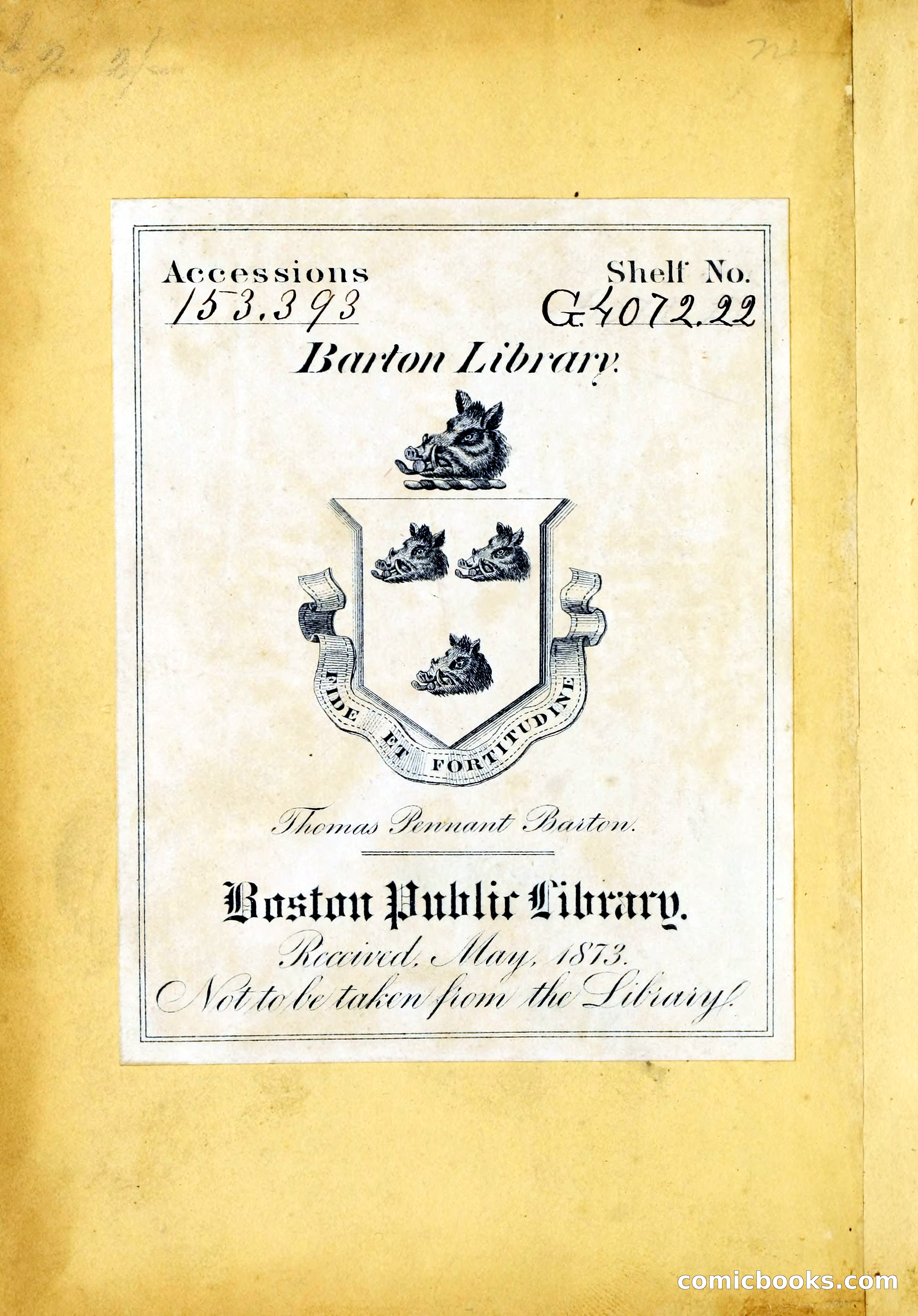
# Analysis This is a **bookplate or library ownership label** from the Barton Library collection. The page features a heraldic coat of arms depicting boars or similar creatures, topped with a crest and bearing the motto "INDE ET FORTITUDNE" (roughly "by integrity and fortitude"). It identifies the book as belonging to Thomas Pennant Barton and notes it was received by the Boston Public Library in May 1873, with the instruction "Not to be taken from the Library." The handwritten accessions number and shelf mark appear at top. This is not a page of the penny dreadful itself, but rather a cataloging/ownership record inserted into a bound volume.

# Analysis This page is **not readable as substantive text**. The image shows a heavily textured, grainy surface with dominant colors of cream, green, and rust-brown, heavily aged or deliberately distressed. The OCR text is garbled and nonsensical—appearing to be random characters and fragments ("cs 5 lt ~ & ss," "APs," etc.)—suggesting either severe image degradation, scanning error, or that this is a decorative endpaper or blank page from the penny dreadful. The only legible element is a watermark reading "comicbooks.com" in the lower right corner, which is modern and not part of the original Victorian publication. Without readable text or clear illustration, the page's purpose within the penny dreadful cannot be determined.

# Page Assessment This appears to be a **heavily degraded or damaged page** from a printed work, with the watermark "comicbooks.com" visible in the lower right corner. The image shows a textured, mottled surface in greens, blues, browns, and grays with scattered dark spots and speckling throughout. **No legible text is visible** on the page itself. The OCR text provided is blank, containing no readable content. The surface texture and coloration suggest either significant age-related deterioration, moisture damage, or poor image quality that has rendered any printed text illegible. Without visible text or clear imagery, it is impossible to determine whether this is a title page, illustration, or prose section, or to identify any specific content related to Victorian penny dreadful literature.

# Assessment This page is **heavily degraded and largely illegible**. The image shows what appears to be a text page with a mottled, stained surface in browns, purples, and greens—typical of aged Victorian-era paper. The OCR text provided is empty or unreadable, and the physical image itself is too worn and discolored to discern any clear written content, illustrations, or distinguishing features. While the page dimensions and coloring are consistent with a Victorian penny dreadful, **I cannot reliably determine whether this is a title page, illustration, prose text, or advertisement, nor can I accurately convey what any visible text actually says.** The deterioration simply prevents meaningful transcription.
This is a title or cover page from a digitized Victorian publication. The page features a classical architectural illustration—a neoclassical building with a triangular pediment and four columns—rendered in muted yellow and cream tones against a aged, textured background. The only readable text states "Digitized by the Internet Archive in 2015" and provides an archive URL (albionsenglandco00warn). The page appears to be the front matter of a digitized work, though the specific title and publication details are not legible in this image. The architectural imagery suggests a serious or institutional subject matter.

# Analysis **Page Type:** This appears to be a largely blank or heavily degraded page, possibly a transition page or section break in a serialized publication. **Visible Content:** The image shows a textured, mottled background in muted blues, purples, greens, and browns with scattered dark spots and marks. The OCR text is essentially illegible—merely fragments of punctuation and symbols with no coherent words visible. A watermark reading "comicbooks.com" appears at the bottom right. **Assessment:** This page contains no discernible printed text and no illustration. It may represent a damaged original, a blank separator between installments, or a printing anomaly. Without readable text or imagery, the actual content and purpose of this particular penny dreadful page cannot be determined.
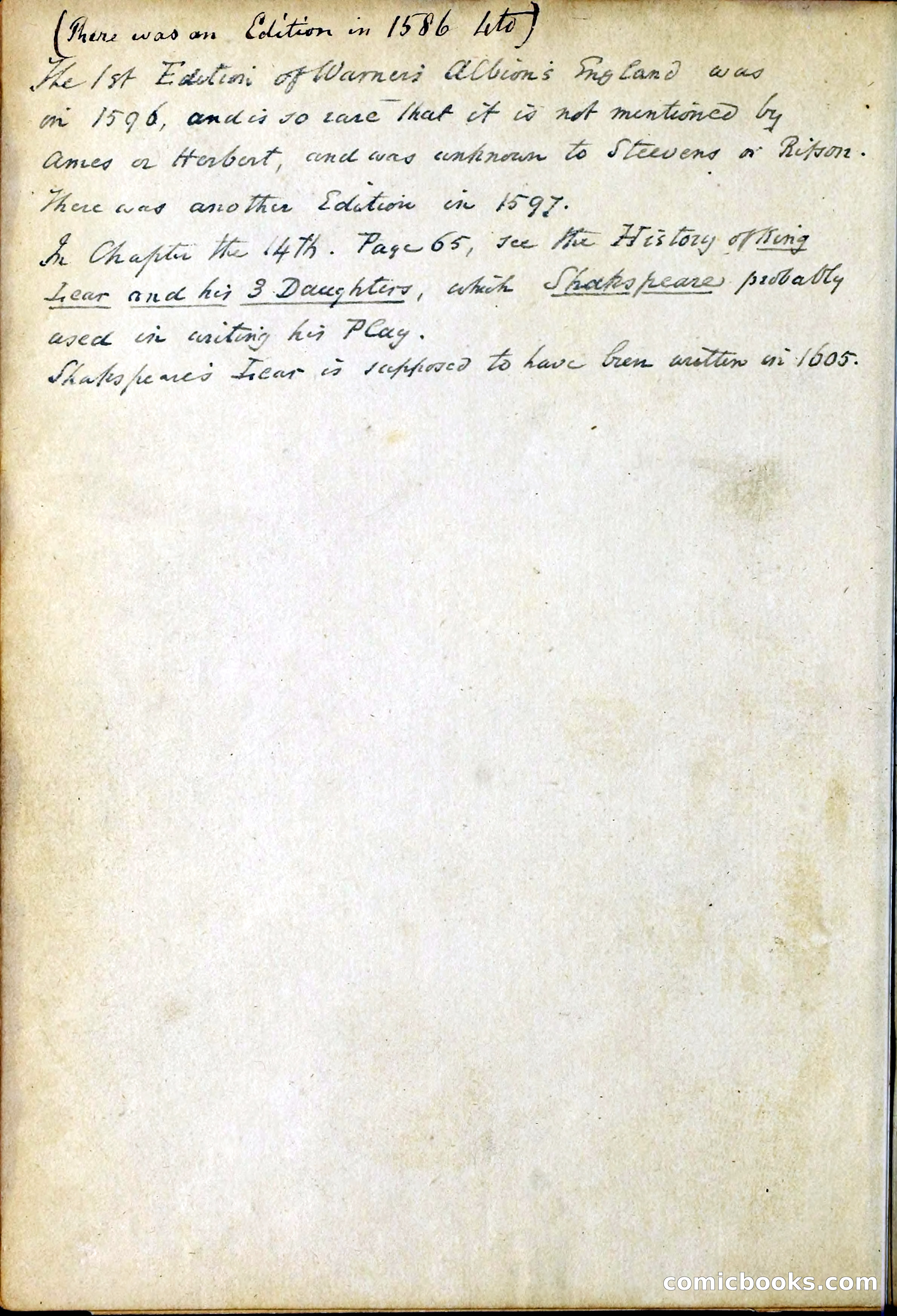
This is a page of running prose text from what appears to be a scholarly or editorial note rather than a penny dreadful narrative itself. The handwritten text discusses editions of a work by Warner Albinus (or similar) from 1596, mentions that it was unknown to Stevens and Ames or Herbert, references another edition from 1597, and directs the reader to Chapter 14, page 65, for information about "King Lear" and his three daughters—noting that Shakespeare "probably" used this source when writing his play. The text concludes by stating that "Shakespeare's Lear is supposed to have been written in 1605." The page appears to be scholarly annotation rather than serialized fiction.
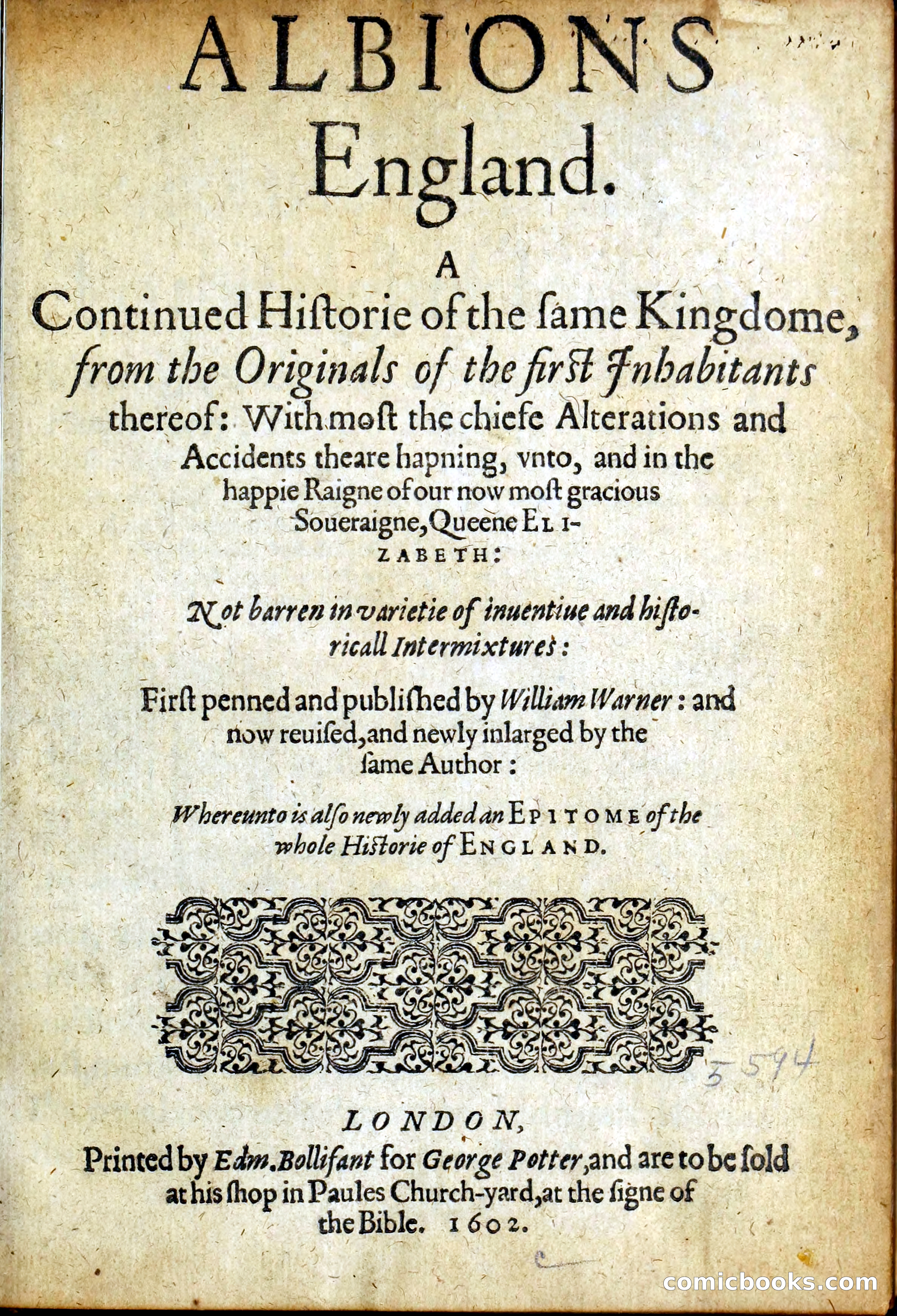
# This Page: Title Page This is a title page from a 1602 London edition of *Albions England*, a historical chronicle. The text indicates it is "A Continued Historie of the fame Kingdome, from the Originals of the first Inhabitants" through Queen Elizabeth I's reign, originally penned by William Warner and here "reuised, and newly inlarged by the fame Author." The page notes an epitome of English history has been newly added. It was printed by Edm. Bollifant for George Potter and sold at his shop in Paules Church-yard. **Note:** This is a 17th-century historical work, not a Victorian penny dreadful as the prompt suggests.
# Assessment This appears to be a **back cover or endpaper** of a Victorian penny dreadful, rather than a page of running narrative or illustration. The page is largely blank or heavily degraded, with only two clearly legible handwritten notations in blue ink: - A reference number: "153,898" - A date: "May 1878" These markings suggest cataloging or archival information added after publication, possibly indicating when this copy entered a library or collection. The heavily aged, stained, and worn condition of the paper is typical of penny dreadfuls, which were cheaply produced and handled by many readers. No title, plot content, or advertisements are distinctly visible on this particular page.
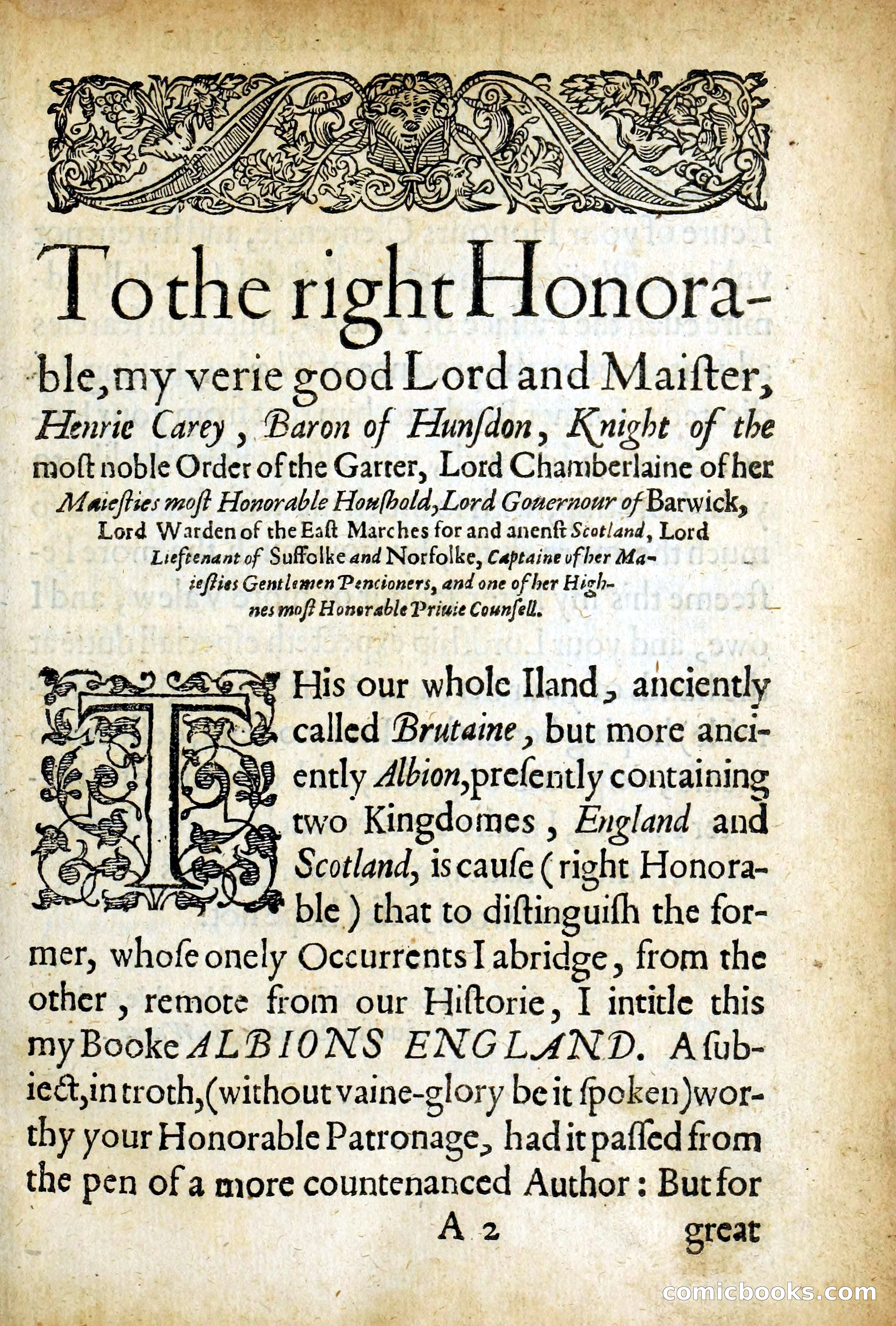
This is a dedicatory page from an early printed book (not a Victorian penny dreadful, but rather an Elizabethan or Jacobean work). The page addresses "the right Honorable" Henry Carey, Baron of Hunsdon, with an elaborate list of his titles and positions. The author explains that he is dedicating a work titled *Albions England* to Carey, noting that the book abridges the notable occurrences of England (distinguished from Scotland and the broader land of Albion/Brutaine) and that the subject is worthy of Carey's patronage despite coming from a less renowned author.
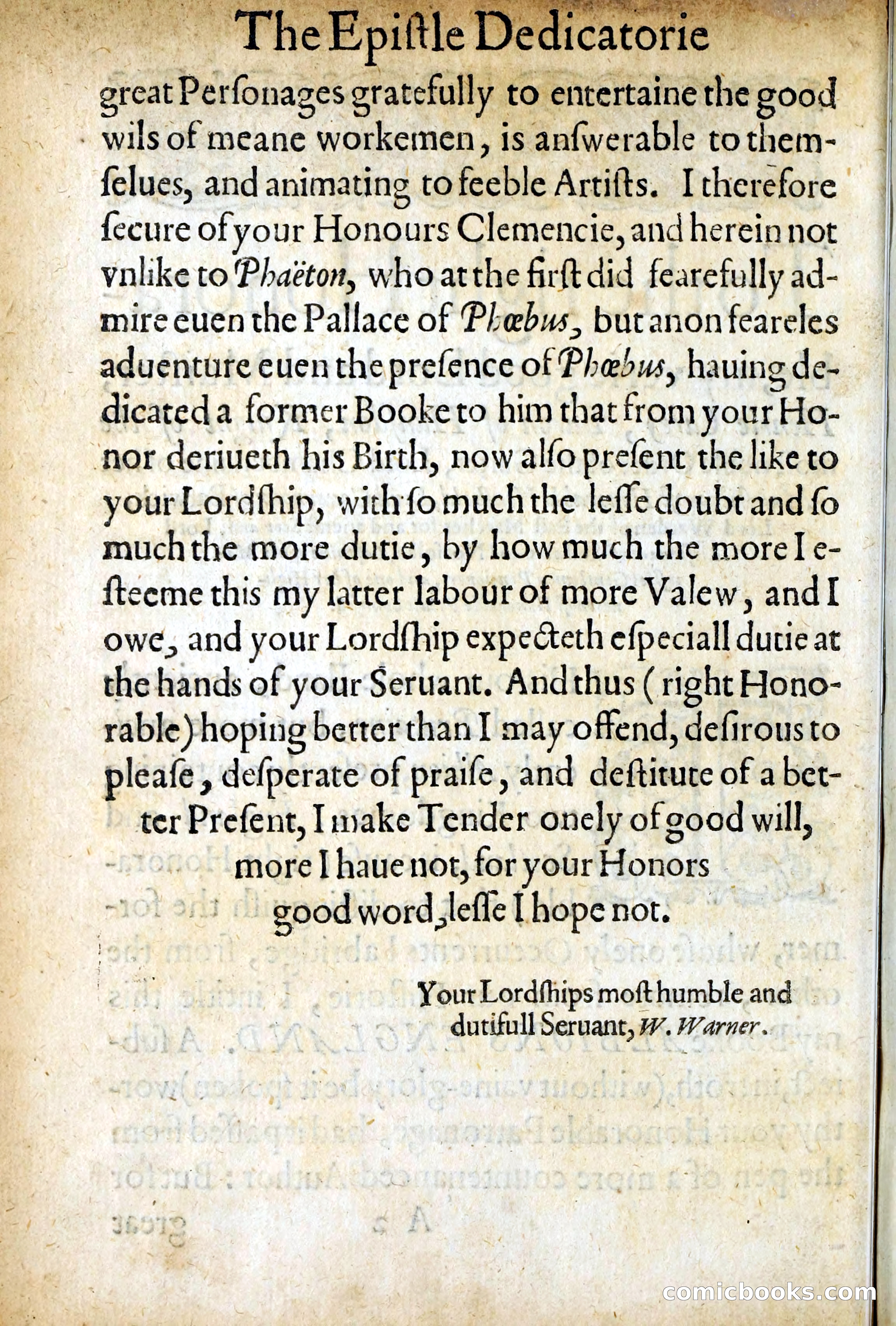
This is a dedicatory epistle (prefatory letter) from an early printed book, not a Victorian penny dreadful as the prompt suggests. The page shows formal prose addressed to "your Honours Clemencié," written by W. Warner, who presents this work as a humble offering. Warner compares himself to Phaëton approaching Phoebus's palace, referencing a prior dedication of a book connected to the addressee's birth. The letter emphasizes Warner's duty, deference, and modest hopes that the work will please, ending with his signature as "Your Lordships most humble and dutiful Servant." The typography and language suggest an early modern publication, likely 16th or 17th century.
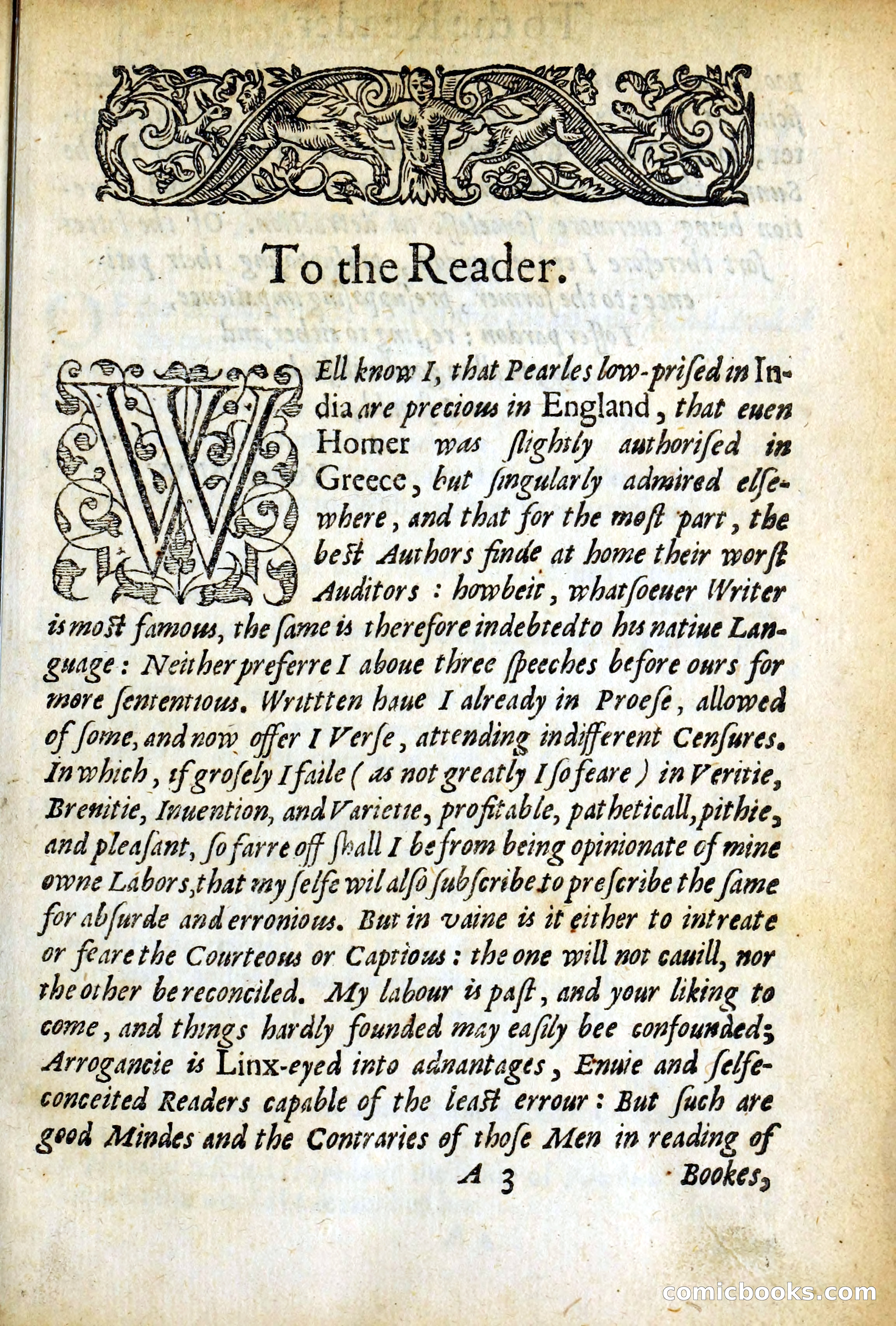
# Analysis This is a prefatory page—specifically a dedicatory letter "To the Reader" printed in early modern English (not Victorian, despite the prompt's framing). The ornamental header and large initial letter indicate this is front matter from a book. The author addresses readers about pearls being low-priced in India yet precious in England, using this as a metaphor for literary merit. He explains that he has written works first in prose (already approved by some) and now offers verse, accepting indifferent judgment. He disclaims pretension to his own work's quality regarding "Veritie, Brewitie, Invention, and Varietie," and warns that arrogant or envious readers will find fault regardless. The tone is apologetic and defensive about impending criticism.
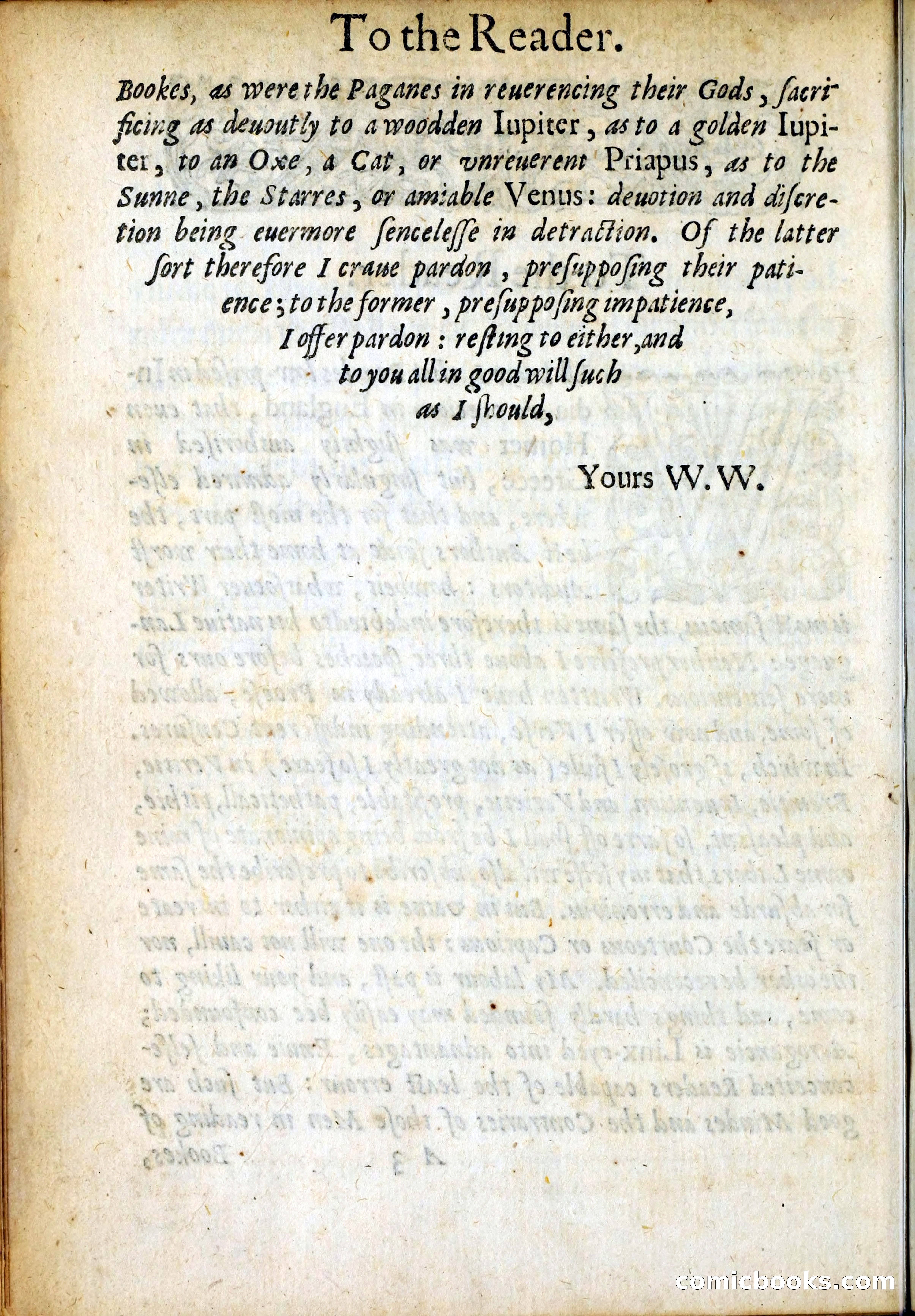
# Analysis This is a **prefatory page** ("To the Reader"), not running narrative prose. It's an address to readers written in early modern English (likely 17th century, not Victorian as the prompt suggests). The author—signed "W.W."—asks pardon from readers, distinguishing between those who worship books like pagan gods (wooden Jupiter, golden Jupiter, oxen, cats, etc.) versus those devoted to the Sun, Stars, or Venus. The text acknowledges that "devotion and disaffection" are "senseless in detraction," offering pardon to both patient and impatient readers alike. The page appears aged and contains some faded text below the main message.
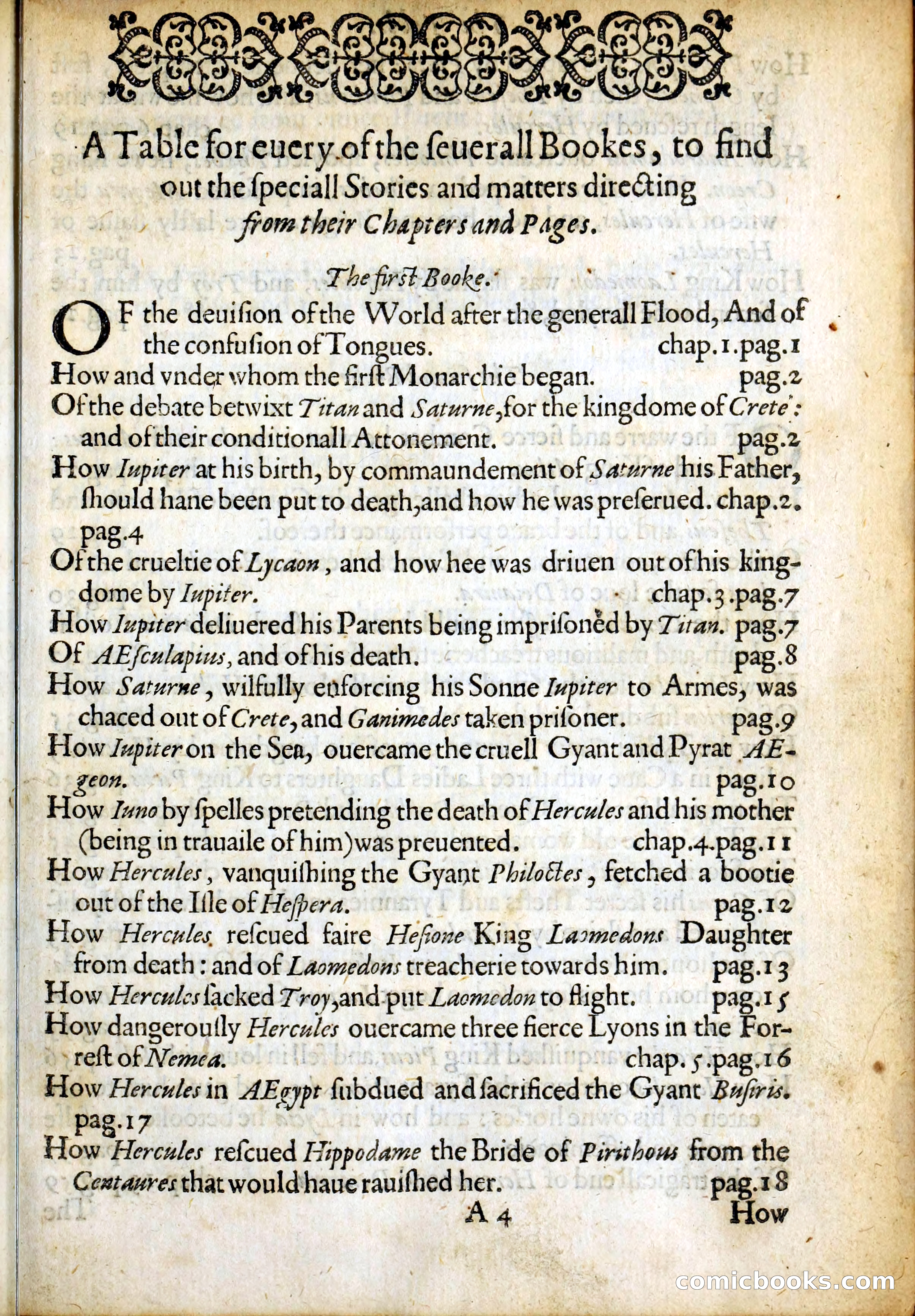
This is a table of contents page from what appears to be a classical mythology text, not a Victorian penny dreadful as suggested. The page lists stories from "the first Booke," organizing entries by chapter and page number. The narratives concern classical figures including Jupiter, Saturn, Hercules, and Juno, with episodes such as the confusion of tongues after the flood, the debate between Titan and Saturn, Jupiter's liberation of his parents, and Hercules's various labors and rescues. The ornamental header and antiquated typography suggest this is an early modern (likely 16th or 17th-century) printed work rather than Victorian-era material.
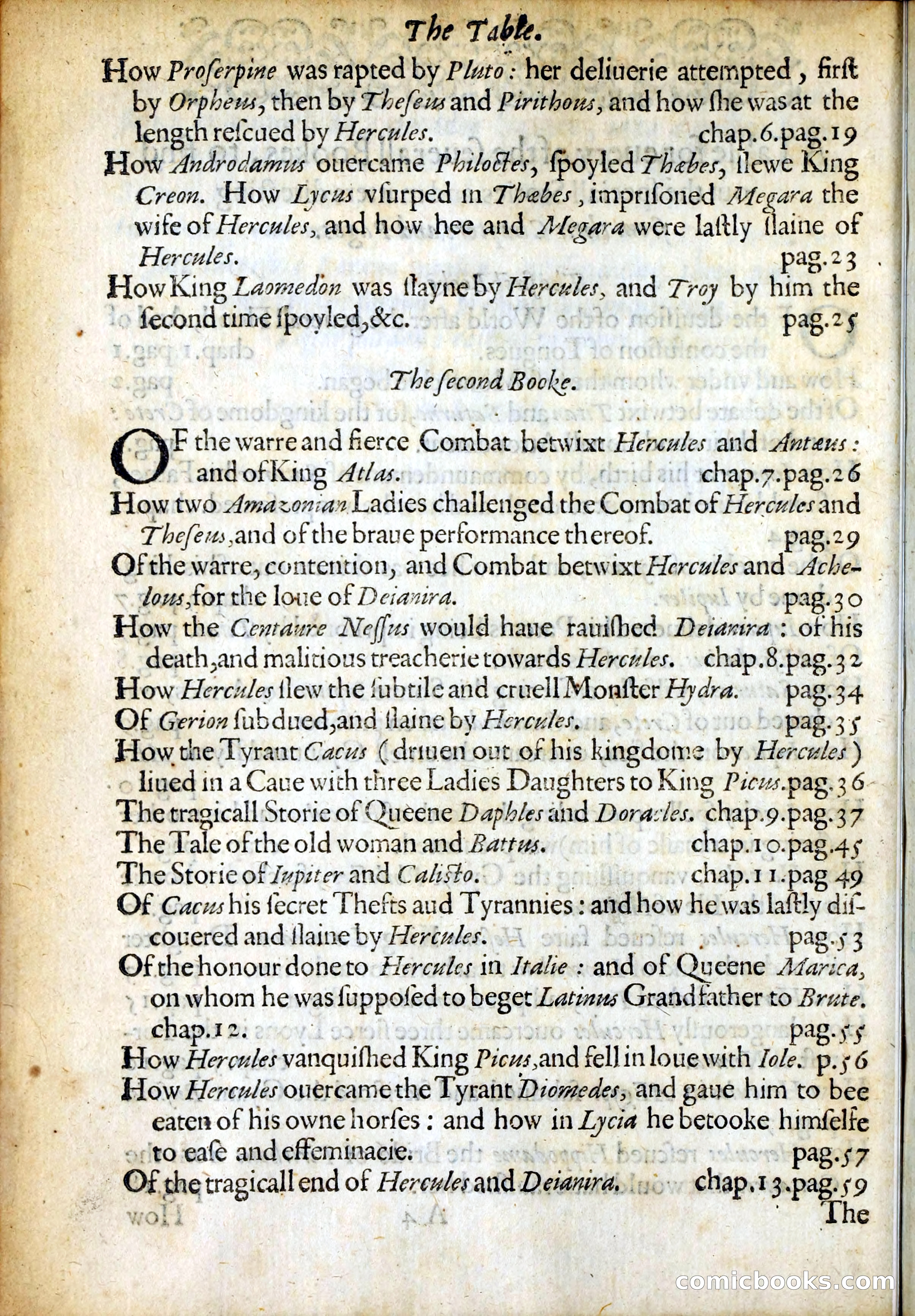
# A Table of Contents from a Classical Adventure Narrative This is a **table of contents page** from what appears to be an early modern (likely 17th-century) prose narrative, not a Victorian penny dreadful as suggested. The page lists chapter summaries for a multi-book work focused on the exploits of **Hercules** in classical mythology. The visible text outlines adventures including Hercules rescuing Proserpine, his battles with Antaeus and other foes, his encounters with Amazonian ladies, and his romantic entanglements—particularly with Deianira. The content is organized by book, with page numbers and chapter references provided throughout. The archaic spelling and typography (like "flayne" for "slain") indicate this is historical rather than Victorian material.
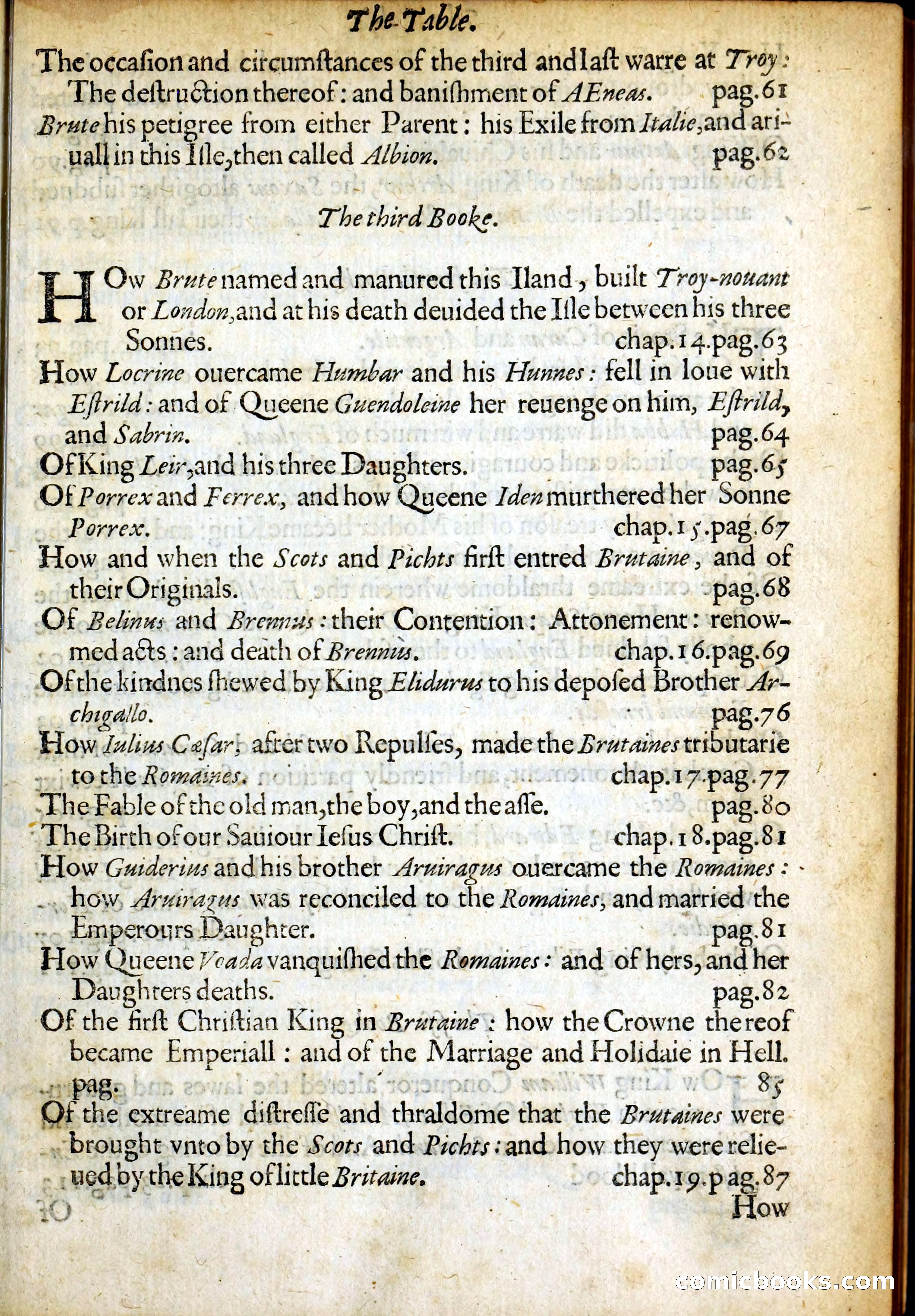
This is a table of contents page from what appears to be an early modern prose work (not a Victorian penny dreadful, as the typography and language—Early Modern English—predate the Victorian era by centuries). The page lists chapter summaries for "The third Booke," detailing legendary British history from the time of Brute (who built Troy-novant/London) through various kings and queens, concluding with accounts of Roman incursions and the first Christian king in Britain. The text covers political conflicts, dynastic struggles, and the birth of Christ within this chronological framework.
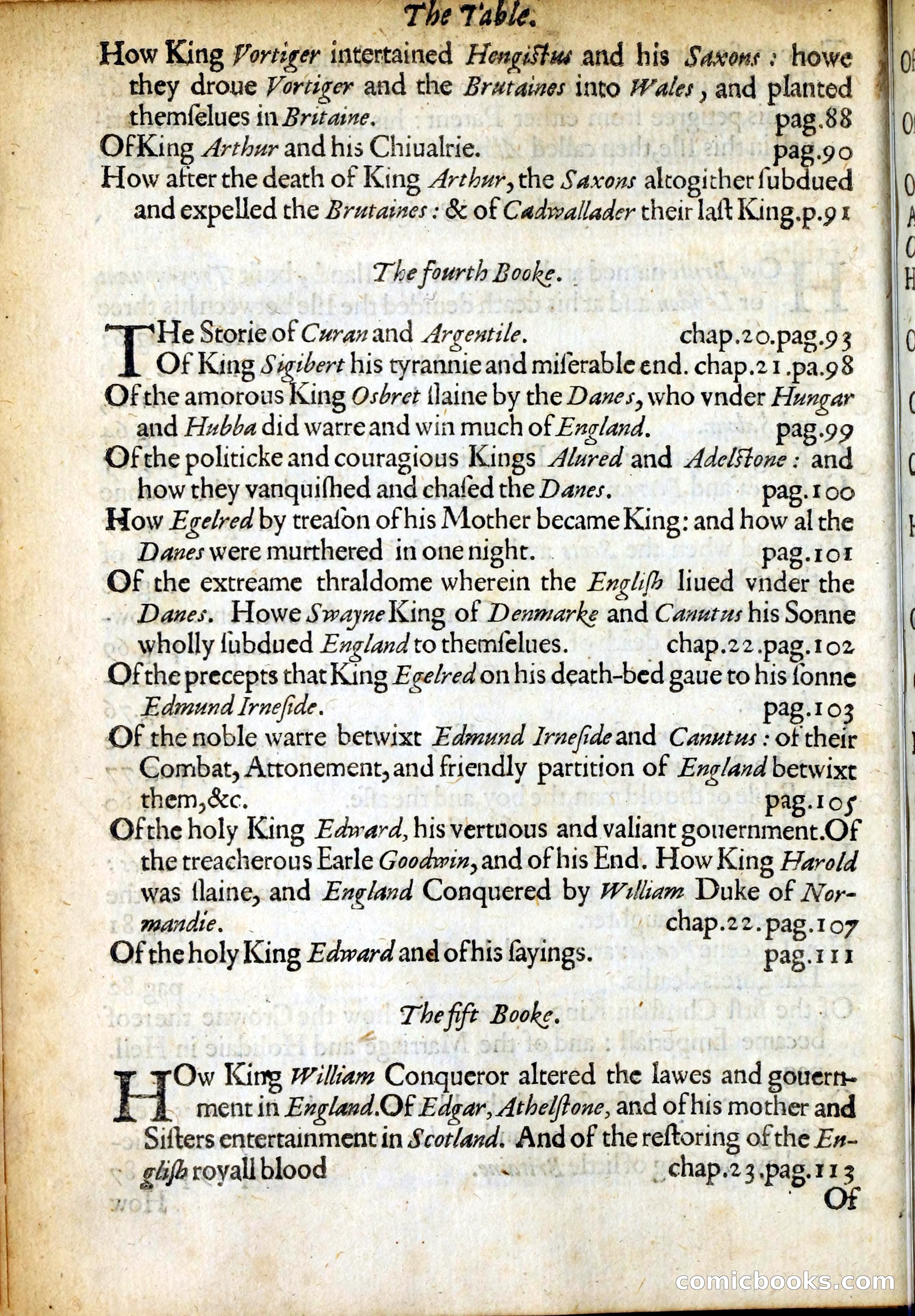
This is a table of contents page listing chapters from what appears to be a historical chronicle. The text outlines the contents of "The Fourth Booke" and "The Fifth Booke," detailing chapters on Anglo-Saxon and Norman English kings—including Vortigern, Arthur, various Saxon rulers, Danish invasions, and William the Conqueror—with corresponding chapter numbers and page references. The page uses period typography and spelling conventions (such as "Exgland" for England).
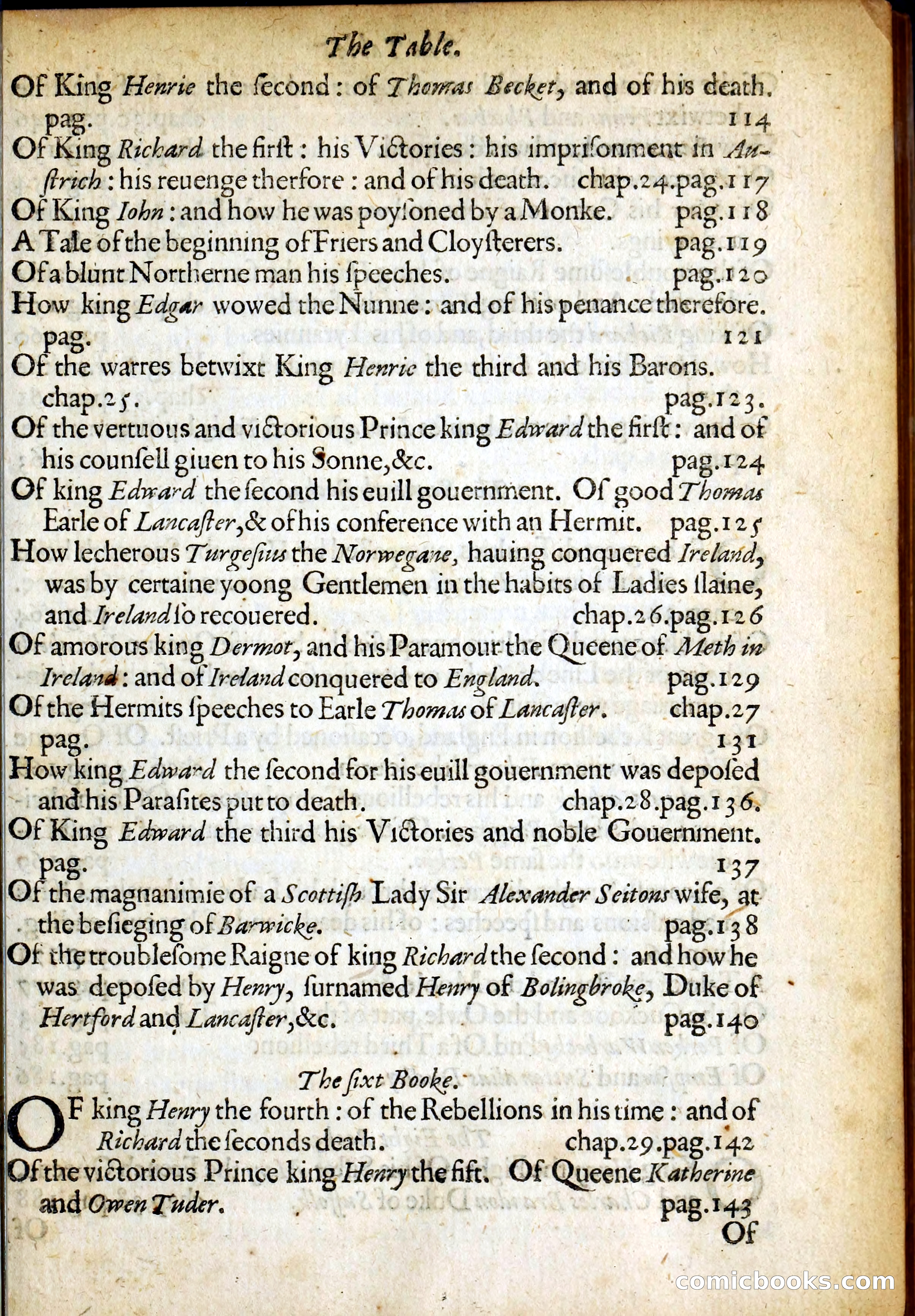
# Table of Contents from a Historical Narrative Work This is a **table of contents page** listing chapters and their page numbers. The text catalogs stories about English kings—Henry II and Thomas Becket, Richard I, King John, King Edgar, Henry III, Edward I and II, Edward III, and Richard II—along with tales of Irish conquest, hermits' speeches, and various nobles. The entries reference chapters numbered in the 20s and 30s, with pages ranging from 114 to 142. At the bottom, "The sixt Booke" begins, introducing King Henry the Fourth and his rebellions. The page appears to be from an early modern printed historical chronicle rather than a Victorian penny dreadful, based on its archaic spelling and format.
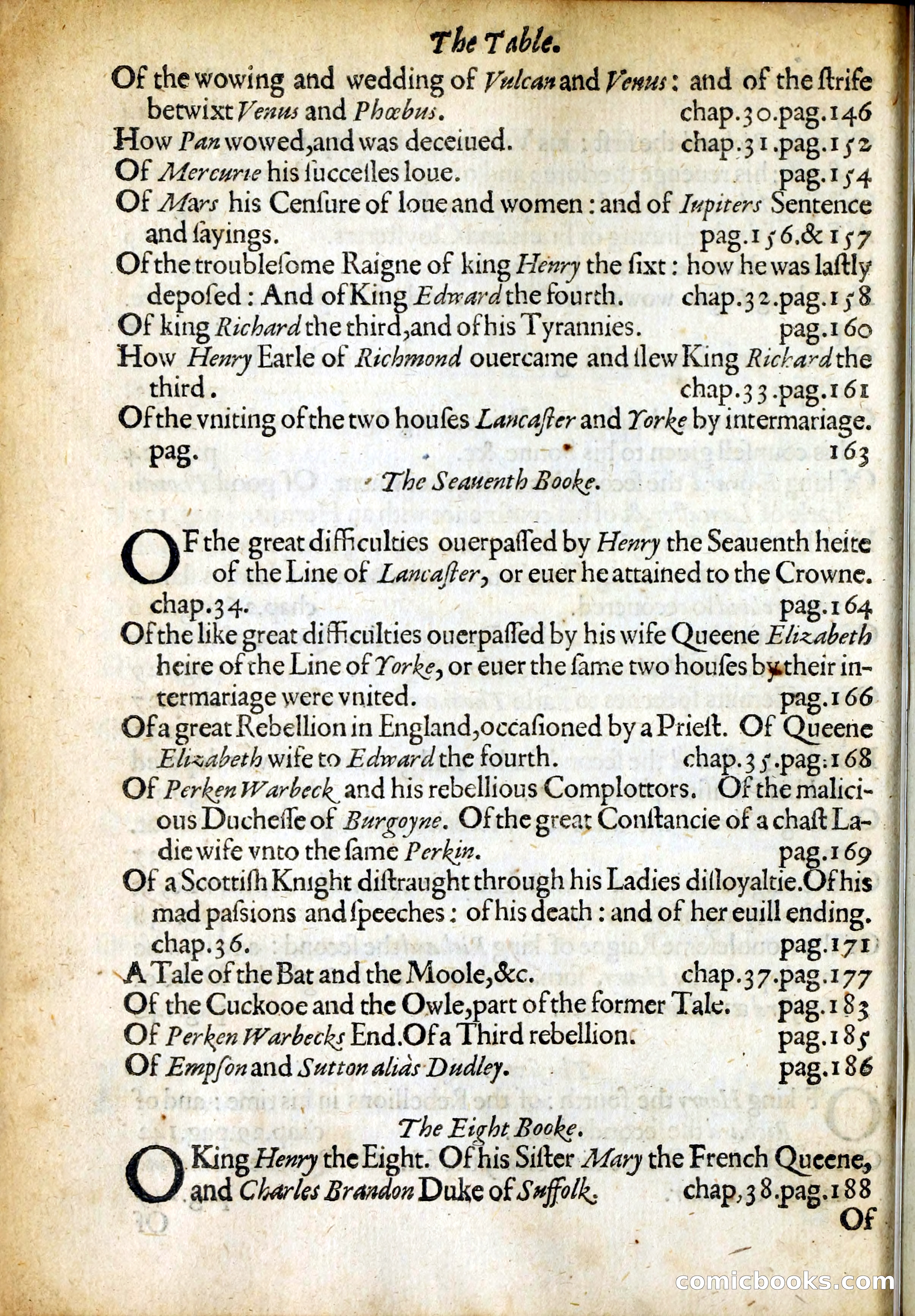
# What This Page Is This is a table of contents from a lengthy prose work, not a penny dreadful. The page lists chapters and their page numbers across multiple "books" (sections), primarily covering English history and mythology. The visible text references historical figures—Henry the Eighth, Richard the Third, Henry the Seventh—and mythological characters (Venus, Mars, Jupiter, Vulcan). Stories include accounts of royal reigns, rebellions (notably Perkin Warbeck's), and interspersed tales like "The Bat and the Moole" and "The Cuckoo and the Owle." The OCR quality is poor in places, but the page clearly functions as an index to navigate a substantial, multi-book narrative combining history, legend, and moral fables. Based on the archaic typography and language, this appears to be an early modern work, likely 16th or 17th century.
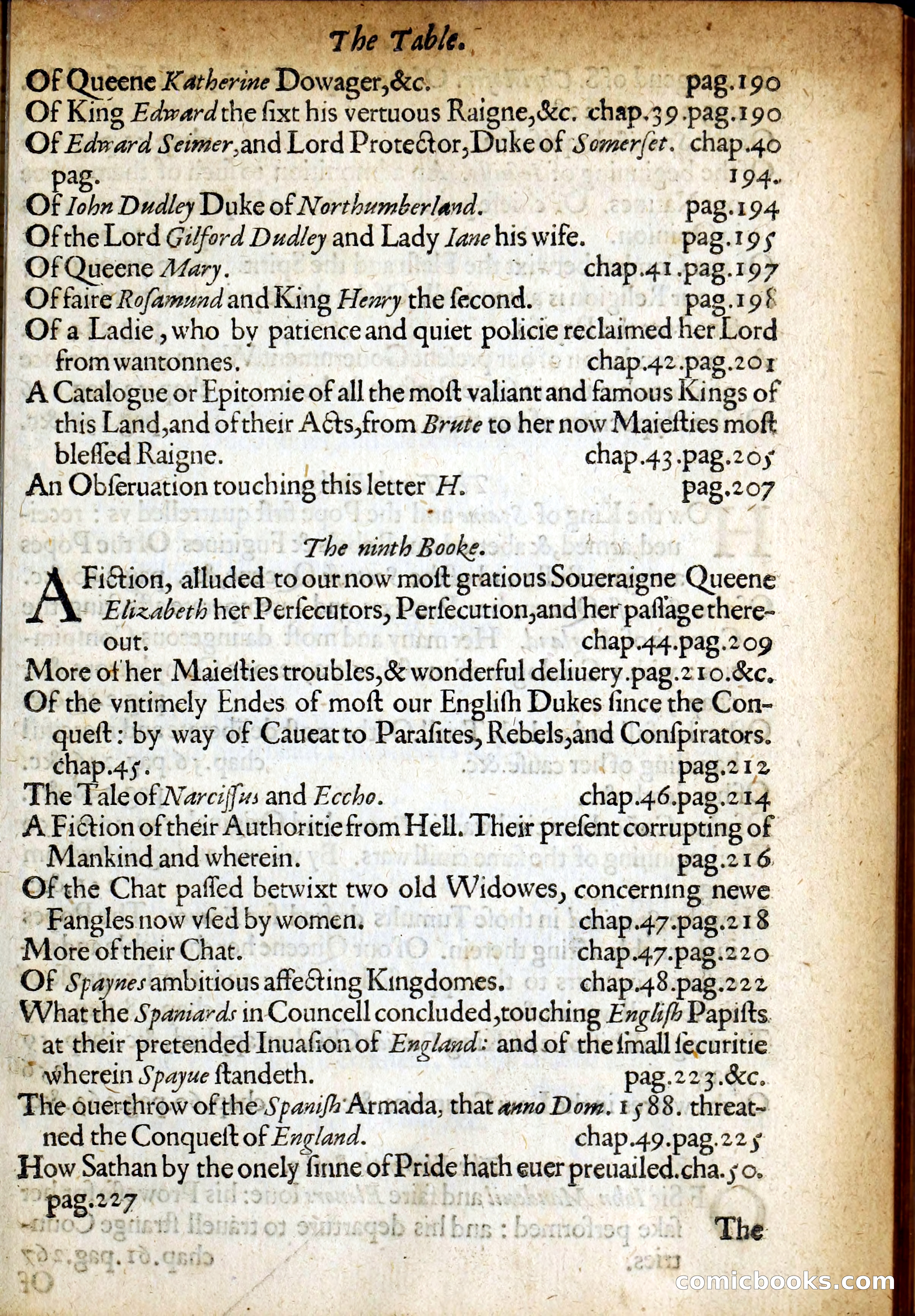
# A Table of Contents from an Early Modern Work This is a **table of contents page** from what appears to be a 16th-century historical or semi-historical narrative (likely Elizabethan-era), not a Victorian penny dreadful. The page lists chapters covering English monarchs and nobles—Edward Seimer, Lady Jane Dudley, Queen Mary, and King Henry II—alongside fictional or allegorical tales such as "Narcissus and Echo" and accounts of the Spanish Armada's defeat in 1588. The work mixes historical chronicle with moral fiction, including chapters on Queen Elizabeth's persecutions and dangers. The aged typography and page numbering (referencing pages in the 190s-220s range) suggest this is an early printed book, not penny serial fiction.
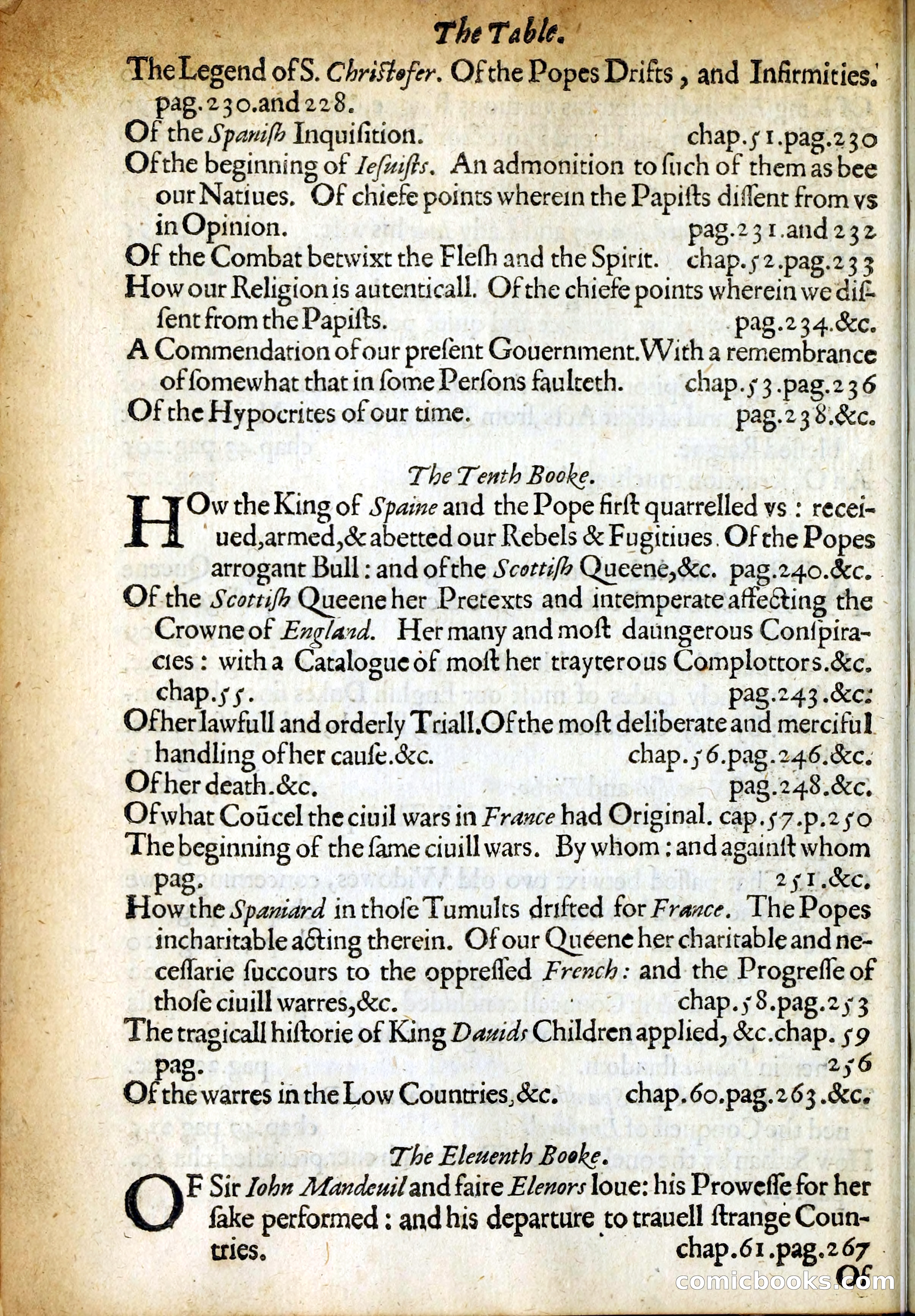
This is a **table of contents page** from an early modern religious polemic (not a Victorian penny dreadful, despite the prompt's framing). The page lists chapter headings and page numbers organized by books, covering topics including the Spanish Inquisition, Jesuit teachings, combat between flesh and spirit, differences from Catholicism, the Scottish Queen's conspiracies and trial, French civil wars, and the Low Countries conflicts. The text appears to defend Protestant doctrine and criticize Catholic authorities, particularly the Pope and Spain's King.
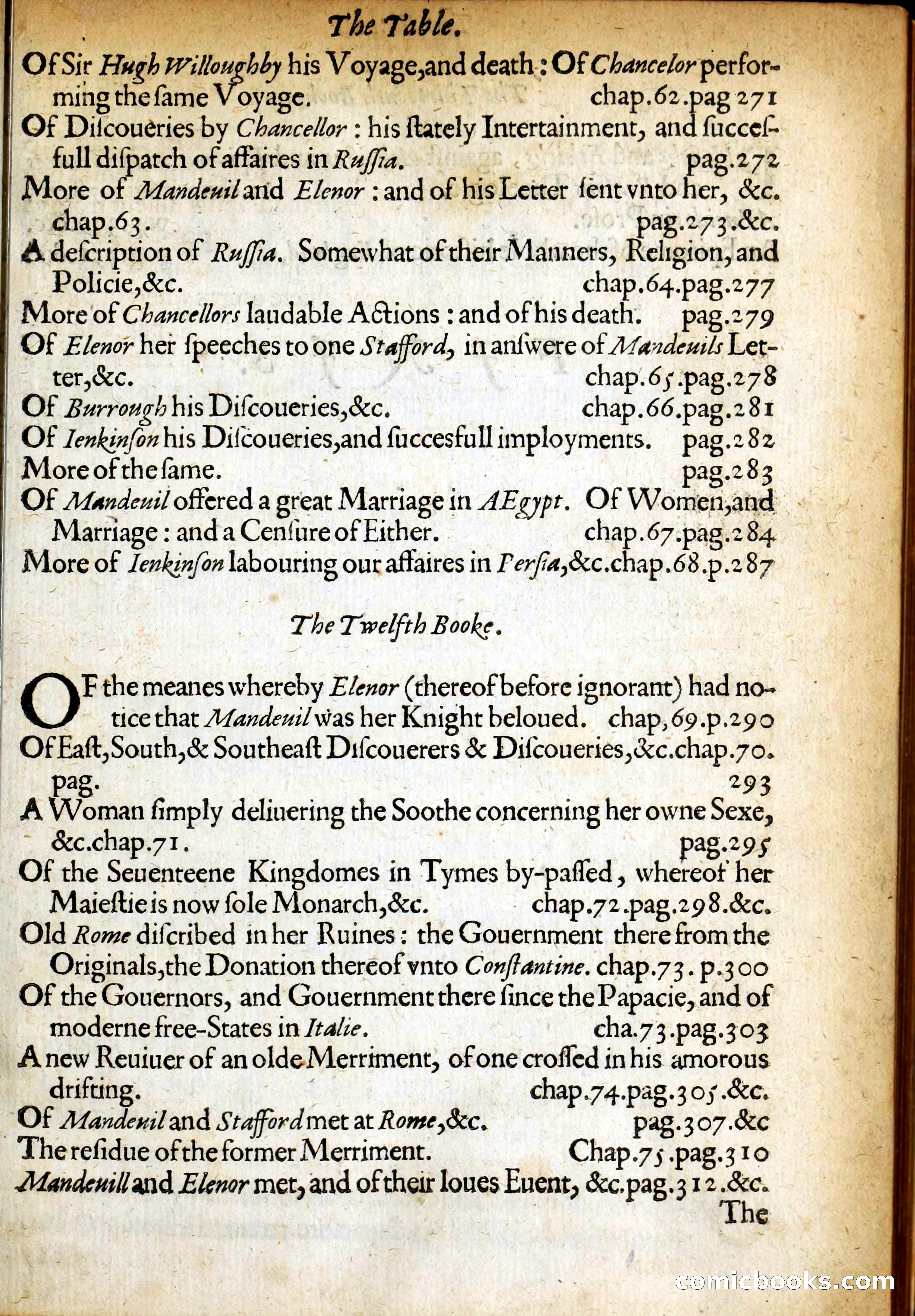
This is a table of contents page from an early modern narrative work (not a Victorian penny dreadful, as the typography and language suggest it predates the Victorian era). The page lists chapters from what appears to be "The Twelfth Book," detailing the adventures and romantic entanglements of characters named Mandenil, Elenor, Chancellor, and others. The entries reference voyages to Russia and Persia, discoveries, a marriage proposal in Egypt, encounters in Rome, and ultimately the meeting of Mandenil and Elenor. The page provides chapter numbers and page references for each episode in this serialized tale of exploration and courtship.
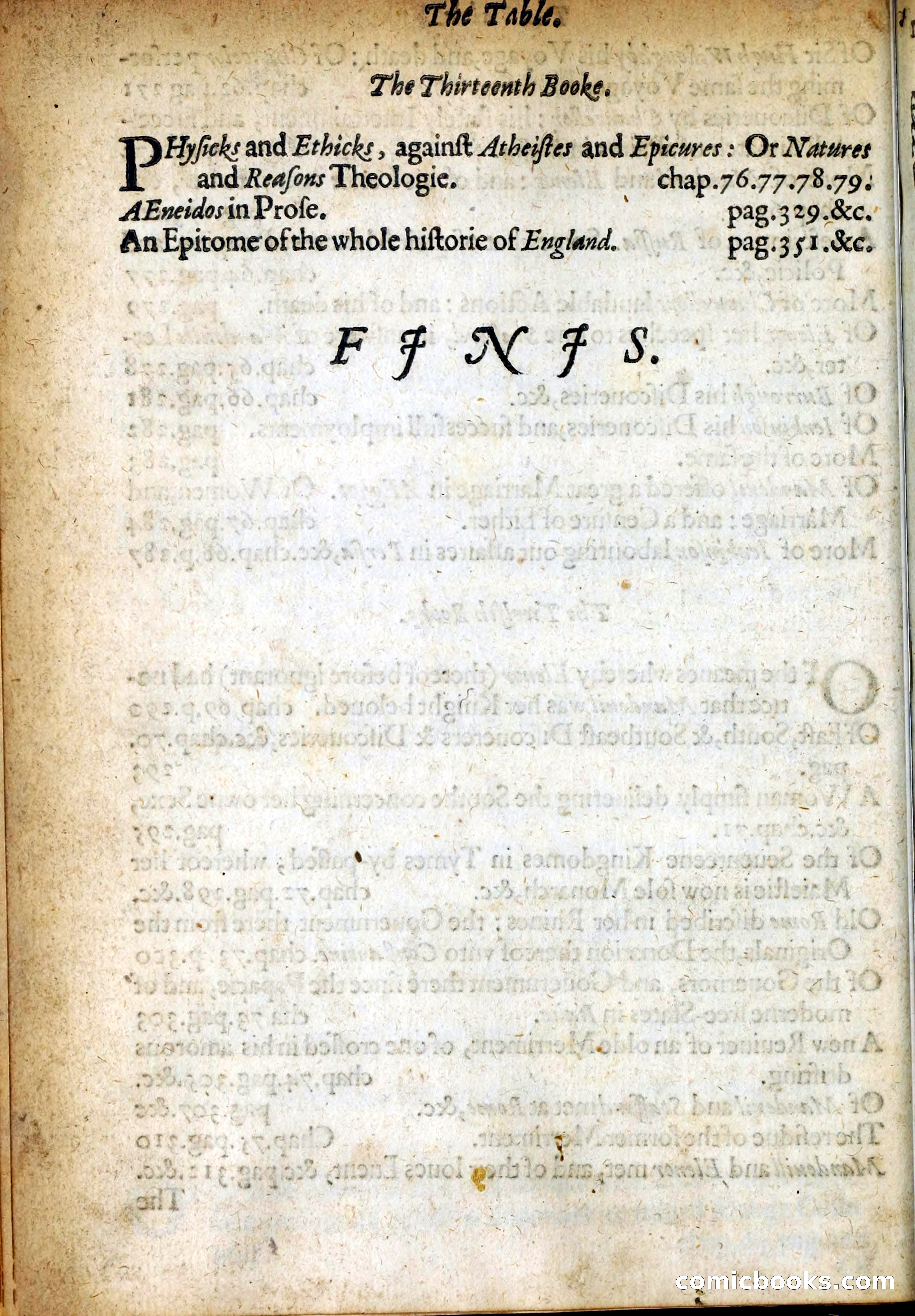
This is a table of contents page from what appears to be a historical religious or theological text rather than a penny dreadful. The legible header reads "The Table" and "The Thirteenth Booke," listing three items: "*Phisicks and Ethicks, against Atheistes and Epicures: Or Natures and Reasons Theologie" (chapters 76-79, pages 329 onwards); "AEneidos in Prole" (page 329); and "An Epitome of the whole historie of England" (page 351). The page shows significant age-related deterioration with faded text throughout the lower half, making most content illegible. This appears to be from an early modern scholarly work, not Victorian penny dreadful fiction.
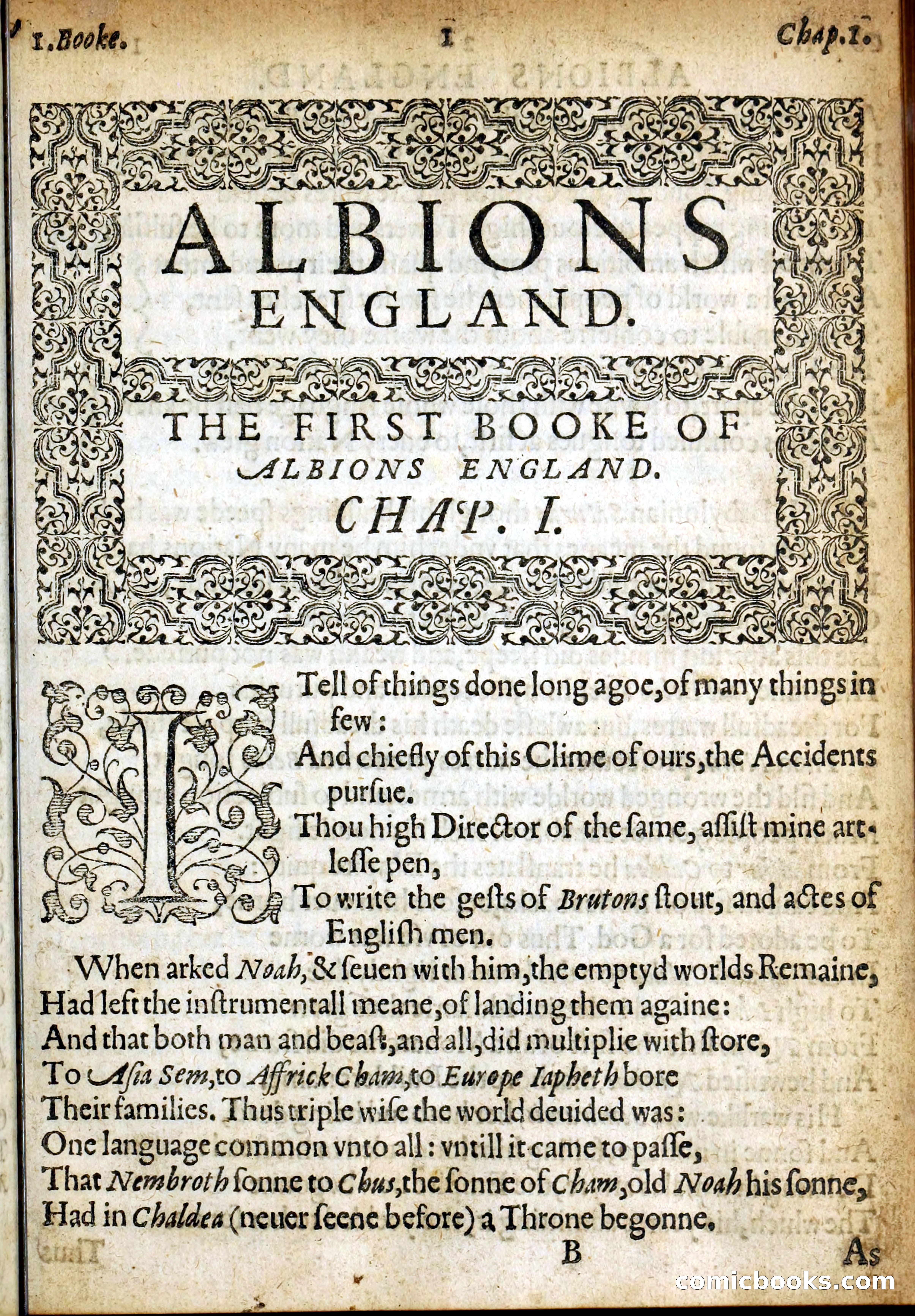
This is the opening page of *Albions England*, presenting the title and the beginning of Chapter I in verse. The ornate decorated border frames the title, and the text below consists of poetic lines addressing a divine director, requesting assistance in writing about the deeds of Britons and English men. The verse then narrates biblical history—Noah's departure from the emptied world, the repopulation of mankind and beasts, and the division of the world among Noah's sons (Shem, Ham, and Japheth), before referencing Nimrod and the Tower of Babel. This appears to be an early modern chronicle poem rather than Victorian penny dreadful fiction.
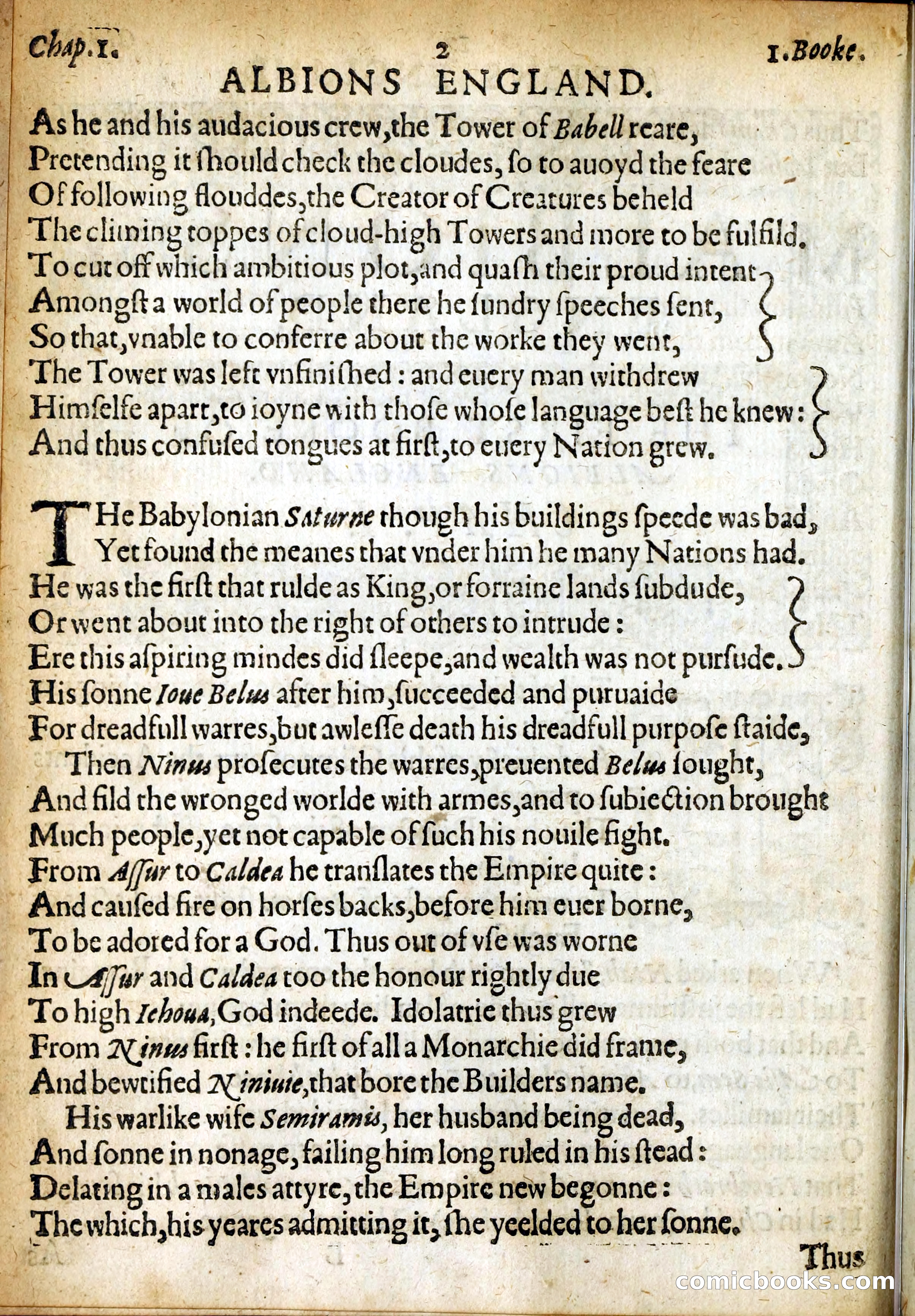
# "Albions England," Chapter I, Book I This is a page of running verse prose—the opening of a narrative poem titled "Albions England." The text recounts the biblical Tower of Babel story, describing how God confused human languages to thwart the builders' ambition, then transitions to ancient Babylon, naming successive rulers (Saturne, Ione Belus, Ninus, and the queen Semiramis). The verse employs early modern spelling and rhyming couplets to narrate early human history and the rise of monarchy and idolatry. This appears to be from a historical or pseudo-historical epic rather than sensational crime fiction.
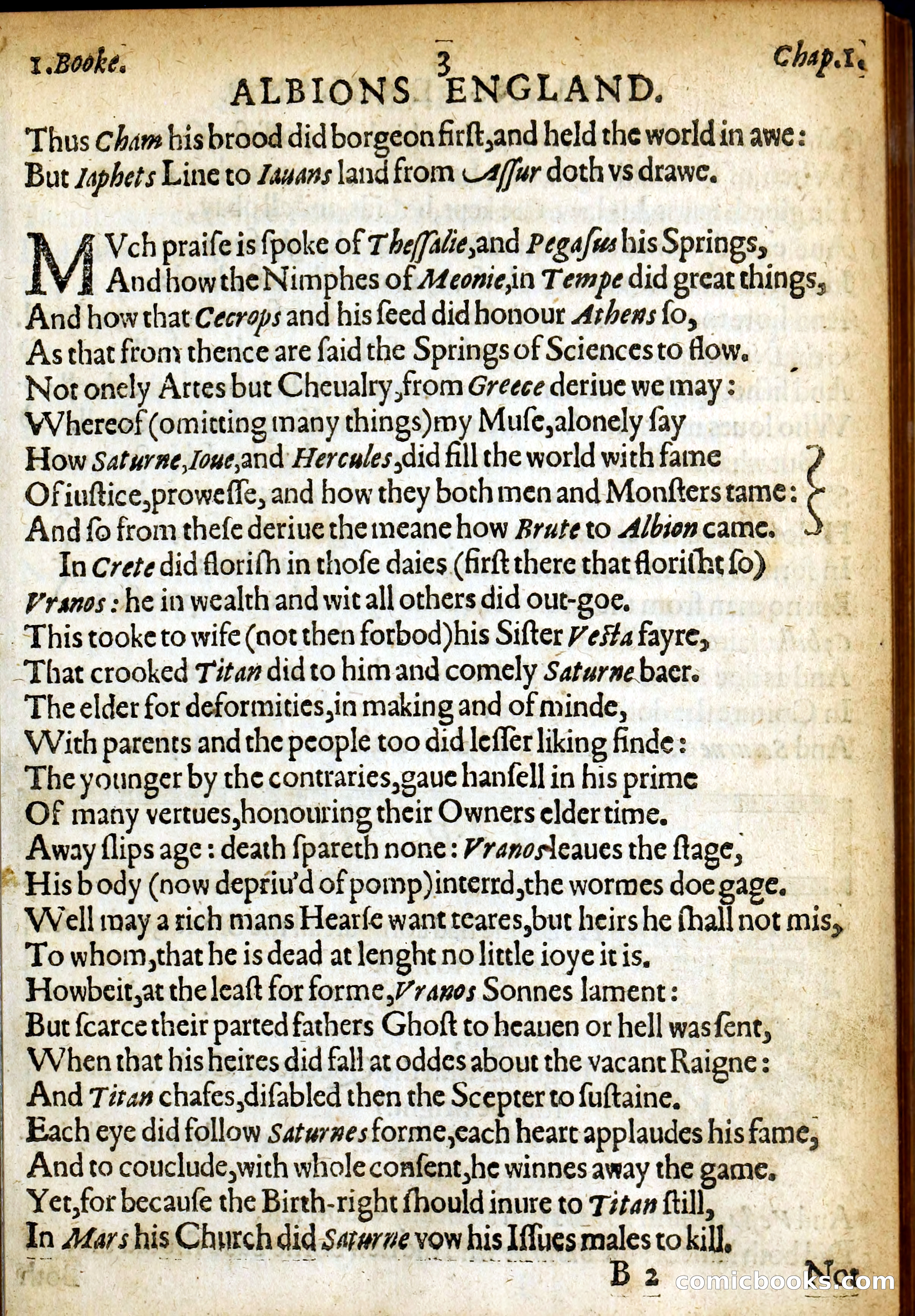
This is a page of running prose poetry from "Albions England," presenting mythological narrative in verse form. The text recounts the genealogy of legendary British kings, beginning with Cham and progressing through classical figures like Uranos, Saturn, and Titan. The passage describes these figures' reigns, virtues, and conflicts over succession, particularly focusing on Saturn's ascendancy over Titan and his vow to kill his male offspring. The page shows characteristic early modern typography with decorative capitals and is numbered "B 2" at the bottom, indicating it is part of a bound work rather than a penny dreadful.
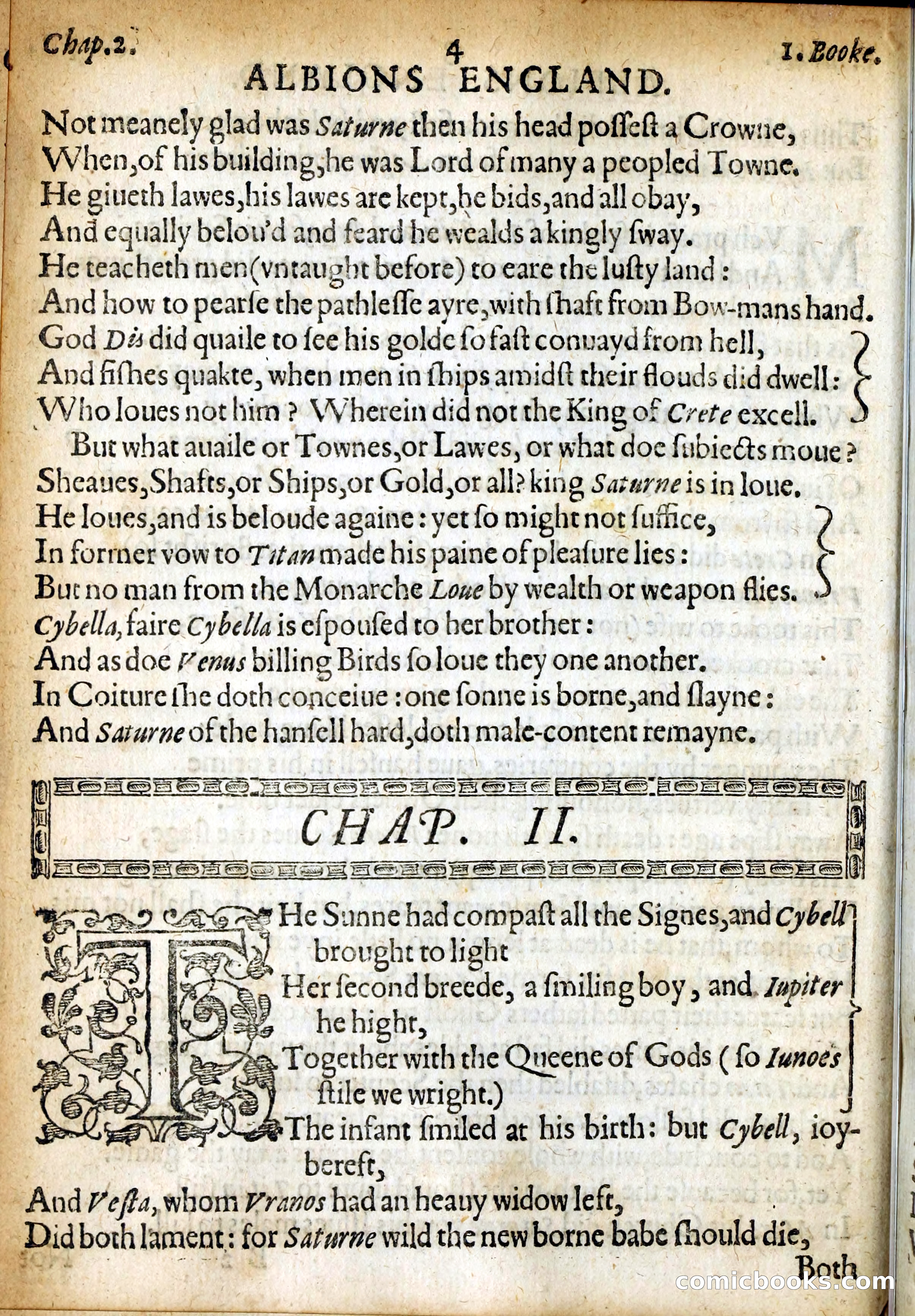
# This is a page of running verse narrative prose from what appears to be a classical mythological poem titled "Albions England." The page contains two chapters. Chapter 1 (top) praises Saturn as a wise ruler who teaches men agriculture and navigation, noting that he loves the goddess Cybella (to whom he is married) and fathered a son who was born and slain. Chapter 2 (bottom, newly begun) describes how the Sun god has completed his circuit through the zodiac, and Cybella gives birth to a second child, Jupiter, fathered by the Queen of the Gods. The text notes the infant smiled at birth but that Saturn wanted the newborn dead, causing grief to the widowed Vesta and others.
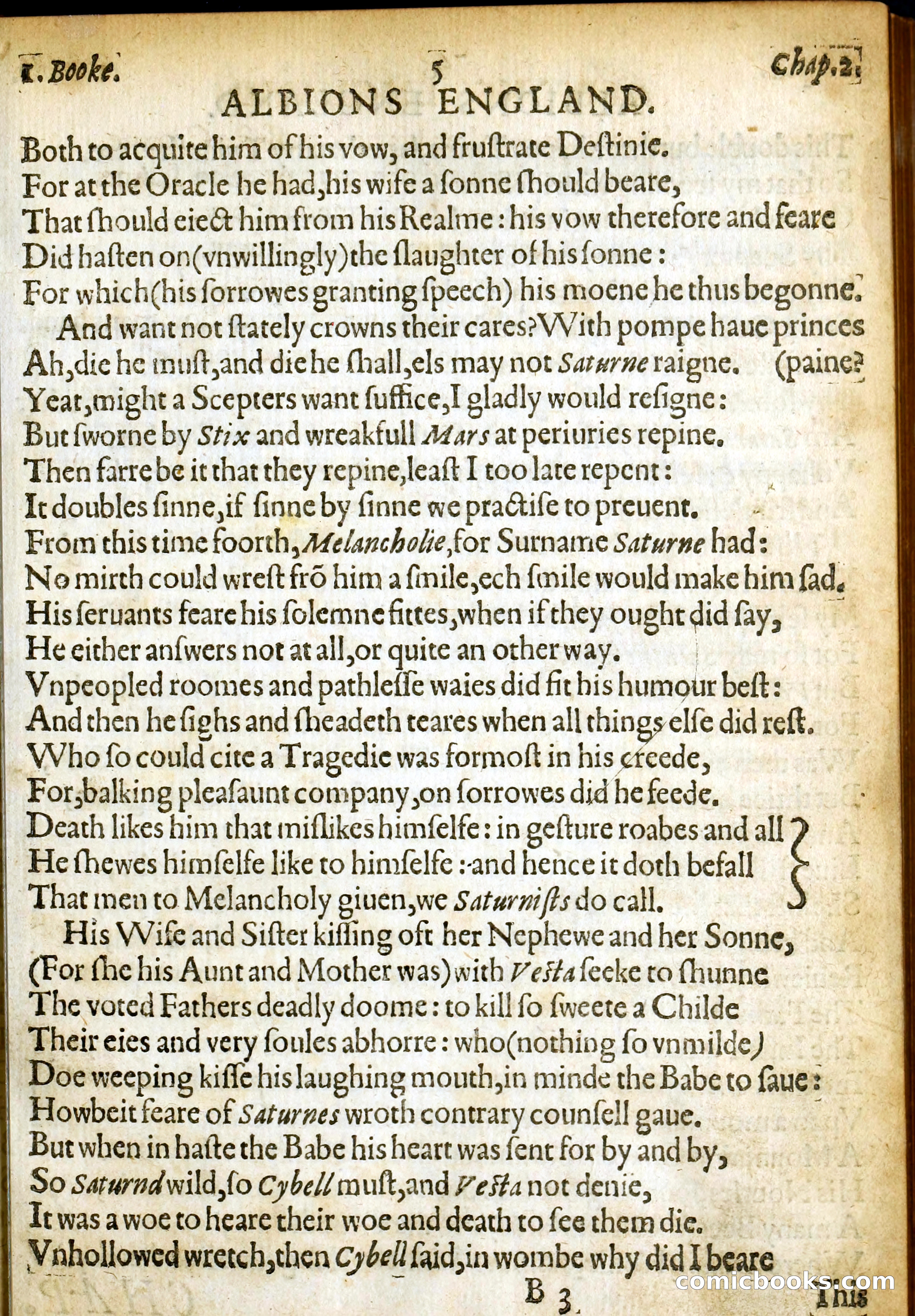
# Analysis of Page from "Albions England" This is a page of running prose poetry in early modern English (not Victorian—this appears to be from an earlier historical work, likely 16th or 17th century based on typography and language). The text recounts a tragic narrative: a king receives an oracle prophecy that his son will eject him from his realm, and in fear, he orders the child's death. The passage describes how this act of violence transforms the king into a melancholy figure (thereafter named "Saturne"), whose servants fear his withdrawn temperament. The text then shifts to the king's wife, sister, and other women lamenting the doomed child, torn between love for the baby and fear of the father's wrath. The emotional core centers on the tension between maternal affection and enforced obedience to paternal authority.
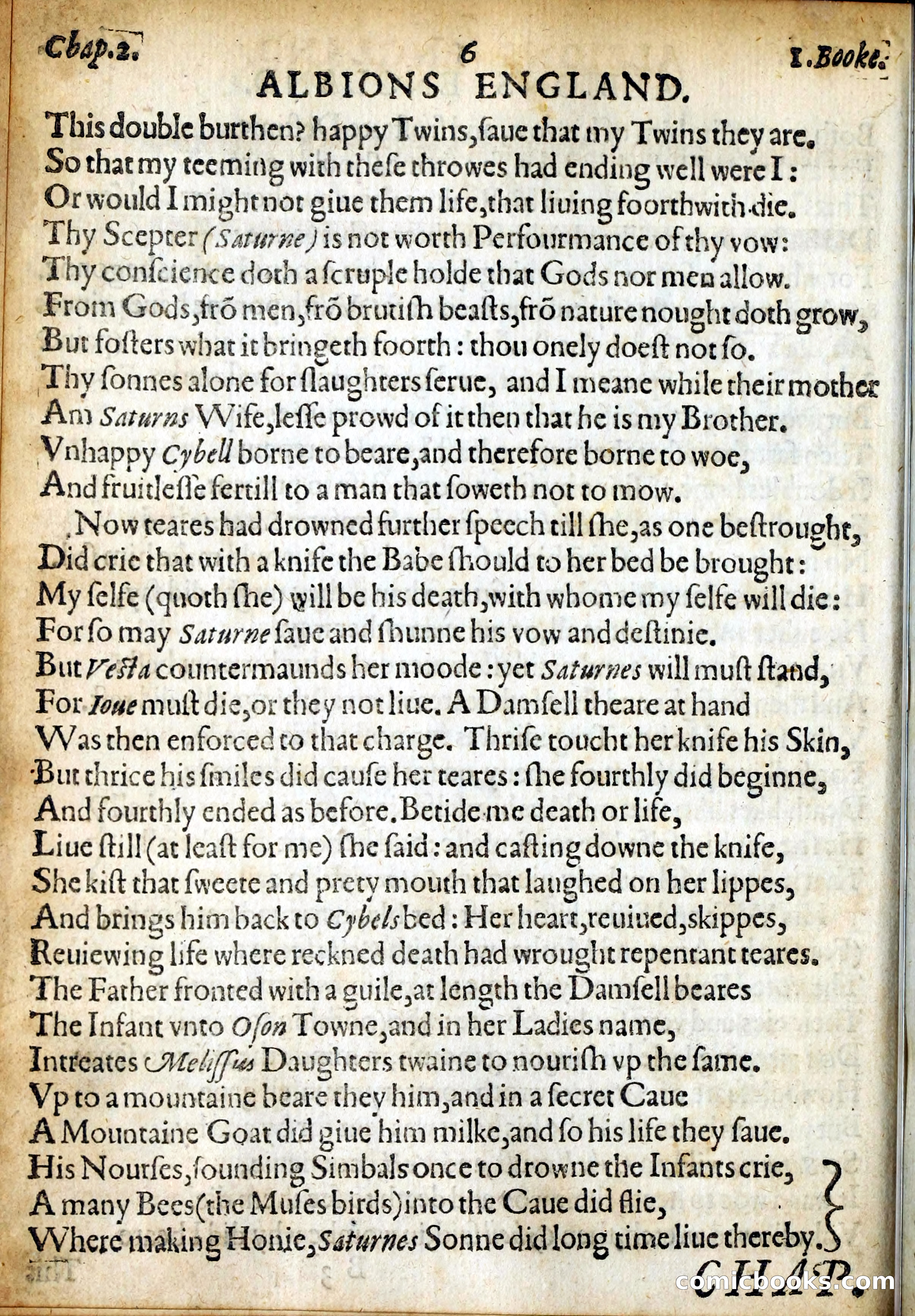
# Page Analysis This is a page of running verse prose from *Albions England*, a narrative poem. The text presents a dramatic mythological scene involving Saturn, his wife Rhea (Vesta), and the infant Jupiter (Jove). The passage describes Saturn's demand that newborn twins be killed to prevent them from fulfilling a prophecy, Rhea's anguished resistance, and ultimately the rescue of the infant—who is taken to a mountain cave where a goat provides milk and bees produce honey to sustain him. The page employs early modern spelling and typography typical of Renaissance-era English poetry rather than Victorian penny dreadful sensationalism, suggesting this is a historical reprint or anthology rather than original Victorian material.
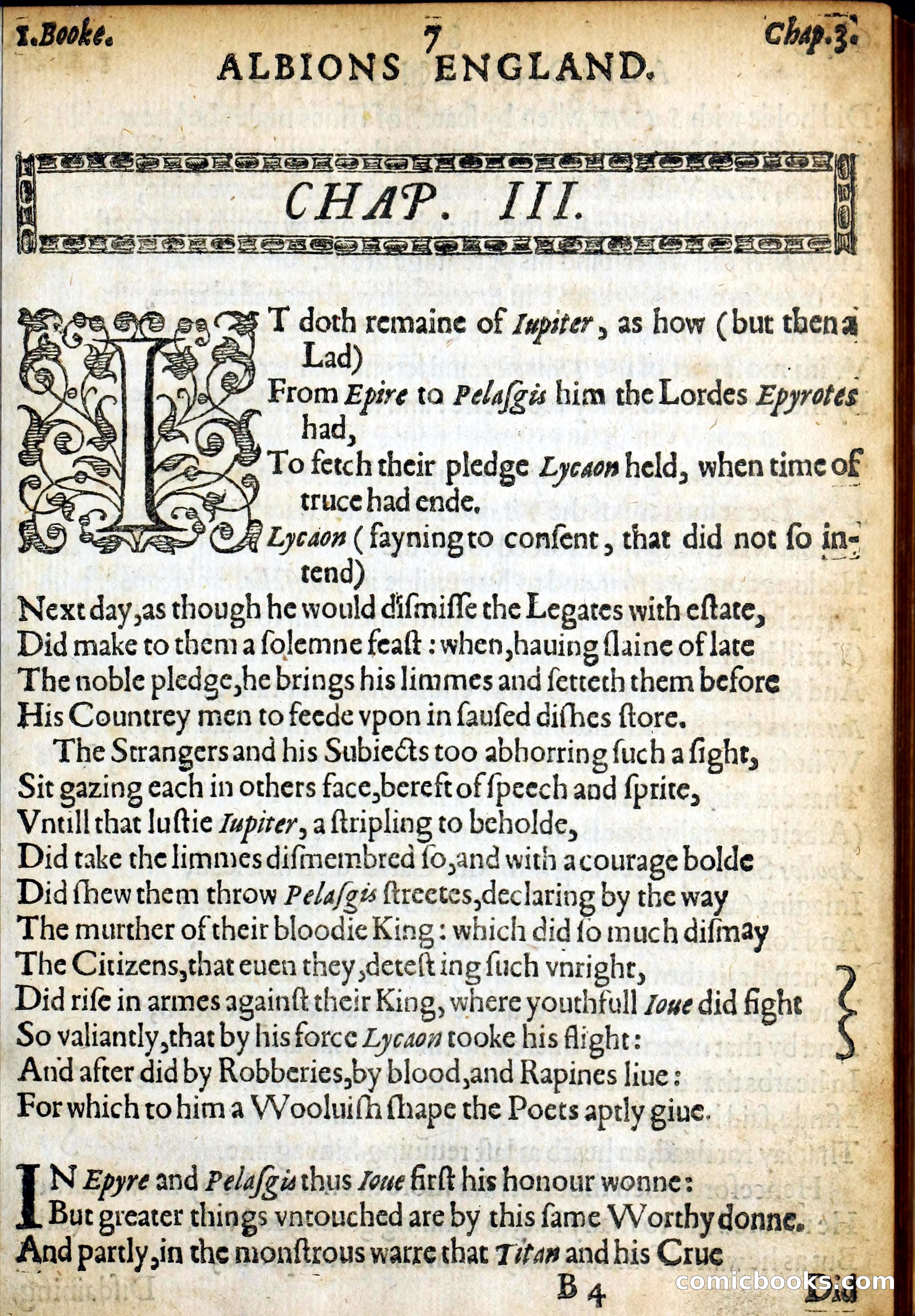
# Page Analysis This is a page of running prose poetry from *Albions England*, Chapter III (Book 1, page 7). The text recounts a classical narrative: Jupiter's remains, the lords Epyrotes, and a pledge called Lycaon. The passage describes a feast where a noble pledge is slain and dismembered, then displayed through streets by a young man named Jove, which provokes citizens to rise against their king Lycaon. The text concludes by noting that Jove first won honor in Epyre and Pelasgis, with greater deeds yet to come involving Titan and his crew. The page is densely set in early modern English verse typography.
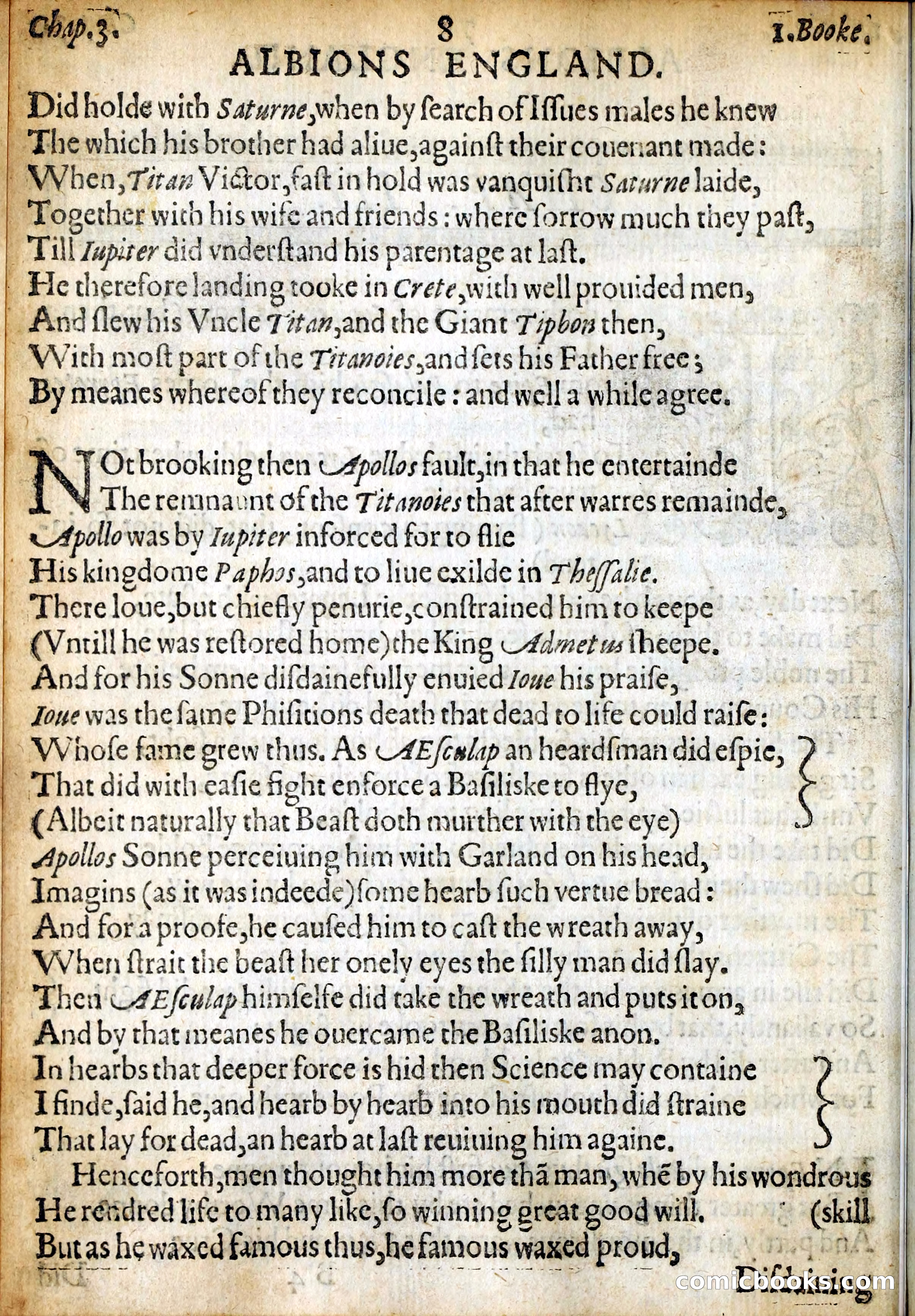
This is a page of running prose poetry from what appears to be *Albions England*, a narrative poem about British legendary history. The text recounts mythological events: Saturn's conflict with Titan, Jupiter's intervention in Crete, and Apollo's exile to serve King Admetus. It then describes how Apollo's son (apparently Asclepius, though the text is unclear) gains fame by using magical herbs to revive the dead, eventually reviving a man killed by a basilisk's gaze. The densely printed page uses Early Modern English spelling and typography typical of period publications.
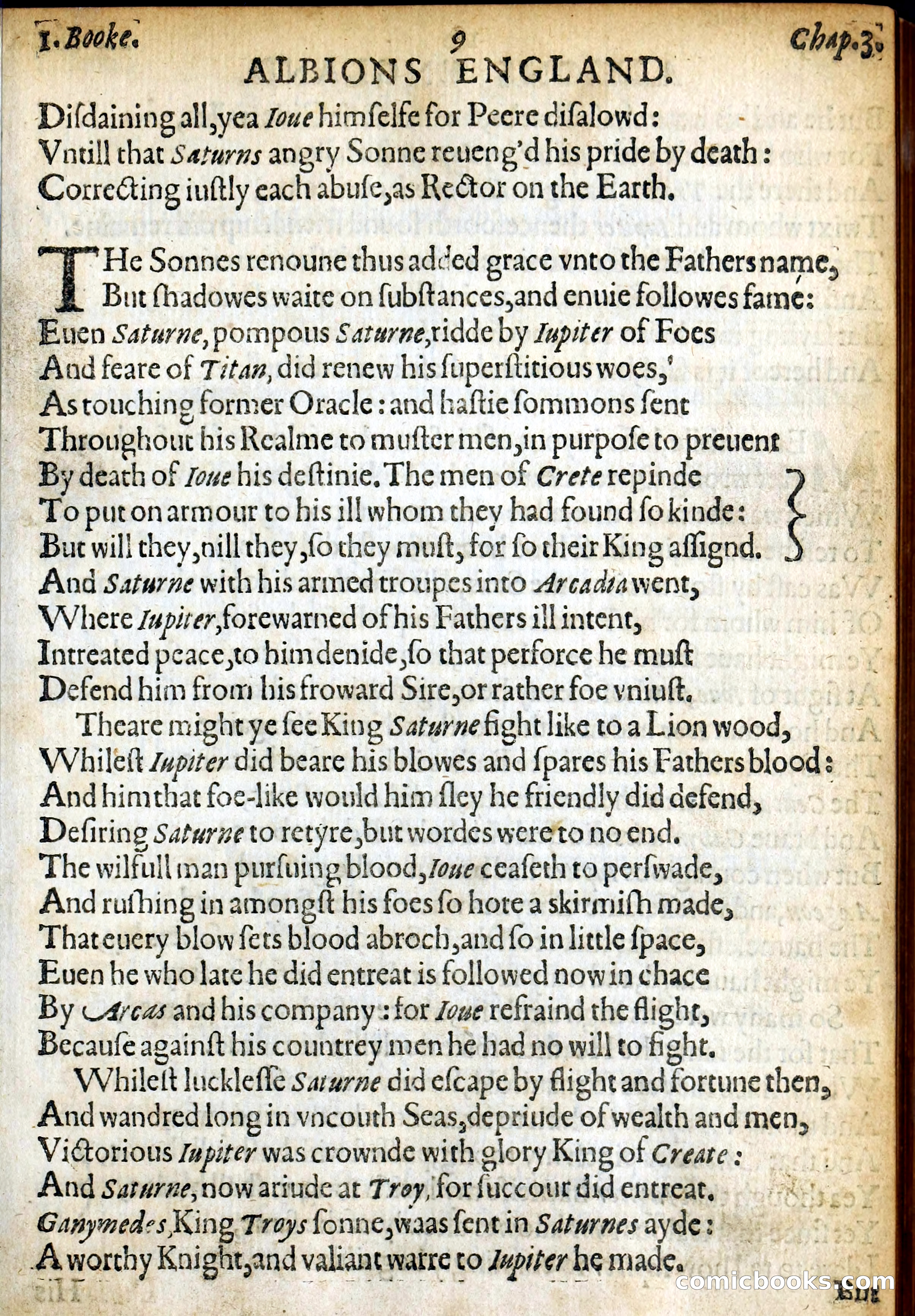
# Page Description This is running prose poetry from *Albions England*, a historical epic poem (not a Victorian penny dreadful as suggested in the prompt—this appears to be an early modern work, likely 16th-17th century based on typography and language). The page contains no illustrations or advertisements, only dense verse narrative in Early Modern English. The text recounts a mythological battle between Saturn and Jupiter: Saturn, seeking to prevent Jupiter from fulfilling his destiny, musters an army and attacks Arcadia. Jupiter, forewarned by his father's hostile intentions, defends himself reluctantly, sparing his father's blood even as Saturn pursues violence. Eventually Jupiter defeats Saturn, who flees to Troy seeking aid, while Jupiter becomes crowned King of Crete.
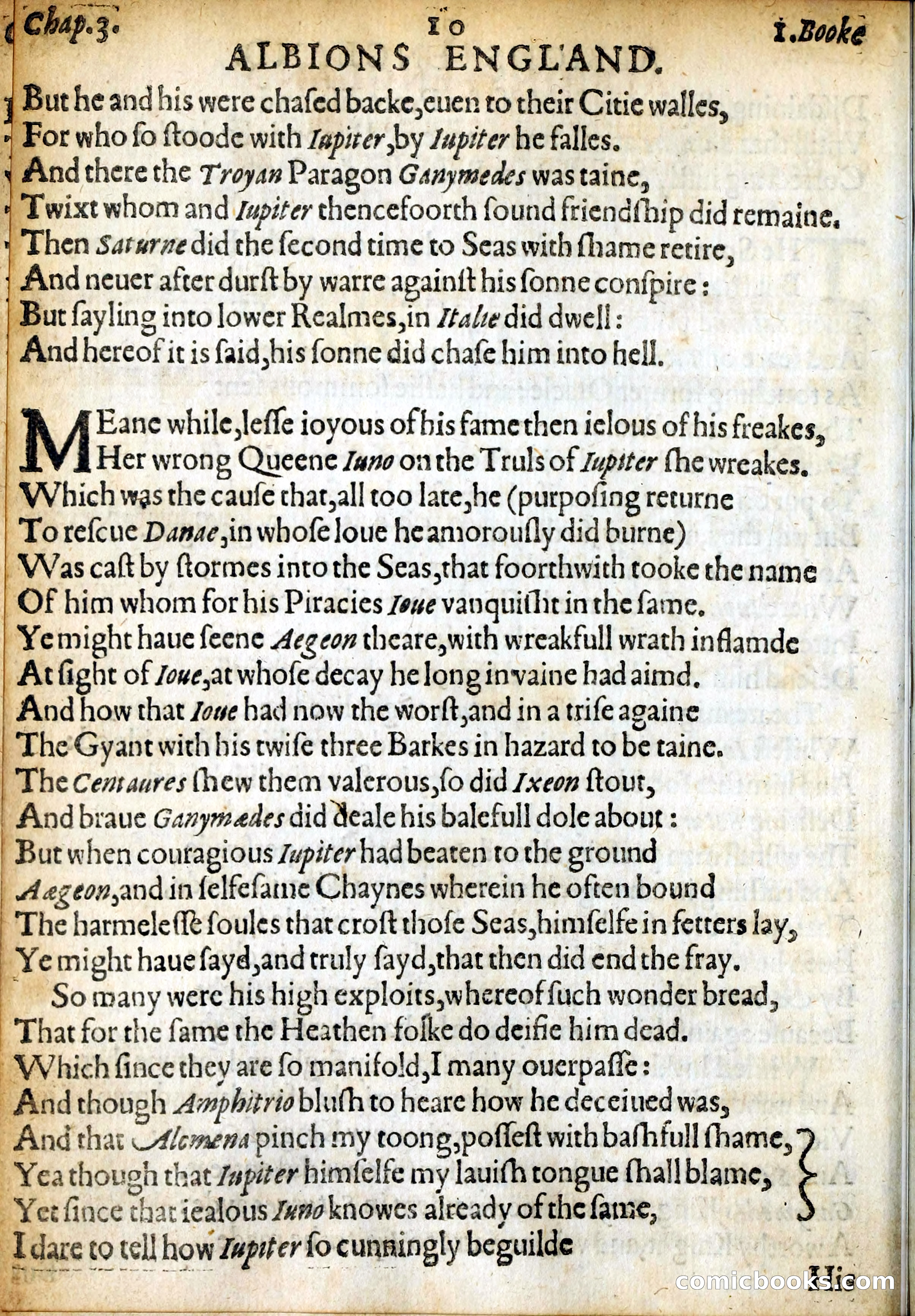
# Analysis of Page This is a page of running verse narrative poetry from *Albions England*, presented in early modern blackletter type. The text recounts mythological battles involving Jupiter, Saturn, Ganymedes, Juno, and the giant Aegeon, describing how Jupiter defeated his enemies and won divine honor among the heathen—though the narrator expresses some embarrassment at recounting Jupiter's deceptive cunning regarding an unnamed seduction. The passage is part of a larger heroic chronicle mixing classical mythology with English legendary history.
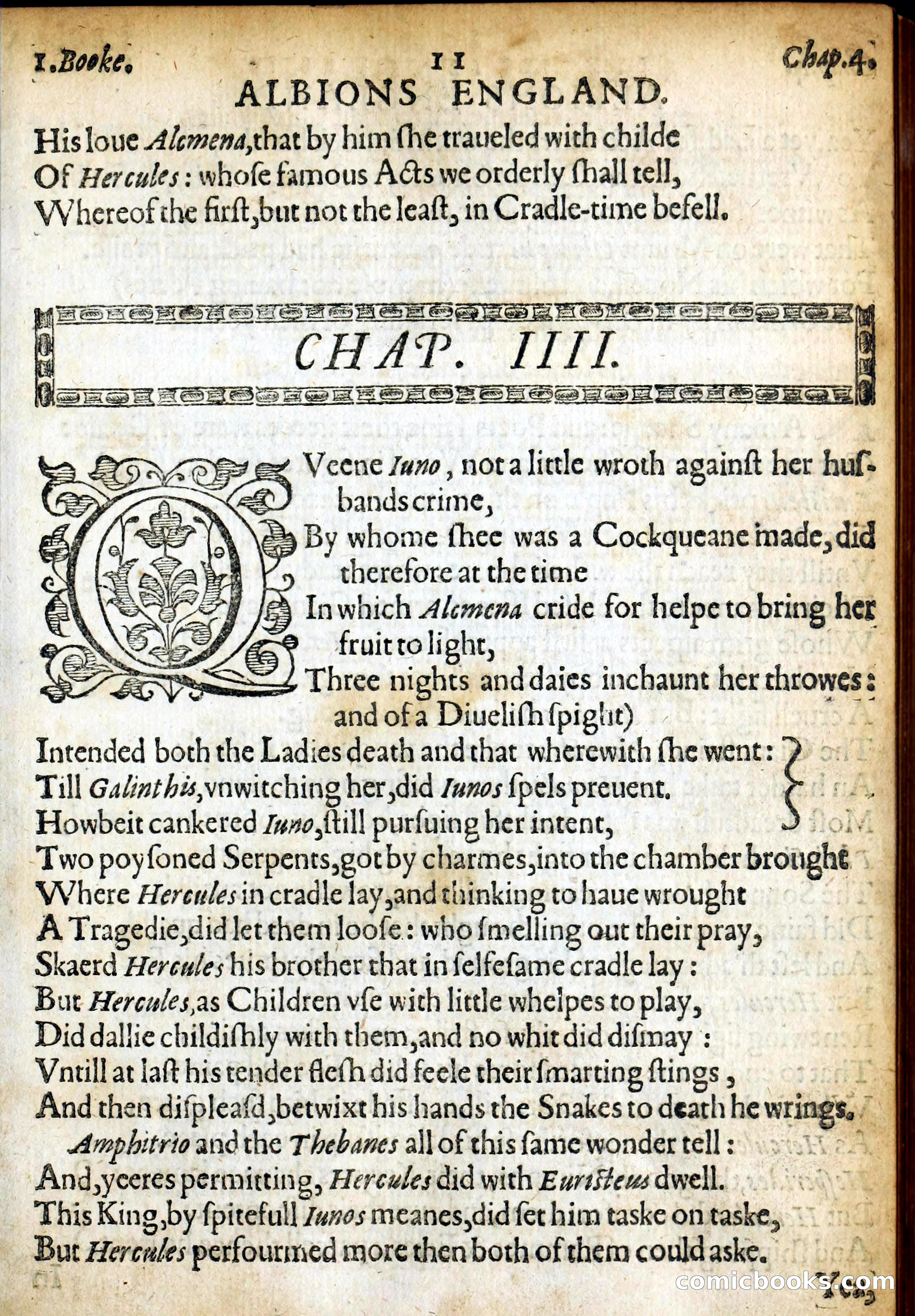
# Analysis of Page This is a page of running prose poetry from what appears to be an early modern text (not Victorian—the OCR attribution seems mistaken; this is likely from *Albion's England*, a 16th-century work). Chapter IV recounts the mythological story of Hercules' infancy: his mother Alcmena's pregnancy by Jupiter, Juno's wrathful interference causing prolonged labor pains, and her dispatch of two poisoned serpents to kill the infant Hercules in his cradle. The text describes how the baby Hercules, playing with the serpents as a child might with puppies, ultimately strangles them to death. The passage establishes Hercules' precocious strength and sets up his later servitude to King Eurystheus under Juno's vindictive influence.
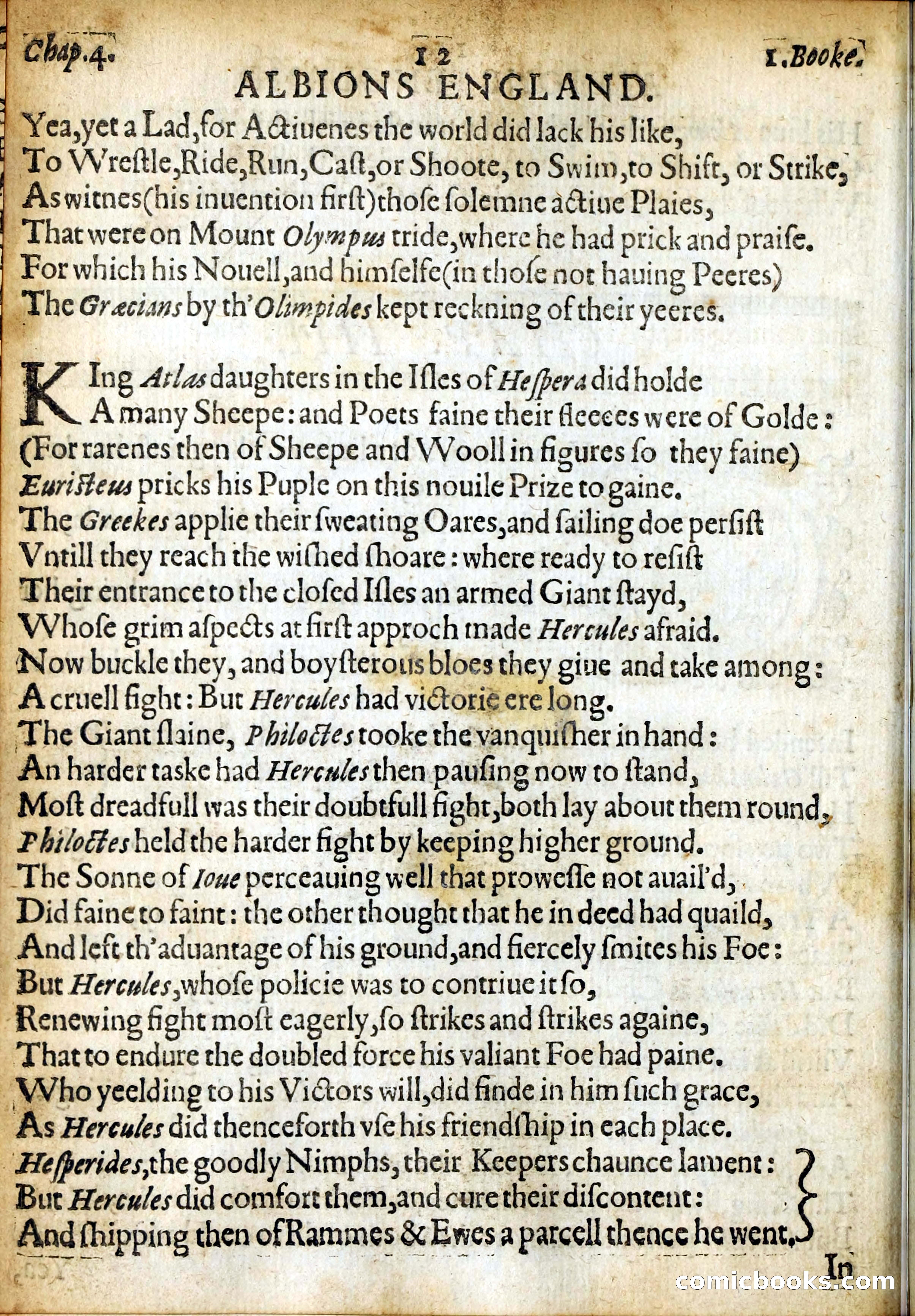
This is a page of running prose from *Albions England*, an early modern chronicle-poem (not a Victorian penny dreadful as the prompt assumes). The text recounts the legend of Hercules in archaic verse, describing his youthful athletic prowess, his task to obtain the golden fleece from the Hesperides, his battle with the giant Philoetes guarding the islands, and his eventual befriending of the giant after victory. The language and typography are Early Modern English, not Victorian.
# Page Description This is a page of running prose verse from *Albion's England*, a narrative poem. The text presents a mythological tale: King Laomedon of Troy borrows money from the priests of Neptune and Phoebus to build Troy's walls but refuses to repay the debt. As punishment, the gods send a sea monster that devastates the city. An oracle declares that a virgin must be sacrificed monthly to appease the creature. The lot falls to Hesione, the king's daughter, whom the Trojans will deliver to the port to be devoured—until Hercules learns of the situation and asks the king what reward he might receive for saving the guiltless lady and proving his valor.
# Analysis of Page from *Albions England* This is a page of running verse poetry, not a title page or illustration. The text recounts a mythological narrative in which Hercules accepts a king's challenge to combat a monstrous sea-creature (described as a "fiend-like fifth") to rescue a lady. After defeating the beast through prolonged combat, Hercules is celebrated in Troy—but the jealous king, fearing his subjects' affection for the hero, treacherously excludes him from the city and withholds the promised reward (two white horses). The passage ends with mention of Alemena's distress at this ungrateful treatment.
# Page Description This is a page of running prose poetry from *Albions England* (Book 1, Chapter 4), not a Victorian penny dreadful as initially suggested, but rather an early modern English verse narrative. The text recounts in heroic couplets the story of Hercules' war against Troy—describing his vow of vengeance, his destruction of allied cities, the pitched battles between Greeks and Trojans, Hercules' prowess with his club that fells the Trojan forces, and the eventual sacking of Troy itself, with only the city of Ileon spared due to the tearful pleas of its ladies, while the false Laomedon flees and his son is taken captive to Greece.
# What's on This Page This is a page of running prose poetry from *Albion's England*, Chapter 5. The text, presented in early modern English verse, narrates a mythological episode: Queen Juno entreats Thorne (apparently Hercules) to slay three lions that have devastated the countryside near Nemea. The passage describes Hercules and Philoctes seeking the lions in a forest, where a terrified herdsman warns them from a tree of the beasts' deadly power. The page ends as the three lions charge toward Hercules, who escapes by climbing.
# This Page: Running Prose from *Albion's England* This is a page of running verse poetry (not a title page or illustration) from what appears to be William Warner's *Albion's England*, an early modern English historical poem—not a Victorian penny dreadful as the prompt suggests. The text narrates Hercules' combat with mythological creatures and his subsequent adventures, including his encounter with the tyrant Busiris of Egypt, who sacrifices strangers to his gods. The passage describes Hercules' superhuman strength, his defeat of a lion, and the cruel custom of human sacrifice that Busiris practices, establishing the setup for Hercules' intervention.
This is a page of running prose poetry from what appears to be *Albion's England*, a narrative poem. The text recounts classical mythology: Hercules defeats the tyrant Busiris in Egypt and is sacrificed on an altar, bringing rain and joy to Memphis. He then returns to Thebes, marries King Creon's daughter Megara, and attends a wedding feast at Thessaly for Pirithous, where centaurs—drunk and unruly—disrupt the celebration and abduct the bride Hippodame. The archaic spelling and typography (long 's' characters) indicate an early modern or Victorian reprint of older material rather than original Victorian penny dreadful content.
This is a page of running prose poetry from what appears to be an early modern narrative poem titled *Albions England* (not a Victorian penny dreadful as suggested in the prompt). The visible text describes Hercules arming himself to rescue a kidnapped bride, engaging in battle against Ixion's Seed where he kills numerous Centaurs with arrows and his club. The passage concludes with twelve knights surviving by flight, and one prisoner (Lycus) yielding to Hercules, while another (Nessus) escapes to cause future trouble. Chapter VI begins below, describing how Hercules and his crew come ashore to prey upon the people of Sicily while feigning religious devotion.
This is a page of running prose poetry from "Albions England," Chapter 6, page 20. The text narrates the classical myth of Orpheus and Eurydice: King Pluto abducts the fair maiden Proserpine; Orpheus takes his harp to Hell's gate, where his music so moves Cerberus (graphically described as hideously ugly) that the demon escorts him to meet Pluto. Orpheus's heavenly harping makes Eurydice laugh, and Pluto grants her release on condition that Orpheus not look back at her until they leave Hell. The passage ends as they begin their passage through the underworld, with Orpheus fearing she might lag behind.
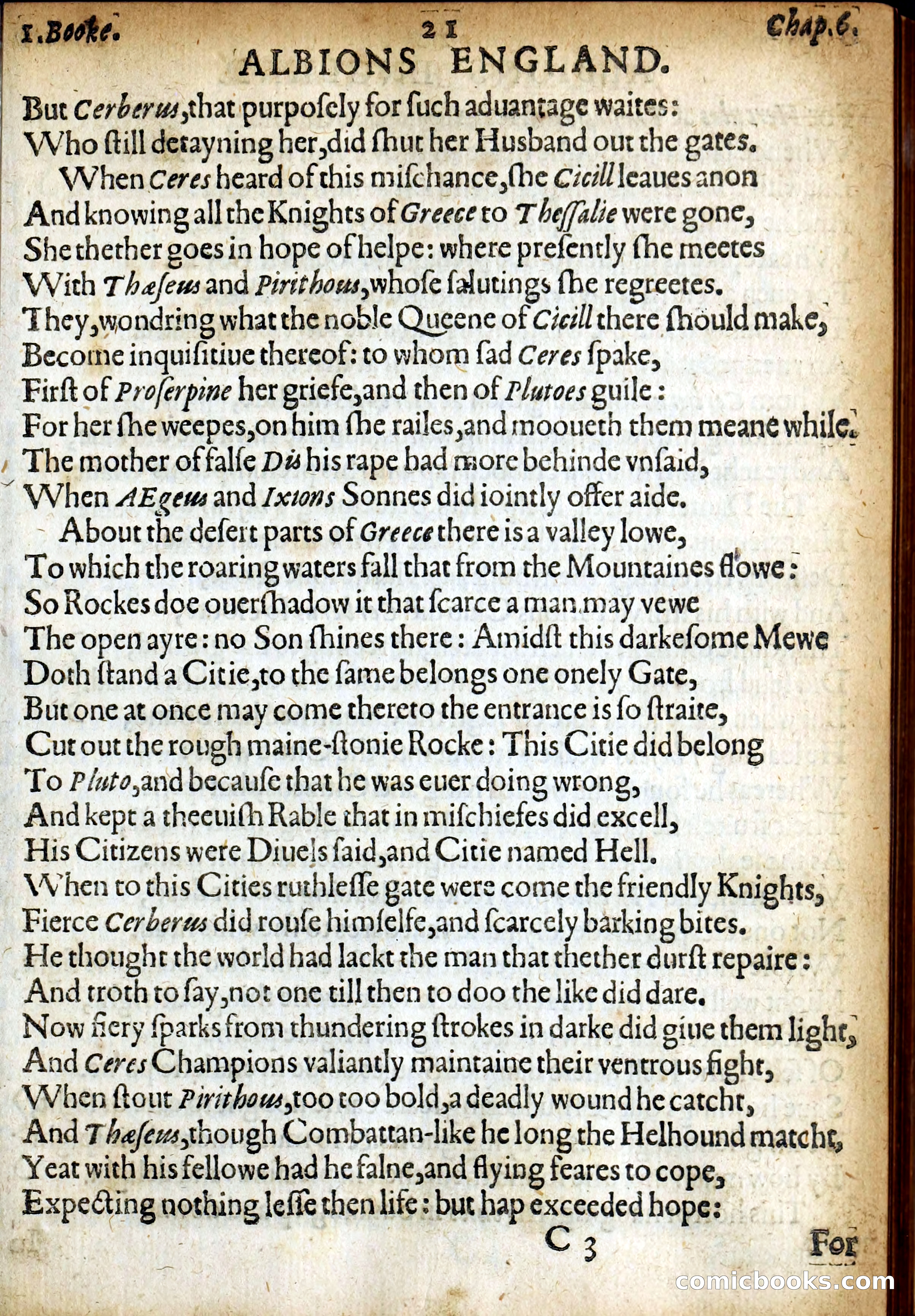
# Analysis of Page This is a running prose page from what appears to be an early modern narrative poem (likely 16th or 17th century, not Victorian as suggested). The text is titled "ALBIONS ENGLAND" and recounts a mythological episode involving Cerberus, Ceres, and Greek heroes Theseus and Pirithous. The narrative describes Ceres' grief over Proserpine's abduction, her journey to seek aid, and a battle at the gates of Hell against the three-headed dog Cerberus. The heroes are wounded in combat but survive, their hopes "exceeded." The page contains only dense printed verse in early modern English, with no illustrations or advertisements.
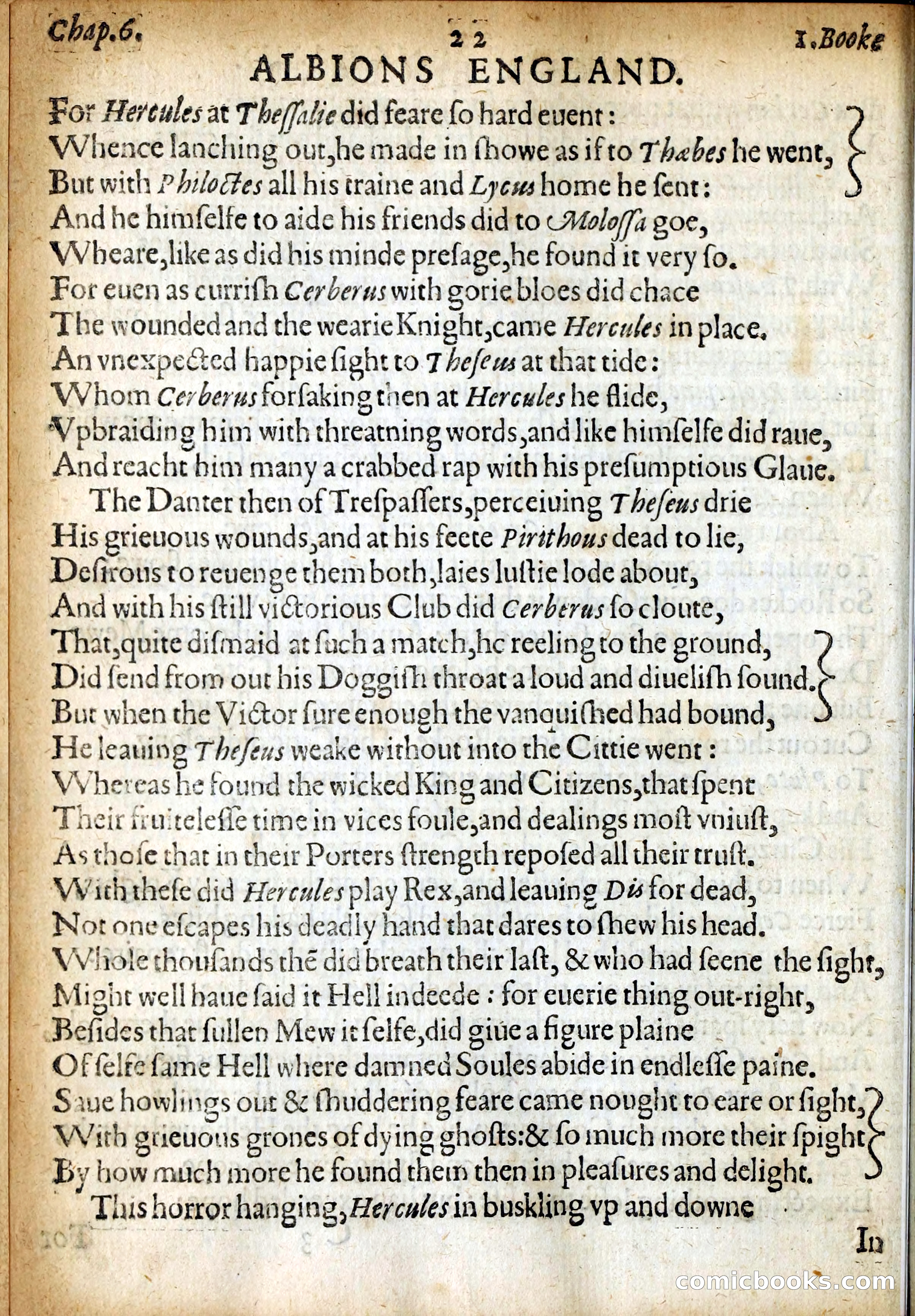
# Page Description This is a page of running verse poetry from "Albions England," a narrative poem about the hero Hercules. The text, printed in early modern typeface, describes Hercules' arrival to aid the wounded Theseus against the monster Cerberus, their subsequent battle, and Hercules' slaughter of a wicked king and corrupt citizens in a city—which the poet compares to Hell itself. The page contains no illustrations or title elements, only densely printed poetic couplets in an archaic style typical of early modern English literature.
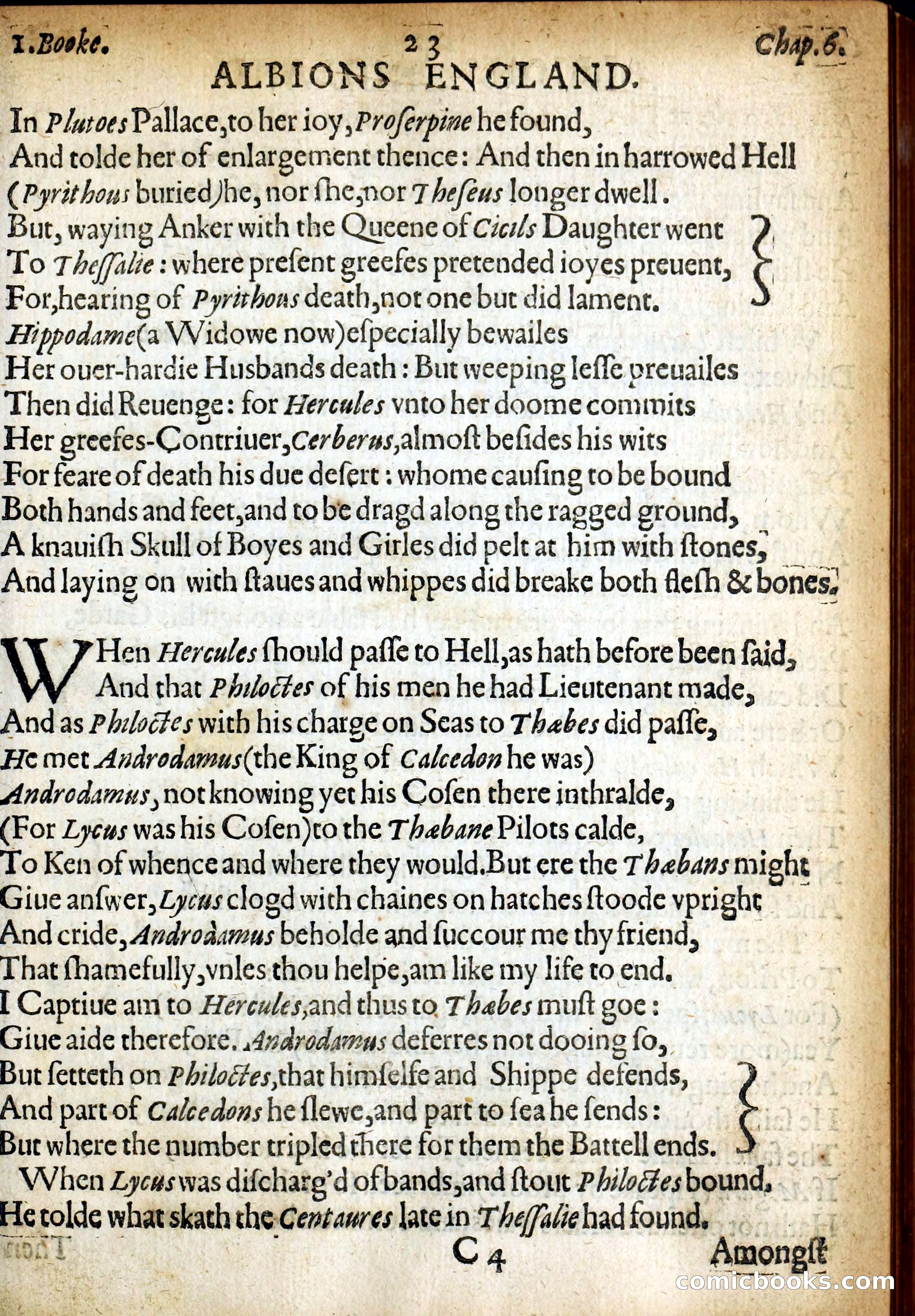
# Page Analysis This is a page of running prose poetry from *Albion's England*, a historical-legendary narrative poem. The text continues a classical mythological narrative, recounting how Hercules encounters various characters and conflicts on his journey to the underworld. The passage describes Hercules' interaction with the widow Hippodame, who seeks revenge for her husband's death through Cerberus; it then shifts to an encounter at sea where Philoctetes, traveling to Thebes with Hercules' lieutenant, meets King Androdamus of Calcedonia, who is shocked to discover his cousin Lycus held captive and appeals for aid in battle. The page is marked as Chapter 6 of Book 1, with signature mark C4 at bottom.
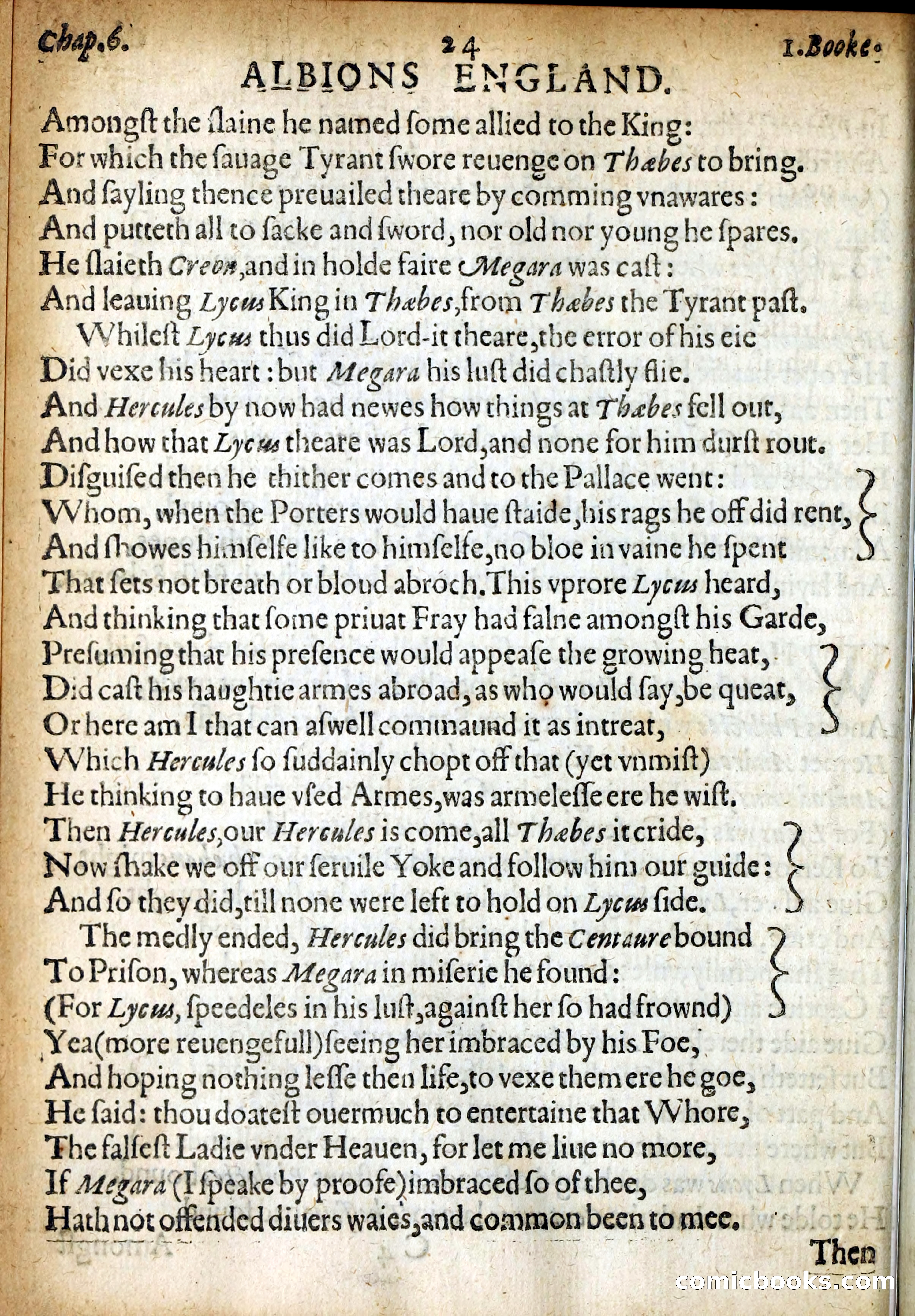
# Page Content Analysis This is a page of **running prose poetry** from "Albions England," Chapter 6, Book 1 (page 24). The text recounts a dramatic narrative involving Hercules, the tyrant Lycus, and the character Megara. It describes how Lycus ruled Thebes after the tyrant's fall, how Hercules arrived in disguise and revealed himself to the people, leading a revolt that deposed Lycus. The passage culminates with Hercules finding Megara in misery and Lycus making bitter accusations against her character before apparently taking his own life. The text employs archaic spelling and Early Modern English verse conventions typical of historical penny dreadful reprints.
# Analysis of Page from *Albions England* This is a page of running prose poetry, not a title page, cover, or illustration. The text recounts classical mythology: Hercules slays a Centaur and a treacherous king named Laomedon, then joins Greek forces to attack Troy alongside warriors including Telamon. The passage describes battles, the fall of the city, and concludes by mentioning how Priam's son later abducts Helen from the Greeks—"thirdly warre be gonne"—establishing the legendary cause of the Trojan War. The archaic spelling and verse form suggest this is from William Warner's *Albions England*, an early modern English historical-mythological narrative poem, not actually a Victorian penny dreadful.
# Page Description This is a running prose page from Chapter VII of "The Second Booke of Albions England," presented in early modern English verse. The text describes military events involving Hercules and the Greeks: Hercules lands in Egypt, encounters a Greek fleet, meets its captain Afer, and then sails with Afer to Libya to fight the Giant King Antaeus. The passage details their siege of the Giant's city and Antaeus's vow for revenge, concluding that despite his boasts, Antaeus is defeated. The page features ornamental borders and an illuminated initial letter at the opening.
# This Page from "Albions England" This is a page of running prose—specifically heroic couplets in Early Modern English verse. The text describes Hercules's military campaign: after his forces weaken, he accepts a truce; meanwhile, a Greek soldier finds supplies from King Antaeus. When Atlas learns Hercules has arrived, he and his giant ally attack in massive numbers, but Hercules defeats them all single-handedly with his club, slaughtering his enemies so thoroughly that he gains complete control of the territory. The narrative then notes that despite these victories, Atlas is brought to the seas, while Philoctetes appears to experience some emotional distress.
# Page Description This is a page of running verse narrative from *Albions England*, appearing as page 28 of Book 2. The text, printed in early modern English, recounts in poetry a mythological battle between Hercules and Antaeus. The passage describes how Hercules defeats Antaeus in combat, crushes him to death, and subsequently conquers Libya, installing a king named Afer to rule in the conquered lands. The page contains no illustrations, only dense black-letter typography arranged in poetic couplets and quatrains.
# Analysis of This Page This is a page of **running prose poetry** from *Albions England*, Book 2, Chapter 7 (page 29). The text describes an expedition where Hercules encounters an Amazon warrior who challenges him on behalf Scythian ladies. She proposes a combat wager: two champions from each side shall fight, with tribute or obedience as stakes. Hercules accepts, and the next day mounted knights meet in combat—Hercules fights Menalippe while Theseus fights Hippolite. The passage details their clash: horses and riders fall, and the combatants, dishonored, take up hand-to-hand fighting with swords, striking helms and armor. The text concludes with Hercules described as never having faced such a formidable opponent.
# Page Description This is a page of running verse text from Chapter 7 of what appears to be an epic or heroic poem titled "Albions England" (visible in header). The visible text recounts mythological battles and romantic episodes involving classical figures: Theseus fights in combat, Hercules aids King Oeneus against the tyrant Achelous who seeks the king's daughter, and various marriages and ransoms of captive women occur. The narrative moves from martial contests to dynastic negotiations, written in early modern English verse with archaic spelling and typography.
# What This Page Contains This is running prose narrative verse from Chapter 7 of a work titled "Albions England." The page depicts an extended poetic account of a military siege and battle involving figures named Hercules, Achelous, and Thebane. The narrative describes a castle under siege, Achelous's contemptuous sortie against Greek forces, their fearful retreat upon seeing Hercules and his club, a subsequent ruse involving a fire-lit ship sent as bait, and Hercules detecting the ambush and engaging Achelous in combat. The verse employs early modern English spelling and typography typical of older printed texts.
# Analysis of Page This is a page of running verse text from *Albions England*, Book 2, Chapter 8, continuing into Chapter 8. The text is composed in rhyming couplets and recounts a classical narrative: King Achelous fights two rival suitors for a woman's hand; one suitor defeats the king in combat with a club; the victorious suitor (Hercules) is then rewarded with marriage to the fair Deianira by the grateful king. The passage concludes by introducing the Centaur Nessus as a figure who will cause the woman's downfall—though the OCR is somewhat garbled in the final lines.
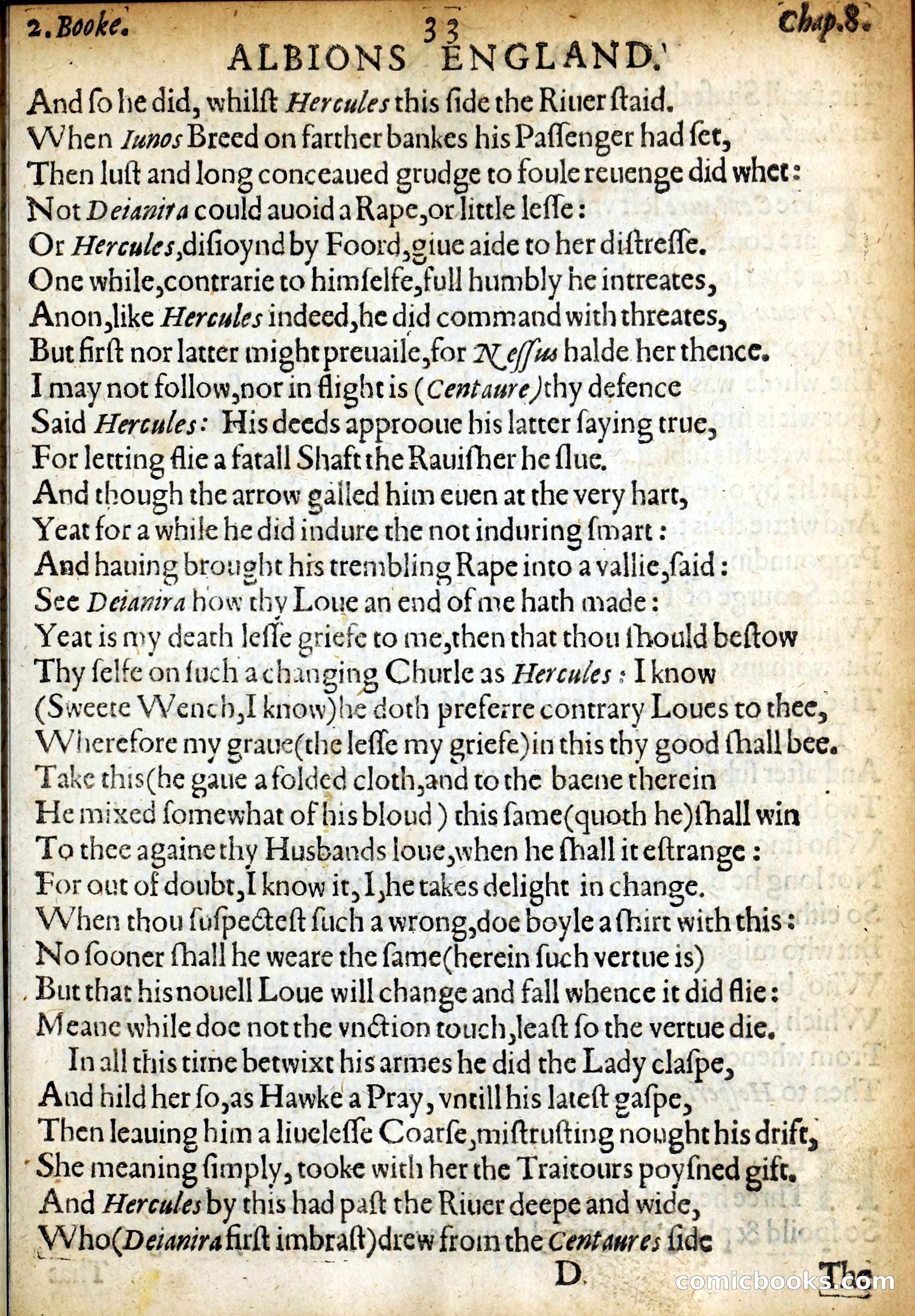
# What is on this page: This is a page of running verse poetry from *Albion's England*, a historical narrative poem. The text is printed in italics and roman type on aged paper, marked as "2. Booke" and "chap.8." The visible passage recounts a classical mythological episode: Hercules helps defend Deianira from rape by a centaur, whom he kills with an arrow. Mortally wounded, the centaur gives Deianira a cloth soaked in his blood, claiming it will restore her husband's love if he strays. The narrative describes their parting as he dies, after which she takes the poisoned gift, unaware of its true nature.
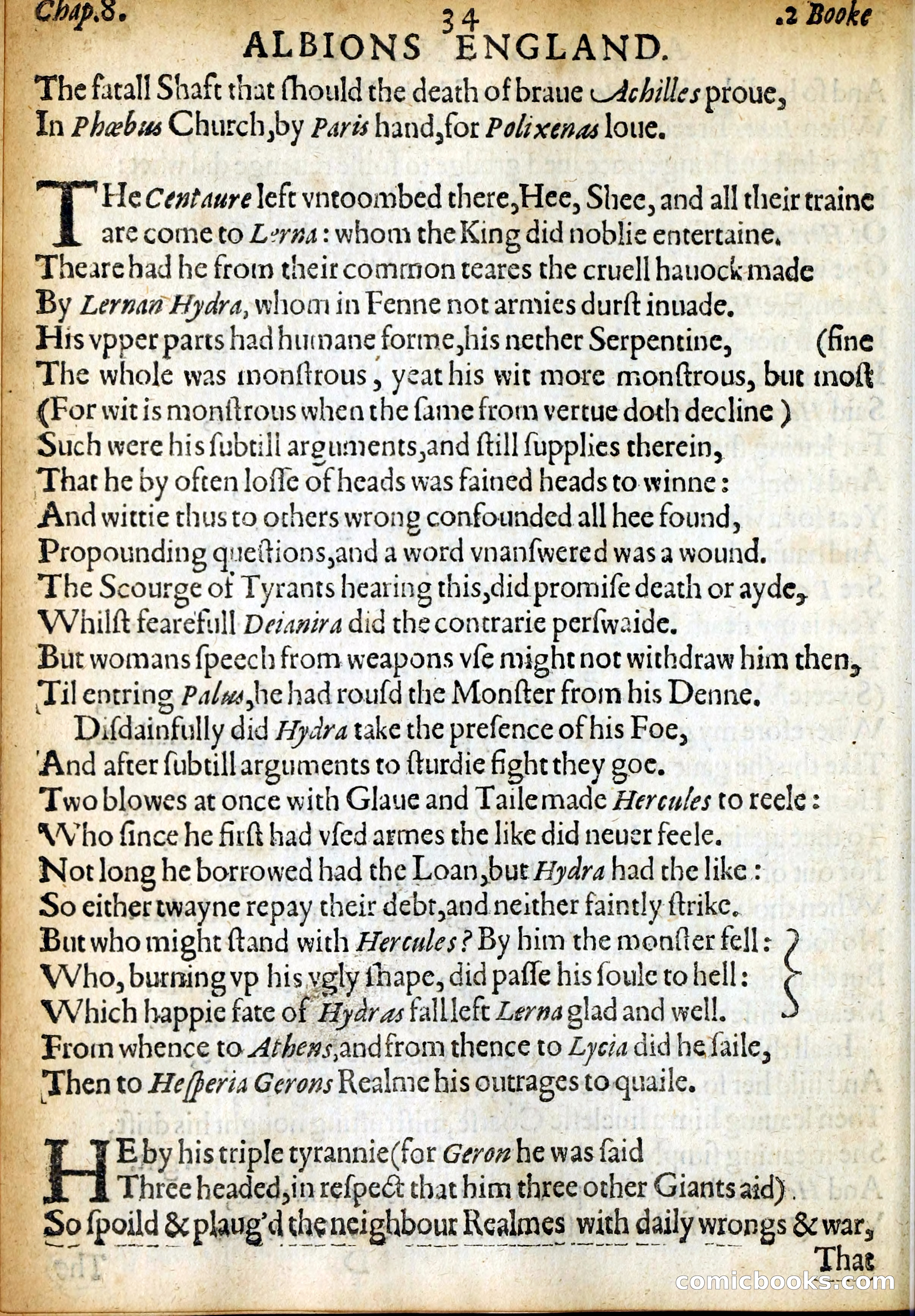
# Description of Page This is a page of running verse prose from Chapter 8 of "Albions England." The text narrates mythological episodes involving the Centaur, the Lernaean Hydra, and Hercules. It describes how a Centaur's corpse was left unburied, the monstrous Hydra's clever but destructive arguments, Hercules's battle with the Hydra resulting in the monster's death and descent to hell, and concludes with Hercules traveling to Athens, Lycia, and Hesperia to confront Geryon, a triple-tyrant giant plaguing neighboring realms with war and wrongdoing.
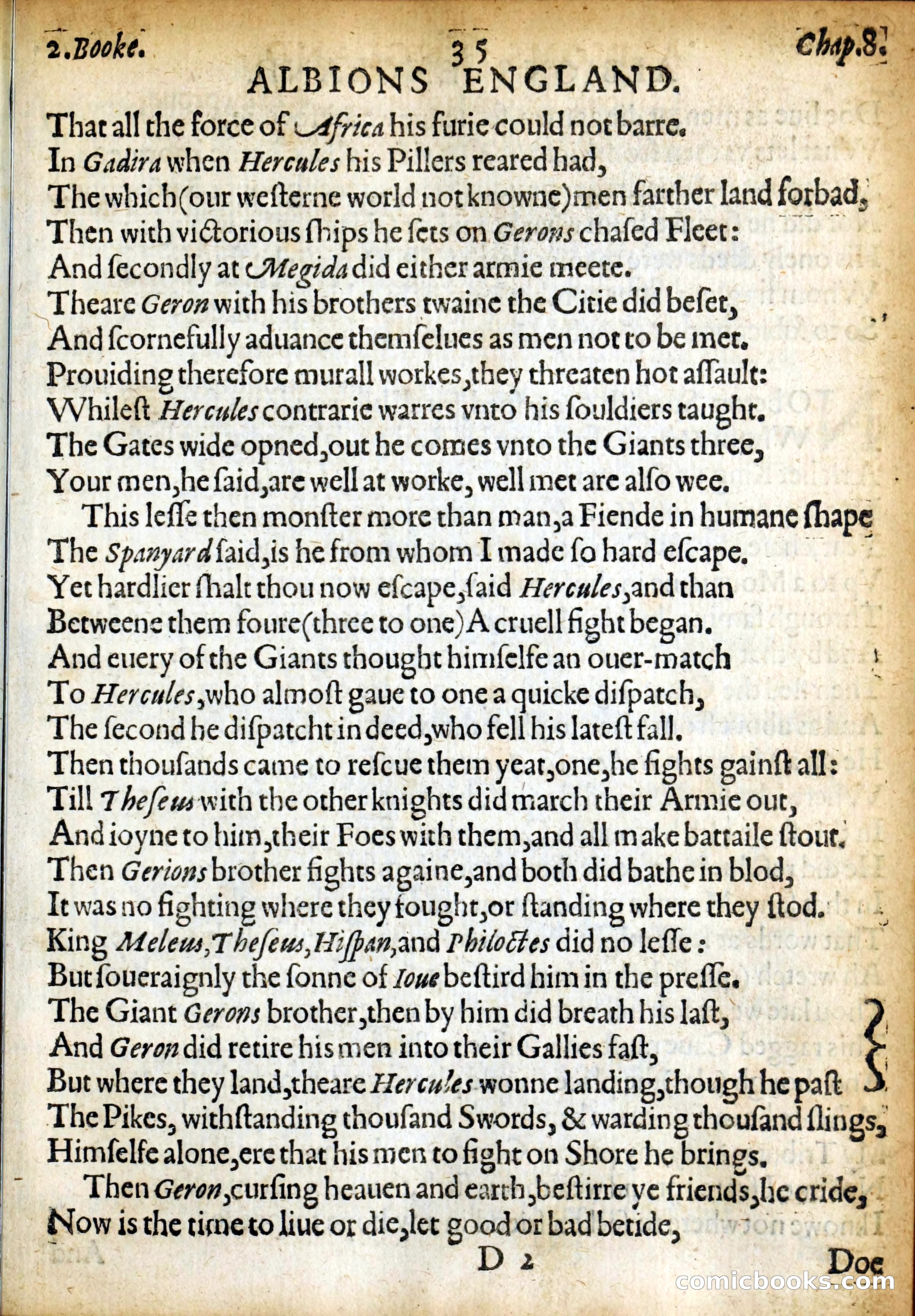
# Page Analysis: Running Verse Narrative This is a page of running prose poetry from what appears to be a classical or legendary narrative work (possibly early modern rather than Victorian penny dreadful, based on typography and language). The text recounts a battle involving Hercules against giants, specifically Geron and his brothers. The verse describes Hercules meeting three giants at the gates, fighting them in combat where he kills two, then enlists other knights and heroes (Theseus, Hippolytus, and others named) to join the battle. The passage concludes with Hercules pursuing the retreating Geron and his men to the shore, where Geron calls his friends to fight, declaring it is "time to live or die."
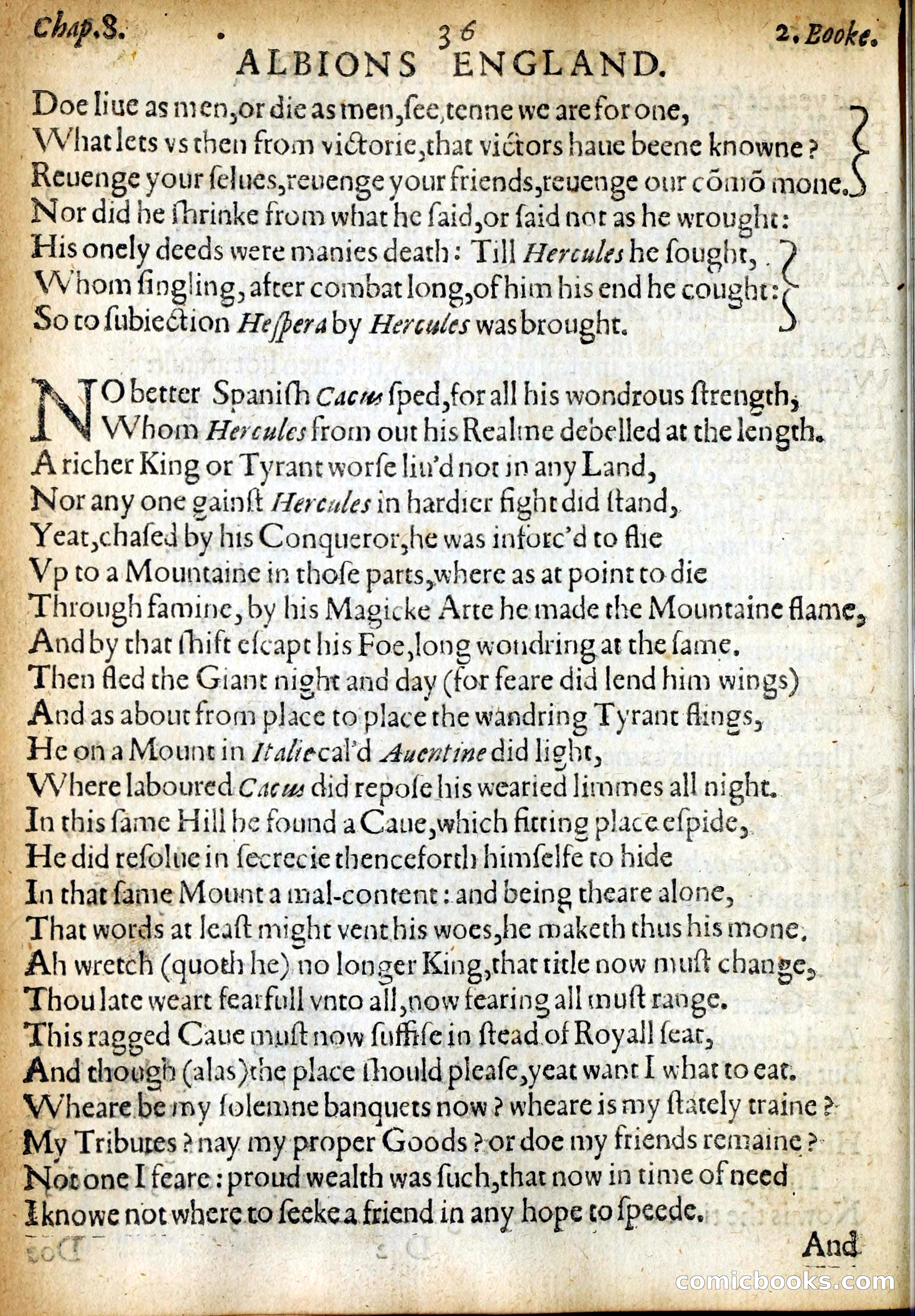
# Analysis This is a page of running **verse narrative prose** from what appears to be an early modern (not Victorian) work titled *Albions England*. The text recounts classical mythology: the defeat of the Spanish giant Cacus by Hercules, and Cacus's subsequent flight to a mountain cave where he laments his fall from power and kingship. The passage emphasizes themes of conquest, loss of status, and the tyrant's isolation—once wealthy and powerful, he now cannot find friends willing to aid him in his need. The typography and spelling conventions (u/v substitutions, italicized proper names like *Hercules* and *Auentine*) suggest this is an early printed edition, likely 16th or 17th century, not a Victorian penny dreadful.
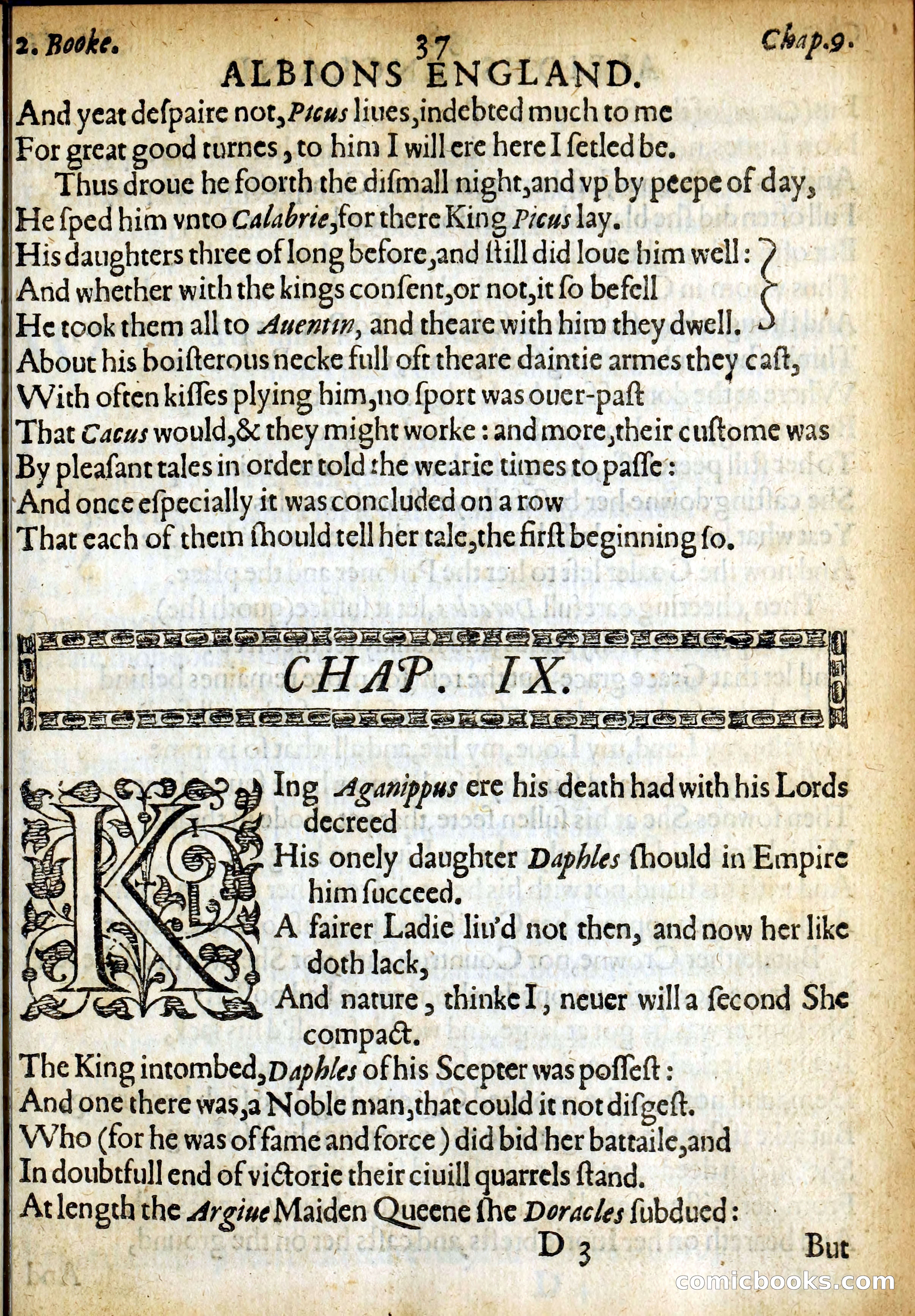
# Analysis of This Page This is a page of running verse narrative prose from what appears to be a longer poem, *Albions England*. The page contains two distinct sections: the conclusion of Chapter 8 (describing how a man named Picus traveled to Calabrie and settled with King Picus, whose three daughters told tales to pass the time), followed by Chapter 9, which begins a new narrative about King Aganippus's death and his daughter Daphles's inheritance of the empire. The text then describes how a noble man challenged Daphles's rule, leading to civil conflict that the "Argine Maiden Queene" eventually subdued. The page is marked as page 37 from Book 2 and uses decorative chapter heading ornaments typical of early modern printing.
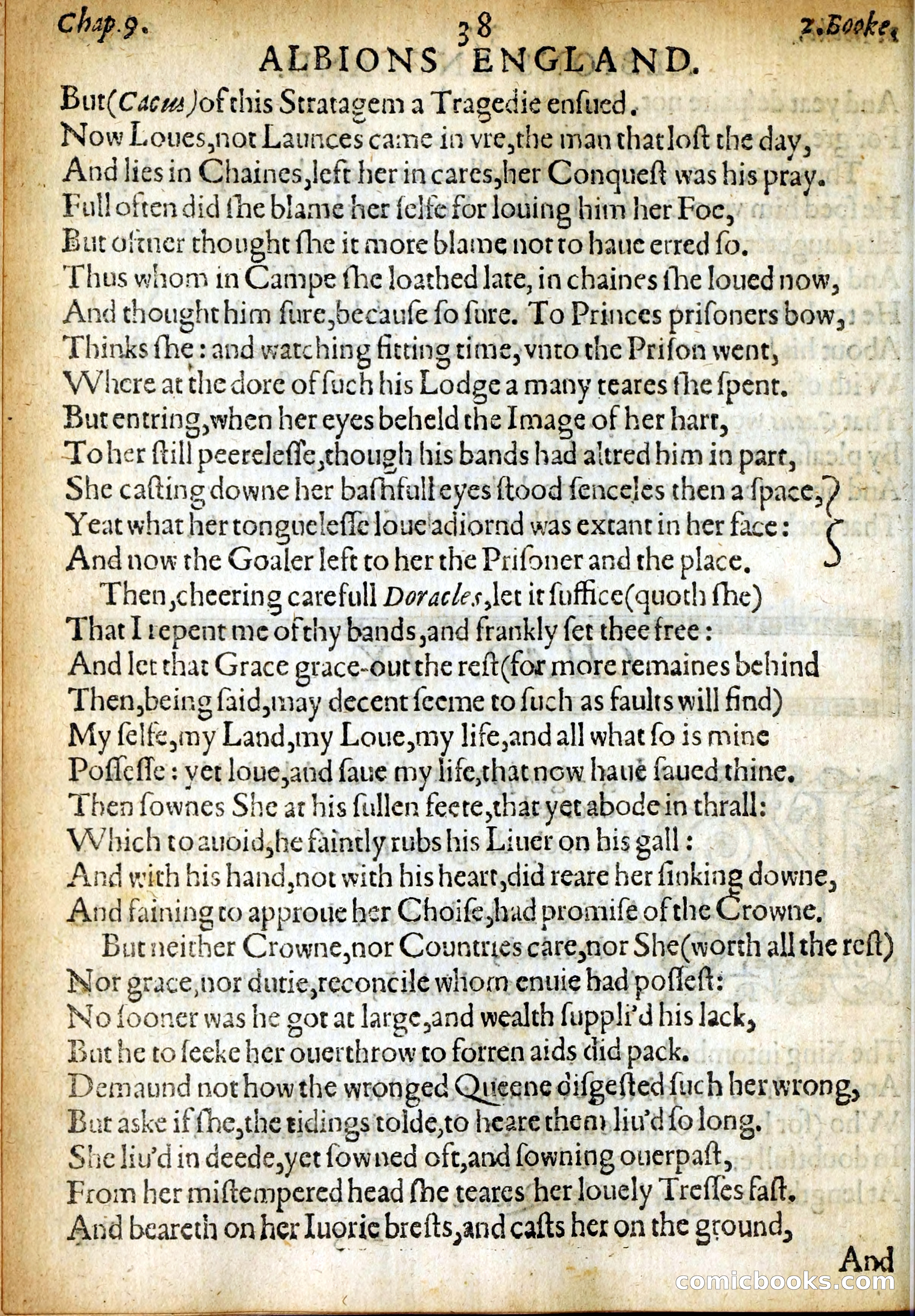
# Page Description This is a page of running verse narrative from *Albions England*, Chapter 9 (page 38). The text recounts a tragic love story: a woman visits a male prisoner in chains, whom she once opposed but now loves. She secures his release by pledging her lands, life, and love to him. However, once freed and enriched, he abandons her, seeking her overthrow through foreign allies. The passage concludes with the wronged woman weeping, her tears falling as she grieves his betrayal. The verse employs period language and elaborate metaphors typical of early modern English poetry.
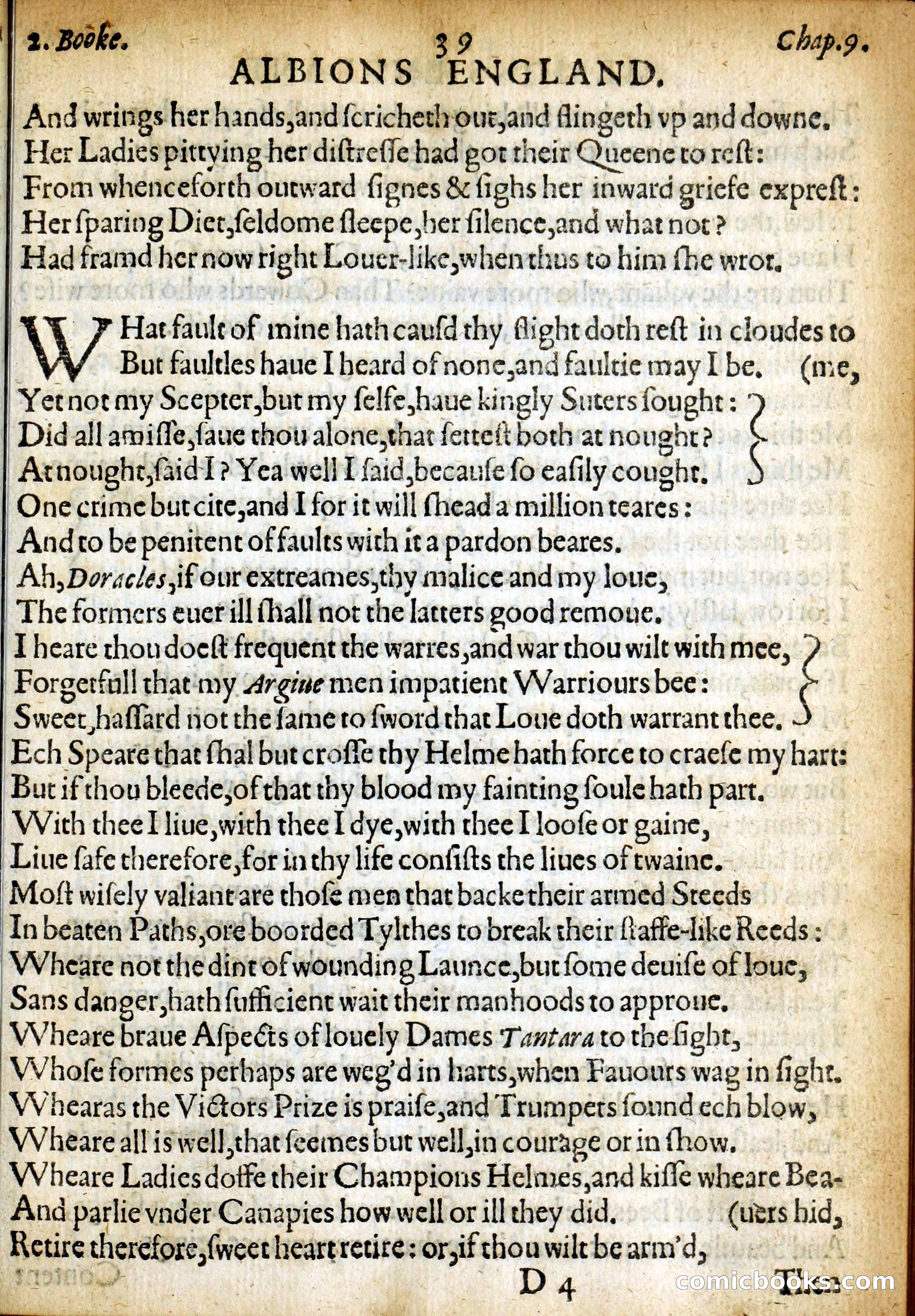
# This Page Contains Running Verse Prose This is a page of running verse text from *Albion's England*, a historical-narrative poem (not a Victorian penny dreadful, but early modern literature). The visible text presents a letter or monologue from a distressed queen to her absent lover, Doracles. She writes of her anguish at his departure, her sleeplessness and fasting, and begs him not to risk his life in wars—arguing that love, not martial valor, should guide his actions. The passage includes praise for warriors who fight thoughtfully and remarks on the power of ladies' favor in inspiring men's courage. The text is printed in black-letter type on aged paper.
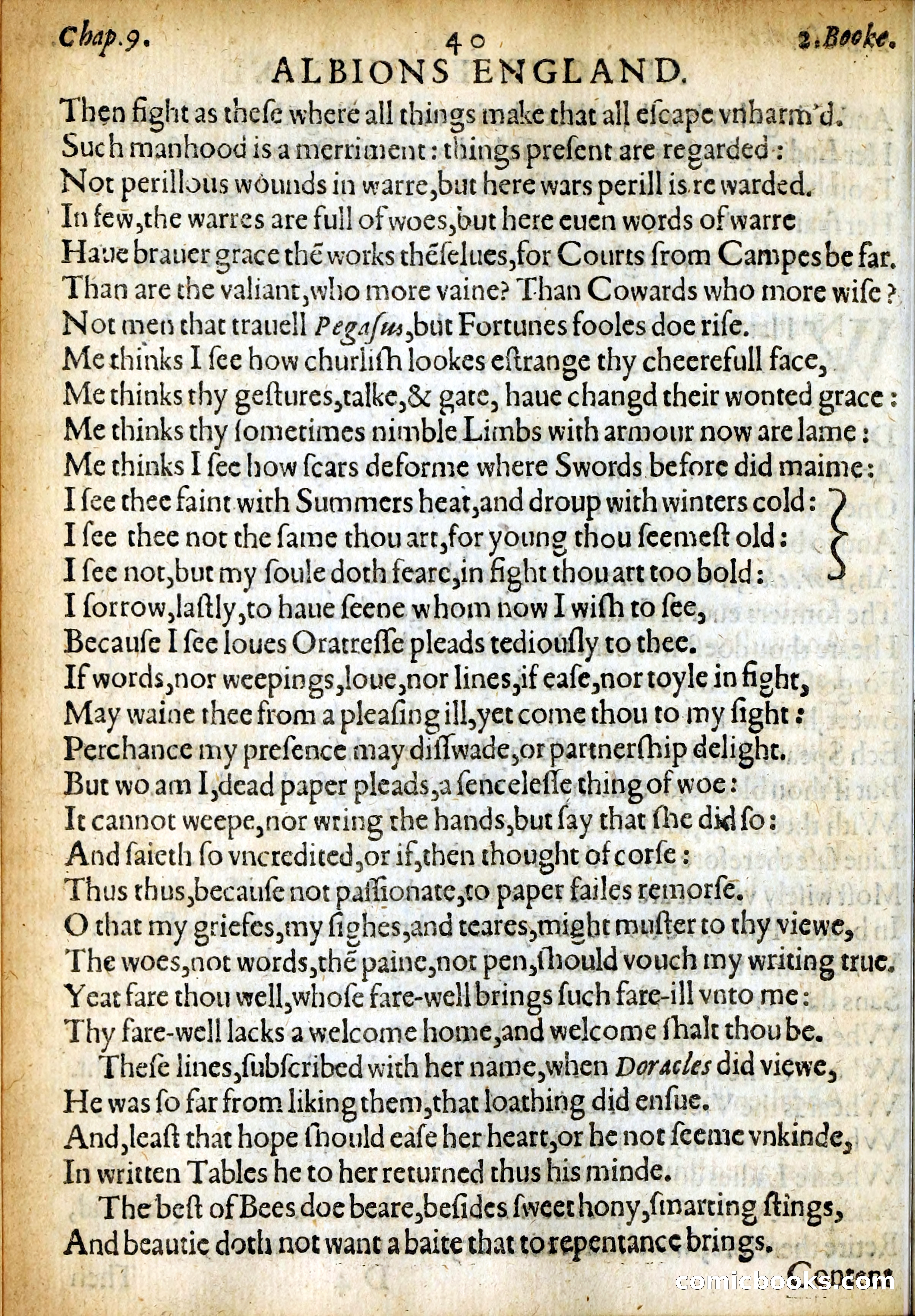
# What's on This Page This is a page of running prose poetry from *Albion's England*, a historical verse narrative. The text presents a dramatic monologue in which a speaker laments to an absent warrior, describing how combat has changed him—his face now strange, his limbs weakened by armor, his youthful vigor lost. The speaker then despairs that written words cannot convey true emotion as powerfully as tears and sighs could. The passage concludes with a reference to "Doracles" viewing and rejecting these lines, followed by his own written response comparing beauty to honeybees: attractive but armed with stinging consequences.
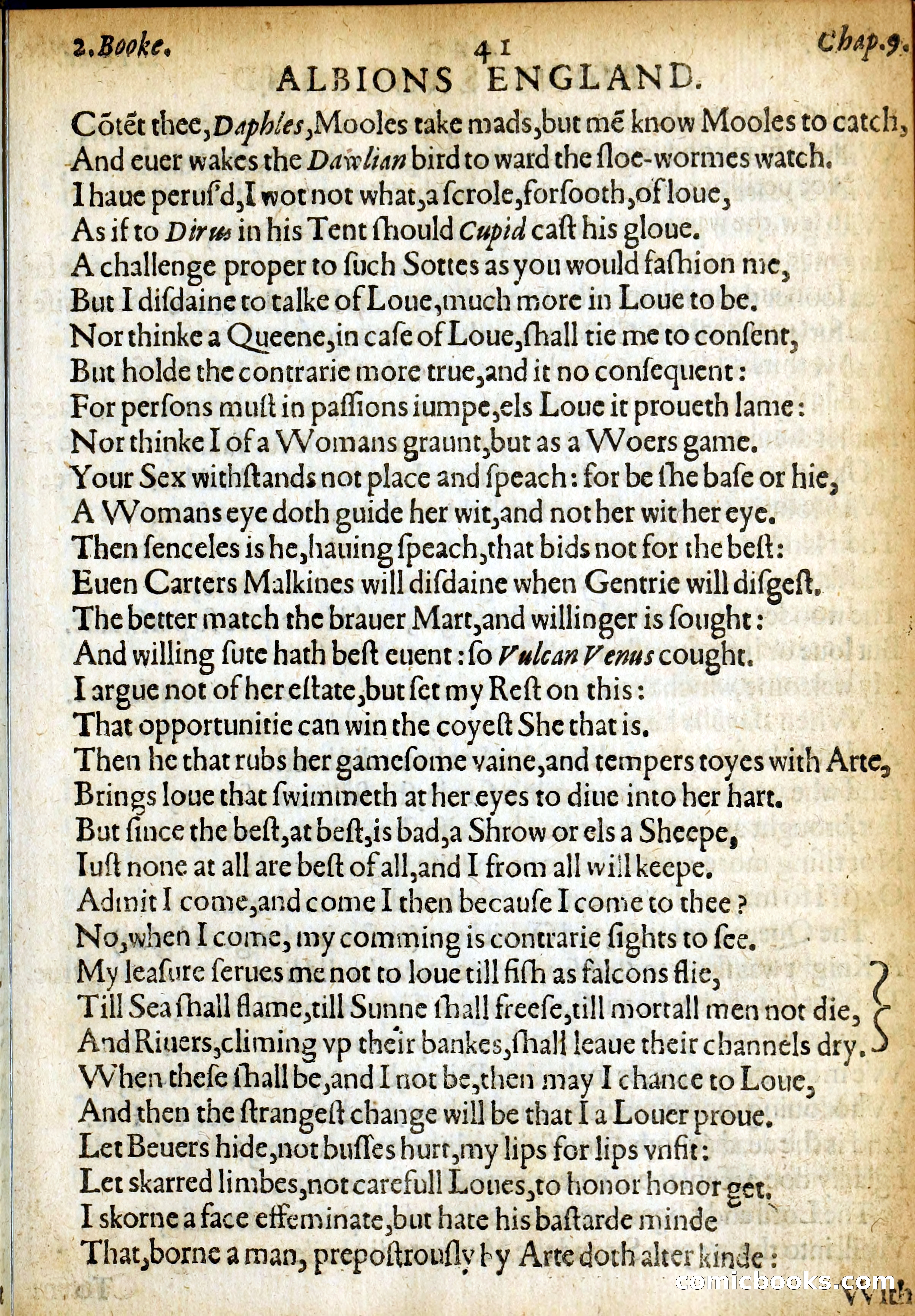
This page contains running verse text from *Albions England*, Book 2, Chapter 9. The speaker, apparently a woman, rejects romantic advances and declares her refusal to love. She argues against female submission to male suitors, asserts that opportunity rather than merit wins women's favor, and states she will remain unwilling until impossible conditions occur—until the sea flames, the sun freezes, and men cease to die. The verse is written in early modern English with archaic spelling and typography.
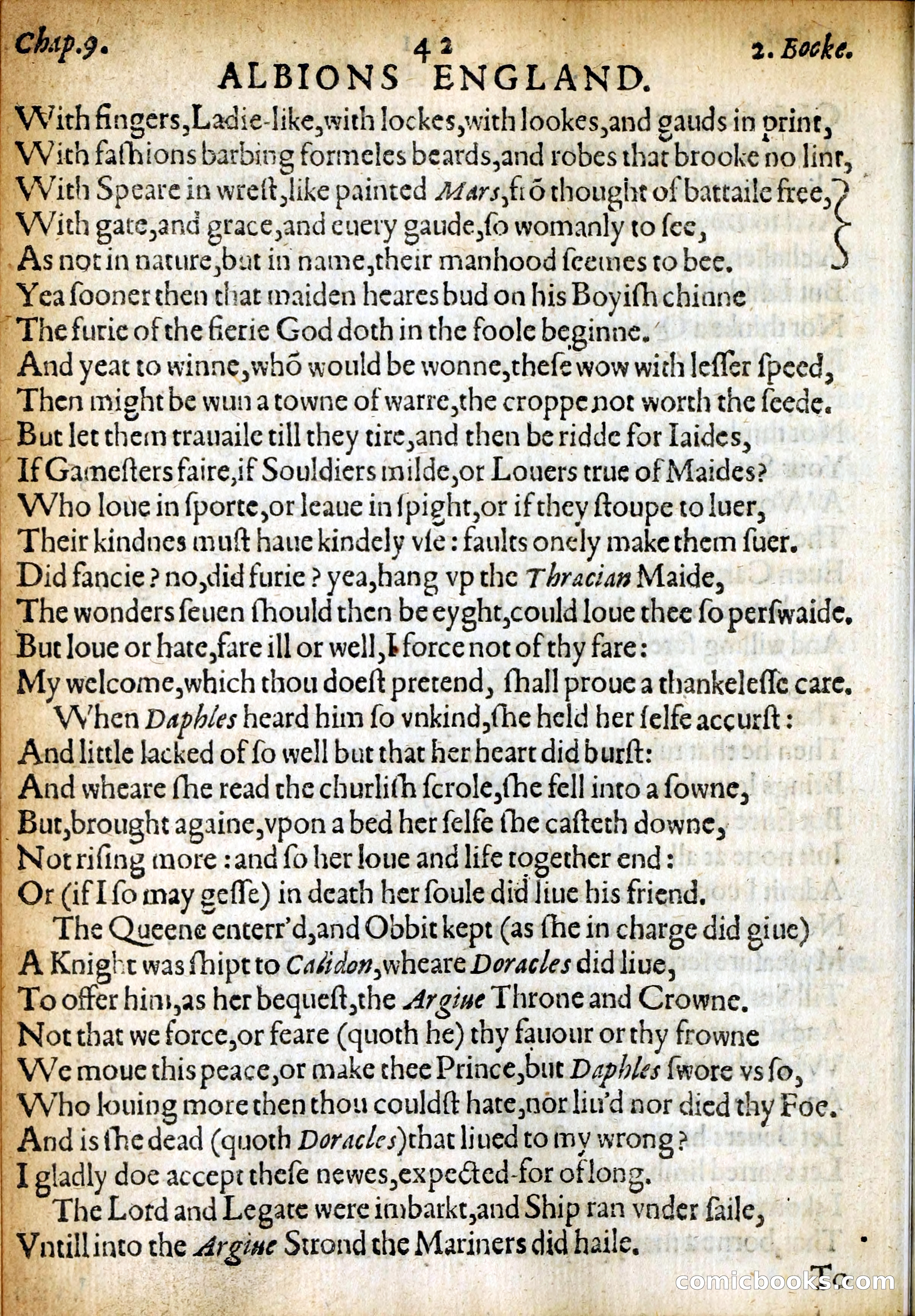
# Page Analysis This is a page of running prose poetry from what appears to be an early modern text (not Victorian—the typography and language suggest 16th or 17th century). The page is numbered 42 and labeled "Albions England" with chapter and book references at top. The text narrates a tragic love story: it describes effeminate courtiers, then tells of a maiden named Daphles who dies of heartbreak upon reading a cruel letter from her lover. After her death, the Queen sends a knight to Caldon to offer Doracles (apparently the lover) a throne and crown as recompense. The passage ends with a ship setting sail toward the Argine Strand. The narrative concerns courtly love, grief, and political reconciliation following romantic tragedy.
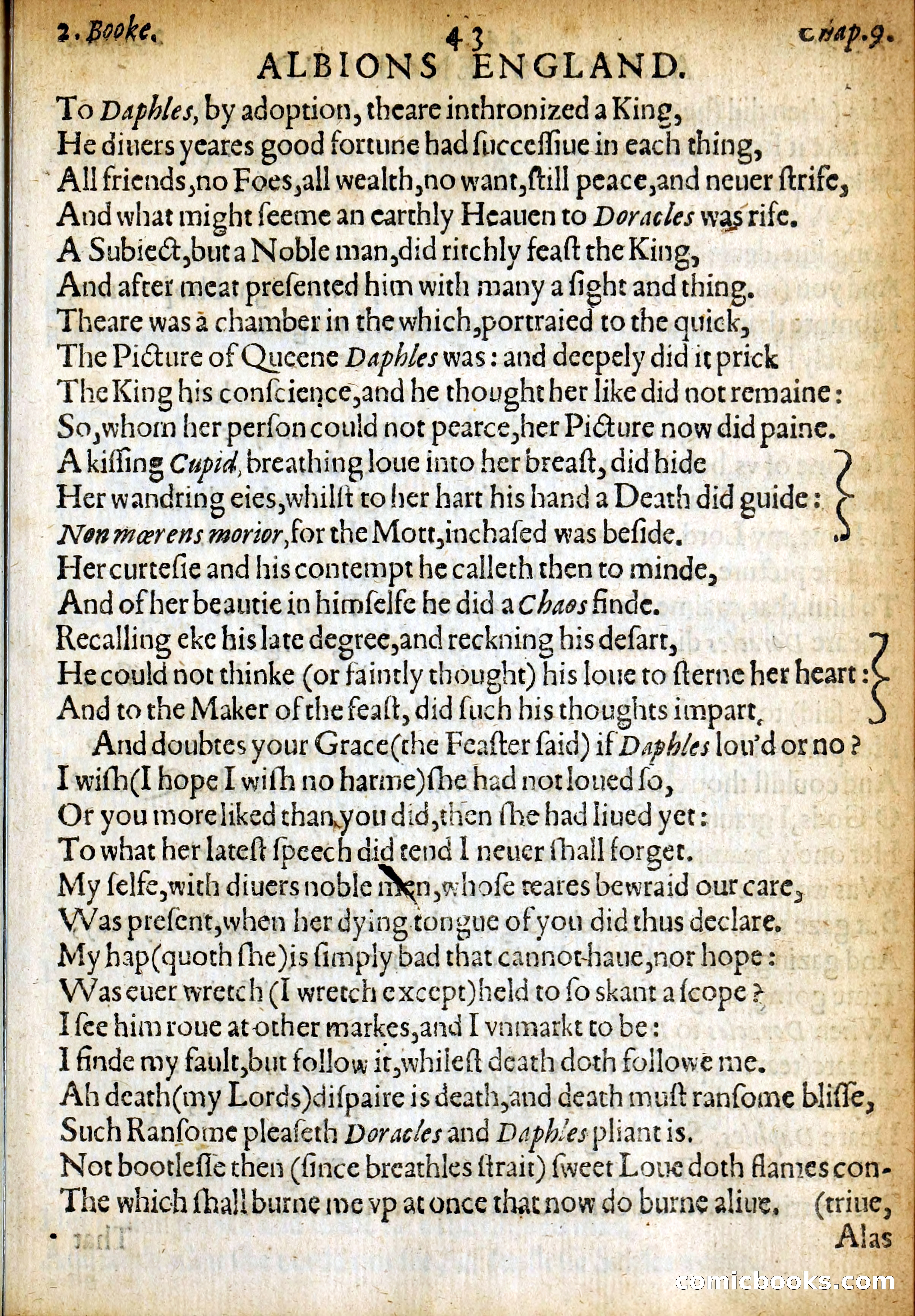
# Analysis This is a page of running prose poetry from what appears to be "Albions England," a historical narrative poem. The visible text concerns King Daphles, who becomes enamored with Queen Daphles (by adoption) after seeing her portrait in a chamber. The poem describes how Cupid's influence torments the King with love and longing, causing him emotional anguish. A noble subject relates the Queen's dying words declaring her love for the King, leading to reflections on death, despair, and the burning pain of unrequited or thwarted love. The archaic spelling and verse form suggest this is early modern English literature rather than a Victorian penny dreadful, despite the OCR header indicating otherwise.
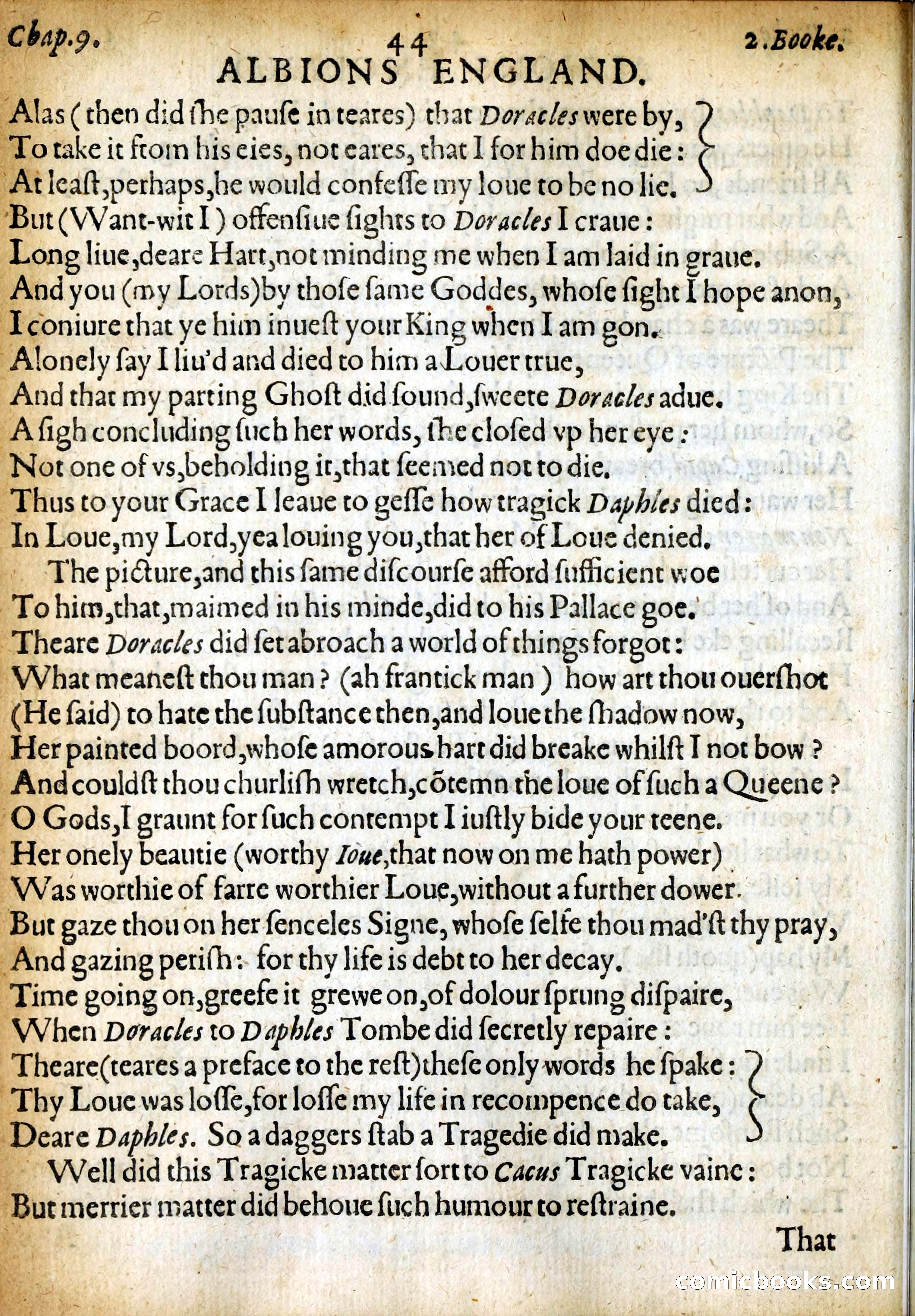
# This Page from *Albions England* This is a page of running verse poetry, not a penny dreadful as initially described. The text presents a tragic love story in early modern English verse: a character named Doracles grieves over the death of Daphles, a queen who died for unrequited love. The passage describes Doracles' despair at her tomb, where he declares his own life forfeit in recompense for her loss, before stabbing himself with a dagger. The verse concludes by noting this tragic matter suited the style of someone named Cacus, though merrier content might have been more appropriate for restraint.
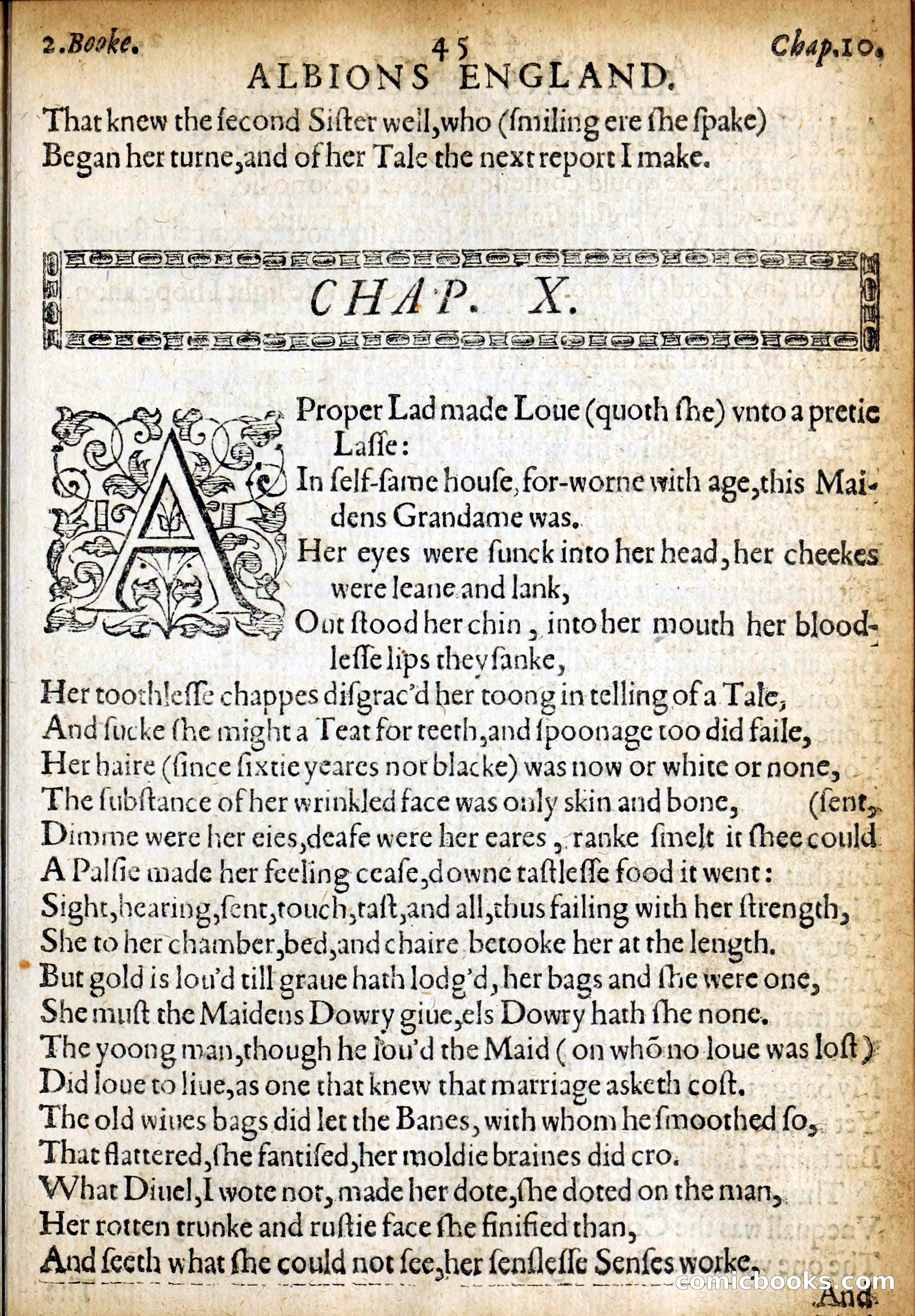
# This Page: Running Prose from a Narrative Poem This is a page of printed verse narrative from *Albion's England*, presenting Chapter X. The text describes, in archaic Early Modern English poetry, an elderly impoverished woman—a "Grandame"—whose physical decline is rendered in grotesque detail: sunken eyes, lean cheeks, protruding chin, toothlessness, white hair or baldness, and wrinkled skin. The passage explains that despite her infirmity and loss of all five senses, she possesses money that makes her attractive to a young man who courts her for her dowry rather than love, while she becomes besotted with him in return.
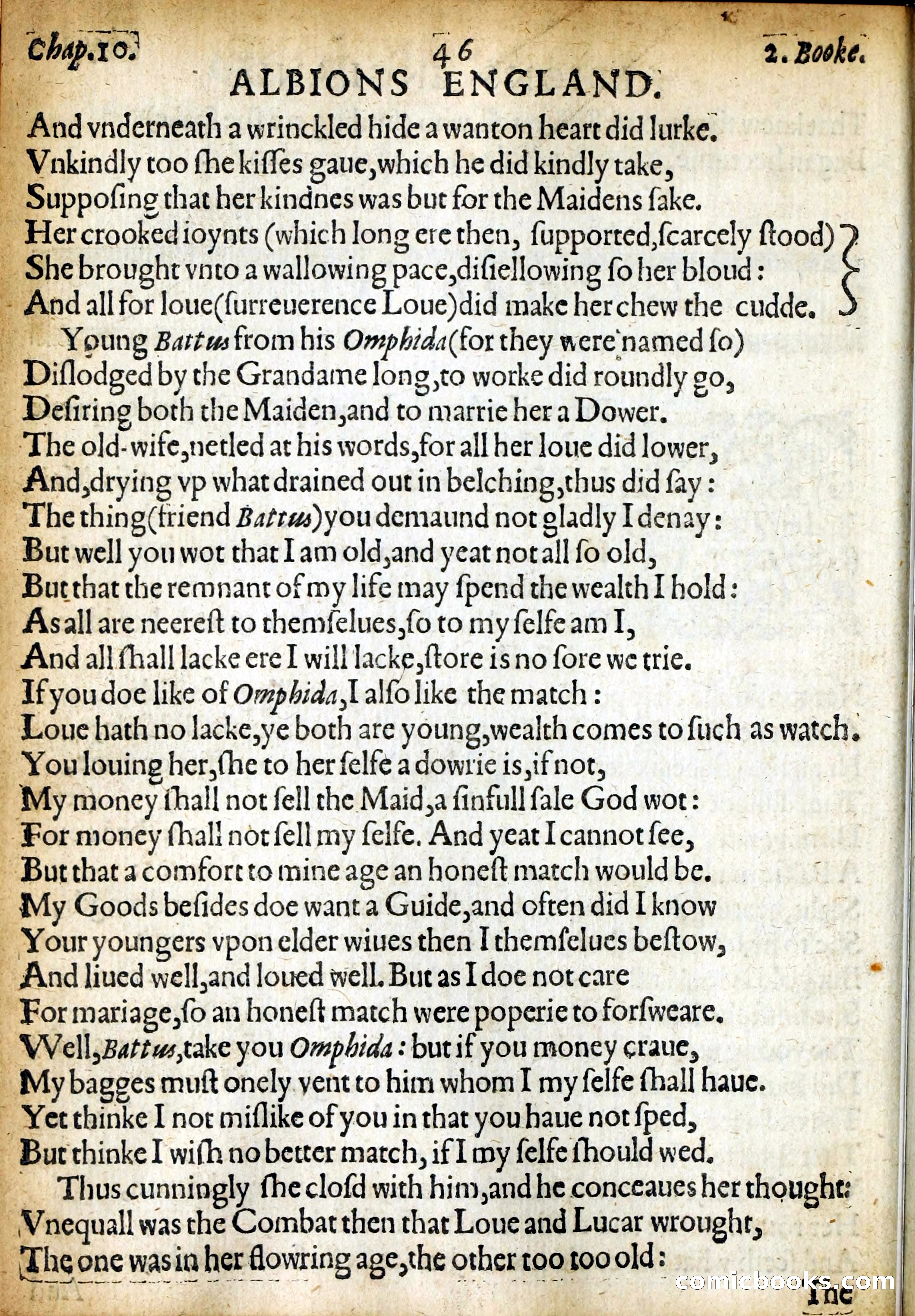
# Analysis of Page from *Albions England* This is a page of running prose verse from Chapter 10, Book 2 of what appears to be *Albions England* (visible in header). The text is Early Modern English poetry, not Victorian penny dreadful as the prompt suggests—the typography, spelling conventions ("vnderneath," "kifles"), and poetic form indicate this is from the 16th or 17th century. The passage depicts an old woman negotiating the marriage of a young couple (Bartus and Omphida), with the grandmother cleverly securing her own interests while appearing generous. The narrative concerns love, inheritance, and marriage arrangements among the characters named.
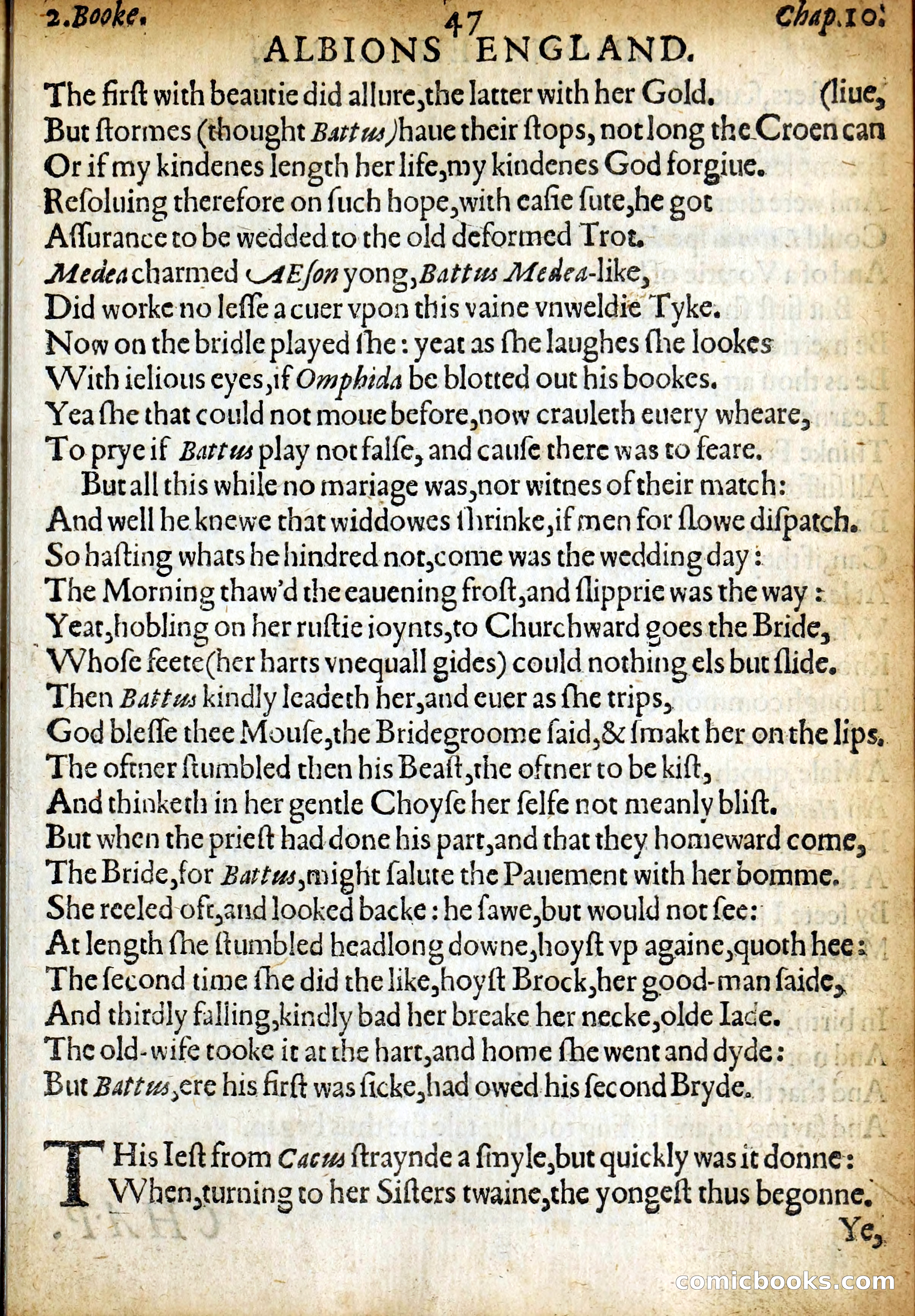
# Page Description This is a page of running prose poetry from what appears to be a narrative work titled "Albions England" (visible at top). The text is printed in early modern English verse and tells the story of a man named Battus who marries an elderly, deformed woman named Trot (or "Troi"). The passage describes their wedding day—including the bride stumbling repeatedly on the way to church—and her subsequent death, after which Battus quickly takes a second bride. The language and typography suggest this is from a historical literary work rather than a Victorian penny dreadful, though the sensational content (marital dysfunction, the bride's death) aligns with melodramatic themes.
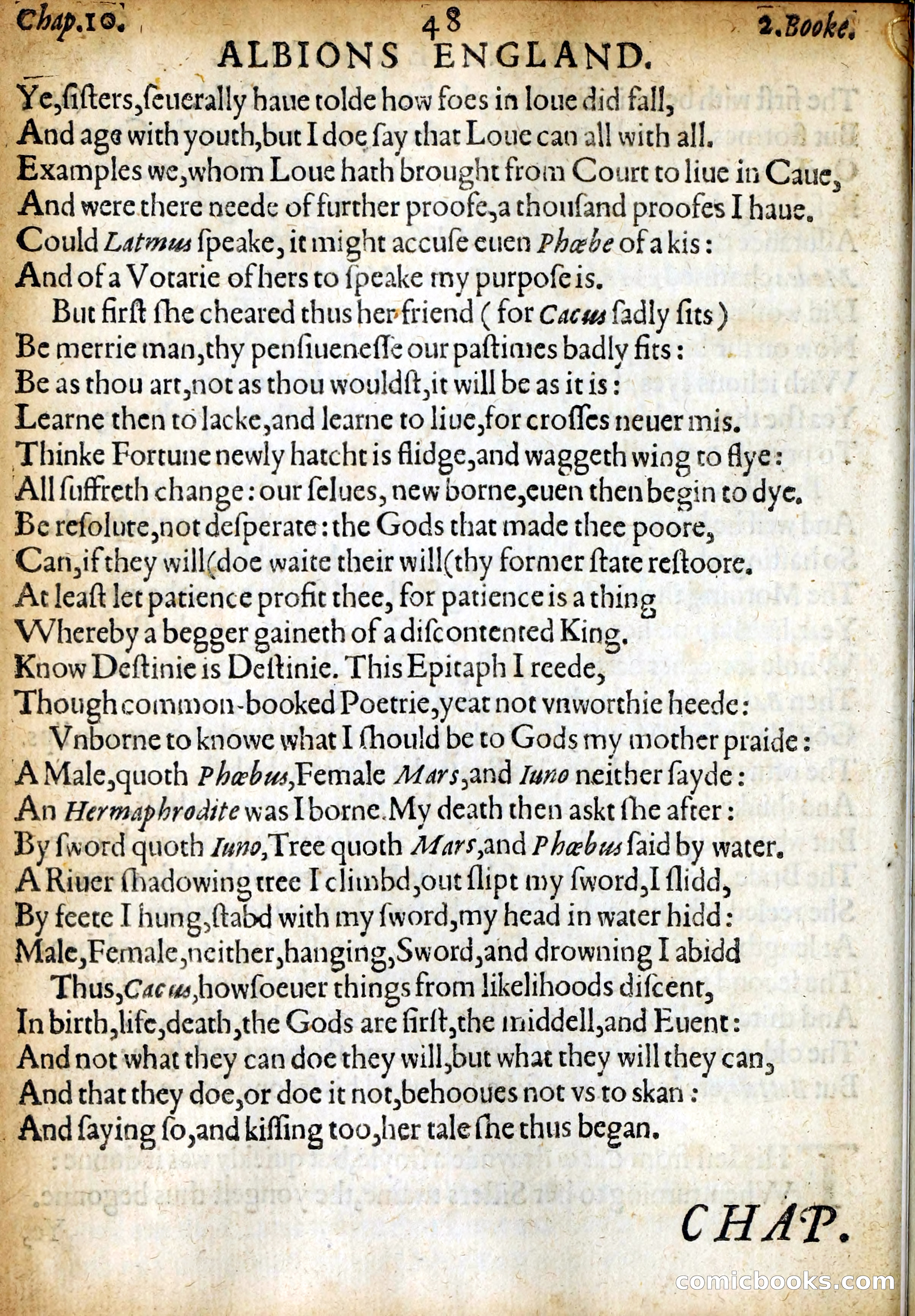
This page contains running prose poetry from *Albions England*, Chapter 18, Book 2. A character addresses another named Cacus, offering philosophical counsel about accepting one's circumstances and the will of the gods. The passage includes an embedded narrative—an "Epitaph"—about a hermaphrodite born of Phoebus, Mars, and Juno, who dies by sword and drowning in a river. The text concerns themes of fortune, patience, divine will, and fate, written in early modern English verse with italicized classical references. This appears to be from a historical reprint or facsimile rather than an actual Victorian penny dreadful.
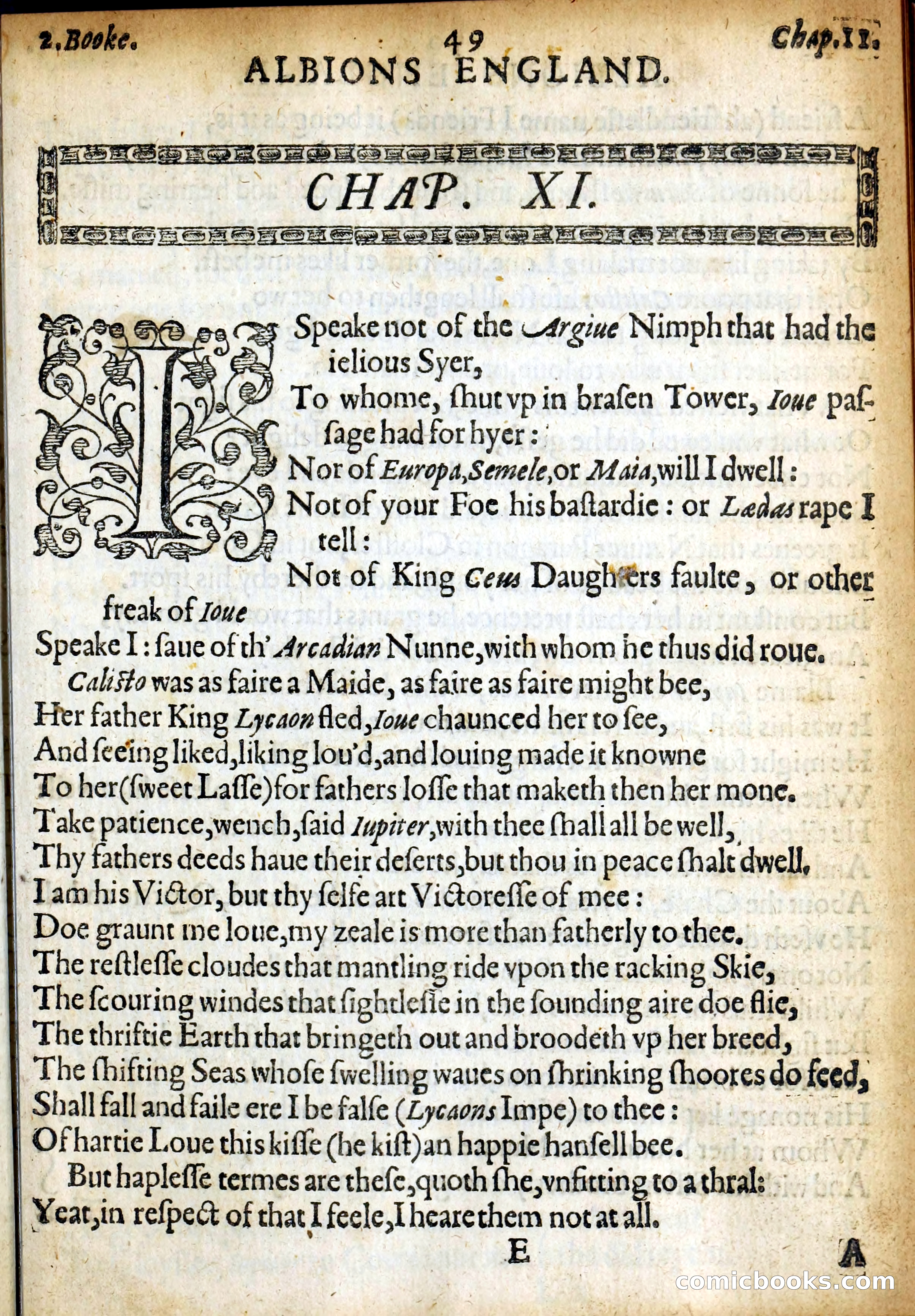
# Analysis of Page 49 from "Albions England" This is a **running prose page** from Book 2, Chapter XI of what appears to be a narrative poem, not a Victorian penny dreadful. The text recounts the mythological story of Callisto and Jupiter in Early Modern English verse. The speaker explicitly refuses to discuss other figures seduced by Jupiter (Argine, Europa, Semele, Maia, and Leda), instead focusing on Callisto, an Arcadian nymph. The passage describes how King Lycaon fled when Jupiter saw and desired Callisto, with Jupiter promising her peace and swearing eternal devotion through elaborate cosmic oaths. Callisto responds that such promises are unsuitable to her condition. The ornate typography and archaic language indicate this is likely 16th or 17th-century literature, predating Victorian penny dreadfuls by centuries.
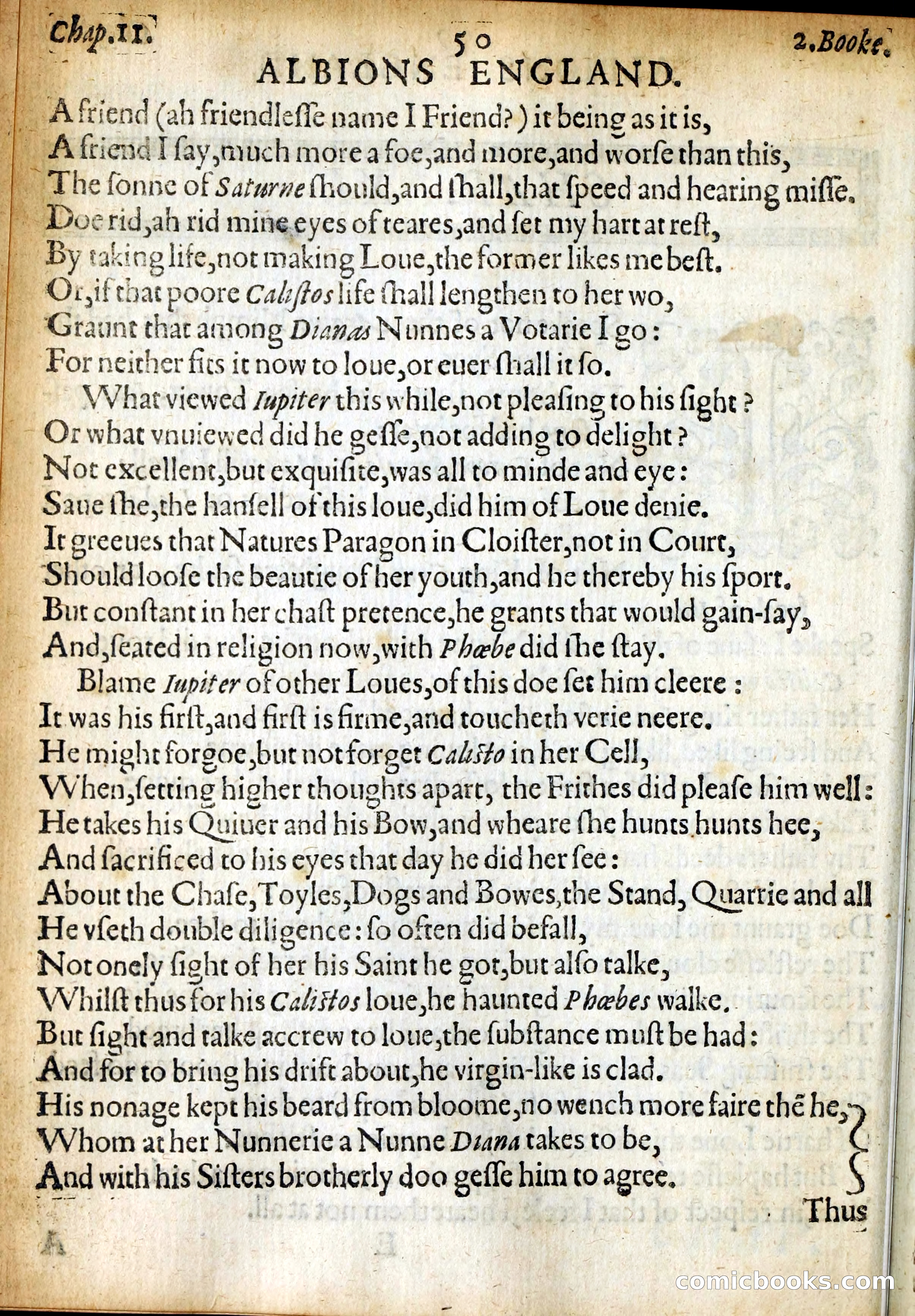
# Analysis of This Page This page contains running verse prose from *Albions England*, Book 2, Chapter 11. The text is a narrative poem in early modern English addressing a friend about matters of love and desire. It appears to recount a story involving Jupiter, a character named Calisto confined to a nunnery, and a figure (possibly disguised) who pursues her—references suggest classical mythological material adapted into English verse. The language concerns romantic pursuit, religious devotion, and the tension between love and chastity, with the narrator defending Jupiter's constancy toward his "first" love despite her withdrawal from the world.
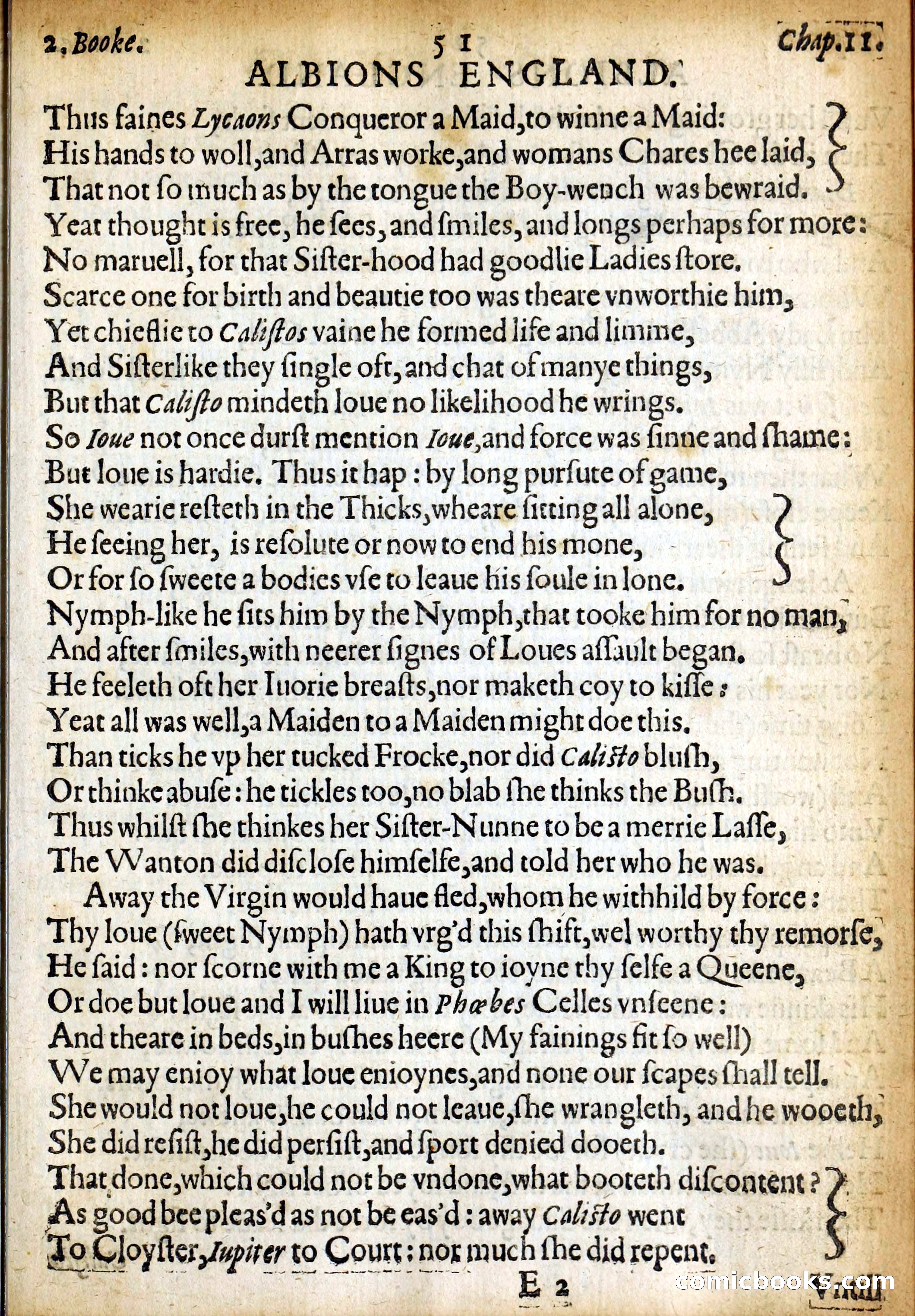
# This Page: Running Prose Narrative This is a page of running verse from *Albions England*, displaying narrative poetry in early modern English. The text recounts a story in which a male character (appearing to be a wanton or disguised nobleman) seduces a young woman he encounters in the woods while she believes him to be a sister nun. After he reveals his true identity and attempts to seduce her by force, she resists but is ultimately overpowered. The passage concludes with the character departing after the assault, leaving the question of what remedy exists for such wrongs.
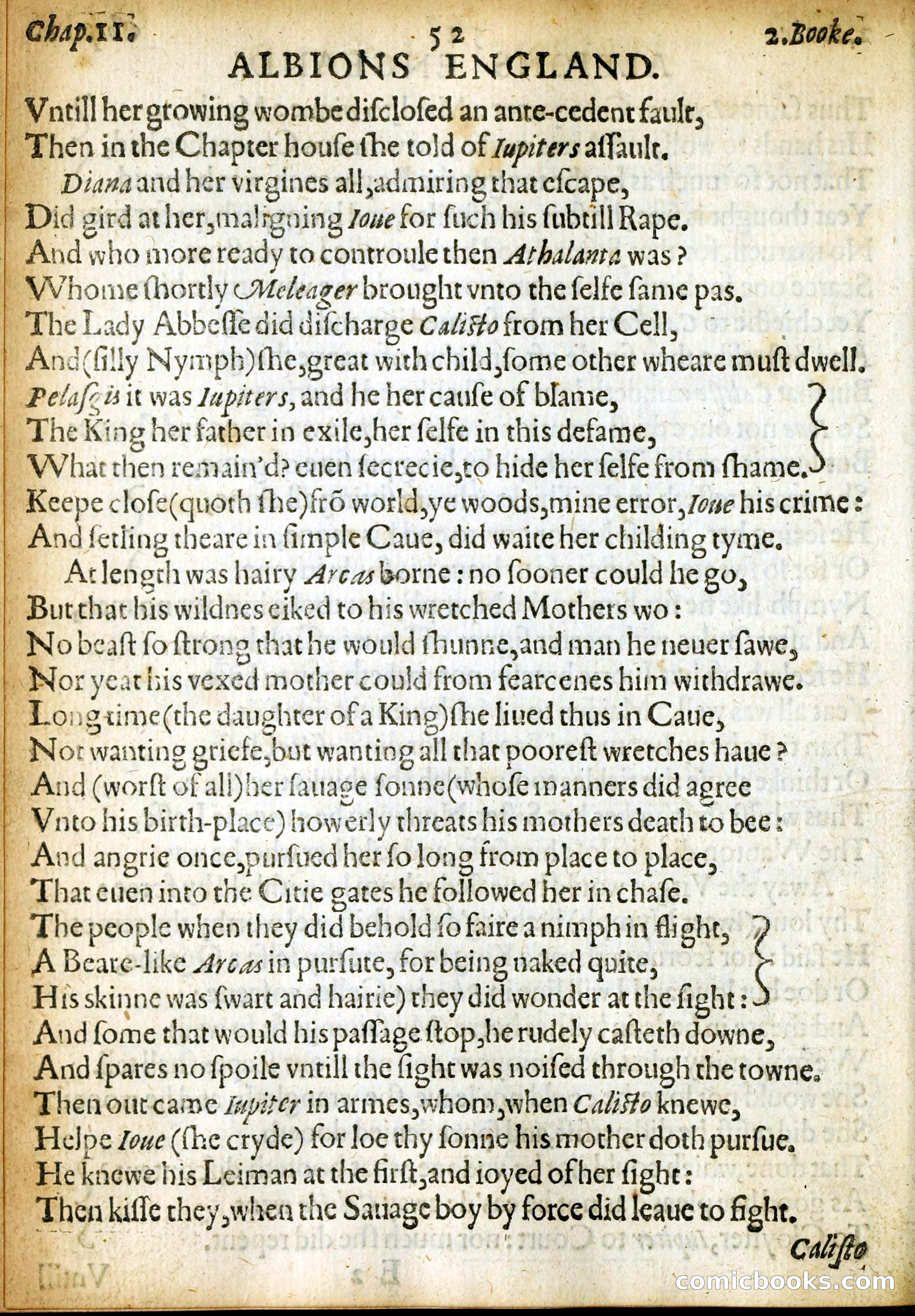
# This Page from "Albions England" This is a page of running verse poetry, not a title page or illustration. The text continues a narrative account of classical mythology—specifically the story of Callisto, who was seduced by Jupiter and bore a son, Arcas. The passage describes how Callisto hid herself in a cave to escape shame, how her wild son eventually pursued her through the city, and how Jupiter intervenes when he recognizes his former lover in distress. The verse employs rhyming couplets in Early Modern English and appears part of a larger poetic chronicle.
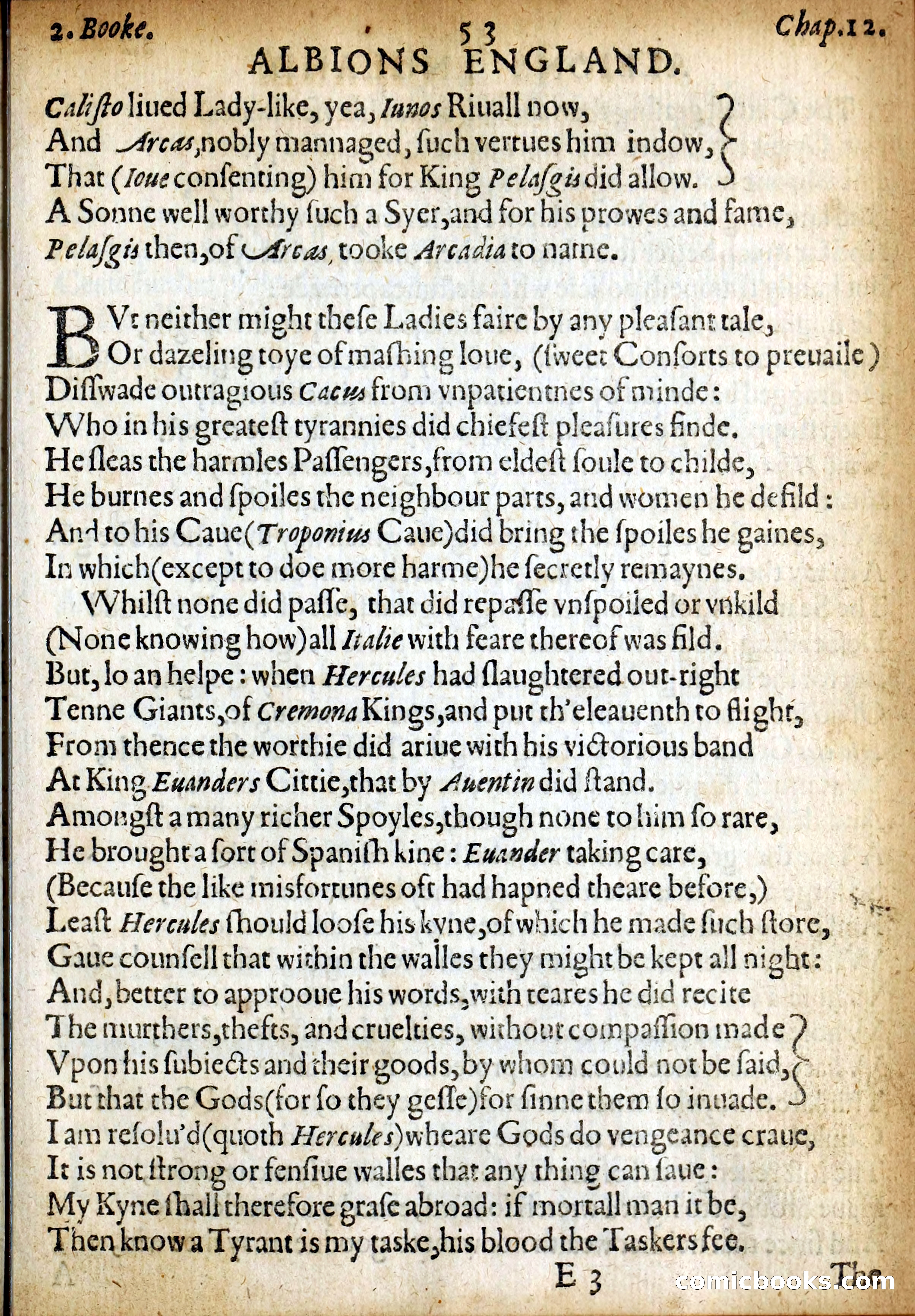
# Page Analysis This is a page of running prose poetry from *Albions England*, Chapter 12, Book 2. The text is printed in early modern English verse and recounts a mythological narrative involving Cacus (a tyrant who steals livestock and plunders his neighbors), Hercules' intervention, and King Evander. The passage describes Cacus's crimes—burning, spoiling neighboring lands, and defiling women—and then shifts to Hercules' arrival after slaughtering giants of Cremona, where he warns of divine vengeance against tyranny. The page contains no illustrations, only densely printed text in period typeface with italicized proper names.
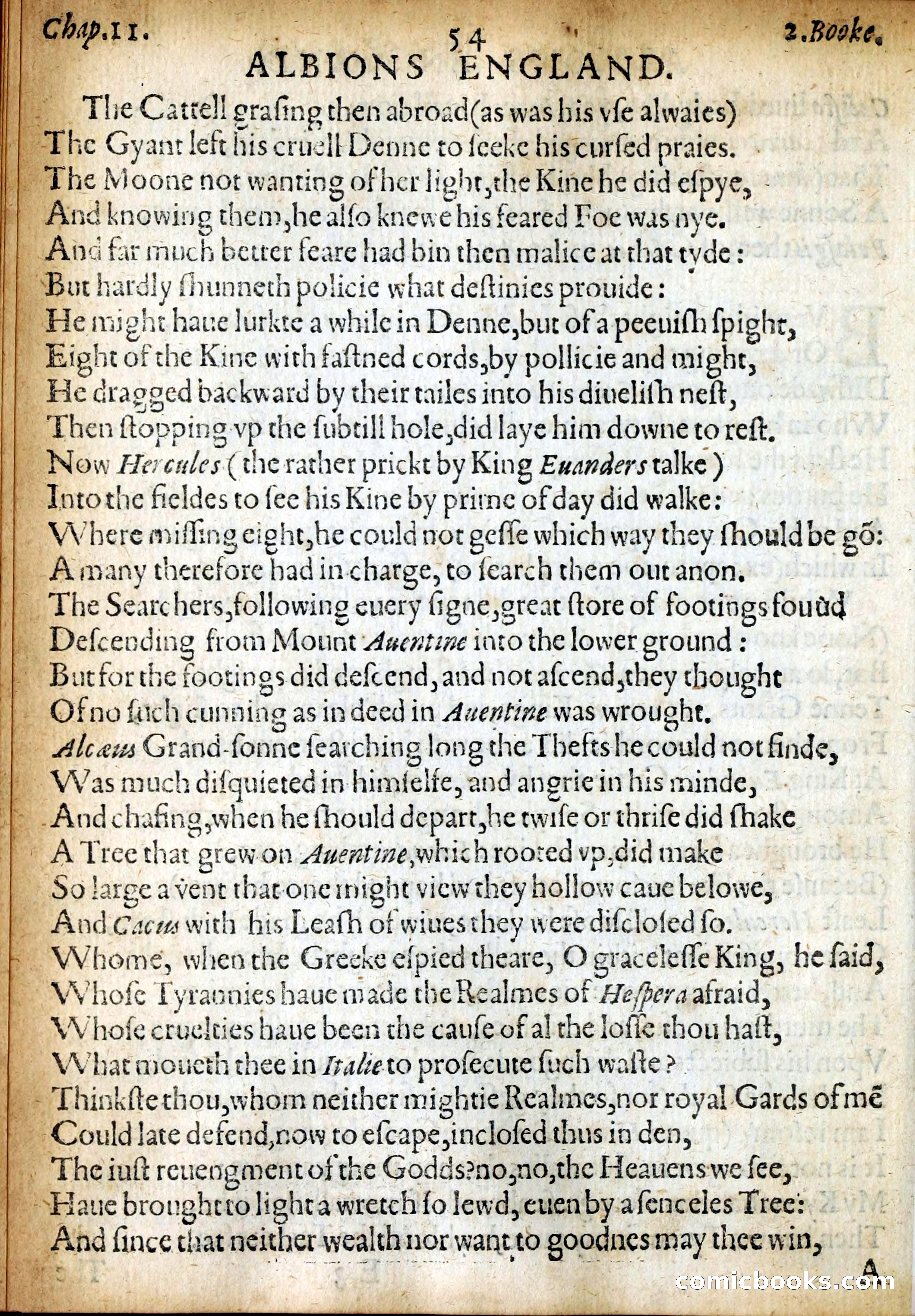
# Analysis of Page This is a page of running verse text from *Albions England* (Chapter II, Book 2, page 54). The text is printed in early modern English typography and appears to be narrative poetry recounting the classical myth of Hercules and Cacus—specifically, Hercules searching for his stolen cattle, discovering them hidden in a cave on Mount Aventine, and confronting the thief Cacus. The passage includes Hercules' accusatory speech condemning Cacus's tyrannies and suggesting divine justice has exposed the criminal. There are no illustrations or title elements on this page—only dense blocks of verse in period typeface.
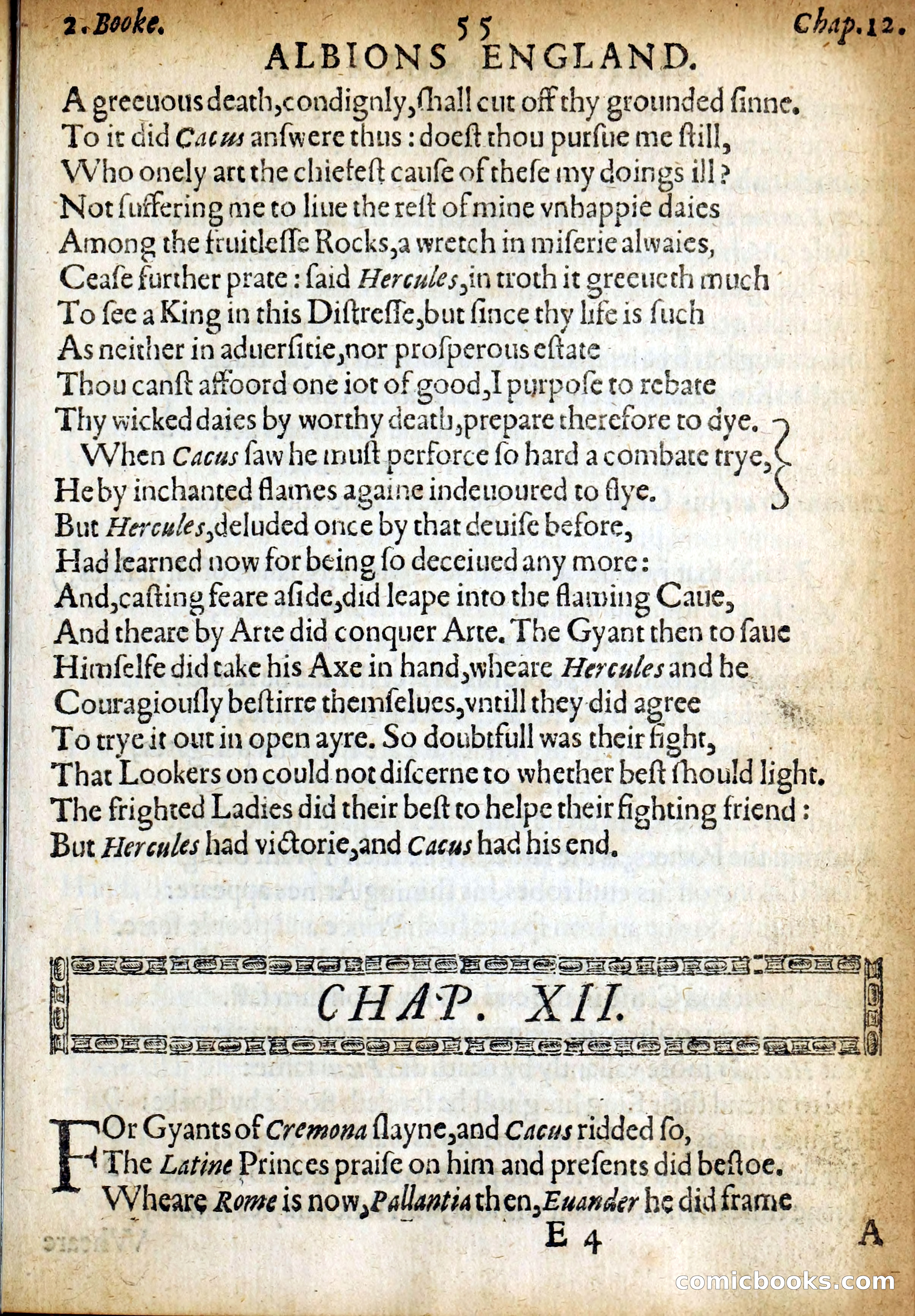
# Page Analysis This is running prose from a narrative poem, appearing to be from Book 2, Chapter 12 of "Albions England." The visible text describes a combat between Hercules and Cacus (a giant), wherein Hercules pursues Cacus into a flaming cave, they fight with axes in open air, and Hercules ultimately defeats and kills his opponent. The passage concludes with Chapter XII beginning, which mentions giants of Cremona and Cacus being slain, with Latin princes praising and presenting gifts to Hercules. The text is printed in early modern English verse with italicized character names.
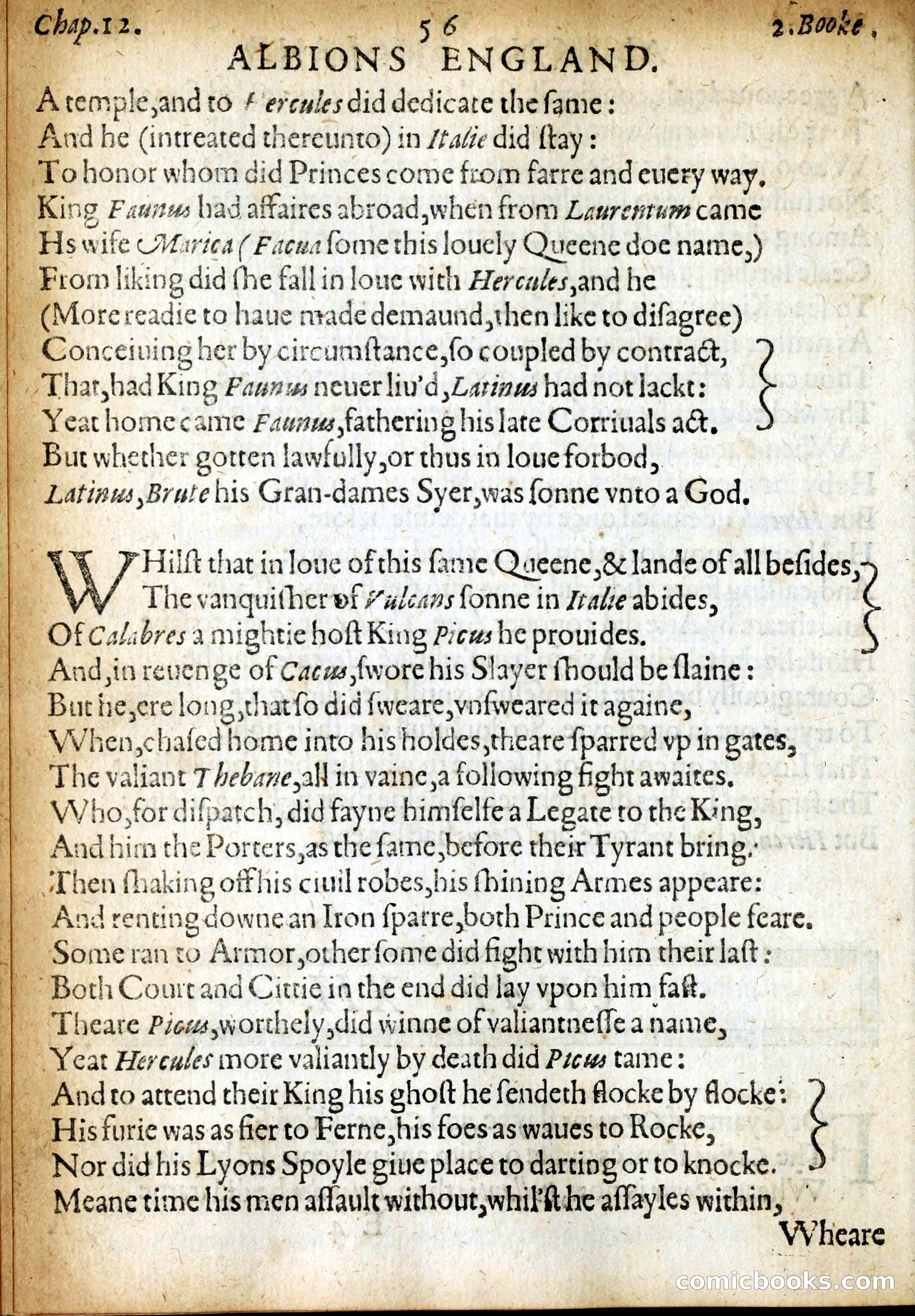
# Albions England, Chapter 12, Book 2 This is a page of running verse prose from what appears to be a narrative poem. The text recounts mythological/legendary British history, specifically describing King Faunus's wife Marica (also called Faena), who fell in love with Hercules, and the subsequent military conflict involving various classical figures including Picus, Thebane, and others. The verse describes battles, oaths, and supernatural consequences, written in early modern English poetic style with archaic spelling and formatting typical of sixteenth or seventeenth-century publication.
# Page 57 of "Albions England" (2nd Book, Chapter 12) This page contains running verse narrative poetry, not a title page or illustration. The text describes Hercules' encounter with King Diomedes of Thrace, who apparently feeds strangers to man-eating horses and demands ransom from travelers. The passage recounts how Hercules, motivated by his love for the maiden Deianira, defeats Diomedes and his Thracian guards in battle. The verse employs archaic spelling and Early Modern English conventions typical of the period work being excerpted here.
# Page Description This is a page of running verse text from *Albions England*, Chapter 12, Book 2 (page 58). The text is poetry in early modern English, describing various historical and legendary military figures—Hercules, Caesar, Hannibal, Cyrus, and others—and their conquests and character. The passage celebrates a common soldier who established virtuous rule and removed tyrants, contrasting peaceful governance with warfare, and concludes with the narrator undertaking to revive the story of this "monster-Master Hercules, this Tyrant Tamer" who has died. The page contains no illustrations, only dense printed verse in period typography.
# Page Analysis: *Albions England*, Chapter XIV This is a page of running verse prose from what appears to be an early modern narrative poem (not a Victorian penny dreadful, despite the prompt's framing). The text recounts a classical mythological episode: when Deianira learned of her husband Hercules's delayed return from a stranger's house, she grew jealous. Learning he had been with Iole, a captive woman, Deianira questioned how Hercules could prefer a slave to his wife. The passage details how Deianira, mindful of a dying woman's gift from Nessus, eventually sent Hercules a poisoned shirt, which he wore and later sacrificed himself for on Mount Oeta. The ornamental initial letter and chapter heading are visible at top.
This page contains running verse narrative from *Albions England*, a historical poem (not a Victorian penny dreadful, as the header dates to the early modern period). The visible text depicts the death of Hercules, describing in graphic detail his agony as a poisoned shirt burns his flesh, his removal to a funeral pyre, and his suicide. The passage also narrates Deianira's grief-stricken response—her affirmation of innocence to the gods and her own death by bloodletting. The language is early modern English with archaic spellings and typography.
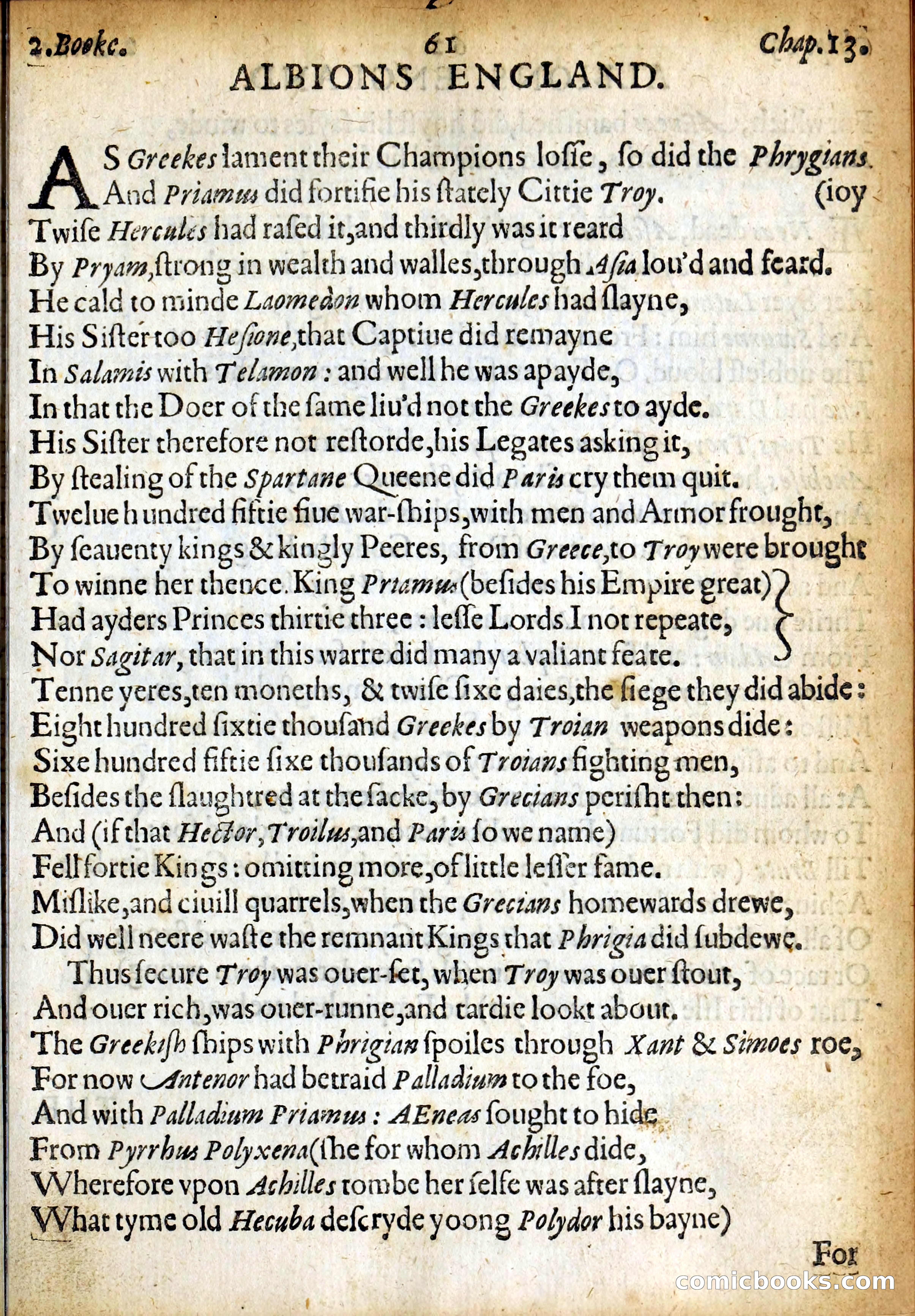
# Page Analysis: Running Prose from "Albions England" This is a page of running verse poetry from Chapter 13 of *Albions England*, Book 2 (visible in the header). The text is printed in early modern English typography and presents a narrative poem about the Trojan War—specifically recounting the fall of Troy, the Greek forces that besieged it (numbered at 860,000 men across twelve hundred ships led by seventy kings), King Priam's defenses, and the eventual destruction of the city. The passage mentions the theft of the Palladium, Aeneas's escape with Polyxena, and Achilles' death. No illustrations or advertisements appear on this page.
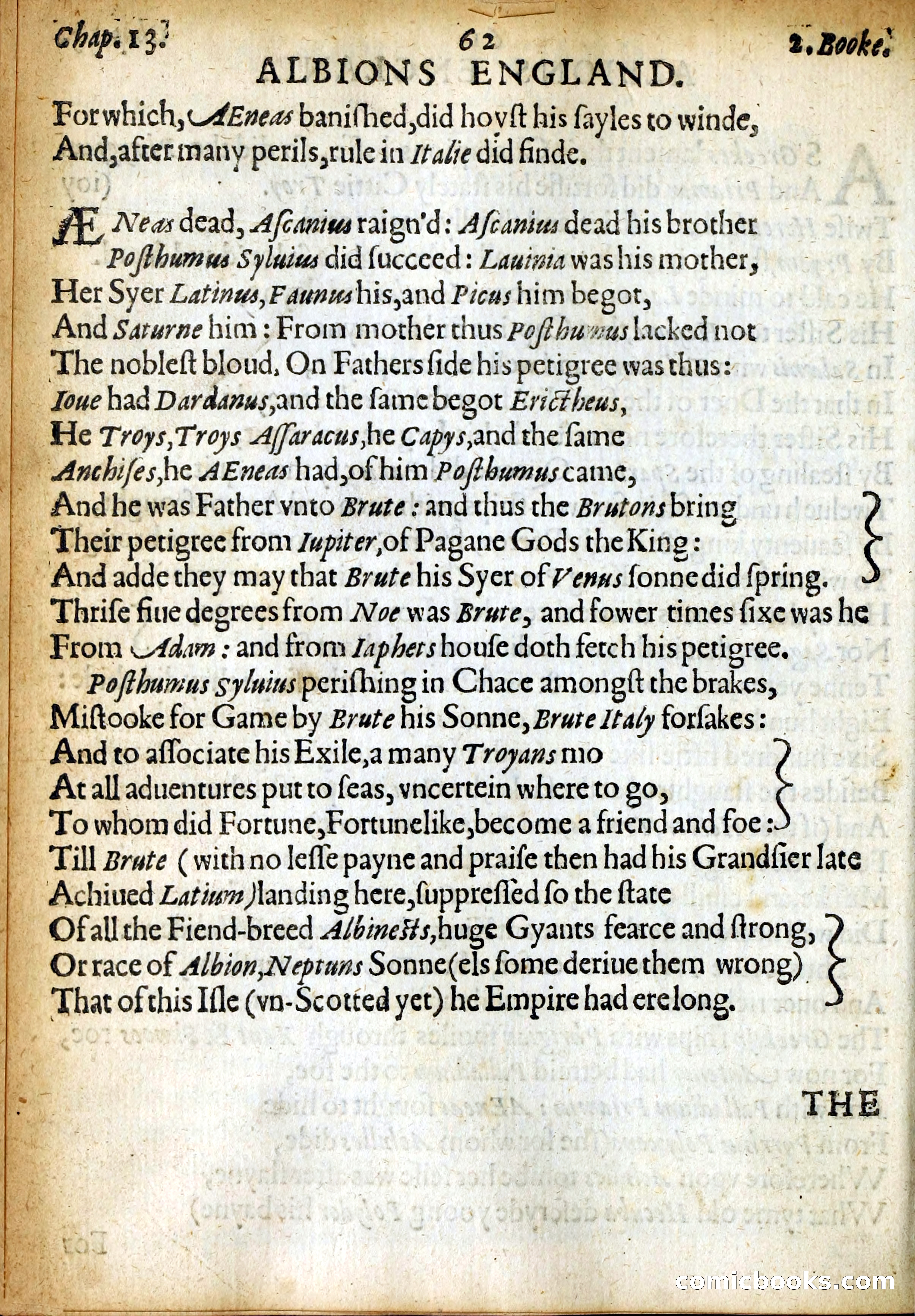
# Albion's England - Running Prose This page contains continuous narrative poetry (not illustrated) from *Albion's England*, a work of English legendary history. The text traces the genealogy and succession of early British rulers, beginning with the death of Aeneas and continuing through his descendants Ascanius, Posthumus Sylvius, and ultimately Brute, who appears to have founded or conquered Britain. The passage recounts Brute's exile from Italy with Trojan followers, his arrival in Britain, and his conquest of giants (the "Albinests") who previously inhabited the island, establishing his empire over this "Isle (yn-Scotted yet)." The writing employs Early Modern English spelling and poetic couplets typical of period chronicle verse.
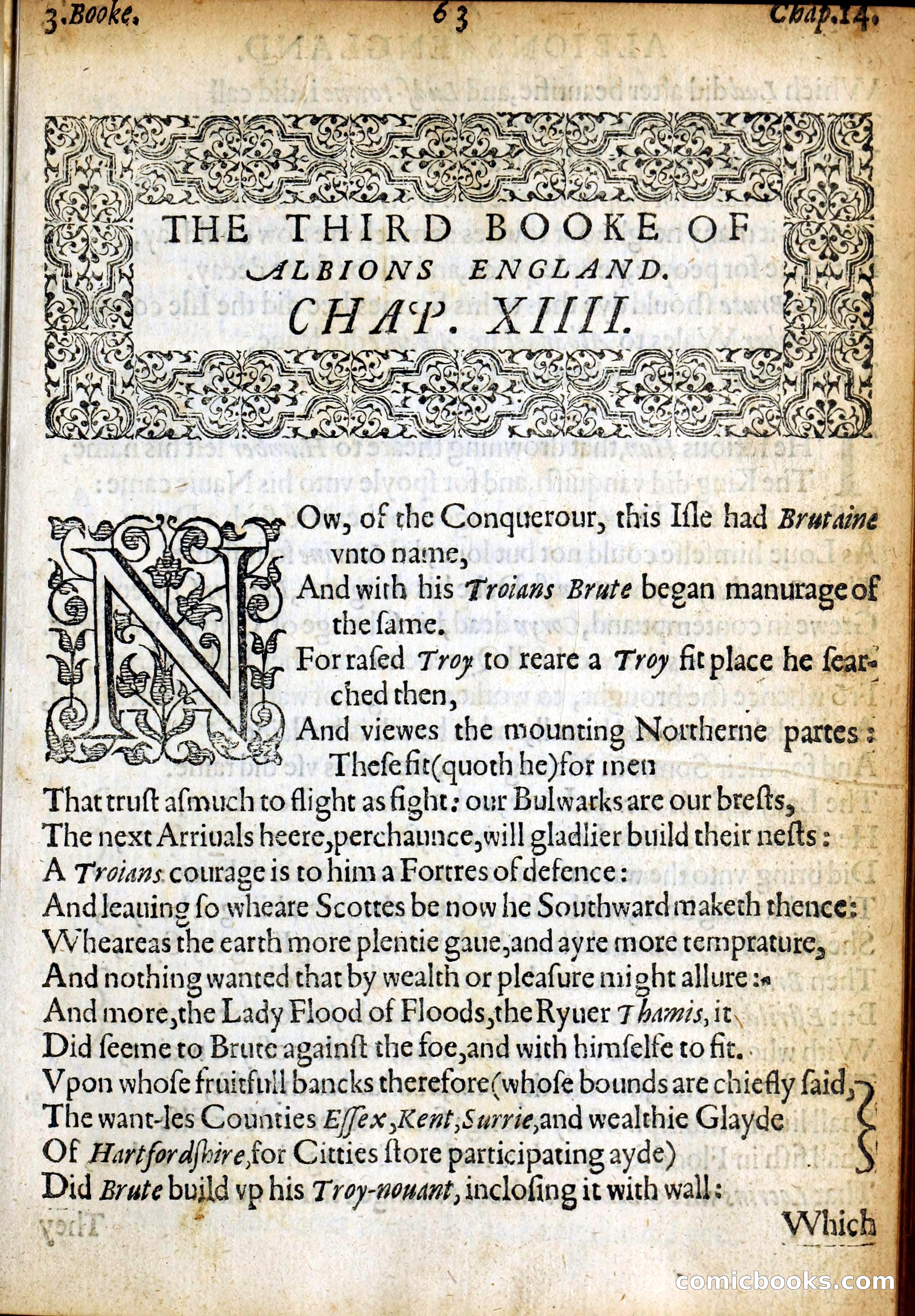
# This Page Analysis This is running prose text from Chapter 14 of *The Third Booke of Albions England*, presented in early modern verse form (not a Victorian penny dreadful, despite the prompt's framing). The ornate decorative border frames the chapter heading. The visible text recounts how Brute, a Trojan leader, establishes a settlement called Troy-nouant (London) in southern England along the River Thames, choosing this location for its fertile land, temperate climate, and the river's strategic defense against enemies. The passage names several English counties—Essex, Kent, Surrey, Gloucestershire, and Hartfordshire—as participating in this settlement's founding.
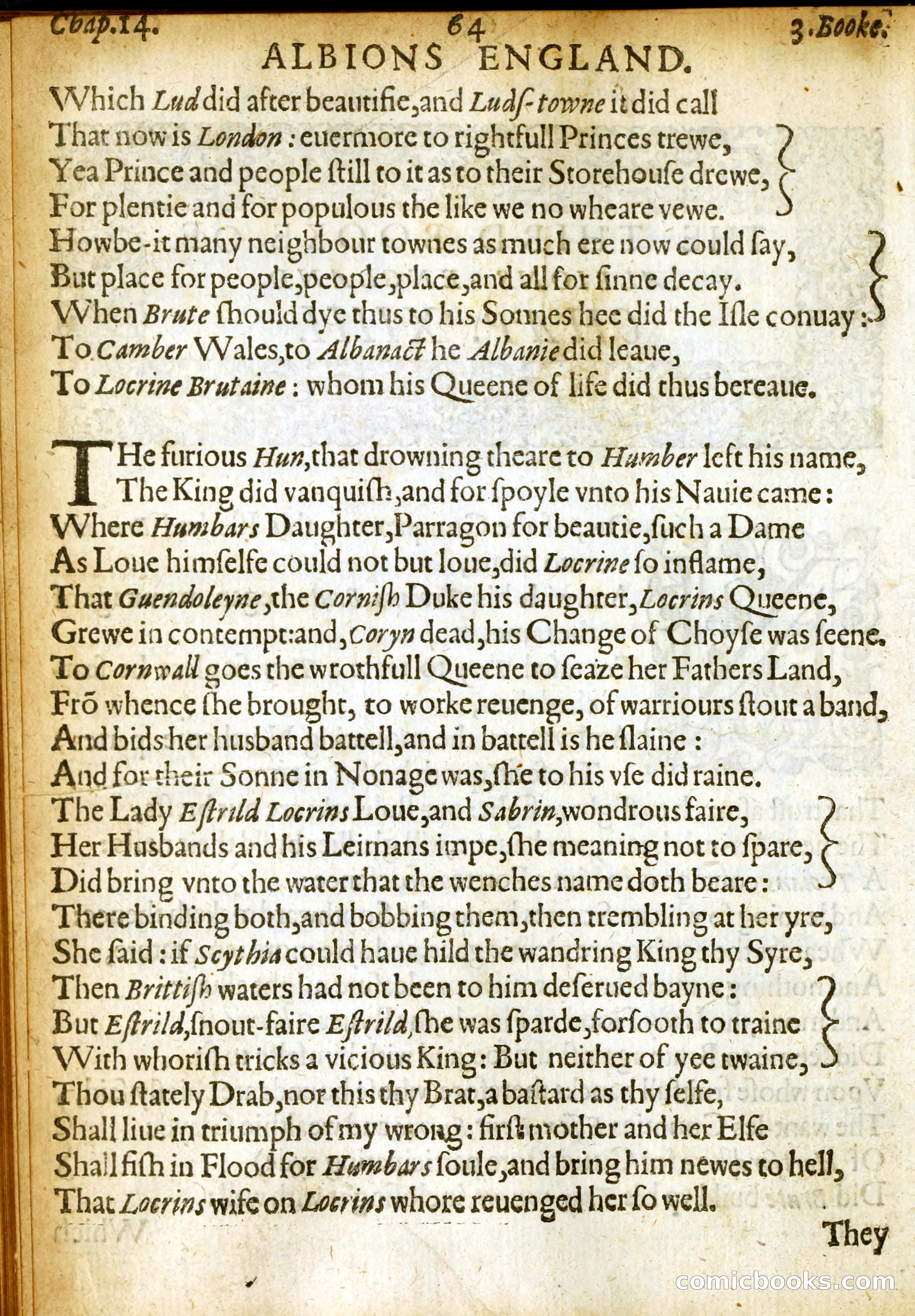
# Page Description This is a page of running prose poetry from *Albions England*, a historical narrative poem. The text recounts legendary British history, specifically the division of Britain among the sons of Brute, and a dramatic revenge tragedy involving King Locrine, his wife Guendoleyne, and his lover Estrild. The passage describes how Guendoleyne, enraged by her husband's infidelity, raises an army, defeats Locrine in battle, and drowns both Estrild and their illegitimate child in a river (now called the Severn, though the text calls it "Estrild's water"). The narrative is written in early modern English verse with considerable archaic spelling and punctuation.
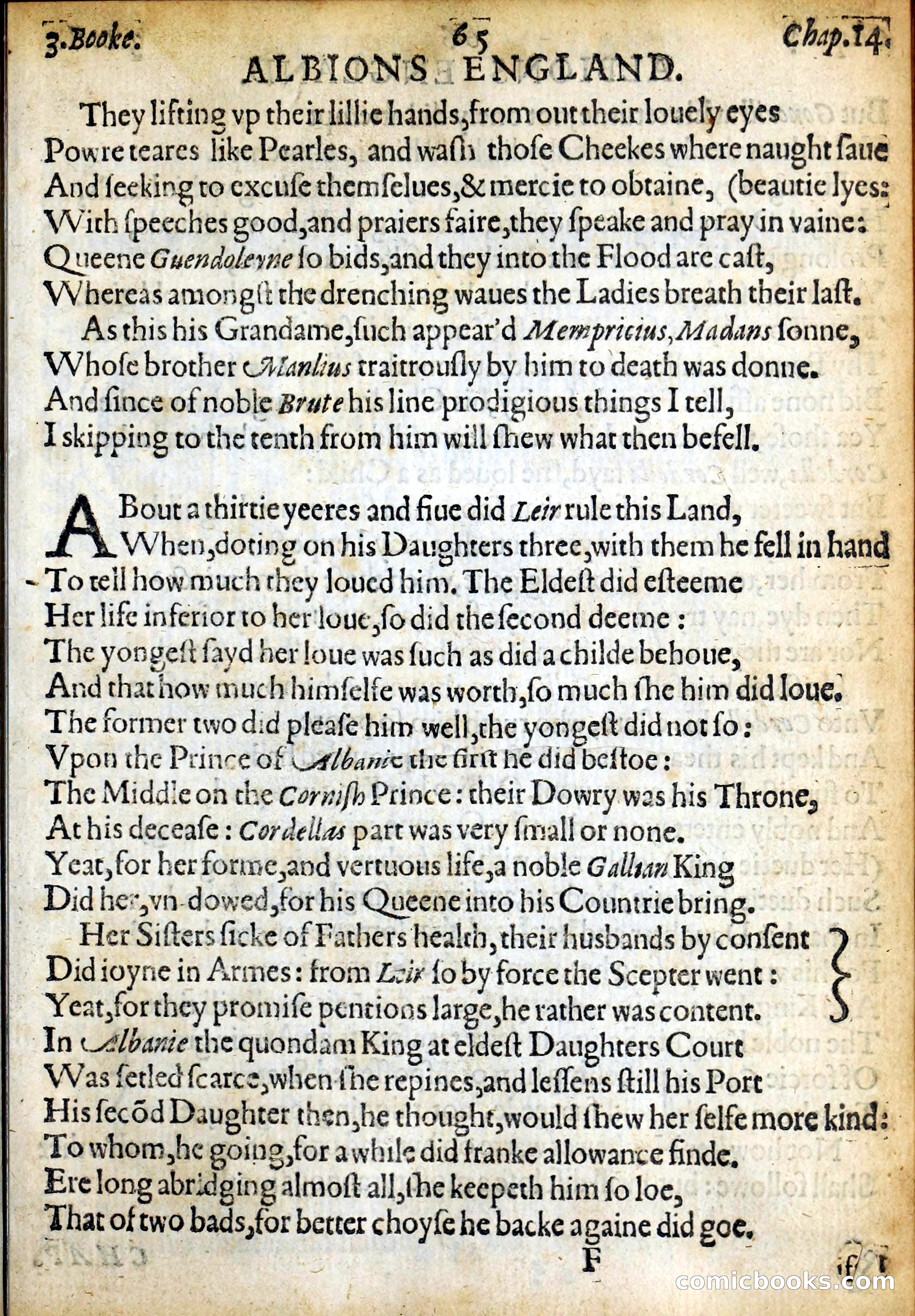
# This Page: Running Prose This is a page of running verse narrative from "Albions England," presenting the story of King Lear and his three daughters. The text describes how the king, ruling for thirty-five years, tests his daughters' love; the two elder daughters flatter him and receive kingdoms as dowry, while the youngest (Cordelia) refuses flattery and receives nothing. The passage then recounts how, after the elder daughters marry—one to the Prince of Albany, one to the Cornish Prince—they gradually diminish the aging king's authority and allowance, forcing him to abandon them. The verse uses early modern English spelling and style characteristic of historical chronicle literature.
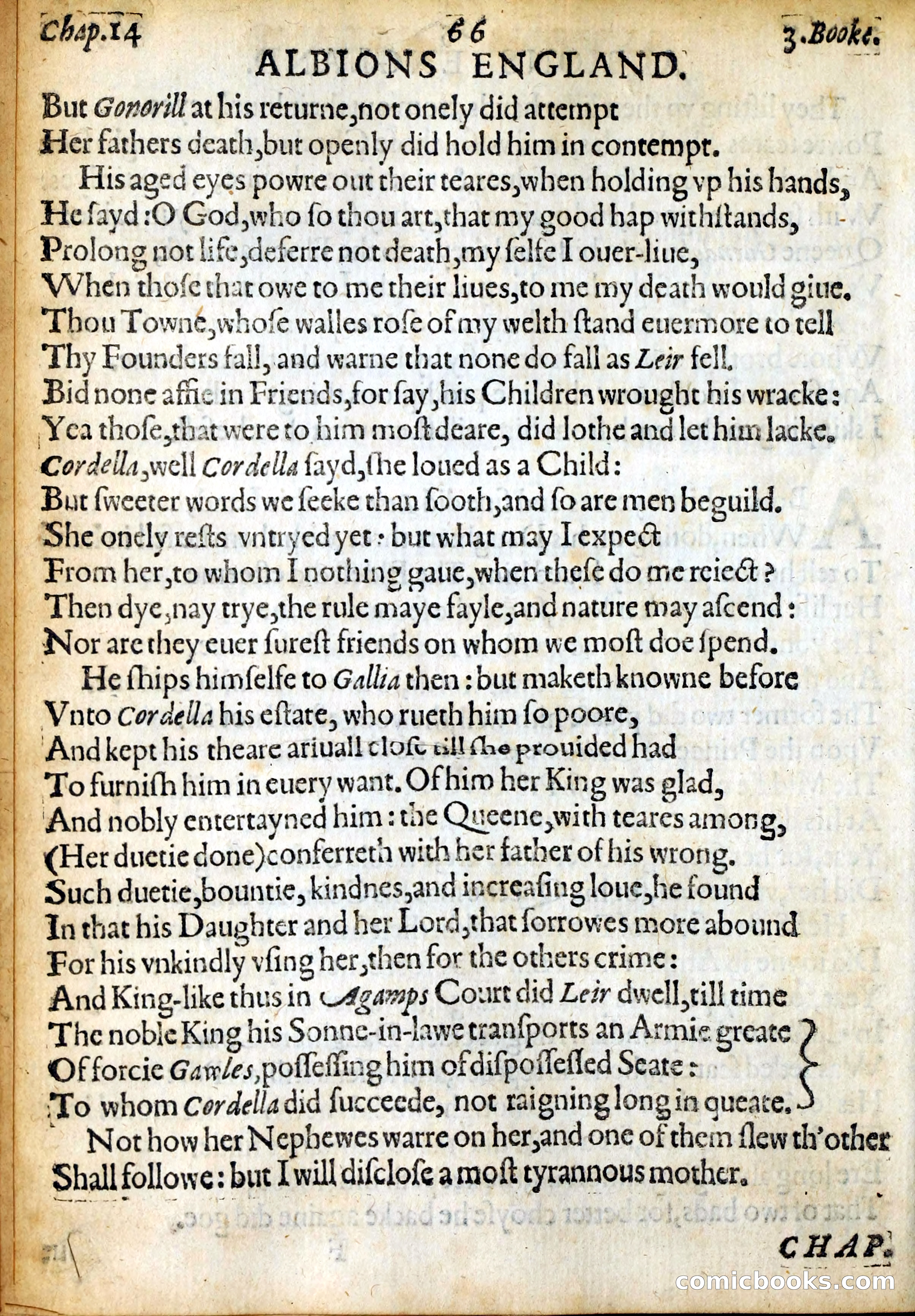
# This Page: Running Prose Narrative This is a page of running prose verse from *Albions England*, a historical narrative poem. The text recounts the story of King Leir (King Lear), focusing on his mistreatment by his ungrateful children and his subsequent exile to Gallia, where his daughter Cordella receives him with kindness and care. The passage describes Leir's despair at his children's ingratitude, his journey abroad, Cordella's dutiful support, her marriage to a foreign king, and hints at future conflicts involving her nephews and a tyrannical mother. The verse uses archaic spelling and early modern English typography typical of period literature.
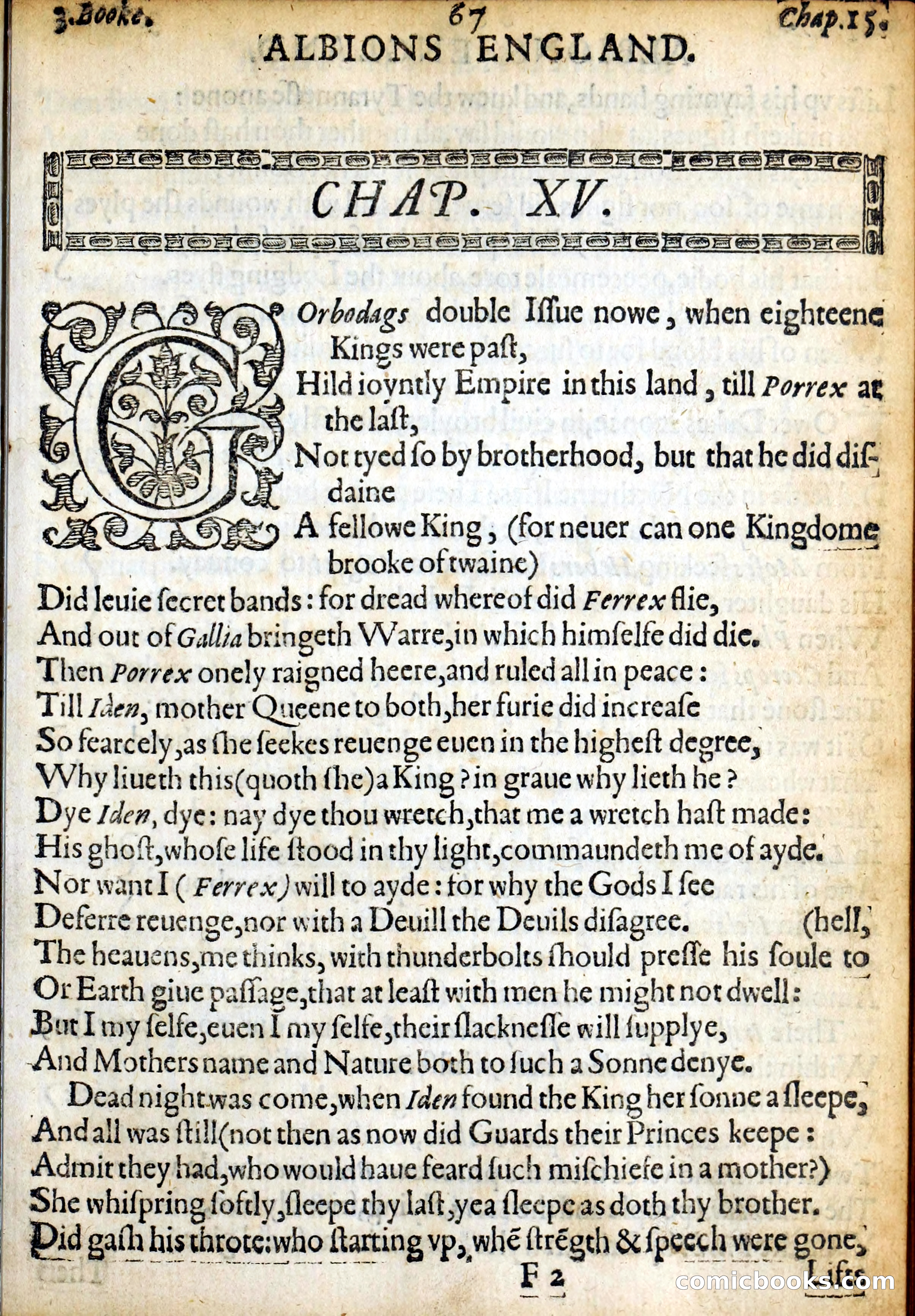
# Page Description This is a page of running verse text from Chapter XV of what appears to be a dramatic or narrative poem titled "Albions England." The text is printed in early modern typeface (likely 16th or 17th century, not Victorian as initially suggested). The verse describes political turmoil: after eighteen kings have ruled, the kingdom falls into conflict when King Porrex brings war from Gaul, resulting in his death. His mother Iden, seeking revenge for her murdered son, decides to take justice into her own hands. The final visible lines narrate how Iden steals into the sleeping king's chamber at night and, whispering softly to him, slits his throat while he sleeps. The page ends mid-narrative as the victim awakens.
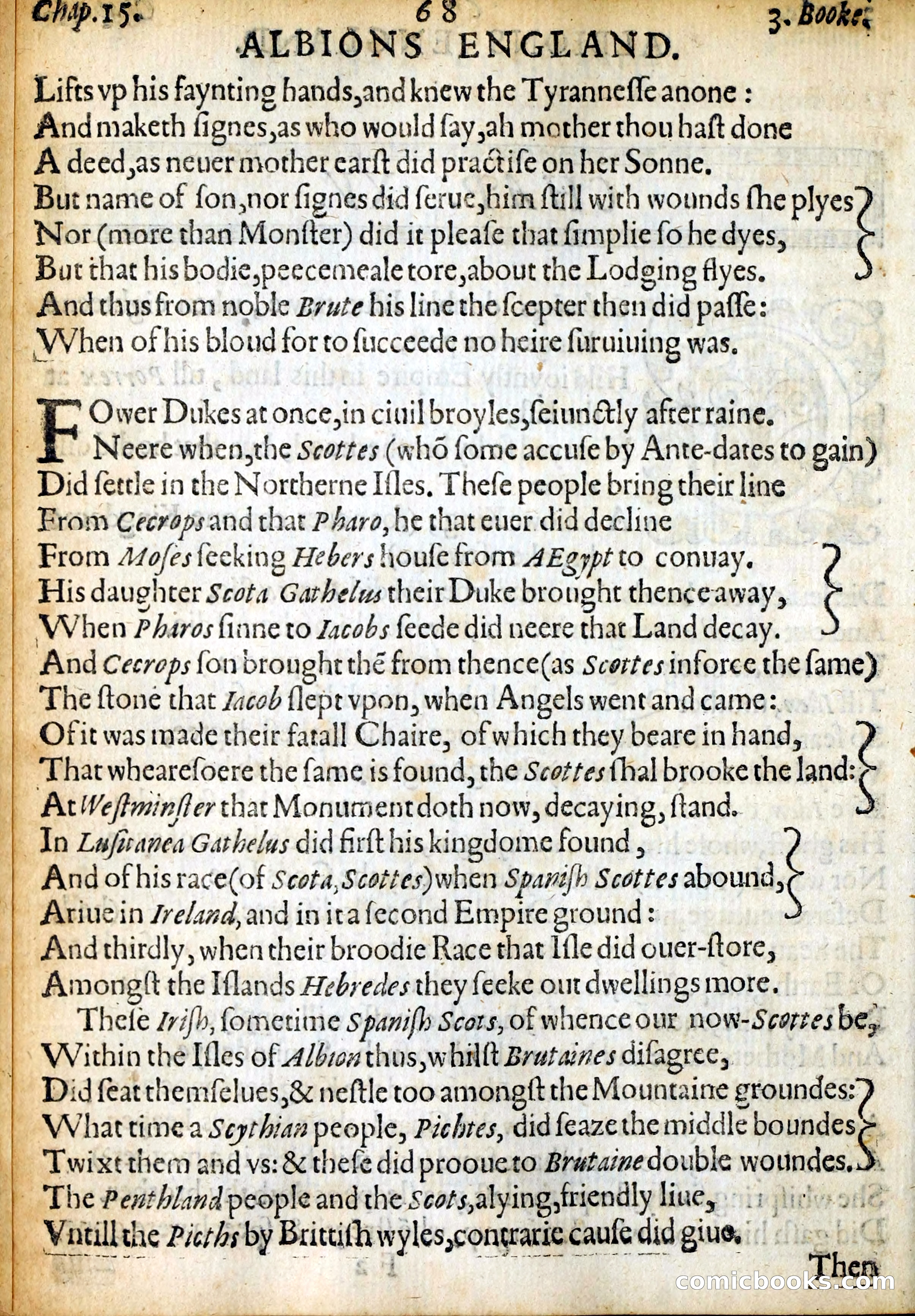
# Description This page contains running verse prose, not a title page or illustration. It appears to be from *Albion's England*, a historical poem (the header identifies it as "3. Bookes," Chapter 15, page 68). The text is written in early modern English and recounts mythological and legendary genealogies of British peoples—tracing Scottish origins from figures like Cecrops and Pharaoh's daughter Scota through Jacob's lineage, and describing how various Celtic and Scythian peoples (Scots, Picts, Irish) settled in Britain and the Isles, with references to civil conflicts and territorial disputes. The passage emphasizes descent lines and dynastic claims in ornate, densely allusive verse.
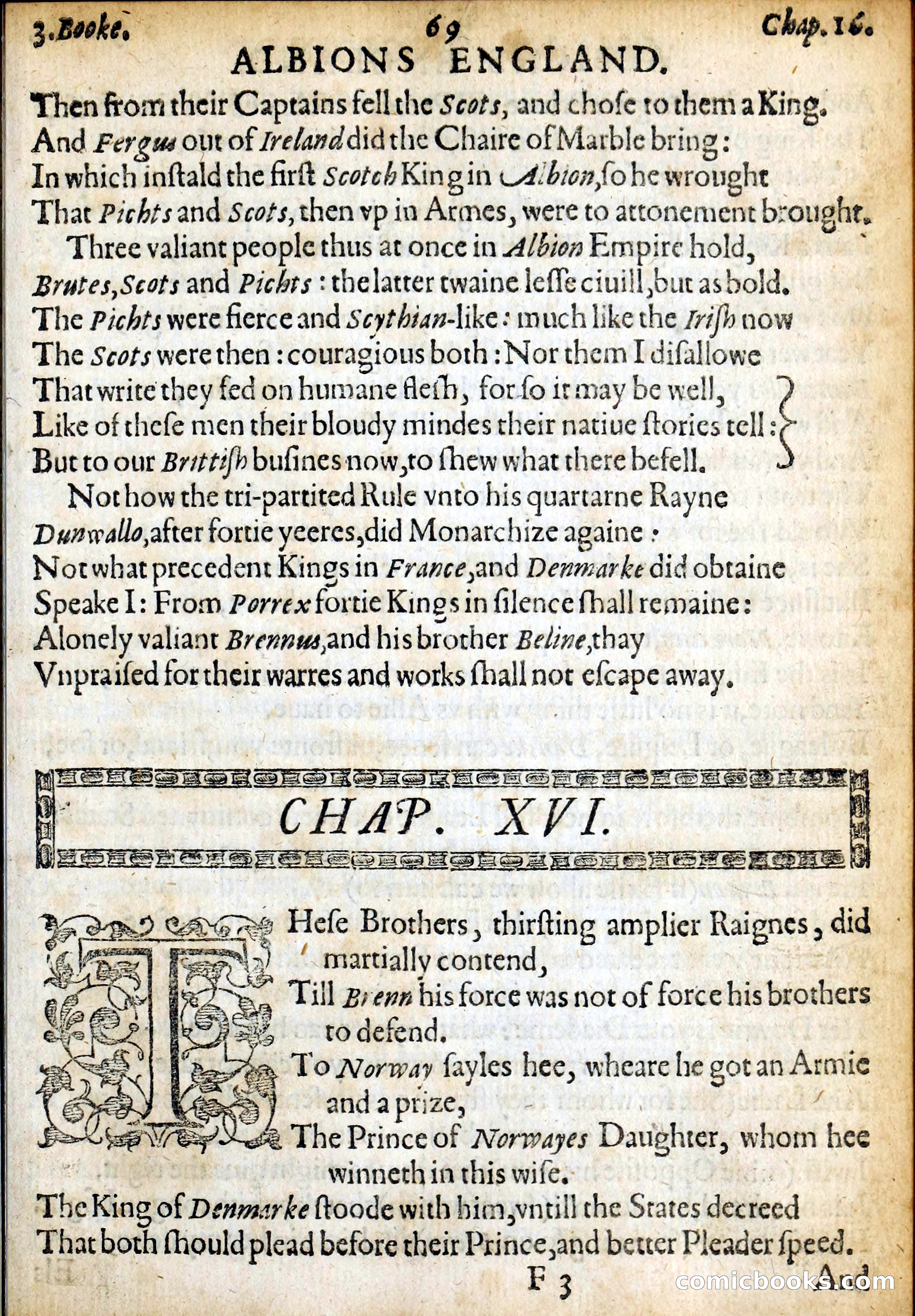
# Page Content Description This is running prose from what appears to be a historical narrative poem titled "Albions England." The visible text recounts early British history in verse, describing how Scots and Picts were settled in Albion (Britain) under various kings. The passage concludes Chapter XV and begins Chapter XVI, which narrates how two brothers, Brenn and Beline, contended for rule—Brenn eventually sailing to Norway where he won the King of Norway's daughter as a prize and gained military support. The text is printed in blackletter typeface on aged paper, characteristic of early modern printing.
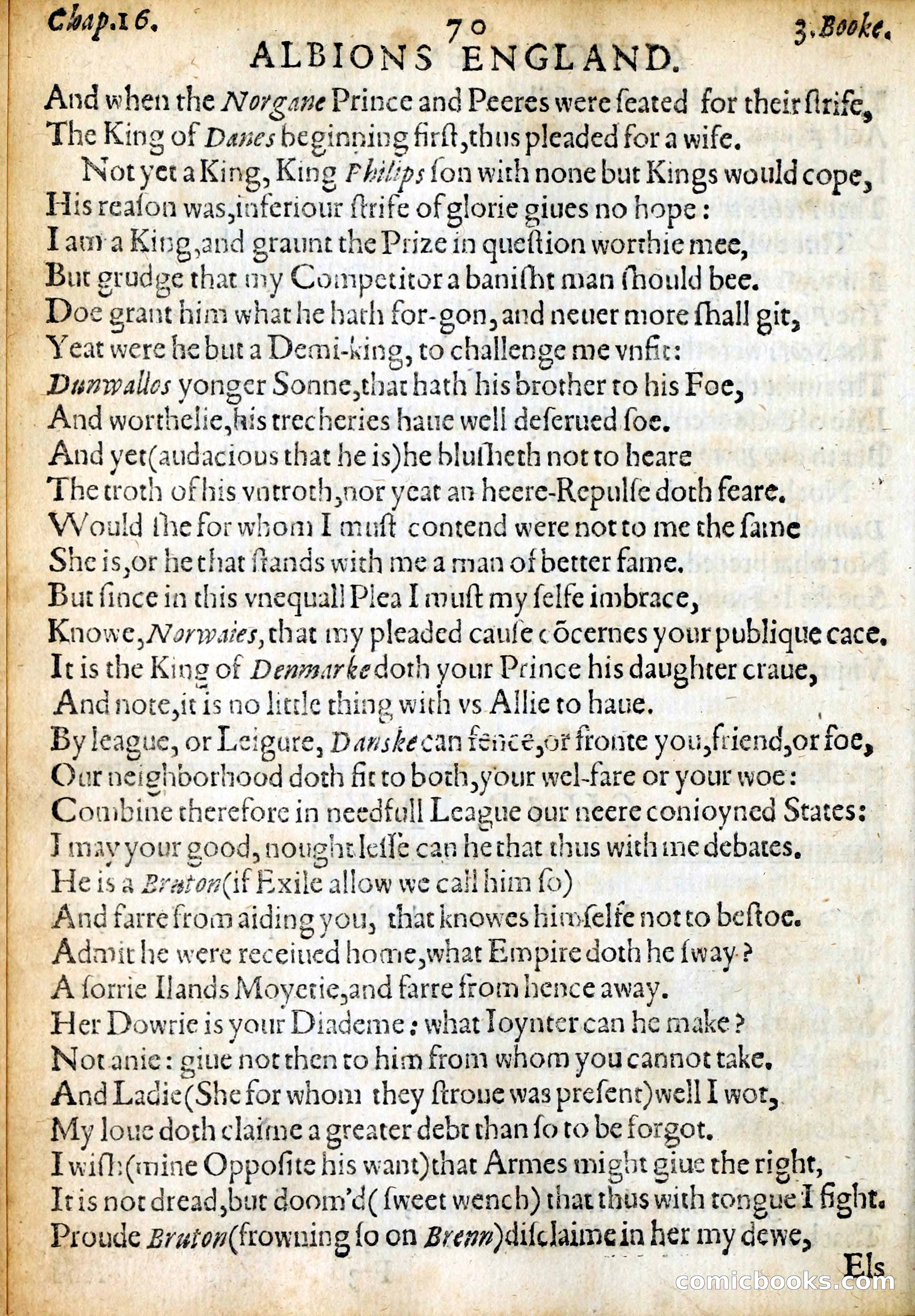
# Analysis of This Page This is a **page of running verse prose** from "Albions England," a historical narrative poem rather than a typical penny dreadful. The text presents a dramatic speech by the King of Danes pleading his case for marriage to a woman (apparently the daughter of the King of Denmark, based on context clues). He argues that his competitor, a man named Dunwalles or a "Braton," is unworthy—an exile with no power or empire—while he himself can offer military alliance and protection through league with Denmark. The tone is mock-heroic complaint mixed with political negotiation, addressing the "Norwies" (Norwegians) with appeals to self-interest and loyalty.
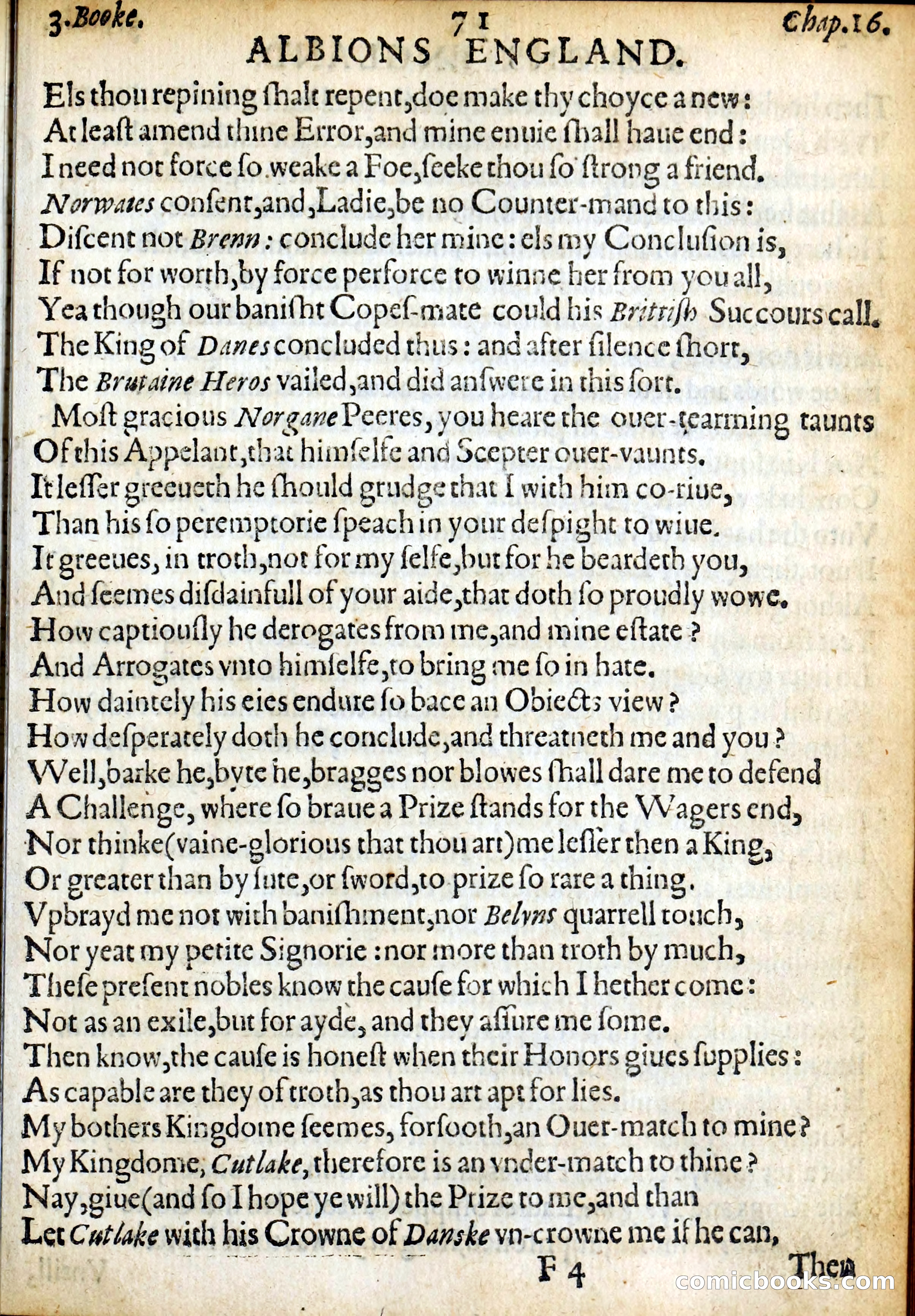
# Analysis of Page **Format:** Running prose text (verse drama) **Content:** This is a page from *Albion's England*, a historical narrative poem, not a Victorian penny dreadful. It presents a dramatic exchange between two rulers—the King of Danes and the "Britain Heros"—disputing over a woman named (apparently) Brena or Cutlake. The King of Danes demands she be surrendered to him; the Britain Heros responds by defending his claim, accusing his rival of arrogance, and proposing a contest for the prize. The language is Early Modern English verse, with elaborate rhetorical flourishes typical of Elizabethan dramatic poetry. The page is numbered 71, Chapter 16, from Book 3.
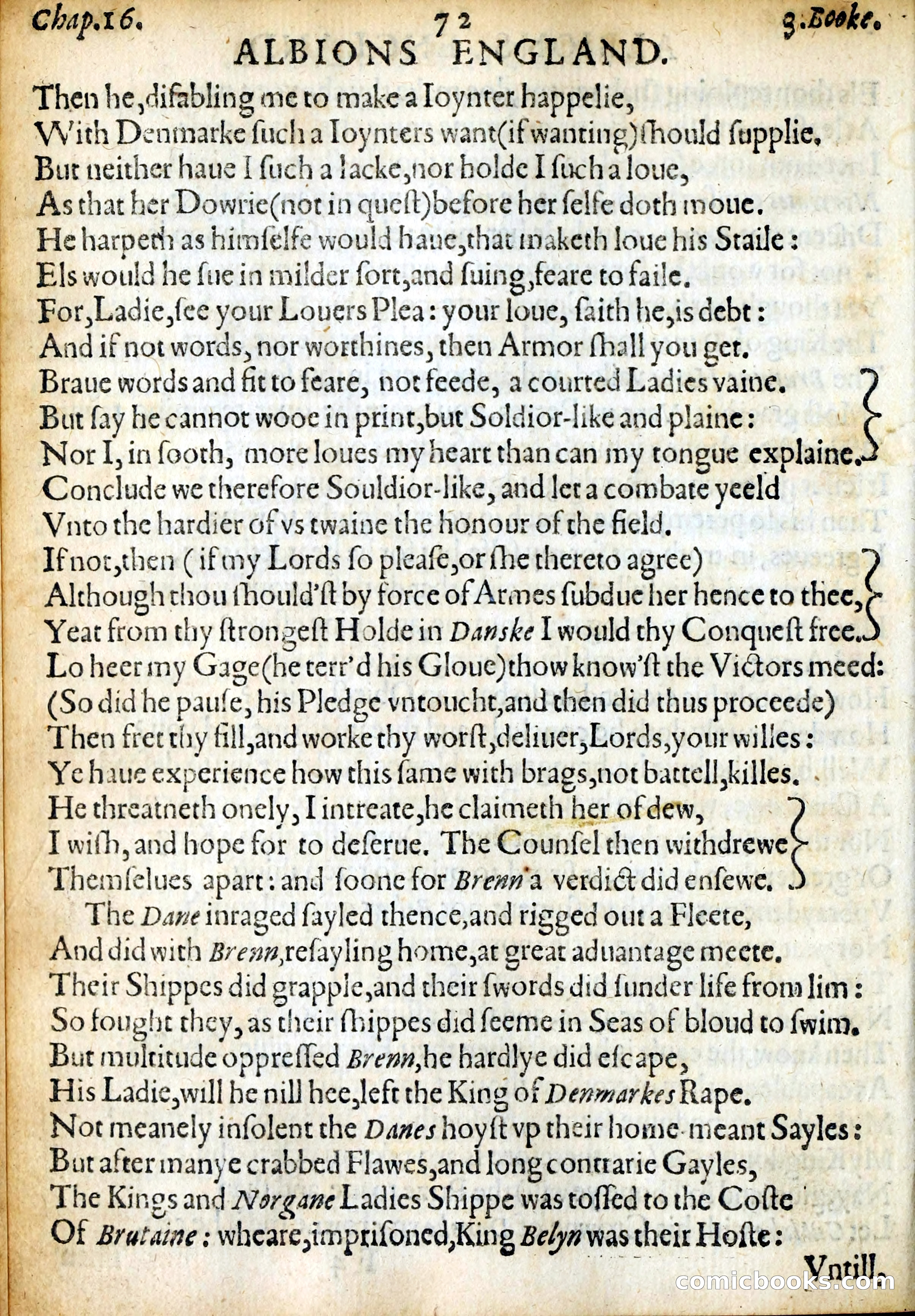
# What's on This Page This is a page of running verse poetry from *Albion's England*, a historical narrative poem. The text describes a lover's plea to win a lady, followed by a military confrontation: the rejected suitor (apparently a Danish king named Brenn) sails away in anger, engages in a naval battle with another party, and ultimately captures the lady. The page concludes with the lady's ship being driven to the coast of Britain, where she is imprisoned by King Behm. The verse employs Early Modern English spelling and discusses matters of courtship, honor, and military conquest in a historical or legendary context.
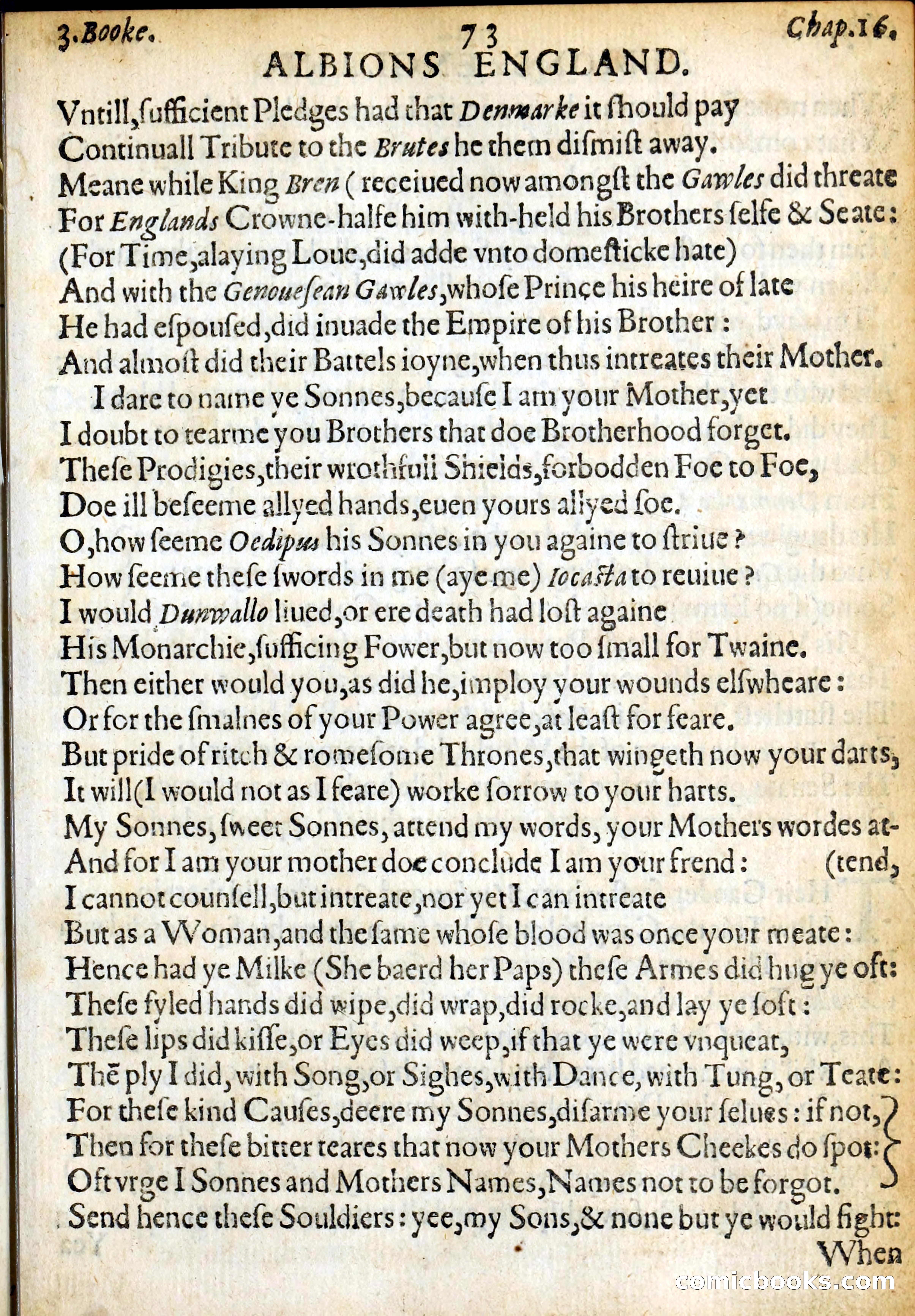
This page contains running prose poetry from what appears to be "Albions England," a historical narrative poem. The text depicts a mother (apparently a queen) pleading with her warring sons—King Bren and another brother—to cease their fratricidal conflict. She invokes their shared blood, recalls nursing them as infants, and warns that their pride and fighting will bring ruin, comparing them to Oedipus's sons. The passage is written in early modern English verse with elaborate metaphors about shields, thrones, and maternal duty.
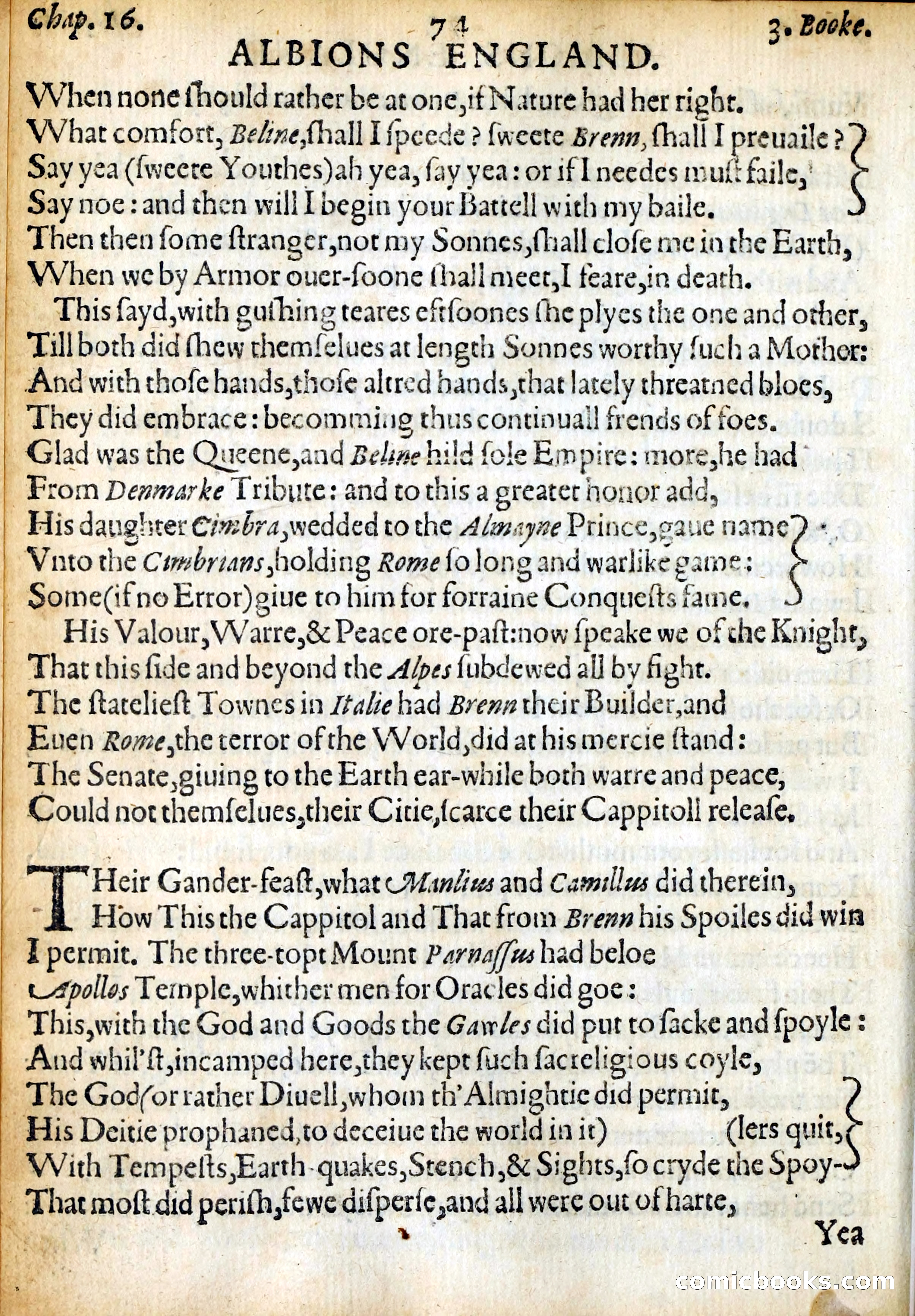
# Page Analysis This page contains running prose poetry from "Albions England," a historical narrative poem (not a Victorian penny dreadful, but an early modern work—this appears to be a much earlier reprint). The visible text is written in archaic verse and describes political and military events: a queen's joy at her son Beline's sole rule and expanded empire through tribute from Denmark; his daughter Cimbra's marriage to an Almaine Prince, uniting the Cimbrians with Rome; and Beline's military conquests in Italy, including his building of cities and his sacking of temples, which allegedly provoked divine punishment through tempests and earthquakes that killed many.
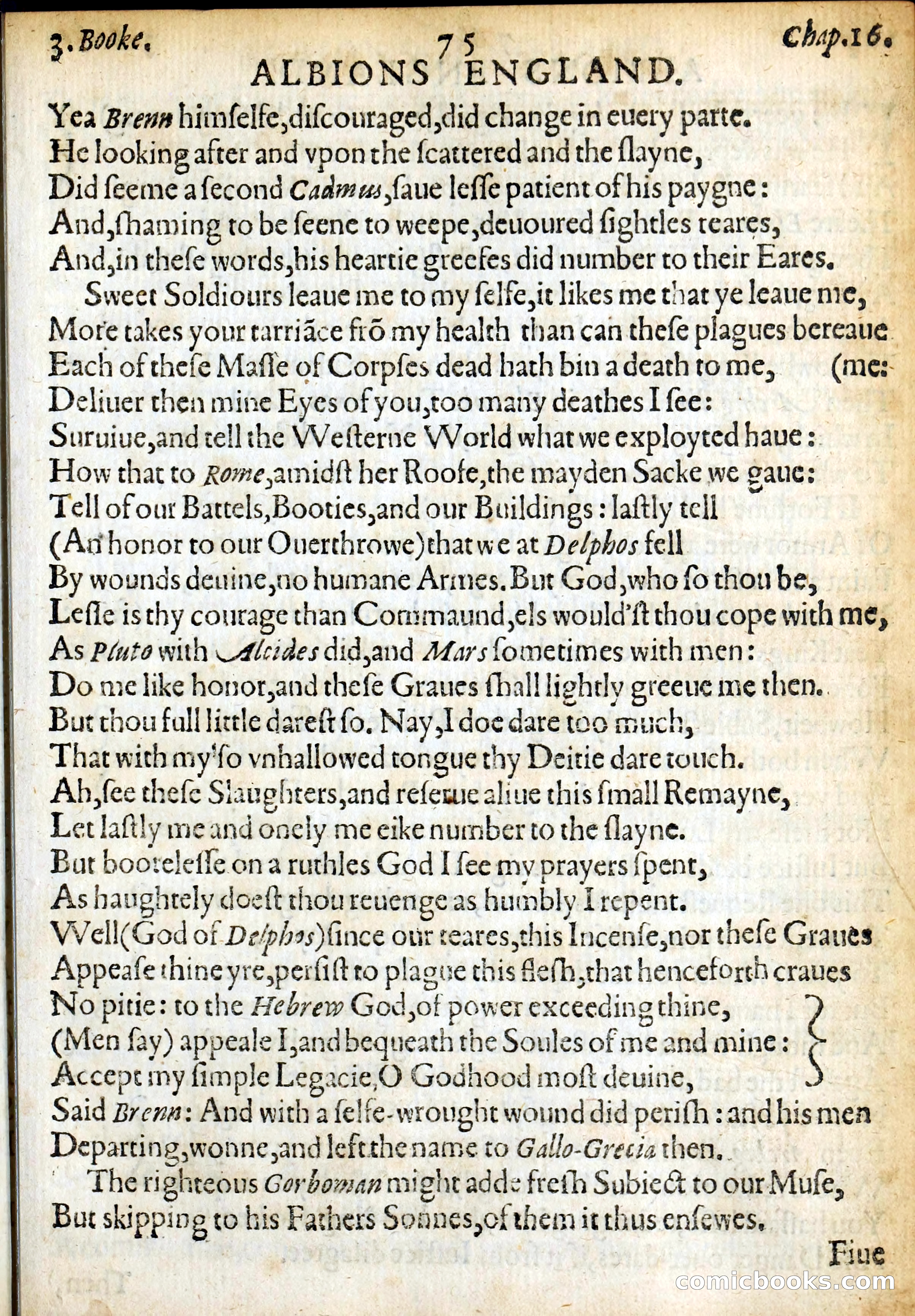
# Page Analysis This is a page of running verse poetry from what appears to be an early modern or Renaissance-era historical narrative (likely the source material for a penny dreadful adaptation). The text presents a dramatic monologue by a character named Brena, a military leader lamenting his fallen soldiers after battles, apparently at Delphos. Brena grieves the dead, invokes both pagan and Hebrew gods for mercy, and ultimately takes his own life by self-inflicted wound. The narrative continues with references to subsequent military figures and their deeds. The typography and language are archaic; this is prose-verse recounting heroic or tragic military history rather than sensational Victorian penny dreadful content per se.
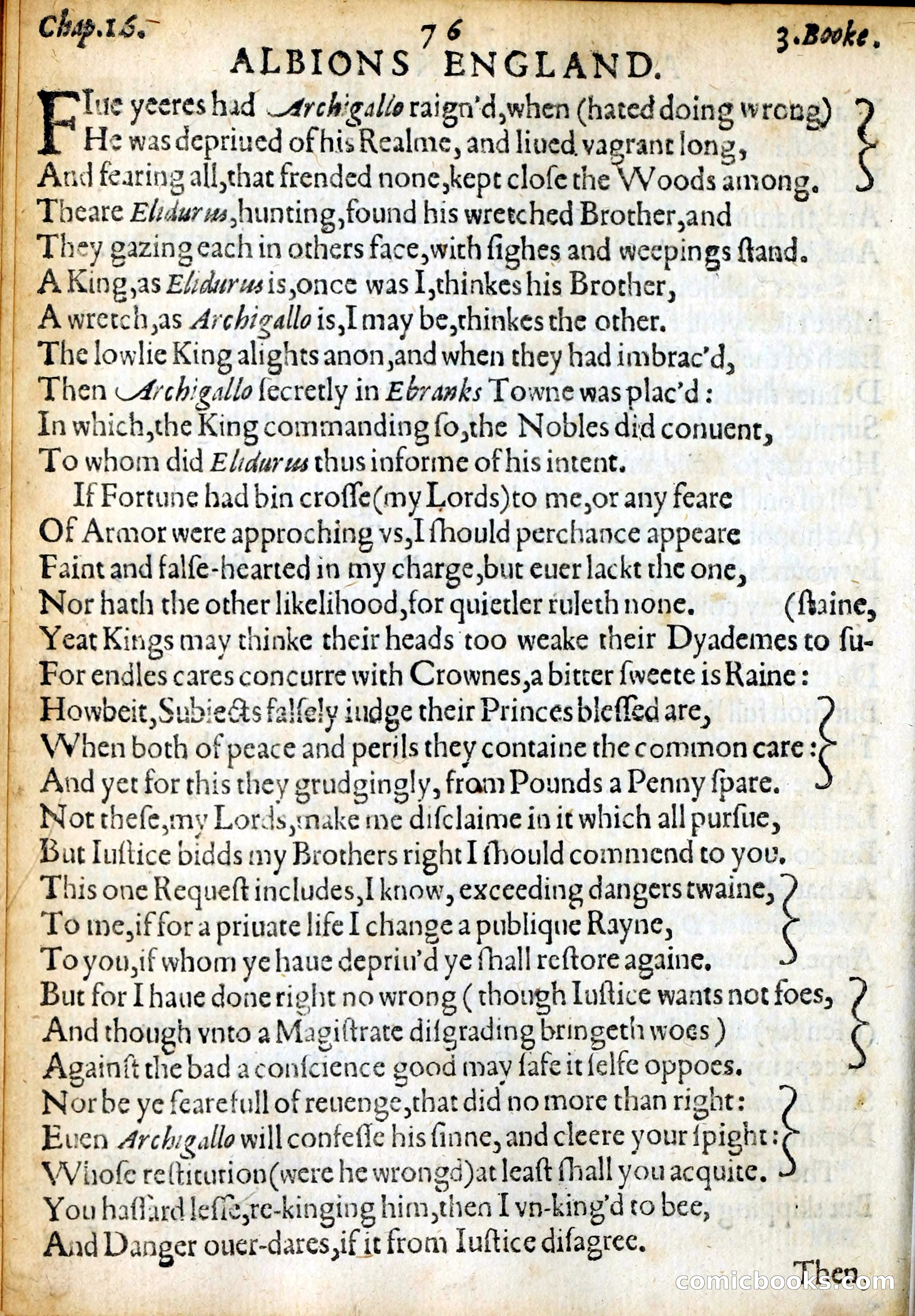
This is a page of running verse narrative from what appears to be a dramatic or historical poem titled "Albions England" (visible in the header). The text depicts a scene where King Elidurus discovers his deposed brother Archigallo living wretchedly in the woods. After embracing, Elidurus brings Archigallo to Ebranks Town and addresses the assembled nobles, arguing that justice requires he restore his brother's throne despite the personal and political dangers involved. The passage emphasizes themes of duty, conscience, and restitution over revenge or self-interest.
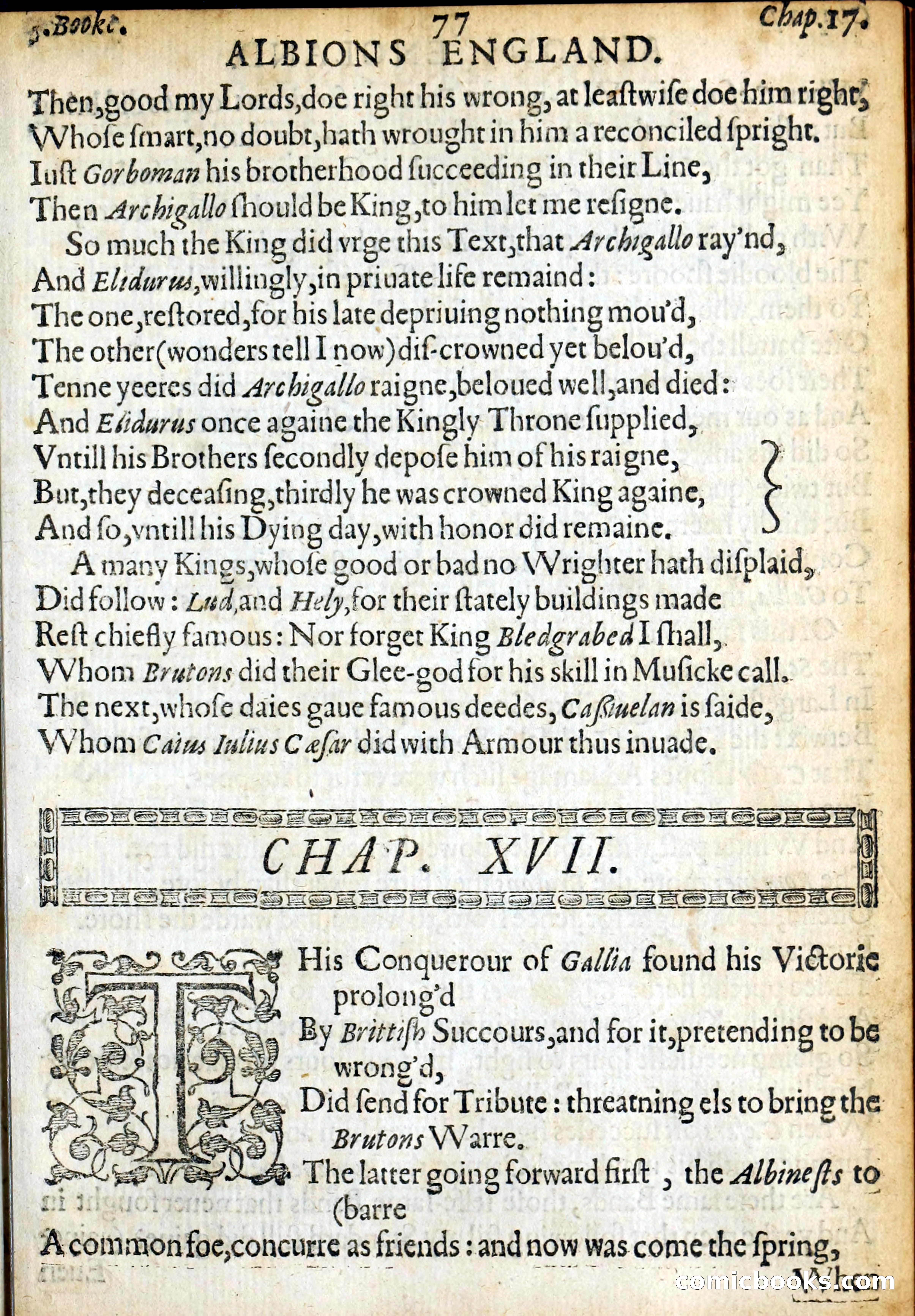
# Description of Page This is a page of running verse prose from *Albions England*, Chapter XVII. The text recounts the succession of early British kings—Gorboman, Archigallo, and Elidurus—and their alternating claims to the throne, before moving to later monarchs like Lud, Hely, Bledgrabed, and Cassiuelan. The passage concludes with an account of Julius Caesar's invasion of Britain, prompted by the Britons' refusal to pay tribute, and notes that the native Albinests and Britons united against this common foreign threat. The page contains ornamental typography and a chapter heading divider.
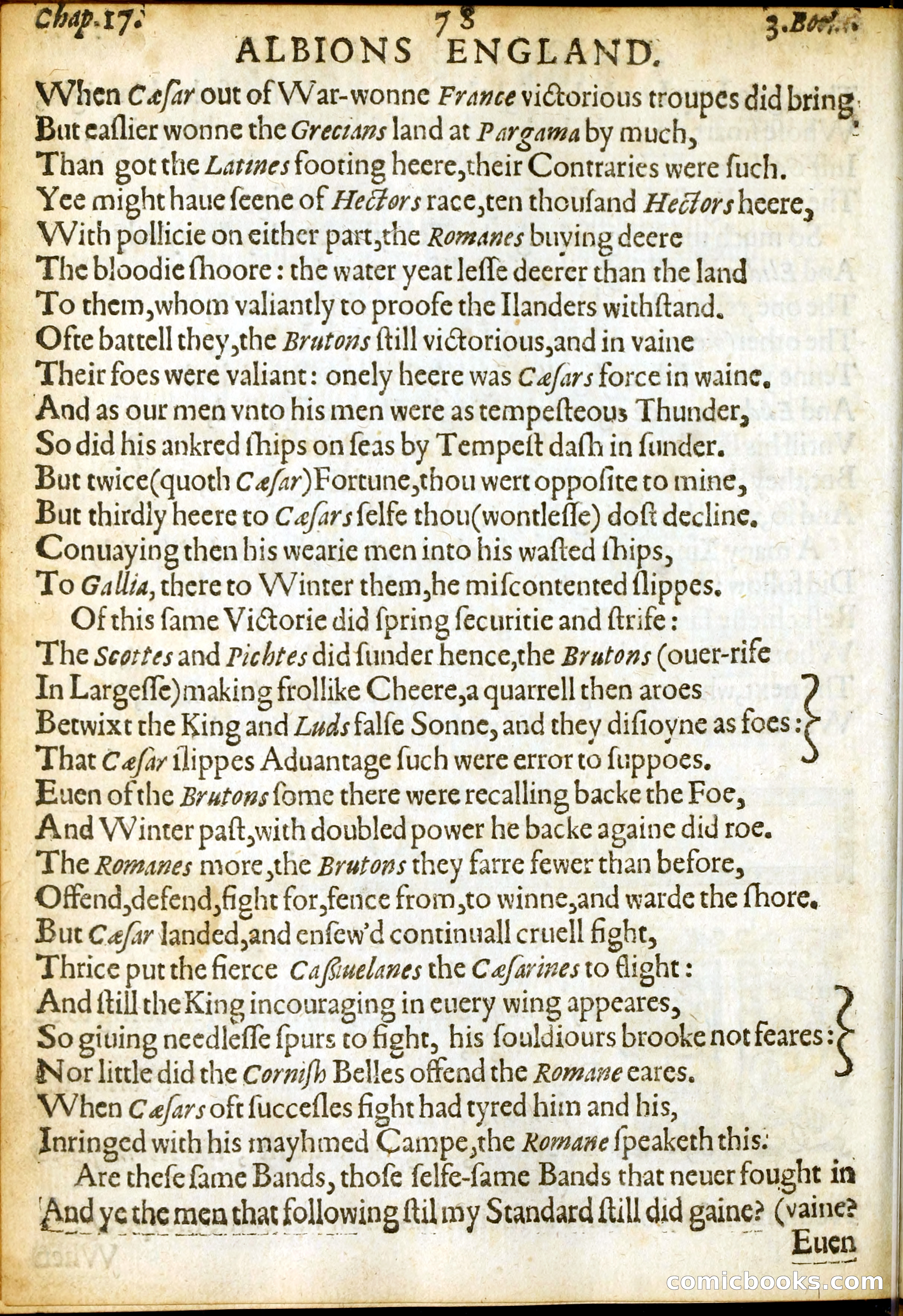
# Page Description This is a page of running verse poetry from what appears to be a historical narrative poem titled "Albions England" (visible at the top). The text, printed in Early Modern English typography, recounts military campaigns involving Caesar, the Romans, the Britons, and various Celtic peoples. The verse describes battles, Caesar's victories and setbacks, fortune's reversals, and conflicts among British factions—particularly mentioning the Scots, Picts, Britons, and a dispute between a king and his son. The passage ends with a Roman speaker questioning whether certain bands of soldiers who followed his standard achieved any gains in battle.
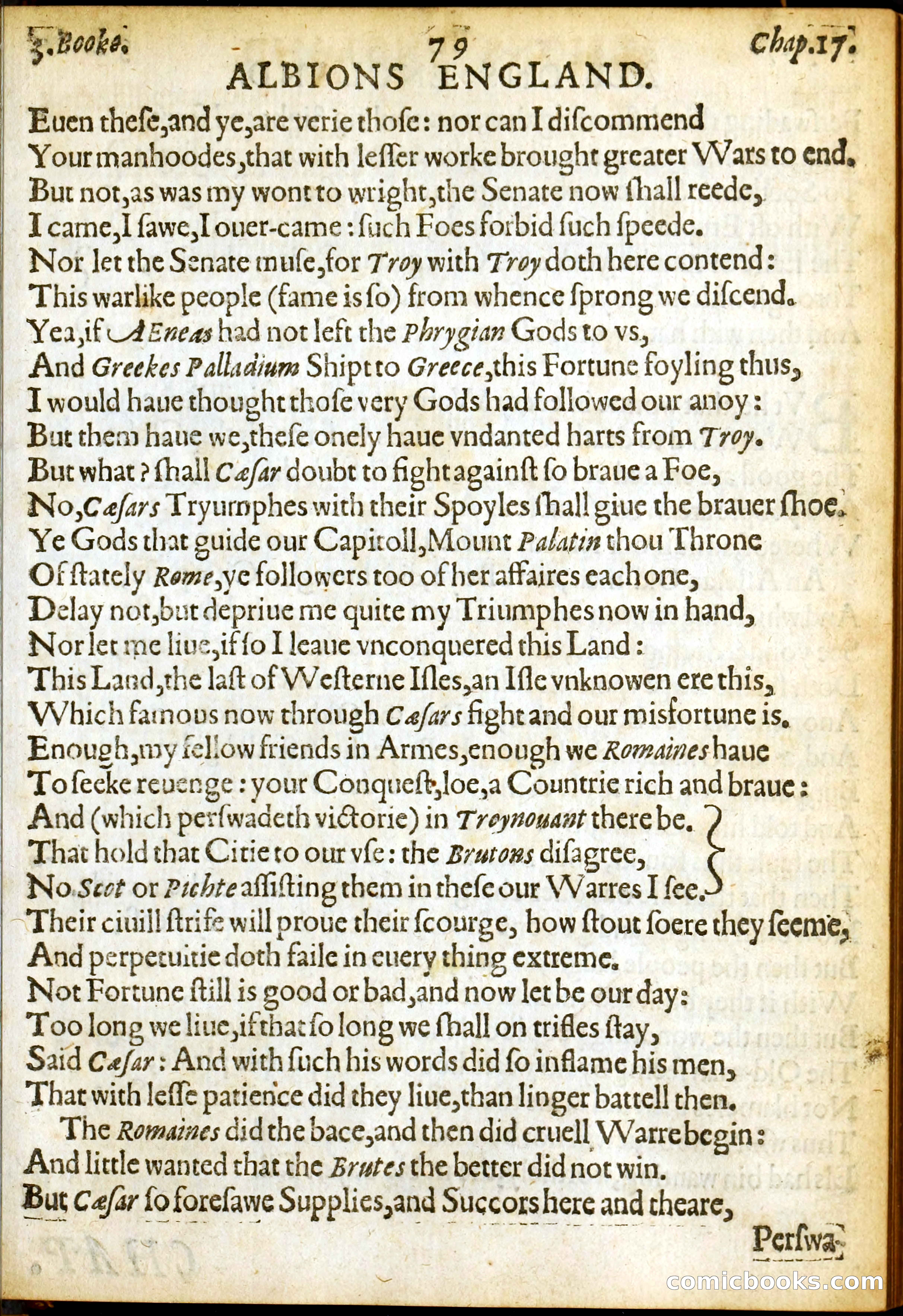
# Description of Page This is a page of running verse poetry from *Albion's England*, presented in Early Modern English typography (likely 16th or 17th century, not Victorian). The text depicts Caesar addressing his Roman troops before battle against the Britons, urging them to conquer this unknown western island and seek revenge. Caesar invokes the gods of Rome and declares he will not rest until Britain is conquered, then his stirring words inflame his soldiers to fight with less patience for delay. The passage ends as the Romans and Britons begin their cruel war.
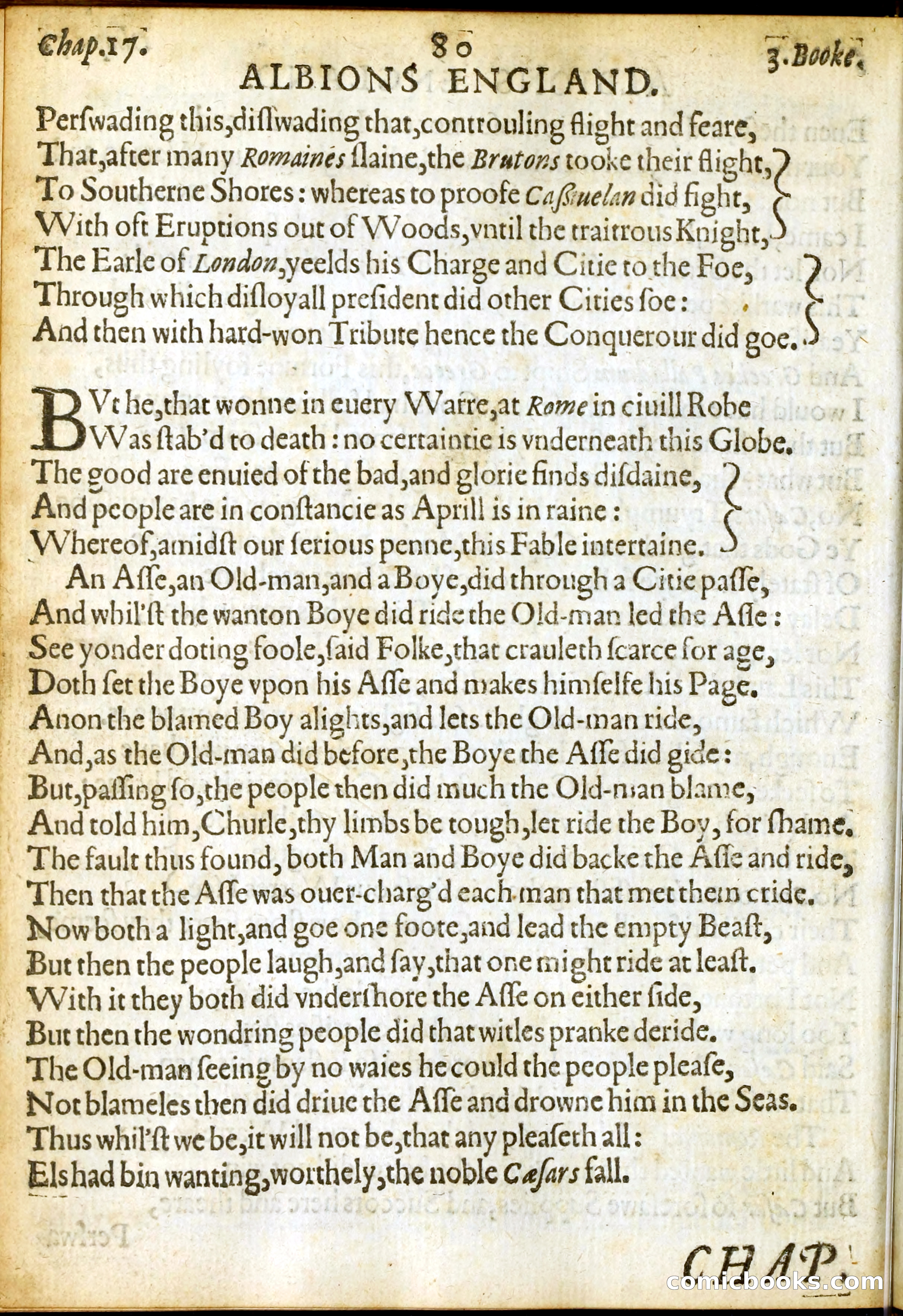
# Page Analysis This is a page of running prose poetry from *Albion's England*, a narrative poem by William Warner. The visible text consists of two sections: an introductory passage about Roman Britain (mentioning Cassivelaunus and the Earl of London), followed by a complete fable about an old man, a boy, and a donkey who travel through a city. The fable illustrates the impossibility of pleasing everyone—as the three try different arrangements (boy riding, old man riding, both riding, both walking), the townspeople criticize each configuration until, in despair, the old man drowns the donkey. The moral concludes that if Caesar had lacked something, he would have been worthily blamed.
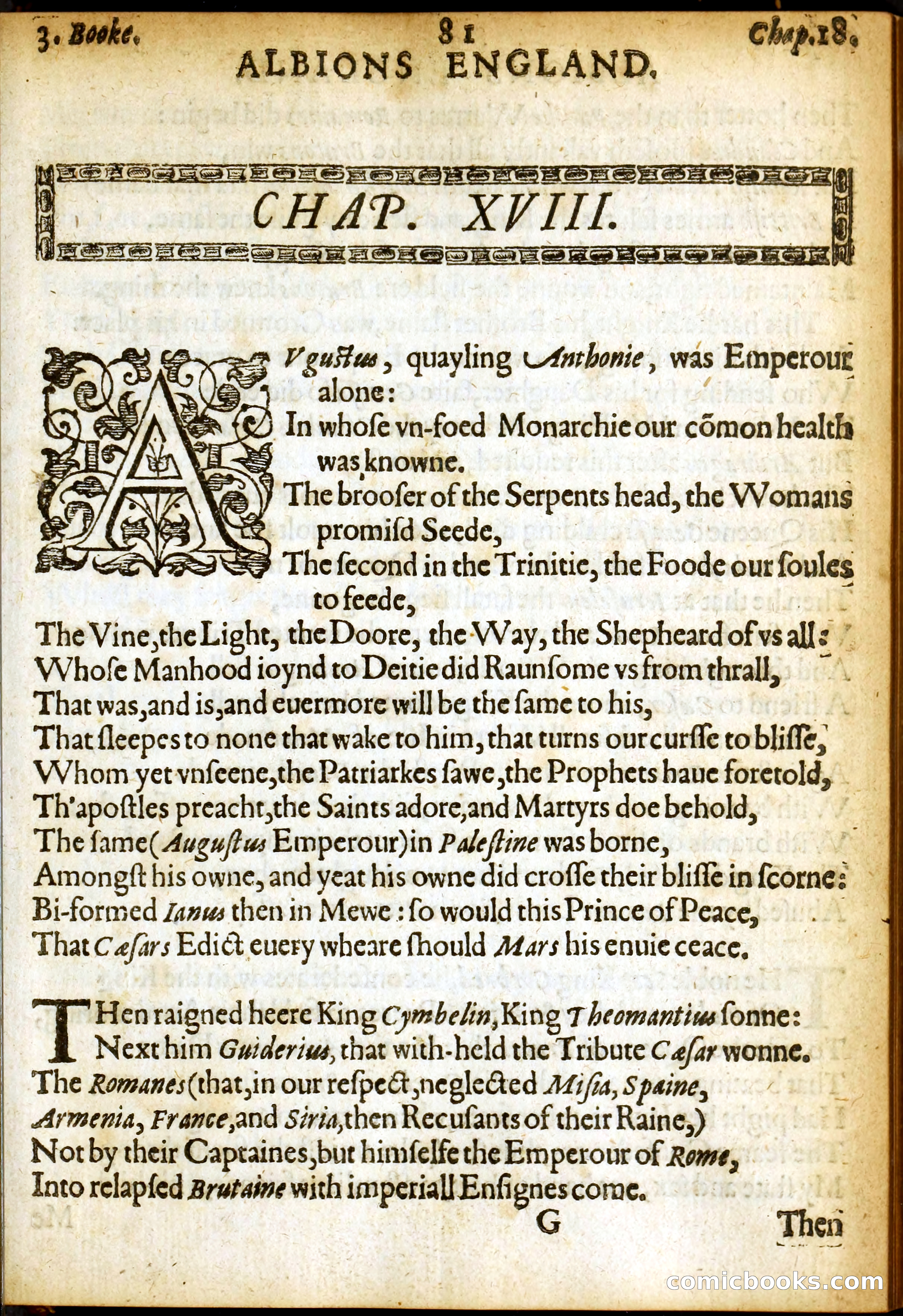
# Analysis of Page This is a running prose page from Chapter XVIII of what appears to be an early modern narrative poem (not actually a Victorian penny dreadful, despite the query's framing). The text presents Christian theological content mixed with British legendary history: it opens with verses celebrating Augustus and Christ's divinity, then transitions to describing ancient British kings—specifically Cymbeline and Guiderius—and their resistance to Roman tribute under the Emperor of Rome. The ornate initial letter and dense verse formatting are characteristic of early printed books rather than Victorian serialized fiction.
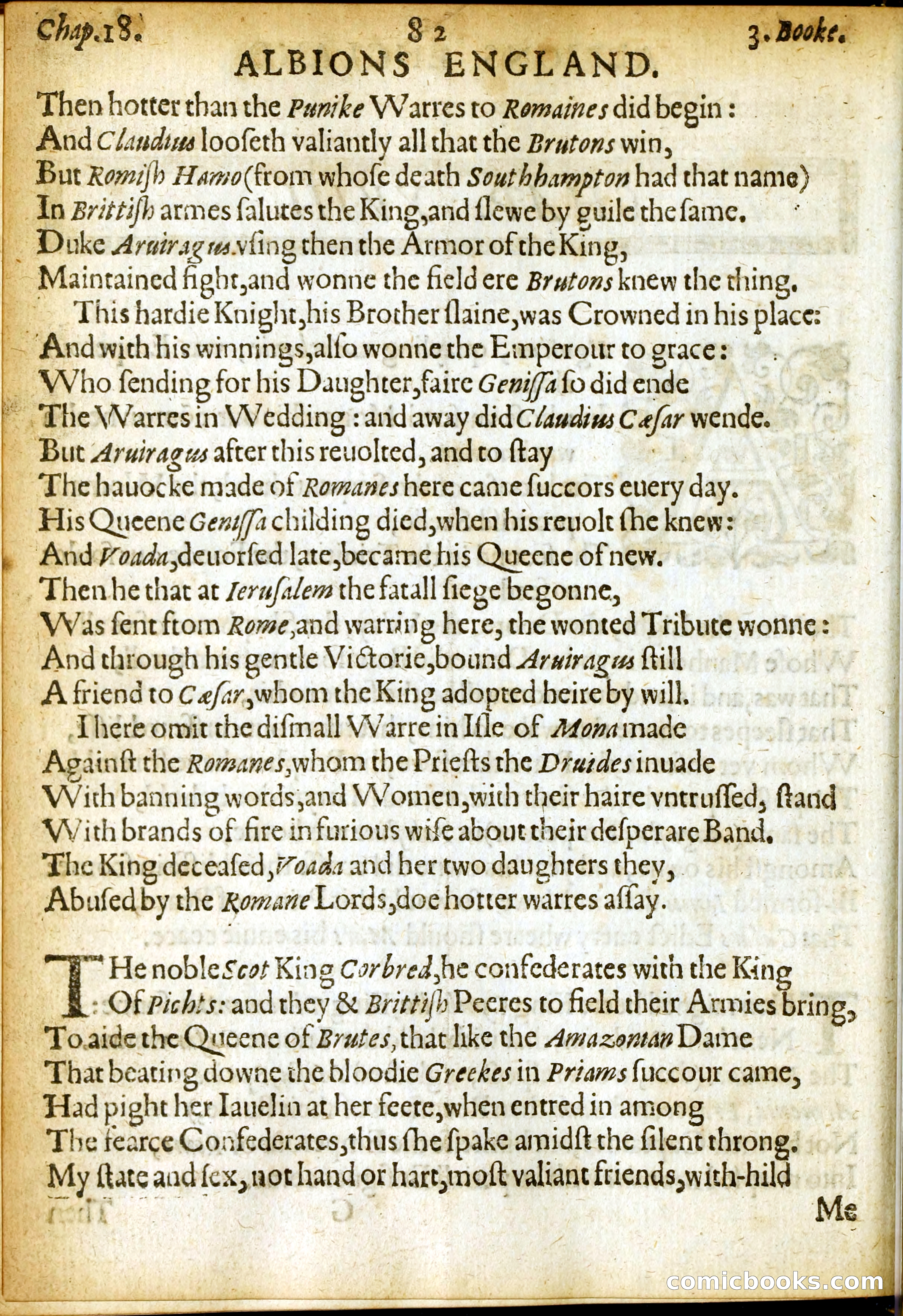
# Page Analysis: "Albions England" This is a page of running prose poetry from what appears to be Michael Drayton's *Albions England*, a historical epic. The text recounts events from Roman Britain, specifically describing conflicts involving figures named Arviragus, Claudius Caesar, and various British and Roman leaders. The verse narrates military campaigns, political alliances (including a marriage between Genipha and Claudius Caesar), revolts against Roman rule, and the later resistance of Queen Voada and her daughters against Roman occupation. The passage includes a reference to a siege at Jerusalem and concludes with Scottish King Corbred's confederation with the British Queen, compared to an Amazonian warrior. The page is numbered 82 and marked as "Chap. 18" and "3. Booke."
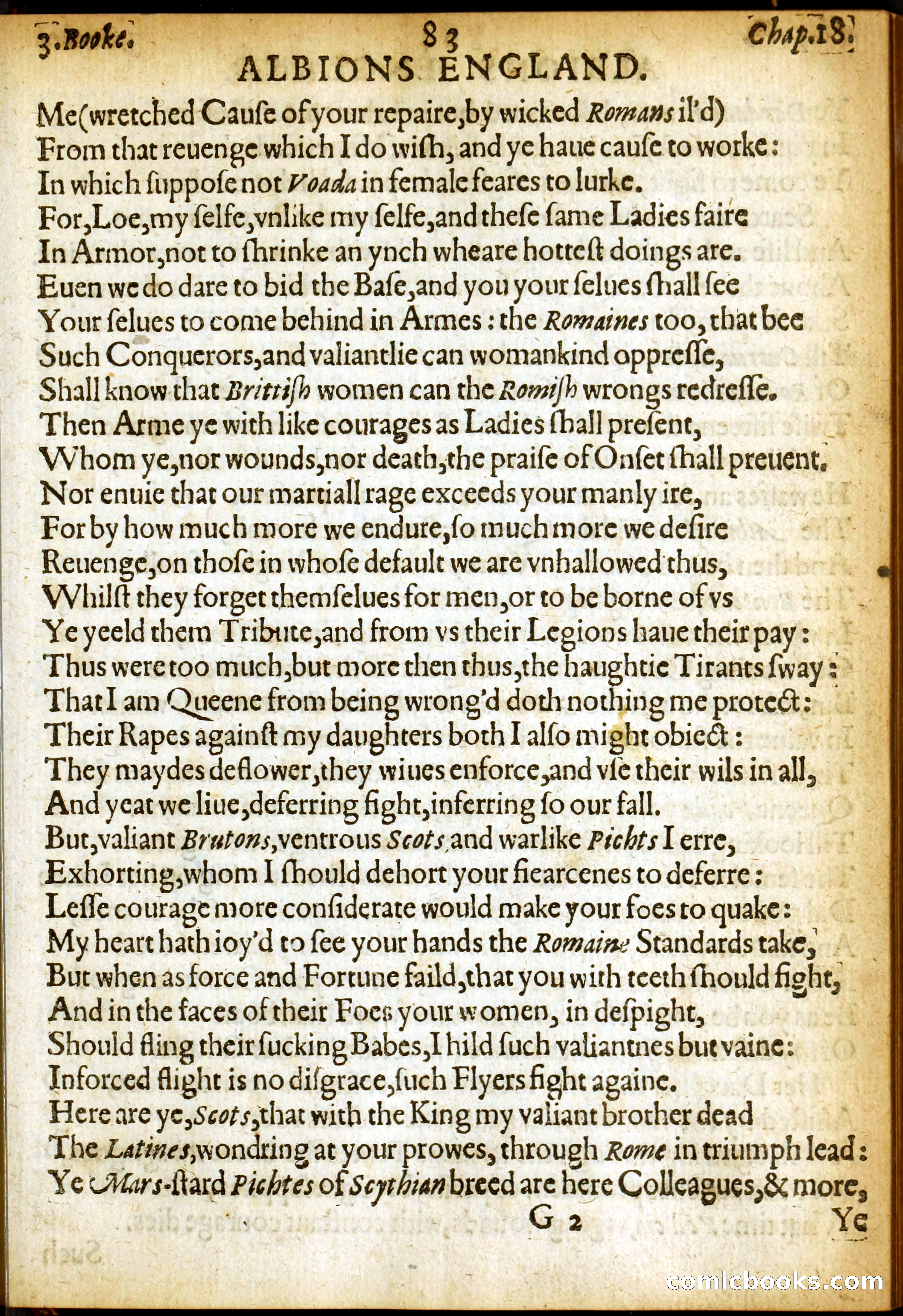
# Analysis of Page This is a page of running prose poetry from what appears to be *Albions England*, Book 3, Chapter 18. The text presents a dramatic speech—likely delivered by a female character, possibly Queen Boudica or similar historical British figure—exhorting British warriors (Britons, Scots, Picts) to rise up against Roman oppression. The speaker invokes the wrongs suffered by British women and children at Roman hands, calling for martial courage and revenge. The language is early modern English verse with archaic spelling and typography typical of period publications, though this appears to be a later reprint rather than a genuine penny dreadful given its classical literary source material.
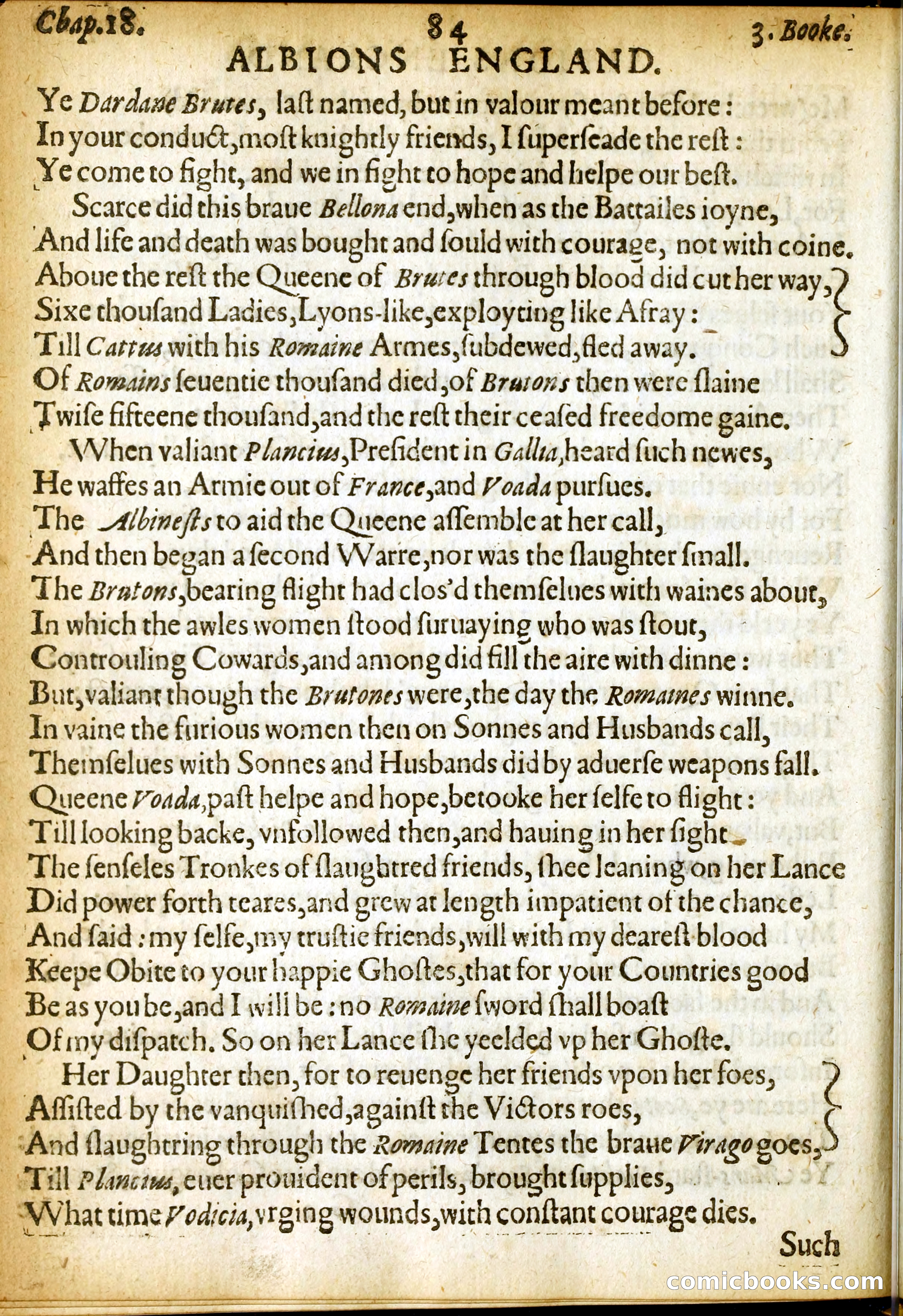
# Victorian Penny Dreadful Page Analysis This is a page of running prose poetry from what appears to be Chapter 18 of a serialized work titled "Albions England" (Book 3, page 84). The text narrates a historical battle involving the Queen of the Britons (Voada/Boadicea) and her forces fighting against Roman armies. The verse describes the conflict's progression: initial British success with six thousand warrior women, eventual Roman victory despite Briton valor, and Queen Voada's suicide after defeat. Her daughter then leads a revenge attack against the Romans. The language is archaic Early Modern English with italicized proper names marking key figures and places. This appears to be historical-legendary narrative verse rather than sensational crime or horror fiction typical of penny dreadfuls.
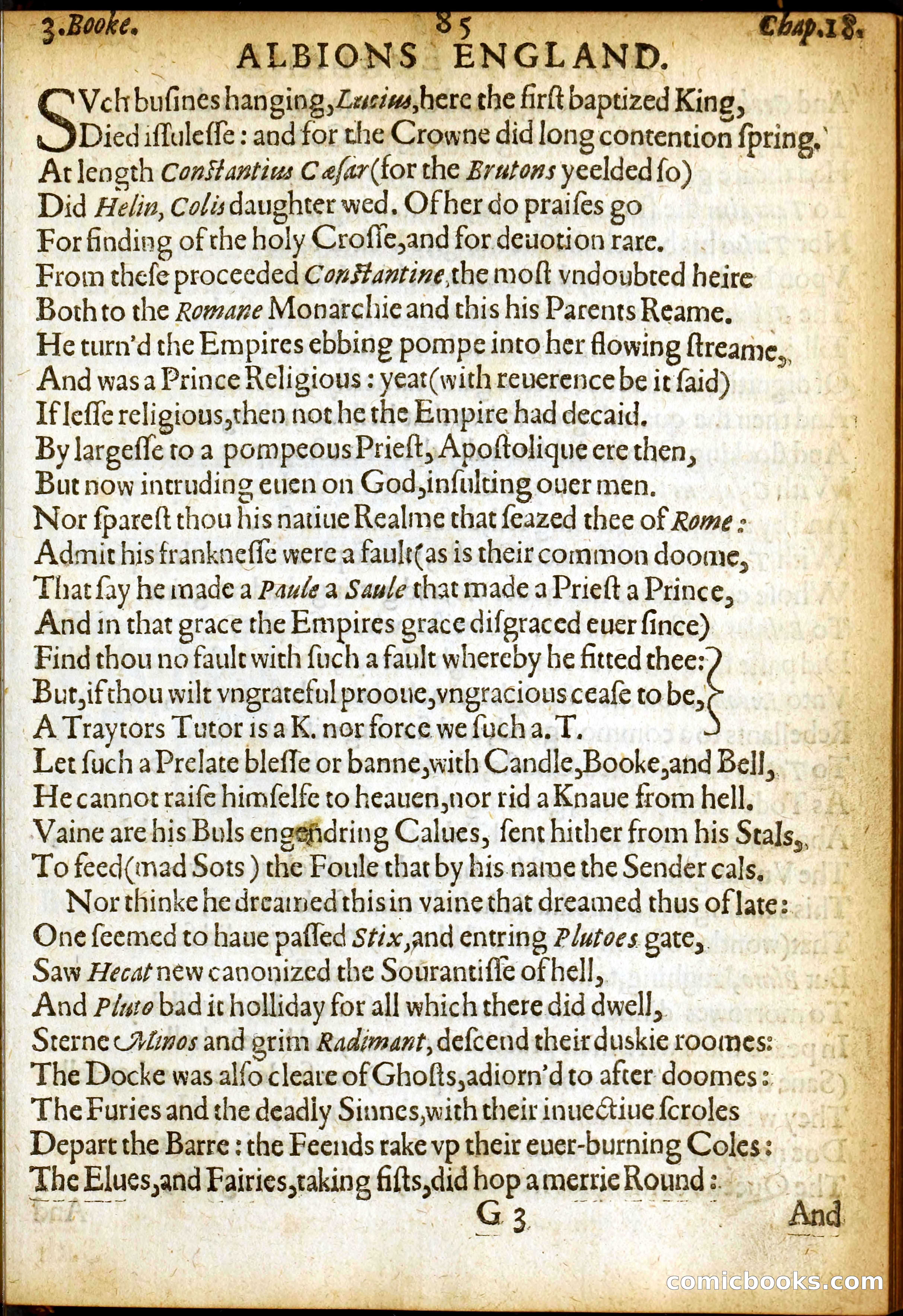
This is a page of running verse poetry from what appears to be an early modern work titled "Albions England" (not a Victorian penny dreadful as suggested). The text, printed in period typeface, discusses Constantine Caesar's marriage to Helen, daughter of a British king, and their son Constantine, who turned the declining Roman Empire toward prosperity. The passage criticizes a prelate (Catholic priest) for overreaching authority, then describes a dream vision where the dreamer passes through classical underworld gates and witnesses infernal figures like Hecate, the Furies, and demons in a satirical religious allegory. The verse employs rhyming couplets in Early Modern English.
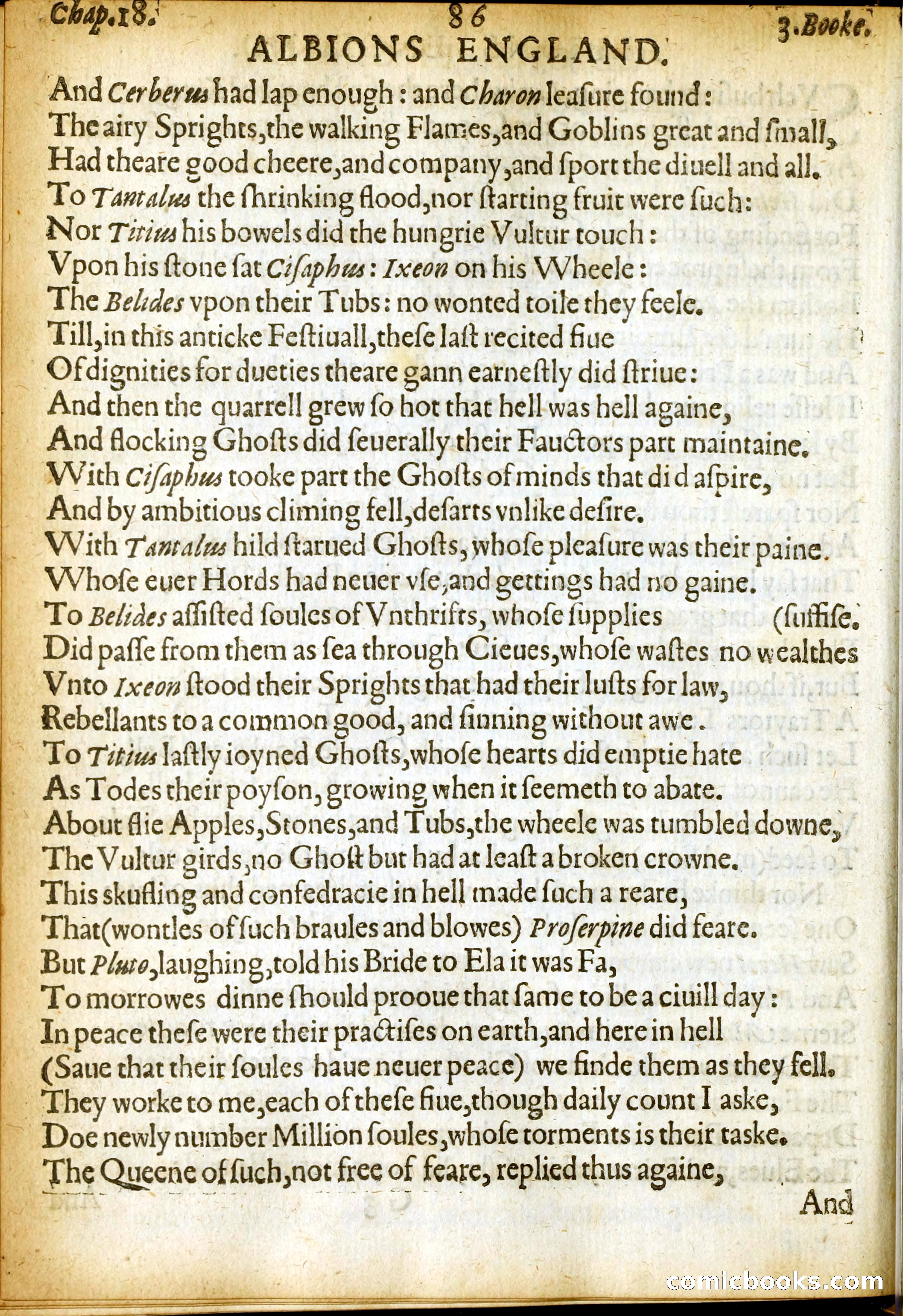
# Page Description This is a page of running verse prose from what appears to be a classical or allegorical work titled "Albions England" (visible at the top). The text is printed in early modern English typography with elaborate italics and decorative initials. The passage describes a chaotic dispute in hell among classical figures of torment—Cerberus, Charon, Tantalus, Tityus, Ixion, and others—who quarrel over their duties and dignities, eventually breaking into violent conflict. Pluto and Proserpine observe the tumult. The verse recounts how these same souls previously behaved on earth and continue their torments in hell, with a final speaker (identified as "the Queene of such") responding to some prior statement.
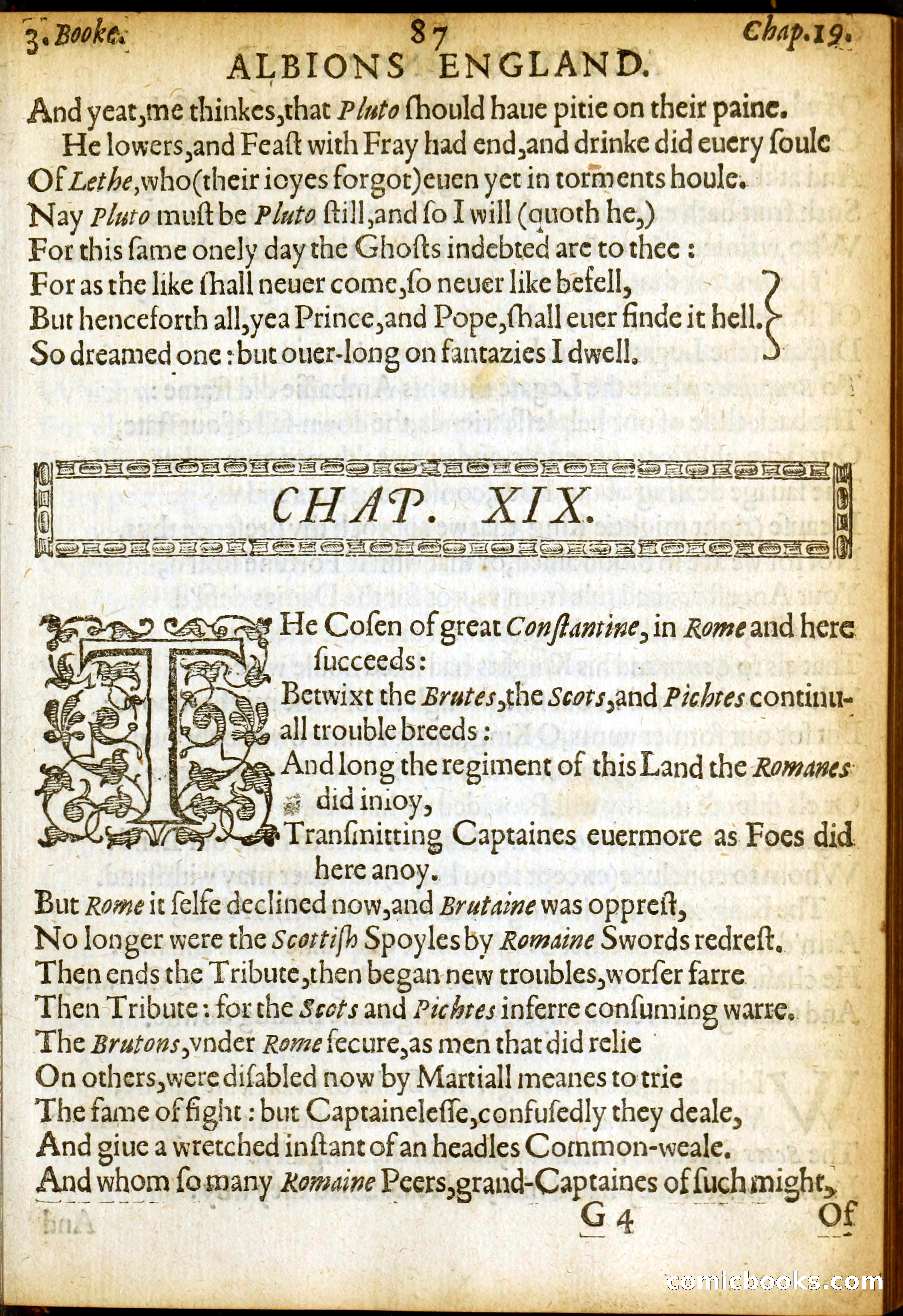
# Page Description This is a page of running verse narrative prose from what appears to be a historical poem about England. The page contains the end of one section (discussing Pluto and the afterlife) followed by Chapter XIX, which begins an account of Roman Britain's decline. The text describes how Rome weakened, how Britain ("Britaine") lost Roman military protection, and how the Scots and Picts then invaded, leaving the Britons leaderless and defenseless—described as "a wretched instant of an headles Common-weale." The page is numbered 87 and marked "3. Books" at the top, suggesting this is part of a larger work rather than a penny dreadful serial.
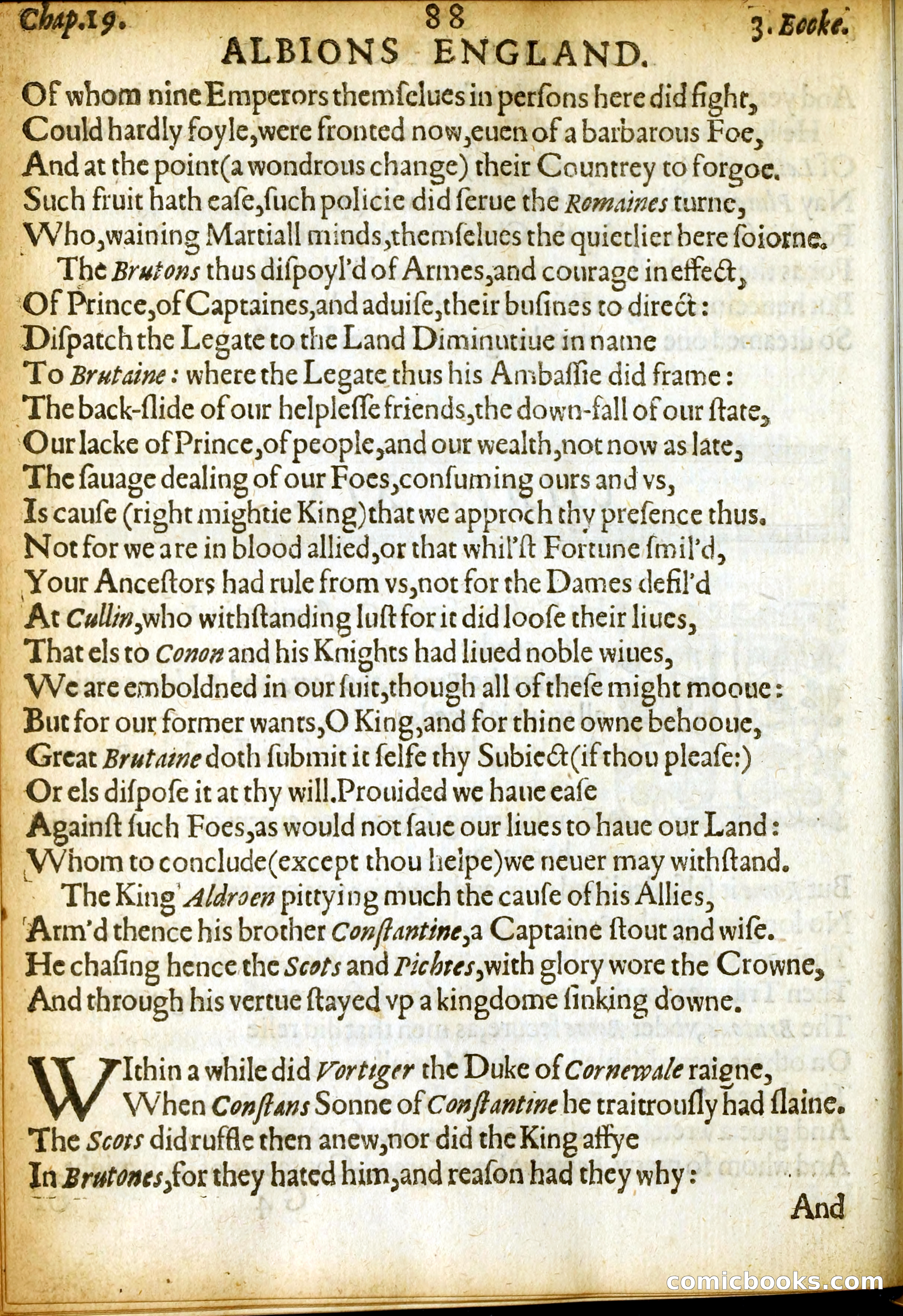
# Victorian Penny Dreadful Page: "Albions England" This is a page of running verse narrative prose from Chapter 19 of what appears to be *Albions England*, a historical chronicle poem. The text depicts a diplomatic embassy to a king, wherein British representatives plead for military aid against foreign enemies, offering Britain as a subject state in exchange for protection. The narrative then shifts to describe King Aldroen sending his brother Constantine to fight the Scots and Picts, followed by events involving Vorteger, Duke of Cornwall, and Constantine's son—apparently a tale of treachery and renewed conflict. The page uses early modern spelling and typography with italicized proper names for places and persons.
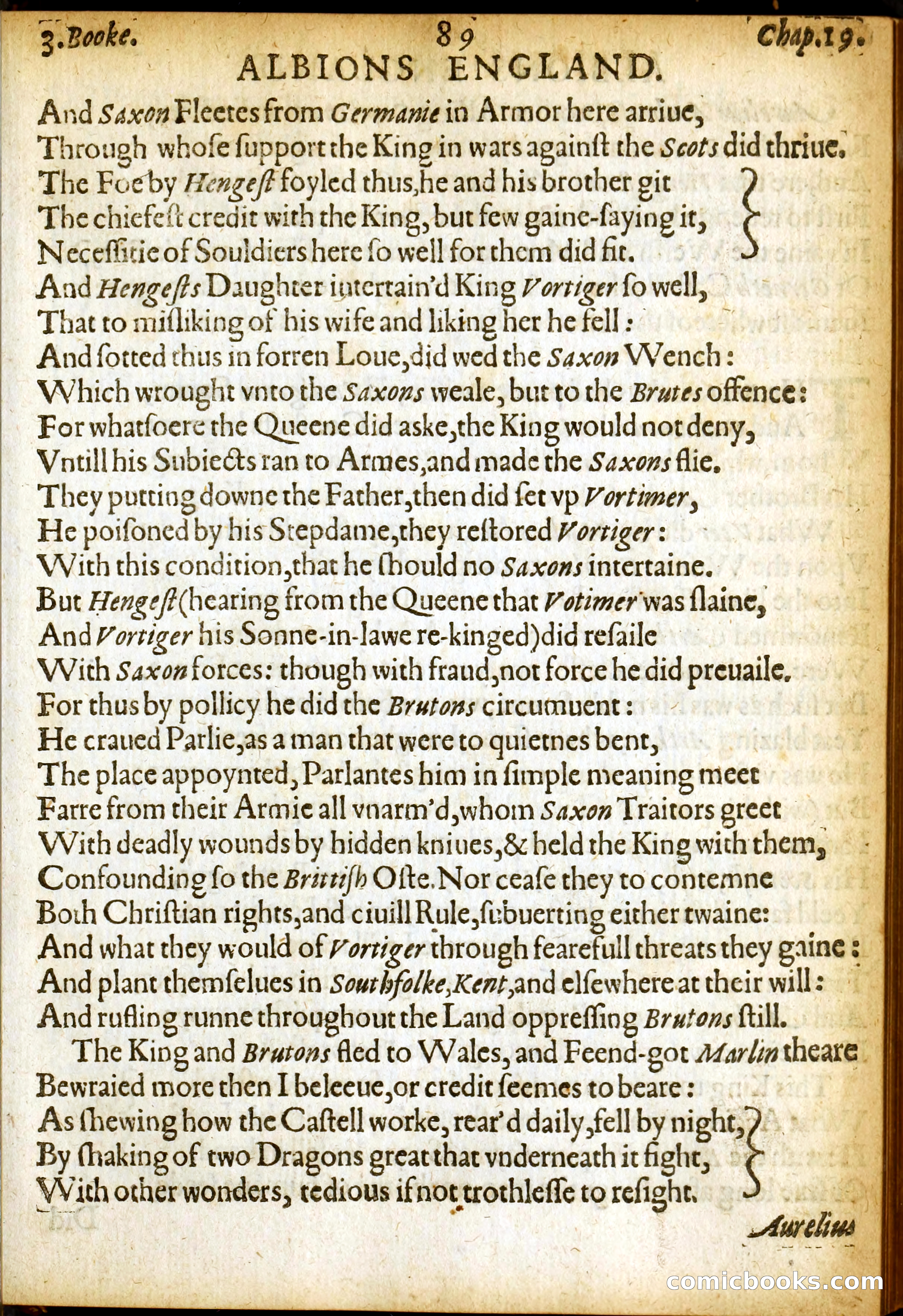
# Page Analysis This is a **running prose page** from what appears to be a historical narrative poem or chronicle (likely from Michael Drayton's *Albion's England*, as the header indicates). The text recounts legendary British history involving Saxon invasions and the conflict between King Vortigern and the Saxon leader Hengist. The visible passage describes how Hengist's daughter married King Vortigern, leading to Saxon influence over Britain; the subsequent poisoning and restoration of rival claimants; and Hengist's treacherous massacre of unarmed British nobles at a peace negotiation, after which the Saxons occupied southern England while the British king fled to Wales. The page employs early modern spelling and typography typical of 16th-17th century printed works.
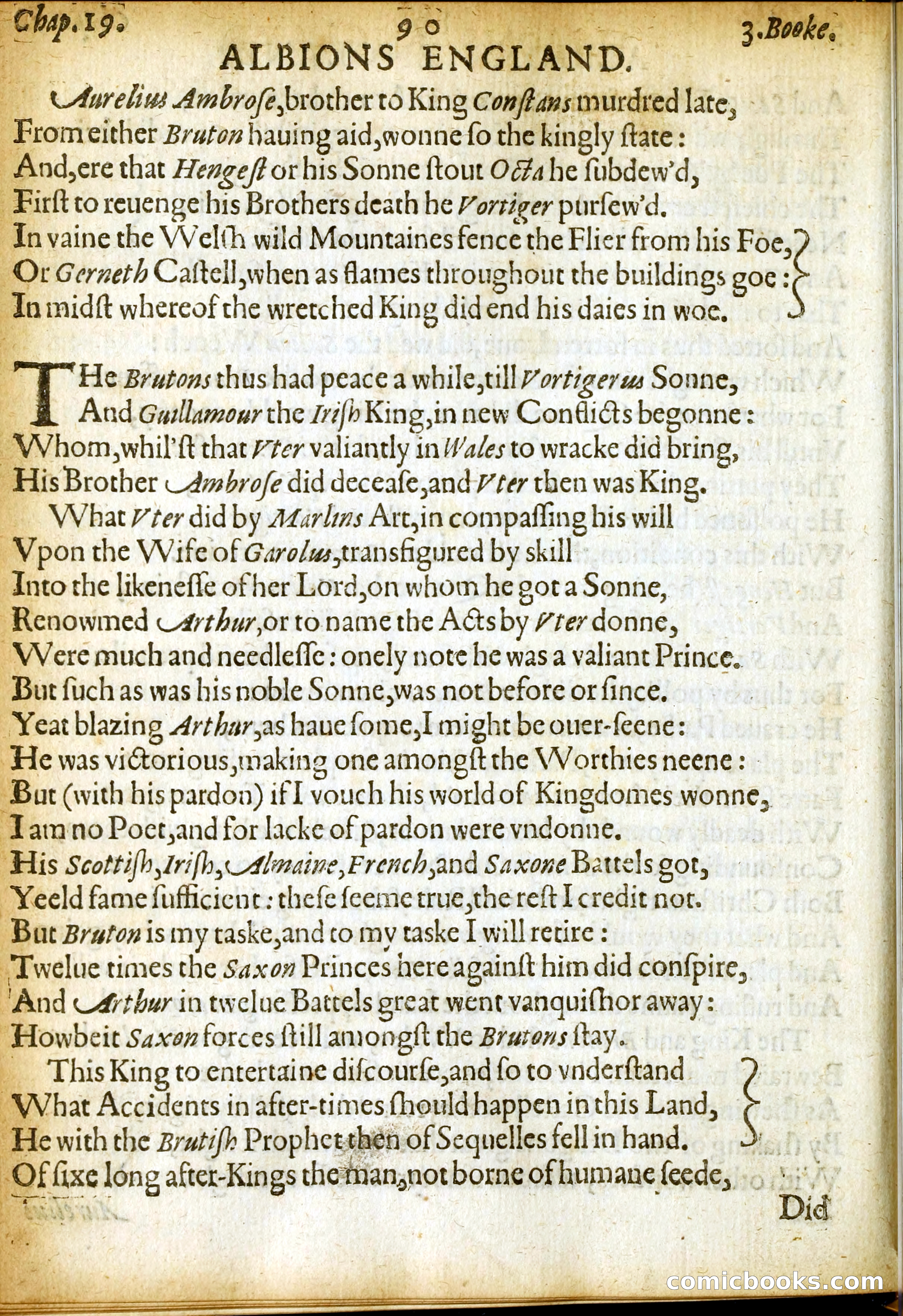
# Analysis of Page Content This is a page of running verse poetry from "Albions England," appearing mid-narrative rather than as a title or cover page. The text recounts legendary British history in rhyming couplets, beginning with Aurelius Ambrosius (brother to murdered King Constans) and tracing the succession through Vortigern, Uther, and Arthur. The verse describes battles against Saxon invaders and Arthur's victories, eventually mentioning a British prophet of Sequelles who foretells the fates of six future kings "not borne of humane seede." The language and typography are Early Modern English, not Victorian, suggesting this is an OCR'd reproduction of a much earlier historical text.
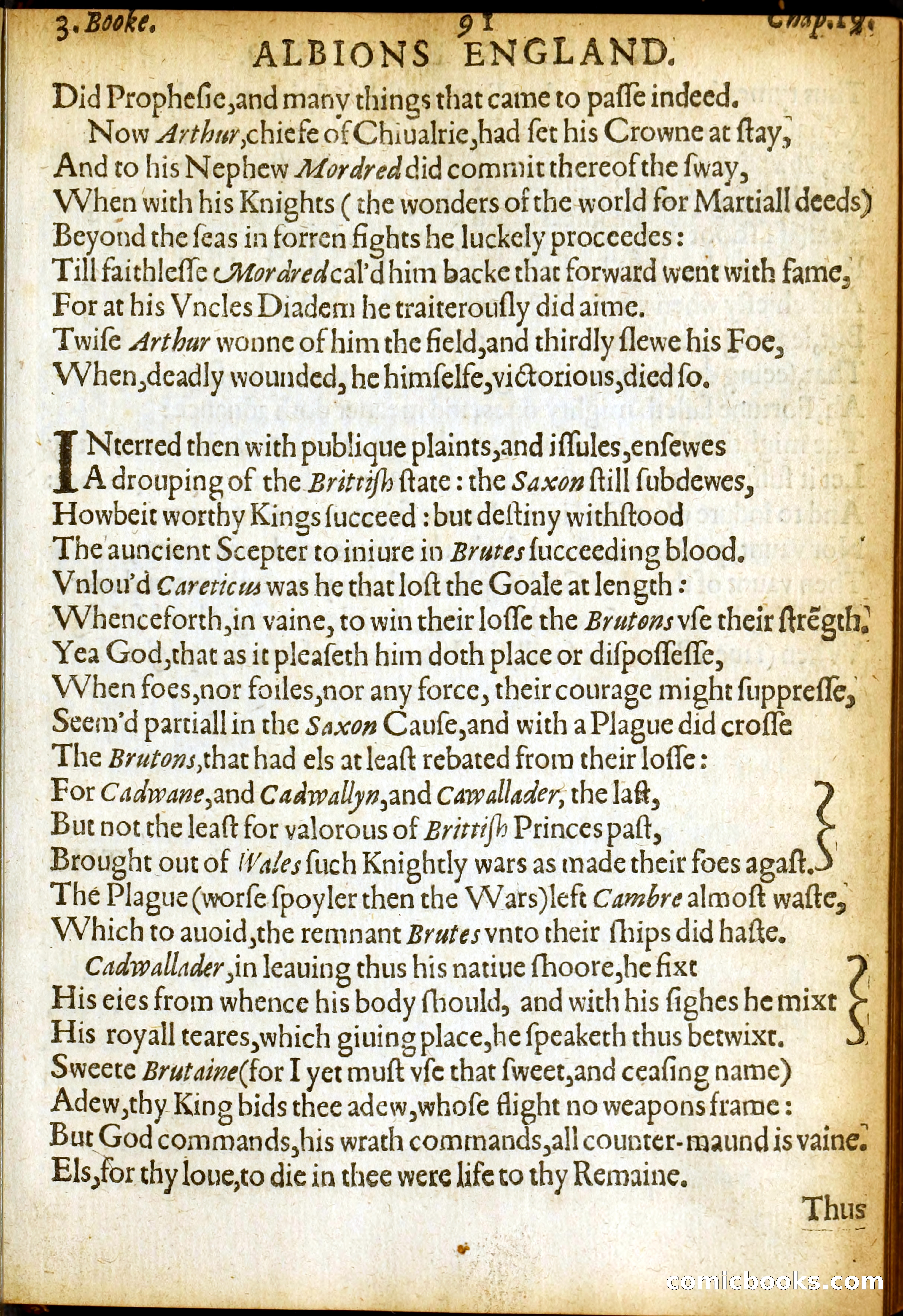
# Page Analysis: Running Prose from "Albions England" This is a page of running verse text from what appears to be Michael Drayton's *Albions England*, a historical narrative poem in English. The visible text recounts the legend of King Arthur—his delegation of power to his nephew Mordred, their subsequent conflicts, Arthur's death in victory, and the subsequent decline of the British kingdom under Saxon pressure. The passage then traces later British rulers including Cadwallader, who apparently abandons Britain due to plague, bidding farewell to his nation in emotional verse. The text uses early modern spelling and typography typical of seventeenth-century publication.
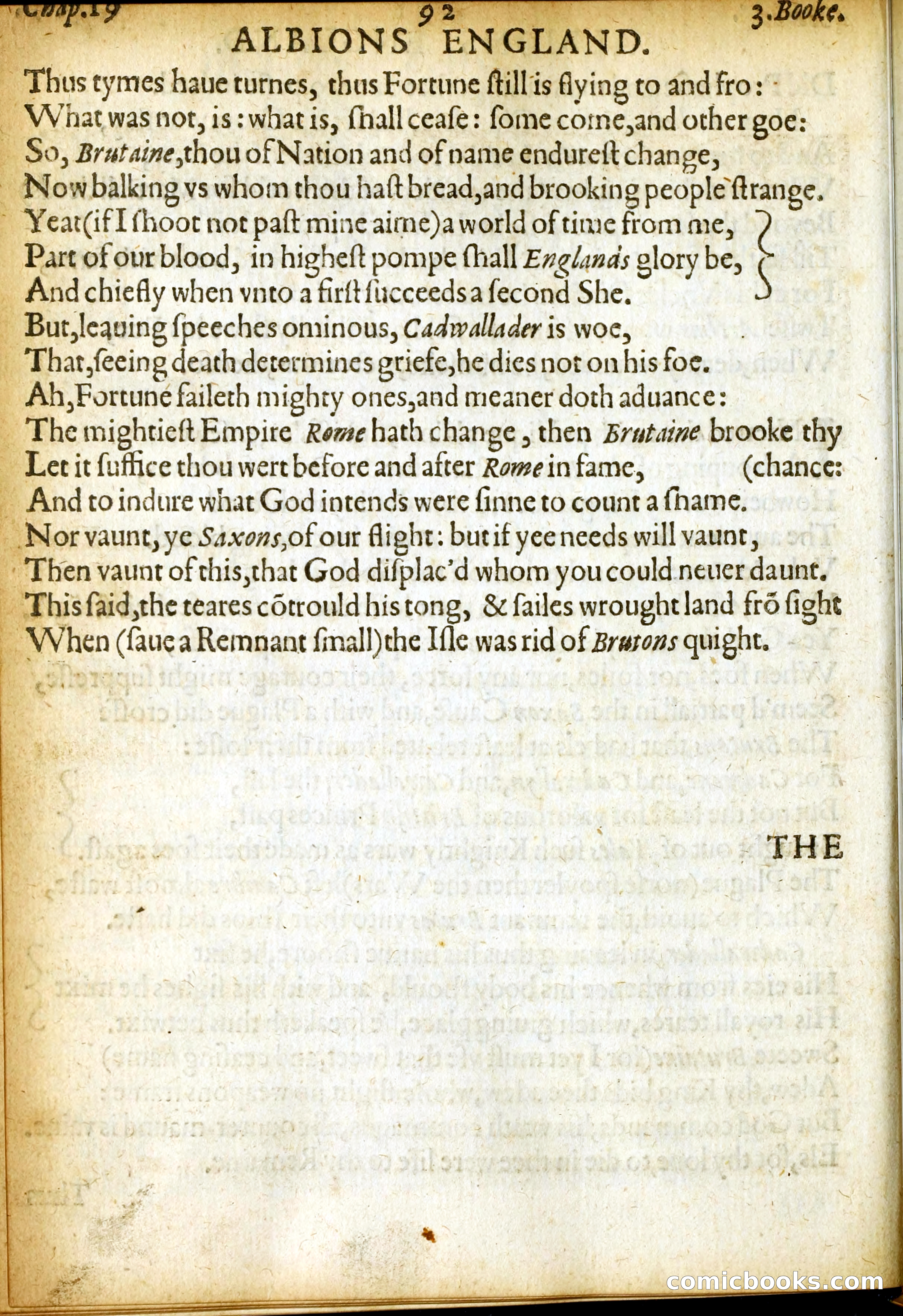
This is a page of running prose poetry from what appears to be an early modern text (not Victorian—the typography and language suggest 16th or 17th century). The page contains verse addressed to "Britaine," discussing the mutability of fortune and nations. The speaker references Rome's fall, England's glory, and the Saxons, concluding with an account of how "the Isle was rid of Brvtons quight" after a remnant survived. The text uses archaic spelling and is printed in blackletter type characteristic of early English publications, not penny dreadful literature.
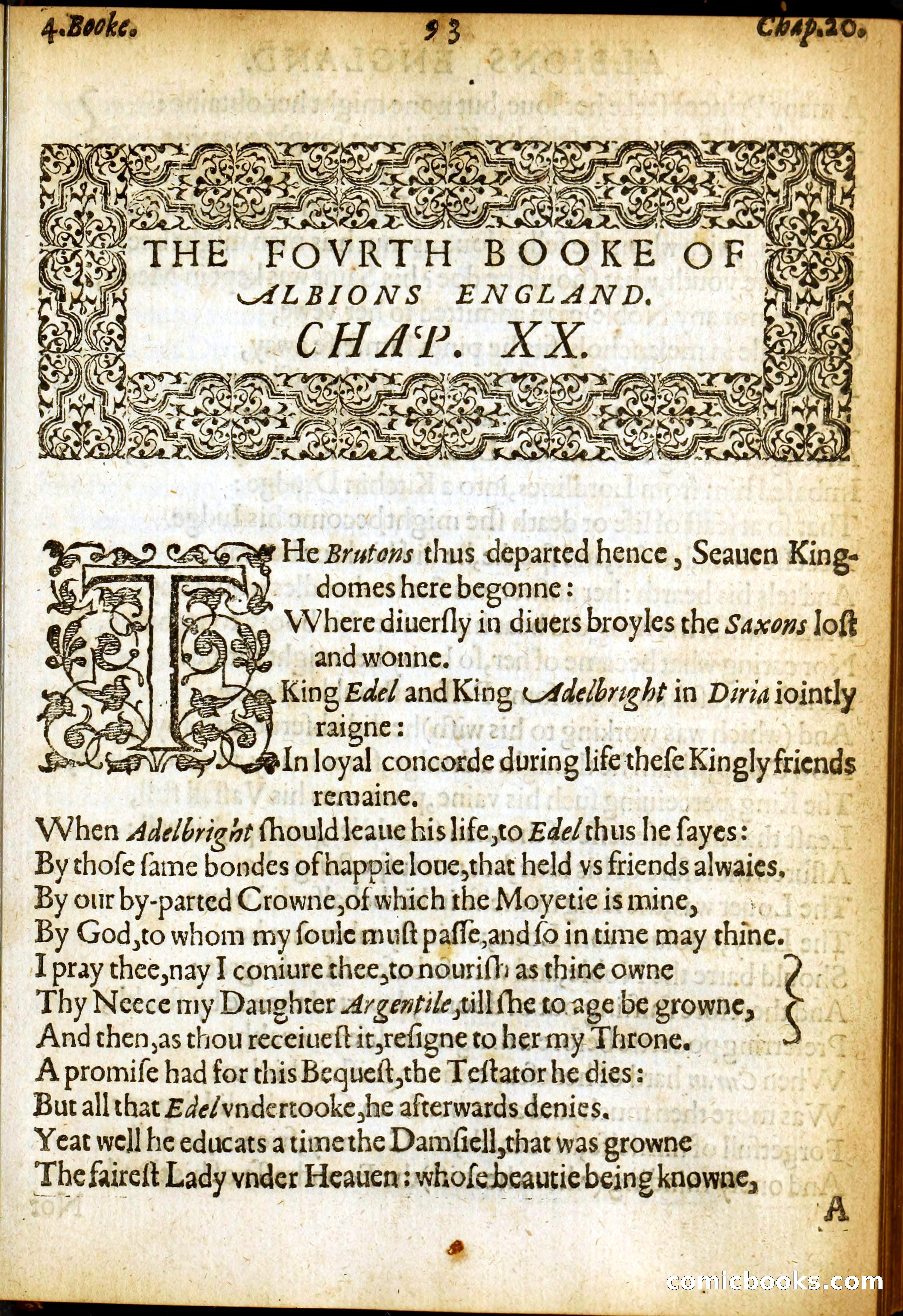
# Analysis This is a page of running prose poetry from **Albions England, Chapter XX** (page 93). The text describes the Brutons' departure and the reign of Kings Edel and Adelbright in Doria. When Adelbright faces death, he entreats Edel to care for his daughter Argentile and eventually restore the throne to her—a promise Edel later breaks. The passage appears to be from a historical/legendary narrative poem rather than a Victorian penny dreadful; it reads as early modern verse (likely 17th century) about Anglo-Saxon succession and betrayal, presented here in a later republication.
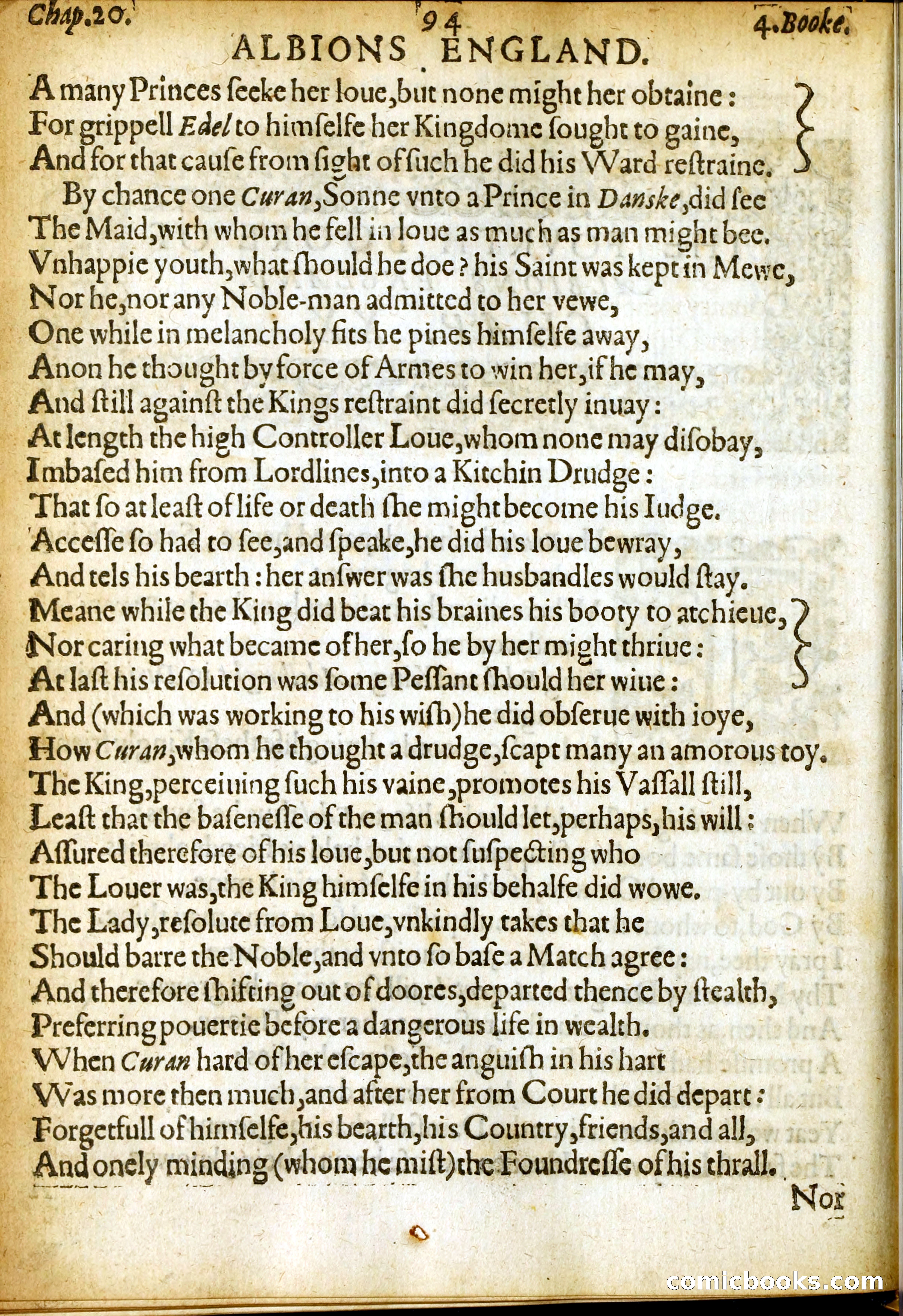
# Analysis of Page This is a page of running verse narrative poetry from what appears to be "Albions England" (Chapter 20, Book 4), not a Victorian penny dreadful as stated in the prompt. The text recounts a romantic tale: a Danish prince named Curan falls in love with a maid guarded by the king. Unable to access her through noble means, Curan is reduced by "Controller Love" to a kitchen drudge, which paradoxically grants him access to speak with her. The king, unaware of Curan's identity, eventually supports the match to a peasant. The maid flees to poverty rather than accept this fate, and Curan abandons everything to follow her, consumed by love.
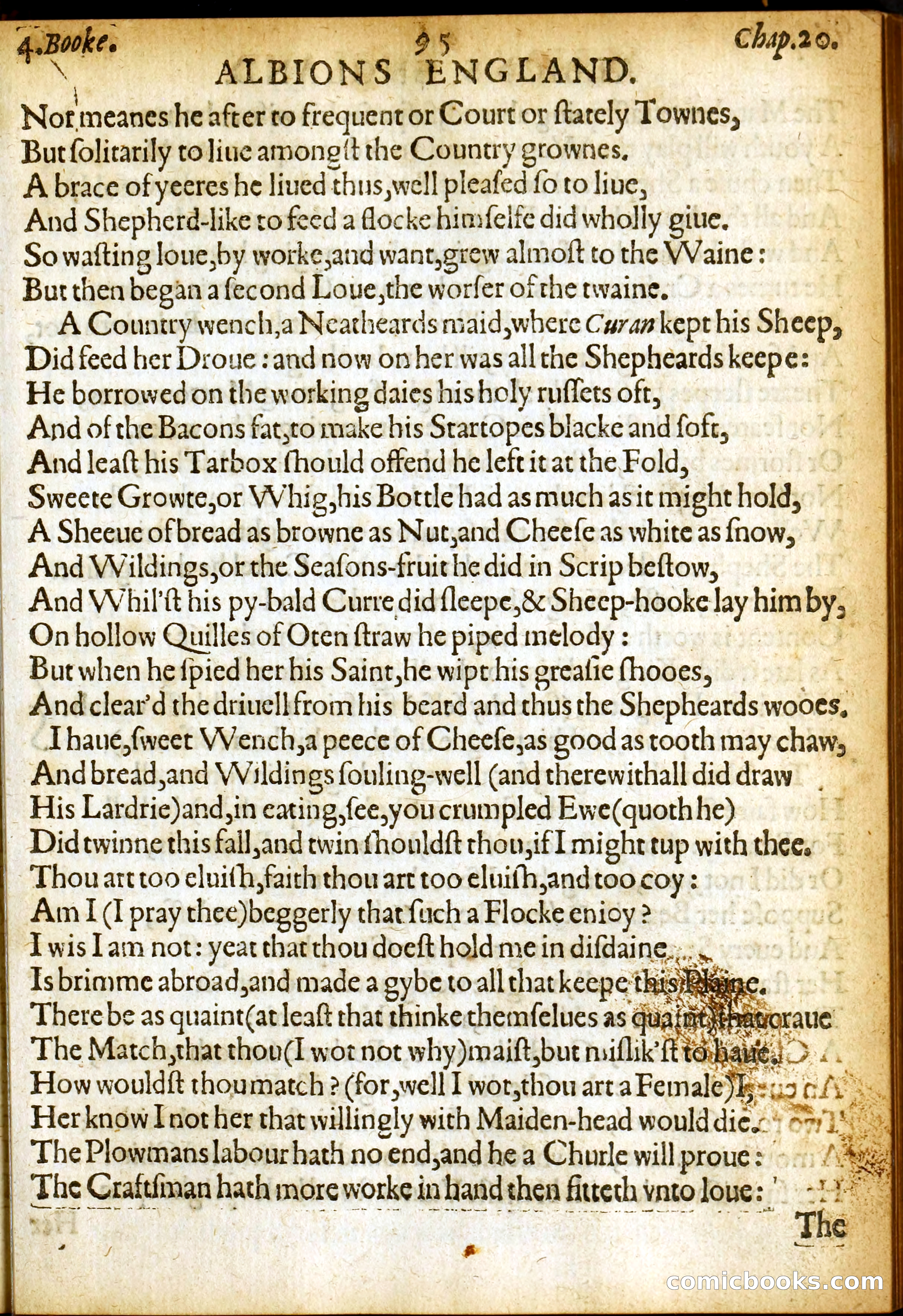
# Analysis This is a page of **running verse text** from what appears to be an early modern pastoral narrative poem (not a Victorian penny dreadful, as the header "Albions England" and typography suggest this is actually 16th-century literature, likely by William Warner). The visible text describes a shepherd's courtship of a country woman. He has abandoned city life to live rurally, fallen in love with a neatherd's maid who tends sheep, and now attempts to woo her by offering gifts of cheese and bread while complaining that she considers him beneath her station. The shepherd questions whether his modest flock makes him unworthy, notes he is mocked by others, and argues that other working men (plowmen, craftsmen) are equally unsuited to love due to their labor.
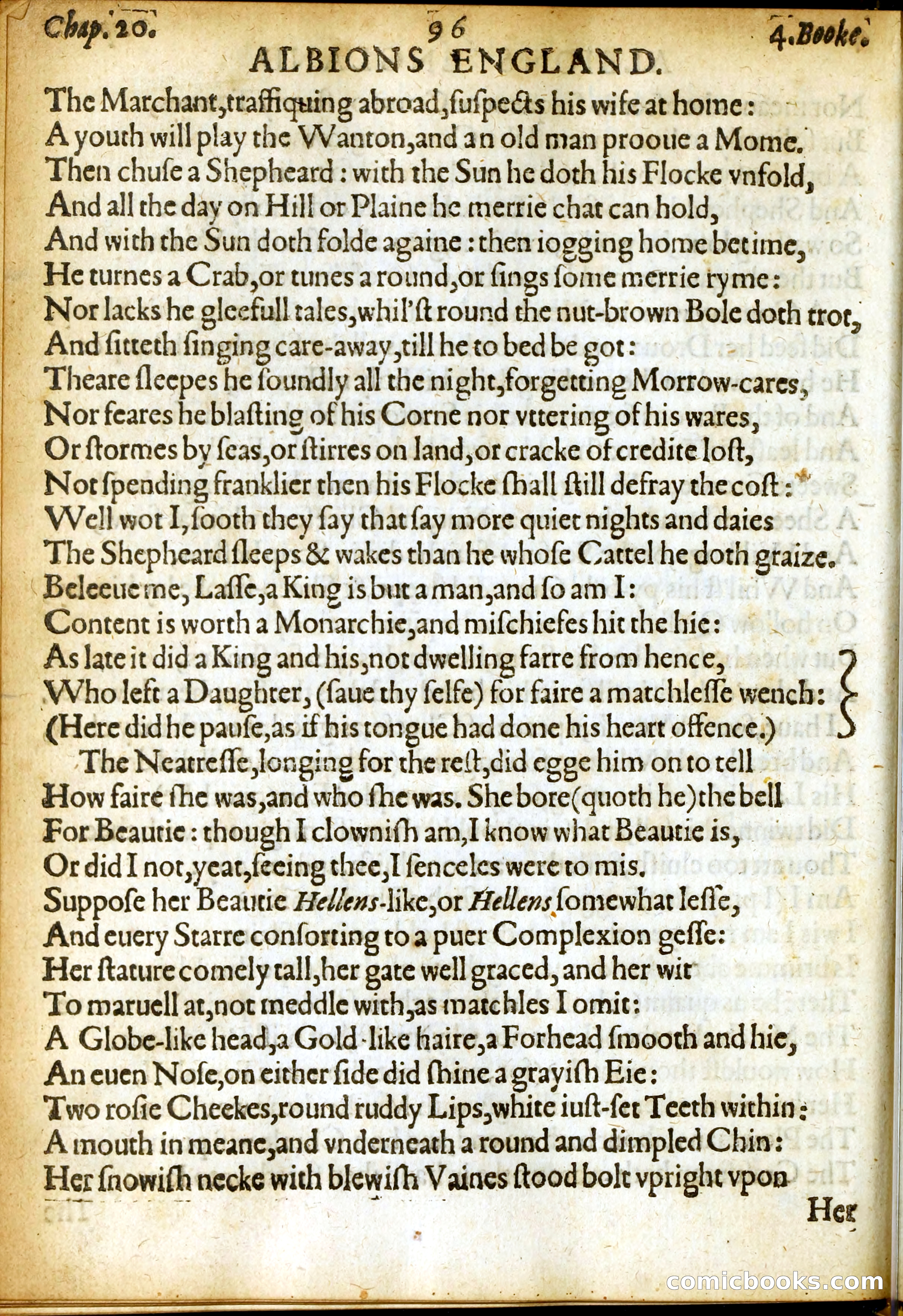
# Analysis of Page from "Albions England" This is a running prose page of poetry from what appears to be an early modern work titled *Albions England* (not a Victorian penny dreadful, as the archaic typography and language indicate this is much earlier). The text presents a narrative poem about a merchant abroad who suspects his wife's infidelity, then shifts to describe a shepherd's contented life, and finally records dialogue in which an old man praises the beauty of a king's daughter—describing her in elaborate detail from her globe-like head and golden hair to her rosy cheeks and dimpled chin. The passage celebrates contentment and rustic simplicity while dwelling extensively on physical beauty.
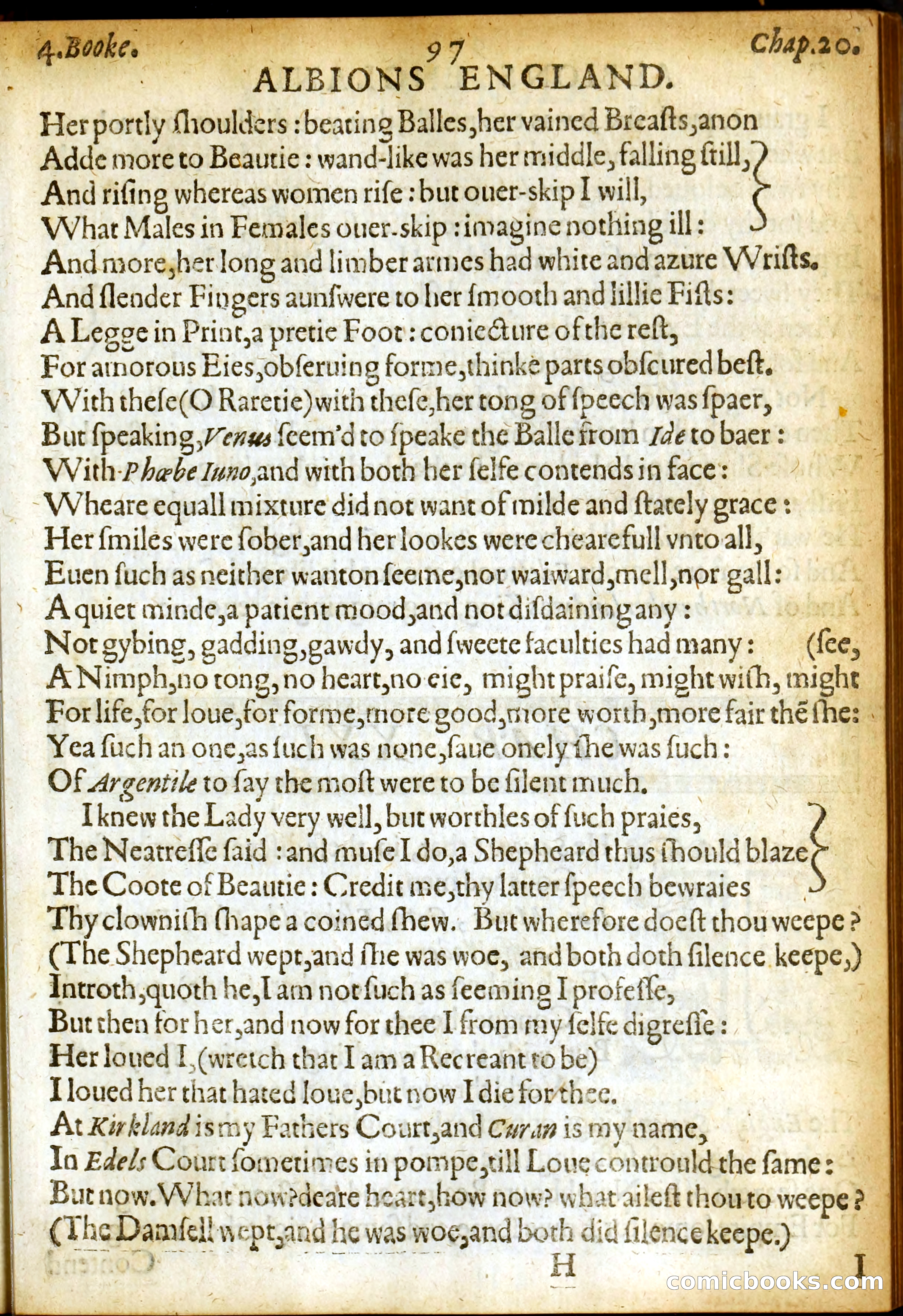
# Albions England, Book 4, Chapter 20 (Page 97) This is a page of running verse poetry from what appears to be *Albions England*, an early modern (not Victorian) narrative poem. The text describes a beautiful noblewoman in elaborate detail—her physical attributes, graceful bearing, and virtuous character—through the voice of a shepherd who laments his love for her. The passage includes dialogue in which the shepherd reveals his name is Curan, from Kirkland, and confesses he loved a lady who rejected him, now dying of heartbreak. The archaic spelling and typeface indicate this is an early printed edition, likely from the 16th or 17th century, not a Victorian penny dreadful as initially suggested.
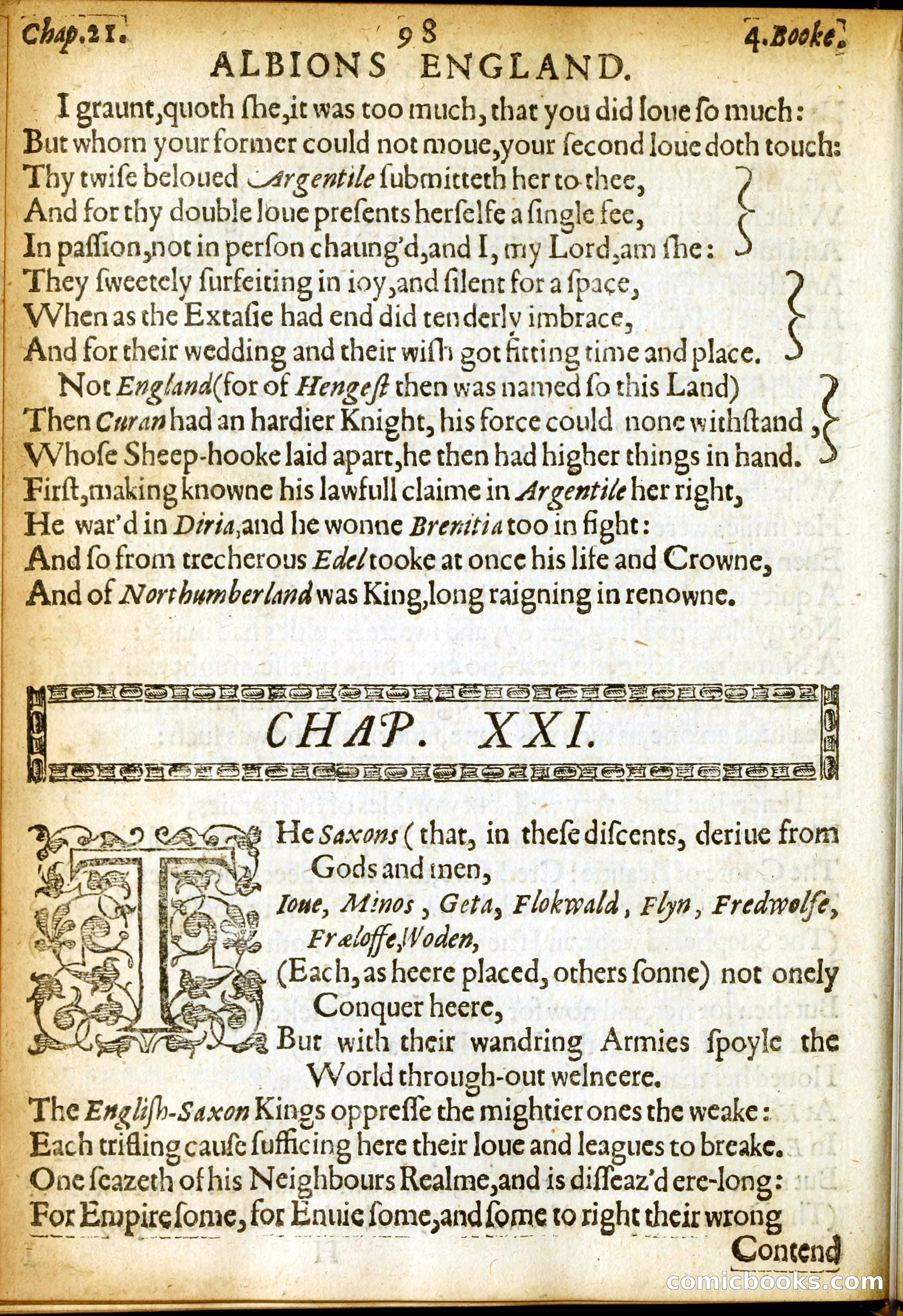
# Description of Page This is a page of running verse from a narrative poem titled *Albions England*. The text describes romantic and dynastic matters: a woman named Argentile submits herself to a suitor whose former love could not move her; they marry and embrace in ecstasy. The passage then shifts to historical narrative, describing how Curan, a knight, claims Argentile as his rightful wife, wages wars in Deria and Brentia, and seizes the crown of Northumberland from the treacherous Edel. The bottom section (Chapter XXI) introduces the Saxon kings, their various genealogies traced to pagan gods, and their conquests and conflicts across England and beyond. No illustrations appear on this page.
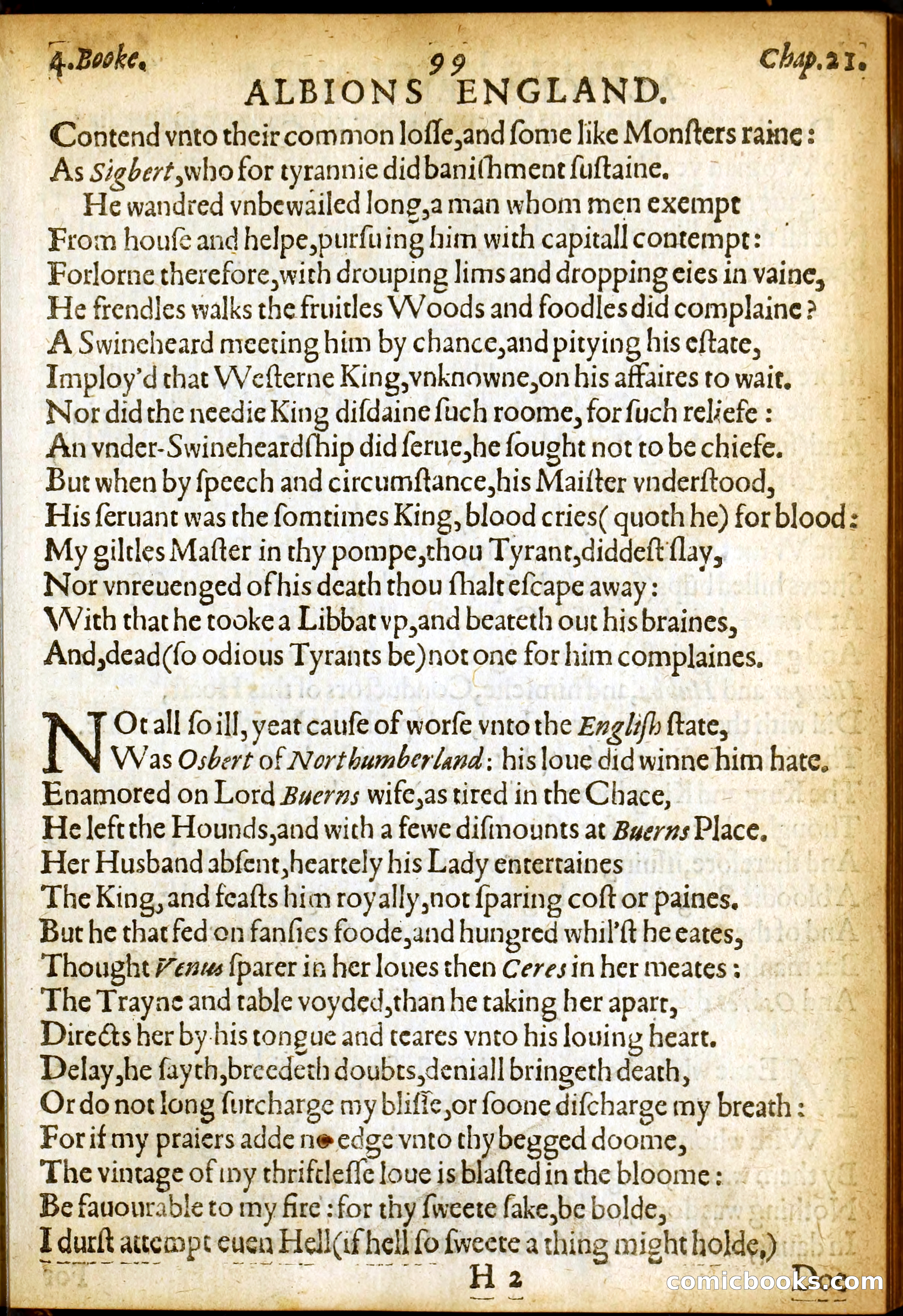
# Analysis of Page 99 from *Albions England* This is a page of running verse text from what appears to be a historical narrative poem, not a penny dreadful as stated in the prompt's framing. The visible text recounts two stories of English kings: first, the tale of Sigbert, a tyrant banished for his crimes, who is eventually killed by a swineherd he had previously wronged; and second, the story of Osbert of Northumberland, whose infatuation with Lord Buerns's wife leads him to abandon his hunting party and visit her, where he makes passionate pleas for her affection. The verse is written in early modern English with archaic spelling and employs rhyming couplets to tell these historical narratives.
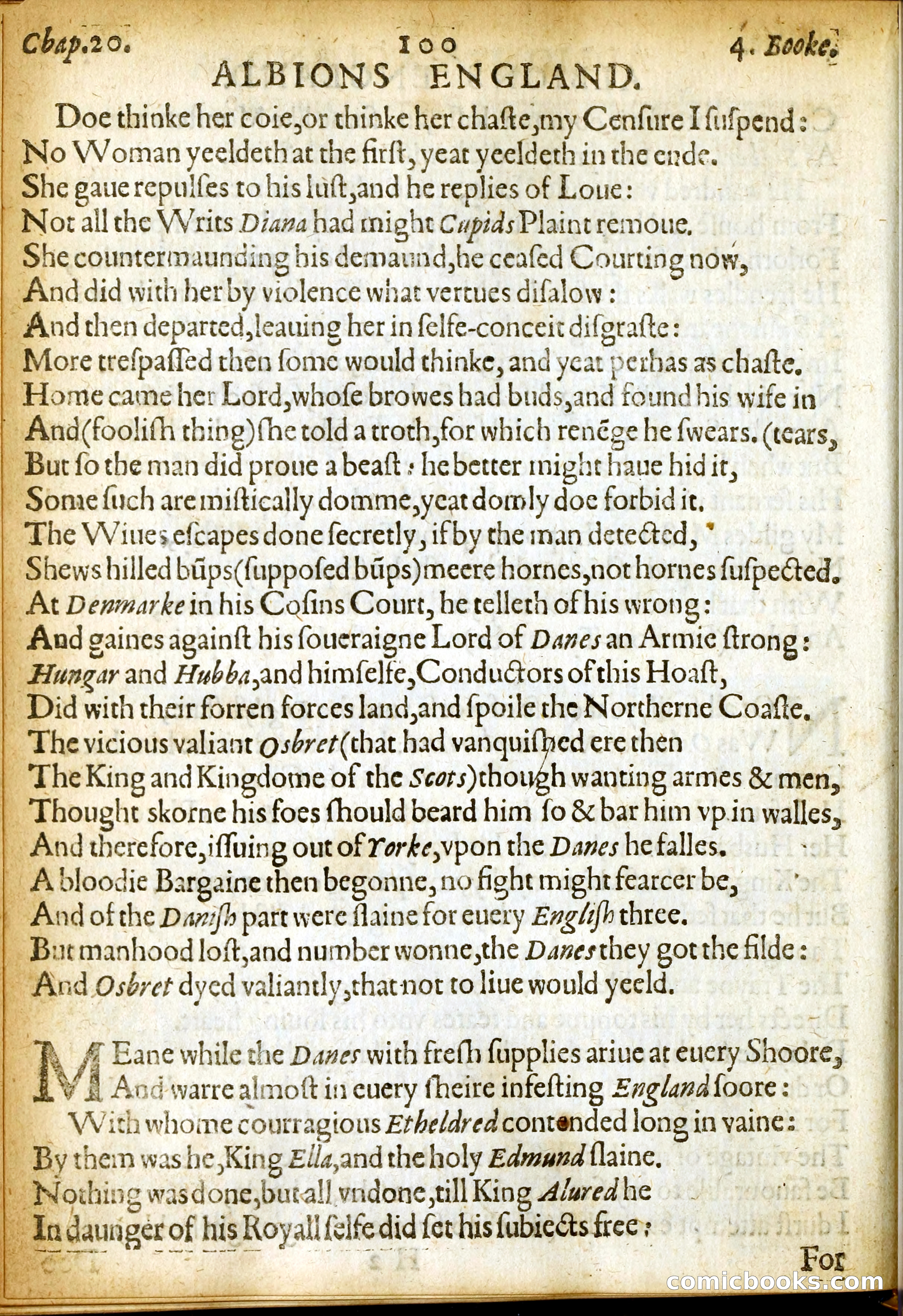
This is a page of running prose poetry from what appears to be *Albions England*, a historical narrative poem (not a Victorian penny dreadful, but an Early Modern work). The text recounts a story of a woman's seduction and subsequent revenge: a man violates her after she initially resists, then departs; she later tells her husband, who seeks vengeance by allying with Danish forces against England. The passage describes military conflict between the Danes and English, including the death of the valiant Osbret, and mentions kings Ella, Edmund, and Alured. The page is densely printed in period typography with minimal spacing.
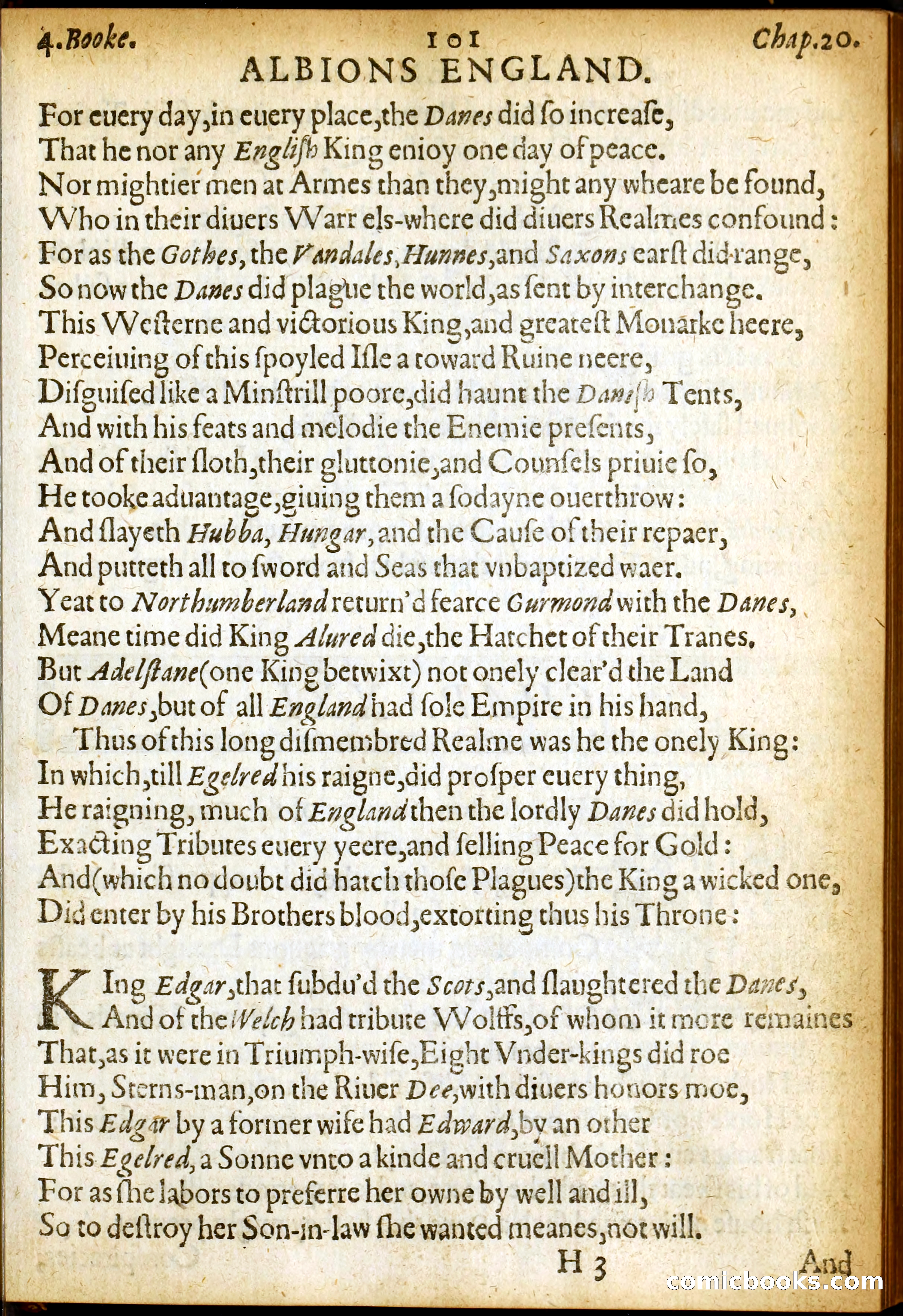
# This Page Analysis This is running prose poetry from Chapter 20 of a historical narrative work titled *Albions England*. The text is printed in early modern English verse and recounts legendary and historical events involving Danish invasions of England and various English kings—including references to the Danes' plague upon the land, King Aelred's struggles against them, King Adelstane's victory, King Edgar's reign, and Egelred's wickedness. The page contains dense, archaic poetic couplets chronicling these conflicts and royal succession, presented in double-column layout typical of historical narrative poetry rather than sensational fiction.
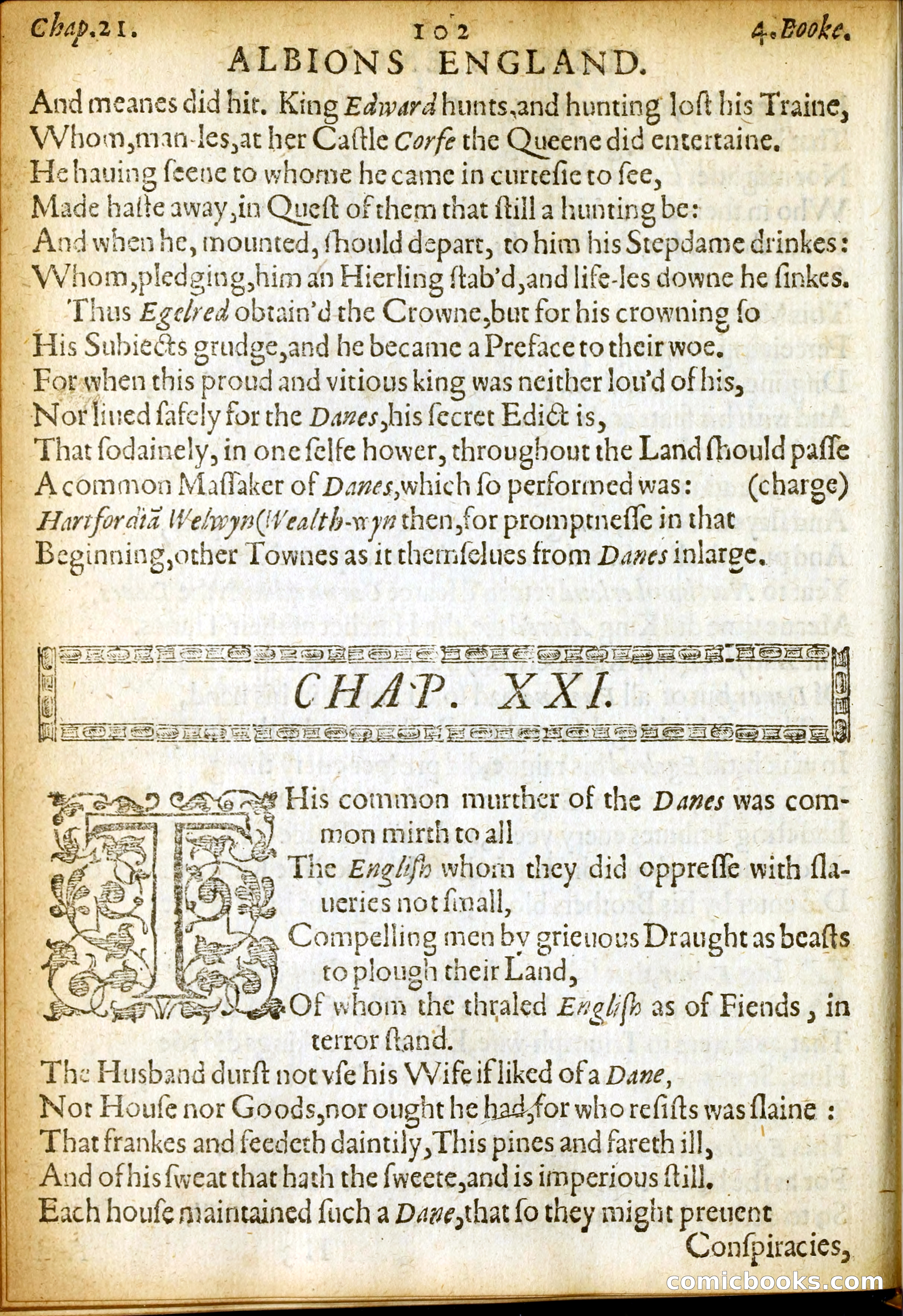
# Page Analysis This is a page of running verse from Chapter 21 of *Albions England*, a narrative poem. The text recounts in archaic English verse how King Edward left his hunting party, after which his stepmother poisoned him; the usurper Egelred then obtained the crown but faced his subjects' hatred. The passage goes on to describe an edict requiring all subjects to maintain "Danes" (apparently referring to Danish occupiers or oppressors), with severe penalties for resistance. The verse explains how this system affected English households and subjects. The page includes a chapter break heading "CHAP. XXI" mid-page and decorative initial letter, typical of early modern printed books.
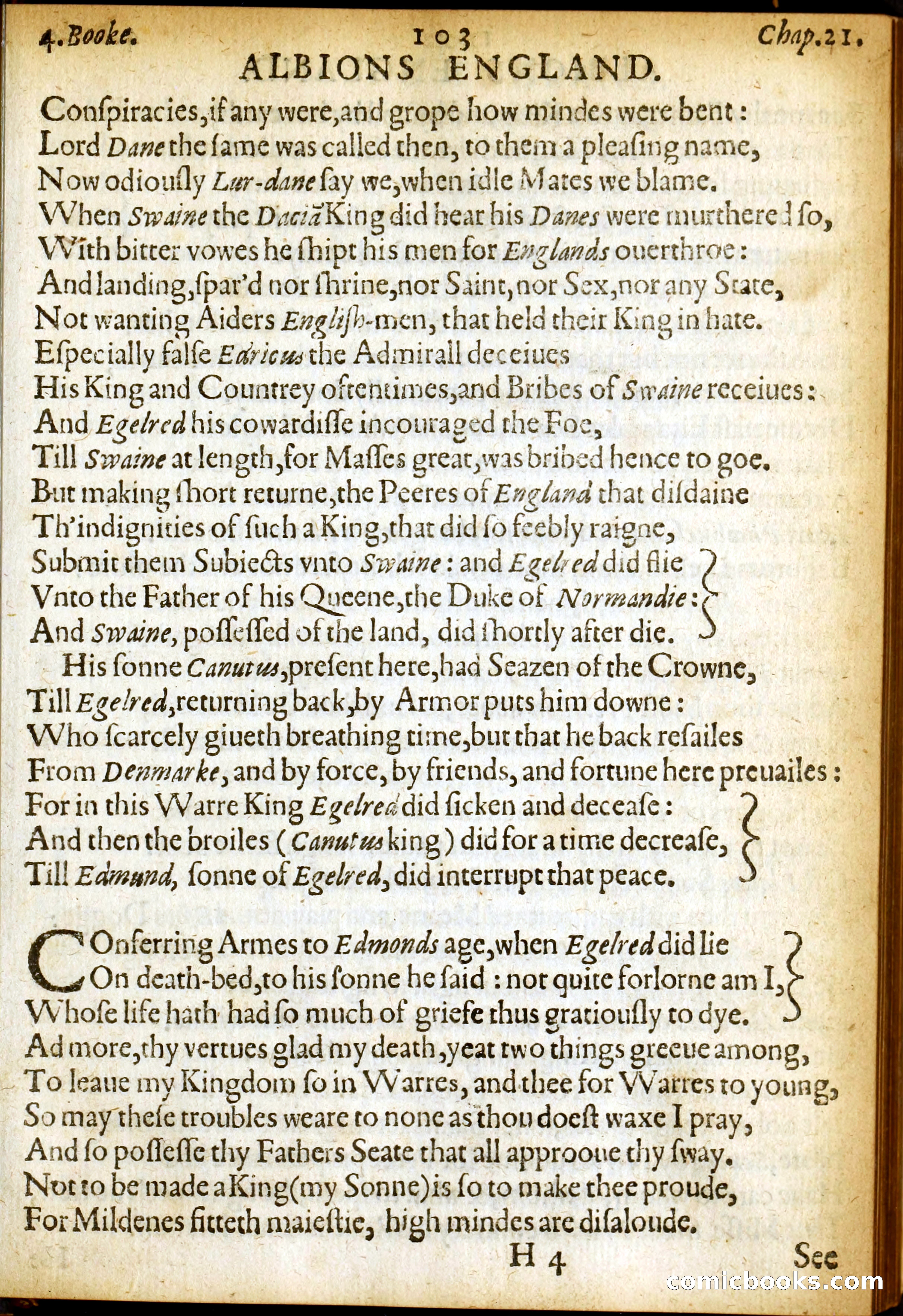
# Page Description This is a page of running verse poetry from what appears to be an early modern historical narrative (not actually Victorian—the typography and language suggest 16th or 17th century). The text recounts English dynastic conflicts involving King Æthelred, the Danish king Swein, and various nobles. The verse describes conspiracies, military invasions, betrayals by English lords, and succession disputes, culminating in Æthelred's deathbed address to his son Edmund, urging him toward virtuous rule. The page number "H 4" at bottom indicates this is part of a larger bound work.
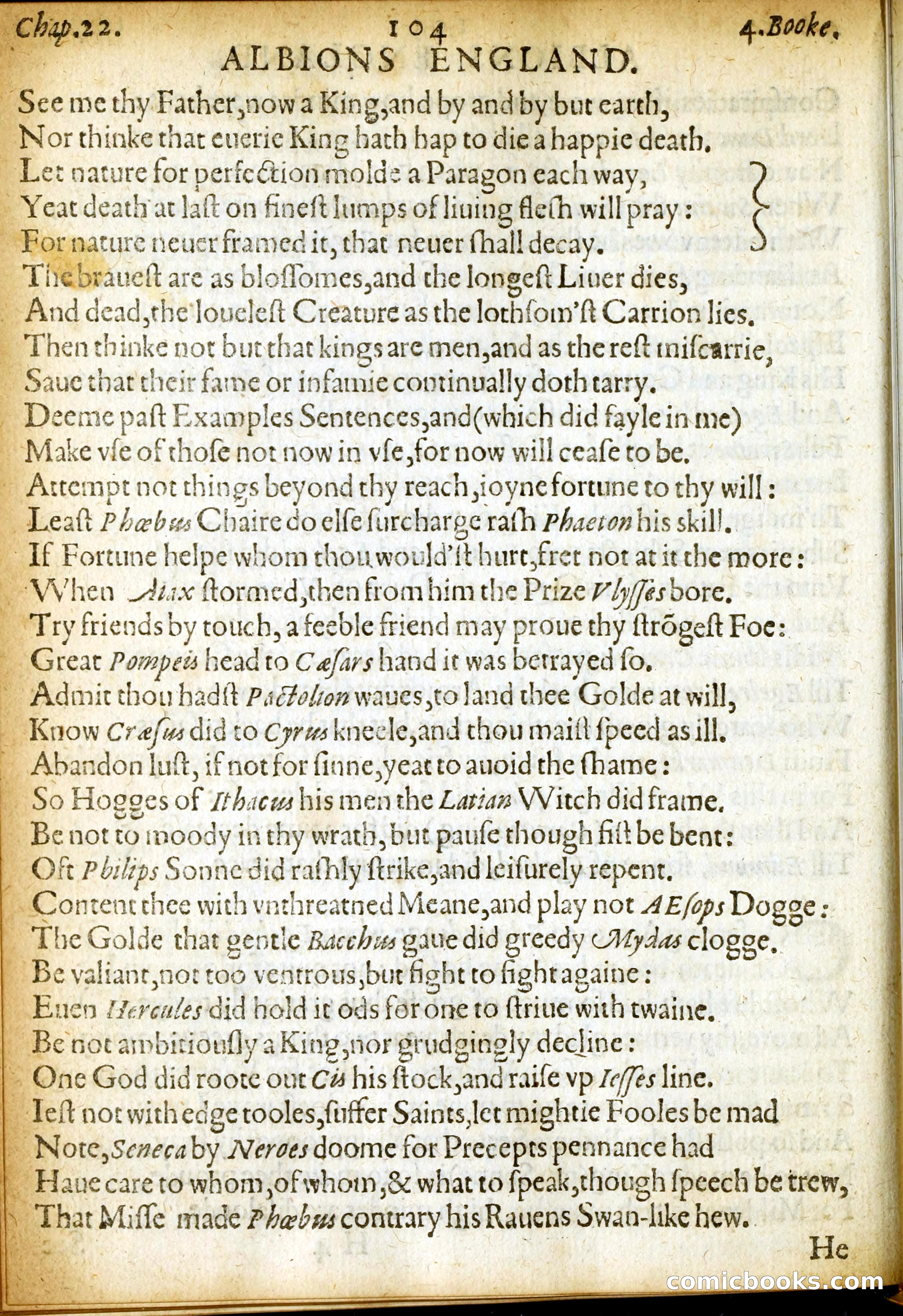
# Page Analysis: *Albions England*, Chapter 22 This is a running prose page—specifically, **verse text** from Samuel Daniel's *Albions England*. The page contains moralizing couplets offering practical advice to kings and courtiers: avoid excessive ambition, accept fortune's reversals, test friendships carefully, and shun greed and pride. The text references classical examples (Ajax, Pompey, Ulysses, Hercules, Seneca, and others) to illustrate lessons about proper conduct. The page number indicates this is mid-text from the fourth book, printed in period typeface on aged paper. The content appears didactic rather than sensational—philosophical counsel rather than penny dreadful melodrama.
# Page Description This is running prose from *Albions England*, presented as a dense block of early modern verse (not Victorian penny dreadful as the prompt suggests—the typography and language indicate this is actually early modern, likely 16th or 17th century). The text consists of moral advice and historical narrative in rhyming couplets. Visible content includes a deathbed scene where a character (apparently named Egelred) offers ethical instruction to his son, followed by verse recounting the deeds of English and Danish warriors, including references to Edmund and Canute, and concluding with a lament that "We euer warre, and neuer winne." The page shows aged paper with period typography.
This is a page of running prose poetry from what appears to be an early printed ballad or narrative poem (not a Victorian penny dreadful, despite the question's framing—the typography and language suggest this is much older, likely 16th or 17th century). The text describes a conflict between two kings who agree to settle their dispute through single combat; King Canute and his opponent fight, then agree to partition their lands as brothers. The passage concludes with an earl named Edricus murdering Edmund to win Canute's favor, for which Canute has Edricus beheaded, after which Canute becomes lord of England, Denmark, and Norway.
# Page Analysis This is a page of running prose poetry from *Albion's England*, a historical verse narrative. The visible text recounts the reign of King Edward, describing his virtuous character, his secret marriage to a maiden, and a dramatic incident where an Earl chokes on bread after falsely swearing innocence in the king's presence—apparently divine judgment for his guilt in the death of Edward's brother. The page also briefly mentions Edward's son Harold and his travels to Normandy. The text is printed in early modern typeface with ornamental chapter heading, typical of historical chronicles.
This page is running verse narrative prose from Chapter 21 of *Albions England*. The text recounts a historical conflict: Duke William seeks to enforce an oath from Goodwin's son (Duke William), concerning the English crown promised to him by Edward. However, Harold seizes the throne after Edward's death despite his oath, forcing William to prepare for war. The passage describes Harold's military victories against the King of Danes and Norwegians, followed by internal discord among English nobles. William then lands in Normandy with his forces, and the text includes a stirring speech from the King of England to his soldiers, exhorting them to defend their country against the Norman invasion.
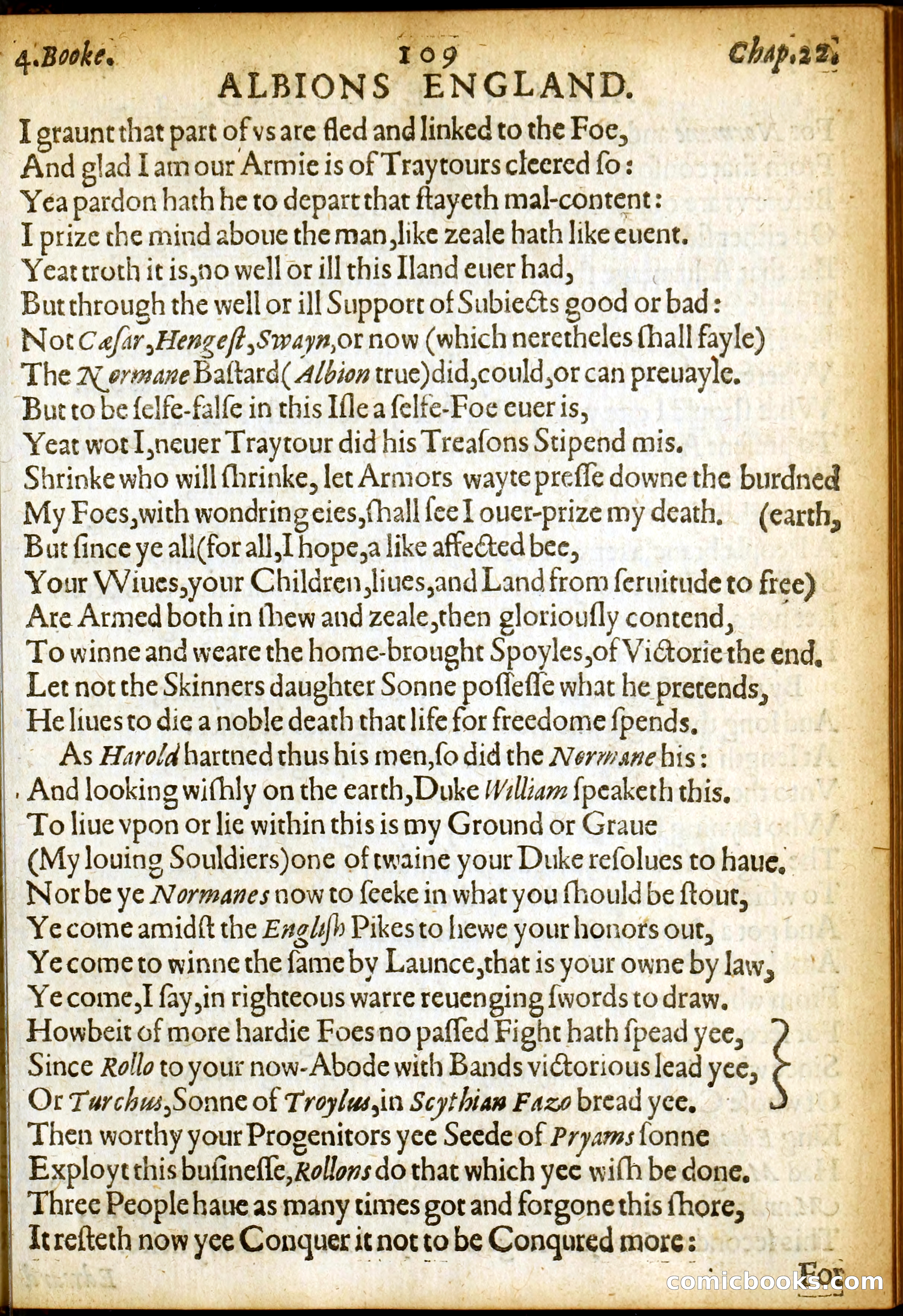
This is a page of running prose poetry from *Albions England*, a historical narrative poem (not a Victorian penny dreadful, but an early modern work). The text presents a speech by Duke William exhorting Norman soldiers to fight for England, invoking their ancestors (Harold, Rollo, and others) and promising victory and honor. The passage emphasizes duty to country, the nobility of dying for freedom, and the shame of betrayal, culminating in a rallying cry that England must be conquered "no more."
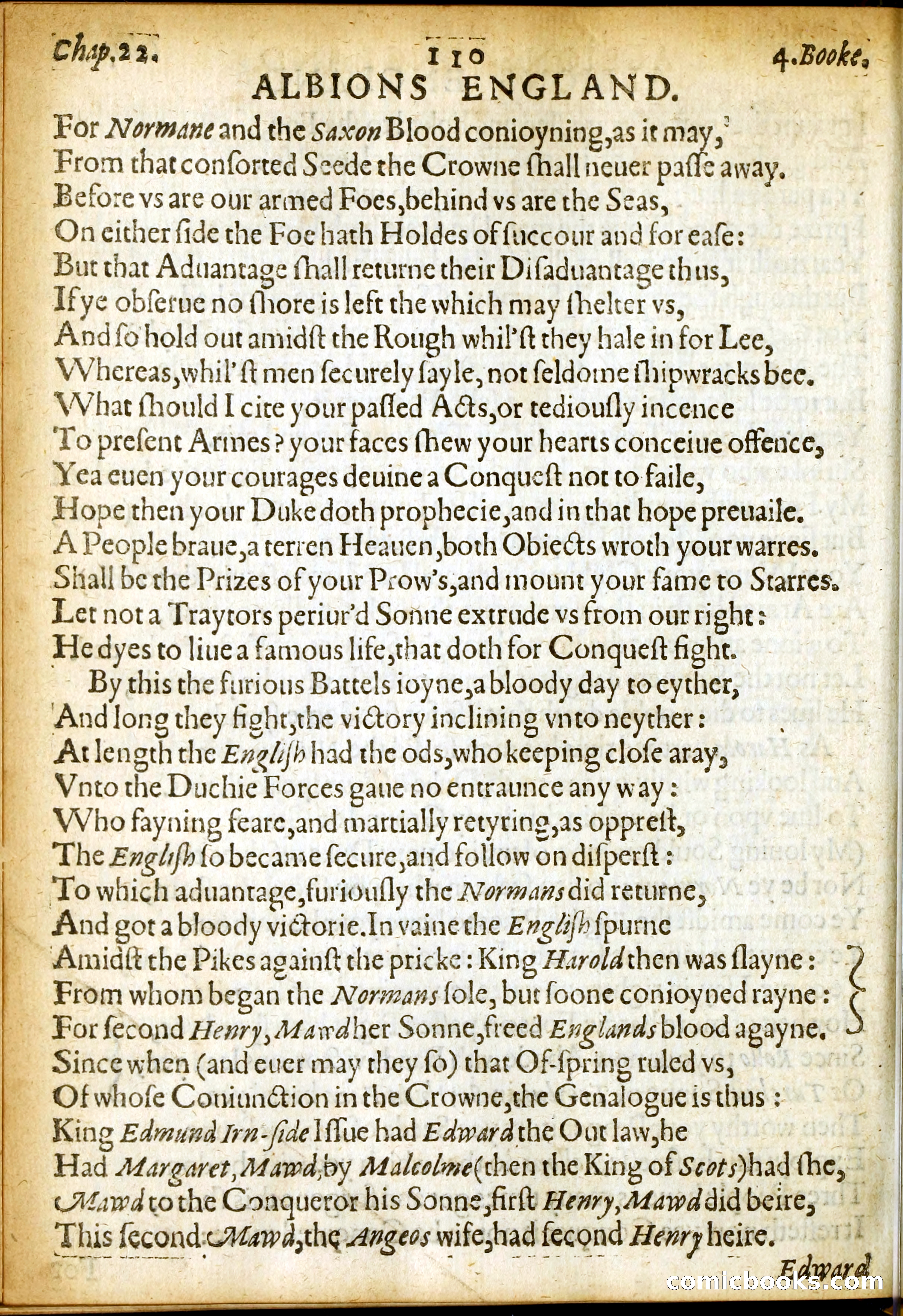
# Albions England (Running Prose Page) This is a page of running verse narrative, not a title page or illustration. The text is a historical poem about English kingship and Norman conquest, recounting battles between English and Norman forces, the slaying of King Harold, and establishing a genealogical line through subsequent kings (Edmund, Edward, Henry, Mawd). The verse celebrates English courage and traces the legitimate succession of the crown through mixed Norman and Saxon bloodlines, apparently working toward justifying a particular royal claim through documented ancestry.
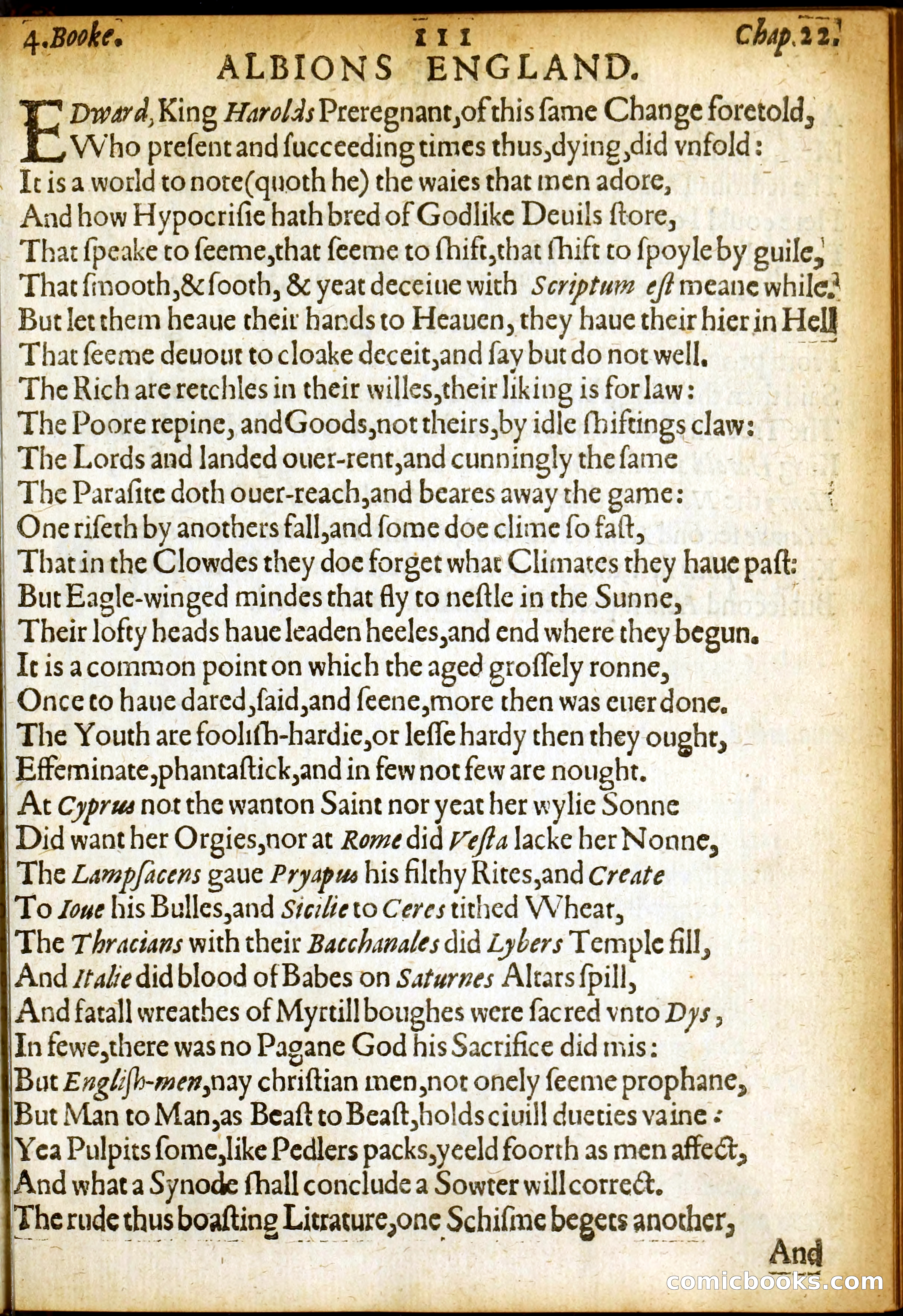
# What This Page Contains This is a page of running verse poetry from *Albions England*, Book III, Chapter 22. The text presents a moralizing speech attributed to Edward, King Harold's preregnant, warning against hypocrisy, social corruption, and religious decay in England. The verse condemns the wealthy for avarice, the poor for envy, parasites and lords for exploitation, and English Christians for abandoning virtue—contrasting them unfavorably with pagan societies that at least honored their gods with sacrifice. The passage ends with complaints about religious schism and pulpit corruption.
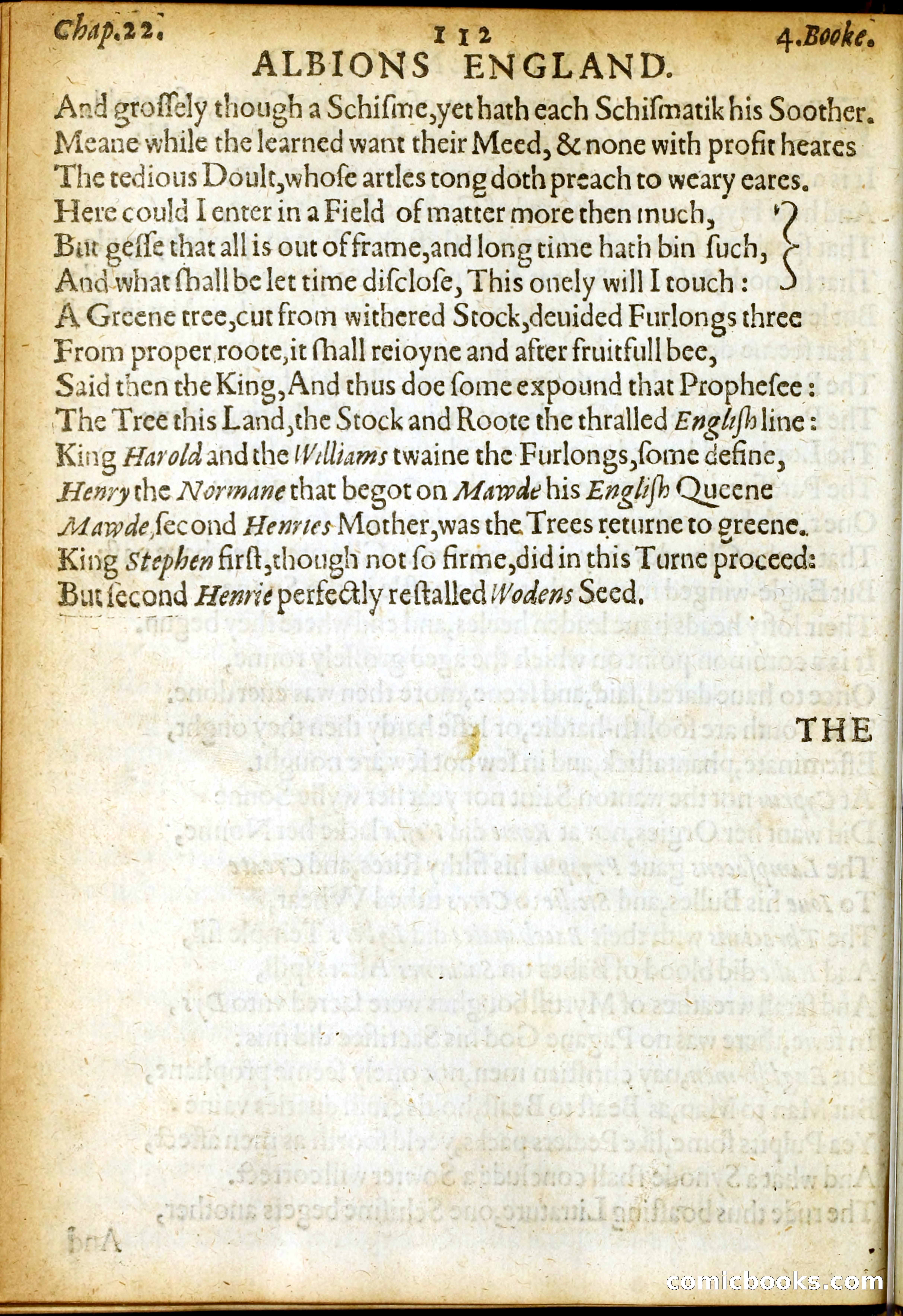
This is a page of running prose from what appears to be a historical or genealogical narrative poem. The text discusses English royal lineage through an extended metaphor of a tree: a "Greene tree, cut from withered Stick" represents England's dynasties, with various kings (Harold, the Williams, Henry the Norman, Stephen, and Henry II) identified as different parts or stages of this symbolic tree's growth. The passage interprets a prophetic saying about England's restoration through its successive rulers, tracing descent from Norman conquest through the Plantagenet line.
This is a page of running prose poetry from *Albion's England*, Book 5, Chapter 23—a historical narrative poem (not a Victorian penny dreadful, despite the prompt's framing). The text recounts Norman Conquest history in verse, describing how English fortunes declined after the Conqueror's victory, then follows Edgar (son of the outlaw Edward) who attempts to reclaim his heritage with his mother and sisters but is driven by storm into Scottish seas, where King Malcolm notices the wreck. The ornamental border and typography indicate this is from an early modern printed edition, not Victorian serialized fiction.
# Analysis of Page 114, "Albions England" This is a **page of running verse prose** from what appears to be a historical or genealogical poem titled "Albions England" (visible in header). The text traces English royal lineage through marriages and succession, mentioning figures including Agatha, Margaret, Edgar, William, Henry, and Stephen. The verse chronicles how various noble bloodlines merged through strategic unions—particularly how Norman and English royal lines became intertwined. The passage ends mid-narrative ("Perplexed" at bottom), indicating continuation on the next page. Despite the OCR label suggesting penny dreadful, this appears to be a historical/genealogical work in verse form, not sensational fiction.
# What This Page Contains This is a page of running verse from what appears to be *Albions England* (as indicated by the header). The text is a sustained poetic critique of papal authority and Catholic religious practices in England. The speaker argues that modern Popes, unlike Saint Peter, are tyrants who oppress secular rulers and extract wealth through religious fees, indulgences, pilgrimages, and sacraments. The verse contrasts Christ's humility with papal pride, and catalogs English Catholic observances—fasting, shrine offerings, rosaries, confession—as evidence of ecclesiastical corruption and financial exploitation.
This is a page of running verse poetry from Chapter 24 of what appears to be a historical narrative work titled *Albions England*. The text, printed in early modern English, recounts events following the Norman Conquest of Kent, describing how local nobles and clergy resisted Norman rule, ratified Kent's laws, and later chronicles conflicts between the church and crown—particularly involving a prelate (likely Archbishop Becket, referenced as "Becker") who opposed the King, leading to his murder at an altar and subsequent papal retaliation against the monarchy. The page contains no illustrations, only densely packed justified verse with marginal brackets highlighting key passages.
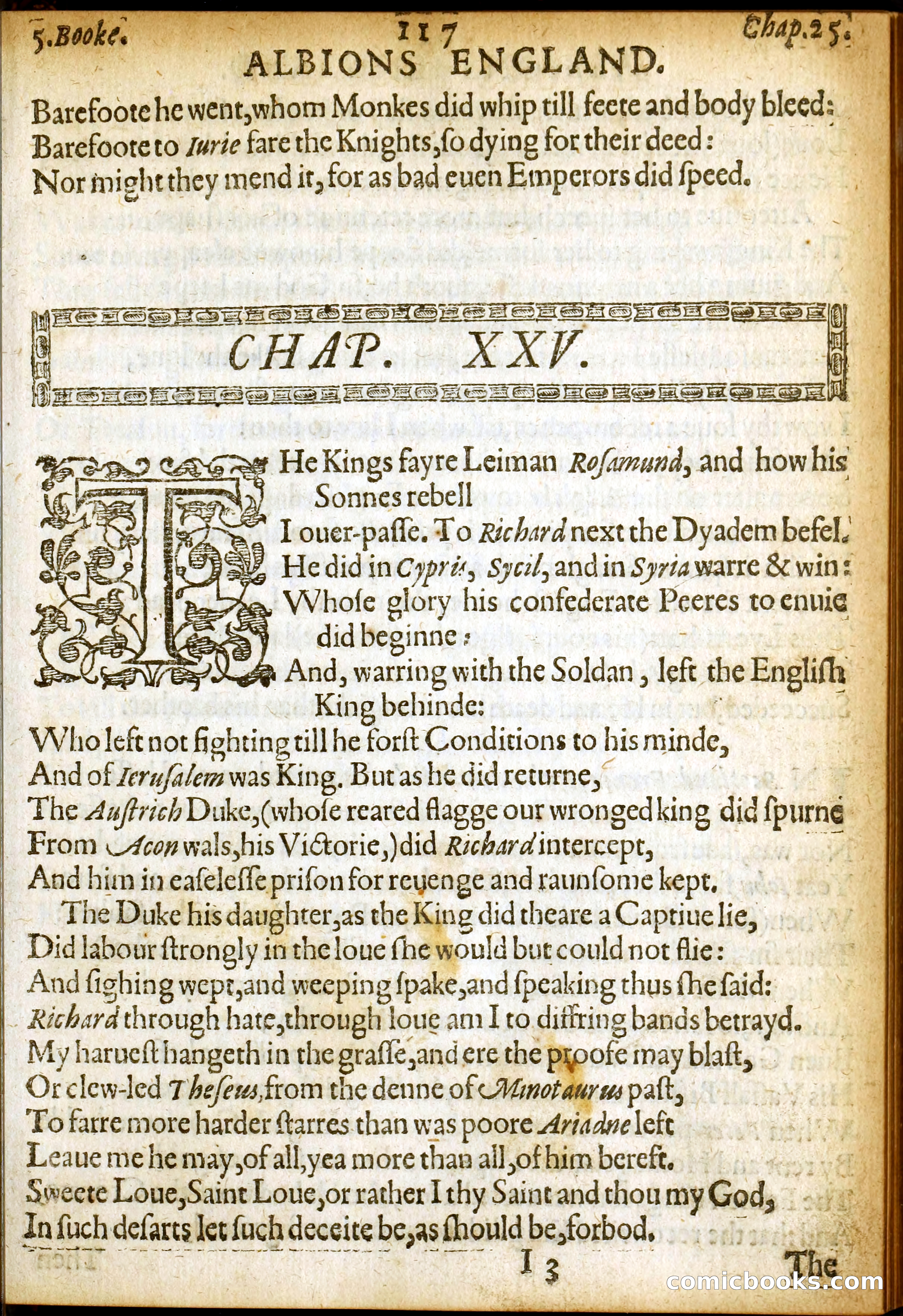
# Page Description This is a page of running verse narrative from "Albions England," presenting Chapter XXV. The text describes King Richard's military campaigns in Cyprus, Syria, and Jerusalem, his imprisonment by the Austrian Duke upon his return, and the Duke's daughter's lament over Richard's captivity. The passage employs dramatic, emotional language typical of the work's narrative verse style, with the daughter pleading for Richard's release and invoking classical references (Theseus, Ariadne, Minotaurus). The page number appears as "I 3" at the bottom.
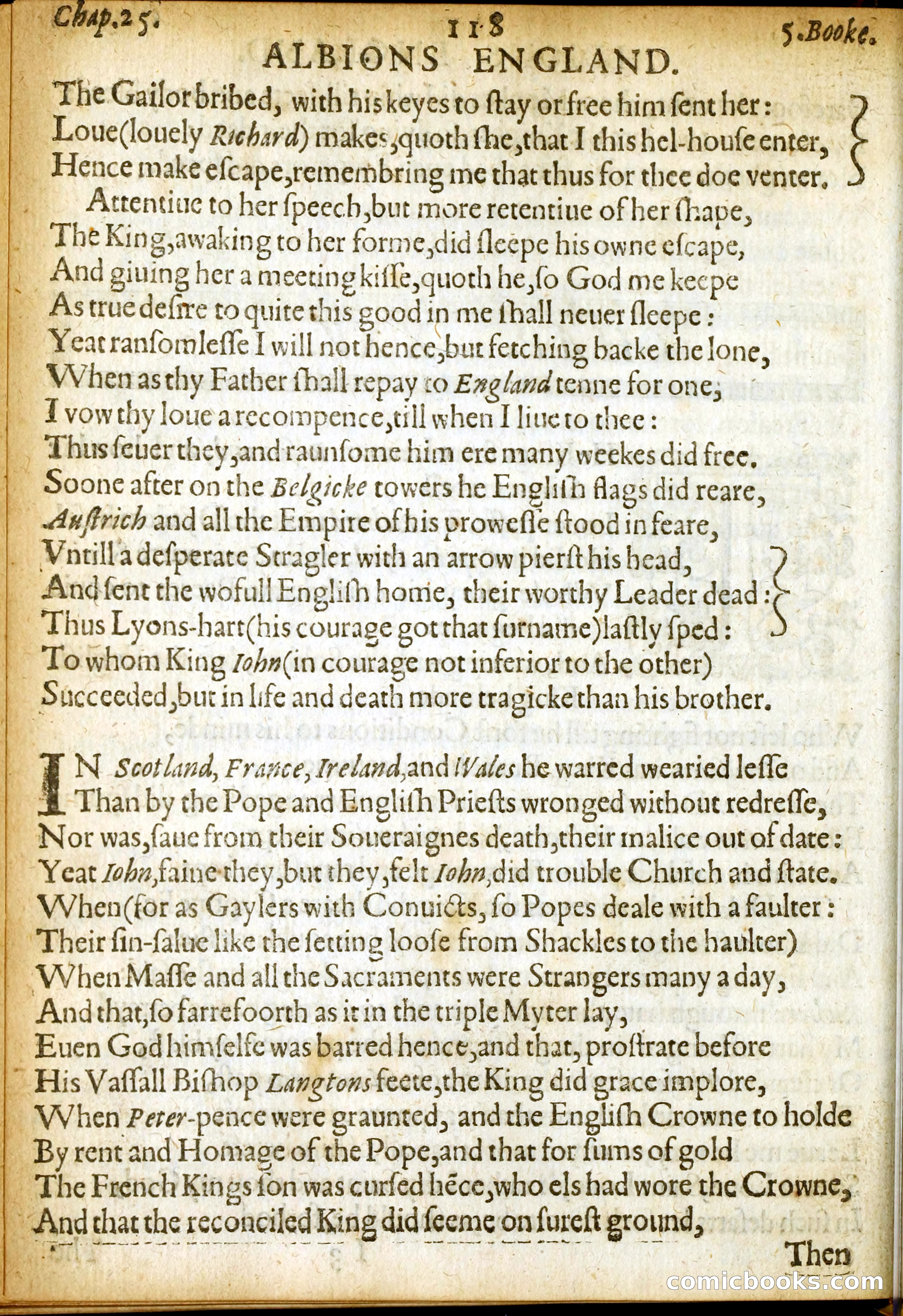
# Albions England — Historical Verse Narrative This is a page of running prose poetry from *Albions England*, a historical narrative work. The visible text recounts events from medieval English history, specifically the reigns of Richard (the Lionheart) and King John. It describes Richard's escape with aid from a woman, his later death by arrow wound, John's succession, and John's conflicts with Scotland, France, Ireland, Wales, the Pope, and English priests. The passage details John's forced submission to papal authority, the Pope's curse upon the French king, and England's reduced status as a papal vassal paying rent and homage to Rome. The text is printed in early modern English with archaic spelling and typography.
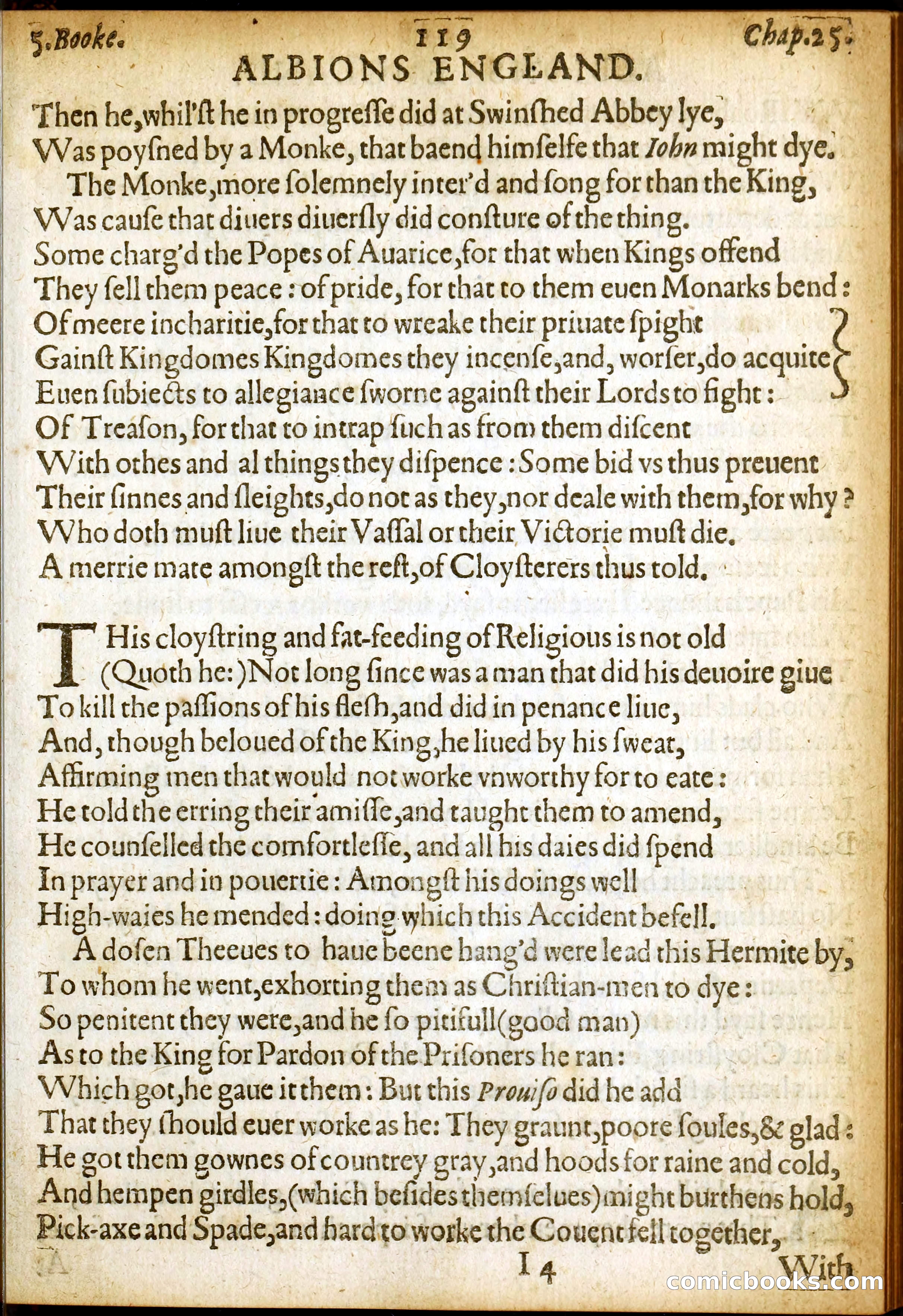
# Page Analysis: "Albions England," Chapter 25, Page 119 This is a page of **running prose poetry** from what appears to be a historical narrative poem. The visible text concerns King John of England: the opening passage describes his poisoning by a monk at Swinfshed Abbey, followed by various interpretations of blame (directed at the Pope, clerical corruption, and treason). The second major section shifts to a story about a virtuous hermit who reformed condemned thieves through Christian exhortation, obtained royal pardon for them, and then set them to honest labor—providing them with simple clothing, tools, and work at a convent. The page is densely printed in Early Modern English with period typography.
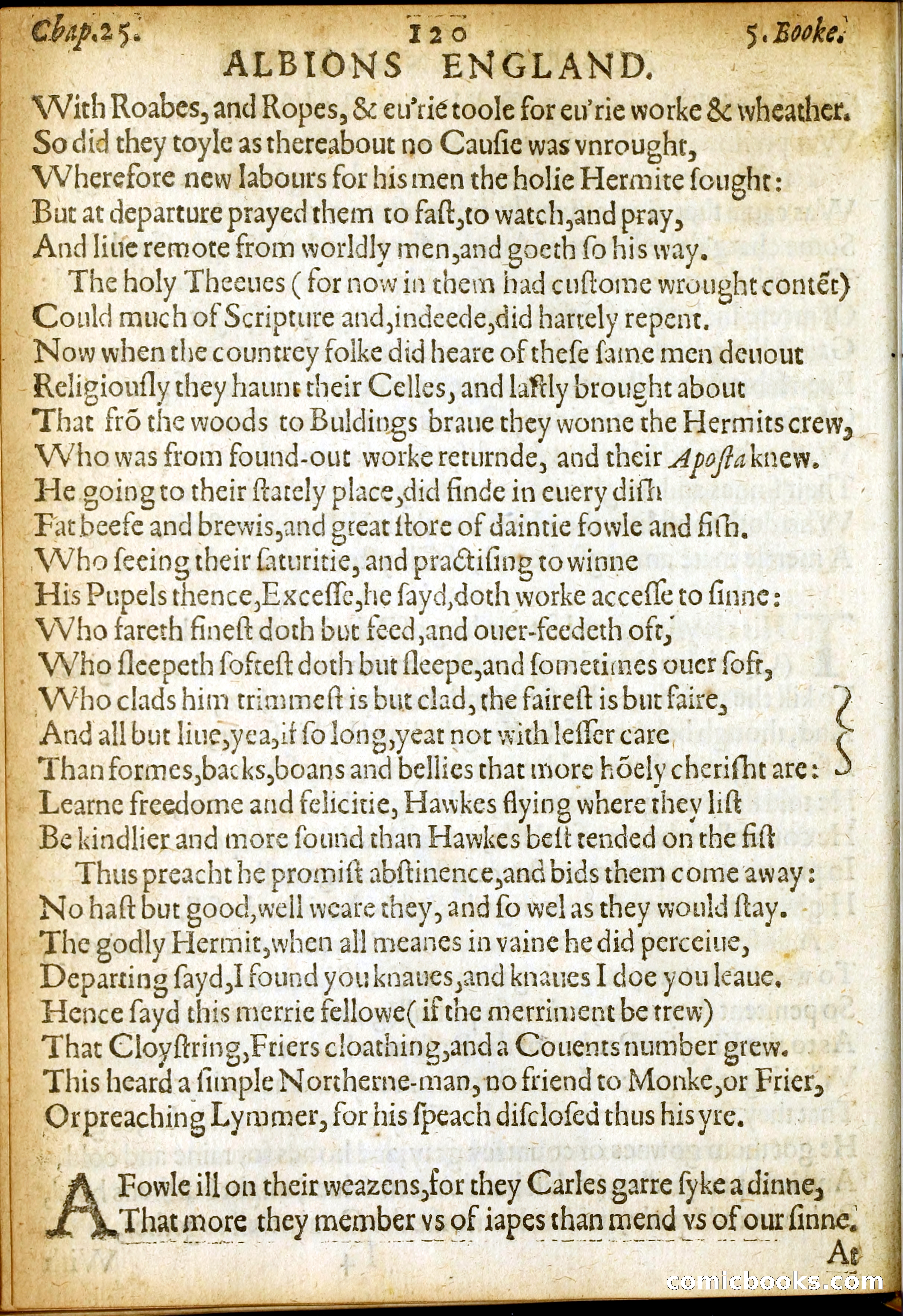
This is a page of running prose poetry from what appears to be a narrative work titled "Albions England." The text recounts a story about a holy Hermit who discovers that thieves he had reformed have returned to gluttony and excess, living in plenty with "fat beefe and brewis, and great store of daintie fowle." Disappointed when his preaching of abstinence fails to persuade them, the Hermit departs, declaring them knaves. The passage then notes how this encounter led to the growth of monastic orders (cloistering and friars), before introducing a northern man who criticizes these institutions for making noise and mockery rather than mending behavior.
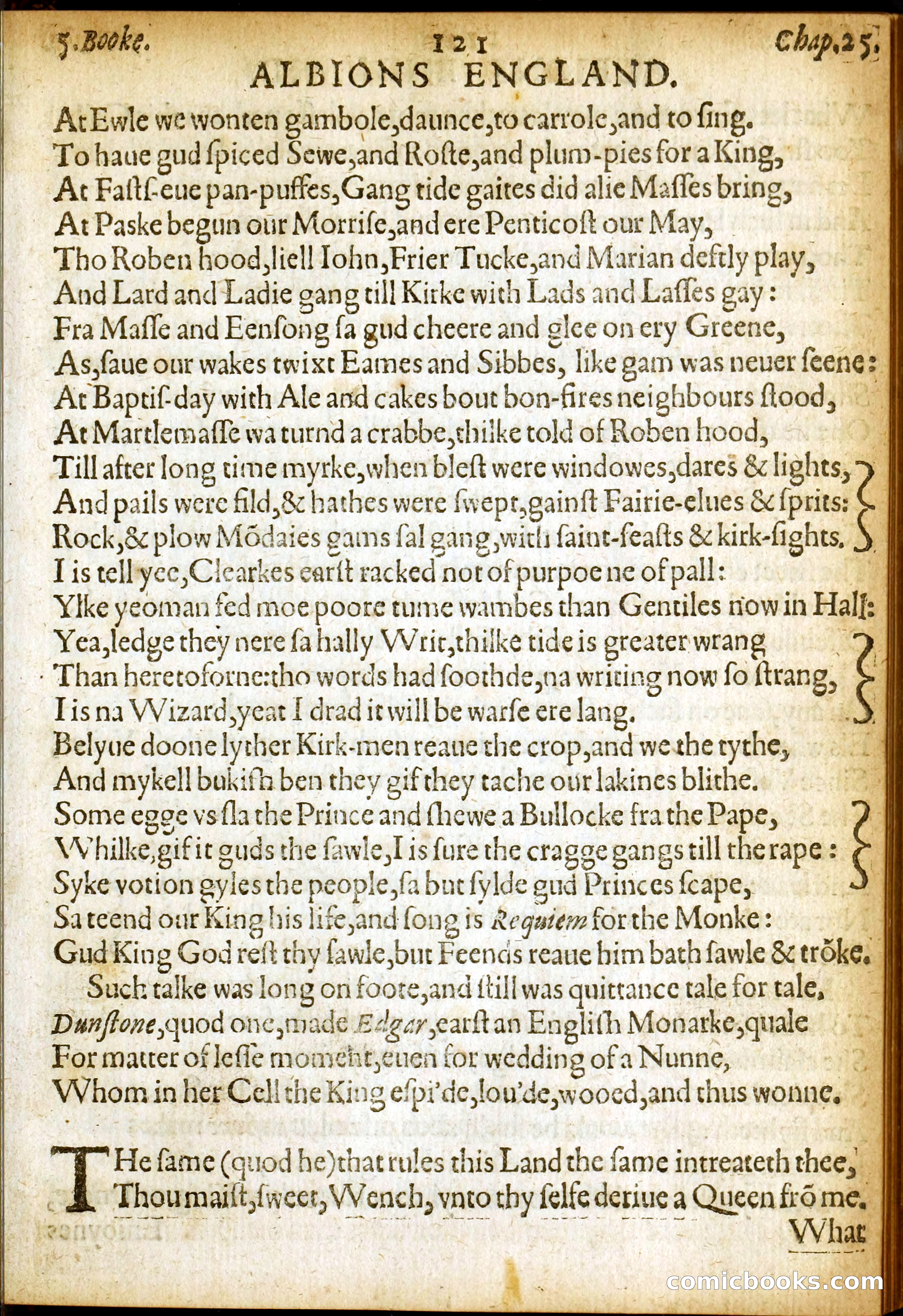
# Analysis of Page This is a page of running **verse text** from *Albions England*, presented in early modern English poetry (likely 16th or 17th century, not Victorian as initially suggested). The visible text describes festive activities and celebrations in England—gaming, dancing, feasting with spiced meats and pies, Maypole dancing, and references to Robin Hood and Marian. The passage laments that such traditional customs and merry-making are declining or changing, with complaints about clerical interference and loss of old English ways. The final lines reference King Dunstone and address "thee" (likely a queen or noble woman) in archaic English verse form.
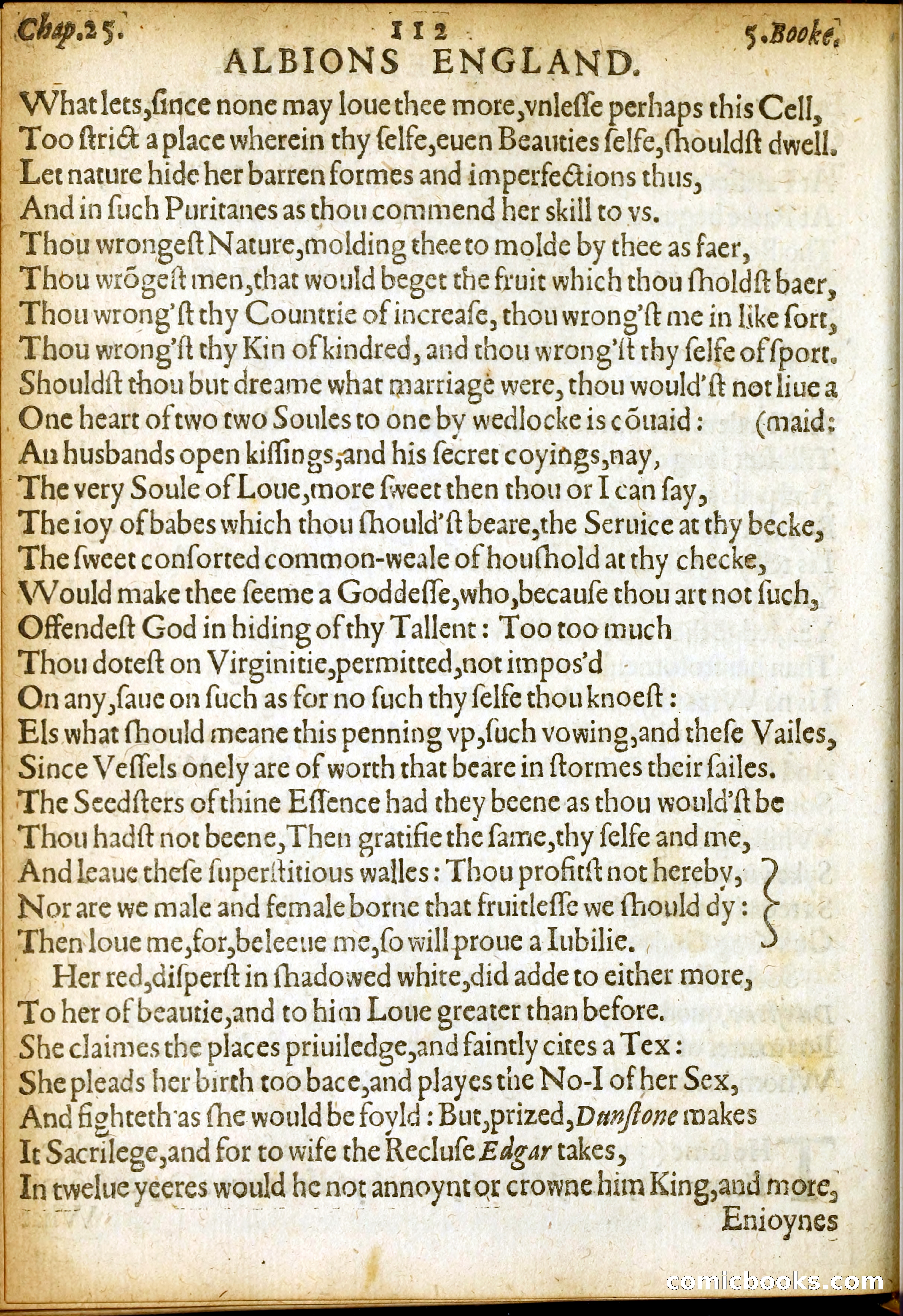
# Analysis of Page This is a page of running verse prose from what appears to be an early modern work titled "Albions England" (visible at the top), not a Victorian penny dreadful as specified in the prompt. The text is a dramatic monologue urging a woman against remaining unmarried and childless. The speaker argues that virginity is wasteful, that marriage brings joy and spiritual fulfillment through children and household companionship, and that refusing these roles offends God by hiding one's talents. The passage concludes with a narrative turn describing a woman who accepts marriage despite claiming low birth. The archaic spelling and Early Modern English syntax confirm this predates Victorian penny dreadfuls by centuries.
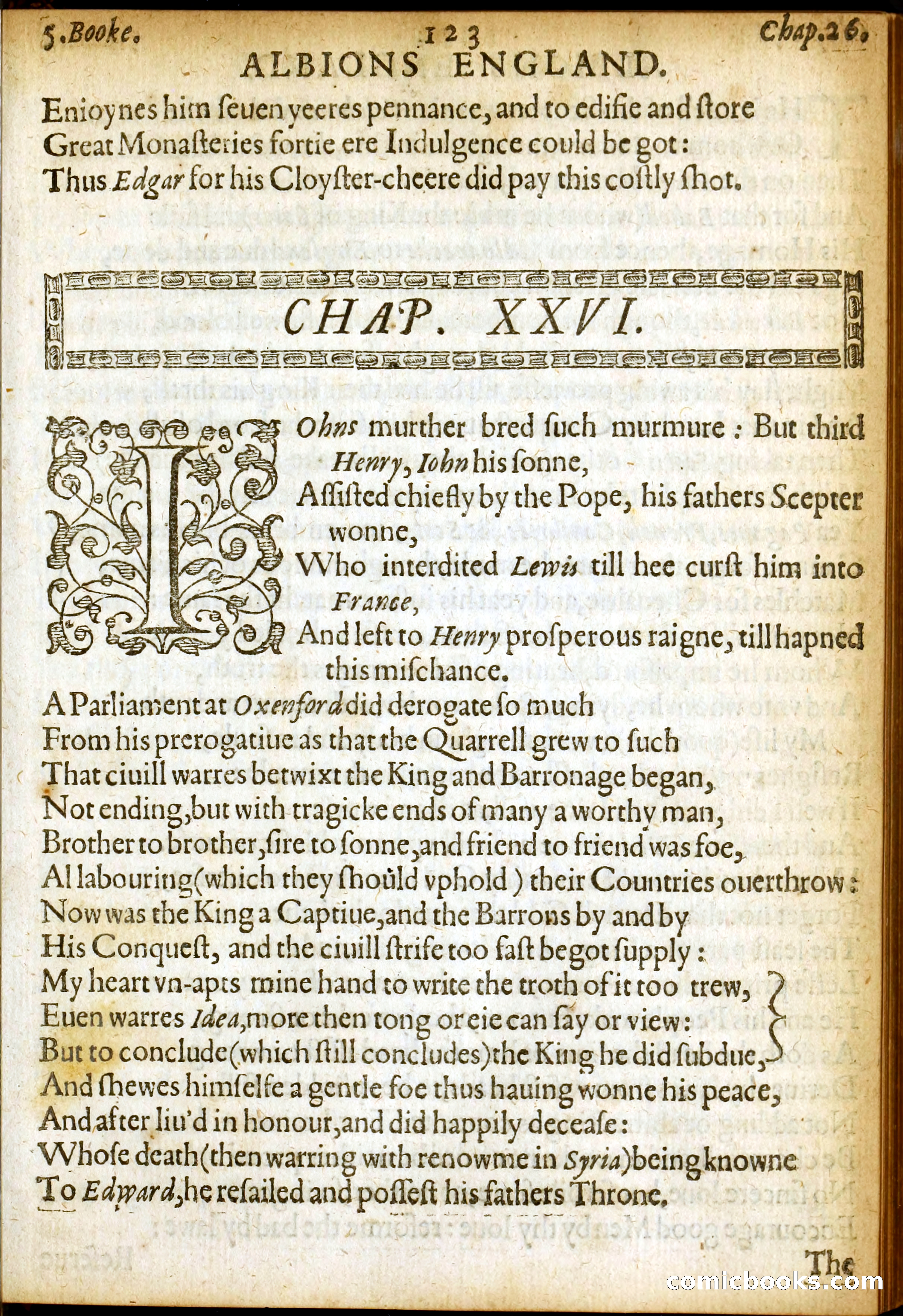
# Page Description This is a page of running prose from *Albions England*, Chapter XXVI (page 123). The text is verse narrative in Early Modern English concerning English royal history. It discusses King Henry III's reign, papal interference in English affairs, civil conflict between the king and barons, the king's captivity, and ultimately his peaceful resolution and death—after which Edward inherited the throne. The page contains ornamental chapter heading and decorative initial letter, typical of period book printing.
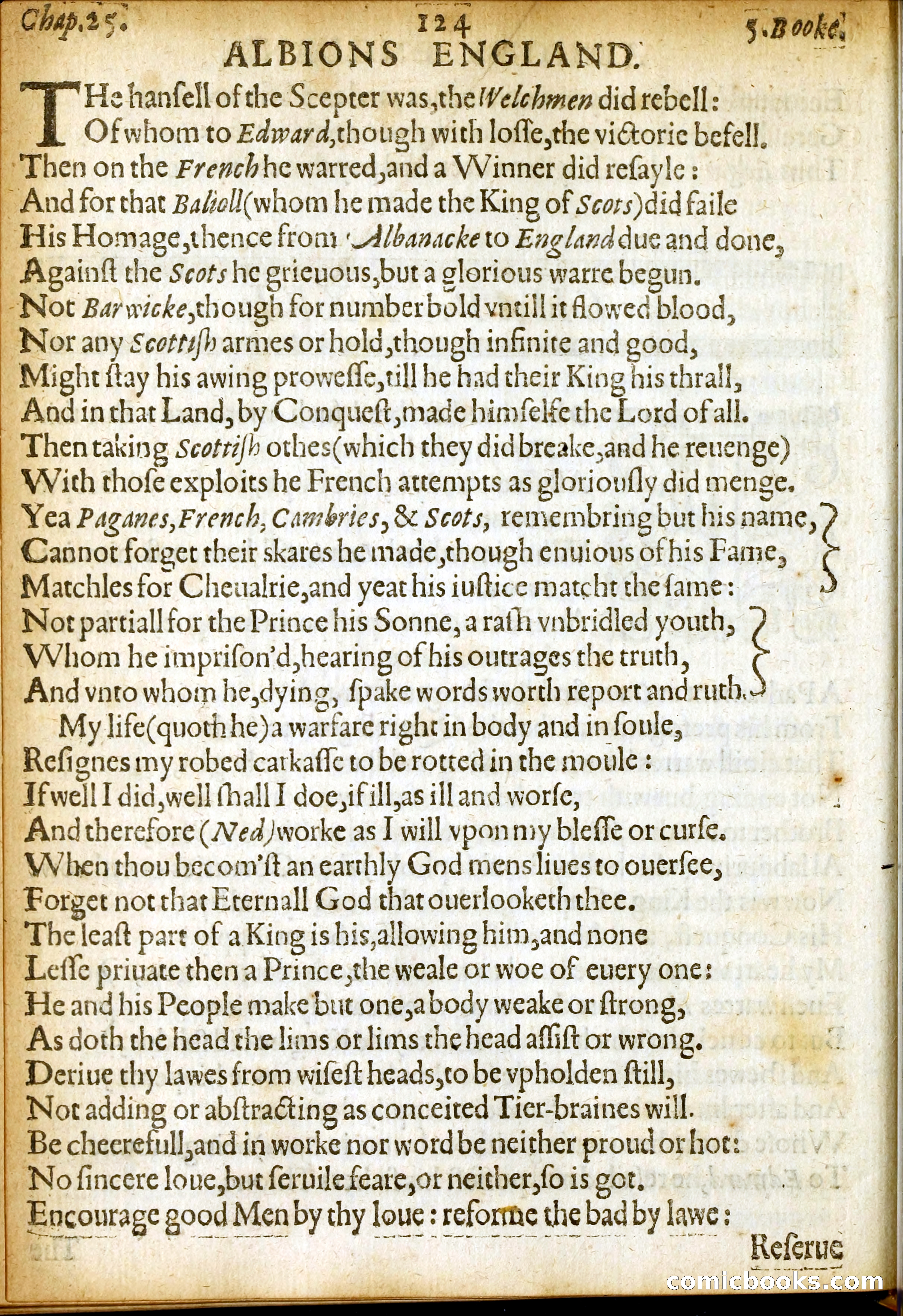
# Page Analysis This is a running prose page from Chapter 25 of "Albions England," printed text (not a penny dreadful as described in your prompt—this appears to be early modern verse, likely from Samuel Daniel's 17th-century historical poem). The visible text is written in ornate verse and concerns King Edward's military campaigns: his victories over the Welsh, his wars against the French and Scots, and his conquest of Scotland. The passage then shifts to deathbed advice from the aging Edward to his son about kingship, divine accountability, and just governance—emphasizing that a king and people form one body, and that laws should derive from wisdom, not caprice.
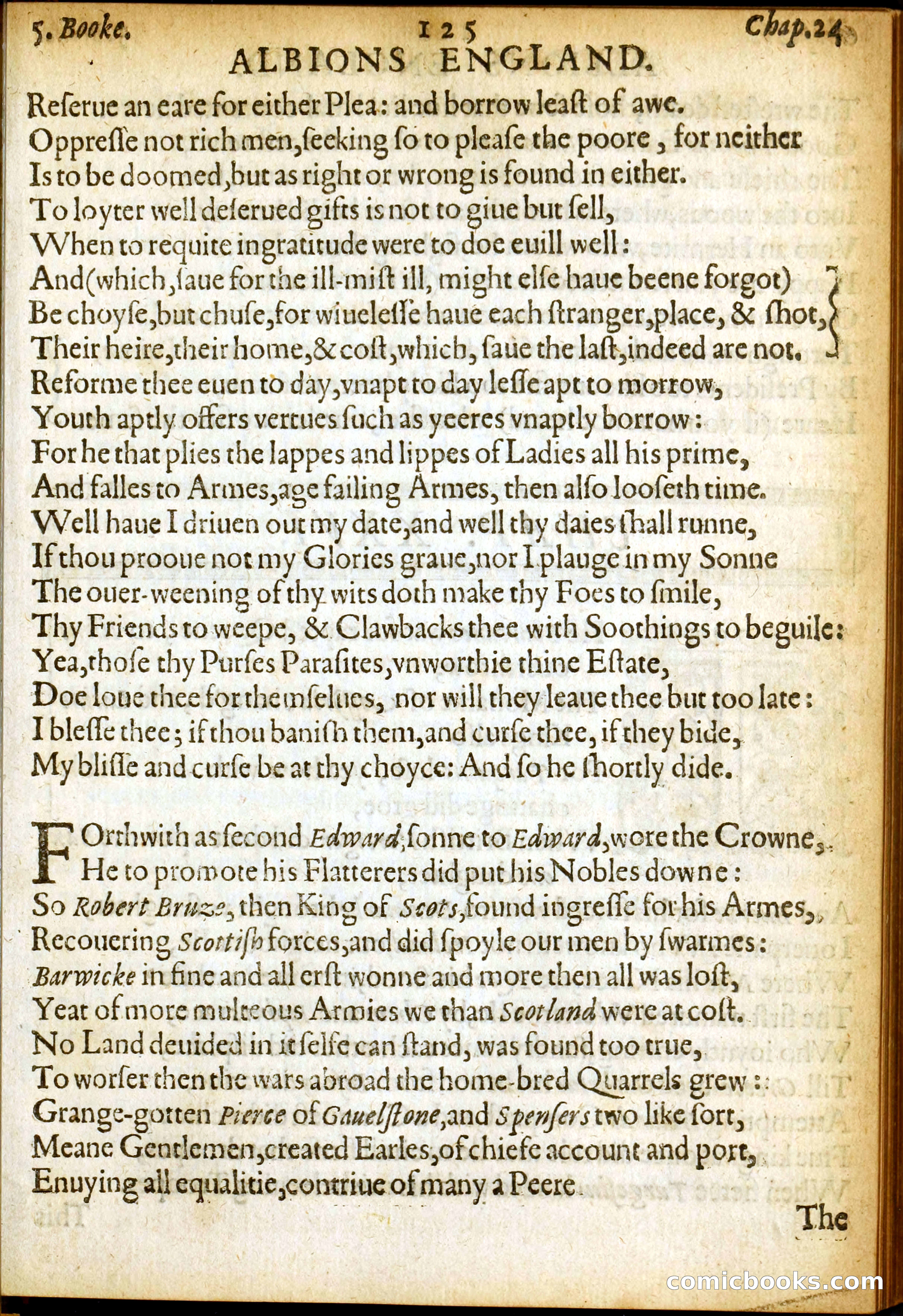
# Analysis of Page from *Albions England* This is a page of running verse poetry, not a penny dreadful as the prompt suggests. The text is from Samuel Daniel's *Albions England* (title visible at top), a historical narrative poem in Early Modern English. The visible passage contains moral counsel warning against oppressing the poor and flatterers, followed by historical examples—notably Edward II and his favorites Piers Gaveston and the Spensers, and Robert Bruce of Scotland. The verse discusses how internal division weakens kingdoms and how creating undeserving nobles through favoritism damages the state. The language and typography (old-style printing with long 's') indicate this is a historical reprint, not Victorian penny dreadful fiction.
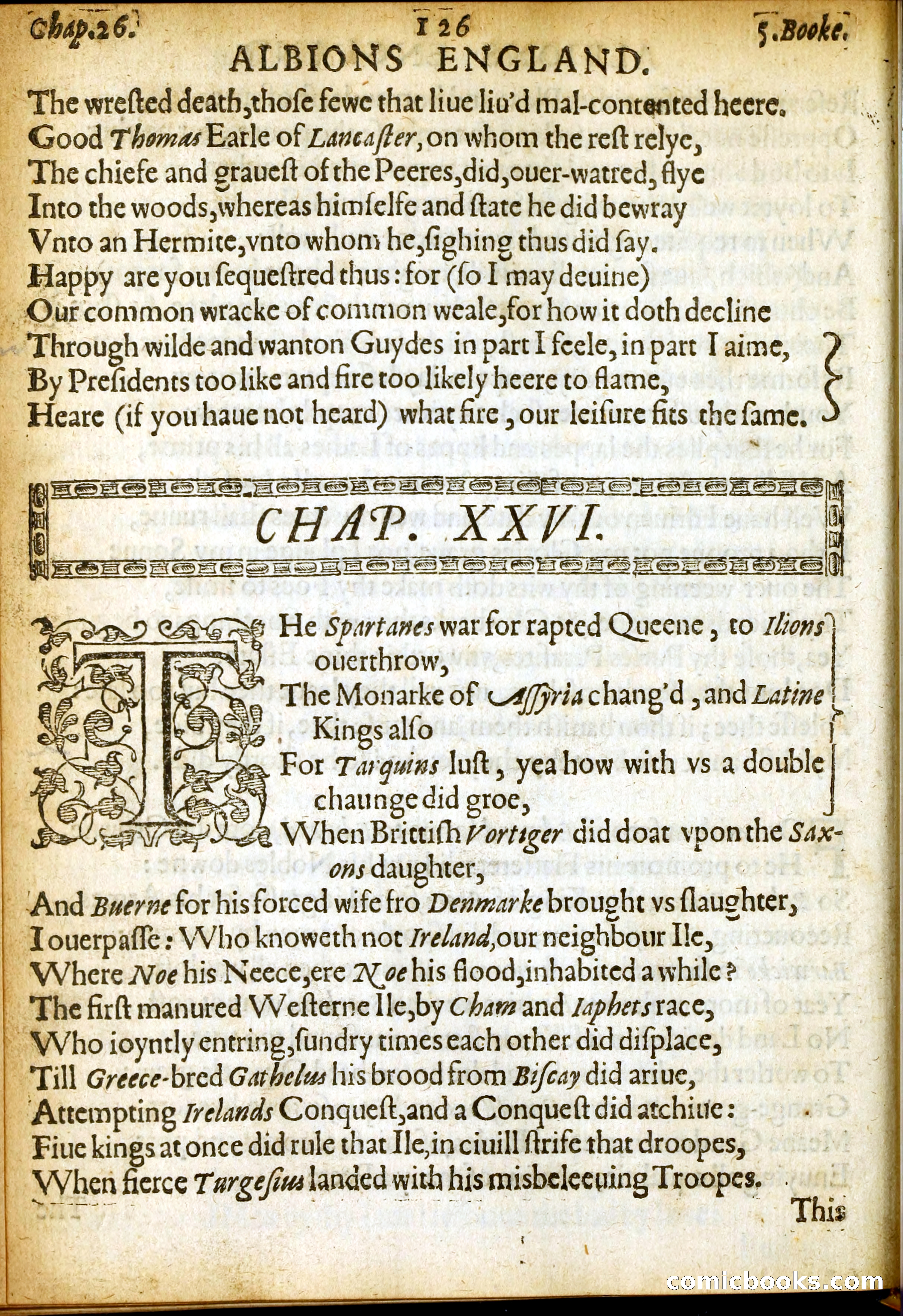
This is a page of running prose poetry from what appears to be Chapter 26 of *Albions England*. The text recounts historical and legendary narratives: it begins with Thomas, Earl of Lancaster, confessing to a hermit about England's decline under poor leaders, then shifts to cataloging various conquests and conflicts—the Spartans' war over a queen, changes in Assyria and Latin kingdoms, Tarquin's lust, the British king Vortigern, and attempts to conquer Ireland by various ancient peoples including those "Greece-bred" from Biscay. The passage employs archaic spelling and verse form typical of early modern English historical narrative.
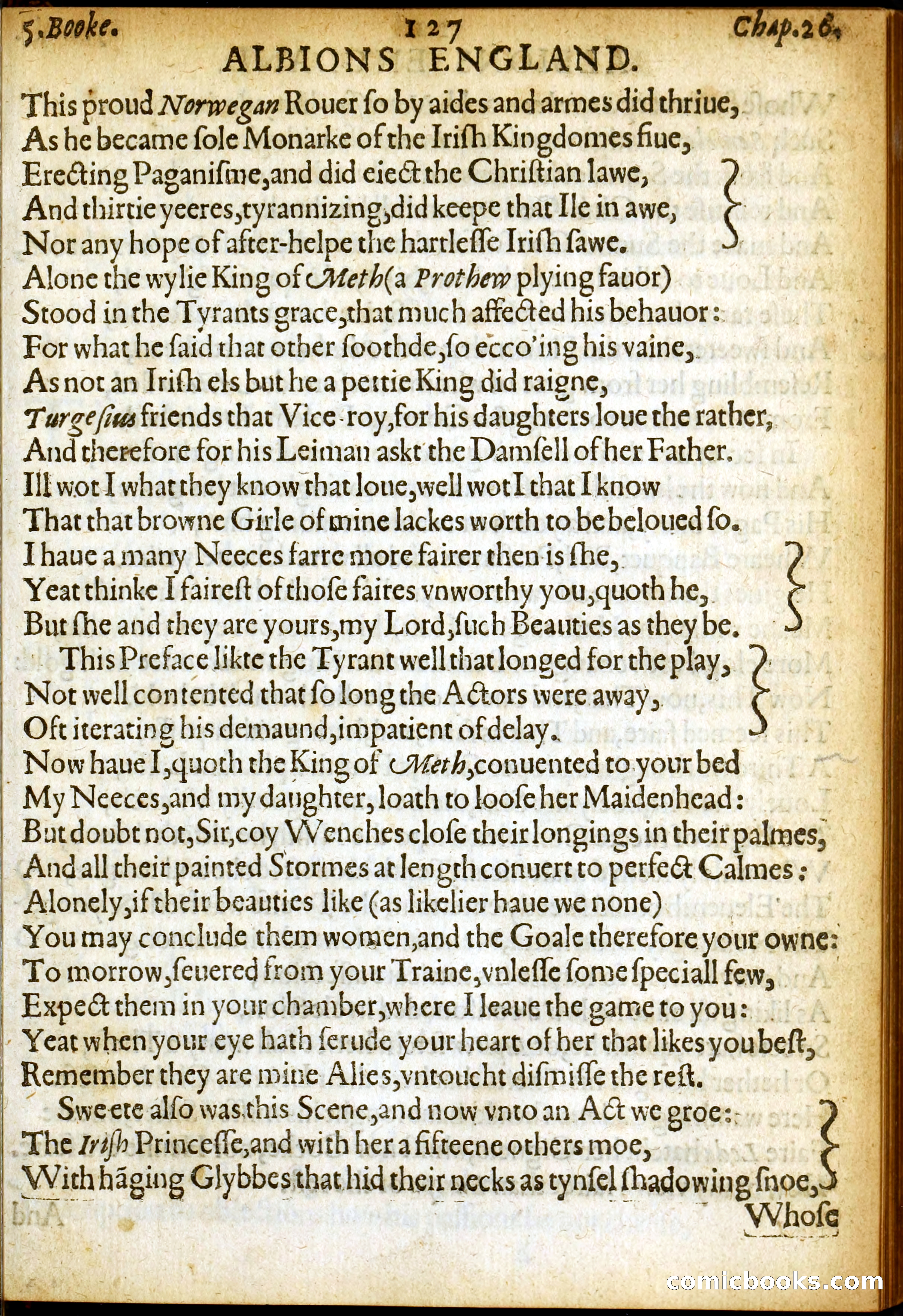
# Analysis of Page 127, "Albions England" This is a page of running prose poetry, printed in early modern English typeface. The text appears to be a narrative verse account of Irish history, describing a Norman ruler who became "sole Monarch of the Irish Kingdoms," erected paganism, and tyrannized the land for thirty years. The passage goes on to detail a vice-roy's request to a king regarding the king's daughter and nieces, with suggestive language about their beauty and availability. The scene concludes with reference to an Irish princess and fifteen other women, hinting at dramatic action to follow. The page is densely printed verse with marginal brackets indicating poetic structure.
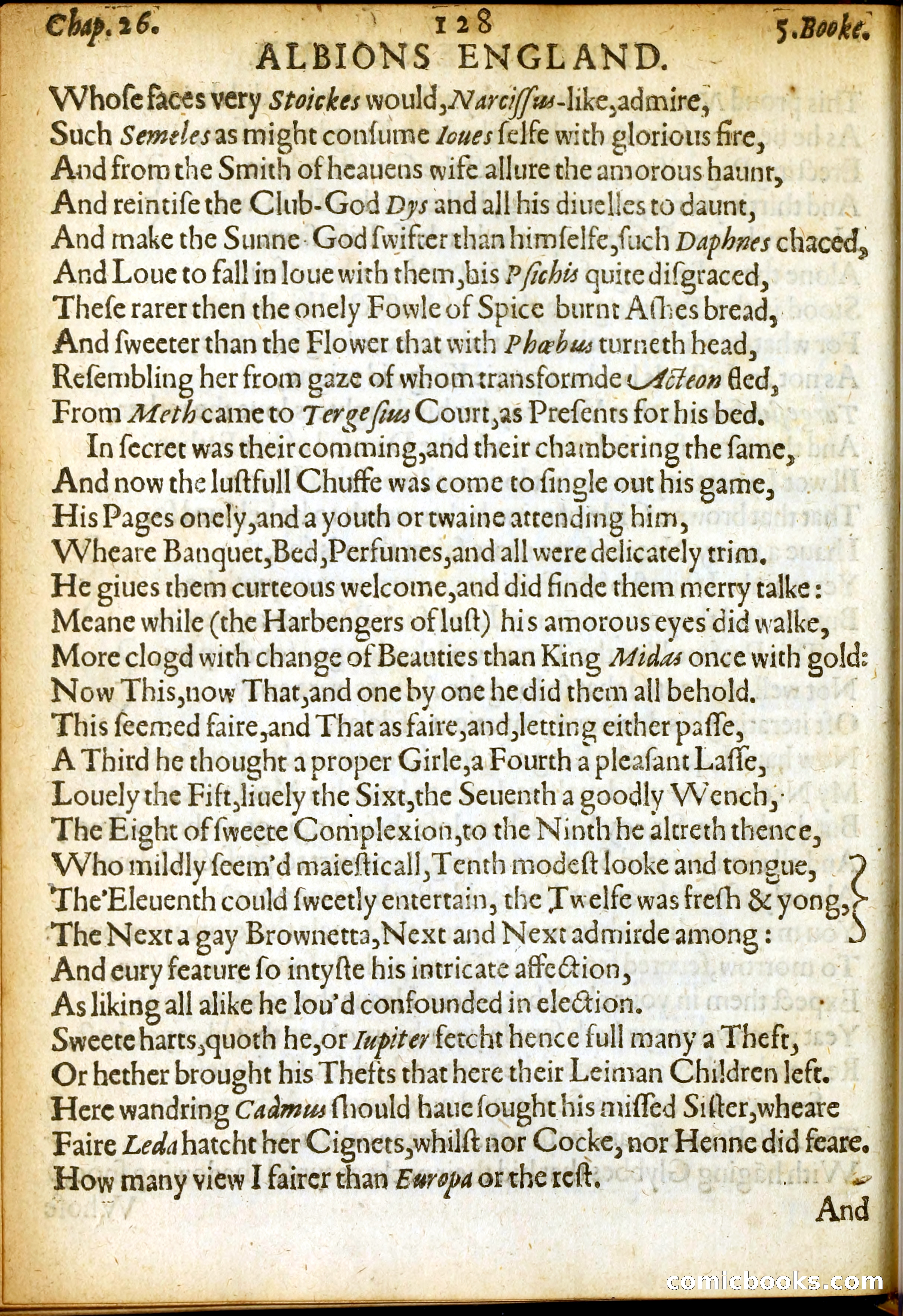
# Page Analysis This is a page of running poetic verse from *Albions England*, Chapter 26. The text describes a lusty nobleman surveying a group of beautiful women brought to his chamber. Written in early modern English (not Victorian), the passage catalogs his admiration of twelve or more females—ranking them sequentially from "fair" to "lovely" to "modest"—while he struggles to choose among them, comparing himself to mythological figures like King Midas. The verse employs classical allusions and ornate language typical of Elizabethan/Jacobean literature, depicting a scene of seduction and courtly intrigue.
This is a page of running prose poetry from what appears to be an early modern narrative poem (not a Victorian penny dreadful as stated in the prompt—the typography, spelling, and style indicate 16th or 17th century). The text recounts a romantic and political narrative involving Irish history: it describes how young Irish gentlemen and "Methean Ladies" helped a tyrant escape, tells of roving warriors from Scandinavia who left Ireland free until "our second Henries time," and then presents an amorous queen who caused new conquests. The bulk of the visible text is a passionate letter from Dermot, King of Leynister, to the Queen of Meth, declaring his love and devotion despite obstacles, comparing their bond to famous tragic loves.
# Analysis This is a page of running verse poetry from what appears to be a historical narrative poem titled "Albions England." The visible text recounts events involving love, betrayal, and Irish-English conquest: a lover's letter moves a woman to tears; her paramour (King Morice of Meth) returns and discovers the affair; he is angered and the woman leaves with another man; this triggers a quarrel involving Harold and his "Geitrone," eventually drawing in Irish and English kings. The passage concludes with references to King Henry, Dermot, and the Norman conquest of Ireland, mentioning figures like the Earl of Strangbowe and the Geraldines. The text is printed in early modern typography with italicized proper names.
This is a page of running prose poetry from what appears to be an early modern English work titled "Albions England" (visible at the top). The text shows Chapter XXVII, in which a character described as an Earle and Exile responds to the County's remarks about England's sins. The Earle speaks about the condition of human infancy and childhood—how creatures are born weak and helpless, how children are prone to foolish toys and dangerous vanities, and how they require correction rather than wit to develop virtue. The passage is written in verse form with elaborate Early Modern spelling and orthography, discussing themes of human weakness, vice, and the need for proper upbringing.
# Description This is a page of running prose verse from *Albions England* (Chapter 27, Book 5), printed in early modern English typography. The text is a narrative poem discussing the hardships of common life—labor, aging, poverty, and mortality—before transitioning into a story about Robin Hood. The passage praises Robin Hood as a righteous outlaw who robbed the rich to feed the poor, lodging his men in caves and forests while they lived better than common folk suffering under corrupt authorities ("Churles"). The verse uses rhyming couplets in Spenserian style.
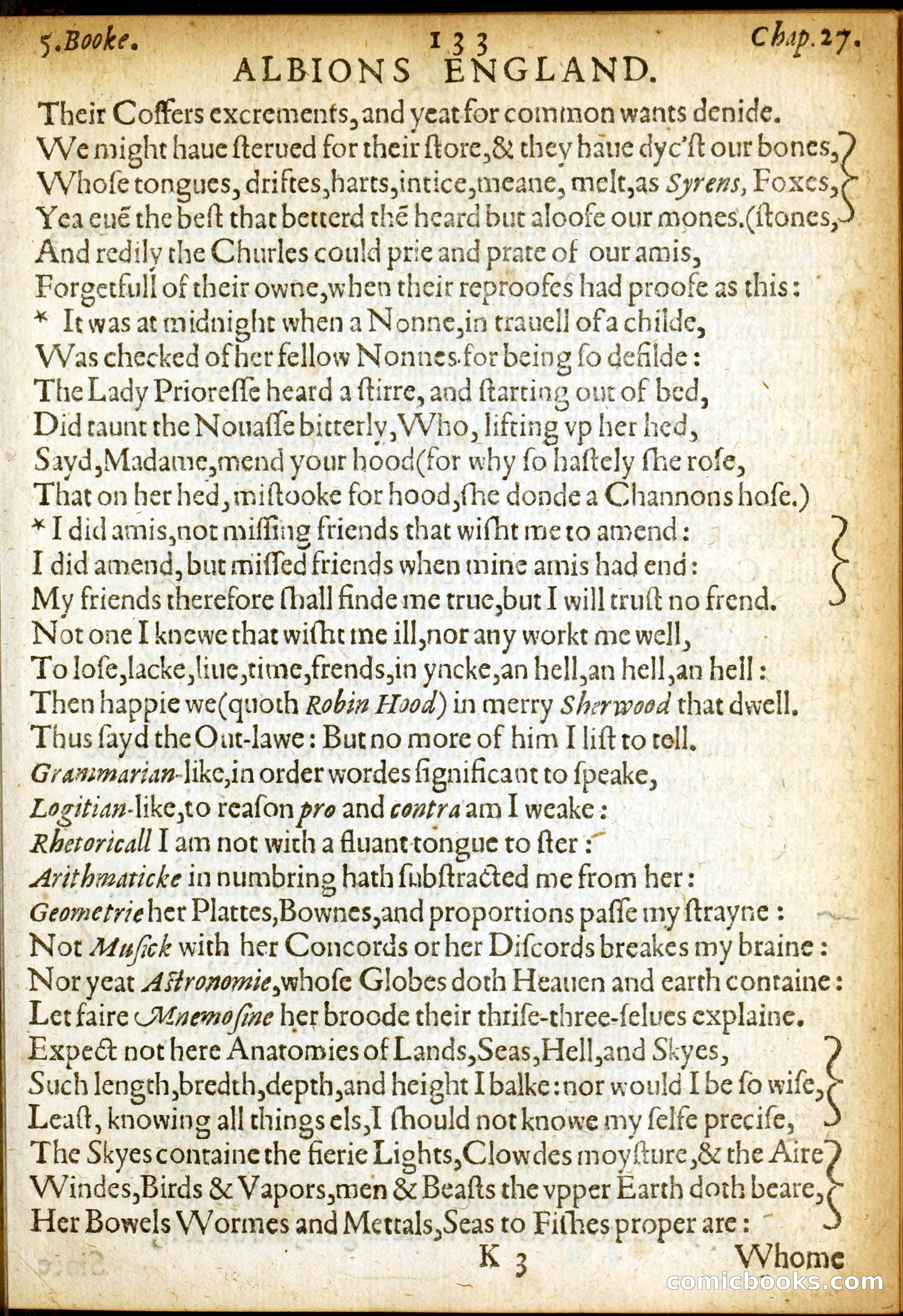
# Page Analysis This is a page of running prose poetry from what appears to be an early modern text (not Victorian—the typography and language suggest 16th or 17th century). The page contains narrative verse about a nun giving birth at midnight and being rebuked by her superior, followed by a monologue from an outlaw character (apparently Robin Hood) lamenting his losses and renouncing friendship. The second half shifts to the speaker disclaiming expertise in various scholarly disciplines—grammar, logic, rhetoric, arithmetic, geometry, music, and astronomy—while asserting he will not attempt comprehensive knowledge of all things lest he fail to know himself.
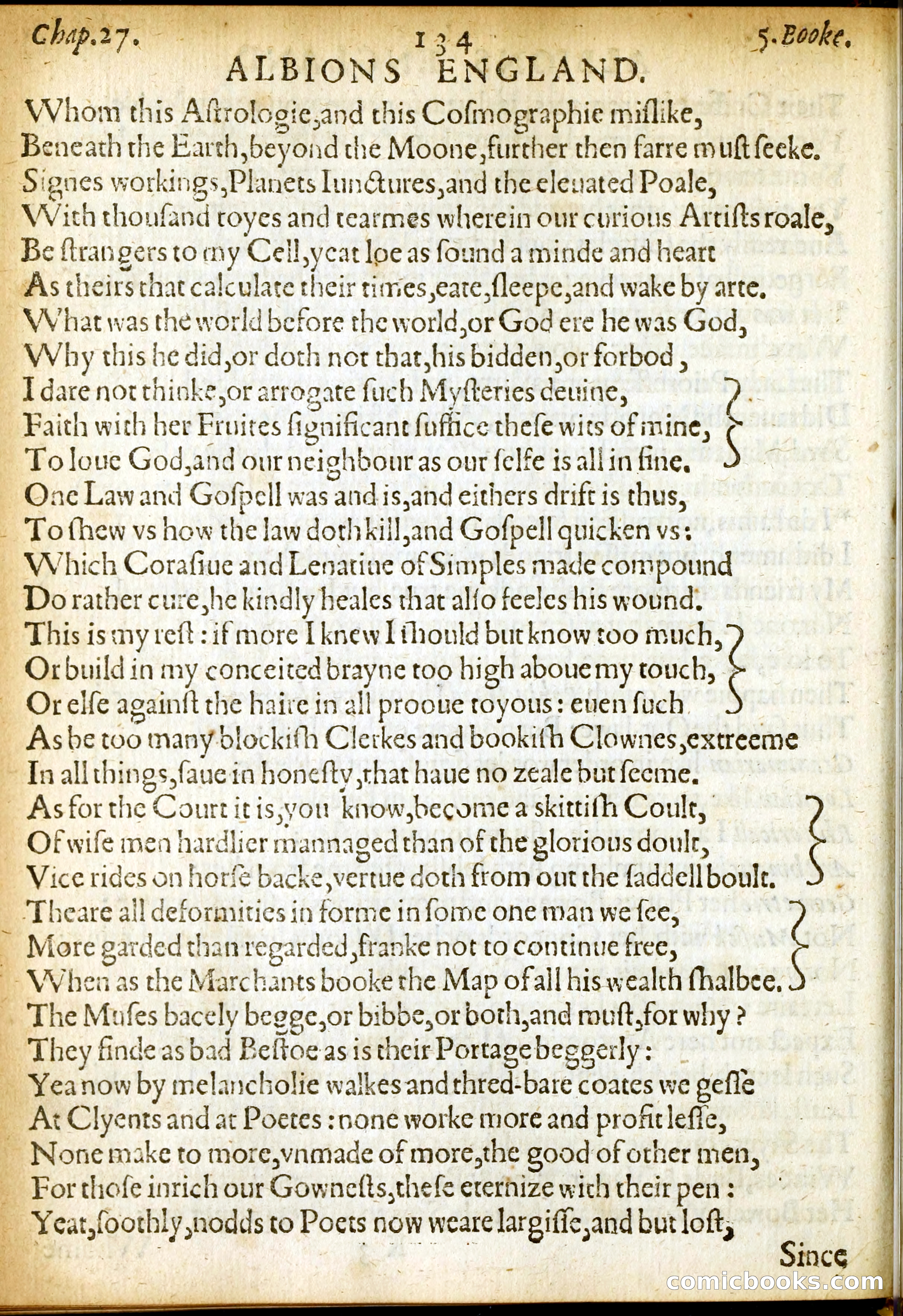
# Analysis of Page This is a printed page of **running verse poetry**, not a penny dreadful but rather early modern literature (the typography and language suggest 17th-century publication, predating Victorian penny dreadfuls by centuries). The visible text is a philosophical and moral poem in English verse titled "Albions England." The speaker defends humble faith and practical charity over astrological and cosmographic learning, declaring that loving God and one's neighbour matters more than understanding celestial mysteries. The poem then shifts to social critique, lamenting the poverty and underappreciation of poets and clerks, contrasting their meager circumstances with the wealth of merchants. The language is archaic and the sentiment moralistic throughout.
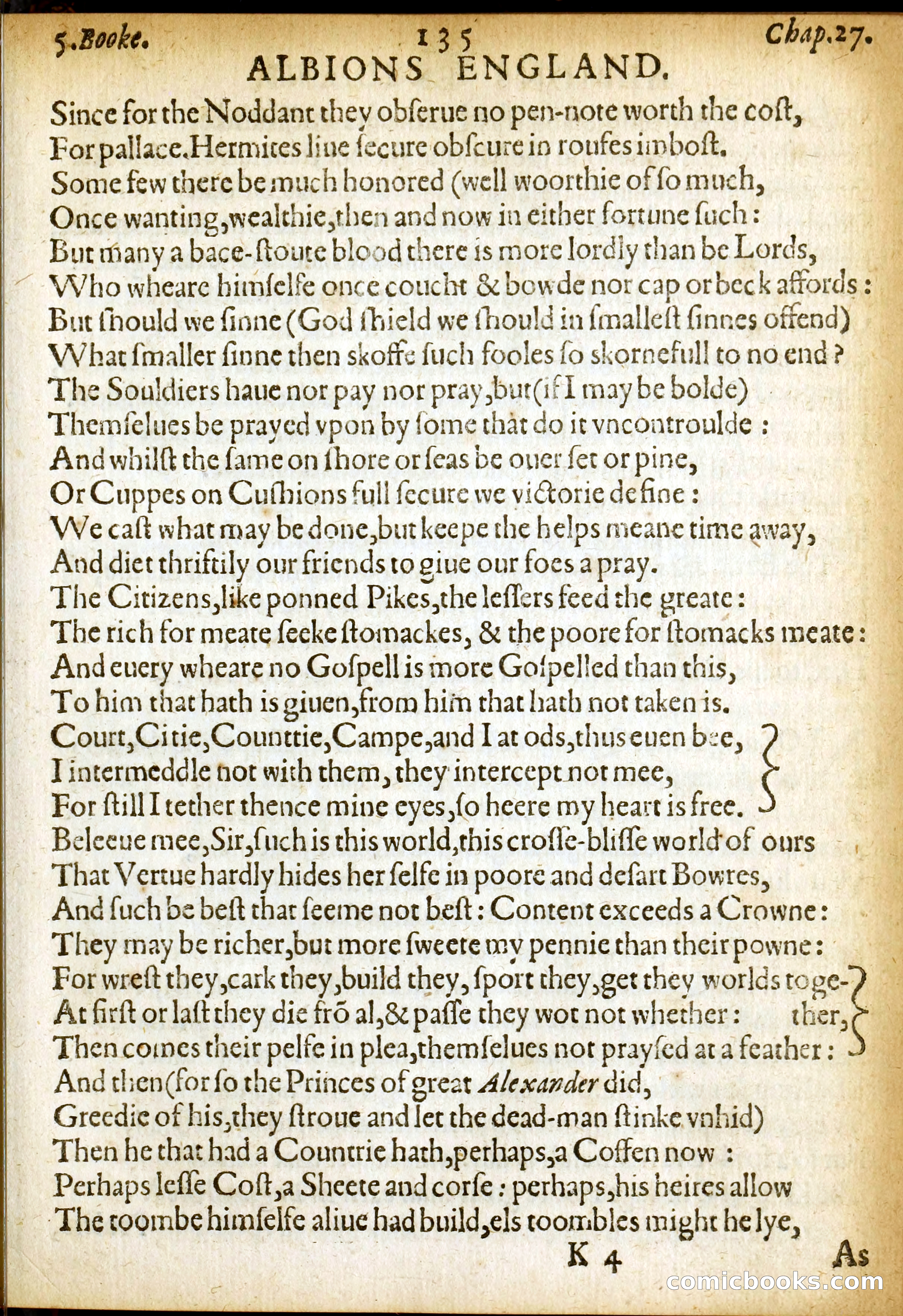
# Analysis of Page This page contains **running prose poetry** from what appears to be an early modern work titled "Albions England" (note the header), not a Victorian penny dreadful as stated in the prompt. The visible text is verse commentary on English social inequality and mortality. The speaker criticizes the wealthy and idle ("Cuppes on Cuthions full secure we victorie define"), contrasts rich and poor ("The rich for meate secke stomackes, & the poore for stomacks meate"), and reflects on how wealth and status mean nothing in death—even great men like Alexander the Great end in coffins. The tone is moralistic, lamenting that virtue hides among the poor while the greedy accumulate meaningless possessions.
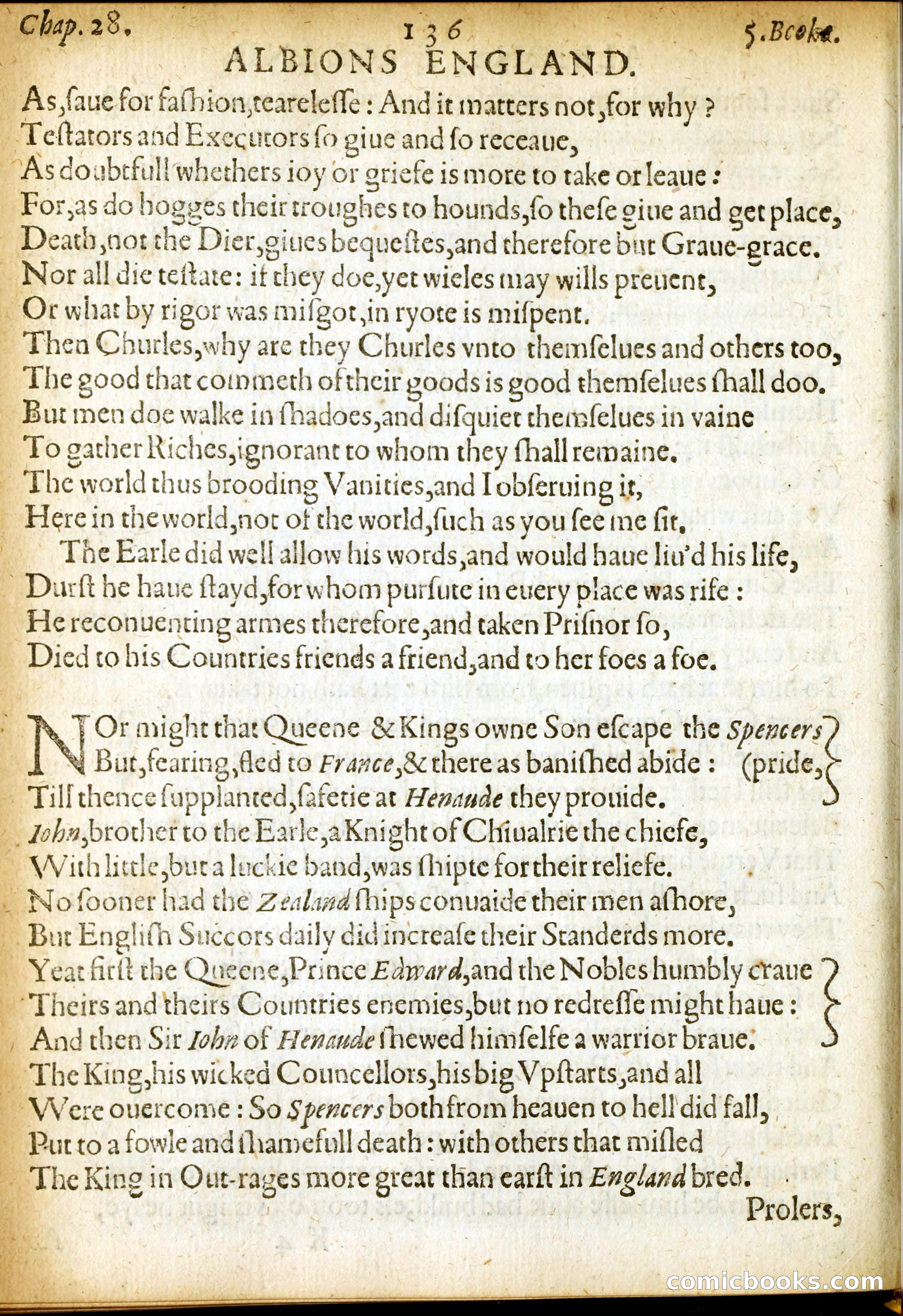
# Running Prose Page from "Albions England" This is a page of running verse text (page 136, Chapter 28) from what appears to be Michael Drayton's *Albions England*, a historical poem in English. The visible text discusses moral themes about wealth, vanity, and death, then narrates historical events involving an Earl, the Queen, Prince Edward, and conflicts with the Spencers. The passage describes military action, flight to France, and ultimately the downfall of the Spencers and the King's wicked counselors. The text is presented in dense verse paragraphs with period typography and spelling conventions.
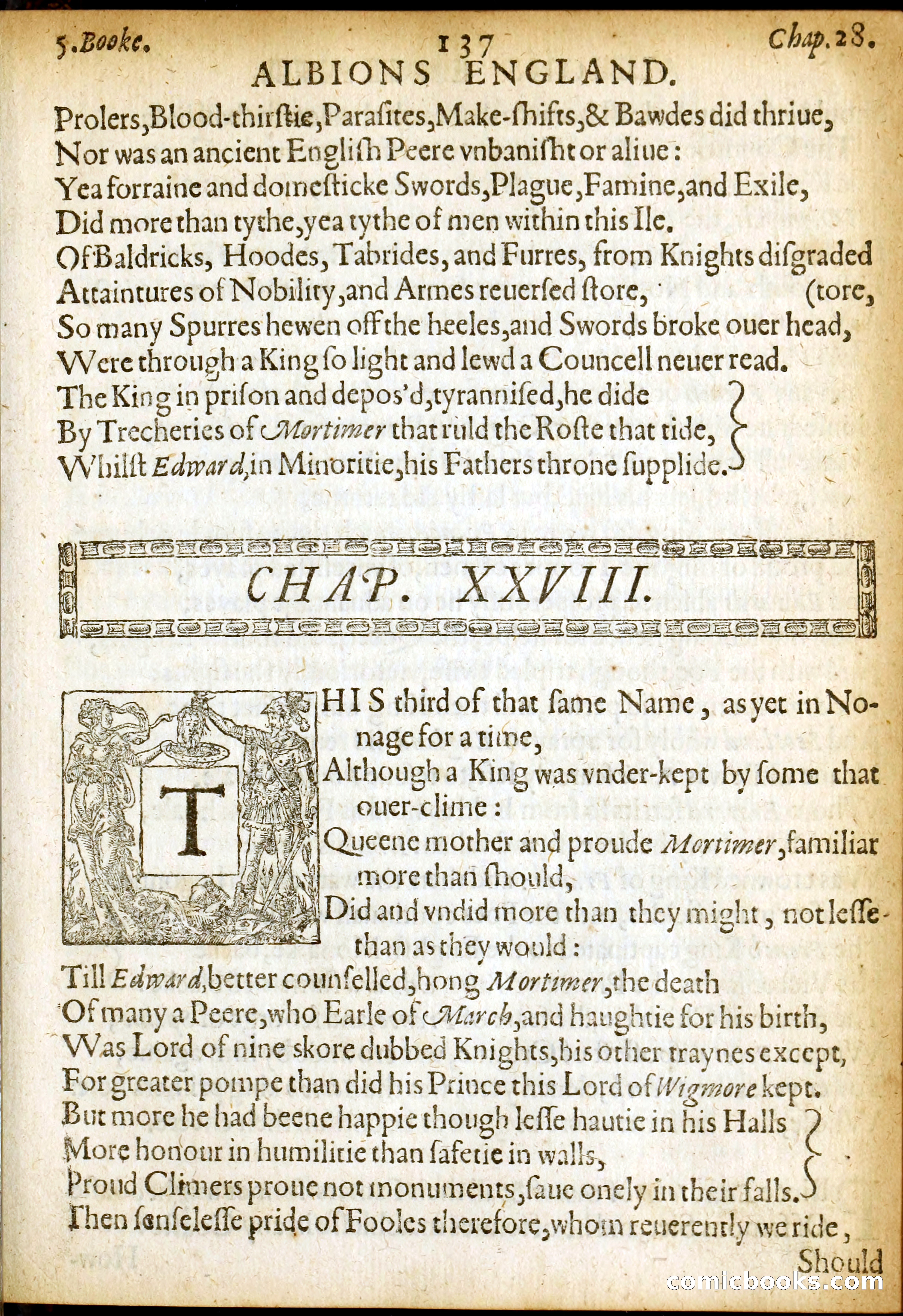
# Page Content Analysis This is a page of running verse text from what appears to be a narrative poem about English history. The visible content consists of two sections: first, concluding lines of verse describing civil turmoil—mentioning blood-thirsty men, plague, famine, exile, and a deposed king controlled by treacheries of Mortimer while young Edward holds the throne; second, Chapter 28 beginning, which narrates the story of "his third of that same Name" (apparently Edward III), describing how Queen mother and Mortimer exercised improper power, and how the Earl of March (Lord of Wigmore) wielded excessive influence despite his youth. The text appears to be early modern poetry (likely from the 16th-17th century, not Victorian as initially suggested), printed in period typography with decorative initial letter.
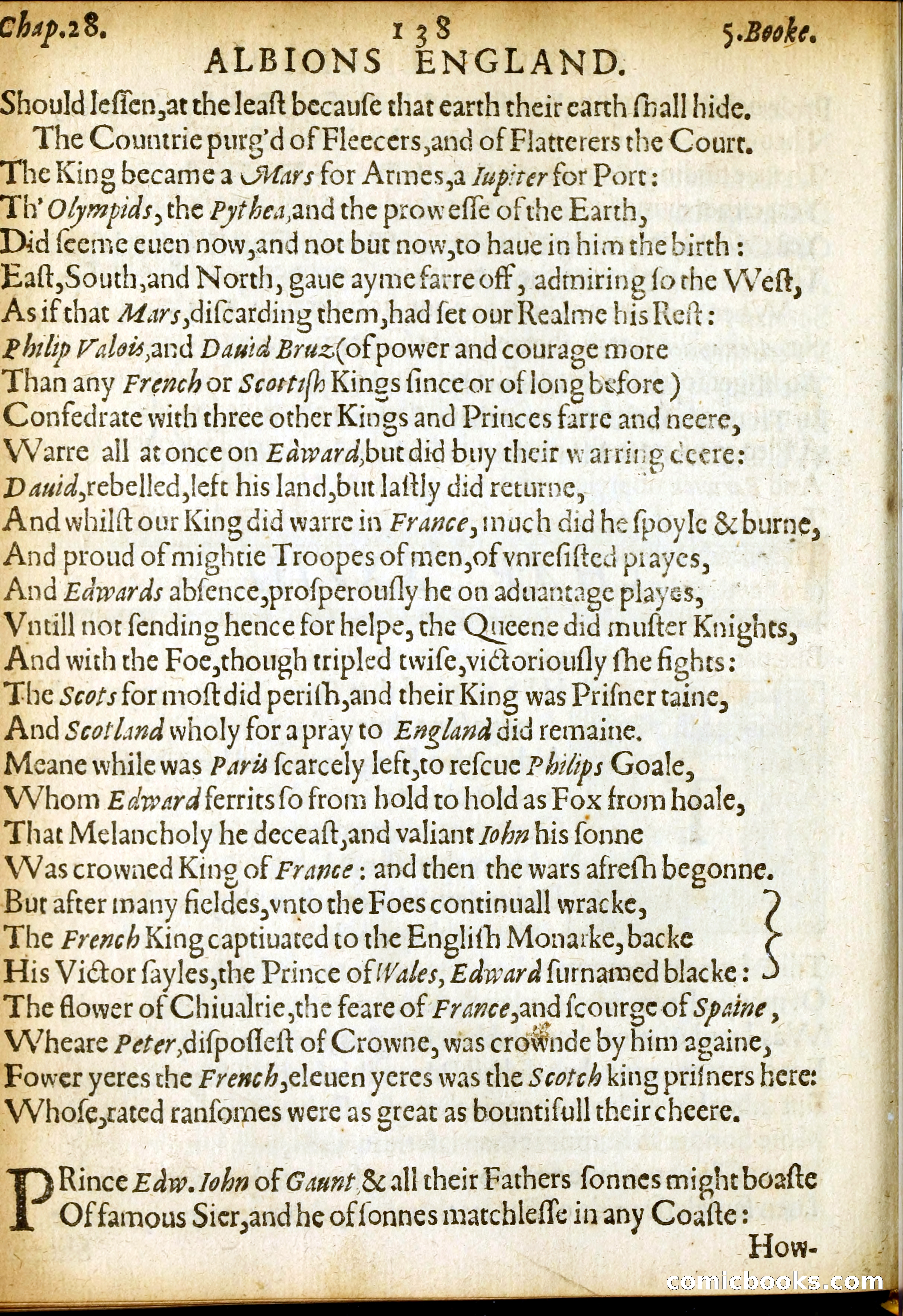
# Victorian Penny Dreadful Page Analysis This is a page of running prose verse from Chapter 28 of *Albions England*, presented in period typography with italicized proper names. The text is a narrative poem recounting English military campaigns, primarily describing King Edward's wars against France and Scotland. It appears to detail battles, the capture of the French king, Scottish prisoners, and the martial achievements of Edward's sons, including "Edward surnamed blacke" (the Black Prince). The verse celebrates English victories and the power of the royal line, particularly praising Prince Edward of Gaunt and other descendants. This appears to be early modern historical verse (not actually Victorian penny dreadful), likely from the 16th century, printed on aged paper.
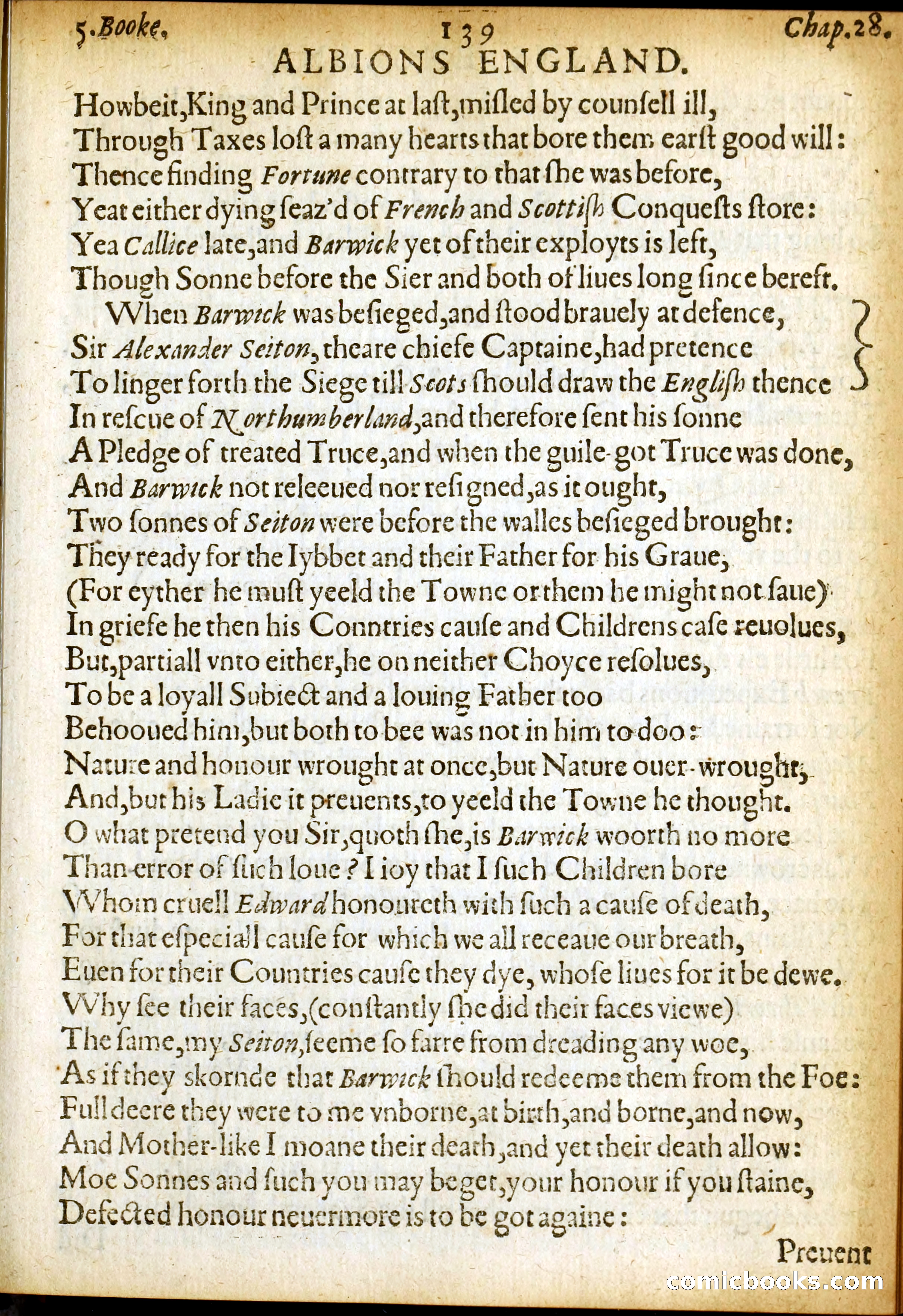
# Page Analysis: Running Prose from Historical Epic This is a page of running verse text (appears to be from *Albions England*, Chapter 28, page 139) depicting a historical narrative in early modern English poetry. The passage concerns King and Prince being poorly advised, leading to the loss of towns like Calais and Barwick to French and Scottish forces. It describes the siege of Barwick, where Sir Alexander Seiton, the chief captain, faces an impossible choice: defend the town or save his two sons, who are held hostage before its walls. His wife argues that honor and country must prevail over parental love, asserting that lost honor cannot be recovered. The text employs elaborate period typography and spelling conventions typical of early printed English literature.
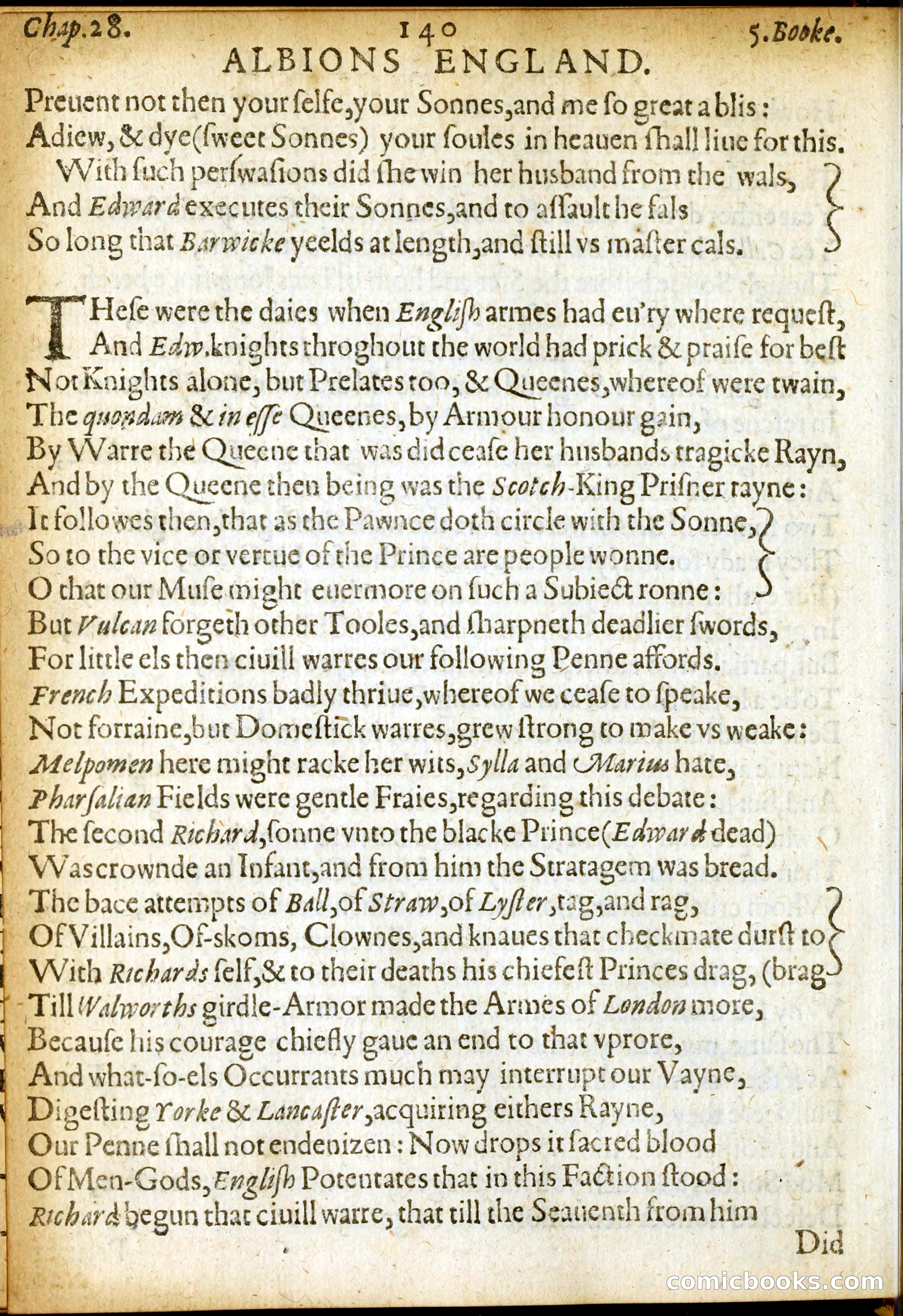
# Analysis of Page This is a running prose page from Chapter 28 of *Albions England*, printed by S. Booke. The text is written in early modern English verse, discussing English military history and the reigns of various monarchs, particularly Edward and Richard II. The passage praises English knights and prelates, references French and domestic wars, and alludes to civil strife involving figures like Wat Tyler and the Peasants' Revolt. The text mentions Richard II's succession following the Black Prince's death and describes various conflicts that troubled England. This appears to be a historical or quasi-historical narrative poem rather than a Victorian penny dreadful, likely from an earlier period than the Victorian era.
# Analysis of Page This is a **page of running verse text** from what appears to be a narrative poem titled *Albions England*, not a penny dreadful as initially supposed. The text uses Early Modern English spelling and describes political conflict involving King Henry, the Duke of Hereford, the Duke of Norfolk, and John of Gaunt. The passage recounts dynastic struggles—specifically the deposing of King Richard and Henry Duke of Lancaster's election to the crown—and warns of future conflict between the families of York and Lancaster that will ensue from these events. The layout is two columns of black-letter verse on aged parchment.
# Analysis of Page This is a **running prose page** from what appears to be an early modern chronicle poem (not a Victorian penny dreadful, despite the assignment framing). The page presents Chapter 29 of "The Sixt Booke of Albions England," continuing narrative verse about English dynastic history. The visible text describes King Henry IV's deposition of Richard II at Pomfret Castle and includes Richard's penitent speech accepting his fate, along with reference to the Duke of Exeter's failed plot against Henry. The ornate decorative border frames the chapter heading in typical early printed book style.
This page contains running prose poetry from *Albions England*, a historical narrative poem. The text discusses King Richard and his son Henry the Fifth, praising Henry's martial victories in France and Scotland, his virtue as a ruler, and his early death at age thirty-six, leaving an infant son and kingdom to regents. The verse employs early modern English spelling and celebrates Henry as an ideal king comparable to Homer's Achilles. This appears to be from a historical chronicle rather than a Victorian penny dreadful.
# Analysis of Page This is a page of running prose poetry from what appears to be a narrative work titled "Albions England." The text presents a romantic story in verse concerning Queen Katherine (daughter of the French King Henry), her son, and Owen Tuder, a Welsh Esquire. The passage describes how Katherine develops affection for Tuder, their courtship conducted through indirect means and veiled language about love and medicine, and Tuder's lengthy declaration of his devotion and lineage. The verse employs elaborate metaphorical language and classical references (Apollo, Daphne, Endymion) typical of early modern English poetry rather than Victorian penny dreadful sensationalism. The archaic spelling and typography suggest this is a reprinted or quoted historical text rather than original Victorian composition.
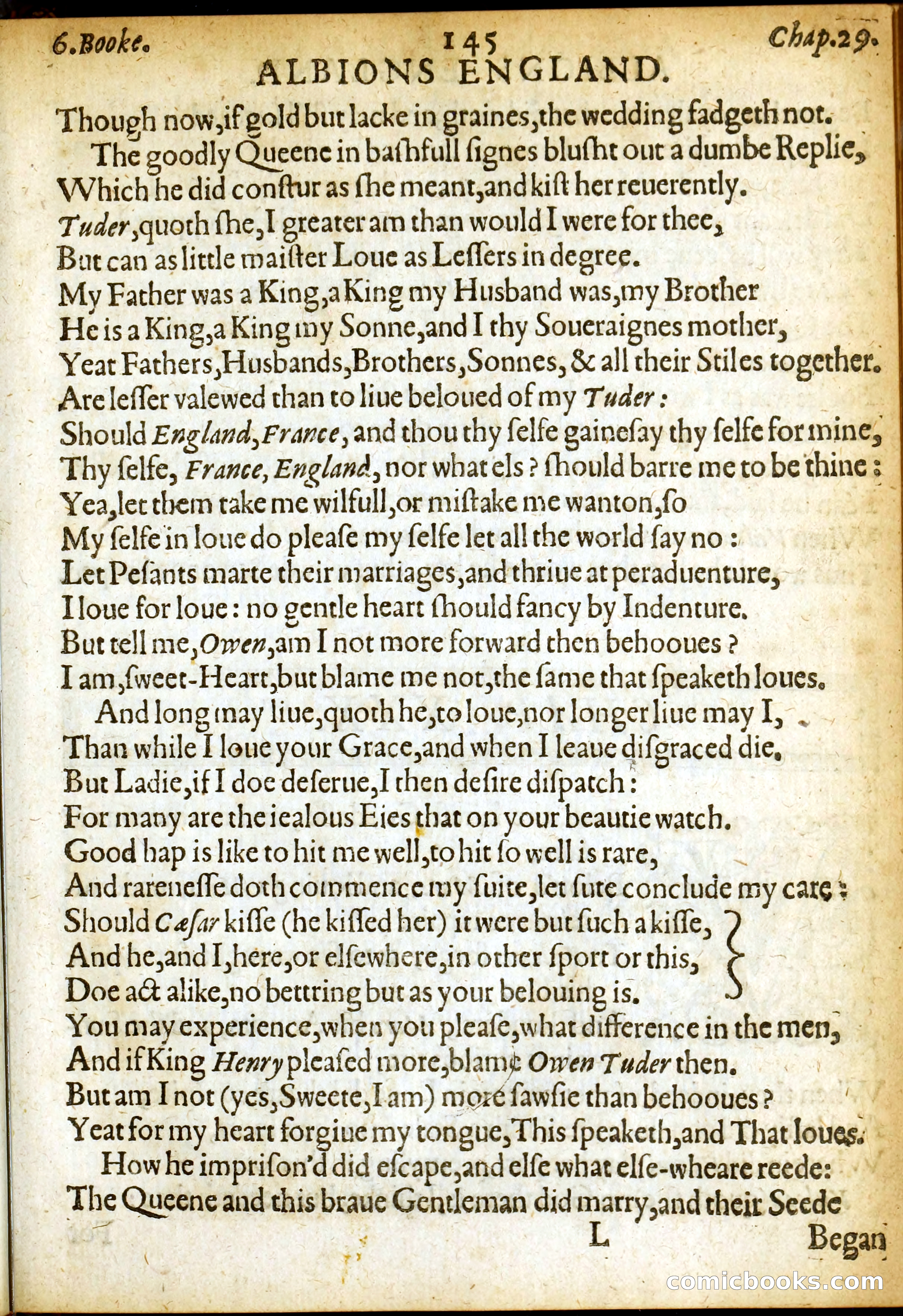
This is a page of running prose—specifically dramatic dialogue in verse from what appears to be a historical romance narrative. The text depicts an exchange between a Queen (who mentions her father, husband, and son were all kings) and a man named Owen Tudor (or "Tuder"). The Queen declares her love for Tudor transcends her royal status, while he protests his unworthiness. The passage concludes with a narrative statement that "The Queene and this braue Gentleman did marry, and their Seede," suggesting a story of royal romance and secret marriage. The archaic spelling and early modern typography indicate this is likely reprinted from an older text rather than Victorian-era original composition.
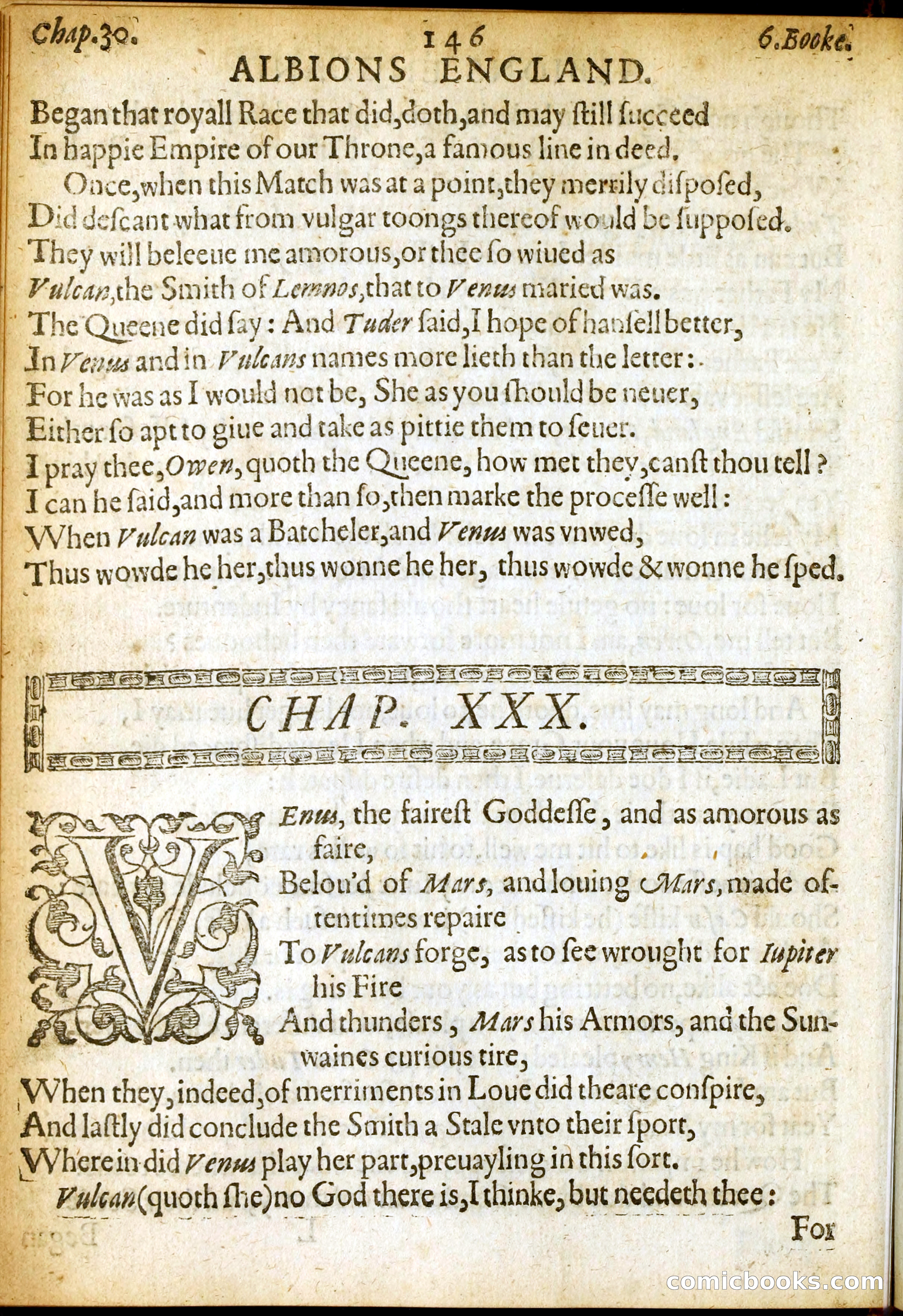
# Page Description This is a page of running prose poetry from what appears to be a narrative work titled "Albions England." The text is printed in early modern English typography and consists of verse dialogue between characters including a Queen, Tader, and Owen, discussing a royal match and drawing a comparison to the classical myth of Vulcan and Venus. The passage concludes with Chapter XXX, which begins a new section narrating Venus's role as "the fairest Goddesse" and her involvement with Mars and Vulcan. The ornate decorative initial letter and decorative chapter heading are typical of printed literature from this period. No illustrations are present on this page.
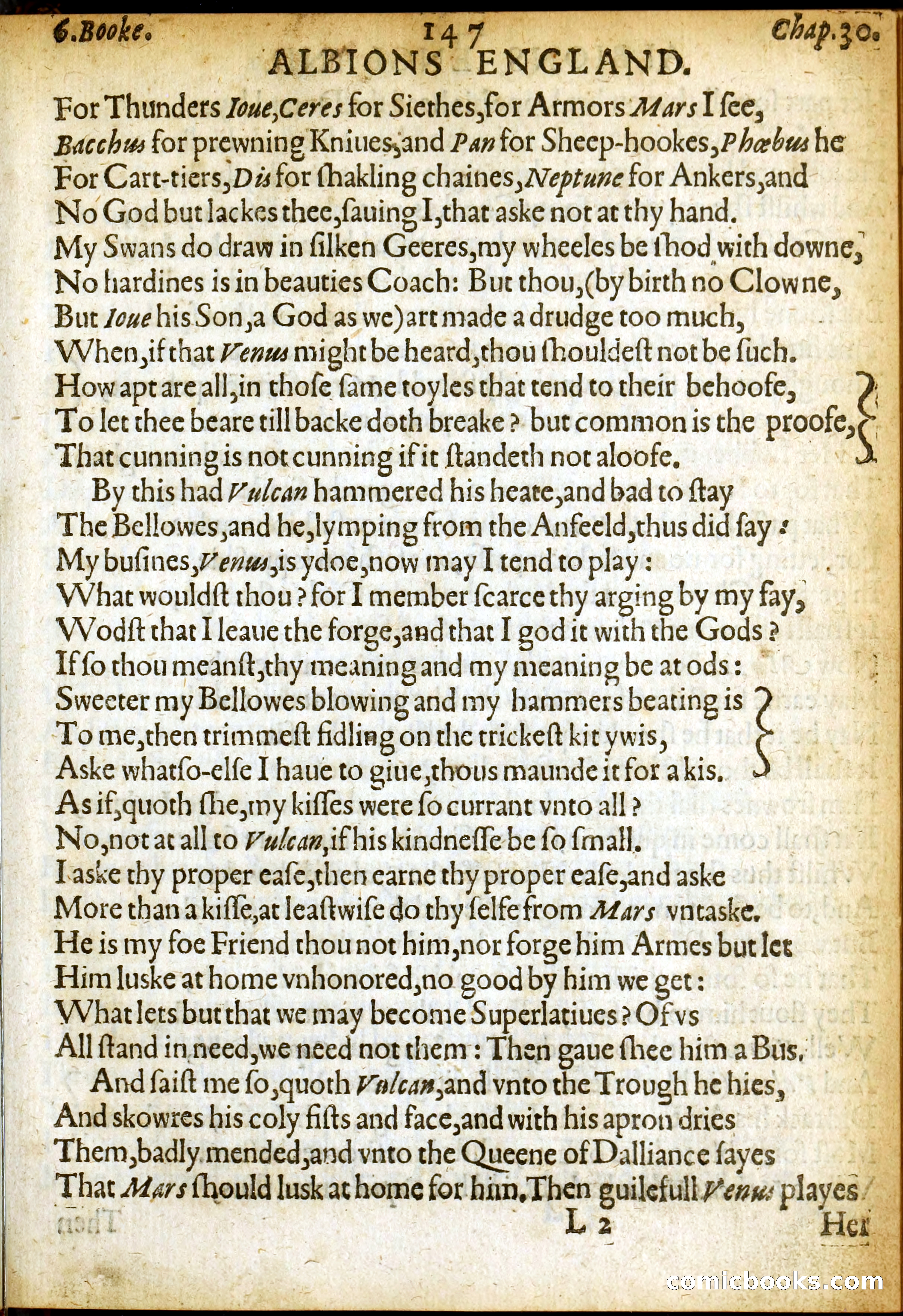
# Page Description This is a page of running verse poetry from what appears to be an Early Modern work (not Victorian—the header reads "Albions England" and uses sixteenth-century typography and language). The text presents a dialogue between Venus and Vulcan in mythological verse, with Venus attempting to persuade Vulcan to abandon his forge and weapons-making. The passage includes classical allusions and discusses matters of love, duty, and divine labor, ending with Vulcan's frustrated response and his departure to wash himself at a trough.
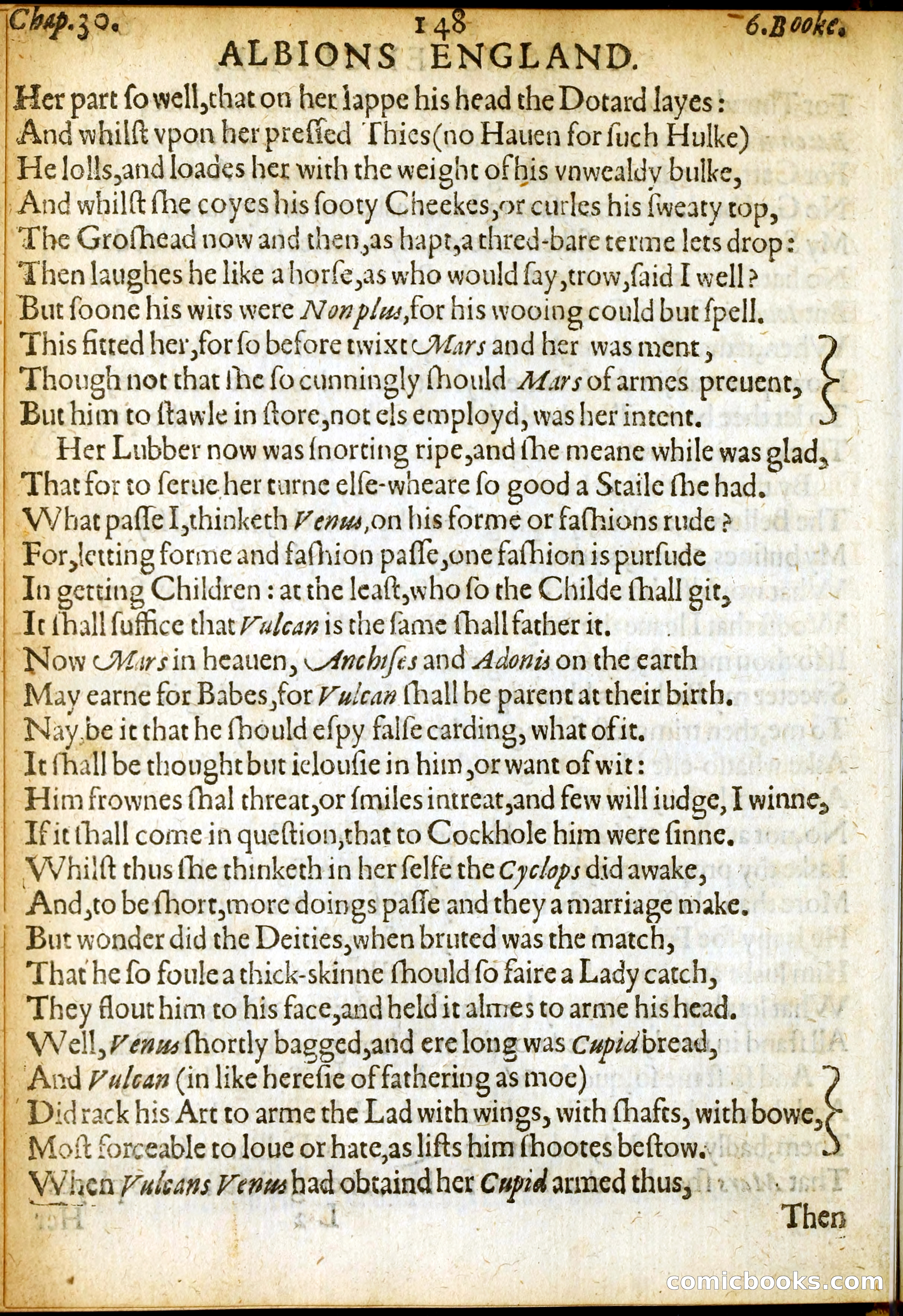
# Description of Page This is a page of running verse from what appears to be a classical or early modern narrative poem titled "Albions England" (visible at top). The text is printed in early modern typeface and consists entirely of poetic couplets describing a crude sexual encounter between a man and woman, followed by mythological commentary involving Venus, Vulcan, Cupid, and Mars. The narrative voice muses on bastardy, divine parentage, and the woman's cunning exploitation of her lover. No illustrations are present—only densely printed text in two columns with period typography and spelling conventions.
# This Page: Running Prose from *Albions England* This is a page of continuous verse narrative (not a penny dreadful, but rather early modern poetry). The text presents mythological drama in rhyming couplets, featuring Venus, Phoebus, Daphne, Cupid, and Vulcan. A female speaker—apparently Vulcan's wife—defends Venus against accusations of wantonness, arguing that the goddess's behavior mirrors that of other deities, and justifies Cupid's actions toward a boy who courted a maiden. The passage concerns divine conflict, love, rejection, and transformation, with classical allusions throughout. The OCR text is heavily corrupted, but the printed page itself shows clearer Early Modern English orthography.
# Page Analysis This is a page of running verse poetry from Chapter 30 of *Albions England*, presented as a woman's monologue. The text appears to be early modern English (not Victorian—the OCR header may be mislabeled), written in a dramatic, conversational style. The speaker defends herself against accusations of infidelity and discusses her husband—a plain smith devoted to Venus—whom she chooses to honor despite his lack of gallantry, praising his virtue and plainness. The verse employs classical allusions (Phoebus, Daphne, Styx, Vulcan) and addresses themes of beauty, constancy, and marital fidelity with a somewhat ironic, self-justifying tone.
# Page from *Albions England* This is a page of **running prose poetry** from what appears to be a narrative work titled *Albions England* (Chapter 30, Book 6). The text is written in early modern English verse and recounts a mythological dispute—apparently involving Venus, Mars, Vulcan, and other classical deities—concerning marital fidelity and a woman's honesty. The speaker argues his wife's virtue against accusations, invokes divine judgment, and references a quarrel among the gods. The passage concludes with what seems to be the beginning of a new episode ("And then he thus begun"). This is characteristic of early modern English narrative poetry rather than Victorian penny dreadful fiction.
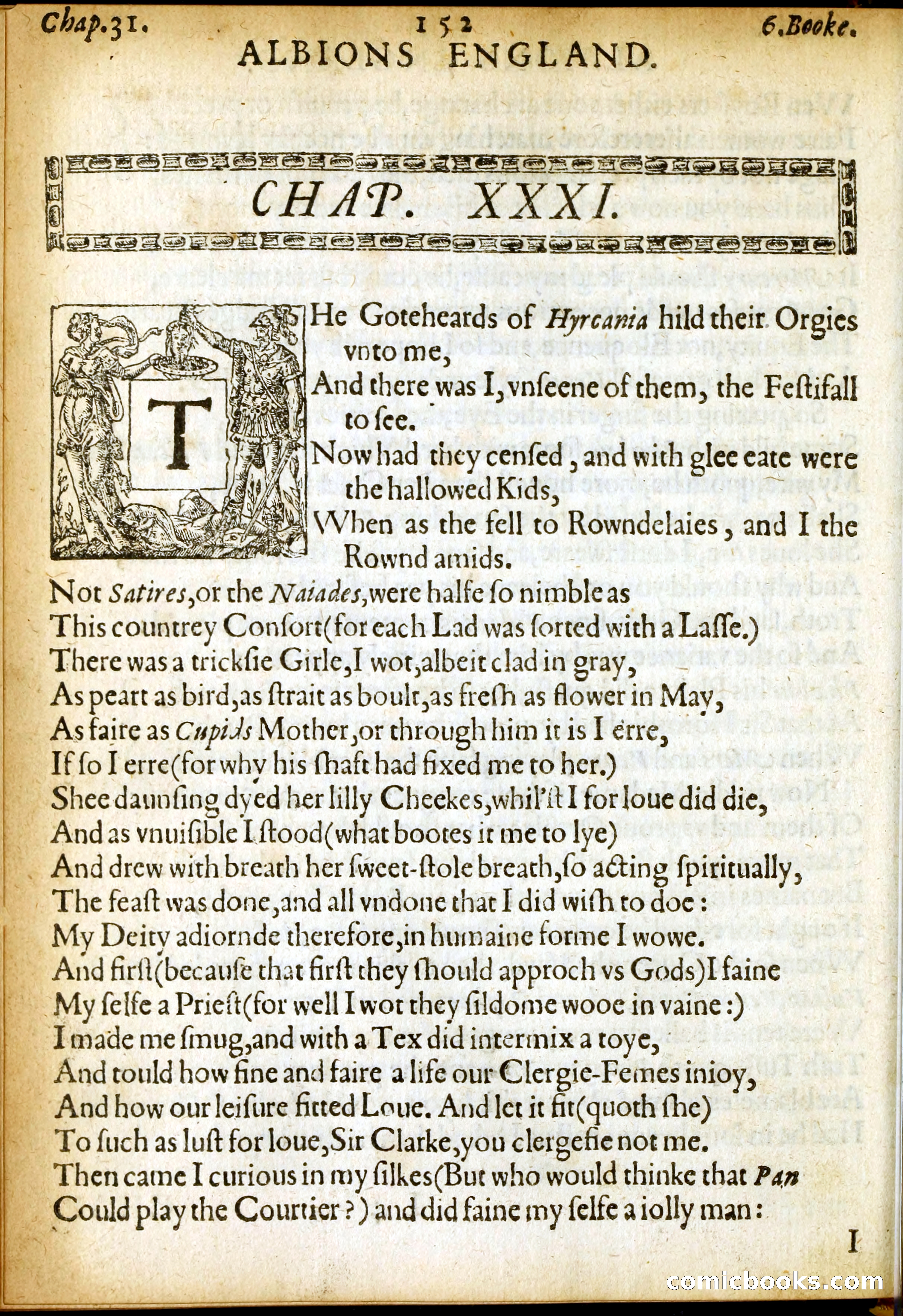
# Page Analysis This is a running prose page from Chapter 31 of *Albions England*, presented in early modern verse (not Victorian penny dreadful as stated in the prompt). The text describes a narrator's attendance at an orgiastic festival held by the Gothcards of Hyrcania, where he encounters a beautiful maiden in gray. The narrator recounts his infatuation with her, his attempts to seduce her by disguising himself as a priest and later as a courtier, and her various rejections. The passage is written in rhyming couplets and contains classical allusions.
# Description of This Page This is a page of running prose poetry from what appears to be an early modern work titled "Albions England" (dated 1553, Chapter 31). The text is not a Victorian penny dreadful, but rather an Elizabethan or Jacobean-era narrative poem in archaic English. The speaker recounts his failed attempts to win a woman's love through various personae—soldier, merchant, countryman, craftsman—before the god Pryapus reveals her infidelity with a rustic man. The passage concludes with the speaker's dismay at this revelation.
This is a page of running verse narrative from what appears to be an early modern literary work titled "Albions England." The text presents a first-person account of courtly love and romantic disappointment. The speaker describes entering a noble court, becoming infatuated with an unknown noblewoman, attempting to win her favor through courtly attentions and accomplishments, and ultimately descending into jealous, unrequited love. The verse discusses how love torments those who experience it, regardless of circumstance, and concludes with the speaker's emotional deterioration from longing. The page references classical figures like Cupid, Priapus, Mercury, and Pan in discussing the nature of desire and romance.
# Analysis of Page from "Albions England" This is a **running prose page** from what appears to be a narrative poem, not a Victorian penny dreadful. The text is from Book 6, Chapter 31 of *Albions England* (a 16th-century historical-poetic work, not Victorian-era sensational fiction). The visible verse concerns a speaker reflecting on lost love and romantic disappointment. The narrator describes physical decline from lovesickness—lost appetite, weakened senses, pallor—and watches the beloved remain unmoved. The passage includes the speaker's internal reasoning about accepting rejection with dignity, arguing that "no folly were in Love, if so no folly were in us," and concluding that it is better to lose love early than to persist futilely. The narrative voice resolves to leave, enduring "scorne and skoffe" (scorn and mockery).
# Page Analysis This is a running prose page from what appears to be an early modern dramatic or poetic work titled "Albions England" (visible at top). The page consists entirely of verse text in Early Modern English, discussing love, women, and courtship through mythological and classical references (Jupiter, Mars, Mercury, Pan). The speaker reflects on love's nature, women's constancy, and recounts his own courtship "with rufull lookes, sighes, sweete Pigfnye, and Fooleries." The language and typography suggest this predates Victorian penny dreadfuls—it appears to be from the 16th or 17th century, not Victorian sensation fiction.
# Page Description This page contains running prose poetry from "Albions England," printed in early modern English (not Victorian). It is not a penny dreadful, but rather an excerpt from a sixteenth-century historical-mythological poem. The visible text discusses Love as a universal force, referencing Adam and Eve, Venus and Vulcan, and the gods' pronouncements on desire in men and women. The verse debates whether love is "fantastical" (imaginary) or real, and makes prophecies about future nations and conquests. The language and typography (including Old English letterforms) confirm this is antique literary material, not Victorian popular fiction.
# Content Description This is a page of running prose poetry from Chapter 32 of *Albions England*, a historical verse narrative. The text discusses English royal succession, beginning with dialogue between a Queen and "Tuder" regarding divine will and fate, then transitioning to Chapter XXXII, which recounts the fifth Henry's son inheriting his father's throne as a child. The passage goes on to describe conflicts between his peers and parasites, and mentions Richard Plantagenet, Duke of York, who sought to reclaim rights for the house of York against King Henry's queen, with the text breaking off mid-sentence at page's end.
# Page Description This is a page of running prose poetry from what appears to be a historical narrative work titled "Albions England" (visible at top). The text is printed in Early Modern English typeface on aged, yellowed paper (page 159, Chapter 32). The visible verse discusses English royal succession and conflict, mentioning King Henry, Edward (Earl of March), and references to Scotland, France, and various nobles including Warwicke and Lancaster. The passage describes battles, political maneuvering, and dynastic struggles, with particular focus on a Queen, Prince of Wales, and matters of inheritance and military defense. The language and style suggest this is a historical poem or chronicle rather than sensation fiction, though the page's condition and typography match the Victorian-era printing described.
# Page Description This is a page of running verse prose from what appears to be an early modern historical narrative poem (not a Victorian penny dreadful as stated in the prompt—the typography and language style suggest 16th or 17th-century publication). The text recounts English dynastic conflicts, specifically describing Edward IV's military victory, the capture of a queen and prince, the stabbing death of a young boy by the Duke of Gloucester, and Edward IV's eventual death. The passage then shifts to describe Richard, Duke of Gloucester, who becomes protector of Edward's young son but proves tyrannical and murderous, eliminating rival claimants including his nephews and niece to secure power. The narrative emphasizes Richard's cruelty toward both Lancastrians and York's own blood relations.
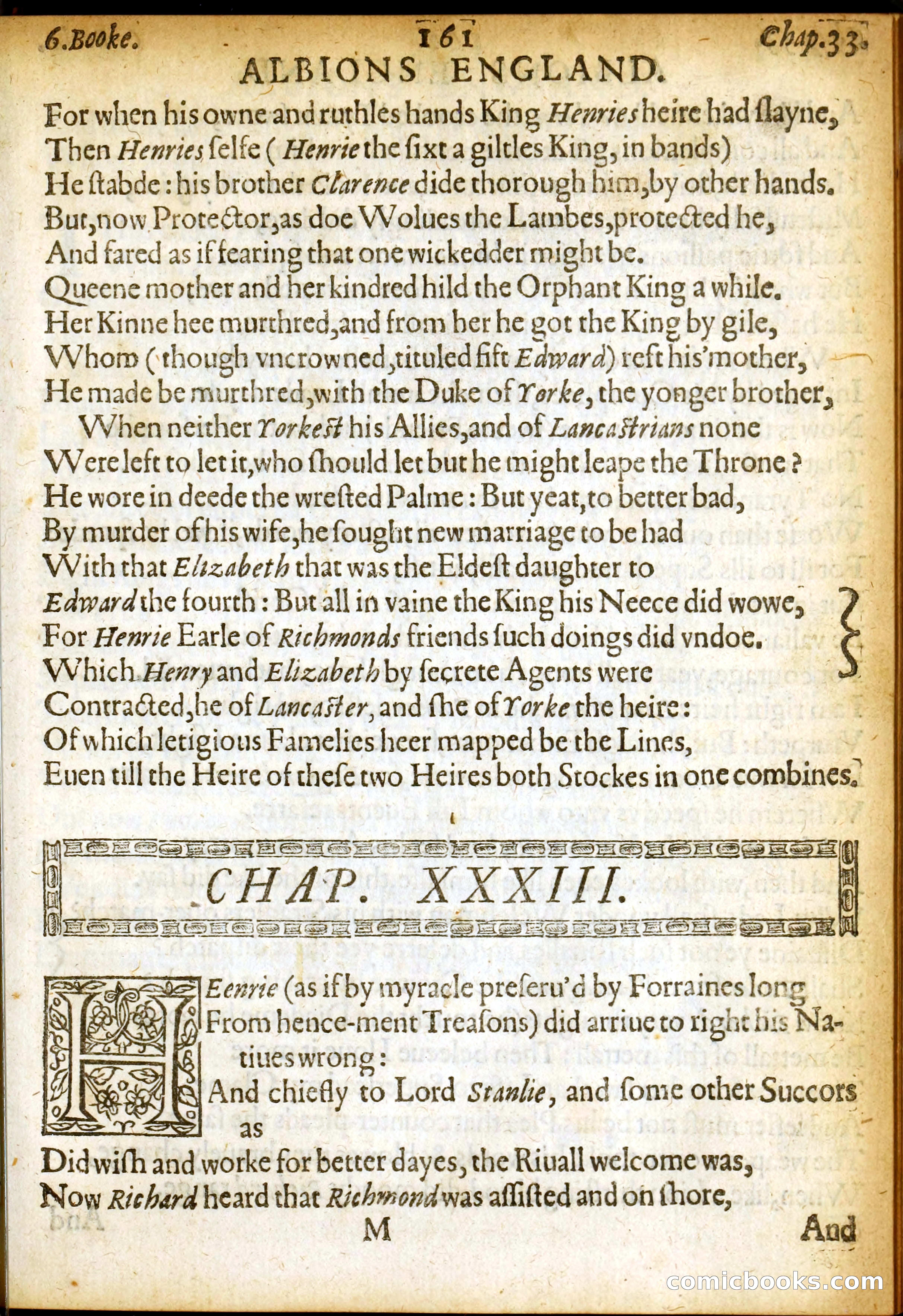
# Analysis of This Page This is a page of running verse text from a historical narrative poem, not a penny dreadful as described in your prompt. The page presents Chapter 33 from "Albion's England," a chronicle-poem about English history. The visible text recounts the reign of King Richard III, detailing his murdering of his nephews (including the young Edward V), his failed marriage attempt to Edward IV's daughter Elizabeth, and the conspiracy of Henry Tudor (the future Henry VII) and Lord Stanley to oppose him. The final lines note that Richard learns Richmond (Henry) has arrived with foreign support and landed on shore. The layout includes decorative chapter heading and ornamental initial letter typical of early printed books.
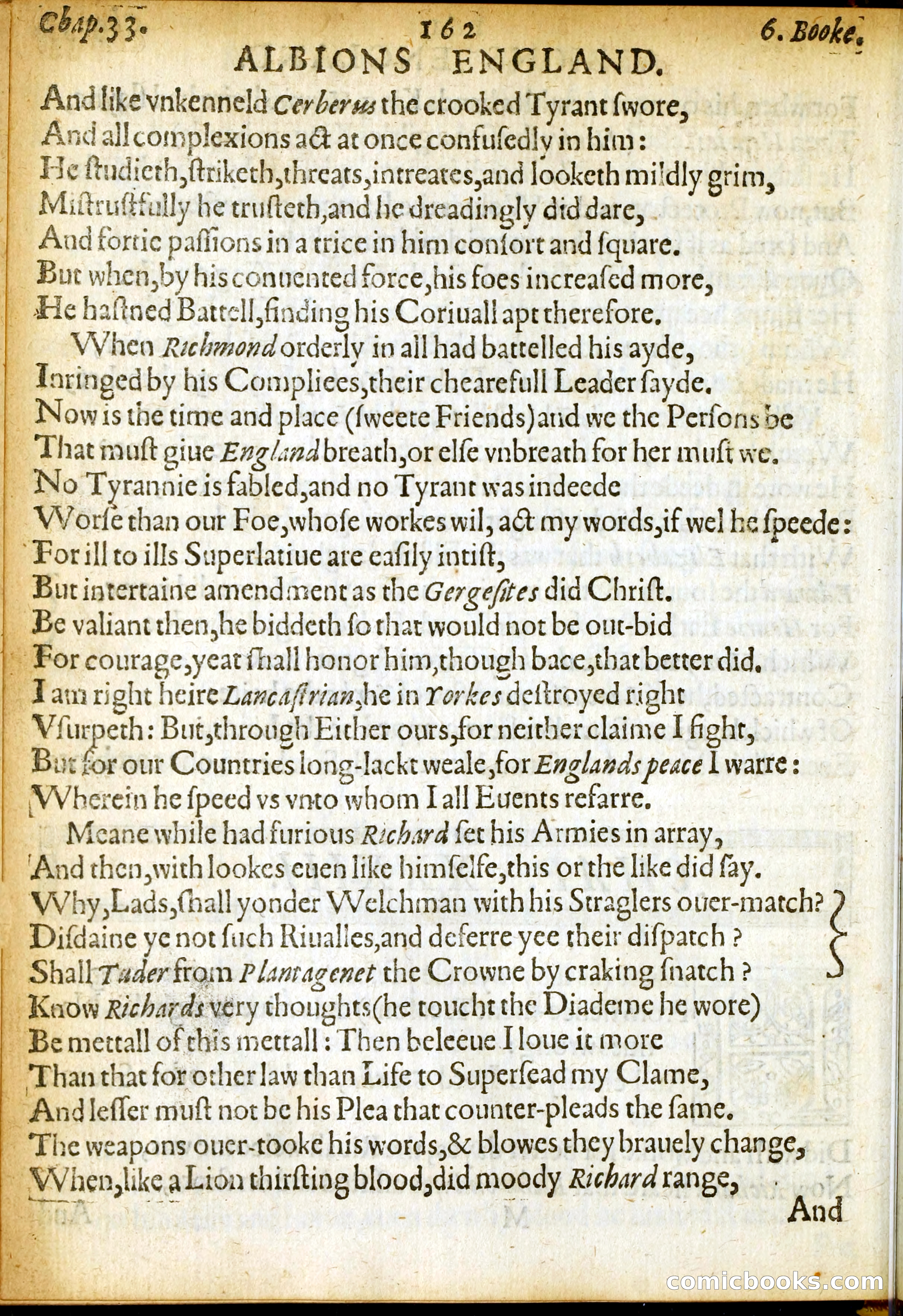
# A Page of Running Verse from *Albions England* This is a page of continuous narrative poetry from Chapter 33 of what appears to be Samuel Daniel's *Albions England* (1602). The text describes a confrontation between the tyrant Cerberus and Richard (seemingly Richard III), with Richmond preparing for battle. The passage includes rousing speeches—one urging English soldiers to fight for their country's peace, another showing Richard arming himself dramatically before combat, comparing him to a lion. The verse is in Early Modern English couplets and concerns itself with themes of tyranny, rightful succession, and martial courage during what appears to be a historical conflict.
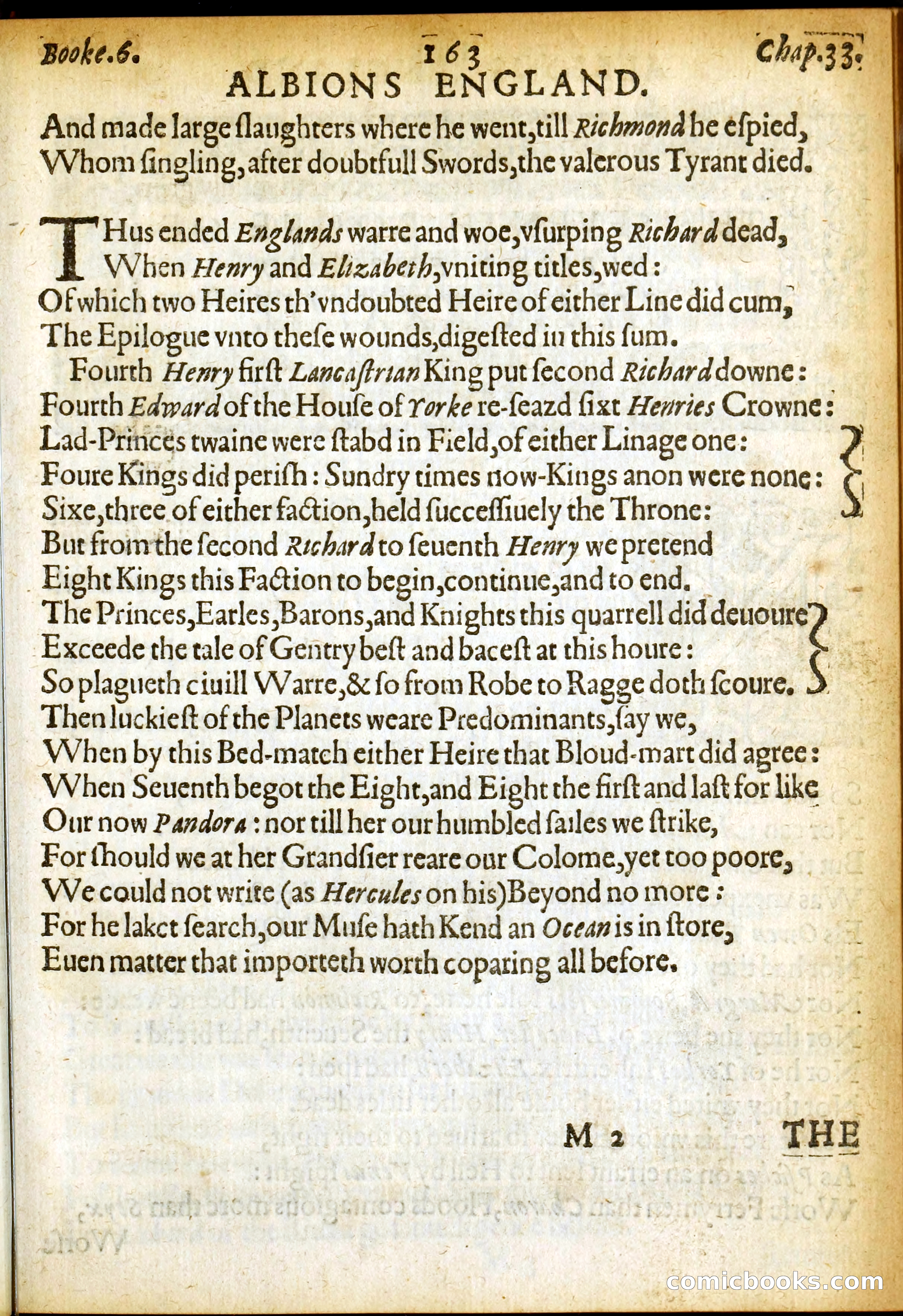
# This page contains running prose in verse form from a historical narrative work. This is a page of poetic text from *Albions England* (Book 6, Chapter 33), discussing the conclusion of England's Wars of the Roses. The verse describes how Richmond defeated Richard (the "Tyrant"), after which Henry and Elizabeth united their titles through marriage. The passage enumerates the succession of kings from Richard II through Henry VII, noting the civil conflict between the houses of Lancaster and York, and concludes by suggesting the author has exhausted their historical material and lacks further matter worthy of narration.
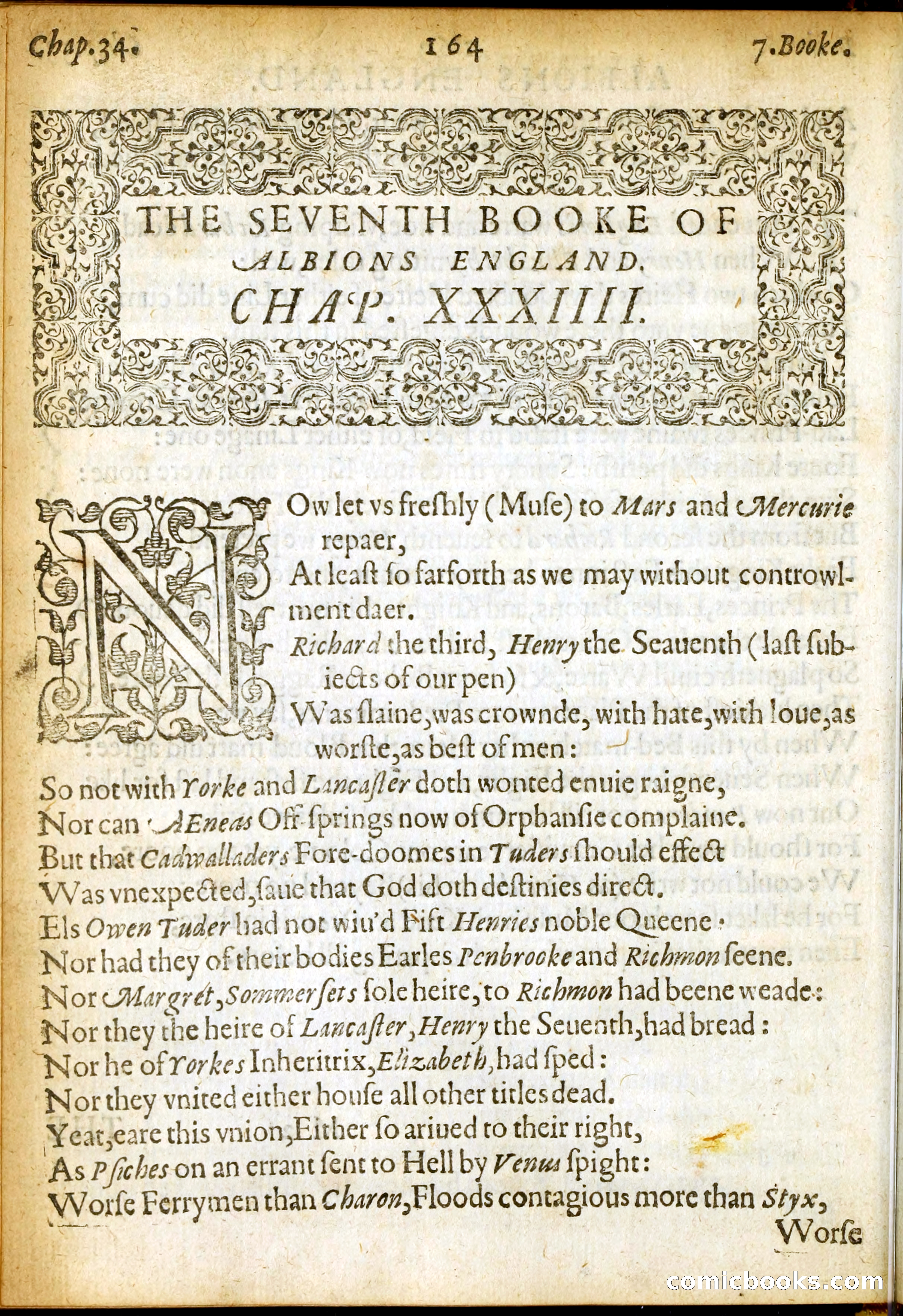
This page is running prose—specifically verse narrative from "The Seventh Booke of Albions England," Chapter 34. The text recounts the dynastic struggles between York and Lancaster, focusing on Richard the Third and Henry the Seventh, their fates, and how divine providence arranged the union of these houses through Owen Tudor and Henry's queen. The verse emphasizes that unexpected deaths and God's design brought about the unification, comparing the obstacles overcome to classical horrors (Charon, Styx, Venus).
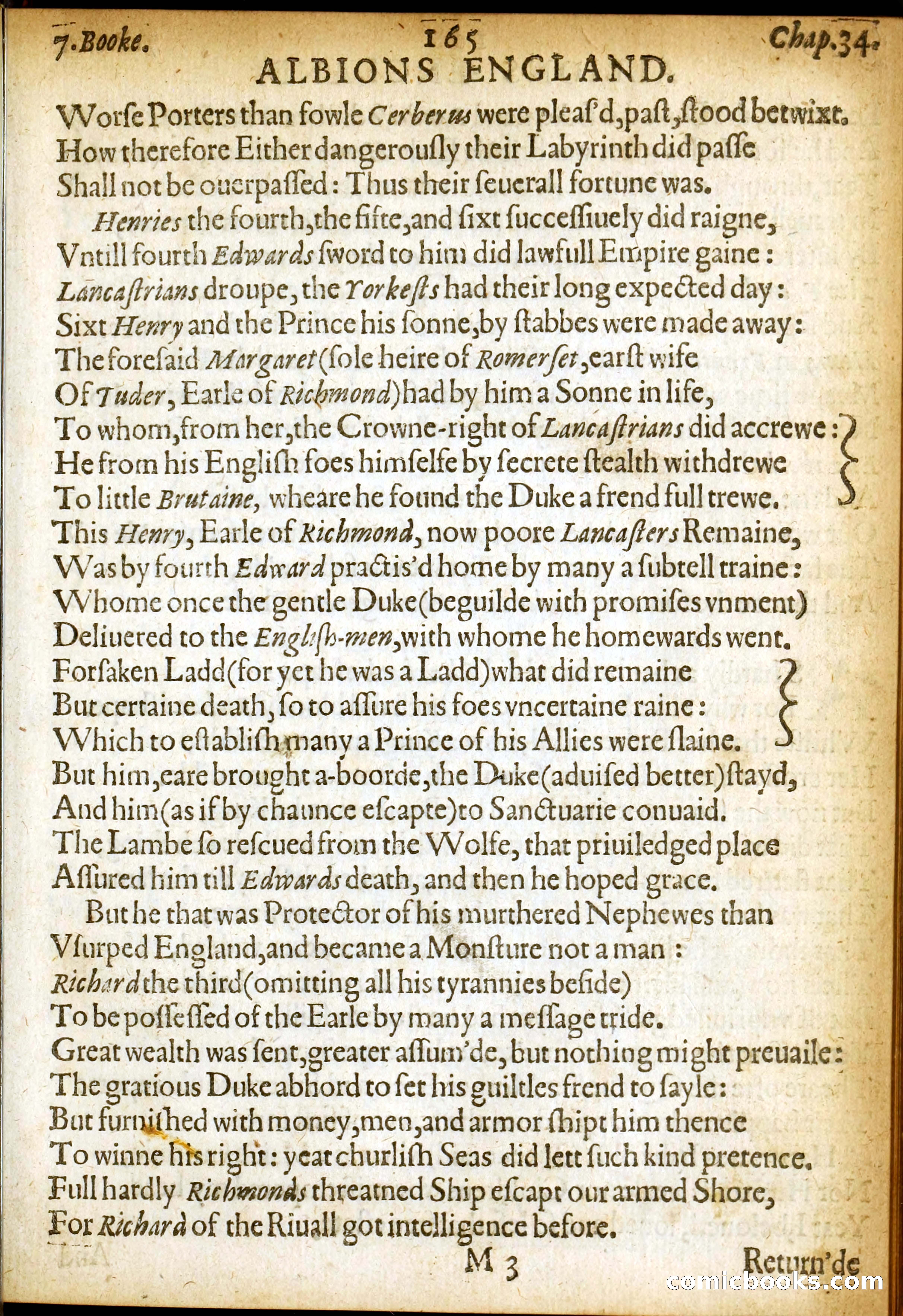
# Analysis of Page This is a **running prose page** from a longer narrative poem titled "Albions England" (visible in the header). The page is numbered 165, Chapter 34. The text is written in early modern English verse and traces English royal history, focusing on the Wars of the Roses and the fates of various kings named Henry and Edward. It recounts how Henry, Earl of Richmond (later Henry VII), fled England to escape persecution, found refuge in Brittany under a sympathetic duke, and was subsequently equipped with money, men, and armor to return and claim his rightful throne—though the seas initially hindered his voyage. The passage emphasizes themes of betrayal, sanctuary, and the struggle for dynastic legitimacy.
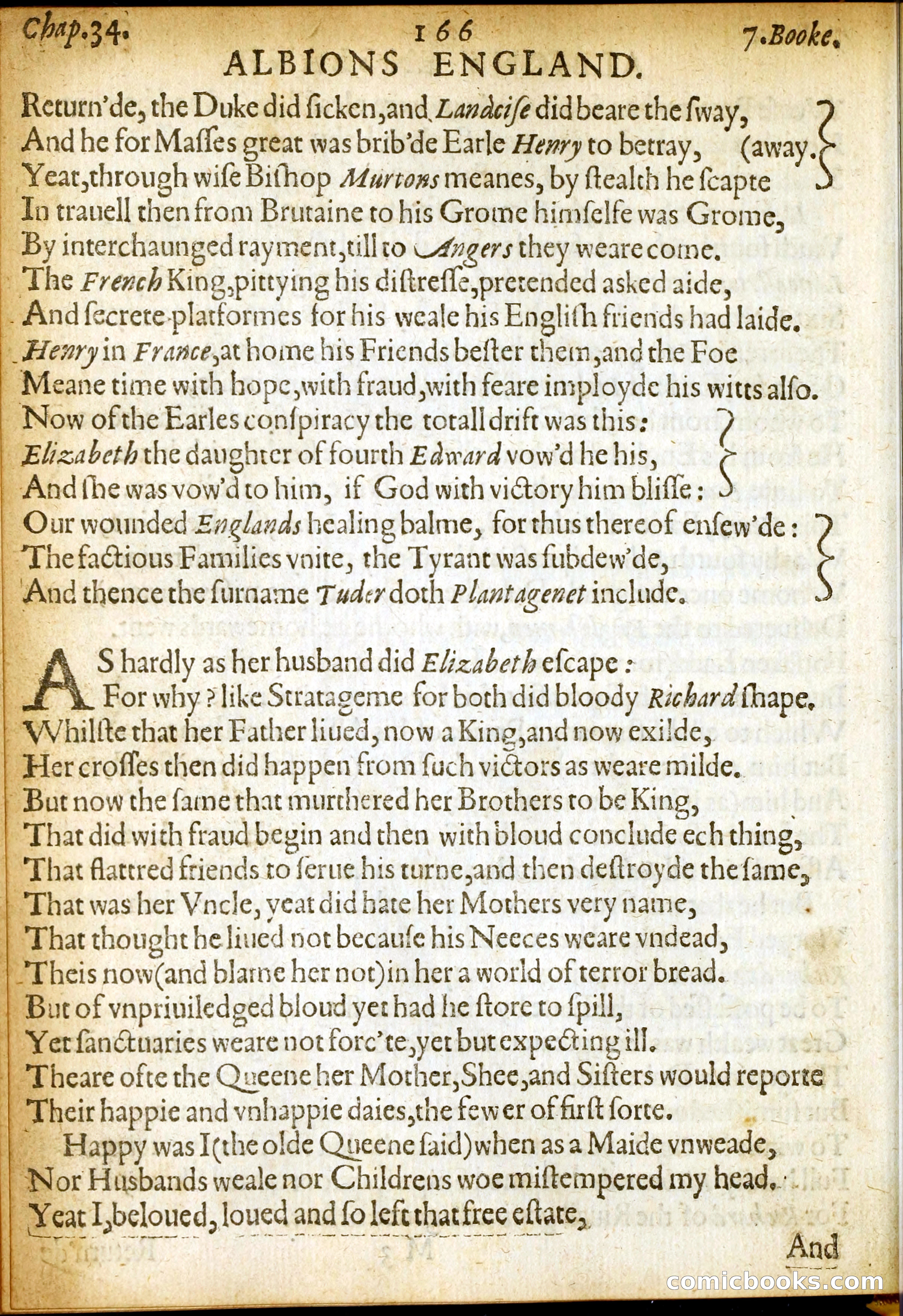
# Analysis of Page from *Albions England* This page contains running verse text—not a title page or illustration—from what appears to be Samuel Daniel's *Albions England*, a historical poem in Early Modern English. The visible text discusses political intrigue surrounding Elizabeth (daughter of Edward IV) and her marriage vow to Henry, framed as healing England's wounds. The passage then shifts to describe Elizabeth's later suffering under her uncle Richard, who murdered her brothers to become king, leaving her in "a world of terror." The final lines present an older queen (apparently Elizabeth's mother) reflecting on her happier days before marriage and motherhood burdened her with worry. The text concerns Tudor genealogy and dynastic conflict, not Victorian penny dreadful material.
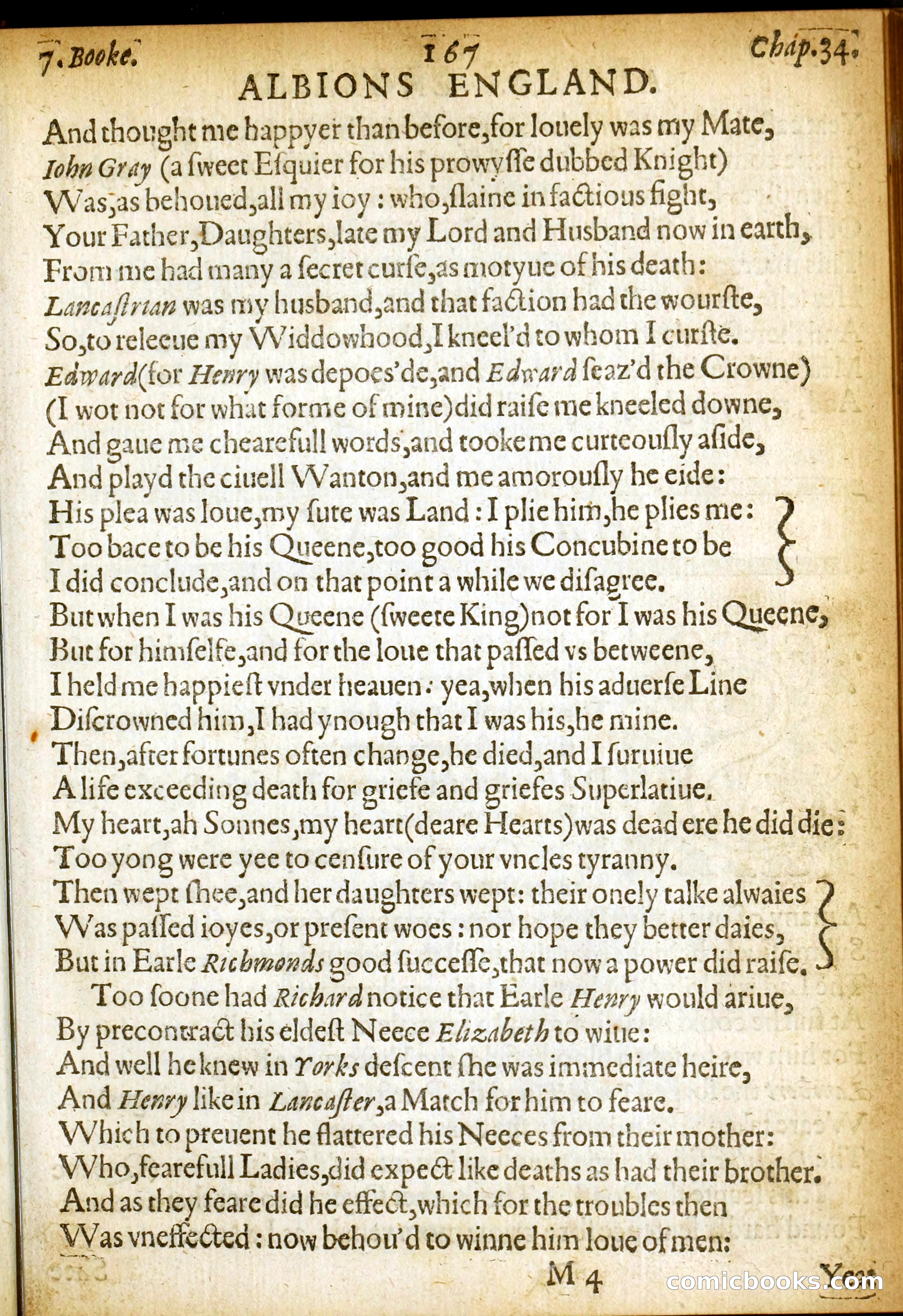
# Analysis of Page This is a **page of running prose poetry** from what appears to be a historical narrative work titled "Albions England" (visible in header). The text is written in early modern English verse and recounts a woman's account of her marriages and political circumstances during England's Wars of the Roses. She speaks of her first husband John Gray, then her marriage to King Edward (who seized the crown), his death, and subsequent threats to her daughters from Richard, who seeks to prevent Henry Tudor's claim by controlling the succession. The passage emphasizes themes of love, political ambition, and family tragedy spanning multiple reigns.
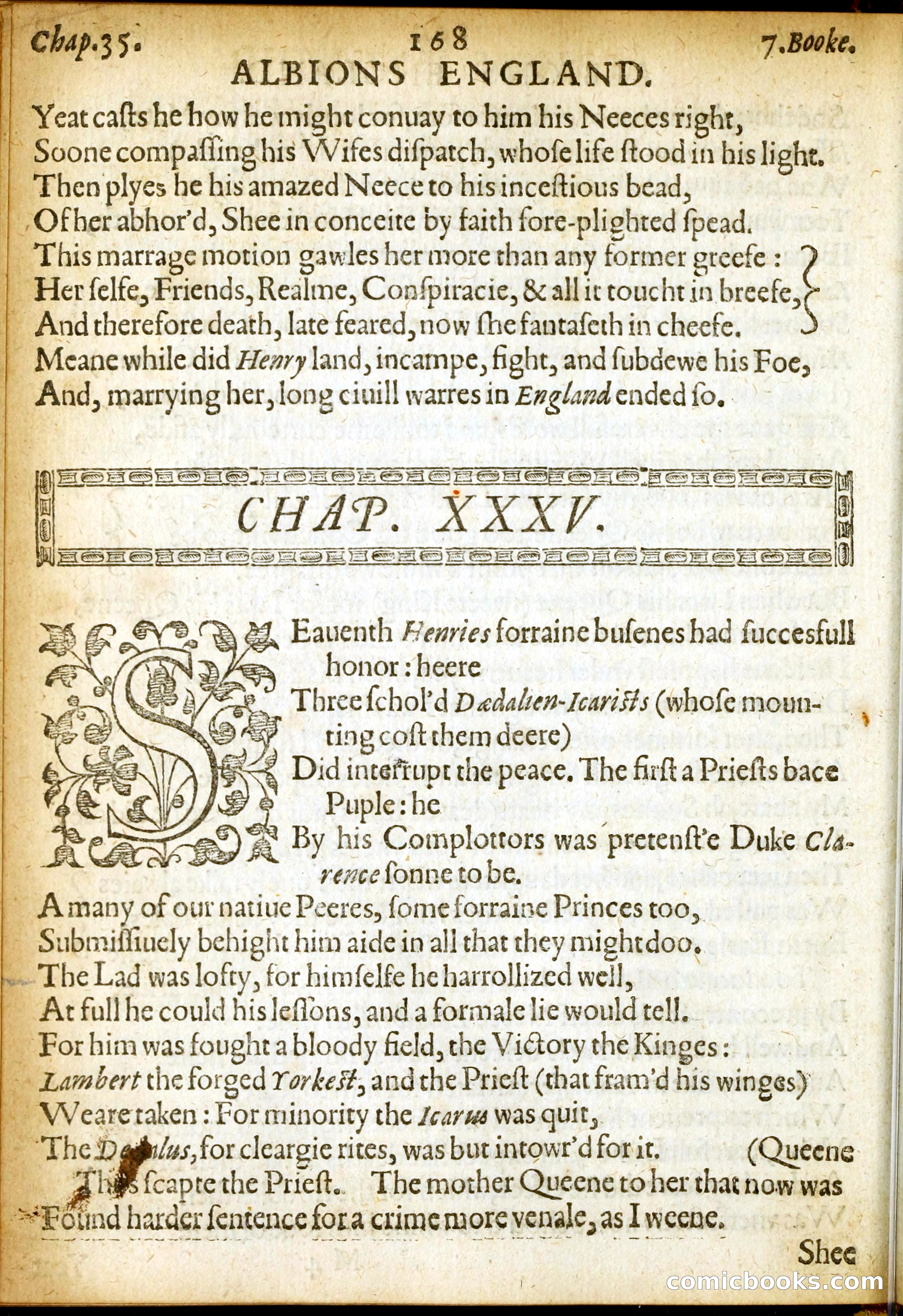
# Description This is a page of running prose from what appears to be a narrative poem in early modern English. The page contains the conclusion of Chapter 35 and the beginning of Chapter 35 (labeled "CHAP. XXXV"). The text describes historical events involving Henry (apparently Henry VII) landing in England, subduing a foe, and marrying a woman, thereby ending civil wars. Chapter 35 then begins discussing Fauchteenth Henry's successful reign, interrupted by a rebellion involving "three-fold Deddalen-Icarists" and conspirators who falsely present the "forged Yorkes" as the rightful Duke Clarence. The passage references battles, a priest, and a Queen pronouncing judgment on crimes.
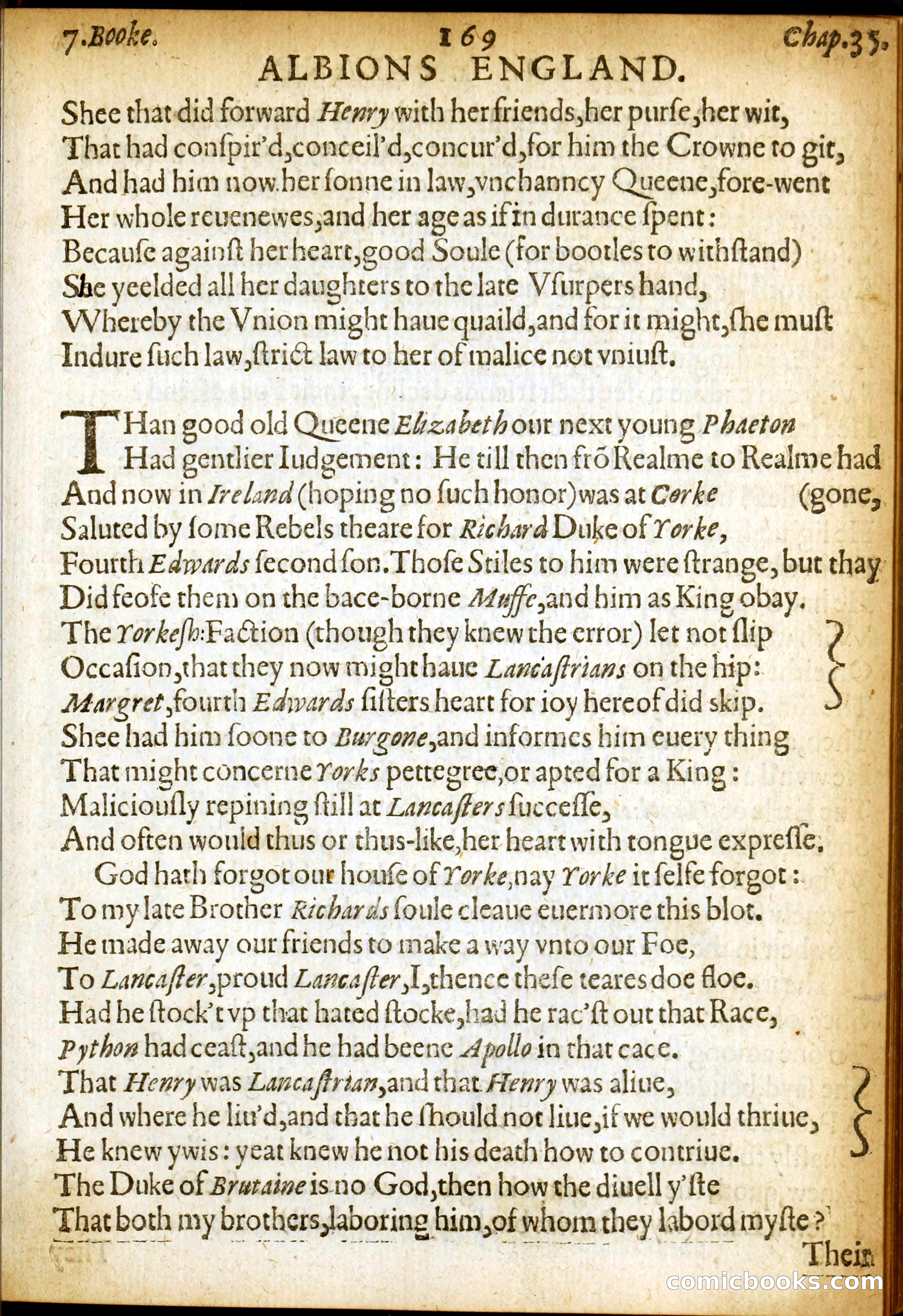
# Page Analysis This is a page of running verse narrative prose from *Albions England* (Book 7, Chapter 23, page 169). The text, rendered in early modern English spelling and typography, appears to recount political intrigue involving Queen Elizabeth, Richard Duke of York, Henry (Lancaster), and various noble factions. The passage discusses accusations of betrayal, dynastic conflict between York and Lancaster, and expressions of bitterness over past wrongs—specifically lamenting that someone (Richard) caused the death of family friends and allies. The overall content concerns itself with historical claims about succession disputes and factional rivalry in medieval English politics.
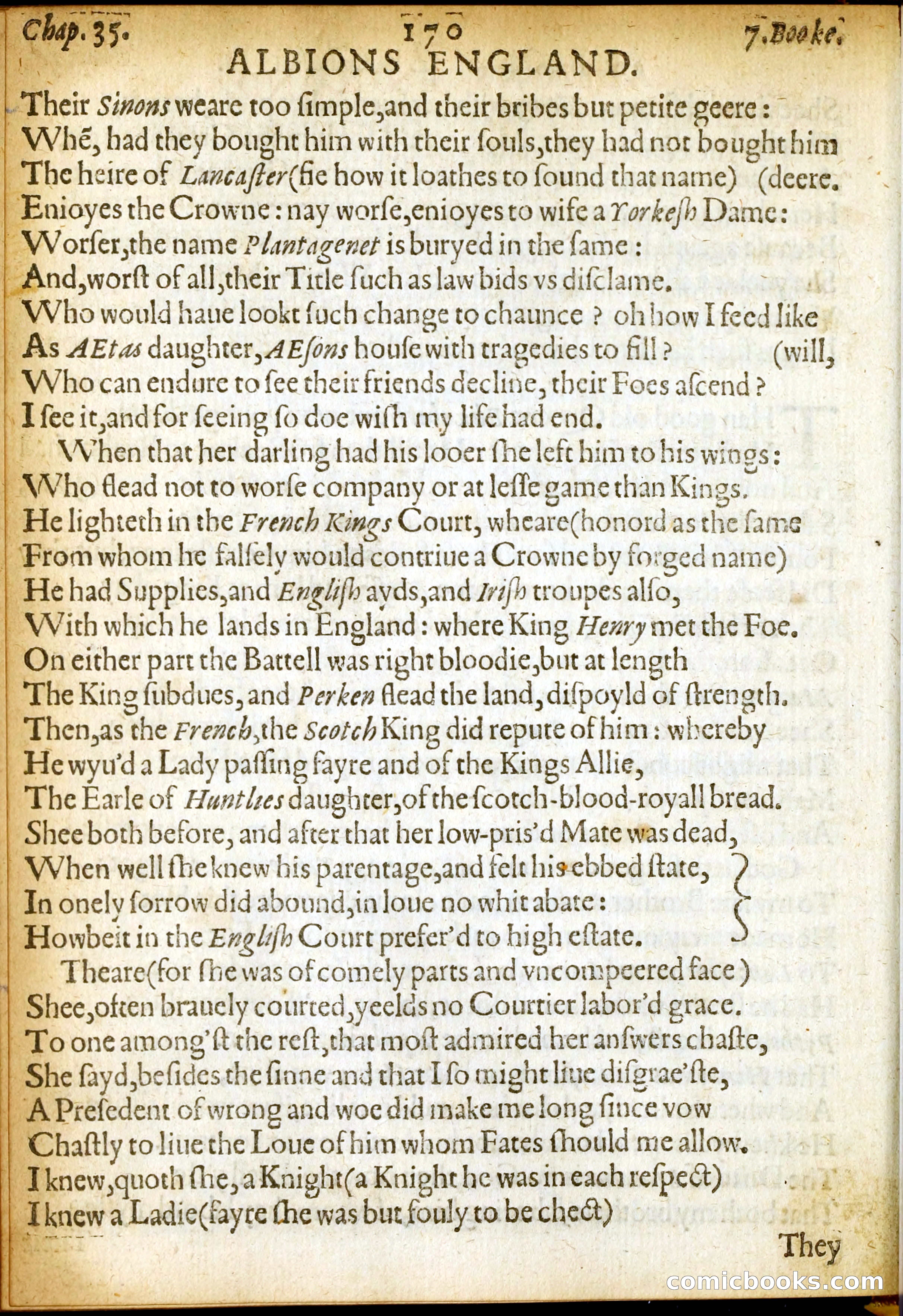
# This Page from "Albions England" This is a page of **running prose poetry** (not a title page or illustration), displaying Chapter 35 of what appears to be Samuel Daniel's historical poem "Albions England." The visible text narrates events surrounding the Wars of the Roses and King Henry VII, focusing on Perkin Warbeck's attempt to claim the English throne with French and Scottish support, and his subsequent defeat. The passage then shifts to describing a Scottish noblewoman (the Earl of Huntly's daughter) who marries Warbeck and, after his death, remains steadfastly devoted to his memory despite her elevated position at the English court.
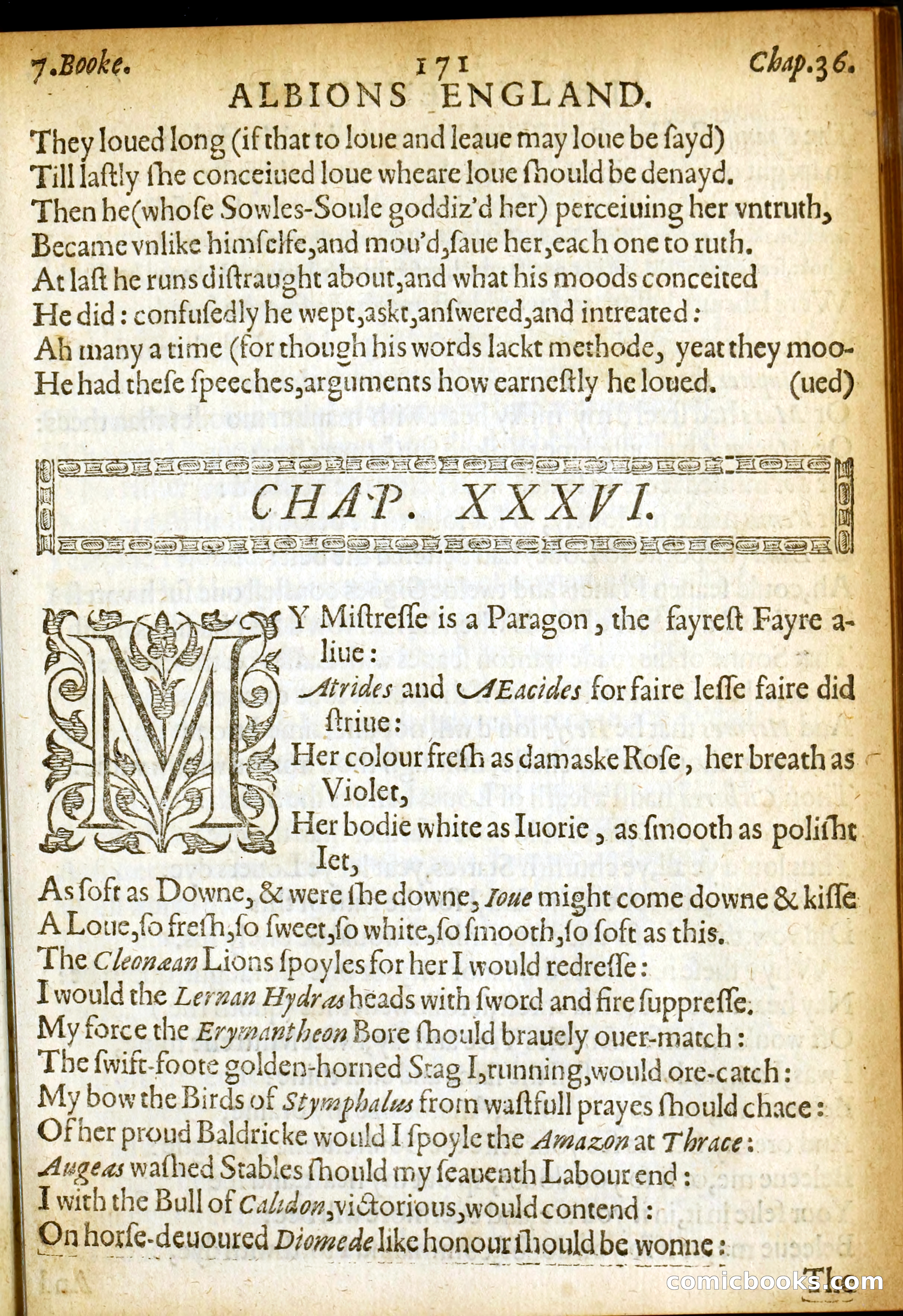
This is a page of running prose poetry from what appears to be an early modern literary work (not actually Victorian penny dreadful, despite the prompt's framing). The page shows Chapter 36, with the opening stanzas depicting emotional turmoil—a male character weeping and pleading after discovering his beloved's infidelity. The chapter then shifts to describe "Mistresse" as a paragon of beauty, comparing her to classical figures (Atrides, Eacides) and launching into a catalogue of mythological labors the speaker would undertake to win her, referencing the Nemean Lion, Lernaean Hydra, and other Herculean tasks. The ornamental chapter heading and dense poetic language suggest this is from an older printed romance or epic poem, likely sixteenth or seventeenth century.
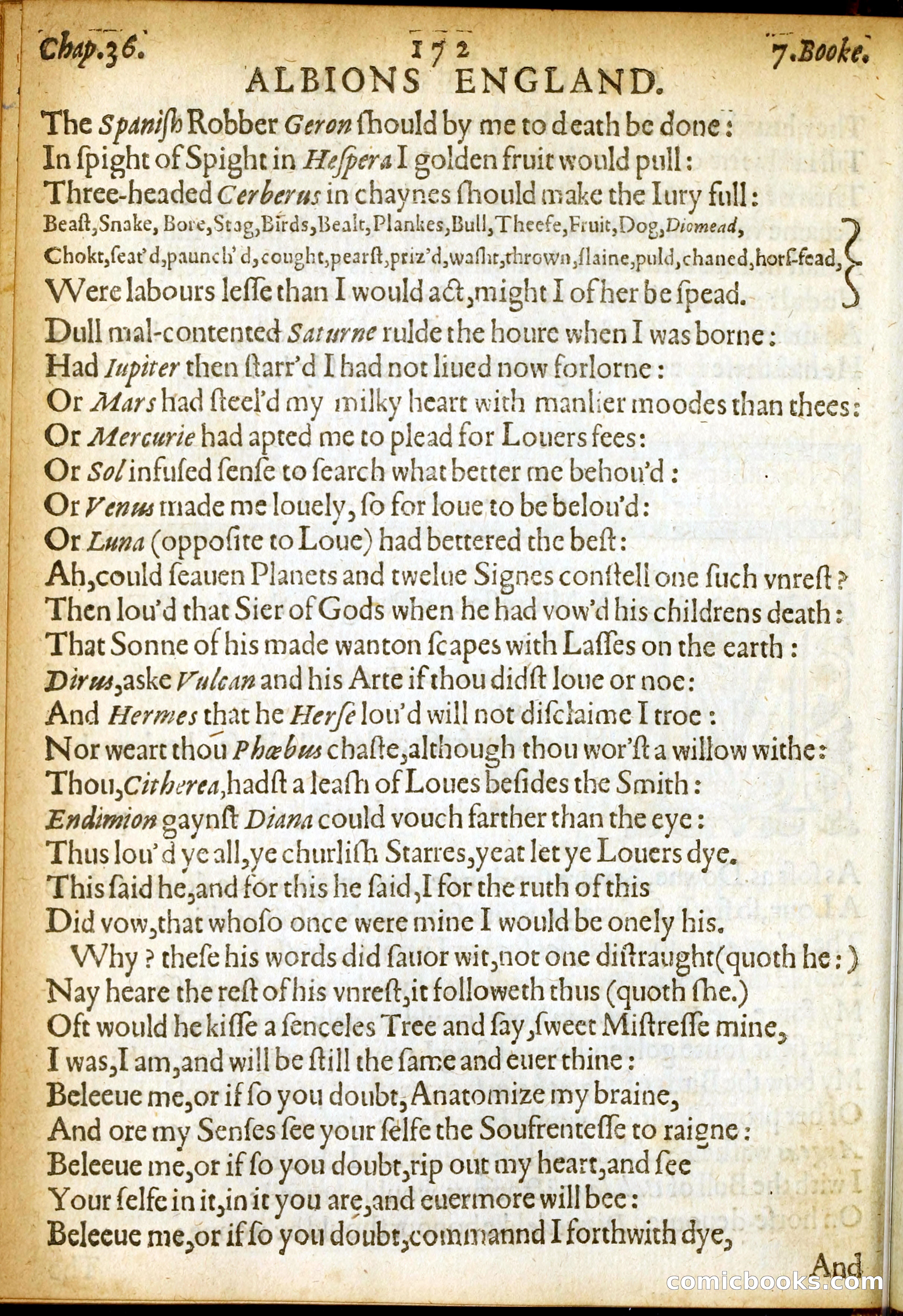
This is a page of running prose poetry from *Albions England* (Chapter 26, Book 7), not a Victorian penny dreadful as the prompt suggests—the typography and language indicate this is an early modern text, likely from the 16th or 17th century. The passage appears to be a dramatic monologue in which a character (possibly a lovelorn speaker) invokes various classical deities and celestial bodies, lamenting their fate and expressing passionate devotion. The speaker catalogs punishments they would endure and references mythological figures (Saturn, Jupiter, Mars, Venus, Diana, Endymion) while describing vows of eternal love and devotion to an unnamed beloved.
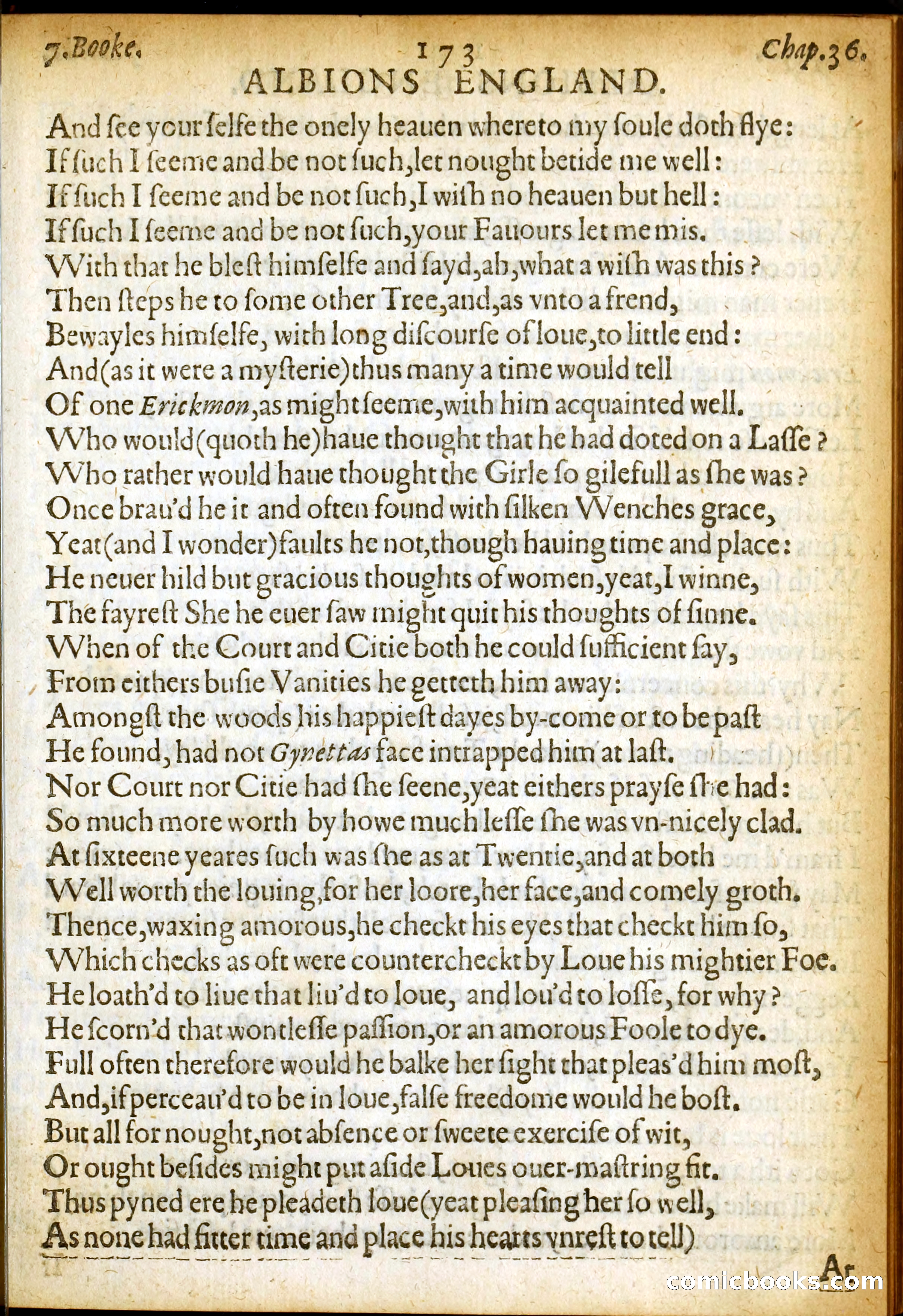
This is a page of running verse poetry from what appears to be an early modern or Renaissance-era work titled "Albions England" (visible at page top). The text describes a man named Erickmon who falls in love with a beautiful young woman called Gyrettas, struggles with his passion for her, attempts to hide his feelings through absence and wit, but ultimately cannot overcome love's power over him. The passage is written in archaic English with old-fashioned typography and spelling conventions typical of early printed books.
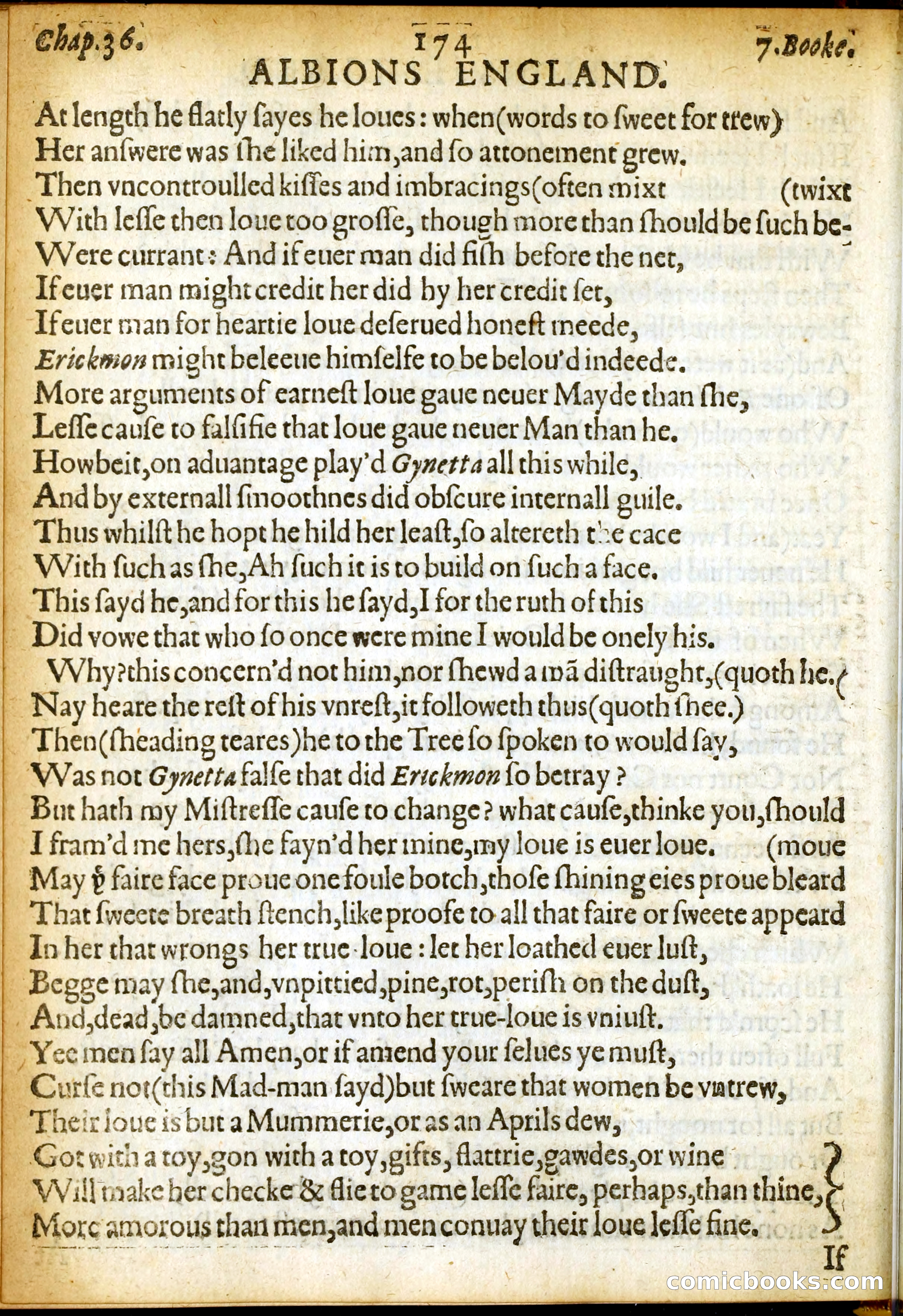
# Analysis of Page This is a page of running poetry text from *Albions England*, a historical narrative poem (not a Victorian penny dreadful as initially suggested—the archaic typography and language indicate this is an early modern work, likely 16th or 17th century). The visible text presents a dramatic love story in verse: a man and woman exchange passionate declarations and kisses, but the woman (Gynetta) deceives him through outward sweetness while harboring inner treachery. The passage culminates in the betrayed lover's bitter curse against women's faithlessness, declaring their love merely superficial ("a Mummerie, or as an Aprils dew"). The speaker rails against feminine deception and vows women cannot be trusted, despite appearing fair and loving.
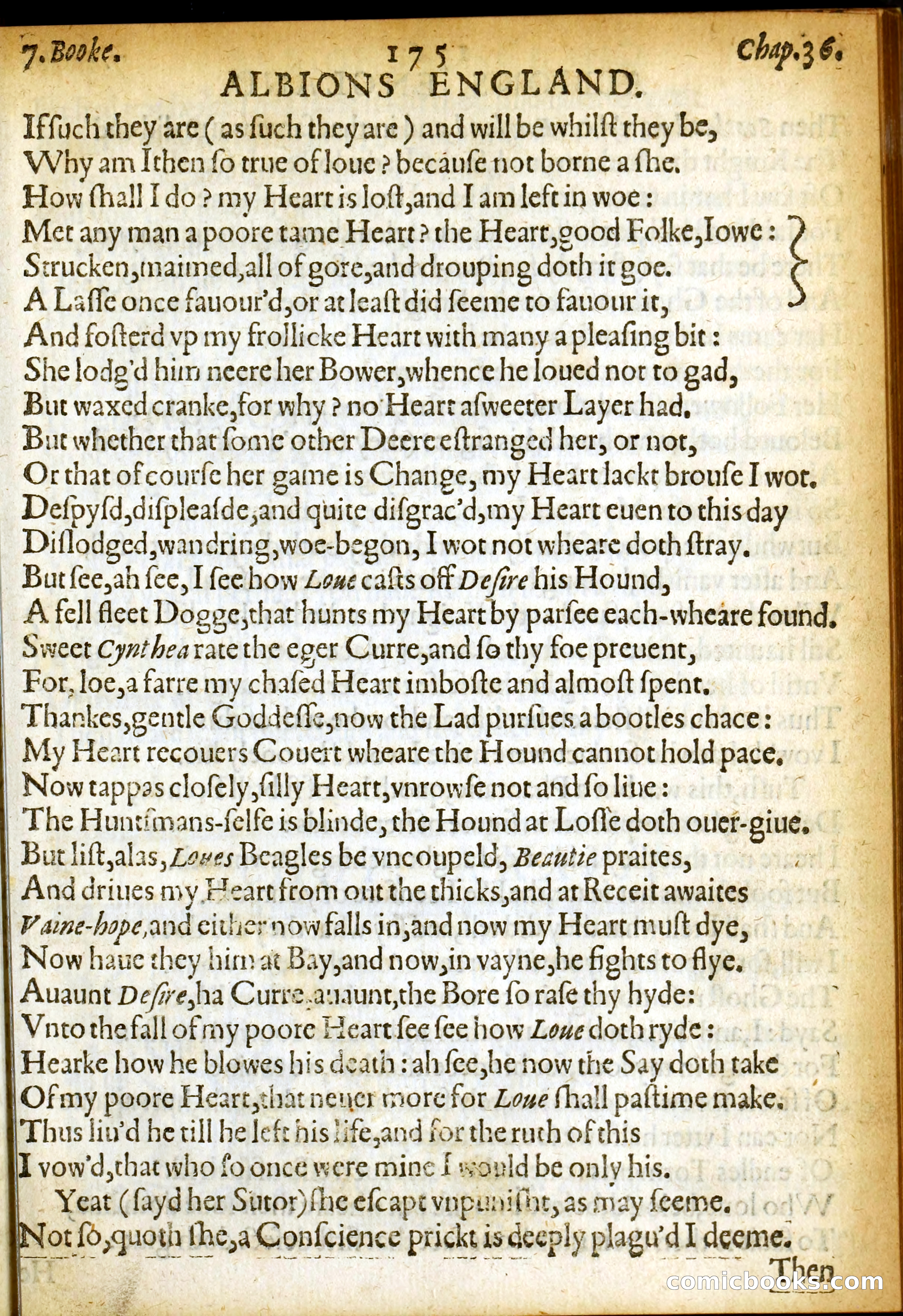
# Albions England, Page 175 This is a page of running verse poetry from what appears to be *Albions England*, a historical/legendary narrative poem. The text presents a dramatic monologue lamenting lost love through an extended metaphor comparing the speaker's heart to a hunted animal pursued by hounds representing desire and beauty. The speaker describes how a lady once favored him, but her affections changed, leaving his heart "stricken, maimed, all of gore" and now perpetually hunted by Love's beagles until it meets its final fall. The verse employs archaic spelling and Early Modern English conventions typical of 17th-century poetry rather than Victorian penny dreadful material.
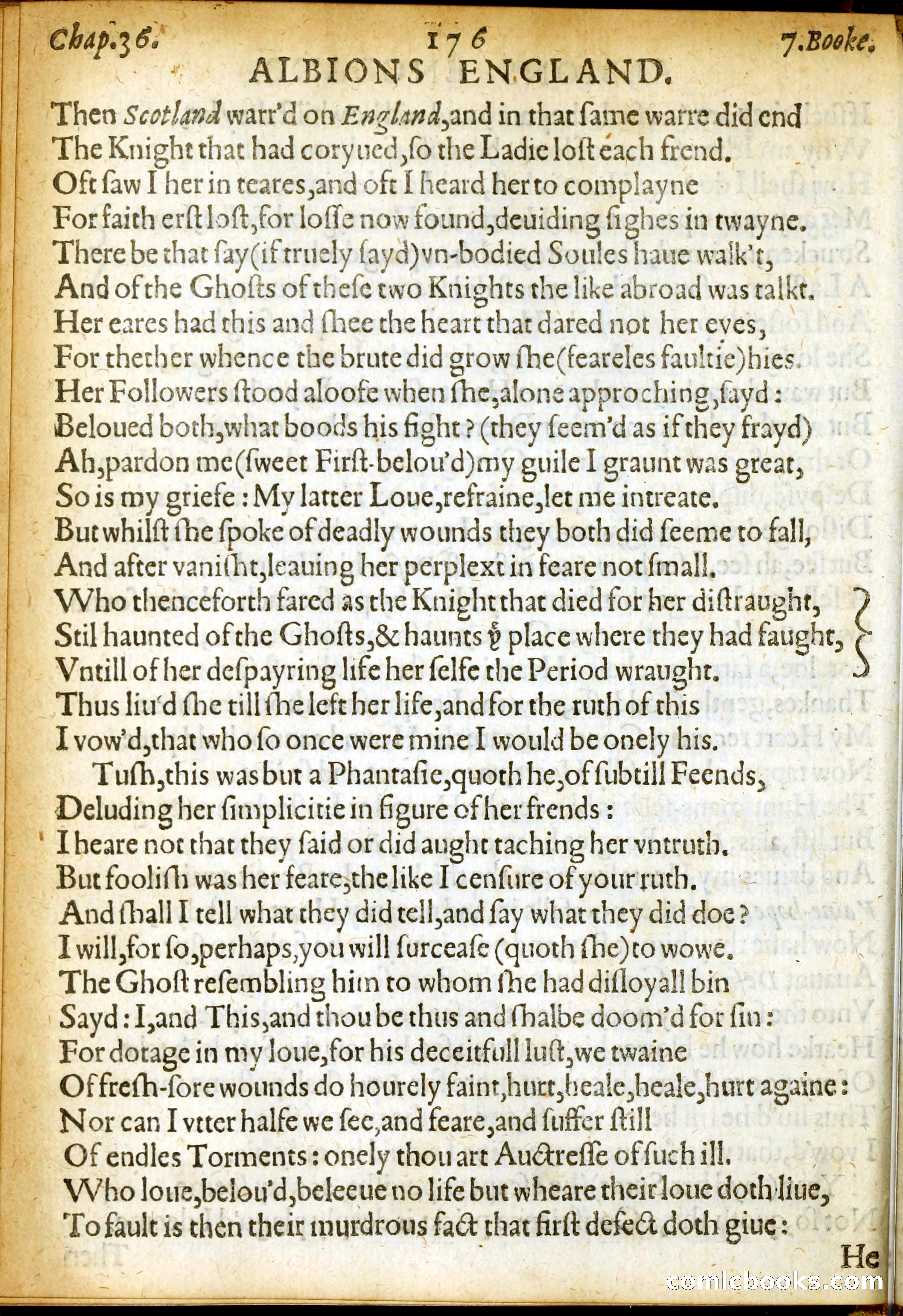
# "Albions England," Chapter 36, Book 7 (page 176) This page contains running prose poetry describing a tragic supernatural tale. A lady, left bereft after two knights die in combat over her, is haunted by their ghosts and gradually wastes away in despair. The narrative explains that the ghosts were actually deceptions sent by "subtull Fiends," yet the lady's fate remains sealed—she is condemned to eternal torment for her "dotage" in love and the deceitfulness of passion. The passage concludes with a moral warning that those who love without their love being reciprocated are "murdrous" in their own ruin. The text employs archaic spelling and Early Modern English verse conventions typical of this narrative poem.
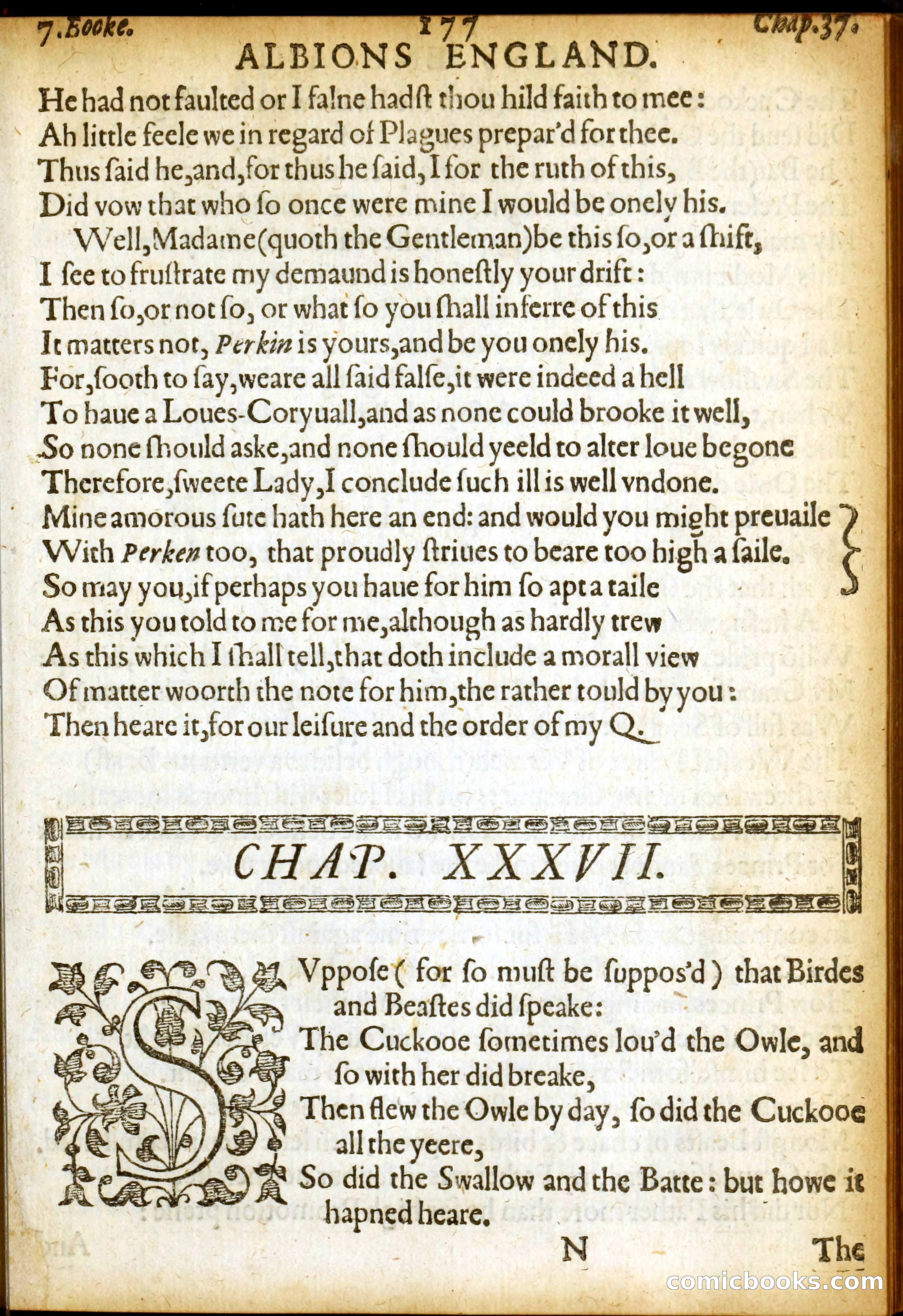
This page from *Albions England* contains running verse prose, not a penny dreadful as described in the prompt's premise. The upper portion concludes a dialogue between a Gentleman and a lady regarding a character named Perkin, with the speaker renouncing his romantic suit and proposing instead to tell a moral tale. Chapter XXXVIII begins below, introducing a fable: "Suppose...that Birdes and Beastes did speake," which describes a quarrel between a Cuckoo and an Owl that escalated, with the Swallow and Bat also becoming involved, though the full account of what happened remains to be told.
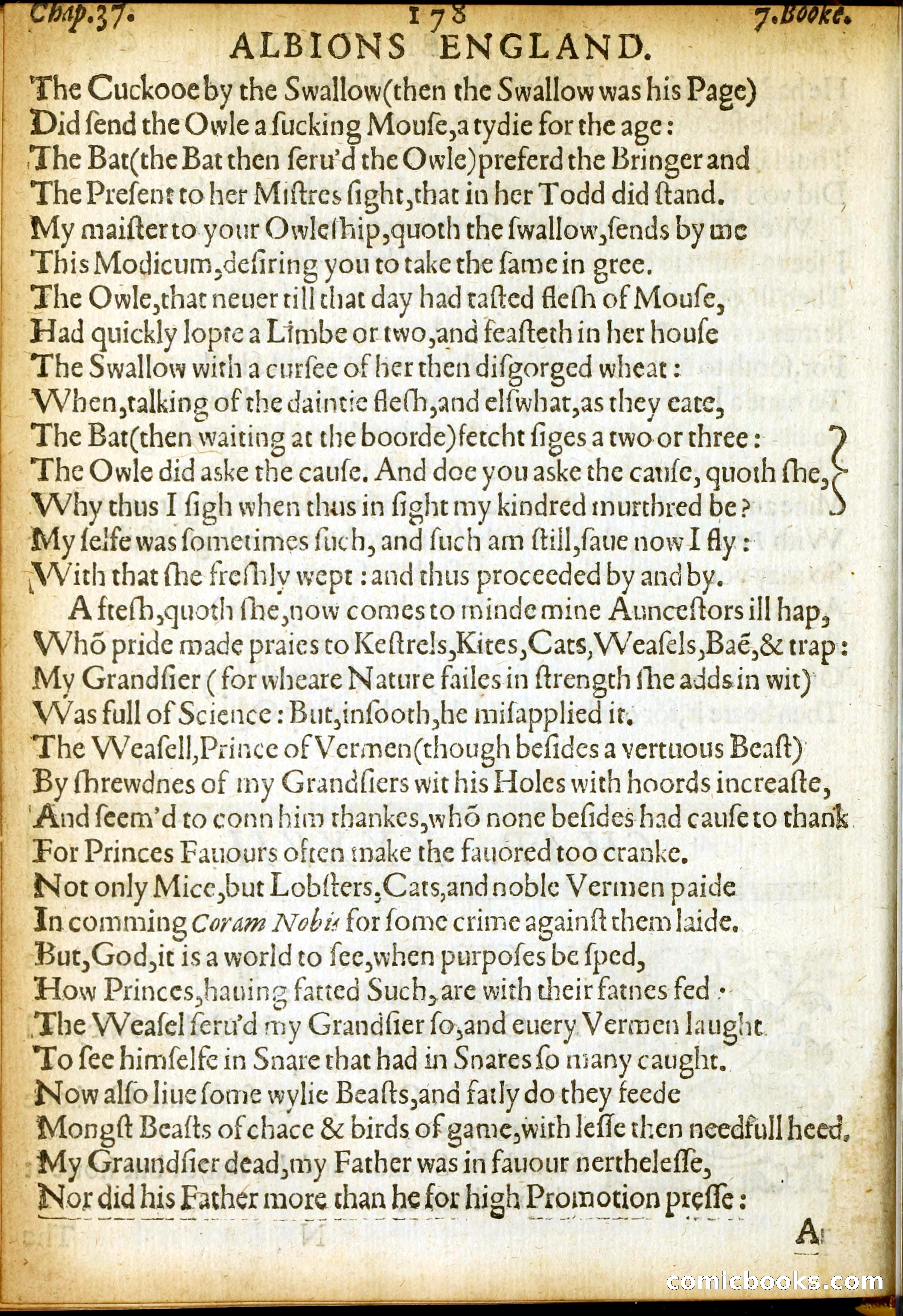
# Page from "Albions England" This is a page of running prose poetry, presented in dense black-letter typeface on aged paper. The text is a narrative verse tale featuring anthropomorphic animals—an Owl, Swallow, Bat, and Mouse—engaged in dialogue and action. The Owl recounts her family history, describing how her ancestors were preyed upon by Kestrels, Kites, Cats, Weasels, and other predators, and how her grandfather, despite his scientific knowledge, misapplied it. The passage discusses princes' favor toward animals and concludes with references to her father's position at court. The language is Early Modern English with archaic spelling and syntax.
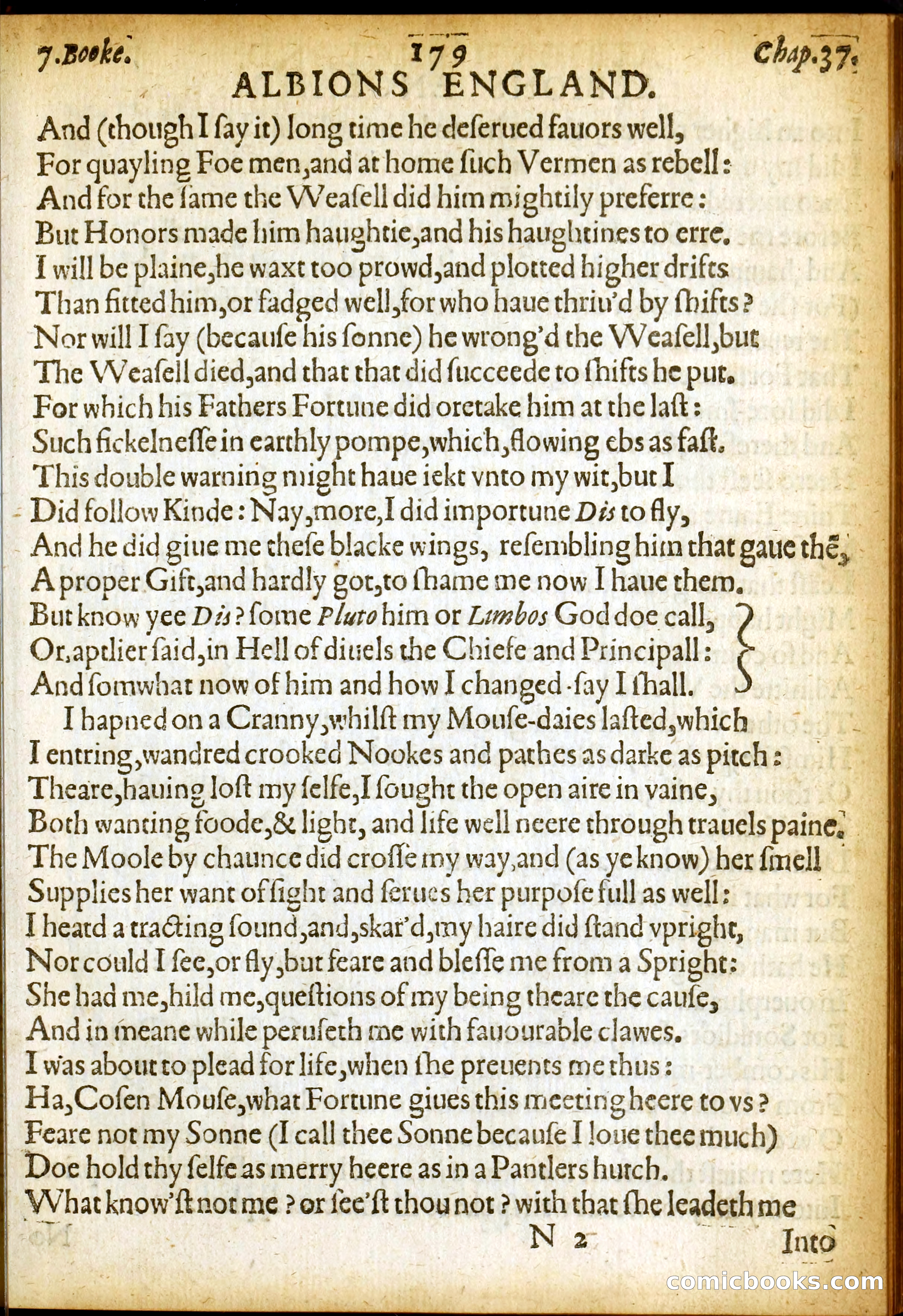
# Page Analysis This is a page of running prose poetry from what appears to be "Albions England," a historical narrative poem. The text depicts a speaker recounting encounters with supernatural or allegorical figures—a creature called "Dis" who gave him black wings, and a Mole who confronts him in darkness. The verse narrates the speaker's warnings about ambition and pride, his subsequent misadventures, and a mysterious meeting with the Mole that ends mid-sentence. The densely printed page is characteristic of early modern printed literature rather than Victorian penny dreadful format, despite the OCR header attribution.
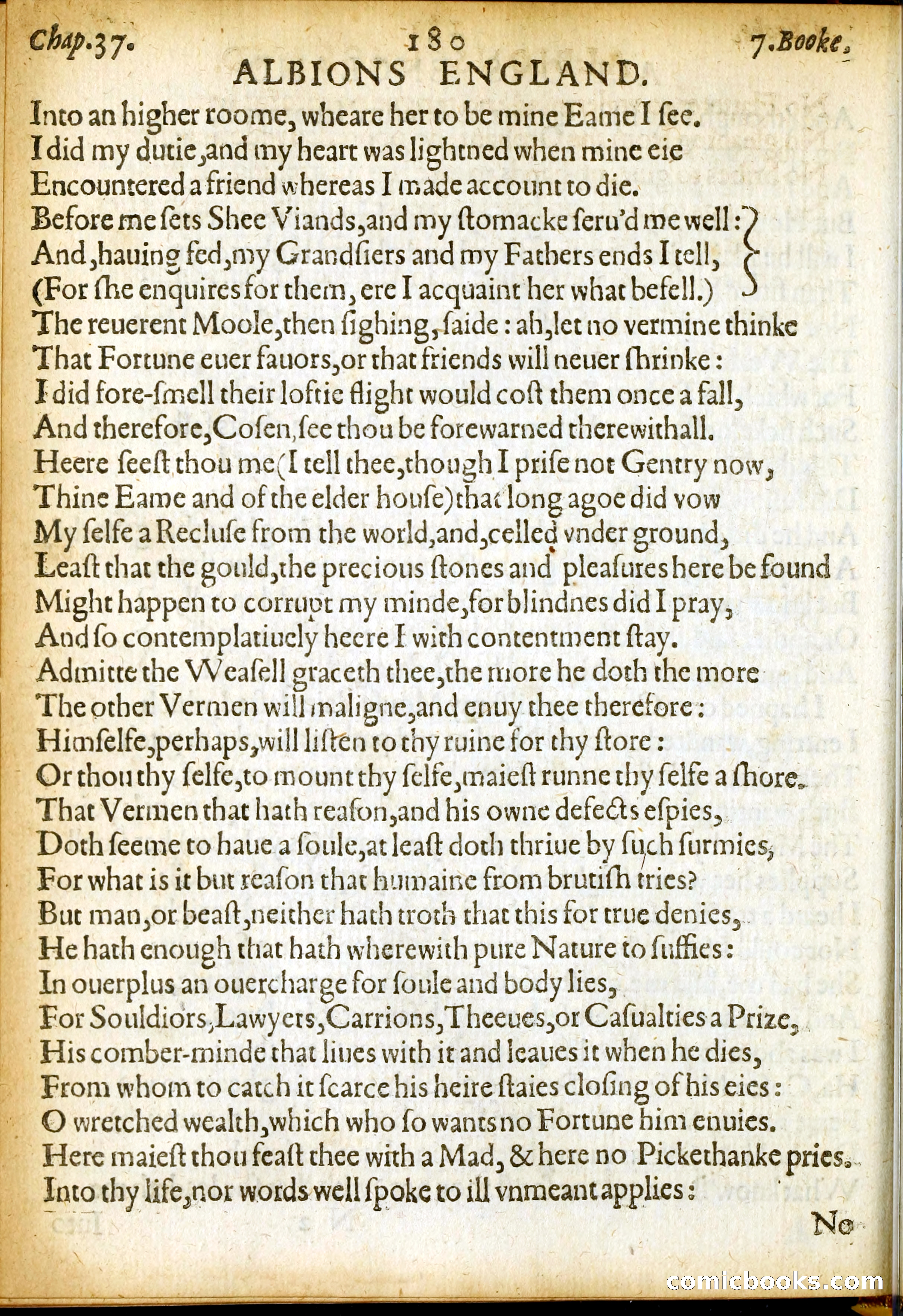
# Victorian Penny Dreadful Page Analysis This is a page of running prose—specifically verse or poetic dialogue—from Chapter 37 of a work titled "Albions England." The text presents a conversation in which a character named Moole (described as "reverent") warns a cousin named Cofen against trusting Fortune and friends, cautioning that their "lofty flight" will inevitably result in a fall. Moole explains his own retreat from worldly wealth and temptation, having taken religious vows and lived underground to avoid corruption. The passage then philosophizes about envy, greed, and human nature, suggesting that excessive wealth beyond what nature requires breeds conflict and moral decay among soldiers, lawyers, thieves, and other classes. The tone is moralistic and cautionary.
# Analysis of Page **Format:** Running prose—this is a text page from the narrative body of the work. **Content:** The page presents verse dialogue from *Albions England*, in which a character (apparently a virtuous woman named Cosen Mouse) addresses the narrator with moral instruction. She describes a journey through an underground realm featuring vast vaults, precious metals, monstrous creatures, and flames—which she identifies as "Pintos Hel" (Pluto's Hell). The passage explains that worldly wealth and pomposity originate from this underworld and corrupt mortals on Earth until death. The speaker expresses a wish to see the "hellish Monarch" (apparently Pluto/Dis) when the opportunity arises.
# Page Description This is a page of running verse poetry from *Albions England* (Chapter 37, Book 7), printed in early modern English with archaic spelling and typography. The text depicts a supernatural narrative: an angelic figure (appearing to be a demonic entity) deceives a character called "Moole," offering earthly pleasures and granting wishes. The narrator accepts and requests wings, which the angel provides. The narrator then attempts flight at twilight with newfound wings, but discovers they are leather-like and inadequate. A swallow encounters and mocks the narrator to other birds, forcing retreat into hiding. The passage concludes with the narrator lamenting their transformed, degraded condition and inability to reverse their shape.
# Description This is a page of running prose poetry from what appears to be *Albion's England*, a historical poem. The text is printed in early modern English verse and presents a narrative dialogue between bird and animal characters—an Owl, a Bat, a Swallow, and a Cuckoo—discussing matters of service, pride, and courtship. The visible lines tell of the Bat's flight to holes, his subsequent service to Dame Owl, and the Swallow's account of how the Bat was prevented from delivering the Owl's amorous message. The archaic spelling and elaborate metaphorical language are typical of the period's allegorical poetry rather than Victorian penny dreadful sensationalism.
# Analysis This is a page of running prose poetry from *Albion's England* (Chapter 37, Book 7), a 16th-century narrative poem—not a Victorian penny dreadful as the prompt suggests. The text recounts an allegorical animal fable involving an Owl, Cuckoo, Swallow, and Buzzard engaged in disputes over servants, infidelity, and domestic quarrels. The narrative describes how the Cuckoo kills a page in rage, then later mediates a dispute between the Owl and Buzzard over her affections, resolving that "one Hen" suffices for both roosters. The language is early modern English with archaic spelling and typography.
# Page Description This is a page of running verse from what appears to be an early modern allegorical or fabulist narrative (not a Victorian penny dreadful, despite the prompt's framing). The text, titled "Albions England," describes the sentencing of various birds by the goddess Pallas following tragic events. The Bat receives permission for twilight flight, the Swallow is condemned to winter migration, the Buzzard is punished for reckless love, the Cuckoo for parasitic behavior, and the Owl for ugliness and ill fortune. The passage concludes by transitioning to a narrative about Perkens and his wife, mentioning Henry and a military campaign. The language and typography suggest an Elizabethan or Jacobean publication, not Victorian.
# Page Analysis This is a page of running prose verse from Chapter 37 of what appears to be a historical narrative poem titled "Albions England" (Book 7, page 186). The text is printed in early modern English typography with blackletter typeface. The verse narrates events from the reign of Henry VII, discussing the fates of various nobles and pretenders. It describes Edward, Earl of Warwick, who was executed; a Fryer who tutored an imposter claiming to be Edward; and the collection of "Benevolences, Taxes and fore Fines" under Henry's reign. The passage appears to document historical grievances and executions, written in rhyming couplets typical of early modern historical verse.
# This Page: Running Prose This is a page of verse narrative from *Albions England*, a historical poem. The visible text describes a gracious king who discovered two corrupt officials ("Harpies") extorting from rich and poor alike. Though the king pardoned them initially, they were eventually executed. The passage then praises King Henry for his later reputation for justice and prowess, noting that despite his wealth, he avoided the private corruption that afflicted other princes.
This is a page of running prose poetry from "The Eight Booke of Albions England," Chapter 38. The text celebrates King Henry (heir of York and Lancaster) following his succession and burial of his father, praising his mind, words, appearance, and stature as befitting a king. It goes on to recount his military victories—including defeats of French forces, victories alongside Maximilian, and naval triumphs—and concludes by describing his marriage to a French king's sister and the subsequent celebrations in Paris, featuring jousts, tournaments, and the arrival of princes and ladies from various realms.
# Analysis This is a page of running prose poetry from what appears to be a historical narrative work titled "Albions England" (visible at top). The text is printed in Early Modern English typography with decorative brackets marking verse sections. The visible content describes Charles Brandon's courtly accomplishments in France—his jousting, fighting, and horsemanship impressing an English-French Queen while her king lies ill. The passage then narrates Brandon's subsequent mission to France to escort the widowed Queen home, detailing their mutual attraction and romantic encounters during the journey. The final lines suggest intimate moments between the two characters. This is neither a title page nor illustration, but dense literary narrative in verse form, likely from a serialized historical-romantic work.
# Page Analysis This is a **running prose page** from what appears to be a historical narrative poem or chronicle, not a penny dreadful as initially suggested. The text discusses English royal history, specifically King Henry VIII's marriage to Queen Katherine and his subsequent divorce. It mentions Katherine's dignified acceptance of the dissolution of their twenty-year marriage, then references Anne Boleyn's fate—her execution at the King's "light beleefe"—and concludes by noting she was "the gracious Mother of our now most glorious Queene." The page uses early modern spelling and typography, appearing to be from a much earlier historical publication than Victorian penny dreadfuls.
# Page Content Analysis This is a **running prose page** from what appears to be an early modern (not Victorian) historical or religious narrative work titled "Albions England," Book 7, Chapter 38-39. The visible text discusses young Edward the Sixth, comparing him to classical figures of beauty and wisdom (Ascamius, Hyacinth, Apollo, Jupiter's Ganymede, Solomon). It then shifts to lamenting Rome's fall in England, arguing that true religion and proper church practices have declined, as people now embrace "Novelties and curious Doubts" rather than following the established "Church-Rites" of earlier times. The passage criticizes contemporary religious and social departures from traditional practices.
# What This Page Contains This is a page of running prose poetry (Chapter 39, page 192) from what appears to be an early modern religious or moral work titled *Albions England*, not a Victorian penny dreadful as suggested. The visible text is a sustained verse argument addressing Church leaders, criticizing those who preach faith without practicing good works and charitable actions. The passage employs biblical references (the Levite and Samaritan, Dives and Lazarus, Solomon) to argue that genuine faith must be demonstrated through conduct and charity, not merely words, and that clergy's bad examples undermine their preaching more than their words can enforce it.
# Analysis of Page **Page Type:** Running prose text (verse narrative) **Content:** This is a page from *Albion's England*, a historical poem, showing verse about charitable giving and clouds as metaphors for different types of alms-givers. The text uses extended metaphors comparing clouds to different classes of people who give charity—some clouds bring helpful rain, others cause harm, some give to the undeserving poor. The passage culminates with a statement about an "Orphant King" whose uncles maintained the realm's stability through religious devotion but whose kingdom began to decline when they fell into dispute. The work appears to be early modern English poetry (not Victorian as assumed), marked by archaic spelling and blackletter typeface typical of 16th-century printing.
# Page Analysis This is a page of running prose poetry from *Albion's England*, a historical verse narrative (not a penny dreadful, but an early modern English chronicle poem). Chapter XL depicts a falling-out between two noblewomen—Admiral's Queen Bigama and the Lord Protector's Wife—that escalates into a deadly feud involving the Earl of Warwick. The text describes how this conflict led to the beheading of one party and the false accusation of the Lord Protector for treason, resulting in the King losing both uncles. It then shifts to Warwick's rise to Duke and his later downfall, touching on the succession of King Edward and Lady Jane's claim to the throne.
# Analysis of This Page This is a page of running verse narrative prose from what appears to be a historical poem about Tudor England. The text, printed in early modern typography, recounts the succession crisis following King Edward's death, focusing on the brief reign of Lady Jane Grey ("Jane, Suffolks Daughter") and the competing claims of Mary. The passage describes how Jane was proclaimed Queen, how Mary subsequently gathered support and was proclaimed Queen instead, with Jane imprisoned in the Tower of London, and concludes with executions of various nobles including Suffolk, Lord Gray, Lord Gylford, and Lady Jane herself. The narrative presents these events in rhyming couplets with period spelling and punctuation conventions.
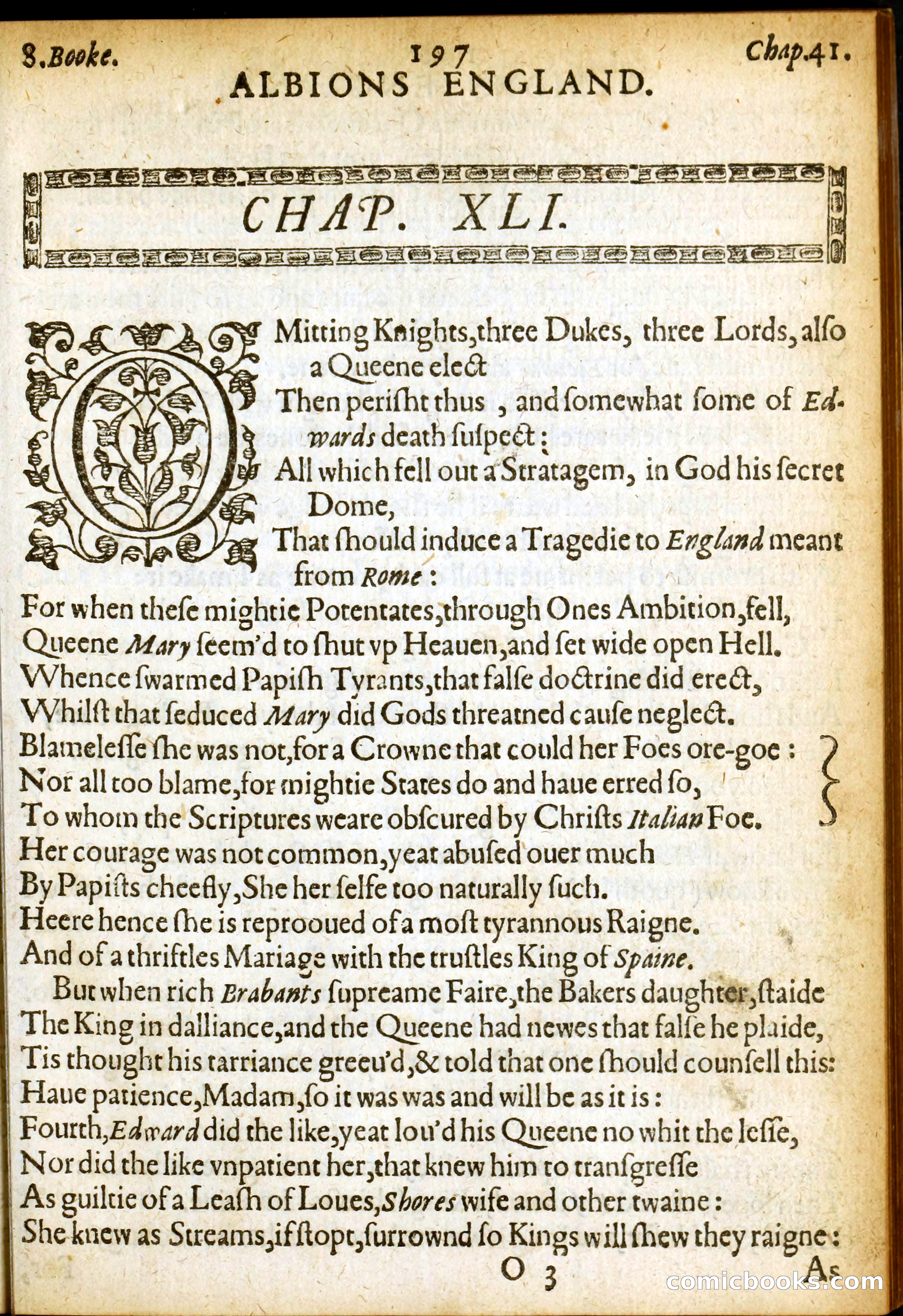
# Analysis of Page **Page Type:** Running prose text (verse narrative) **Content:** This is Chapter XLI from what appears to be a historical narrative poem titled "Albions England." The visible text recounts political intrigue involving knights, dukes, lords, and a queen-elect, referencing Edward's death and subsequent religious and political turmoil in England. The verse discusses Queen Mary, papal influence, and matters of royal marriages and infidelity, including references to Spain and figures like Shore's wife. The ornamental drop capital and period typography indicate this is from an early modern printed work, though the OCR quality and archaic spelling make some passages difficult to parse with complete certainty.
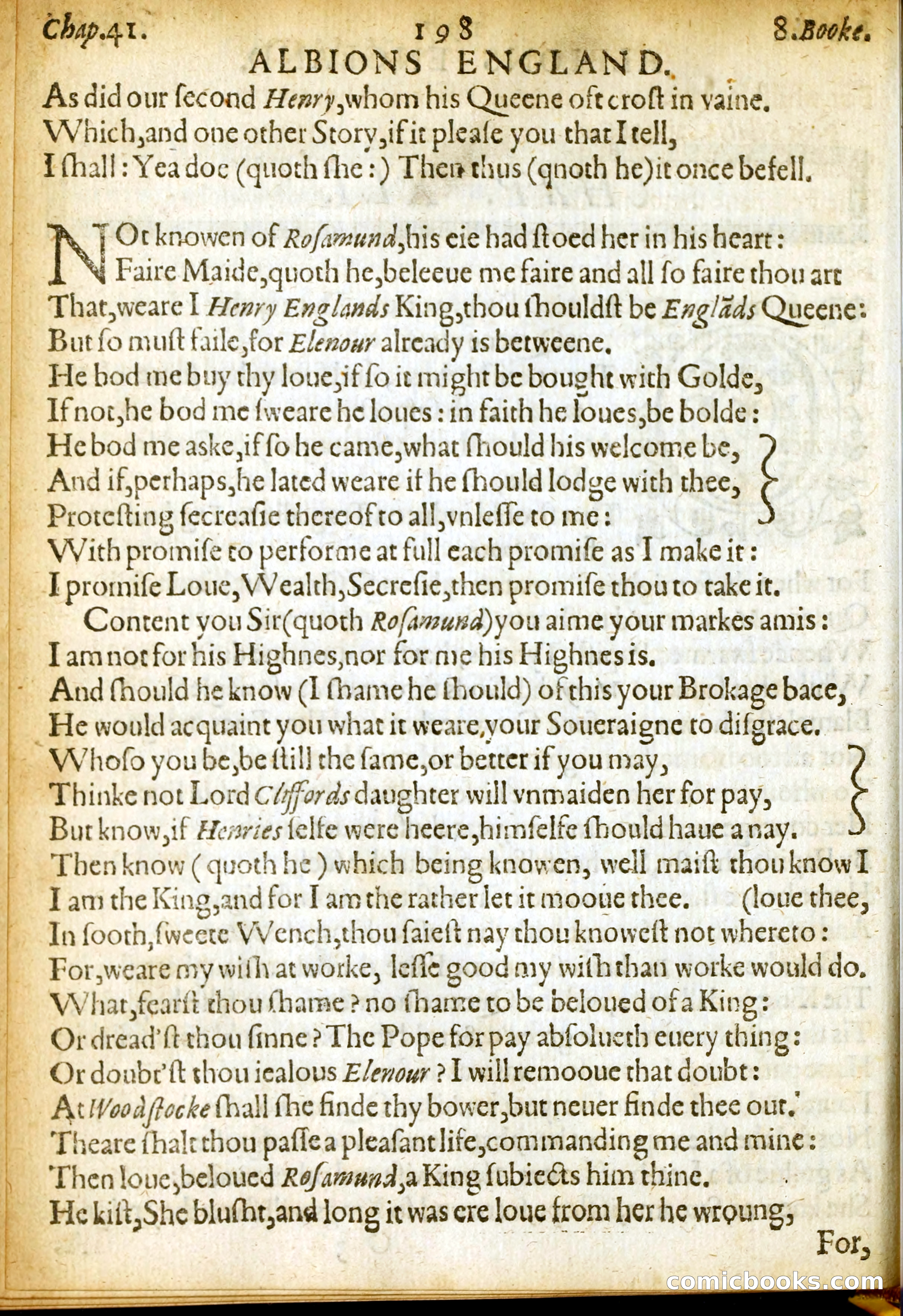
# Page Description This is a page of running prose verse from what appears to be "Albions England," Chapter 41. The text presents a dramatic narrative in which a character recounts how King Henry II attempted to seduce a fair maiden (Rosamund) through an intermediary, offering her love, wealth, and secrecy in exchange for becoming his mistress. The maiden initially refuses, citing her honor and her father Lord Clifford's reputation, but the King eventually reveals his identity and persuades her—the passage concludes with him kissing her as she blushes and yields. The text is printed in early modern English typography with archaic spelling and punctuation.
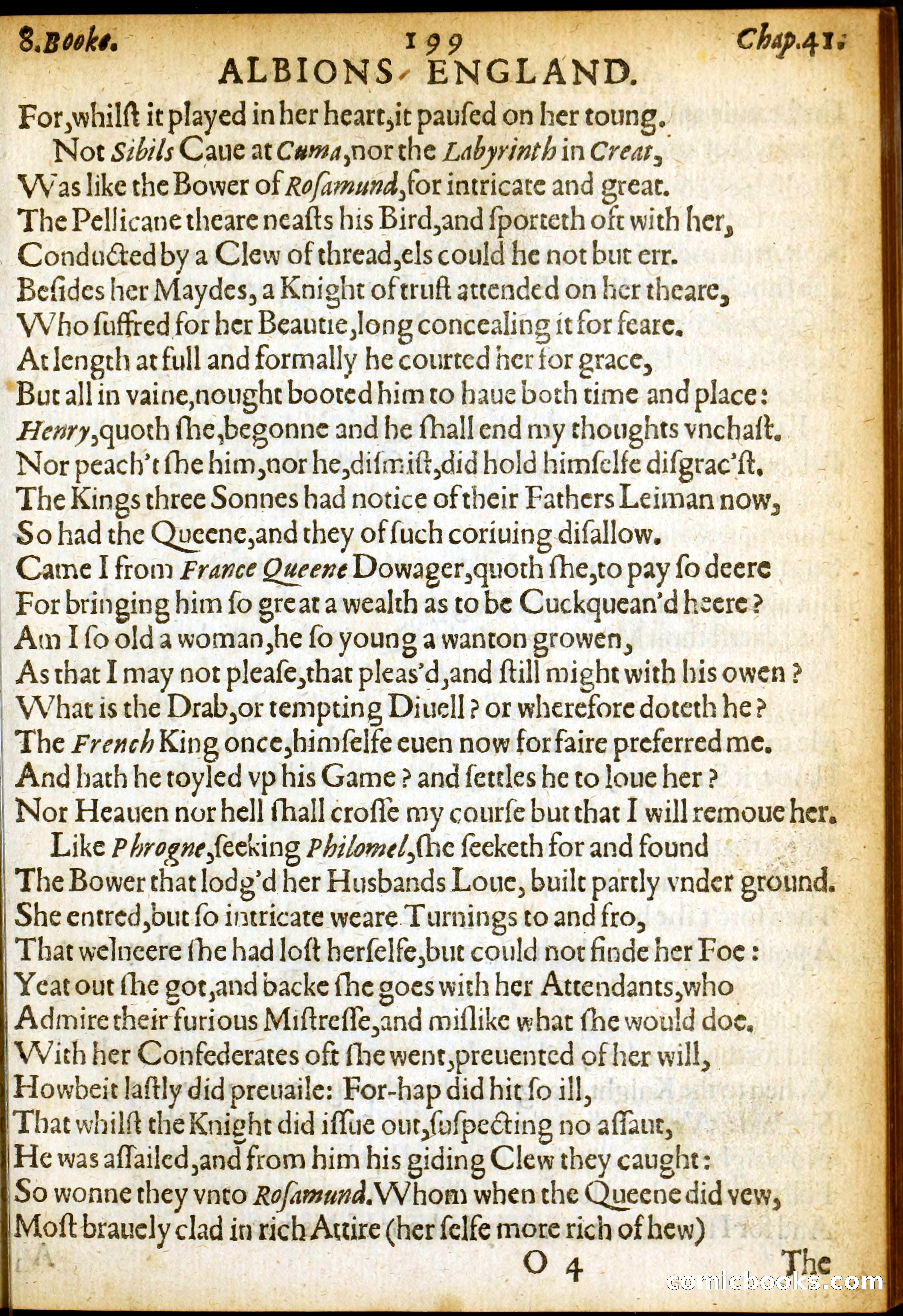
# Page Analysis This is a page of running verse narrative (page 199 of a work titled "Albions England") printed in early modern English typography. The text recounts the story of Rosamund, apparently the mistress of a king, and describes how a queen discovers her location through intricate plotting. The narrative focuses on a knight's failed courtship of Rosamund, the king's sons and queen learning of her existence, the queen's angry response, and her eventual discovery of Rosamund's hidden bower—a journey complicated by an intricate maze of "Turnings." The passage concludes as the queen finally locates and confronts Rosamund, finding her richly dressed.
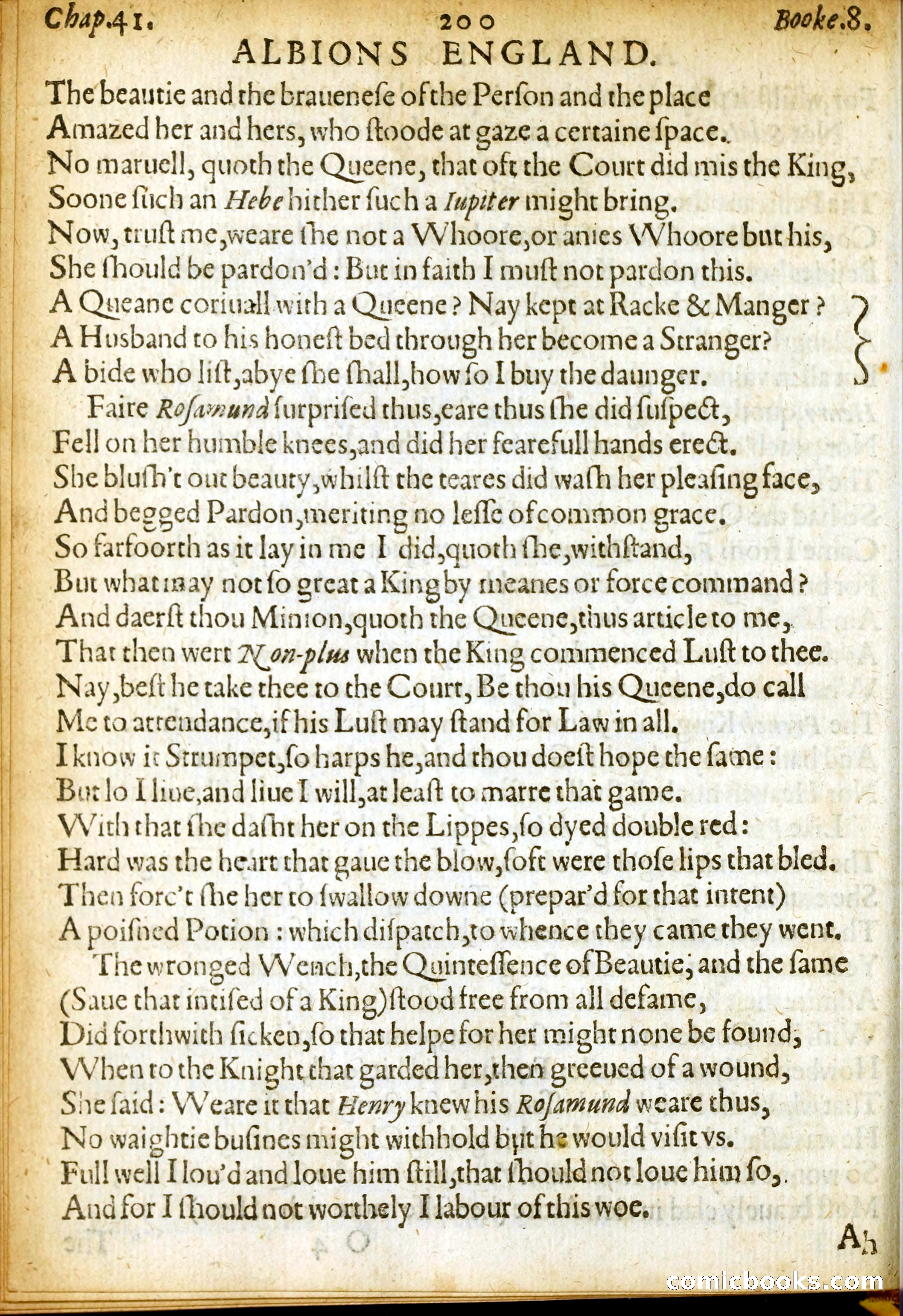
# Page Analysis This is a page of running prose poetry from what appears to be an early modern narrative poem (not a Victorian penny dreadful, despite the header). The text recounts a dramatic scene involving a Queen, a character named Rosamund, and the King. The Queen confronts Rosamund for her affair with the King, delivers angry accusations about betraying the Queen's marriage, and then forces Rosamund to drink a poisoned potion, causing her death. The passage emphasizes Rosamund's beauty, her humble submission, and the tragic consequences of the King's lust—presented as a cautionary melodrama about courtly transgression and fatal passion.
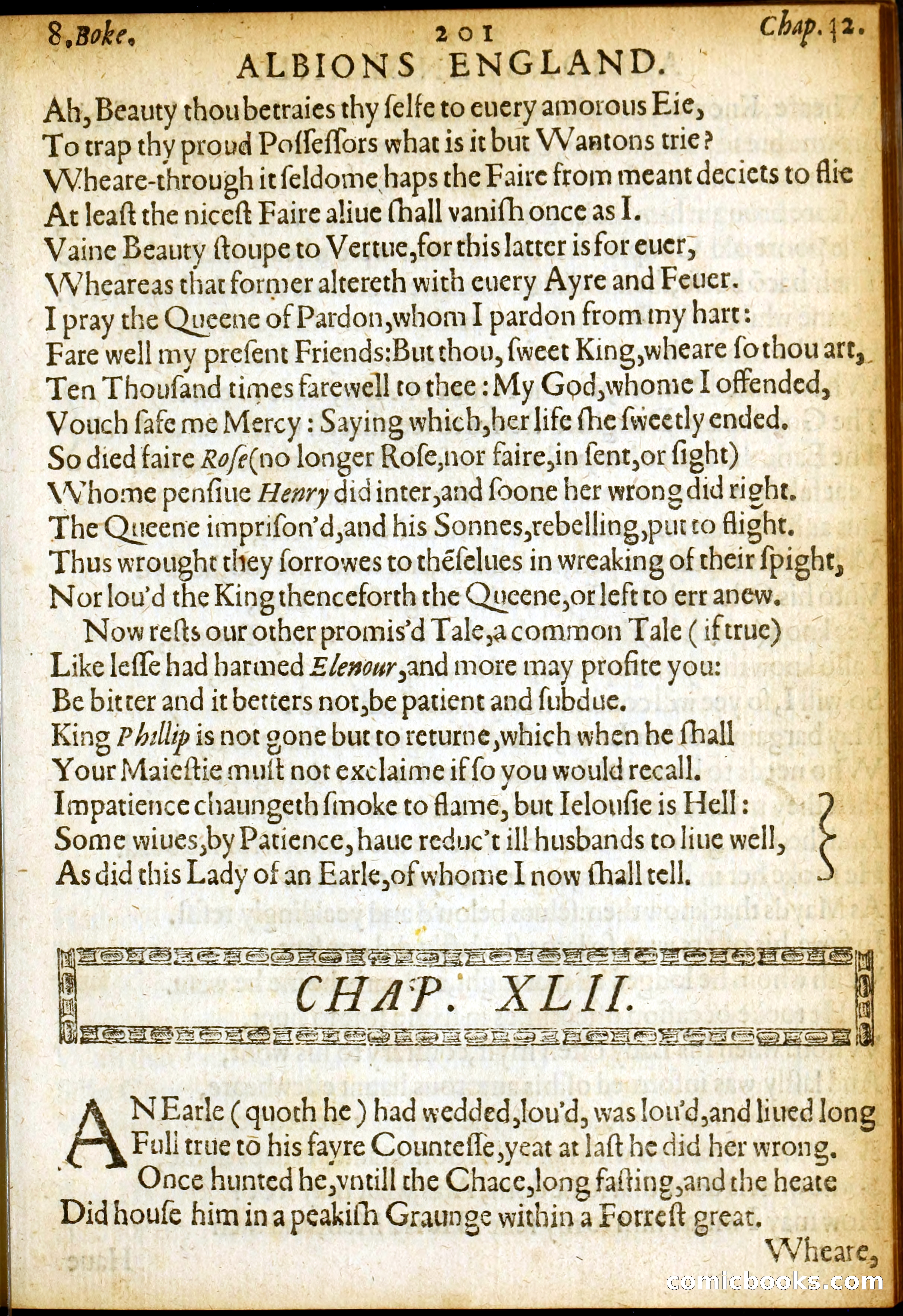
# What's on This Page This is a page of running prose poetry from *Albion's England*, a narrative poem. The visible text concludes one story (about the fair Rose and King Henry) and introduces another tale about an Earl and his Countess. The passage moralizes about beauty versus virtue, patience versus impatience, and appears to be transitioning between episodes. A chapter heading ("CHAP. XLII") divides the content. This is characteristic serialized verse narrative—not a penny dreadful as initially described, but rather an early modern literary work, likely from a later reprint or anthology popular in Victorian times.
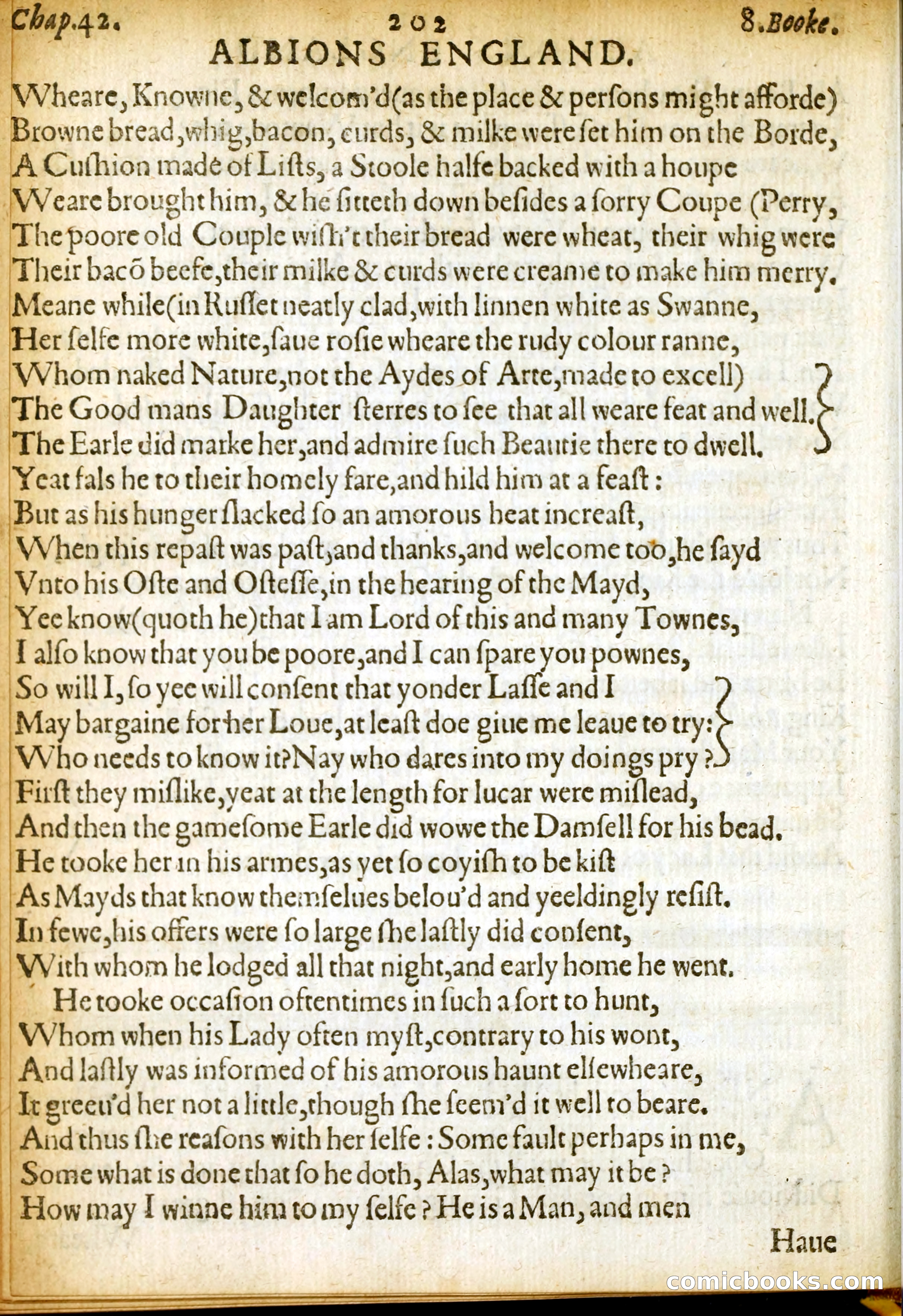
# Analysis This is a page of **running verse narrative prose** from what appears to be a serialized poem or ballad (Chapter 42, Book 8), titled "Albions England." The visible text recounts a nobleman's seduction of a poor farmer's daughter. An Earl visits a cottage, is welcomed with humble food, admires the beautiful daughter, and after the meal proposes to her parents that he "bargain for her Love." The passage describes their liaison and hints at subsequent complications—the Earl frequents the area to hunt, his wife notices his absences and learns of his "amorous haunt elsewhere," and she grieves, questioning what fault in herself caused his infidelity. The page ends mid-thought with her reasoning that "He is a Man, and men / Have..."—trailing to the next page. The text employs Early Modern English spelling and verse form typical of period narrative ballads.
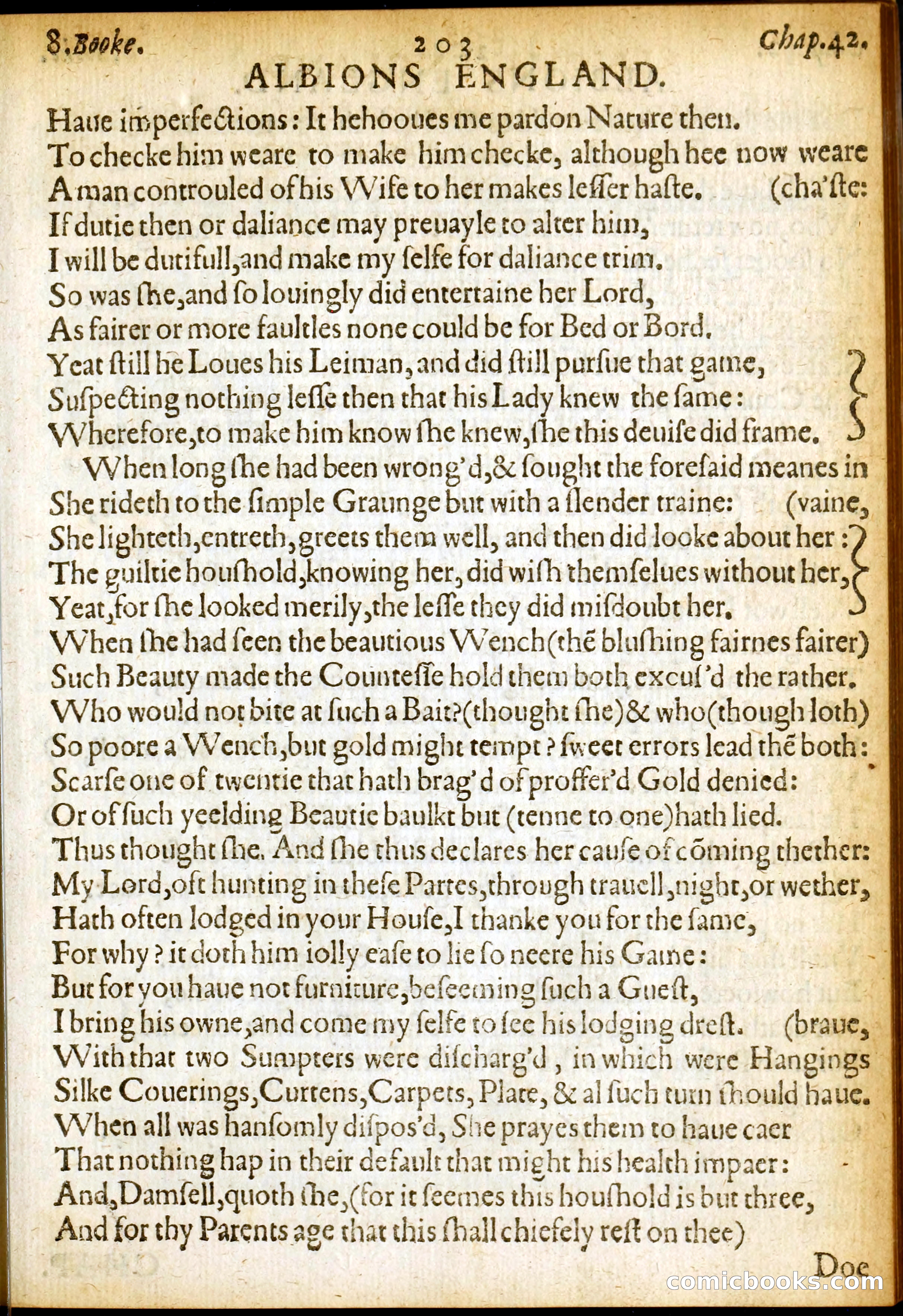
# This Page from *Albions England* This is a page of running prose poetry from what appears to be Samuel Daniel's *Albions England*, a narrative poem. The text describes a noblewoman's stratagem: having been wronged by her husband's infidelity with a beautiful young woman, she visits the countryside lodge where they meet, ostensibly to provide furnishings and hospitality for her husband's hunting trips. The passage details her arrival, her observation of her rival's beauty, and her explanation to the household staff—all part of an apparent scheme to expose or confront the situation. The language and narrative form are early modern rather than Victorian penny dreadful.
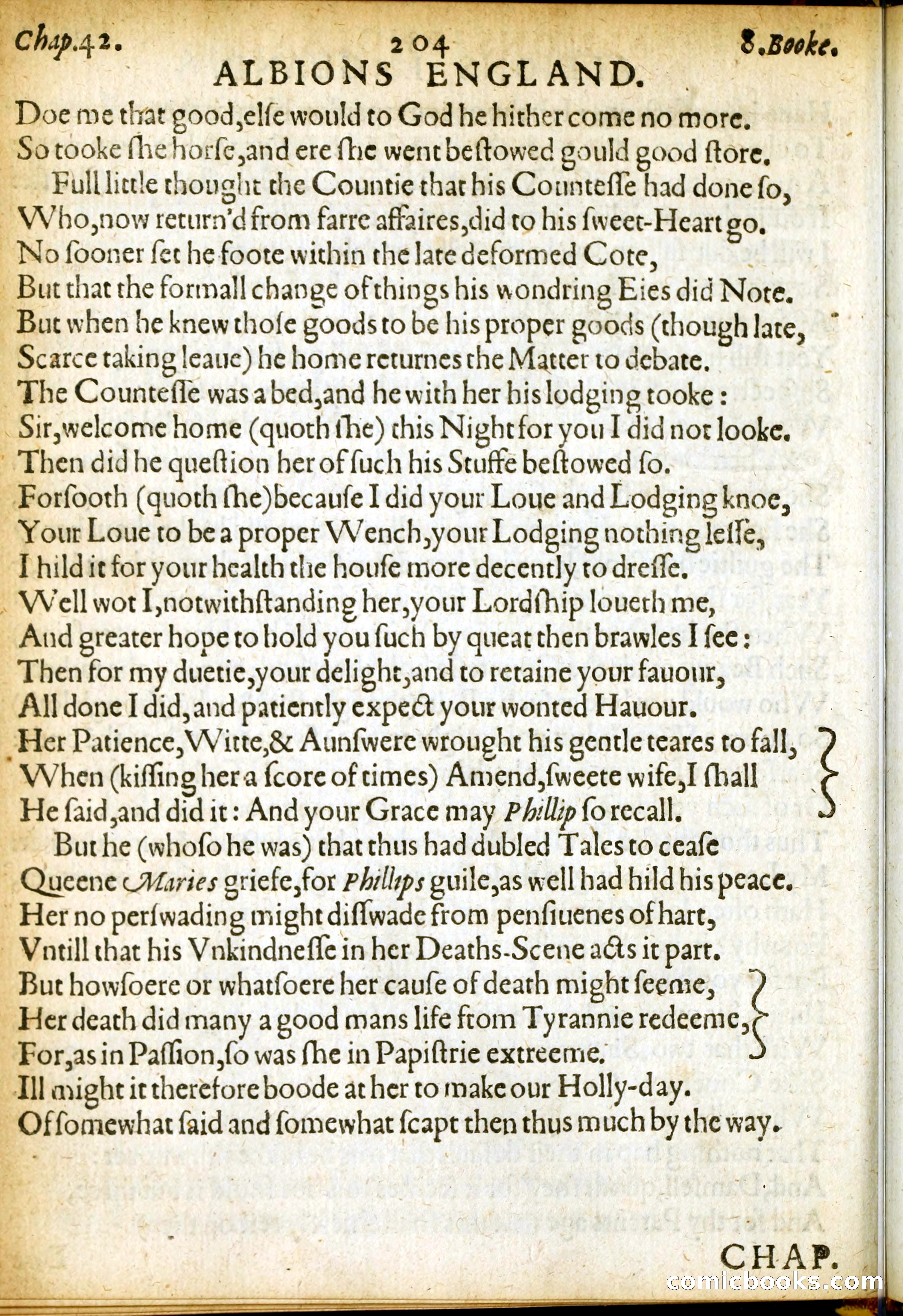
# Analysis This is a page of running prose poetry from Chapter 42 of "Albions England." The text appears to be a narrative verse account of a domestic scene: a County returns home to find his Countess has given away his goods to the poor, and when questioned, she defends her charity as dutiful and motivated by love. The passage culminates in the husband's reconciliation with her, followed by a shift to mention of "Queene Maries griefe" and references to "Phillips" and matters of religious passion ("Papiftrie"), suggesting the narrative connects personal virtue to broader historical or religious themes. The dense Early Modern English typography and language indicate this is likely an excerpt from a much older source that Victorian penny dreadfuls serialized for popular audiences.
# Analysis This is a page of running prose poetry from Chapter 44 of what appears to be *Albion's England*, a historical verse narrative. The text catalogues legendary and early British kings—beginning with Brute (who supposedly led Greek refugees to Britain) and progressing through various monarchs including Brennus, Belynus, Cassibelane, and others. The verse recounts their military conquests, constructions, and conflicts with Roman forces under Caesar. The writing style is archaic English verse with italicized proper names marking historical figures and places. This is not a sensational penny dreadful as initially suggested, but rather early modern historical-legendary literature presented in a later Victorian edition.
# Analysis of This Page This is a page of running verse poetry (not an illustration or title page) from what appears to be a historical or genealogical work titled "Albions England." The text celebrates England's legendary and historical rulers—Constantine, Arthur, Malgo, Alfred, and William the Conqueror among them—tracing their deeds and lineage. The verse emphasizes how these kings conquered territories, subdued enemies, and established England's glory. Notably, the passage concludes by asserting that English blood now combines Saxon, Danish, Norman, Roman, and Pictish ancestry, creating a "tripartite" national identity forged through conquest and mixture.
# Analysis of Page This is a **page of running prose poetry** from what appears to be an early modern historical or genealogical work titled "Albions England" (visible at page top). The text is written in archaic verse and discusses English kings—particularly Richard the Lionheart, Edward I-V, and Henry VII—cataloging their conquests and martial achievements. It references territorial gains (Cyprus, Syria, France, Spain) and concludes with legendary British origins, mentioning figures like Hercules, Hengist, and Horsa. The page contains no illustrations, only densely printed black-letter and roman typeface text typical of early printed books rather than Victorian penny dreadfuls.
# Page Analysis This is a **running prose page** from the end of a chapter (Chapter 43, page 208) titled "Albions England." The visible text is a rhyming verse summary of English monarchs—specifically various Henries—and their reigns, mentioning Saxon rule, the restoration of English reign under early Henries, Henry IV's obtaining of Lancaster's crown, Henry VII uniting Lancaster and York in peace, and Henry VIII ending Rome's religious authority. The passage concludes with a prayer-like dedication to "our Mother Nurse" and an appeal for safe passage "through the Ocean deepe and large." This appears to be historical verse chronicle rather than sensational fiction.
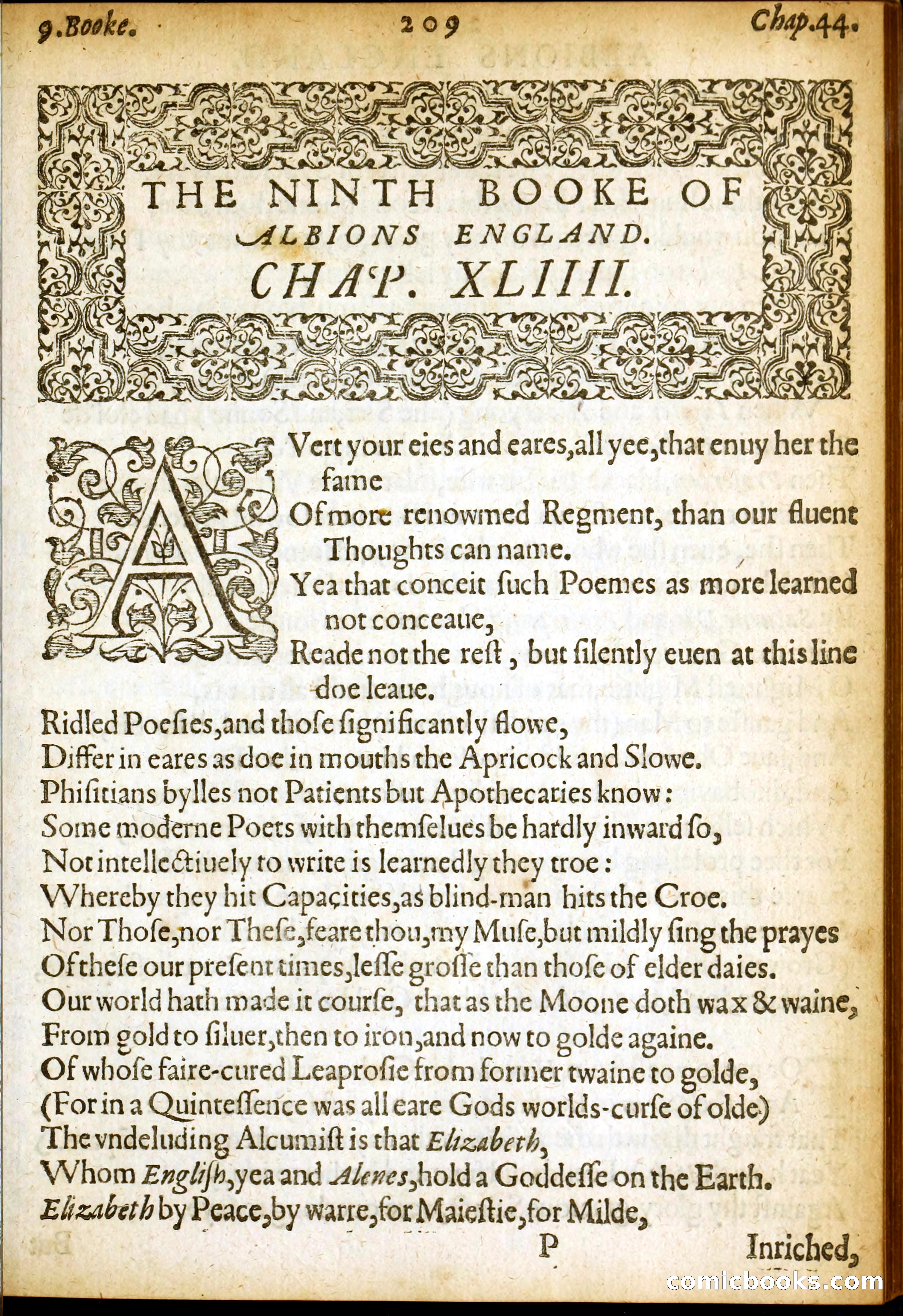
# Page Analysis This is a **chapter opening page** (Chapter 44) from *Albions England*, a work of early modern English verse narrative—**not** a Victorian penny dreadful as the premise suggests. The ornamental border and typeface indicate this is a 16th or 17th-century printed book, predating Victorian literature by centuries. The visible text is an **address to the reader** and a poetic passage about Queen Elizabeth. The speaker defends serious poetry against contemporary critics, then praises Elizabeth as an "Alchemist" who has transformed England from base to noble metals ("From gold to silver, then to iron, and now to golde againe"), celebrating her as a "Godesse on the Earth."
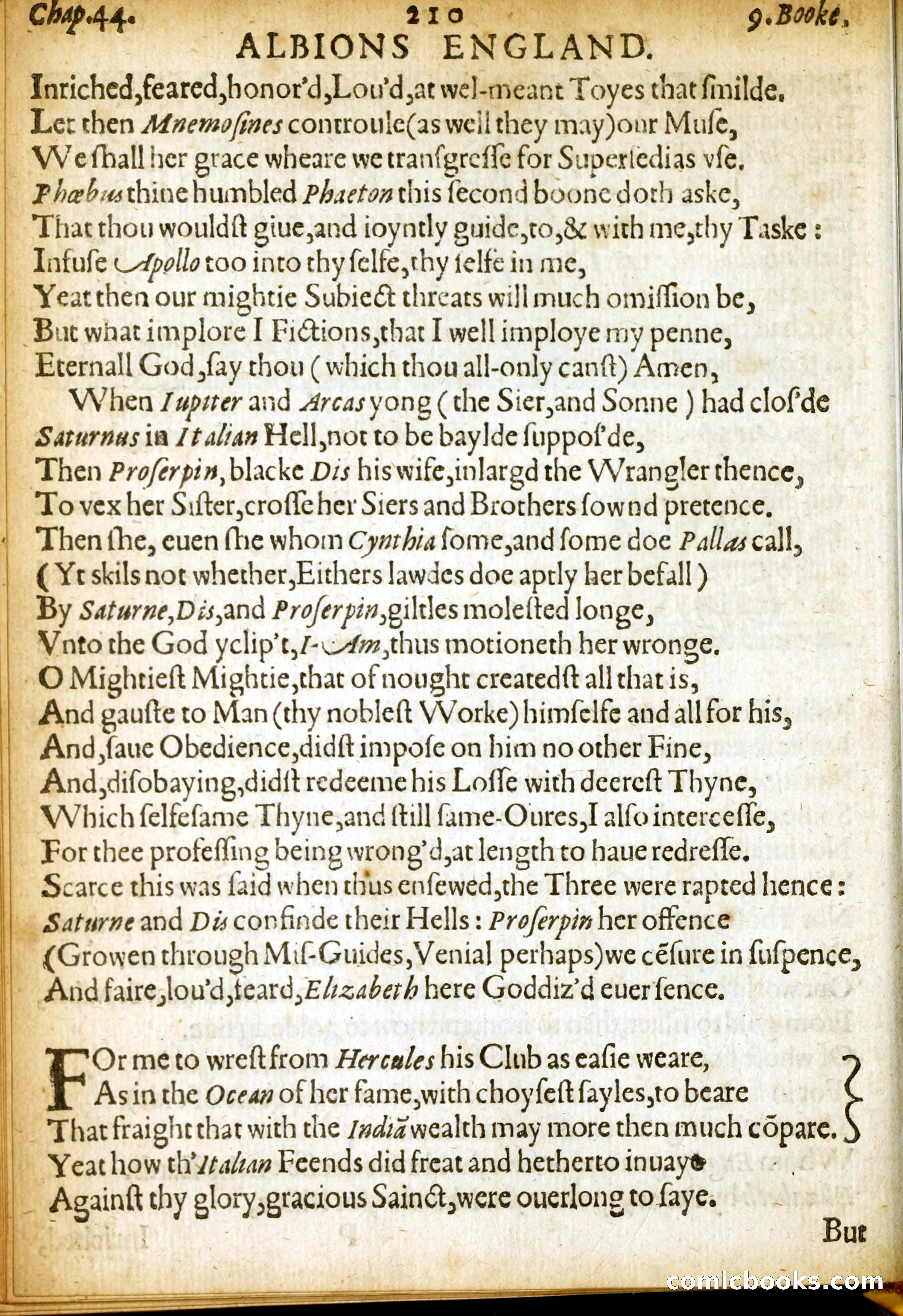
# Running Prose from a Poem This is a page of **running poetic text** from what appears to be a dedicatory or complimentary verse, not a penny dreadful narrative proper. The speaker invokes the Muse and classical deities (Jupiter, Saturn, Proserpine, Diana/Cynthia), recounting mythological events in Hell, then pivots to praise "Elizabeth" as a gracious saint. The final stanza invokes Hercules and India, suggesting the poem celebrates a patron or noble figure. The ornate, learned mythological language and formal dedicatory tone suggest this is an introductory poem *within* a larger work, rather than the main serialized narrative itself.
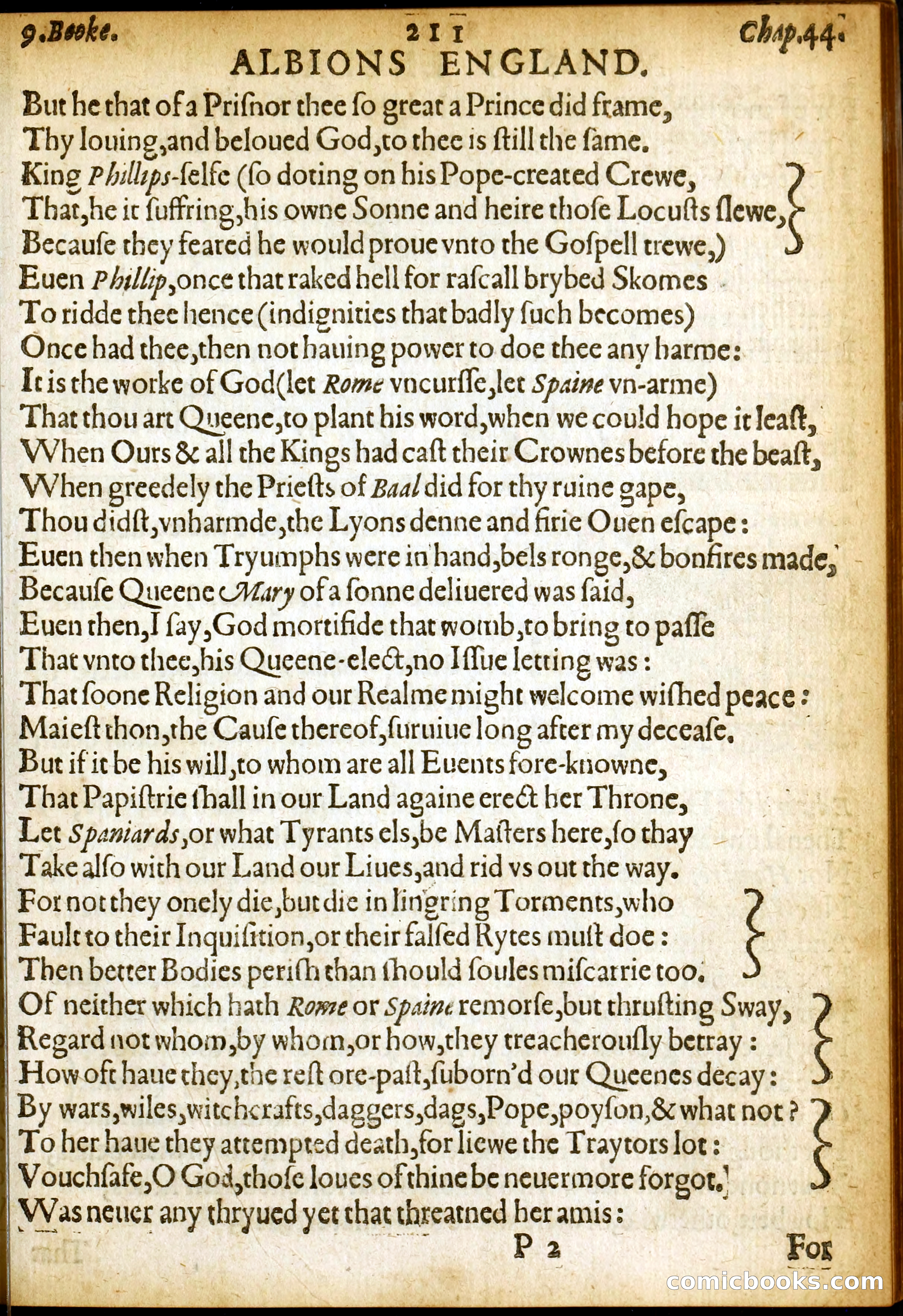
# A Page from "Albions England" This is a page of running verse poetry, not a penny dreadful as the prompt suggests. The text is from *Albions England* (Chapter 44, Book 9), a historical narrative poem in early modern English. The visible verse celebrates Queen Elizabeth I, praising her as divinely chosen to plant Protestant religion in England. It credits God with protecting her from threats by Catholic powers—specifically King Philip of Spain and the Pope—and references her miraculous survival despite plots against her, including the failed Spanish Armada. The verse also mentions the death of Mary Queen of Scots and warns of future Catholic threats to England's throne and Protestant faith.
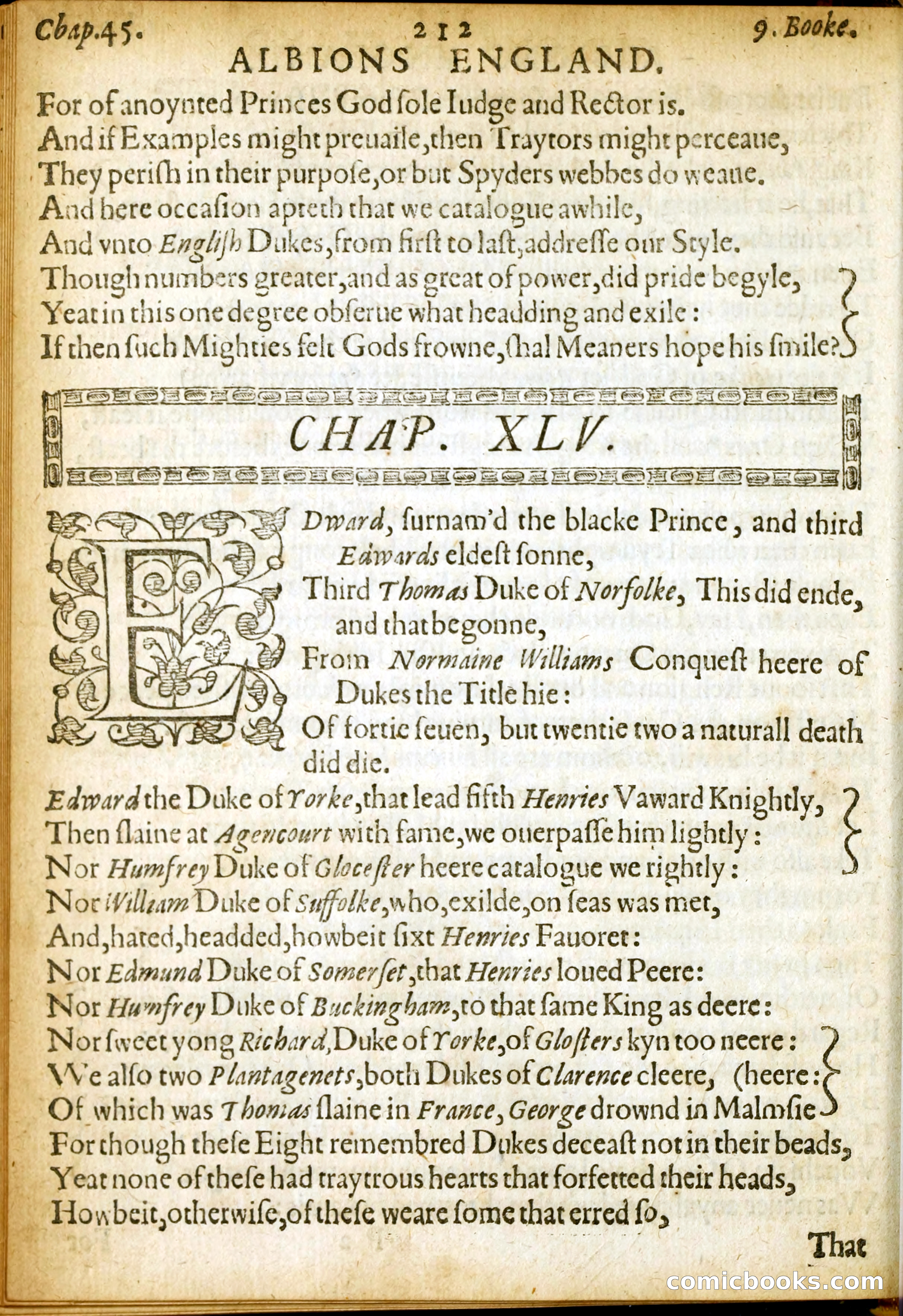
# Analysis of Page This is a page of running prose poetry from what appears to be a historical narrative work titled "Albions England." The visible text catalogs English Dukes, beginning with Chapter 45. The passage addresses the fates of various medieval English nobility—including Edward (the Black Prince), Thomas Duke of Norfolk, Edward Duke of York, and several others associated with the Houses of Lancaster and York. The author lists these figures "from first to last" to illustrate examples of mighty men who "felt Gods frowne," emphasizing that despite their power and numbers, eight named Dukes met unfortunate ends (exile, death in battle, execution, or drowning), yet notably "none of these had traytrous hearts that forfetted their heads." The tone is moralizing, using these historical examples to demonstrate divine judgment upon nobility.
# This Page This is running prose text—specifically narrative verse—from what appears to be a historical chronicle presented in poetic form. The page is numbered 213 and titled "ALBIONS ENGLAND," discussing English nobility and royal succession through several reigns. The text catalogs the fates of various dukes and nobles across periods involving Richard II, Henry, and Edward, detailing their executions, exiles, and political intrigues. The verse employs a heavily archaic printing style (long s's, contracted words) typical of early modern English publications, though the "penny dreadful" dating may be incorrect—this appears to be from an earlier historical source material, possibly a 16th or 17th-century work that Victorian publishers may have reprinted.
# Page Analysis: Running Prose from "Albions England" This is a page of running verse text from Michael Drayton's *Albions England*, a historical poem in English. The upper portion recounts political executions during Tudor times—beheaded nobles and the Duke of Norfolk—and credits Queen Elizabeth with ending such tragedies. The text then transitions (marked "CHAP. XLVI") to mythological narrative, describing Cadmus planting his kingdom and the birth of Narcissus to the goddess Lyriope and the mortal Cephisus in Boeotia. The page employs Early Modern English spelling and poetic couplets typical of this era's popular historical-mythological verse.
# Page Content Analysis This is a running prose page from **Albions England** (Book 9, Chapter 46), containing narrative verse rather than a penny dreadful. The text retells the classical myth of Narcissus and Echo: a vain youth falls in love with his own reflection at a fountain, while Echo, a nymph who loves him unrequited, attempts to win his affection through stealth and mimicry. When Narcissus discovers his beloved is merely his shadow and leaps into the fountain to drown, Echo's voice echoes his calls mockingly. The passage concludes by noting that Narcissus's shadow and Echo's voice continue to haunt the world—presenting the myth as a cautionary tale about pride causing plague-like destruction.
# Page Description This is a page of running verse poetry from what appears to be an early modern (not Victorian) allegorical work titled "Albions England." The text describes mythological and infernal figures—including Minos, Radamant, the Furies Tisiphone and Alecto, Echo, and Narcissus—being commissioned to travel Earth and corrupt human society. The verse catalogues various forms of corruption: how authority becomes tyrannical, how lawyers prioritize rhetoric over justice, how religious prelates are misled, and how Mars and Venus influence human behavior toward disorder. The language and typography suggest this is from the 16th or 17th century, not the Victorian penny dreadful era.
This page is running prose from "Albions England," a satirical verse work. The text is a moral critique in rhyming couplets attacking various social vices: the corruption of the gentry, citizens falsely climbing social ranks through bribes, worldly excess and greed, incompetent preachers, fashionable folly, and flattery. The passage references specific types (the Brownist, the Barrowist) and concludes that flattery and echo particularly mislead women. The archaic typography and spelling ("Cittizens," "vfe," "preache") indicate this is an early modern work, likely from the 1590s, not actually Victorian penny dreadful material.
# Analysis of Page This is a page of running prose verse from Chapter 47 of what appears to be *Albions England*. Two widows, sitting by a fire, discuss how fashion and behavior have changed over their lifetimes—specifically lamenting the elaborate, costly clothing and adornments now worn by women (including corked shoes, silk stockings, gold-edged garters, embroidered petticoats, periwigs, masks, and feathered plumes). The passage nostalgically contrasts their modest youth with present extravagance, questioning whether such vanity is lawful. **Note:** This is NOT a Victorian penny dreadful but rather early modern poetry (likely 17th century, given the text style and spelling conventions).
This page contains running poetry or verse from what appears to be a moral or cautionary narrative. The speaker (a woman) recounts her youthful vanity and descent into foolishness, describing how she was raised wealthy but became proud and overly concerned with her appearance. She references a friar's warning about Narcissus and Echo as cautionary tales against vanity and pride, then shifts to lamenting her hasty marriage and poor choice of husbands, three of whom are now dead. The text uses early modern spelling and employs colloquial language and parenthetical asides typical of period narrative verse.
# Victorian Penny Dreadful Page Analysis This is a page of running prose poetry from what appears to be *Albions England* (Chapter 47), printed in an old blackletter typeface. The text is a first-person female monologue in verse recounting a youthful romance: the speaker describes losing her virginity to a lover who subsequently abandoned her and crossed the seas, leaving her unmarried but unburdened by scandal. She reflects nostalgically on past courtship customs compared to her present day, lamenting that men once approached love with genuine fellowship, whereas "now" they pursue it only sentimentously. The passage uses archaic language and spelling conventions typical of early modern English literature rather than Victorian penny dreadful sensationalism.
This is a page of running prose poetry from *Albions England*, Chapter 47 (Book 9). The text consists of dialogue and narrative verse discussing love, marriage, and human folly. A speaker criticizes both men and women for their superficiality and vices—men for being curious, petulant, and jealous; women for being forward and mercenary. The passage describes people gossiping idly about widows, orphans, and mythological tales (Echos, Narcissus), attributing their foolish talk to drink and pride. The verse concludes with an invocation against "haughty Follies" and "Furies." This appears to be satirical social commentary in early modern English verse.
# Analysis of Page from "Albions England" This is a page of running verse prose from Chapter 48 of William Warner's *Albions England*, a historical-allegorical poem. The text describes a continental monarch (Spain) who rules vast territories across Europe, Africa, and the Americas, and who recently attempted to dominate England through a "holy League" involving the Pope, Savoy, and the Duke of Guise. The passage celebrates England's triumph against these Catholic powers "through God," contrasts Spanish failures in France and Rome with English victory, and addresses Christian princes to punish this foreign threat. The archaic spelling and verse form are typical of late 16th-century English poetry.
# Page Analysis: Running Prose from "Albions England" This is a page of running verse from what appears to be Michael Drayton's *Albion's England*, a historical narrative poem. The text discusses Spanish political schemes and threats to England, specifically referencing plots against Queen Elizabeth and English Catholics. The passage describes Spanish ambitions to conquer England for profit rather than religious conversion, and warns of Spanish treachery and cruelty. The verse form uses rhyming couplets typical of early modern English narrative poetry, presenting this as serious historical-political commentary rather than the sensational fiction suggested by the query's framing.
This is a page of running prose poetry from what appears to be an early modern text (likely 16th or 17th century, not Victorian as stated in the prompt). The page, numbered 224 and marked "Chap. 48" and "10. Booke," contains verse in English discussing the rise and fall of various empires—Cortes and Spain, the Medes, Persians, Macedonians, Romans, and others—warning that Spain's power will not last perpetually. The text moves toward criticism of Spanish and papal authority in Christendom, suggesting God has protected England ("our Ile"). The material is historical-political commentary in verse form rather than penny dreadful fiction.
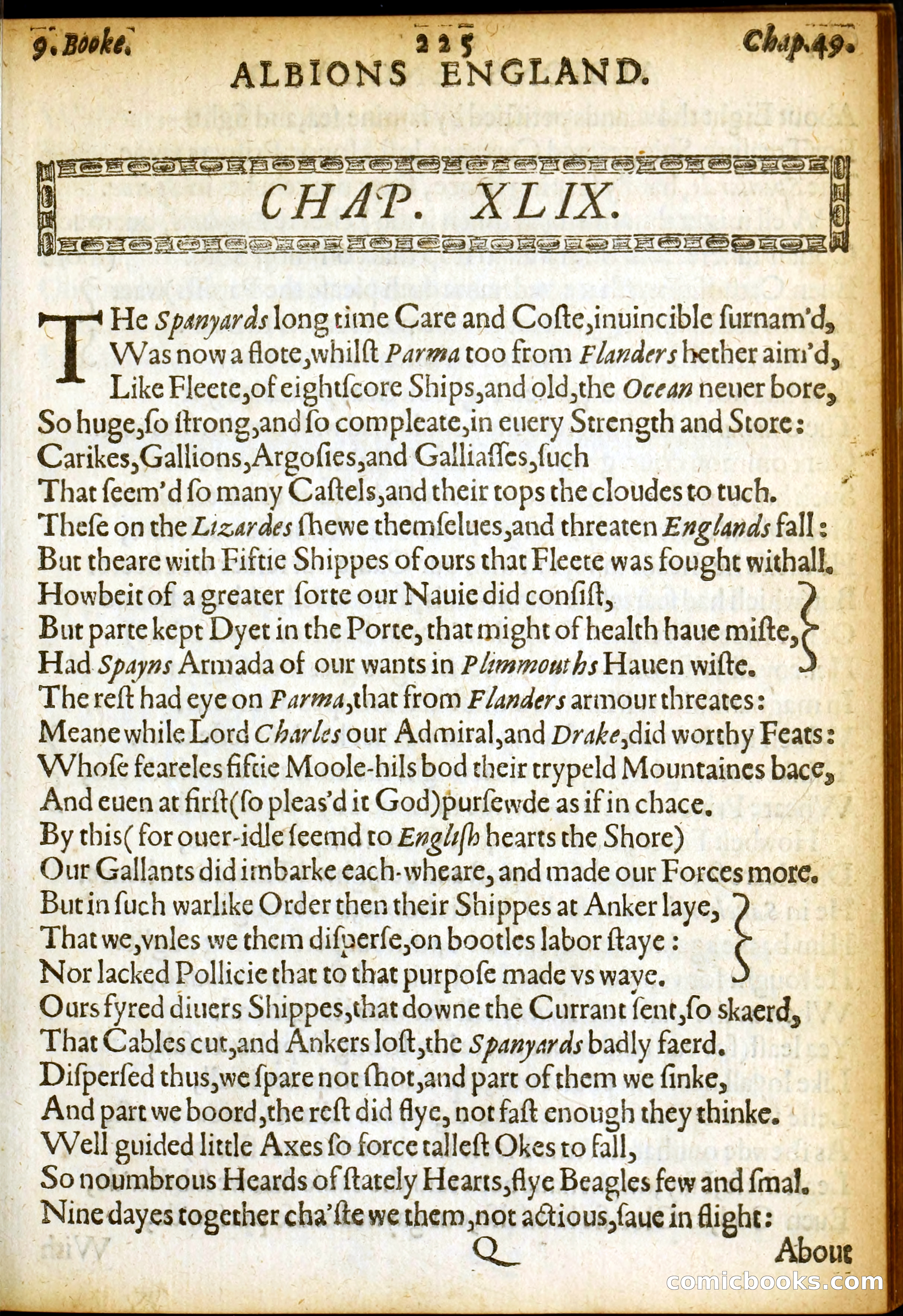
This page contains running prose—specifically, poetry in early modern English spelling and typography. It presents Chapter XLIX (49) from what appears to be a historical narrative poem titled *Albions England*. The text describes naval conflict between English and Spanish forces, mentioning the Spanish Armada, the fleet of Parma from Flanders, English admirals including Lord Charles and Drake, and battles fought over nine days. The verse celebrates English naval prowess against the Spanish threat, describing ship types, combat tactics, and the dispersal of Spanish vessels.
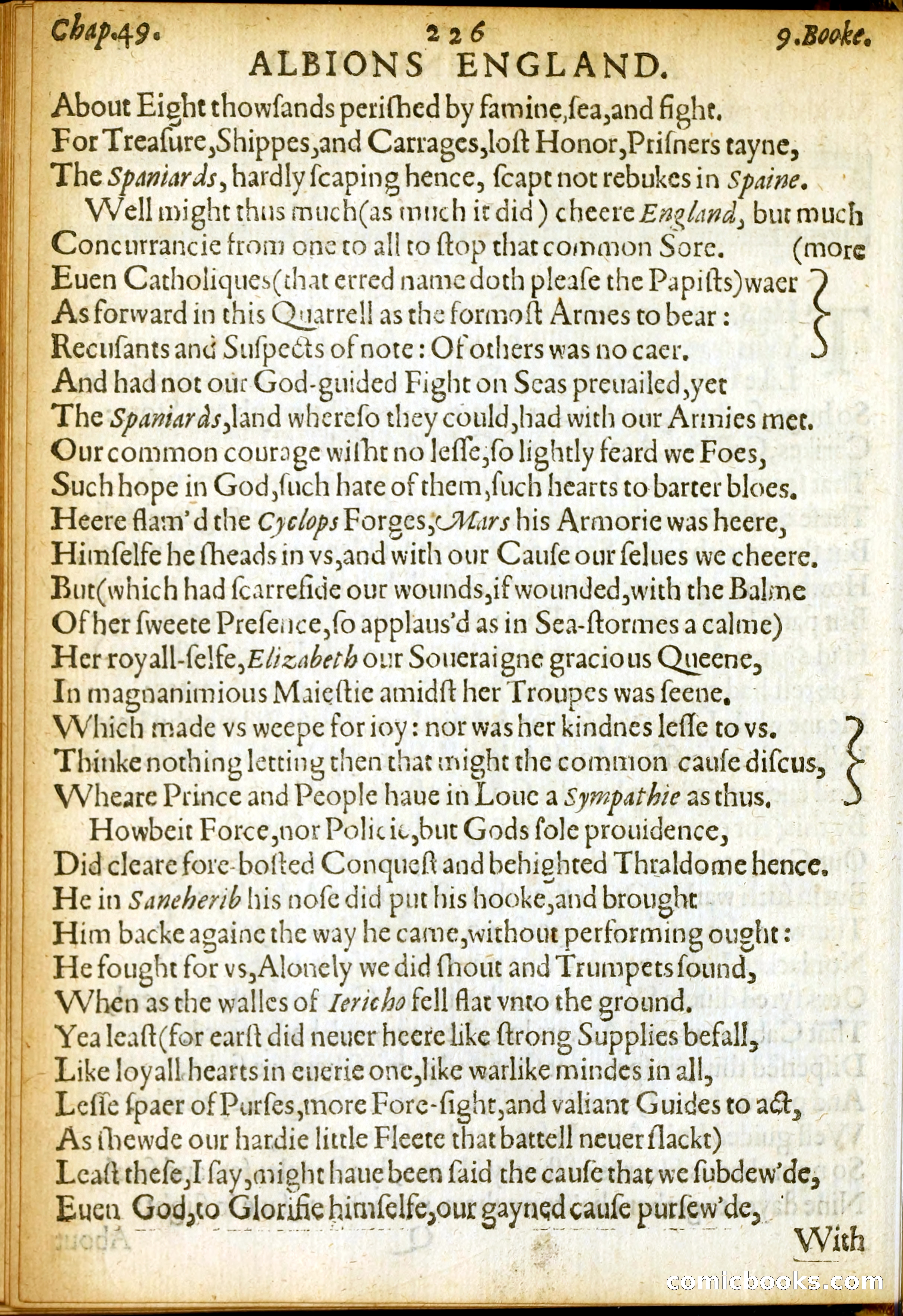
# Analysis of Page This is running prose from **Albion's England**, a historical narrative poem (not a penny dreadful, despite your framing). The visible text is verse celebrating England's victory over the Spanish Armada, attributing success to divine providence, Queen Elizabeth's leadership and presence among her troops, and the courage of English forces. The passage emphasizes that God—not military force or strategy alone—secured the triumph, invoking biblical parallels (Sennacherib, Jericho) to frame the English victory as divinely ordained. The antiquated spelling and typography date this to the early modern period, likely the 1590s-1600s.
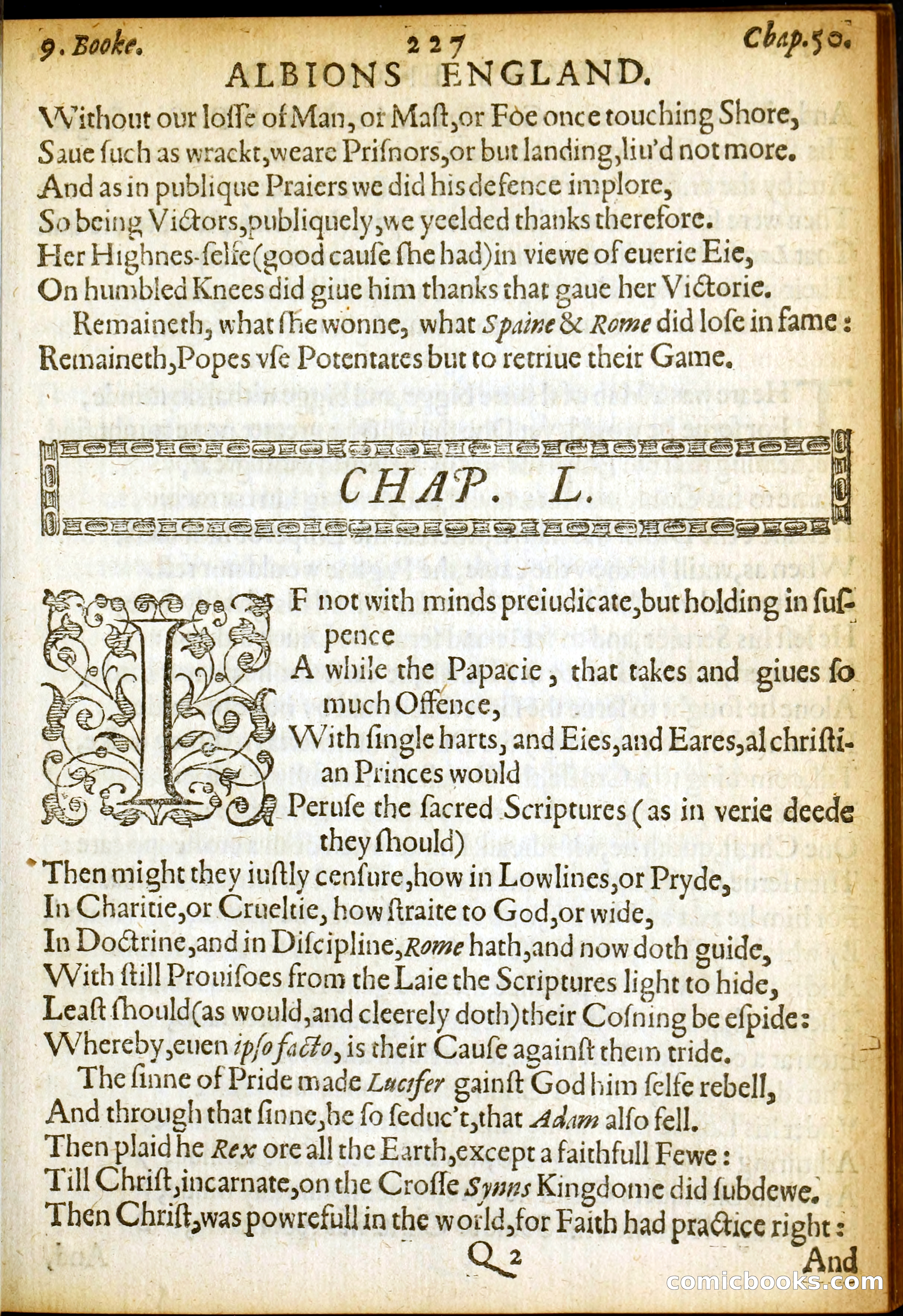
# Analysis of Page 227 This is a page of running prose poetry from what appears to be Samuel Daniel's *Albions England*, a historical verse narrative. The visible text celebrates an English naval victory (seemingly against Spain), praising Queen Elizabeth's leadership and thanksgiving for protection "without our losse of Man, or Mast, or Foe once touching Shore." The second section (Chapter L) launches into religious polemic against the Papacy and Rome, arguing that Christian princes should study Scripture rather than follow papal authority. The text invokes themes of pride, sin, and Christ's ultimate triumph, presenting Protestant religious arguments within a historical narrative framework. This is not a penny dreadful but rather an early modern historical poem.
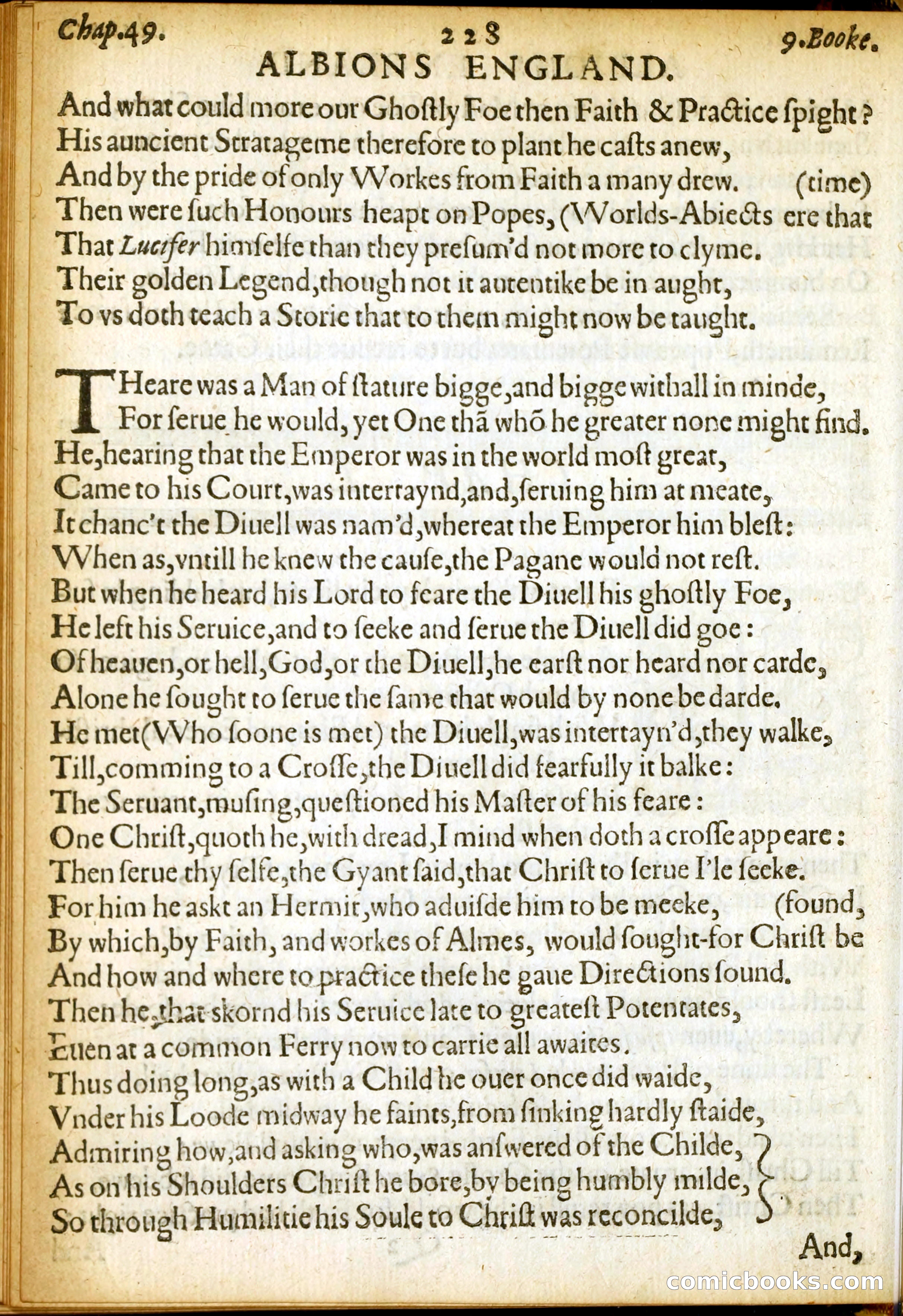
# Page Description This is a page of running verse narrative text from *Albions England*, Chapter 49. The page presents an allegorical tale in early modern English poetry about a man of great stature who, upon learning that the Emperor fears the Devil as his "ghostly Foe," abandons his service to the Emperor and instead seeks to serve the Devil. The narrative follows this man's eventual encounter with a hermit who redirects him toward Christ through humility and alms-works. The story culminates when the man, now serving Christ humbly, faints while carrying a child who reveals himself to be Christ—thereby reconciling the man's soul to Christ through humility. The text employs archaic spelling and religious allegory typical of early modern didactic verse.
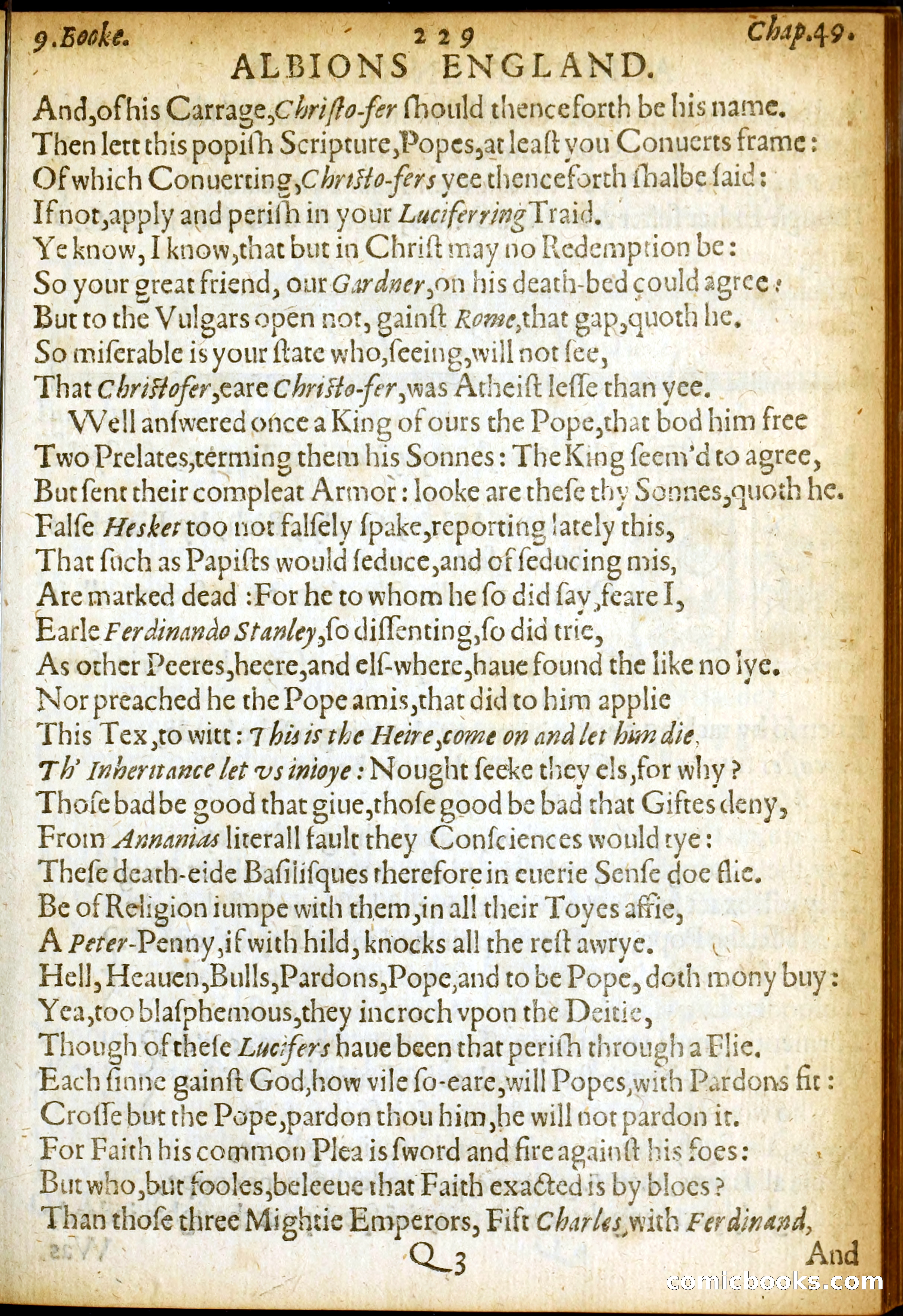
# Page Description This is a page of running verse poetry from Samuel Daniel's *Albions England* (Chapter 49, Book 9, page 229). The text is a sustained anti-Catholic polemic in early modern English verse, attacking papal authority, Catholic conversion practices, and papal indulgences. It references specific historical figures including "Earle Ferdinando Stanley" and critiques papal claims to spiritual authority, portraying the Pope as corrupt and manipulative. The passage defends Protestant faith against Catholic theology, with particular venom directed at papal pardons and the seduction of converts. No illustrations appear on this page.
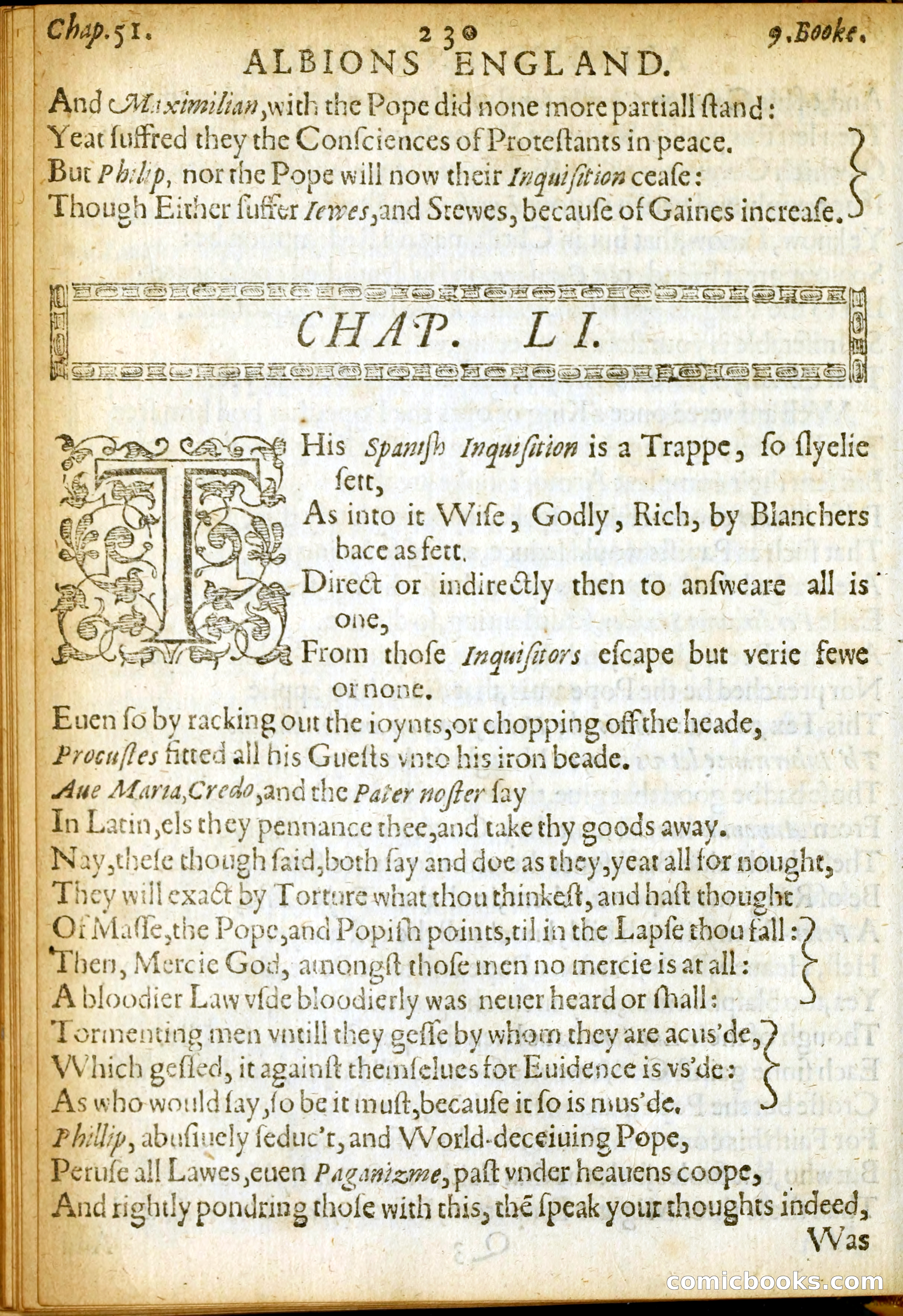
# Page Analysis This is a running prose page from Chapter LI of what appears to be "Albions England," a historical narrative poem. The text discusses the Spanish Inquisition as a "trap" and condemns its practices of torture, confiscation of goods, and execution of those accused of heresy. The verse criticizes Pope Philip for refusing to cease the Inquisition despite its brutality, describing specific torments (racking joints, chopping off heads) and denouncing the forced confessions extracted through torture. The language is polemical and anti-Catholic in character, typical of Protestant polemic literature.
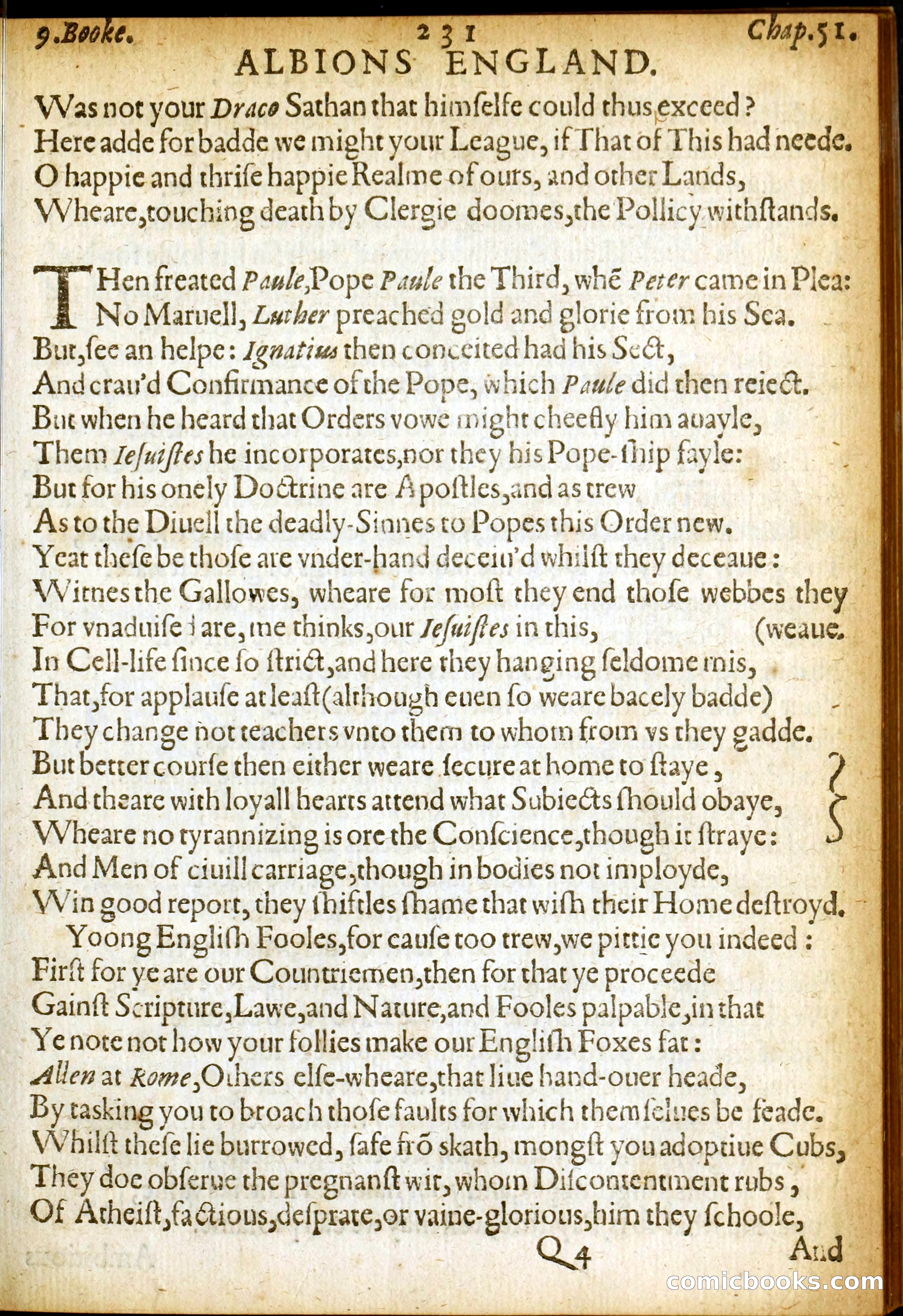
# Page Description This is a page of running verse poetry from what appears to be an early modern text titled "Albions England," not a Victorian penny dreadful as suggested in the prompt. The visible text consists of several stanzas in archaic English addressing "Young English Fooles" and discussing religious orders (apparently Jesuits), papal authority, and moral corruption. The passage criticizes those who adopt foreign religious doctrines and argues that proper subjects should obey established conscience and law. The typography, spelling conventions, and reference to "Pope Paule the Third" and "Allen at Rome" suggest this is actually a 16th or 17th-century satirical religious poem, predating Victorian penny dreadfuls by centuries.
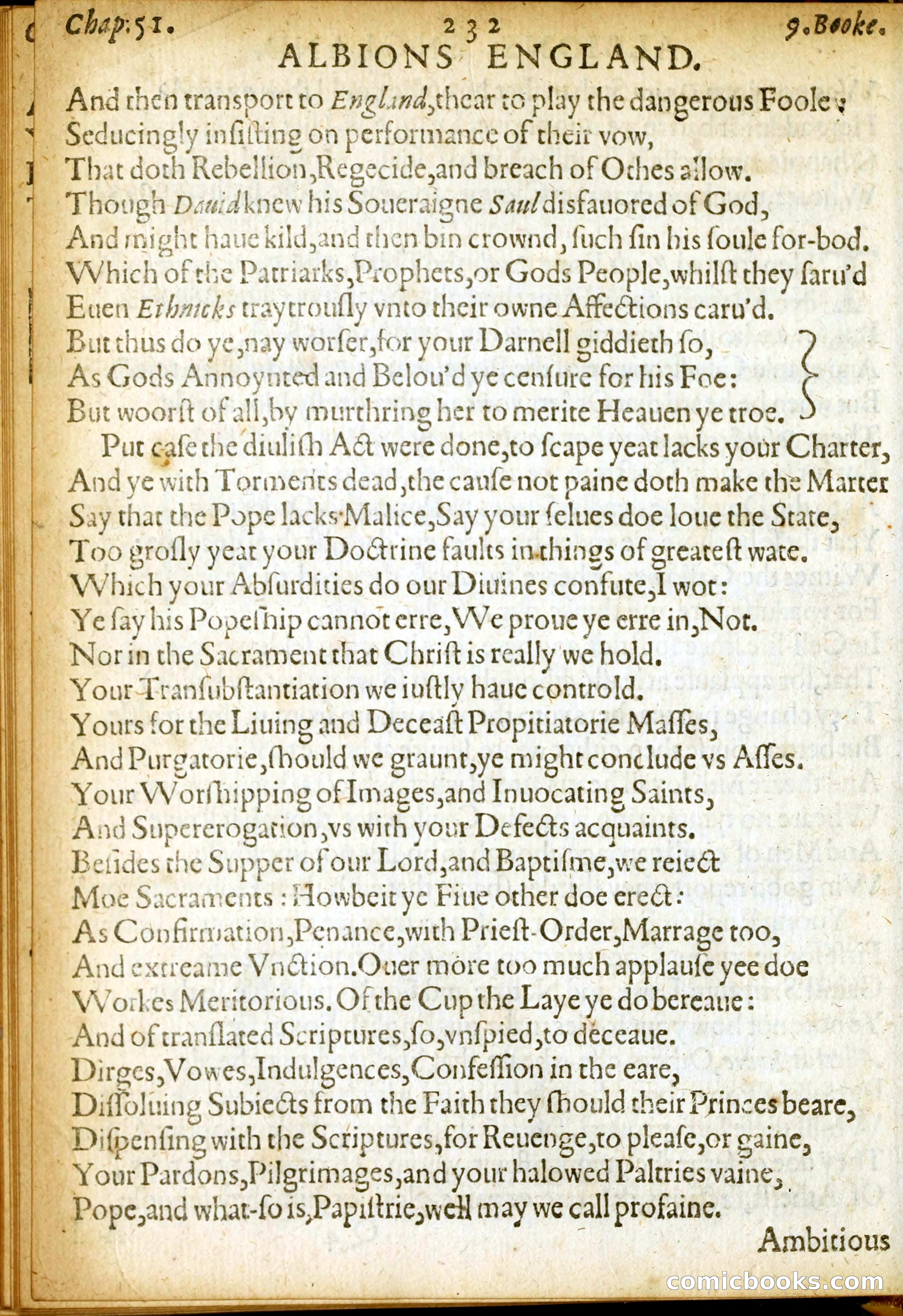
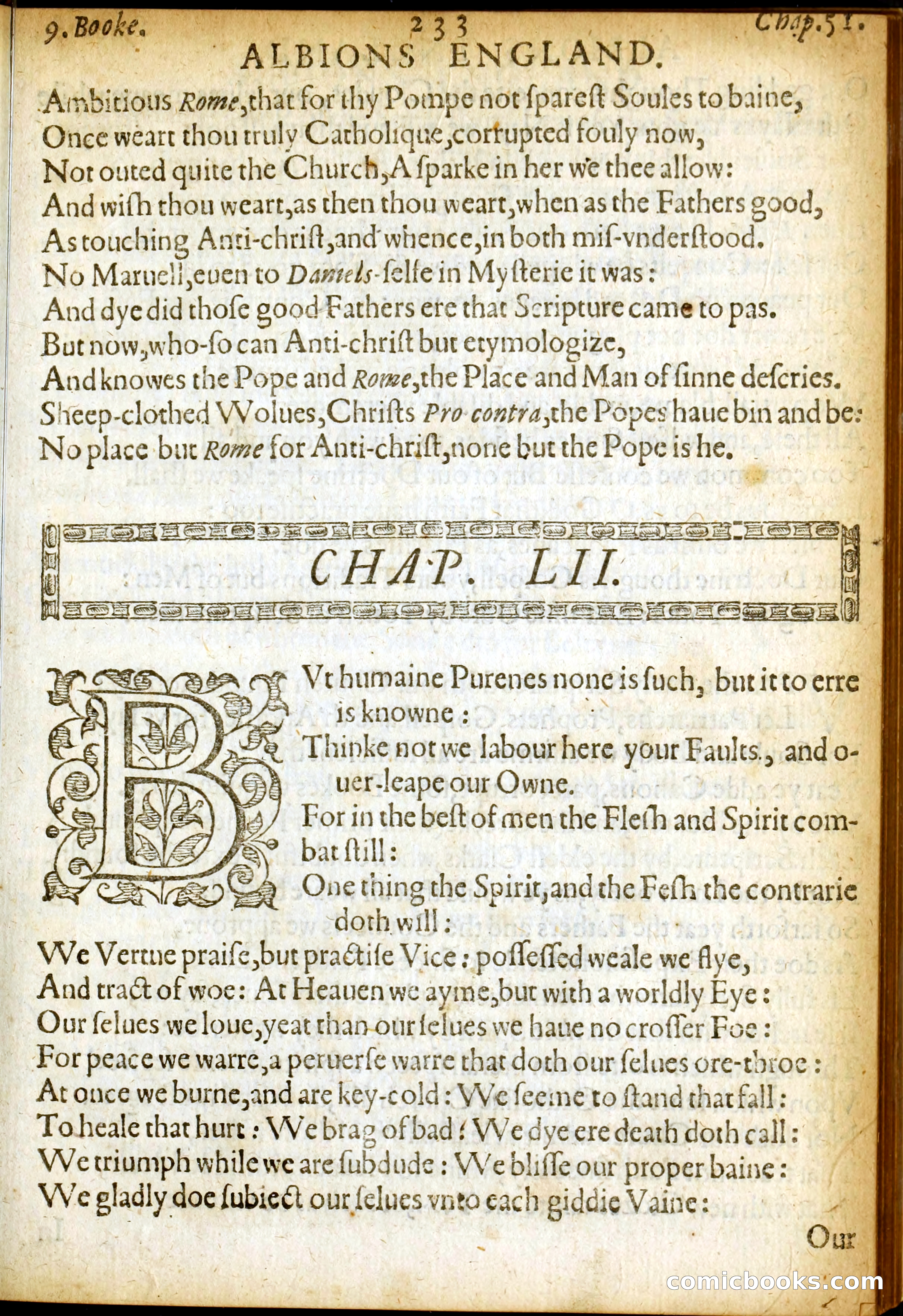
# Description of Page This is a page of running prose poetry from what appears to be an early modern religious work (not a Victorian penny dreadful, despite the OCR source attribution). The page contains two distinct sections: an introductory passage addressing "Ambitious Rome" and its corruption, accusing the Pope of being Anti-christ; and below a chapter heading "CHAP. LII," a longer moral poem beginning "Vt humaine Purenes none is such" that discusses the conflict between flesh and spirit, human hypocrisy, and moral weakness. The text uses archaic spelling and typography typical of 16th or 17th-century English printing.
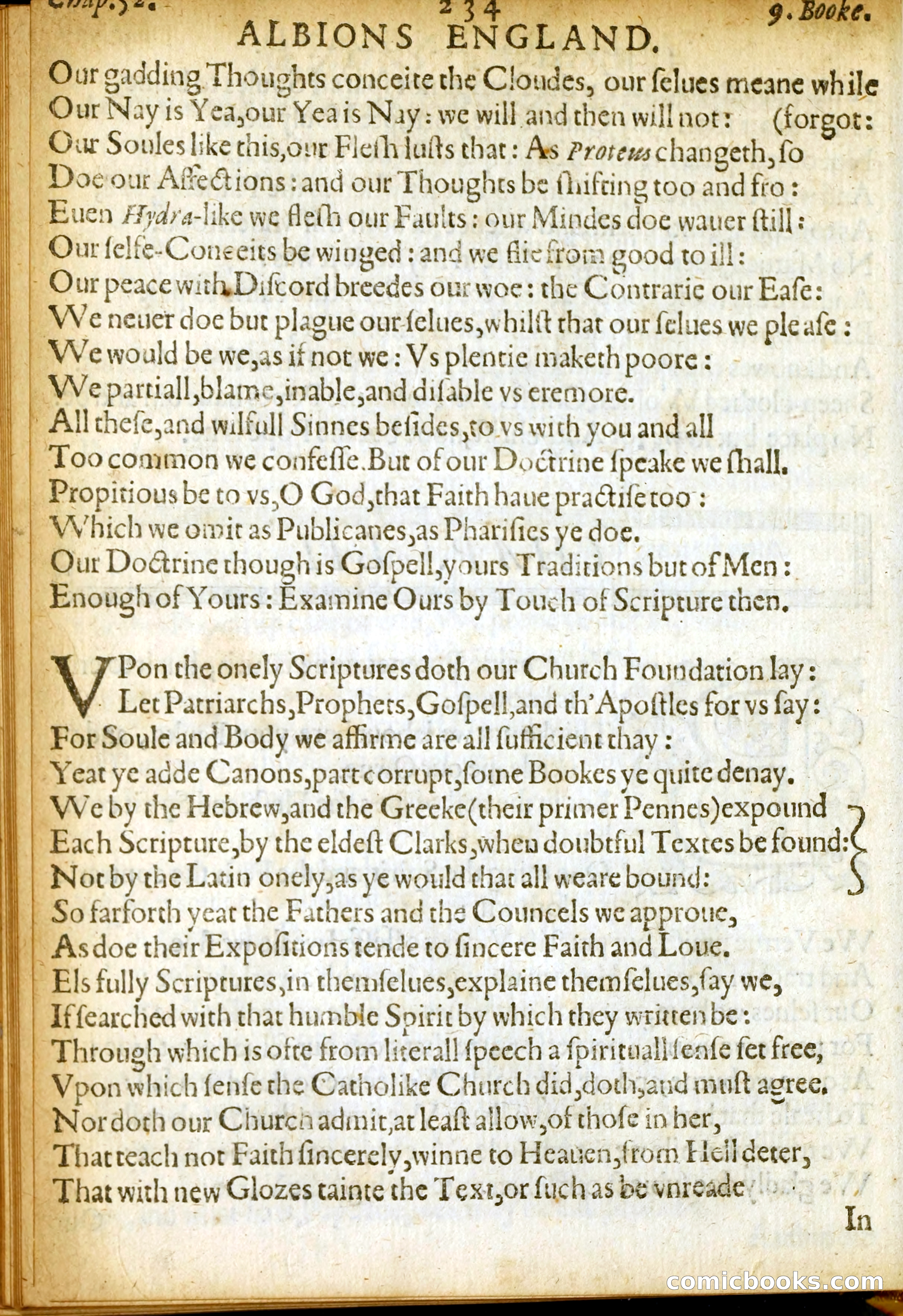
# Analysis of This Page This is a page of running **prose verse** from what appears to be a religious or theological polemic, not a Victorian penny dreadful. The text presents arguments defending Protestant doctrine—specifically emphasizing Scripture alone as the foundation of church authority, criticizing Catholic traditions and papal authority, and asserting that the Bible (in Hebrew and Greek) requires no additional ecclesiastical glosses or interpretations. The language and typography suggest this is from an **early modern period text** (likely 16th or 17th century), not Victorian popular literature. The page number "234" and header "ALBIONS ENGLAND" indicate it belongs to an older Protestant religious tract rather than sensational Victorian fiction.
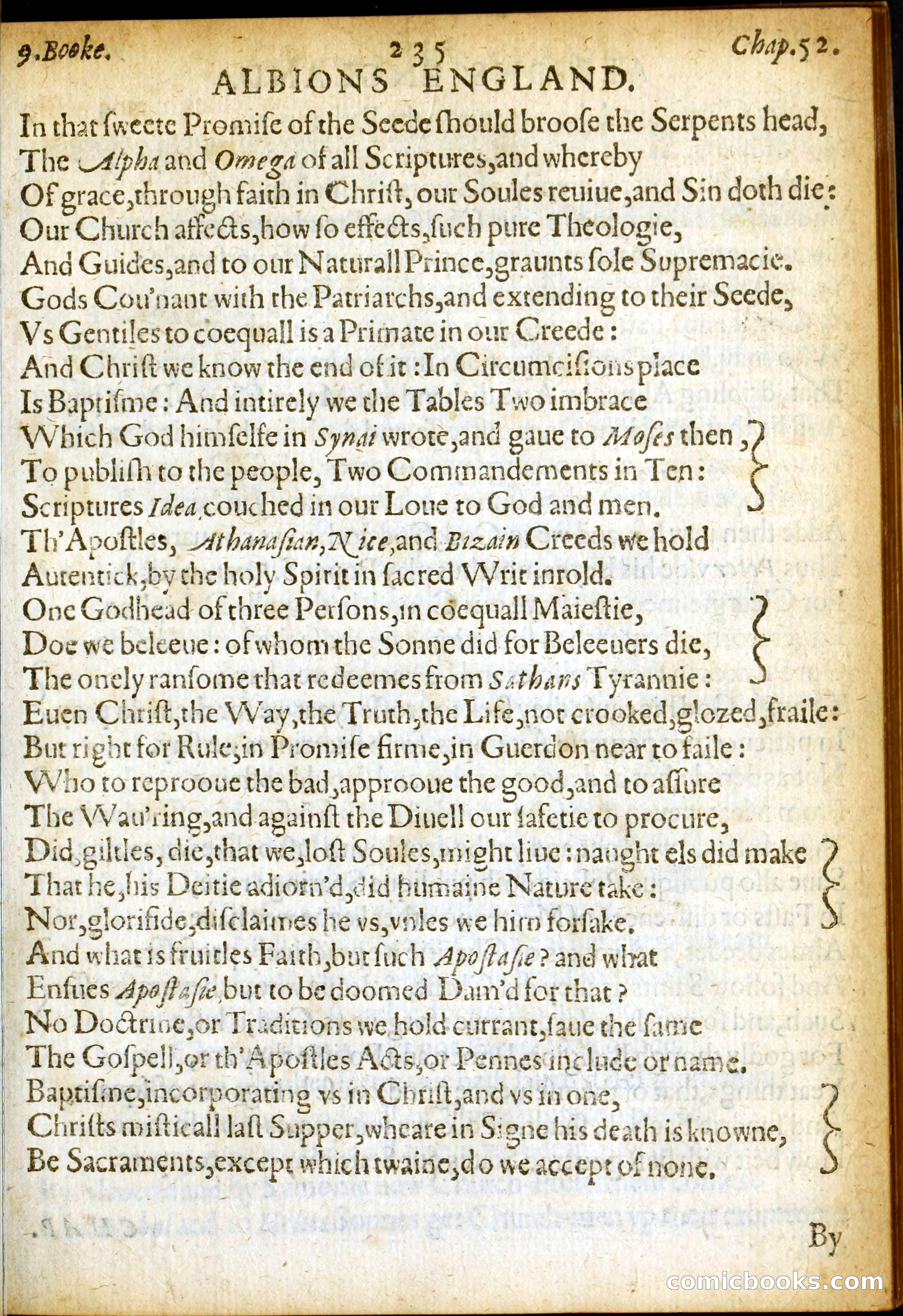
# Analysis of This Page This is a page of running prose poetry from what appears to be an early modern religious text (not a Victorian penny dreadful, as the title "Albions England" and typography suggest this is from an earlier period—likely 16th or 17th century). The text is a versified statement of Protestant Christian doctrine, covering themes including Christ as savior, the authority of Scripture, the Apostles' Creed, baptism, the Ten Commandments, the Trinity, and rejection of certain Catholic traditions. The ornamental brackets on the right margin mark significant theological passages. The heavy use of italics and archaic spelling reflects the era's printing conventions.
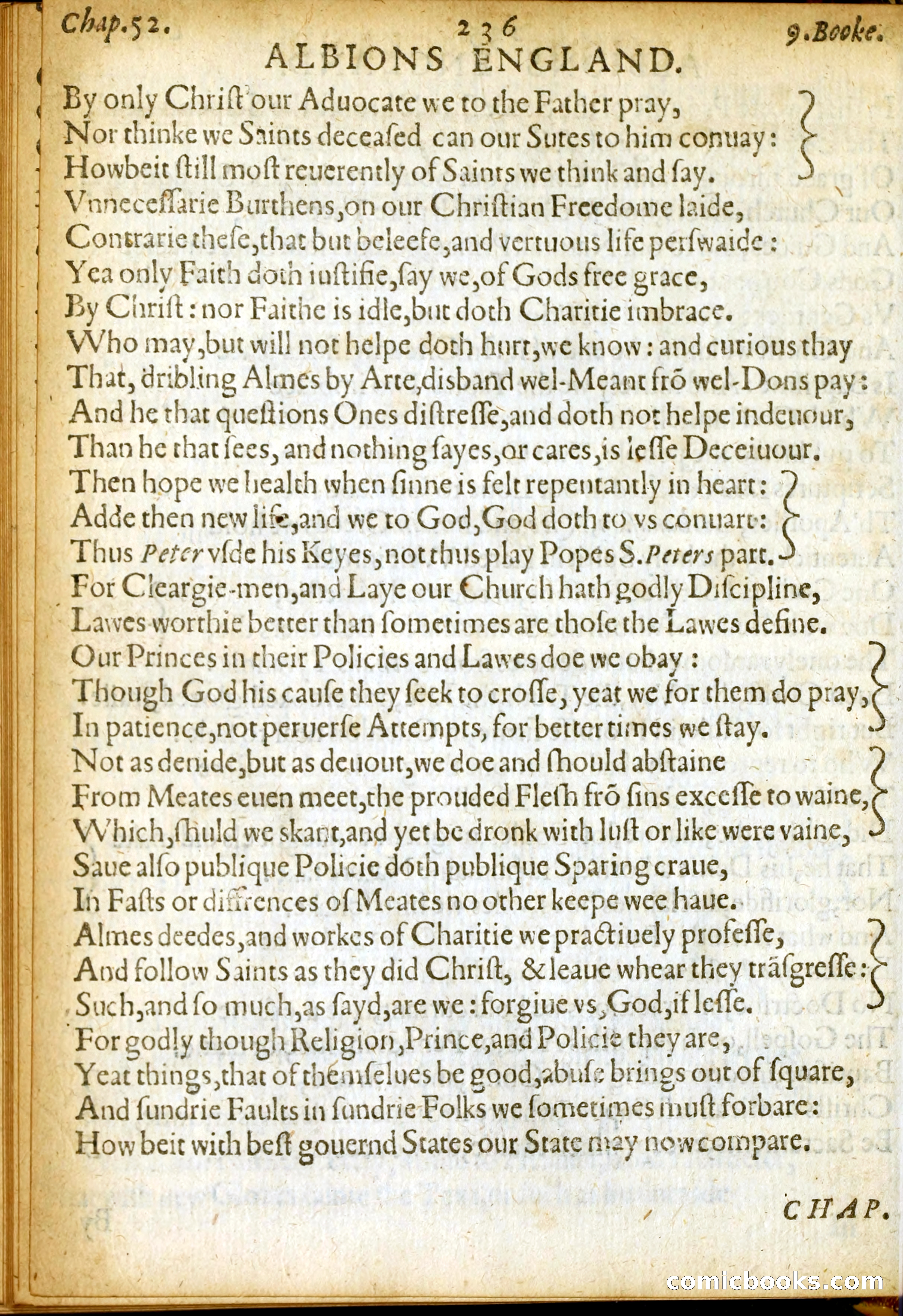
# Analysis of Page This is a **running prose page** from what appears to be a religious or moral didactic work titled "Albions England" (visible at top). The text is verse in Early Modern English, discussing Christian doctrine and conduct—specifically addressing prayer to Christ rather than saints, the relationship between faith and charity, church discipline, dietary abstinence, and almsgiving. The passage argues that genuine faith must produce charitable works, and defends both religious and civil authority while acknowledging human imperfection. The page number (236) and chapter reference (chap.52) suggest this is from a longer work, not a penny dreadful as initially suggested by the prompt.
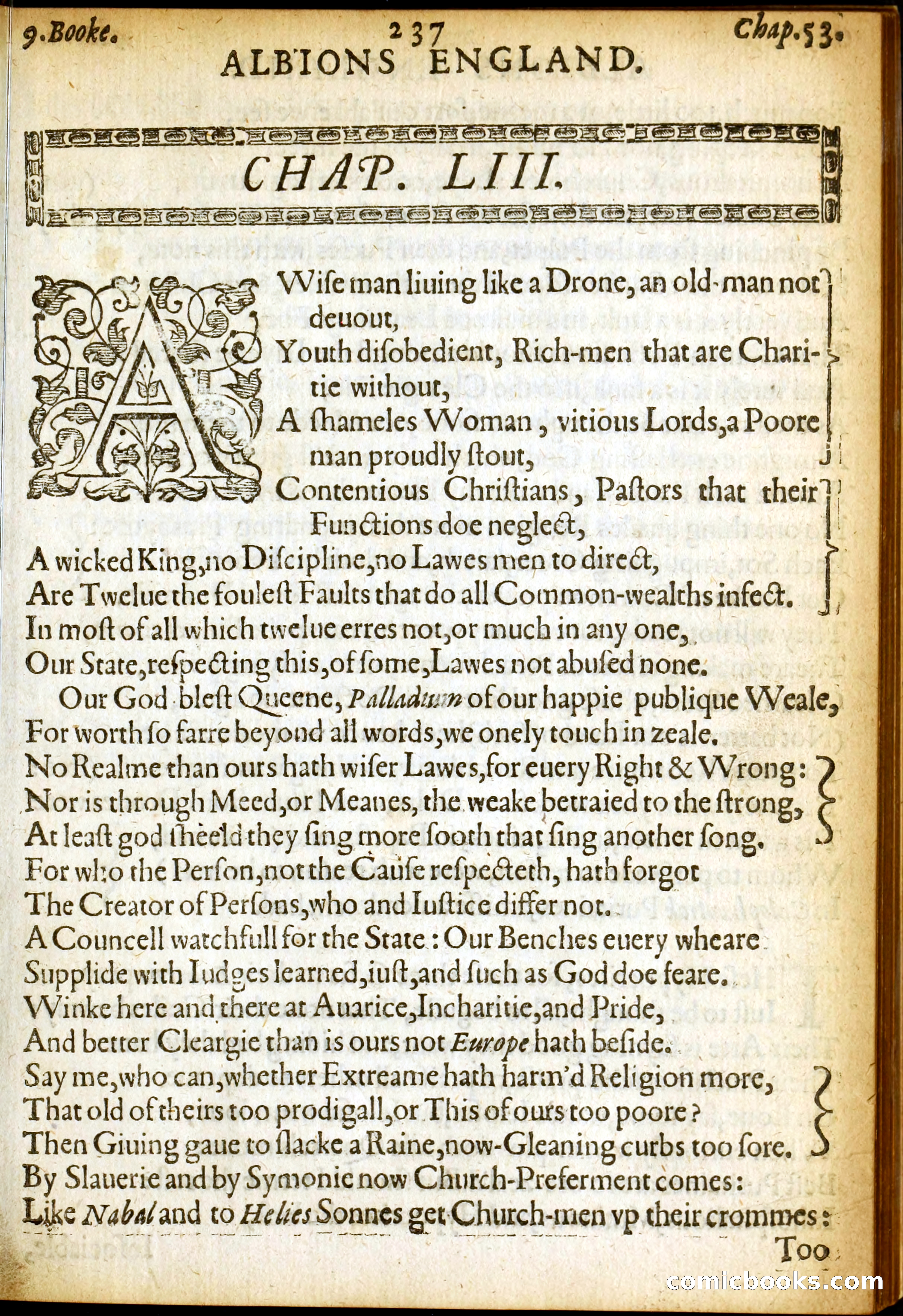
This is a page of running verse poetry from Chapter LIII of what appears to be an early modern English work (not Victorian—the typography and language suggest 17th century). The text consists of moral instruction listing twelve major faults afflicting commonwealths, then praises England's Queen (called "Palladium"), laws, judges, and clergy as superior to other nations. The verse concludes by criticizing the corruption of church preferment through "Slavery and Symonie" (simony). The ornamental initial letter and dense black-letter typography are characteristic of early printed books rather than Victorian penny dreadfuls.
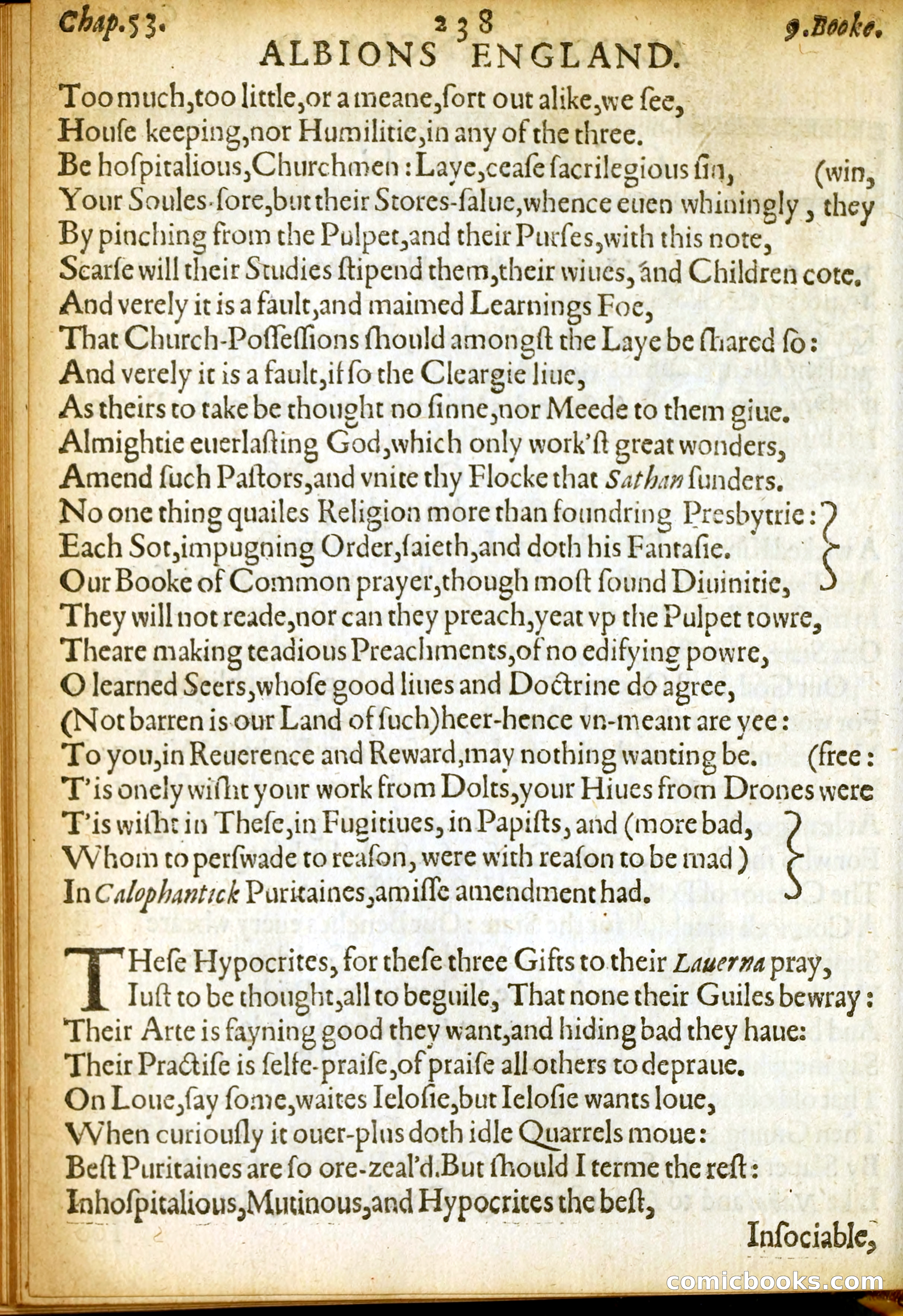
# Page Description This is a page of running verse poetry from what appears to be an early modern satirical work titled "Albions England" (visible at page top). The text is NOT a Victorian penny dreadful, but rather 16th or 17th-century English verse—likely from William Warner's *Albion's England* (1586 onward). The visible poetry satirizes religious hypocrisy, attacking corrupt clergy and Puritan "hypocrites" who preach poverty while accumulating wealth, refuse to use the Book of Common Prayer, and deliver tedious sermons. The passage criticizes those who impugn Church Order and accuses various religious factions—Calophantick Puritains, the overzealous, the mutinous—of feigning goodness while practicing self-promotion and deceit. The tone is moralistic and combative.
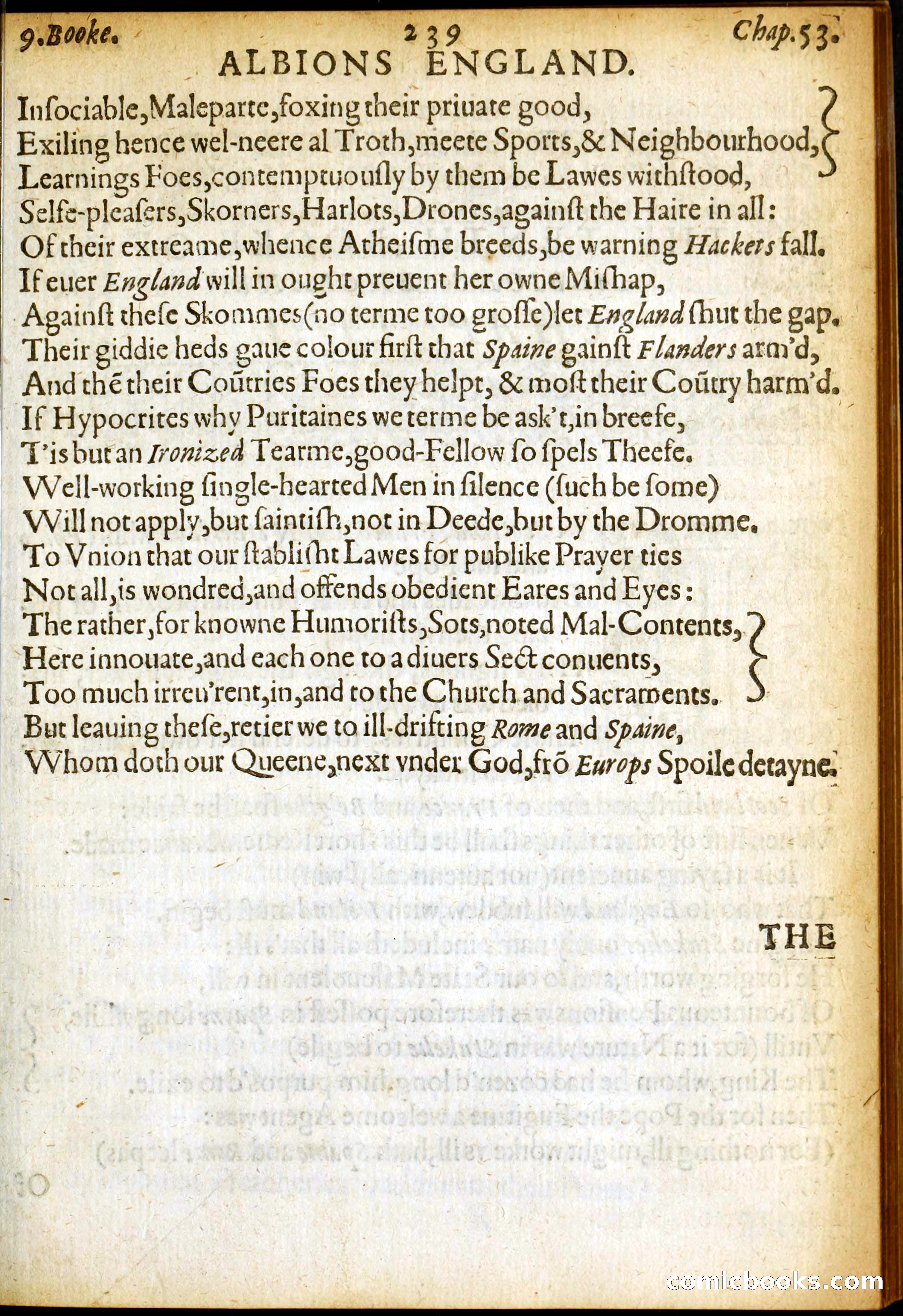
This is a page of running prose poetry from what appears to be *Albions England*, a historical work (not a Victorian penny dreadful, but an early modern English poem). The visible text is a moral and political verse criticizing various social vices—infidelity, irreverence, self-interest, and licentiousness—while warning against threats to England from Rome and Spain. The passage attacks hypocrites and Puritans, defends established church laws, and praises the Queen's protection of Europe from Spanish spoils. The language and typography are distinctly early modern rather than Victorian.
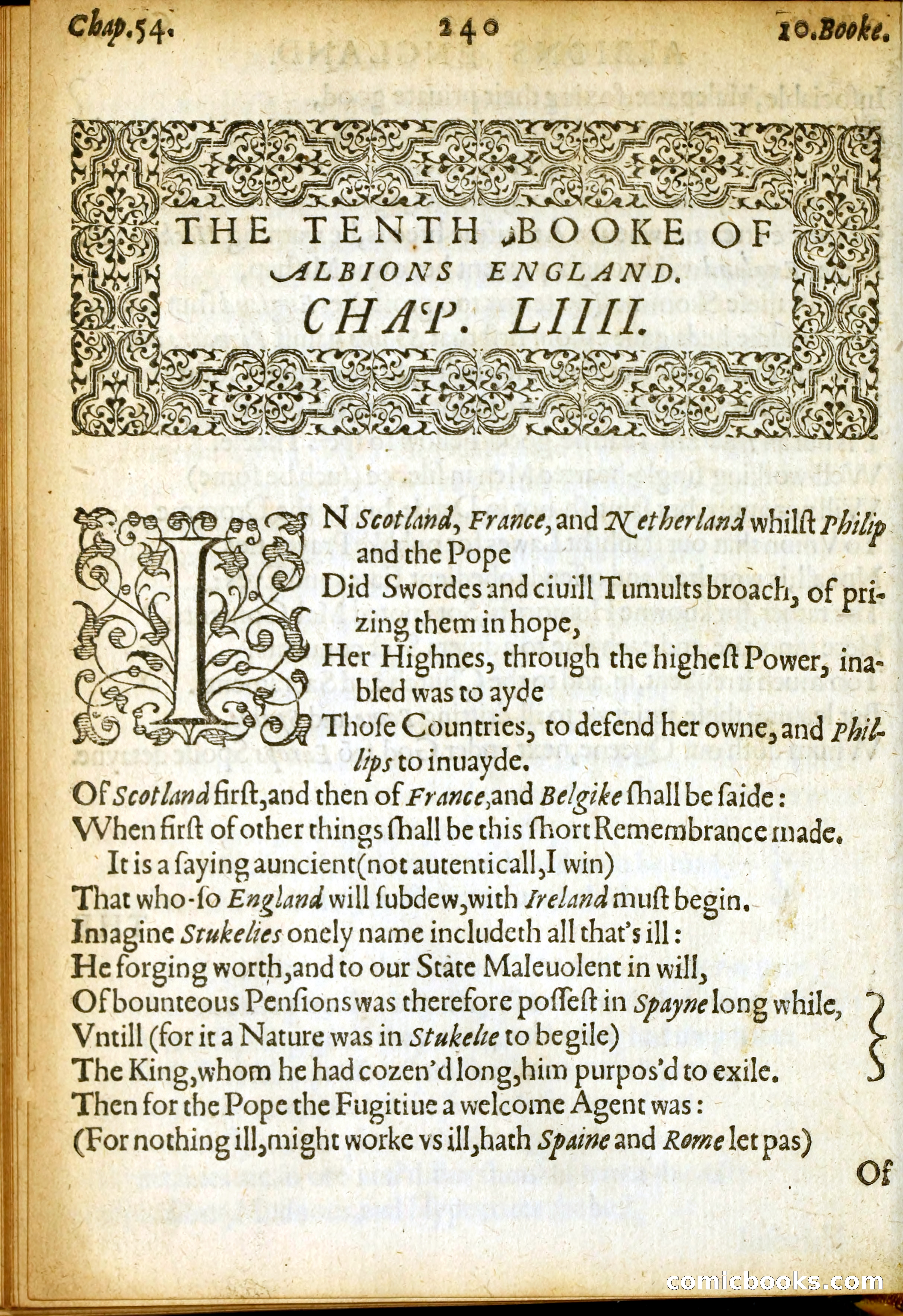
# Analysis of Page This is a prose page from the running text of a Victorian penny dreadful serialized narrative. The page presents Chapter 54 ("Chap. LIIII") from "The Tenth Booke of Albions England" and discusses, in verse, historical conflicts involving Scotland, France, and the Pope during what appears to be the reign of Elizabeth I. The text names a figure called "Strukelies" as malevolent and describes his exile by a king, his subsequent service to the Pope as a fugitive agent, and hints at conspiracies involving Spain and Rome against England. The ornate border and old-fashioned typography (including medieval letterforms) suggest this is presented as historical or quasi-historical material, though the actual content and source remain unclear from the page alone.
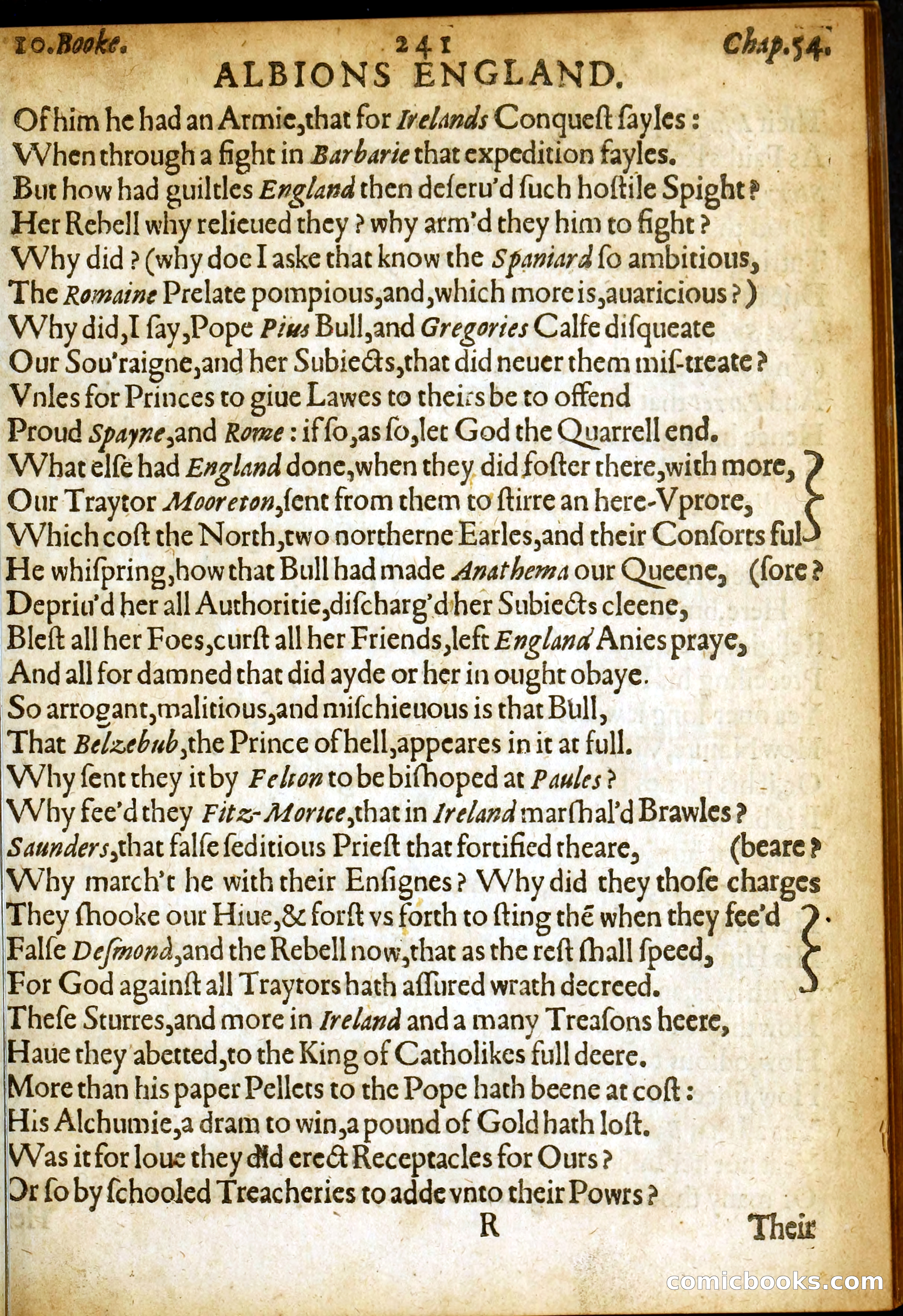
# Page Analysis: Running Prose from "Albions England" This is a page of running verse text (page 241) from what appears to be Michael Drayton's *Albions England*, a historical poem, not a Victorian penny dreadful as the prompt suggests. The visible text consists of poetic couplets and quatrains attacking Pope Pius's bull against Queen Elizabeth I, criticizing papal authority's role in fomenting Irish rebellion and treason against England. The passage condemns Spanish and Roman Catholic interference in English affairs, names specific traitors (Desmond, Fitz-Morice, Saunders), and expresses outrage that English Catholics supported papal plots to delegitimize the Queen and incite rebellion in Ireland. The tone is fiercely Protestant and nationalist, defending Elizabeth's sovereignty against papal and foreign Catholic machinations.
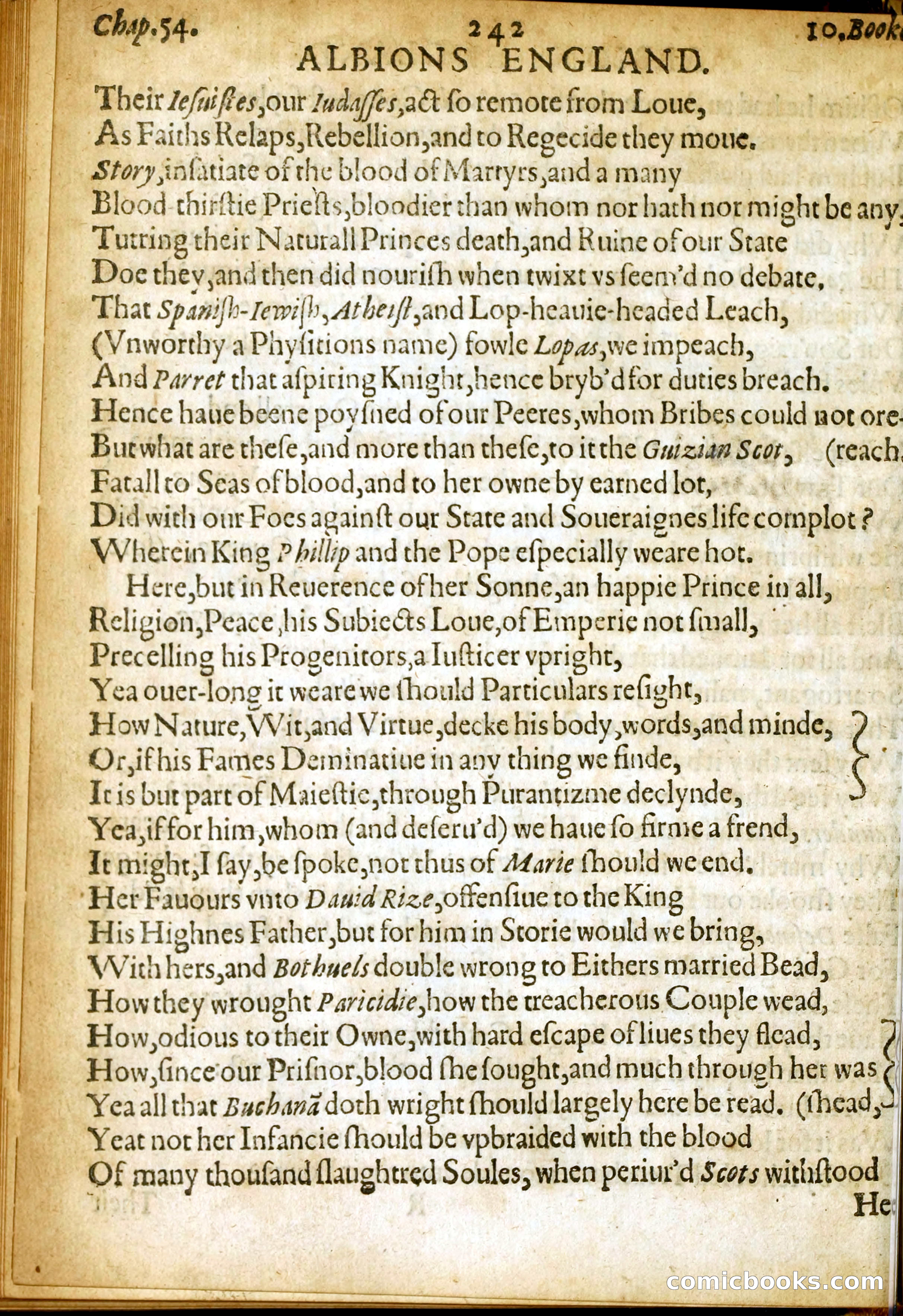
# Analysis of Page This is a page of running verse poetry from what appears to be a historical narrative poem titled "Albions England." The text is written in Early Modern English (not Victorian) and discusses alleged Catholic conspiracies, naming figures like Spanish-Jewish atheists and "Lopas," while denouncing plots against the English state and sovereign involving King Philip and the Pope. The passage then shifts to praising a prince and discussing Mary (likely Mary, Queen of Scots) and her relationships with David Rize and Bothwell, referencing accusations of murder and treason. The irregular typography and spelling reflect the source's age rather than a Victorian penny dreadful.
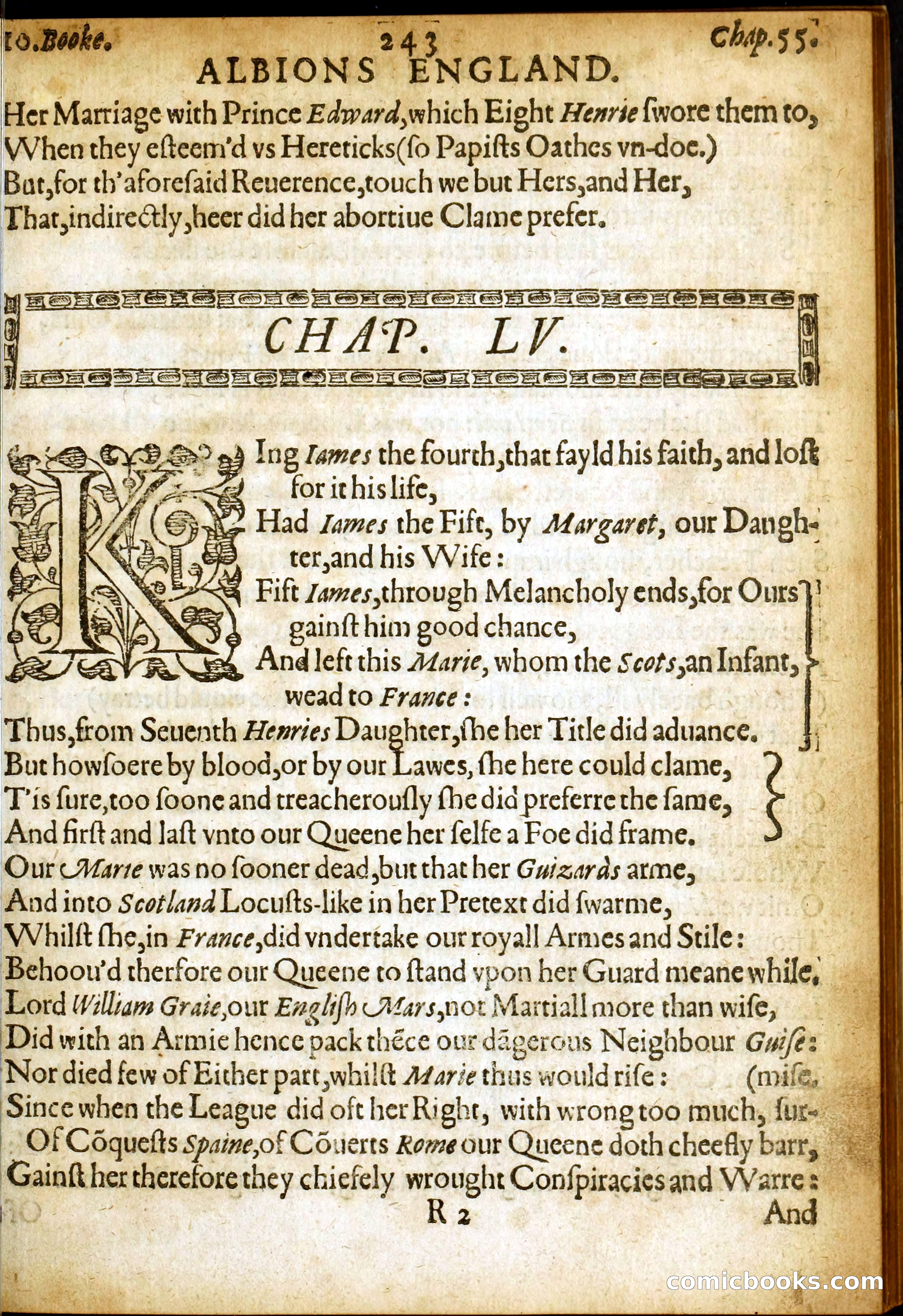
# This Page: Running Prose from a Historical Narrative Poem This is page 243 from *Albions England*, containing the continuation of Chapter 55 in verse form. The text discusses the marriage of a woman (appears to be Mary, Queen of Scots) to Prince Edward under Henry VIII, and then traces the lineage and troubles of James IV and James V of Scotland through their daughter Margaret. The passage recounts how this woman became a threat to the English Queen, describing military conflicts involving Lord William Gray and foreign conspiracies involving Spain and Rome against the English throne. The content is presented as historical-political poetry rather than fiction.
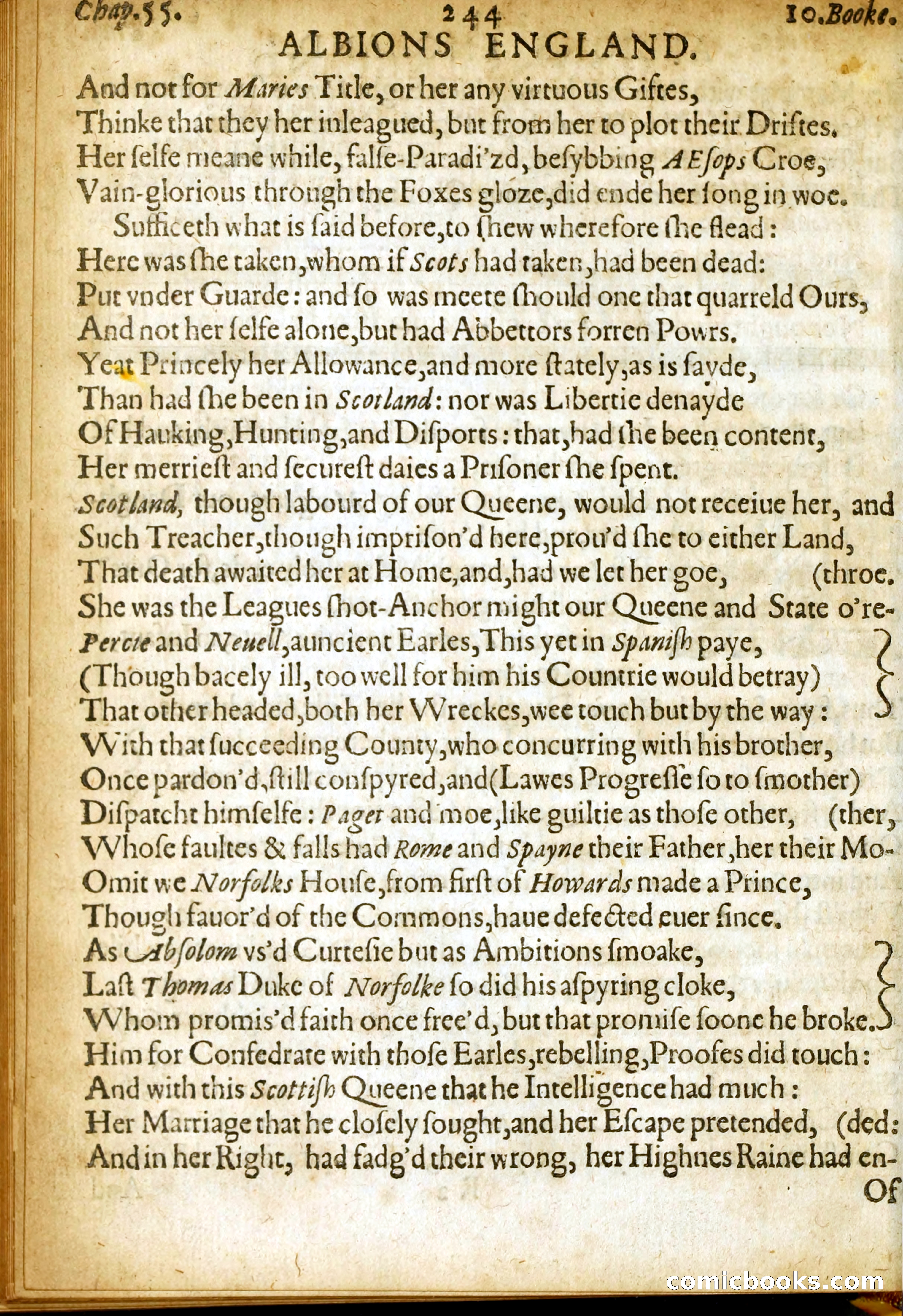
# Analysis This is a page of running prose poetry from a historical narrative work titled "Albions England." The text discusses Mary, Queen of Scots—her imprisonment in England, her threat to Queen Elizabeth's security, and various nobles implicated in plots on her behalf. The passage explains why she was kept under guard rather than released to Scotland or elsewhere, and details the treachery of figures including the Duke of Norfolk, who allegedly conspired with the Scottish Queen and plotted her marriage and escape. The archaic spelling and verse form indicate this is an early modern text, not actually Victorian penny dreadful fiction as initially suggested by the framing.
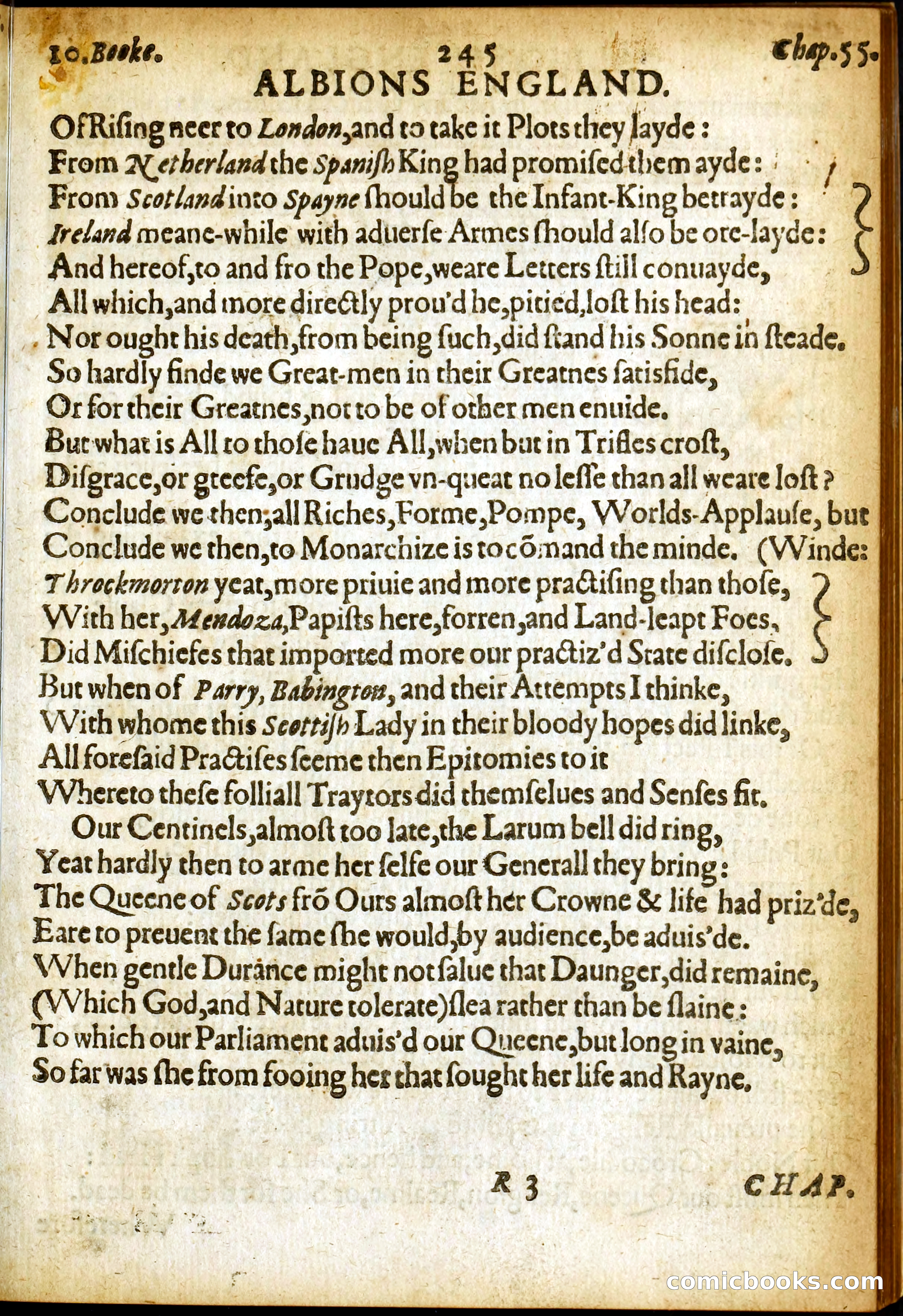
# This Page Contains Running Verse About Albion's England This is a page of running prose—specifically poetry or verse—from what appears to be a historical narrative work titled "Albions England." The text recounts political conspiracies and plots against England, referencing threats from Spain, Scotland, Ireland, and papal involvement. It mentions specific historical figures including the Scottish Lady (likely Mary Queen of Scots), Parry, Babington, and Throckmorton, describing their conspiracies and attempts against the English throne. The verse concludes with Parliament advising the Queen (apparently Elizabeth I, though not named) to execute her rival, whom she reluctantly allows to flee rather than face death. The text is densely printed in early modern English typography with archaic spelling conventions.
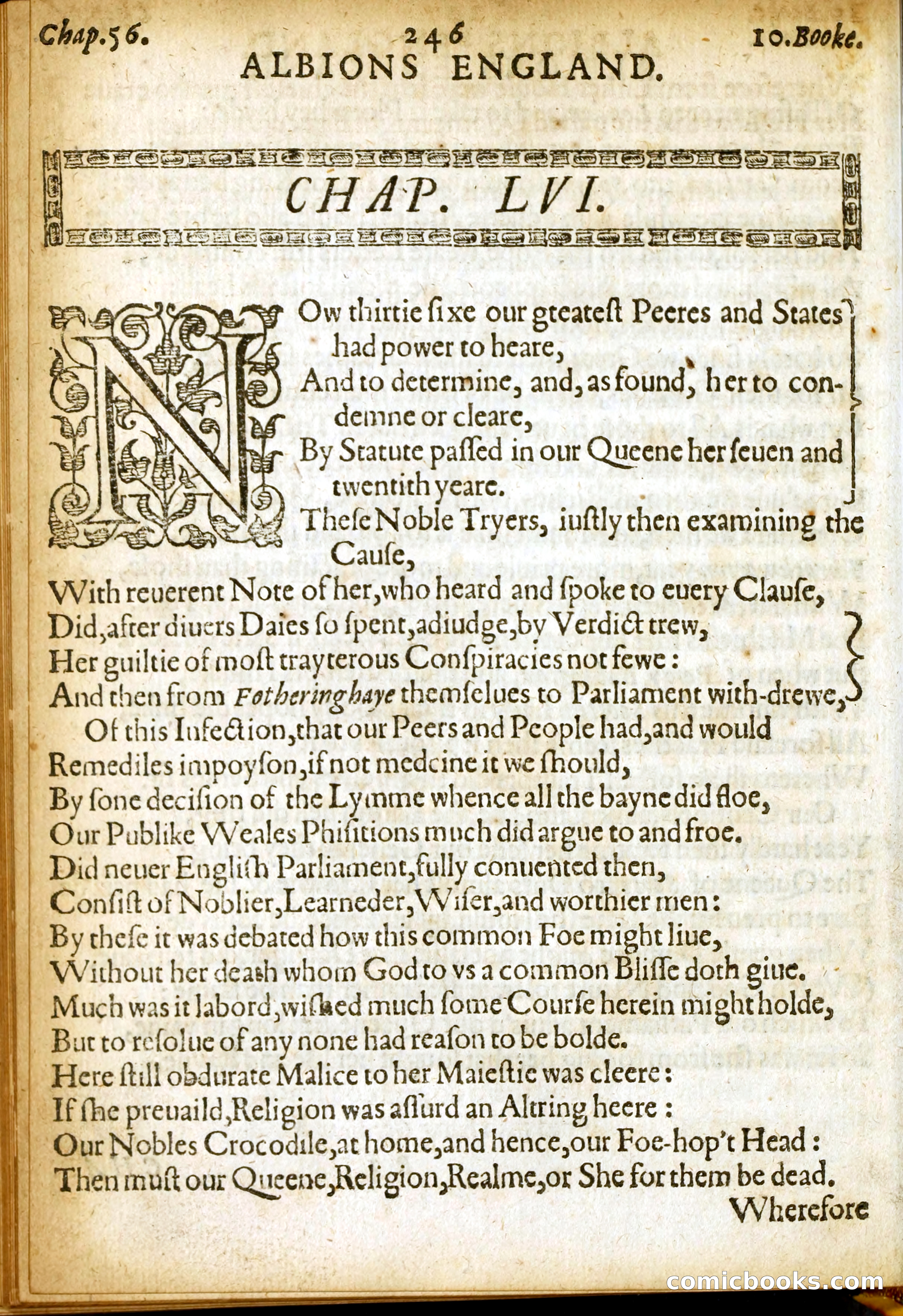
# Page Analysis This is running prose from Chapter 56 of *Albions England*, presented in early modern English verse. The passage concerns a trial of England's peers and states examining charges against someone (appears to be a historical figure tried by Parliament under a statute from the Queen's twenty-seventh year). The text describes how noble jurors examined evidence, found the accused guilty of "traiterous Conspiracies," and discusses Parliament's debate over whether execution is necessary to protect the realm and religion. The passage is densely packed verse written in archaic orthography typical of early printed English literature.
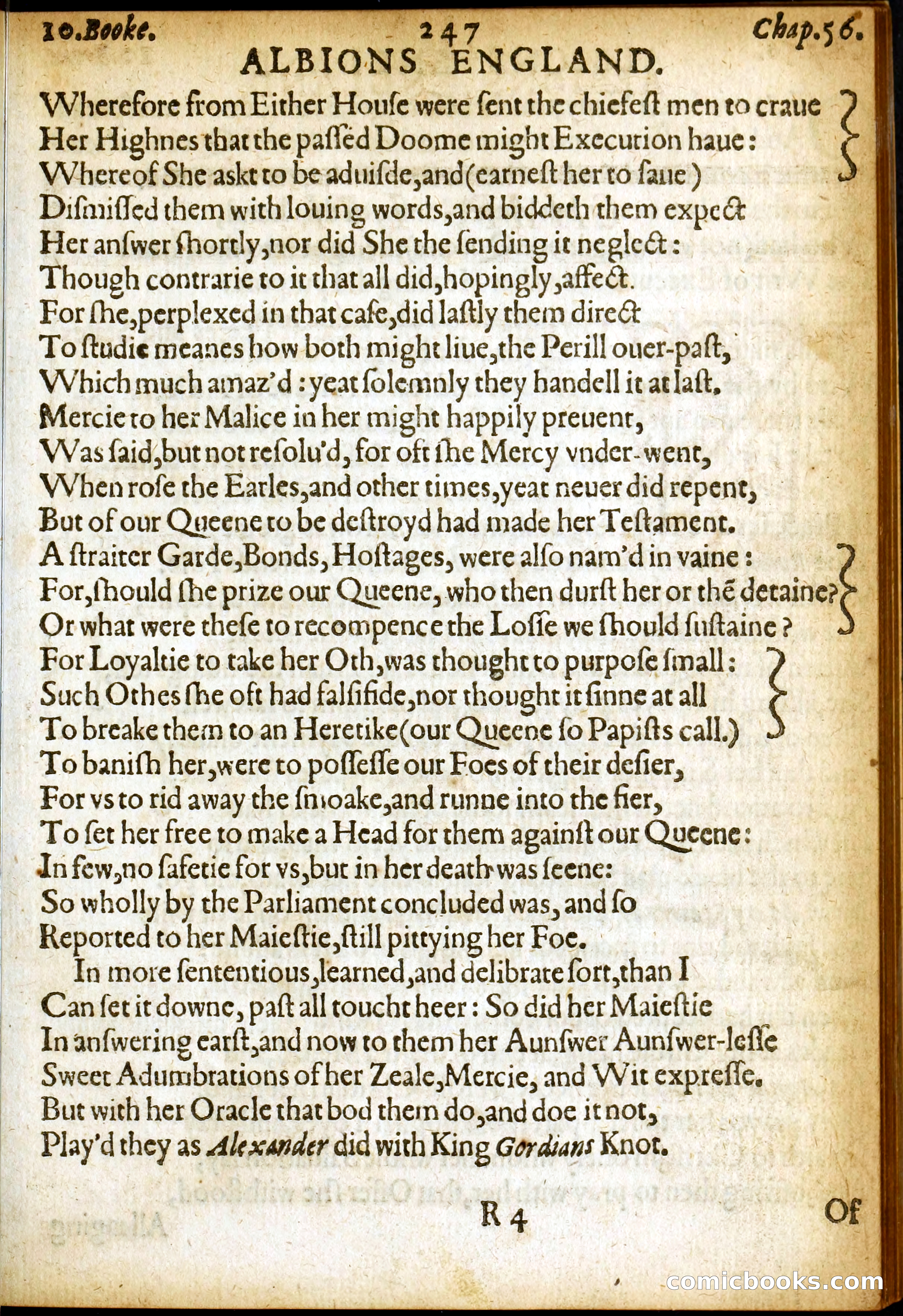
# Analysis of Page 247 from "Albions England" This is a page of running verse from what appears to be a historical narrative poem titled "Albions England" (not a Victorian penny dreadful, but an early modern work). The text describes Parliament's debate over executing a female prisoner—likely a historical or legendary figure—where mercy and political necessity conflict. The passage details how the Queen, perplexed by the dilemma, ultimately receives Parliament's recommendation that the woman must die for state security, though the Queen reportedly responds with characteristic ambiguity, neither fully deciding to execute nor pardon the prisoner (compared to Alexander cutting the Gordian Knot).
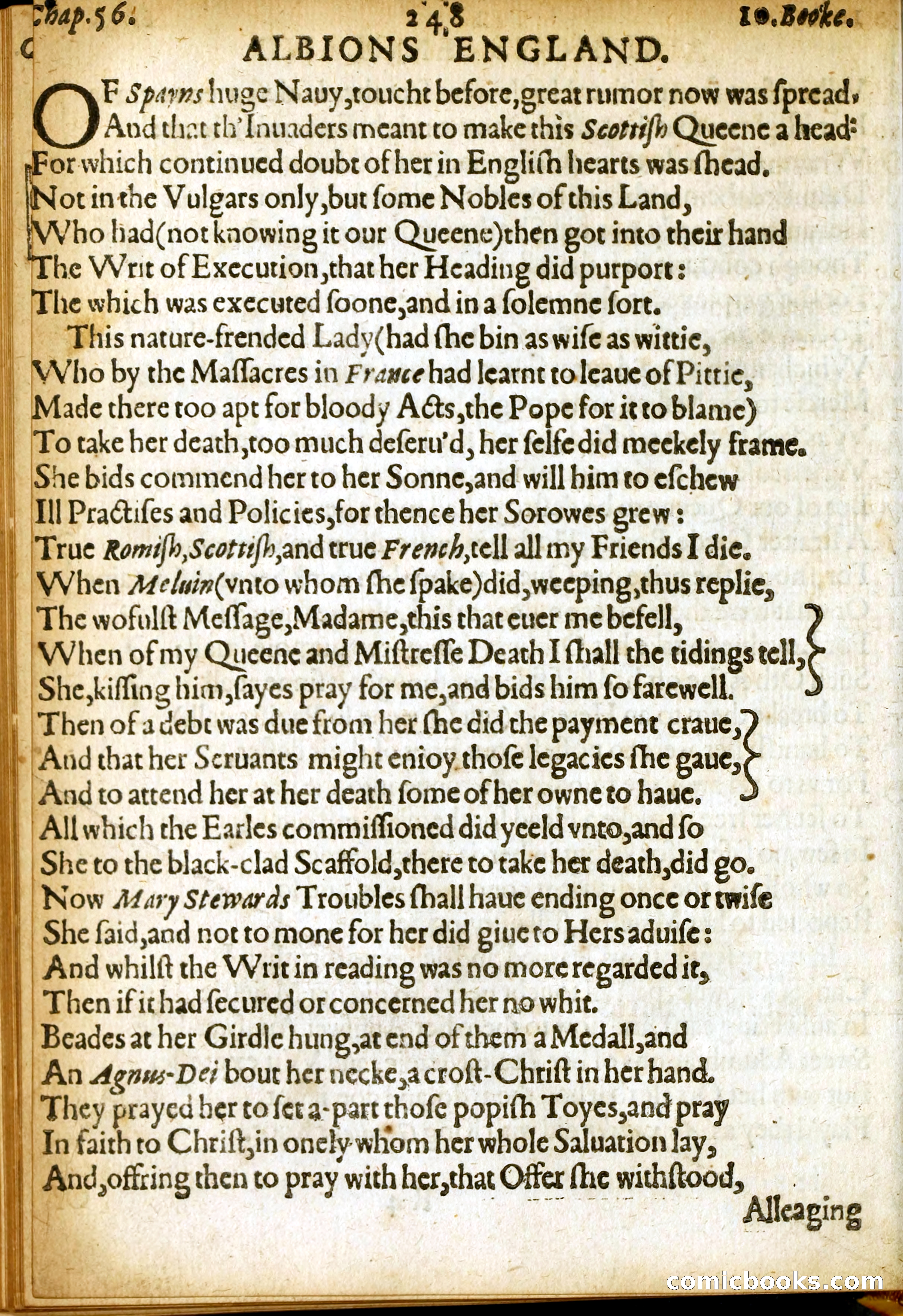
# This Page: Running Prose This is a page of continuous verse narrative from *Albion's England*, a historical poem. The text describes the execution of a Scottish queen (apparently Mary, Queen of Scots, though not explicitly named until near the end as "Mary Stewards"). The passage details rumors of invasion, a writ of execution issued without the English Queen's knowledge, the condemned woman's dignified composure, her final messages to her son and servants, and her preparation for death on the scaffold, including religious items she carried and her refusal of Protestant prayers.
This is a page of running verse poetry from what appears to be an early modern (not Victorian) historical narrative poem titled "Albions England." The text denounces Catholic practices and the Pope's authority, then praises Queen Elizabeth's handling of threats from Mary Queen of Scots and her protection of England. The passage credits William Duries and the Earl of Sussex with military service, and concludes by noting that Elizabeth's aid to France will be discussed next. The language and typography suggest this is from the 16th or 17th century, not the Victorian era.
# Page Description This is a running prose page from Chapter 58 of what appears to be a narrative poem or dramatic work titled "Albions England." The text describes a politician's (a "Germaine") account delivered before the Queen-Mother, Charles the King, and others, concerning his travels and observations of absolute monarchy in France. The passage contrasts aristocratic and democratic governance with monarchy, detailing how an absolute monarch maintains power through appointed officials (Janizaries), controls religion and policy, avoids building fortifications except at borders, and governs subjects without imposing taxes or imports—thereby preventing tumult. The text is printed in early modern typeface with decorative initial letter.
# Analysis of Page This is a **page of running verse text** from what appears to be a narrative poem titled "Albions England" (visible at top). The text discusses French political strategy, describing how a French King might consolidate power by controlling the three estates (Princes, Nobles, Commons), managing religious conflict, and preventing noble rebellion through patronage and military strength. The passage then shifts to describing how religious strife and civil war in France have actually occurred, referencing the St. Bartholomew's massacre and Protestant martyrdom. The verse argues that religious bloodshed paradoxically strengthened the Reformed Church and inspired figures like Luther to challenge papal authority. The page contains dense early modern English verse in black letter type, densely packed with minimal margins.
# Page Description This is running prose from Chapter 57 of *Albions England*, a historical narrative poem in early modern English. The page contains verse discussing religious conflicts in France, specifically referencing the St. Bartholomew's Day Massacre (though not named explicitly) involving the Guisian faction, French Papists, and Protestant victims called "Saints" and "Lambes of Vasie." The text condemns the slaughter of innocent Christians and criticizes papal involvement, describing a "blacke Marrage-Feaft" where thousands were killed. It references King Charles, the Queen-Mother, and appears to situate these events within broader civil wars in France.
This is a page of running prose from what appears to be an early modern narrative poem (not Victorian, despite the collection's framing). The text describes religious and political conflict in France, specifically mentioning the Duke of Guise, the Huguenots, the Prince of Condé, and violent persecution of Christians. The passage discusses factional struggles over the crown and how Spain observes French turmoil while strengthening France's enemies through financial support. The page includes a chapter heading ("CHAP. LVIII") and uses archaic spelling and typography characteristic of much earlier printing.
# What This Page Contains This is a page of running verse poetry from *Albions England* (Chapter 53, Book 10), visible at the top of the page. The heavily damaged OCR reflects the image quality, but the legible text discusses English religious and political conflicts, specifically concerning the Guise family's Catholic machinations against Protestant England and Queen Elizabeth. The poem references the Pope, France, Spain, Scotland, and various historical figures including the Duke of Guise, and describes military and political threats to England. The verse employs a narrative, propagandistic tone typical of early modern English patriotic literature rather than penny dreadful sensationalism.
This page presents running prose poetry from what appears to be a dramatized biblical narrative titled "Albions England." The text recounts the story of David's children—Tamar, Amnon, and Absalom—focusing on Amnon's lustful fixation on his sister Tamar and his conspiracy (aided by the cunning Jonadab) to seduce her through deception. The verse describes Amnon feigning illness to manipulate their father David into sending Tamar to care for him, setting up the tragedy to follow. The language employs early modern English spelling and poetic conventions typical of penny dreadful serialization.
# Analysis of Page 258 from "Albions England" This is a page of **running prose poetry** from Samuel Daniel's *Albions England*, a historical narrative poem. The text recounts the biblical story of Tamar and Amnon: a woman of virtue is seduced through deceit by her brother, who then casts her out in shame. The passage describes how Amnon feigns illness to lure Tamar to his chamber, how she initially resists his advances, and how he ultimately forces himself upon her before abandoning her in disgrace. Her brother Absolom later comforts her in her desolation. The narrative emphasizes Tamar's lost virginity, her shame, and the lasting consequences of lust and incest. This appears to be serious moral-historical verse rather than sensational penny dreadful fiction.
# Analysis of Page This is a page of running verse text from what appears to be a narrative poem, not a penny dreadful as initially framed. The page—numbered 259 and marked "Albions England"—contains densely printed Early Modern English poetry discussing revenge and biblical narrative. The text recounts a story of sexual violation and familial vengeance, invoking figures like Simeon, Levi, and Amnon, and debating whether avenging rape justifies extreme action. The passage concerns a character's plot to murder his brother in retribution. This appears to be from a classical or Renaissance literary work rather than Victorian sensation fiction.
# Description of This Page This is a page of running verse poetry from *Albion's England*, a historical narrative poem. The text recounts biblical and English history in Early Modern English verse, here focusing on King David's son Absalom—his rebellion against David, his exile, his attempted coup with help from the counselor Achitophel, and his eventual death caught by his hair in an oak tree. The passage concludes with moral reflection on the fate of those who seek power unlawfully. The page contains no illustrations, only densely printed text in period typography with italicized proper names.
# Page Description This is running prose from Chapter 59 of *Albions England*, rendered in early modern English verse. The page contains a narrative epilogue resolving the tragedy of Adonijah's rebellion against King David and Solomon's succession. The text describes how various captains revolted with Adonijah, how Nathan and David ensured Solomon received the kingdom, and how the aging David's death left Solomon sole ruler. It concludes by noting Adonijah's flight to the altar seeking pardon from Solomon, establishing that even a king's rival may die from the slightest cause—illustrated here by Joab's death at the altar. The page is densely printed in blackletter type with italicized proper names.
This is a page of running prose poetry from what appears to be an early modern work (not Victorian—the typography and language suggest 16th or 17th century). The text consists of verse in Chapter 60 ("Chap. LX") discussing political and religious conflict involving King Philip, the Inquisition, the Netherlands, and Spain. The passage references a Duke of Alva and conflicts over land, laws, and religious authority, with apparent allusions to Protestant-Catholic tensions. The OCR quality is poor, making precise interpretation difficult, but the visible text concerns dynastic and religious strife in early modern Europe.
This is a page of running verse poetry from "Albions England," printed in an early modern typeface with substantial OCR corruption. The text describes Protestant resistance to Catholic innovations in England, then shifts to criticizing Philip II's oppressive governance through Spanish Alva's military actions in the Low Countries. The verse celebrates Elizabeth I's intervention supporting the Netherlands against Spanish tyranny and mentions the Prince of Orange. The narrative condemns ambitious rulers who use manipulation and force to dominate territories, contrasting this with Elizabeth's merciful statecraft.
# Analysis This is a **page of running verse prose** from what appears to be a narrative poem titled "Albions England" (visible at page top). The text is written in early modern English (not Victorian), discussing military and political conflicts involving figures named Alva, Orange, Egmond, and Antony, with references to the King's authority, soldiers' conduct, and religious matters. The speaker reflects on betrayals, poor leadership among military commanders, and starvation of troops, before noting that criticism of friends is difficult but necessary. The page contains no illustrations—only dense printed text in period typography.
# Analysis This is a **running prose page** from what appears to be an early modern text (not Victorian—the typography and language suggest 17th century). The visible text consists of verse in praise of England, celebrating its naval power and maritime commerce. The passage praises England's fleets for bringing wealth through trade and "glorious spoyles" (plunder) from foreign lands, and announces that the work will digress to recount England's naval "Progresse" in detail. The page is numbered 266 and titled "ALBIONS ENGLAND" at the top. The heavily faded lower portion of the page is largely illegible.
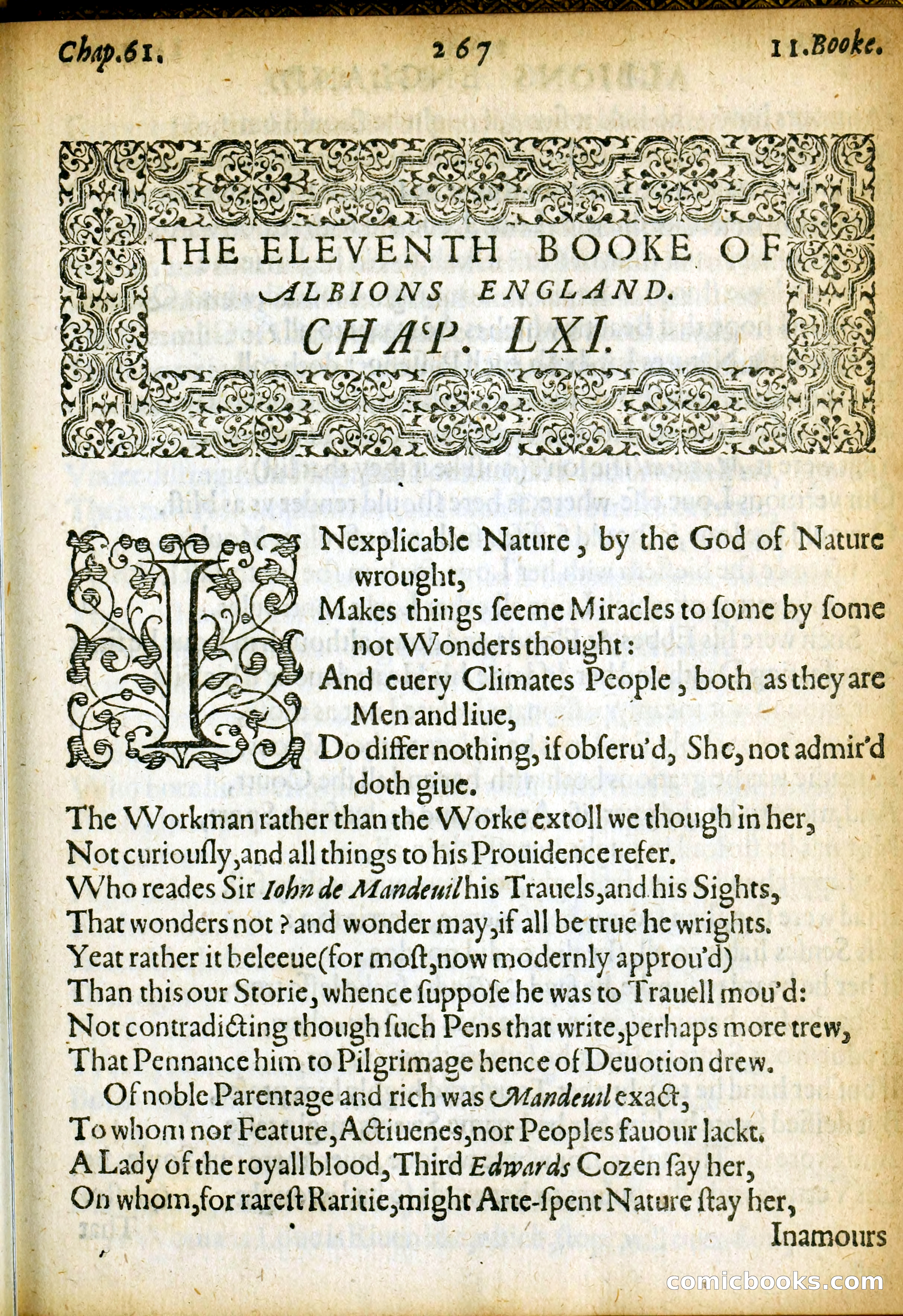
# This Page from *Albions England* This is a running prose page—specifically the opening of Chapter LXI of the eleventh book of *Albions England*. The text is poetry written in praise of nature's workmanship and introduces the figure of Sir John de Mandeville and another noble character named Mandevil, apparently of royal descent (described as "Third Edwards Cozen"). The verses discuss how natural wonders should inspire admiration for divine providence rather than mere curiosity, and appear to frame a narrative about this figure's travels and pilgrimage, emphasizing his noble parentage and exceptional qualities.
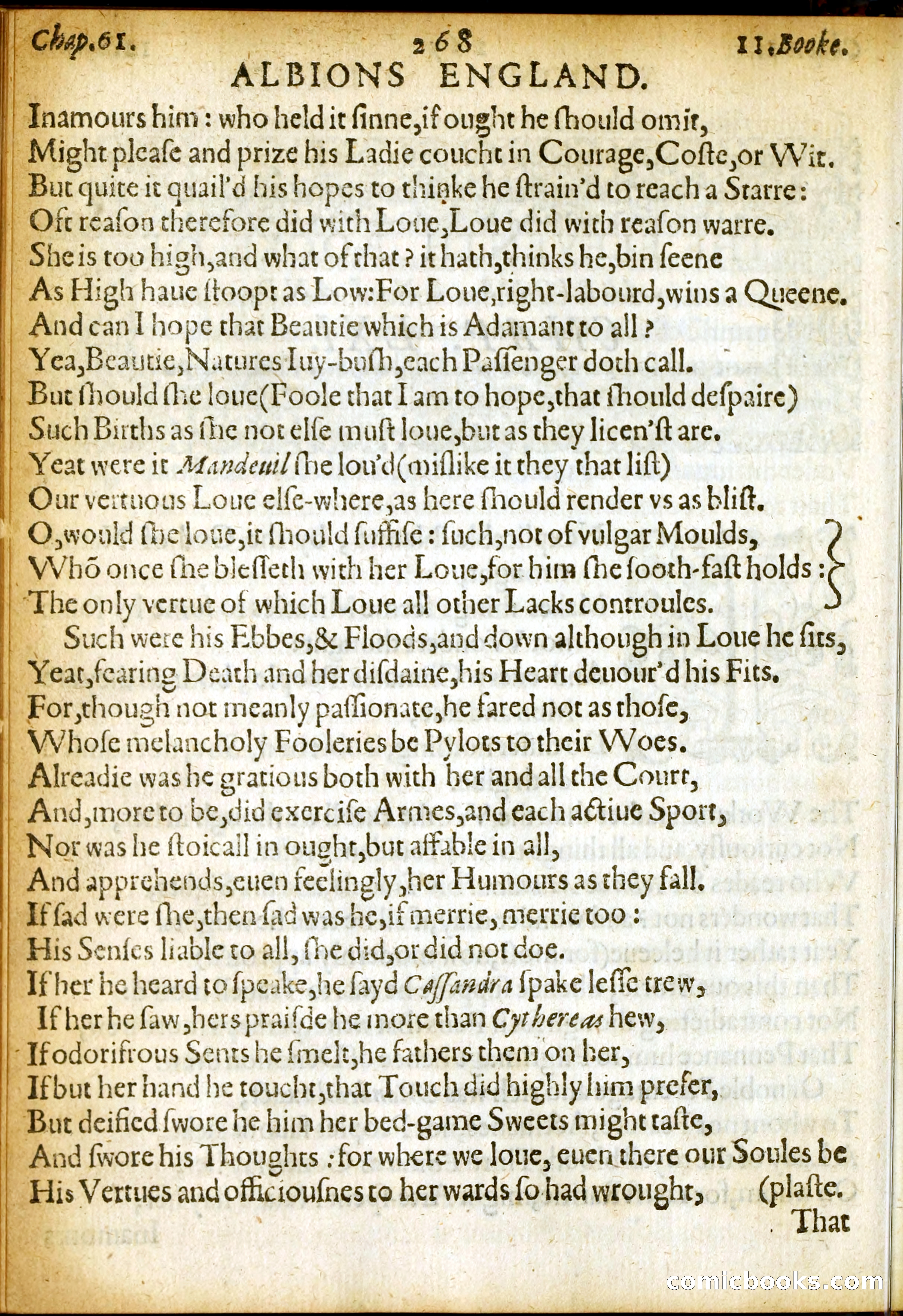
# Analysis of Page **Page Type:** Running prose/poetry text **Content:** This is a page from *Albion's England* (Chapter 61, page 268), displaying narrative verse about a courtier's unrequited love. The text describes a man devoted to a noblewoman—how he mirrors her moods, praises her above all others (comparing her favorably to mythological figures like Cassandra and Cyrberaea), and swears his thoughts and virtues to her service. The passage emphasizes his constancy despite her indifference, his participation in courtly activities, and his emotional devotion, concluding that "where we loue, even there our Soules be." **Note:** This appears to be early modern poetry (likely 16th-17th century), not Victorian penny dreadful fiction as the prompt suggests.
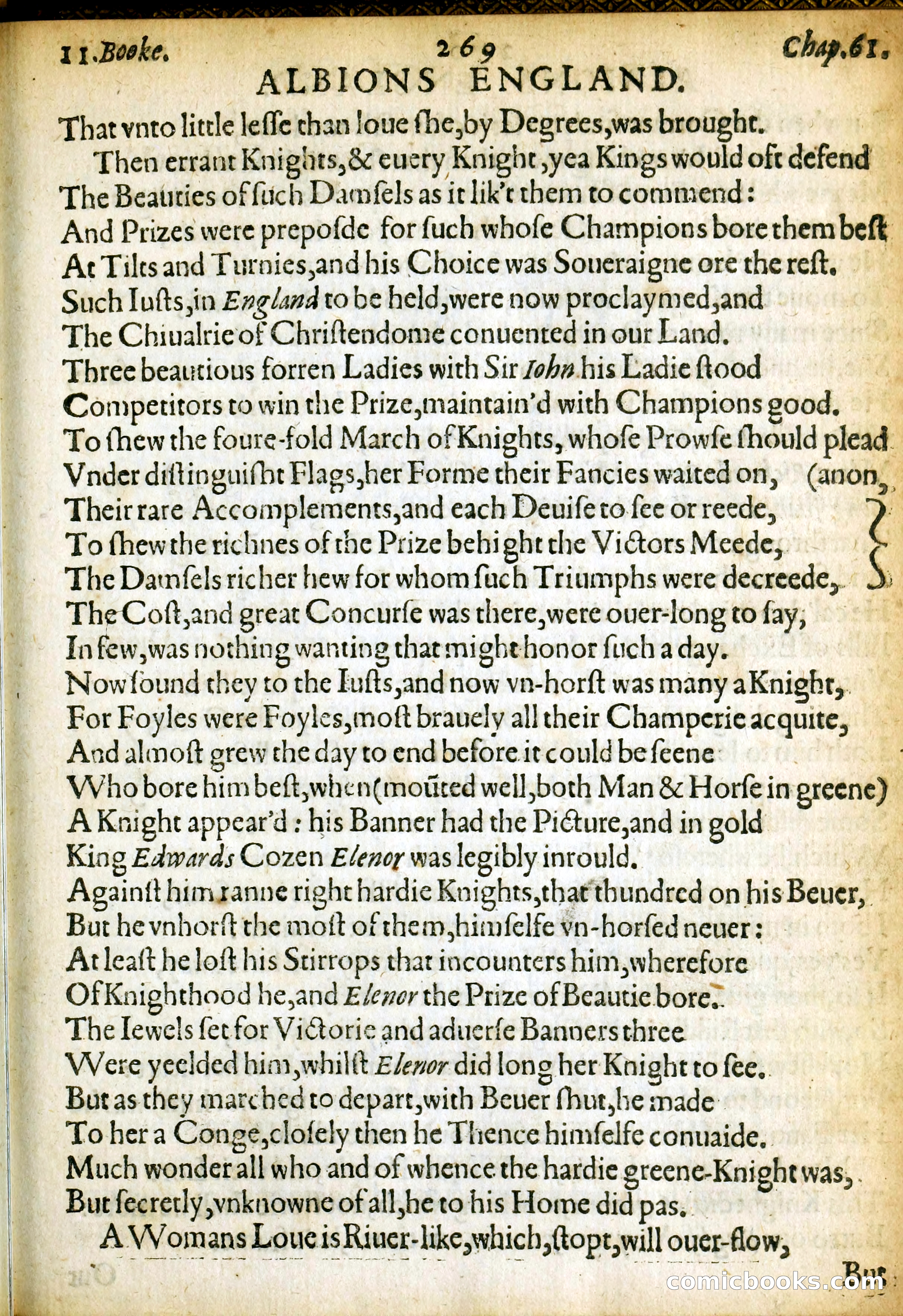
# Running Prose from a Narrative Poem This page contains running prose verse from *Albion's England*, a narrative poem about chivalric tournaments in England. The text describes knights competing in jousts and tournaments for prizes, with particular focus on a mysterious knight dressed in green who bears King Edward's cozen Elenor's picture on his banner. He defeats his competitors, wins the prize of beauty for Elenor, and then departs secretly, leaving observers wondering about his identity. The passage concludes with a philosophical observation about women's love. This appears to be Book 11, Chapter 61 of the work.
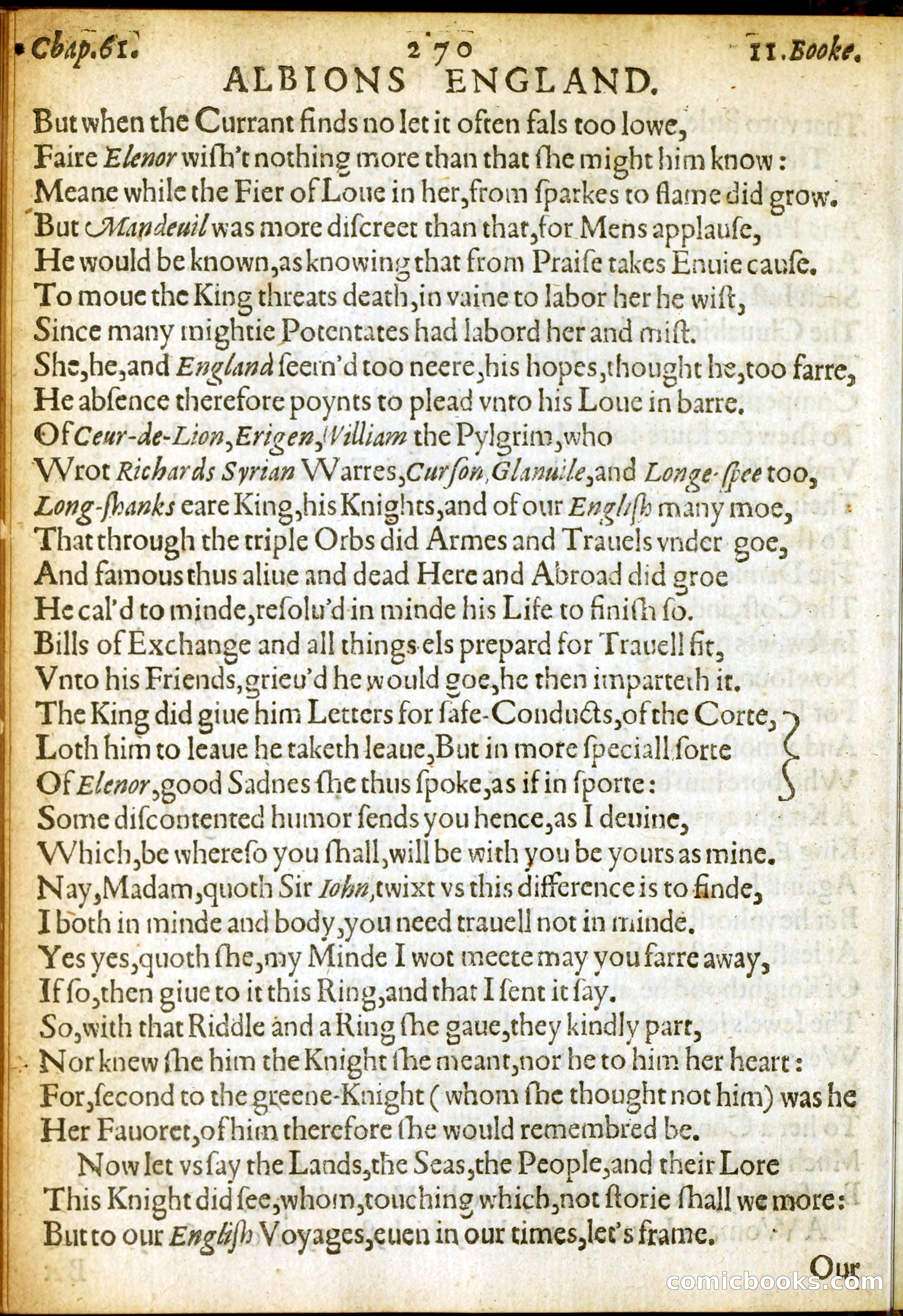
# Analysis of Page from "Albions England" This is a page of running prose poetry from what appears to be *Albions England*, Book II, Chapter 6 (not a Victorian penny dreadful, but early modern verse chronicle, circa 1590s). The text recounts a narrative episode involving Elenor (Eleanor), a knight named Mandeuil, the King, and the departure of a character identified as Sir John on a journey. The passage describes romantic tension, the King's authorization for travel via letters of safe conduct, and a farewell exchange between Elenor and the knight—she gives him a ring and riddle as parting tokens. The verse culminates in a transition toward tales of English voyages.
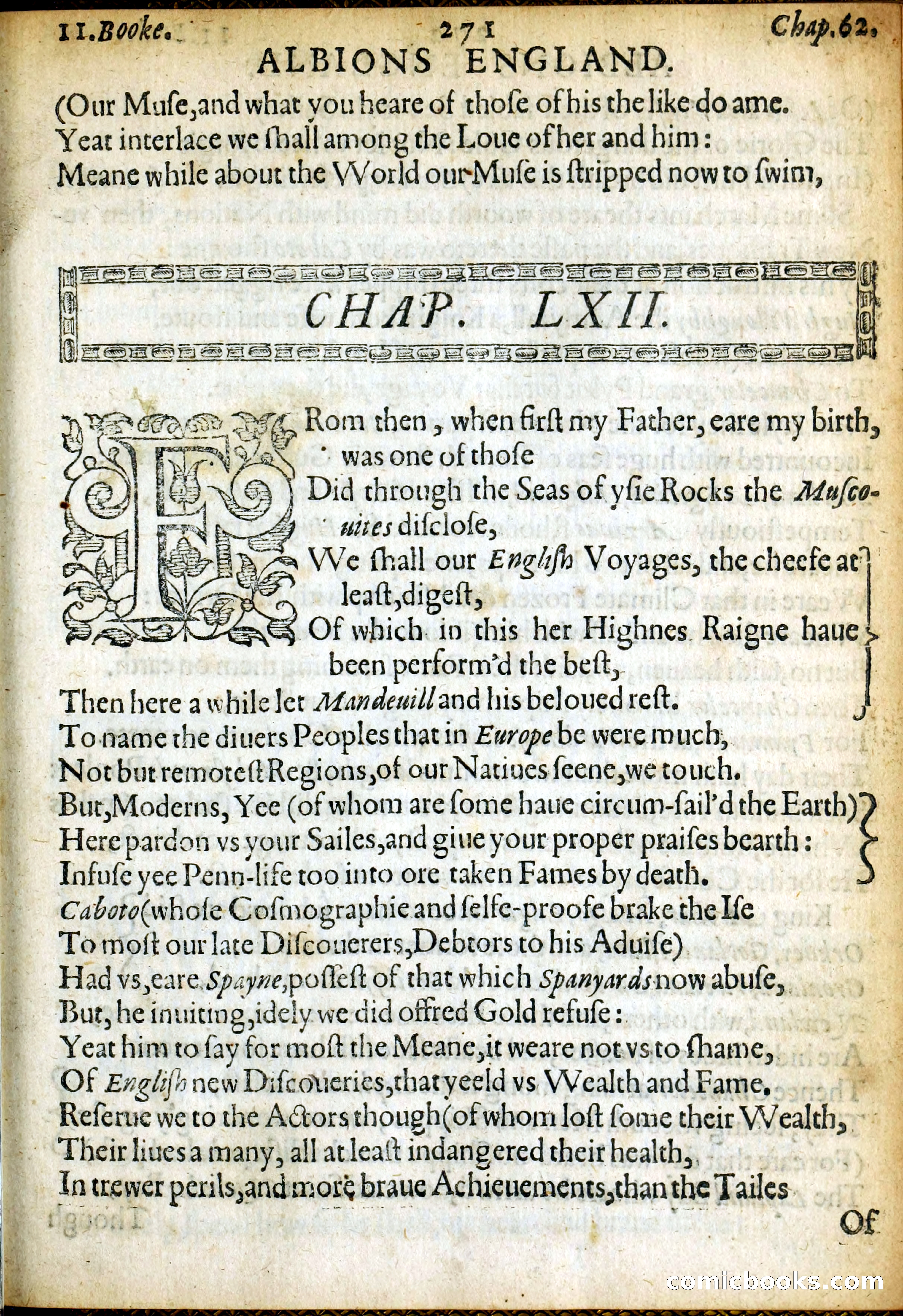
# Page Description This is a page of running verse text from Chapter 62 of "Albions England." The text is written in early modern English poetry and appears to celebrate English maritime voyages and discoveries. It mentions explorers who sailed through dangerous seas, references figures like Cabot and Mandeuill, and praises English naval achievements and those who risked their "wealth" and "health" in exploration. The passage discusses voyages to discover new lands and the accomplishments of English explorers, though some specific historical references are unclear in the archaic language and typography.
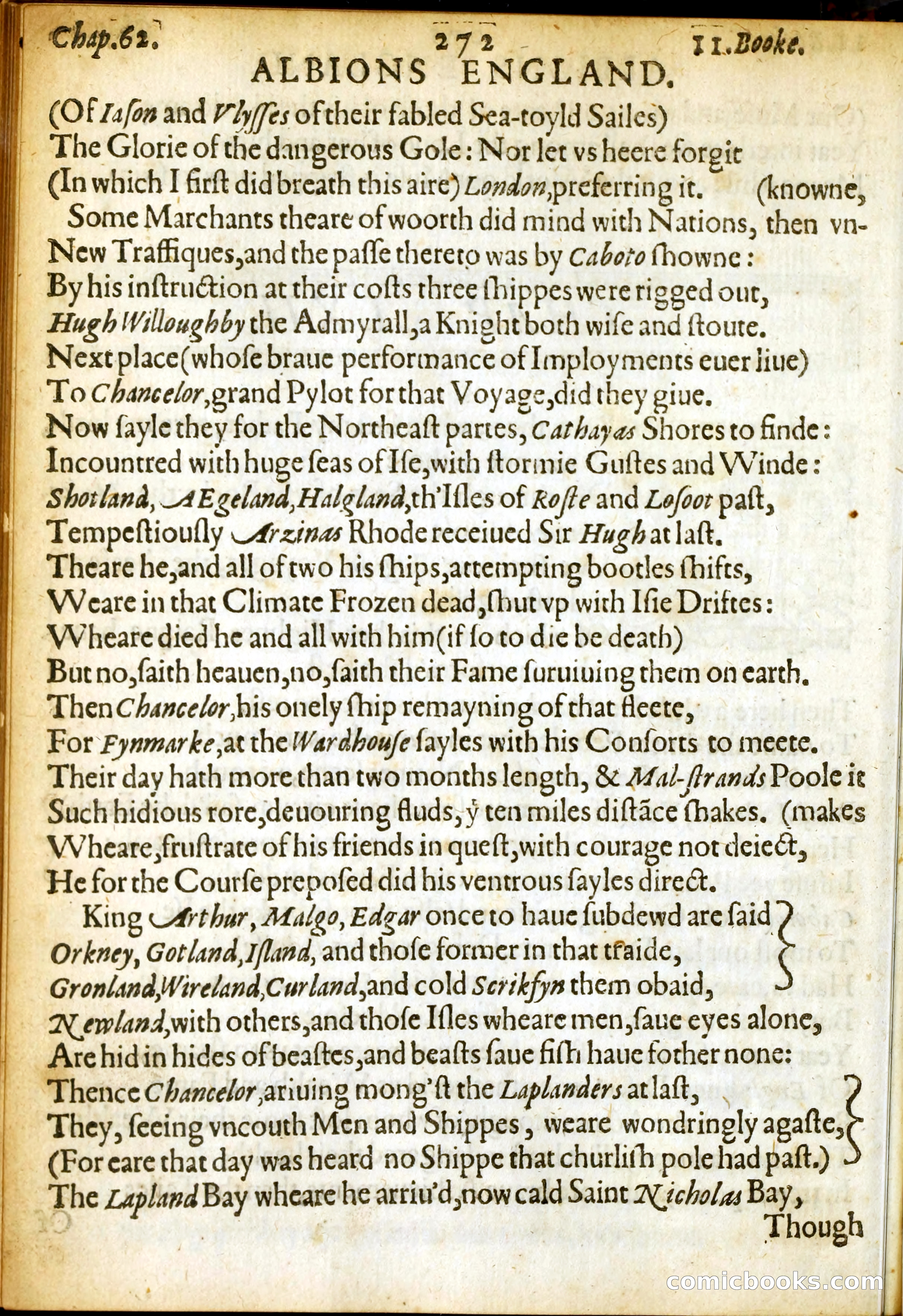
# Page Analysis This is a **running prose page** from what appears to be an early modern narrative poem (not Victorian penny dreadful, despite the framing—the typography and language suggest 16th or 17th century). The text describes an Arctic exploration voyage, apparently sponsored by London merchants, led by **Hugh Willoughby** (the Admiral) and **Chancellor** (the pilot). The expedition sails northeast seeking Cathay, encounters severe ice, storms, and frozen conditions near Shetland and other northern regions. Willoughby and his ships perish in the ice, but Chancellor survives with one remaining vessel, eventually reaching the Lapland Bay (now called Saint Nicholas Bay). The passage mixes historical exploration with elevated poetic language.
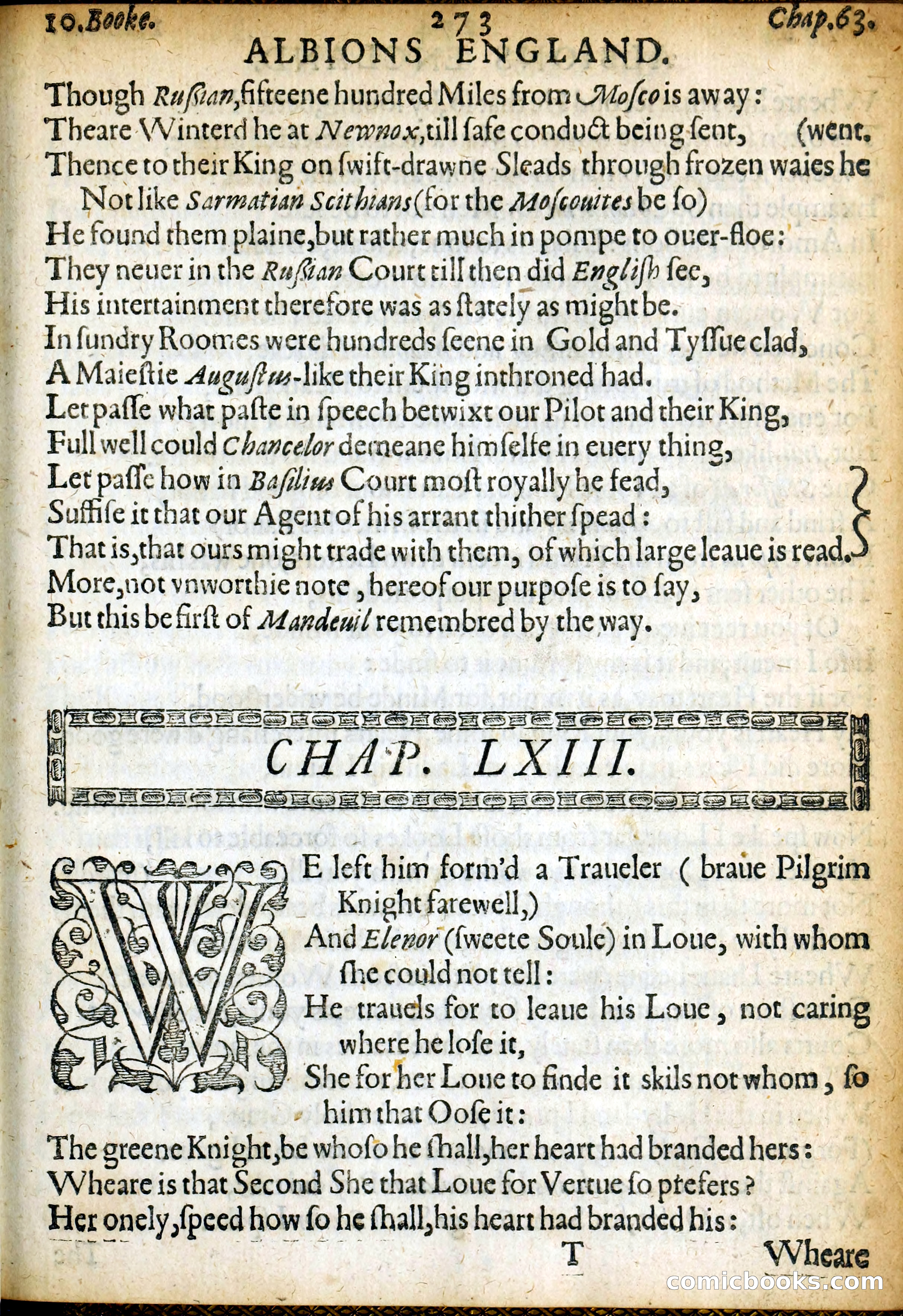
# Page Analysis: "Albions England" This is a page of running prose poetry from what appears to be a narrative work titled "Albions England." The visible text describes an English diplomatic mission to Russia: an envoy travels to meet the Russian King at Novgorod in winter, journeys by sledge through frozen waters, and is received with great ceremony in halls decorated with gold and silver. The passage then shifts to Chapter LXIII, introducing a romantic subplot involving a character who departs as a traveler, leaving behind his love Elenor, while another female character seeks to find love through virtue. The language is archaic verse in Early Modern English.
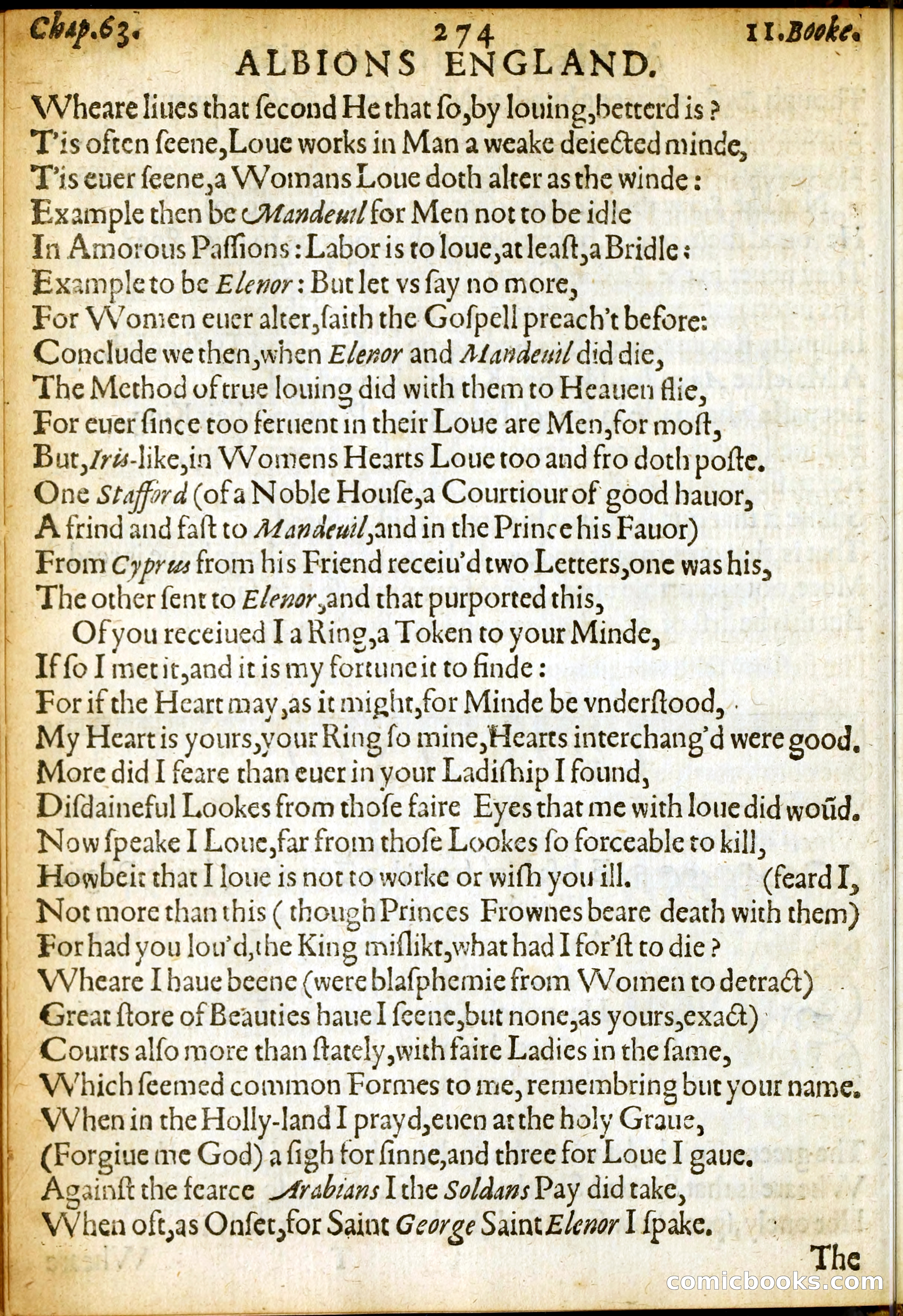
# What's on This Page This is a page of running verse narrative prose from what appears to be a romantic or historical tale titled "Albions England." The text presents a love story involving characters named Elenor, Mandeuil, and Stafford, narrated largely through letters exchanged between them. The verse discusses the constancy of male love versus the fickleness of female affection, presents two exemplary lovers whose devotion transcended death, and relates Stafford's passionate declaration of love via a ring sent as a token. The narrative touches on courtly love, religious devotion, and military service, written in early modern English verse with ornate typography.
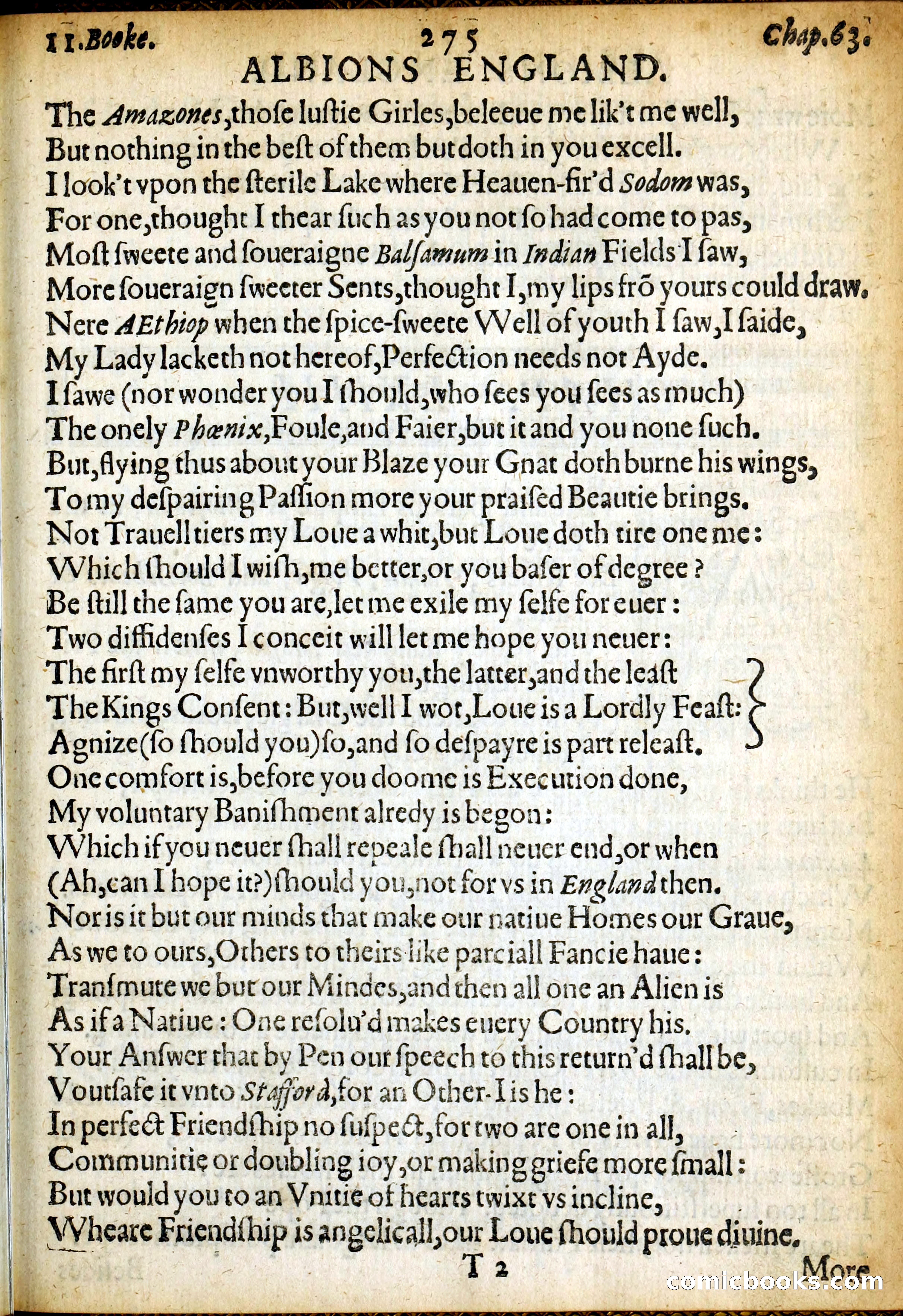
# Page Analysis: Albions England, Chapter 63 This is a page of **running verse text** from what appears to be an early modern work titled "Albions England" (not a Victorian penny dreadful as the prompt suggests). The visible text is a love poem or romantic epistle in Early Modern English, where a speaker praises a lady's beauty above legendary comparisons—the Amazons, Balm of Gilead, the Phoenix—and expresses longing and despair at separation, declaring voluntary banishment and requesting written reply addressed to "Stafford." The passage ends with reflections on friendship and unity of hearts, written in rhyming couplets with period typography (long "s" characters).
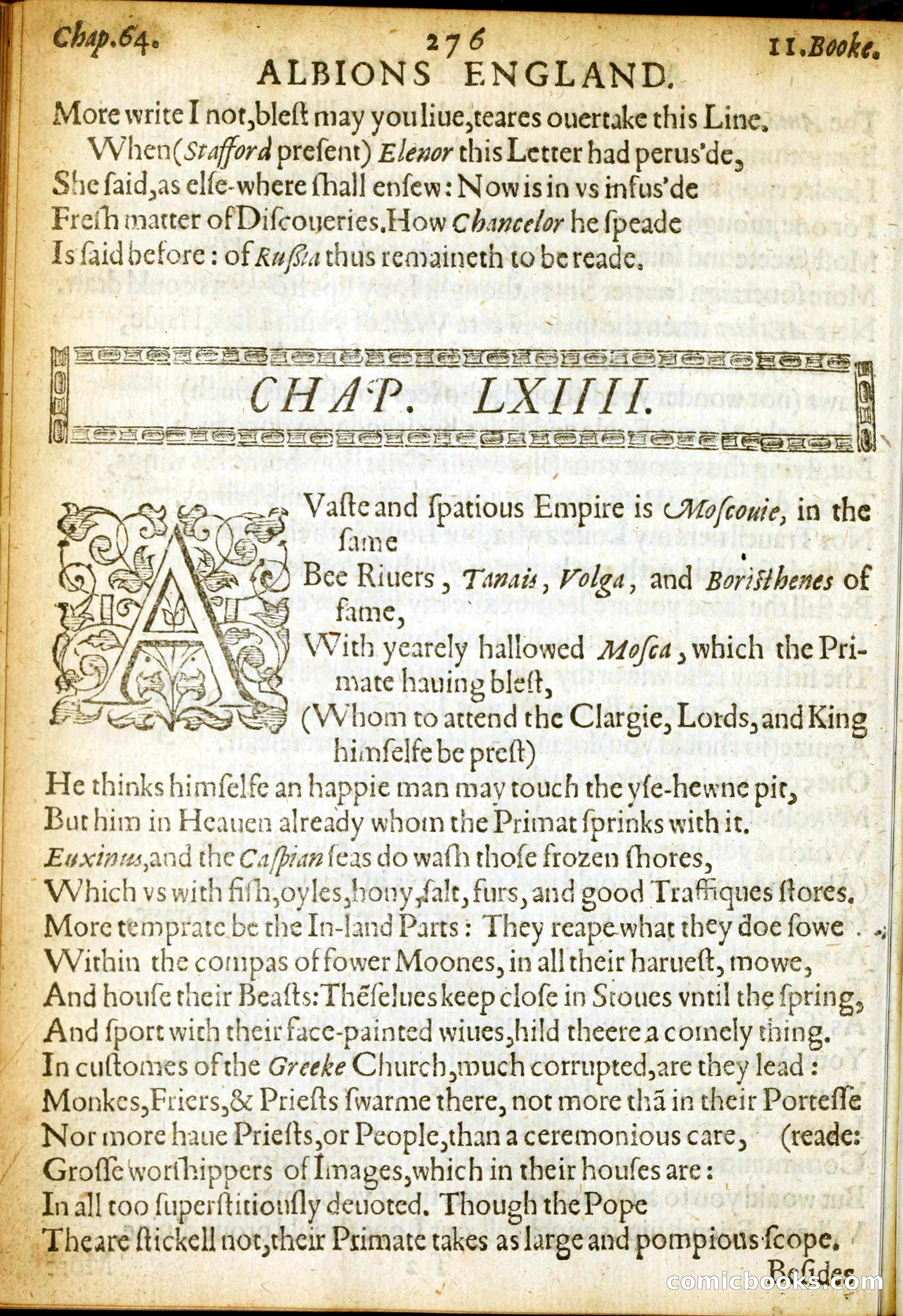
This is a page of running prose poetry from Chapter 64 of what appears to be "Albions England," a historical verse narrative. The text describes Muscovy (Russia), its rivers (Tanais, Volga, Boristhenes), and the customs of its people—their agricultural practices, winter habits, marriages, and religious practices. The passage offers a critical ethnographic account, noting the abundance of fish, furs, and trade goods, while commenting disparagingly on Greek Orthodox Church practices, monks, friars, and the veneration of images. The ornate initial letter and chapter heading indicate this is mid-narrative prose rather than a penny dreadful; the language and subject matter suggest early modern (not Victorian) authorship, though the OCR attribution may be in error.
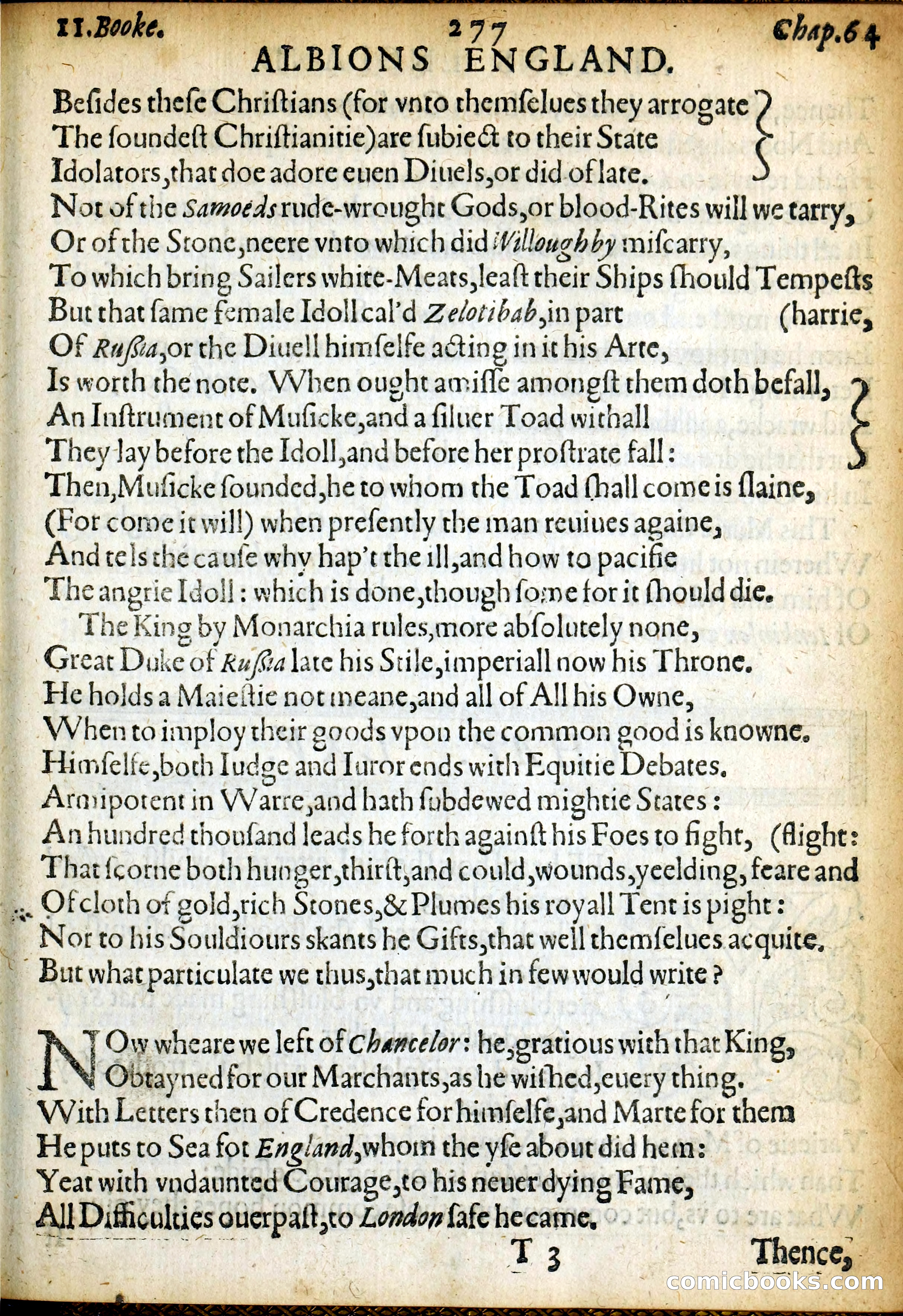
# Page Content Analysis This is a running prose page (page 277, Chapter 64) from *Albions England*, printed in early modern English verse. The text describes Christian practices among foreign peoples, particularly an idol cult involving a musical instrument and a silver toad that allegedly reveals the cause of misfortunes. It then shifts to praising the King of Russia (the Duke of Russa), describing his absolute monarchy, military power, and wealth. The passage concludes by returning to an account of the Chancellor, who obtains favorable terms for English merchants and prepares to sail back to England. The page contains no illustrations, only densely printed verse in period typography.
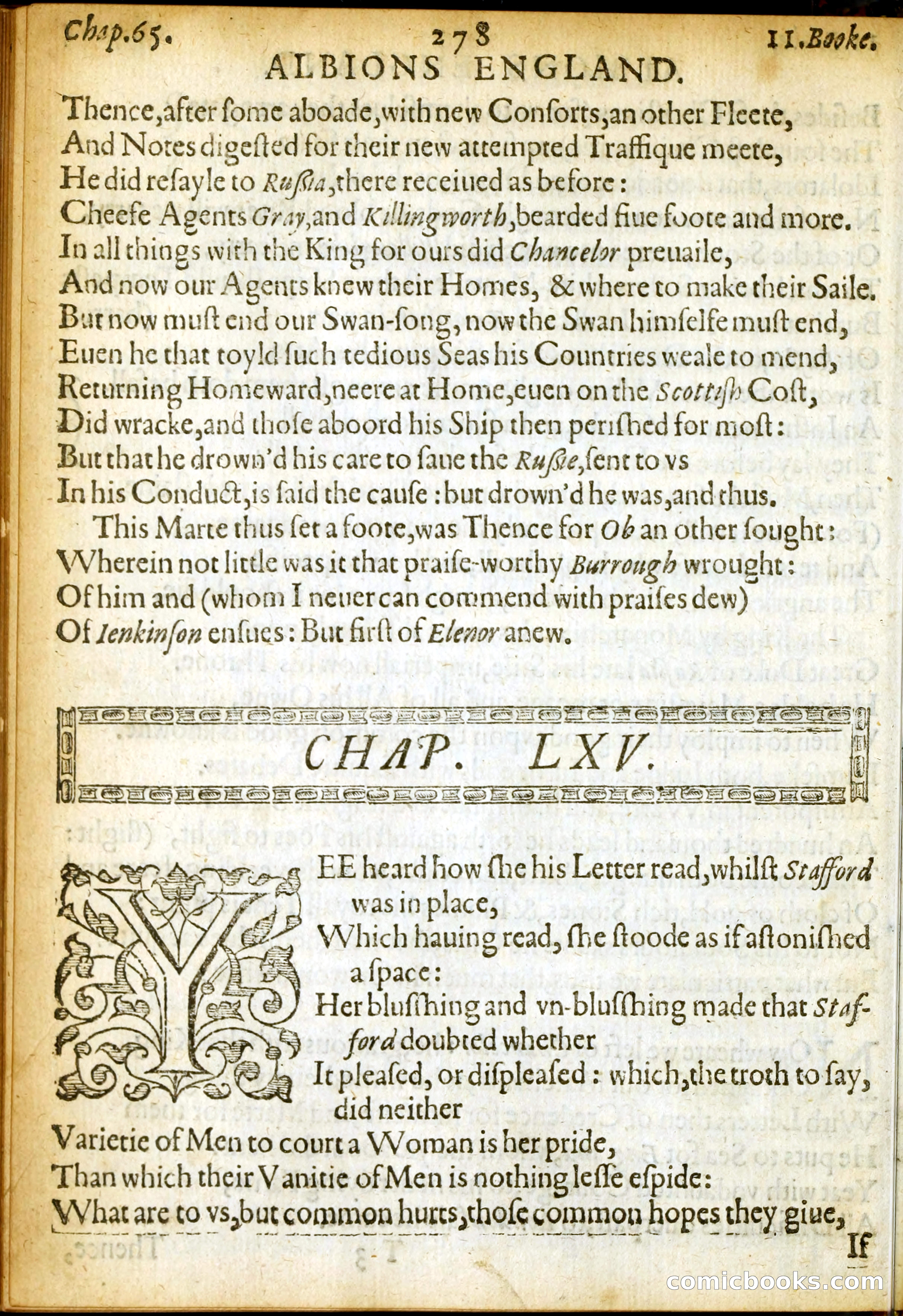
# Page Analysis This is a running prose page from what appears to be a narrative poem about England's maritime ventures. The text describes a voyage's conclusion: agents Gray and Killingworth conduct business in Russia, but the protagonist—referred to as "the Swan"—drowns on his return home off the Scottish coast due to neglecting to save a Russian vessel. The page then shifts to a new scene (Chapter LXV) involving a woman named Stafford receiving a letter, leaving her uncertain whether she is pleased or displeased by its contents. The writing employs archaic spelling and poetic meter typical of early modern English literature, not Victorian penny dreadful sensationalism.
# Page from "Albions England" This is a page of running prose poetry from *Albions England*, a historical narrative poem (not a Victorian penny dreadful as the prompt suggests—this is an early modern work, likely 17th century). The visible text consists of verse monologue in which a female speaker at court defends herself regarding a man named Stafford from Mandeuill, who has self-exiled from his native home. She argues that his departure is not her fault, discusses the nature of beauty and courtly love, and expresses hurt that he has judged her harshly despite her high birth and court favor. The speaker wrestles with questions of virtue, form, and the vanity of court life.
# Page Description This is a page of running prose poetry from what appears to be an early modern work titled *Albions England* (not a Victorian penny dreadful as the prompt suggests—the typography and language clearly predate the Victorian era by centuries). The text is dialogue in verse concerning matters of love and marriage. A woman discusses her beloved with characters named Stafford and Mandewell, revealing that her chosen one is "the greene-Knight, Victor at the Luts" whom she encountered years ago. The passage concludes with her emotional reaction upon hearing of him, expressed in highly formal, archaic English verse with period typography (including long "s" characters).
# What This Page Contains This is a page of running prose poetry from Chapter 66 of what appears to be "Albions England," a historical verse narrative. The text describes the Arctic expeditions of Burrough (likely William Burroughs) through frozen seas to the River Ob, detailing encounters with indigenous peoples—the Samoyeds—and their customs, boats, deer-sleds, and trade goods. The passage praises Burrough's achievements and mentions other explorers (Per, Jackman, Jenkinson) who traveled to Europe, Asia, and Africa in service of England's commercial interests. The ornate initial letter and decorative header frame the chapter opening in typical early modern printing style.
# Victorian Penny Dreadful Page Analysis This is a page of running prose poetry from *Albions England* (Chapter 66, Book II, page 282). The text celebrates English commerce and diplomatic achievements, specifically praising Captain Jenkinson's trading missions to Russia and Persia under Elizabeth I. The passage describes journeys across the Caspian Sea, dealings with Tartar merchants and caravans, encounters with Russian nobility, and the transport of ambassadors and goods—all framed as evidence of England's growing commercial fame and international influence. The archaic verse style and historical subject matter suggest this is serialized popular historical-poetic literature rather than pure sensation fiction.
# Page Description This is a page of running verse from what appears to be a narrative poem about England's trade relations. The text, printed in early modern English typeface, describes how Jenkinson traveled to Persia (Hyrcana, Shyram, or Media) to meet King Obdolowan's court. It details the king's luxurious pavilion, furnishings, concubines, hunting pursuits, and hospitality, then notes Jenkinson's diplomatic mission carrying letters and gifts, with merchants subsequently fetching silks, spices, and drugs back to England. The passage emphasizes the commercial and political benefits of this Persian trade relationship negotiated through Queen Elizabeth's letters.
# Analysis of Page 284 from "Albions England" This is a page of running prose poetry from what appears to be a historical/narrative poem titled "Albions England" (visible at top). The page contains two sections: the conclusion of Chapter 67 describing ancient Persian cities and wonders, followed by the opening of Chapter 68, which begins a new narrative about a knight named Mandevil courting a noble lady. The text references historical locations (Persia, Egypt) and describes Mandevil's romantic pursuit of a virtuous, wealthy noblewoman who is also of royal blood. The ornate initial letter and decorative chapter heading indicate this is from an early modern printed book, not actually a Victorian penny dreadful as initially suggested.
# Page Analysis This is a page of running poetry or verse from Chapter 67 of what appears to be "Albions England." The text consists of rhyming couplets addressing a figure named Manducil (or similar), criticizing his creation of "Love" as misguided. The verse discusses marriage, women, and morality—praising marriage as a legitimate institution while condemning frivolous or illicit love. It references pagan versus Christian contexts and concludes by addressing "this faire AEgyptian Ladie (of the English Toy in this." The page shows aged, yellowed paper typical of early printed texts, with ornamental brackets marking poetic sections.
# This Page Analysis This is a page of running verse prose from Chapter 67 of what appears to be an early modern narrative poem titled "Albions England" (not a Victorian penny dreadful, as the archaic typography and language indicate this is a much older text—likely 16th or 17th century). The visible text discusses a knight's conflicted thoughts regarding his affection for Eleanor versus Helen, meditating on female beauty's transience with age, the troubles of married life, and women's perceived faults and manipulations. The passage references a knight's exploits in Egypt and Persia, apparently by an author named Jenkinson.
This is a page of running prose poetry from Chapter 68 of *Albions England*. The text describes Casben, who ruled the Shawgh's court for thirty years without leaving home, maintaining a royal court with numerous concubines and wives in the manner of great monarchs. It narrates diplomatic matters involving Turkish merchants, trade agreements, letters from English sovereigns to the Shawgh, and the treatment of Christian visitors who must remove their shoes when granted audience. The passage concerns itself with religious differences and commercial negotiations between England and the Ottoman Empire.
# Page Content Summary This is a page of running prose poetry from *Albions England* (Chapter 68, page 288). The verse recounts diplomatic and trade missions, particularly describing how Arthur Edwards was sent on Persian trade ventures, and how an aged man named Tenkinson traveled extensively through Europe, the Levant, Turkey, Africa, India, and Egypt in service to various emperors and kings. The text also contains a eulogy for this traveler, describing him as a rare and noble figure whose memory should endure. The language is Early Modern English verse celebrating exploration and international commerce.
This is a page of running prose poetry from "Albions England" (Chapter 68, page 289), appearing to be an early modern historical poem rather than a Victorian penny dreadful. The visible text describes achievements accomplished by English people in various climates since a maiden's crowning, and mentions lifting "Staffords Comforts" to Eleanor. The passage is written in archaic English verse with period spelling conventions. The lower portion of the page is largely blank, suggesting either a section break or the end of a chapter.
# What's on This Page This is a prose page from Chapter 69 of "The Tweleth Booke of Albions England." The text describes a banquet scene in which a character named Dorcas instructs Elenor about accessing Mandeuil's locked closet containing rare and rich items, suggesting she feign illness to isolate herself so she can investigate. The passage employs archaic spelling and Early Modern English verse conventions typical of period literature rather than sensation fiction proper.
# Page Description This is a text page of running prose from what appears to be a narrative poem or romantic tale titled "Albions England" (visible at the top). The page contains roughly 40 lines of verse in Early Modern English, recounting a scene where two ladies discover armor belonging to a knight and discuss his identity and deeds. The text mentions characters named Dorcas, Elenor, Stafford, and a mysterious "greene-Knight," and centers on the revelation of the knight's identity and his past jousting accomplishments. The page number (291) and chapter marking (Chap.69) appear at the top.
This is a page of running prose poetry from what appears to be *Albions England*, a narrative poem. The text consists of dialogue and verse narration concerning characters named Mandeuil, Elenor, and Dorcas, discussing matters of marriage, loyalty, and honor. The passage describes a banquet scene and concludes with mention of a "greene-Knight" and references to English enterprises in Africa and Asia. The page number indicates this is Chapter 69 from the 12th Book of the work.
# Page Description This is a page of running verse poetry from what appears to be an early modern historical narrative (marked "12. Boke" and "Chap. 70"), not a Victorian penny dreadful. The text is printed in early modern English typography and discusses northern regions and voyages. The verse celebrates great personages and poets, then shifts to narrate a specific historical episode: a man named Edward (apparently Third Edward) who traveled to Mandevil, where his lover died in Madera. Edward built a chapel there, and this lover's body was later discovered in a hollow tree and transported to Africa/Castle, leading to important maritime discoveries. The page is densely printed verse with decorative initial capital letter.
# Page Description This is a page of running verse poetry, not a title page or illustration. The text celebrates England's maritime expansion and colonial trade during what appears to be Elizabeth I's reign ("Highnes Raigne"). It praises explorers and privateers—Drake, Hawkins, Gilbert, and others—crediting them with establishing English commerce in Guinea, Brazil, Africa, the Levant, and other regions. The verse also calls for worthy writers to memorialize these men's deeds in literature, comparing such an undertaking to Homer's *Iliads* and *Aeneids*. The language and typography are early modern, suggesting this page predates Victorian penny dreadfuls; the actual date and provenance remain unclear from the image alone.
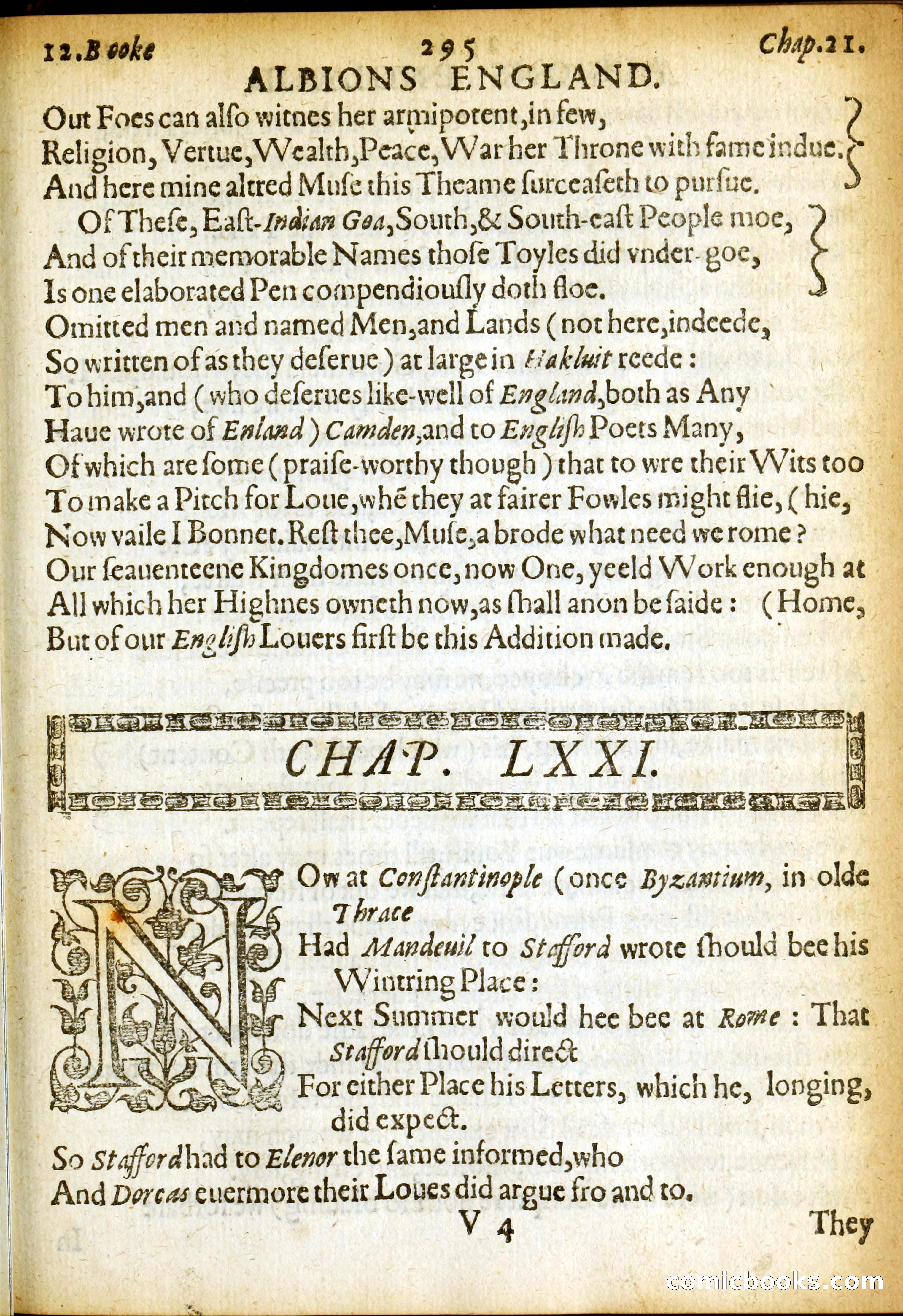
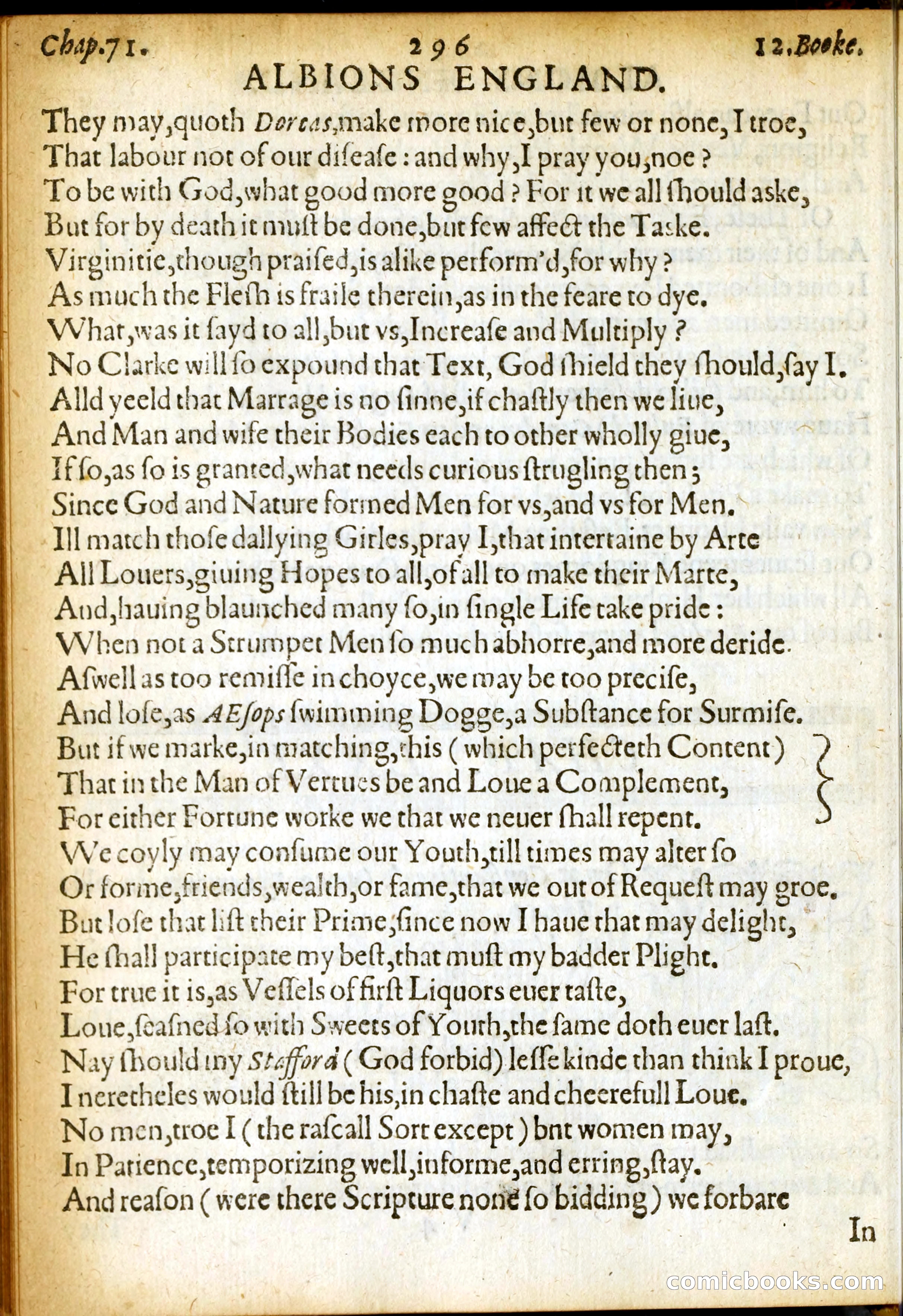
# Analysis of This Page This is a page of running prose poetry from Chapter 71 of *Albions England*, printed as the 12th book. The text is a lengthy verse monologue on marriage, virtue, and female comportment. The speaker (appears to be female, addressing concerns about virginity and chastity) argues that marriage is no sin if conducted chastely, that men and women are naturally formed for each other, and warns against both excessive prudishness and loose behavior in women seeking husbands. The passage references "Dorcas" and "Stafford" (likely a particular man), discusses fortune and virtue, and concludes with advice about matching virtue and love in marriage as the path to contentment. The language and style are early modern English, not Victorian penny dreadful.
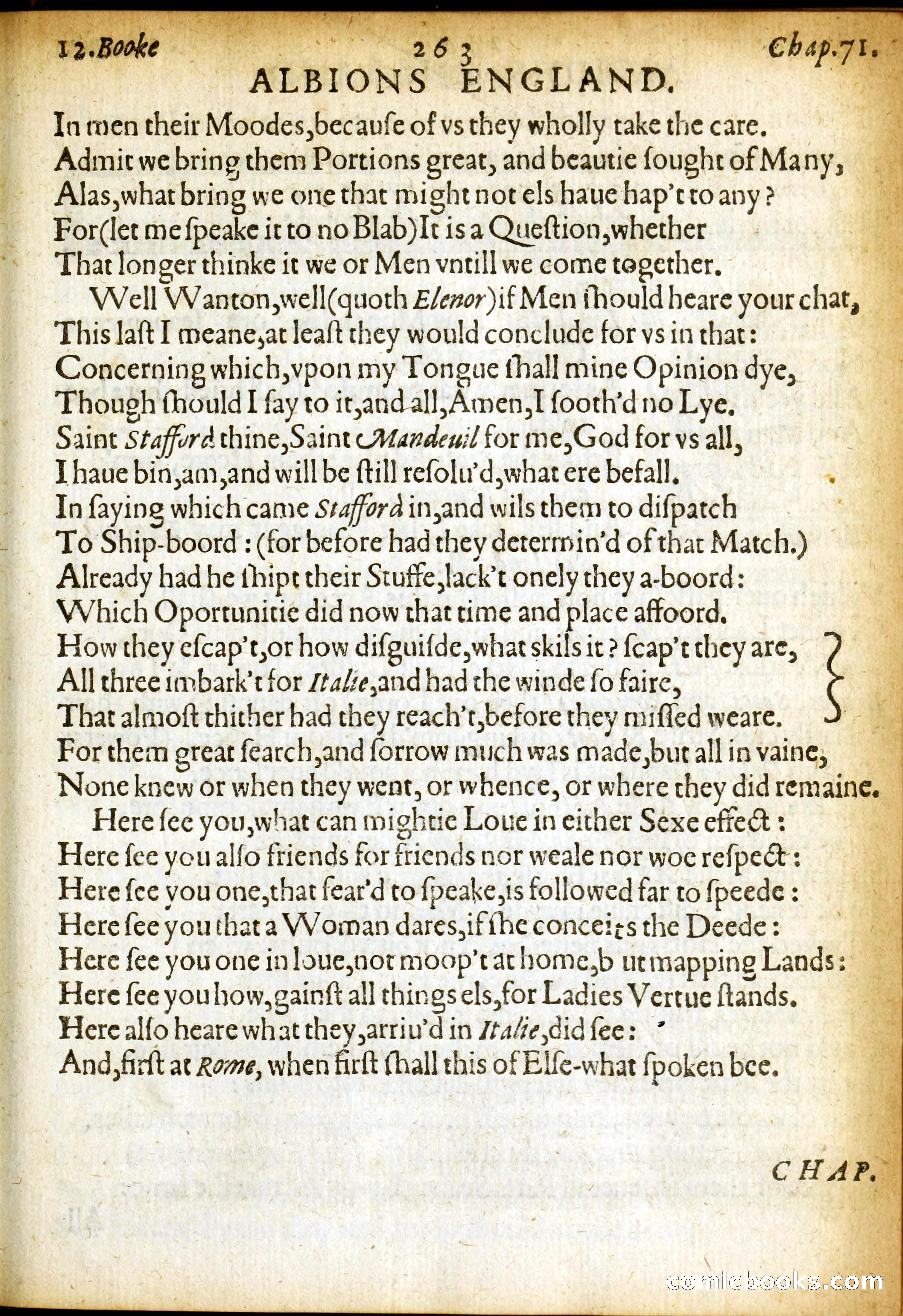
# Analysis of Page This is a **running prose page** from what appears to be an early modern narrative poem (not Victorian—the header "Albions England" and archaic typography suggest 16th-17th century), though the question assumes Victorian penny dreadful context. The text depicts characters—including figures named Stafford, Elenor, and Mandeuil—discussing a romantic or adventurous situation. Three people embark by ship for Italy, their departure causes distress and confusion among those left behind, and the passage reflects on how love motivates both men and women to undertake dangerous journeys. The page concludes by promising that the narrative will soon reveal what the travelers witnessed upon arriving in Rome.
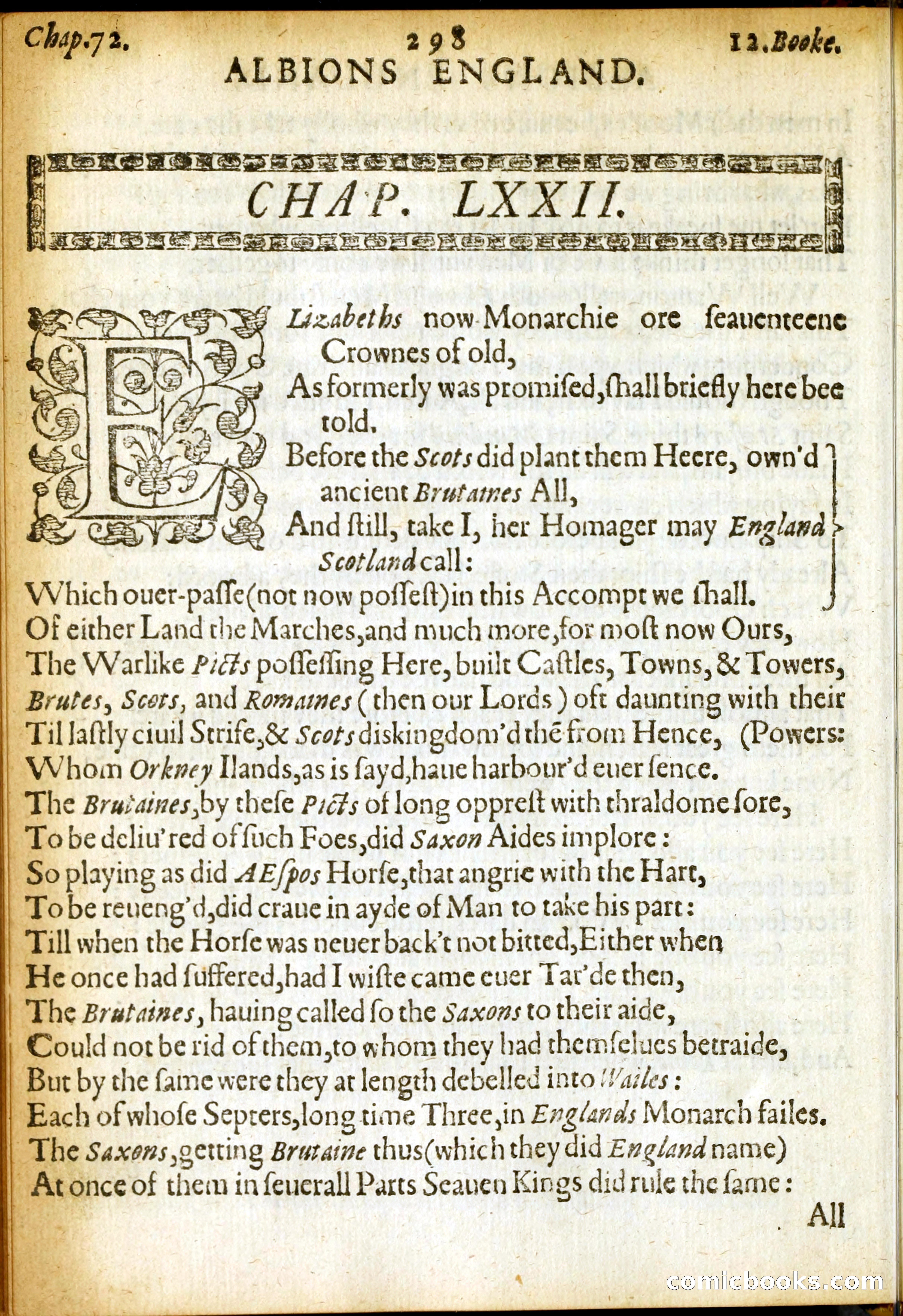
# Analysis of Page This is a running prose page from what appears to be a historical narrative poem or verse chronicle. It is Chapter LXXII of "Albions England" (as indicated at the top). The text discusses the early history of Britain, narrating in verse how Elizabeth now holds the monarchy and crown, then recounting how Picts, Scots, Romans, Britons, and Saxons successively occupied and ruled the land. The passage explains that Britons called upon Saxon aid against their oppressors, but subsequently could not rid themselves of the Saxons, who eventually established rule and divided Britain into several kingdoms. The language and typography are characteristic of early modern English literature rather than Victorian penny dreadfuls.
# What's on This Page This is a page of running verse text from "Albions England," a historical poem. The page presents allegorical and historical narrative in Early Modern English verse, discussing the consolidation of various kingdoms (Man, the Hebrides, Orkades, and the Isle of Wight) under English rule. The text celebrates this political unification, praises noble families like the Mandevils and Beauchumps, and argues that a single monarchy brings greater security than multiple kings. It concludes with warnings to France and Spain regarding religious and political allegiances. The page is densely printed with italicized proper names and archaic spelling throughout.
# Analysis of Page This is a page of running prose poetry from what appears to be *Albion's England*, a historical narrative poem. The page contains the end of Chapter 37 (discussing Spanish conflict and Rome) and the beginning of Chapter 73, which introduces a character named Stafford traveling to Italy on business. The text describes Stafford's arrival in good health and wealth, his search for someone named Mandeuil, and includes descriptive passages about Rome's ruins and former grandeur. An ornamental initial letter "W" marks the chapter opening. The language and typography are consistent with early modern English verse, not Victorian penny dreadful fiction.
# Page Analysis This is a page of running verse prose from what appears to be a historical poem about ancient Rome, not a Victorian penny dreadful. The text describes the architectural grandeur of Rome—its aqueducts, baths, arches, theaters, obelisks, bridges, and gates—cataloging monuments in elaborate detail. The passage marvels at Rome's magnificent structures and their present state of ruin, then transitions to discussing early rulers, mentioning Janus and Etruscan kings. The archaic typography and language ("thether," "caru'd," "ruin'd") suggest this is early modern English verse, likely from a much earlier period than the Victorian era.
# Page Description This is a running prose page from Chapter 73 of what appears to be "Albions England," a historical narrative poem in early modern English. The text, printed in black letter typeface on aged paper, presents verse describing Rome's history—from the founding by Romulus through the reign of emperors like Julius Caesar and Constantine, to Rome's decline at the hands of the Goths under Alaracus. The passage celebrates Roman military and senatorial virtue, mentions Constantine's donation and the removal of imperial power to Constantinople, and concludes by promising to return to an earlier narrative thread involving Mandeuil and Elenor. Asterisks mark editorial annotations in the margins.
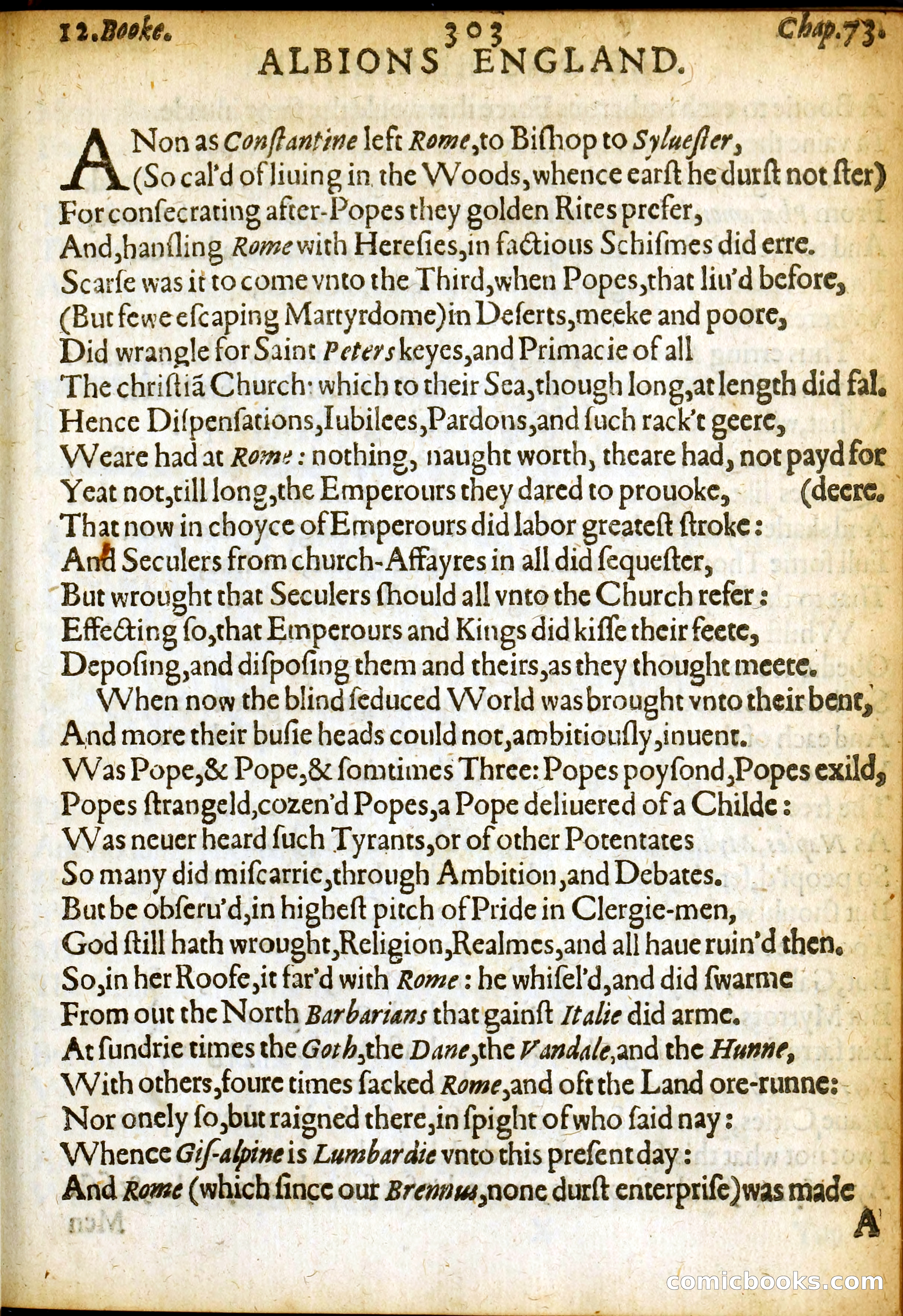
# Analysis of Page 303, Chapter 73, from "Albions England" This is a **page of running verse prose** — specifically Protestant polemical poetry attacking the Roman Catholic Church and papal authority. The visible text is a sustained historical attack on Rome's religious corruption. It describes how non-Constantine bishops left Rome to live in woods; how subsequent Popes wielded golden ritual and schismatic heresy; how they accumulated dispensations, jubilees, and pardons of no worth; and how they gradually made emperors and kings submit to Church authority, kissing the Pope's feet. The passage then catalogs papal wickedness—poisoned, exiled, and strangled Popes—before pivoting to argue that God punished Rome's pride through barbarian invasions: the Goths, Danes, Vandals, and Huns repeatedly sacked Rome. The text concludes that Rome has never recovered since (suggesting this is from William Warner's *Albions England*, a lengthy historical poem).
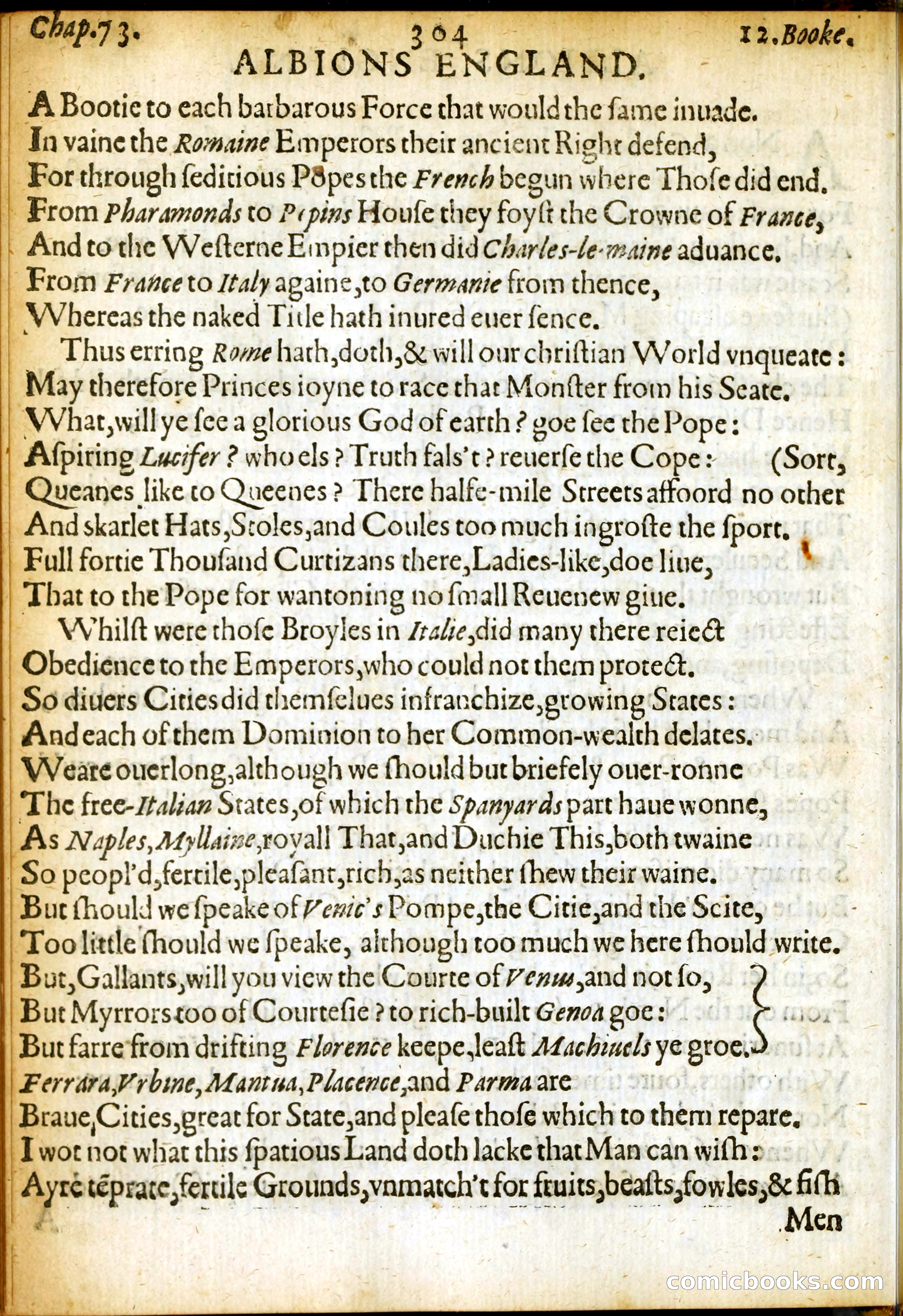
# This Page This is a page of running verse poetry from *Albion's England*, a historical poem (not a Victorian penny dreadful, but an Elizabethan or early Jacobean work). The text presents a polemical critique of Rome and the Pope, arguing that papal influence corrupted European power from France through Italy and Germany. It then catalogues Italian cities—Venice, Genoa, Florence, Ferrara, Urbino, Mantua, Placentia, and Parma—praising their wealth, fertility, and magnificence while noting Italy's abundance of resources. The verse is densely packed with geographical and political references presented in a tone of Protestant anti-Catholic polemic mixed with admiration for Italian civic splendor.
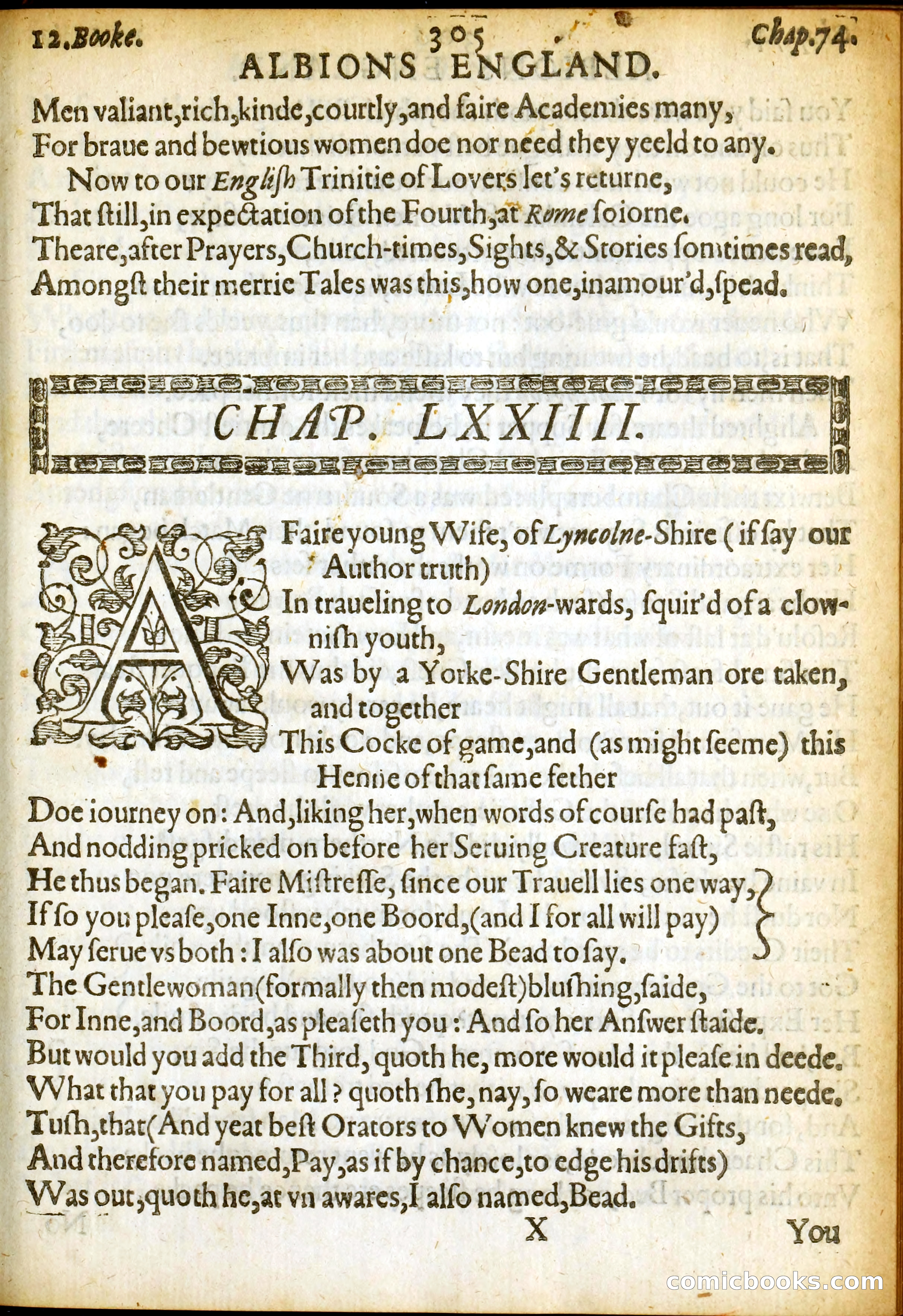
# Analysis of Page 305, Chapter 74 This is a **running prose page** from what appears to be an early modern or Renaissance-era narrative text (not actually Victorian—the page header reads "12. Booke" and the typography suggests 16th-17th century publication). The text presents a story about a fair young wife from Lincolnshire who, while traveling to London, is encountered by a Yorkshire gentleman. The passage describes their conversation at an inn, where the gentleman proposes they share lodging and board. The narrative employs period verse conventions and appears to contain bawdy wordplay involving the terms "Pay" and "Bead" as double entendres. The page continues mid-story with dialogue establishing a flirtation scenario.
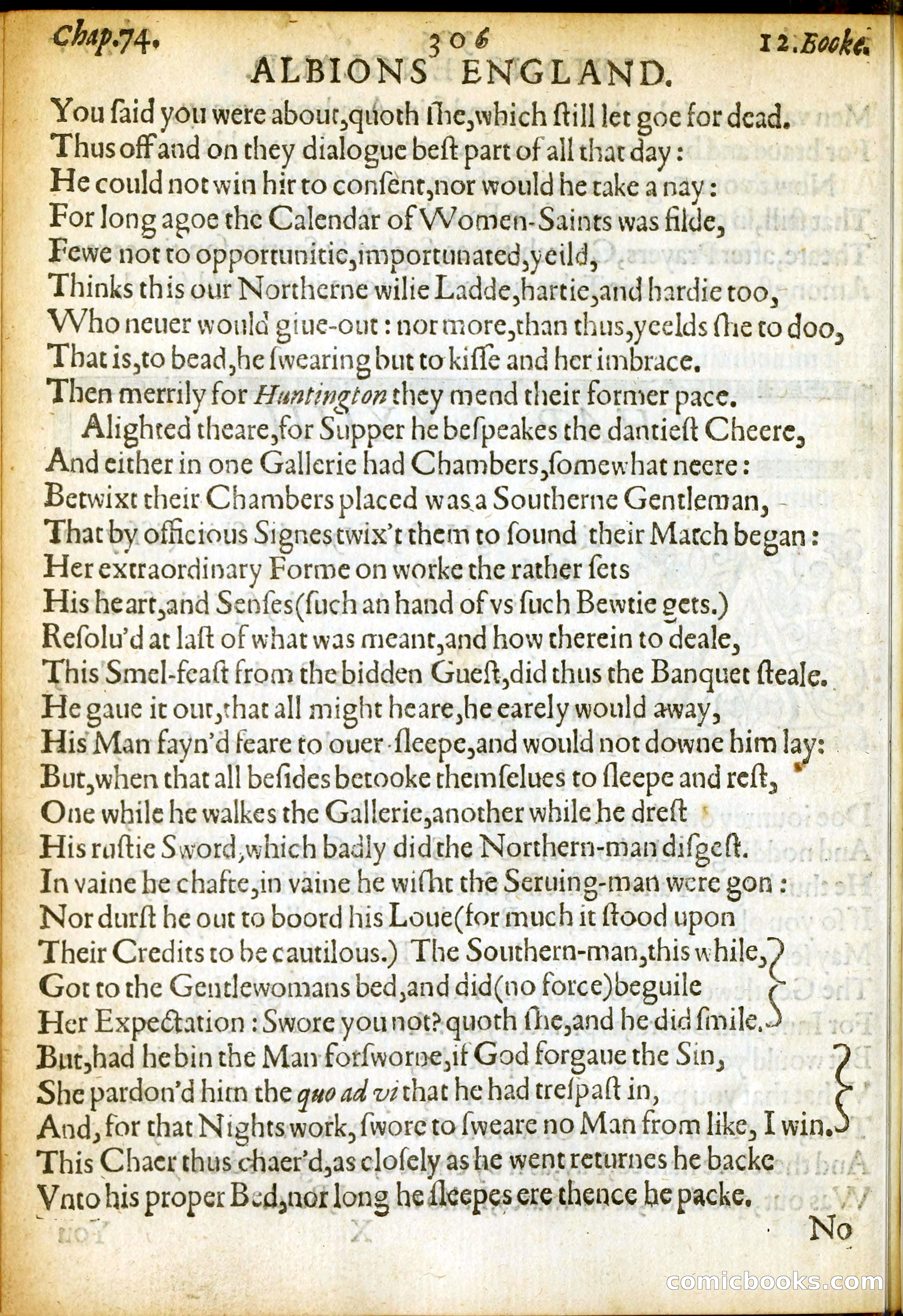
# This Page: Running Prose Narrative This is a page of running verse narrative from *Albion's England*, a historical poem. The text describes a dialogue between a man and woman who refuse each other's advances, then their travel to Huntington where they lodge at an inn. A southern gentleman positioned between their chambers orchestrates an encounter, and he successfully seduces the woman while the northern man walks the gallery unaware. The passage ends with the man returning to bed, apparently ignorant of what has transpired.
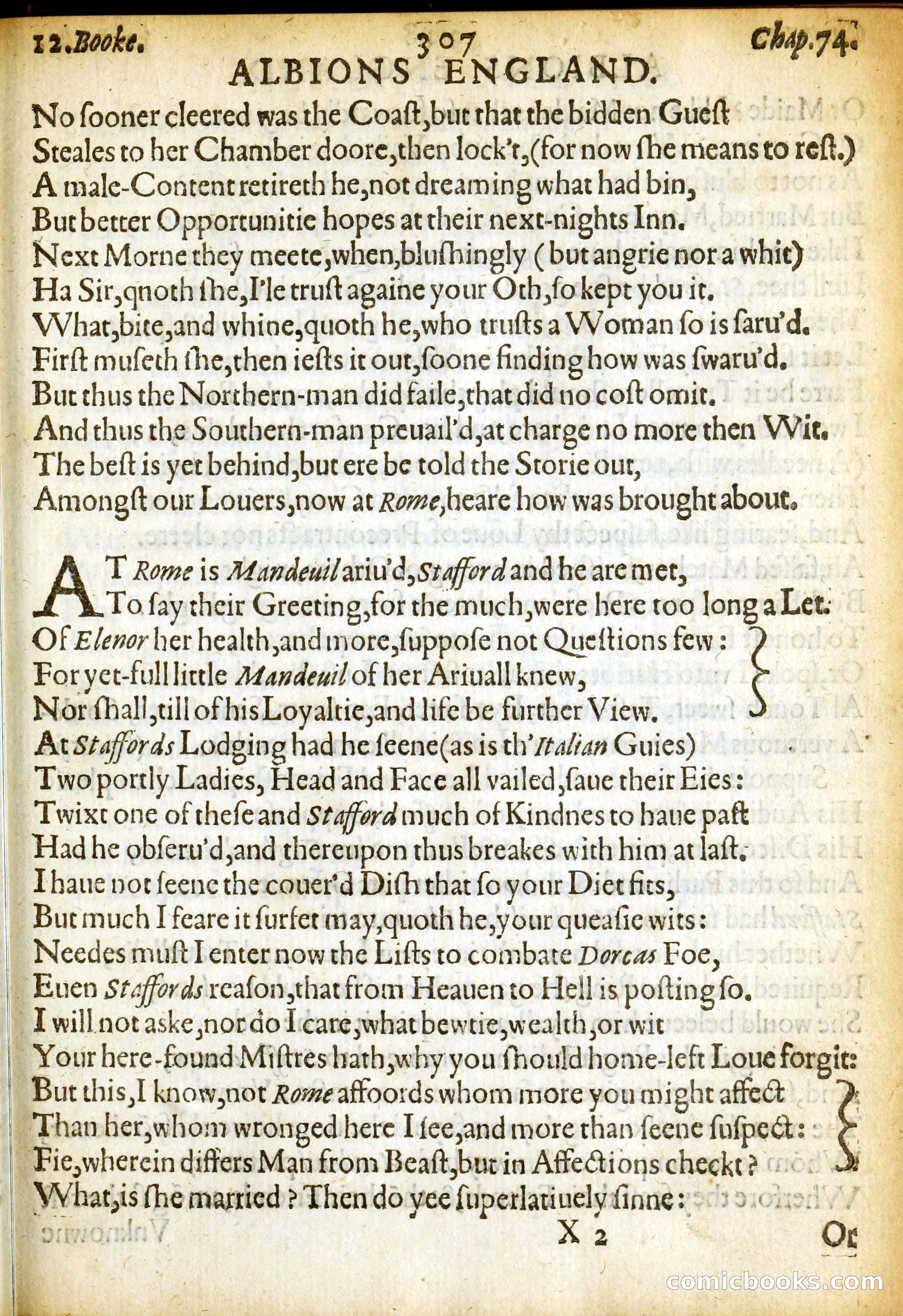
# Albions England - Page 307 This is a page of **running verse prose** from what appears to be an early modern narrative poem (not a Victorian penny dreadful, despite your prompt's framing). The text describes a romantic entanglement: a hidden guest steals to a lady's chamber; the next morning they meet, and he questions whether he should trust a woman. The passage then shifts to Rome, where characters named Mandeuil, Stafford, and others have gathered. Stafford addresses someone about a veiled lady and warns against infidelity, questioning how a man differs from a beast except in checked affections, and whether the object of desire is even married. The language and typography are early modern English, not Victorian.
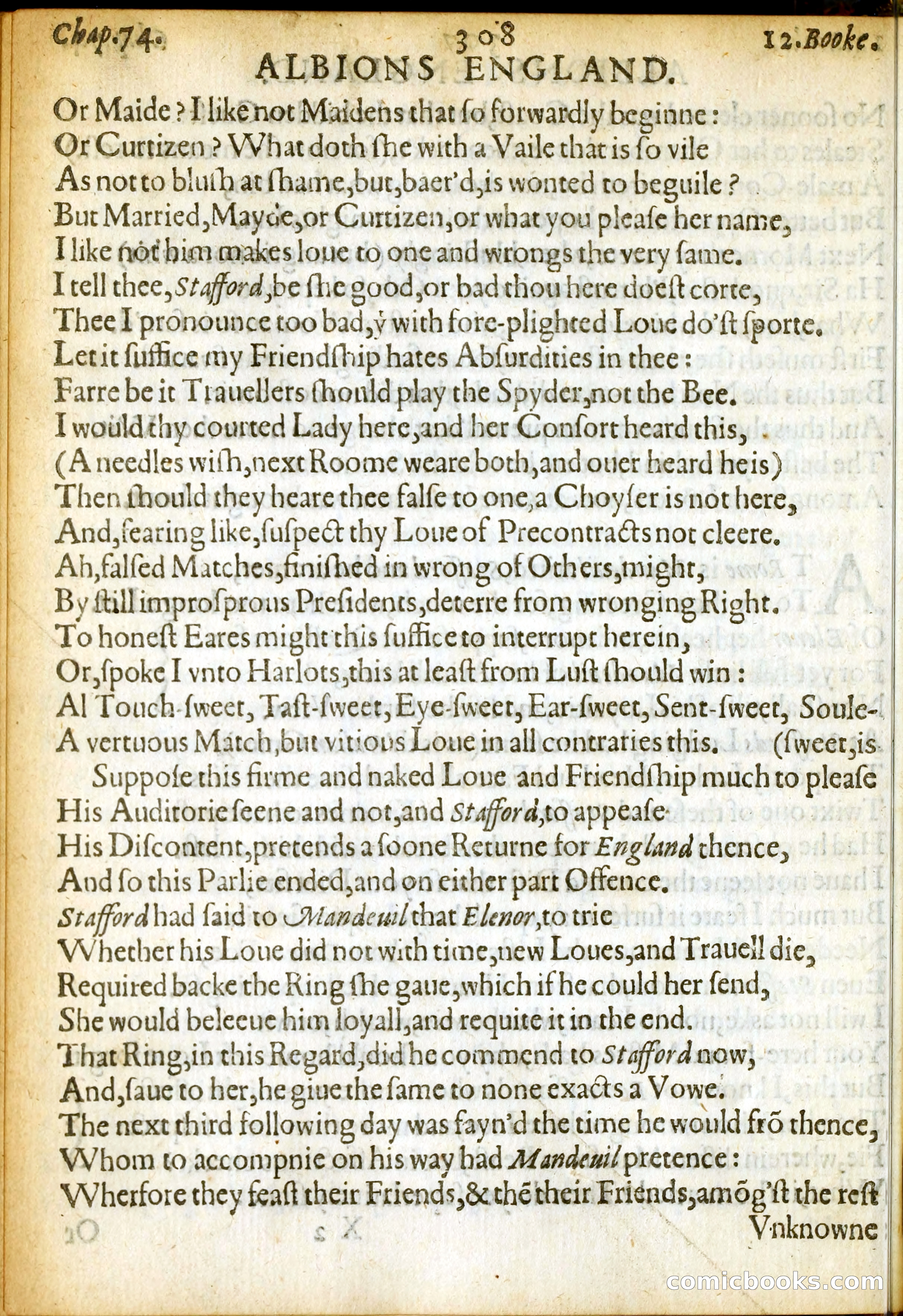
# Page Description This is running prose from the body of a narrative work titled "Albions England" (visible at page top). The page contains dramatic dialogue and exposition in verse, discussing matters of love, loyalty, and courtship. A character named Stafford is being addressed regarding his romantic conduct, with references to a woman, a ring as a token of fidelity, and Stafford's impending departure from England. The text mentions characters including Mandewil and Elenor, and describes arrangements for a feast and journey. The language and typography are early modern English, not Victorian—this appears to be a much older work, likely from the sixteenth or seventeenth century, not a Victorian penny dreadful.
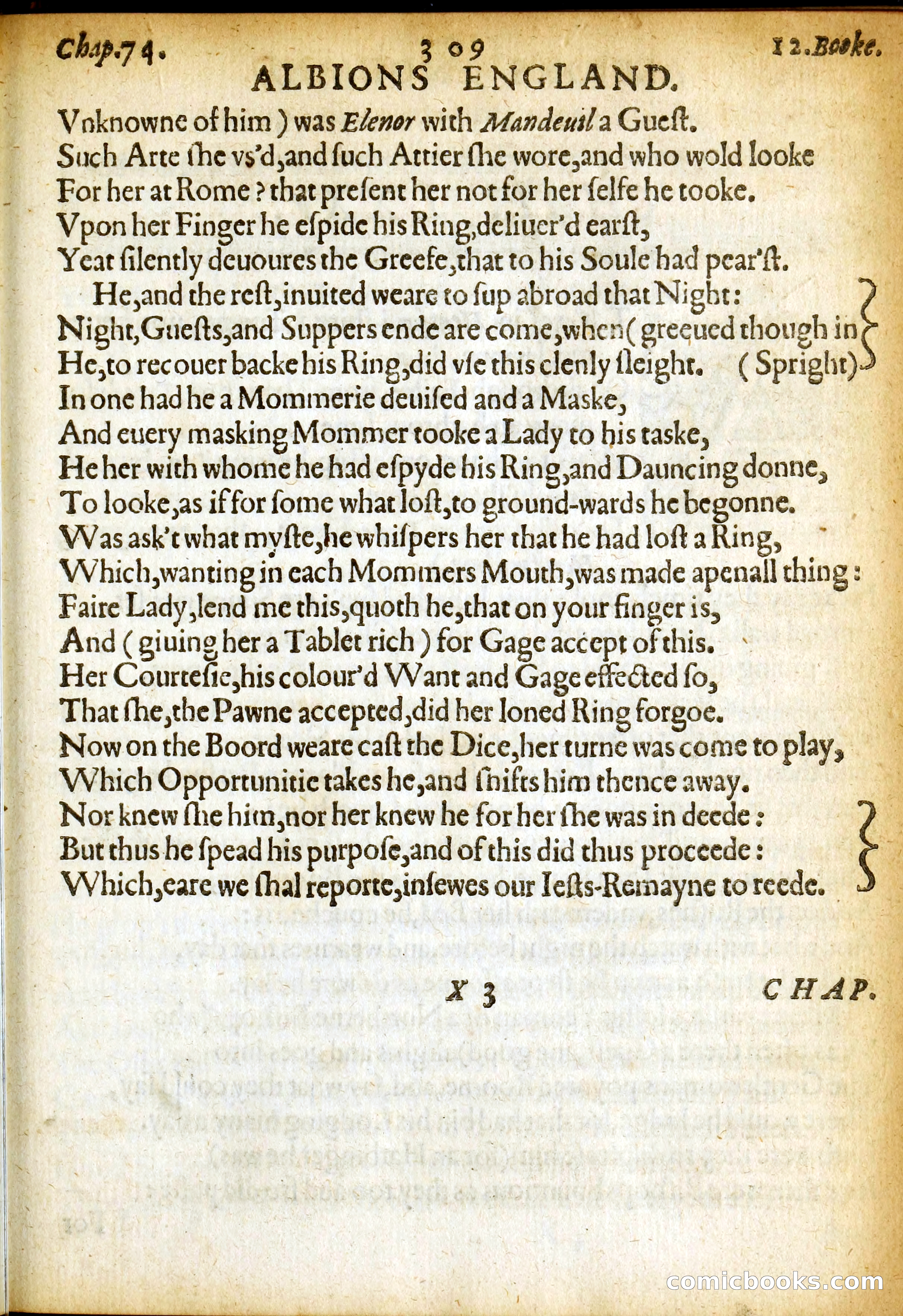
This is a page of running prose poetry from *Albion's England*, presenting a narrative about deception involving a ring. The text describes how a man at a masquerade ball tricks a lady into surrendering her ring by pretending to have lost one himself, offering her a tablet as collateral. He then uses a game of dice as cover to flee with the stolen ring. The passage is written in early modern English verse (appears to be from an older work, not actually Victorian), employing rhyming couplets to relate this tale of cunning theft and romantic intrigue.
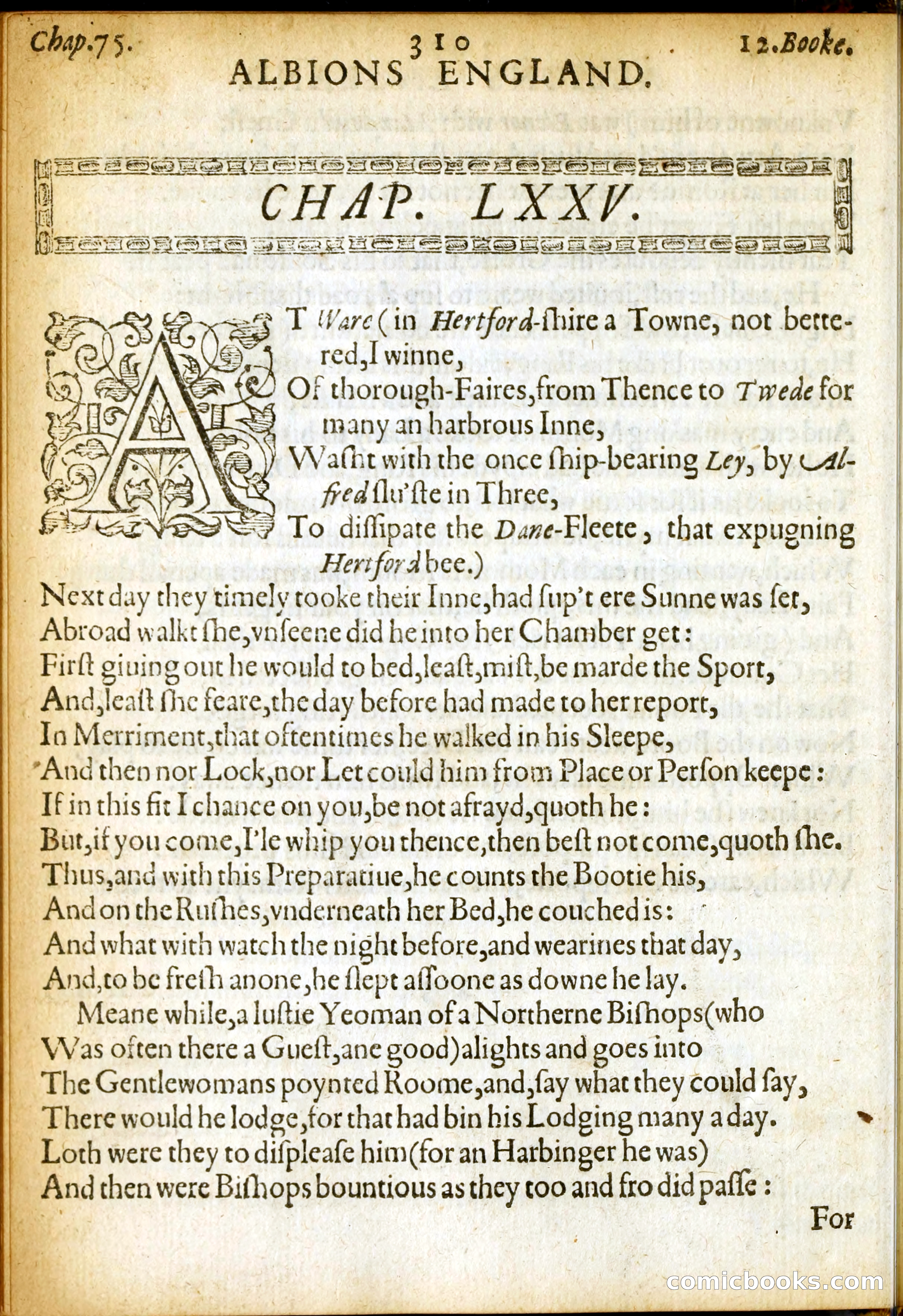
# This Page This is running prose text from Chapter LXXV of what appears to be *Albions England*, a narrative poem. The page contains ornamental header decoration and a large decorative initial letter beginning the chapter. The visible text describes a man's arrival at an inn in Hertfordshire and his deceptive plan to hide beneath a gentlewoman's bed while claiming he sleepwalks. Meanwhile, a lusty yeoman from a Northern Bishop's household arrives to lodge at the same residence, creating dramatic tension as the bishops attempt to accommodate him.
# What Is On This Page This is a page of running prose poetry from what appears to be a narrative work titled "Albions England" (visible at top). The text is printed in early modern English verse and describes a dramatic nighttime incident at an inn: a bishop's servant attempts to sexually assault a gentlewoman in a shared bedroom; she cries out, he grabs her by the beard thinking she's a man, and a struggle ensues with other servants arriving with lights and tools. The passage concludes with the accused man claiming everyone is deceived and promising to explain his actions. The page contains no illustrations, only densely printed text in period typeface with ornamental brackets marking verse sections.
# Page Analysis This is running prose from Chapter 75 of *Albions England*, printed in the 12-book format. The page contains verse narrative in early modern English spelling and typography. The text describes a plot involving characters named Mandevil, Stafford, and Elenor, centered on a ring and a love-token exchange: after a masque and revels end at Stafford's lodging, Elenor recounts the circumstances of her ring, and Mandevil sends her a tablet with a cryptic message about lending and pledging ("Gage") that plays on romantic obligation. The narrative then shifts to Mandevil's troubled journey to confront Stafford, arriving to find preparations for a wedding already underway.
# Page Analysis This is a page of running verse from a narrative poem. The text recounts a dramatic scene in which the character Stafford encounters his friend Dorcas (and later Elenor) in Rome. The passage describes their emotional reunion, their marriage that day, and then shifts into philosophical commentary on Roman Catholicism and atheism, criticizing both the "pompious Prelacie of Rome" and those who deny God in favor of pagan philosophy. The narrative appears to blend romantic melodrama with Protestant religious polemic, typical of sensational Victorian literature.
# Analysis of Page This is a running prose page from Chapter 76 of "Albions England," Book 13, featuring ornamental borders and an elaborate drop-cap. The text is not a penny dreadful but rather early modern religious verse (likely 16th-17th century, republished in the Victorian era). The passage addresses theological matters through poetry, exhorting atheists and non-believers to recognize God as creator of heaven, earth, sea, man, fish, fowl, and beasts. It argues against atheism, epicureanism, and other non-Christian faiths, warning that only fools deny God's existence. The language and style are distinctly archaic rather than sensational melodrama.
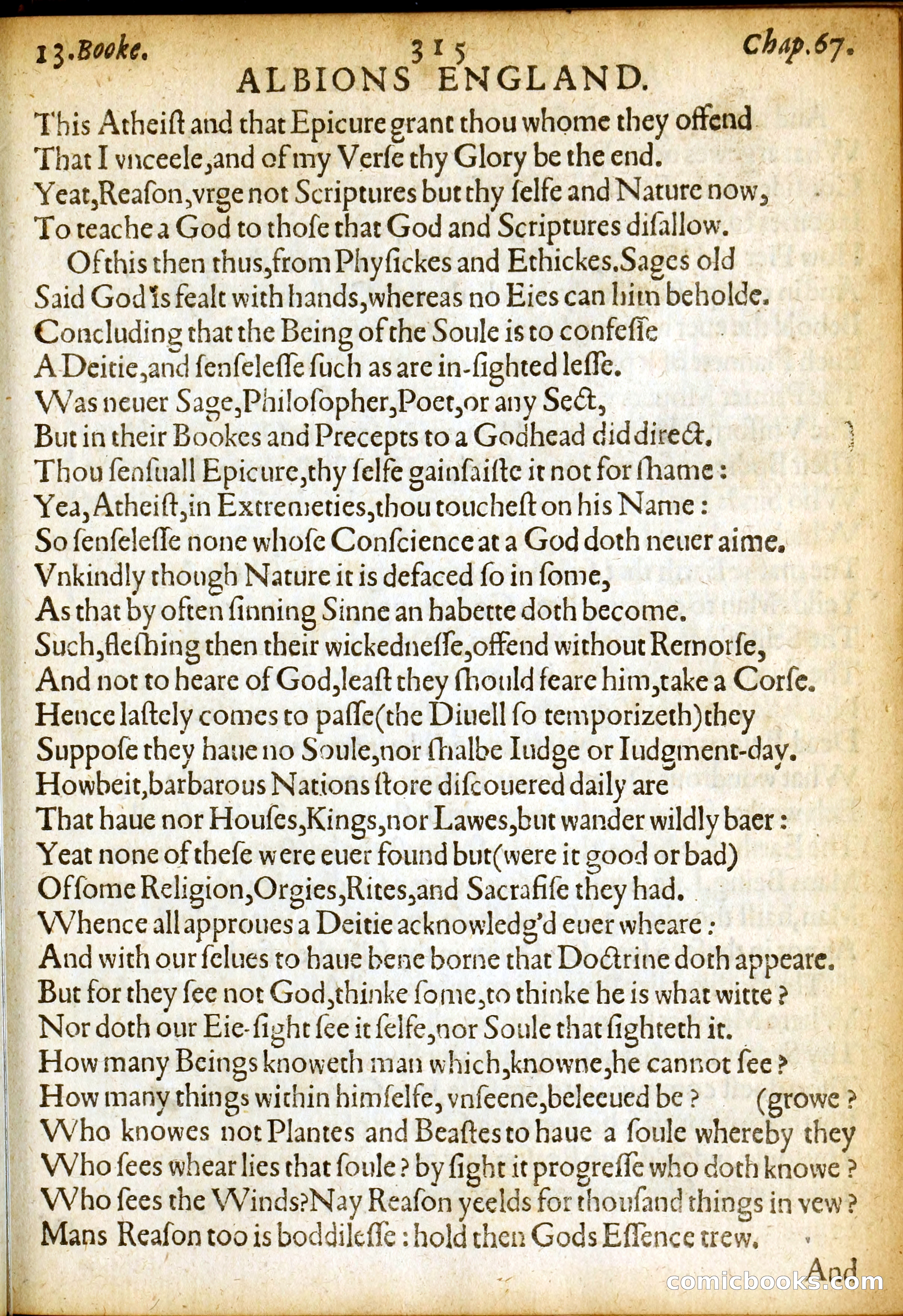
# Page Content Summary This is a page of running verse poetry from what appears to be an early modern religious text titled "Albions England" (visible at top, Chapter 67). The densely printed page contains argumentative verse in Early Modern English addressing atheism and Epicureanism. The text defends belief in God and the soul against philosophical skepticism, arguing that even pagan nations acknowledge deity through religion and ritual, and that reason itself—being invisible like wind and thought—demonstrates that invisible things (including God) can exist beyond human sight. The argument progresses through rhetorical questions about perception and knowledge to conclude that God's essence should be accepted by reason.
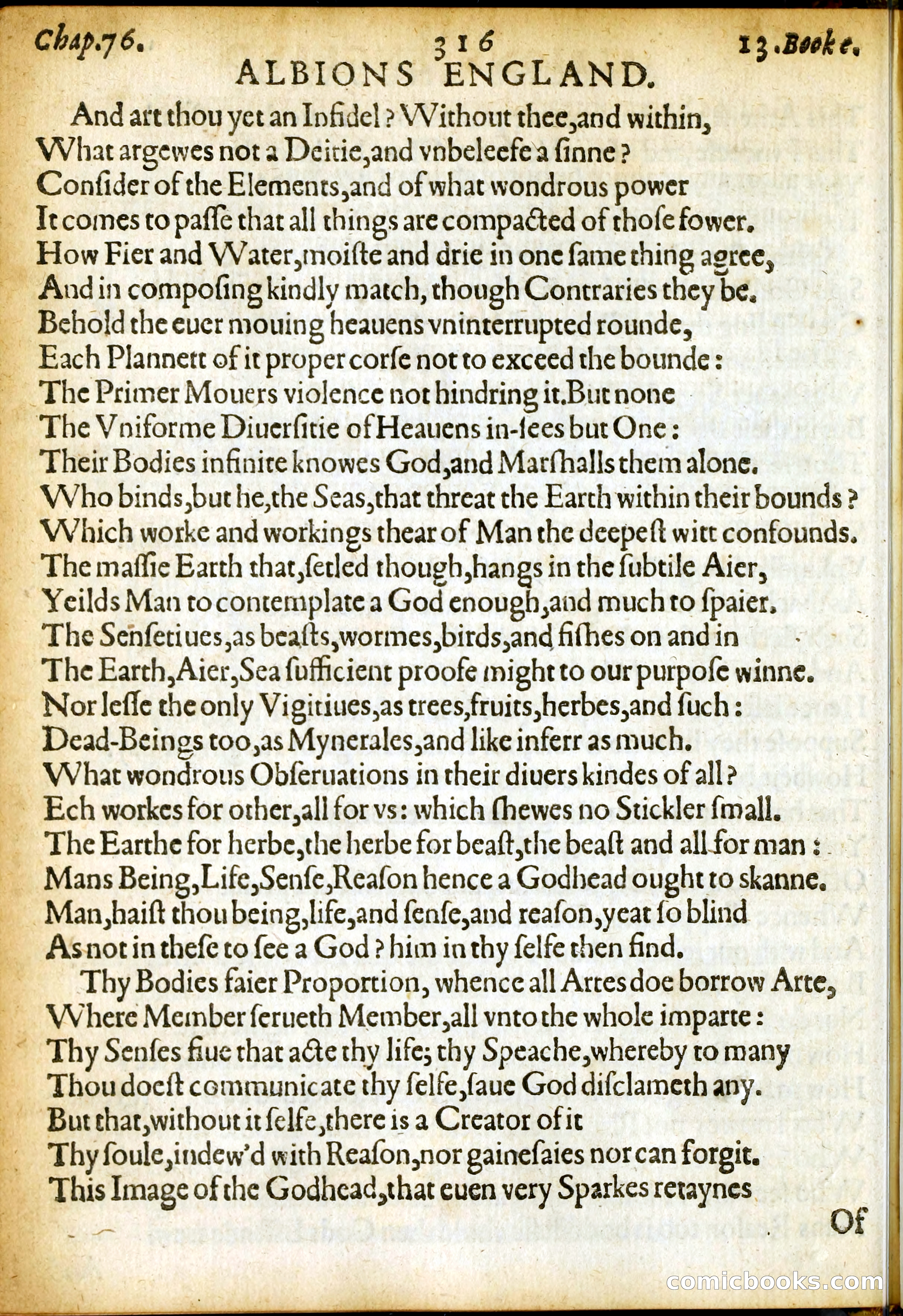
This page is running prose from *Albions England*, a didactic poem (not a Victorian penny dreadful, but early modern verse—the OCR attribution appears incorrect). The visible text is philosophical and theological verse addressing an infidel, arguing that God's existence is evident in the elements, the heavens, the earth, and especially in mankind's reason, senses, and soul. The speaker contends that humans, possessing life, sense, reason, and the ability to communicate, bear God's image and should recognize the divine through contemplation of creation and of themselves.
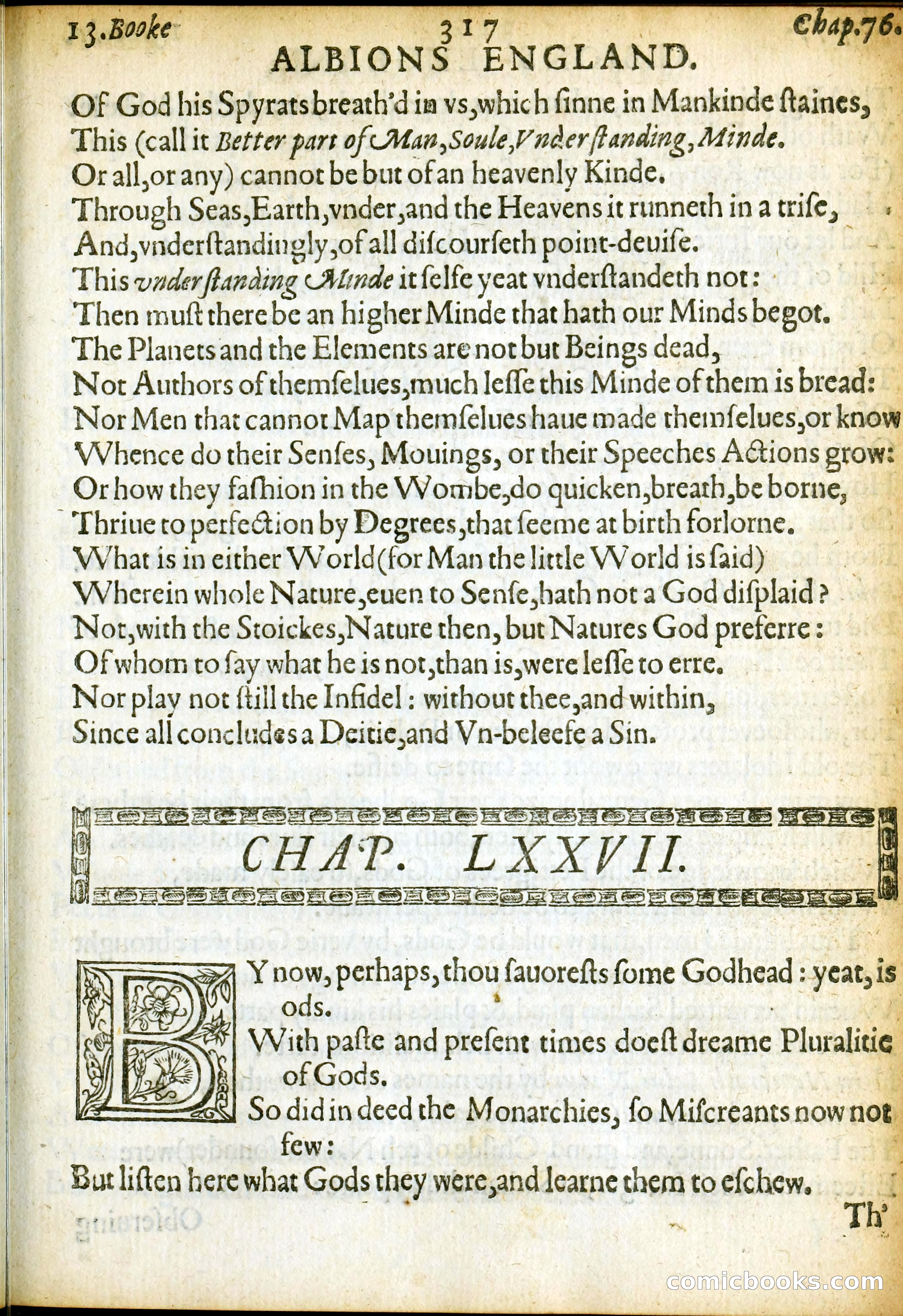
This is a page of running prose poetry from *Albions England*, a historical verse narrative. The text presents philosophical and theological arguments about the nature of God, the human mind, and divine creation. It argues that the human soul and understanding must derive from a heavenly source, that planets and elements are not self-governing but require a higher divine mind, and that all of nature testifies to God's existence. The passage concludes by dismissing polytheism and cautioning against infidelity. Chapter LXXVII begins at the bottom of the page with a speaker addressing the reader about belief in multiple gods.
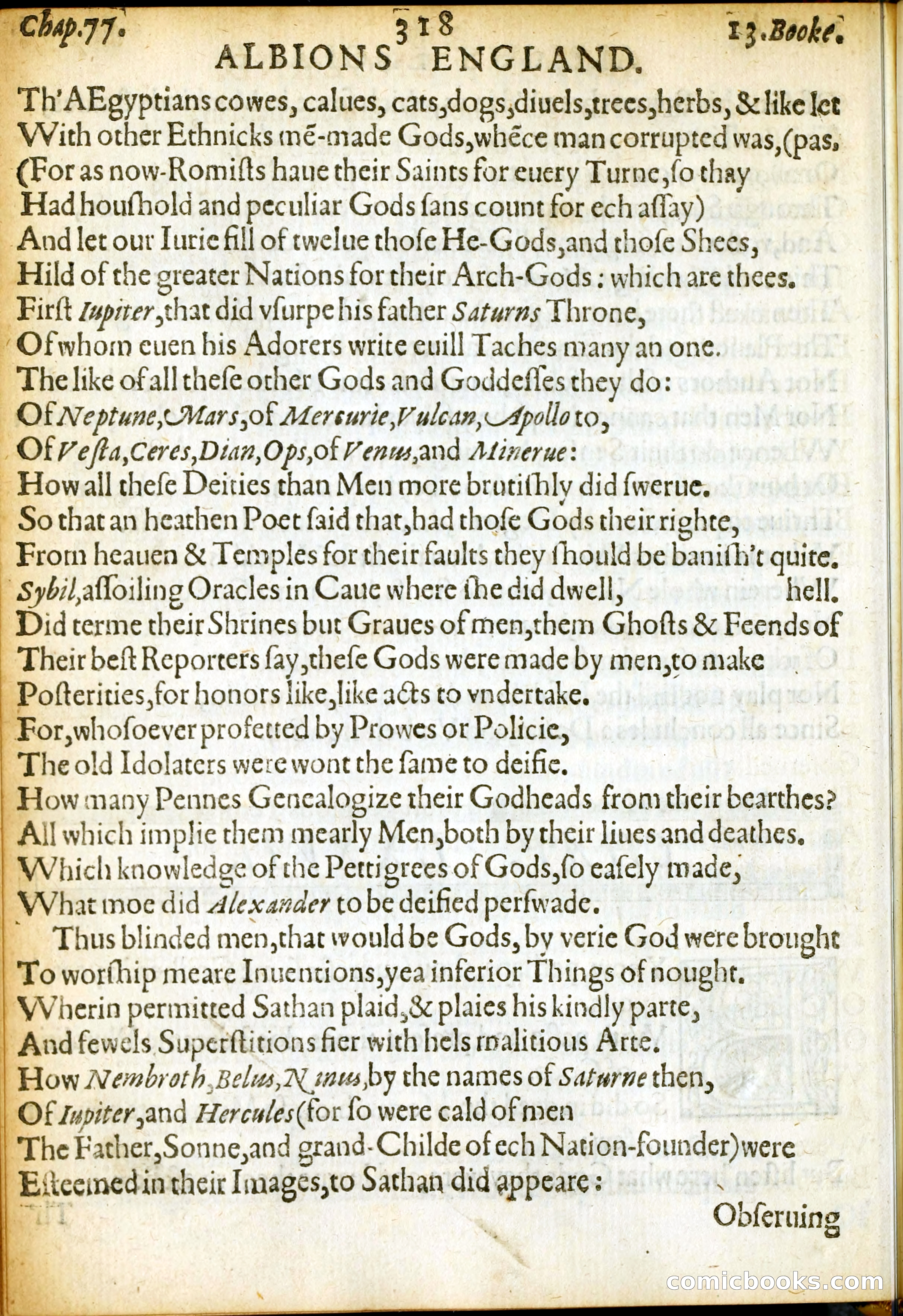
This is a page of running prose poetry from what appears to be a religious polemic text titled "Albions England" (visible in the header). The visible text is a lengthy passage condemning pagan idolatry, arguing that ancient peoples—Egyptians and others—worshipped false gods that were actually invented by men, citing examples like Jupiter, Neptune, and Mars. The author contends that these deities were merely mortal men later deified for political or martial prowess, and suggests Satan exploited such superstitions. The passage draws parallels between pagan practices and contemporary Catholic veneration of saints. The language and typography suggest early modern rather than Victorian production, though the OCR source indicates Victorian publication.
# Page Analysis This is a page of running prose poetry from *Albions England* (Chapter 77, Book 13), a historical narrative poem in early modern English. The text, written in archaic verse with period spelling and typography, discusses pagan religious practices—specifically how ancient nations used idols and oracles, and how priests gradually escalated demands from modest offerings (flowers, meal, oil) to elaborate temples, cattle sacrifices, and eventually human sacrifice of children and prisoners. The passage condemns these practices as instruments of tyranny and corruption.
This page contains running verse prose from Chapter 78 of what appears to be *Albions England* (a historical poem, not a penny dreadful). The text criticizes pagan gods and their associated rituals—particularly their indecent feasts and the obscene theatrical practices devoted to them—while contrasting heathen beliefs with Christian doctrine. The passage argues that serving such gods through inappropriate rites is ungodly, and distinguishes between mere wonders (achieved through physics) and true miracles wrought by God through holy men. A new chapter (LXXVIII) begins partway down, discussing how heathen philosophers held lesser gods subordinate to one sovereign deity. The language and typography are early modern, not Victorian.
# Analysis of Page This is a page of running verse poetry from *Albions England* (Book 13, Chapter 78), printed in Early Modern English. The text is a theological meditation in rhyming couplets that argues for monotheism—the existence of one supreme God—against pagan pluralism and polytheism. The passage invokes Aristotle's philosophy and catalogs divine attributes (omnipotence, eternality, self-sufficiency) while dismissing competing philosophical and religious systems as mere custom rather than truth. The language and typography are characteristic of seventeenth-century English verse rather than Victorian penny dreadful material.
This is a page of running prose poetry from what appears to be an early modern (not Victorian) theological work titled "Albions England." The text debates whether a single God can be responsible for both good and evil things in creation, arguing against the heretical doctrine of two opposing divine powers. The passage uses natural examples—heat and cold, light and darkness, poison and medicine—to argue that all things serve God's purposes and that evil represents corruption or accident rather than independent creation. The dense, archaic language and italicized philosophical terms suggest this is serious religious philosophy rather than sensational penny dreadful fiction.
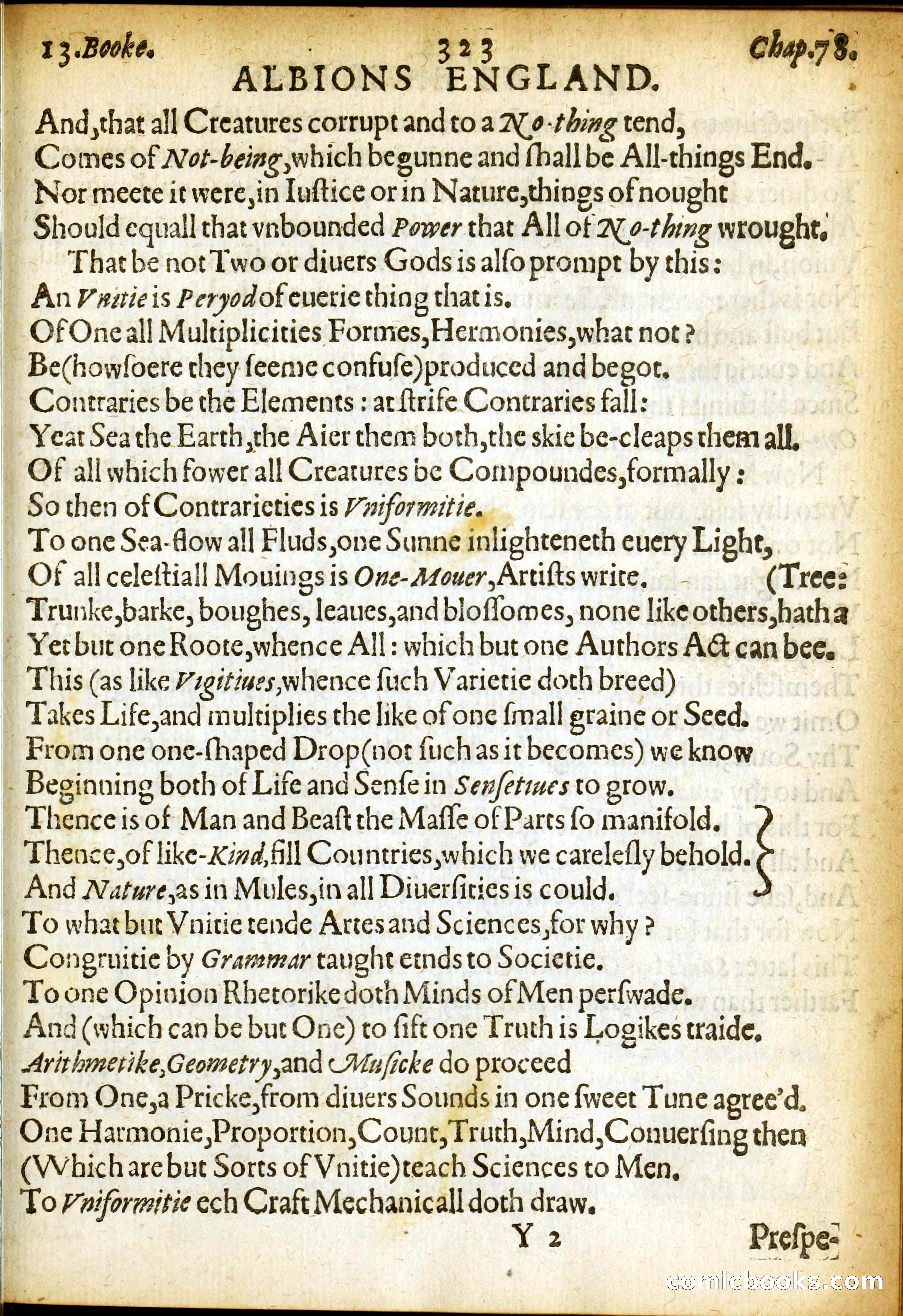
# Analysis This is a page of **running verse prose** from what appears to be an early modern philosophical or didactic poem, not a Victorian penny dreadful as the prompt suggests. The page is numbered 323, from "Albions England," Chapter 78, Book 13. The visible text discusses metaphysical and philosophical concepts: that all creatures tend toward nothingness, that contradictions and varieties in nature proceed from unified divine power, and that all arts and sciences (grammar, rhetoric, logic, arithmetic, geometry, music, mechanics) ultimately derive from a single principle of unity. The poem uses natural examples—trees, seeds, elements, celestial bodies—to illustrate how multiplicity emerges from unity. The typography and layout indicate this is from an early printed edition, not a Victorian-era publication.
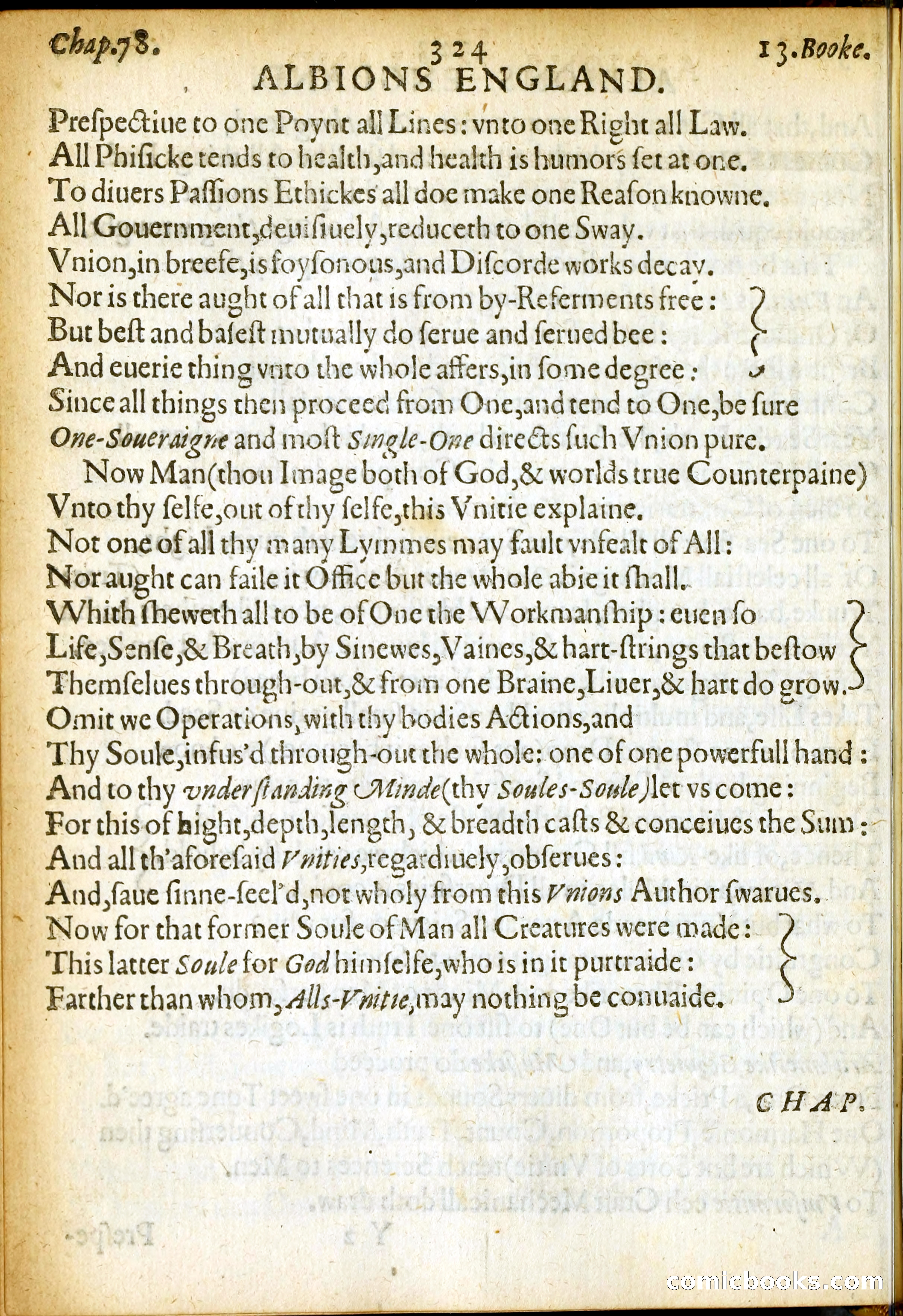
This is a page of running prose poetry from what appears to be an early modern philosophical text (not Victorian penny dreadful, despite the assignment framing). The text presents philosophical arguments about unity and hierarchy in creation, arguing that all things proceed from and tend toward "One," and that man—as God's image—embodies this universal principle through the interconnection of his body parts, senses, and soul. The dense, archaic verse employs elaborate conceits about bodily unity to explain metaphysical oneness, concluding that God himself represents the ultimate unity beyond which nothing exists.
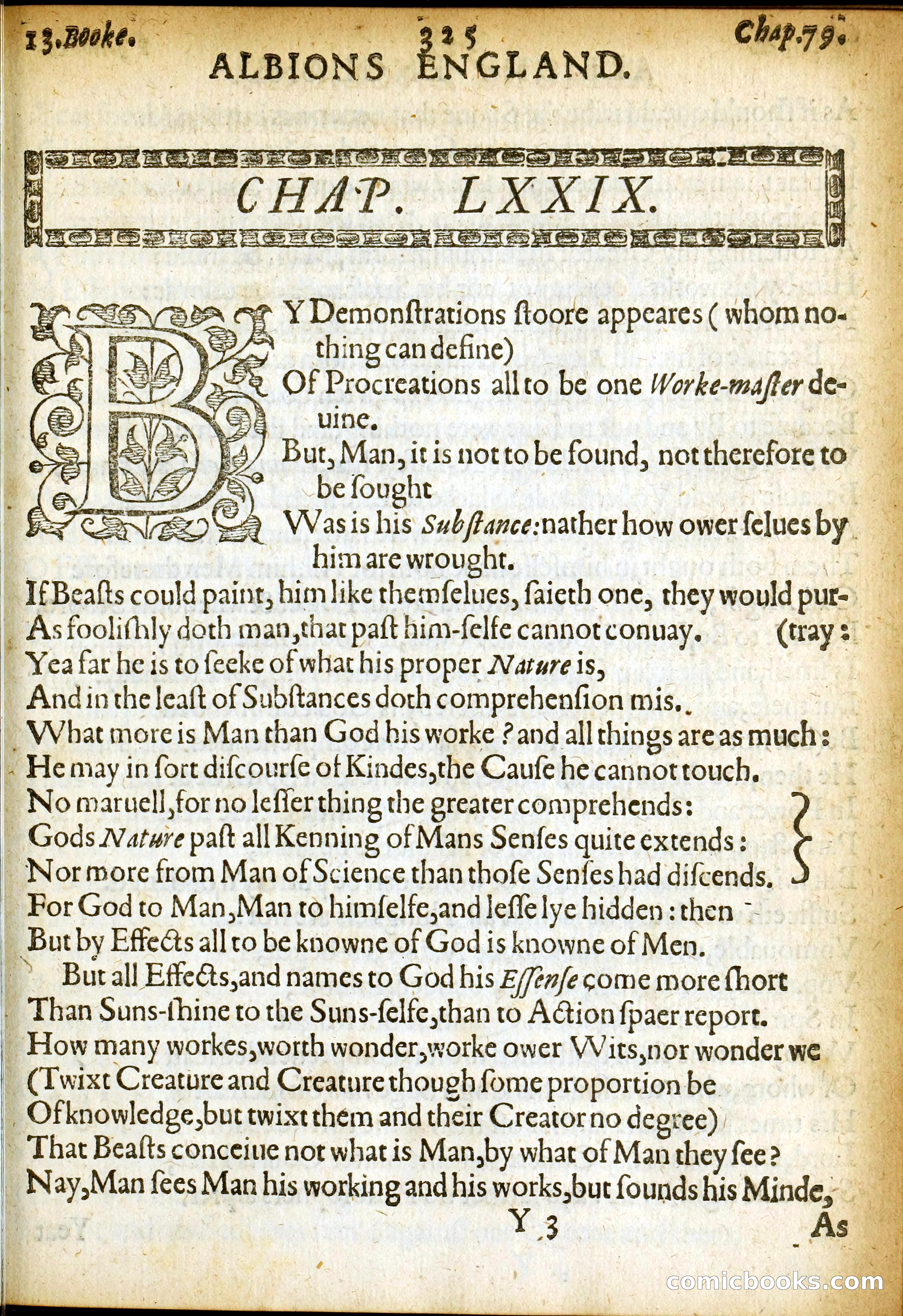
# Analysis of Page This is a running prose page from what appears to be a philosophical or didactic work titled "Albions England." Chapter LXIX presents lengthy verse argumentation about human nature, divine knowledge, and the limits of human understanding. The text uses ornate Early Modern English spelling and syntax, discussing whether humans can truly know themselves or God's nature, and whether beasts can comprehend what man is. The passage argues that humans perceive only God's effects, not his essence, and that man cannot fully understand his own substance—a meditation on epistemological limits rather than sensational fiction. The page number and chapter heading suggest this is from a bound book rather than a penny dreadful serial installment.
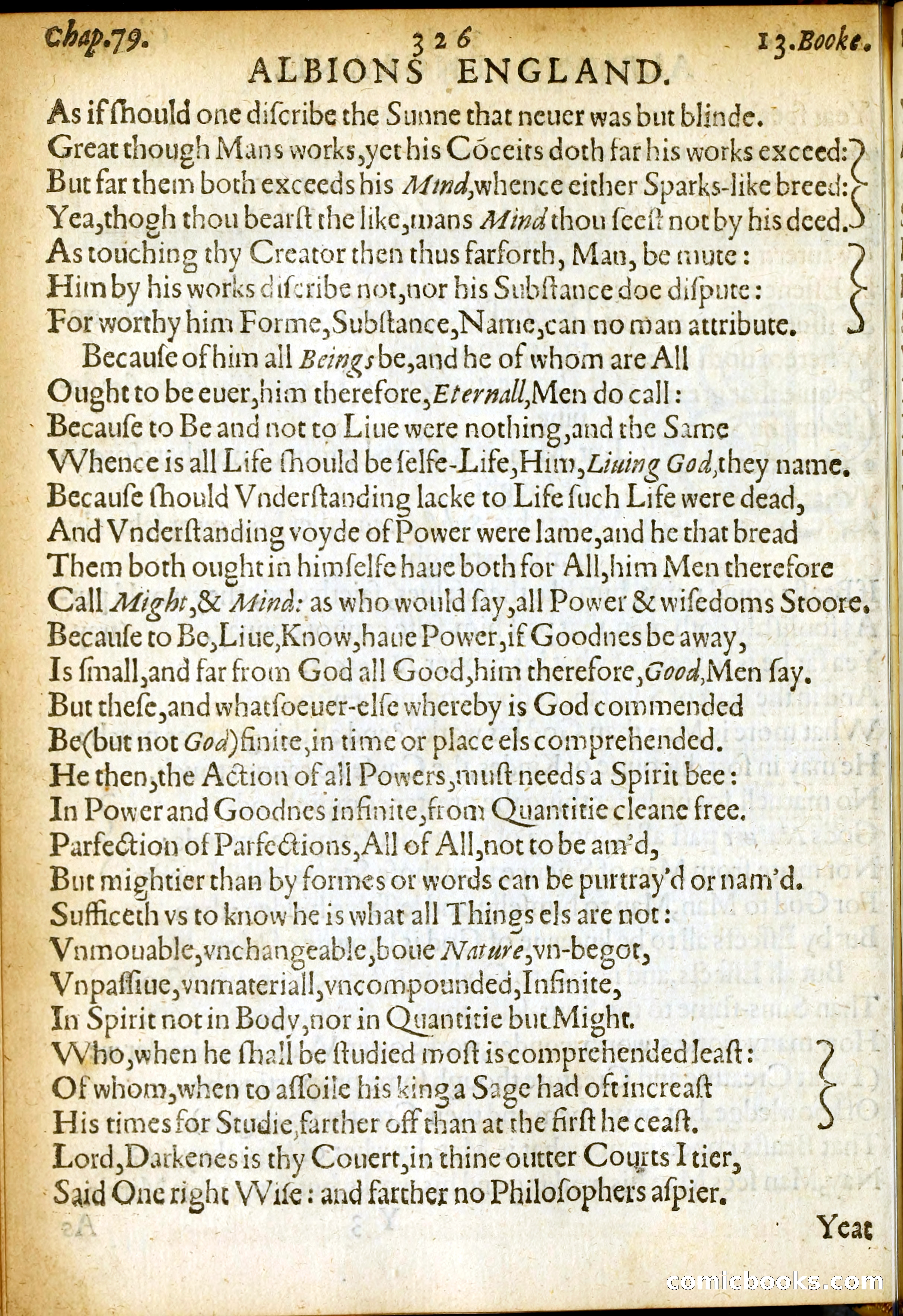
# Analysis of Page 326 from *Albion's England* This is a **running prose page** of philosophical verse, not a penny dreadful. The text is theological poetry from Chapter 79 of what appears to be Michael Drayton's *Englands Heroicall Epistles* or similar period work (printed in Early Modern English, not Victorian). The verse argues that God's nature—Being, Life, Understanding, Power, and Goodness—transcends human comprehension and material description. It asserts that God is eternal, infinite, immaterial, and beyond the reach of philosophy or language, concluding with a prayer acknowledging divine mystery. The ornamental brackets on the right margin denote stanza breaks.
# Page Analysis This is a page of running prose verse from what appears to be an early modern religious-philosophical work (likely 17th century, not Victorian as initially suggested). The text is printed in blackletter type on aged paper and discusses theological concepts, particularly God's nature, essence, and the Trinity. The verse argues that God exists in all things without mixture, that human minds similarly produce effects without intermixture, and concludes with declarations about godhead and the Trinity. The final paragraphs appear to transition toward a narrative work involving heroic acts and a queen, though the connection remains unclear from this page alone.
# Analysis of Page 238 from "Albions England" This is a page of running verse text, not a penny dreadful but rather early modern poetry. The visible passage appears to be the concluding lines of a work addressing Queen Elizabeth (named explicitly as "Elizabeth" in the text). The poet appeals to the Queen as his Muse, acknowledges his pen's limitations in praising her, and offers a prayer for her blessed life and reign to continue long. The page ends with "FINIS," marking the conclusion of this section or the entire work. The typography and language indicate this is Renaissance or Jacobean-era literature, not Victorian sensation fiction.
# This Page This is a **title page and prefatory address** for an addition to a larger work. It announces "An Addition in Proem to the second Booke of ALBIONS ENGLAND," which contains a brief account of the true history of Aeneas. The text is addressed to the reader ("Ceepthim, friendly Reader"), apologizing for departures from proper order and sequence, asking patience for the author's borrowing from "Decorum" rather than strict precedent. The page ends with the heading "AEneidos," indicating the classical Aeneid is the source material. There is a decorative initial letter at the top but no illustration or advertising visible.
# Victorian Penny Dreadful Page Analysis This is a prose page from what appears to be a serialized narrative adaptation of the Aeneid. The ornate header and decorative initial letter indicate the opening of a new section titled "AEneidos." The text describes Aeneas escaping the burning city of Troy, carrying his aged father Anchises on his shoulders while leading his young son Ascanius and his wife Creusa, along with other Trojans fleeing through the flames. The passage continues through their sea voyage to Thrace (specifically Cresa, near Mydonia), where Aeneas arrives with his followers and treasure, seeking respite from his difficult journey. The language and typography are characteristic of early modern English printing, though this Victorian edition presents classical material in sensationalized, accessible format typical of penny dreadful serialization.
# Page Description This is a page of running prose from what appears to be a classical narrative work (page 331, marked "An Addition to the Second Booke"). The text recounts a scene in which Aeneas, founding a city near Troy, sacrifices a bull at an altar. When he cuts branches from nearby trees for the ritual, blood flows from them. A ghostly voice—identifying itself as Polydor, son of Priam—reveals that Aeneas has wounded the body of the dead man, whose murdered corpse was buried in the sand by Polymnestor, the king who betrayed and killed him for treasure during Troy's decline. The ghost explains how trees grew from his buried body and now bleeds when wounded.
This is a page of running prose from what appears to be a classical narrative adaptation rather than a typical Victorian penny dreadful. The text recounts Aeneas receiving divine instruction to abandon his settlement and seek Italy, his completion of religious rites, and his fleet's subsequent voyage to Carthage, where Queen Elisa (Dido) receives him with such hospitality and personal charm that she becomes enamored of him. The language is archaic and highly ornate, employing early modern English spelling and style, suggesting this is either an actual early modern text or a Victorian pastiche imitating classical literature.
This is a page of running prose text, printed in an early modern typeface. The page appears to be from a classical or historical narrative rather than a Victorian penny dreadful—the header reads "of ALBIONS ENGLAND" (page 333), and the text concerns Dido's emotional conflict over her attraction to Aeneas the Trojan, whom she addresses to her sister Anna. Dido describes how Aeneas has disrupted her vow of continued widowhood and seeks her sister's counsel on whether to pursue a second marriage. The passage is written in ornate, archaic English typical of Renaissance-era literature, not Victorian sensation fiction.
This is a page of running prose from what appears to be a Renaissance or early modern literary work (not Victorian—the archaic typography and language suggest 16th or 17th century). The text describes Anna's counsel to Elisa regarding her love for Aeneas, urging her to marry him and bear his children to strengthen her kingdom. It then recounts how Elisa followed this advice, and concludes with the beginning of a hunting scene where Aeneas and the Queen are suddenly caught in a violent storm with black clouds and lightning.
# Page Description This is a page of running prose text—specifically a narrative passage from what appears to be an early modern work (likely 17th century, not Victorian as the query assumes). The text describes Aeneas and Elissa sheltering together during a storm, their subsequent courtship and marriage, and a Trojan nobleman's reproachful speech to Aeneas, urging him to abandon his idle life in Carthage and remember his duty to the gods and his people. The passage treats classical mythological material with elaborate, ornate language typical of Renaissance literature.
# Page Analysis This is a running prose page from what appears to be a dramatic or narrative work. The text is printed in early modern typeface (likely 16th or 17th century, though presented as a Victorian reprint). The page depicts a scene in which a character (apparently the Queen of Carthage) confronts Aeneas after observing his fleet being repaired. She accuses him of inhuman treachery, contrasting her earlier belief that he was divine with her present view that he is "less than a man and worse than a Devil." The text contains dialogue and narrative description of Aeneas preparing his ships to depart, apparently at someone's urging that he leave Carthage and make Italy his destination. The Queen expresses both love and bitter reproach at his abandonment.
# Page Description This is a page of running prose (page 337) from what appears to be an early modern dramatic or narrative work, not a Victorian penny dreadful as suggested. The text is a monologue by a character (Dido, addressing Aeneas) lamenting his departure from Carthage and his rejection of her love. She catalogs all she has sacrificed and offered him—her city, her wealth, her affection—and warns that his abandonment will be her death and bring shame upon them both. The language and typography are characteristic of sixteenth or seventeenth-century English printing, with archaic spelling and long paragraphs of ornate, emotional rhetoric rather than Victorian melodrama.
# Analysis of This Page This is a page of running prose—specifically narrative fiction text, not a title page or illustration. The passage appears to be from a classical or early modern literary work (likely an adaptation of the Aeneid story), discussing the emotional turmoil of a Queen (Dido/Elisa) abandoned by Aeneas. The text describes her grief through personified emotions—Love, Wrath, Sorrow, and Despair—acting upon the stage of her mind, with her desperation intensifying as the other emotions depart. The ornate, archaic language and classical subject matter suggest this is NOT actually a Victorian penny dreadful as the prompt suggests, but rather an early modern or Renaissance-era literary text (possibly from the 16th or 17th century), subsequently reproduced in a later edition.
# Page Description This is a page of running prose from what appears to be a narrative work about classical subjects. The text recounts how a Wizard or Witch advised a Queen to burn the relics and armor of Aeneas—including his weapons, a Phrygian cup, bracelets, and ear-rings—as a sacrificial offering to infernal deities in order to extinguish her passion for him. The passage details the Queen's instructions to her sister Anna to gather faggots and garlands for the ritual, and includes the Queen's enumeration of the objects to be burned and her reasons for each item's destruction, presented in elaborate early modern English prose.
# Page Description This is a page of running prose text from what appears to be a classical or early modern narrative (not a Victorian penny dreadful as indicated in the prompt). The page is numbered 340 and titled "An Addition to the second Booke." The text consists of a dramatic monologue addressed to Aeneas, condemning him for abandoning Elisa (Dido) in Carthage. The speaker curses Aeneas with stormy seas and shipwreck, then reveals the passage concludes with Elisa/Dido taking Aeneas's sword and piercing her own breast—performing a tragedy she sought and meeting an unforeseen terror. The language is early modern English with archaic spelling and typography.
This is a page of running prose from what appears to be a narrative work about classical history or legend (page 341). The text recounts events following the fall of Troy, describing how Aeneas traveled to Sicily where he was entertained by King Acestes, participated in games and contests, and eventually sailed to Italy (Latium), where he sent an ambassador with a hundred knights to King Latinus to establish their shared Trojan ancestry and explain Aeneas's arrival. The prose is written in archaic Early Modern English with italicized proper names.
# Description of Page This is running prose from what appears to be a classical or pseudo-classical narrative work (not a Victorian penny dreadful, despite the assignment framing). The page shows dialogue between characters named Aeneas and Latinus. Aeneas petitions the King of a country for settlement rights, referencing the Trojans' long voyage and offering precious gifts—a rich robe, golden crown, and the scepter of King Priam. Latinus responds graciously, acknowledging their kinship and the gods' commands for hospitality, while philosophizing about timidity and prudence. The text uses early modern English spelling and typography.
# Page Analysis This is a page of running prose text (page 343) from what appears to be a classical or historical narrative, not a Victorian penny dreadful as initially suggested. The visible text consists of dialogue and narrative describing events involving *Aeneas*, *Latinus*, and *Lavinia*. A character (appears to be Latinus) welcomes Aeneas and his Trojans to Italy, expresses hope that his daughter Lavinia's marriage to the foreign stranger will succeed, and thanks Aeneas for his gifts. The narrative then describes the Trojans' departure, Aeneas's cautious response, and Queen Amata's angry opposition to her daughter's marriage to what she views as an exile—opposition she attempts to enforce by inciting the king's nobles to resist. The text uses early modern English spelling and typography.
# Page Description This is a page of running prose narrative text from what appears to be a classical or pseudo-classical tale. The page (numbered 344) describes Turnus, Prince of the Rutiles, holding a council to plot against Aeneas and win the hand of Lavinia through war and deception. The narrative then recounts how Ascanius and Trojan companions accidentally hunt and wound a tame stag belonging to a man named Tyrrhus; the stag flees to the hall of a young gentlewoman named Sylvia (or Ilia), who has long cared for the animal and swoons upon seeing it injured. She vows revenge. The text is densely set in early modern English typography with italicized proper names.
This page contains running prose—specifically narrative text from what appears to be a classical or historical tale. The visible text describes a violent encounter between armed country people (shepherds, plowmen) and a group of travelers identified as Trojans. When the rustics mistake the Trojans for having killed a stag, they attack with improvised weapons (stakes, axes, flails), sparking a confused melee that spreads to nearby fortresses. The passage names casualties including a man called Almon and an older man named Galefus, and describes how their bodies are used to inflame political tensions. The language and references suggest this is an adaptation or translation of classical material, written in archaic English prose.
# Description This is a page of running prose text from what appears to be a classical narrative work, not a Victorian penny dreadful. The text recounts events from the Trojan Wars, describing how King Latinus was persuaded to support Turnus and Aeneas in conflict, and later presents a dialogue between Aeneas and Turnus regarding truces and combat. The language and content suggest this is an early modern English prose adaptation of classical material (likely based on Virgil's *Aeneid*), not the sensational crime or horror fiction typical of Victorian penny dreadfuls. The page is numbered 346 and marked "An Addition to the second Booke."
# Page 347: Running Prose from "Albions England" This is a page of running prose dialogue, likely from a dramatic work or narrative poem rather than a penny dreadful (the typography and language suggest early modern rather than Victorian). The text depicts an exchange between characters named Aeneas and Turnus, discussing whether to engage in combat. Turnus responds to Aeneas's challenge, ultimately accepting a duel while questioning Aeneas's motives—whether he speaks from insult, arrogance, or emulation. Turnus declares his readiness to fight, invoking Jupiter and asserting his courage. The dialogue is written in early modern English with elaborate rhetorical flourishes typical of Renaissance literature.
# Page Description This is running prose text from the body of a Victorian-era historical narrative (page 348, marked "An Addition to the Second Booke" at the top). The page recounts classical legend: Aeneas defeats and kills Turnus in single combat over the prize of Lavinia's hand and the kingdom of Latium; Aeneas then marries Lavinia and rules until his death, after which his son Ascanius inherits; later, Lavinia bears a posthumous son named Silvius, to whom Ascanius cedes the kingdom, and from whom descend all subsequent Latin kings. The passage concludes by introducing Brutus, Silvius's son, who—after accidentally killing his father—sails with Trojan descendants to an island called Albion.
This is a concluding page of prose text from what appears to be a historical narrative about Britain's origins. The visible text describes giant-like inhabitants of monstrous making and uncivil manners (said to be begotten of Dituels) who conquered the country and named it "Brutaine" after their leader Brutus, establishing him as an original ancestor to the Britons. The page ends with "FINIS," marking the conclusion of "this abridged Historie of his Grandfather Aeneas." The rest of the page is largely blank or contains faded/illegible text, typical of end matter in early printed books.
This is a prefatory page of prose addressed "To the Reader." The author explains that he has observed clergy and parsons becoming entangled in lengthy, digressive historical chronicles of England, making them difficult to follow. To remedy this, he claims to have created a shortened, accessible passage through the entire "Legend of the maine, State-Occurrants" that can be read in one or two hours uninterrupted. He invites future authors to amend or add epitomes of histories of Ireland, Pict-Land, the Isle of Man, Wales, and other territories under England's monarchy, which he would gladly praise. The page is signed by W. Warner, appearing to be an introductory dedication rather than part of the main narrative text.
This is not a penny dreadful page, but rather an introductory essay from an early modern historical work. The page presents "An Epitome of the whole Historie of England" and discusses the legendary origins of Britain—debating whether the land was named after Brutus or derived from the tripartite division among his three sons (Locrine, Camber, and Albanack), which allegedly became Logria, Cambria, and Albania. The author acknowledges uncertainties about pre-Roman Britain and cites Camden's *Britannia* as a source, while promising to follow established chronicles rather than introduce novelties.
# Page Description This is a page of running prose from what appears to be a historical chronicle or epitome of British history. The text, printed in early modern English typography, traces the legendary and early historical lineage of British kings from Brute (the mythical founder who renamed the land Britaine) through various successors, including Ferrex and Porrex, Dunwallo, Gorboman, and Cassiuilan. The passage culminates in noting that under Cassiuilan, Julius Caesar won the first tribute ever paid by the Britons to Rome. The page is numbered 352 at the top and includes dense genealogical and chronological information about early British monarchy.
This is a page of running prose from what appears to be a historical work on England (page 353), not a penny dreadful. The text discusses how Roman discoverers found ancient Britain divided into numerous regions and peoples with distinct names, listing them systematically—from the Danmoines in Cornwall and Devon through to the Ottadimes in Northumberland. It then describes how the Romans later reorganized these territories into a "Pentarchia, or fivefold Divident" called Britannia prima. The typography and Latin references suggest this is scholarly historical writing, likely from an earlier period than Victorian penny dreadfuls.
# Description This is a page of running prose from what appears to be a historical chronicle or antiquarian text, not a Victorian penny dreadful. The page discusses early British history, tracing succession of rulers from Cassiuilan through Cymbeline to Lucius, and describes the introduction of Christianity to Britain under King Lucius in the year 188 AD. The text also addresses the subsequent Saxon invasions and the transfer of power from British kings to Roman Emperors. The typography and layout suggest this is from an early modern printed book rather than Victorian-era serialized fiction.
# Analysis This is a page of running prose from what appears to be a historical text—not a penny dreadful, but rather a work titled *Historie of England* (visible at top of page, numbered 355). The text discusses Roman Britain's history, specifically covering the period from Julius Agricola through the decline of Roman rule and subsequent Pictish invasions. It describes how the Romano-British state endured roughly 130 years, was then governed by Roman emperors like Severus, and eventually weakened after the Roman withdrawal, leaving Britain vulnerable to attacks from the Picts and Scots. The passage emphasizes the turbulent conditions that followed Roman departure and introduces the Picts as "warlike and terrible people."
This is a page of running prose from what appears to be a historical or antiquarian work (not a penny dreadful, despite the prompt's framing). The text discusses Roman military fortifications in Britain, describing defensive walls and structures built by Roman emperors and generals—including those attributed to Agricola, Adrian, and others—to protect against "Picts" and barbarian incursions. The passage details two major walls extending across Britain, garrison fortifications at regular intervals, and an ingenious brass pipe communication system connecting distant towers and castles, allowing whispered messages to travel across miles for military alerts.
# Analysis of Page 357 This is a **running prose page** from what appears to be an early modern historical text (not a Victorian penny dreadful—the typography, spelling, and style suggest 17th-century origin). The visible text discusses Roman Britain's military history: how Roman forces built defensive structures against the Picts, then withdrew from Britain entirely, leaving the Britons vulnerable. Constantine, a French-Breton, eventually ruled Britain and established a foreign dynasty. After his death, his son Constance—a former religious recluse—became king, but was murdered by Vortiger, Duke of Cornwall, who seized the throne and subsequently faced trouble from the Picts.
# Page Description This is a page of running prose text from what appears to be a historical narrative or chronicle. The visible text discusses early British history, specifically the Saxon invasion and settlement of Britain. It describes how Ambrosius and Uther pursued the Saxon leader Vortigern to his castle in Wales, and how the Saxons subsequently founded their kingdoms in Britain. The passage traces the decline of British (Celtic) kingdoms and their gradual confinement to Wales by Saxon forces, mentioning various rulers including Arthur and Malgo. The text uses period typography with italicized names and archaic spelling conventions typical of early modern English printing.
# Content Description This is a page of running prose from what appears to be a historical chronicle, not a Victorian penny dreadful. The text (page 359) discusses early British history, specifically the end of King Cadwallader's reign around 686 AD and the subsequent establishment of Welsh kingdoms. It explains how the remaining Britons became known as "Welch-men" (meaning aliens or strangers in Saxon), and traces the succession of Welsh kings until their incorporation under King Henry VIII. The passage concludes by noting that a fuller account of Saxon settlement and the seven Saxon kingdoms ("Heprarchia") will follow. The page is densely printed in period typography with italicized proper nouns.
This is a page of running prose from what appears to be a historical narrative (not a penny dreadful, but rather an early modern chronicle or antiquarian work). The text discusses the covenants between Britons and Saxons, describing how Saxon forces initially defended the realm but eventually turned against the Britons after becoming powerful, forcing the Britons into Wales. The passage concludes by introducing the first Saxon kingdom or canton, established around 475 AD under a Saxon leader named Hengist, during the reign of Vortigern. The ornate typography and page layout are characteristic of early printed English texts.
# Analysis This is a **page of running prose** from what appears to be a historical chronicle or treatise, not a penny dreadful. The page heading reads "Historie of England" and the text systematically describes the early Anglo-Saxon kingdoms—specifically Kent, the South-Saxons (Sussex and Southrie), and East-Angles—noting their founding dates, first Christian kings, final kings, durations, and eventual conquest or absorption by the West-Saxons. The text discusses approximately when these kingdoms began (around 450-536 CE), how long they lasted under various successions of kings, and their eventual subjection to larger powers or the Danes. The page concludes by introducing the fourth kingdom, the West-Saxons, as "prevailing."
This is a page of running prose text from what appears to be a historical or antiquarian work (not a typical penny dreadful). The visible text discusses the Saxon conquest of Britain, explaining how King Egbert renamed his dominion "Angel" or "England" after his Saxon ancestors' homeland, and tracing the origins of the English people to three Germanic regions—Saxony, Anglia, and Jutland—whose inhabitants invaded and settled Britain, eventually displacing the Britons and establishing the Heptarchy.
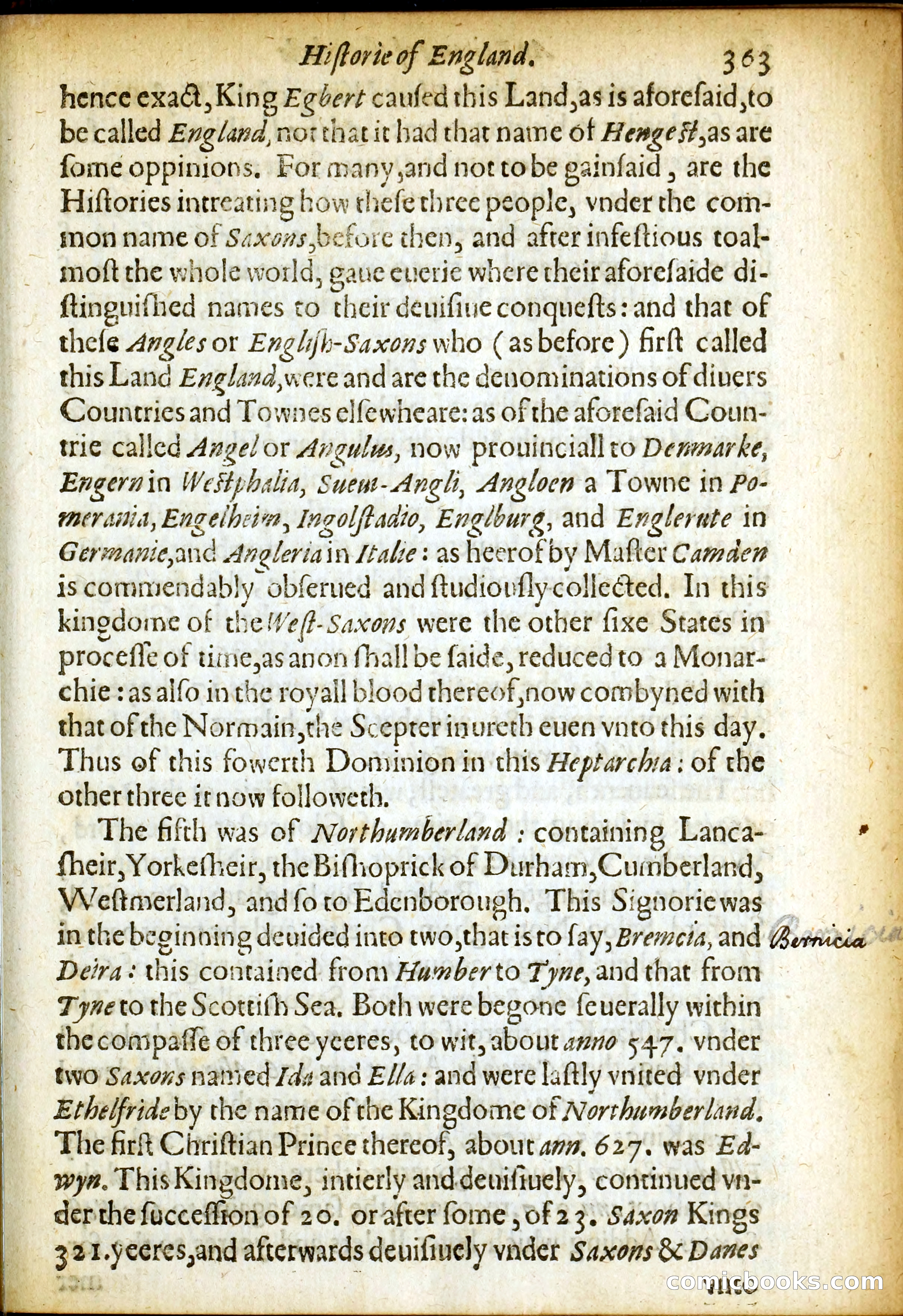
# What This Page Contains This is running prose from a historical text titled "Historie of England" (page 363). The text discusses the Anglo-Saxon origins of England's name and territory, explaining how King Egbert unified various Saxon kingdoms. It describes the geographical origins of place-names like "Angel" and "Anglulus" in continental Europe, and traces the consolidation of the West-Saxon kingdom. The passage then turns to describe Northumberland as the fifth Anglo-Saxon state, detailing its division into Bernicia and Deira around 547 AD under Saxon leaders Ida and Ella, and their later unification under Æthelfrida. It notes the kingdom's Christian conversion under Edwin around 627 AD and its duration of approximately 321 years under Saxon rule.
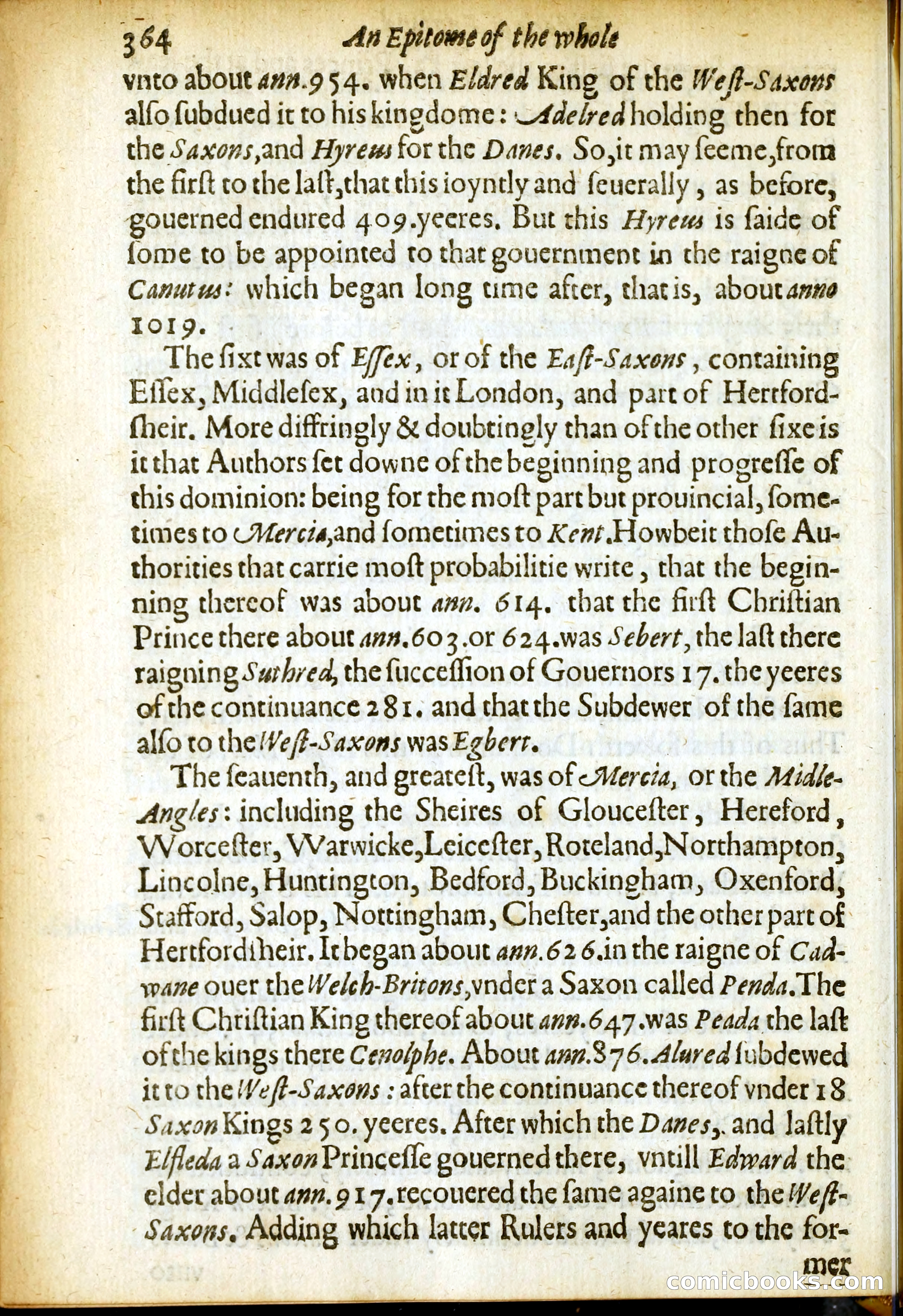
# Page Description This is a page of running prose text—specifically page 364 from what appears to be a historical chronicle or reference work. The text is an "Epitome of the whole" (as the header states) documenting the early Anglo-Saxon kingdoms. It describes the origins, rulers, and durations of various Saxon territories, including Essex (the East-Saxons), Mercia (the Middle-Angles), and their subsequent conquests. The author cites approximate dates from the 600s-900s AD, including references to kings like Eldred, Sebert, Penda, and Edward the Elder. The text is dense, in Early Modern English with old spelling conventions, and appears to be a systematic historical enumeration rather than narrative fiction.
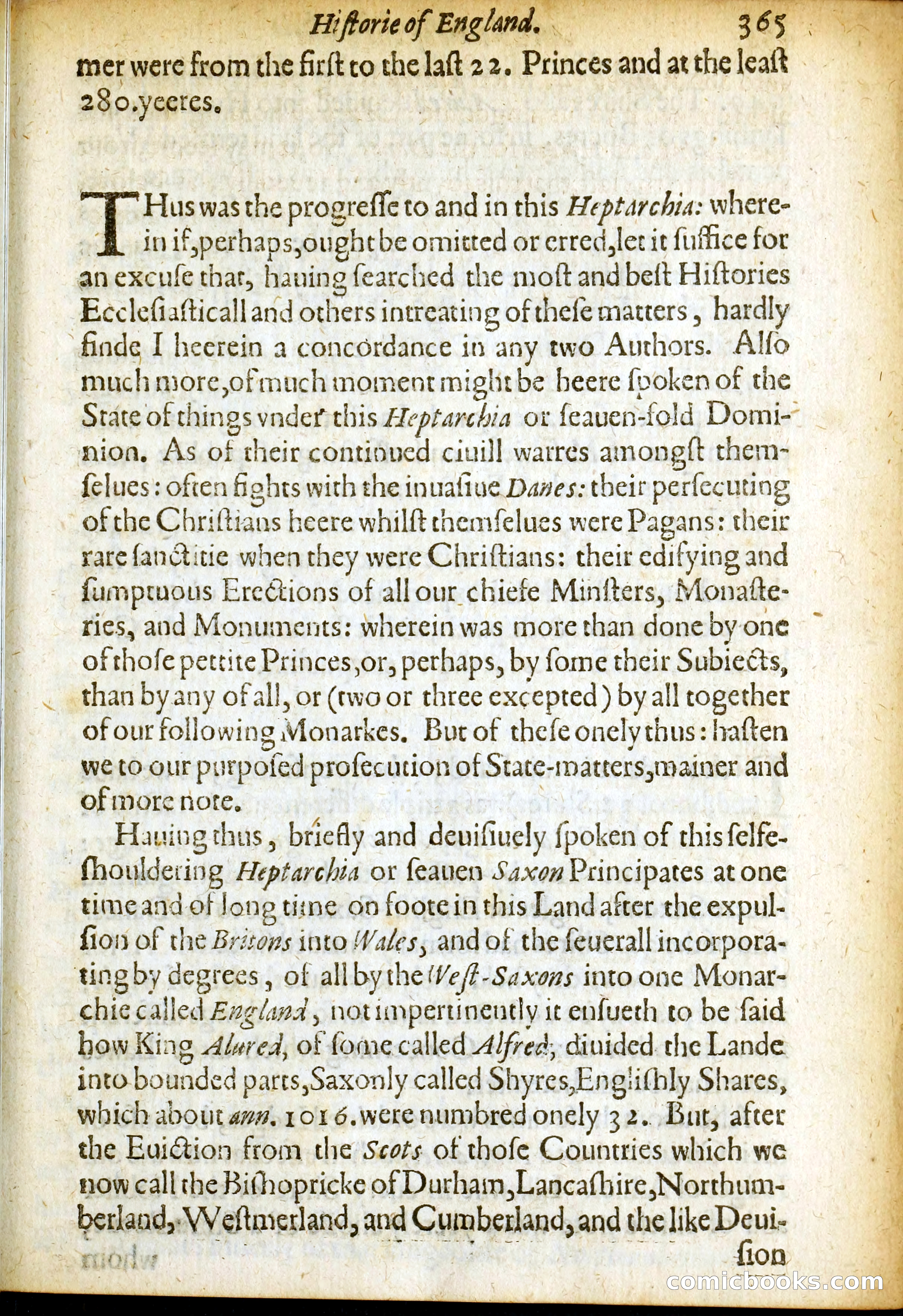
This is a page of running prose from a historical text (page 365 of what appears to be a *Histoire of England*). The visible text discusses the Anglo-Saxon Heptarchy—the seven Anglo-Saxon kingdoms—acknowledging disagreement among historical sources on these matters. It then transitions to describing King Alfred's division of England into shires (numbered at 32 around 1016), and mentions subsequent territorial incorporations following the expulsion of the Scots from regions now known as Durham, Lancashire, Northumberland, Westmorland, and Cumberland. The typography and layout suggest this is from an early modern historical work rather than a Victorian penny dreadful.
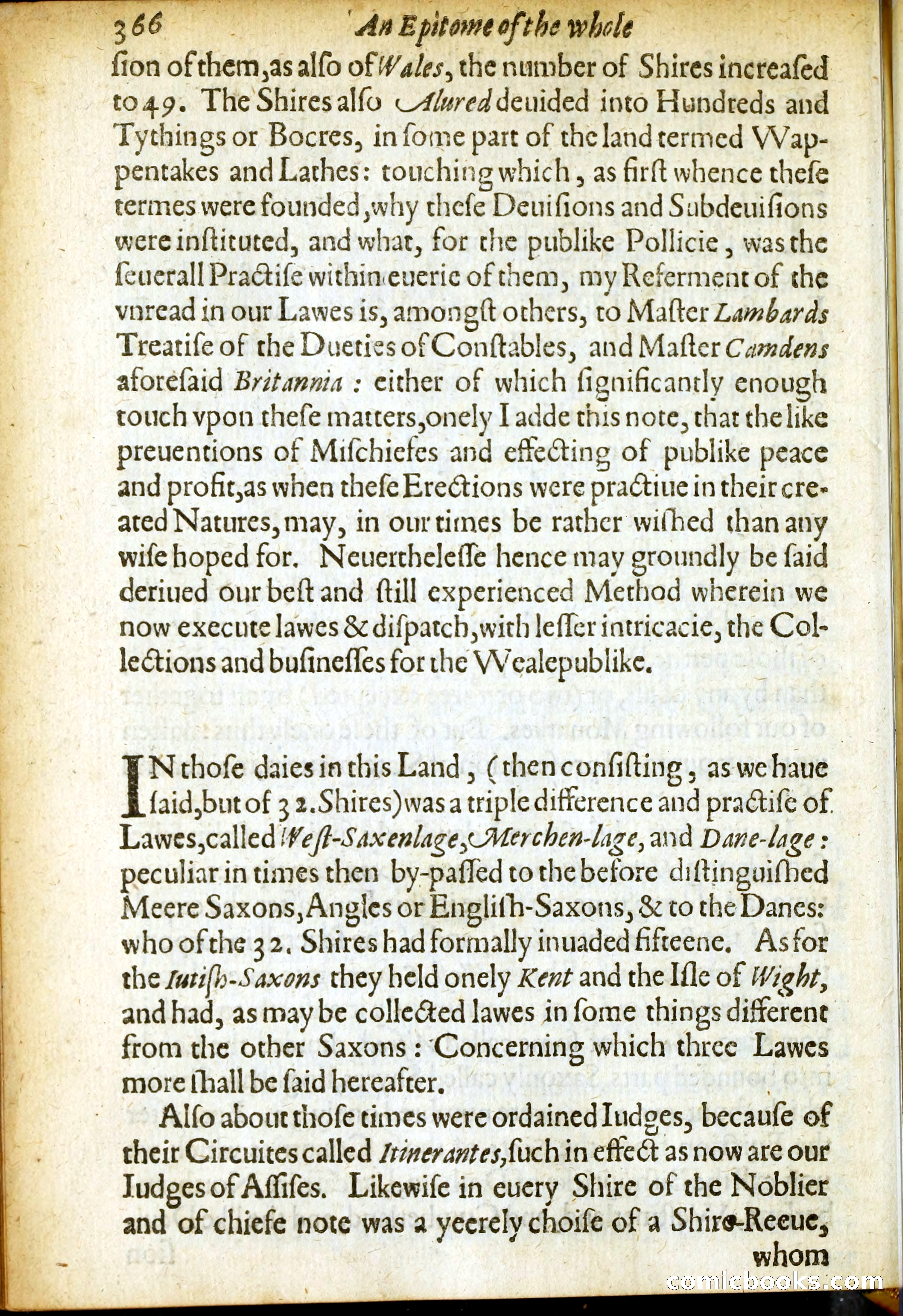
This is a page of running prose from what appears to be a scholarly historical work, not a Victorian penny dreadful. The text discusses the administrative divisions of Anglo-Saxon England—specifically the organization of Shires into Hundreds and Tythings, and the three distinct legal systems (West-Saxon, Mercian, and Danish law) that existed in early medieval Britain. The author references historical authorities like Lambard and Camden, and explains the appointment of itinerant judges and shire officials in ancient times.
# Description of Page This is a page of running prose from a historical text (page 367 of "Historie of England"), not a penny dreadful as initially suggested. The visible text discusses medieval English governance, specifically the role of Sheriffs, and then transitions into a historical account of Danish invasions of Saxon England beginning around 787 AD. The prose describes how the Danes, initially repelled by Saxon princes, returned with greater force around 808 during King Egbert's reign, and eventually grew powerful enough to establish dominion in England by approximately 863 under King Ethelred. The language is archaic Early Modern English with period spelling and typography.
# This Page This is a page of running prose text from what appears to be a historical chronicle or epitome. The page (numbered 368) presents a continuous narrative account of Anglo-Saxon and Danish history, describing the conquest and subjugation of York, the campaigns of King Alfred against the Danes, and the subsequent reigns of English kings including Edward the Elder, Æthelred, and others. The text traces the struggle between English and Danish forces from approximately 834 to the reign of Æthelred, detailing military victories, conversions to Christianity, and the establishment of tributary arrangements. No illustrations or advertising are present.
This is a page of running prose from what appears to be a historical text titled "Historie of England" (page 369). The visible text discusses Danish invasions of England, describing how the King paid tribute money (eventually called "Dane-gelt") to buy peace with Danish enemies who continued raiding the land. The passage explains how this tax was initially levied to fund forces against Danish invasions, then later became a general tax collected into royal treasuries under successive English kings including Edward the Confessor, William the Conqueror, and Henry I. The text concludes by describing King Ethelred's secret order to massacre all Danes in England on Saint Brice's day—a stratagem the English apparently supported enthusiastically.
This is a page of running prose from what appears to be a historical narrative or chronicle. The text presents an epitome (summary) of English history during the reign of King Æthelred, focusing on Danish invasions under Sweyn Forkbeard, the subsequent succession disputes involving Cnut and Edmund Ironside, and the treacherous role of the English admiral Eadric Streona. The passage traces dynastic complications and the fates of various princes, written in archaic early modern English with characteristic old-fashioned spelling and typography.
# Page 371: Running Prose from a History of England This is a page of running prose text from what appears to be a historical chronicle rather than a penny dreadful. The visible text discusses English royal succession following Danish rule, specifically describing King Canute's reign over England, Denmark, and Scotland, and his sons Harold and Canute II. The passage concludes the account of Danish kings who ruled England for approximately 255 years, then describes the restoration of the English crown to Edward (the youngest son of Æthelred) from the West-Saxon line. The text uses early modern English spelling and typography, characteristic of an older historical work.
This is a page of running prose text (page 372) from what appears to be a historical narrative or chronicle. The text discusses King Edward the Confessor's reign and his efforts to reform the English church and legal system. It describes how Edward, despite his piety, was undermined by corrupt subjects, and explains his consolidation of three Anglo-Saxon legal codes (Marchenlage, Westfexenlage, and Danelage) into a unified common law—a foundation for modern English law. The passage also touches on Edward's marriage and succession issues, mentioning the Earl of Godwyne. The dense, archaic prose with italicized Latin phrases is typical of early modern historical writing rather than penny dreadful fiction.
# Page Description This is a page of running prose (page 373) from what appears to be a historical chronicle rather than a Victorian penny dreadful. The text discusses English succession politics, specifically the claims of Edgar Aetheling and Edward the Confessor, and describes how the Earl Godwine maneuvered to place his son Harold on the throne after King Edward's death. The narrative traces genealogical claims and political intrigue around the Danish and Saxon lines of succession in medieval England. The page is densely printed in early modern typeface with antiquated spelling conventions.
# Page Content Description This is running prose text from page 376 of what appears to be a historical narrative. The page discusses Anglo-Saxon succession disputes, focusing on the murder of Alfred and the rise of Edward, followed by accounts of Godwin and Harold. The text traces political rivalries and claims to the English throne, mentioning figures like Edgar Aetheling and William, Duke of Normandy. The dense, ornate typography and spelling conventions are consistent with early modern printed history rather than Victorian penny dreadful fiction—this appears to be an excerpt from an older historical chronicle or commentary, not contemporary sensation fiction.
# Analysis of Page 377 This is a page of running prose from what appears to be a historical chronicle titled "Historie of England" (visible at top). The text discusses the succession dispute following King Edward's death, focusing on three claimants: one by adoption of King Edward, a second (Harold), and a third unnamed candidate. It describes Harold's English birth and noble support, his seizure of the crown without completing coronation ceremonies, and his subsequent military victory against an invading Norwegian king (Harefager) and Harold's own brother Tosfo in a confederate attack. The passage concerns itself with legitimacy, succession, and early military triumphs, written in early modern English with period typography and spelling conventions.
This is a page of running prose from what appears to be a historical narrative or genealogical account (numbered 376, titled "An Epitome of the whole"). The text traces the Norman lineage of William the Conqueror, beginning with Rollo the Scythian and detailing successive Dukes of Normandy through William's descent. It explains William's claimed right to the English throne through his connection to Edward the Confessor and Harold, and lists his grievances—including the murder of kinsmen and Harold's alleged breach of a marriage contract—which justified his invasion of England. The language and typography are consistent with early modern historical writing rather than typical penny dreadful sensationalism.
# Page Description This is a page of running prose from what appears to be a historical narrative (page 377 of a *Historie of England*). The text describes political and ecclesiastical intrigues surrounding King Harold's reign, including Robert of Normandy's exile, papal involvement via Pope Alexander II, and the conflict between Harold and Duke William. The passage culminates in an account of a "vigorious and blooddy Battle" where William prevails, Harold is killed along with thousands of his soldiers, and William wins the kingdom. The text is printed in black-letter type on aged paper, typical of early modern historical chronicles rather than Victorian penny dreadfuls.
# Page Analysis This is a page of running prose from what appears to be a historical chronicle or epitome (page 380). The text discusses William, Duke of Normandy, being crowned King of England in 1067 following the Norman Conquest, and explains the various political obstacles and factions that hindered resistance to his rule. It concludes by cataloguing this as the "fifth absolute alteration" of England's rule—listing five successive foreign conquests: Romans, Armoricans/French Britons, Saxons, Danes, and finally Normans. The typography and language suggest an early modern or late Renaissance work rather than Victorian penny dreadful fiction.