
Penny Dreadfuls, 1602 · page 359 of 400
Penny Dreadful Cover — page 359: what you’re looking at
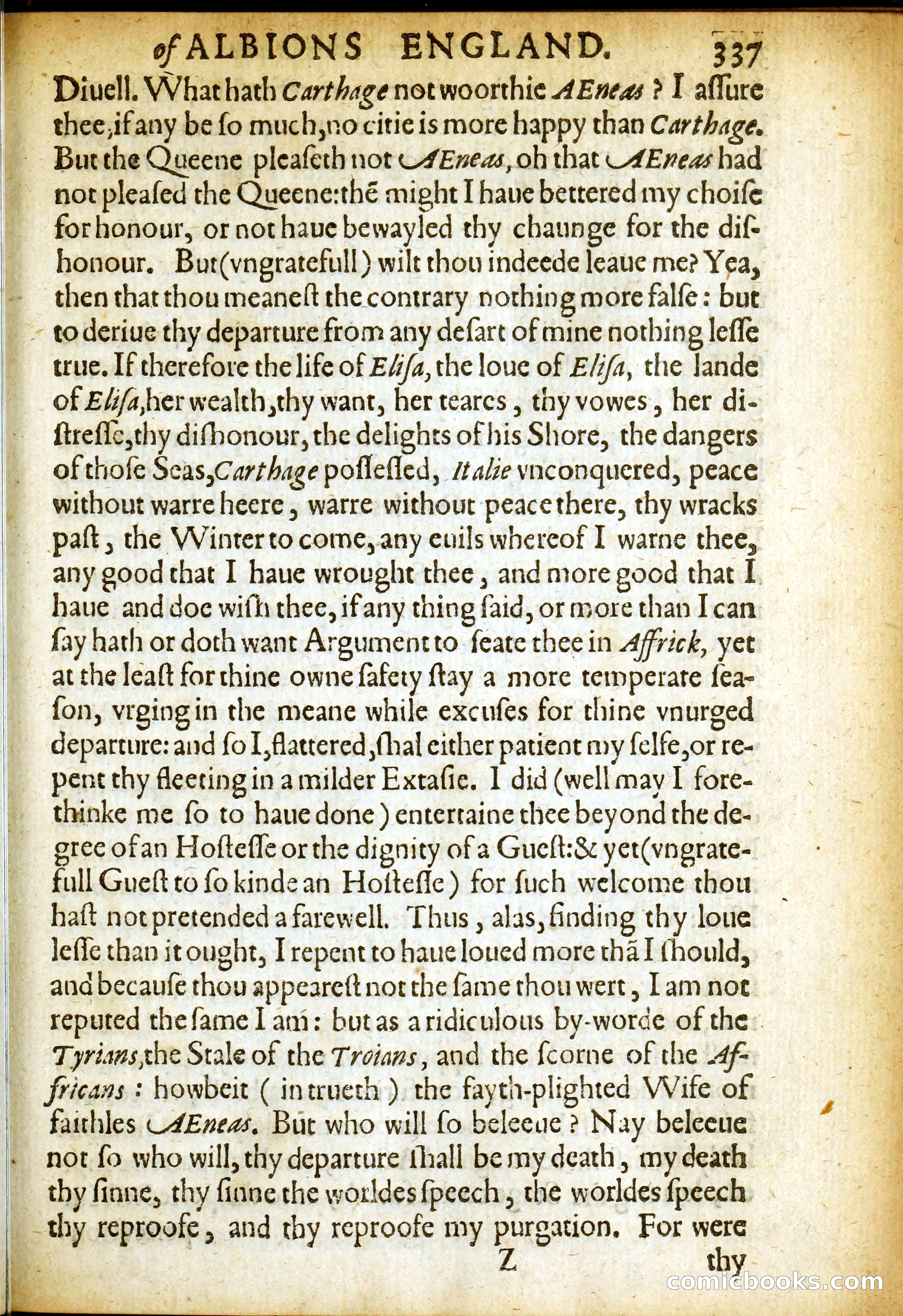
What you’re looking at
# Page Description This is a page of running prose (page 337) from what appears to be an early modern dramatic or narrative work, not a Victorian penny dreadful as suggested. The text is a monologue by a character (Dido, addressing Aeneas) lamenting his departure from Carthage and his rejection of her love. She catalogs all she has sacrificed and offered him—her city, her wealth, her affection—and warns that his abandonment will be her death and bring shame upon them both. The language and typography are characteristic of sixteenth or seventeenth-century English printing, with archaic spelling and long paragraphs of ornate, emotional rhetoric rather than Victorian melodrama.
📄 Transcribed text from this page (OCR, searchable)
Machine-transcribed from the original scan — historical spelling and the odd misread are preserved.
, +4 ey ~.4 wil s on 2h. . ~ ee fa? av, = — ry Pe et : ep fee —_— Ls , of . | | a flees pe <3 Sx. i 3 Bw ing a | eg oe te SF a . tie ee . | “7 E “kh. - @ - ; J i j q — -Diuell. What hath Cartnage not wo | _ thee,ifany be fo much,no citie is more happy than Carthage. Butthe Queene pleafeth not C/Eneas, oh that 4Ereas had not pleafed the Queene:thé might I have bettered my choife for honour, or nothave bewayled thy chaunge for the dif- honour, But(vngratefull) wilt hou indeede leauc me? Yea, then that thou meanelt the contrary nothing more falfe: but ~ toderiue thy departure from any defart of mine nothing lefle true. If therefore the life of E4/a, the loue of E//a, the lande of E&é/a,her wealth thy want, her teares , thy vowes, her di- {trefle,thy difhonour, the delights of his Shore, the dangers of thofe Seas,Carthage poflefled, /talée vnconquered, peace without warre heere , warre without peace there, thy wracks - paft, the Winterto come, any euils whereof I warne thee, _ any good that I haue wrovght thee , and more good that I. haue and doe with thee, ifany thing faid, or more than I can fay hath or doth want Argumentto feate thee in Affrick, yet _atthe leaft forthine owne fafety {tay a more temperate fea- fon, vrgingin the meane while excufes for thine vaurged departure: and fo I, flattered (hal either patient my felfe,or re- pent thy fleeting in amilder Extafie. 1 did (well may I fore- _ thinke me fo to haue done) entertaine thee beyond the de- _ grec ofan Hoftefle or the dignity of a Guelt:& yet(vngrate- full Gueft to fokinde an Hottefle) for fuch welcome thou _ haft notpretended a farewell. Thus , alas, finding thy loue _ leffe than itought, I repent to haueloued more thal {hould, | andbecaufe thou appeareft nor the fame thou wert, Lam not _ reputed thefame lam: butas aridiculous by-worde of the: - Tyriansxhe Stale of the Treians, and the {corne of the .4f- _ fricans : howbeit ( intcueth ). the fayth-plighted Wife of: fatthles -4Exeas. But who will fo beleeue 2 Nay beleeue. - not fo who will, thy departure thall be my death, my death _ thy finne, thy finne the worldes{peech, the worldes {peech. 7 : ; . 4 a So) ~~ = ie » = ad as ~ ‘ > ‘ _-thy reproofe, and thy reproofe my purgation, For were f m aa . GO upon F » : oe i ( e + Yh adil ey oo pad Pi ‘ i eae ae -, oer a % a py