
A complete issue · 38 pages · 1920
Life — January 29, 1920
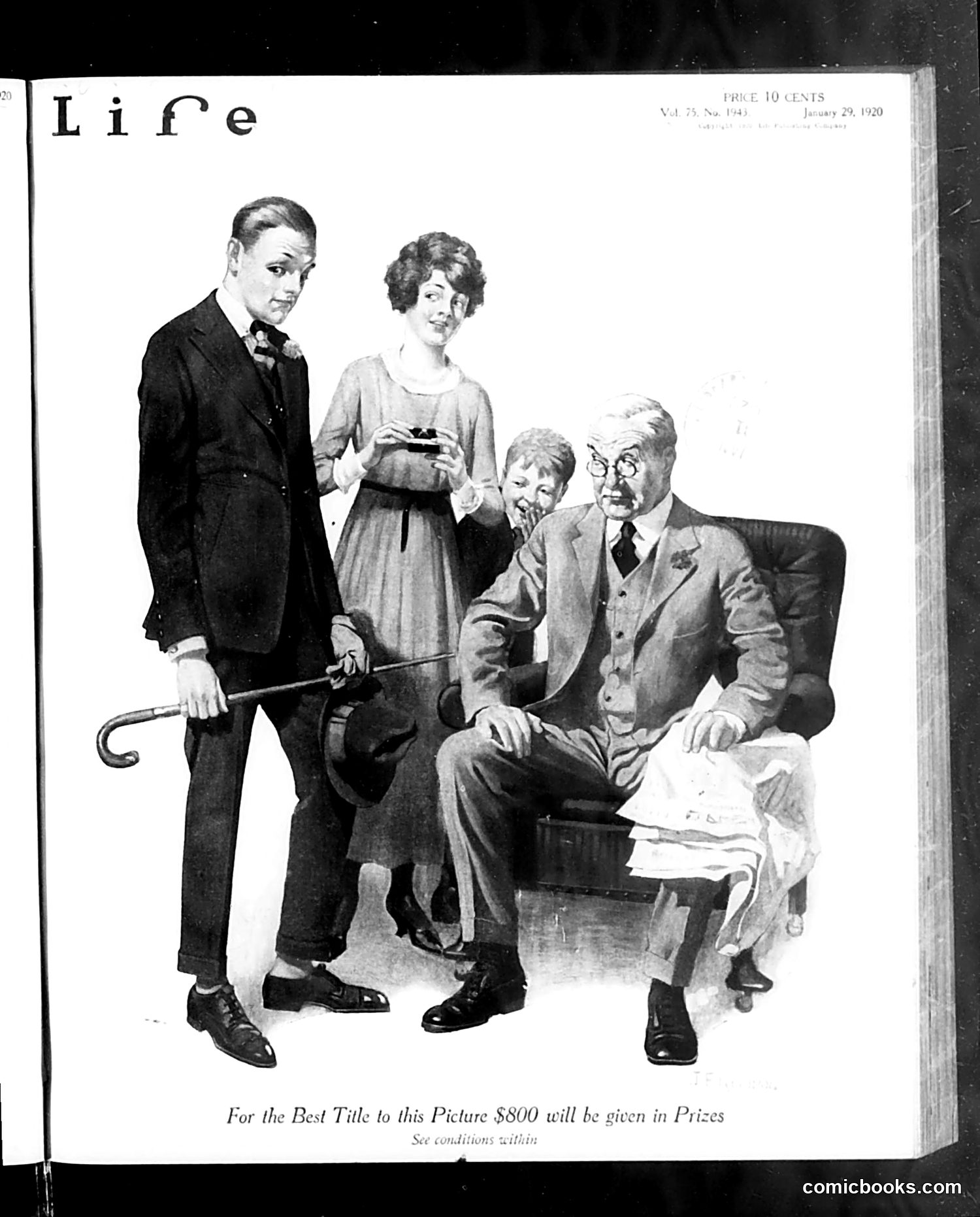
This satirical illustration depicts a domestic scene where a woman serves food to three men while one stands nearby holding an umbrella. The caption invites readers to submit titles for $800 in prizes. The image likely satirizes post-WWI social dynamics, possibly commenting on gender roles, domestic service, or the reintegration of soldiers. The umbrella-holder's prominent position and the formal attire suggest class or authority distinctions. Without the submitted titles that would have accompanied publication, the specific satirical target remains unclear, though the composition suggests commentary on family hierarchies, economic disparity, or societal expectations of the 1920s era. The "caption contest" format was typical of Life's humor approach during this period.

This is **not a political cartoon or satire**—it's a straightforward advertisement for United States Tire Company's new solid truck tire technology, published in *Life* magazine (dated Jan 29, 1920, based on the header). The page promotes a manufacturing innovation: a bonded rubber-to-steel tire that eliminates reliance on traditional dovetail grooves. The ad emphasizes durability and cost-effectiveness, highlighting an "unlimited mileage guarantee"—apparently a novel selling point at the time. The decorative eagle emblem and patriotic language ("good faith," "oldest and largest rubber company") reflect early-20th-century advertising style, lending authority through nationalist imagery. This is period advertising copy, not satirical content.
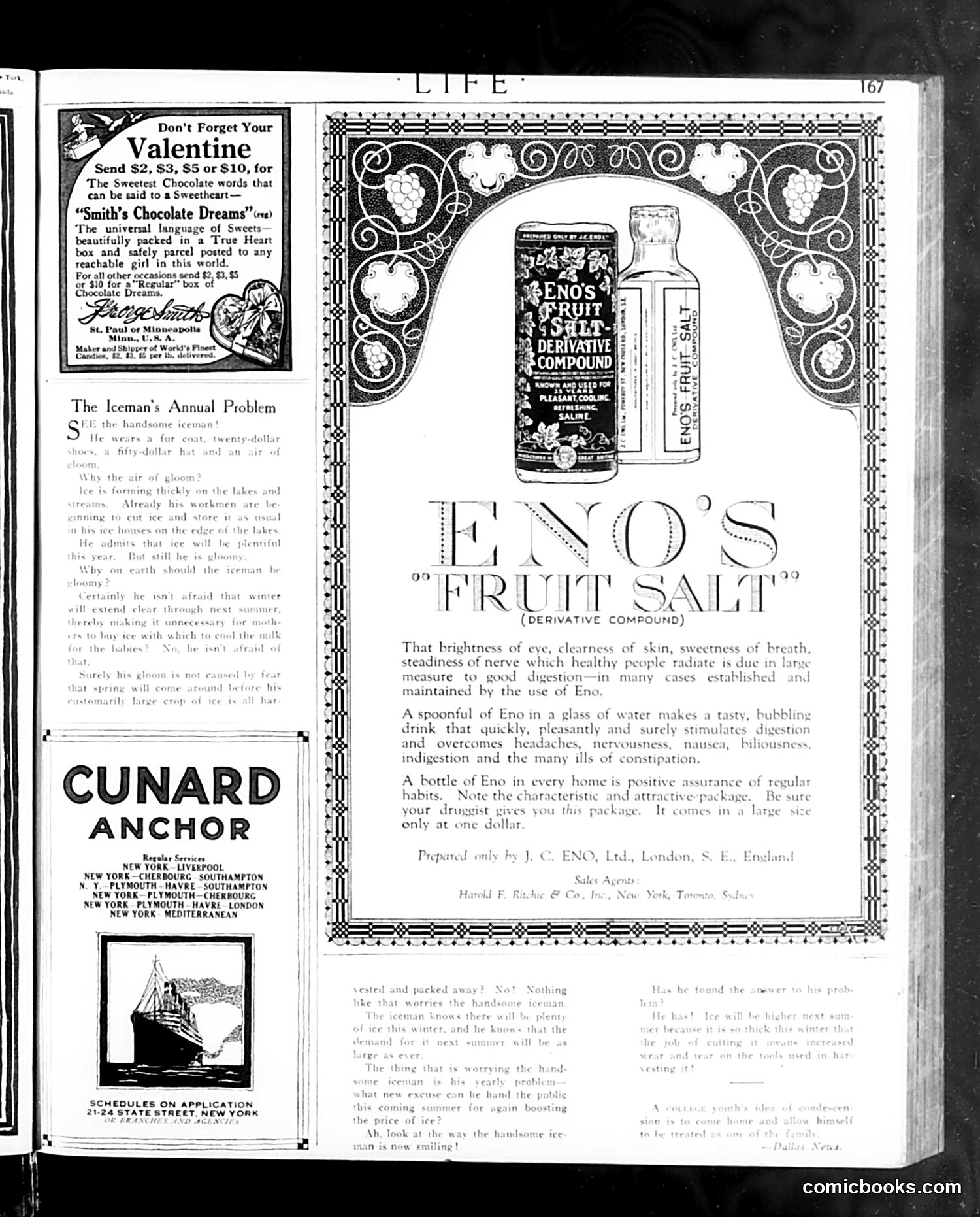
This page is primarily **advertising**, not political satire. The dominant feature is a large advertisement for **Eno's Fruit Salt**, a digestive compound produced in London. The ad emphasizes the product's benefits for digestion, headaches, and constipation relief. In the left column is an article titled "The Iceman's Annual Problem," which humorously discusses the challenges faced by ice delivery workers during winter—their heavy clothing, the physical demands of the job, and concerns about staying warm. It's social commentary on working-class labor conditions rather than political satire. The page also contains smaller ads for Smith's Chocolate and Cunard shipping lines. Overall, this is a typical Life magazine page mixing editorial content with commercial advertisements.
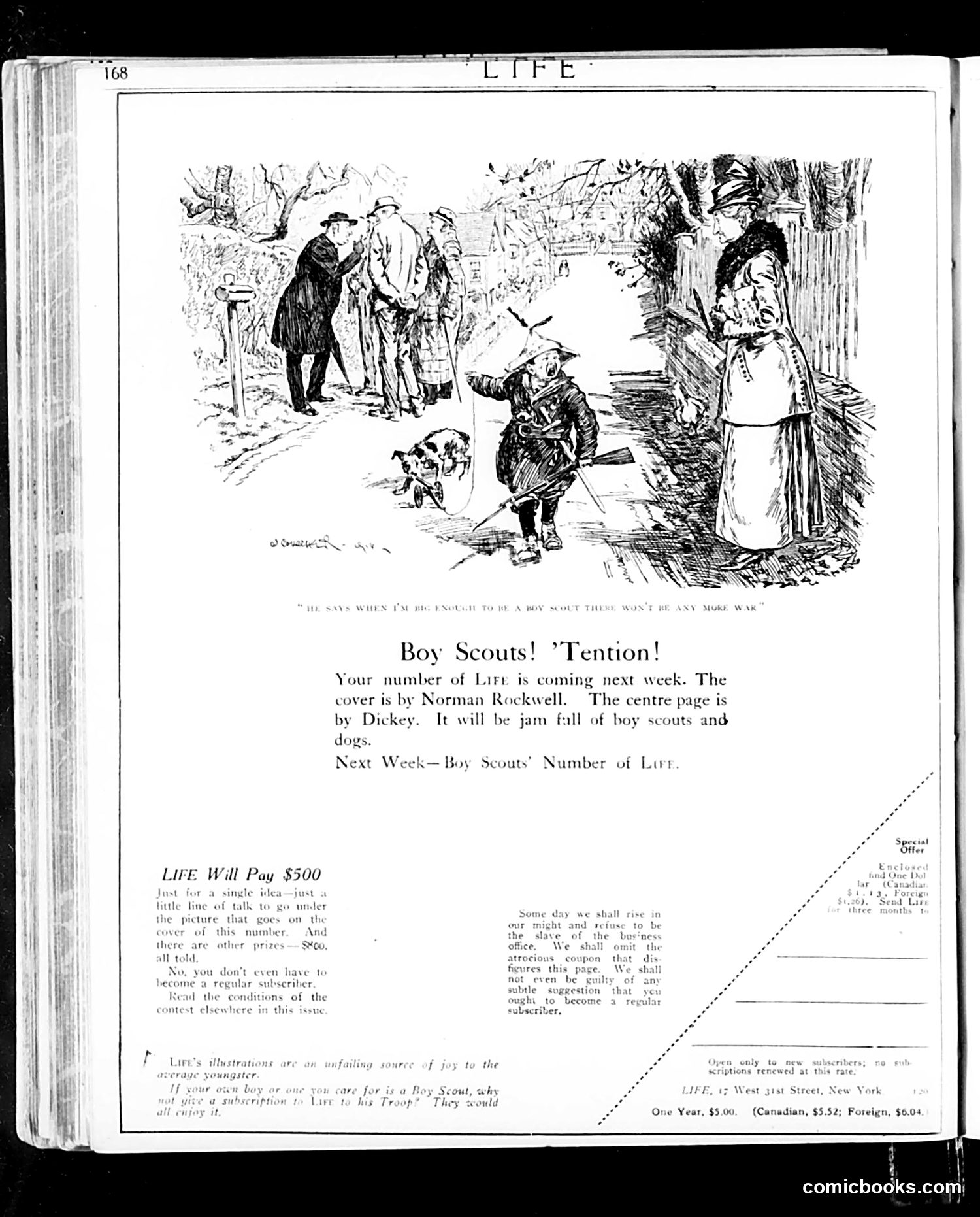
This page primarily features a **Boy Scouts advertisement** rather than political satire. The illustration shows a young Boy Scout encountering adults and a dog, with a caption about being "old enough to be a boy scout" without wars. The accompanying text announces an upcoming Boy Scouts-themed issue of *Life* magazine, with cover art by Norman Rockwell and center pages by Dickey, promising content about "boy scouts and dogs." Below is a contest announcement: *Life* will pay $500 for caption submissions for the cover illustration. The satirical element is minimal here—this is primarily **promotional content** advertising the magazine's next special Boy Scouts issue to readers. The humor appears gentle rather than pointed at any particular political target.
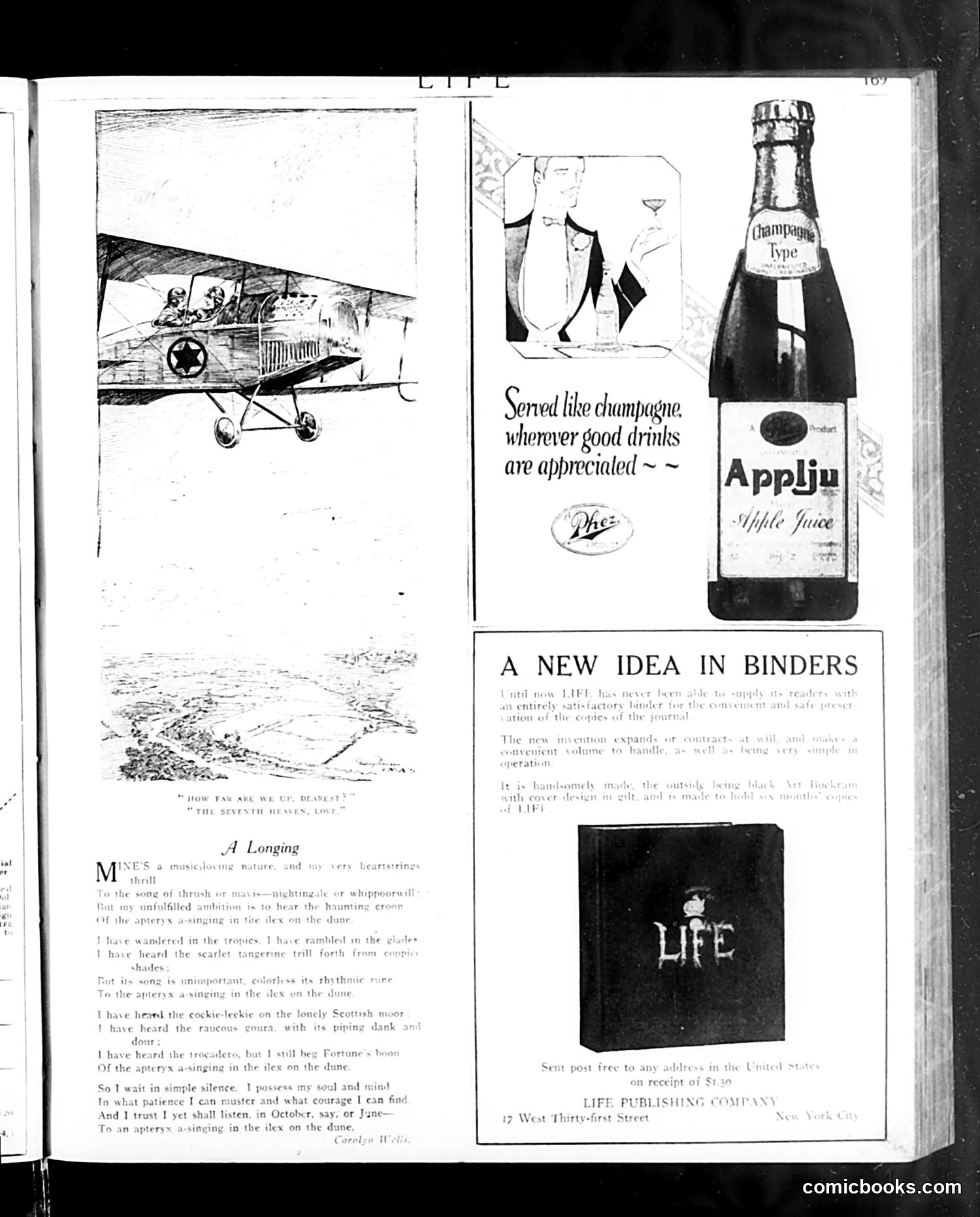
This page contains mostly **advertising** rather than political satire. The left side features a vintage airplane illustration with the poetic caption "How Far Are We Up, Dearie?" and "The Seventh Heaven, Love" — likely romanticizing early aviation. Below is a poem titled "A Longing" about yearning to hear bird calls and natural sounds. The right side advertises **Applin Apple Juice** (served "like champagne") and promotes **Life Publishing Company's new binder** for organizing magazine issues. The content reflects **early 20th-century consumer culture** and leisure interests rather than political commentary. The aviation imagery was contemporary and likely appealed to readers fascinated by the novelty of flight technology.
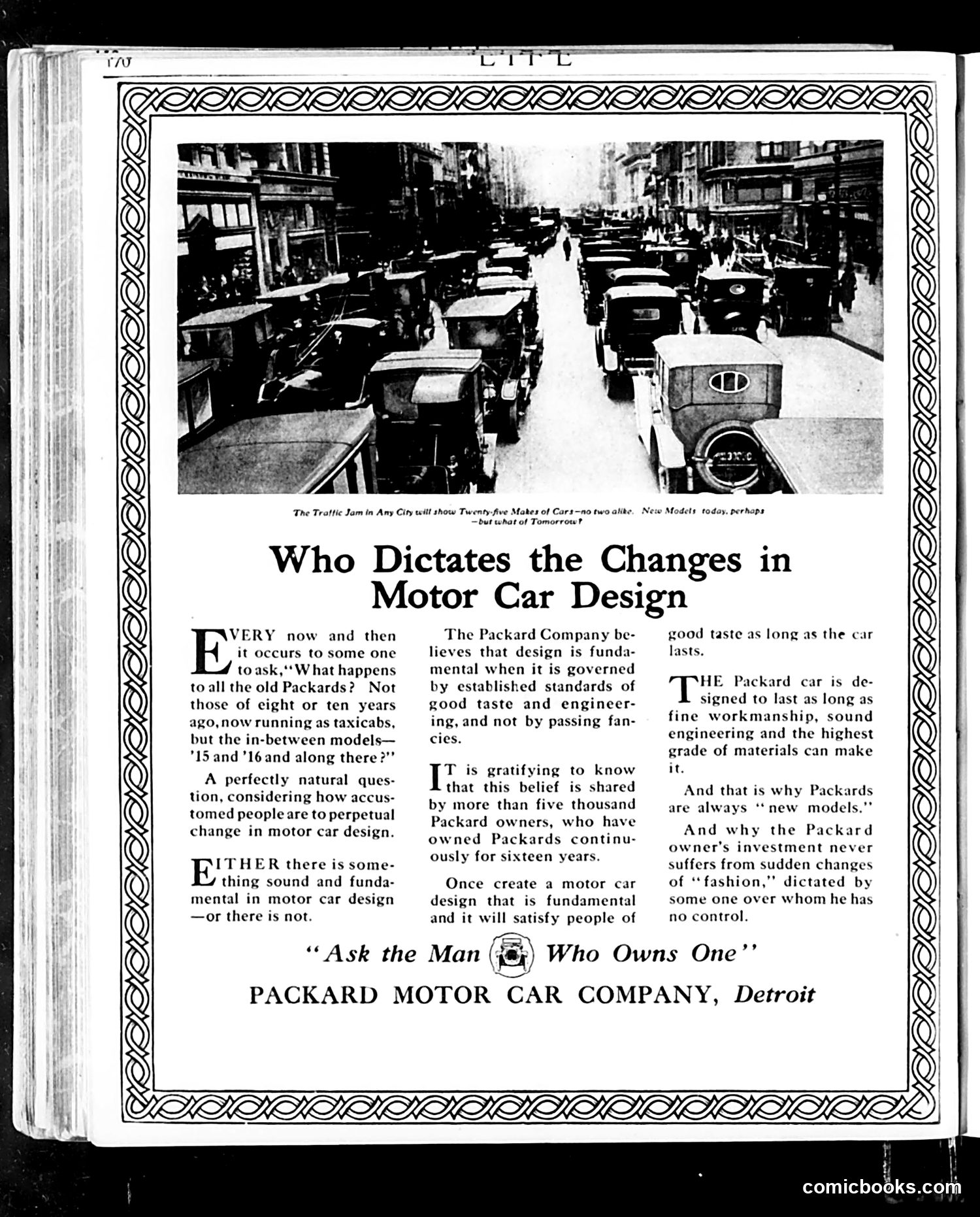
This is primarily **advertising content, not satire or political commentary**. The page features a Packard Motor Car Company advertisement titled "Who Dictates the Changes in Motor Car Design." The image shows a crowded city street filled with automobiles from different eras, illustrating traffic congestion. The ad argues that Packard's design philosophy prioritizes fundamental engineering and good taste over fleeting fashion trends. It claims this stability protects owner investments from "sudden changes of 'fashion'" dictated by competitors. The tagline "Ask the Man Who Owns One" was apparently Packard's advertising slogan. The piece is essentially a luxury car manufacturer defending conservative design choices while implicitly criticizing competitors (likely Ford, General Motors) for frequent model changes that rendered older cars obsolete.
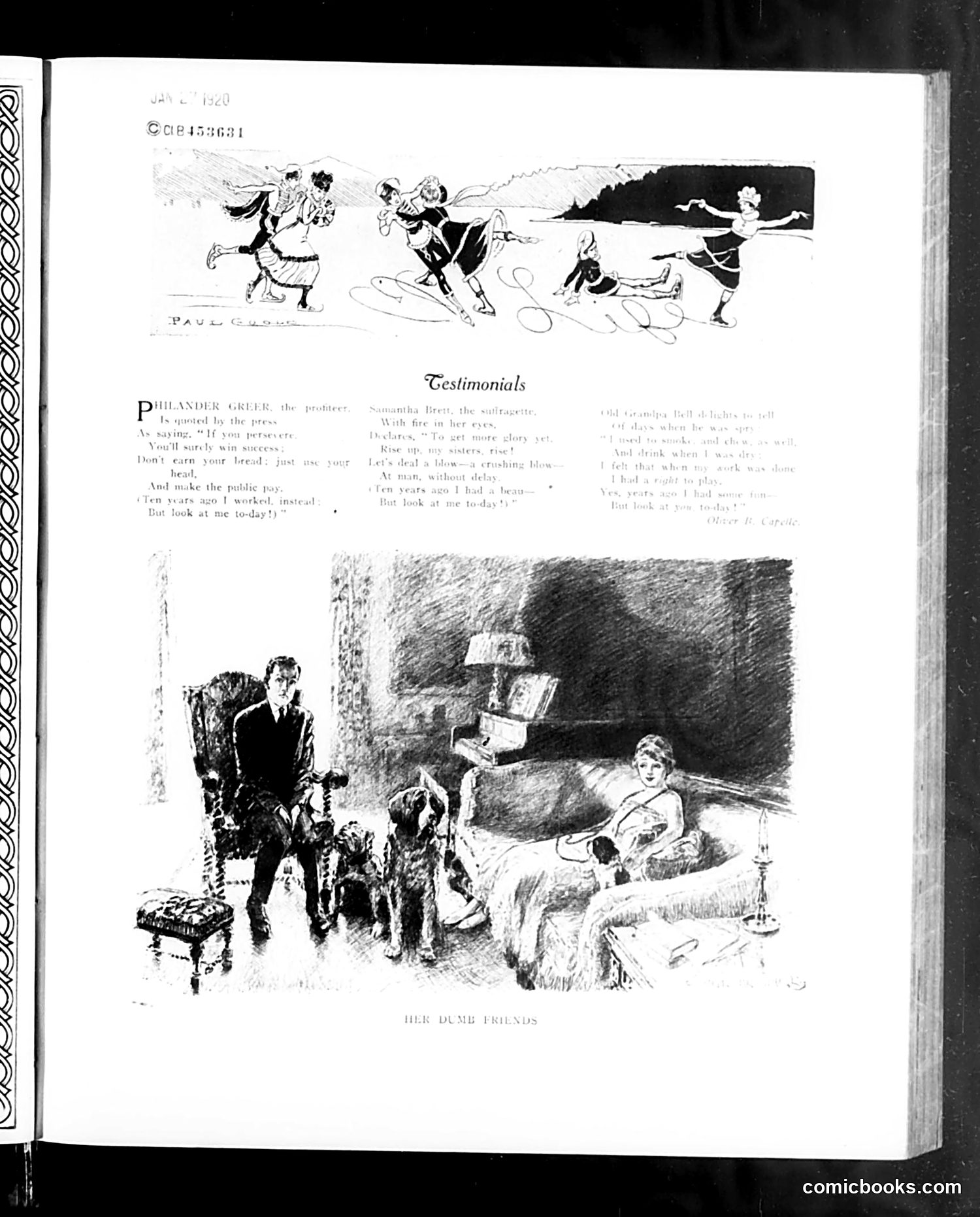
This page contains two satirical sections from Life magazine. The top section, "Testimonials," presents mock endorsements from three characters—Philander Greer (a profiteer), Samantha Brett (a suffragette), and Old Grandpa—each praising some unnamed product or person with obviously insincere or contradictory statements. This appears to be satirizing false advertising testimonials common in the era. The lower illustration, "Her Dumb Friends," depicts a woman in bed visited by several dogs, with a man sitting nearby. The caption and scene suggest satire about social companionship, likely poking fun at unmarried women's relationships or pet ownership as a social substitute—a common early-20th-century comedic theme in satirical publications.
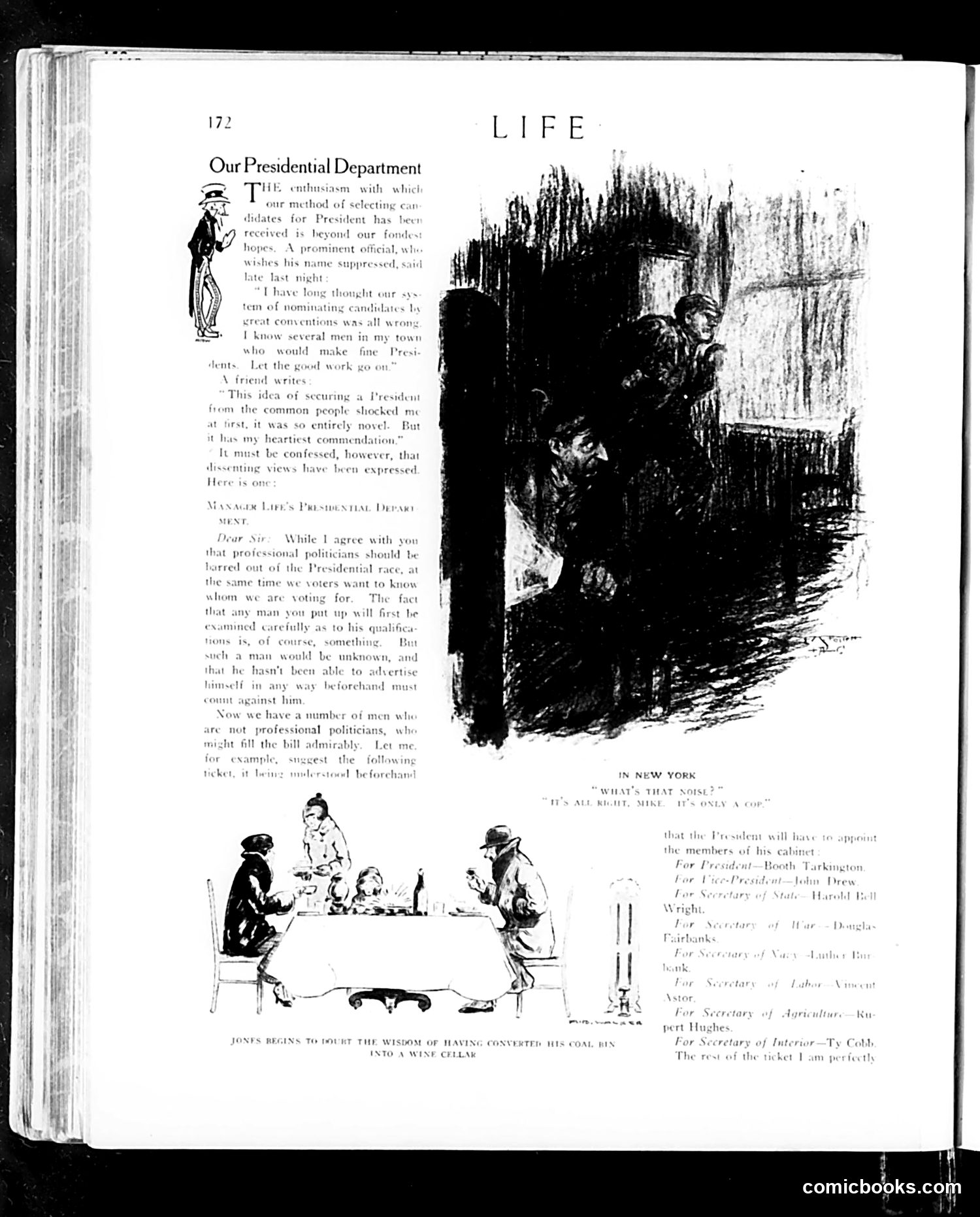
This page satirizes the process of selecting a U.S. President through nominations. A letter to Life's editor proposes that instead of professional politicians, the President should appoint his cabinet from ordinary citizens—businessmen and professionals unknown to the public who haven't had opportunity to self-promote. The lower cartoon illustrates this idea: titled "Jones Begins to Doubt the Wisdom of Having Converted His Coal Bin Into a Wine Cellar," it shows a man at a dinner table with three guests, suggesting that private domestic choices become scrutinized when one enters public life. The satire critiques both the nomination process and the loss of privacy accompanying political office.
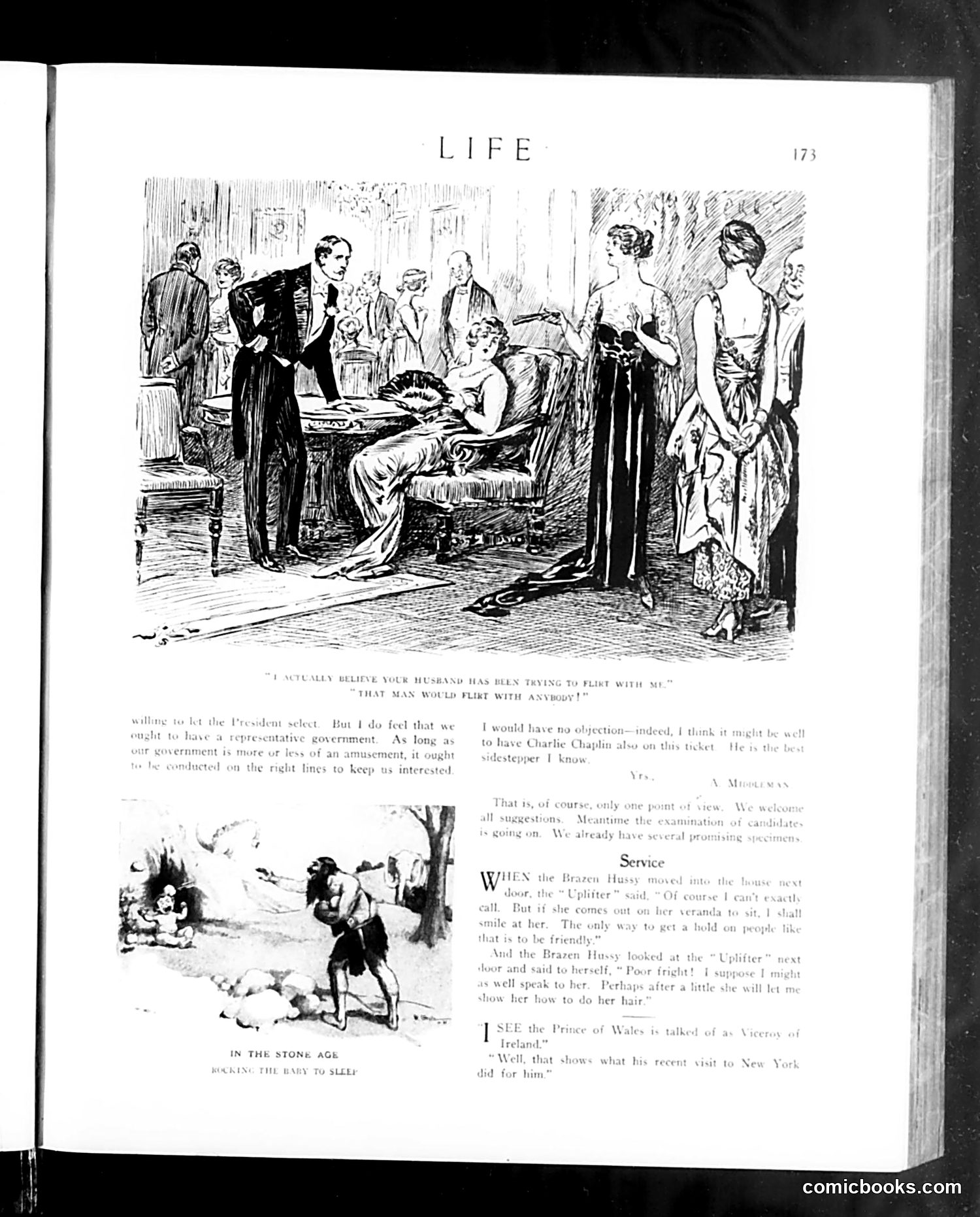
The upper cartoon depicts a formal social gathering where a woman seated at a table declares: "I NATURALLY BELIEVE YOUR HUSBAND HAS BEEN TRYING TO FLIRT WITH ME" / "THAT MAN WOULD FLIRT WITH ANYBODY!" This satirizes upper-class social dynamics and women's competitive behavior—the joke centers on the woman's boast about being flirted with, which her interlocutor dismissively deflates by suggesting the husband flirts indiscriminately. The lower illustration, captioned "IN THE STONE AGE / ROCKING THE BABY TO SLEEP," shows primitive figures and appears to be a humorous historical commentary, though its specific satirical point remains unclear from the image alone. The text discusses government representation and mentions Charlie Chaplin and the Prince of Wales, suggesting broader social and political commentary typical of Life magazine's satirical approach.
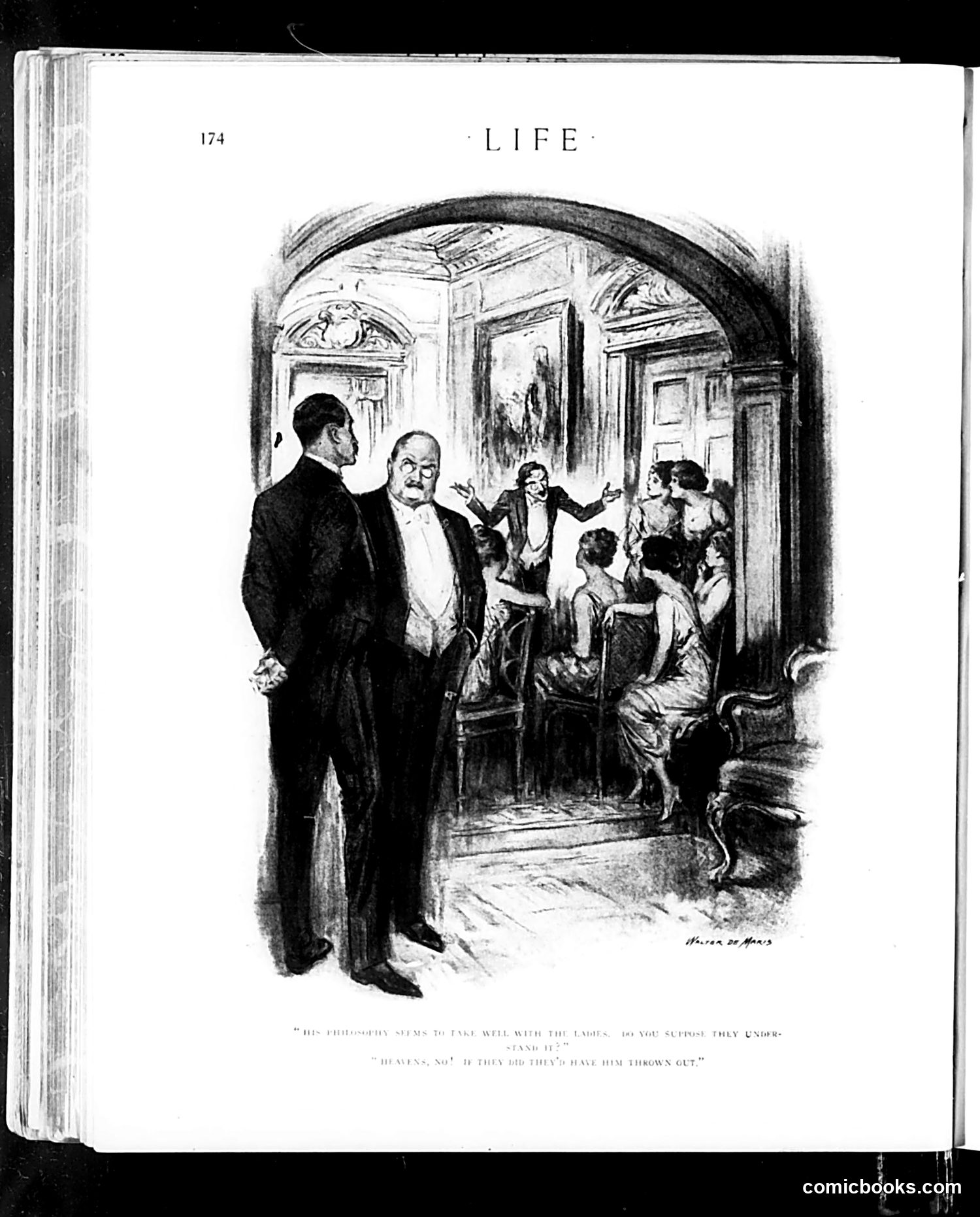
This is a satirical cartoon from *Life* magazine (page 174) depicting a social scene in an elegant interior. Two well-dressed men in formal evening wear appear to be hosting or managing a gathering of women seated in the room. The caption reads: "HIS PHILOSOPHY SEEMS TO TAKE WELL WITH THE LADIES. 'DO YOU SUPPOSE THEY UNDERSTAND—STAND IT?' / 'HEAVENS, NO! IF THEY DID THEY'D HAVE HIM THROWN OUT.'" The satire targets a common social type of the era: a man whose intellectual pretensions or philosophical discourse charms women primarily through style and delivery rather than substance. The joke suggests the women are captivated by his manner while remaining blissfully ignorant of his actual ideas—implying that if they actually *understood* his philosophy, they'd reject him entirely. This mocks both superficial male intellectualism and stereotypes about women's reasoning abilities.
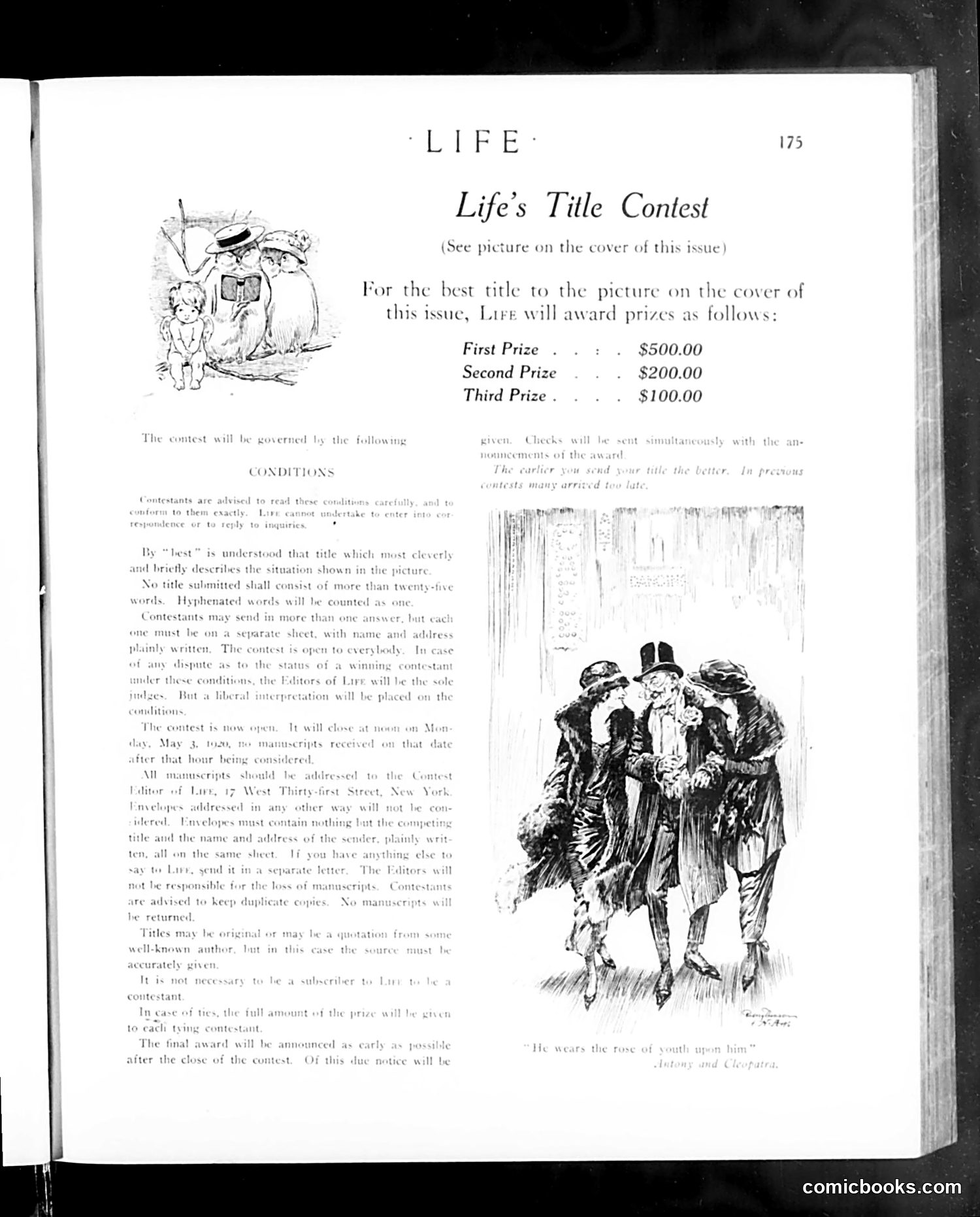
This page announces a **title-writing contest** for a cover illustration rather than explaining an existing cartoon. The contest invites readers to suggest captions for the cover picture showing three men in formal attire (top hats and coats) walking together. The illustration caption reads: "He wears the rose of youth upon him" — *Antony and Cleopatra* (a Shakespeare quote). The contest offers substantial prizes ($500, $200, and $100) and specifies rules: titles must be 25 words maximum, original or accurately sourced, submitted by May 4, 1920. The humor likely derives from the image itself rather than the announcement—possibly satirizing aging men's pretensions to youth or vanity, though the specific satirical point requires seeing the actual cover illustration.
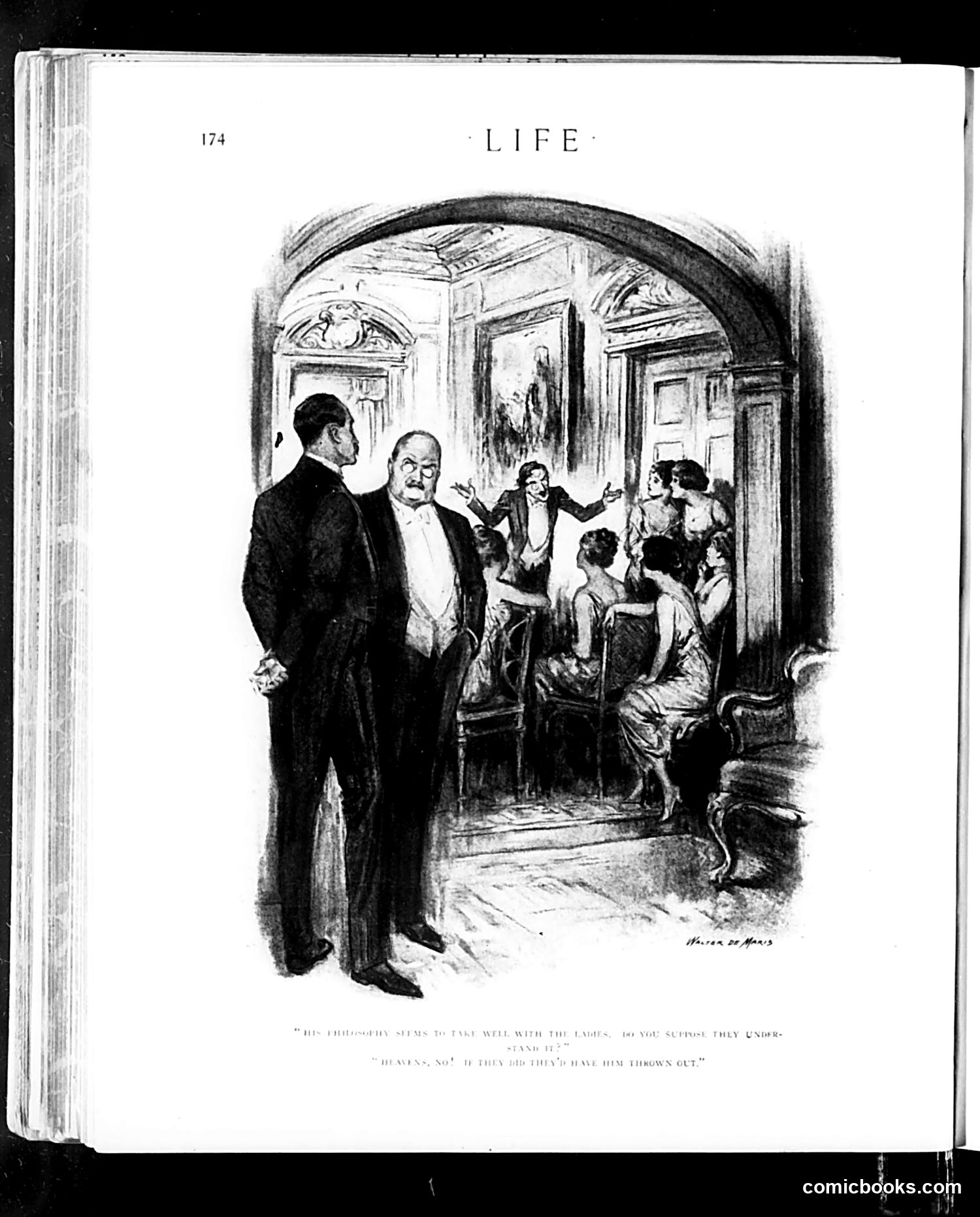
This is a satirical cartoon from Life magazine (page 174) depicting what appears to be a social scene in an elegant interior. Two well-dressed men in formal attire observe a group of women and children in the background. The caption reads: "His philosophy seems to take well with the ladies, do you suppose they understand what he's saying?" followed by "Heaven, no! if they did they'd have him thrown out." The satire targets a pretentious man whose philosophical discourse impresses women through style rather than substance—they appreciate his manner without comprehending his actual words. The joke mocks both the man's empty intellectualism and the women's shallow appreciation, reflecting early 20th-century social attitudes about gender and intellectual capacity. The cartoon critiques pretension and superficial social performance in high society.
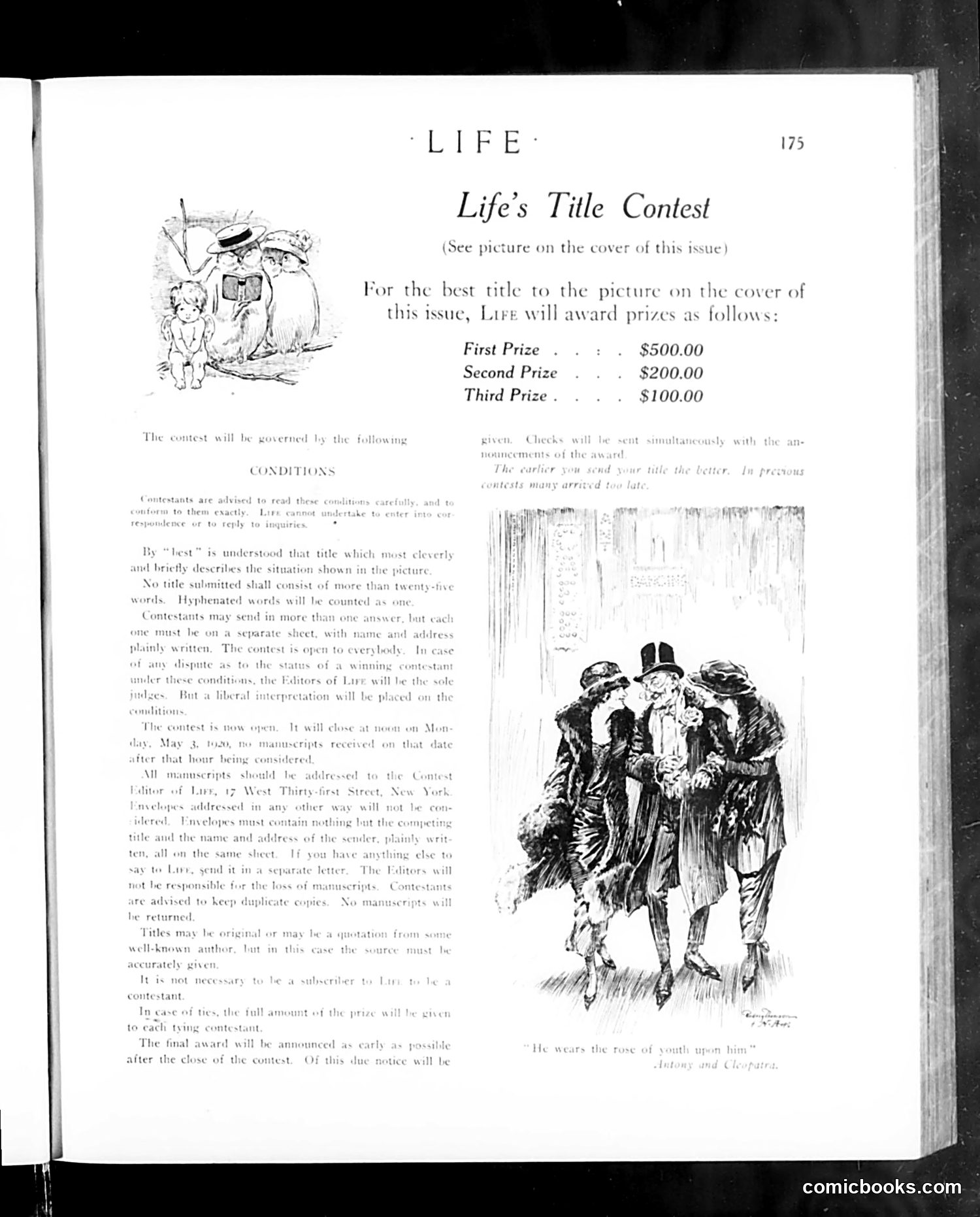
This page announces a title-writing contest for a cover picture (not shown here). The accompanying illustration depicts three men in winter coats and hats walking together, with the caption "He wears the rose of youth upon him" — attributed to *Antony and Cleopatra*. The contest invites readers to suggest witty titles for the cover image, with prizes up to $500. The satirical point appears to be the *Shakespeare quotation itself*: applying a romantic phrase about youthful beauty to what seems an ordinary street scene of working-class or ordinary men creates humorous incongruity. The joke likely mocks either pretentious literary allusions or the gap between Shakespeare's elevated language and mundane modern life.
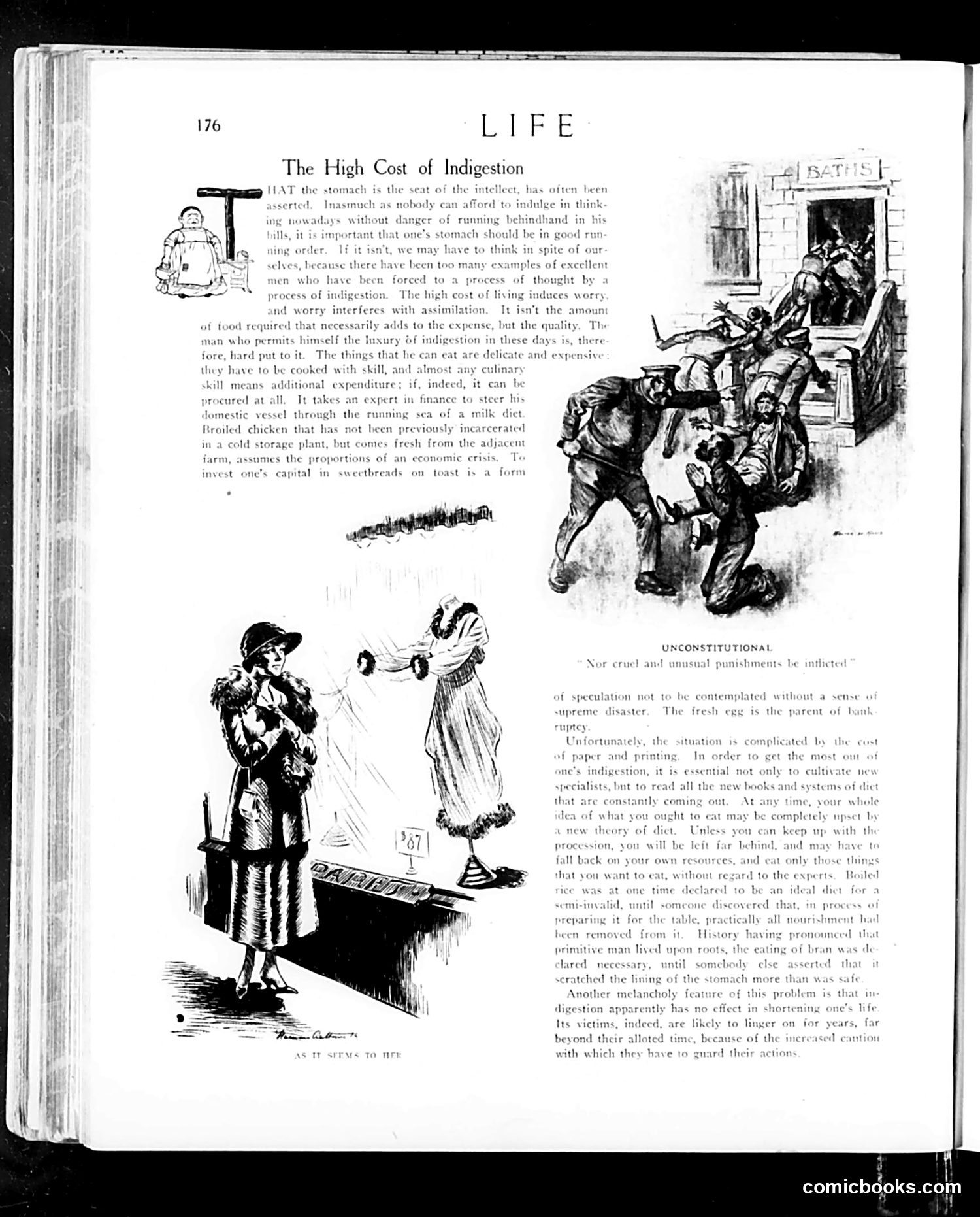
This satirical piece critiques the obsession with dietary theory and expensive, fussy eating habits among the wealthy. The main illustration (upper right) depicts a man suffering physically from indigestion—doubled over in apparent agony. The caption "Unconstitutional" suggests his distress is almost criminal. The text mocks how the affluent must constantly consult diet experts and new books about nutrition, making eating needlessly complicated and expensive. The lower illustration shows a woman weighing food on a scale, satirizing the precision and obsession with dietary measurement. The satire suggests that while the wealthy believe their elaborate, costly food preparation prevents illness, it paradoxically *causes* indigestion. The humor lies in the irony: spending fortunes on "proper" eating creates the very digestive problems it aims to prevent.
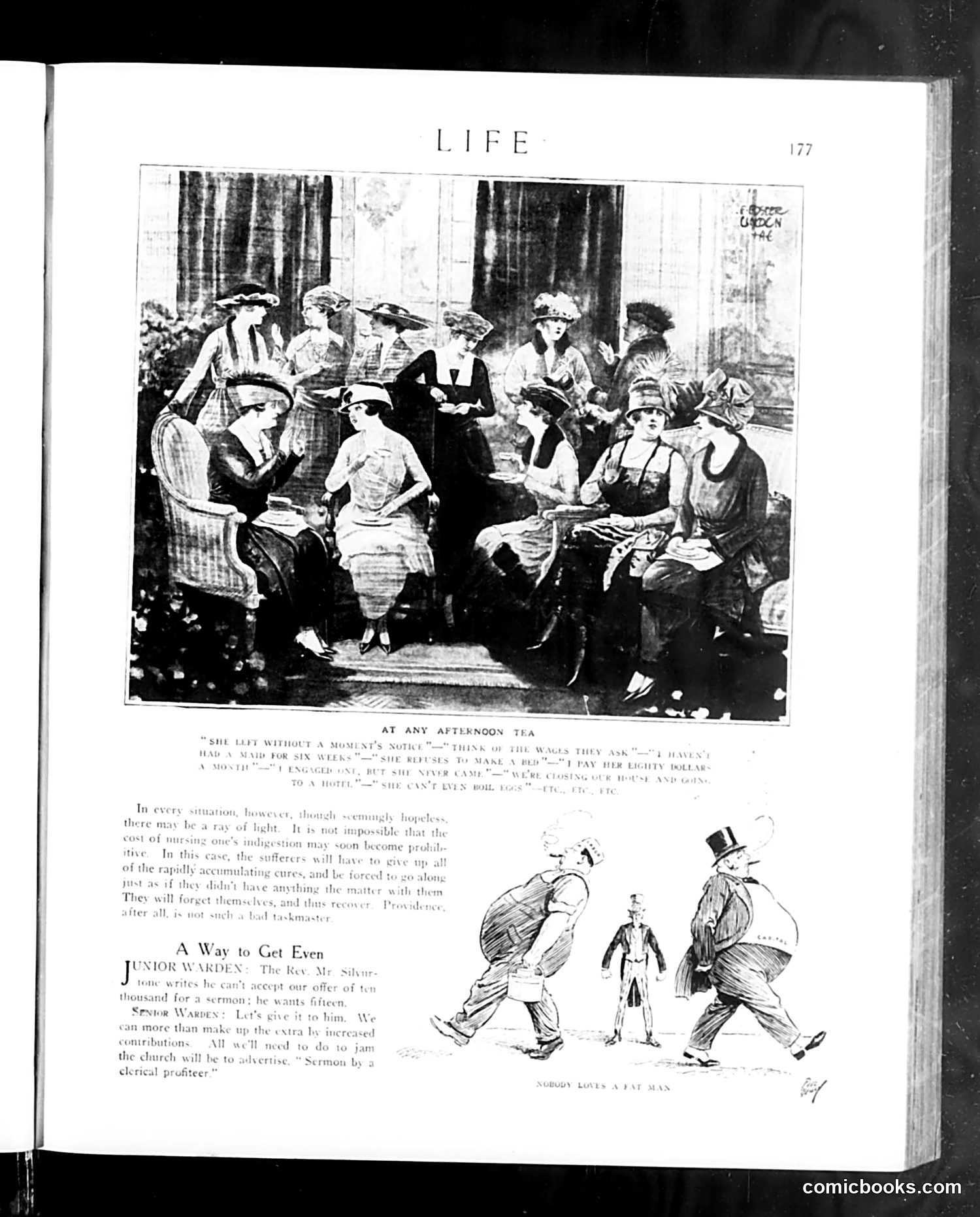
**Upper Section - "At Any Afternoon Tea":** This photograph shows women at a social gathering, with a caption listing complaints: unpaid wages, a maid's six-week absence, refusal to cook, demands for higher pay, inability to find servants, and domestic staff leaving for hotels. The satire targets upper-class women's frustration with a domestic labor shortage—likely post-WWI, when working-class women had better employment options and refused exploitative conditions. **Lower Section - "A Way to Get Even":** A brief dialogue titled "Junior Warden" shows a clergyman suggesting the church could afford to pay a junior warden's requested fifteen-thousand-dollar salary by jamming clerical profits into advertising. The cartoon satirizes both clergy greed and the absurdity of institutional financial priorities during economic hardship. Both pieces mock class tensions and financial hypocrisy.
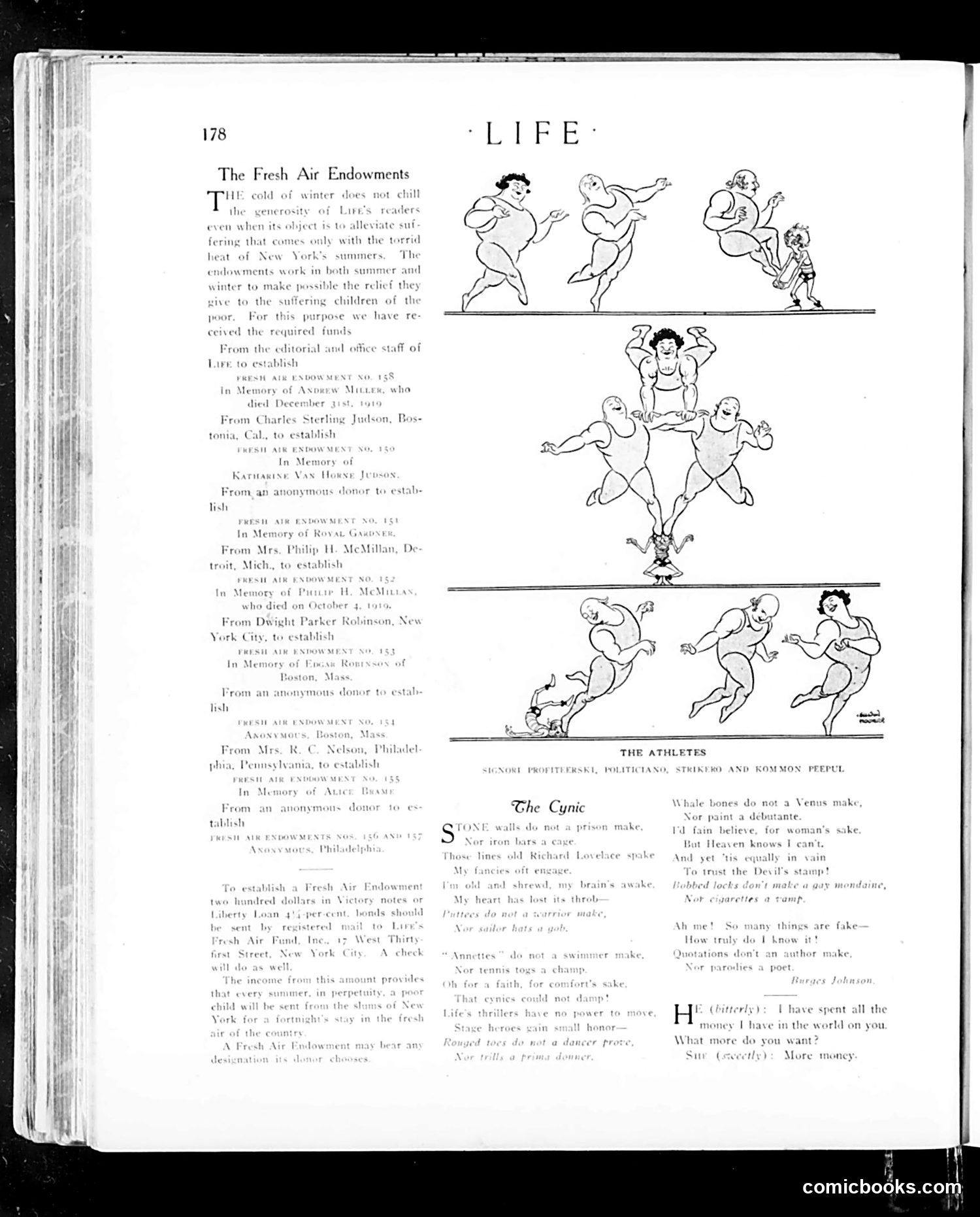
This page combines charitable announcement with satirical commentary. The left column describes various "Fresh Air Endowment" donations—funds established to send poor children to the countryside for summer relief from New York's heat. The right side features whimsical line-drawn cherubs and children in playful poses, illustrating the idealized vision of youth enjoying fresh air and outdoor activity. Below, "The Athletes" caption and accompanying poem ("The Cynic") appear to mock the contrast between romantic ideals and reality. The verse sarcastically suggests that physical vigor, moral virtue, and athletic prowess don't guarantee success or happiness—a jab at the era's faith in fresh air and exercise as cure-alls for poverty and social ills. The satire targets both the charity establishment's optimistic rhetoric and broader Progressive Era assumptions about nature's redemptive power.
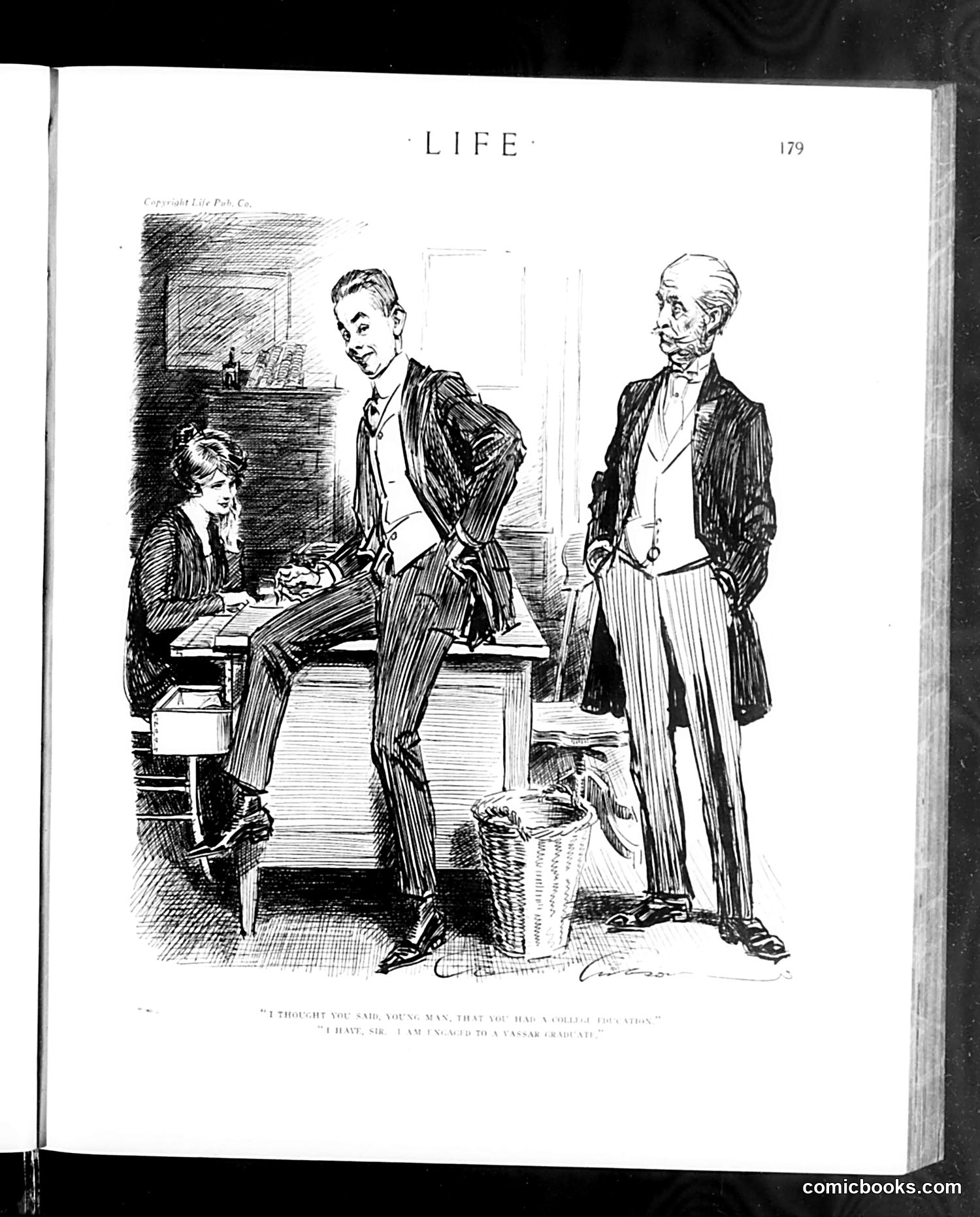
This cartoon depicts a hiring or employment scene. A young man sits at a desk (appearing to be an interviewer or employer), while two older, well-dressed gentlemen stand before him. Based on the dialogue caption—"I THOUGHT YOU SAID, YOUNG MAN, THAT YOU HAD A COLLEGE EDUCATION." "I HAVE, SIR. I AM NO GOOD TO A VASSAR GRADUATE."—the satire targets class pretension and education snobbery. The joke appears to critique the era's social hierarchies: the young man is admitting his college education makes him *unmarriageable* to a Vassar graduate (a prestigious women's college), suggesting he lacks sufficient social status or wealth despite his credentials. The cartoon mocks both the superficiality of educational prestige and the rigid class consciousness of the period's marriage market.
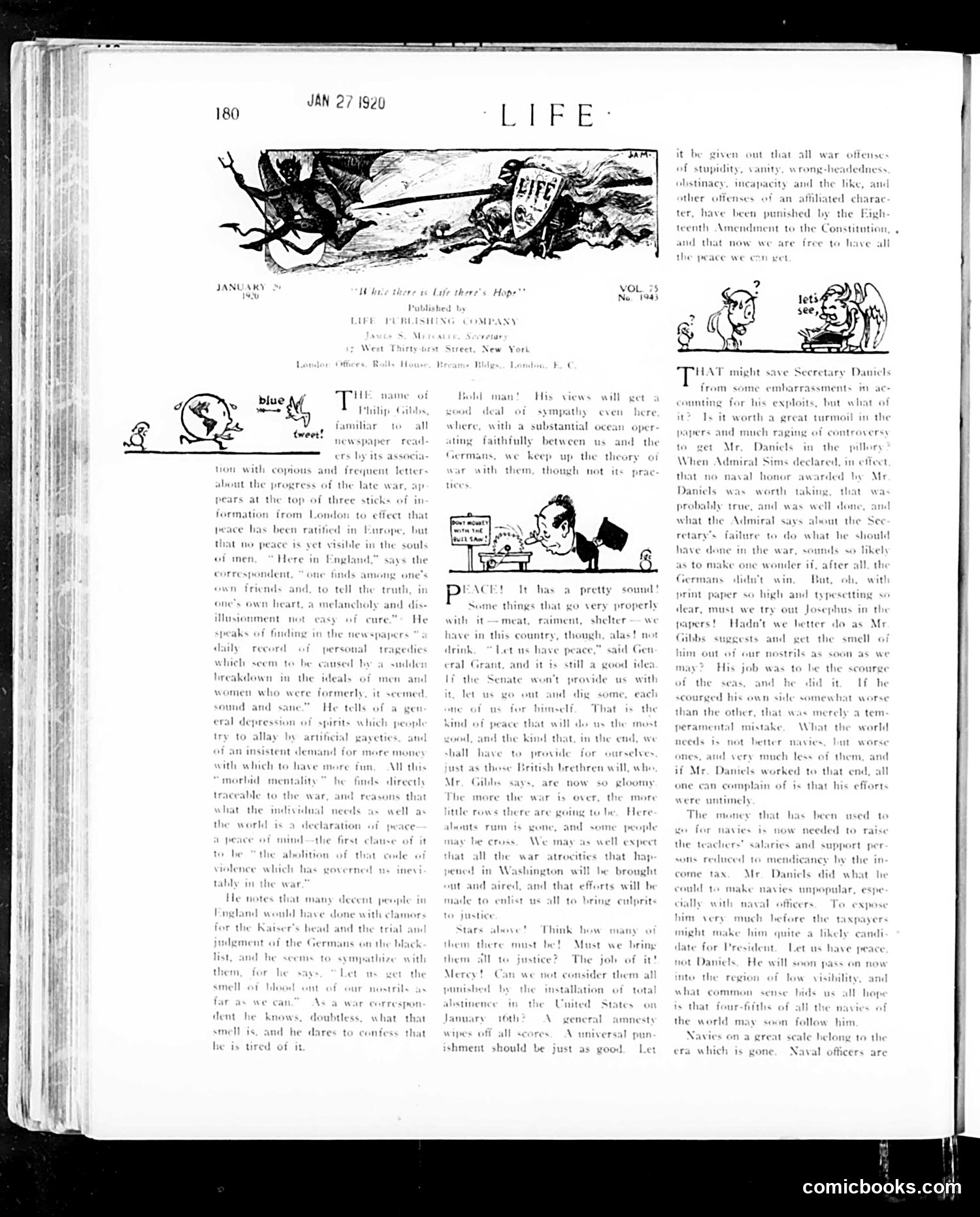
This page discusses Secretary of the Navy Josephus Daniels, critiquing his wartime leadership and peacetime policies. The cartoons (visible in the left margin) appear to satirize Daniels through caricature, though specific figures are difficult to identify clearly in this reproduction. The text argues that Daniels failed in his naval duties during WWI and now, post-war, is mismanaging Navy finances and administrative matters. The author suggests Daniels should be exposed to public scrutiny before taxpayers support his continued tenure. References include the 18th Amendment (Prohibition), General Grant's famous plea "Let us have peace," and Admiral Sims's wartime disagreements with Daniels over naval strategy against Germany. The satire's point: a military administrator unfit for peacetime governance wastes taxpayer money on questionable priorities rather than sailors' welfare and legitimate naval needs.
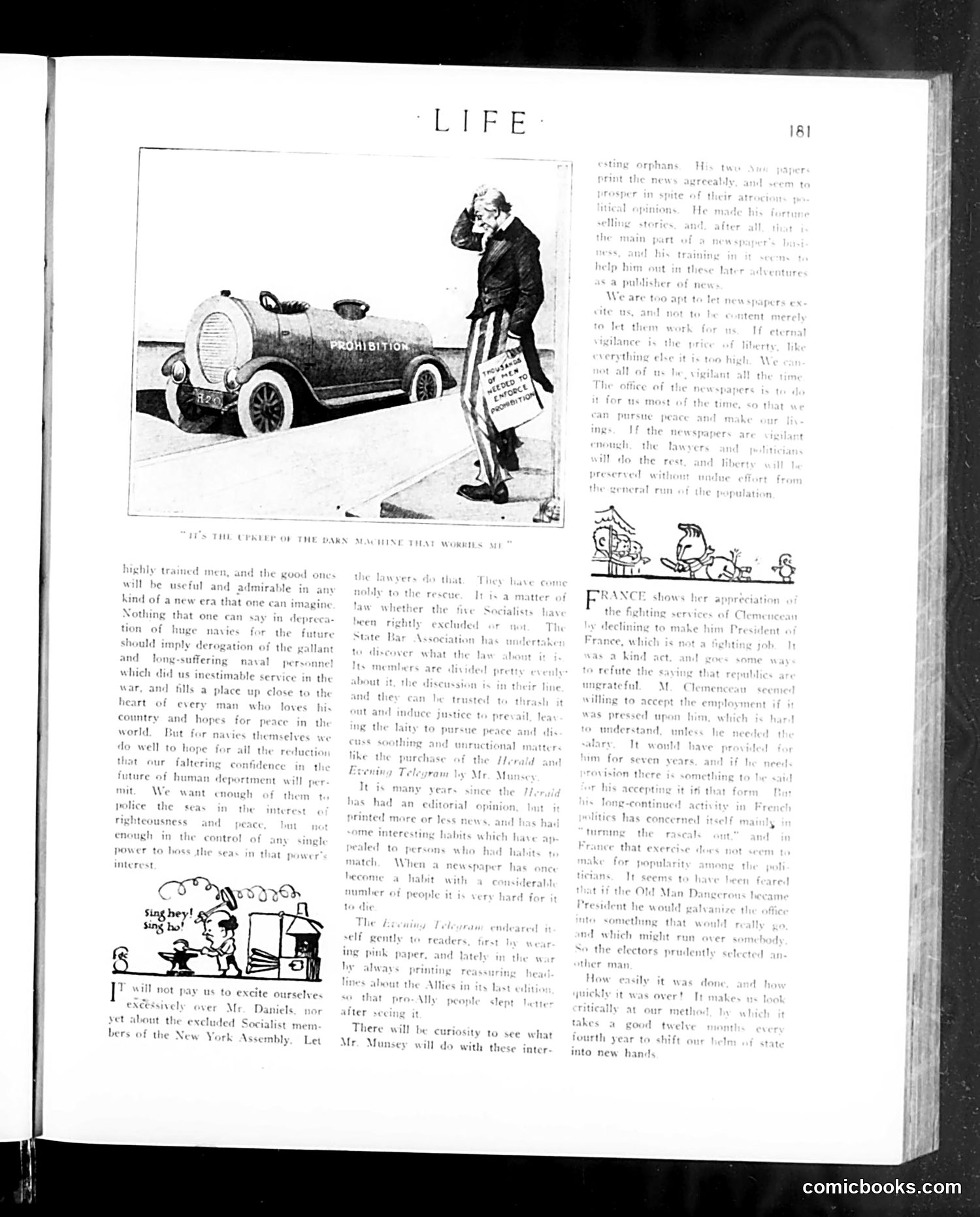
The main cartoon depicts a man in formal dress standing next to a car labeled "PROHIBITION," holding a sign reading "IT'S THE UPKEEP OF THE DARN MACHINE THAT WORRIES ME." This satirizes Prohibition enforcement costs and difficulties. The figure appears to represent someone struggling to maintain the unpopular policy—likely a government official or supporter. The "upkeep" complaint suggests Prohibition was proving expensive and burdensome to enforce. The accompanying text discusses newspaper vigilance regarding liberty and press freedom, mentioning the Herald and Evening Telegram. A smaller cartoon below shows figures singing, apparently mocking enforcement efforts. The page dates to America's Prohibition era (1920-1933), when the policy faced mounting practical and financial challenges despite legal mandate.
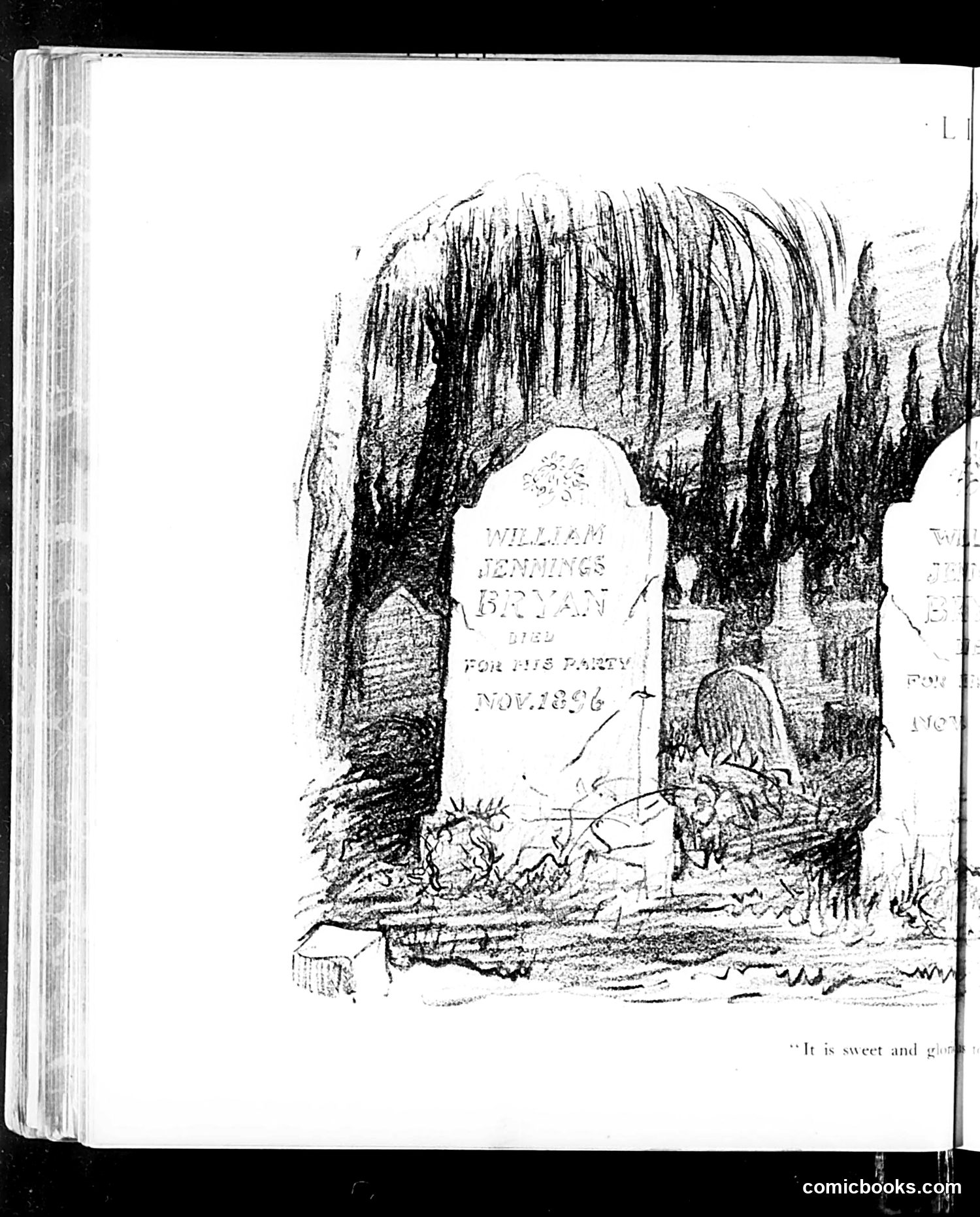
This page shows a single illustrated cartoon featuring a gravestone beneath a weeping willow tree. The headstone reads "WILLIAM JENNINGS BRYAN" with text indicating it commemorates "HIS PARTY" and a date appearing to reference November (possibly an election date). The cartoon is a political satire depicting the symbolic "death" of William Jennings Bryan's political faction or party, likely after an electoral defeat. Bryan was a prominent three-time presidential candidate (1896, 1900, 1908) and Democratic Party figure. The melancholic imagery—the willow tree, grave, and mourning figure—satirizes the perceived demise of his political movement or influence. The partial text visible at the bottom ("It is sweet and g...") suggests accompanying commentary, though it's largely cut off in this reproduction.
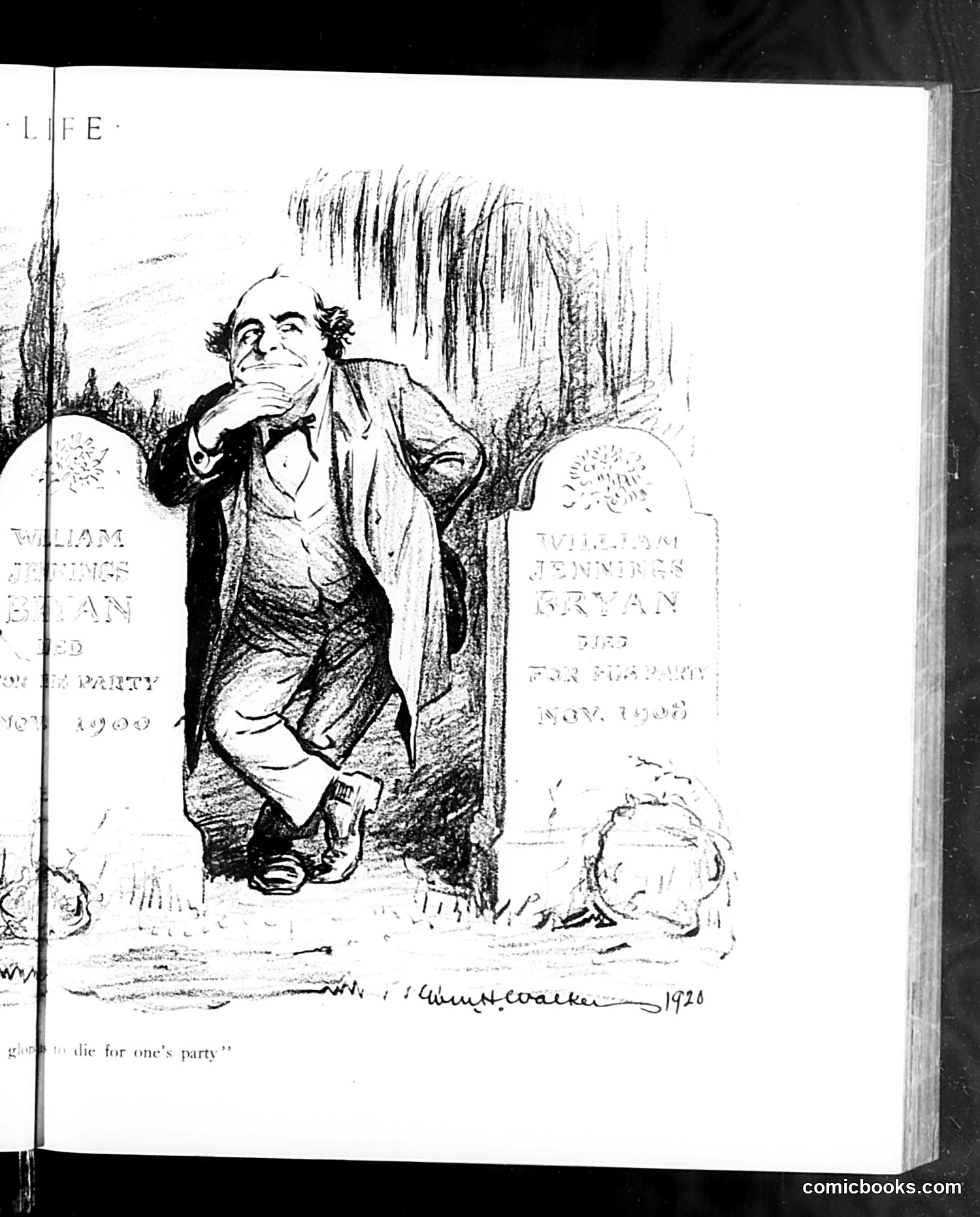
This 1926 cartoon by Cesare Coker depicts a man in formal dress mourning between two gravestones. The visible headstone reads "WILLIAM JENNINGS BRYAN" with dates indicating his recent death (November 1896). The cartoon references Bryan's death and the famous "Cross of Gold" speech that made him a three-time presidential candidate. The figure appears to be grieving the loss of Bryan's political influence or the populist movement he represented. The willow tree and cemetery setting emphasize finality and loss. The caption fragment "die for one's party" suggests commentary on political loyalty or sacrifice. Without the complete caption, the exact satirical point remains somewhat unclear, but the cartoon likely critiques either Bryan's legacy or the political consequences of his death.
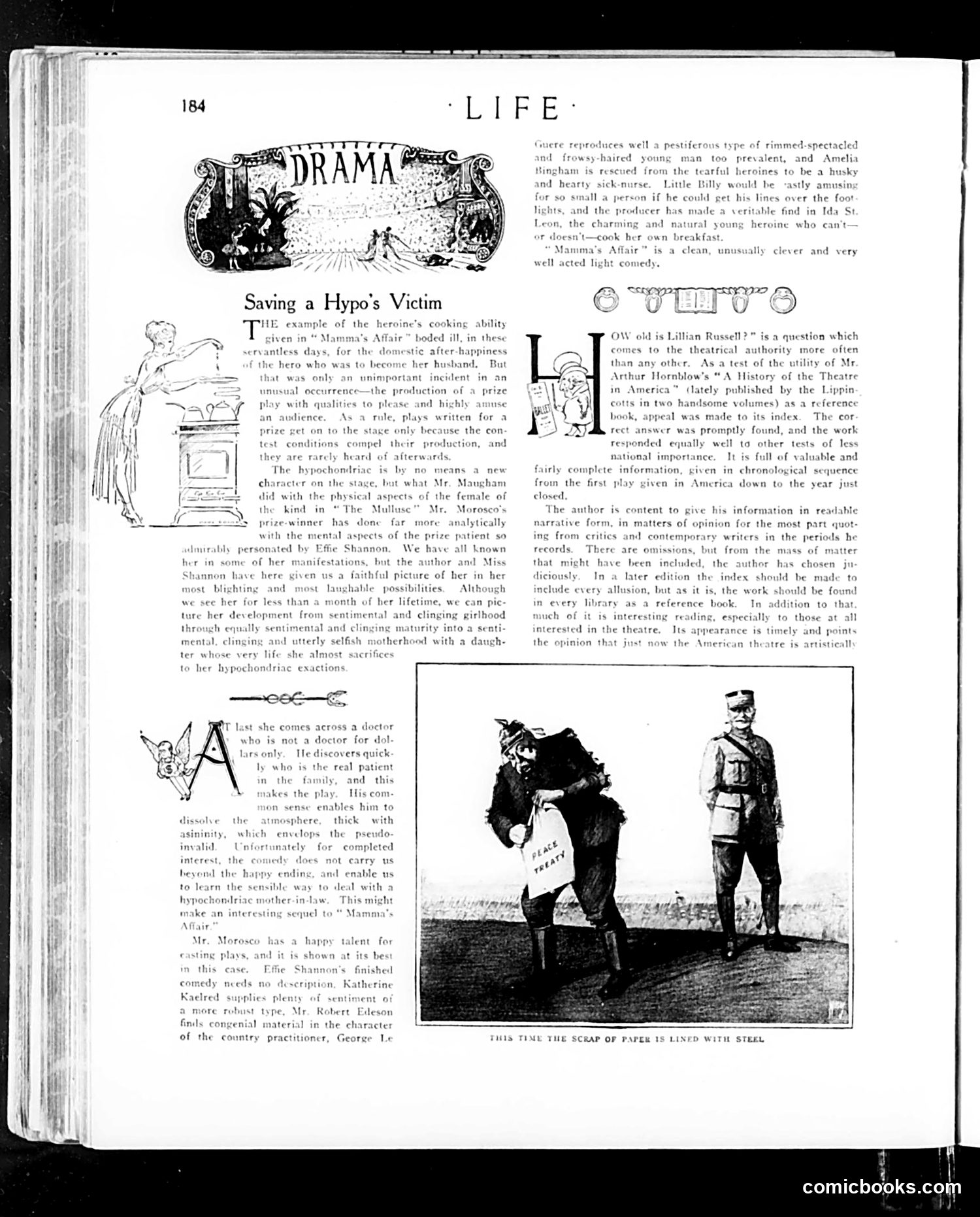
This page reviews the play *"Mamma's Affair,"* focusing on how the lead actress demonstrates her cooking ability while playing a character who rescues the hero from an unsuitable romantic entanglement. The text praises the actress's comic timing and the play's overall cleverness. The photograph shows what appears to be a military or wartime scene, captioned "THIS TIME THE SCRAP OF PAPER IS LINED WITH STEEL." This likely references World War I and the famous "scrap of paper" phrase used to describe treaty violations—here suggesting steel (weapons/military might) now backs diplomatic agreements. The illustration at left depicts a woman at a stove, visualizing the plot point about domestic competence mentioned in the review. The overall page combines theater criticism with a topical wartime reference, typical of *Life* magazine's satirical approach.
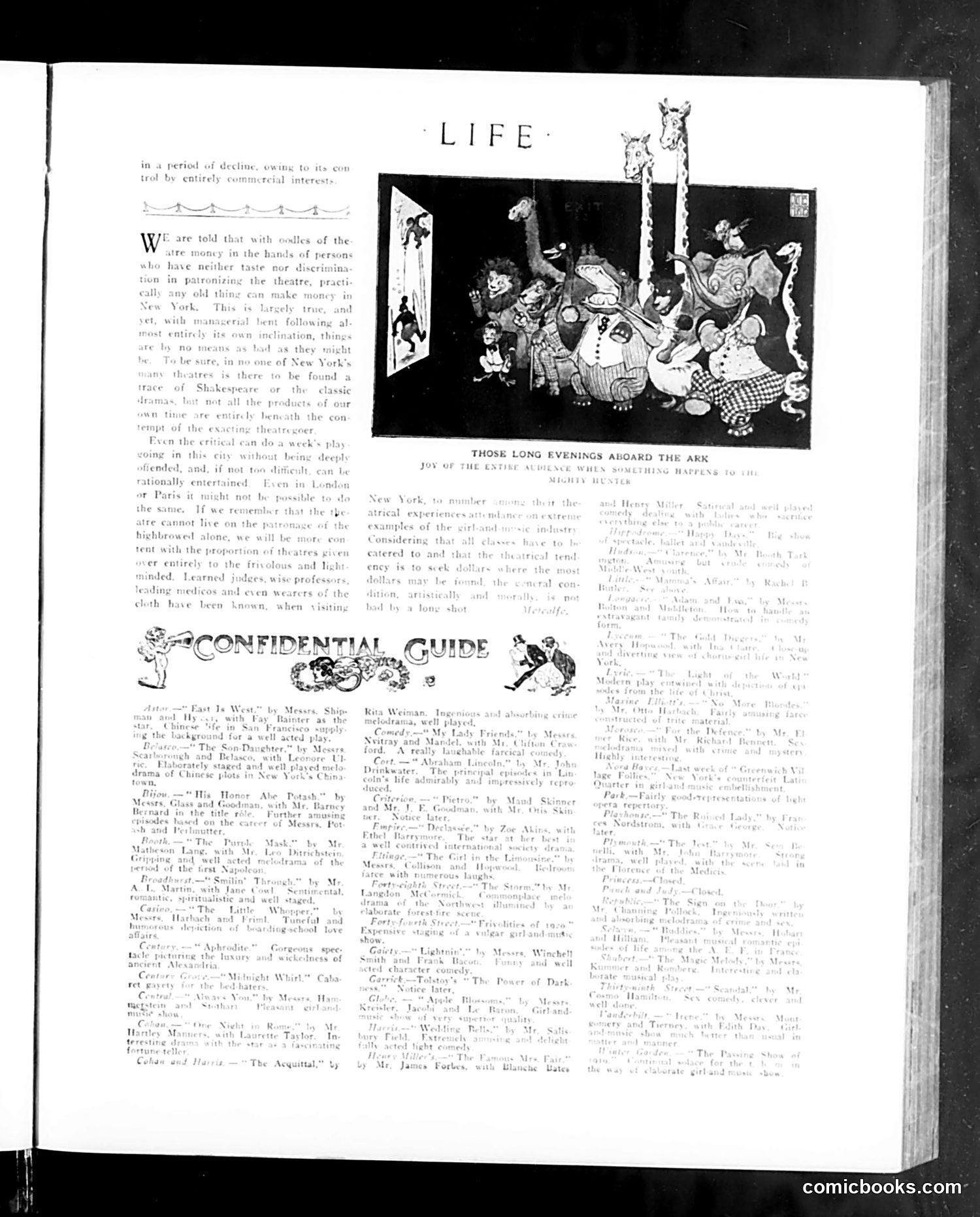
This page contains a theatrical review article titled "Those Long Evenings Aboard the Ark" (likely referencing a play), accompanied by a black and white illustration showing what appears to be passengers or characters in an animated, crowded scene aboard a ship or vessel. The article discusses New York theatrical experiences and critiques of drama productions. The "Confidential Guide" section below lists various theatrical productions with cast members and brief reviews, suggesting this is a theater criticism/entertainment guide page rather than political satire. The illustration's style is characteristic of early 20th-century Life magazine—satirical and caricatured. However, without clearer identification of specific figures or context about which play is being reviewed, I cannot definitively identify the particular social or political commentary intended. The page primarily functions as entertainment criticism rather than political commentary.
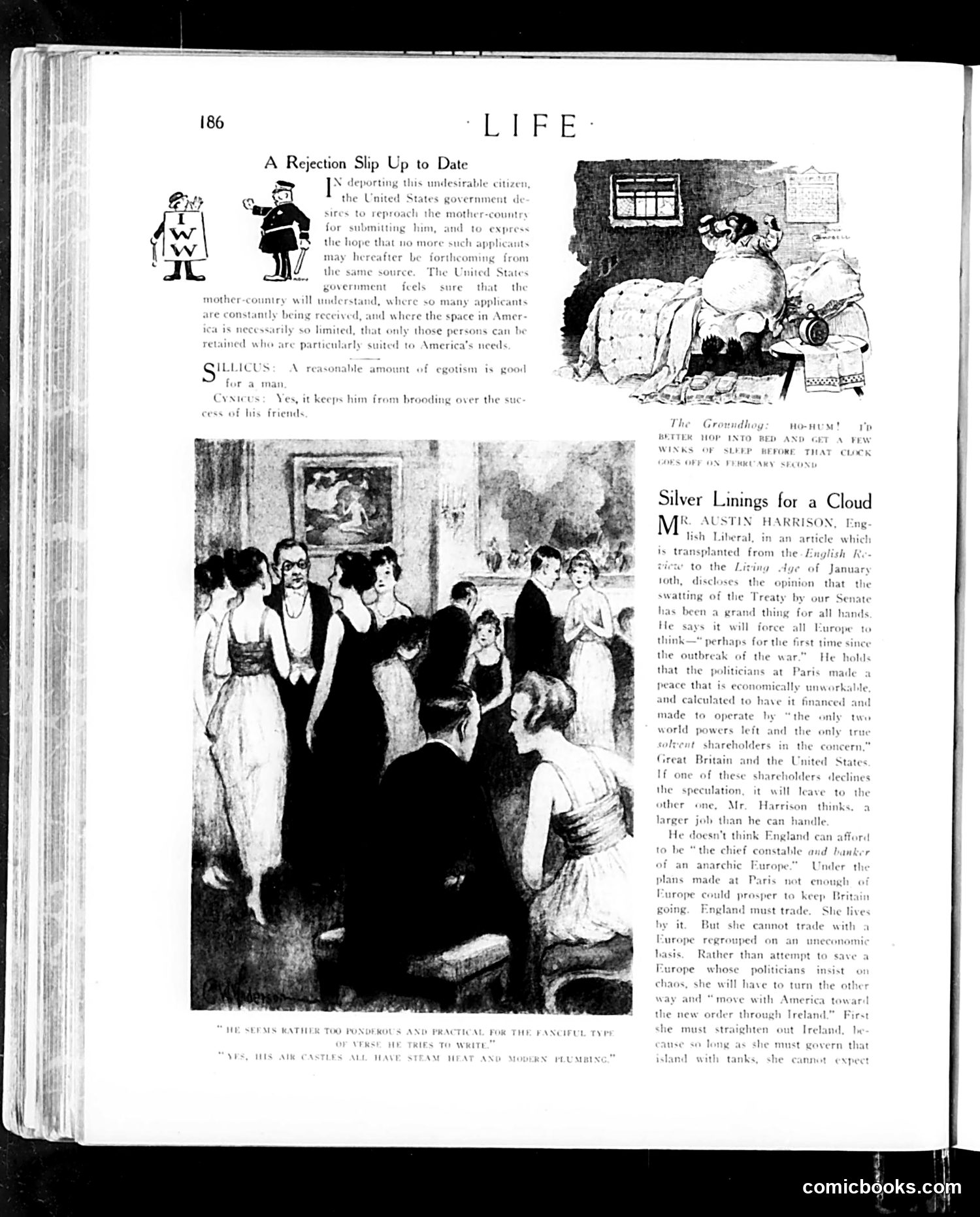
**Top Section ("A Rejection Slip Up to Date"):** This satirical dialogue mocks U.S. immigration policy. The cartoon shows officials rejecting an "undesirable citizen" applicant, with text indicating the government prefers limiting immigration to preserve space for those "particularly suited to America's needs." The joke critiques American xenophobia and selective immigration standards of the era. **Bottom Section ("Silver Linings for a Cloud"):** An article by British Liberal Austin Harrison discusses post-WWI peace treaties. The accompanying illustration depicts a formal social gathering, likely representing political negotiations. Harrison argues that while the Treaty settlement appears unworkable, it forces Europe and Britain into economic interdependence—potentially creating unexpected beneficial consequences ("silver linings"). He suggests Britain must trade with America rather than a fragmented Europe, implying the treaty's failures paradoxically strengthen Anglo-American relations. The page reflects 1920s anxieties about immigration restriction and post-war geopolitical realignment.
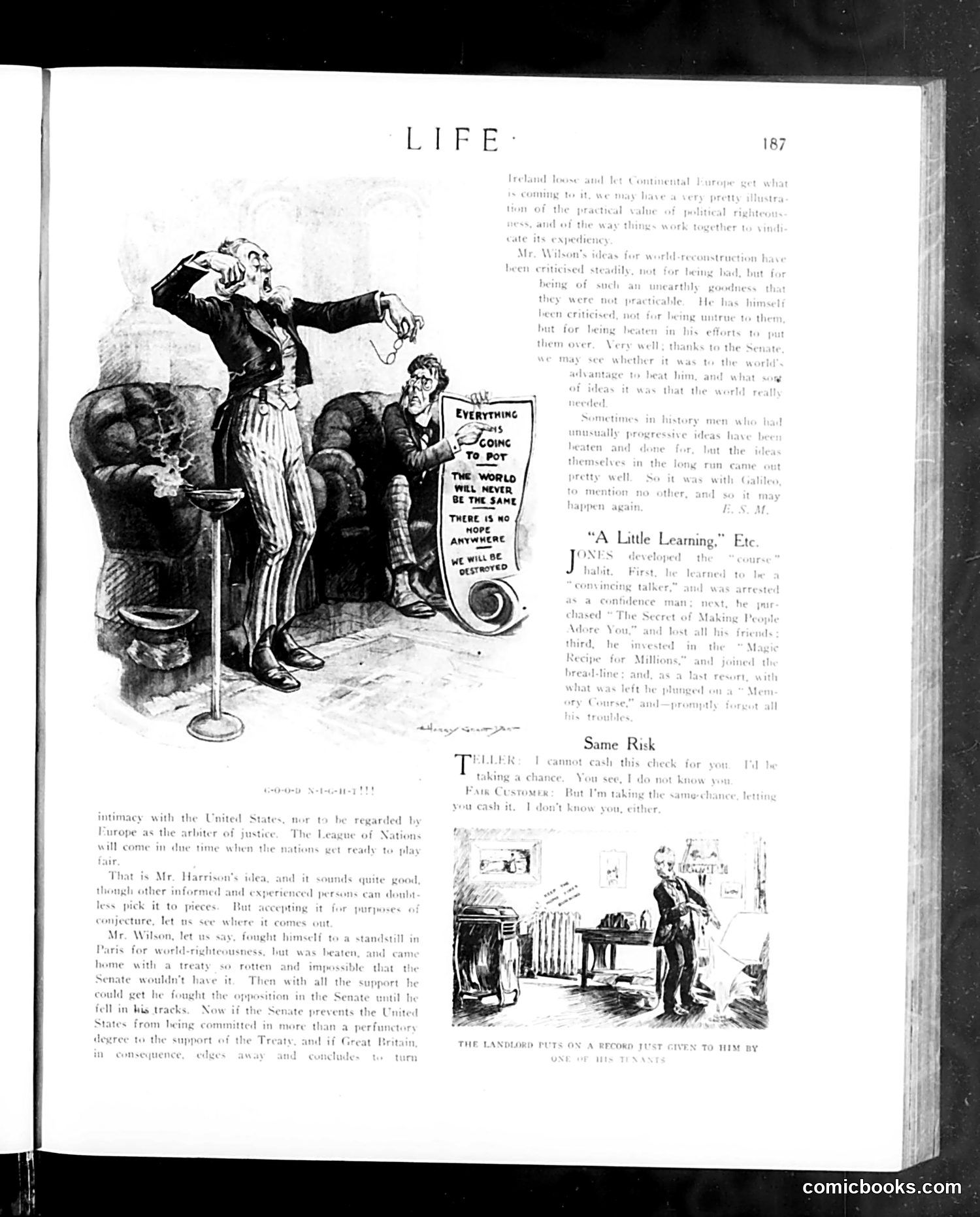
The main cartoon depicts a figure (likely representing a political figure or ideologue) gesturing dramatically while holding a sign listing failed utopian schemes: "Everything is going to pot," "The world will never be right," and "There is no hope anywhere." The satire targets someone promoting doom-and-gloom prophecies or failed revolutionary ideologies. The accompanying text discusses Mr. Wilson's post-war reconstruction ideas and references to the Senate's skepticism, suggesting this ridicules pessimistic political rhetoric or defeated reformers clinging to failed grand schemes. The lower cartoon, titled "Same Risk," shows a teller and customer discussing check-cashing, playing on uncertainty and mutual distrust—likely satirizing post-war economic instability or banking practices. The overall page mocks ideological excess and failed political ambitions of the WWI era.
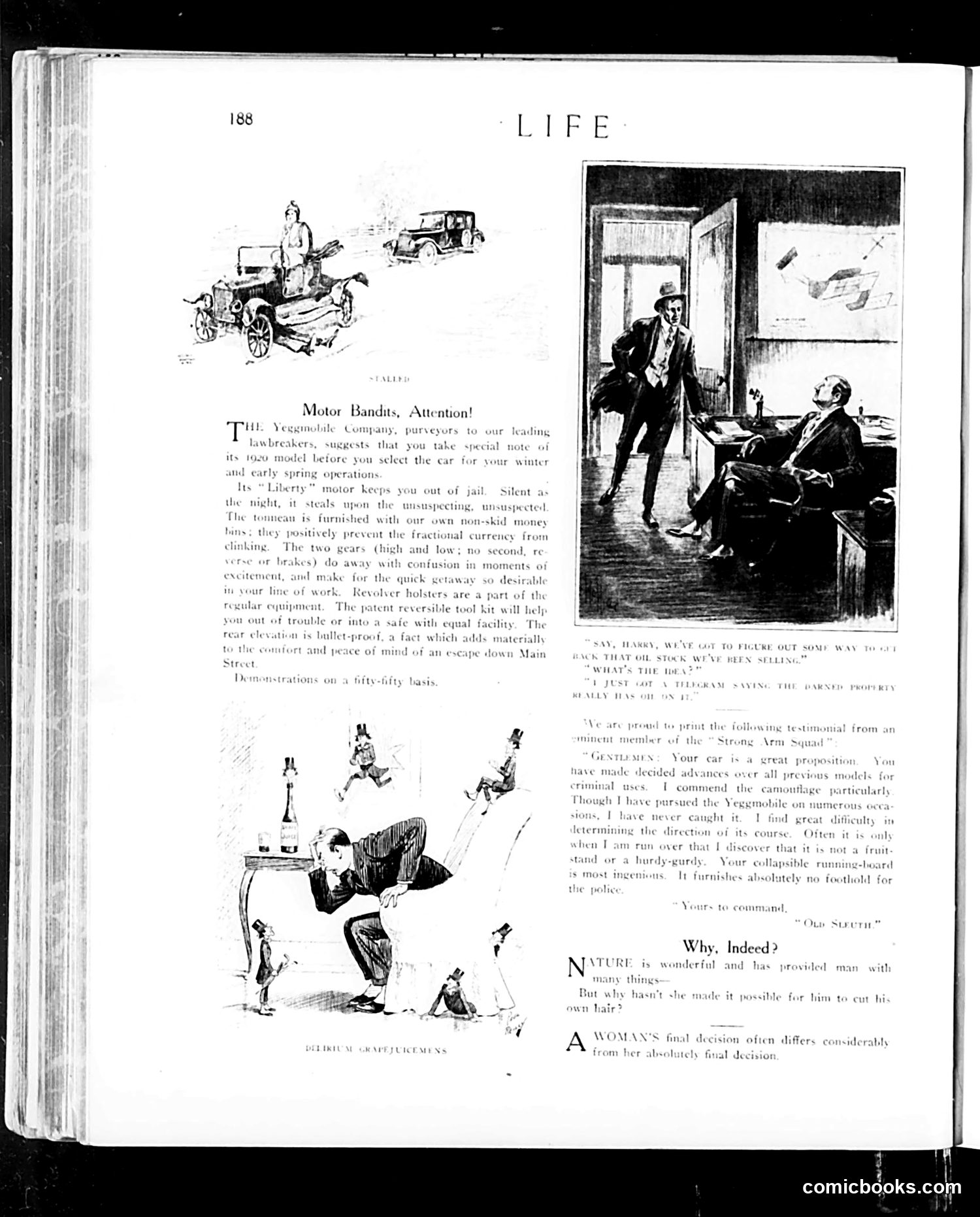
This page satirizes automobile crime and gender norms circa 1910s-1920s. The top cartoon, "Motor Bandits, Attention!" humorously advertises the "Yeggmobile" (a slang term for burglar's vehicle) as the perfect getaway car, highlighting features like non-skid tires and silent operation that would appeal to criminals. It's satire on how modern technology enables crime. The office scene illustration shows a man apparently discussing the vehicle with another, playing up the criminal angle for comedic effect. The bottom section titled "Why, Indeed?" contains two brief philosophical jokes: one questioning why nature hasn't let humans cut their own hair (suggesting self-haircuts are impossibly difficult), and another observing that women's "final decisions" often differ from their "absolutely final decision"—a dated stereotype about female indecisiveness presented as humorous observation.
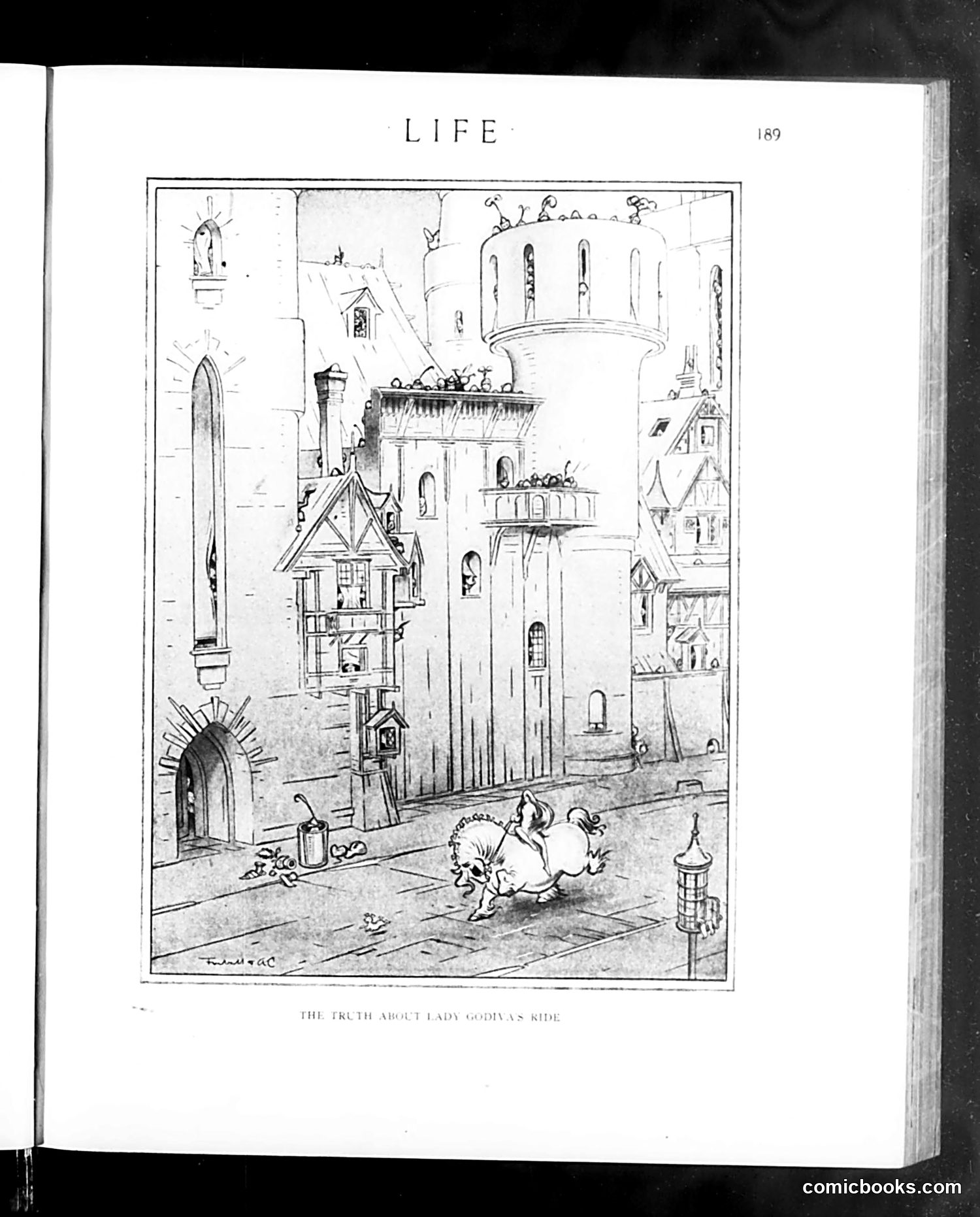
This satirical cartoon depicts a medieval street scene with a tower and buildings. A horse and rider appear in the town square—ostensibly illustrating the famous legend of Lady Godiva, who allegedly rode naked through the streets to protest taxes. However, the cartoon's title suggests this is a debunking illustration—showing "the truth" rather than the romanticized legend. The detailed medieval architecture and everyday street life (with what appears to be common townspeople and objects scattered about) implies the cartoon is mocking the legendary version as exaggerated or false. The satire likely comments on how historical legends become embellished over time, or how popular myths obscure actual truth. Without additional context, the specific target of the satire remains unclear, though it appears to be a commentary on historical revisionism or gullibility.
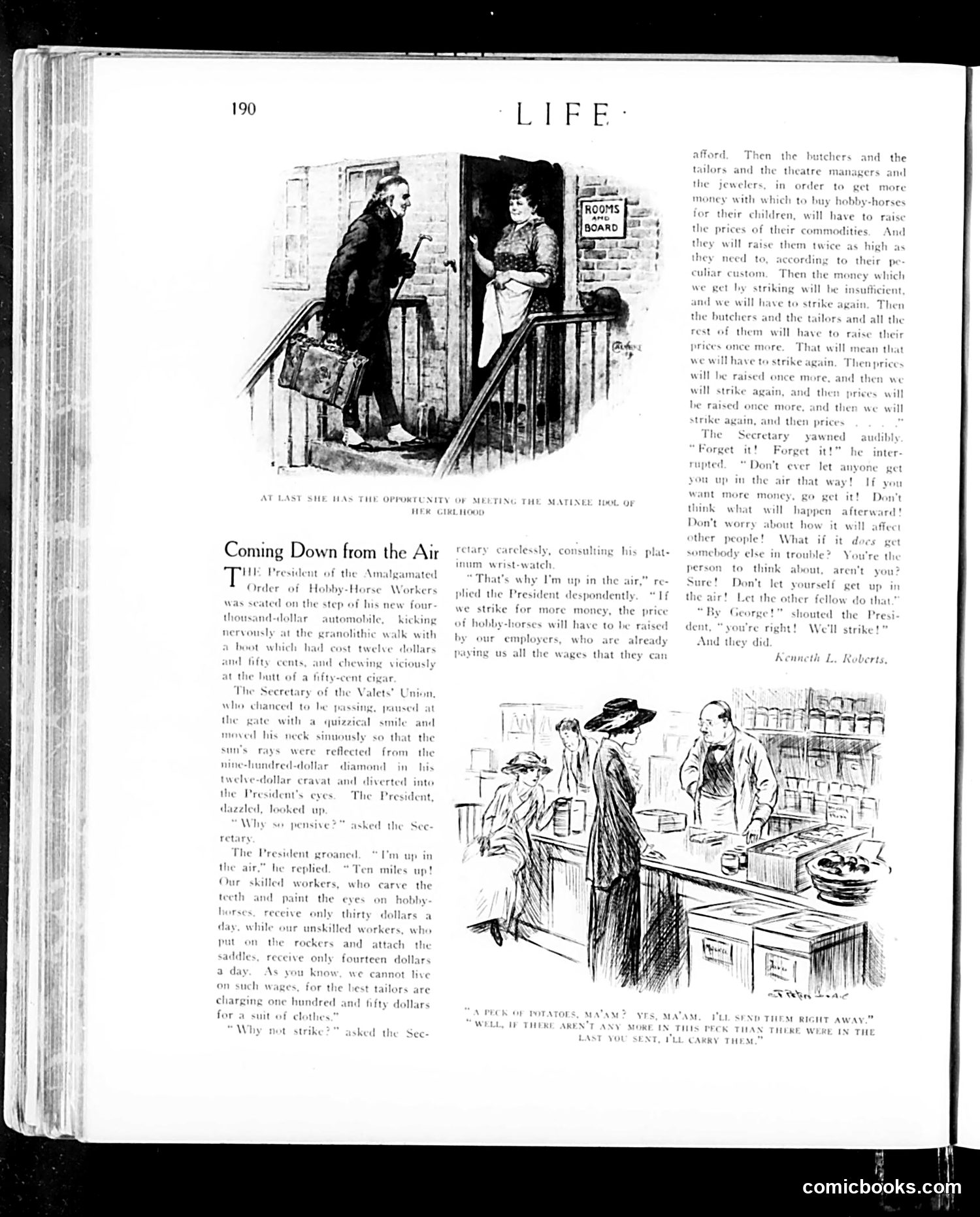
This 1920s-era *Life* magazine satire mocks labor union strategy during a strike for higher wages. The narrative presents a circular economic argument: workers strike for more money, so employers raise prices of goods to cover wage increases, which increases cost of living, forcing another strike—an endless cycle. The top illustration shows a landlady confronting a tenant about rent. The bottom sketch depicts what appears to be a workplace or union meeting discussing strike strategy. The satire's target: union leadership promoting strikes without considering inflationary consequences. The piece argues that wage increases don't improve workers' actual purchasing power—prices simply rise accordingly. The President and Secretary characters represent labor officials who dismiss these concerns, insisting workers should "get theirs" without acknowledging economic realities. The joke: workers chase their own tails economically.
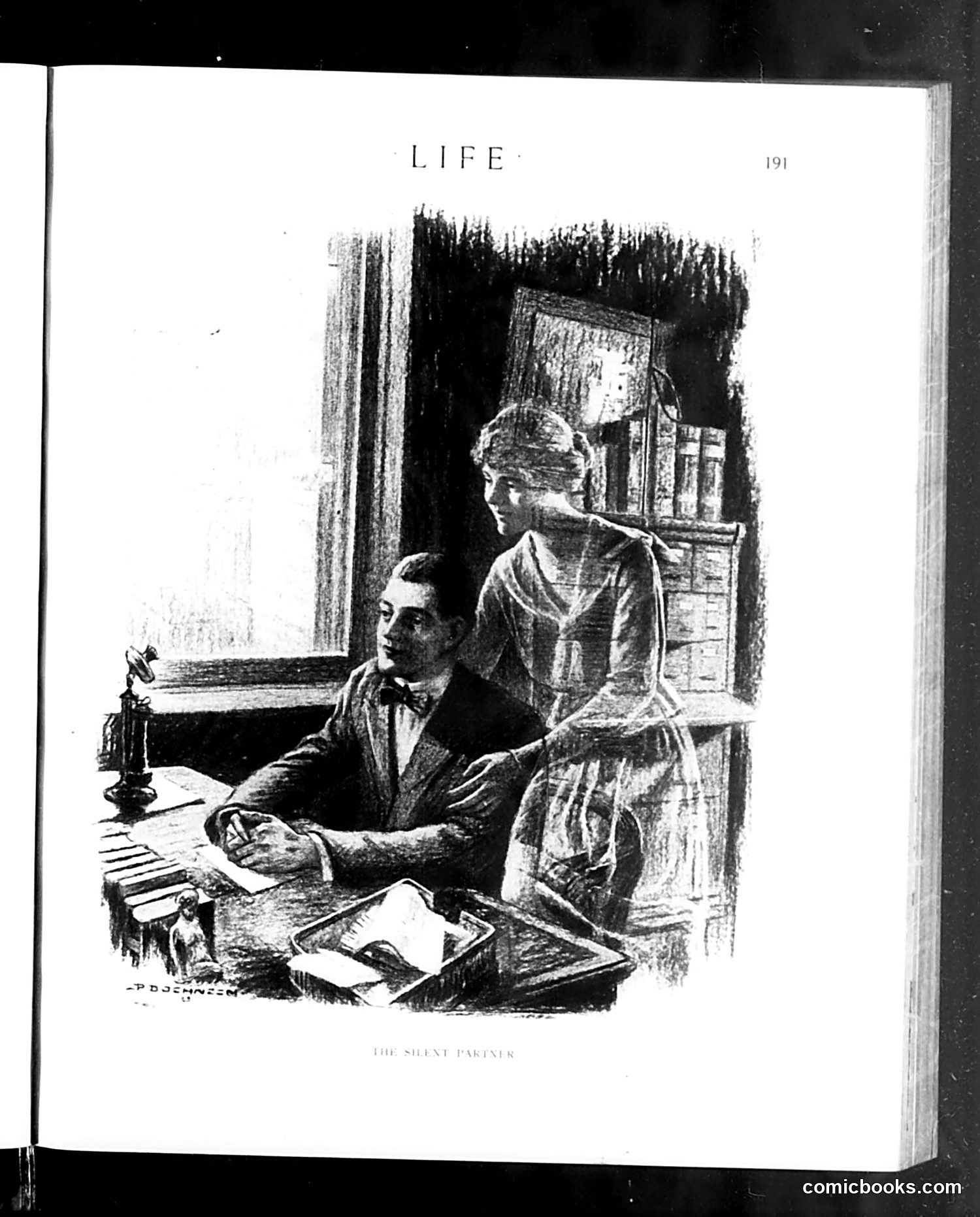
This cartoon depicts two men in an office setting. One sits at a desk with papers and a desk lamp, appearing to work on business matters. The other stands behind him, observing. The title "The Silent Partner" suggests commentary on a business relationship dynamic. The cartoon likely satirizes the role of a passive investor or partner who provides capital but doesn't actively participate in day-to-day operations—hence "silent." The composition emphasizes the contrast: one man actively engaged while the other watches, possibly suggesting questions about fairness in profit-sharing or the value of different types of business contributions. Without additional context about the specific issue of *Life* magazine, the precise targets remain unclear, though the satire appears to address workplace or business relationships.
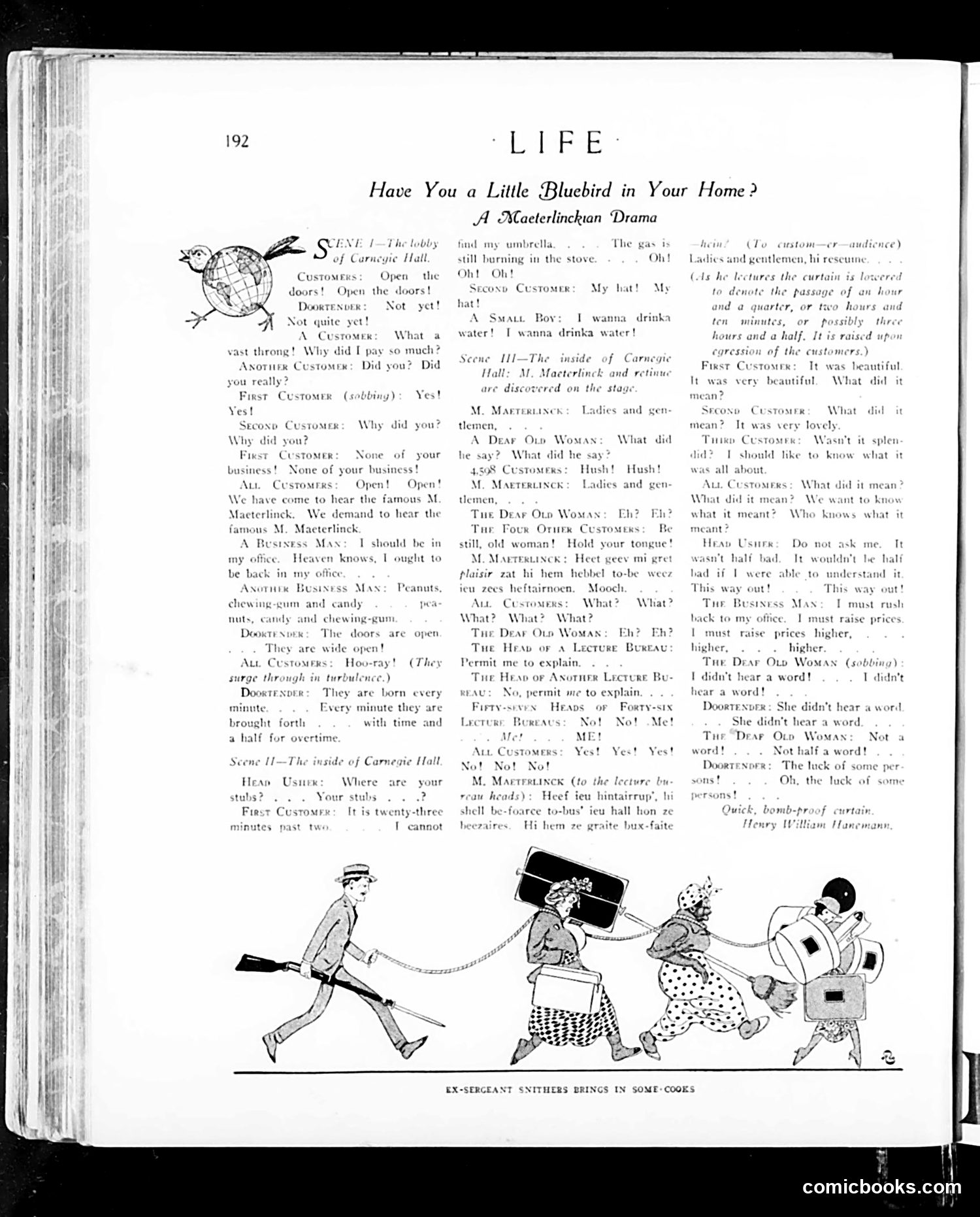
This is a satirical one-act play mocking the avant-garde theatrical style of Belgian symbolist playwright Maurice Maeterlinck, whose work was fashionable in intellectual circles of the early 1900s. The joke: A Carnegie Hall performance descends into chaos as thousands of customers jam the lobby demanding entry, while on stage, Maeterlinck's pseudo-profound dialogue about umbrellas, hats, and incomprehensible philosophical utterances plays out. The "Bluebird" reference alludes to Maeterlinck's famous play *The Blue Bird*. The satire targets both the pretentiousness of modernist theater and the absurdity of applying such obscure, symbolist drama to mundane situations. The illustration shows an usher struggling to manage the unruly crowd—the contrast between high-minded theatrical ambition and lowbrow mob chaos is the comedy. The piece ridicules those who treat Maeterlinck's work as profoundly meaningful when it's actually nonsensical.
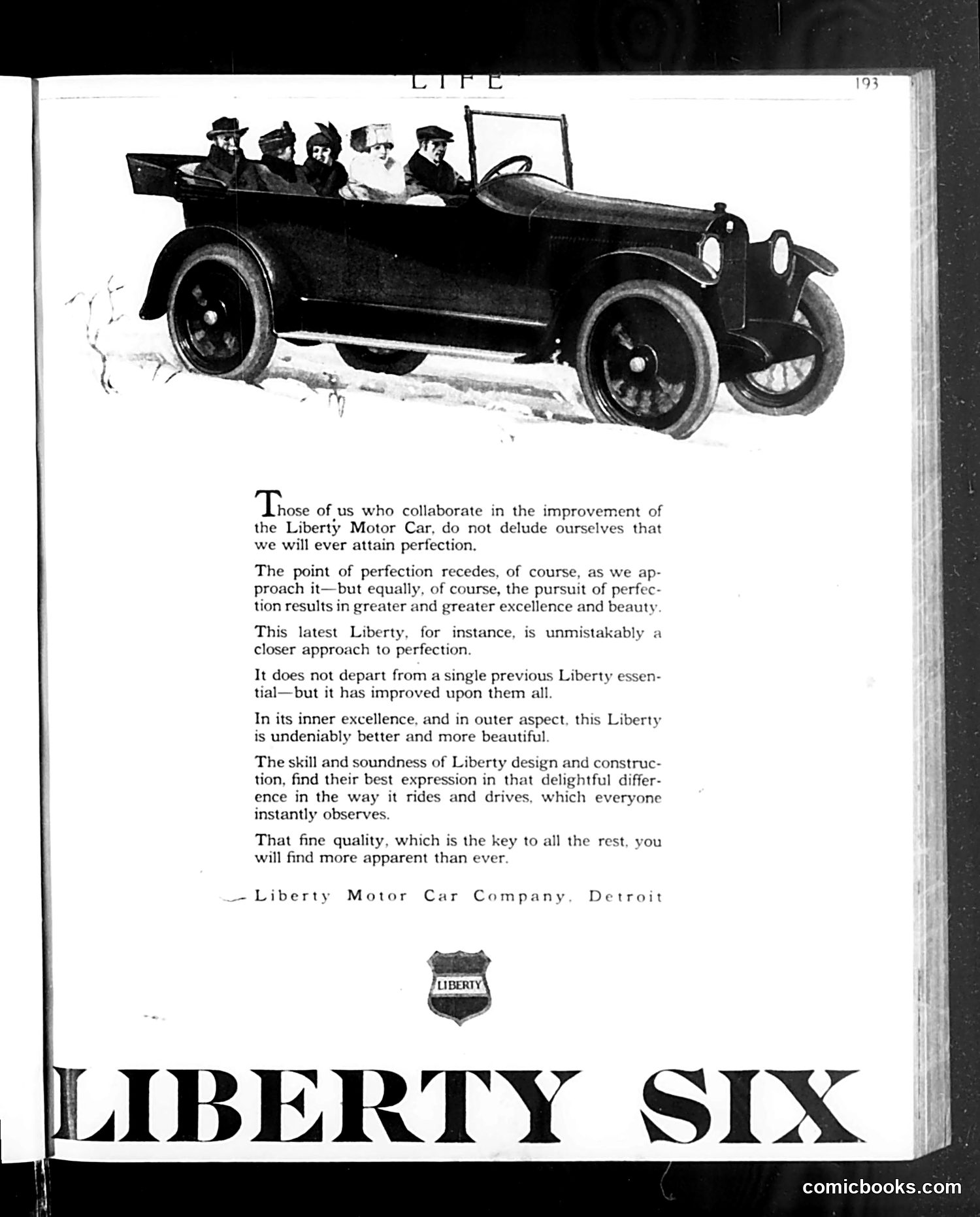
This is a full-page advertisement for the Liberty Motor Car Company of Detroit, not satirical content. The image shows an open touring car carrying six well-dressed passengers in hats and coats, typical of early automotive advertising. The text is a straightforward marketing pitch claiming the new Liberty model represents incremental perfection—improved upon previous models while maintaining essential design elements. The copy emphasizes quality, ride comfort, and beauty as selling points. There is no political satire or social commentary here. This appears to be a standard commercial advertisement from Life magazine's early automotive era, designed to appeal to affluent buyers through promises of continuous refinement and superior craftsmanship. The "Liberty Six" likely refers to a six-cylinder engine configuration.
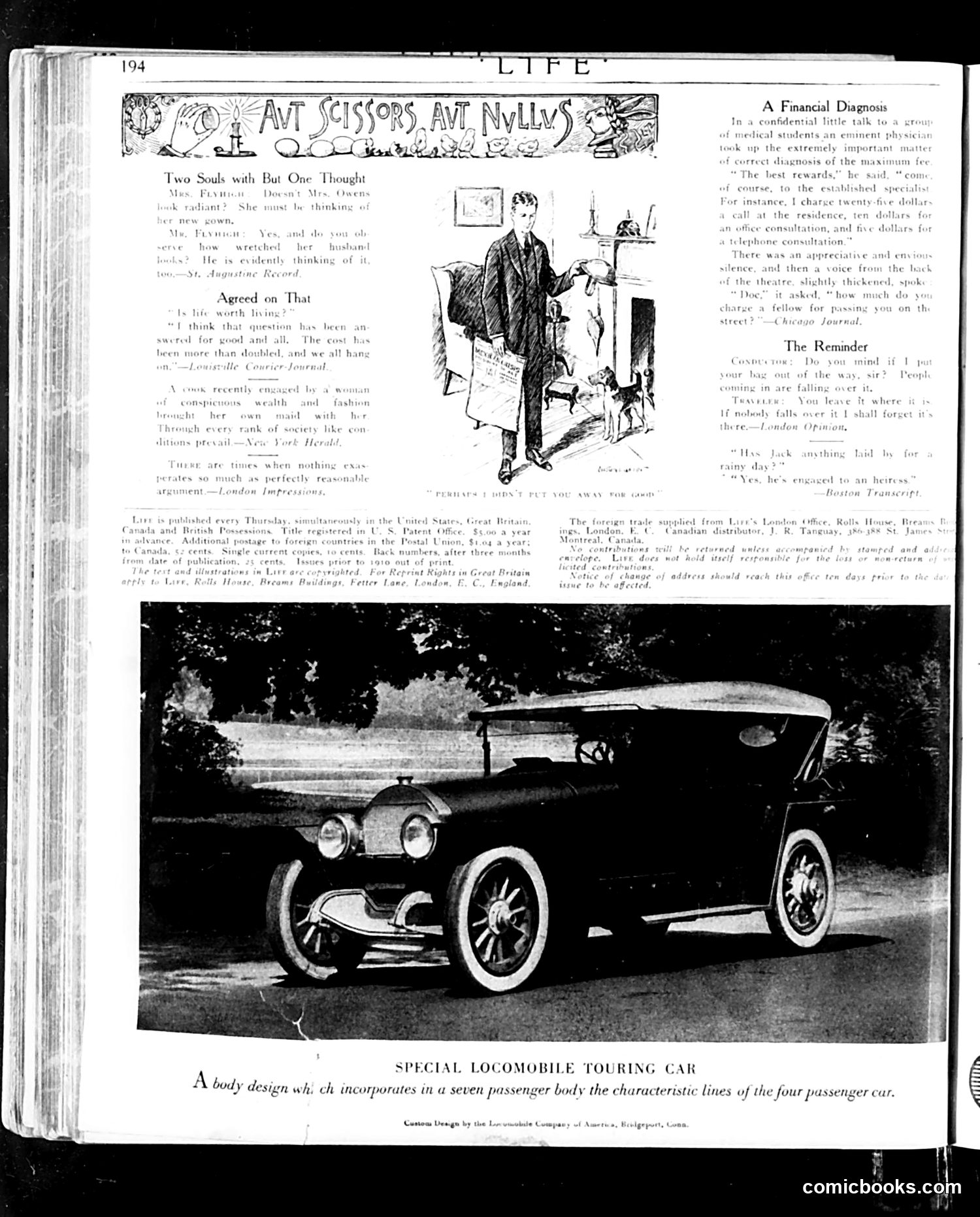
The page contains three short satirical pieces ("At Scissors, At Nylls"): **"Two Souls with But One Thought"** and **"Agreed on That"** are brief comic dialogues mocking romantic couples who claim perfect agreement—a common satire target suggesting relationships lack genuine individuality or authentic debate. **"A Financial Diagnosis"** satirizes a doctor's consultation about medical fees, poking fun at the high cost of professional services—a relatable complaint for working-class readers. The centerpiece is an **advertisement for a Locomobile Touring Car**, a luxury automobile manufacturer. The photograph showcases an early 1900s vehicle designed to blend seven-passenger capacity with sporty four-passenger styling—targeting wealthy consumers wanting both practicality and prestige. The page represents Life's mix of satirical commentary on social manners and class dynamics alongside commercial appeals to affluent readers.
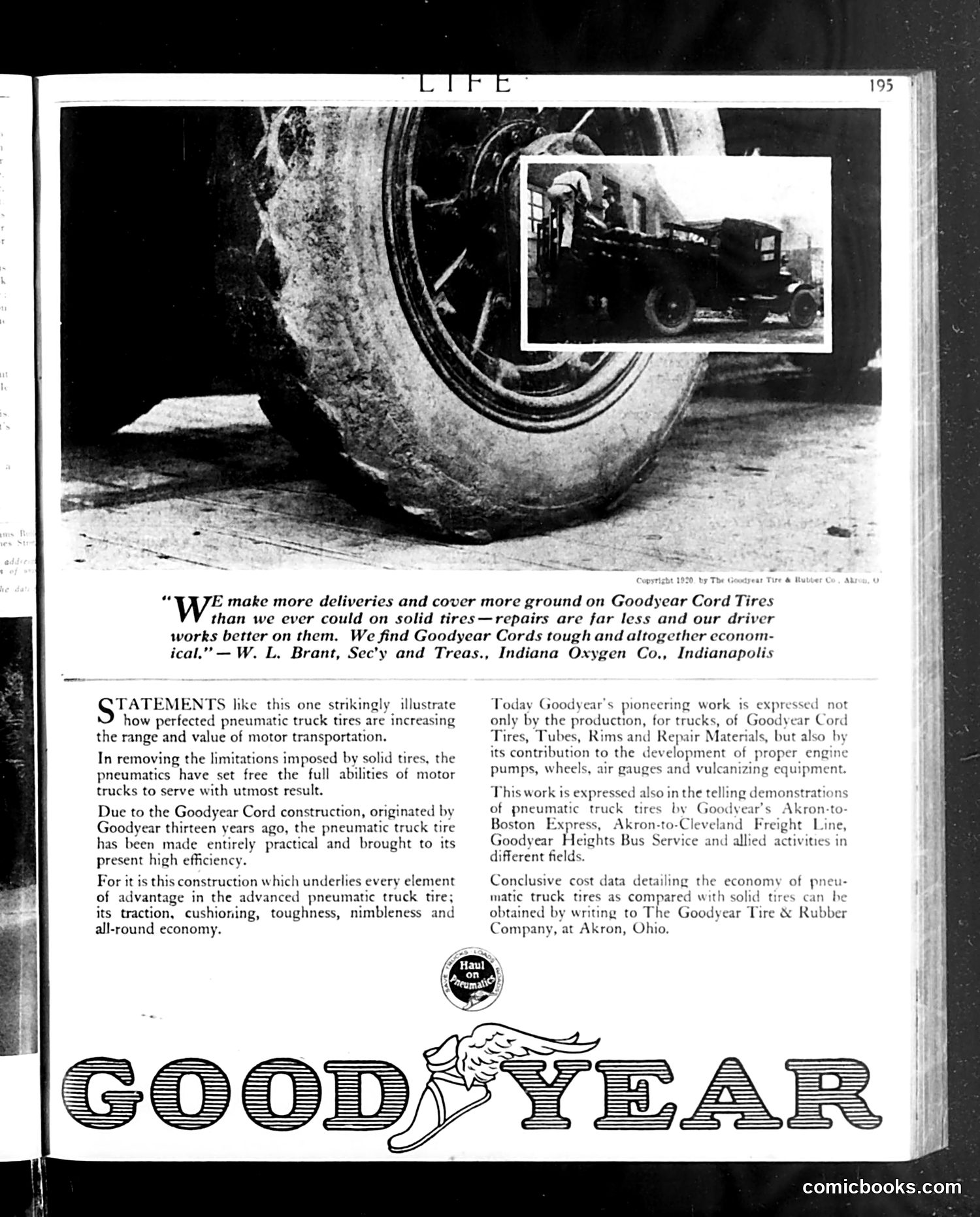
This is a **Goodyear tire advertisement**, not political satire or a cartoon. The page features a testimonial from W.L. Brant of Indiana Oxygen Co. praising Goodyear Cord pneumatic tires for delivery trucks. The image shows a close-up of a pneumatic tire alongside an inset photograph of an actual delivery truck in use. The advertisement argues that pneumatic (air-filled) tires, invented by Goodyear thirteen years prior, represent a major technological advancement over solid rubber tires. The claims emphasize practical benefits: more deliveries, lower repair costs, better driver comfort, and overall economy. The copy positions Goodyear as a pioneering innovator and invites readers to request cost comparison data. This reflects early-20th-century industrial marketing—using customer testimonials and technical superiority claims to promote newer commercial products.
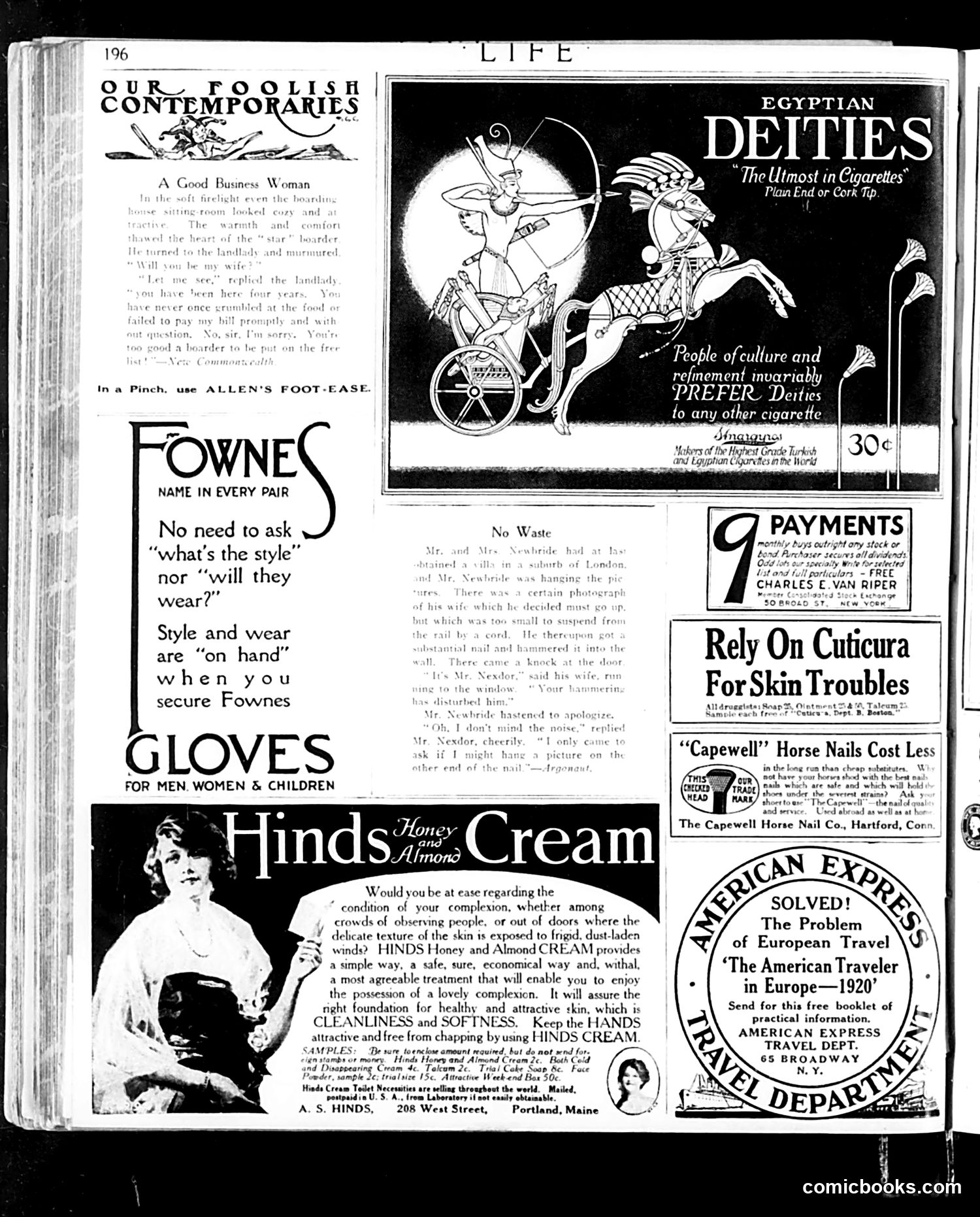
This page is primarily **advertising**, not satire or political commentary. It contains multiple product advertisements typical of early 1920s magazines: The top section includes ads for **Fownes Gloves** (emphasizing reliable style and quality), **Egyptian Deities cigarettes** (featuring Egyptian imagery to convey exoticism and sophistication), and **Allen's Foot-Ease** (a foot comfort product). The largest ad promotes **Hinds Honey and Almond Cream**, a complexion treatment addressing concerns about skin appearance in public and harsh weather—reflecting period beauty standards emphasizing "cleanliness and softness." Other ads include **Cuticura** for skin troubles, **Capewell Horse Nails**, and an **American Express travel guide** for European travel in 1920. There is a brief satirical text snippet titled "A Good Business Woman" and "No Waste" at left, but these are minor filler content, not the page's primary focus. The page reflects consumer culture and marketing strategies of the 1920s rather than political commentary.
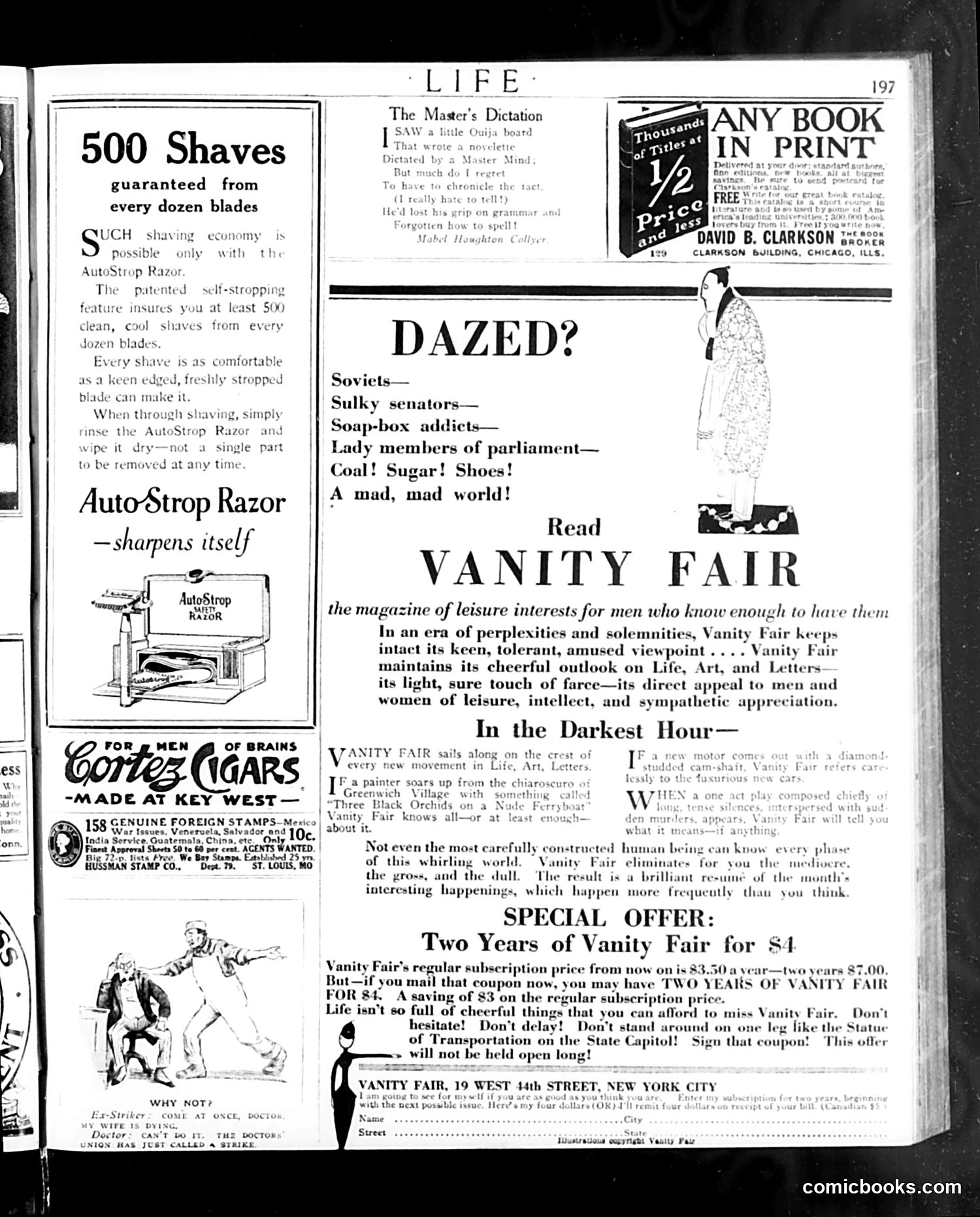
The "DAZED?" advertisement for Vanity Fair magazine satirizes contemporary concerns of the 1920s-30s era by listing bewildering social and political phenomena: "Soviets—Sulky senators—Soap-box addicts—Lady members of parliament—Coal! Sugar! Shoes! A mad, mad world!" This reflects anxieties about: - **Soviet communism** (Cold War fears) - **Political gridlock** (uncooperative senators) - **Women's political participation** (still novel; women gained U.S. voting rights in 1920) - **Economic shortages and inflation** (coal, sugar, shoes scarcities) The satire positions Vanity Fair as a refuge from this chaos—a magazine offering "leisure interests" and an "amused viewpoint" for sophisticated readers who can afford detachment. The pitch essentially says: "The world is bewildering and mad; escape into our magazine." The remainder of the page contains standard period advertisements (AutoStrop Razors, cigars, books) typical of Life magazine's format.
This is an **advertisement for advertising itself**, not a cartoon. It's a earnest (not satirical) piece promoting the social and economic benefits of advertisements. The page argues that national advertising creates national unity by exposing Americans across regions—from Oregon to New York to Arizona—to identical products and messages. The named characters (Jim Hawkins, Cousin Peter) exemplify this: they're geographically separated but share consumer experiences through ads. The argument reflects **early 20th-century advertising industry thinking**: that standardized national marketing breaks down regional divisions, fosters common ground, and improves consumer choice and value. A modern reader should recognize this as **corporate advocacy disguised as social commentary**—claiming advertising serves national cohesion rather than profit. By today's standards, the pitch appears naive or propagandistic: it conflates commercial consumption with genuine cultural unity and uncritically assumes advertised goods are inherently superior to unadvertised ones. The ad is signed by LIFE's advertising department, making clear this is industry self-promotion.
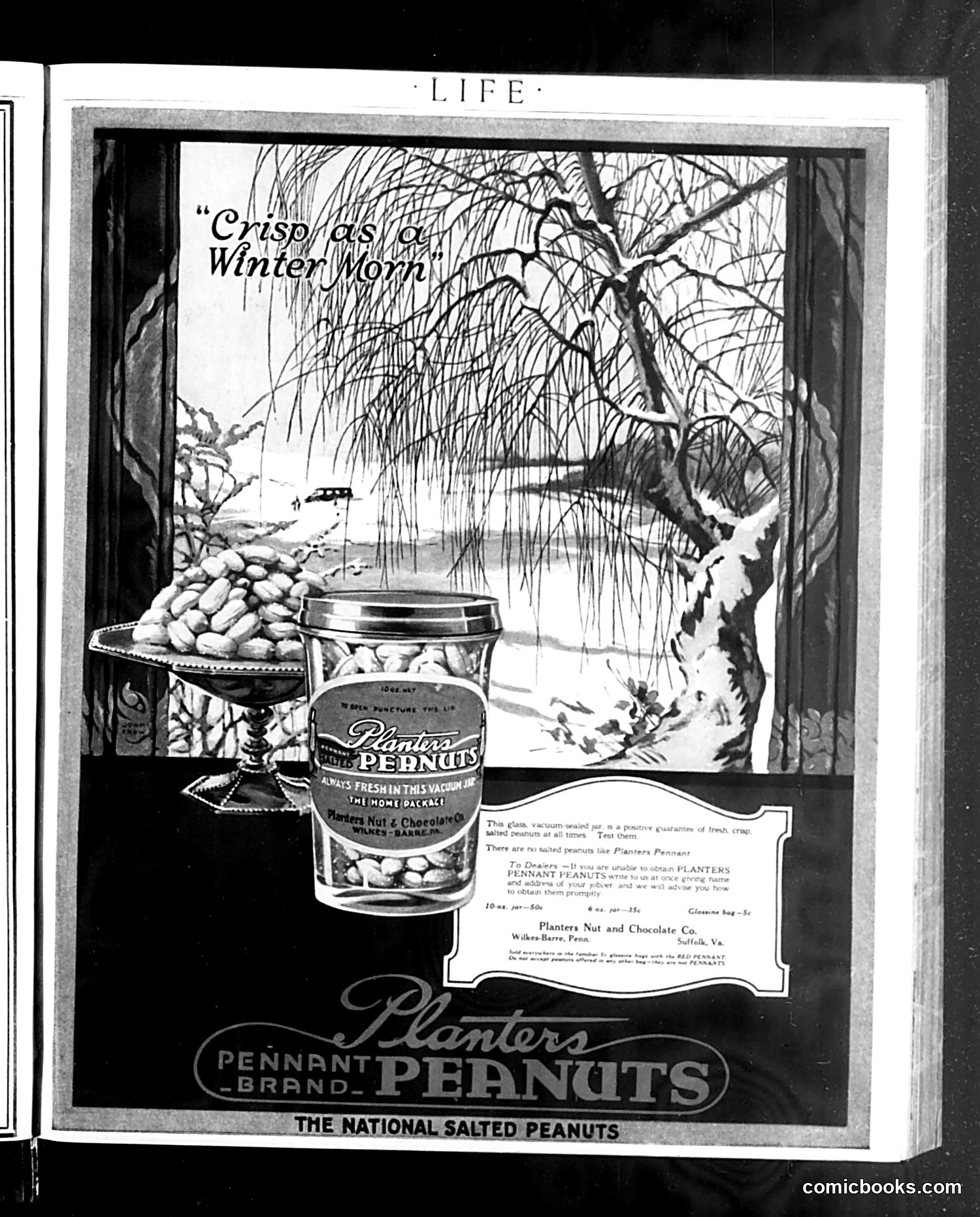
This is a **Planters Pennant Brand Peanuts advertisement**, not a political cartoon or satire. The page appears in *Life* magazine and promotes the product with the tagline "Crisp as a Winter Morn." The ad features a winter landscape scene viewed through a window, with snow-covered willow branches and a frozen pond. A jar of Planters peanuts sits prominently in the foreground on a decorative pedestal alongside a bowl of nuts. The copy emphasizes freshness ("always fresh in this vacuum jar") and positions the product as wholesome winter comfort food. The "national salted peanuts" reference at bottom confirms this is straightforward commercial advertising rather than editorial content or satire.
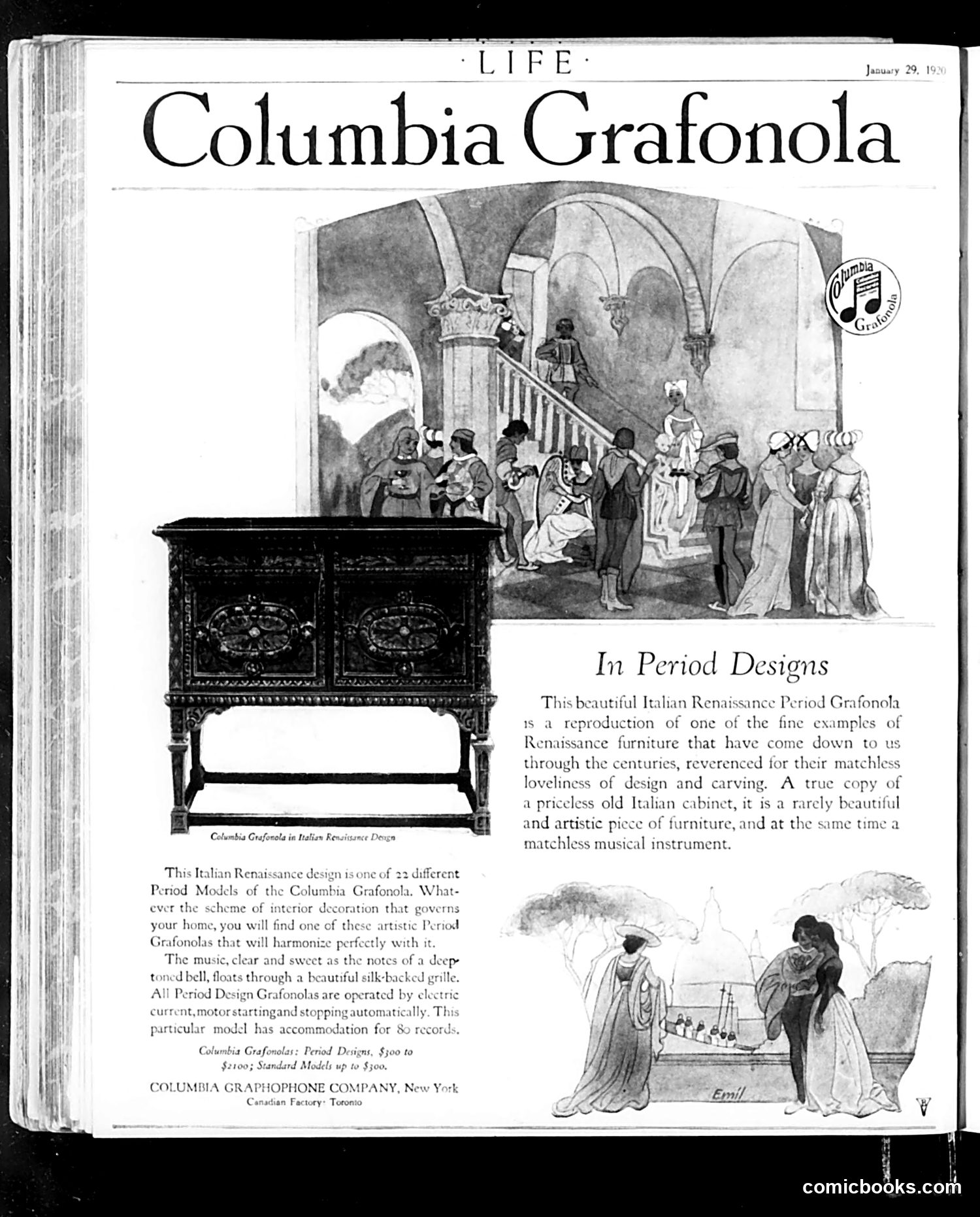
This is **not a political cartoon or satire**—it's a straightforward commercial advertisement for the Columbia Grafonola, a phonograph/gramophone player. The page promotes a luxury phonograph designed in Italian Renaissance style, marketed as both fine furniture and a musical instrument. The illustrated vignettes show wealthy, well-dressed people in elegant period settings enjoying music, positioning the device as a status symbol for affluent homes. The ad emphasizes craftsmanship, historical authenticity, and artistic value—appealing to early 20th-century consumer desires for cultured sophistication. The pricing ($500-$1500) and reference to Canadian manufacturing indicate this targets upper-middle-class buyers. There is no satirical commentary or political messaging visible. This is period advertising designed to sell a premium consumer product through aspirational imagery.