
A complete issue · 20 pages · 1906
Life — March 22, 1906
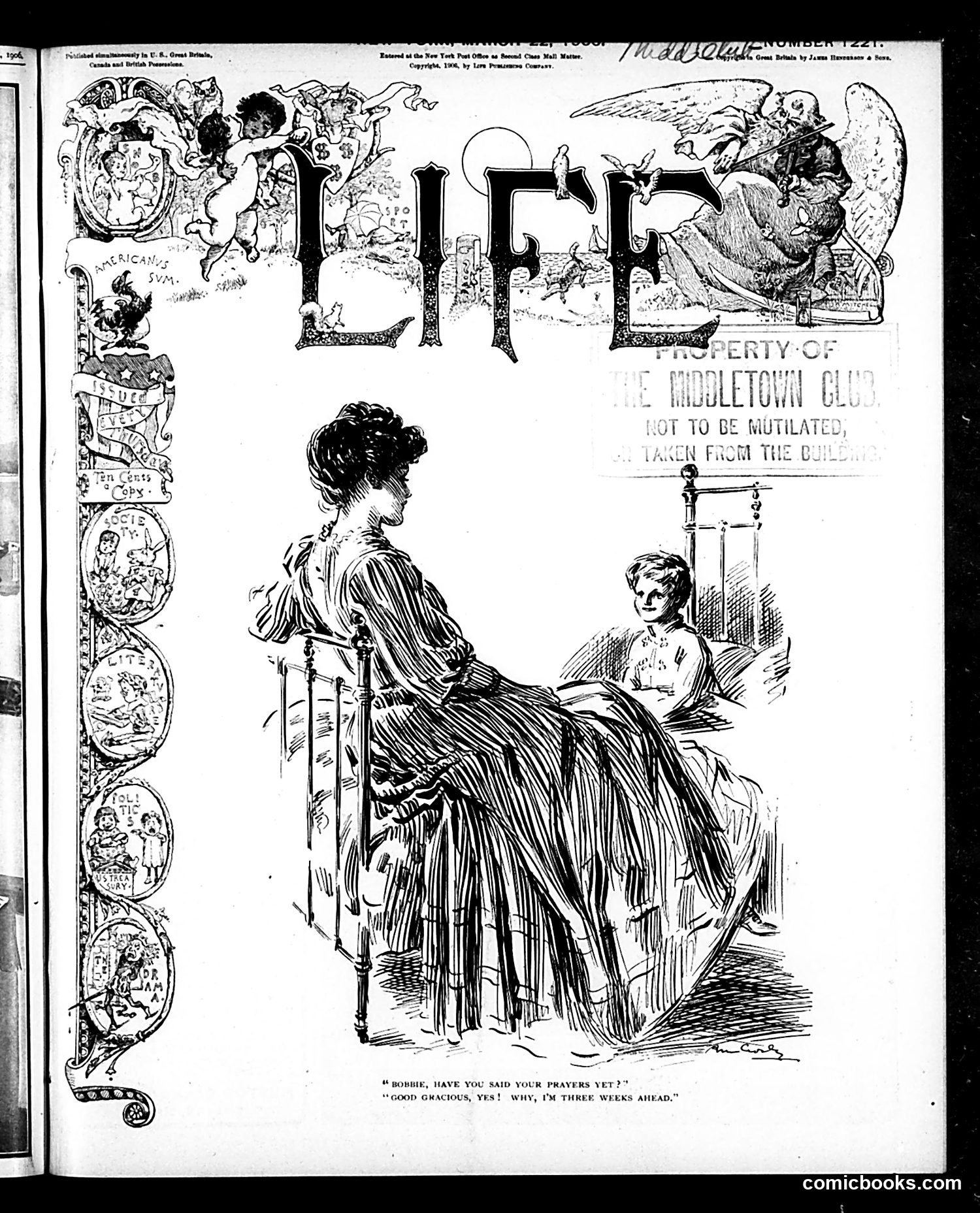
This appears to be a cover or feature page from Life magazine's satirical section. The large decorative "LIFE" masthead dominates the upper portion, surrounded by ornamental illustrations including cherubs and classical imagery. The main illustration depicts a woman speaking with a young child, with the dialogue: "ROBBIE, HAVE YOU SAID YOUR PRAYERS YET?" / "GOOD GRACIOUS, YES! WHY, I'M THREE WEEKS AHEAD." The joke satirizes modern childhood efficiency or precocity—the child has apparently gotten so far ahead with religious duties that they're already three weeks in advance. This likely mocks either overzealous parenting, rigid scheduling culture, or the way children are being pushed toward adult-like organization and responsibility. The decorative border on the left contains various circular vignettes with period illustrations, typical of Life's ornamental design style from this era.
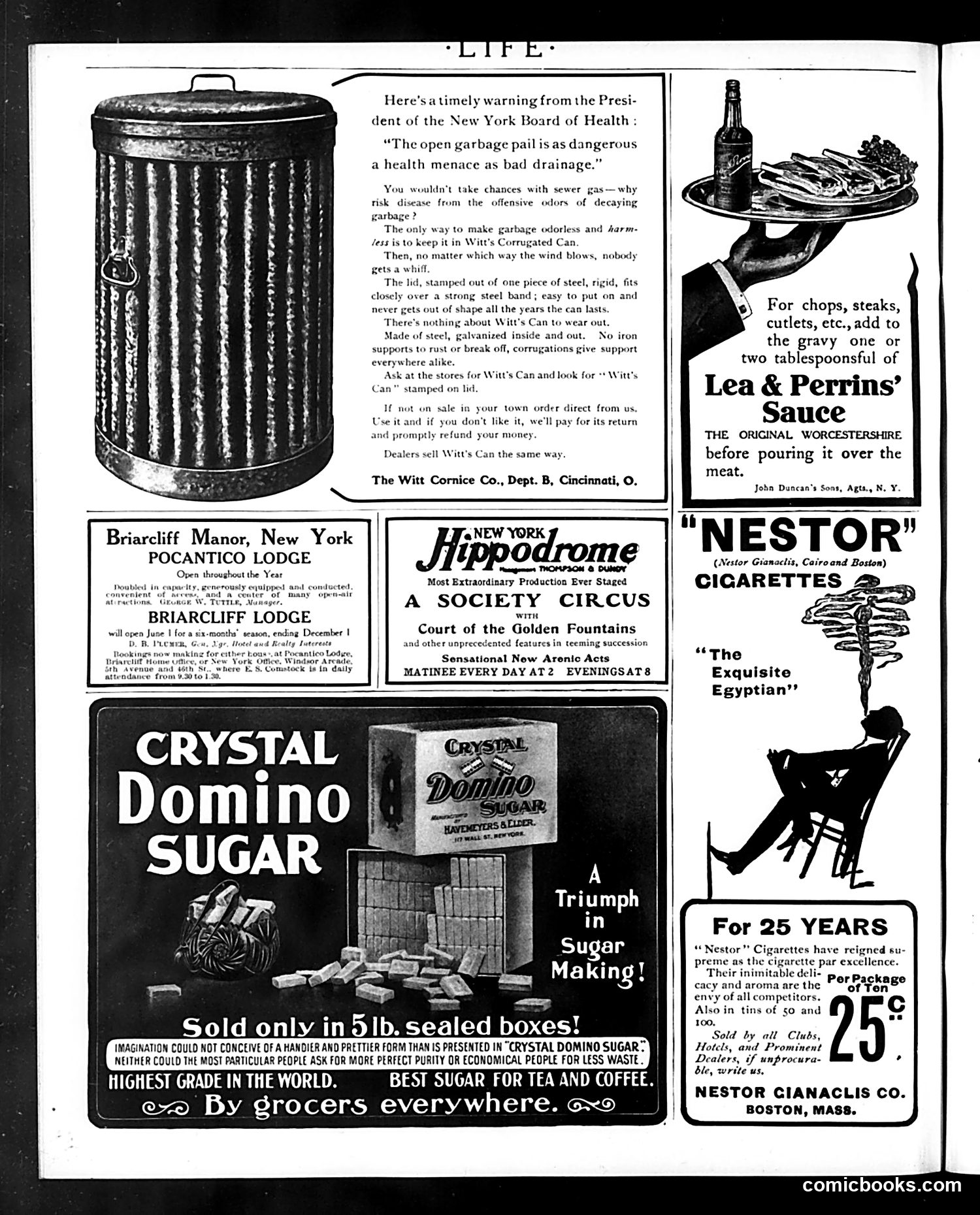
This page is primarily **advertising**, not satirical content. It contains five distinct commercial advertisements: 1. **Witt's Corrugated Can** — a garbage container promoted for odor control and hygiene, endorsed by New York's Board of Health 2. **Briarcliff Manor Lodge** — a resort hotel advertisement 3. **Hippodrome theatre** — promoting a "Society Circus" show 4. **Crystal Domino Sugar** — emphasizing purity and quality for tea/coffee 5. **Nestor Cigarettes** — marketed as "The Exquisite Egyptian" brand, priced at 25¢ The Lea & Perrin's Sauce advertisement appears as well. These are standard early 20th-century product endorsements with period-appropriate design and claims. There are **no political cartoons or satirical commentary** visible on this page—it's a straightforward advertising section from *Life* magazine.
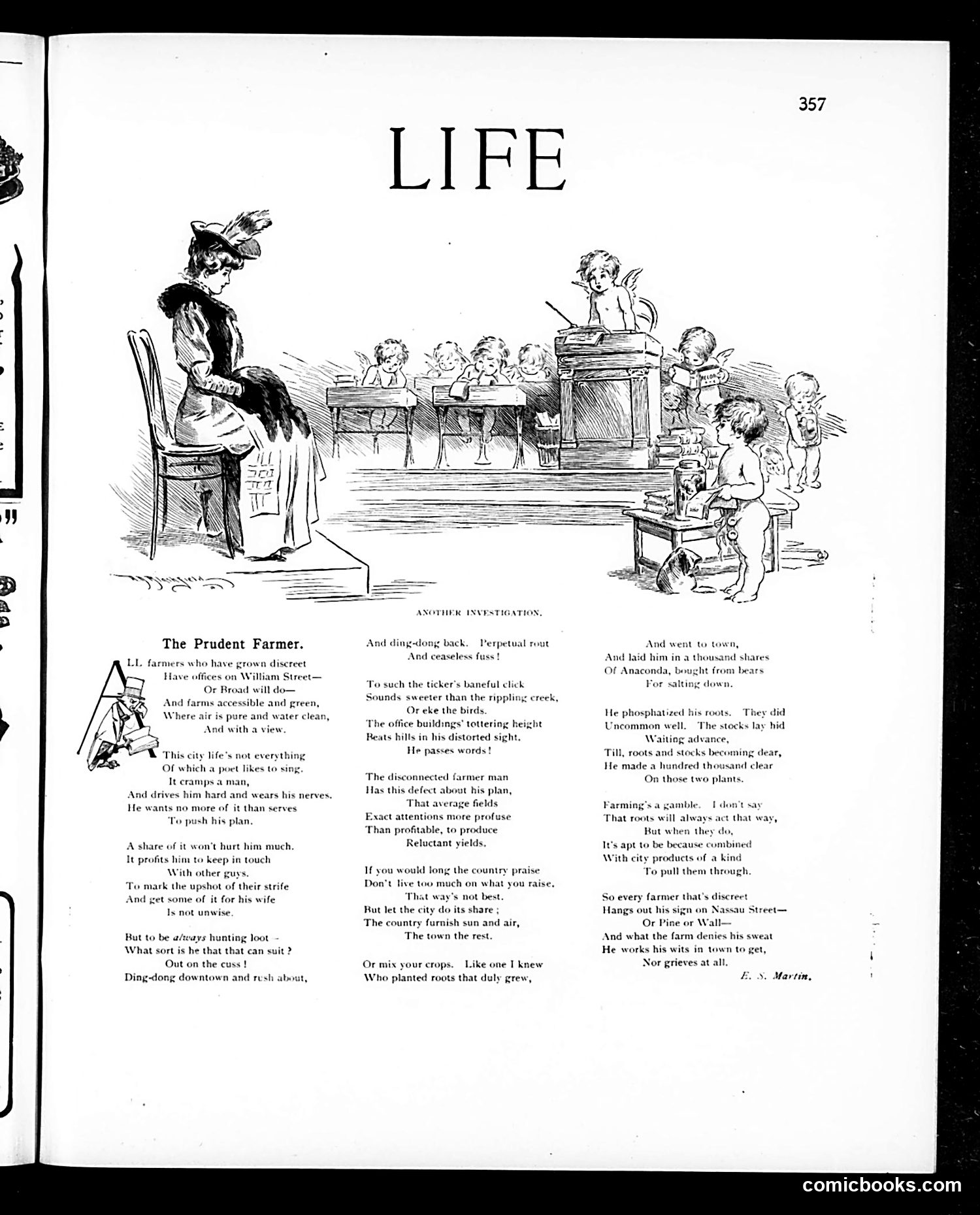
This page satirizes urban attitudes toward farming and rural life. The illustration shows a schoolteacher instructing children about agriculture while apparently disconnected from actual farming reality. The poem critiques a "prudent farmer" who maintains offices on Wall Street rather than working the land, and who treats farming as a financial investment rather than genuine agricultural work. The satire targets the disconnect between city-based speculation about farming and the actual labor involved. The piece mocks genteel urban pretensions about rural life—suggesting wealthy urbanites dabble in farming as a status symbol or financial scheme while remaining ignorant of real agricultural practice. The children's classroom setting emphasizes how this romanticized, impractical view of farming gets perpetuated through education.
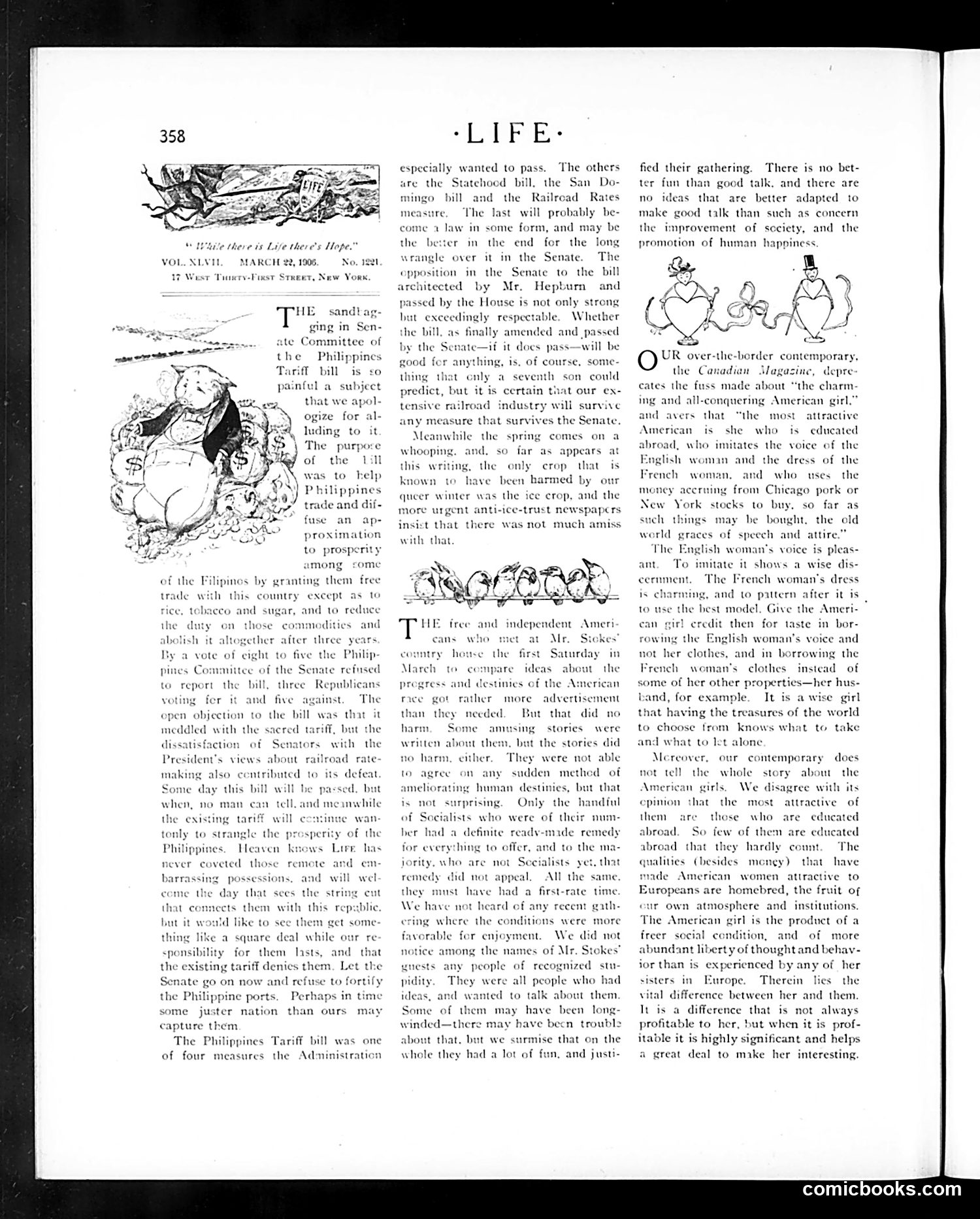
The page contains two editorial illustrations accompanying articles about tariff legislation and American women's attractiveness. The **left cartoon** depicts the Philippines Tariff bill as a chaotic scene with competing interests—likely representing various political factions and business lobbies fighting over trade policy. The imagery suggests the bill's complexity and the contentious debate surrounding Philippine commerce and tariff protections. The **right illustration** shows stylized female figures, accompanying an article praising American women's superiority over European counterparts. The piece celebrates American girls as more independent and charming than English or French women, reflecting early 1900s attitudes about national identity and gender. Both cartoons employ satirical visual humor typical of Life magazine's social and political commentary of this era.
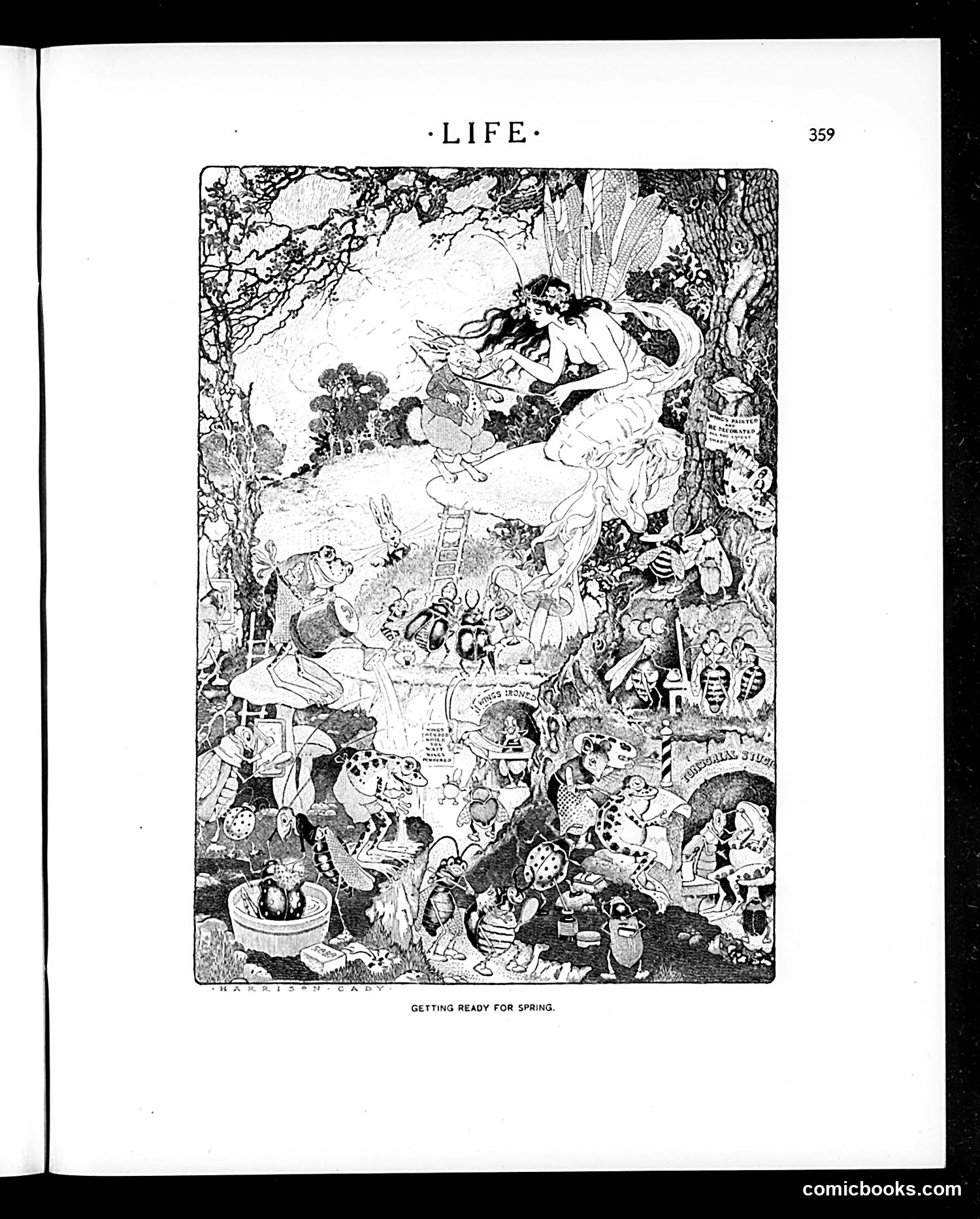
This intricate illustration by Harrison Cady depicts a whimsical woodland scene where anthropomorphic animals and fantastical creatures prepare for the spring season. The composition teems with activity—animals cleaning, organizing, and making repairs to their homes and surroundings. The satire likely reflects human spring-cleaning customs through an animal lens, humorously suggesting that even wildlife engages in seasonal preparations and domestic labor. The densely packed scene with numerous small figures and details creates a busy, chaotic energy that emphasizes the collective effort involved in "getting ready" for the new season. Without additional context from surrounding articles, the specific contemporary social commentary remains unclear, though the work appears to be gentle, nature-focused humor typical of Life magazine's illustrated content.
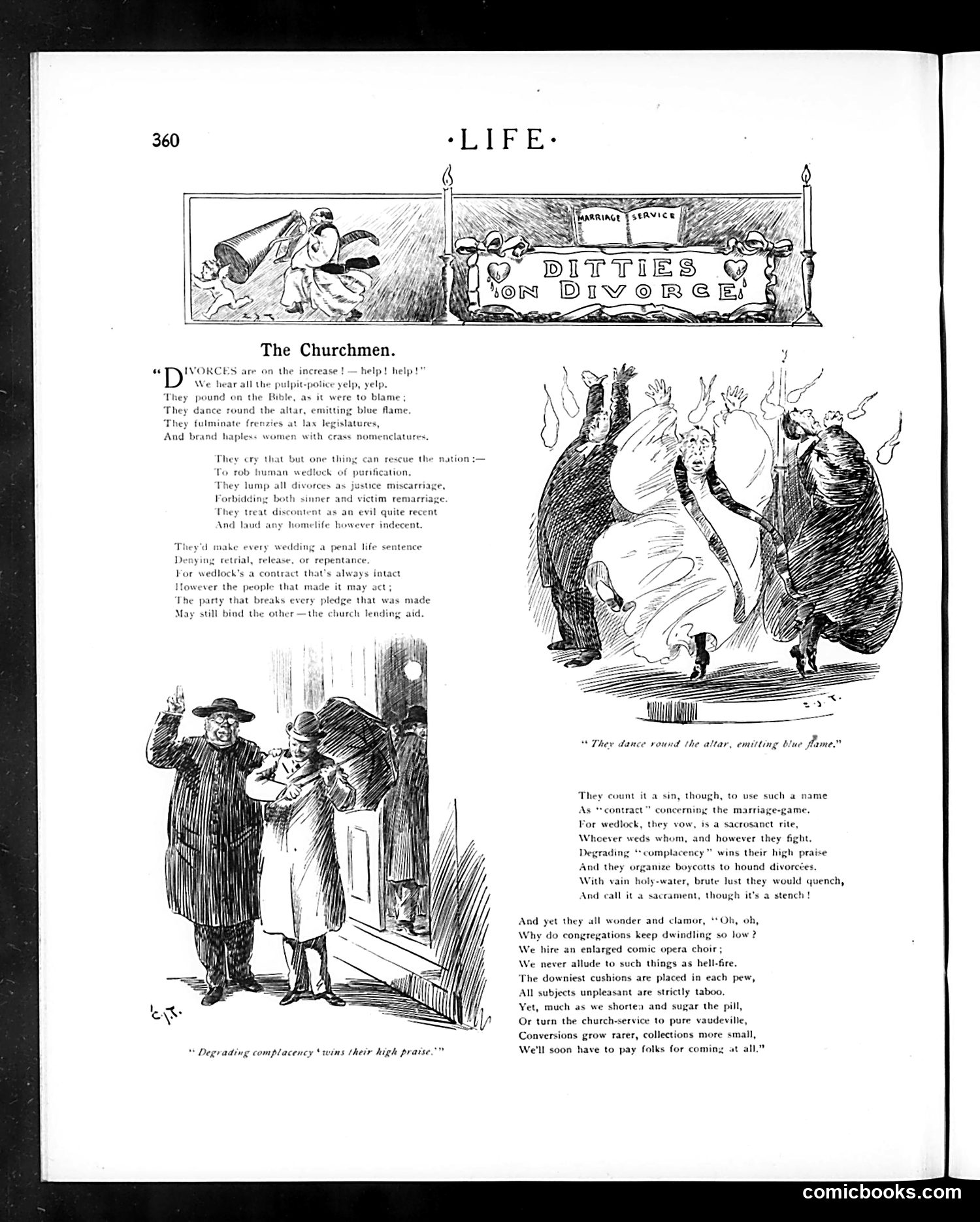
This satirical piece critiques clergy who loudly oppose divorce while ignoring their own institutional failures. The poem describes churchmen blaming the Bible for rising divorces, calling it a "justice miscarriage," yet doing nothing substantive to prevent them. The cartoons depict clergymen in various states of hypocrisy: one pair of devils "dancing round the altar, emitting blue flame" illustrates the chaos clergy claim divorce causes; another shows a clergyman "degrading complacency" receiving "high praise." The satire's core message: churches organize boycotts and employ rhetoric about "sacraments" and "compliancy," but their real solution—lowering church contributions or reforming actual practices—never materializes. The clergy profit symbolically while accomplishing nothing practical.
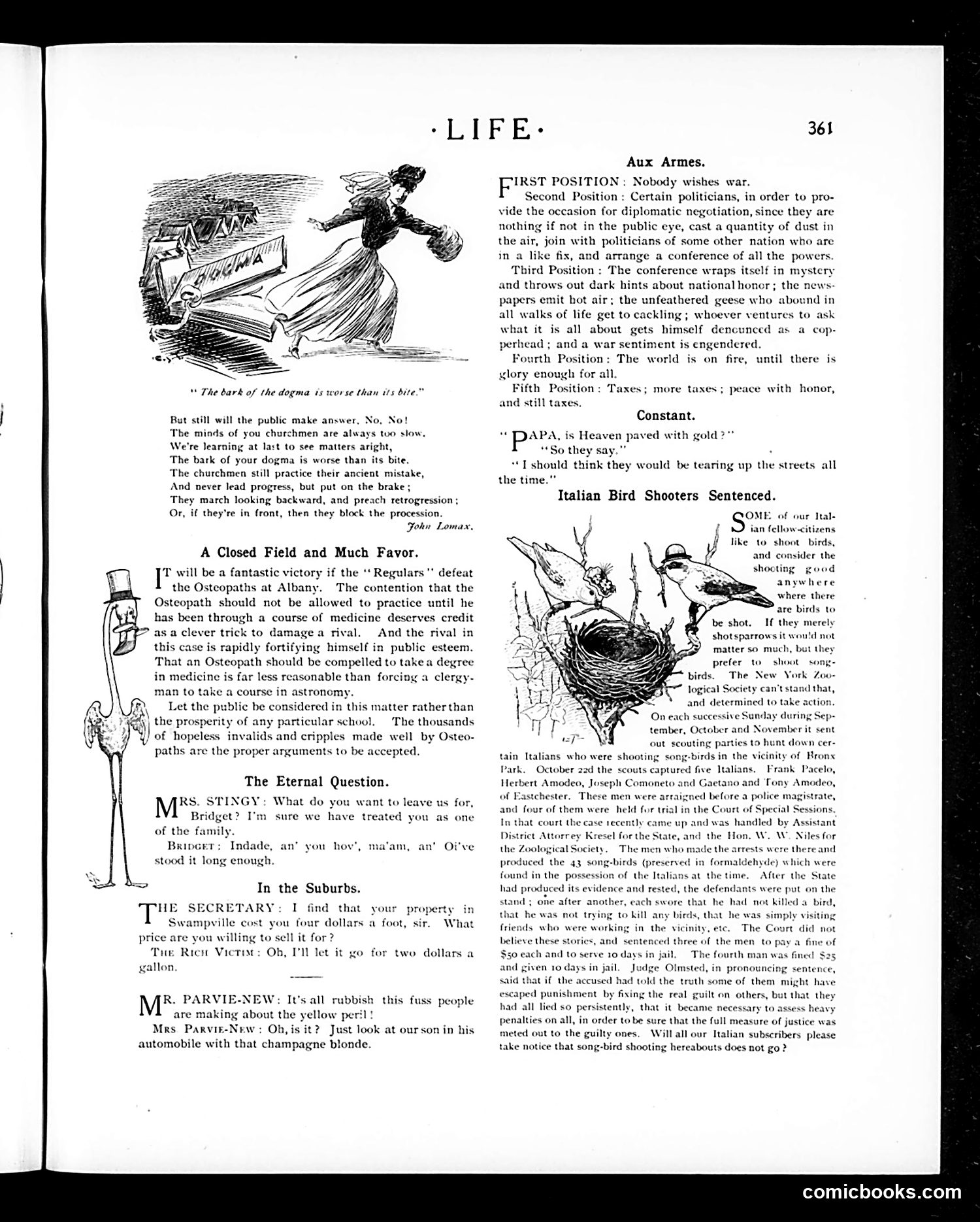
This page satirizes how politicians manufacture public support for war through propaganda and staged diplomacy. The cartoon shows a figure riding on what appears to be a dogma or abstract concept, illustrating the satirist's point that war justifications are built on flimsy ideological foundations. The text mocks five progressive positions politicians adopt: denying they want war, arranging diplomatic theater for public appearance, hinting at national honor to inflame sentiment, capitalizing on widespread anxiety, and ultimately declaring war inevitable. The satire targets how politicians manipulate public opinion by creating artificial crises, involving media spectacle, and appealing to national pride—all while maintaining plausible deniability about their true intentions. The piece critiques the cynical machinery of manufacturing consent for military conflict.
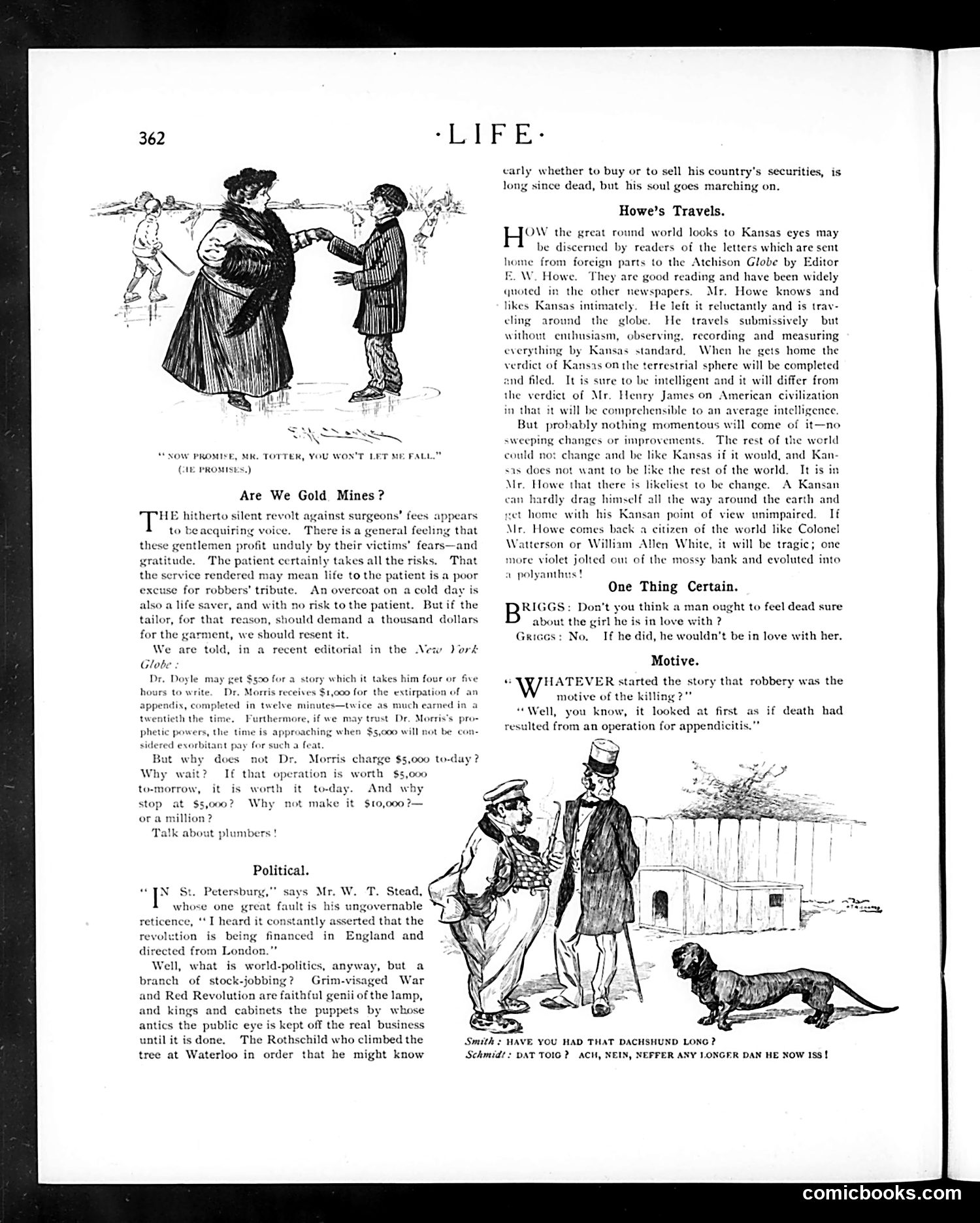
This page contains three separate satirical pieces: 1. **"Are We Gold Mines?"** critiques surgeons' fees, arguing that doctors charge exorbitant rates ($5,000) for procedures that take minimal time, comparing their profit margins to robbery. 2. **"Howe's Travels"** discusses Editor E.W. Howe's circumnavigation and his Kansas perspective on world affairs, suggesting Kansans view themselves as authoritative judges of civilization. 3. **"Political"** mocks British politics, specifically referencing W.T. Stead's claim that England's revolution is "directed from London." The satire suggests that powerful financial interests (like the Rothschilds) secretly control political outcomes while the public remains distracted. The dachshund cartoon below presents a domestic joke about the dog's longevity.
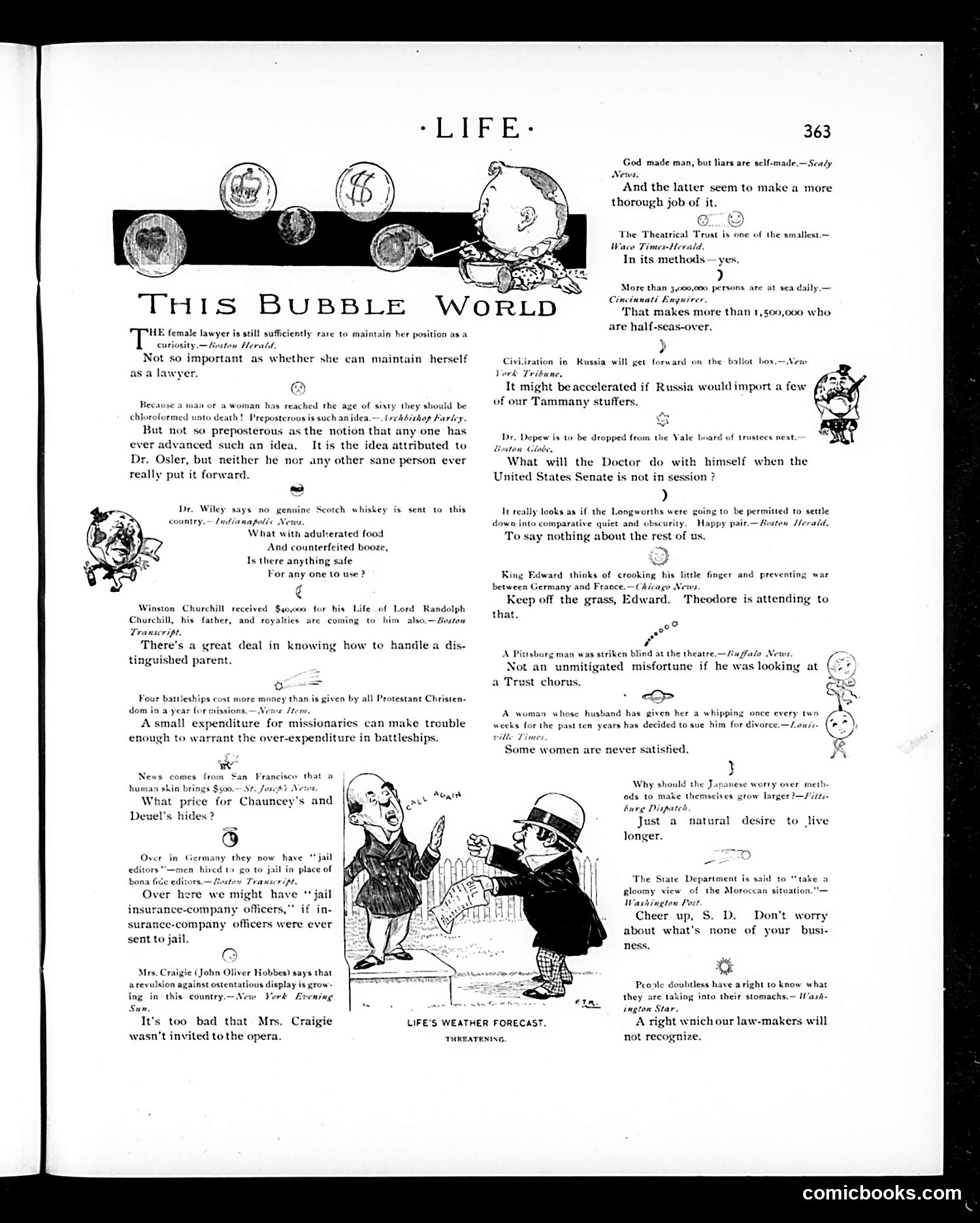
This satirical page combines short witty commentary with cartoon illustrations. The main cartoon, "Life's Weather Forecast - Threatening," depicts two men in formal dress appearing to argue or debate, likely representing political or social figures engaged in contemporary disputes. The surrounding text mocks various topics: absurd ideas attributed to Dr. Osler, adulterated whiskey imports, and questions about Dr. Wiley's food safety work. References to Winston Churchill, the Theatrical Trust, and discussions of Russian immigration suggest early 1900s American concerns. The page's title "This Bubble World" suggests the content satirizes inflated egos, foolish notions, and unstable situations. Without clearer identification of specific figures or exact dates, the precise political targets remain unclear, though the tone is decidedly critical of contemporary institutions and public figures.
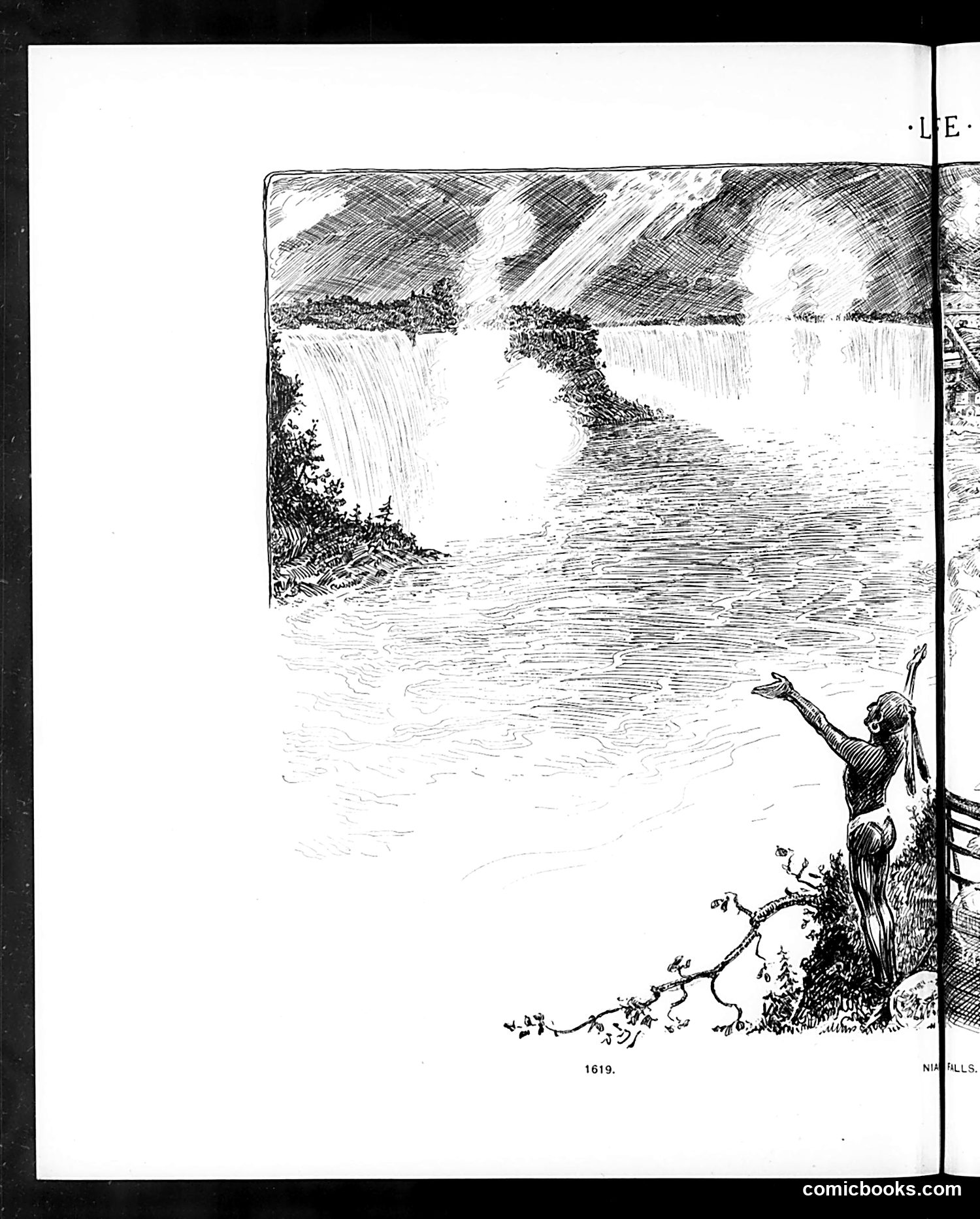
This is an ink sketch depicting a classical or allegorical female figure standing at the edge of a body of water, pointing outward toward a distant landscape. The figure appears nude or partially draped and is positioned near a gnarled tree branch in the foreground. The image's style and composition suggest it may be illustrative rather than satirical—possibly a romantic or philosophical commentary on nature, contemplation, or human connection to landscape. Without accompanying text visible on this page, the specific political or social message is unclear. The reference number "1619" and "NIAGARA HILLS" notation at bottom may indicate the illustration's location or publication details, but the cartoon's precise satirical intent cannot be determined from the image alone.
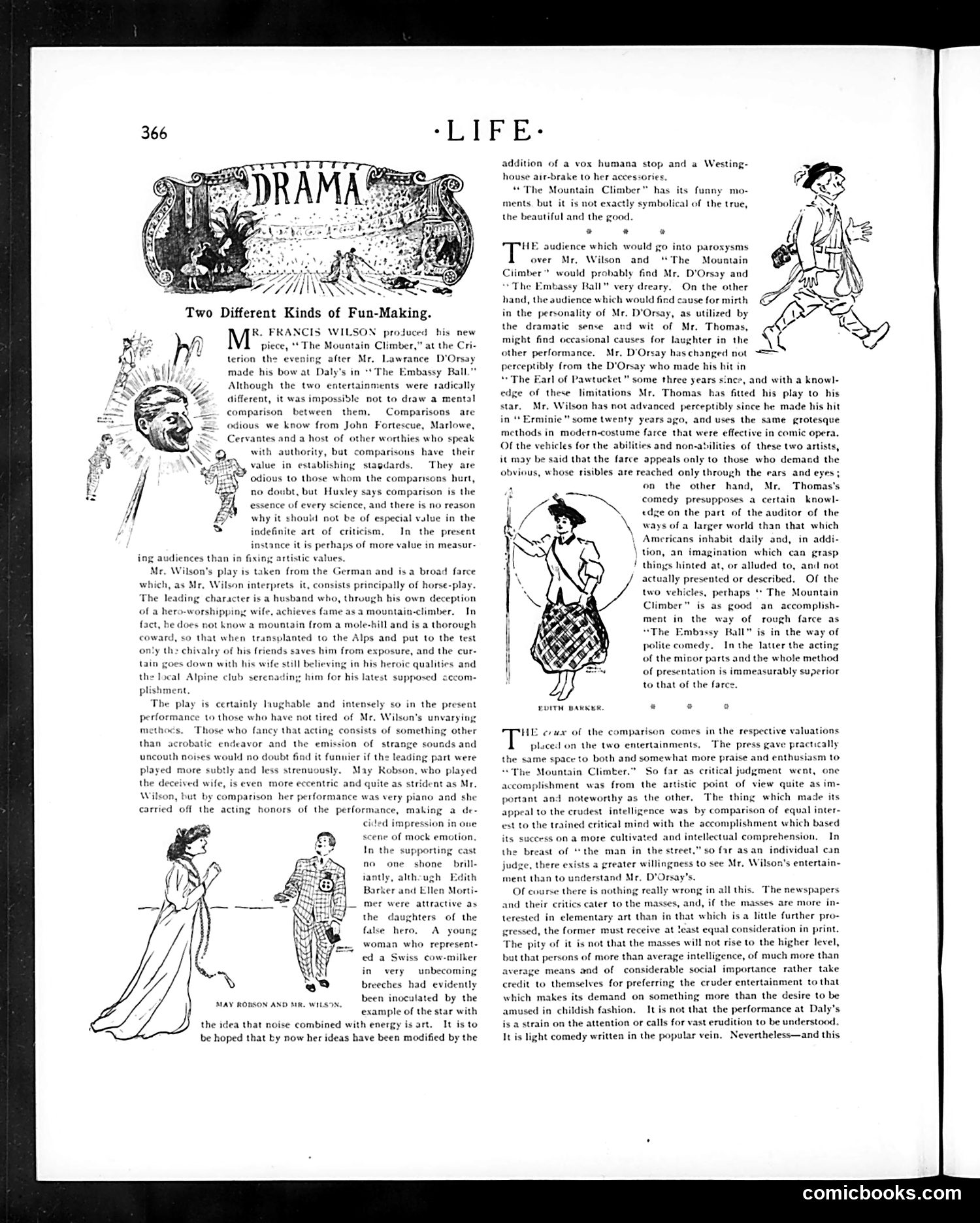
This page reviews two theatrical productions: "The Mountain Climber" and "The Embassy Ball," comparing their approaches to comedy. **The critique discusses:** - **"The Mountain Climber"**: A broad farce by Mr. Wilson featuring a husband deceiving his wife. The reviewer finds it "hugely laughable" but notes the acting relies on exaggerated physical comedy rather than wit. - **"The Embassy Ball"**: Described as more polished, with superior acting and refined comedic methods, though apparently less immediately hilarious. The reviewer argues that while "Mountain Climber" appeals to crude tastes through obvious jokes, "Embassy Ball" demonstrates superior artistry and appeals to more intelligent audiences. The page includes illustrations of performers (including one labeled "Edith Barker" and another showing "May Robson and Mr. Wilson"), exemplifying the theatrical performances discussed.
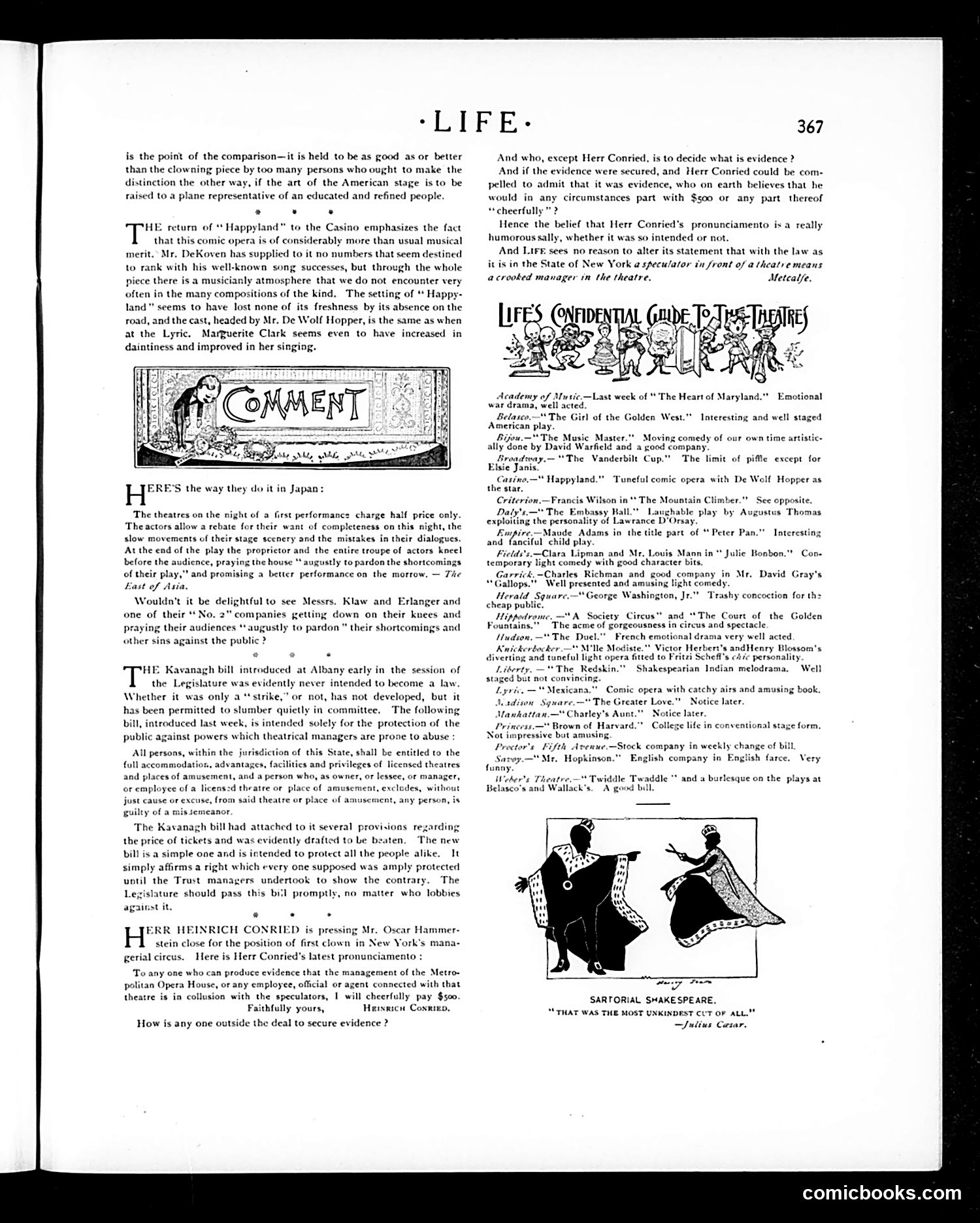
This page primarily contains theatrical reviews and commentary rather than political cartoons. The main illustration shows two figures in period costume labeled "Sartorial Shakespeare," depicting what appears to be a humorous comment on Shakespeare's clothing or theatrical presentation, credited to Jules César. The text discusses Japanese theatrical practices, debates about theater regulation (the Kavanagh bill), and includes a notable letter from Heinrich Conried, a Metropolitan Opera House manager, offering $500 to anyone who can provide evidence that his theater collaborated with speculators—suggesting ticket-scalping scandals affected major cultural institutions of the era. The page reflects early 1900s American theater world concerns: regulation, management ethics, and international theatrical traditions.
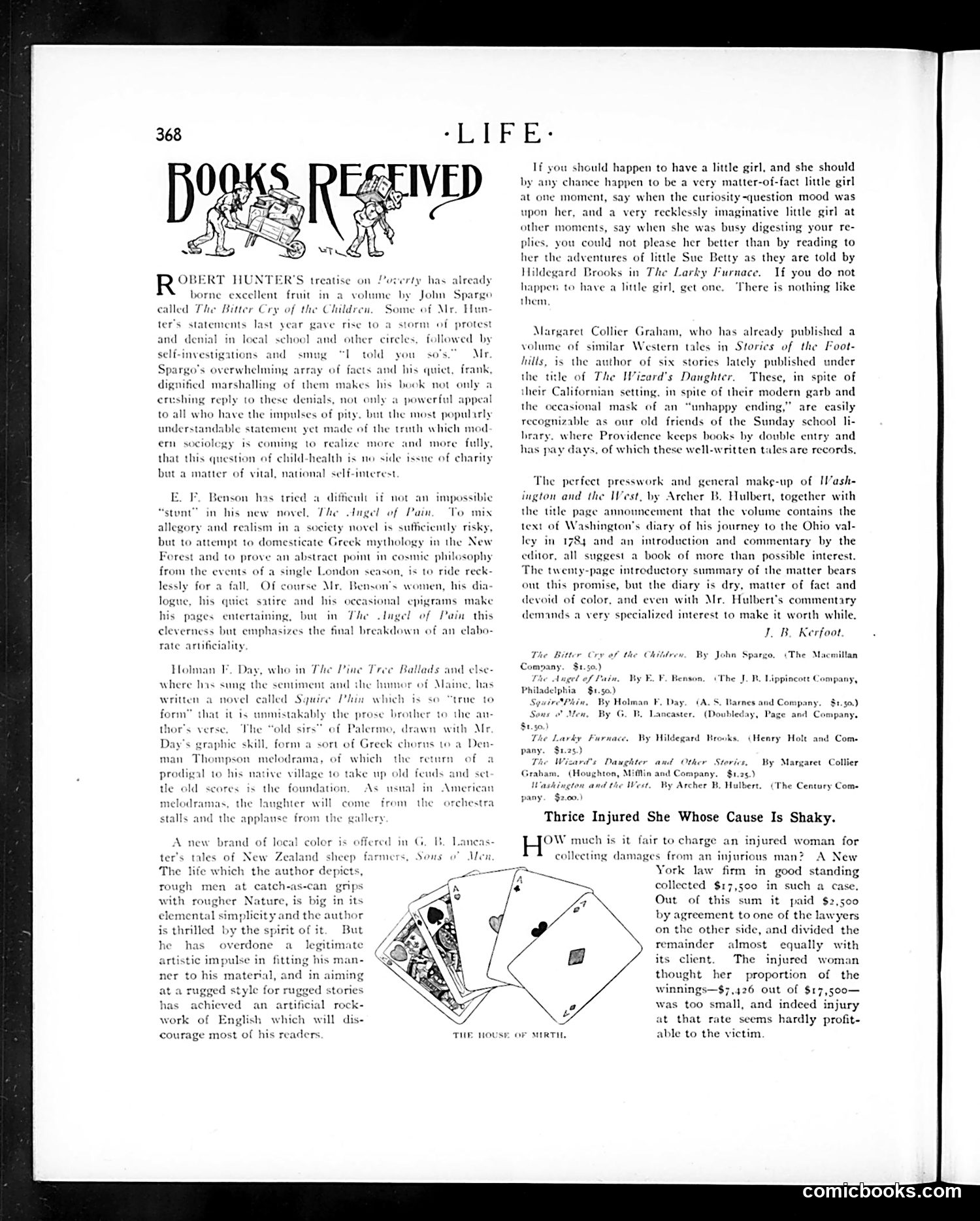
This page from *Life* magazine contains a book review section and an illustration titled "THE HOUSE OF MIRTH" depicting playing cards spread in a fan pattern. **The Illustration's Context:** The cards likely reference Edith Wharton's novel *The House of Mirth* (published 1905), which traces a socialite's financial and moral decline through gambling and poor choices. The playing cards symbolize chance, gambling, and the precariousness of wealth in high society—central themes of the novel. **Adjacent Article: "Thrice Injured She Whose Cause Is Shaky"** This discusses a legal case where an injured woman collected $17,500 in damages from a New York lawsuit. Her lawyer received $1,500 by agreement, leaving her only $2,426 of the remaining settlement—deemed "hardly profitable to the victim." The piece critiques how legal fees diminish injury compensation, making litigation economically unfavorable for injured parties despite ostensibly large damage awards. Together, these elements reflect *Life* magazine's satirical concern with social inequality and the systems (wealth, law) that disadvantage ordinary people.
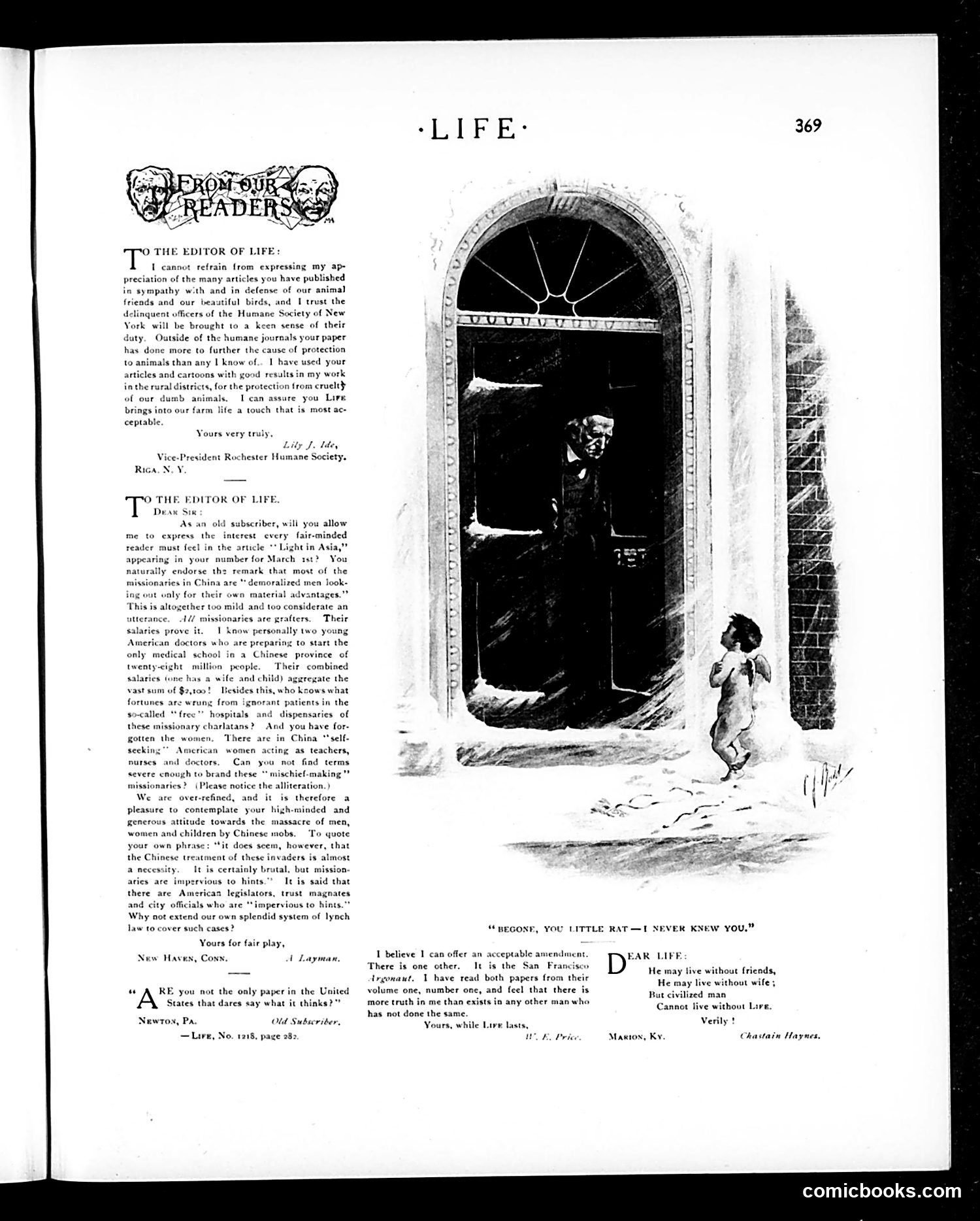
This page consists primarily of **reader letters to the editor**, with one accompanying cartoon. The main cartoon depicts a figure (appearing to be a rat or similar creature) being chased from a doorway by an angry resident, captioned "BEGONE, YOU LITTLE RAT—I NEVER KNEW YOU." The image illustrates a common domestic scene of pest removal, likely accompanying one of the letters about animal-related issues. The letters themselves address **Life magazine's editorial stance on animal welfare and missionaries in China**. One correspondent praises Life's advocacy for animal protection and humane treatment. Another criticizes Life's mild treatment of missionaries in China, sarcastically praising the magazine's "generous attitude towards the massacre of men, women and children by Chinese mobs" while questioning why similar protective standards don't apply to human victims. A third letter humorously claims Life is among the only American papers willing to publish unpopular truths. The page demonstrates Life's role as a **forum for public debate** on social and ethical issues of the era.
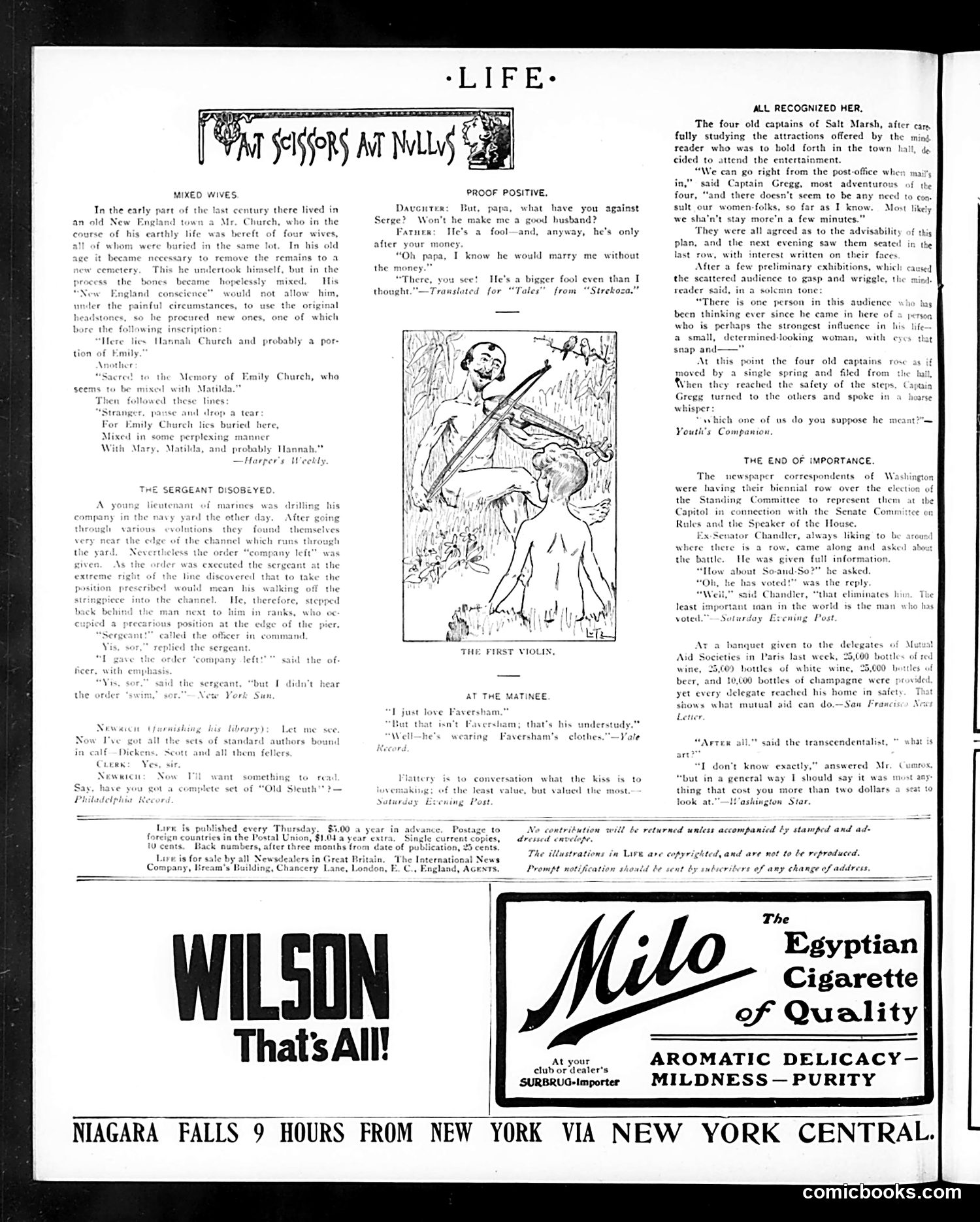
This page contains several brief satirical anecdotes typical of *Life* magazine's humor: **"Mixed Wives"**: A historical joke about a New England man (Mr. Church) who married four times and buried all wives in the same cemetery lot. When relocating the remains, he couldn't ethically use original gravestones since bodies were "mixed," creating an awkward epitaph acknowledging the jumbled remains. **"The Sergeant Disobeyed"**: A military discipline joke where a marine lieutenant orders "company left," and the sergeant, interpreting the command literally, steps off a pier into water. **"All Recognized Her"**: Four elderly sea captains from Salt Marsh attend a town hall performance, planning to leave quickly—but when the speaker mentions "the strongest influence" in their town (implied to be a formidable woman), they flee immediately, suggesting she's a domineering local figure they feared. **"The End of Importance"**: A political anecdote where Senator Chandler dismisses a man as "the least important man in the world"—because he actually *voted*, implying non-voters held more power in political circles. The page also includes period advertisements for Wilson cigarettes and Milo Egyptian Cigarettes.
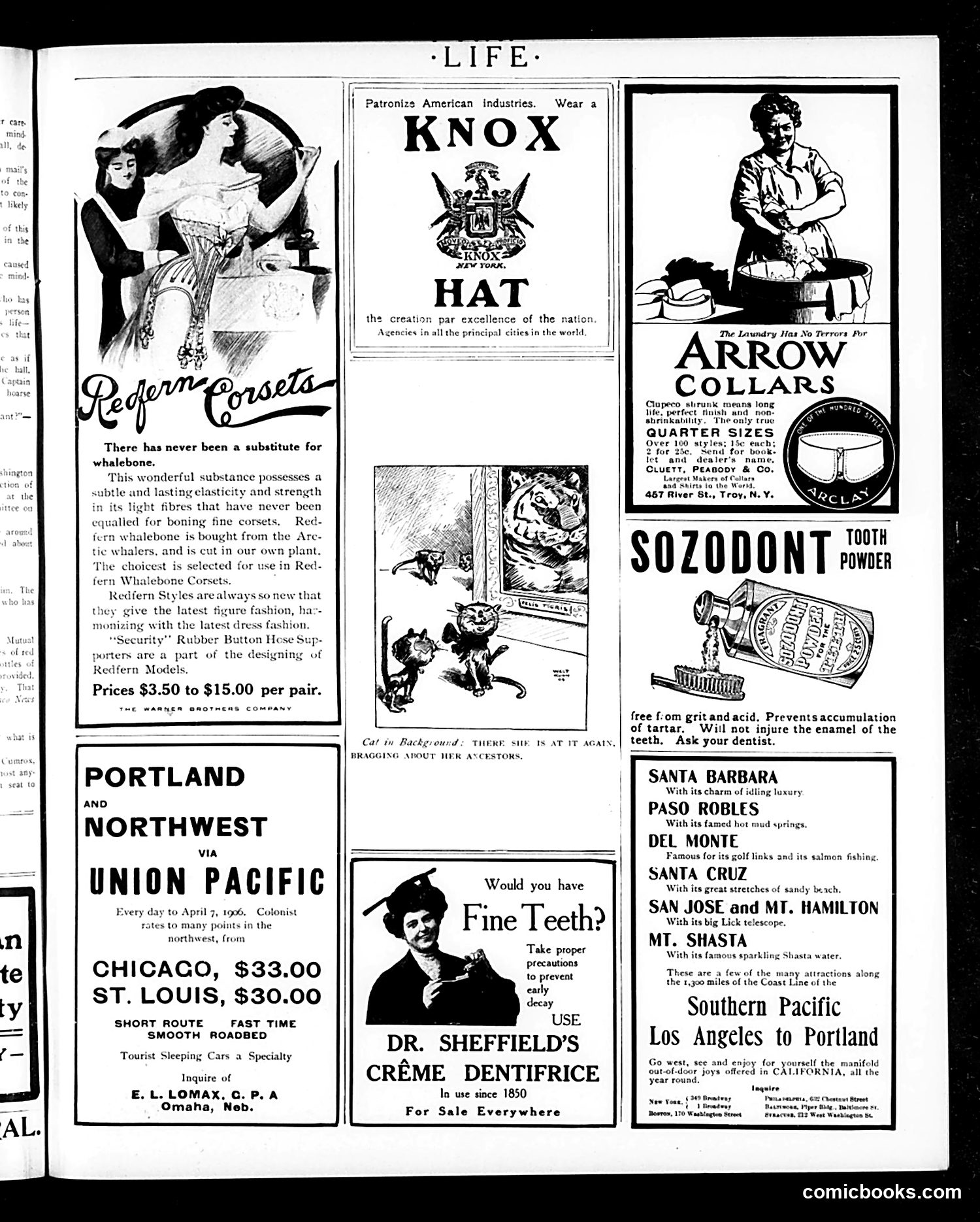
This page is primarily **advertising**, not satirical content. It contains commercial ads for products and travel services typical of early 1900s America. The one cartoon present shows a cat bragging about ancestry to another cat, captioned "There she is at it again, bragging about her ancestors." This is a gentle social satire mocking pretentiousness and ancestor-worship—a common theme suggesting that obsessing over one's lineage is foolish or snobbish. The ads themselves reflect period concerns: **Redfern Corsets** emphasize whalebone construction (then standard), **Knox Hats** promote American manufacturing, and dental products (**Dr. Sheffield's Crème Dentifrice**, **Sozodont**) address tooth decay. The **Southern Pacific** and **Union Pacific** railroad ads showcase California tourism destinations, reflecting the era's enthusiasm for westward travel and natural attractions. The page overall captures turn-of-century consumer culture and Victorian-era preoccupations with propriety, health, and leisure.
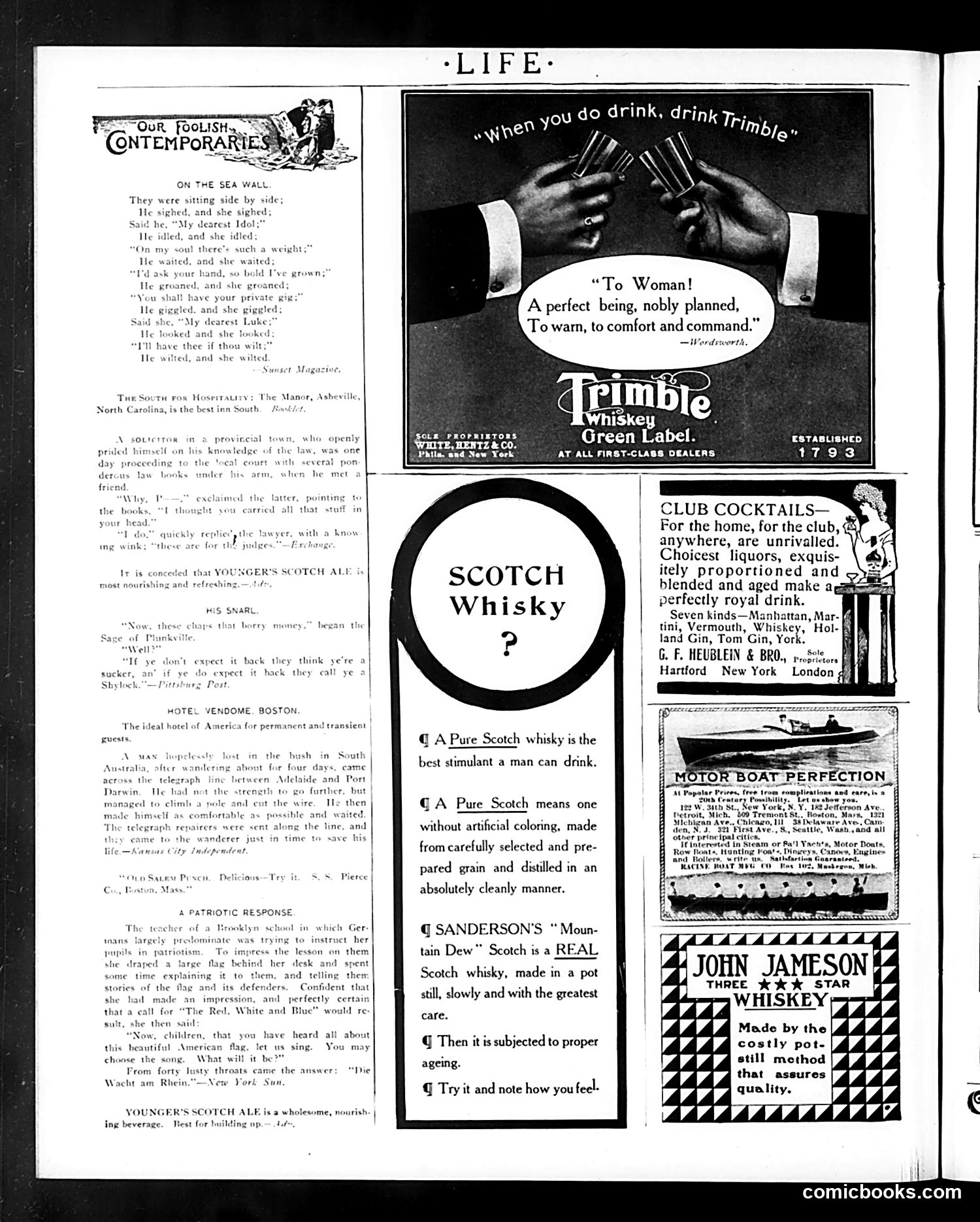
This page from *Life* magazine (established 1793, so clearly a satirical reprint or parody) is primarily **advertising**, featuring multiple whiskey and spirits ads from the Prohibition era or shortly after. The left column contains a brief satirical poem titled "Our Foolish Contemporaries: On the Sea Wall"—a romantic scene between a couple where the man repeatedly sighs, waits, and groans while the woman remains unmoved. The humor targets sentimental Victorian courtship rituals, mocking the predictable emotional performance. The right side displays liquor advertisements (Trimble Whiskey, Sanderson's Scotch, John Jameson, etc.) promoting various spirits as tonics and remedies. One ad quotes Wordsworth about "Woman" as a "perfect being," incongruously juxtaposed with drinking promotion. The satire suggests contemporary foolishness includes both overwrought romantic melodrama and the medicinal/health claims made by alcohol advertisers—likely mocking both gender relations and consumer marketing of the period.
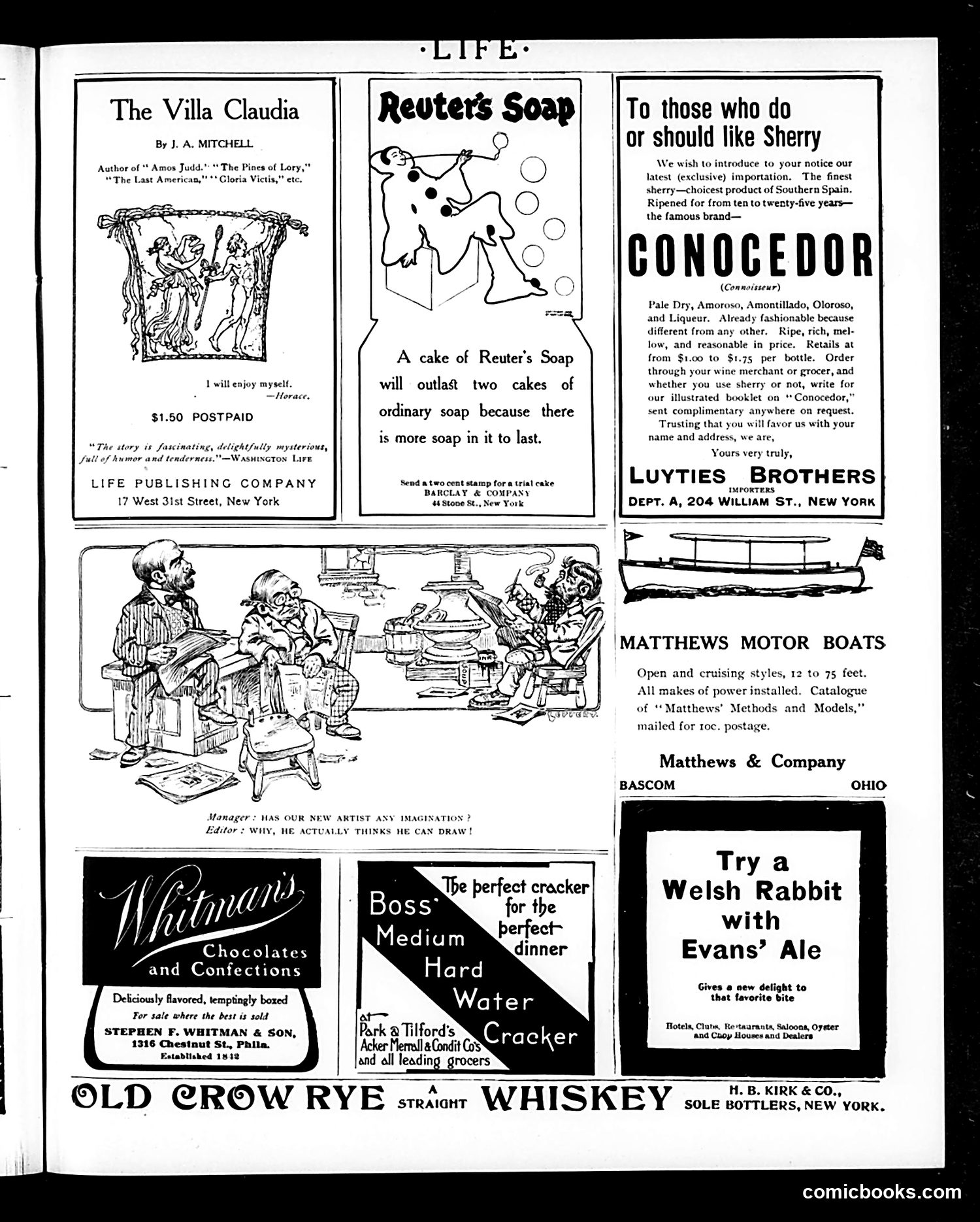
This page is primarily **advertising**, typical of Life magazine's revenue model. The layout includes: **Main content:** Advertisement for "The Villa Claudia," a novel by J.A. Mitchell, priced at $1.50 postpaid. **Satirical cartoon (center-left):** Shows an editor and manager discussing an artist's work. The joke: the manager asks if the new artist has imagination, and the editor replies "Why, we actually think he can draw!"—a mild jab at artistic pretension, suggesting that technical skill is underrated compared to claimed creativity. **Surrounding ads:** Reuter's Soap, Conocedor Sherry, Whitman's Chocolates, Matthews Motor Boats, Boss Crackers, Welsh Rabbit with Evans' Ale, and Old Crow Rye Whiskey—representing luxury consumer goods marketed to affluent readers. The page reflects early 20th-century Life as a vehicle for advertising upscale products to educated, wealthy audiences while maintaining light satirical humor.
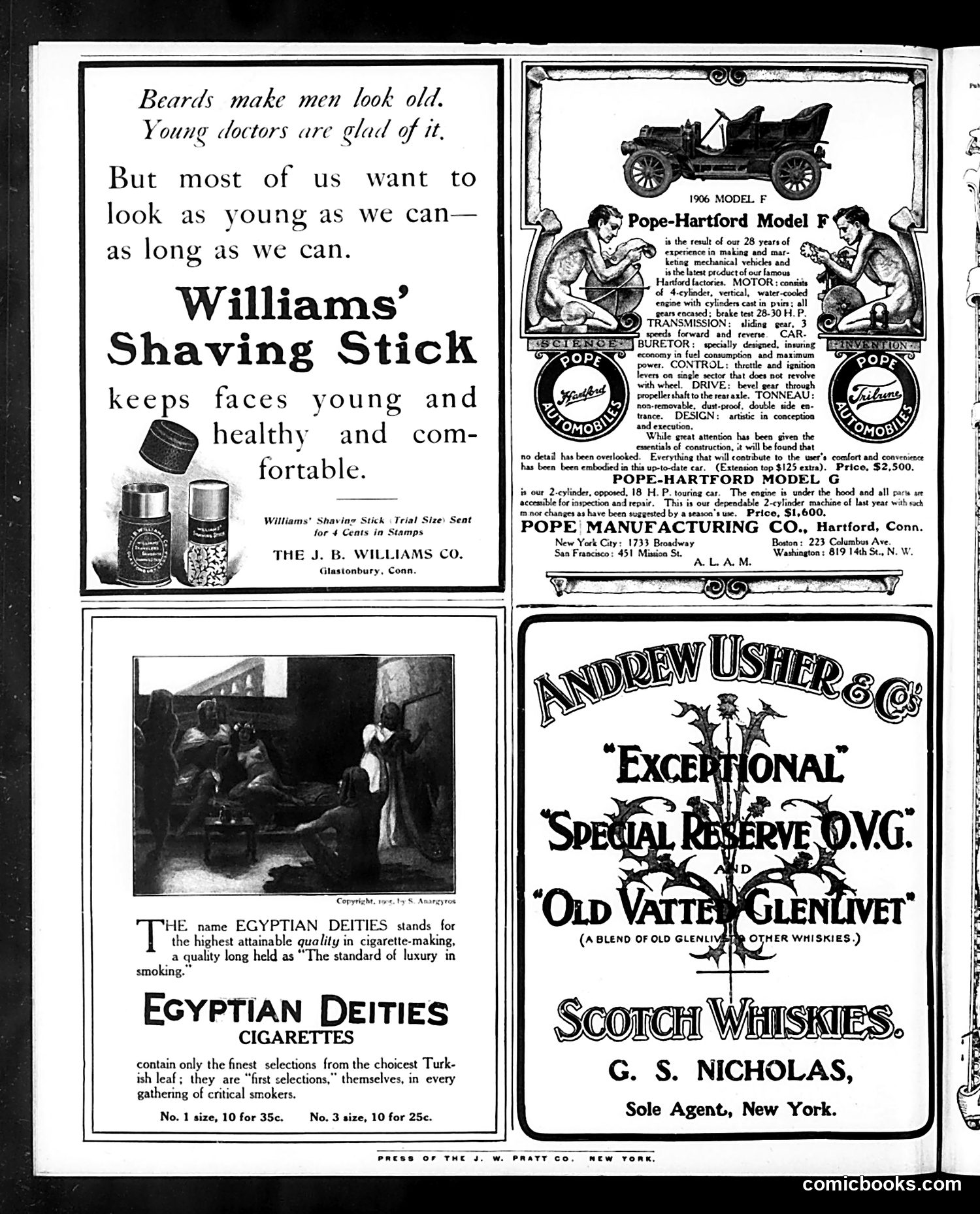
This is primarily an **advertising page**, not satirical content. It contains four product advertisements typical of early 1900s magazines: 1. **Williams' Shaving Stick** (top left): A straightforward ad claiming the product keeps faces "young and healthy and comfortable"—playing on contemporary anxieties about aging appearance, particularly beards making men look old. 2. **Pope-Hartford Automobiles** (top right): Detailed specifications for two car models ($2,500 and $1,600), representing luxury automobiles of the era. 3. **Egyptian Deities Cigarettes** (bottom left): Emphasizes quality Turkish tobacco as "the standard of luxury in smoking." 4. **Andrew Usher Scotch Whiskies** (bottom right): Advertises premium whisky brands. The page reflects **early 20th-century consumer culture** and male grooming/lifestyle concerns. There is no political satire visible—this appears to be standard magazine advertising revenue content rather than editorial commentary.