
Life, 1906-03-22 · page 12 of 20
Life — March 22, 1906 — page 12: what you’re looking at
What you’re looking at
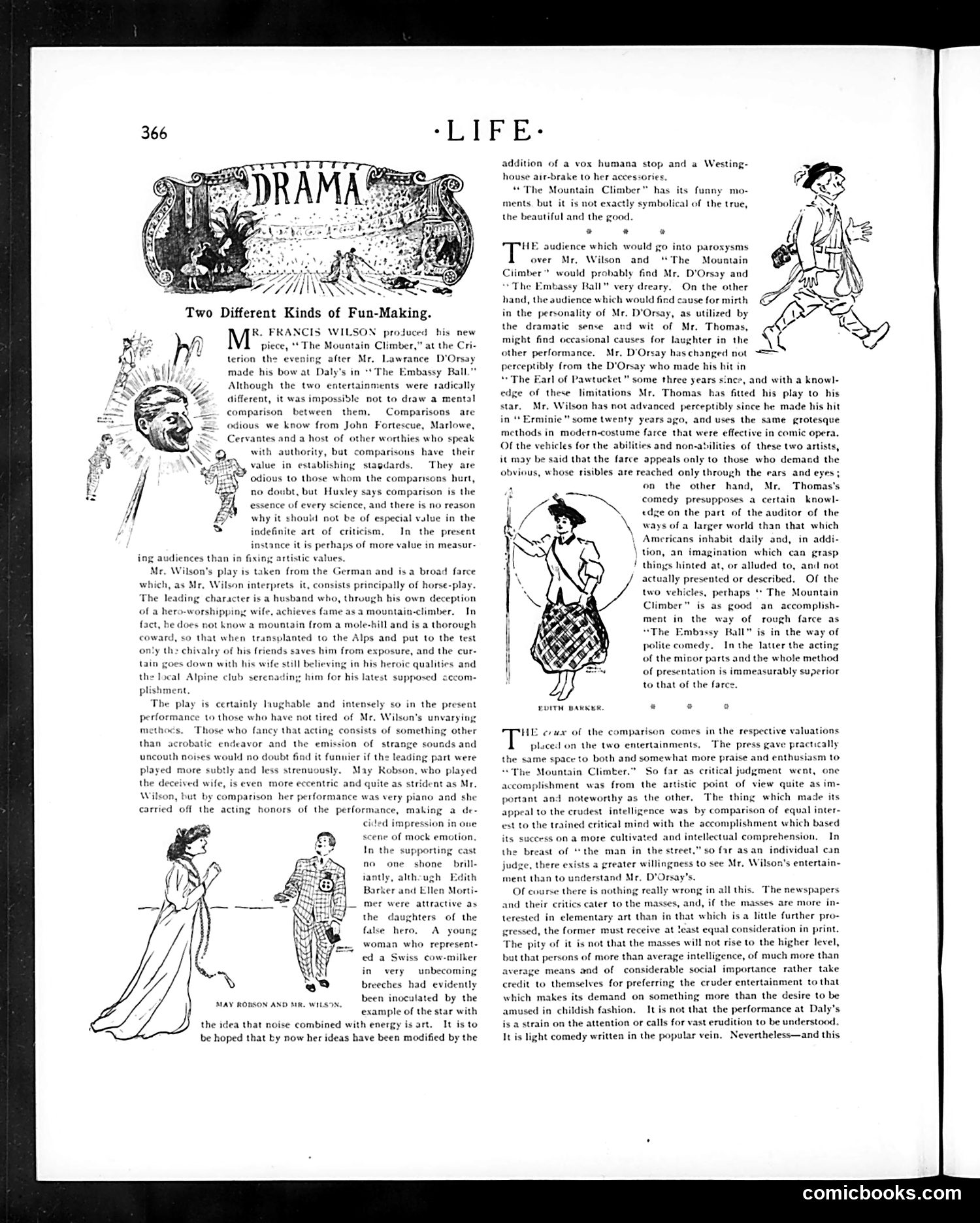
This page reviews two theatrical productions: "The Mountain Climber" and "The Embassy Ball," comparing their approaches to comedy. **The critique discusses:** - **"The Mountain Climber"**: A broad farce by Mr. Wilson featuring a husband deceiving his wife. The reviewer finds it "hugely laughable" but notes the acting relies on exaggerated physical comedy rather than wit. - **"The Embassy Ball"**: Described as more polished, with superior acting and refined comedic methods, though apparently less immediately hilarious. The reviewer argues that while "Mountain Climber" appeals to crude tastes through obvious jokes, "Embassy Ball" demonstrates superior artistry and appeals to more intelligent audiences. The page includes illustrations of performers (including one labeled "Edith Barker" and another showing "May Robson and Mr. Wilson"), exemplifying the theatrical performances discussed.
📄 Transcribed text from this page (OCR, searchable)
Machine-transcribed from the original scan — historical spelling and the odd misread are preserved.
-LIFE-* Two Different Kinds of Fun-Making. R. FRANCIS WILSON produced his new piece, The Mountain Climber,” at the Cri- terion the evening after Mr. made his bow at Daly's in The Embassy Ball.”* Although the two entertainments were radically awrance D'Orsay different, it was impossible not to draw a mental them, Comparisons are odious we know from John Fortescue, Marlowe, comparison between Cervantes and a host of other worthies who speak with authority, but comparisons have their value in establishing stagdards. They are odious to those whom the compansons hurt, no doubt, but Huxley says comparison is the essence of every science, and there is no reason why it should not be of especial value in the indefinite art of criticism, In the present instance it is perhaps of more value in measur- ing audiences than in fixing artistic values, Mr. Wilson's play is taken from the German and isa broad farce which, as Mr, Wilson interprets it, consists principally of horse-play The leading character is a husba who, through his own deceptic of a hero-worshipping wife, achieves fame asa mountain-climber. In fact, be does not know a mountain from a mole-bill and is a thorough coward, so that when transplanted to the Alps and put to the test only the chivalry of his friends saves him from exposure, and the cur- tain goes down with his wife still believing in his heroic qualities and the local Alpine club serenading him for his latest supposed cccom- plishment The play is certainly laughable and intensely so in the present performance to those who have not tired of Me, Wilson's unvaryit other e emission of strange sounds and methocs. Those who fancy that acting consists of somethi than acrobatic endeavor and t uncouth noises would no doubt find it funnier if the leading part were May Kobson, who played ed wife, is even more eccentric and quite as strident as Mr. played more subtly less strenuously. the de Wilson, but by comparison her performance was very piano and she carried off the acting honors of the performance, making a de- cided impression in one scene of mock emotion, In the supporting cast no one shone brill- iantly, although Edith Barker and Ellen Morti- mer were attractive as the daughters of the false hero, A_ young woman who represent- ed a Swiss cow-milker in very unbecoming breeches had evidently been inoculated by the example of the star with the idea that noise combined with energy isart. It is to be hoped that by now her ideas have been modified by the MAY ROBSON AND MR, WILSON addition of a vox humana stop and a Westing- house air-brake to her accessories, “The Mountain Climber” has its funny mo- ments but it is not exactly symbolical of the true, the beautiful and the good. ° * ° HE audience which would go into paroxysms over Mr, Wilson and “The Mountain * would probably find Mr. D'Orsay and ‘The Embassy Ball” very dreary. On the other hand, the audience which would fied cause for mirth in the personality of Mr. D'Orsay, as utilized by the dramatic sense and wit of Mr. Thomas, might find occasional causes for laughter in the other performance. Mr, D’Orsay has changed not perceptibly from the D'Orsay who made his hit in he Earl of Pawtucket" some three years since, and with a knowl- edge of these limitations Mr. Thomas bas fitted his play to his star, Mr, Wilson has not advanced perceptibly since he made his hit in“ Erminie” some twenty years ago, and uses the same grotesque methods in modetn-costume farce that were effective in comic opera. Of the vehicles for the abilities and non-abilities of these two artist it may be said that the farce appeals only to those who demand the obvious, whose risibles are reached only through the ears and eyes ; on the other hand, Mr. Thomas's comedy presupposes a certain edge on the part of the auditor of the ways of a larger world than that which Americans inhabit daily and, in addi- tion, an imagination which can grasp things hinted at, or alluded to, and not actually presented or described. Of the two vehicles, perhaps ‘* The Mountain Climber” ment in the way of rough farce as “The Embassy Ball” is in the way of polite comedy. In the latter the acting of the minor parts and the whole method of presentation is immeasurably superior to that of the farce. Climber knowl is as good an accomplish- HE. crax of the comparison comes in the respective valuations pluced on the two entertainments, The press gave practically same space to both and somewhat more praise and enthusiasm to +The Mountain Climter. accomplishment was from the artistic point of view quite as im- portant and noteworthy as the other, The thing which made its appeal to the crudest intelligence was by comparison of equal inter- So far as critical judgment went, one est to the trained critical mind with the accomplishment which based its success on a more cultivated and intellectual comprehension, In the breast of ‘the man in the street.” so far as an individual can judge, there exists a greater willingness to see Mr. Wilson's entertain ment than to understand Mr. D’Orsay’s. Of course there is nothing really wrong in all this, The newspapers and their critics cater to the masses, and, if the masses are more in- terested in elementary art than in that which is a little further pro- gressed, the former must receive at feast equal consideration in print. The pity of it is not that the masses will not rise to the higher level, but that persons of more than average intelligence, of much more than average means and of considerable social importance rather take credit to themselves for preferring the cruder entertainment to that which makes its demand on something more than the desire to be amused in childish fashion, It is not that the performance at Daly's is a strain on the attention or calls for vast erudition to be understood. It is light comedy written in the popular vein, Nevertheless—and this comicbooks.com