
A complete issue · 26 pages · 1905
Life — August 17, 1905
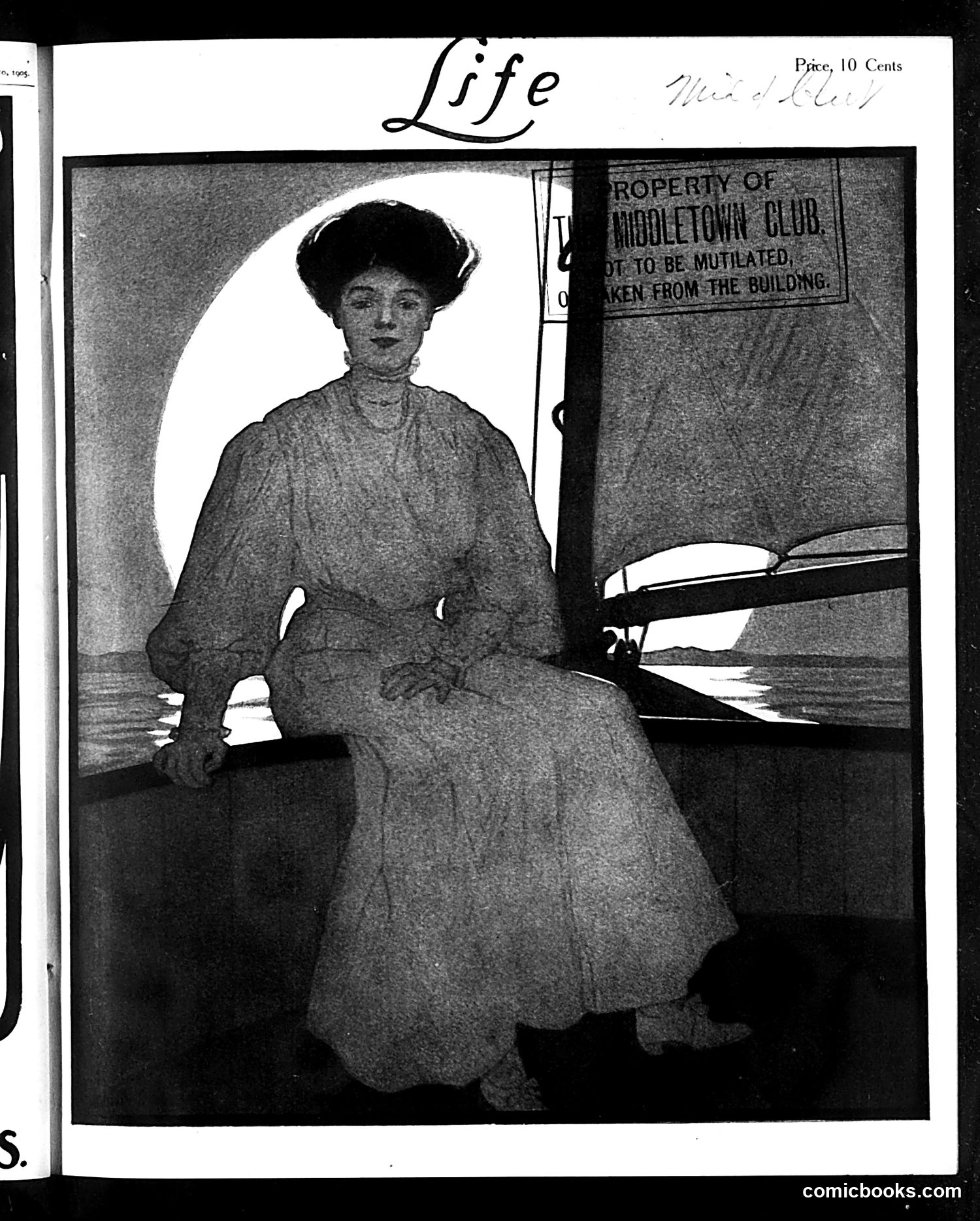
This is a cover from *Life* magazine (price 10 cents), featuring a portrait photograph rather than a cartoon. The image shows a woman in Edwardian-era dress seated indoors, with a mirror visible behind her. The only legible text is a stamp reading "PROPERTY OF MIDDLETOWN CLUB" with a note about mutilation and removal from the building—suggesting this is a library copy marked for institutional use. Without additional context or readable caption text, the specific identity of the subject and the satirical point—if any—cannot be determined from this image alone. The photograph appears to be a straightforward portrait rather than political satire, though the magazine's name indicates satirical content was typical for this publication.
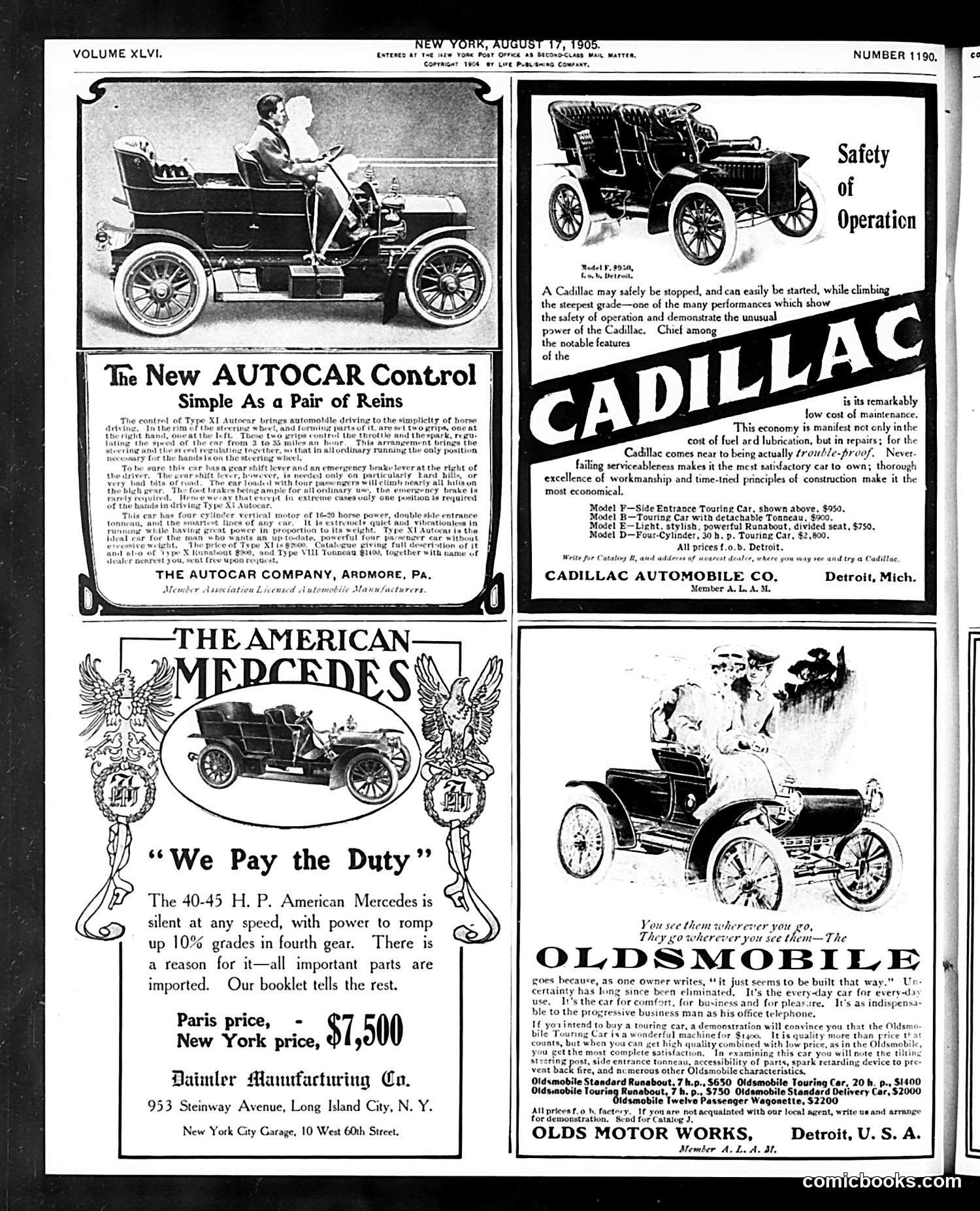
This page is **primarily automobile advertising** from August 17, 1905, with no political cartoons or satire present. The four advertisements promote competing car manufacturers: Autocar (Pennsylvania), Cadillac (Michigan), American Mercedes (imported), and Oldsmobile (Detroit). Each emphasizes different selling points—Autocar highlights simple controls "as a pair of reins," Cadillac stresses reliability and ease of operation, Mercedes emphasizes imported quality and power, and Oldsmobile appeals to business owners with testimonials about durability and practicality. The only visual humor appears subtle: each brand uses period photographs and illustrations of early automobiles. The ads collectively reflect the competitive early automotive market, with manufacturers targeting wealthy buyers and emphasizing safety, ease of use, and prestige. No political commentary or social satire is evident.
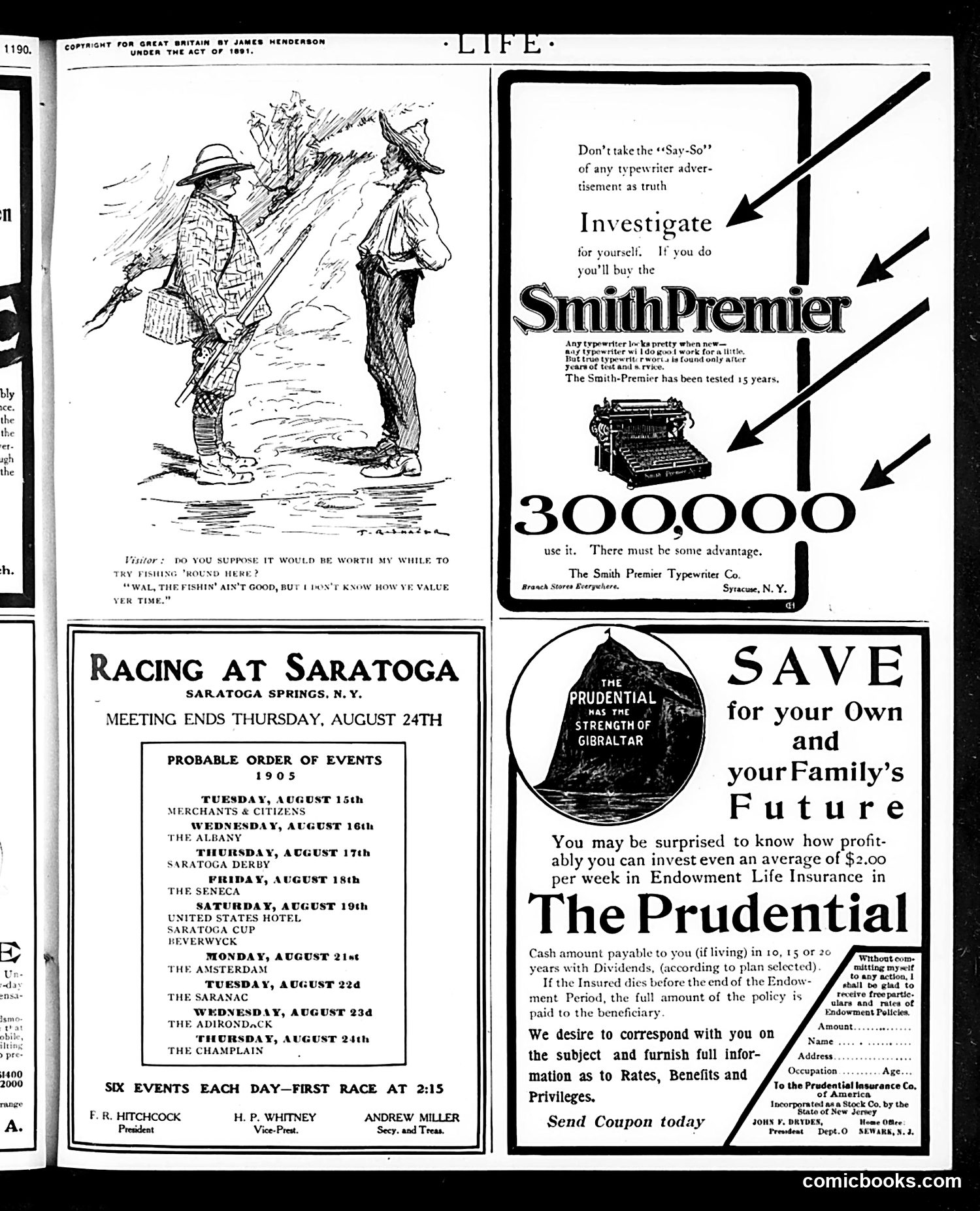
This page contains primarily **advertisements** rather than satirical cartoons. The main visual content is a sketch showing two figures in conversation about fishing ("Well, the fishin' ain't good, but I don't know how ye value yer time"), which appears to be humorous genre illustration rather than political satire. The advertisements include: - **Smith Premier Typewriter**: promoting 300,000 units sold with investigative claims - **Saratoga Springs Racing**: listing horse racing events for August 1905 - **The Prudential Life Insurance**: offering endowment policies with financial incentives The page reflects early 1900s commercial culture—typewriter competition, leisure activities for the wealthy (horse racing), and emerging life insurance as a financial product. There is no evident political satire or caricature present.
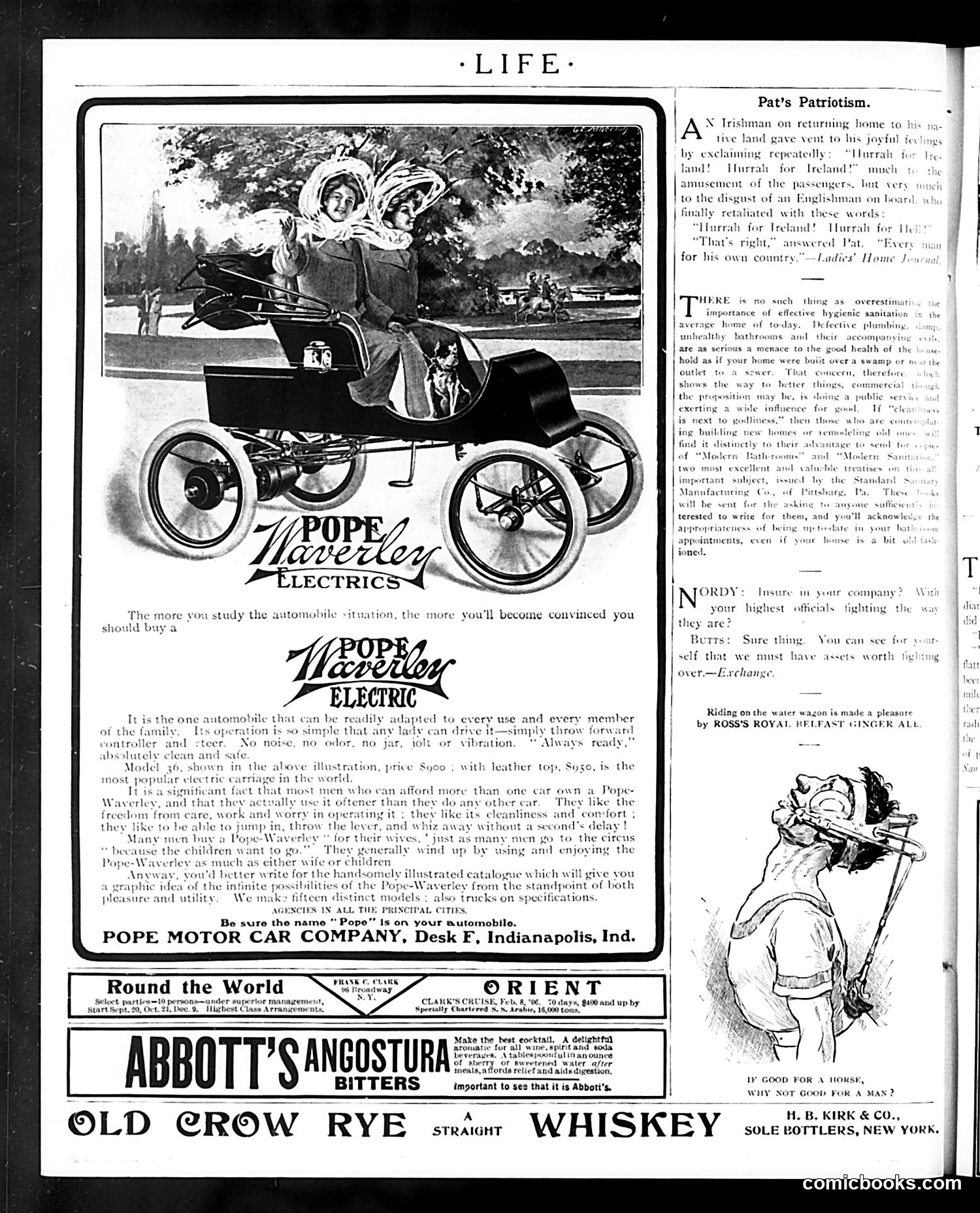
This page is primarily **advertising**, not political commentary. The dominant content features a Pope-Waverley Electric automobile advertisement showing a woman driving a motorcar, emphasizing the vehicle's simplicity—"any lady can drive it." The right column contains brief humor items labeled "Pat's Patriotism" and other short jokes, plus an advertisement for Abbott's Angostura Bitters. The only potentially satirical element is the Irish patriotism joke, where an Irishman returning home repeatedly shouts "Hurrah for Ireland!" until an Englishman responds: "Every man for his own country"—mocking enthusiastic but generic patriotic sentiment. The page reflects early 1900s consumer culture and gender attitudes regarding automobile operation.
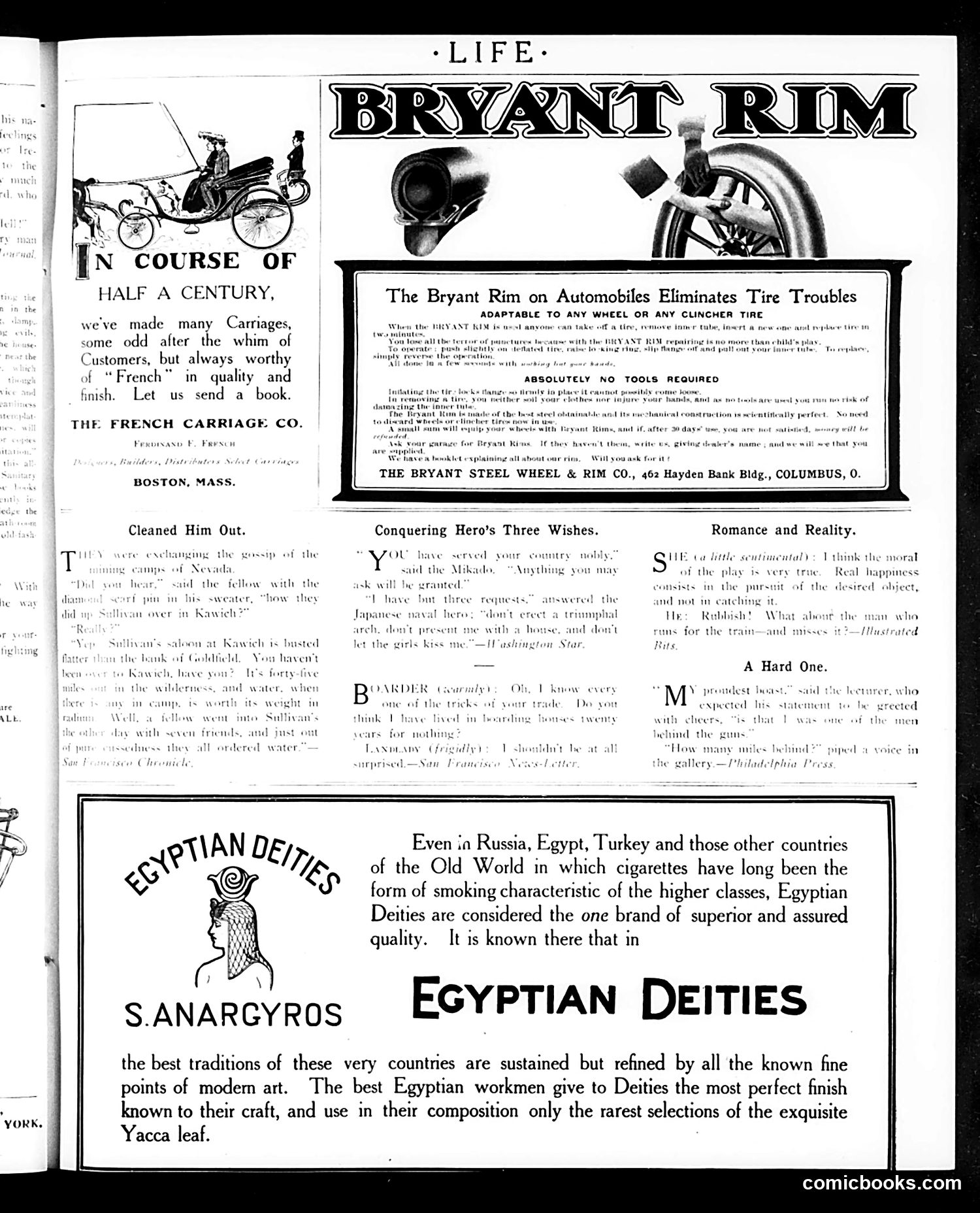
This page is primarily **advertising content** rather than satirical cartoons. The main features are: 1. **Bryant Rim advertisement** (top): Promotes an automobile tire product claiming to eliminate tire troubles, requiring "absolutely no tools." 2. **French Carriage Co. ad** (left): Announces carriages made over "half a century," emphasizing quality and finish. 3. **Three short humor pieces** (middle): Brief anecdotes titled "Cleaned Him Out," "Conquering Hero's Three Wishes," and "Romance and Reality"—typical early-1900s Life magazine jokes about men, military life, and relationships. 4. **Egyptian Deities cigarette ad** (bottom): Promotes cigarettes as a mark of refined taste, particularly in Russia and Egypt. The page reflects early-20th-century consumer culture and gender attitudes rather than political satire.
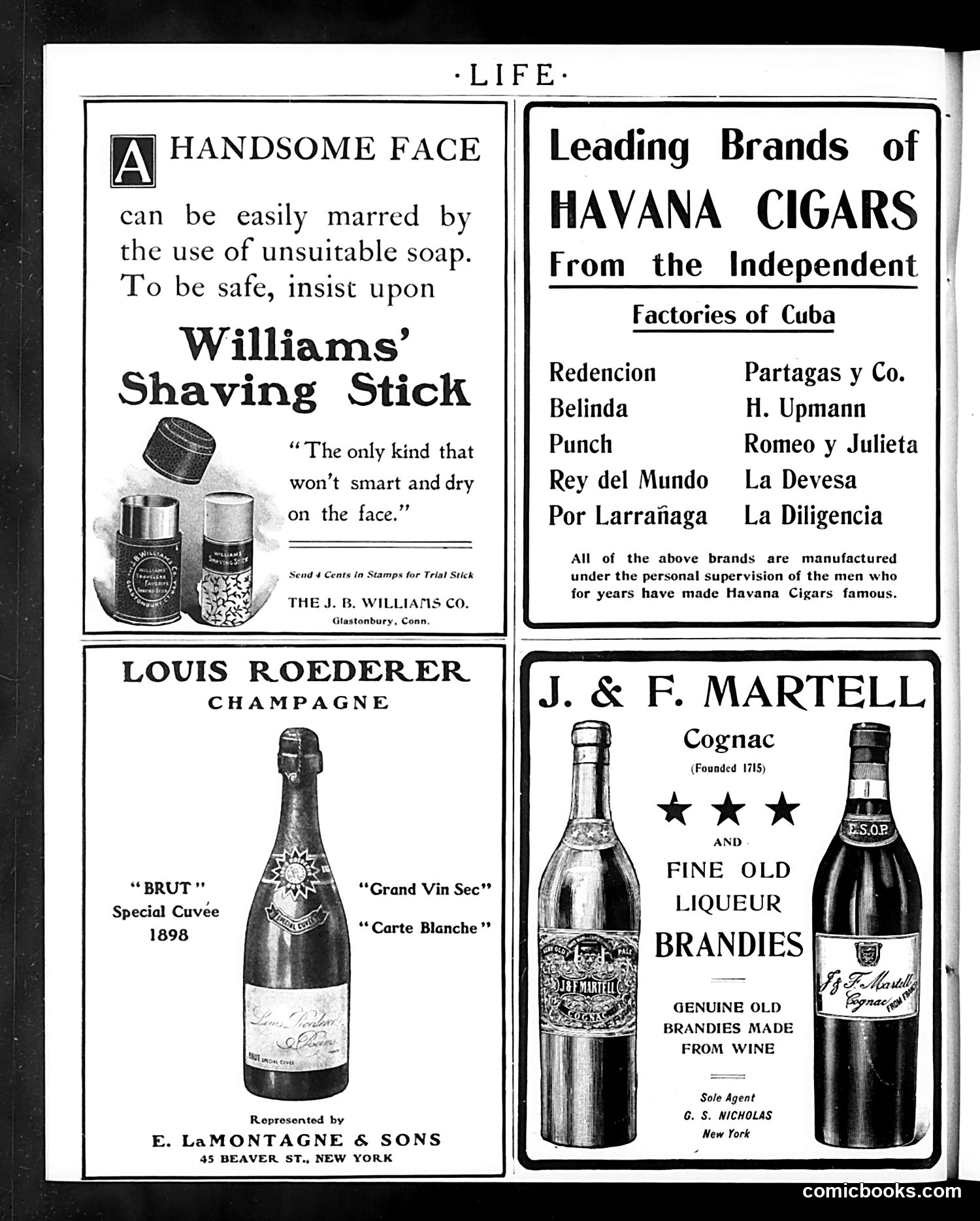
This page contains **no political cartoons or satire**—it is purely **advertising**. The four advertisements promote luxury consumer goods: 1. **Williams' Shaving Stick** (upper left): promotes a soap product claiming not to dry facial skin 2. **Havana Cigars** (upper right): lists Cuban cigar brands from independent factories, emphasizing their fame and quality 3. **Louis Roederer Champagne** (lower left): advertises French champagne varieties from 1898 4. **J. & F. Martell Cognac** (lower right): promotes French brandy founded in 1715 These ads reflect early 20th-century Life magazine content, which mixed satirical editorial material with high-end product advertisements targeting affluent readers. The page demonstrates the magazine's affluent readership and the prevalence of luxury goods marketing during this period.
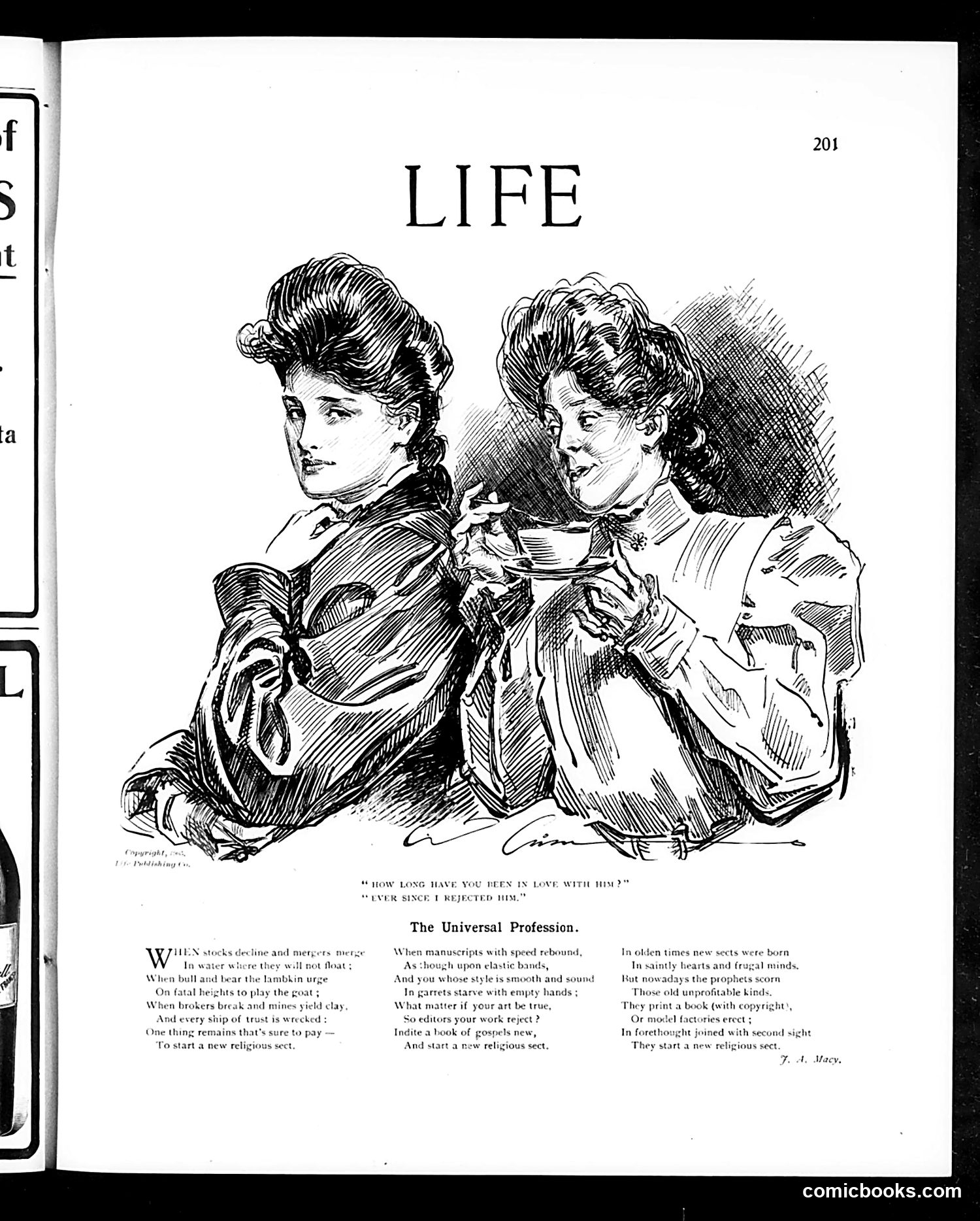
This page satirizes women entering publishing and editorial work. The illustration shows two fashionable women in conversation, with the caption "'HOW LONG HAVE YOU BEEN IN LOVE WITH HIM?' 'EVER SINCE I REJECTED HIM.'" The accompanying poem mocks the instability of the publishing industry—mergers, declining stocks, failed ventures—suggesting that editing manuscripts is as fickle and unreliable as romantic rejection. The satire implies that women newly entering professional editorial roles are themselves as unreliable or capricious as the publishing business itself, conflating romantic fickleness with professional incompetence. This reflects early-20th-century skepticism about women's suitability for serious professional work outside the home.
This page contains editorial commentary on contemporary political issues rather than traditional political cartoons. The text discusses General Wood's return from the Philippines and his potential candidacy for District Attorney of New York—apparently a controversial prospect among Life's editors. The illustrated figures appear to be decorative elements rather than caricatures of specific individuals. The main satirical point targets the newspaper coverage of General Wood and criticism of Mr. Jerome's (likely William Travers Jerome, a New York prosecutor) political plans. The page also addresses broader geopolitical concerns: Russia's military weakness, European anxieties about German expansion, and China's emerging nationalist movement—reflecting early 1900s imperial concerns about power balances in Asia and Europe.
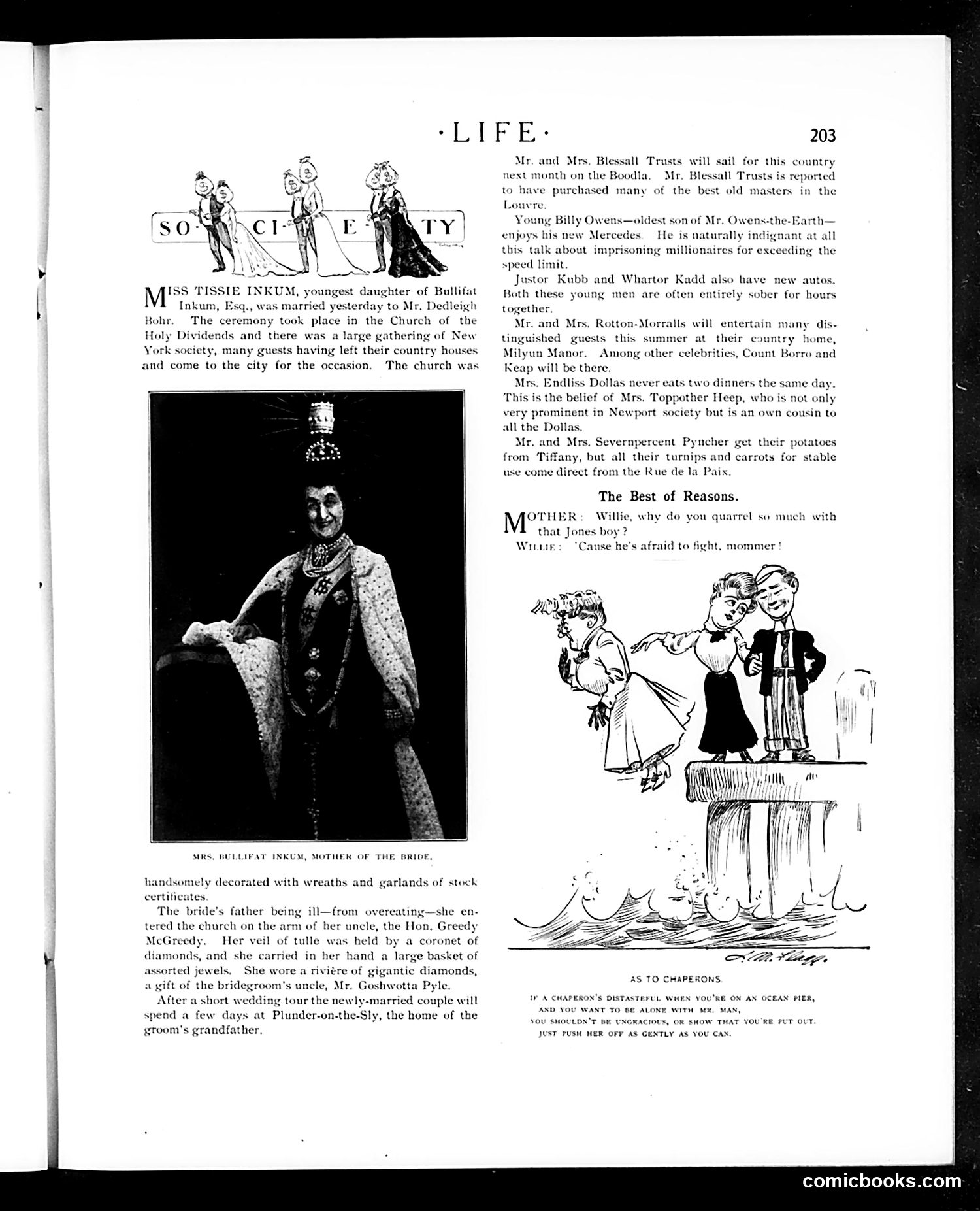
This page contains **society gossip and humor** rather than political satire. The upper section reports on Manhattan high-society events: Miss Tissie Inkum's wedding at a Holy Dividends church, with details about wealthy guests' automobiles and leisure activities (sailing trips, country estates). The photograph shows **Mrs. Bulliaf Inkum**, the bride's mother, in formal dress with jewelry. The cartoon titled "The Best of Reasons" depicts a **mother-son quarrel**: a boy explains he won't fight "that Jones boy" because he's "afraid to fight, mommer." The humor relies on the boy's cowardice and dialect speech typical of early 20th-century comic conventions. The page satirizes **aristocratic pretension and social climbing** through gossipy commentary about the wealthy's consumption habits and relationships.
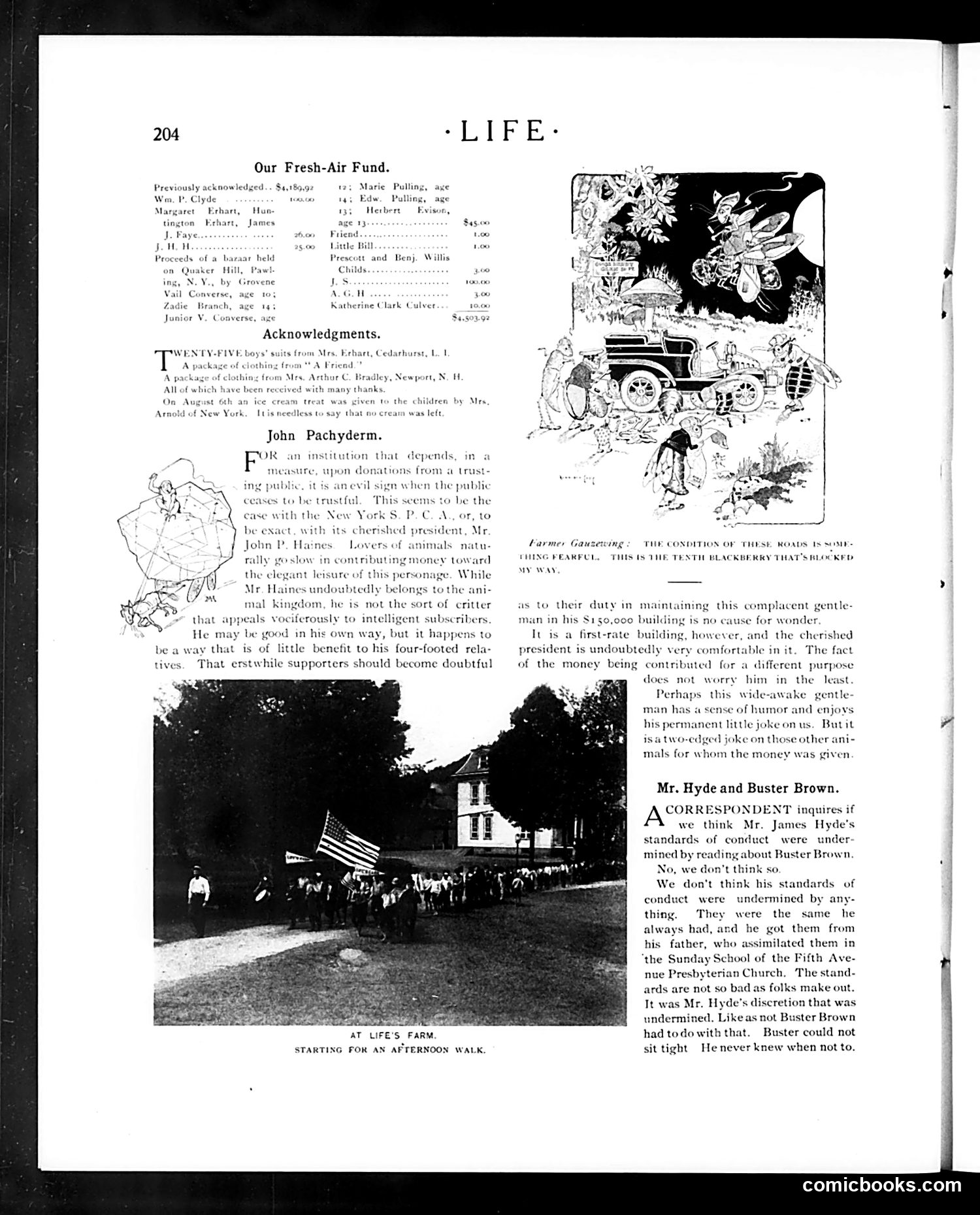
This page contains two distinct sections: **Upper section:** "John Pachyderm" is an editorial piece criticizing the New York S.P.C.A. (Society for Prevention of Cruelty to Animals) and its president, John D. Haines. The satire suggests that while Haines generously donates to animal welfare causes, he neglects human suffering—particularly among the poor. The "pachyderm" reference (elephant = Republican symbol) likely indicates political commentary about misplaced charitable priorities. **Lower section:** A photograph labeled "At Life's Farm: Starting for an Afternoon Walk" appears to show a gathering at what seems to be a charitable or institutional facility, with an American flag visible. **Right side:** "Mr. Hyde and Buster Brown" addresses whether James Hyde's ethical standards were undermined by Buster Brown. The piece defends Hyde, attributing his conduct to his father and Presbyterian upbringing, not external influence.
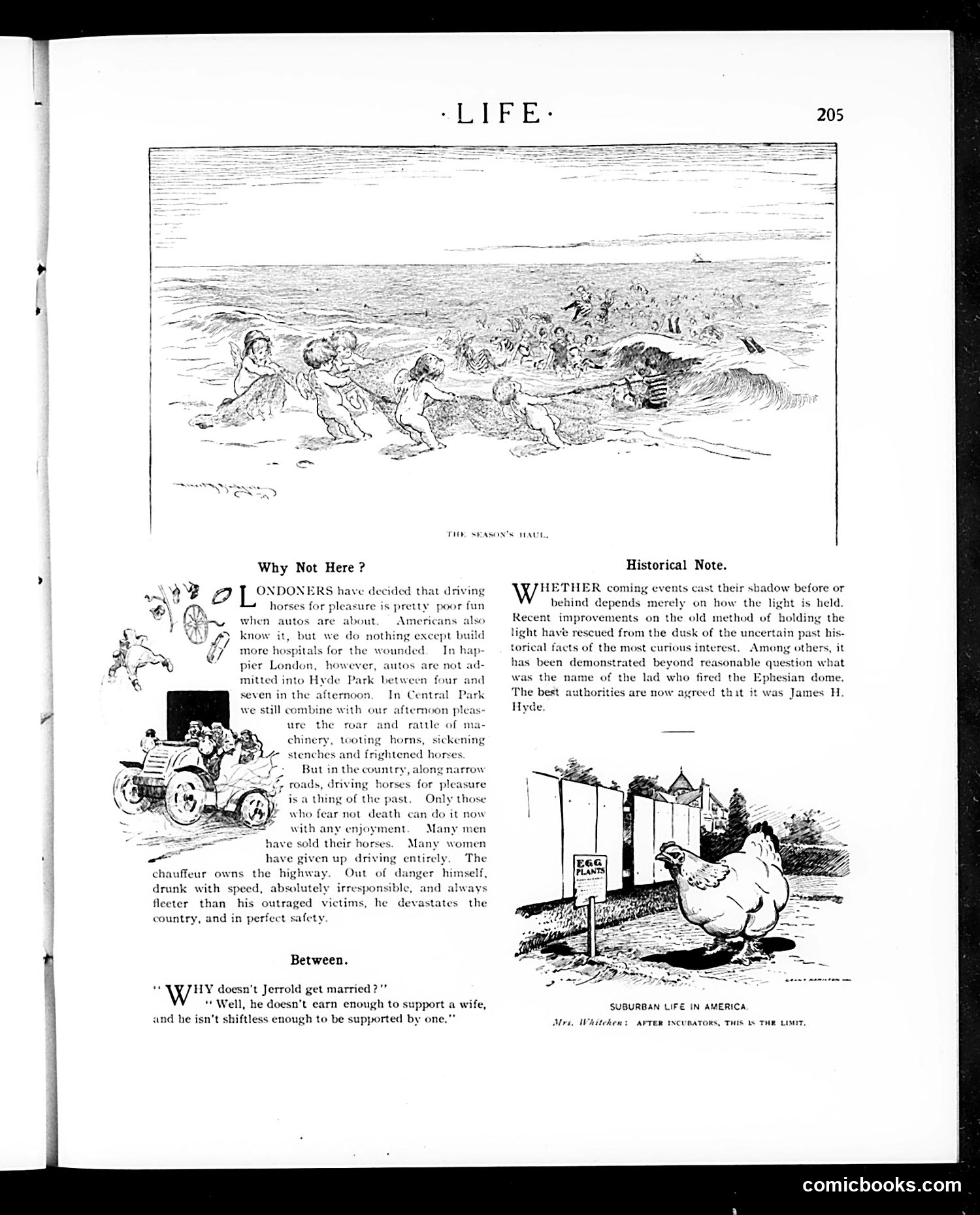
This page contains three satirical pieces critiquing modern life: **"The Season's Haul"** (top illustration) shows children collecting what appear to be jellyfish or sea creatures at the beach. **"Why Not Here?"** mocks London's resistance to automobiles for pleasure driving while Americans embrace cars. The piece ironically notes that while Londoners fear autos, they still allow traditional horse-drawn carriages despite the dangers these pose—contradicting their safety concerns. **"Between"** is a brief joke about marriage and financial responsibility. **"Suburban Life in America"** depicts a large chicken in an egg incubator, captioned with Mrs. Wilkins's comment that "after incubators, this is the limit"—satirizing suburban domestic life and the mechanization of traditionally rural activities.

This page appears to be a title page or section divider for *Life* magazine, showing only the word ".LIFE" printed vertically on the left side of an otherwise blank page with a dark photographic image on the right that is too obscured and degraded to discern clearly. Without readable cartoon content, visible caricatures, or legible text beyond the magazine title, I cannot identify specific political figures, social references, or satire. The dark image quality and lack of contextual detail prevent me from explaining what commentary or joke this page intended to convey to contemporary readers. To provide accurate historical analysis, I would need a clearer or more complete page showing actual cartoon artwork or article text.
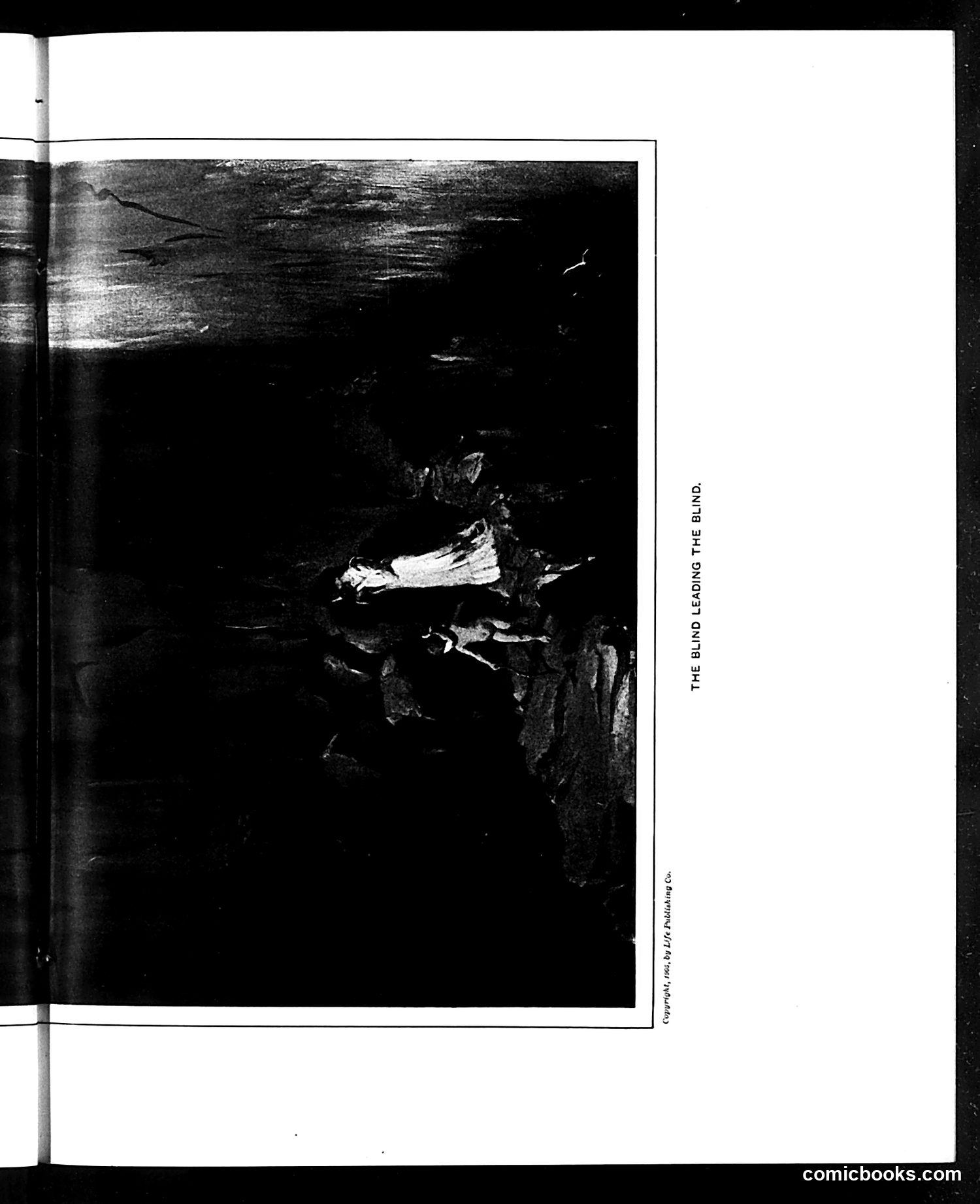
This appears to be a darkly satirical illustration showing a figure in light clothing being led by a dark, shadowy figure in what looks like a cave or tunnel setting. The caption "The Blind Leading the Blind" is a biblical reference suggesting mutual incompetence or the impossibility of guidance when both parties lack understanding. Without clearer visibility of specific facial features or additional context clues, I cannot definitively identify which political figures this caricatures. However, the composition suggests commentary on failed leadership or guidance during a particular historical moment when *Life* magazine was critiquing government or institutional authority. The stark black-and-white contrast emphasizes the moral or intellectual darkness of the scenario being depicted.
This page contains two distinct pieces of satirical fiction from *Life* magazine: **"The Garden of Adjectives"** is a serialized story mocking romantic excess and bohemian affectation. The heroine "Hominy" is a woman of exaggerated sensibilities who sees the world in overwrought, flowery language. Her relationship with the cynical "Andrumandwhiskey" plays on the contrast between her poetic delusions and his brutish pragmatism (he literally kicks her downstairs). The satire targets pretentious artistic types and melodramatic female characters popular in contemporary literature. **"His Idea"** is a brief joke contrasting American materialism: a first millionaire obsesses over English cathedrals while a second focuses on practical automobile design—mocking both the ostentatious wealthy and their competing value systems. The humor relies on exaggerated character types and verbose adjectives (the story's title) that were recognizable to 1910s-era readers familiar with romantic fiction conventions the magazine lampooned.
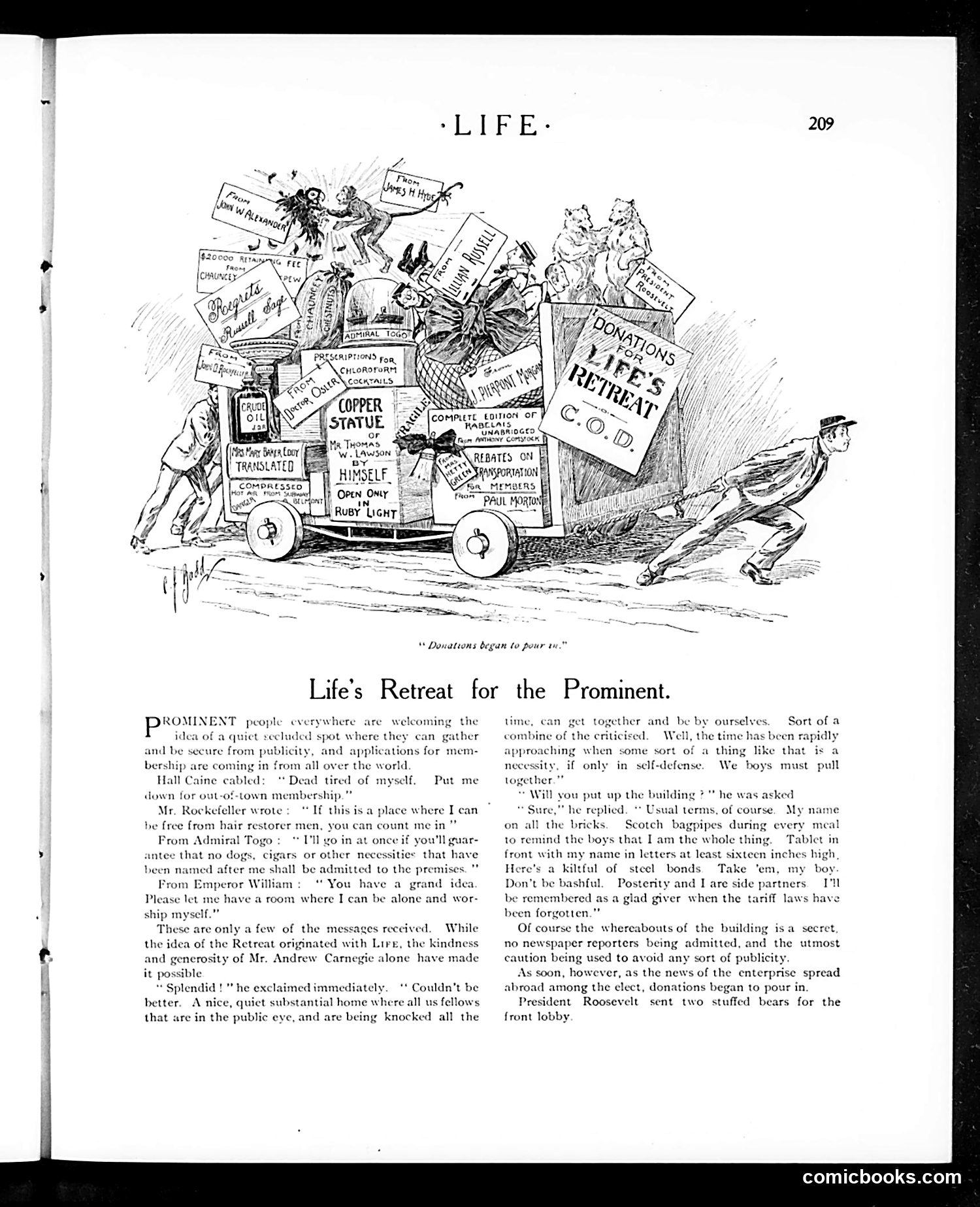
This satirical cartoon mocks wealthy and famous figures' desire for privacy and escape from public scrutiny. The central image depicts a cart overflowing with donations—books, statues, and goods bearing the names of prominent donors—being pushed toward a proposed exclusive retreat. The accompanying article presents fake letters from celebrities like Hall Caine, Rockefeller, Admiral Togo, and Emperor William, all claiming they desperately need refuge from public life and criticism. Andrew Carnegie supposedly agrees to fund the project but insists his name appear on everything ("My name on all the bricks"). The satire targets wealthy industrialists' hypocrisy: they simultaneously crave publicity and anonymity, want self-defense from criticism while remaining "in the public eye," and can't resist attaching their names to philanthropic ventures. The joke culminates with donations beginning to pour in immediately—proving these "prominent" figures cannot resist public recognition even while claiming to seek seclusion.
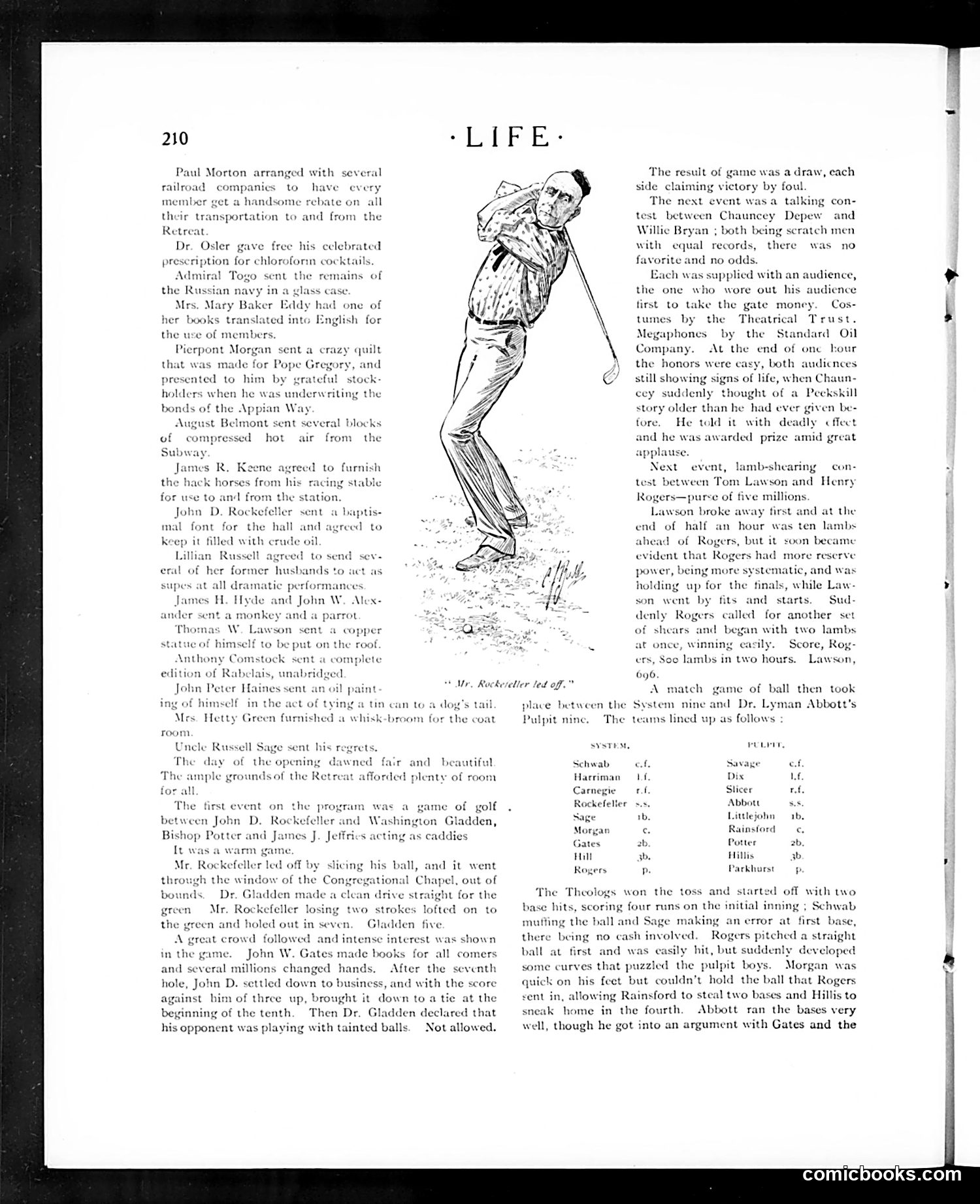
This satirical piece mocks the wealthy elite's "Retreat," where tycoons and prominent figures compete in games while their associates donate absurdly inappropriate gifts. **The Main Cartoon** shows a golfer mid-swing—likely John D. Rockefeller, based on context describing his golf match against Bishop Potter and Washington Gladden. **The Satire's Targets:** - **Rockefeller and industrial magnates** competing in leisure activities while supposedly philanthropic - **Paul Morton** (railroad executive) arranging rebates—mocking corporate favoritism - **August Belmont** sending "compressed hot air from the Subway"—criticizing empty corporate gestures - The absurd "gifts": Mary Baker Eddy translating her books, Pierpont Morgan's "crazy quilt," Russell Sage's regrets **The Point:** The piece ridicules how the super-wealthy present themselves as cultured and generous while engaging in self-serving competition. The donations are portrayed as either useless, self-promotional, or cynically calculated. The detailed accounts of athletic contests (Lawson vs. Rogers; Depew vs. Bryan) emphasize their obsession with winning over substance. This is early-1900s critique of Gilded Age excess and hypocrisy.
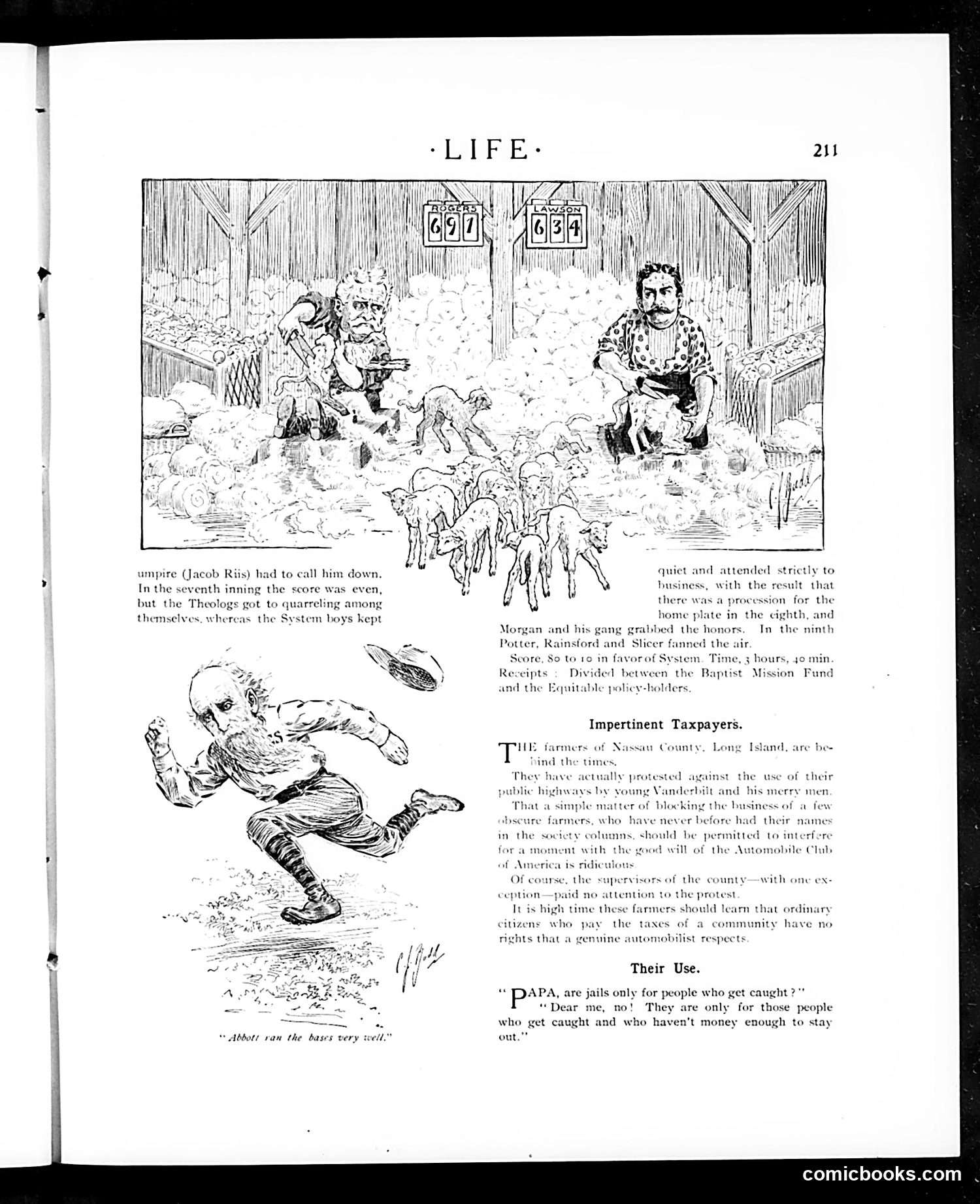
This page satirizes two distinct issues: **Top cartoon**: A baseball game between "System boys" and "Theologs" (religious figures), with umpire Jacob Riis. The satire mocks theological disputes interrupting practical business—the game itself is secondary to the quarreling. **Main article: "Impertinent Taxpayers"**: Attacks wealthy automobile enthusiasts (led by young Vanderbilt) who use public roads while dismissing farmers' protests. The satire's point: wealthy automobilists claim rights to roads funded by ordinary taxpayers' taxes, yet show contempt for those taxpayers' concerns. **"Their Use" dialogue**: Cynically suggests jails exist only for poor people who "get caught and haven't money enough to stay out"—implying wealthy people escape consequences through money. **Overall**: Early 1900s critique of class privilege and the arrogance of wealthy elites who exploit public infrastructure while dismissing working-class objections as "impertinent."
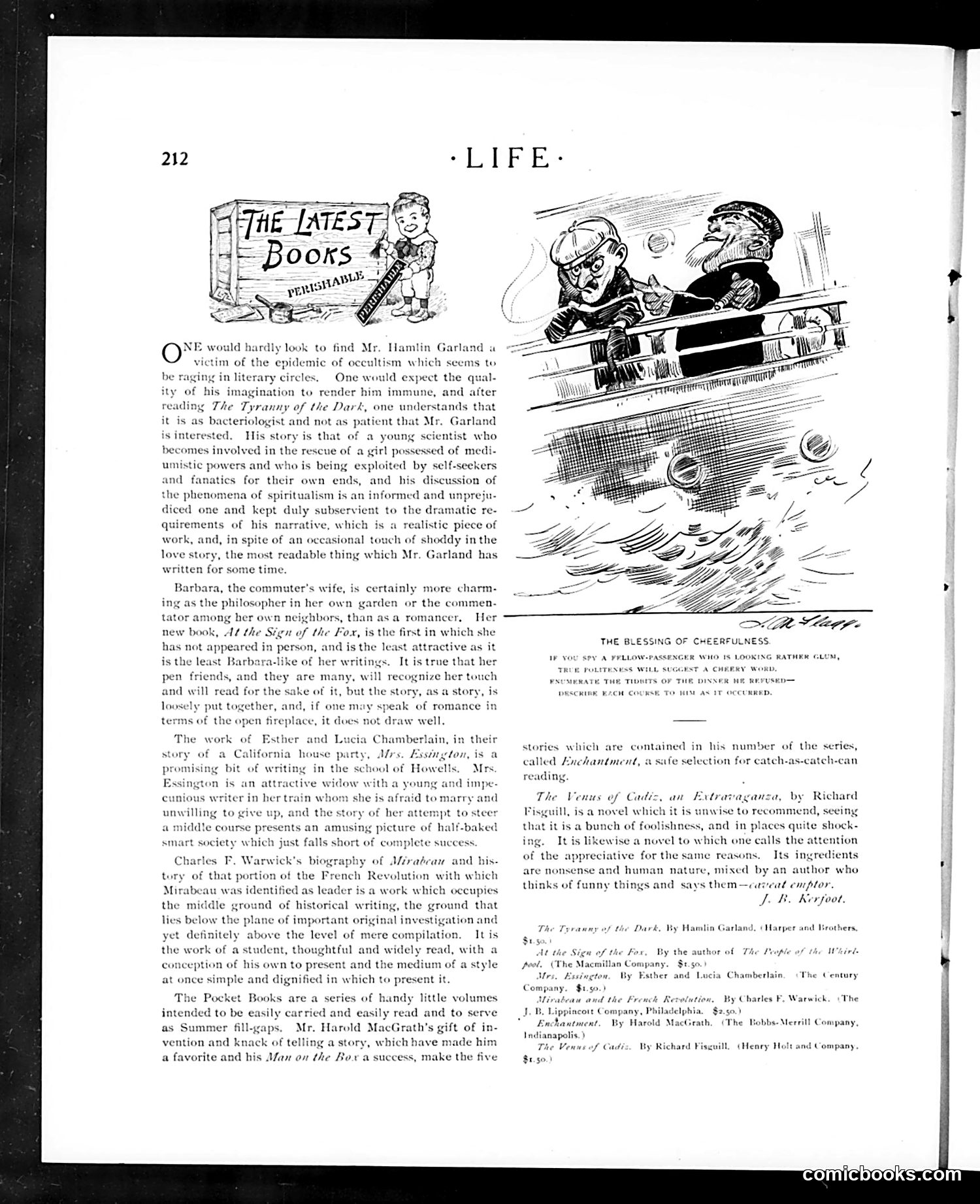
This page reviews new books, primarily novels dealing with occultism and spiritualism—topics that were genuinely fashionable among educated Americans in the early 20th century. The cartoon depicts a railway passenger offering cheerful conversation to a glum fellow traveler, with the caption's moral: spread good cheer by engaging fellow travelers in pleasant talk, especially enumerating dinner courses they've refused—a humorous jab at social etiquette and forced politeness. The reviews discuss Hamlin Garland's *The Tyranny of the Dark* (about a girl with mediumistic powers exploited by spiritualist charlatans) and other novels. The satire is gentle—poking fun at spiritualism's popularity in literary circles while acknowledging these books' readability. The "blessing of cheer" caption satirizes Victorian-era social conventions about maintaining pleasant demeanor in public spaces, regardless of one's actual mood.
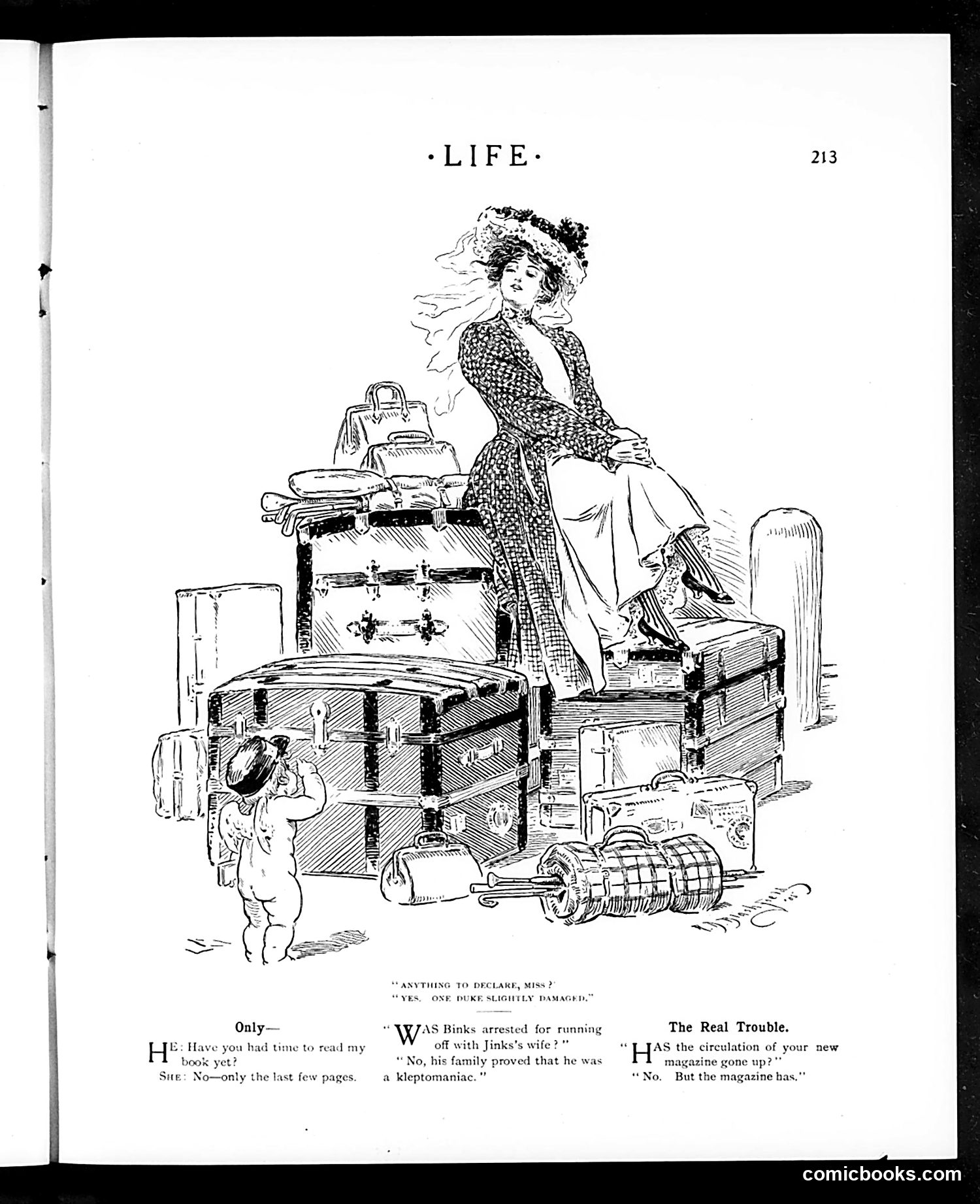
This page contains three separate satirical jokes typical of early 20th-century Life magazine humor: **Main Illustration:** Shows a fashionable woman perched atop steamer trunks and luggage with a cherub figure below. The caption "Anything to declare, miss?" / "Yes. One duke slightly damaged" is a play on customs inspections. It satirizes wealthy American women who traveled to Europe seeking titled husbands—the "duke" is presented as a romantic acquisition, humorously described as "damaged goods." **Bottom Left Joke:** References a character named Binks arrested for running off with Jinks's wife, but the family proved Binks was a kleptomaniac (compulsive thief)—implying he stole the wife rather than eloped romantically. It's a dark joke about involuntary infidelity. **Bottom Right Joke:** "The Real Trouble"—someone boasts their new magazine's circulation increased, but the response reveals the magazine itself, not its readership, has "gone up" (in price). All three jokes reflect upper-class social preoccupations of the era.
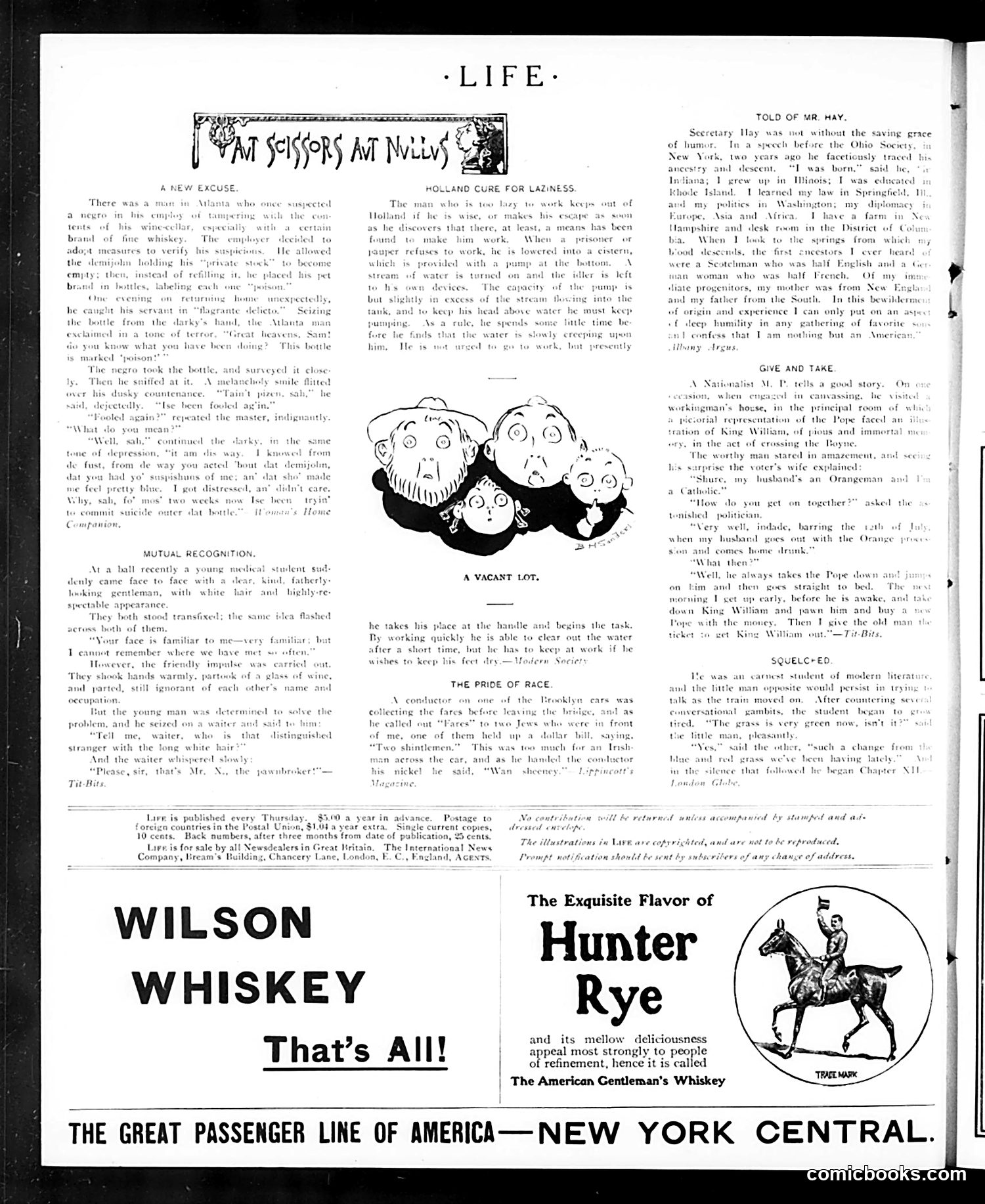
This page contains **several humorous short stories with illustrations** rather than political cartoons: 1. **"Scissors at Nullis"** – A satirical anecdote about an Atlanta man who tried to cheat a Negro servant by claiming to pay him with "invisible stock" instead of actual wages. The servant's clever response exposes the con. 2. **"Holland Cure for Laziness"** – A brief joke about keeping a lazy worker motivated through fear (a pump threatening to spray him). 3. **"Mutual Recognition"** – A medical student and distinguished gentleman at a ball recognize each other as former acquaintances, both now of higher social standing. 4. **"A Vacant Lot"** – A joke about an Irish worker's domestic disputes involving Orange Order processions (sectarian Irish-Protestant conflict). 5. **"The Pride of Race"** – A conductor's anecdote about collecting fares on a train. The page is primarily **satirical humor and advertisements** (Wilson Whiskey, Hunter Rye), typical of Life magazine's early 20th-century format mixing social commentary with commercial content.
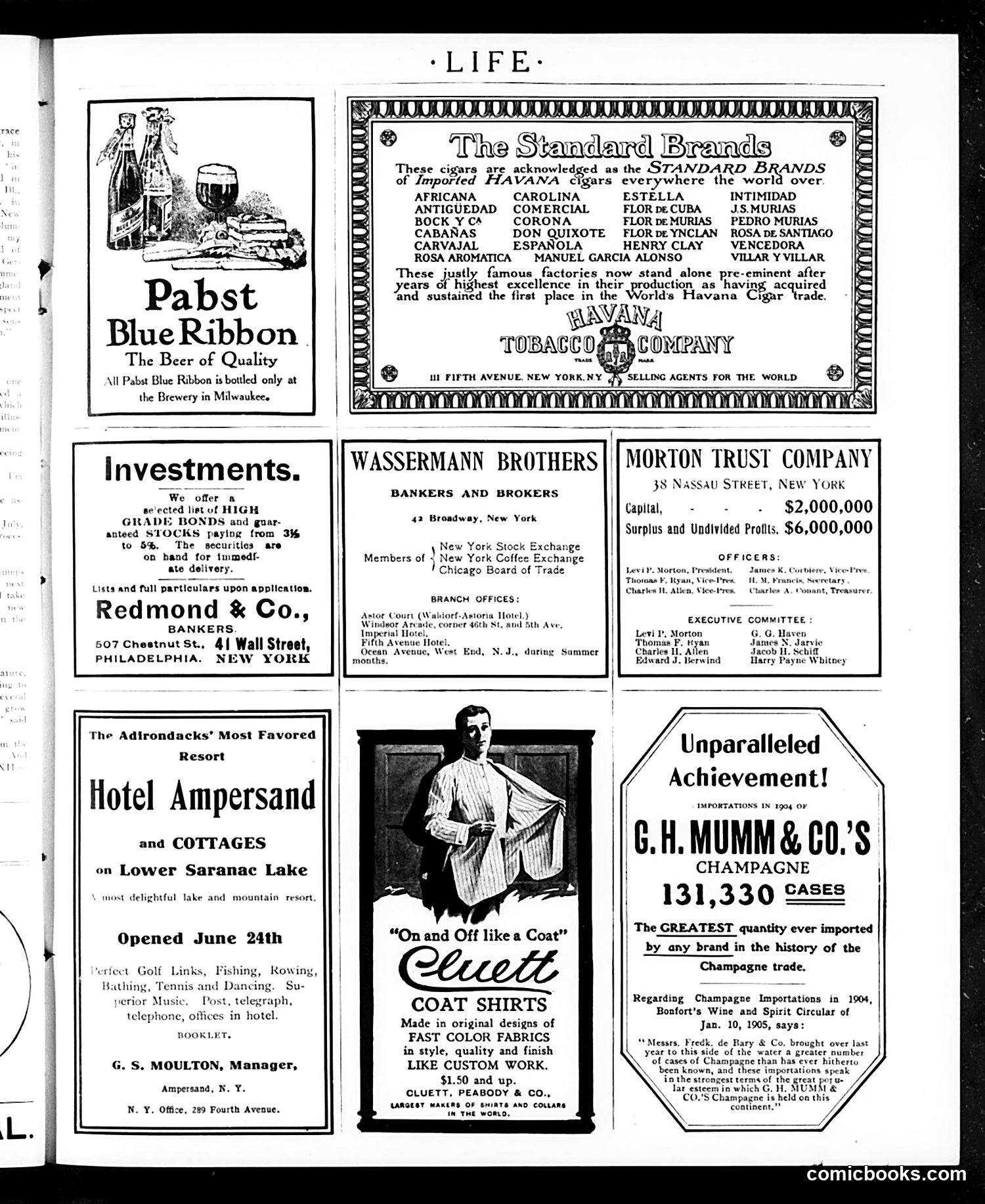
This page is primarily **advertising**, not satire or political commentary. It consists of various commercial advertisements from approximately 1904-1905. The advertisements promote: - **Pabst Blue Ribbon beer** (Milwaukee brewery) - **Havana cigars** (multiple Cuban brands sold by a New York tobacco company) - **Financial services** (Redmond & Co. bankers, Wassermann Brothers brokers, Morton Trust Company) - **Hotel Ampersand** (Adirondack resort in upstate New York) - **Cluett coat shirts** (with illustration of man in casual shirt) - **G.H. Mumm champagne** (boasting record 1904 imports of 131,330 cases) The only illustration with satirical intent is the **Cluett shirt advertisement**, featuring a man casually wearing an unbuttoned shirt with the slogan "On and Off like a Coat"—a visual pun about the shirt's convenience and ease of wear. Otherwise, this is a straightforward commercial page showcasing luxury goods and financial institutions aimed at affluent readers.
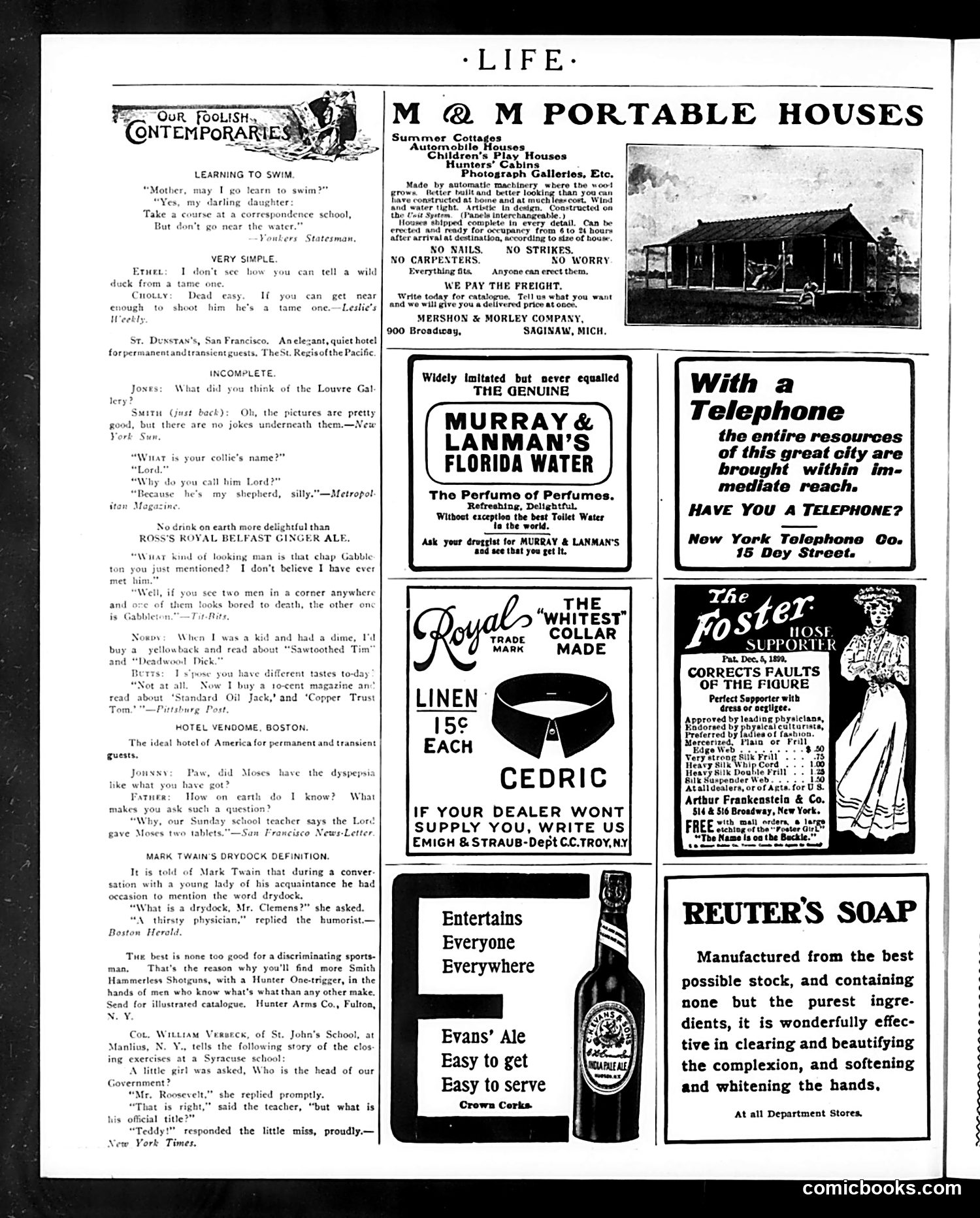
This is primarily a **humor and advertising page** from Life magazine (early 1900s). The left side contains brief comic anecdotes—jokes about swimming children, duck hunting, art galleries, and Mark Twain's definition of "drydock" as a "thirsty physician." Most rely on wordplay or puns typical of turn-of-the-century humor. The right side features product advertisements including portable houses, Florida Water cologne, linens, ales, soaps, and corsets. **Notable content:** A joke about a schoolgirl who answers that Theodore Roosevelt is "the head of our Government" but his "official title" is "Teddy"—gentle satire of Roosevelt's informal public persona and popular nickname during his presidency (around 1901-1909). The page reflects early 20th-century advertising aesthetics and American humor conventions largely unfamiliar today: genteel wordplay rather than observational comedy, and advertisements integrated seamlessly with editorial content.
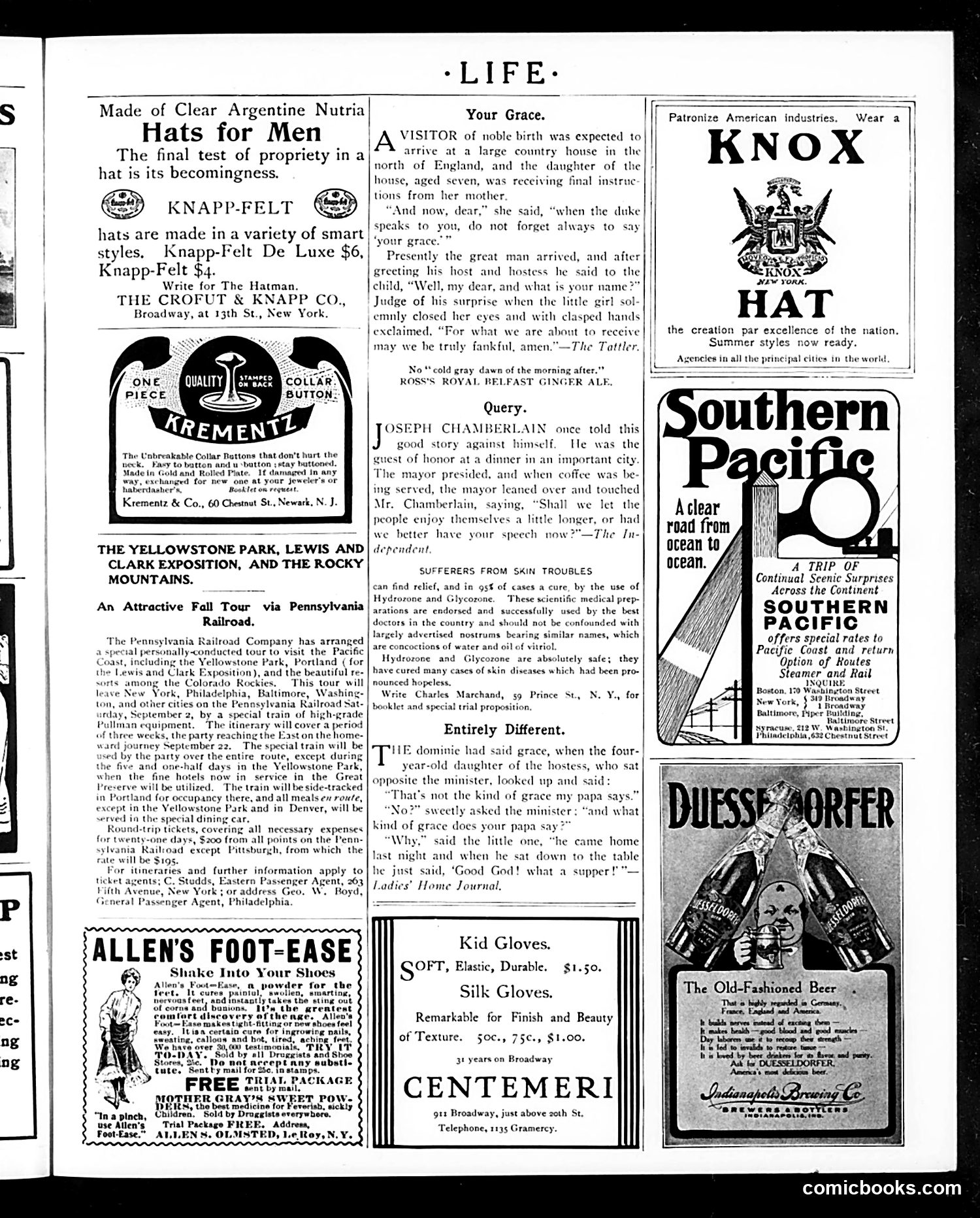
This page is primarily **advertisements and humorous anecdotes**—not political cartoons. The content includes: **Advertisements** for products like Knapp-Felt hats, Allen's Foot-Ease powder, and Pennsylvania Railroad tours dominate the page. **Three brief humorous stories** under headings like "Your Grace" and "Query": - A child instructed to say "your grace" to a visiting duke, who instead recites a dinner prayer - A story about Joseph Chamberlain (likely the British politician) at a dinner where the mayor asks him to hurry his speech - A brief anecdote about a clergyman and a child These are light, genteel humor typical of Life magazine's satirical content—poking fun at social etiquette and miscommunication rather than politics. The jokes rely on Victorian-era social conventions that modern readers would find quaint rather than sharp satire.
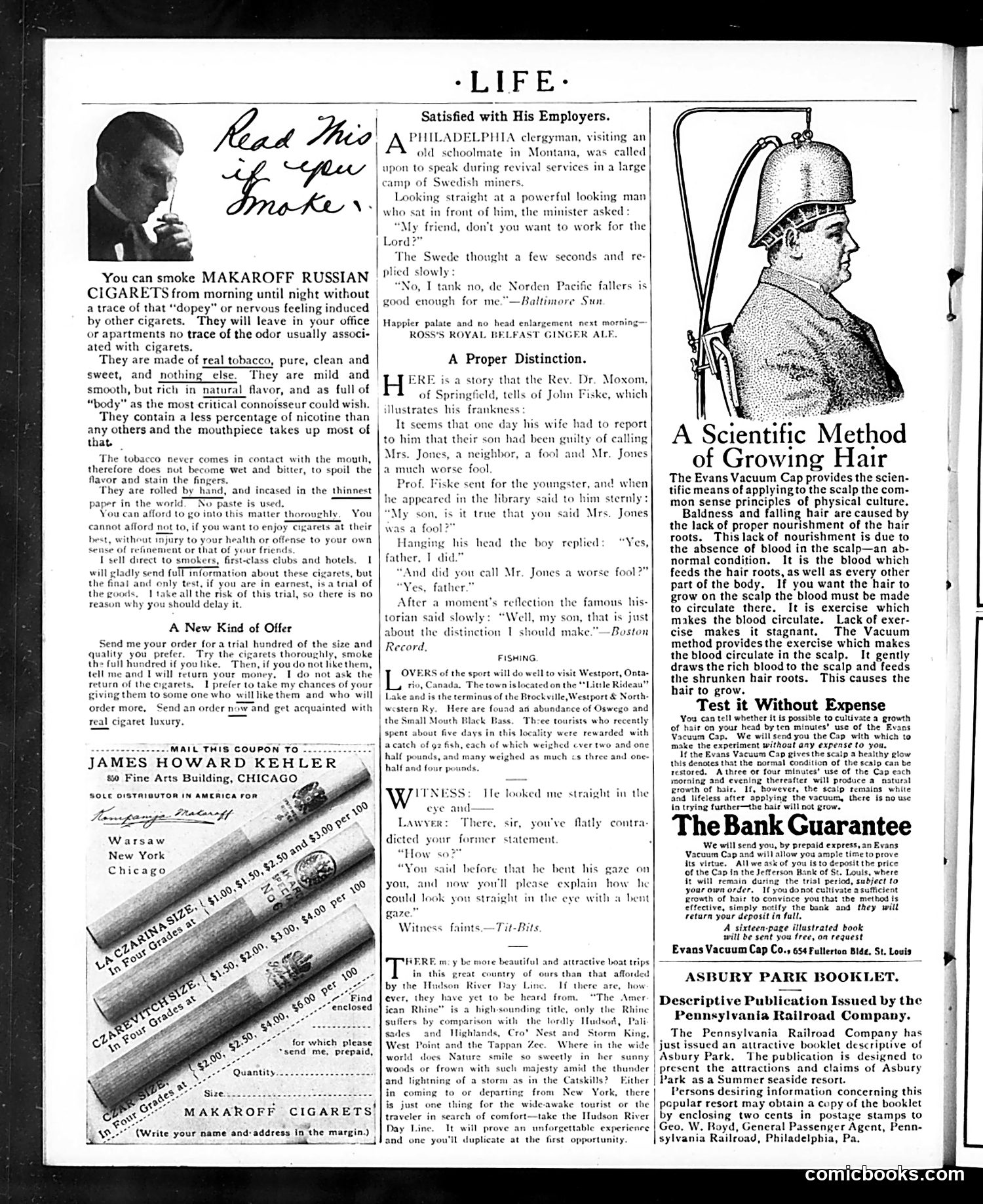
This page is primarily **advertising and humor pieces**, not political satire. The main content includes: **Makaroff Russian Cigarettes ad**: A lengthy advertisement claiming these cigarettes are pure tobacco without the "dopey" nervous feeling of other brands. The accompanying photo shows a man smoking with text "Read This if you Smoke." This reflects early 20th-century cigarette marketing before health warnings existed. **Three brief humor pieces**: 1. "Satisfied with His Employers"—A joke about a Swedish miner rejecting a minister's call to "work for the Lord," preferring his railroad job instead. The humor relies on ethnic stereotyping (dialect) and class commentary. 2. "A Proper Distinction"—A anecdote about philosopher John Fiske distinguishing between calling someone a "fool" versus a "worse fool," finding the distinction philosophically valid. 3. A fishing travel piece promoting Westport, Ontario. **Note**: This is primarily a **commercial/entertainment page**, not satirical commentary. The humor is gentle, conversational—typical of Life magazine's lighter content mixed with period advertising.
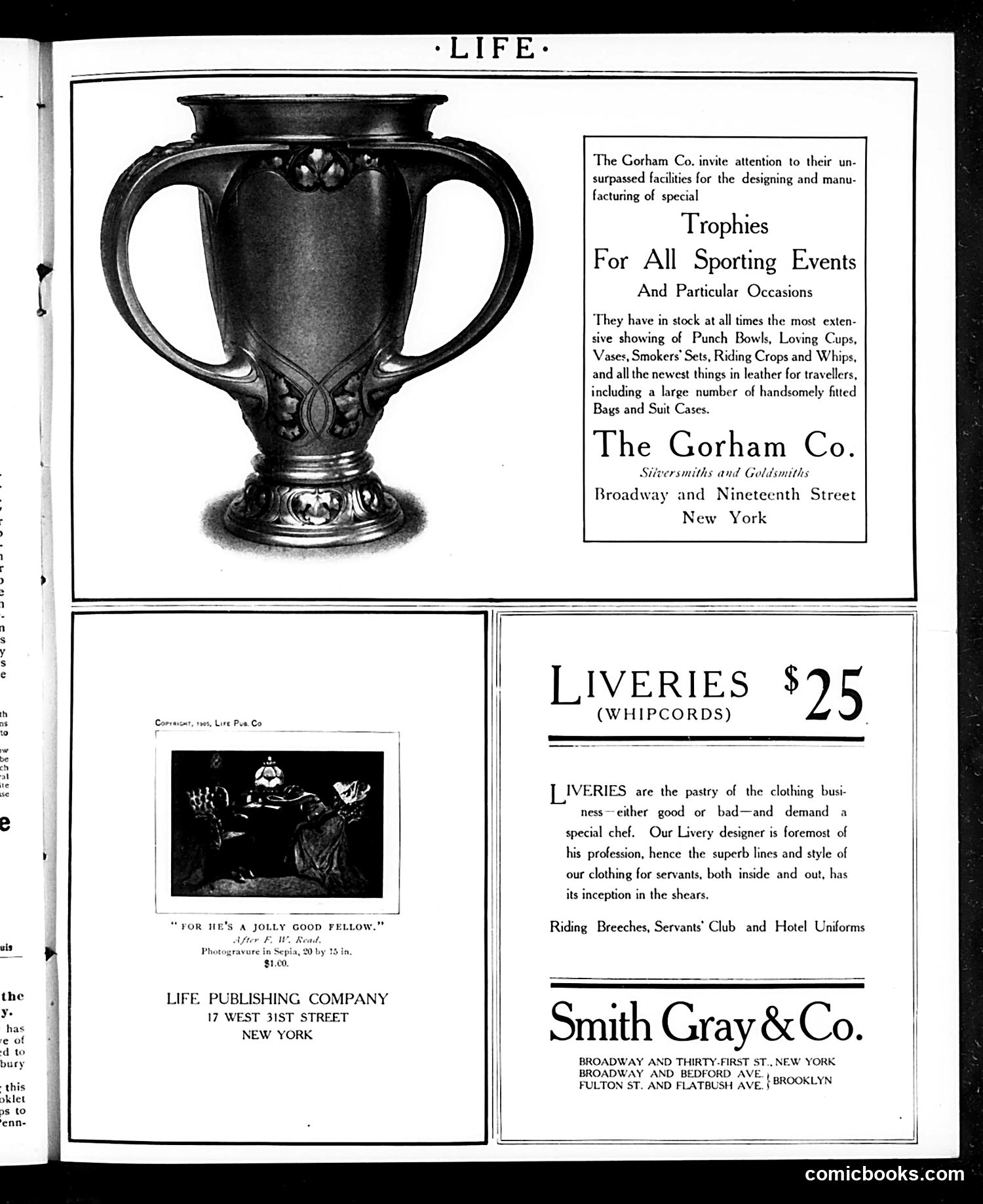
This page is **primarily advertising**, not political satire or editorial content. It contains three commercial advertisements from early 20th-century New York businesses: 1. **The Gorham Co.** (top): A luxury silversmith/goldsmith firm advertising trophies and sporting goods, with an ornate two-handled cup as the visual centerpiece. 2. **Life Publishing Company** (bottom left): Promoting a photogravure titled "For He's a Jolly Good Fellow" by W. D. Kroll. 3. **Smith Gray & Co.** and **Liveries** (right): Advertisements for servant clothing and uniforms, emphasizing quality tailoring for hotel and club staff. The content reflects the period's class structure—servants' uniforms and luxury goods were marketed to wealthy clientele. There is no cartoon or satirical commentary visible; this is a straightforward advertising page from *Life* magazine.
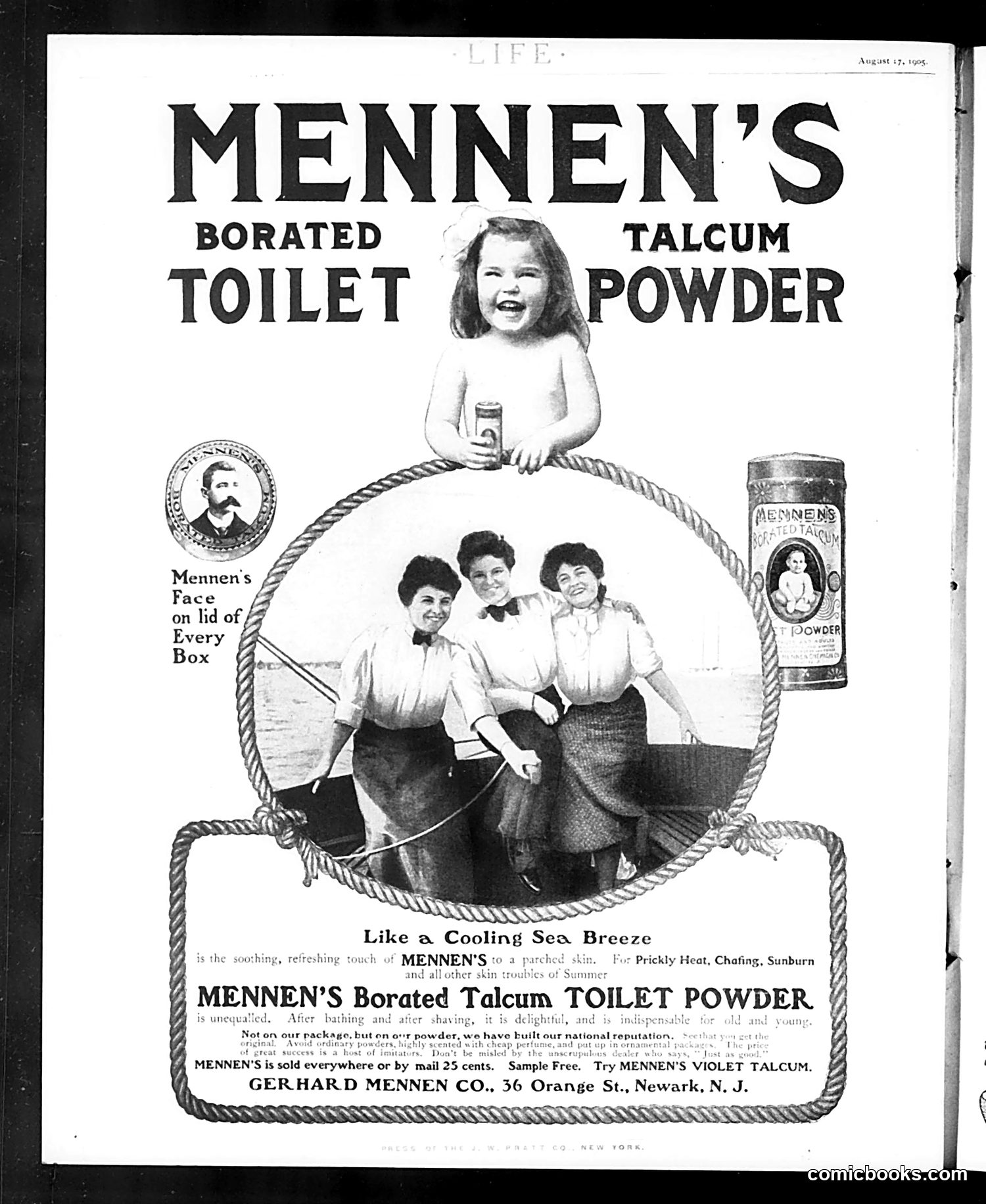
This is a **product advertisement**, not political satire. It promotes Mennen's Borated Talcum Toilet Powder, a hygiene product from the early 1900s. The ad uses imagery of a smiling child atop a rope circle, with three women below—likely representing the product's appeal across age groups and genders. The "cooling sea breeze" tagline emphasizes relief from summer skin problems (prickly heat, chafing, sunburn). The left side shows Mennen's company seal/logo on every box. The right displays the product tin. The message stresses the powder's soothing properties and national reputation, while noting it costs 25 cents and is available by mail. By modern standards, the casual use of young children in beauty/hygiene advertising appears unusual, reflecting early 20th-century marketing norms before stricter regulations.