
A complete issue · 24 pages · 1905
Life — February 16, 1905
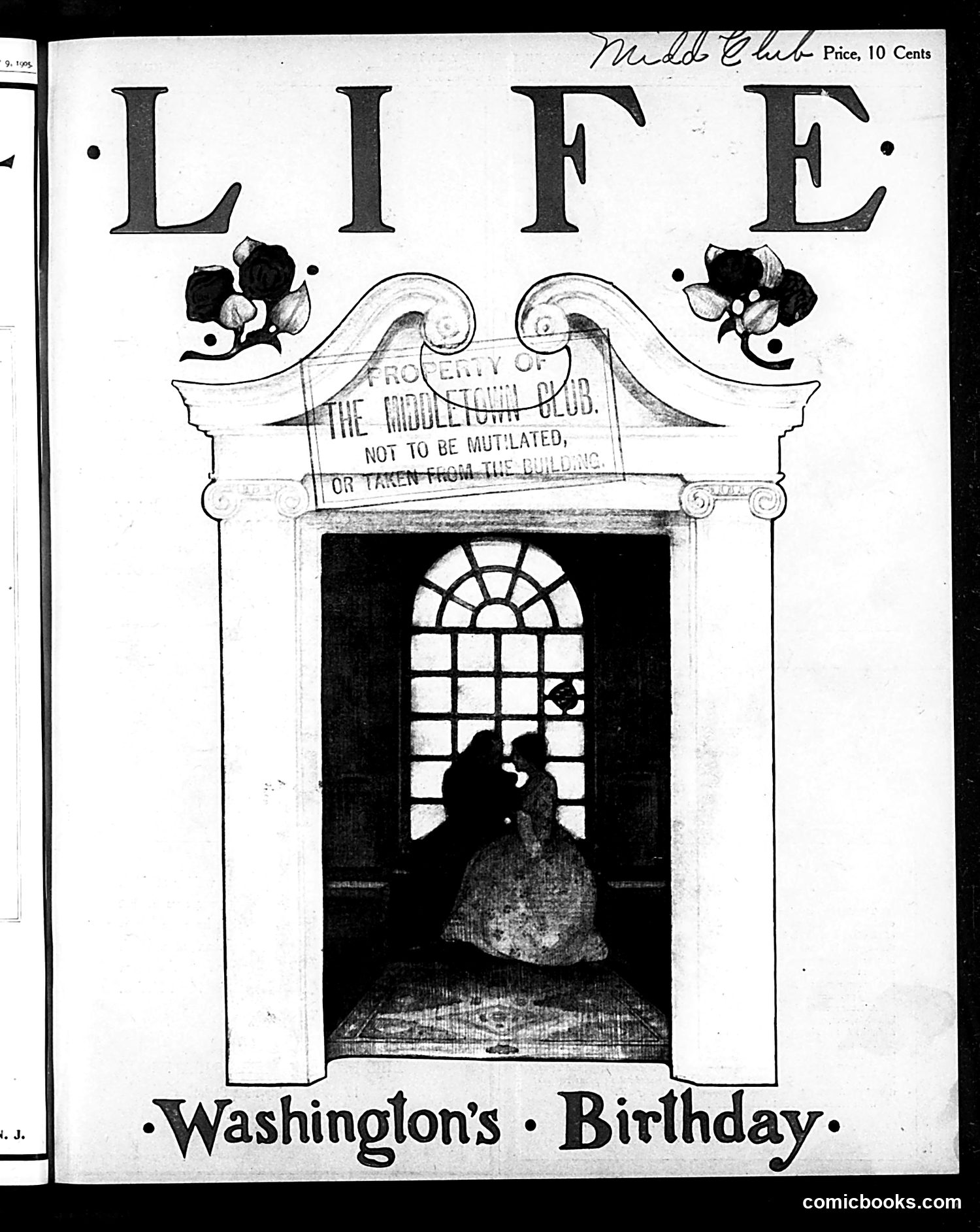
This is a "Life" magazine cover (price 10 cents) themed around Washington's Birthday, a major American holiday celebrating George Washington's February 22 birth. The cover shows a silhouetted couple in period dress (likely 18th-century style, referencing Washington's era) gazing out a window with a fan transom. The architectural framing—with classical columns and decorative florals—evokes Federal/neoclassical design associated with early American monuments and government buildings. The satirical point appears subtle here: the romantic, idealized imagery of Washington's era contrasts with whatever contemporary social commentary "Life" magazine intended. Without additional context from the magazine's interior, the specific satire remains unclear, though the nostalgic presentation of historical America was common in early 20th-century American humor and social criticism.
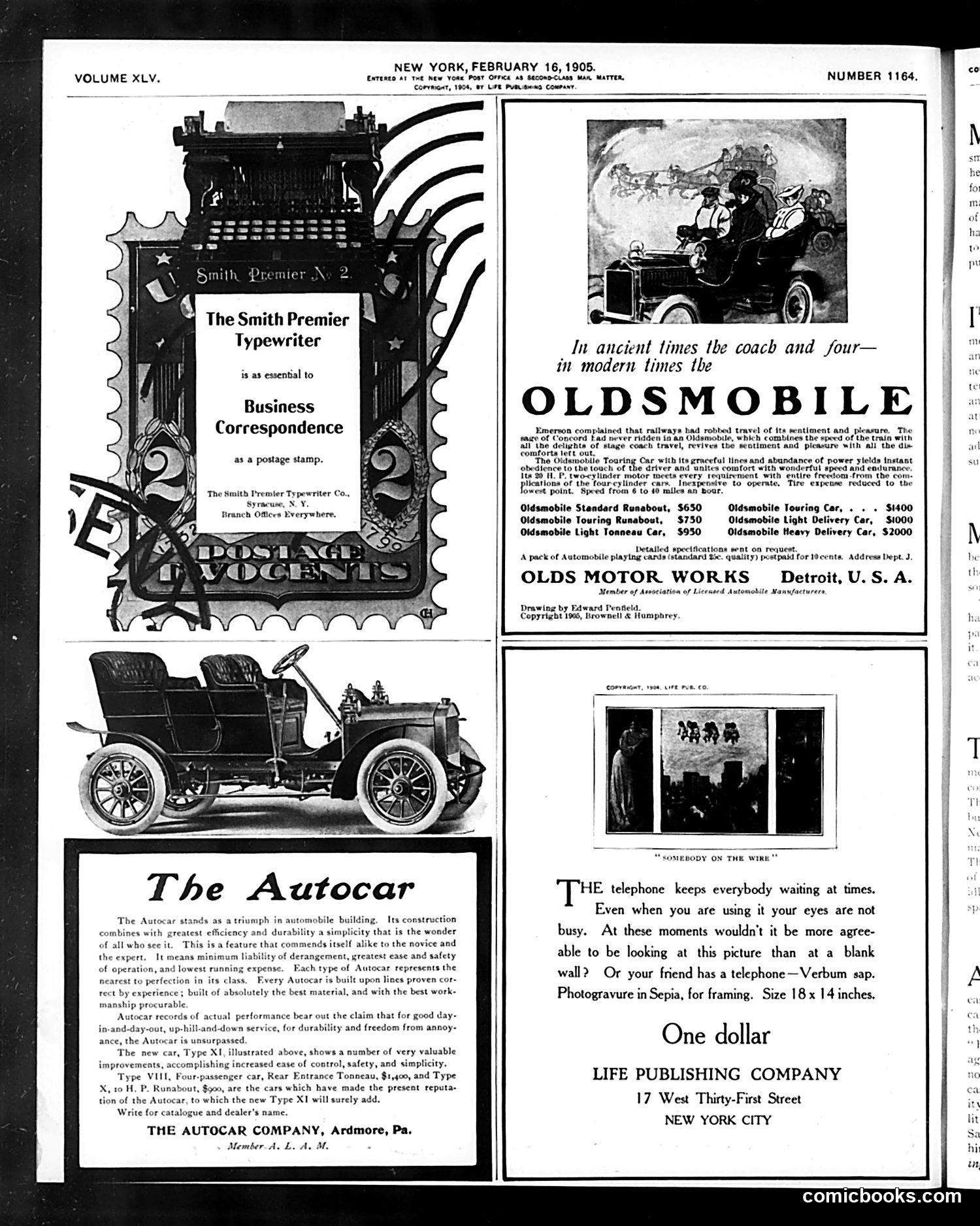
This page consists primarily of **advertisements** rather than satirical content. The ads feature: 1. **Smith Premier Typewriter** - positioned as essential to business correspondence 2. **Oldsmobile automobiles** - marketing various touring and delivery car models 3. **The Autocar** - another automobile brand emphasizing safety and reliability 4. **Life Publishing Company** - advertising a photographic sepia print titled "Somebody on the Wire" The only potentially satirical element is the Oldsmobile ad's opening line contrasting "ancient times the coach and four" with "modern times the Oldsmobile," gently mocking the rapid technological transformation of the era. Otherwise, this represents early 1900s consumer advertising reflecting America's emerging automobile and business technology industries.
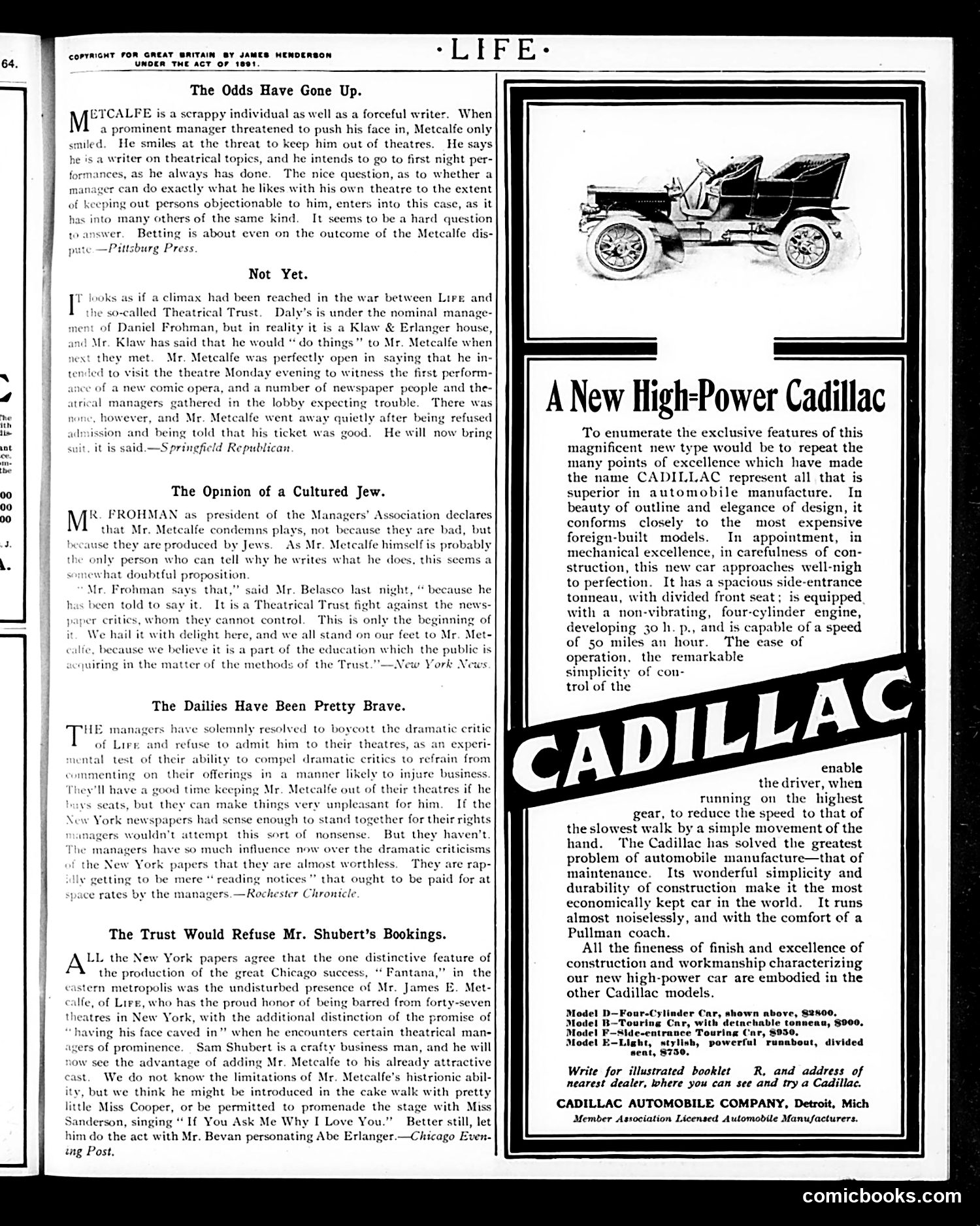
This page contains **theatrical gossip and criticism**, not political cartoons. The left column discusses disputes between theater manager **Mr. Metcalfe** and the "Theatrical Trust"—a trust controlling New York theaters. Articles describe Metcalfe as a "scrappy" figure who defies the Trust's authority, resists threats, and attends performances despite being denied admission. The right side is a **Cadillac automobile advertisement** featuring an illustration of an early motorcar and promotional text about the vehicle's features and performance specifications. The theatrical pieces satirize industry power struggles and Metcalfe's principled resistance to institutional control, but they're more news commentary than formal satire. The page blends entertainment industry gossip with early 1900s advertising.
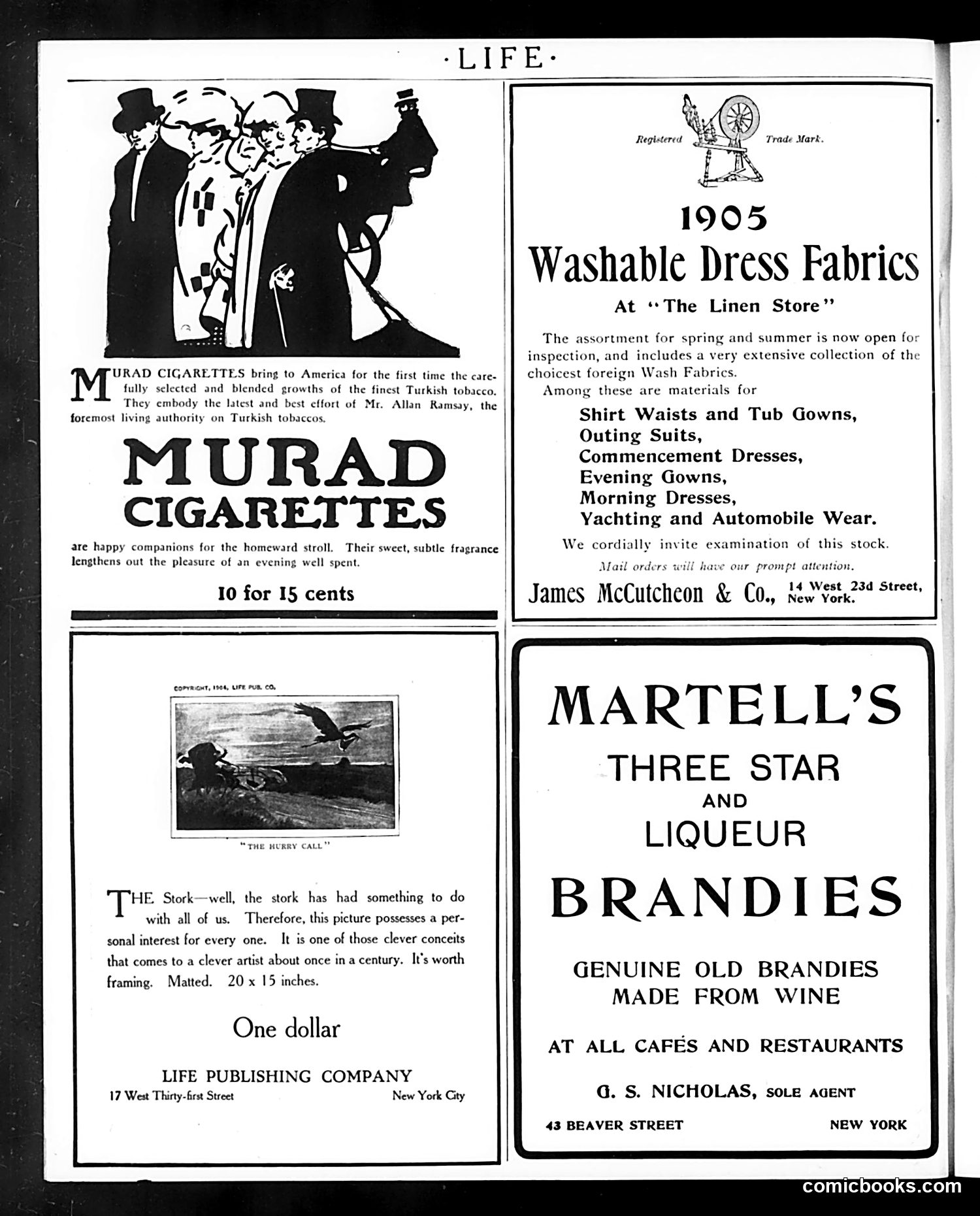
The top-left cartoon depicts four men in formal attire (top hats and coats) in what appears to be a satirical scene. The accompanying Murad Cigarettes advertisement claims these are "the finest Turkish tobacco" and references "Mr. Allan Ramsay" as an authority on Turkish tobacco—though the cartoon's exaggerated style suggests this may be humorous or ironic commentary on the product's marketing claims. The remaining page content is primarily **advertisements**: washable dress fabrics from James McCutcheon & Co., a Life Publishing Company art print ("The Hurry Call"), and Martell's brandy. Without clearer identification of the cartoon's specific figures or historical context, I cannot definitively explain the satire's target. The page appears to mix editorial cartooning with commercial advertising, typical of early 1900s *Life* magazine format.
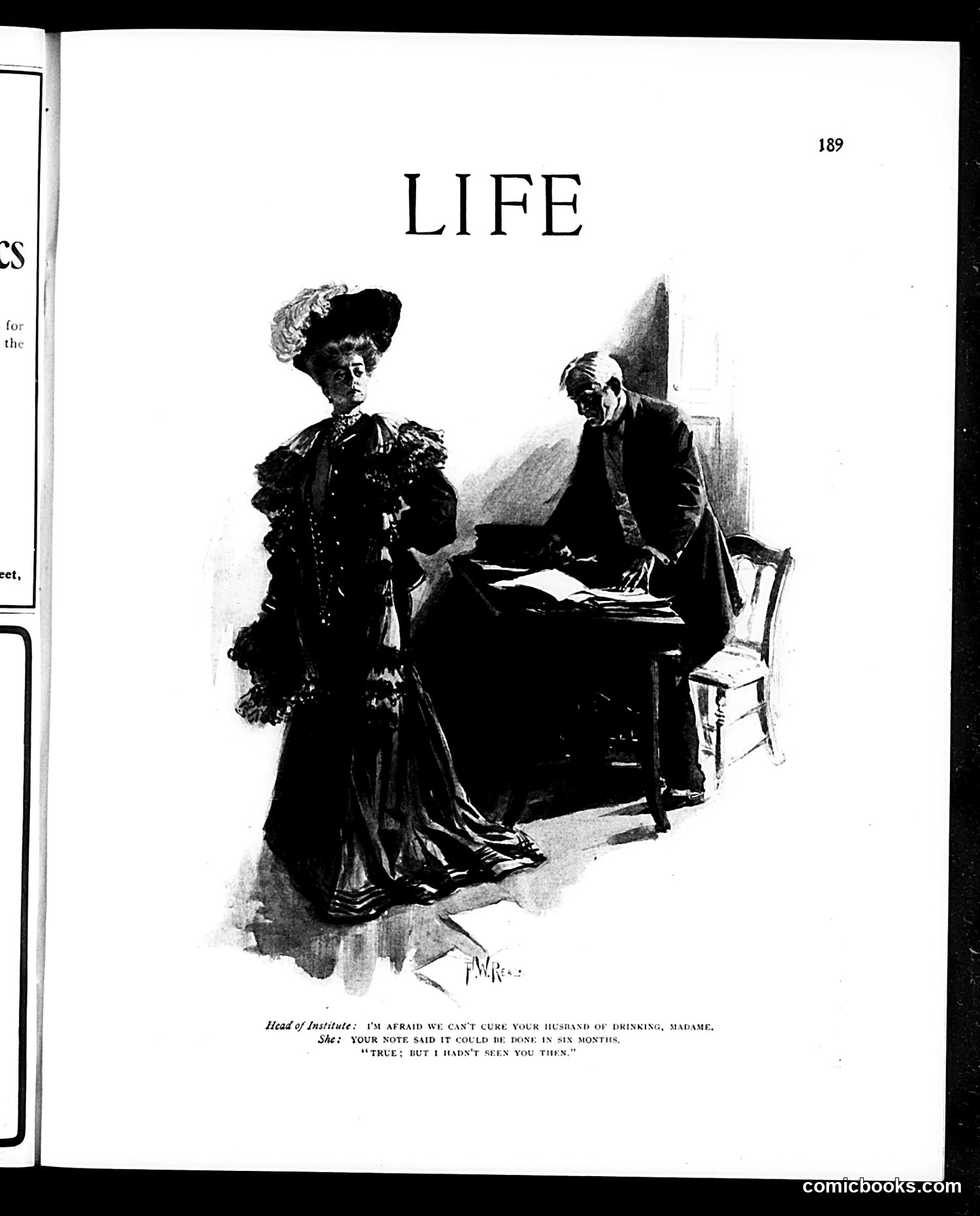
This page depicts a scene at what appears to be a medical or psychiatric institute. A well-dressed woman visits a male official seated at a desk. The caption reveals their exchange: she notes her husband's drinking problem, and the institute head claims they cannot cure alcoholism within six months—but adds pointedly, "True; but I hadn't seen you then." The satire targets the institute's fraudulent practices. The joke suggests the official is implying he could "cure" the husband simply by having the attractive wife visit regularly, reducing the claim to absurdity. This mocks both quack medical institutes promising miracle cures for alcoholism (a significant Progressive-era social issue) and the shallow reasoning behind their dubious treatments. The cartoon satirizes both medical fraud and gender dynamics of the period.
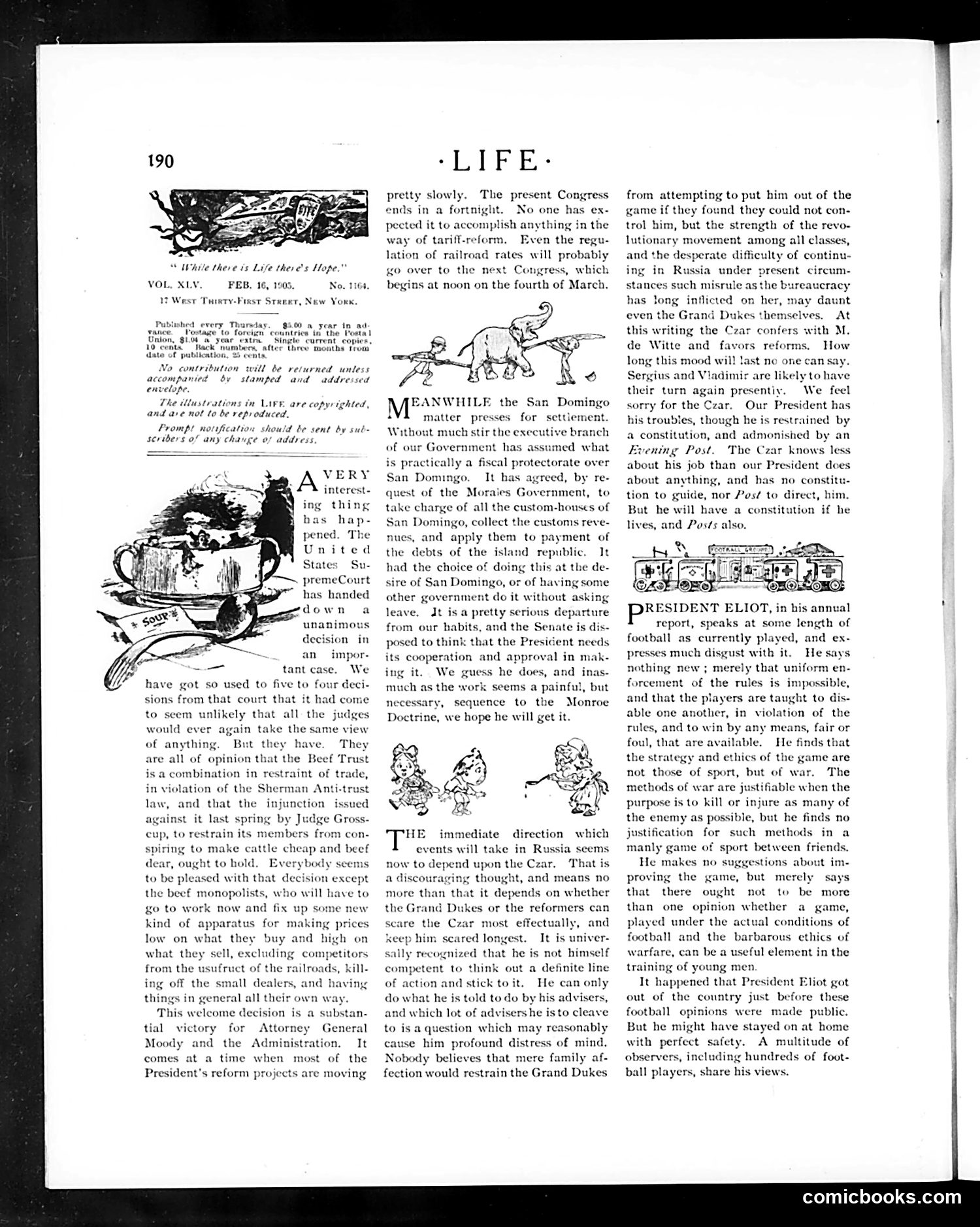
The page contains political commentary on Russian affairs during the Russo-Japanese War period. The text discusses the Czar's difficulties, reform movements, and bureaucratic challenges. The prominent cartoon at top-left appears to show a figure in a barrel or confined space, likely satirizing governmental restriction or entrapment—a common motif for depicting oppressive regimes. Additional illustrations accompany commentary on San Domingo (Dominican Republic) fiscal matters and President Roosevelt's football opinions. The satire mixes domestic American politics (Roosevelt, trust-busting) with international affairs (Russian instability, Caribbean governance), using cartoons and witty commentary to critique both foreign despotism and American political developments. The tone suggests skepticism toward government intervention while poking fun at various public figures.
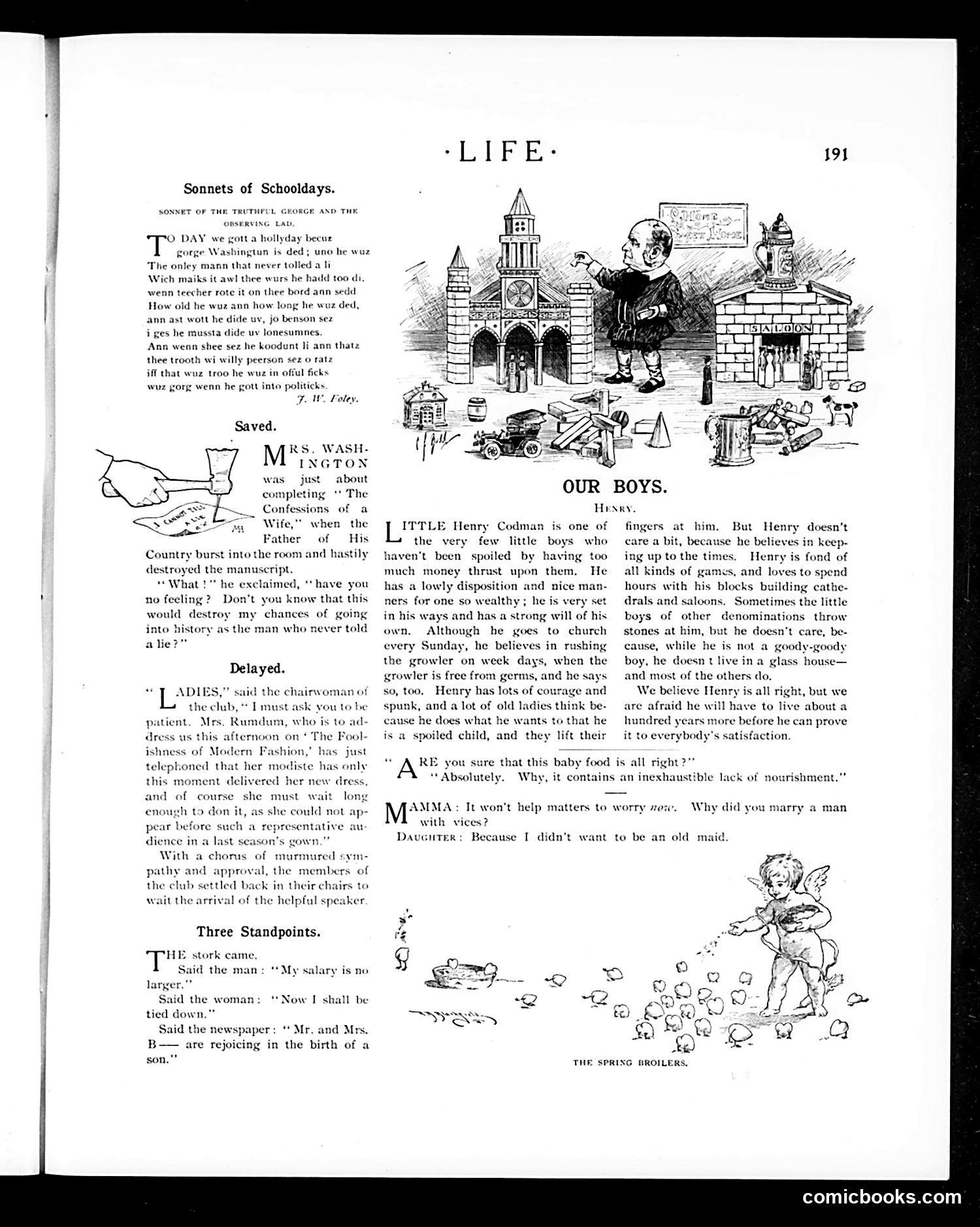
This page contains several humorous short pieces rather than political cartoons. "Our Boys" satirizes wealthy parents who spoil their children with money, using little Henry Codman as an example. The piece suggests such children become bratty and demanding, though Henry himself escapes this fate through his good character. "Saved" mocks a woman's relief when she completes a book ("The Confessions of a Retired Father") before her manuscript is destroyed—a joke about the trivial concerns of wealthy leisure-class women. "Three Standpoints" presents a brief observational humor piece about different perspectives on a birth announcement. The illustrations, including "The Spring Broilers" (cherubs), are typical decorative vignettes common to Life magazine's satirical format targeting upper-class American society and pretensions.
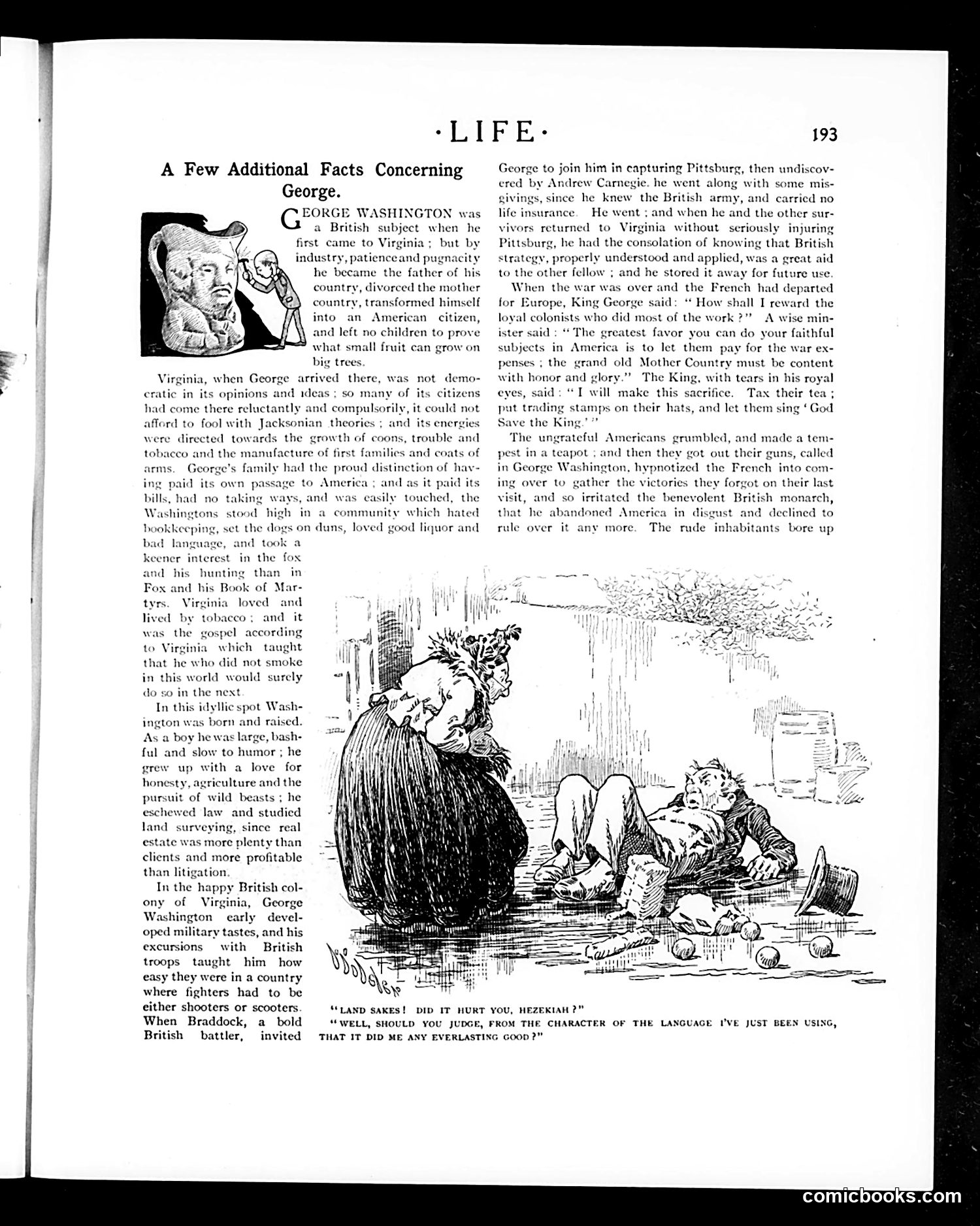
This satirical piece mocks George Washington's character and legacy. The text presents a revisionist (and clearly tongue-in-cheek) biography claiming Washington was undemocratic, despised American citizens, and abandoned the country in disgust after the Revolutionary War. The cartoon below depicts what appears to be a figure (likely representing Washington or a contemporary politician) scolding two others over their use of profanity, with the caption sarcastically praising their "everlasting good." The satire appears to critique either Washington's actual reputation or—more likely—contemporary political hypocrisy, where leaders present themselves as moral exemplars while their actual conduct contradicts their public image. The piece uses exaggeration and ironic praise to expose perceived inconsistencies.
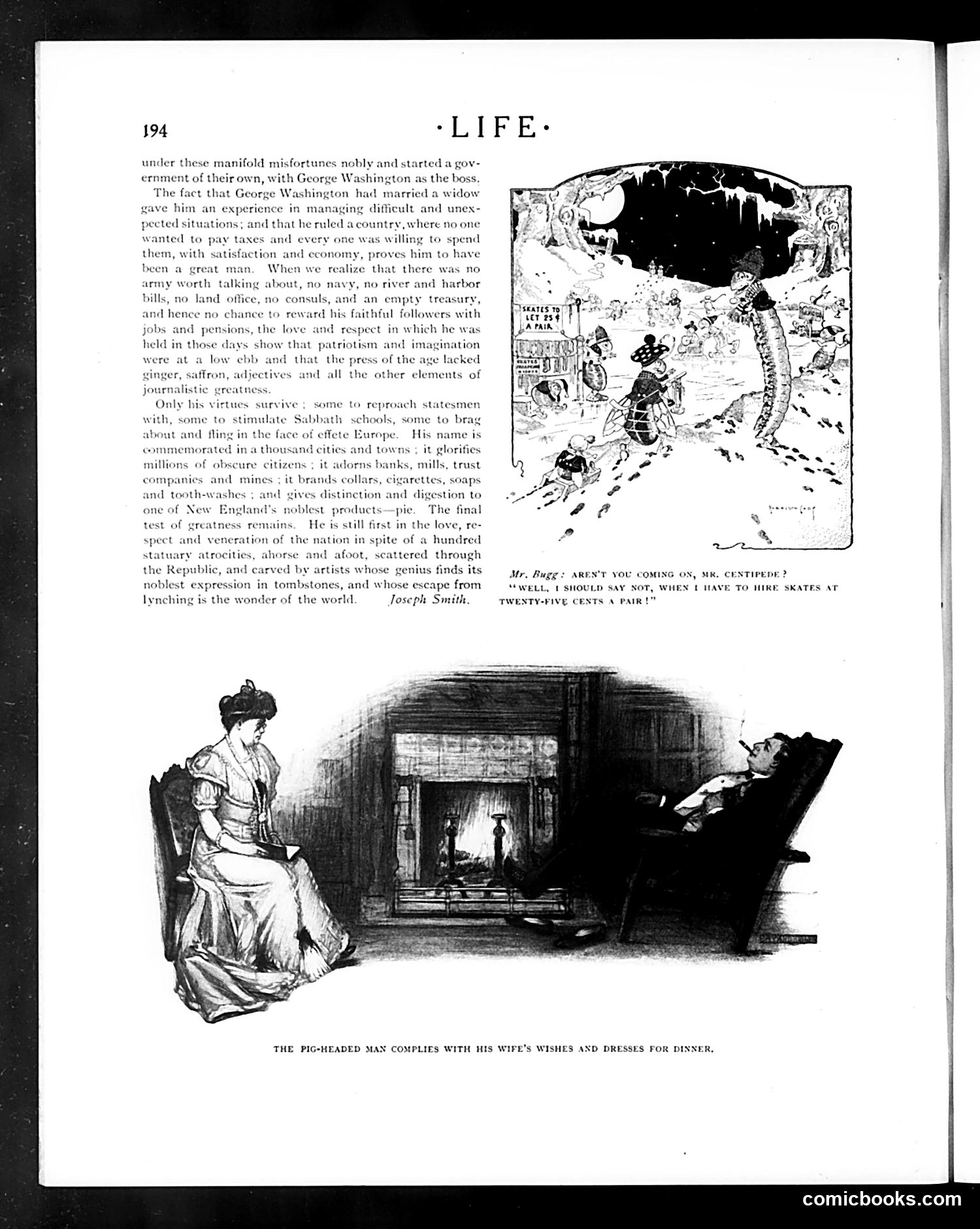
This page contains two distinct cartoons satirizing American society and politics. The upper illustration depicts a chaotic scene labeled as a park, with numerous figures engaged in various activities. The caption quotes a character named "Mr. Buggs" refusing to attend because ice-skate rentals cost twenty-five cents—satirizing penny-pinching attitudes toward entertainment. The lower cartoon, titled "The Pig-Headed Man Complies with His Wife's Wishes and Dresses for Dinner," shows a domestic scene where a man reluctantly agrees to his wife's demands. This satirizes marital dynamics and masculine resistance to social conventions regarding proper dress. The adjacent text praises George Washington's character and leadership during the founding era, contrasting his patriotism with contemporary American materialism and cynicism—suggesting the magazine lamented declining national values.
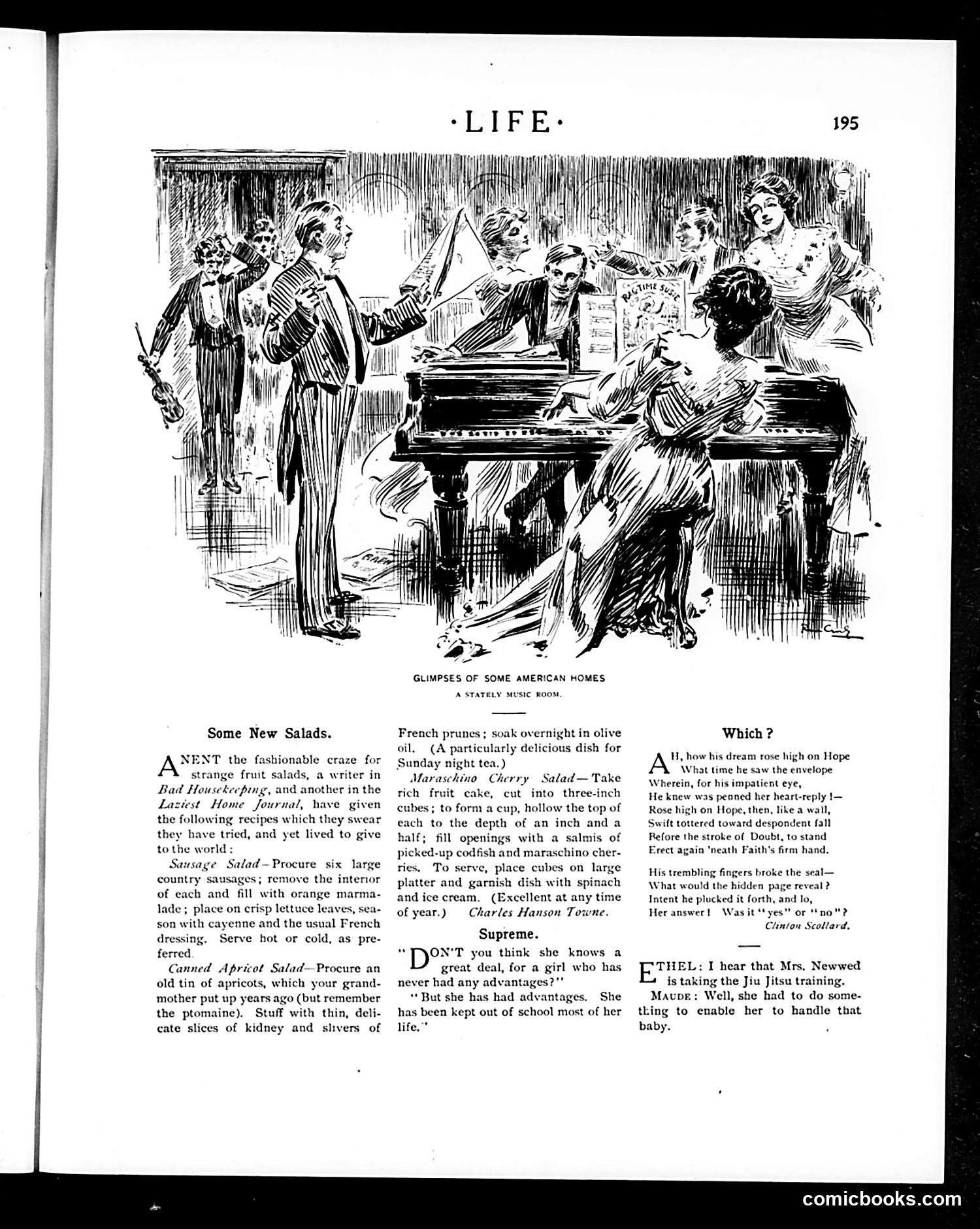
This satirical sketch depicts an upper-class musical performance. The cartoon mocks the pretensions of wealthy American households through exaggerated contrasts: formally dressed men conduct or supervise while women play piano, suggesting rigid gender and class hierarchies in domestic entertainment. The "stately music room" title is likely ironic, given the somewhat chaotic arrangement of figures and the hint of performance anxiety visible in the sketched poses. This reflects early 20th-century satire of nouveau riche American society attempting to emulate European cultural refinement. The accompanying text about salad recipes and brief comedic exchanges ("Which?") suggests the page satirizes both domestic aspirations and the trivial concerns of fashionable households—mocking how Americans sought cultural sophistication while remaining preoccupied with superficial matters.
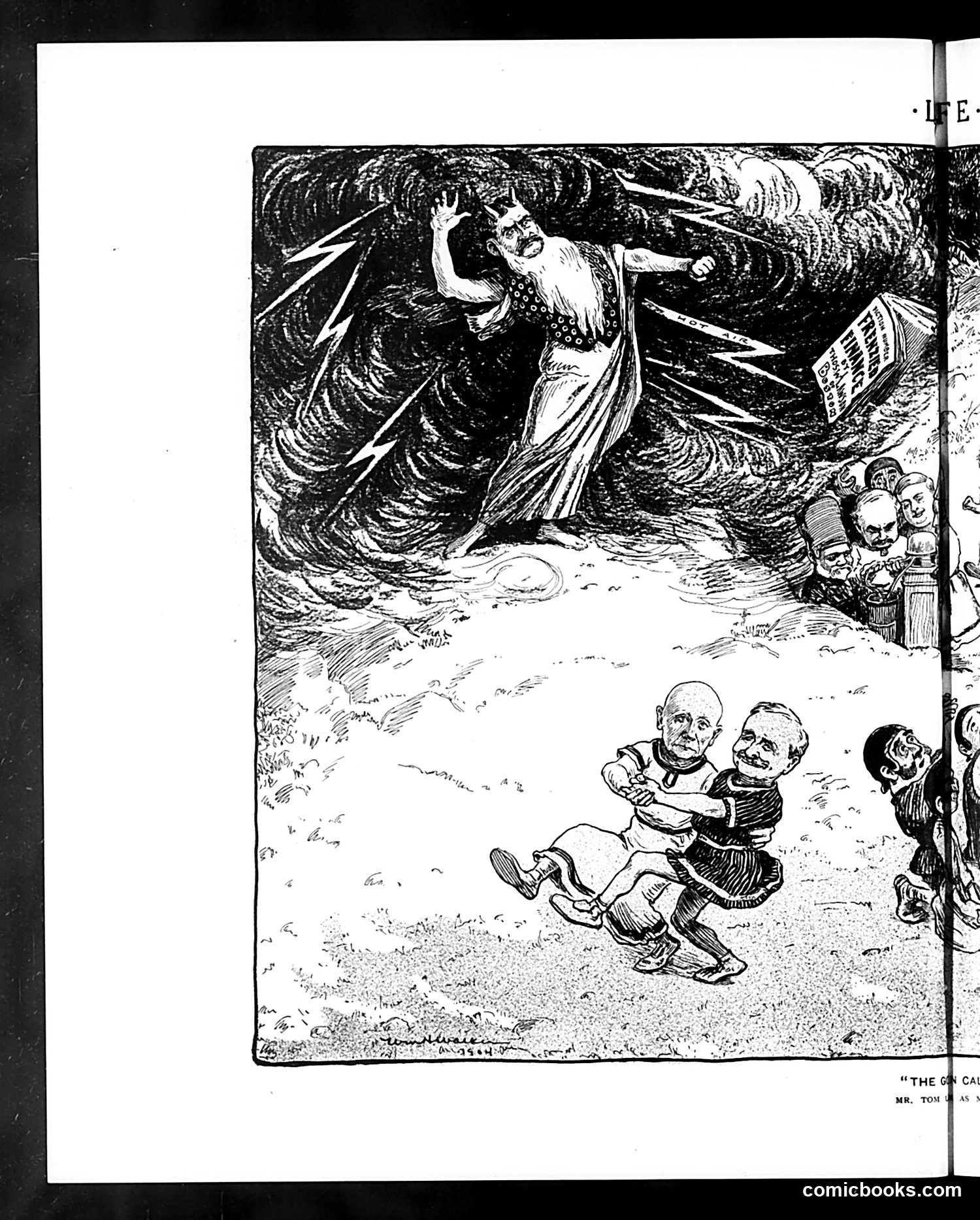
This appears to be a satirical illustration from *Life* magazine, though the OCR text is too fragmentary to read clearly. The image depicts a dramatic supernatural or hellish scene: a robed female figure (possibly representing a classical or allegorical character) gestures dramatically amid swirling dark clouds and lightning above. Below, two bald caricatured men appear distressed or fleeing, with other figures visible on the right edge. The style and subject matter suggest political or social satire, likely commentary on contemporary events or figures from the early-to-mid 20th century. However, without legible text identifying the specific figures or context, I cannot definitively state whom the caricatures represent or what event is being satirized. The dramatic, ominous tone suggests criticism of powerful figures or movements.
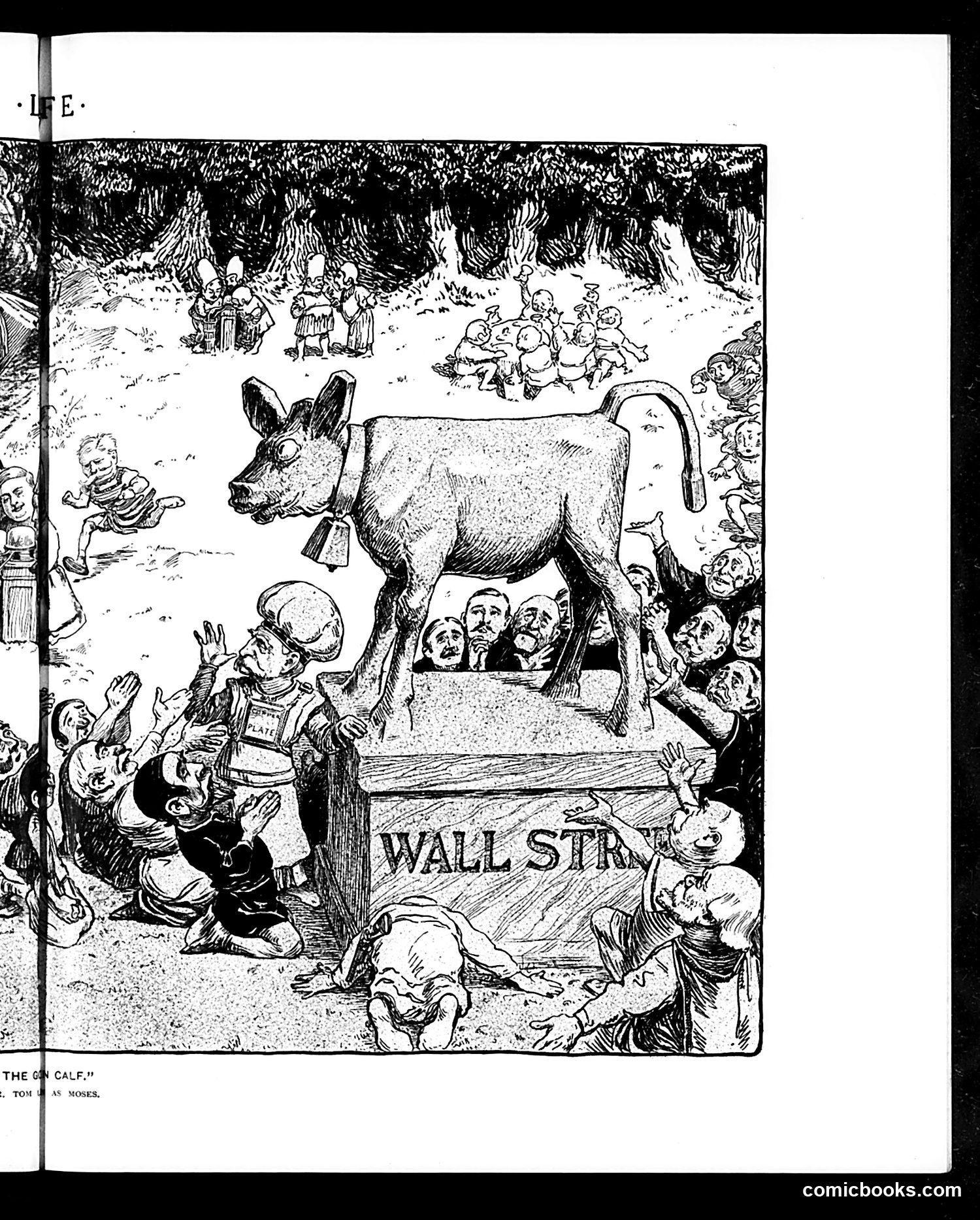
This political cartoon depicts a massive cow-like figure labeled "WALL ST" (Wall Street), worshipped by a crowd of smaller figures. The image references the Biblical story of the Golden Calf—a false idol created when Moses descended from Mount Sinai—applying this religious allegory to American financial markets. The satire suggests that Wall Street has become an object of blind worship and devotion among the public, who treat financial speculation and wealth accumulation as a false religion. The crowd's reverent posture toward the Wall Street "idol" critiques the era's speculative excess and the public's uncritical faith in financial institutions. This appears to be from Life magazine's commentary on 1920s American capitalism and stock market culture, satirizing financial mania as modern idolatry.
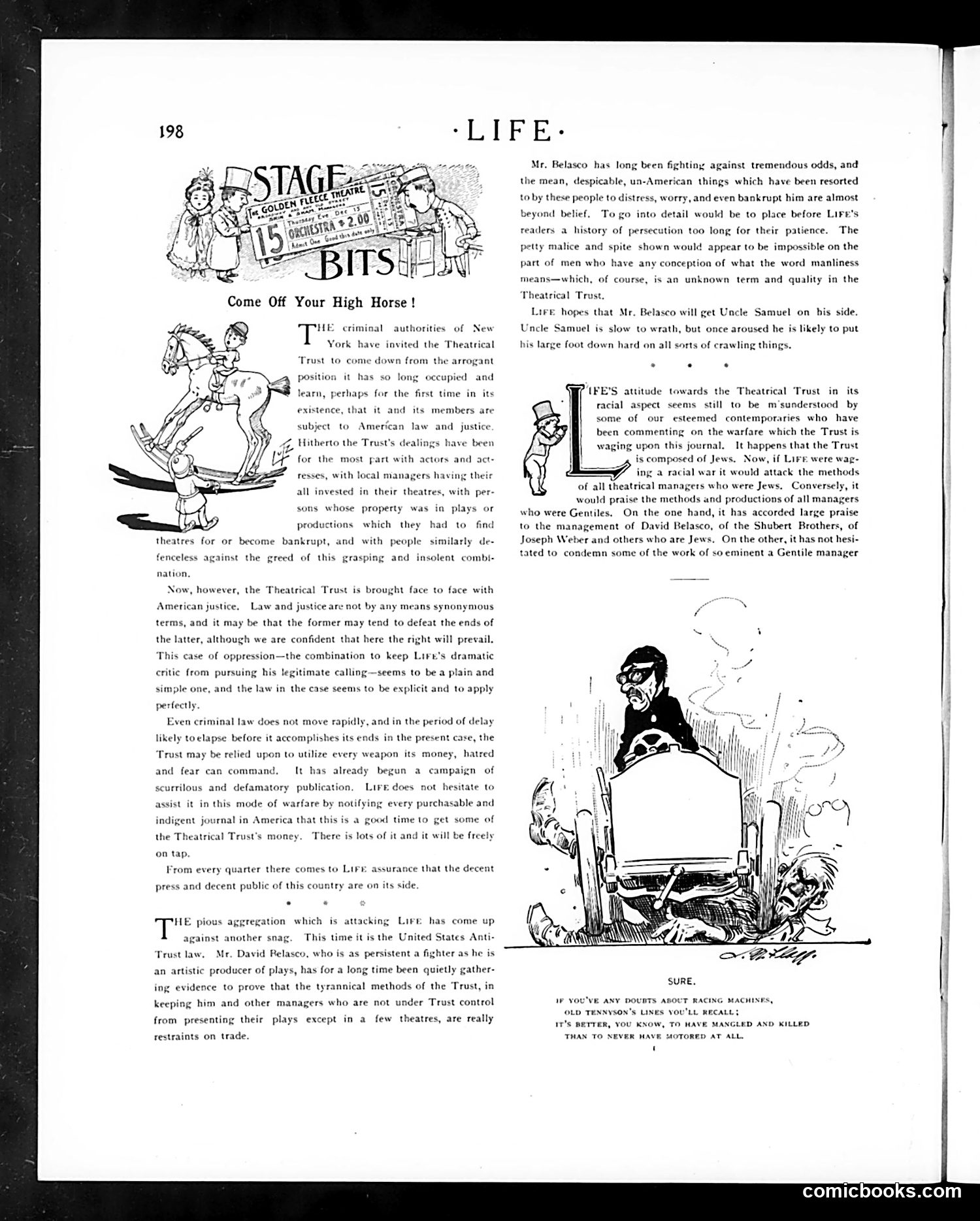
This page attacks the **Theatrical Trust**, a monopolistic theater management organization, on multiple fronts: **The Main Conflict:** Life's dramatic critic was allegedly prevented from his work by the Trust's power. Life presents this as an antitrust violation and calls for legal action. **Key Figures:** **David Belasco**, an independent theatrical producer, is praised as fighting the Trust's tyrannical control over which theaters can present plays. The Trust allegedly uses financial intimidation against non-compliant managers and producers. **The Satire:** The cartoons mock the Trust's arrogance—depicted as a "high horse" needing to be brought down. Life sarcastically invites wealthy Trust members to fund rival publications attacking Life, knowing they will. **Racial Defensiveness:** Life explicitly addresses accusations that its Trust criticism is antisemitic (the Trust being Jewish-owned). Life claims it attacks *methods*, not ethnicity, and would praise any ethical manager regardless of religion. **Context:** This reflects early-1900s antitrust sentiment and labor disputes in American theater.
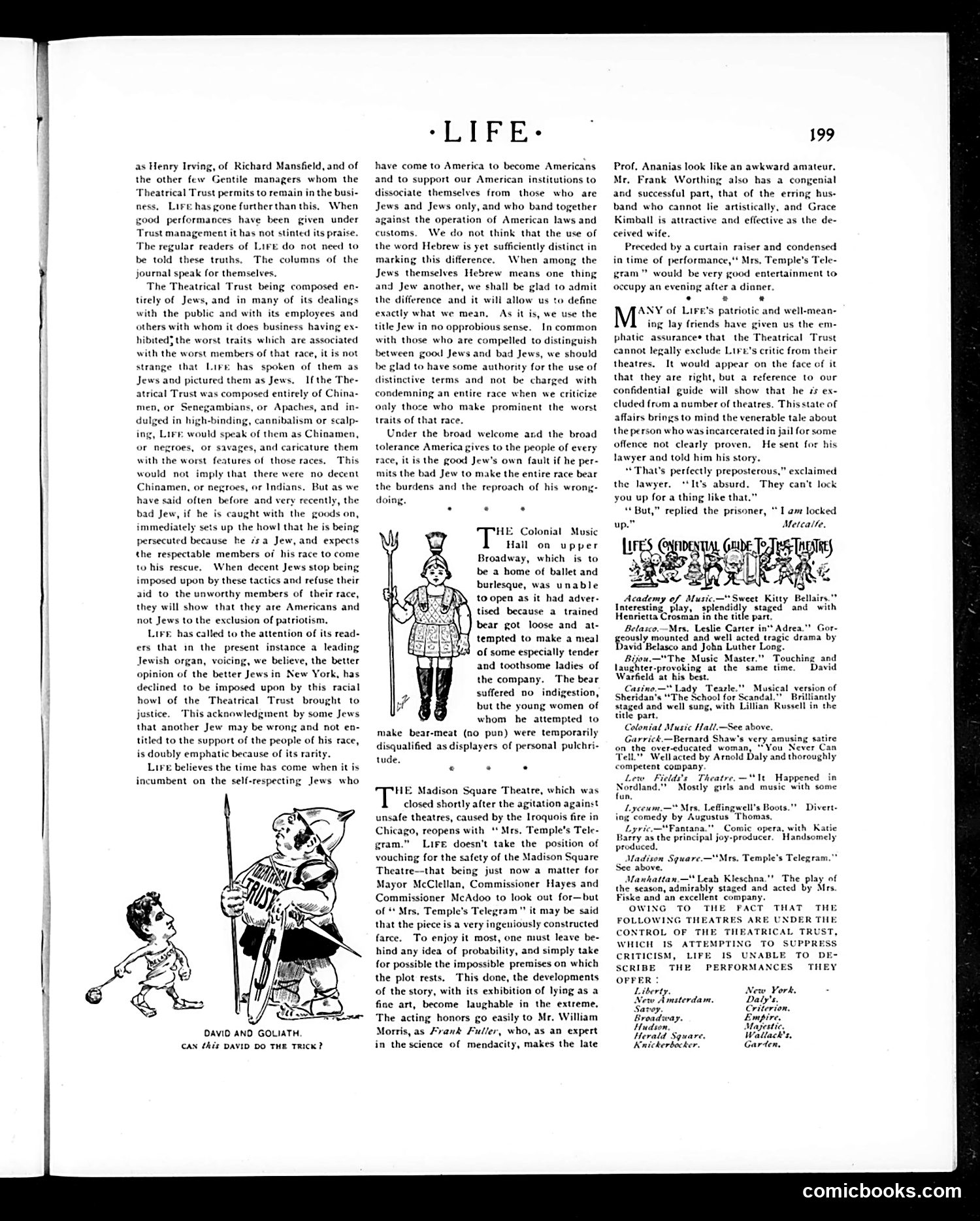
This page contains a lengthy editorial defending Life's criticism of the "Theatrical Trust"—a monopolistic theater management organization. The text argues that Life has fairly criticized the Trust's unethical business practices while acknowledging decent individual members. Notably, the editorial makes explicitly ethnic arguments, stating the Trust is "composed entirely of Jews" and justifying ethnic caricature by claiming it would do the same for Chinese or other groups engaging in similar misconduct. **The David and Goliath cartoon** (lower left) depicts a small figure confronting a larger authority figure, likely symbolizing an underdog challenging the Trust's power. **The Colonial Music Hall anecdote** (lower right) humorously describes a trained bear escaping and terrorizing performers at a Broadway venue—likely included as light relief or social commentary about theatrical chaos. The page reflects early 20th-century American journalism's casual use of ethnic stereotyping alongside substantive criticism, revealing period attitudes toward Jewish-American identity and business ethics.
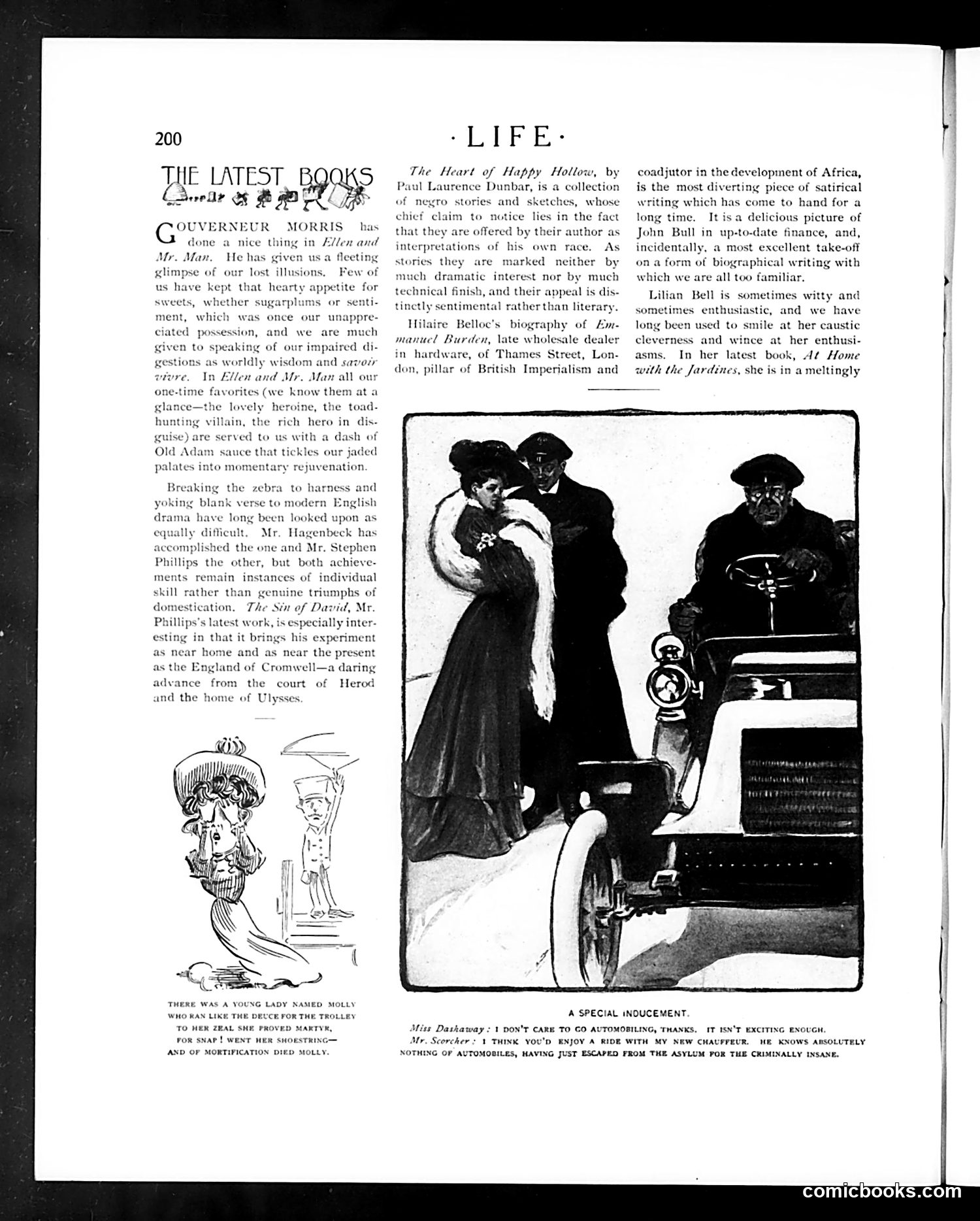
This *Life* magazine page reviews recent publications and includes two satirical cartoons. **Top Cartoon (Limerick):** A humorous illustration accompanying a verse about "young lady named Molly" who ran for a trolley, broke her shoestring, and died of embarrassment. It's light social satire about Victorian propriety and the perils of public mishap. **Bottom Cartoon ("A Special Inducement"):** A sharper satire on early automobile culture. A woman declines a ride as "not exciting enough," whereupon a man ("Mr. Scorcher") invites her with his new chauffeur—who "knows absolutely nothing of automobiles, having just escaped from the asylum for the criminally insane." This mocks both the recklessness of wealthy motorists and the anxieties automobiles provoked in 1900s society. **Book Reviews:** The page discusses works by Gouverneur Morris, Paul Laurence Dunbar (*Heart of Happy Hollow*), and others, with brief critical commentary on their literary merit.
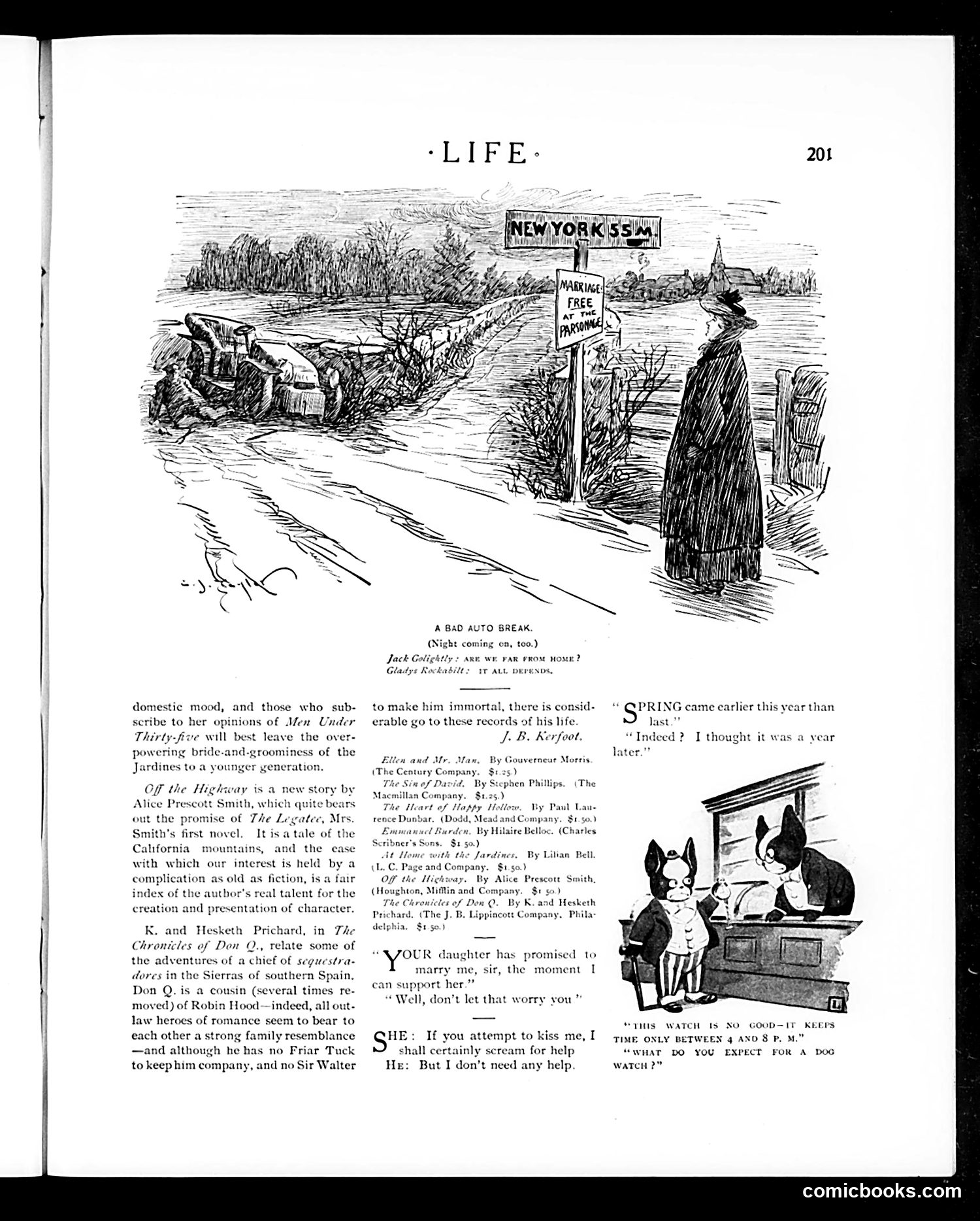
This page from *Life* magazine contains book reviews and several satirical cartoon jokes typical of early 20th-century humor. **The cartoons mock domestic situations:** 1. **"A Bad Auto Break"** shows a stranded couple; the woman asks if they're far from home, and the man replies "It all depends"—suggesting marital discord where he's in no hurry to return. 2. **The marriage proposal joke** plays on class anxiety: a suitor tells the father his daughter promised to marry him once he could support her. The father's reassurance ("don't let that worry you") darkly implies the daughter won't marry him. 3. **The kiss/scream joke** presents a woman threatening to cry for help if kissed, with the man confidently stating he needs no assistance—suggesting he's physically overpowering. 4. **The "dog watch" pun** jokes about a broken timepiece that only works 4-8 PM (a nautical "dog watch" term), with wordplay on "dog watch" as something of low value. These reflect period attitudes about gender relations, courtship, and marriage—often cynical and assuming male persistence in romantic/physical matters.
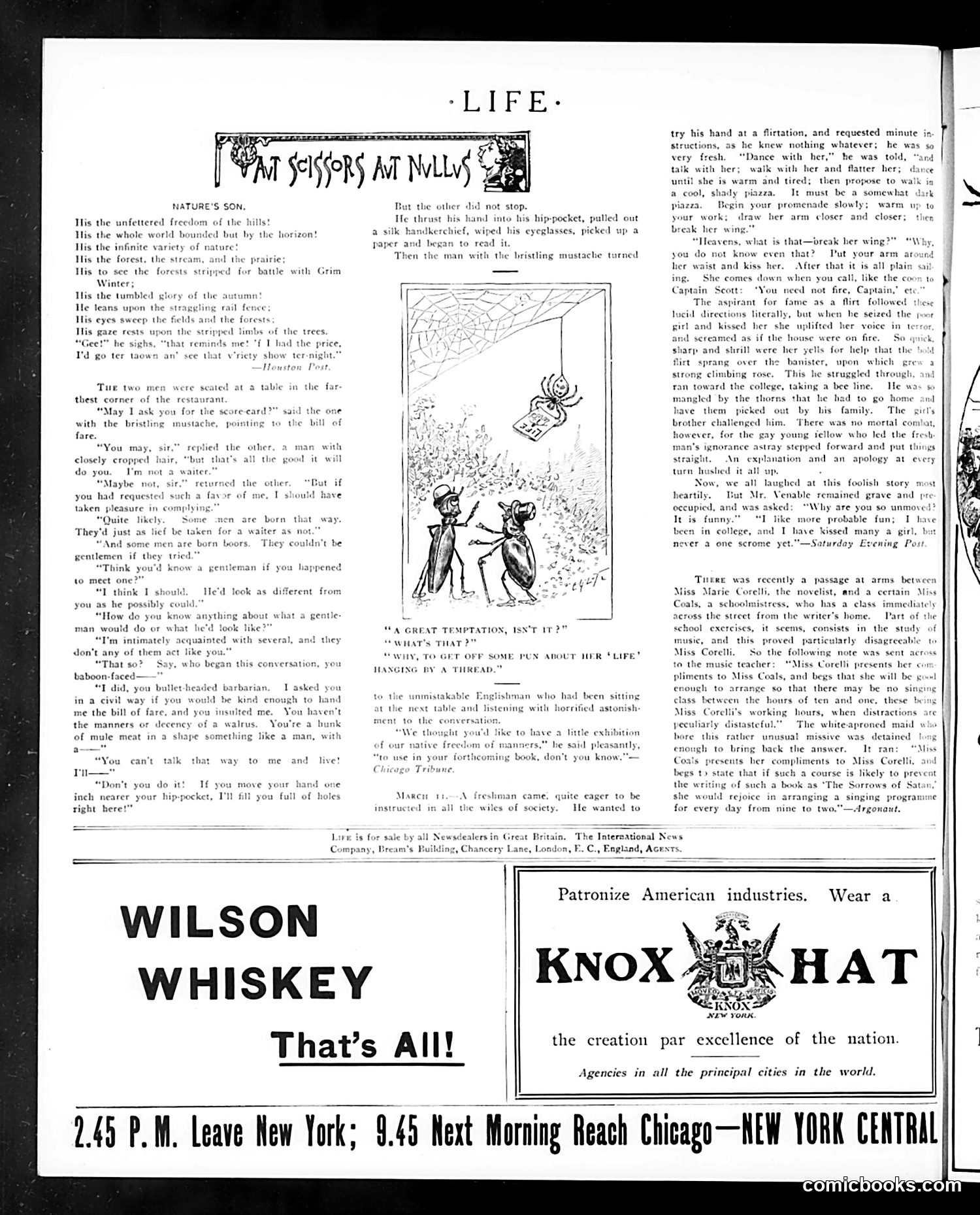
This page contains two satirical pieces typical of *Life* magazine's humor: **Main cartoon**: Two men at a restaurant corner debate whether gentlemen exist. One, with a "bristling mustache," demands the waiter fetch a scorecard (bill). When refused and insulted, he argues about the nature of gentlemen—a class commentary suggesting gentlemen are defined by behavior, not birth. The working-class mustached man acts ungentlemanly, proving the point. **Secondary story**: A college freshman receives flirtation coaching and physically assaults a girl by kissing her without consent. Everyone laughs except Mr. Venable, who prefers "probable fun"—satirizing both naive masculine entitlement and casual sexual presumption as acceptable social comedy. **Social context**: Both pieces mock class pretensions and male courtship behavior of the era, presenting sexual aggression and working-class rudeness as objects of humor rather than critique.
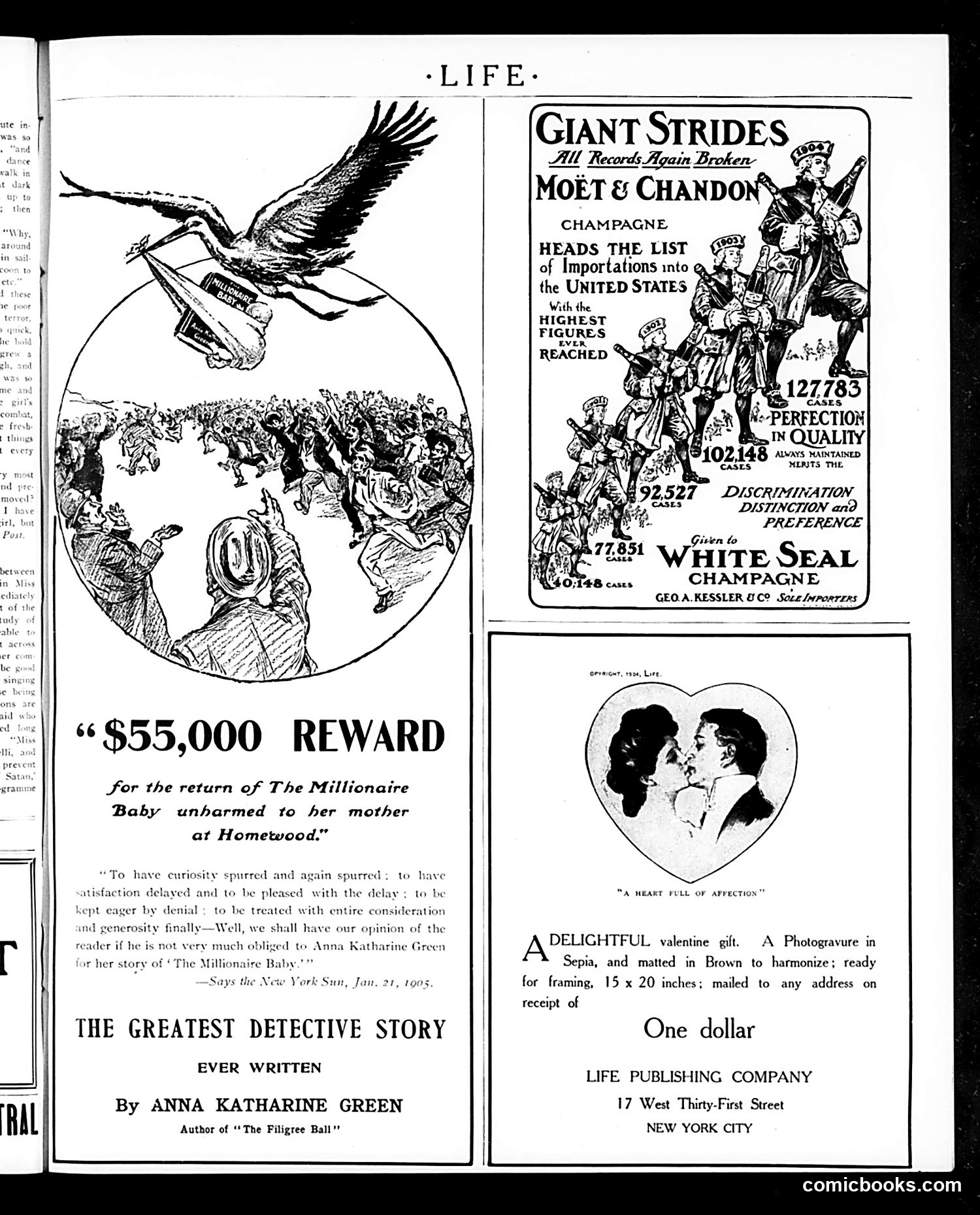
This page mixes advertising with a literary promotion, reflecting early 1900s Life magazine content. The left side advertises Anna Katharine Green's serialized detective novel "The Millionaire Baby," promoting it as "the greatest detective story ever written." The "$55,000 reward" imagery—showing a stork carrying a baby above crowds—is a literary hook referencing the story's kidnapping plot at "Homewood." The accompanying quote from the *New York Sun* (Jan. 21, 1905) emphasizes reader anticipation for plot developments. The right side contains advertisements: Moët & Chandon champagne boasts import records and sales figures, while a competing champagne (White Seal) emphasizes quality. Below is a Valentine's Day photogravure offer from Life Publishing Company. For modern readers: this reflects pre-cinema entertainment where serialized fiction in magazines generated genuine public suspense and competed for reader attention alongside luxury goods advertising.
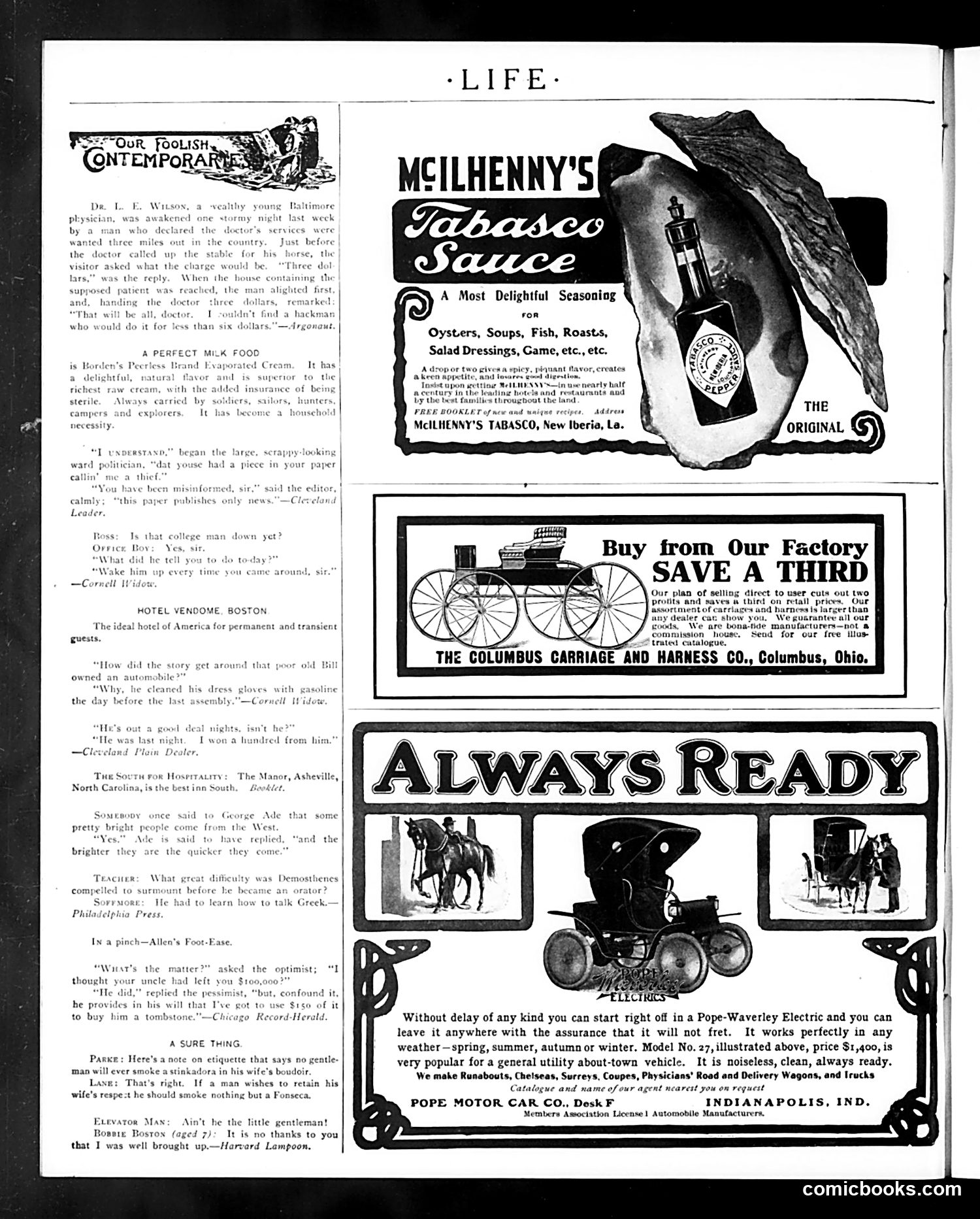
This page is primarily **advertising**, with brief humorous anecdotes in the left column. The cartoons are minimal—mostly joke texts rather than visual satire. The left column contains short jokes typical of early-1900s Life magazine: a doctor refusing a house call, a man bragging about winning money at cards, and commentary on etiquette and manners. These target genteel society's pretensions and hypocrisy. The advertisements dominate: McIlhenny's Tabasco Sauce, Borden's evaporated cream, horse carriages, and notably early automobiles (Columbus Carriage and Pope Motor Car electric vehicles). The Pope-Waverley Electric is pitched as a modern alternative to horses—"noiseless, clean, always ready"—reflecting the automotive revolution replacing horse-drawn transport. The humor assumes readers familiar with formal etiquette, classical education references (Demosthenes learning Greek), and consumer goods. The overall tone reflects upper-middle-class concerns of the era.
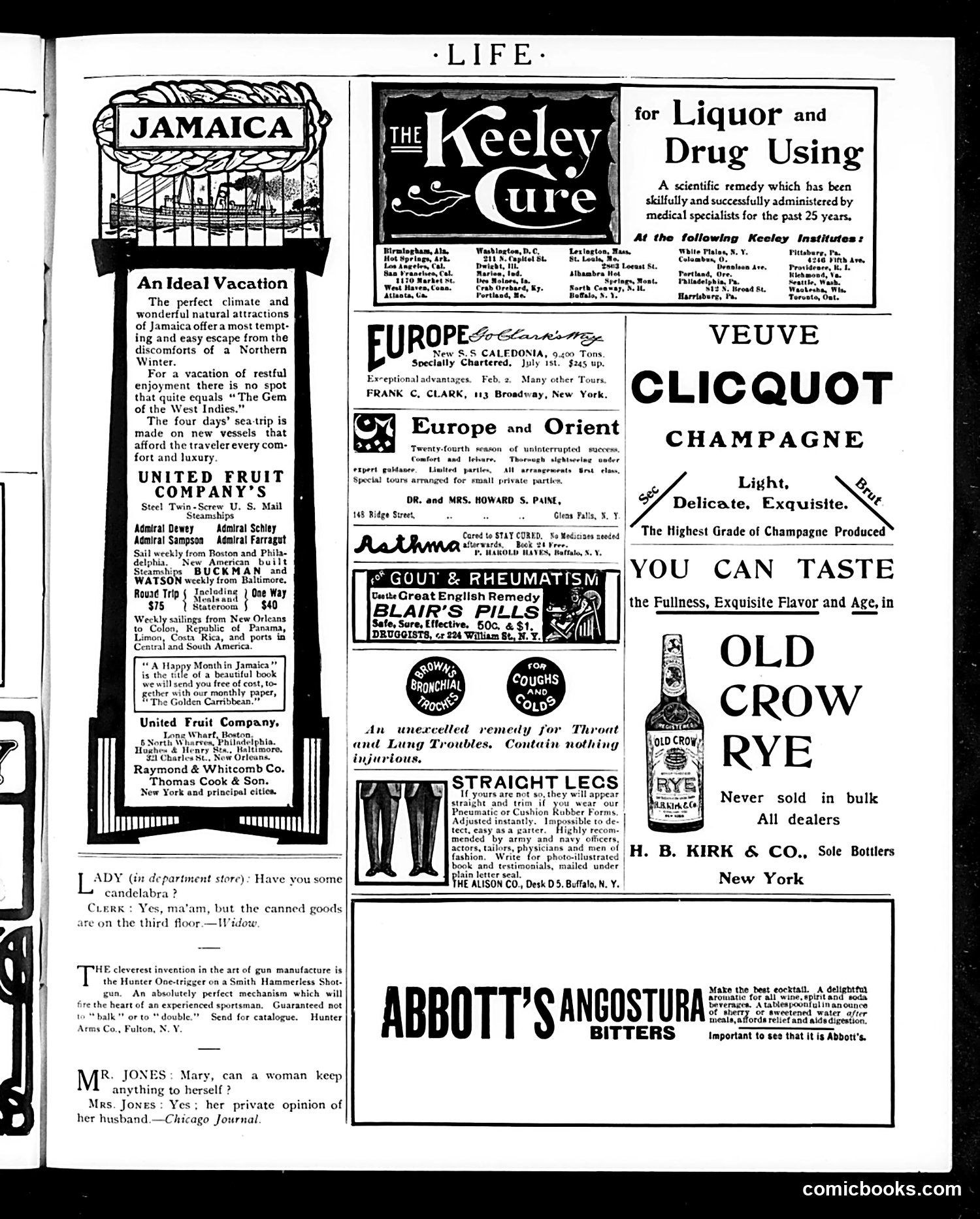
This page is primarily **advertising**, typical of early 20th-century magazines. The advertisements promote products reflecting the era's medical and social attitudes: **Key Products Advertised:** - **Keeley Cure**: A "scientific remedy" for liquor and drug addiction, presented as legitimate medical treatment. The Keeley Institutes were real establishments that promised cure through their proprietary methods—now understood as pseudoscience. - **Straight Legs/Pneumatic Cushion**: Leg braces marketed to make crooked legs appear straight, revealing period anxieties about physical appearance and disability. - **Gout & Rheumatism pills**, **cough remedies**, **bitters**: Patent medicines with exaggerated health claims. **The Humor:** The small dialogue jokes (bottom left) are conventional period humor—wordplay about department stores and married life—unrelated to advertising's medical dubious claims. **Modern Context:** This page reveals how openly manufacturers marketed unproven remedies as "scientific," exploiting public desperation regarding addiction, disability, and illness without regulatory oversight that would later emerge.
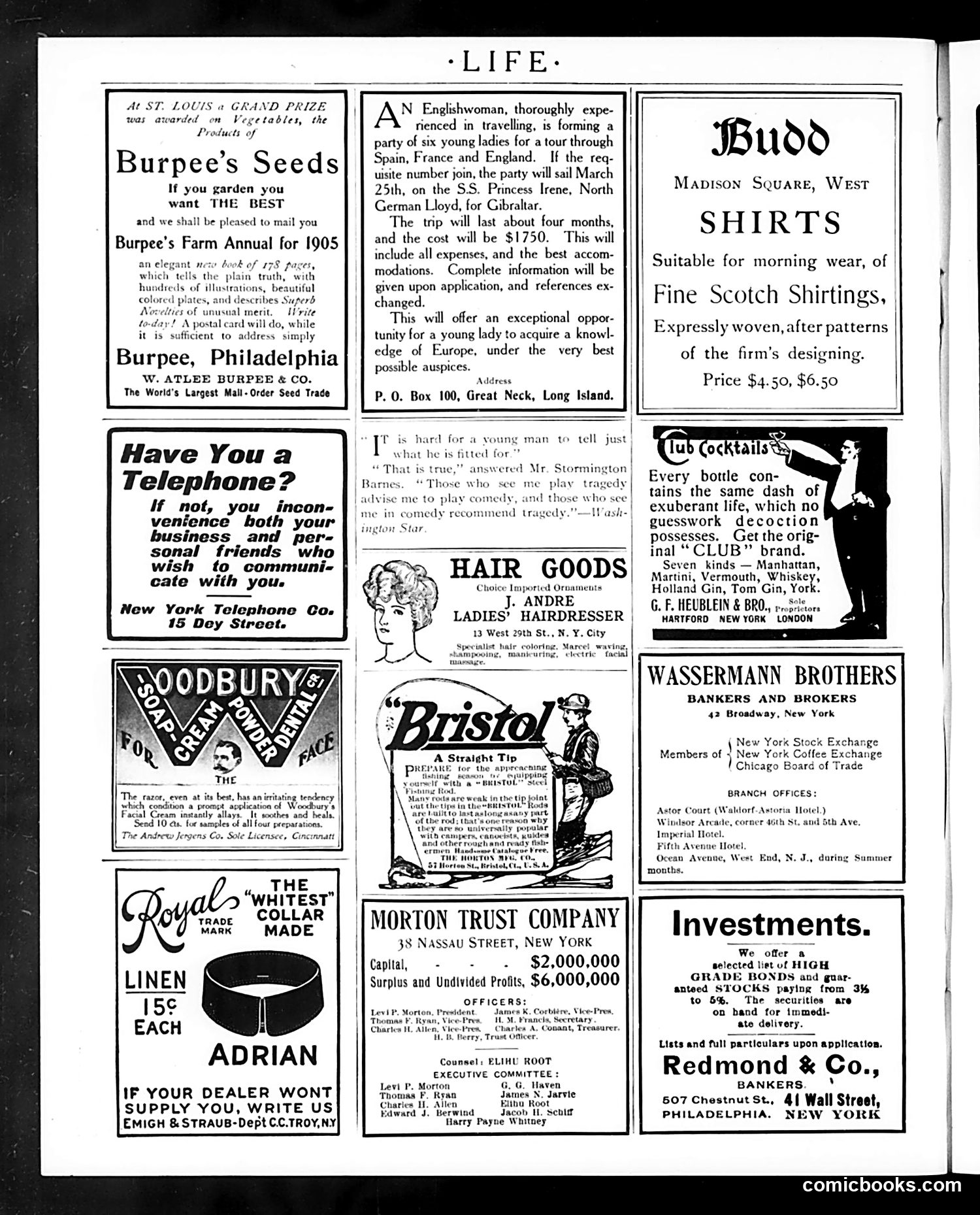
This is primarily an **advertisement page** from Life magazine's 1905 edition, containing no political cartoons or satirical commentary. Instead, it features commercial advertisements typical of the era: Notable ads include Burpee's Seeds (mail-order gardening), a European tour for young women ($1,750), fine Scotch shirts, and financial services (Morton Trust Company, Wassermann Brothers bankers). The **"Bristol" advertisement** appears to be the only content with illustrative humor—showing a figure labeled "A Straight Tip" promoting Bristol products for shaving or grooming. This uses a casual, colloquial male character as a sales device. The **telephone company ad** humorously argues that not owning a telephone inconveniences friends—an early marketing appeal for adoption of this new technology. Overall, this reflects **early 20th-century commercial culture**: mail-order businesses, luxury services for wealthy patrons, and emerging technologies marketed to American consumers.
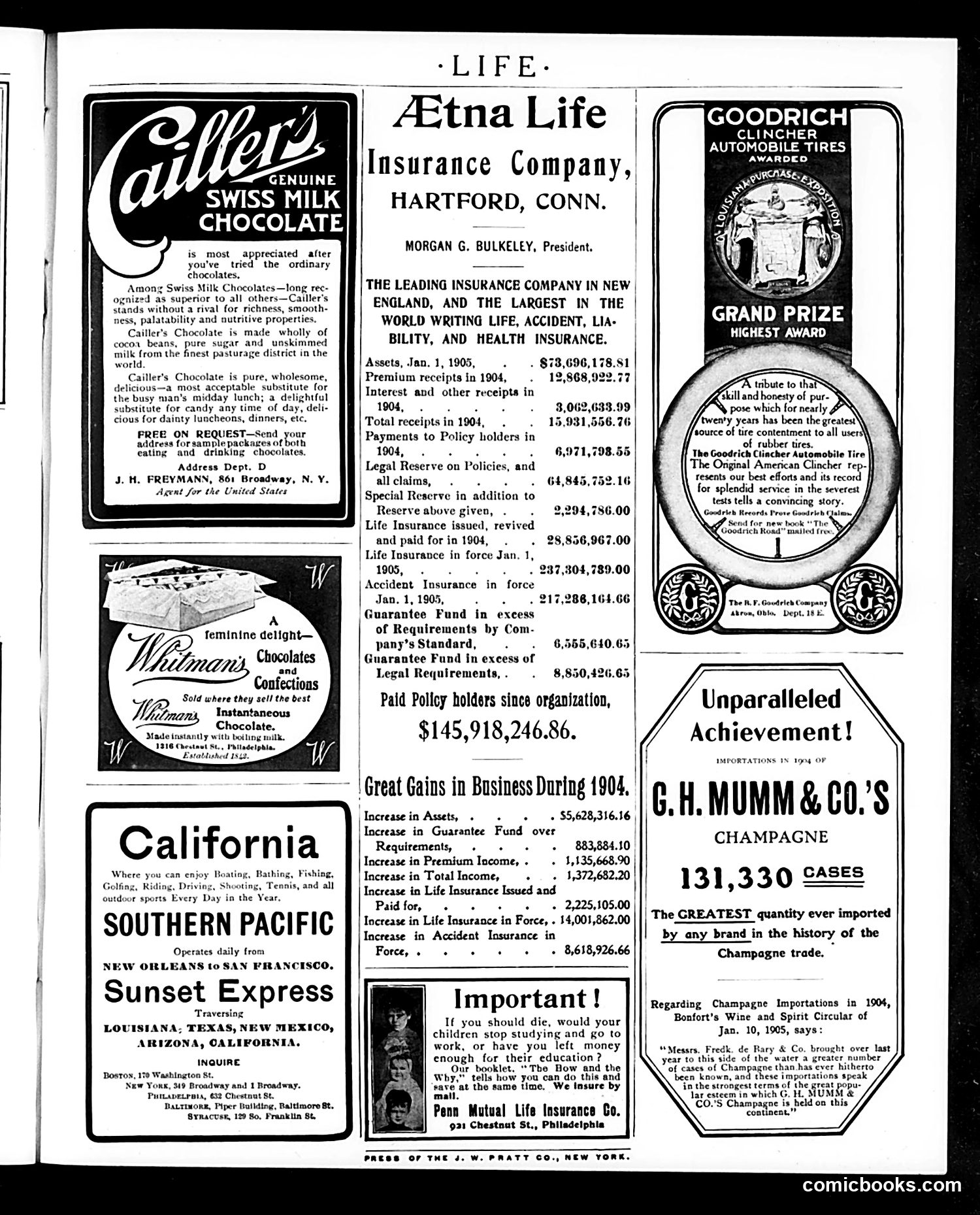
This is primarily a **advertising page**, not a satirical cartoon page. It contains business advertisements typical of early 1900s Life magazine. **Key advertisements:** - **Cailler's Swiss Milk Chocolate**: Marketed as superior to competitors, emphasizing purity and nutritional value for "the busy man's midday lunch" - **Aetna Life Insurance**: Detailed financial statements showing the company's 1904 growth, with President Morgan G. Bulkeley listed - **Goodrich Clincher Automobile Tires**: Promoting their tire as "the Original American Clincher" with a "Grand Prize" award - **Southern Pacific Railway**: Advertising the "Sunset Express" route through western states - **G.H. Mumm & Co. Champagne**: Claiming "131,330 cases"—"the GREATEST quantity ever imported by any brand" - **Penn Mutual Life Insurance**: Offering financial security for children's education The page reflects early 20th-century consumer capitalism and corporate expansion, with companies emphasizing superiority, safety, and financial security—major concerns of the period's middle-class readers.
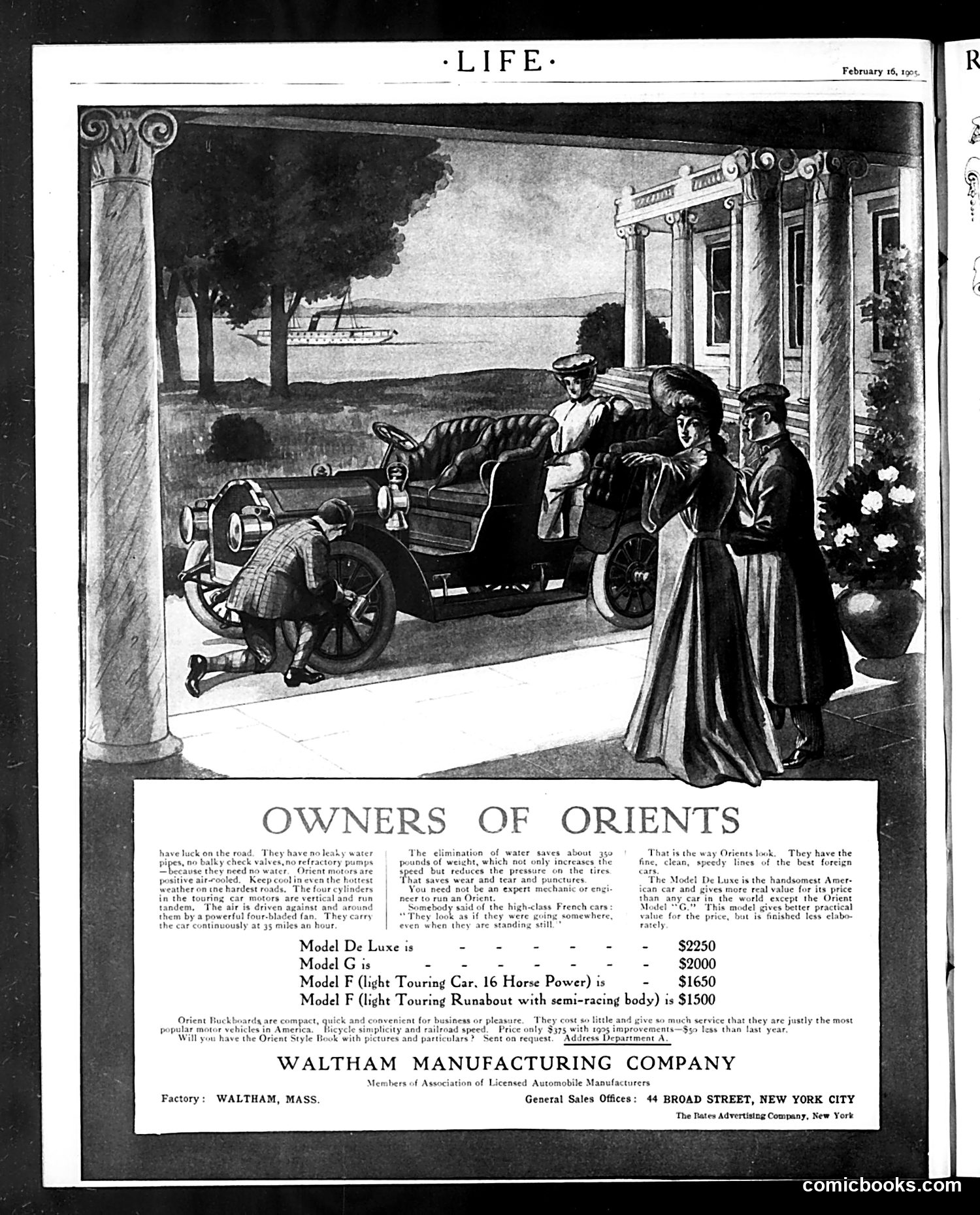
This is primarily a **automobile advertisement**, not satire. The page promotes Waltham Manufacturing Company's "Orient" motor cars (circa 1905). The illustration depicts a **wealthy social scene**: well-dressed women in long coats and hats observe a gentleman in an Orient automobile, with a servant/mechanic attending to the vehicle. A steamboat and columned mansion suggest leisure and affluence. The accompanying text celebrates the Orient's practical virtues—reliability, fuel efficiency, ease of maintenance—while claiming superiority over high-end French cars. Notably, the ad emphasizes that even "high-class" owners appreciate the Orient's practicality despite its lower price point ($1,500-$2,250). **The point for modern readers**: This reveals early automobile marketing strategy—positioning a mid-range American car as both accessible and sophisticated, implying that practical wisdom trumps foreign luxury. The aspirational imagery (wealth, leisure, servants) targets middle-to-upper-class buyers wanting automobiles without extravagant expense.