
A complete issue · 23 pages · 1904
Life — June 30, 1904
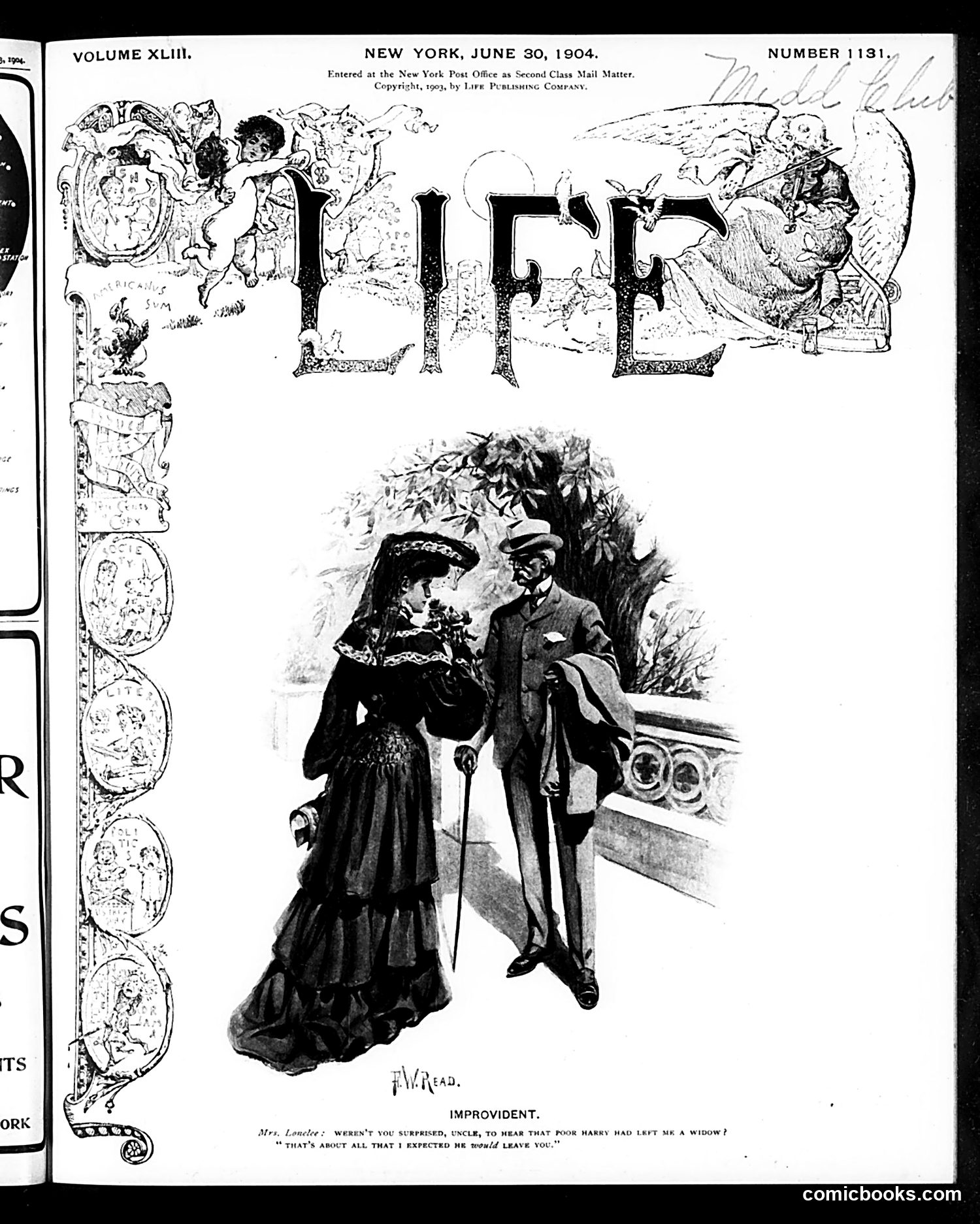
This cartoon satirizes a social situation involving inheritance and financial irresponsibility. The caption reads: "Mrs. Lendler: Weren't you surprised, Uncle, to hear that poor Harry had left me a widow? 'D that's about all that I expected he *would* leave you.'" The joke targets a spendthrift husband ("poor Harry") who apparently squandered his wealth during life, leaving his widow with nothing but her widowed status. The uncle's dry response suggests Harry was so financially reckless that the only predictable outcome was his wife being left destitute. This reflects early 1900s anxieties about male financial mismanagement and women's economic vulnerability in marriage, when wives had limited independent legal or financial standing.
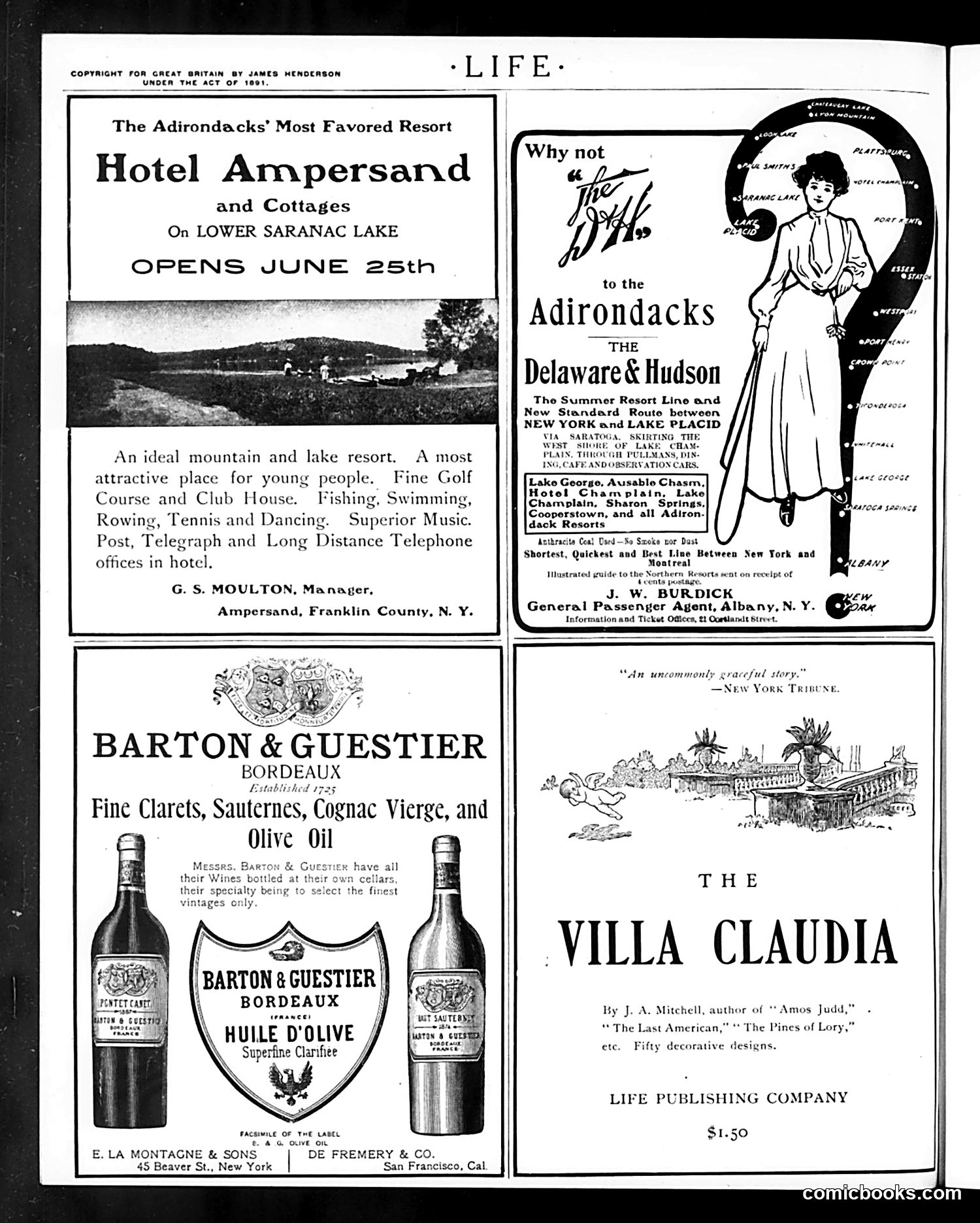
This page is primarily **advertising**, not satire or political commentary. The top half features ads for tourist destinations: Hotel Ampersand (a resort in the Adirondacks opening June 25th) and the Delaware & Hudson railway promoting access to Adirondack resorts. The railway ad includes a decorative illustration of a woman in period dress pointing to a map. The bottom half advertises luxury goods: Barton & Guestier wines and olive oil from Bordeaux, and "The Villa Claudia," a book by J.A. Mitchell (published by Life Publishing Company for $1.50) featuring fifty decorative designs. There is **no discernible political cartoon or satire** on this page—it's a straightforward collection of advertisements typical of early 20th-century magazine content.
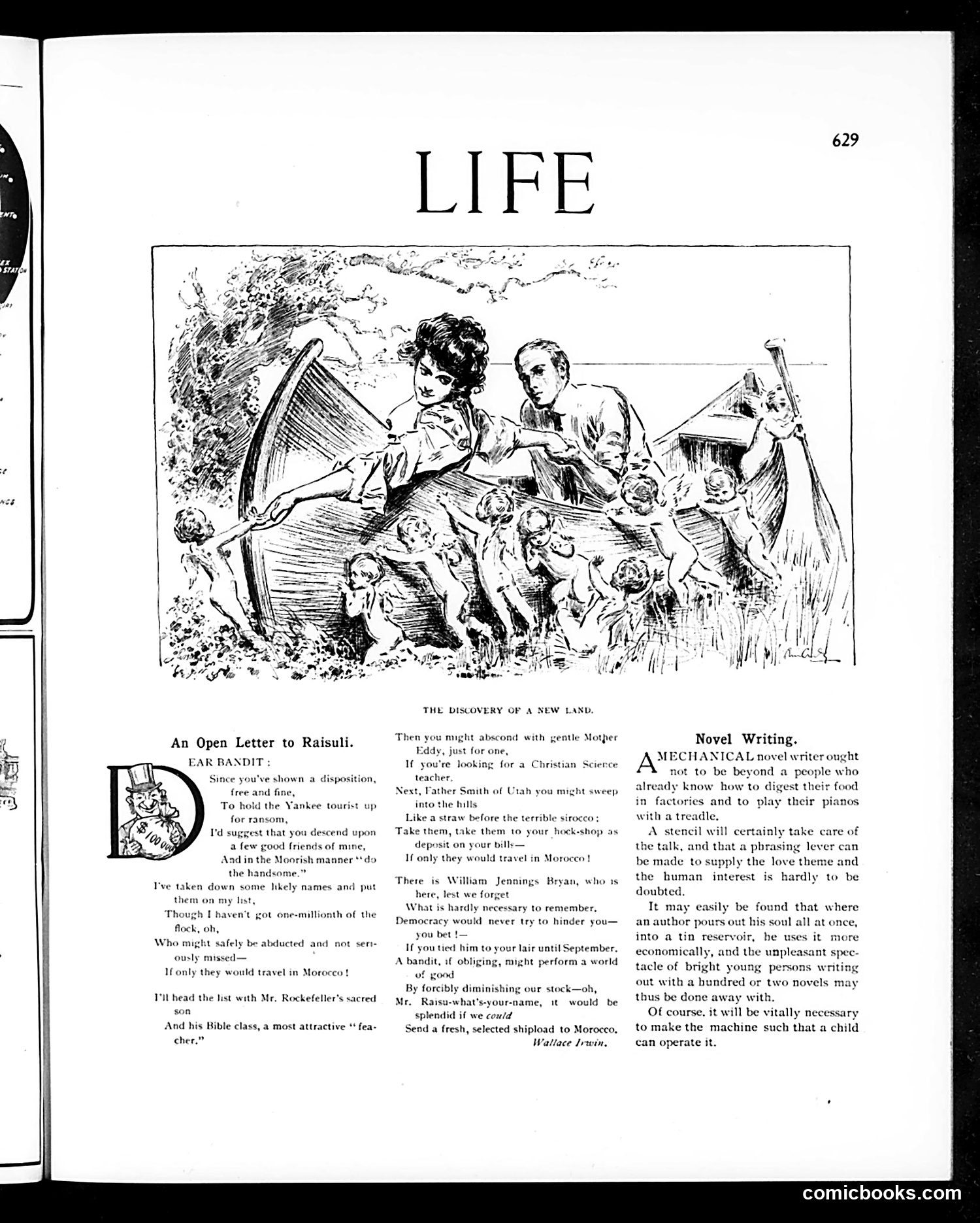
The illustration titled "The Discovery of a New Land" depicts a man and woman in a boat with several cherub-like children, appearing to reference family life or domestic contentment. The text includes "An Open Letter to Raisuli," addressing someone described as a bandit. The letter suggests sending various people to Morocco—including a tourist, a Christian Science teacher, and Father Smith of Utah—apparently as satire on unwanted or problematic individuals. The joke seems to be proposing to rid society of irritating people by exiling them. The "Novel Writing" column critiques mechanical fiction, arguing that authors stuffing novels with many characters for commercial purposes undermines genuine human interest in storytelling. The specific identity of "Raisuli" and exact historical context remain unclear without additional research.
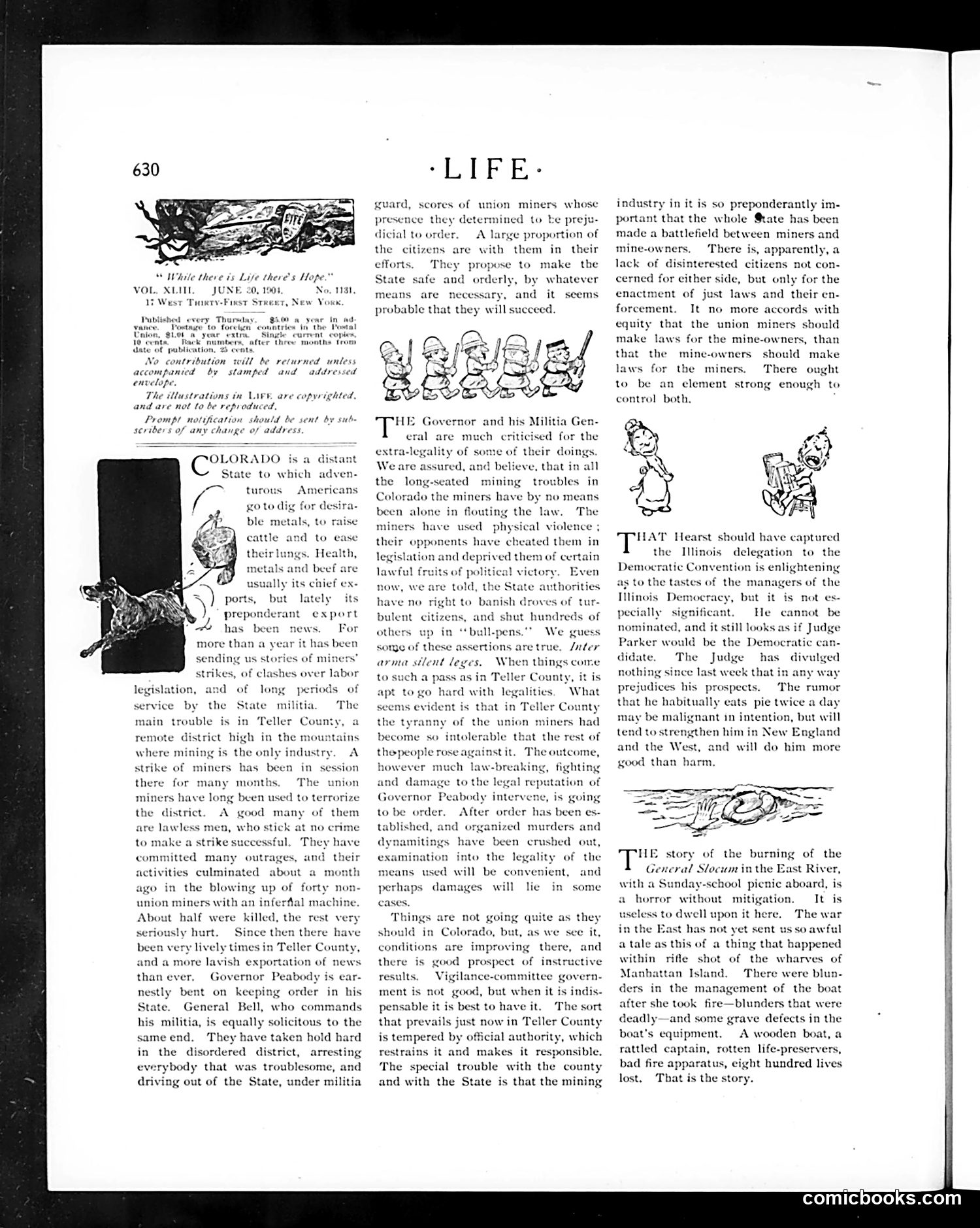
This Life magazine page (June 30, 1904) discusses labor violence in Colorado's mining districts, particularly Teller County. The article criticizes both union miners and state authorities for escalating conflict—miners have used physical violence and dynamite, while Governor Peabody and his militia have responded with heavy-handed enforcement. The cartoons (five small caricatured heads at top; sleeping figure at bottom) appear to satirize the incompetence or stubbornness of involved parties. The text argues neither side deserves exclusive blame, but advocates for stronger state laws that protect both miners' and mine-owners' interests equally, suggesting legal frameworks—not militia violence—should resolve disputes.
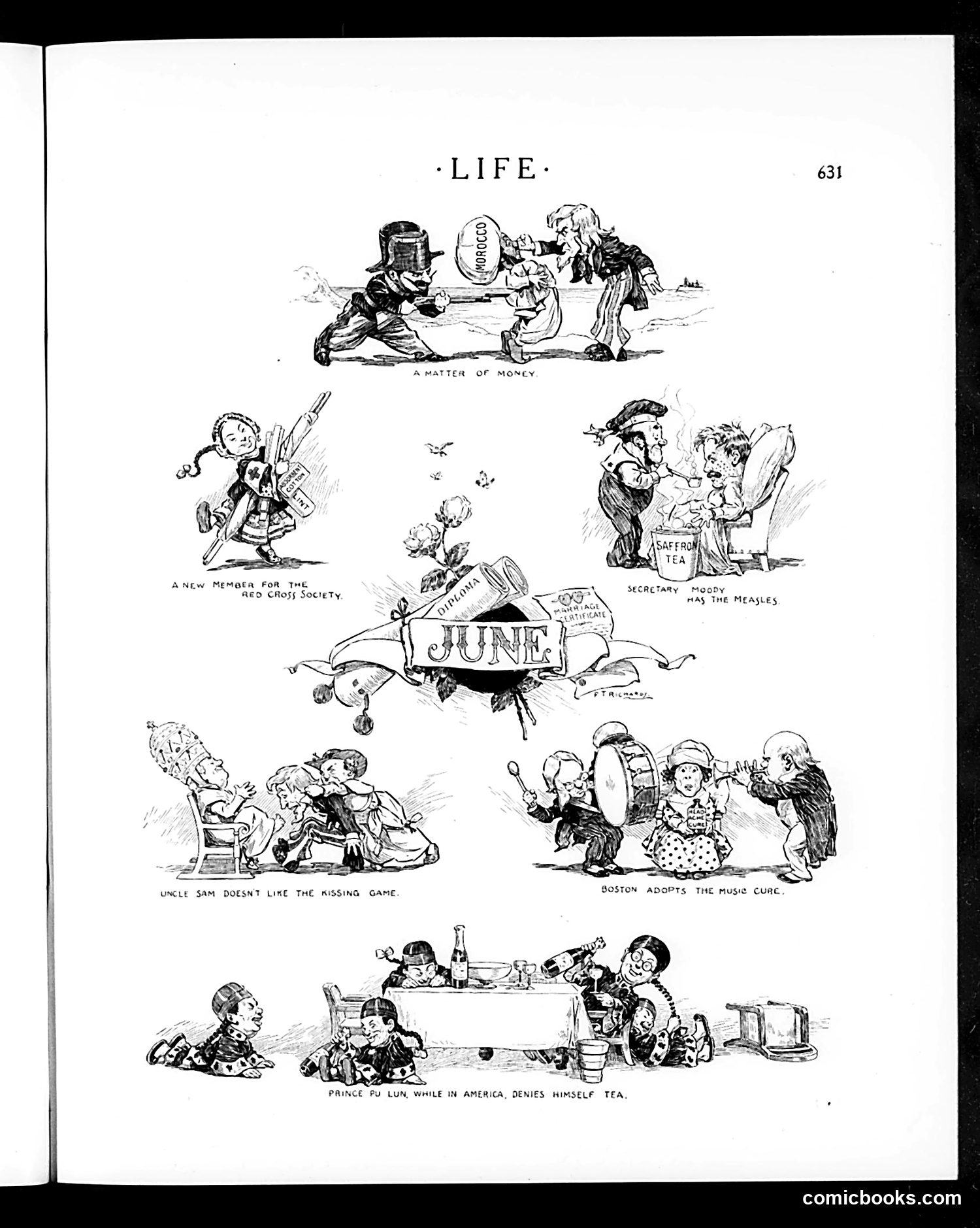
This page presents six satirical vignettes commenting on early 20th-century American life and politics: 1. **"A Matter of Money"**: Figures dispute over a bag labeled "Prohibition," suggesting debate over alcohol regulation policy. 2. **"A New Member of the Red Cross Society"**: A child carries weapons, satirizing militarism. 3. **"Secretary Troggy Has the Measles"**: Officials deal with illness, likely referencing a specific cabinet member. 4. **"Uncle Sam Doesn't Like the Kissing Game"**: Uncle Sam rejects romantic/diplomatic gestures, possibly about foreign relations. 5. **"Boston Adopts the Music Cure"**: Depicts an unconventional medical treatment. 6. **"Prince Fu Lun While in America Denies Himself Tea"**: References a visiting Asian dignitary, satirizing cultural contrasts between East and West. The humor relies on contemporary political figures and events now requiring historical context.
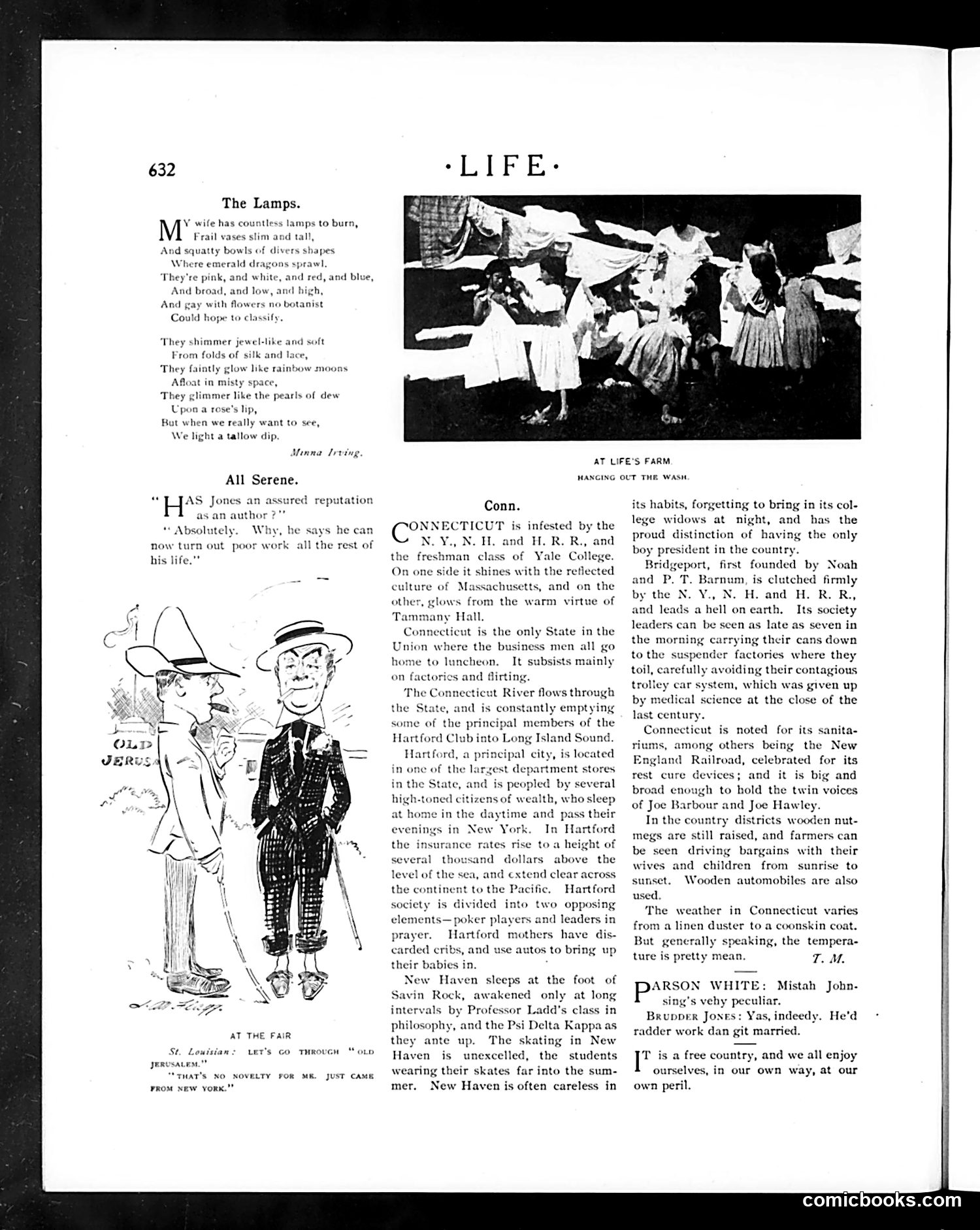
The page contains two distinct elements: **"The Lamps" poem** by Minna Irving describes decorative lamps in romantic, whimsical terms—comparing them to jewels, rainbows, and pearls. **"All Serene" cartoon** features two caricatured men at what appears to be a fair. The figure on the left is labeled "Old Jersey" and the right figure wears a suit and hat. The caption reads: "St. Louis: 'Let's go through old Jersey.' That's no novelty for me. Just came from there.'" This is likely a regional/state rivalry joke, suggesting New Jersey's reputation as an undesirable destination—implying that experiencing Jersey is not worth particular note or effort. The satire mocks New Jersey's standing compared to other American locations in this era.
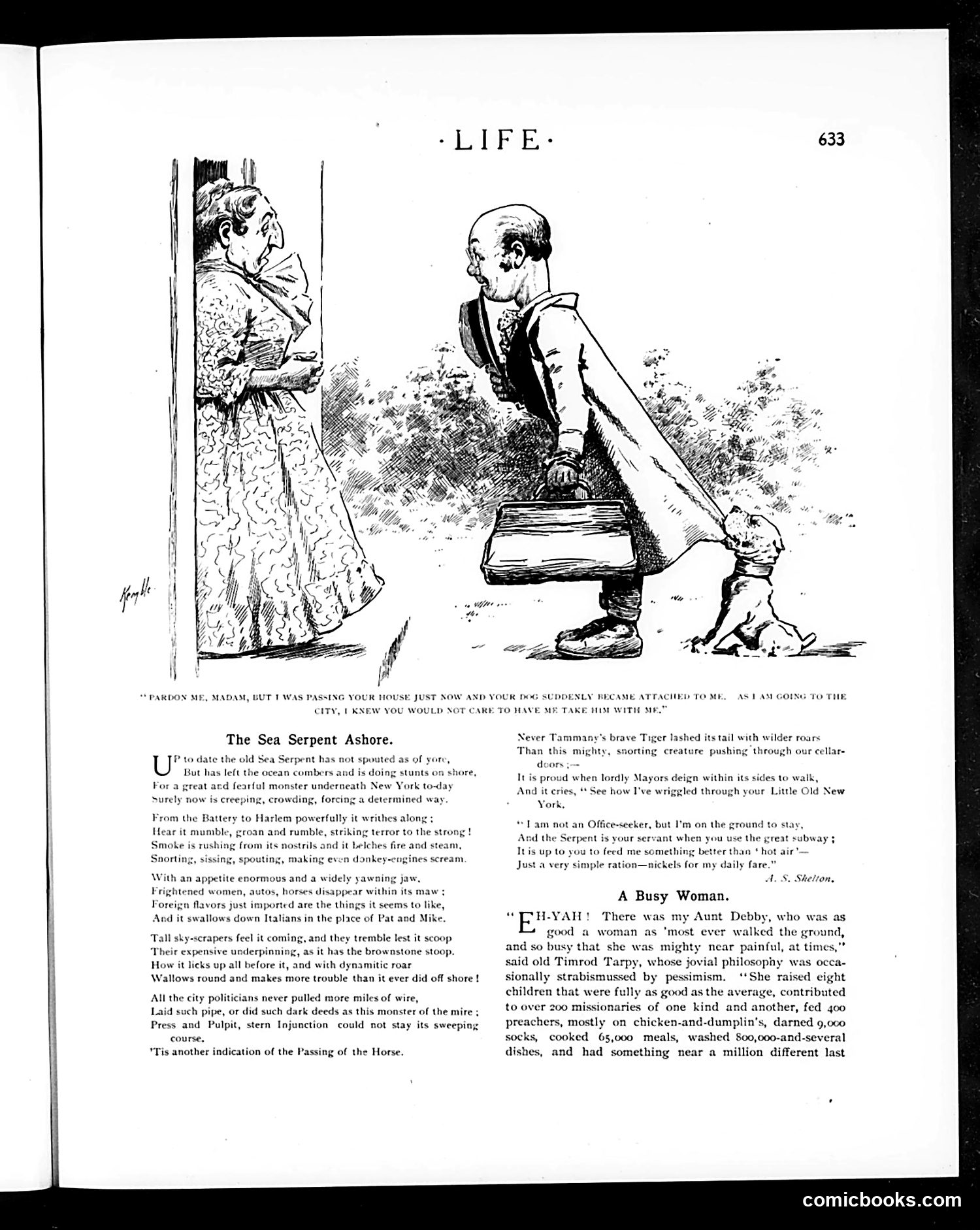
This page from *Life* magazine contains two satirical pieces: **"The Sea Serpent Ashore"** is a poem mocking New York City's persistent "sea serpent" sightings—a recurring hoax/legend. The verses humorously describe the creature's fearsome appearance while suggesting it's been spotted near the city. **"A Busy Woman"** describes Aunt Debby, a woman praised for her enormous productivity: raising eight children, feeding missionaries and preachers, cooking 65,000 meals, washing 500,000 dishes—yet somehow remaining "fully as good as the average." The satire appears to critique either excessive domesticity expectations or the absurdity of quantifying women's unpaid household labor as moral virtue. The top cartoon shows a woman refusing to let a man take her dog to the city, establishing the domestic-sphere tension running through the page.
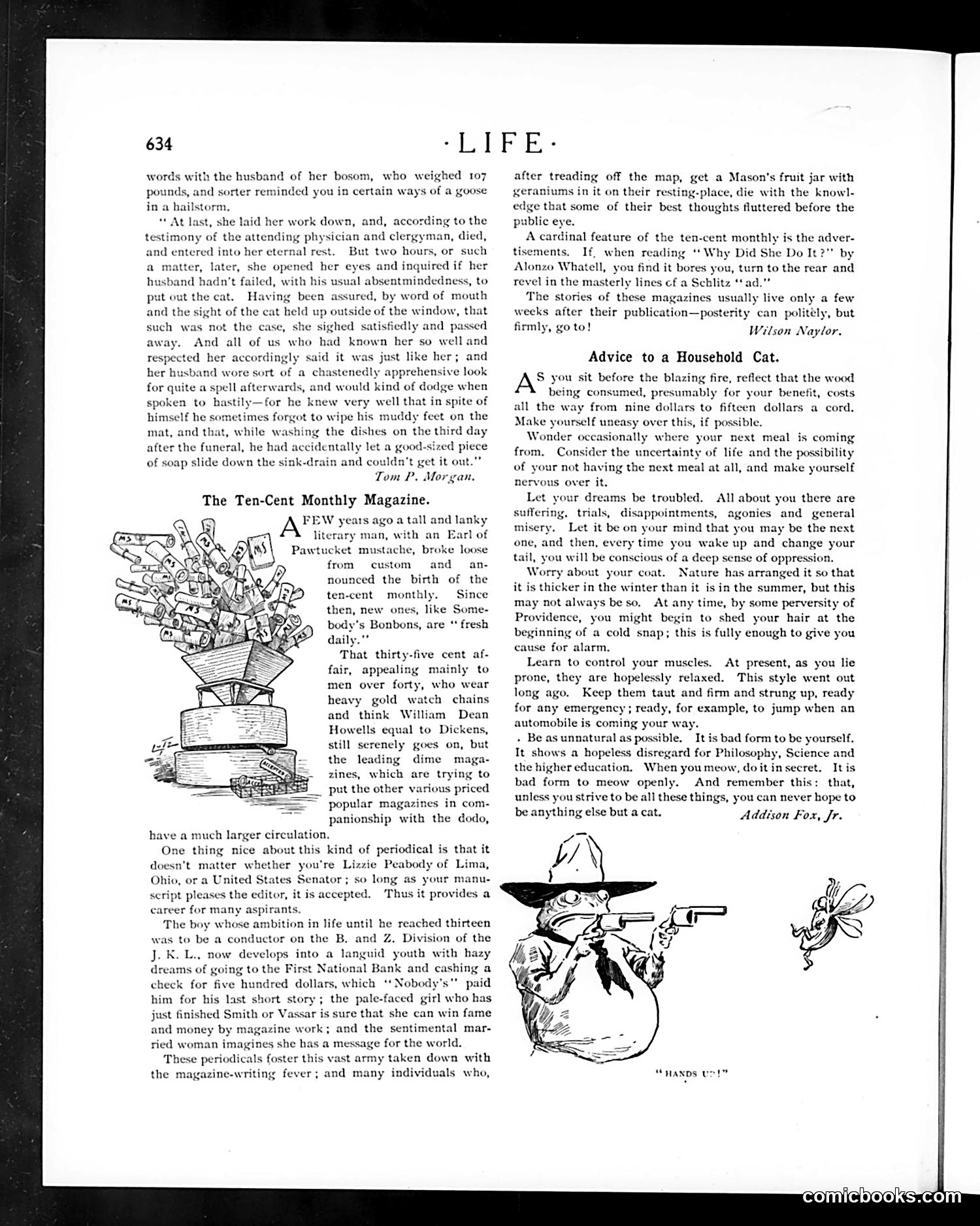
This page contains two distinct pieces: 1. **"The Ten-Cent Monthly Magazine"** — A satirical article with accompanying illustration of a cornucopia overflowing with magazines. The text mocks the proliferation of cheap monthly magazines flooding the market, noting their appeal to aspiring writers and "sentimental" readers. It's a critique of mass-market periodicals and the "magazine-writing fever" they inspire. 2. **"Advice to a Household Cat"** — A humorous essay offering absurdist life advice to cats, accompanied by a cartoon of an anthropomorphic cat in cowboy attire saying "HANDS UP!" The piece parodies self-help writing by treating feline behavior with mock-serious guidance about controlling muscles, maintaining dignity, and proper cat decorum. Both pieces satirize contemporary American popular culture and literary trends.
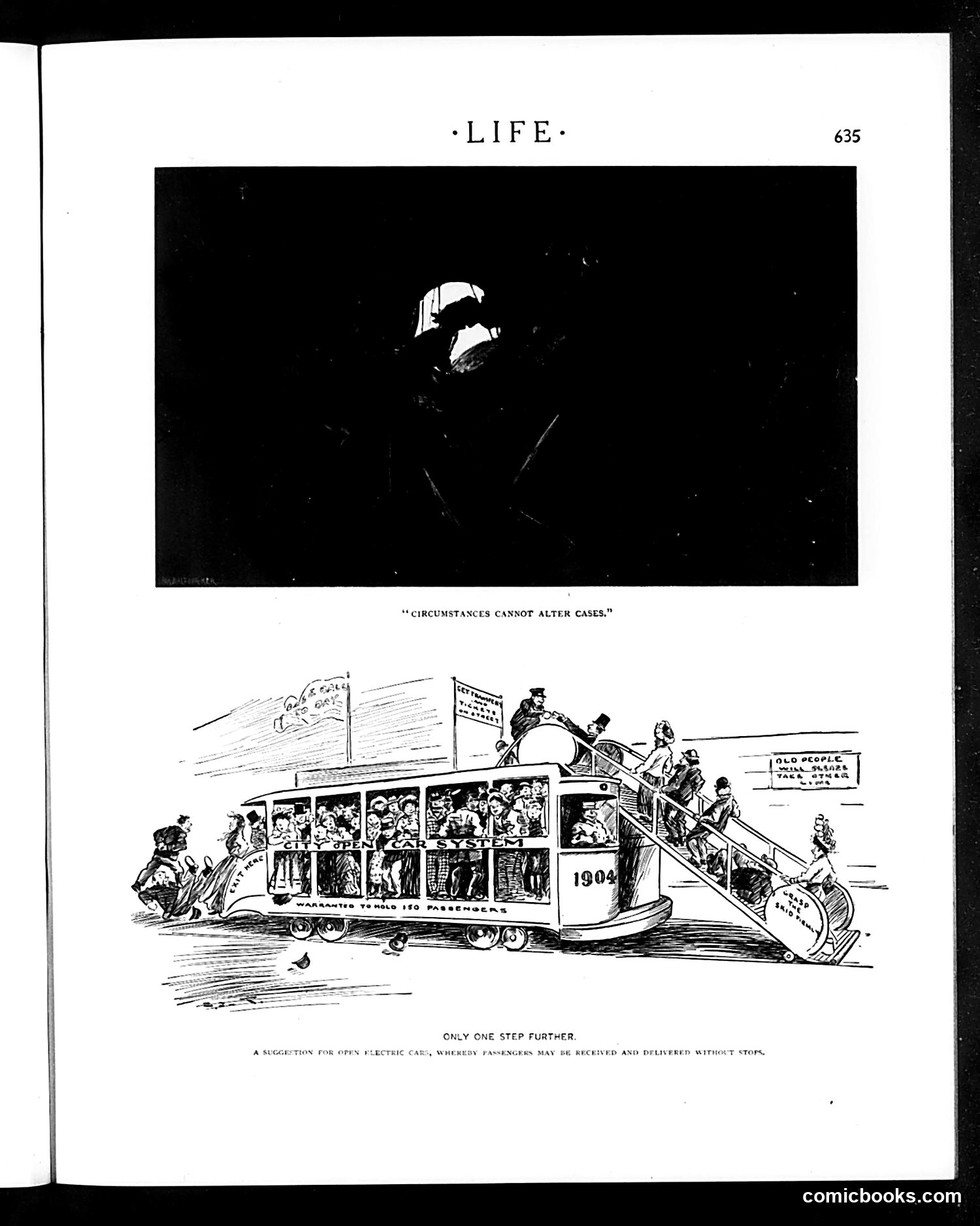
This page contains two satirical cartoons from early 1900s America: **Top Image**: "Circumstances Cannot Alter Cases" — A darkly lit photograph or dramatic image showing what appears to be a figure in distress or confinement, likely commenting on judicial or legal matters. **Bottom Cartoon**: "Only One Step Further" — depicts an open electric streetcar from 1904 packed with passengers. The satirical "suggestion" mocks the evolution of public transportation, implying that the next logical step would be removing the floor entirely so passengers could be "received and delivered without steps." The joke critiques how streetcar operators prioritize profit and passenger volume over safety and comfort, showing progressively packed conditions in a crowded vehicle as the absurd endpoint of this trend.
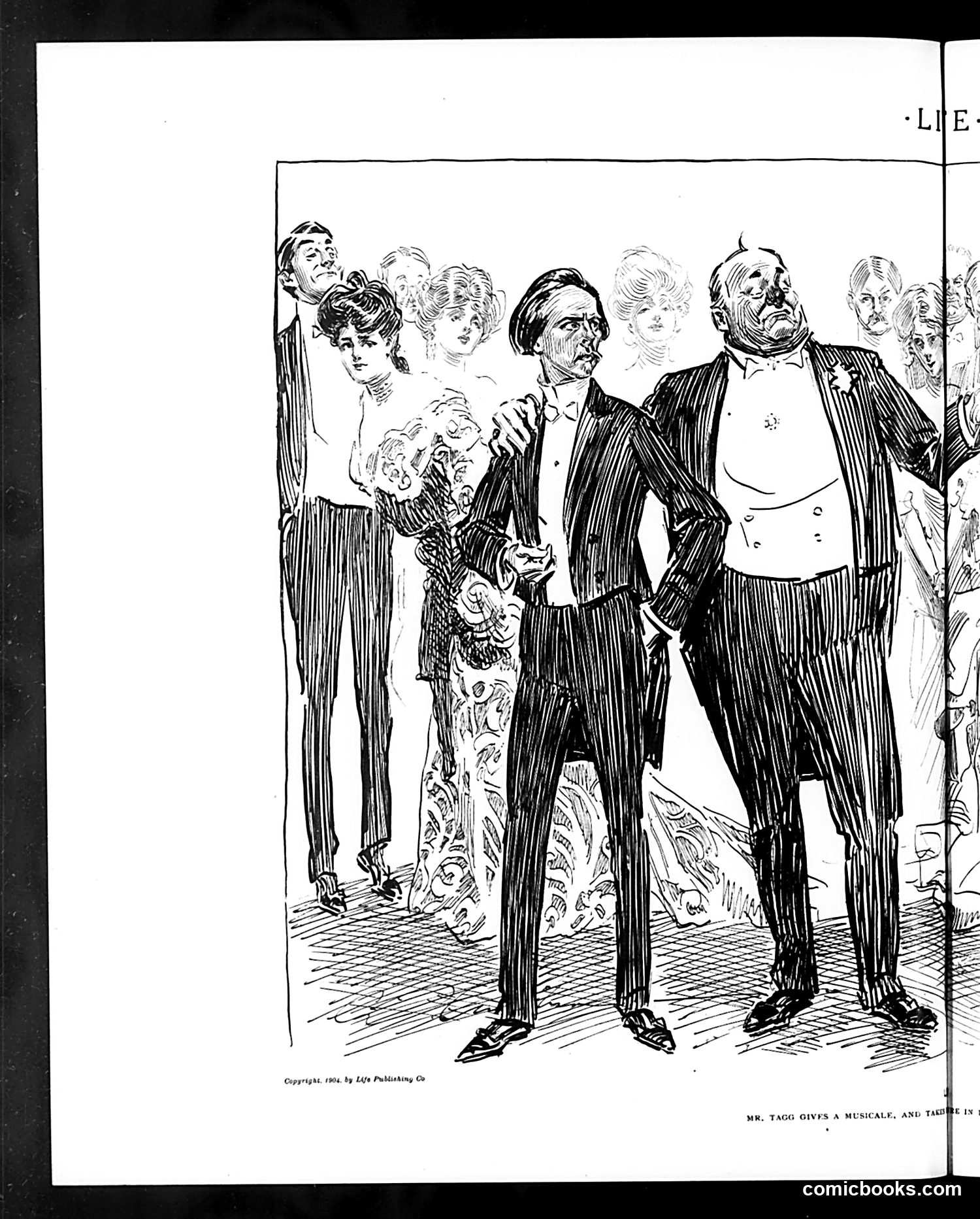
The caption reads "MR. TAGG GIVES A MUSICALE, AND THERE IS..." (text cuts off). This is a social satire depicting an elegant musical evening. A thin man in the center (presumably "Mr. Tagg") appears to be the host, gesturing to his guests—well-dressed men and women in formal attire. The sketch style is characteristic of early 1900s Life magazine social commentary. Without the complete caption, the full joke is unclear, but the satire likely mocks either Mr. Tagg's pretensions to high society, his guests' behavior, or some specific social scandal of the period. The incomplete text prevents identifying what "there is" that's supposedly ridiculous about this musicale. The copyright shows this is from Life Publishing Co., 1904.
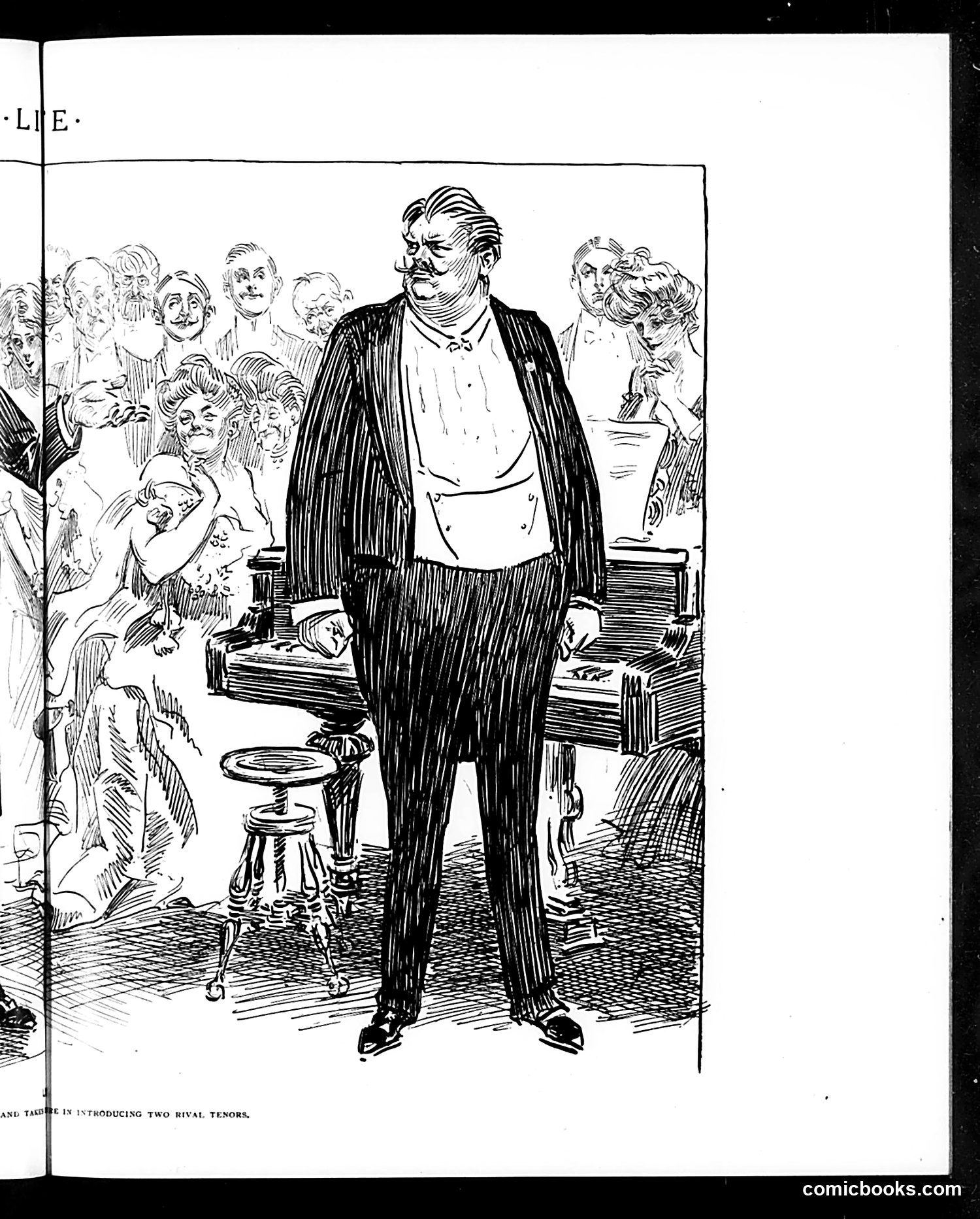
This appears to be a satirical illustration titled "Introducing Two Rival Tenors" (visible at bottom). The cartoon depicts a portly, mustachioed man in formal evening wear standing prominently in what appears to be a drawing room or concert hall, surrounded by well-dressed audience members. The satire likely mocks operatic rivalry or competition between famous singers of the period. The central figure's exaggerated physique and facial features—common in Life magazine's caricature style—suggest ridicule of a specific public figure, though the identity is unclear from the image alone. The gathered crowd observing this introduction implies social commentary about the spectacle and drama surrounding high-society musical performances in early 20th-century America. Without additional context, the specific tenors referenced remain unidentified.
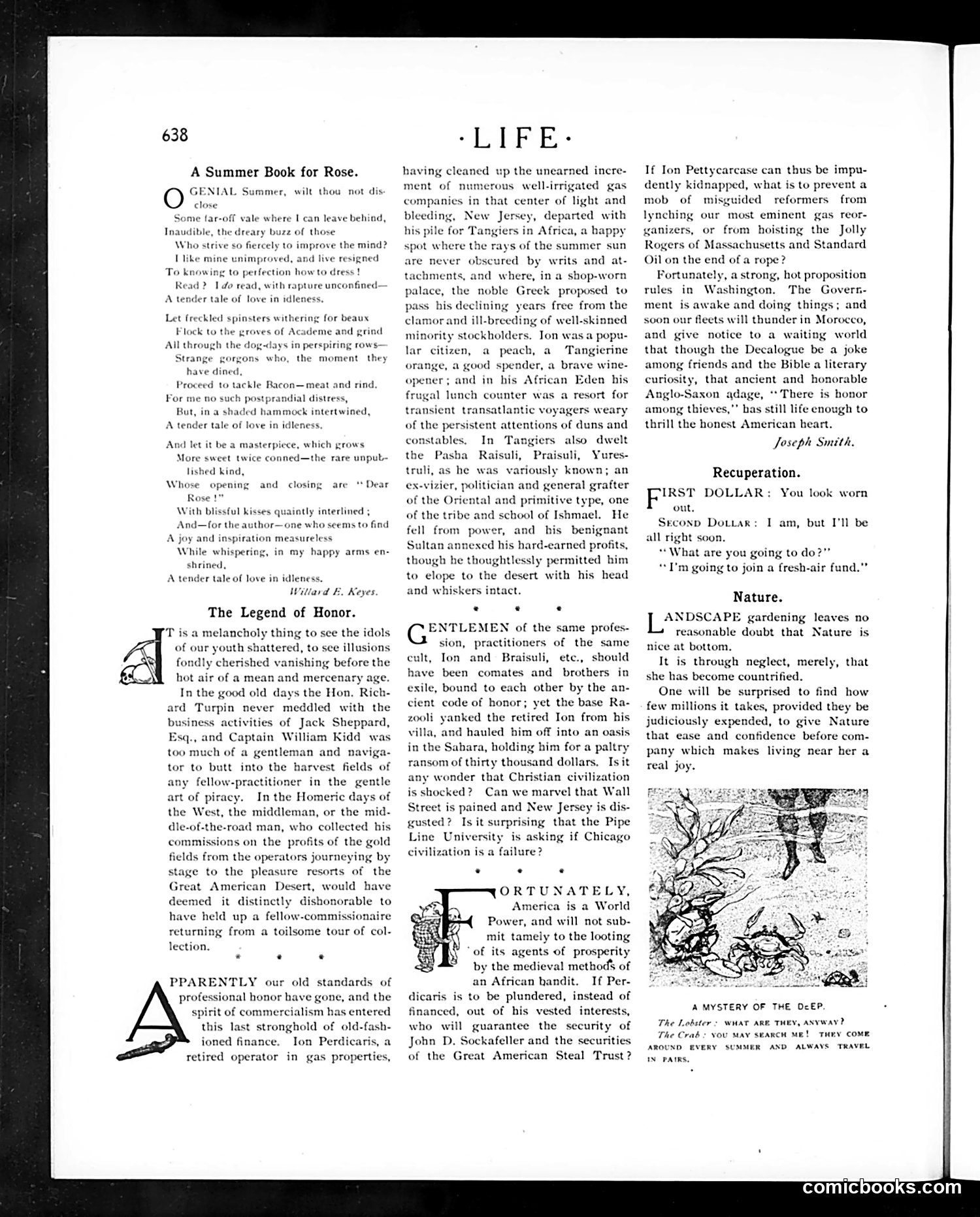
This page contains several satirical articles and one illustration titled "A Mystery of the Deer." The main political content critiques American business practices and colonial exploitation. The article "The Legend of Honor" attacks the hypocrisy of wealthy industrialists—specifically naming Ion Pettycarcase and referencing figures like Rockefeller and the "Great American Steal Trust"—for accumulating vast fortunes through questionable means (gold fields, gas companies) while maintaining respectable social standing. The final section, "Fortunately," satirizes America's imperial ambitions in Africa, suggesting that instead of sending military forces to plunder (as "medieval methods" suggest), America should use financial manipulation through figures like Rockefeller to control resources and maintain global dominance. The deer illustration's caption humorously suggests nature itself marvels at human behavior.
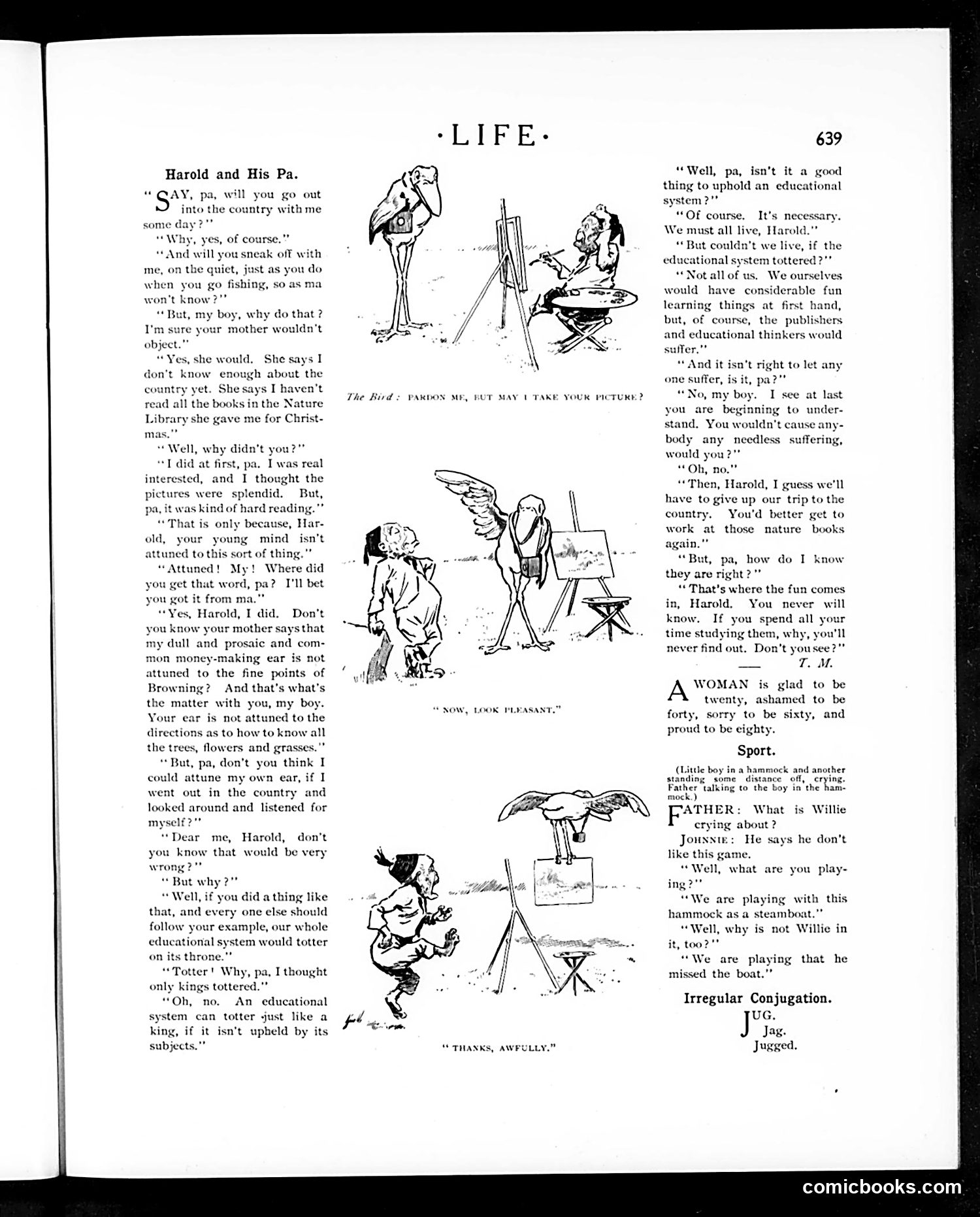
This comic strip satirizes rigid, book-based education. Harold wants to learn about nature through direct experience—exploring the countryside with his father. But Pa refuses, arguing that if everyone learned independently rather than from prescribed textbooks, "our whole educational system would totter on its throne." The joke exposes the absurdity: the educational establishment (publishers, textbook authors) depends on students studying *their* books rather than discovering truth firsthand. Pa cynically admits they can't know if the books are even correct—but studying them anyway maintains the system that employs educators and publishers. The satire targets early 20th-century progressive education critics who argued that rigid, textbook-dependent schooling stifled genuine curiosity and learning. It mocks how institutional interests—not actual learning—drive educational policy.
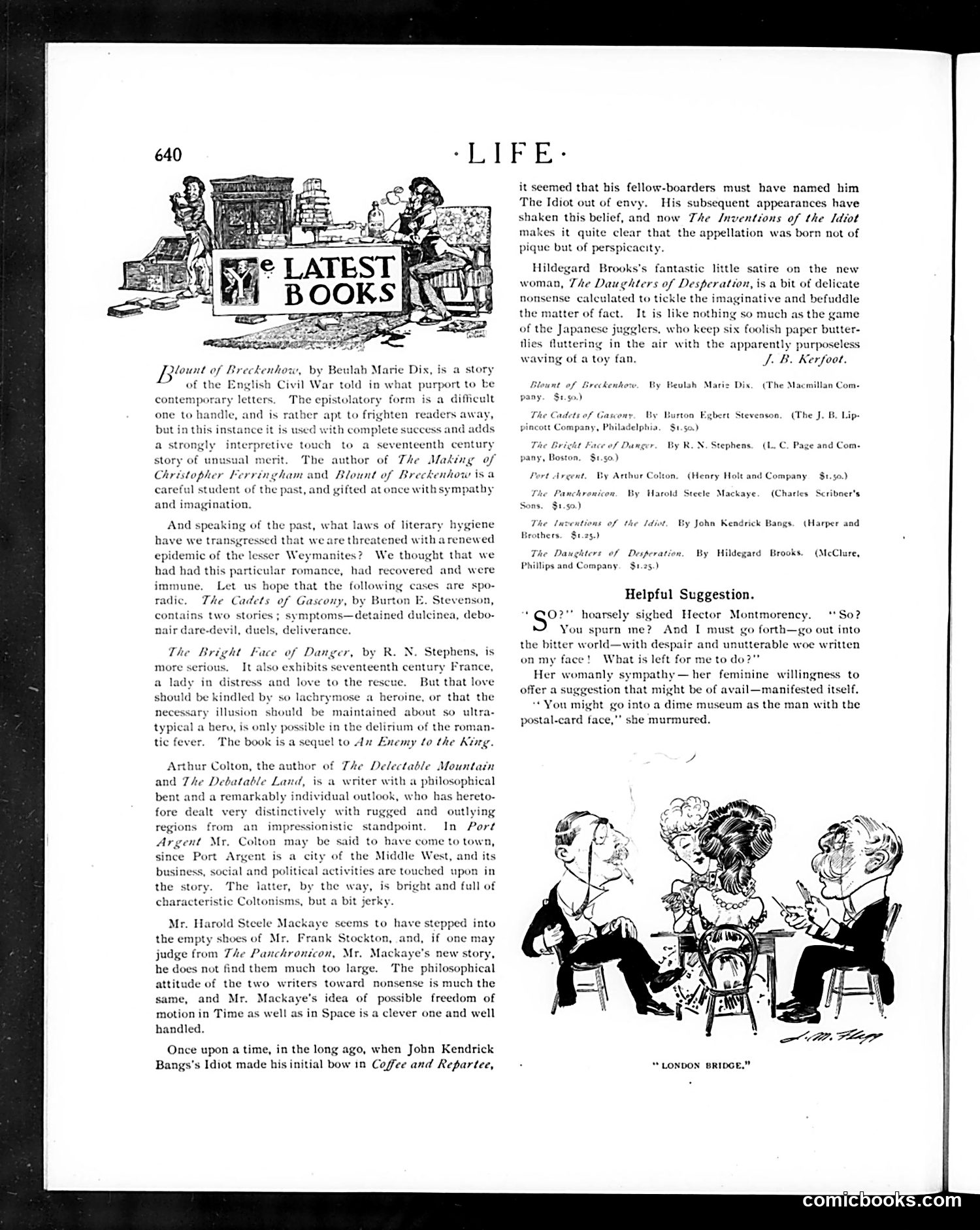
This cartoon satirizes the conventions of polite society and romance, likely referencing the popular "weeping hero" trope in contemporary fiction. The image shows a man in formal dress dramatically lamenting to a woman—he's performing the role of the tragically doomed lover, complete with theatrical despair ("despair and unutterable woe written on my face"). The woman's response—suggesting he visit a dime museum as "the man with the postal-card face"—mocks his melodramatic self-pity. She's essentially saying his tragic expression has become a cheap, mass-produced cliché, suitable only for carnival attractions. The joke critiques both the overwrought sentimentality of popular romance fiction and the male tendency toward self-pitying theatrics when rejected. The title "London Bridge" likely references the nursery rhyme, suggesting this emotional display is as predictable and worn-out as a child's song.
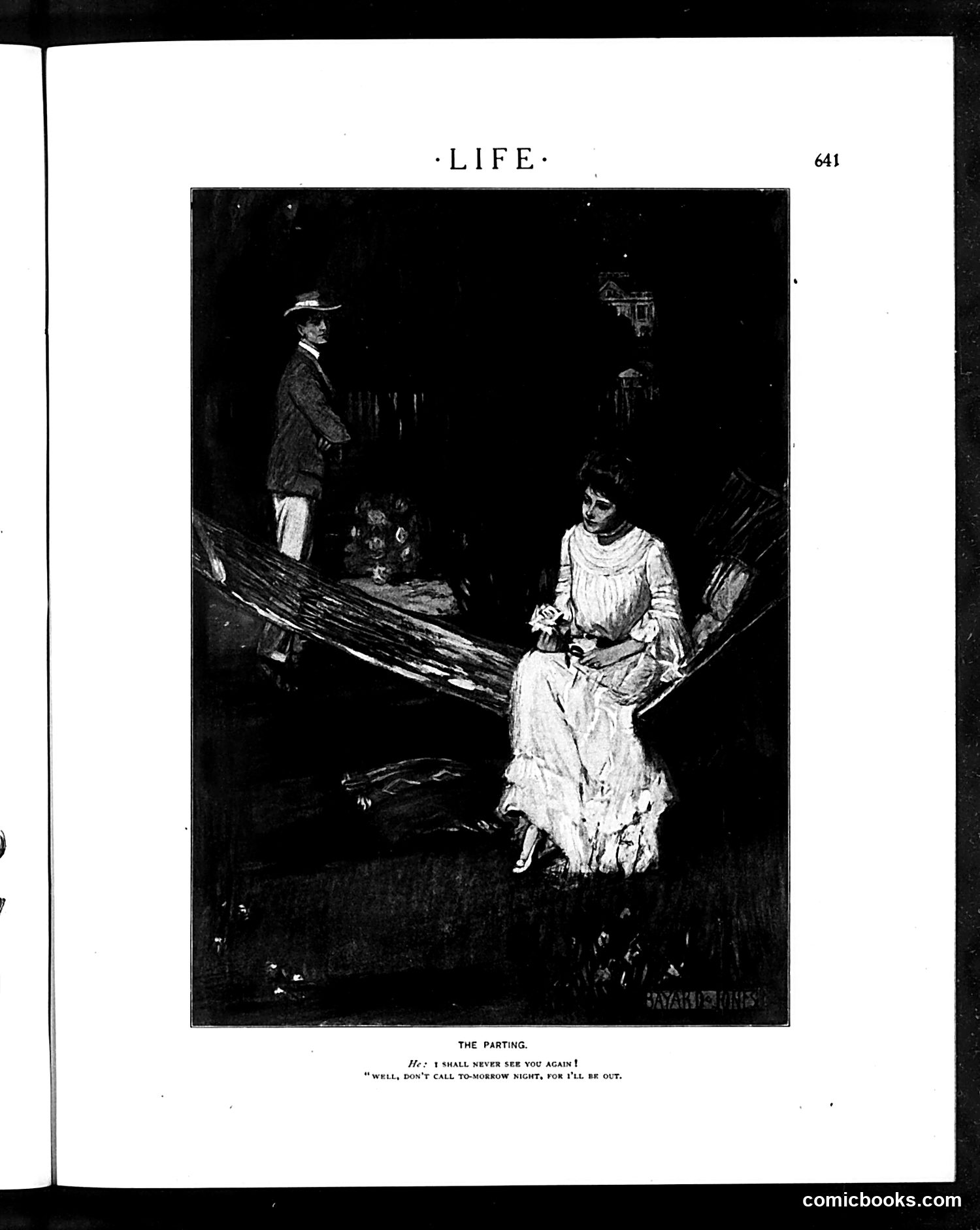
This illustration depicts a dramatic romantic farewell between a man and woman. The man, dressed formally with a hat, declares he'll "never see you again," suggesting a permanent separation or breakup. The woman's response—"Well, don't call tomorrow night, for I'll be out"—undercuts his melodrama with casual indifference. The satire targets the gap between romantic posturing and actual feeling. The man's theatrical gesture and emotional declaration are deflated by the woman's practical, dismissive reply. She essentially says: "Your grand gesture means nothing to me; I have other plans." This mocks both overwrought romantic conventions of the era and the gender dynamics of courtship, suggesting the woman's emotional detachment matches or exceeds the man's supposed heartbreak.
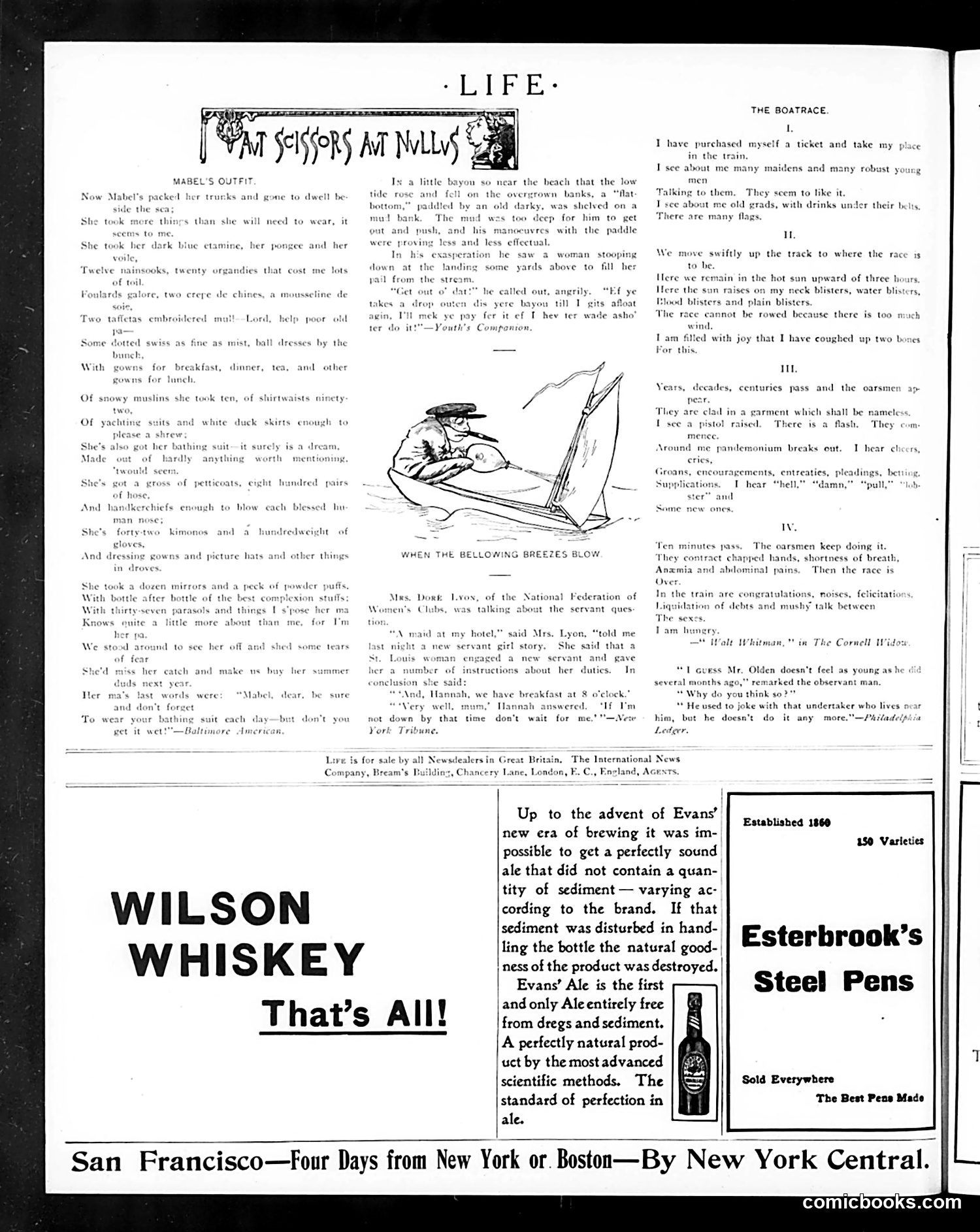
This page contains two distinct narratives: **"Mabel's Outfit"** (left column): A humorous poem satirizing the excessive luggage and wardrobe wealthy women of the era packed for travel. The piece catalogs absurd quantities of garments—dozens of organdie dresses, multiple crepe de chines, kimonos, and countless handkerchiefs—mocking the conspicuous consumption and impracticality of Edwardian women's fashion and travel habits. **"The Boatrace"** (center/right): A narrative story, likely satirical fiction, about a boat race in a Louisiana bayou. The illustration shows a man in a small boat. The text describes competitive rowing with dramatic flair, including dialogue with dialectal speech ("Ef ye outen dis yere bayou"). The page also contains period advertisements for Wilson Whiskey and Esterbrook's Steel Pens, typical of Life's commercial content. The overall tone targets upper-class leisure culture and women's fashion excess—standard subjects for Life's satirical humor during this era (early 1900s).
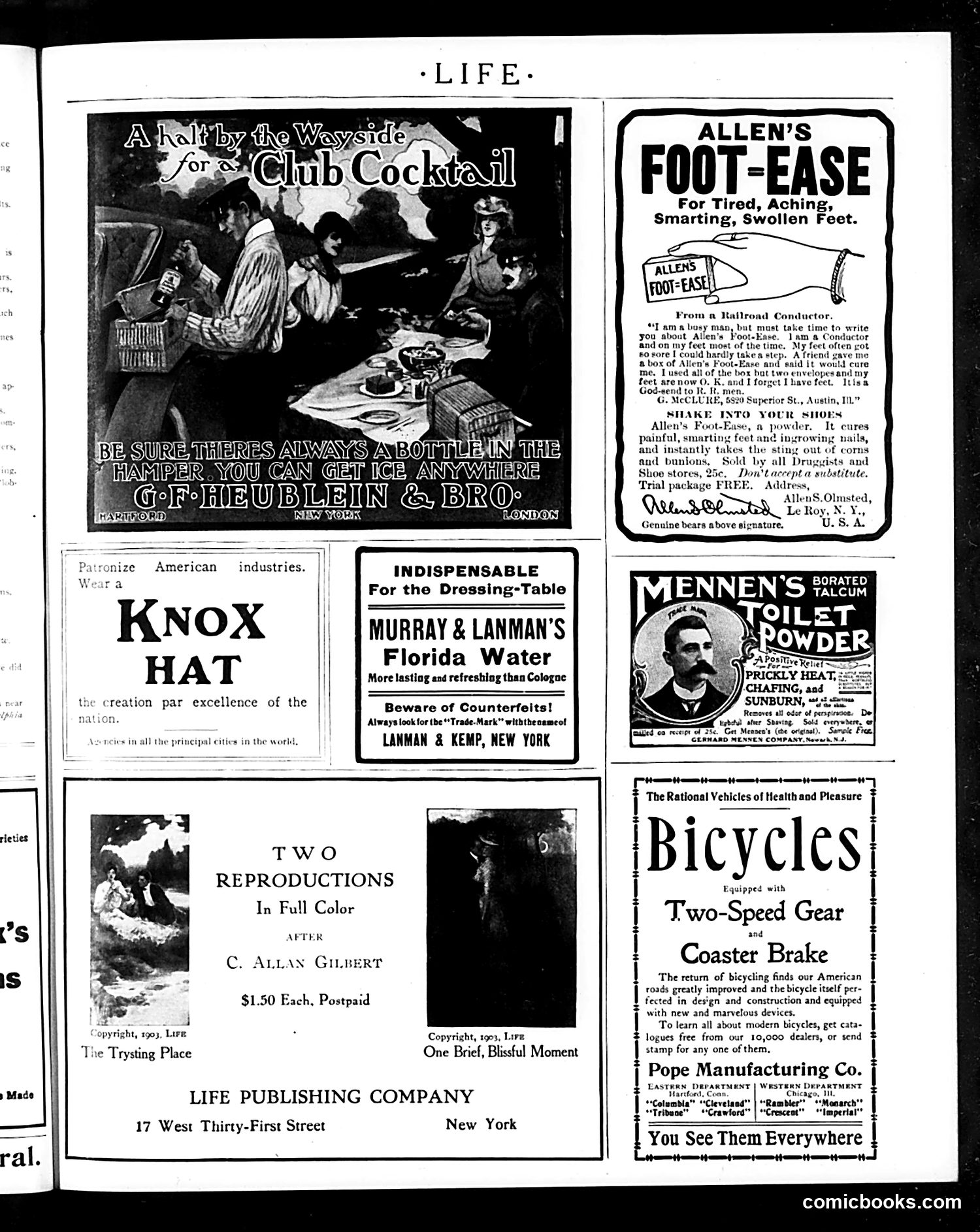
This is primarily an **advertising page** rather than satirical content. The layout features period product advertisements (circa early 1900s) alongside two small art reproductions. The top image shows a social scene titled "A Kab by the Wayside for a Club Cocktail," depicting men in a tavern—likely promoting alcohol consumption or socializing habits of the era. The advertisements reflect common early-20th-century concerns: **Allen's Foot-Ease** addresses worker fatigue (featuring a railroad conductor's testimonial), **Murray & Lanman's Florida Water** offers grooming products, **Mennen's Talcum Powder** addresses hygiene, and **Knox Hat** appeals to nationalism ("Patronize American industries"). The **Pope Manufacturing Company bicycle advertisement** emphasizes modern improvements and accessibility through widespread dealers—reflecting growing enthusiasm for bicycles as practical transportation. The bottom section advertises **art reproductions** by C. Allan Gilbert, available through Life Publishing Company's New York office. The page demonstrates how early Life magazine balanced satirical editorial content with commercial revenue, targeting middle-class male consumers with products addressing practical, social, and leisure concerns.
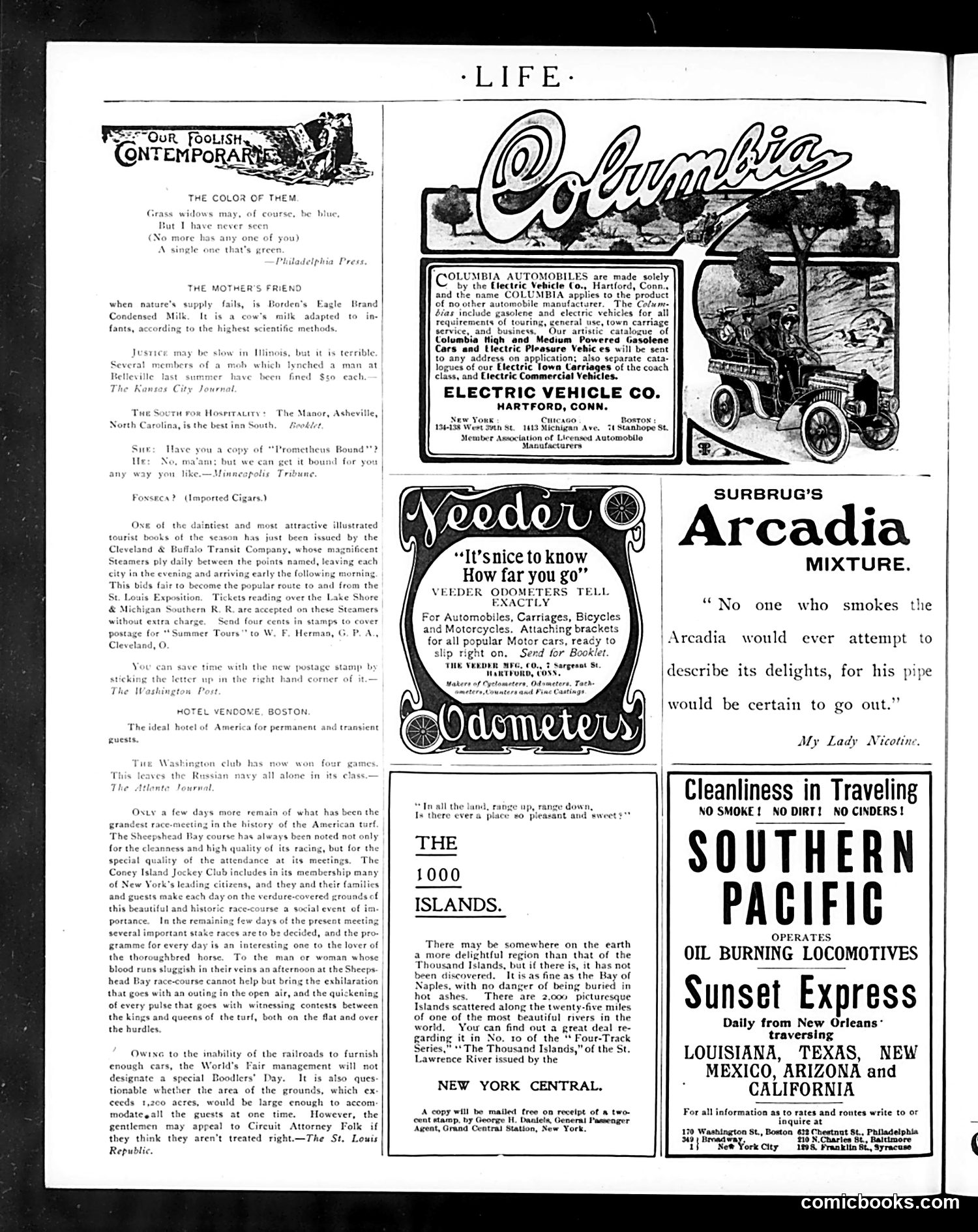
This is primarily an **advertising page** from an early 1900s issue of *Life* magazine, with brief text snippets and columnular content rather than political cartoons. The notable content includes satirical product advertisements and promotional pieces typical of the era: - **"Our Foolish Contemporaries"** section quotes regional newspapers humorously, poking fun at provincial or illogical statements in papers like the *Philadelphia Press*. - Multiple **automobile and transportation ads** (Columbia Electric Vehicles, Veeder Odometers, Southern Pacific Railway) represent the era's fascination with new motorized technology. - A **tobacco advertisement for Surburg's Arcadia Mixture** uses the literary persona "My Lady Nicotine" to market pipe tobacco. - Text references the **1904 St. Louis World's Fair** and **Thousand Islands tourism**, dating this page to that period. The satire is gentle and commercial—mocking provincial opinions while selling modern luxuries to sophisticated urban readers. There are no identifiable political figures or serious social commentary visible.
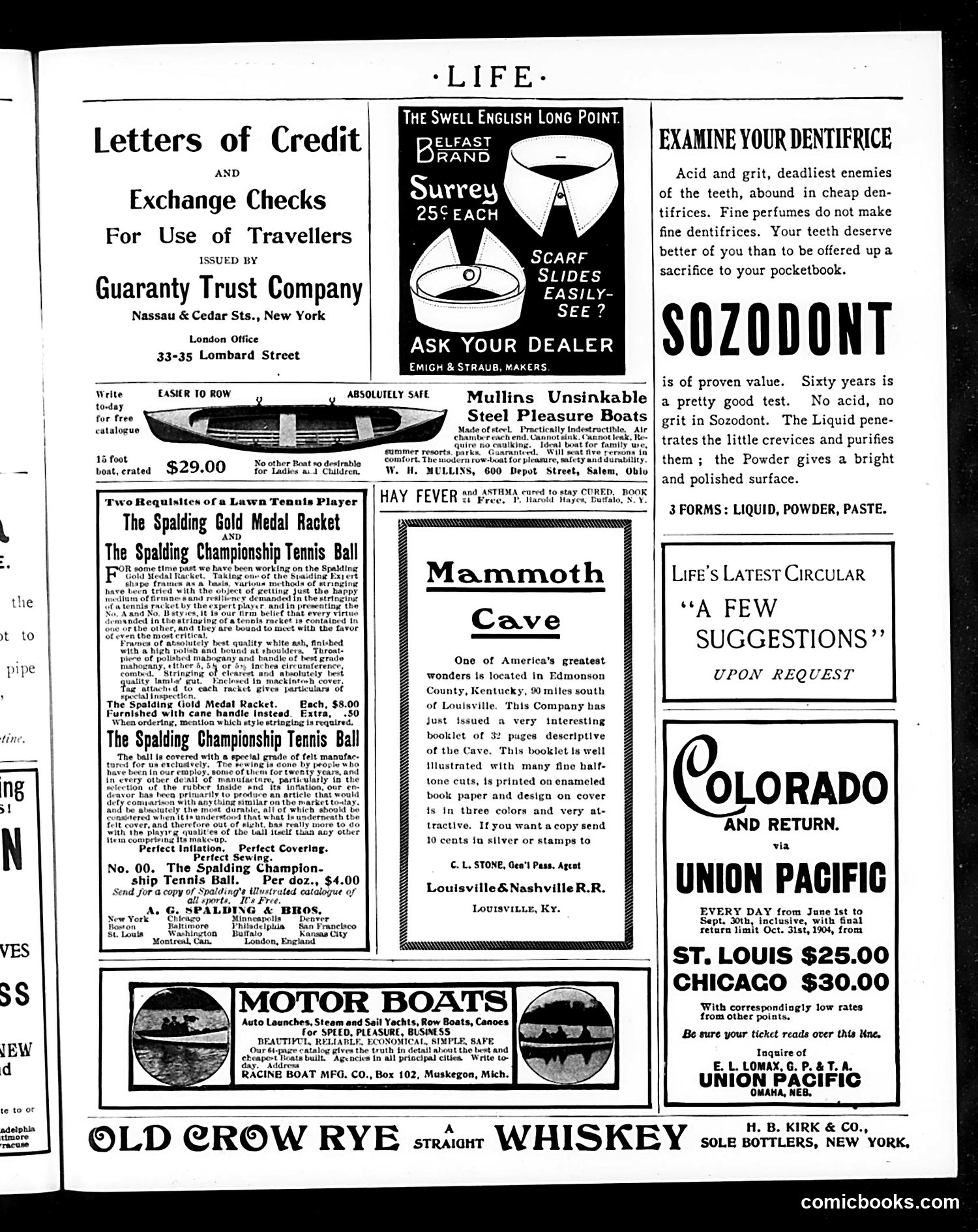
This is primarily an **advertising page** from Life magazine (circa 1904, based on the Union Pacific return date). Rather than satire or editorial cartooning, it features commercial advertisements typical of the era. Notable ads include: - **Spalding tennis equipment** (rackets and balls), presented with detailed product specifications - **Sozodont toothpaste**, emphasizing its lack of acid and grit—a selling point suggesting competitors used abrasive ingredients - **Mammoth Cave tourism** booklet promotion - **Union Pacific Railroad** excursions to Colorado and western destinations - **Motor boats** from Racine Boat Manufacturing - **Old Crow Rye whiskey** - Various financial services (letters of credit, exchange checks) The page reflects **early 1900s consumer culture**: sporting goods, dental hygiene concerns, tourism promotion, and luxury goods marketed to affluent readers. There is **no political satire** visible—this is straightforward commercial content designed to generate revenue for the magazine.
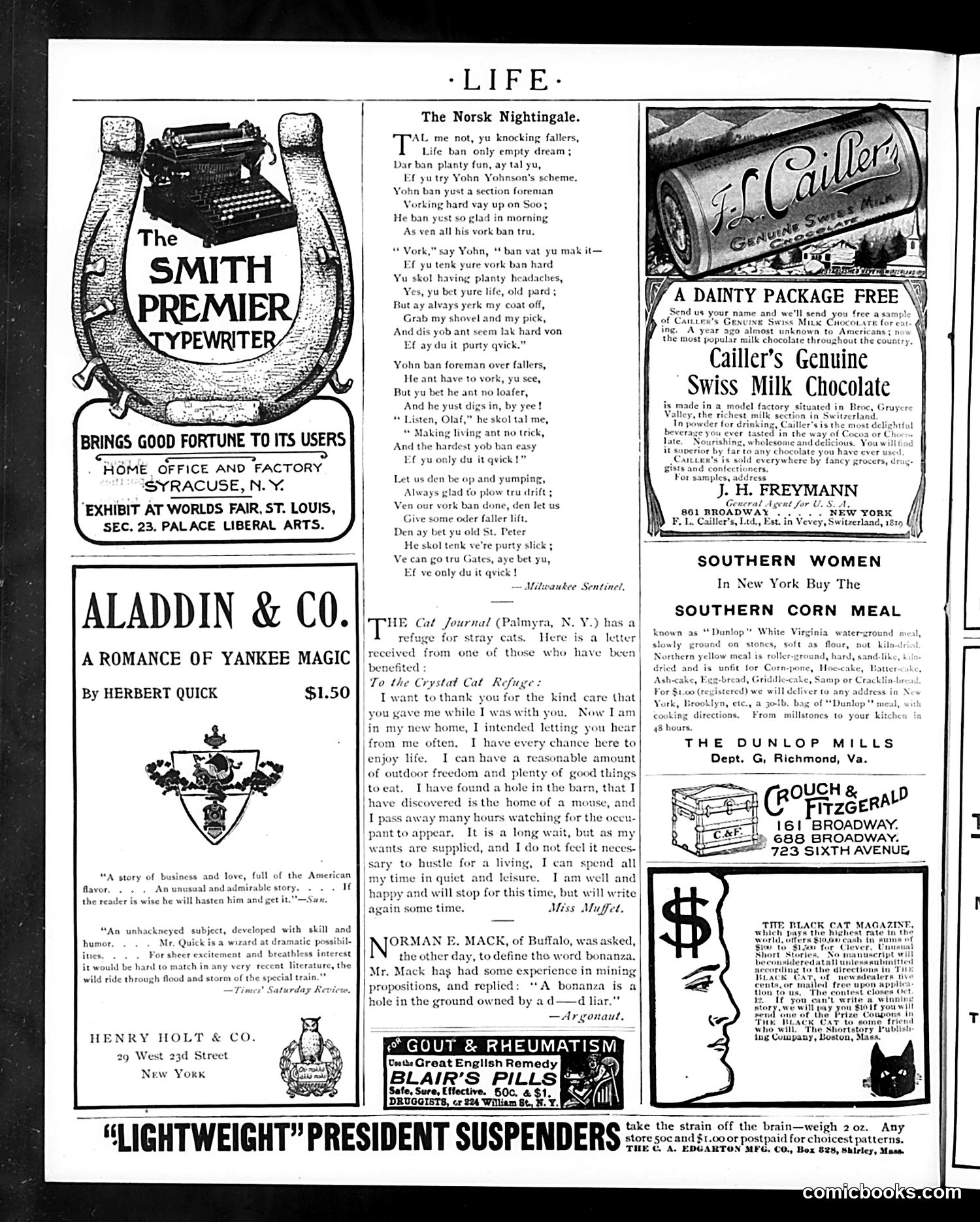
This poem, credited to the *Milwaukee Sentinel*, is a humorous piece using heavy Scandinavian-immigrant dialect to satirize working-class optimism and work ethic. The character "Yohn" (John) is a Norwegian section foreman on the Soo (Sault Ste. Marie railroad line) who preaches that hard work makes any job bearable—the key is doing it "purty qvick" (pretty quick). The satire targets both immigrant workers and American attitudes toward labor: Yohn's philosophy that "vork ban vat yu mak it" (work is what you make it) suggests that positive attitude alone overcomes exploitation. The exaggerated dialect—"yumping," "skol," "vork"—makes the character comic while also reflecting contemporary stereotyping of Scandinavian immigrants. The moral lesson about heavenly reward ("St. Peter") for diligent workers adds gentle social commentary: the poem implies working-class immigrants internalize capitalist values, finding spiritual meaning in labor rather than questioning conditions. This reflects early 1900s *Life* magazine's mix of gentle ethnic humor and middlebrow sentiment.
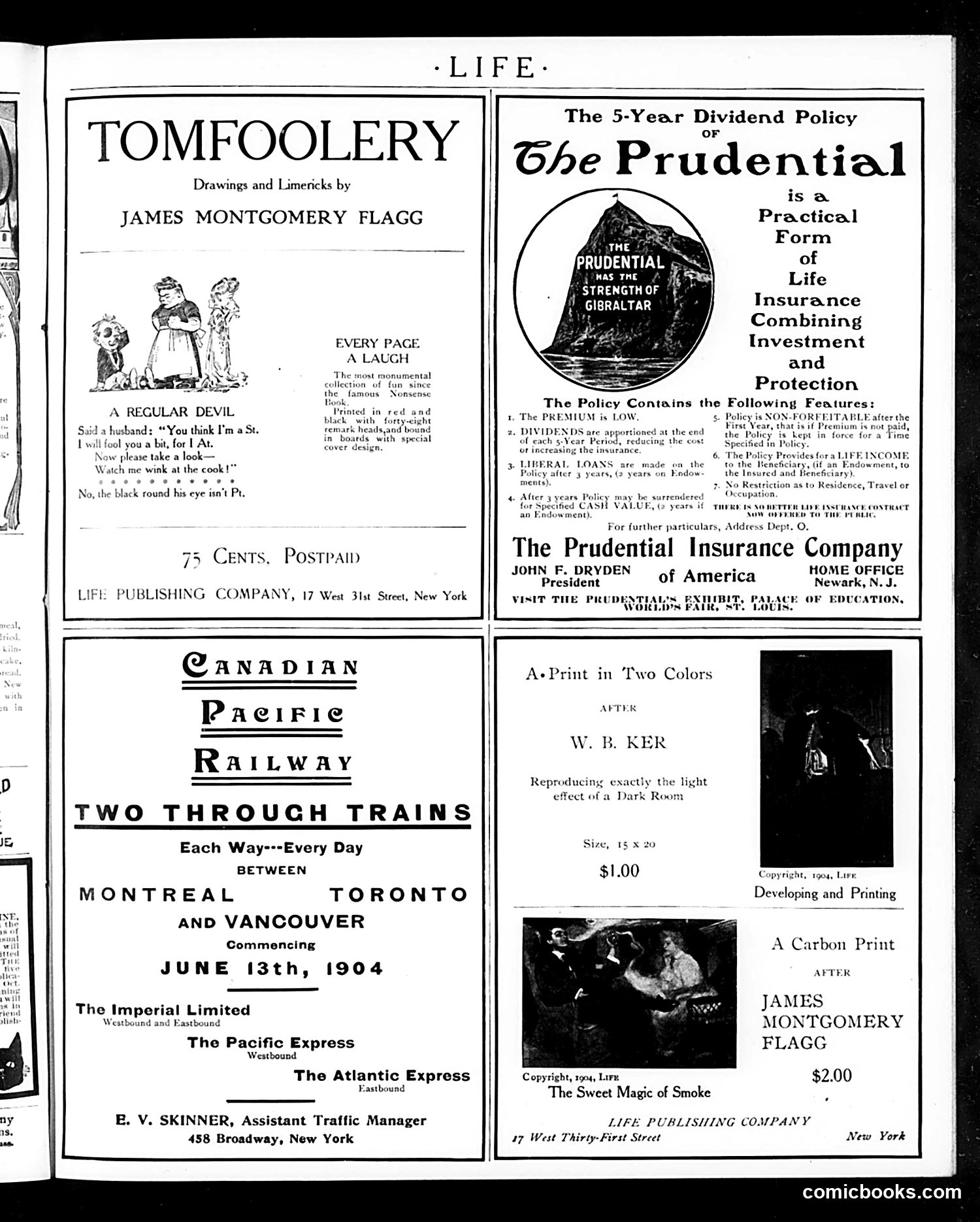
This is primarily an **advertising and merchandise page** from Life magazine, with minimal editorial cartoon content. The main humor piece is "Tomfoolery" by James Montgomery Flagg—a single-panel cartoon with limerick captioned "A Regular Devil." It depicts a domestic scene where a husband, presumably caught flirting with the cook, claims the black eye he's sporting came from the cook, not his wife's jealous rage. The joke plays on marital infidelity and domestic violence as comedy—reflecting early 1900s attitudes that treated spousal jealousy and physical retaliation as humorous rather than serious. The remainder of the page consists of advertisements: Prudential Insurance's dividend policy, Canadian Pacific Railway service (commencing June 1904), and prints by W.B. Ker and Flagg available through Life Publishing Company.
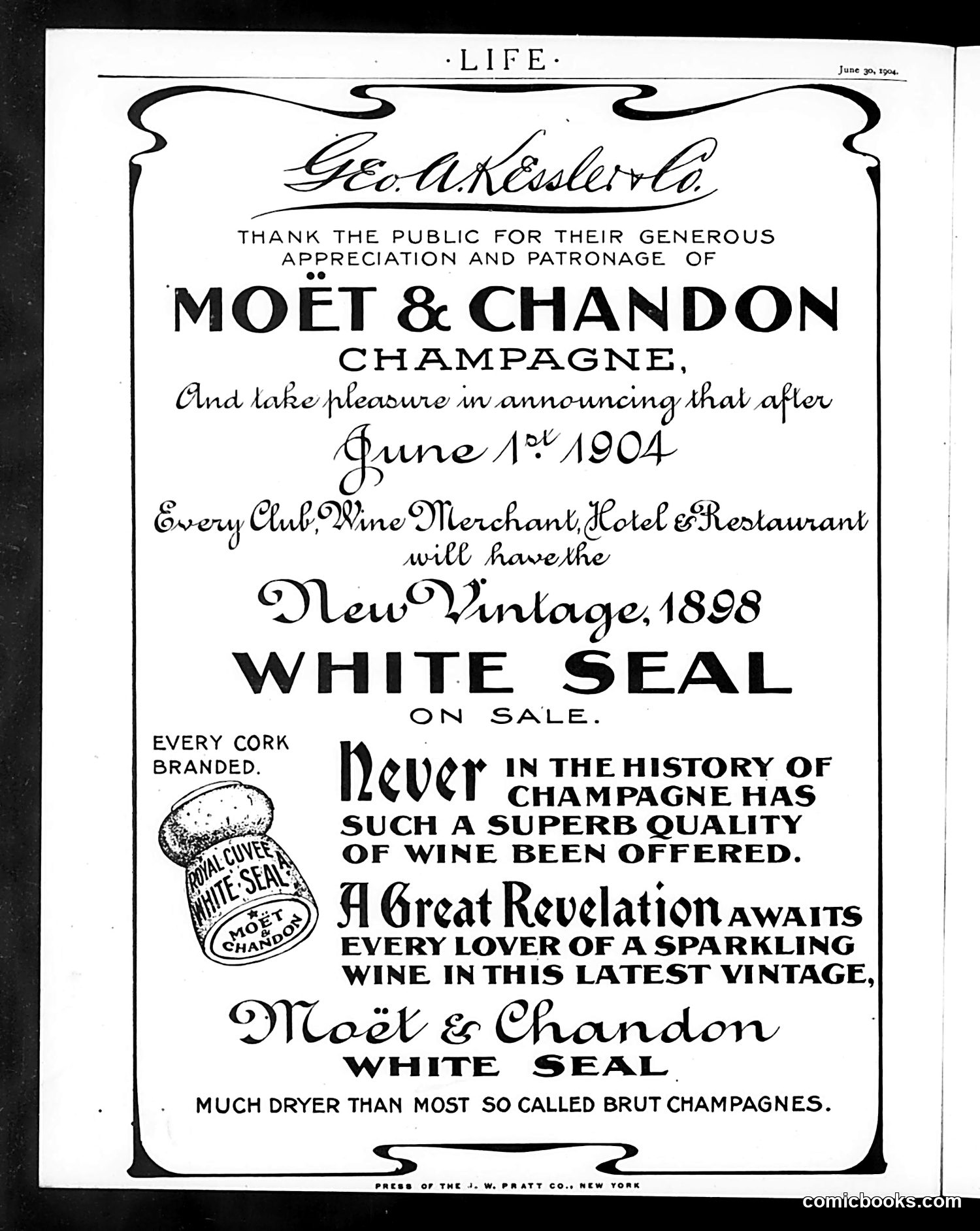
This is a **full-page advertisement**, not satire or political commentary. It's a 1904 advertisement for Moët & Chandon champagne, specifically their "White Seal" vintage. The ad announces that starting June 1st, 1904, clubs, wine merchants, hotels, and restaurants will stock the newly available 1898 vintage White Seal champagne. The promotional copy uses hyperbolic marketing language typical of the era—claiming "never in the history of champagne" has such quality been offered and promising "a great revelation" for wine lovers. The only visual element is a branded cork illustration. The ad emphasizes the product is "much dryer than most so called brut champagnes," positioning it as superior to competitors. This represents straightforward commercial advertising within *Life* magazine's pages—not editorial commentary or satire.

I can see this is a blank or nearly blank page from what appears to be a Life magazine archive, with only "comicbooks.com" visible at the bottom right corner as a watermark or source attribution. There are no visible cartoons, illustrations, text content, or satirical imagery on this page to analyze. The page appears to be either: - A blank page between content - A title page or divider - Improperly scanned or loaded Without visible political cartoons, caricatures, or substantive text to examine, I cannot identify figures, historical references, or satirical intent. A clearer or different page would be needed for analysis.