
Life, 1904-06-30 · page 14 of 23
Life — June 30, 1904 — page 14: what you’re looking at
What you’re looking at
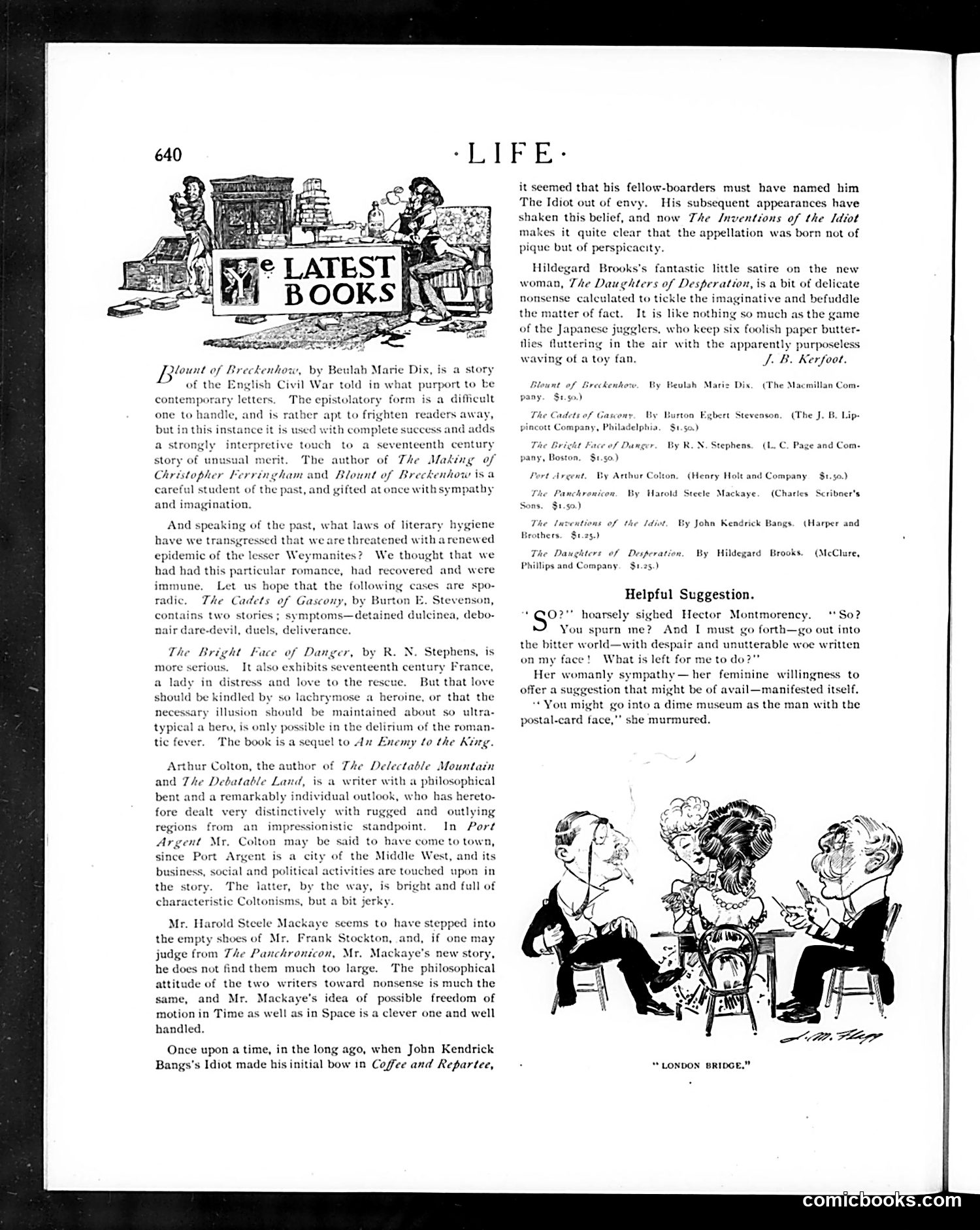
This cartoon satirizes the conventions of polite society and romance, likely referencing the popular "weeping hero" trope in contemporary fiction. The image shows a man in formal dress dramatically lamenting to a woman—he's performing the role of the tragically doomed lover, complete with theatrical despair ("despair and unutterable woe written on my face"). The woman's response—suggesting he visit a dime museum as "the man with the postal-card face"—mocks his melodramatic self-pity. She's essentially saying his tragic expression has become a cheap, mass-produced cliché, suitable only for carnival attractions. The joke critiques both the overwrought sentimentality of popular romance fiction and the male tendency toward self-pitying theatrics when rejected. The title "London Bridge" likely references the nursery rhyme, suggesting this emotional display is as predictable and worn-out as a child's song.
📄 Transcribed text from this page (OCR, searchable)
Machine-transcribed from the original scan — historical spelling and the odd misread are preserved.
“LIFE: it seemed that his fellow-boarders must have named him The Idiot out of envy. His subsequent appearances have shaken this belief, and now The /nventions of the Idiot makes it quite clear that the appellation was born not of pique but of perspicacity. Hildegard Brooks's fantastic little satire on the new woman, The Daughters of Desperation, is a bit of delicate nonsense calculated to tickle the imaginative and befuddle the matter of fact. It is like nothing so much as the game of the Japanese jugglers. who keep six foolish paper butter- ties fluttering in the air with the apparently purposeless waving of a toy fan. . B. Kerfoot. Biome of Breckenhow, by Beulah Marie Dis, is a story J s of the English Civil War told in what purport to b fount of Breckenkew. By Beulah Maris Dix. (The Macmillan Com- contemporary letters. The epistolatory form is a difficult one to handle, and is rather apt to frighten readers away, ‘ t Egbert Stevenson, (The J. B. Lip- but in this instance it is used with complete success and adds a stron i . h to a seventeenth century he Bi 7 uncer. By R.N. Stephens. (L.C. Page and Com- story of unusual merit. The author of The Making of Christopher Ferringham and Blount of Breckenko Port Argent, By Arthur Cokon. (Heary Holt and Company. $1.50) f the past, and gifted at once with sympathy The Panchronicon. Wy Warold Stecle Mackaye. (Charles Scribner's and imagination. Sons. $1.50.) And speaking of the past, what laws of literary hygiene The Inventions of the Idiot. By John Kendrick Bangs. (Harper and ve we transgressed that we are threatened witharenewed — Brothers: $425.) epidemic of the lesser Weymanites? We thought that we The Daughters ef Desperation. By Hildegard Brooks. (McClure, had had this particular romance, had recovered and were Phillips and Company. $1.25.) immune, Let us hope that the following © Spo- . radic. The Cadets of Gascony, t iE. Steve Helpful Suggestion. cont two stories ; symptoms—detained dulcinea, debo- J Ss? hoarsely sighed Hector Montmorency. ‘So? rdare-devil, ducls, deliverance. 4 sparn me? And I must go forth—go out into the bitter world—with despair and unutterable woe written on my face! What is left for me to do? Her womanly sympathy —her feminine willingness to The Bright Face of Danger, by R. N. Stephens, is more serious, It » exhibits seventeenth century nce, a lady in distress and love to the rescu But that lov stiould be kindled by:solachrymose a heroiiie, or that the Wet 9 Suggestion that might be of avall—manitested itself. “You might go into a dime museum as the man with the necessary illusion should be maintained about so ultra- ) postal-card face,"” she murmured. typical a hero, is only possible in the delirium of the roman- tic fever. The book is a sequel to Ax Enemy to the King. Arthur Colton, the author of The Delectable Mountain and The Debatable Land, is a writer with a philosophical bent da remarkably individual outlook, who has hereto- fore dealt very distinctively with rugged and outlying regions from an impressionistic standpoint. In Port Argent Mr, Colton may be said to have come to town, since Port A: is a city of the Middle West, and its business, social and political activities are touched upon in the story. The r, by the way, is bright and full of acteristic Coltonisms, but a bit . Harold Steele Mackaye seems ave stepped into the empty shoes of Mr. Frank Stockton, and, if one may judge from The Panchronicon, Mr. Mackaye’s new s he does not find them much too large. The philosophical attitude of the two writers toward nonsense is much the same, and Mr. Mackaye’s idea of possible freedom of motion in Time as well as in Space is a clever one and well handled. Once upon a time, in the long ago, when John Kendrick Bangs’s Idiot made his initial bow 1n Coffee and Repartee, “LONDON BRIDGE.” comicbooks.com