
A complete issue · 24 pages · 1903
Life — February 5, 1903
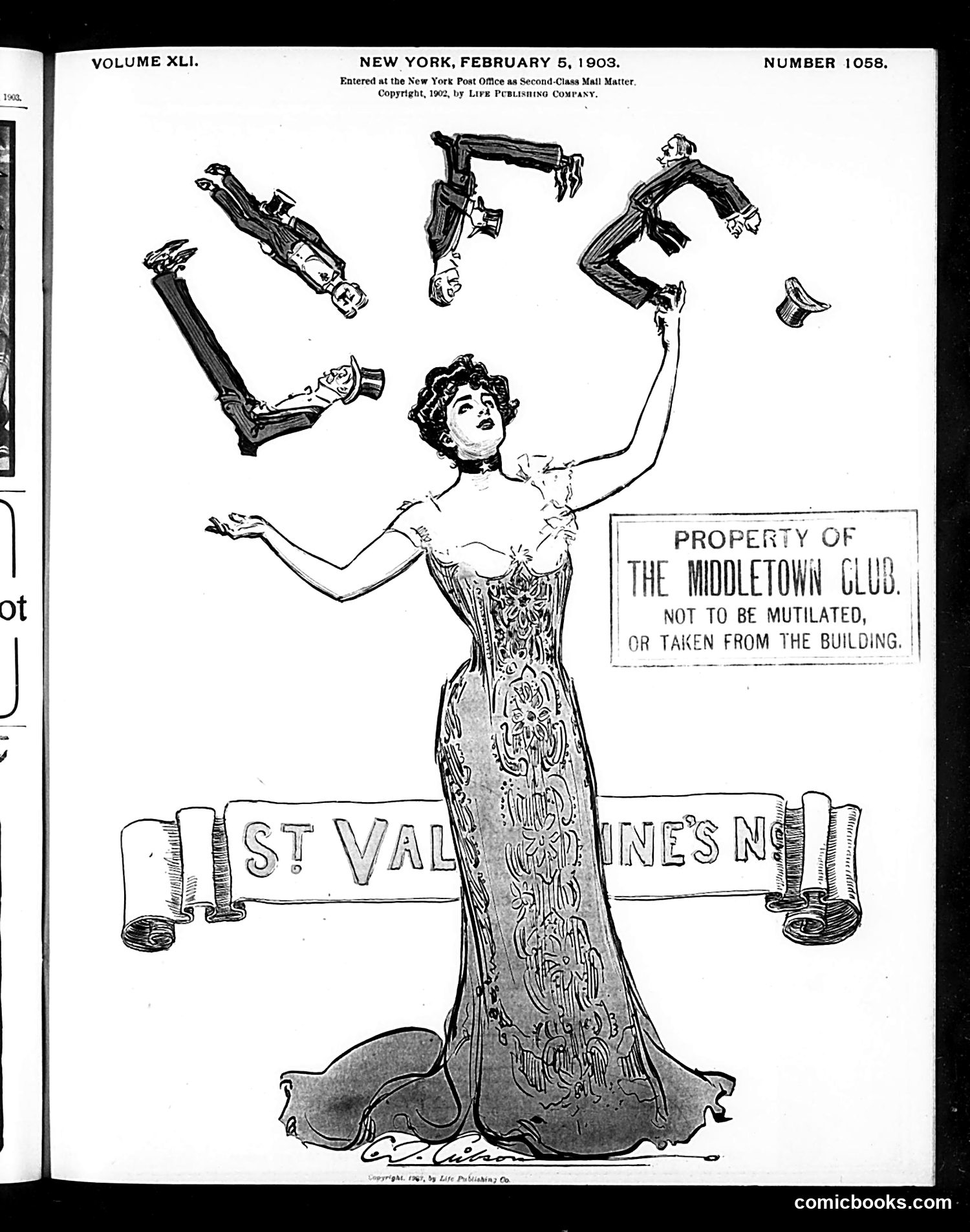
This satirical illustration presents a woman juggling various male figures and objects labeled as "property of the Middletown Club"—a social/gentlemen's club. The caption warns the items are "not to be mutilated, or taken from the building." The cartoon mocks the casual dating and romantic entanglements of early 1900s club society, suggesting women are juggling multiple suitors from the same exclusive club. It satirizes both the frivolous romantic pursuits of wealthy club members and the notion that these men are interchangeable "property"—a cutting commentary on how women of that era were viewed as objects to be competed for among elite male social circles. The St. Valentine's Day context emphasizes romantic themes.
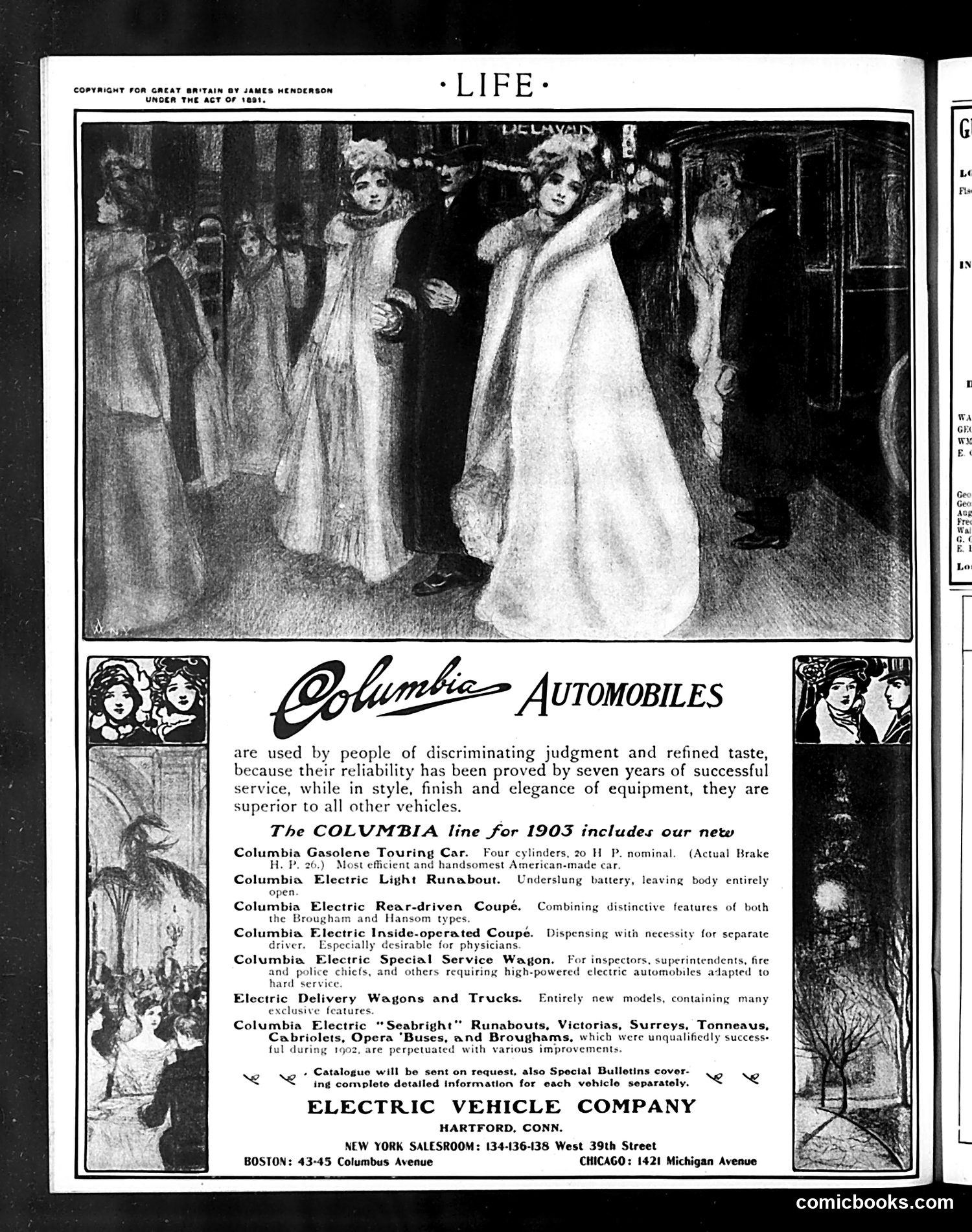
This page is **primarily an advertisement**, not a satirical cartoon. It features Columbia Automobiles, promoting their 1903 vehicle lineup to "people of discriminating judgment and refined taste." The top image shows well-dressed women in elaborate fur coats and formal attire arriving at what appears to be a social event or theater. This depicts the **target market**: wealthy, fashionable urbanites. The decorative vignettes along the left side show similarly affluent women in leisurewear. The advertisement emphasizes reliability, style, and elegance. Columbia offered both gasoline-powered touring cars and electric vehicles—notably including models designed for women (the "Inside-operated Coupe" required no separate controls, suggesting women drivers' needs). Electric vehicles were popular luxury items for wealthy urban women during this era. This reflects early 1900s class aspirations and emerging women's mobility, presented without satirical intent.
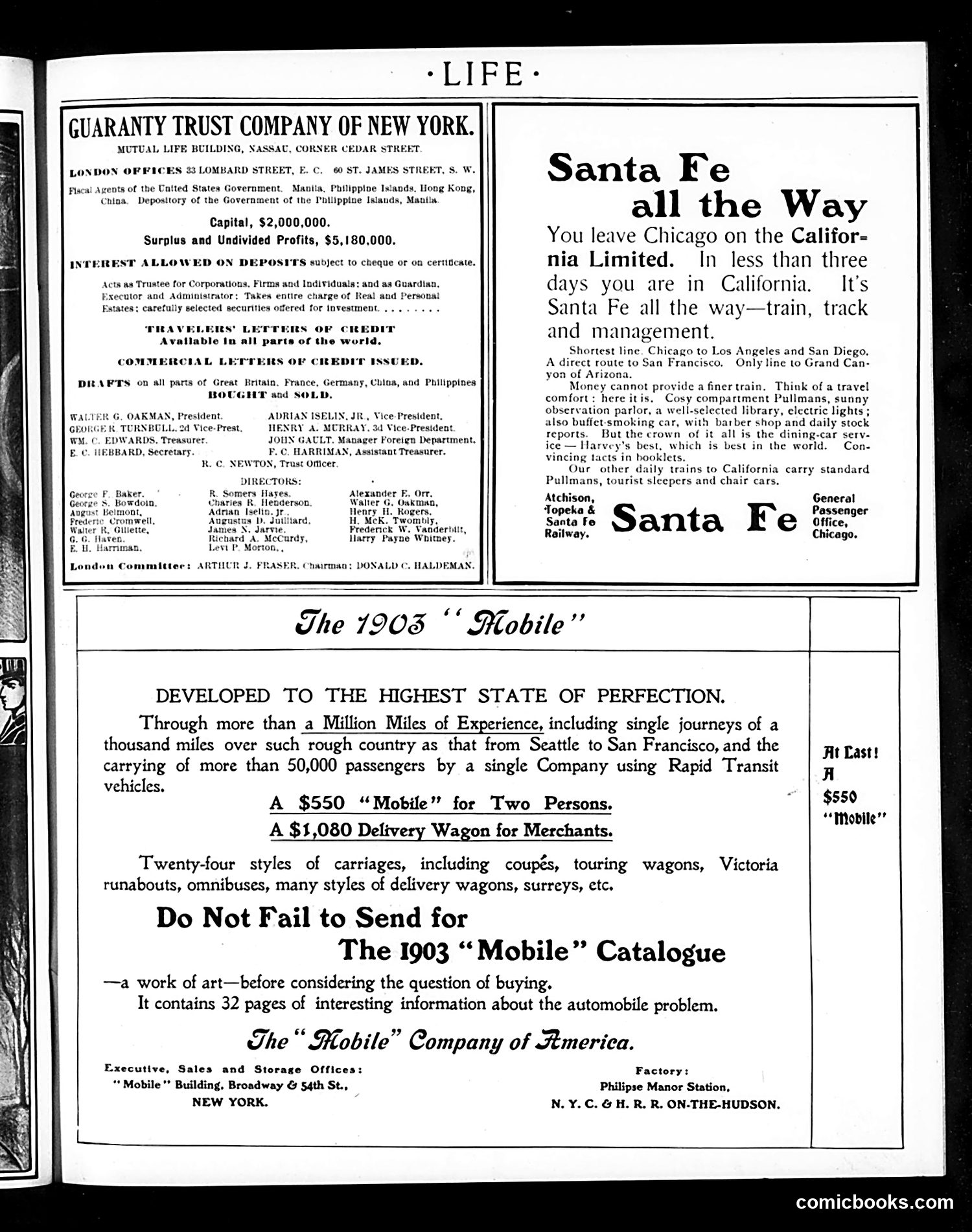
This page contains **no political cartoons or satirical content**. Instead, it features three distinct advertisements from circa 1903: 1. **Guaranty Trust Company of New York** — a financial institution advertisement listing capital, services, and board members. 2. **Santa Fe Railway** — promoting the "California Limited" train service from Chicago to California in under three days, highlighting comfort features like Pullman cars. 3. **The "Mobile" Automobile** — advertising early automobiles, claiming over a million miles of testing experience and offering models priced at $550-$1,080. The page represents typical early 1900s *Life* magazine content: advertising revenue mixed with editorial material. The "Mobile" auto ad is particularly notable as evidence of the nascent automobile industry competing for consumer attention alongside established transportation (railroads).
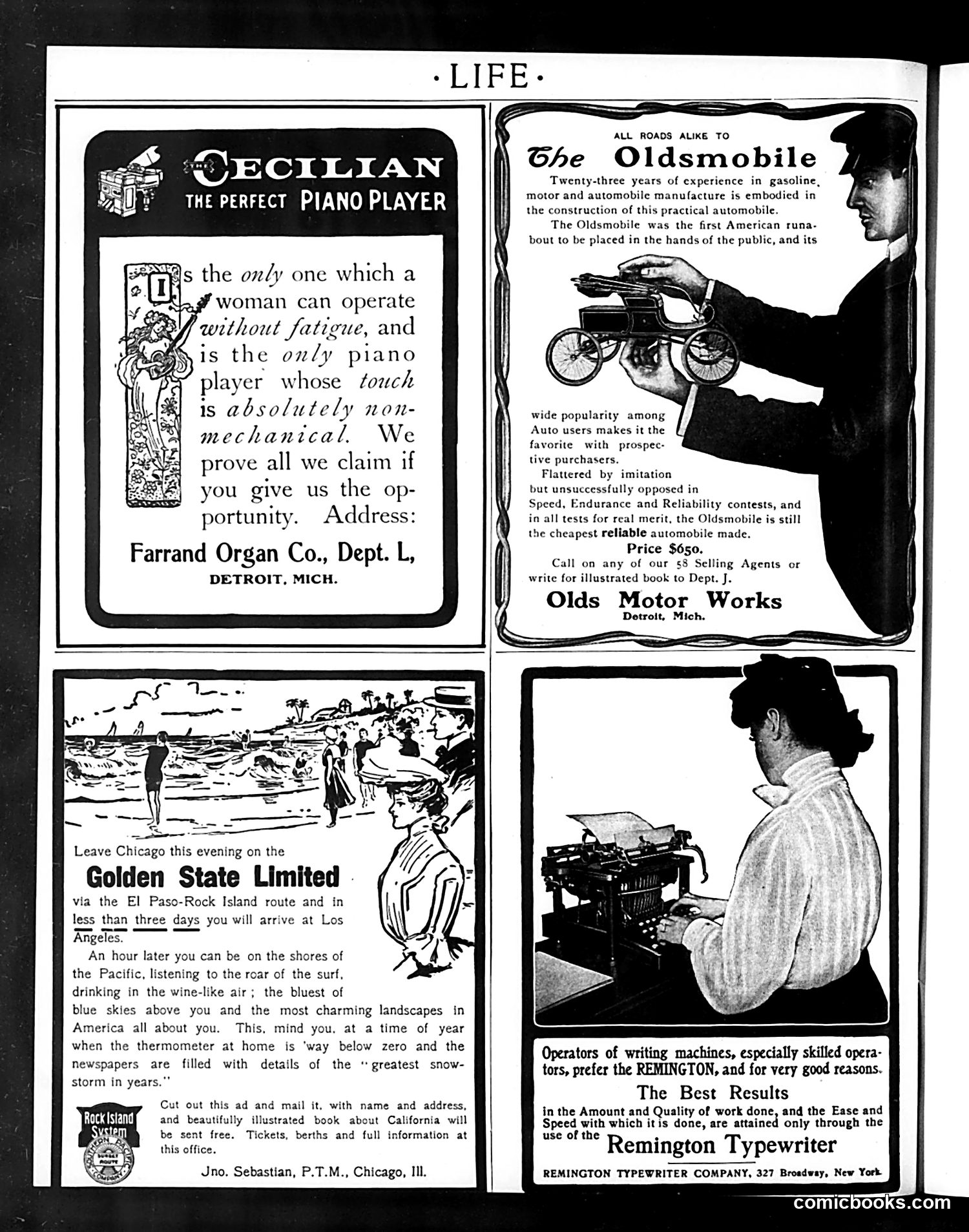
This page contains **four advertisements**, not political cartoons or satire. The ads showcase early 20th-century consumer products: 1. **Cecilian Piano Player** (top left): Promotes an automated piano device claimed to be operable by women without fatigue, with "absolutely non-mechanical" touch. 2. **Oldsmobile** (top right): Advertises the automobile as reliable and affordable ($650), emphasizing its racing pedigree and popularity among buyers. 3. **Golden State Limited** (bottom left): A train travel ad promoting passage from Chicago to Los Angeles in three days, appealing to those seeking California's mild winter climate. 4. **Remington Typewriter** (bottom right): Features a skilled operator, targeting professional typists with claims of superior results and ease of use. These ads reflect period consumer aspirations around technology, comfort, and modernity.
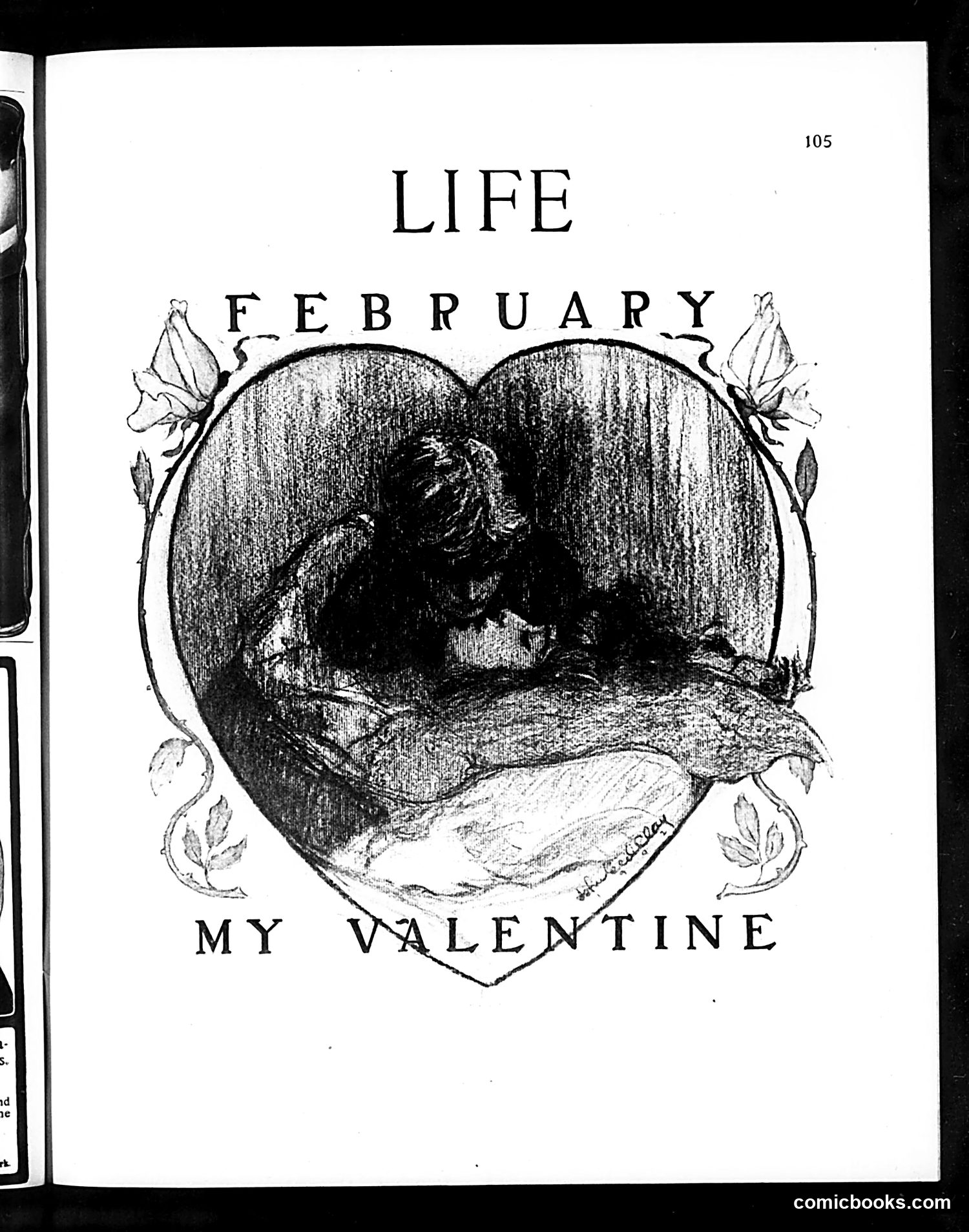
This is a Valentine's Day themed cover from *Life* magazine (page 105). The image shows a heart-shaped frame containing what appears to be a groundhog or similar burrowing animal emerging from or nestled in earth/soil, surrounded by decorative botanical elements (flowers and buds). The title "My Valentine" is a playful romantic gesture, but directed toward an animal rather than a human. This likely satirizes either: - The sentimentality of Valentine's Day customs themselves, or - Contemporary attitudes toward nature/animals The choice of a groundhog—particularly in February—may reference Groundhog Day (February 2nd), making this a seasonal pun combining two February observances. The joke appears to mock romantic excess by redirecting Valentine sentiment toward an unexpected, earthy subject.
This page contains three distinct editorial sections praising notable figures rather than satirical cartoons. The illustrations are decorative rather than caricature-based. The first section discusses a Croatian man whose skeletal remains were discovered in Kansas, used to argue that human civilization has progressed—a somewhat awkward celebration of evolutionary/racial advancement typical of early 1900s thinking. The second praises an unnamed citizen (likely a political figure or judge) for his public service and integrity, noting his influence exceeds others in New York. The third discusses the Flatiron building's design problems: its thin profile causes wind damage and threatens pedestrians, requiring legal protection for the owners—an early architectural controversy in Manhattan. All three pieces adopt a congratulatory or wryly observational tone rather than satirical critique.
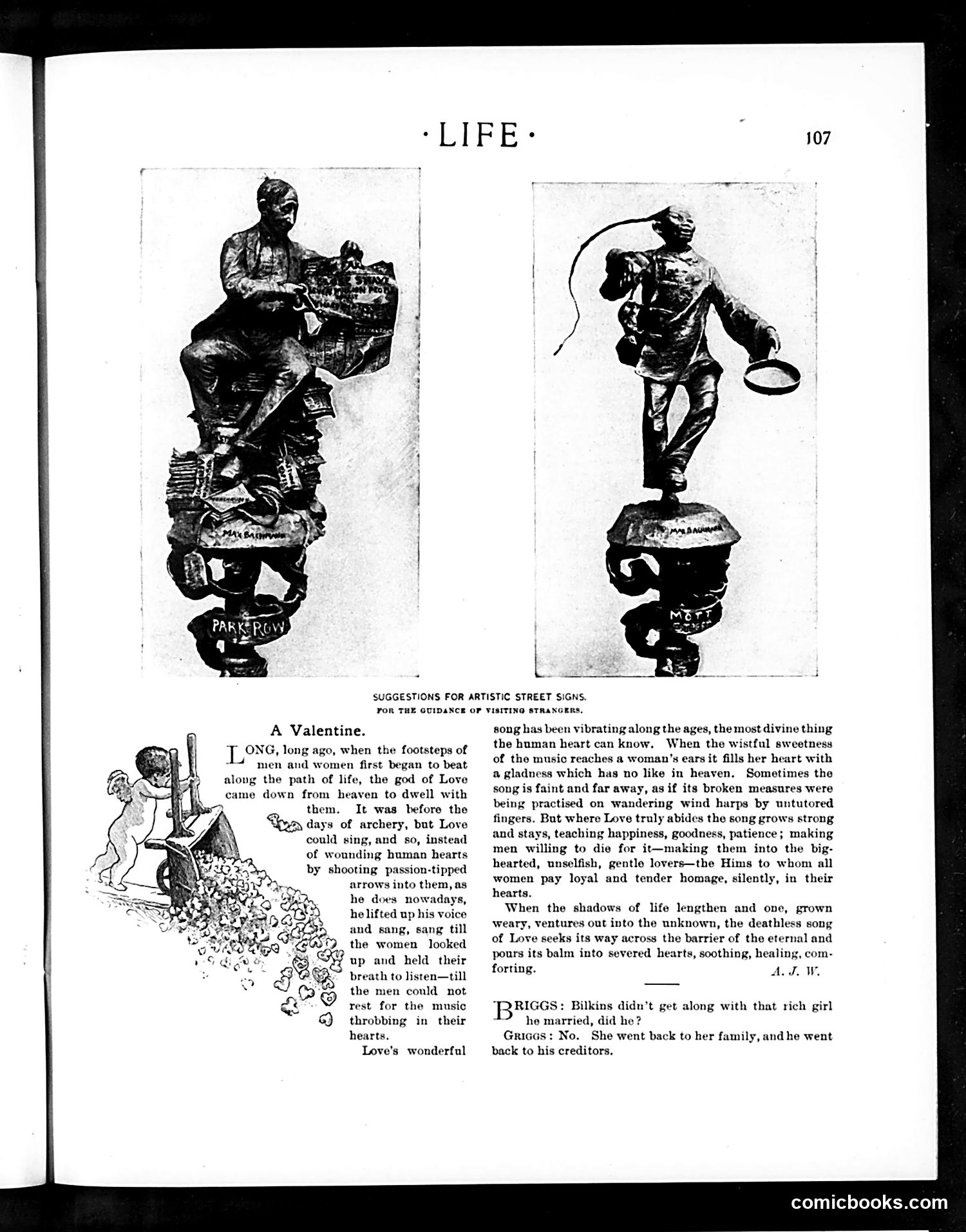
This page presents "Suggestions for Artistic Street Signs for the Guidance of Visiting Strangers"—two decorative metal street markers depicting allegorical figures. The left shows a seated figure holding a city model, labeled "PARK ROW" (New York's famous newspaper district). The right depicts a standing figure with a whip and ring, labeled "MERIT" (unclear reference). Below, an essay titled "A Valentine" romantically describes Love's historical role in human hearts, using flowery Victorian language about music and emotion. The brief dialogue at bottom between Briggs and Griggs offers social commentary: when asked why a wealthy woman didn't marry a poor man named Bikkins, the reply is cynical—she returned to her family while he returned to his creditors, suggesting class divisions prevent genuine romantic unions.
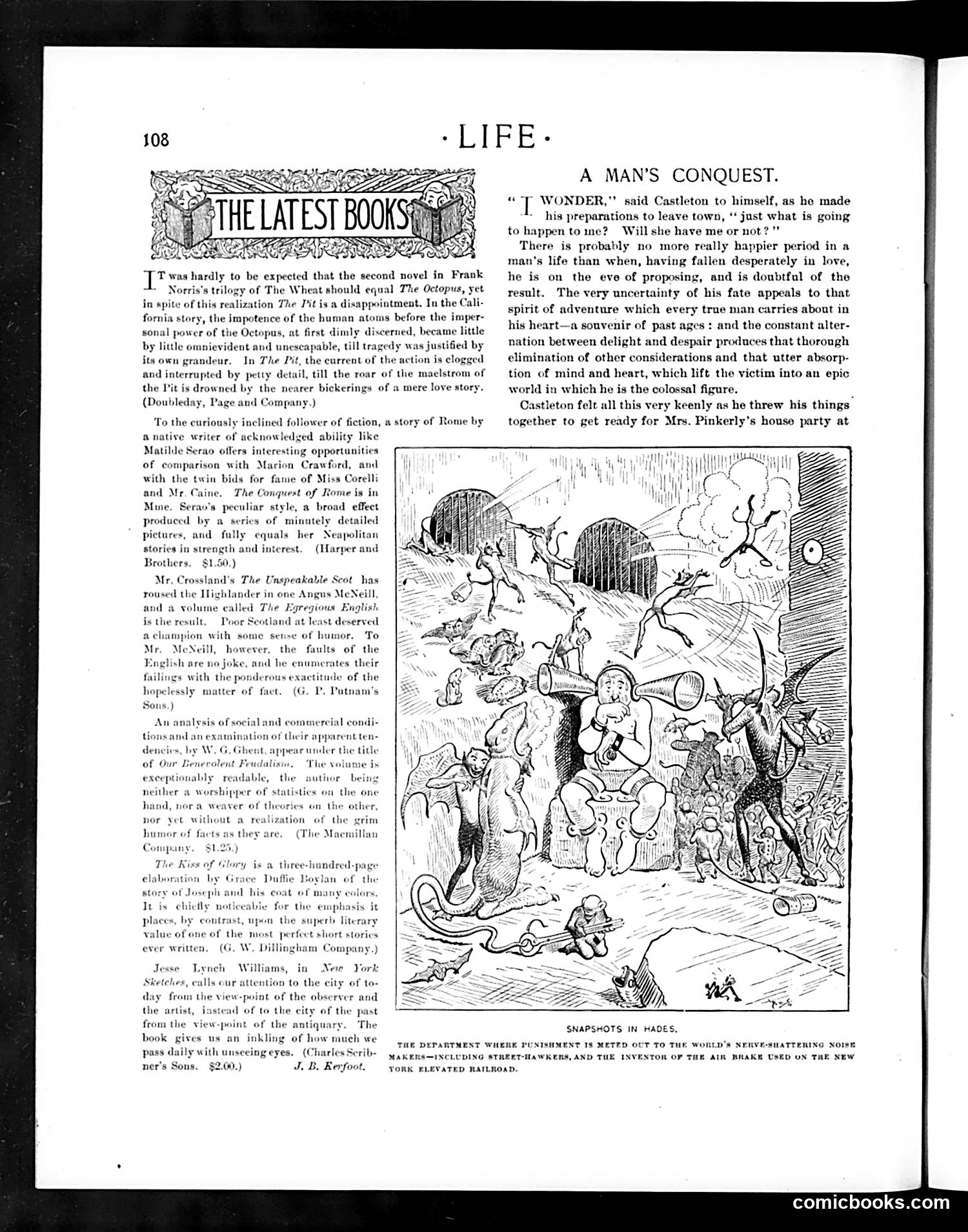
This cartoon depicts classic punishment scenarios from Greek mythology, reimagined as a chaotic scene in the underworld. The image shows various mythological figures experiencing their eternal torments: a figure appears to be pushing a boulder (likely Sisyphus), others seem caught in various predicaments of suffering. The caption indicates this illustrates "the department where punishment is meted out to the world's nerve-shattering noise makers—including street-hawkers, and the inventor of the air brake used on the new York elevated railroad." The satire targets modern nuisances—particularly street vendors and a specific railway inventor—by comparing contemporary annoyances to mythological torment. It's a humorous complaint about urban noise pollution and technological intrusions on city life, treating them as deserving of eternal punishment.
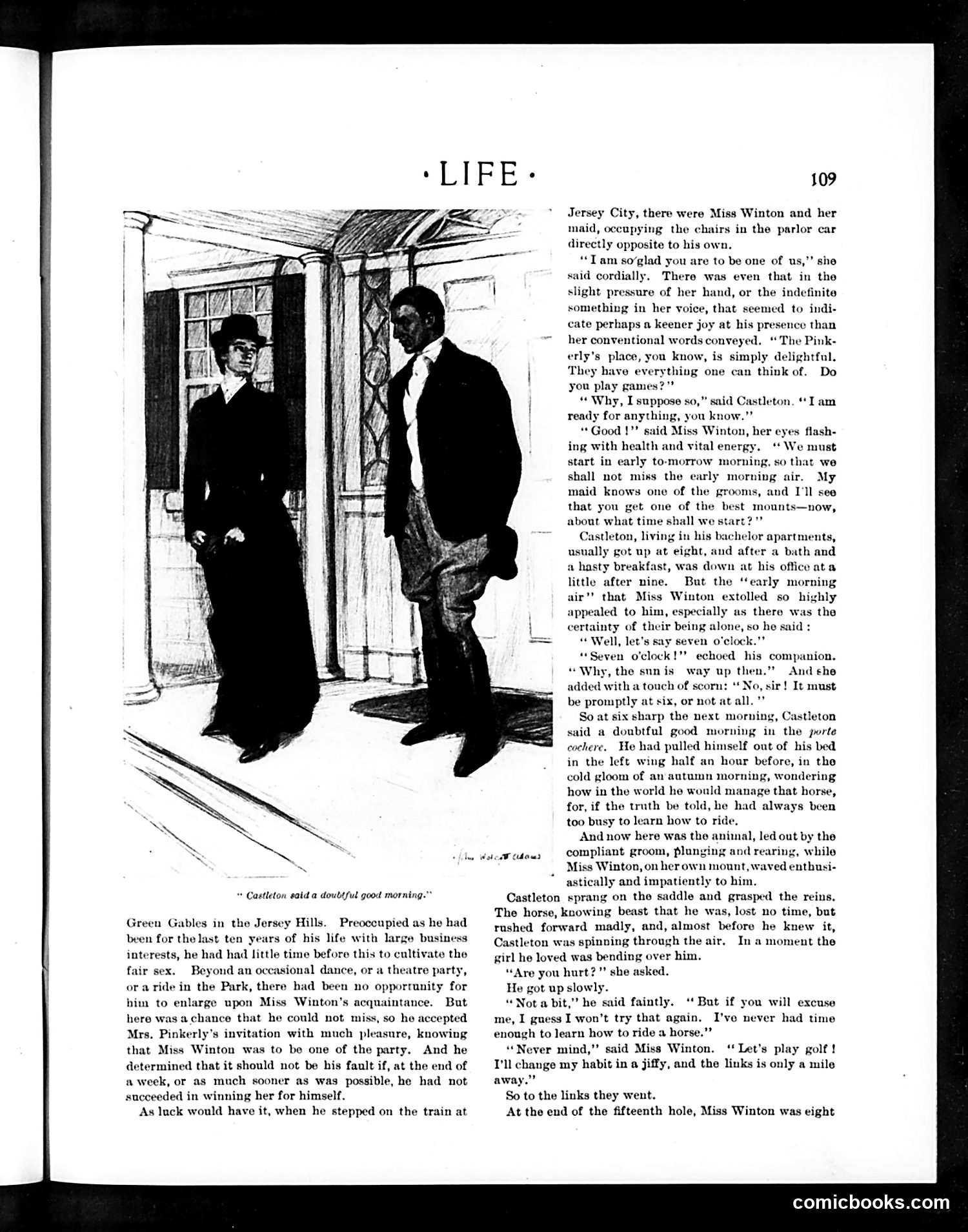
This page is from a serialized fiction story titled "Green Gables in the Jersey Hills," not a political cartoon. The illustration shows two men in formal attire meeting at a doorway—likely Castleton and a visitor, based on the caption "Castleton said a doubtful good morning." The narrative describes Castleton, a bachelor, reluctantly accepting a social invitation from Miss Winton to go riding. The text humorously portrays his discomfort with early morning activities and horseback riding, contrasting with Miss Winton's enthusiastic energy. The story appears to be a romantic comedy about courtship among wealthy leisure-class characters in the Jersey Hills area. There is no political satire present—this is simply entertainment fiction typical of Life magazine's literary content.
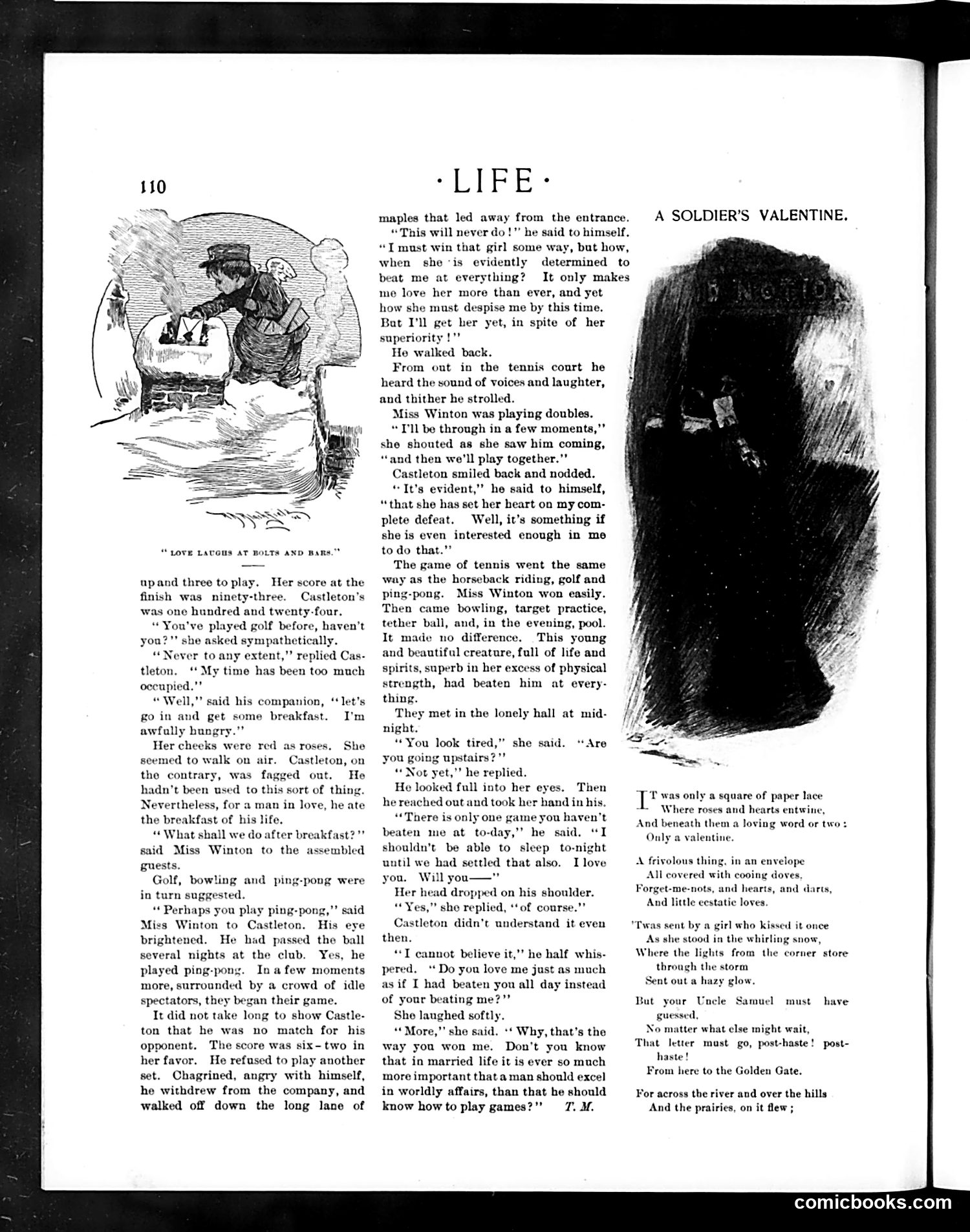
This page contains a short story titled "A Soldier's Valentine" rather than political satire. The left illustration shows two figures in what appears to be a comedic domestic scene, captioned "Love Laughs at Bolts and Bars." The narrative describes a romantic exchange between Miss Winton and Castleton during various games (tennis, bowling, ping-pong, pool). The story explores themes of courtship and romantic competition—Castleton struggles with his pride as Miss Winton consistently beats him at games, yet he remains smitten. The right side features a poem titled "A Soldier's Valentine," romantic verse about love and separation. This is lighthearted entertainment literature with illustrations, not political commentary. The "bolts and bars" reference remains unclear without fuller context.
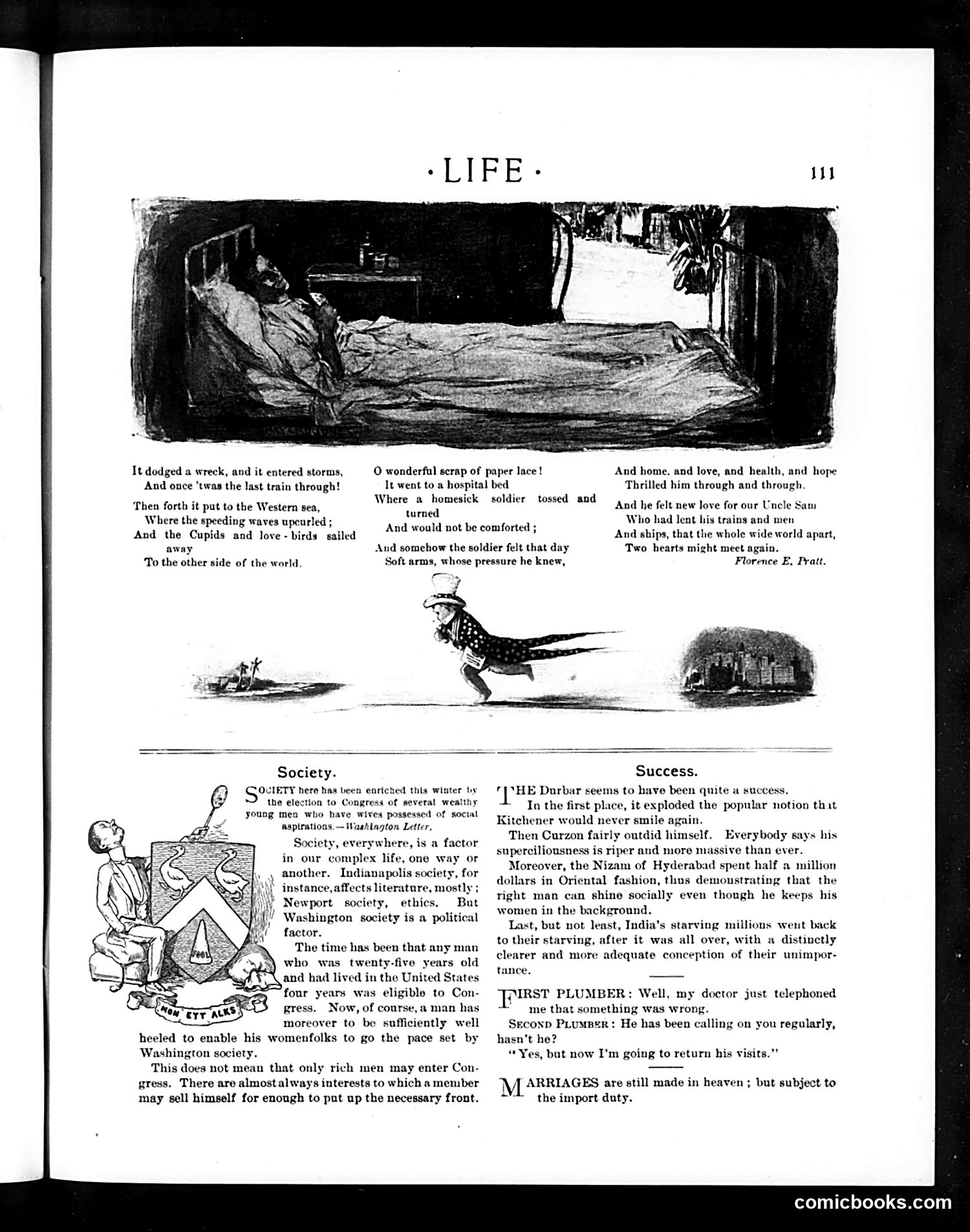
This page contains three satirical sections: **"Life" header section**: A poem about a scrap of paper lace that traveled via train to the Western sea, then hospital bed, comforting a wounded soldier. The illustration shows a bedridden patient. The satire appears to address how small comforts from home sustain soldiers during wartime. **"Society" section**: Satirizes Washington D.C. social circles, mocking how wealthy young men without genuine qualifications can enter Congress simply by possessing financial means and social connections. The illustration depicts well-dressed socialites, critiquing class-based political access. **"Success" and "First Plumber" sections**: Brief humorous pieces about social pretension and domestic life—one about the Dunbar's social climbing, another a joke about a plumber's repeat visits. The overall tone mocks American class systems and wartime sentimentality.
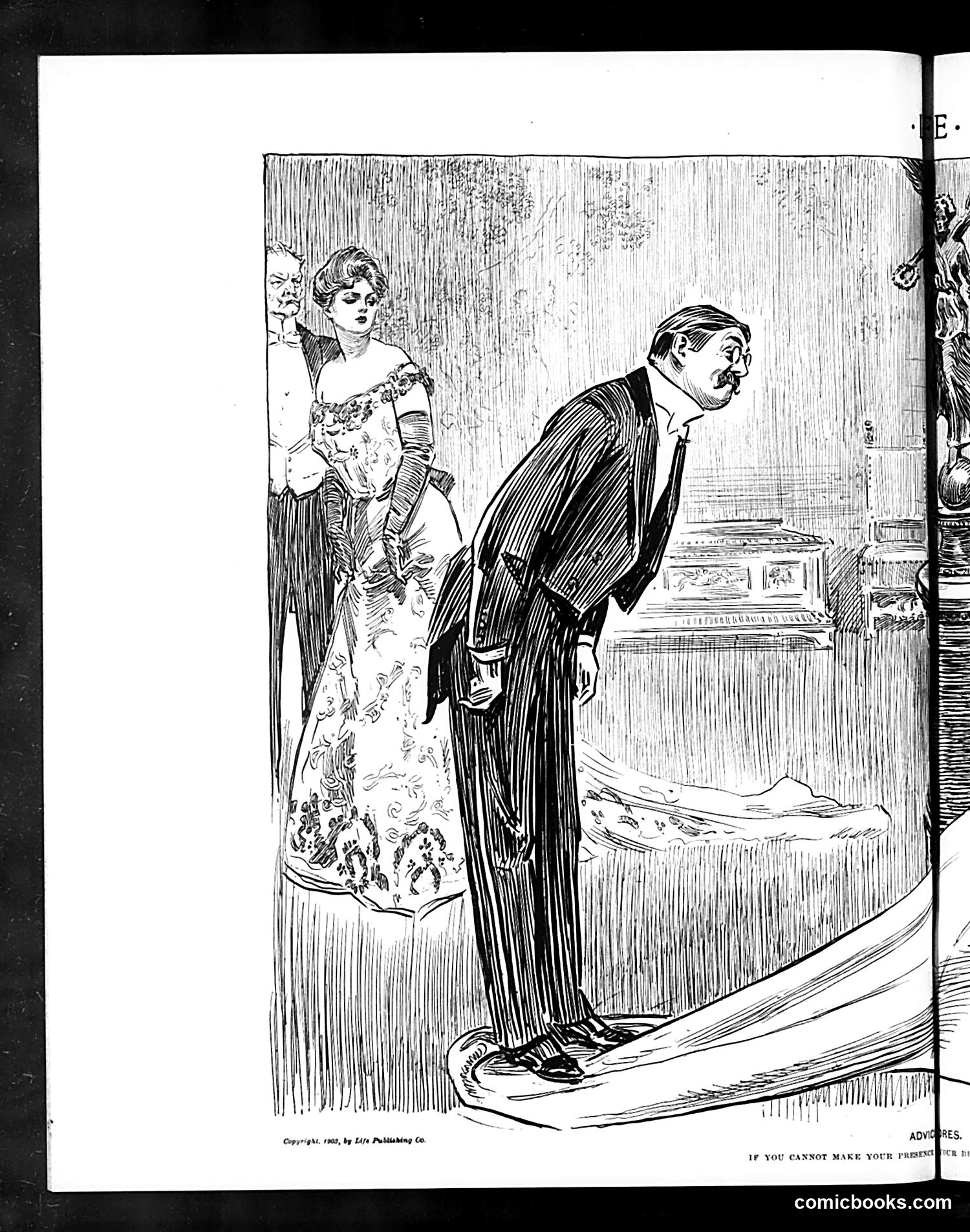
This appears to be a satirical illustration from Life magazine (copyright 1903, per the visible credit). The cartoon depicts a well-dressed man in a striped suit turning away from an elegant woman in an ornate gown, with his body language suggesting rejection or avoidance. The partially visible caption at bottom reads "IF YOU CANNOT MAKE YOUR PRESENTS B..." (text cut off), suggesting the cartoon comments on gift-giving or financial obligation in romantic relationships. The specific identities of the figures and the full context of the satire are unclear from what's visible. The illustration appears to mock social conventions around courtship, wealth, or masculine responsibility—common satirical targets in early 1900s American humor—but without the complete caption, the precise target of ridicule cannot be determined.
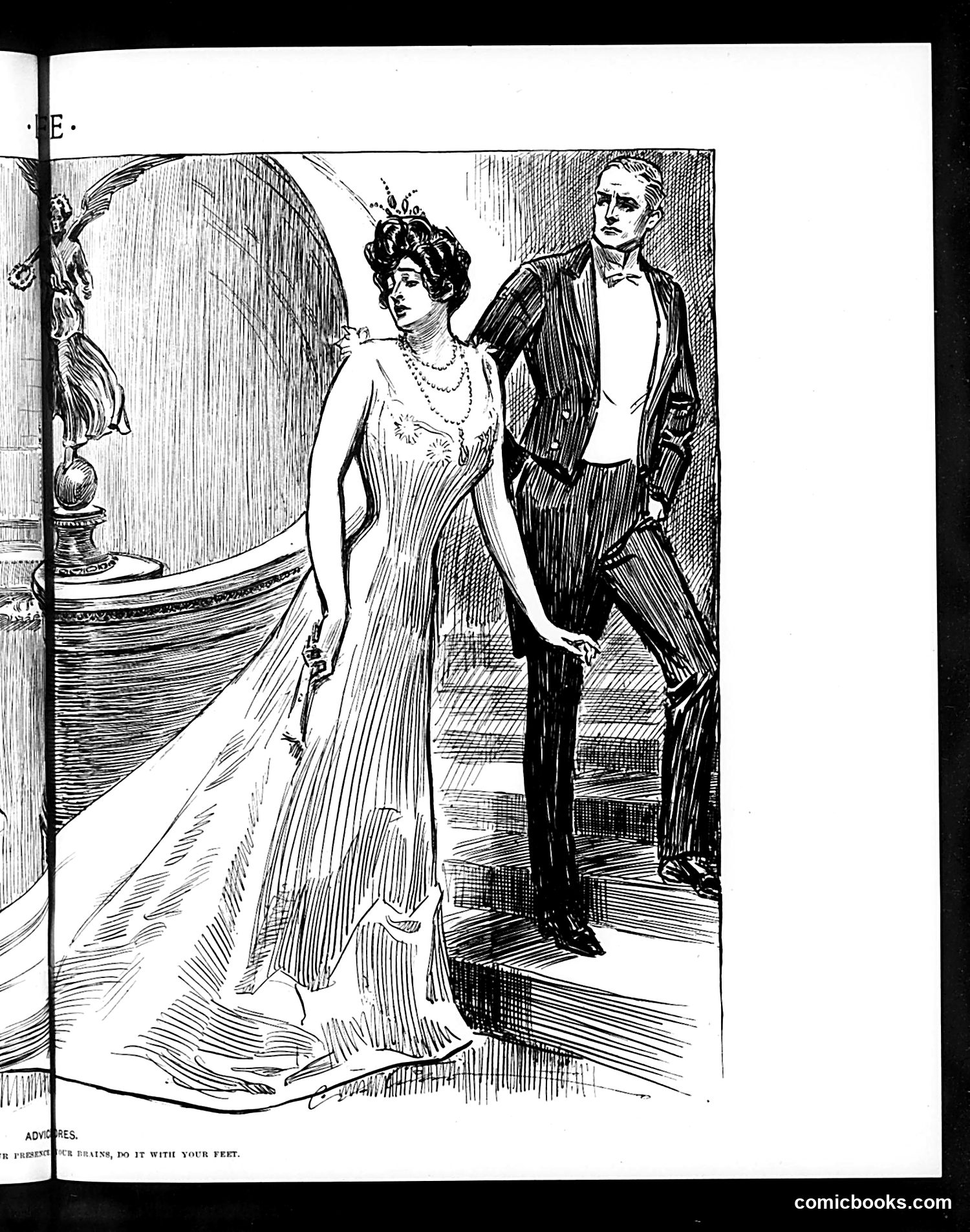
This appears to be a page from *Life* magazine featuring a single illustration of an elegantly dressed couple in formal evening wear—a woman in a flowing gown with a tiara and a man in a tuxedo. The woman's elaborate train trails behind her. The visible text fragment at the bottom reads "ADVISES" and mentions something about "YOUR BRAINS, DO IT WITH YOUR FEET," though the full caption is partially cut off and unclear. Without the complete caption or date visible, the specific satirical target is difficult to identify with certainty. The image likely comments on high society, fashion, or courtship conventions of the early 20th century, but the exact point of satire cannot be determined from the information provided.
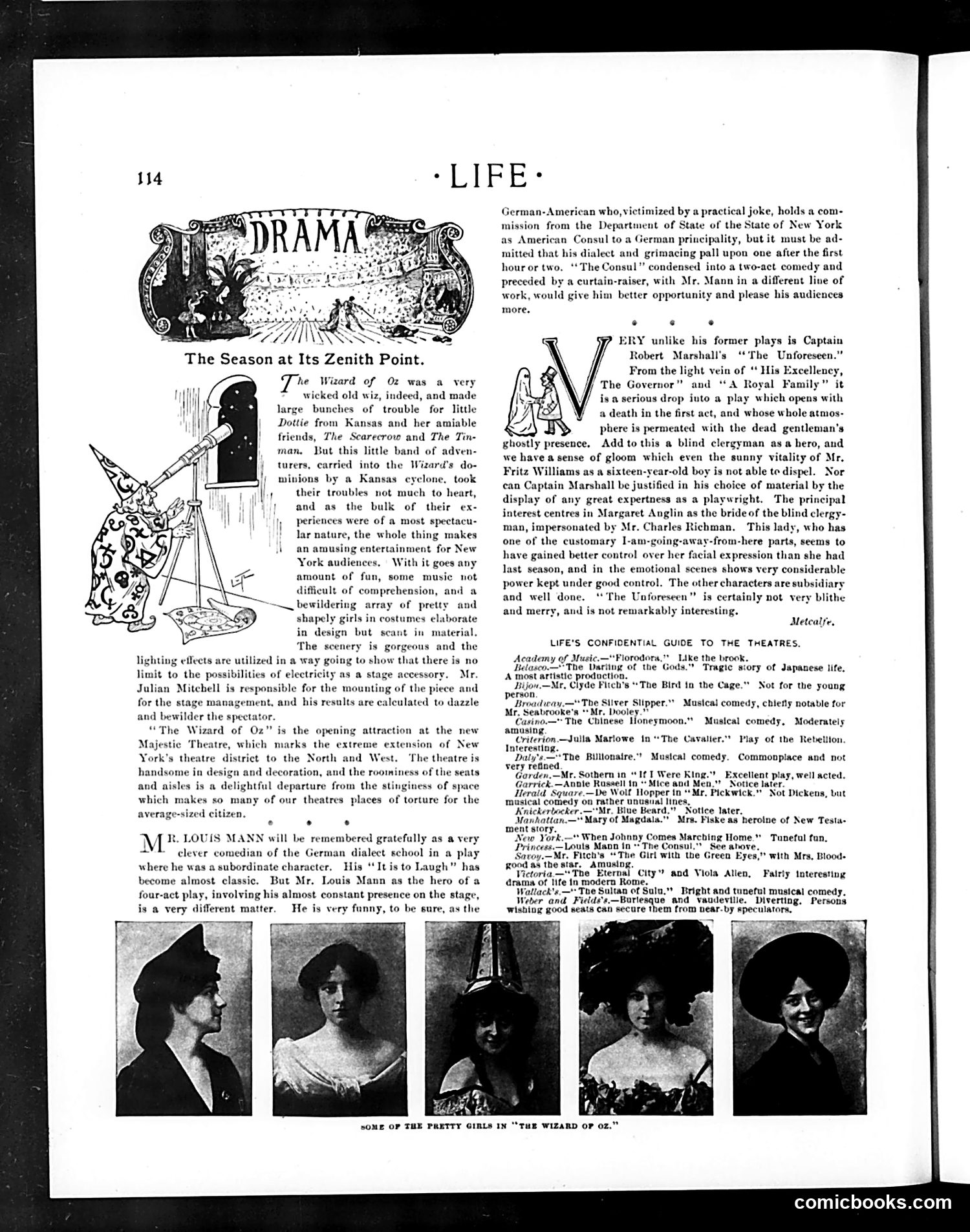
This page reviews theatrical productions opening in New York, circa early 1900s. The main content discusses: **"The Wizard of Oz"** - A new stage adaptation opening at the Majestic Theatre. The review praises its spectacle, elaborate costumes, and scenic effects, while noting it offers "fun, some music not difficult of comprehension, and a bewildering array of pretty and shapely girls in costumes elaborate in design but scant in material"—typical period theater criticism emphasizing visual display. **"The Consul"** - Starring comedian Louis Mann in a German-dialect role. The reviewer finds Mann funny but criticizes his performance becoming tiresome over four acts, suggesting the play be condensed. **"The Unforeseen"** - A serious drama featuring Margaret Anglin. The critic finds it unnecessarily gloomy and questions the playwright's expertise, though praising Anglin's emotional control. The five photographs below show actresses from "The Wizard of Oz," exemplifying the era's emphasis on theatrical glamour and female performers as attractions.
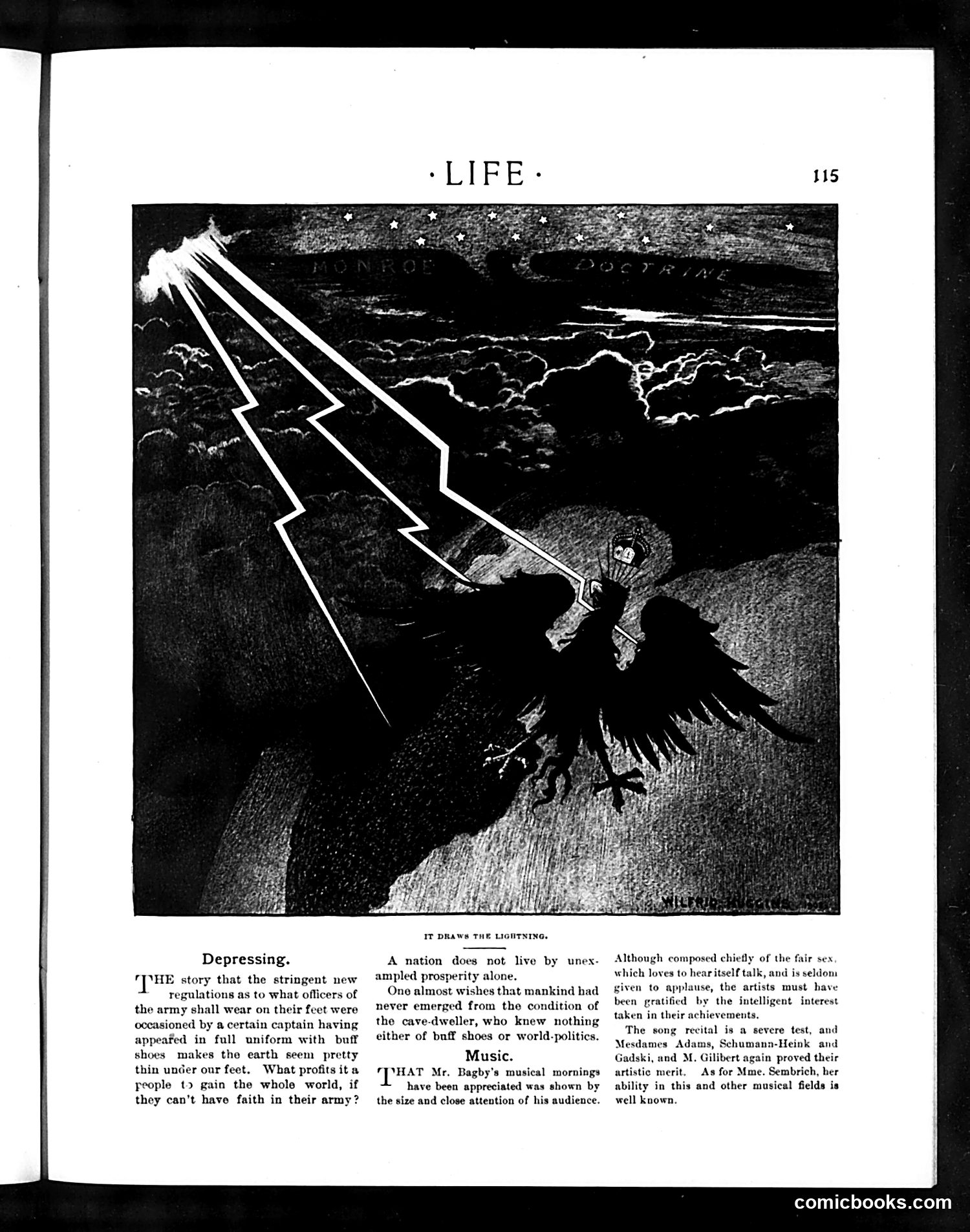
This page contains three brief satirical commentary pieces typical of Life's editorial style: **"Depressing"** mocks military bureaucracy. An army officer appeared in full uniform wearing buff (tan) shoes, triggering new regulations about footwear. The satire argues this absurdity undermines public faith in the military—what good is an army if it can't maintain discipline over something as trivial as shoe color? **"It Draws the Lightning"** (the cartoon) depicts an eagle being struck by lightning, apparently symbolizing the nation being damaged by excessive prosperity and materialism. The caption suggests humanity was better off in simpler times before worldly concerns and politics complicated life. **"Music"** reviews a performance by Mr. Bagby featuring opera singers Mesdames Adams, Schumann-Heink, and Gadski, plus Mme. Sembrich. The critic notes the primarily female audience was unusually attentive and appreciative, praising the artists' merit. These reflect Life's characteristic blend of political criticism, social observation, and cultural commentary.
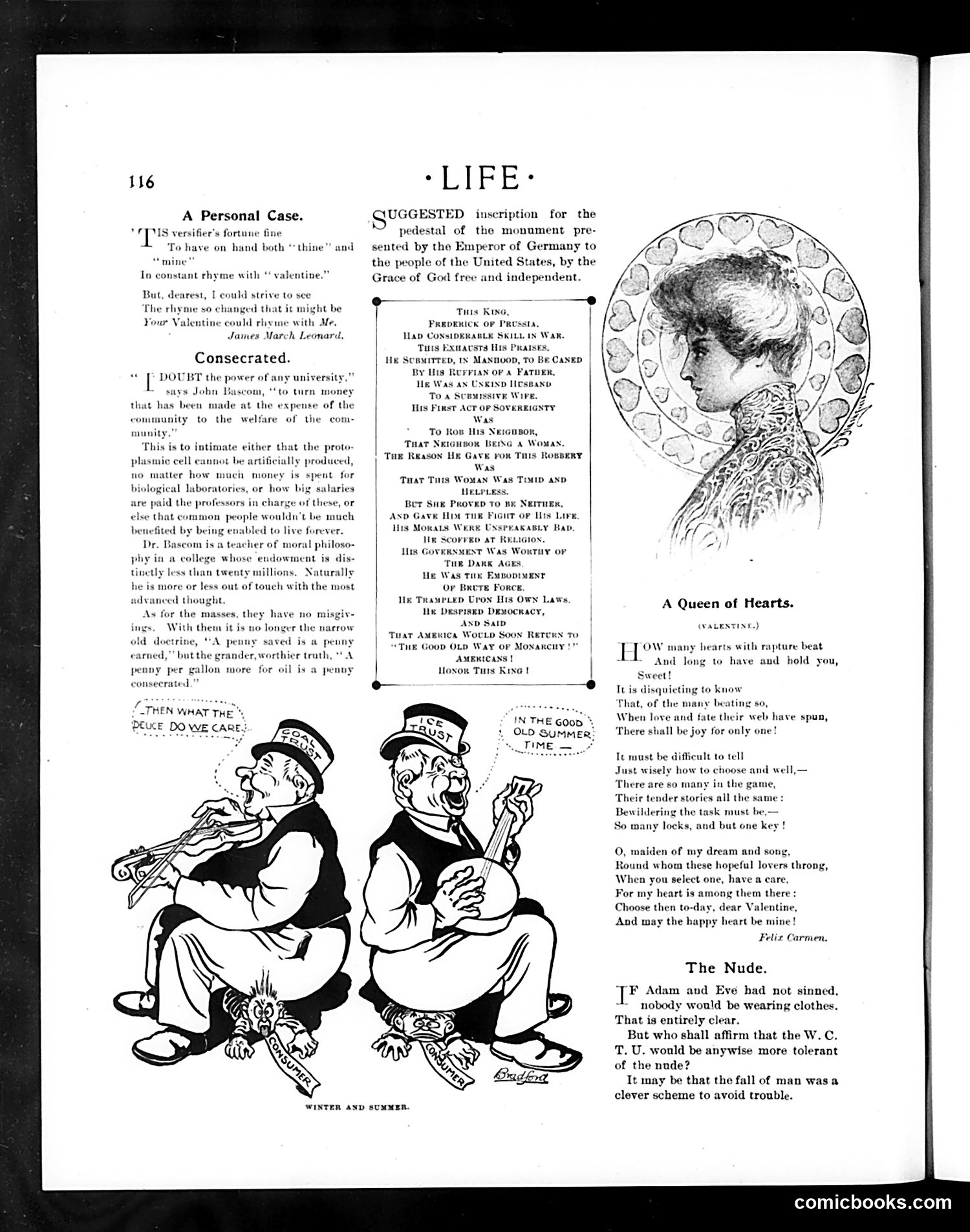
This page contains political and social satire from Life magazine. The main cartoon depicts two rotund figures labeled "Winter and Summer" discussing trust in government—likely commenting on political hypocrisy or seasonal inconsistency in policy. The lengthy inscription is a scathing satirical "monument" to Frederick the Great of Prussia, listing his brutality, disrespect for democracy, and authoritarian rule. The point: Germany's ruler embodied monarchical oppression and contempt for American democratic values—highly relevant given German-American tensions of the era. The lighter pieces—"A Queen of Hearts" (Valentine's Day poem about choosing among suitors) and "The Nude" (joking that the W.C.T.U., a temperance organization, would oppose nudity as much as sin)—provide comic relief while mocking prudish reformist groups through wordplay. The page overall balances serious political critique with humorous domestic and social commentary typical of Life's satirical approach.
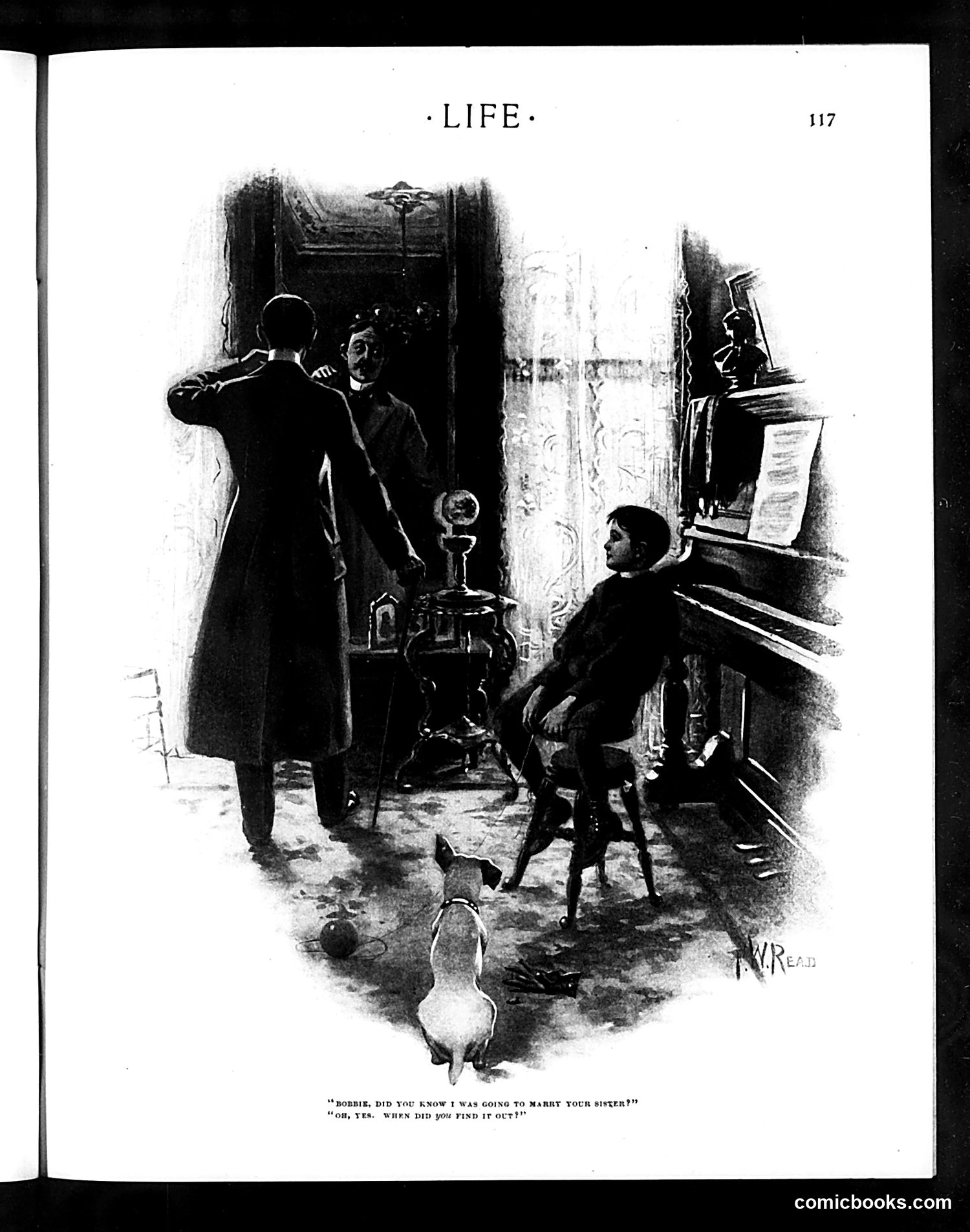
This is a domestic humor cartoon from *Life* magazine showing a scene in an upper-class parlor. A man stands confronting another man seated at a piano, with a woman in the doorway and a duck in the foreground. The joke relies on a misunderstanding: the standing man asks when the seated man "found it out"—meaning discovered the marriage plan. The seated man responds he found it out "when did you," creating confusion about who knew what and when. The cartoon satirizes Victorian-era courtship conventions and the awkwardness of announcing engagements. The duck's presence suggests absurdist humor typical of *Life*'s style. The elegantly dressed figures and piano indicate this is social commentary on upper-class manners and the formality surrounding marriage announcements among the wealthy.
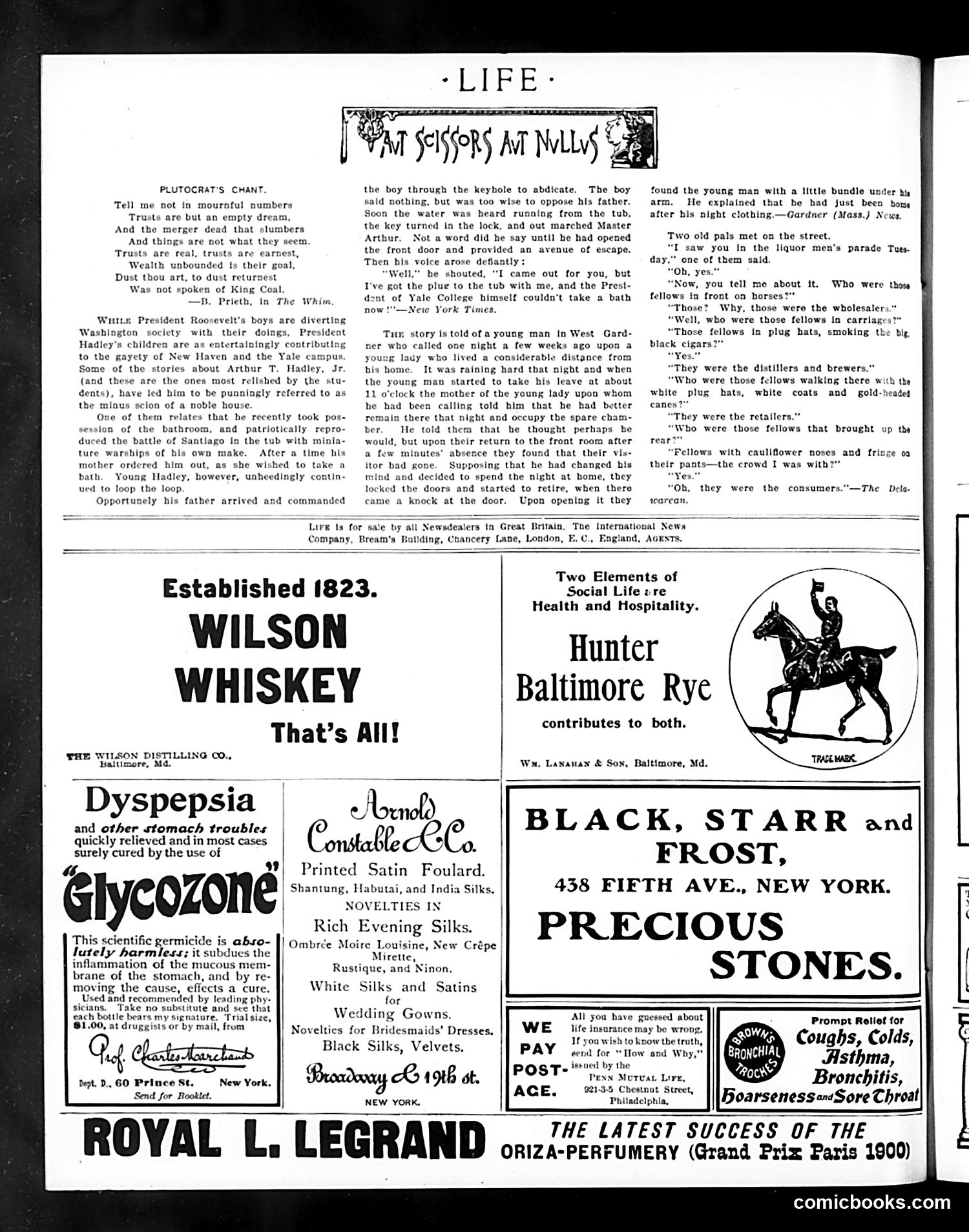
This page from *Life* magazine contains primarily **satirical text pieces and advertisements** rather than visual political cartoons. The main humor piece describes **President Roosevelt's and Yale President Hadley's children** engaging in mischievous antics—young Hadley staging a naval battle in a bathtub with toy warships, then defiantly keeping the bathtub plug hostage from his father. The satire mocks wealthy, privileged children's entitled behavior. Another joke portrays a **liquor industry parade**, humorously categorizing participants by social class: wholesalers on horseback, distillers/brewers in carriages with fine hats and cigars, retailers walking, and finally—the "consumers" (ordinary drinkers) bringing up the rear with "cauliflower noses" (a stereotyped appearance associated with excessive drinking). The satire targets **class distinctions within the alcohol trade** and mocks working-class drinking culture through crude physical stereotyping typical of early 1900s humor.
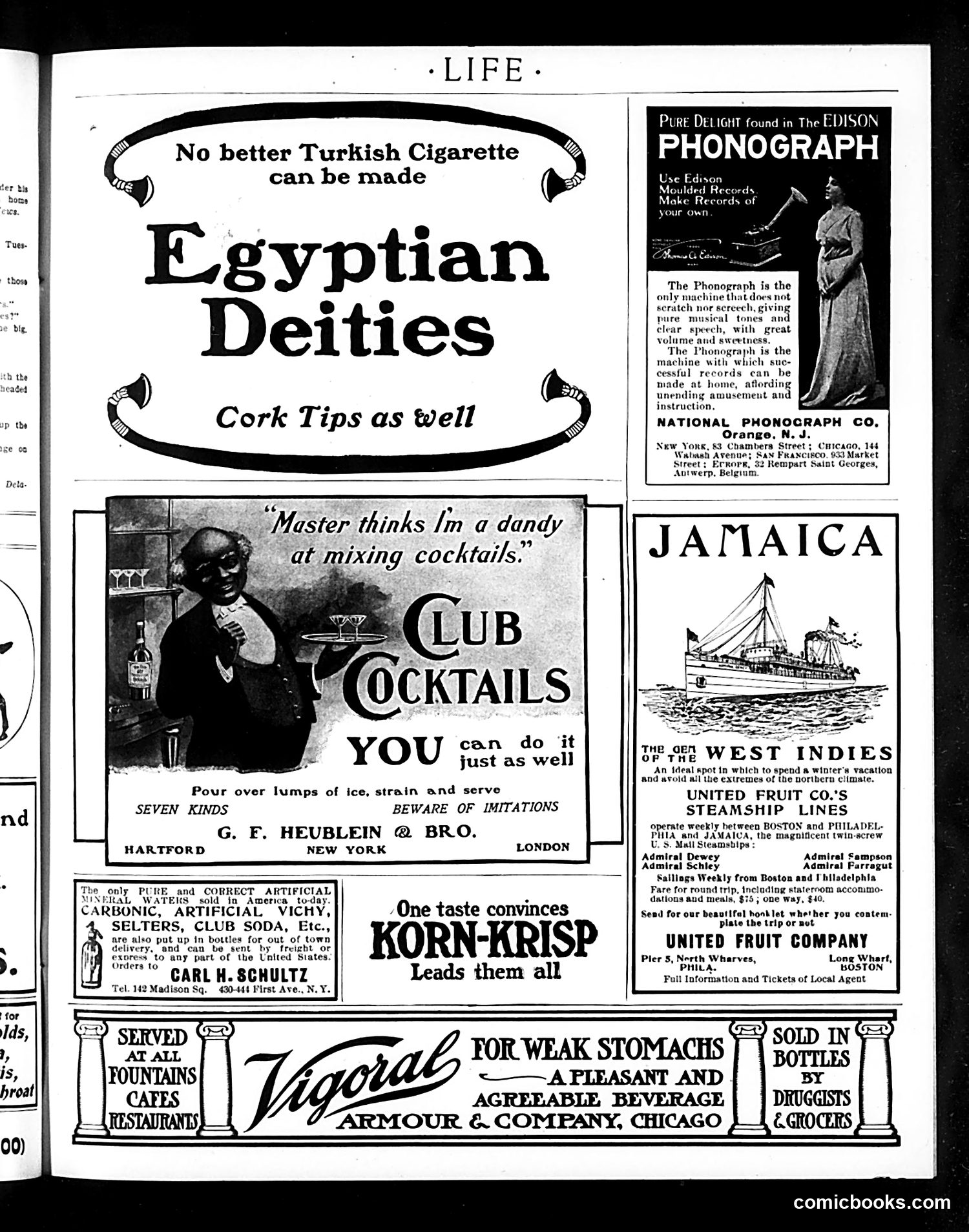
This is primarily an **advertisement page** from Life magazine (early 20th century), not political satire. The content reflects period advertising and social attitudes: **Main advertisements include:** - **Egyptian Deities cigarettes** with cork tips - **Club Cocktails** by Heublein—notably featuring a Black servant mixing drinks, with the caption "Master thinks I'm a dandy at mixing cocktails." This reflects the era's racist stereotyping of Black workers in service roles - **Korn-Krisp** cereal - **Edison Phonograph** for home recording - **Jamaica travel** via United Fruit Company steamships - **Vigoral beverage** for digestive health **Historical context:** The racist imagery in the cocktail advertisement was standard in early-20th-century American advertising. The products advertised (phonographs, steamship travel, patent medicines) reflect consumer goods of the 1900s-1910s era. The page demonstrates both period commercial culture and the casual racism embedded in mainstream American media.
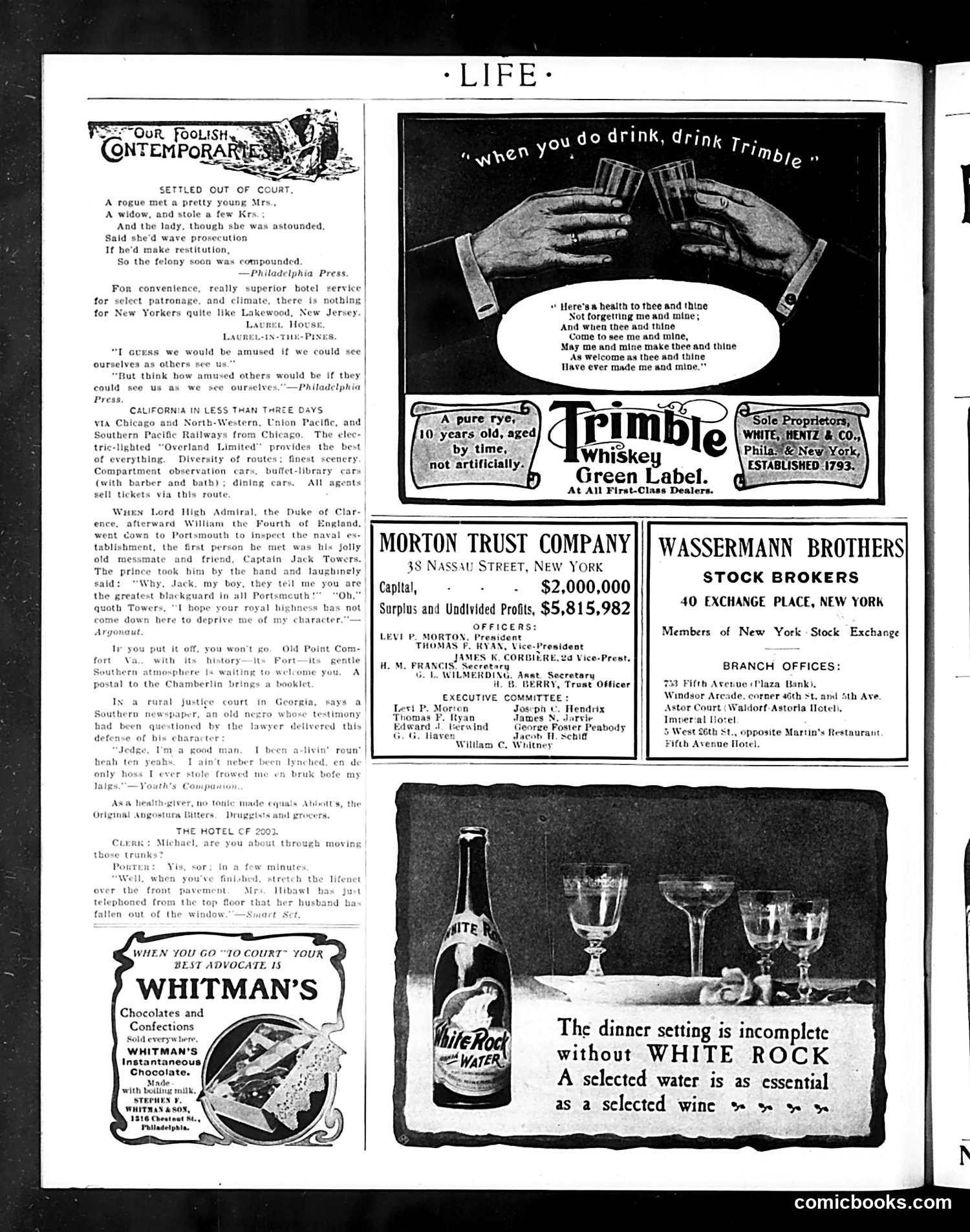
This page from *Life* magazine is primarily **advertising and humor vignettes** rather than political satire. The content includes: **"Our Foolish Contemporaries"** — Brief satirical anecdotes mocking social pretensions and human folly, including a joke about a rogue settling a scandal "out of court" and commentary on regional preferences (New Jersey hotels vs. New York). **Main advertisements:** - **Trimble Whiskey** — promotes their product with a sentimental verse about friendship - **Morton Trust Company** and **Wassermann Brothers** — financial services ads - **White Rock Water** — argues that quality water is as essential to dinner as quality wine - **Whitman's Chocolates** — suggests these are essential when going to court (humorous) **Humor pieces** include anecdotes about Admiral naval inspections and rural Southern dialect jokes typical of the era's popular humor. The page reflects early 20th-century consumer culture and genteel social comedy rather than sharp political critique. The satirical edge is mild—poking fun at pretension and social conventions rather than targeting specific political figures or events.
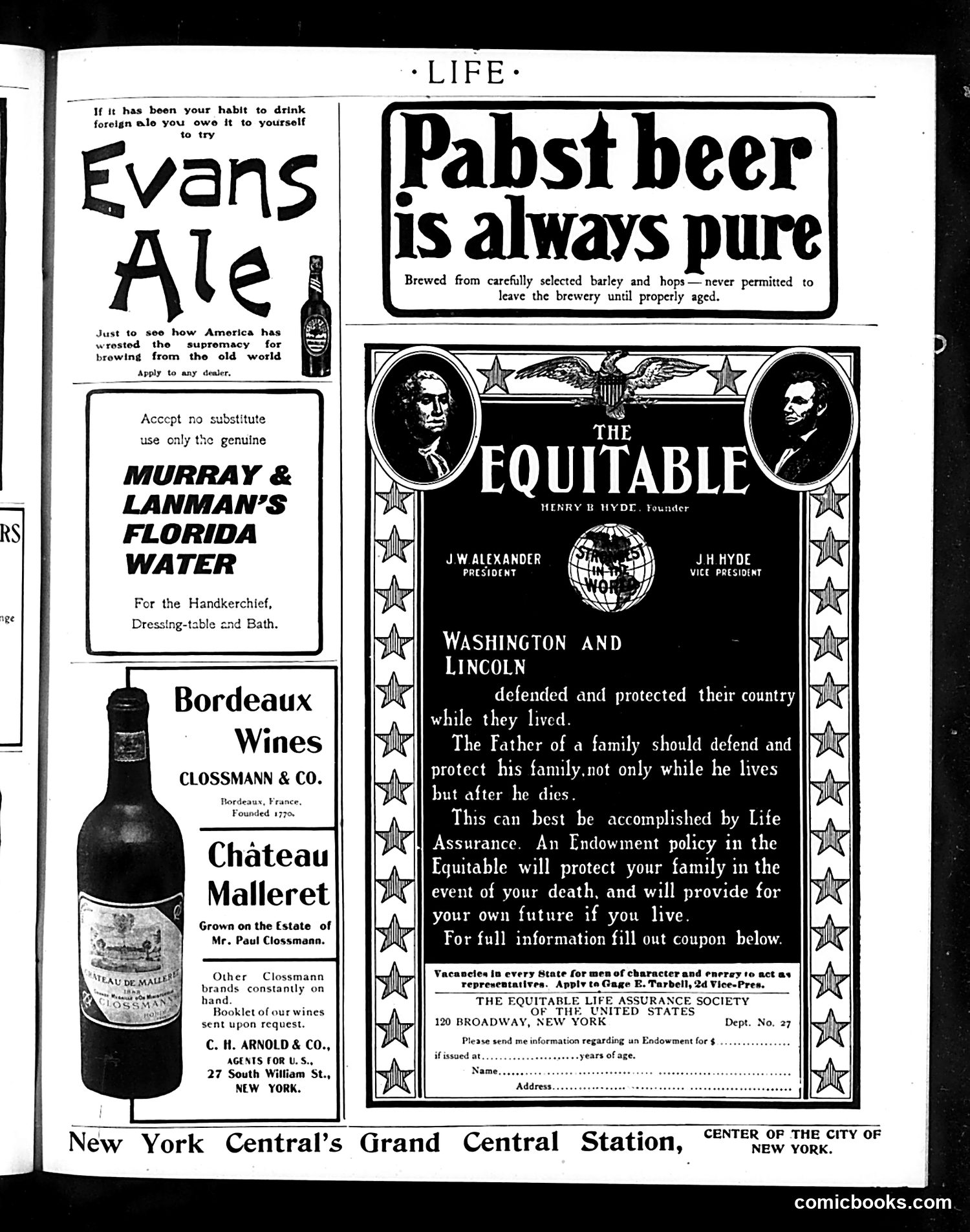
This is primarily an **advertising page**, not a satirical cartoon. It contains multiple unrelated commercial advertisements typical of early 20th-century magazines. The ads include: - **Evans Ale**: Appeals to American nationalism, claiming U.S. brewing has surpassed European superiority - **Pabst Beer**: Emphasizes purity and quality control - **Murray & Lanman's Florida Water**: A toiletry product - **Bordeaux Wines & Château Malleret**: French wine imports - **The Equitable Life Assurance Society**: A major life insurance company, using patriotic imagery of Washington and Lincoln to argue that life insurance protects families "after he dies" The **only satirical element** is subtle: the Equitable ad uses America's founding fathers to sell insurance, a somewhat ironic appeal to patriotism for a financial product. Otherwise, this page reflects the advertising ecosystem of the era, mixing nationalist sentiment with luxury imports and emerging financial services.
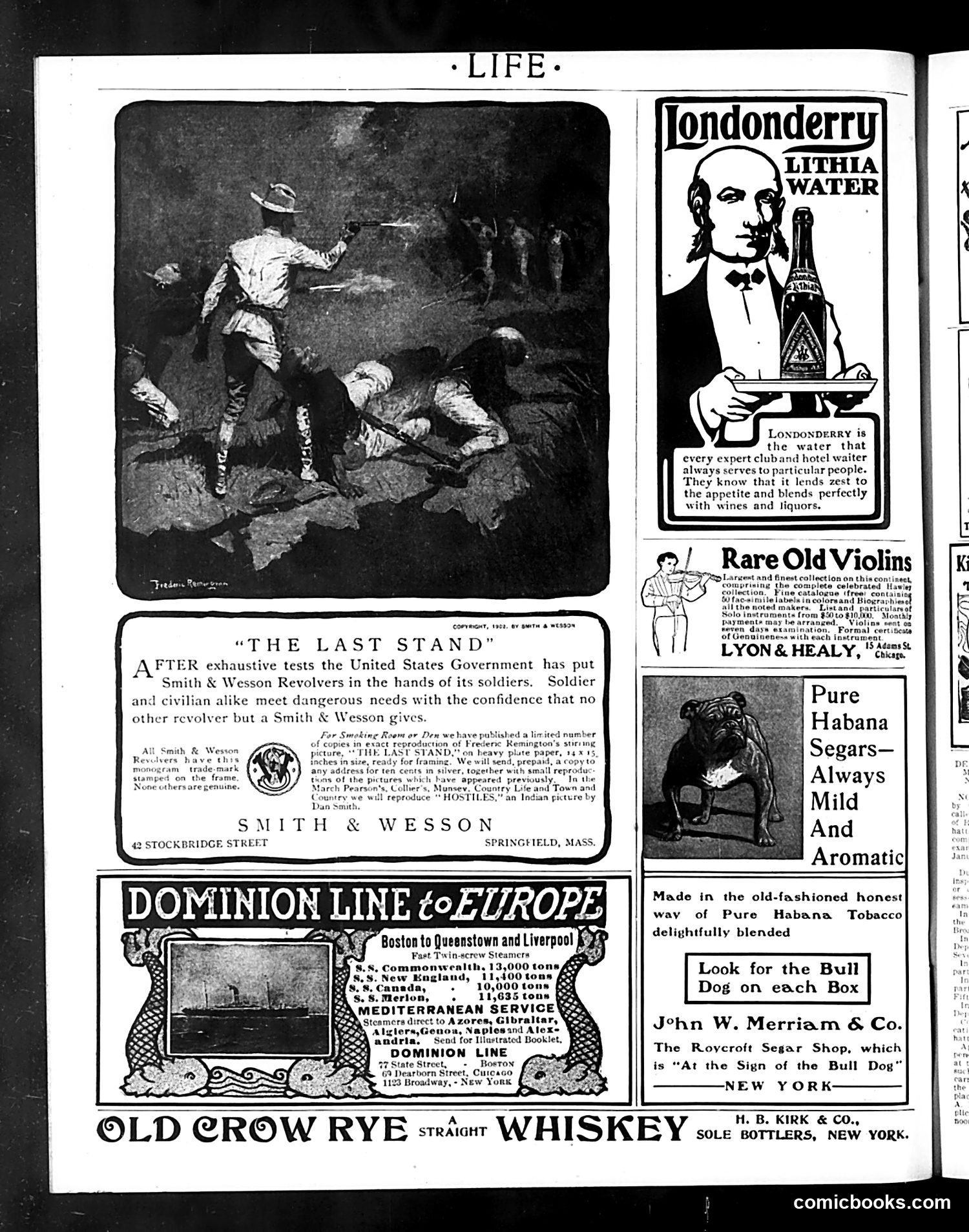
**The Image:** The artwork depicts a dramatic historical scene of soldiers in combat—appearing to show a defensive last stand with figures wielding weapons against attackers. **The Advertisement Context:** This is primarily a **product advertisement page** for Smith & Wesson revolvers, not political satire. The cartoon serves as marketing material, not commentary. **The Sales Pitch:** The text claims the U.S. Government has endorsed Smith & Wesson revolvers for soldiers, arguing they instill "confidence" in dangerous situations. It's designed to associate the product with military authority and reliability. **What Modern Readers Miss:** In early 20th-century America, government endorsements carried significant marketing weight. This ad exploits patriotic confidence in military institutions to sell weapons to civilians. The dramatic "last stand" imagery creates emotional investment in the product's protective promise. The page is mostly **period advertising**—for Londonderry water, violins, cigars, and whiskey alongside the revolver ad—typical of Life magazine's revenue model.
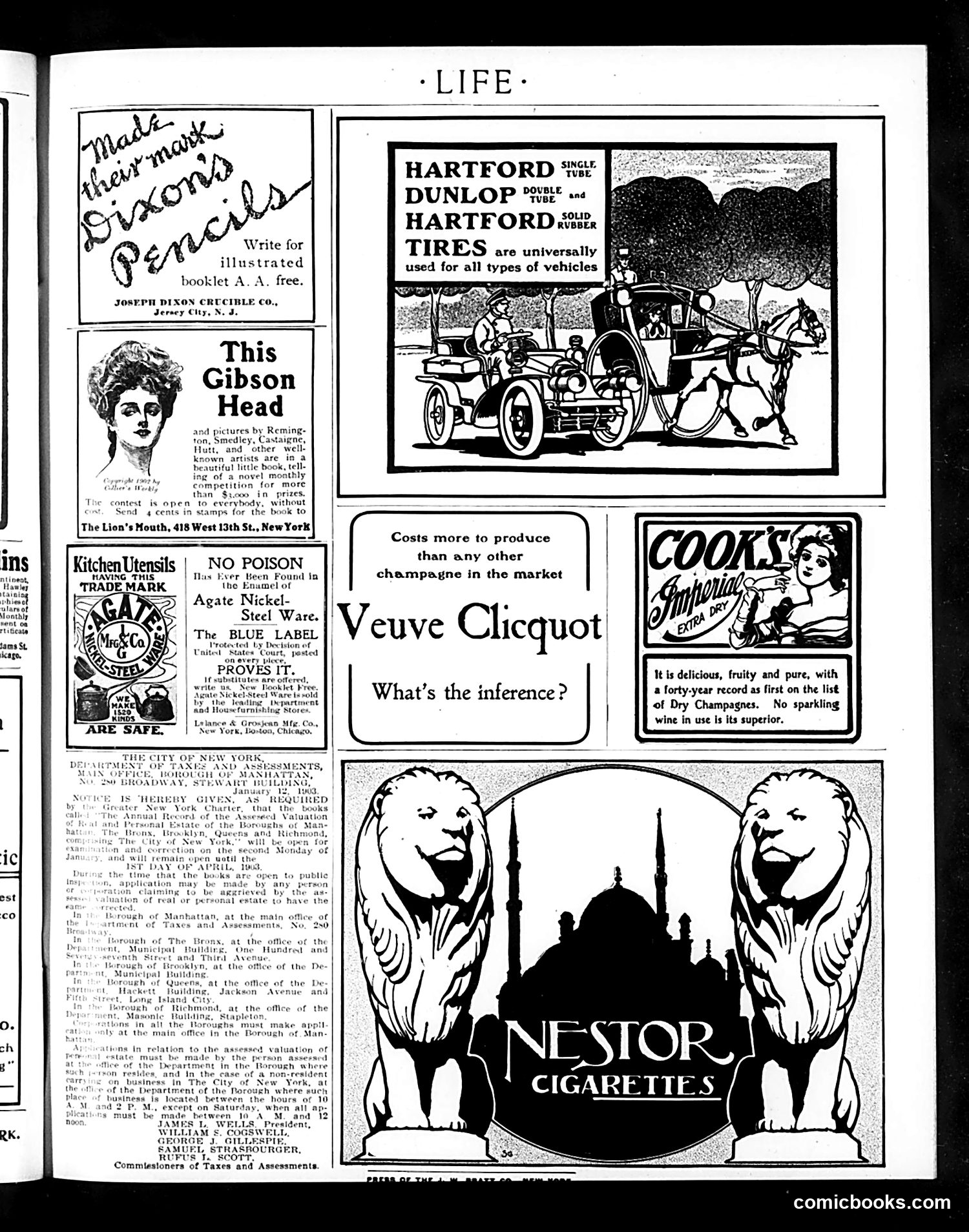
This is primarily an **advertising page** from Life magazine, typical of early 20th-century publications. The advertisements include: - **Pencils** (Joseph Dixon Crucible Co.) - **A Gibson Girl book** (Remington Schuyler illustrations)—referencing the popular "Gibson Girl" aesthetic of the era - **Kitchen utensils** marketed as poison-free (responding to contemporary food-safety concerns) - **Hartford and Dunlop tires** for vehicles - **Veuve Clicquot champagne** with a rhetorical question about its premium cost - **Nestor cigarettes**, featuring two lion heads framing a cityscape The page reflects **early 1900s consumer culture and anxieties**: food safety fears, automobile adoption, luxury goods marketing, and smoking normalization. The Gibson Girl reference dates this to the "Gibson Girl era" (roughly 1890s-1910s). Most content serves commercial rather than satirical purposes, though the champagne ad's subtle humor questions whether cost equals quality.
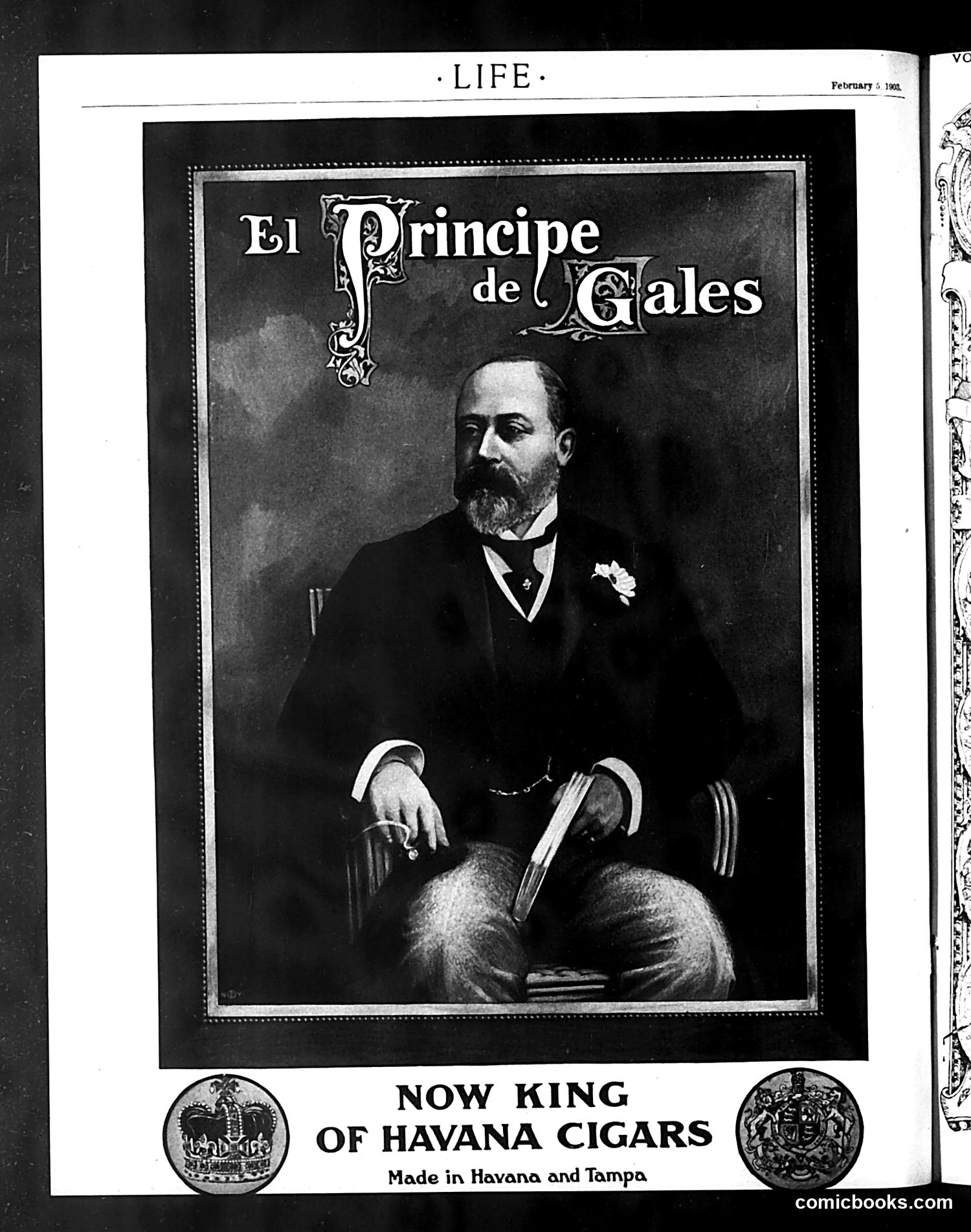
This is a cigarette advertisement disguised as satirical commentary. The page features a formal portrait of a distinguished bearded gentleman in evening dress, labeled "El Príncipe de Gales" (The Prince of Wales) at the top, with the punchline below: "NOW KING OF HAVANA CIGARS." The joke appears to play on a recent royal succession—likely referencing Edward VIII's abdication crisis (1936) or a similar contemporary event involving British royalty. The ad humorously suggests that the former prince, having lost his royal status, has become a cigar brand king instead. The dual coats of arms flanking the text reinforce the mock-royal presentation. This combines flattery of the product through royal association with irreverent humor about fallen nobility—typical Life magazine style advertising from the era.