
A complete issue · 20 pages · 1901
Life — August 8, 1901
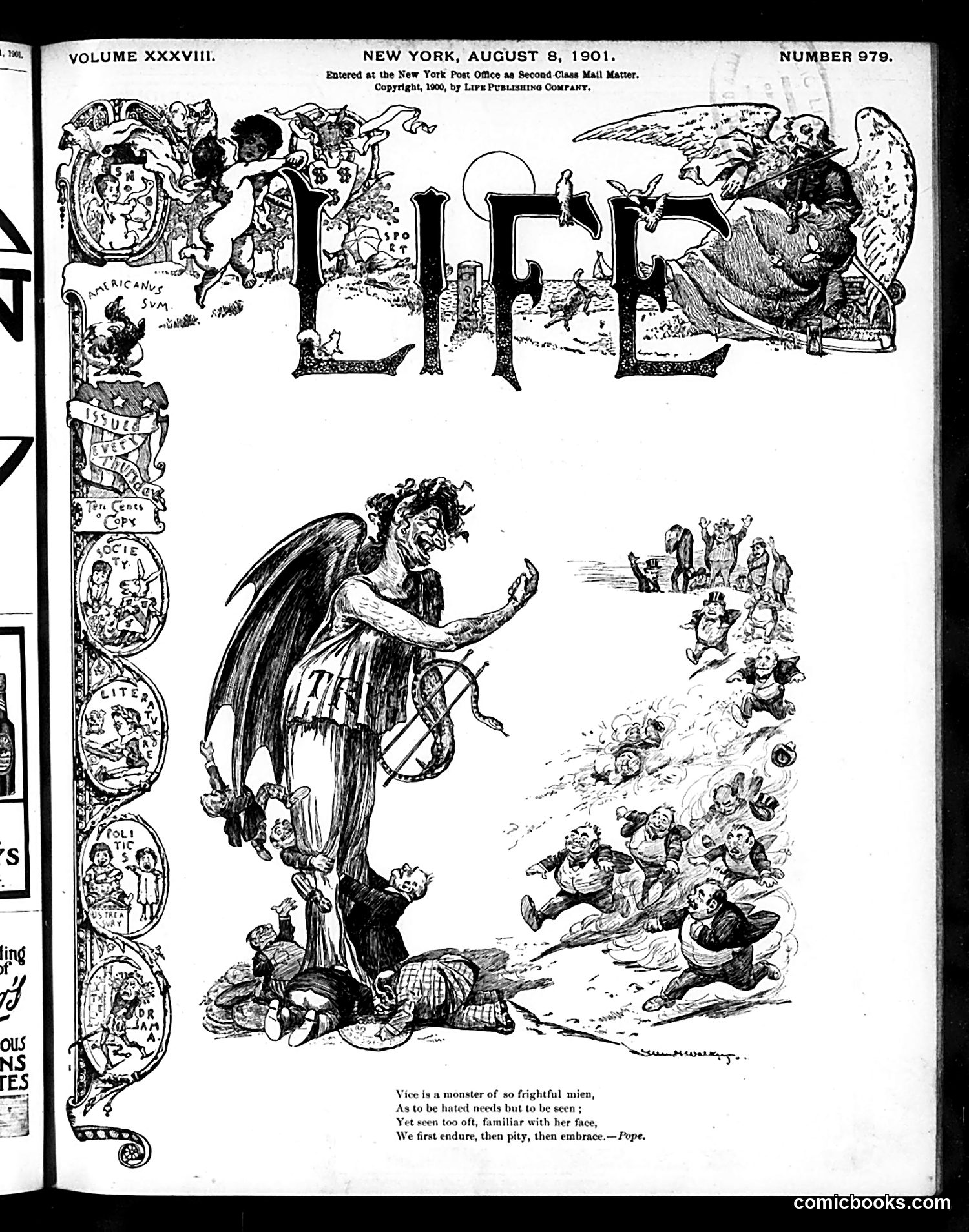
This page features a satirical cartoon titled "LIFE" with an allegorical figure—a winged demon or devil character—confronting a crowd of small human figures. The demon appears menacing and predatory, suggesting Vice or some moral threat. The caption quotes Pope: "Vice is a monster of so frightful mien, / As to be hated needs but to be seen; / Yet seen too oft, familiar with her face, / We first endure, then pity, then embrace." The cartoon illustrates this moral warning about how familiarity with vice leads to gradual acceptance and moral compromise. The small figures below represent ordinary people gradually accepting or becoming inured to whatever societal vice the artist critiques—though the specific contemporary reference remains unclear without additional context from the 1901 period.
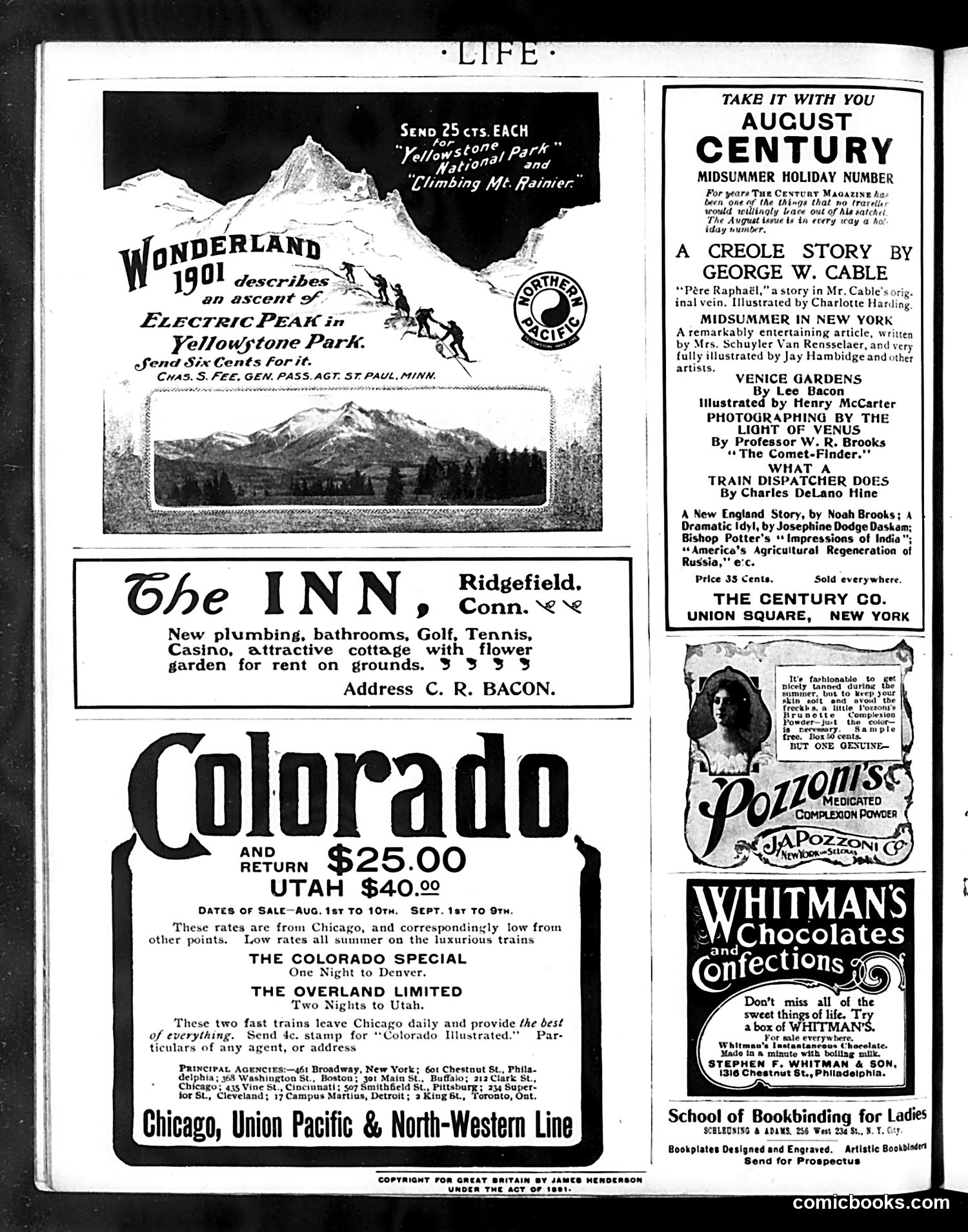
This page is primarily **advertisements with no political cartoons or satire**. The content consists of commercial promotions typical of early 1900s Life magazine: - Travel ads for Yellowstone Park and Colorado railway tours - The Inn resort in Ridgefield, Connecticut - Cosmetics (Pozzonisi Complexion Powder) - Whitman's Chocolates and Confections - August Century magazine subscription offer - School of Bookbinding advertisement The only potentially humorous element is the Century magazine masthead promising "midsummer holiday number" content, but this is straightforward advertising copy rather than satire. The page demonstrates how Life magazine generated revenue through paid advertisements alongside editorial content, a common publishing practice of the era.
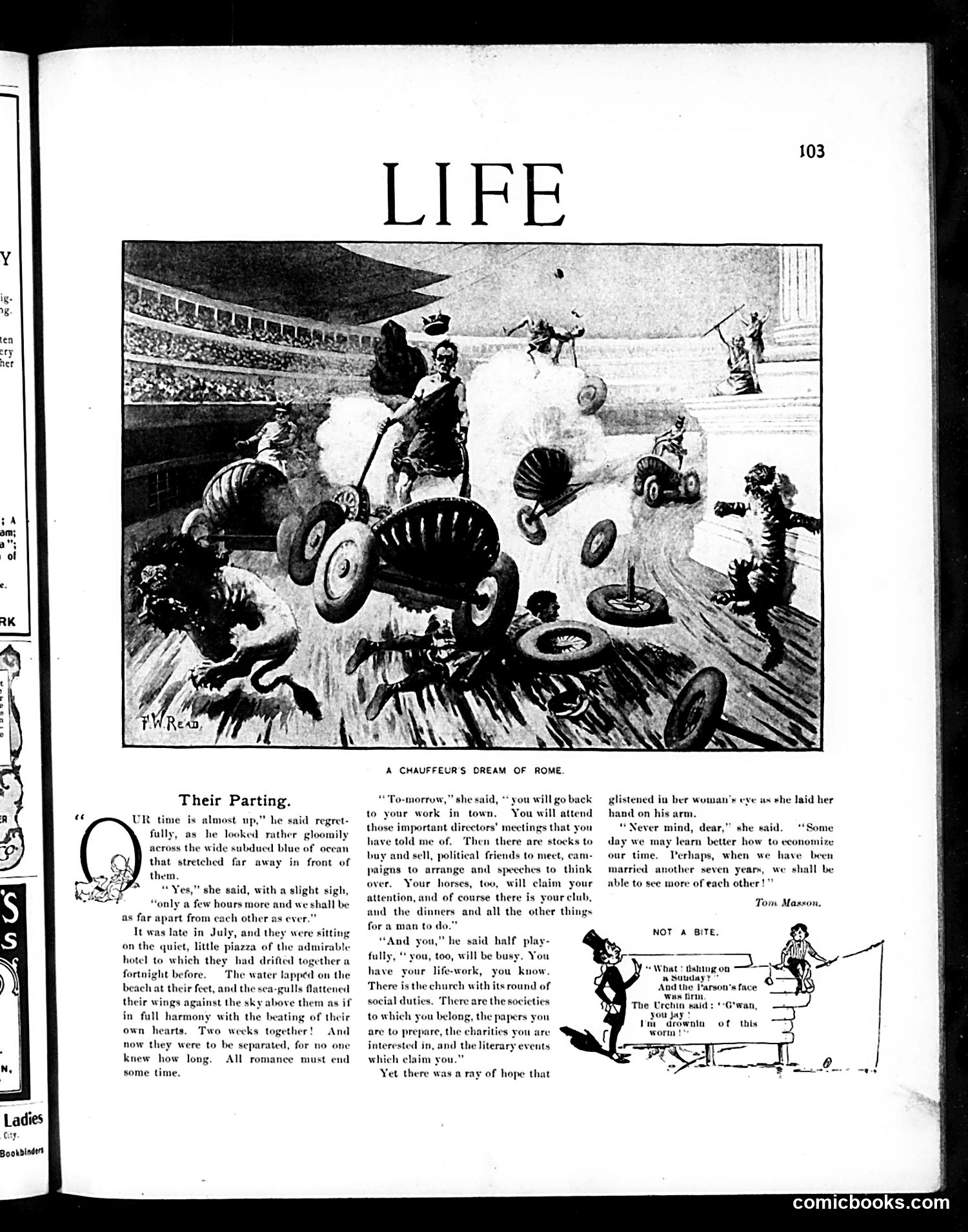
The main illustration depicts a chauffeur's surreal dream set in a Roman amphitheater, where racing automobiles and drivers appear as gladiatorial entertainment before crowds. This satirizes the early 20th-century fascination with automobile racing as public spectacle—transforming the driver into a modern gladiator risking death for entertainment. The accompanying story "Their Parting" depicts a romance between a wealthy woman and a chauffeur that must end due to class differences. She pragmatically explains he must return to his work and social obligations while she manages her own domestic duties. "Not a Bite," the small cartoon below, appears to be unrelated humor about dining etiquette or food, though context is limited from this excerpt. The page reflects period anxieties about class mobility and the automobile's cultural significance.
The page contains editorial commentary on several topics rather than a focused political cartoon. The main illustration shows a figure on a bicycle, likely satirizing Admiral Dewey (referenced in text as "the greatest popular favorite in the navy"), who appears to be the subject of commentary about his conduct or reliability. The text discusses the Fosburgh trial's discharge and critiques Chief Justice Nicholson's handling of it. It also addresses summer heat patterns, the "Buffalo Fair," and urban amenities like pizzerias in American cities. The bicycle illustration seems to mock Dewey's balance or stability—perhaps his political positioning or recent decisions—though the exact satirical point remains somewhat unclear without additional historical context about the Admiral's contemporary controversies.
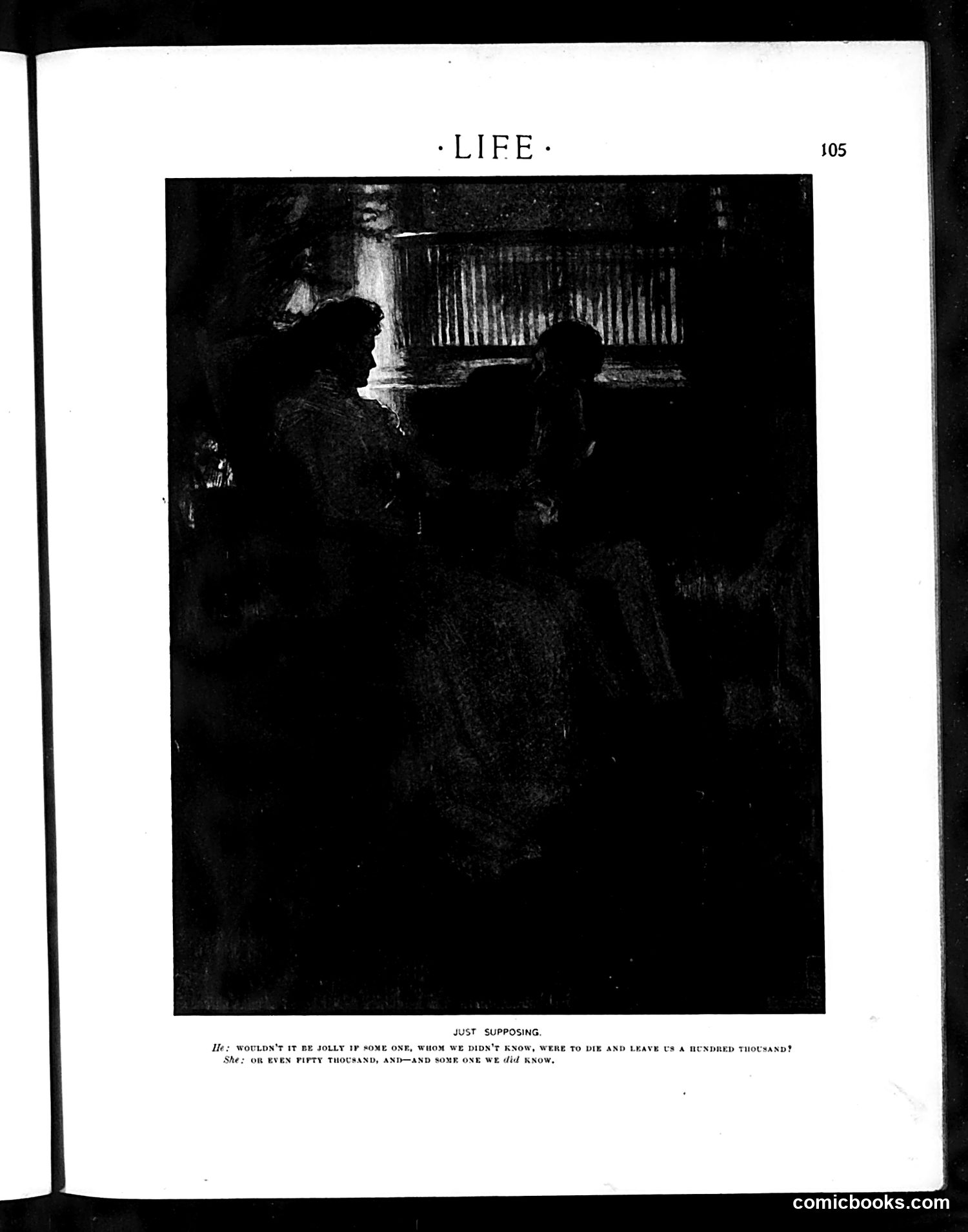
This cartoon depicts an interior scene with multiple figures in silhouette. The caption presents a hypothetical scenario about inheritance: "He: 'Wouldn't it be jolly if some one, whom we didn't know, were to die and leave us a hundred thousand?' She: 'Or even fifty thousand, and—and more one we *did* know.'" The satire targets the universal human fantasy of unexpected wealth through inheritance. The joke plays on the couple's casual willingness to benefit from a stranger's death, with the woman adding the cynical twist that they'd prefer inheriting from someone they actually knew—suggesting that even this dark scenario would be improved by a personal connection. It's satirizing greed and materialistic wishful thinking dressed up as genteel conversation.
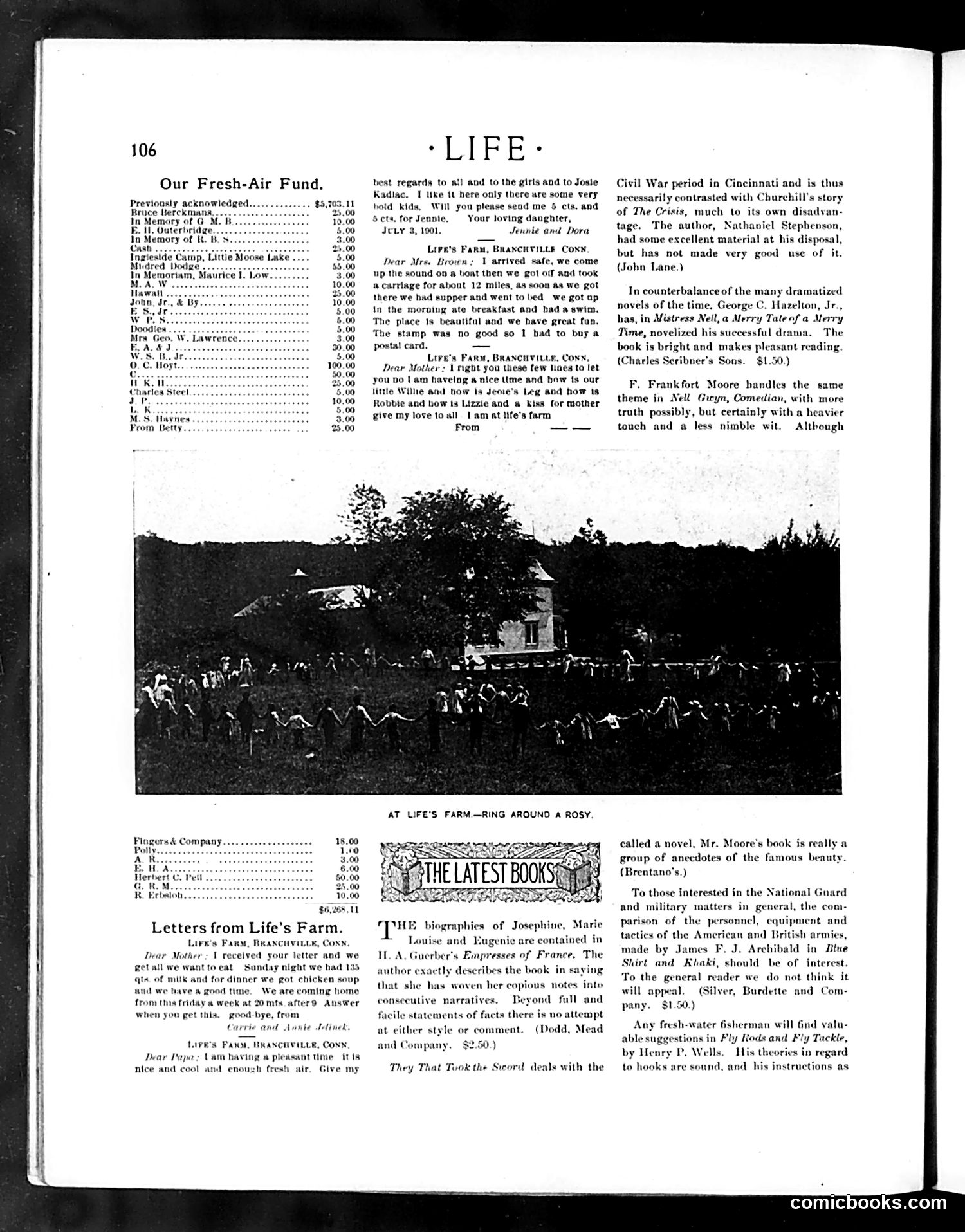
This page features letters to Life's Farm section and book reviews rather than political cartoons. The main image shows "AT LIFE'S FARM—RING AROUND A ROSY," depicting a large crowd of people gathered outdoors around what appears to be a farmhouse, likely illustrating rural life or a farm gathering. The page consists primarily of: - A "Fresh-Air Fund" donation list - Reader letters about farm experiences - Book reviews, including discussion of works about the American and British armies during what appears to be the WWI era This is essentially a domestic/lifestyle content page rather than satirical political commentary. The image documents early 20th-century rural American social gatherings, but contains no identifiable caricatures or pointed political satire.
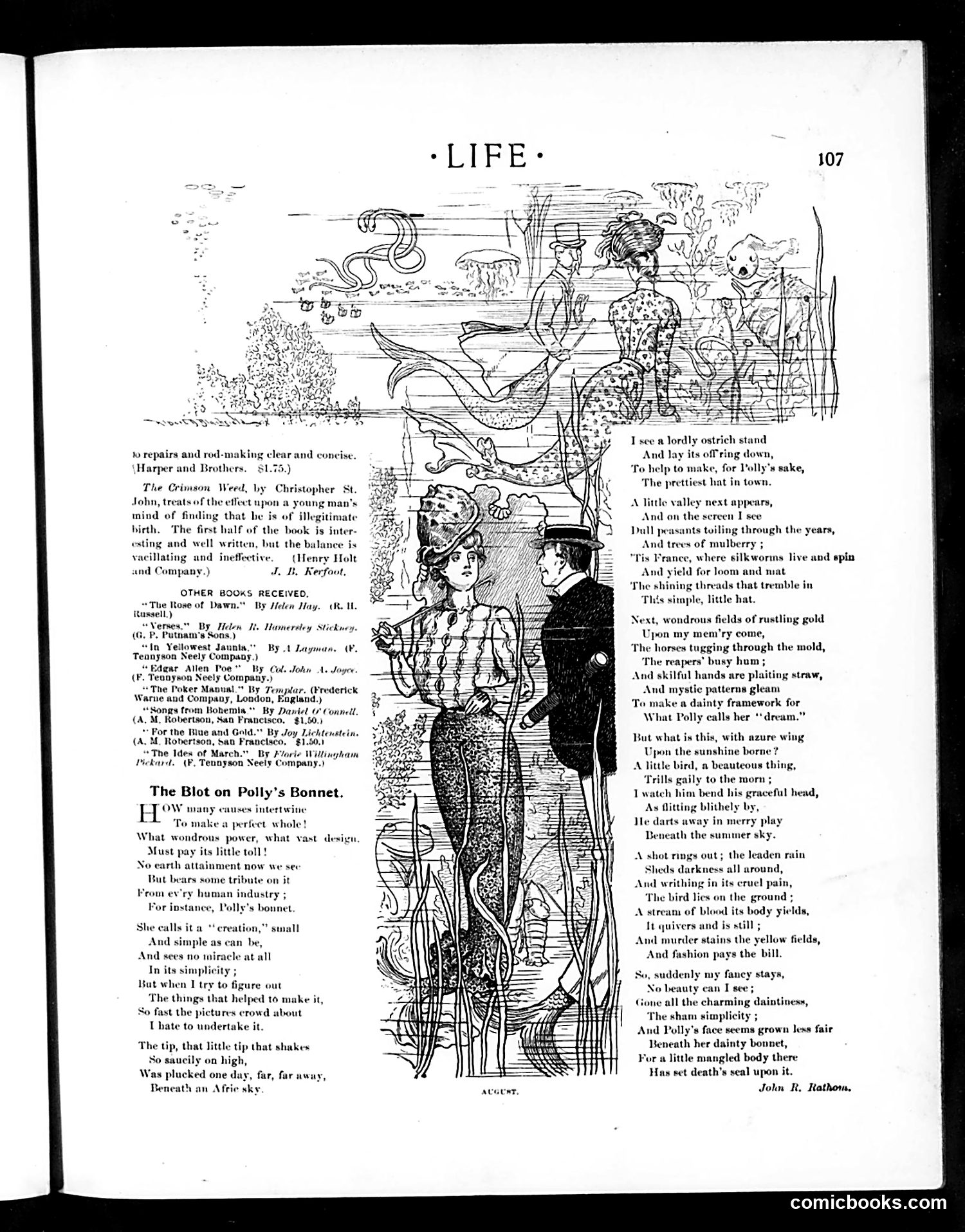
This page features a poem by John B. Hatherm about a small stain on a young woman's bonnet that becomes the subject of intense scrutiny and anxiety. The accompanying illustration shows a Victorian-era couple examining the bonnet closely, with naturalistic details of insects and plants visible through what appears to be magnification. The satire mocks Victorian obsession with appearances and propriety—particularly women's concern with maintaining perfect dress and reputation. The "blot" serves as a metaphor for how minor imperfections or social transgressions were treated as catastrophic in rigid Victorian society. The poem's detailed, overwrought treatment of a trivial stain humorously exaggerates the era's tendency toward social anxiety and superficiality, especially regarding women's public presentation.
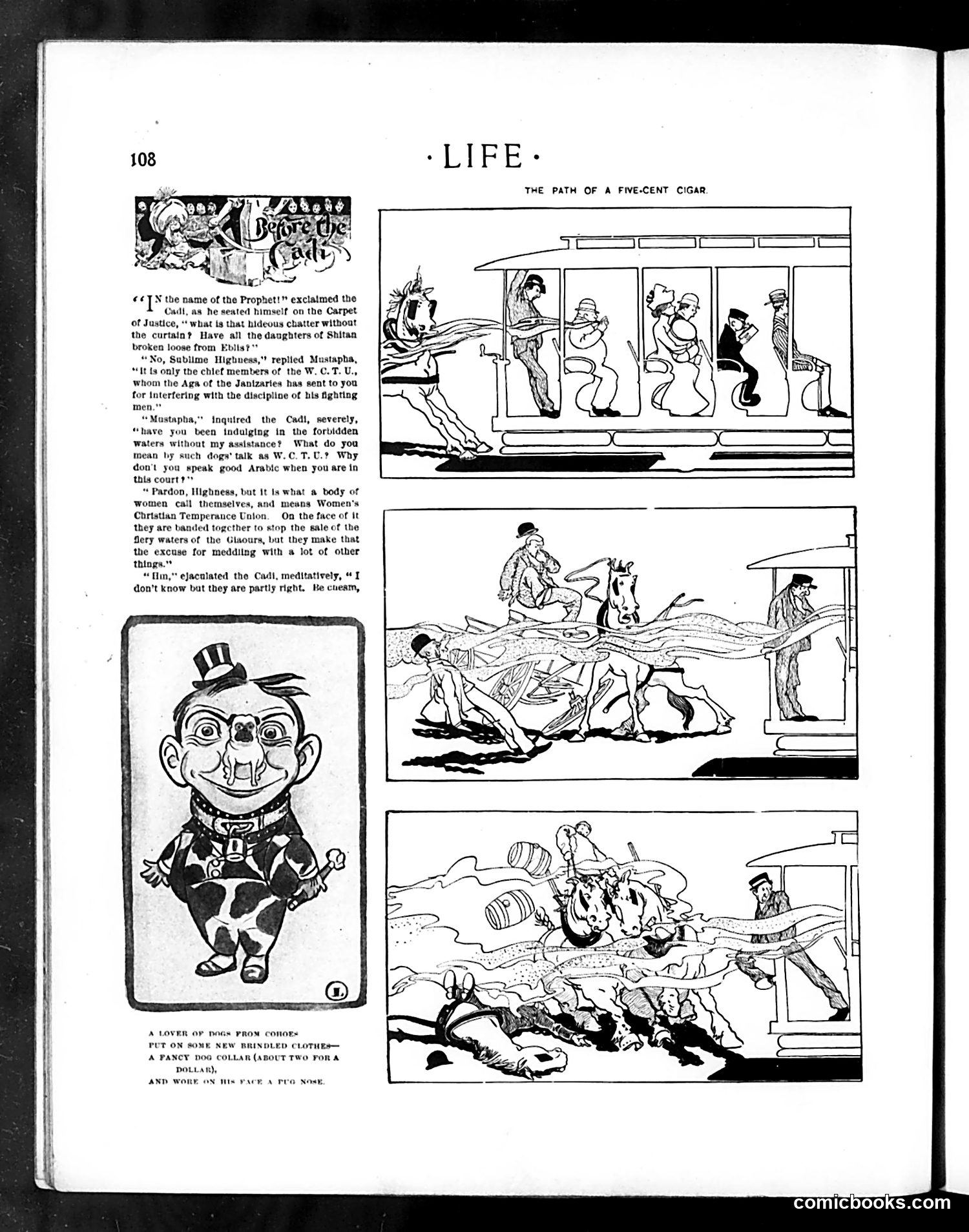
This satirical comic strip traces the journey of an inexpensive cigar through various hands and contexts. The narrative appears to critique class distinctions and labor conditions of the era. The strip shows the cigar passing through a train car (upper panel), then through what appears to be working-class or immigrant scenes with animals and manual labor (middle panel), and finally ending in degradation (lower panel). The accompanying text references the W.C.T.U. (Women's Christian Temperance Union) and discusses "forbidden waters" and "meddling," suggesting social reform movements of the period. The left panel shows a caricatured figure in formal dress with exaggerated features—likely representing a wealthy consumer or businessman profiting from the cigar trade. The satire appears to mock both product commercialization and the moral crusades of contemporary reform movements.
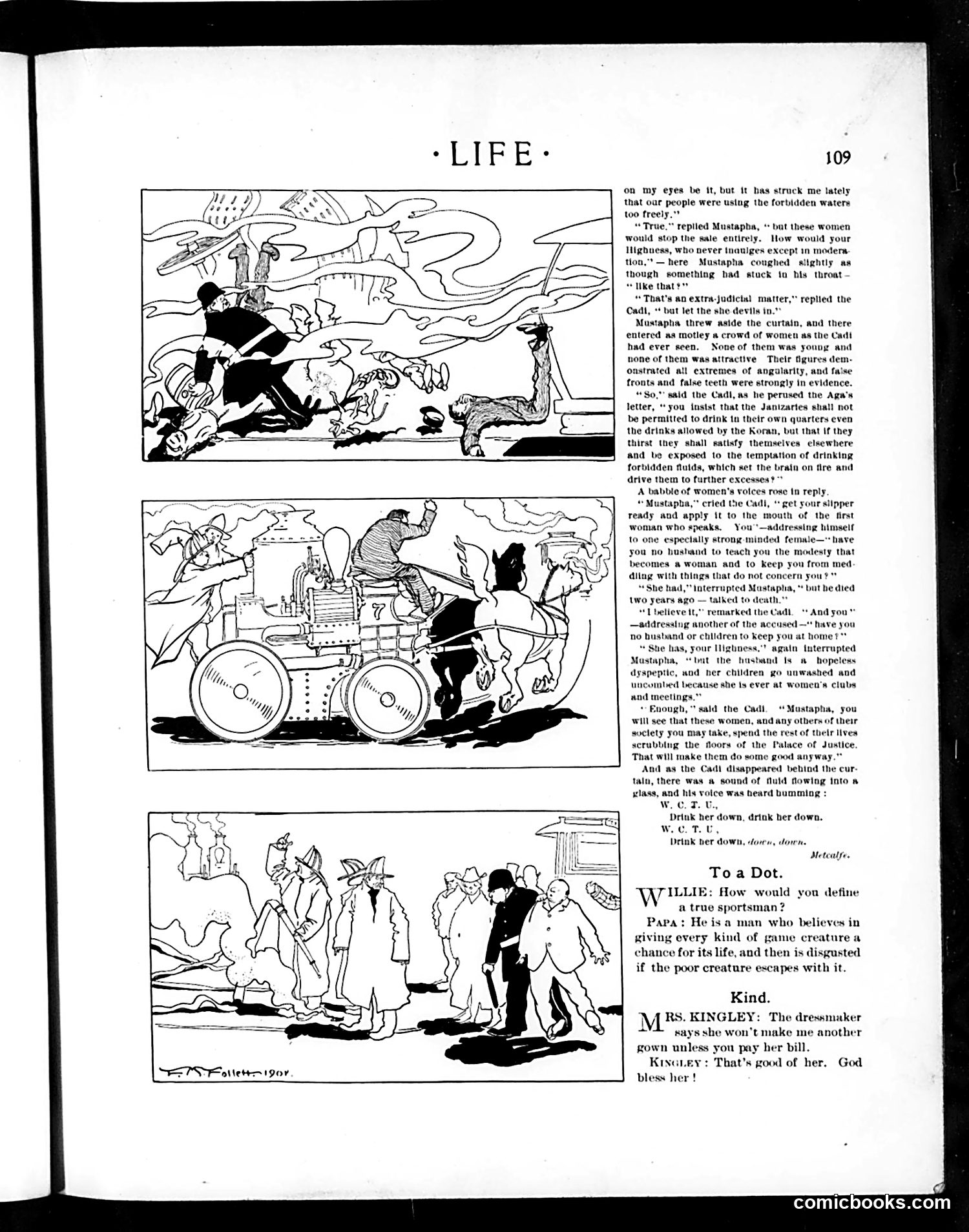
This page contains three satirical cartoons addressing women's conduct and social propriety in early 20th-century America. The top two cartoons depict a dialogue between a Cadi (Islamic judge) and Mustapha about women's behavior, seemingly criticizing Western women's freedoms—drinking, appearing in public unveiled, and behaving without male supervision. The cartoons use orientalist framing to satirize contemporary debates about women's rights and social roles. The bottom cartoon and "To a Dot" section present domestic humor: a dressmaker demanding payment and a brief dialogue defining a sportsman as someone who accepts game escaping with grace. The page uses these vignettes to comment on class relations, women's economic independence, and masculine virtue—reflecting anxieties about changing social hierarchies in the period.
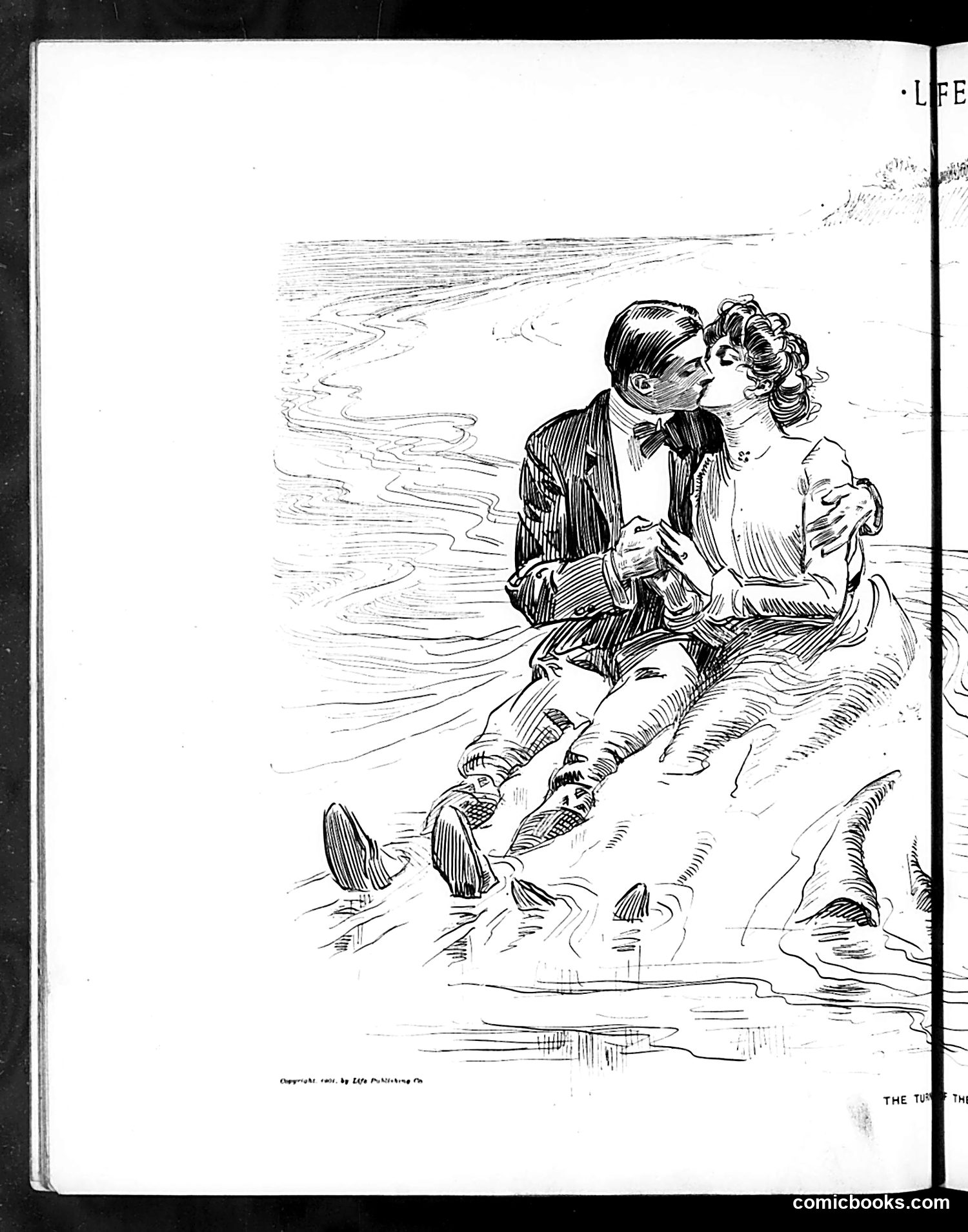
This is a romantic illustration from *Life* magazine showing a couple on a beach. The man in formal attire (suit and bow tie) embraces a woman in a light dress as they sit on sand overlooking water. The drawing style uses cross-hatching typical of early-to-mid 20th century magazine illustration. The visible text fragments ("THE TUR" and "THI" at bottom right) suggest this page is part of a larger article or story, but without complete text, the specific satirical point remains unclear. The copyright notice indicates "Life Publishing Co." The image itself appears to be romantic rather than overtly political satire, though *Life*'s characteristic wit may be embedded in accompanying text not fully visible in this reproduction.
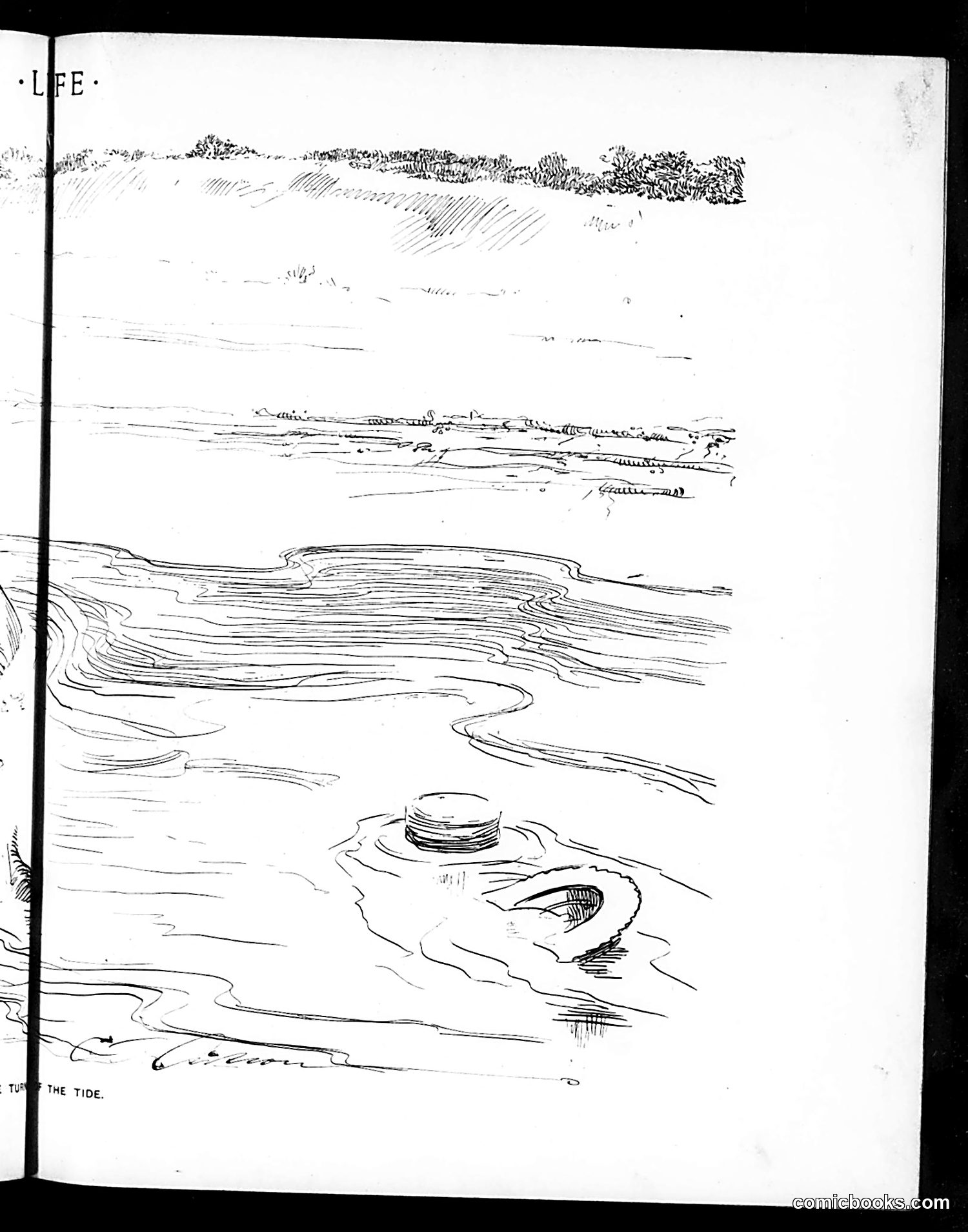
This page from *Life* magazine contains an illustration titled "THE TIDE" (visible at bottom left). The sketch depicts a coastal landscape with tidal features—layered geological strata, flowing water patterns, and what appears to be a tidal pool or depression with a cylindrical object (possibly a post or marker). The drawing emphasizes the physical dynamics of tidal movement through cross-hatching and flowing lines showing water and sediment patterns. Rather than political satire, this appears to be a naturalistic or scientific illustration exploring geological/hydrological phenomena. Without additional text or context on the page, the specific satirical point—if any—remains unclear. It may simply be an illustrative piece on natural processes for the magazine's audience.
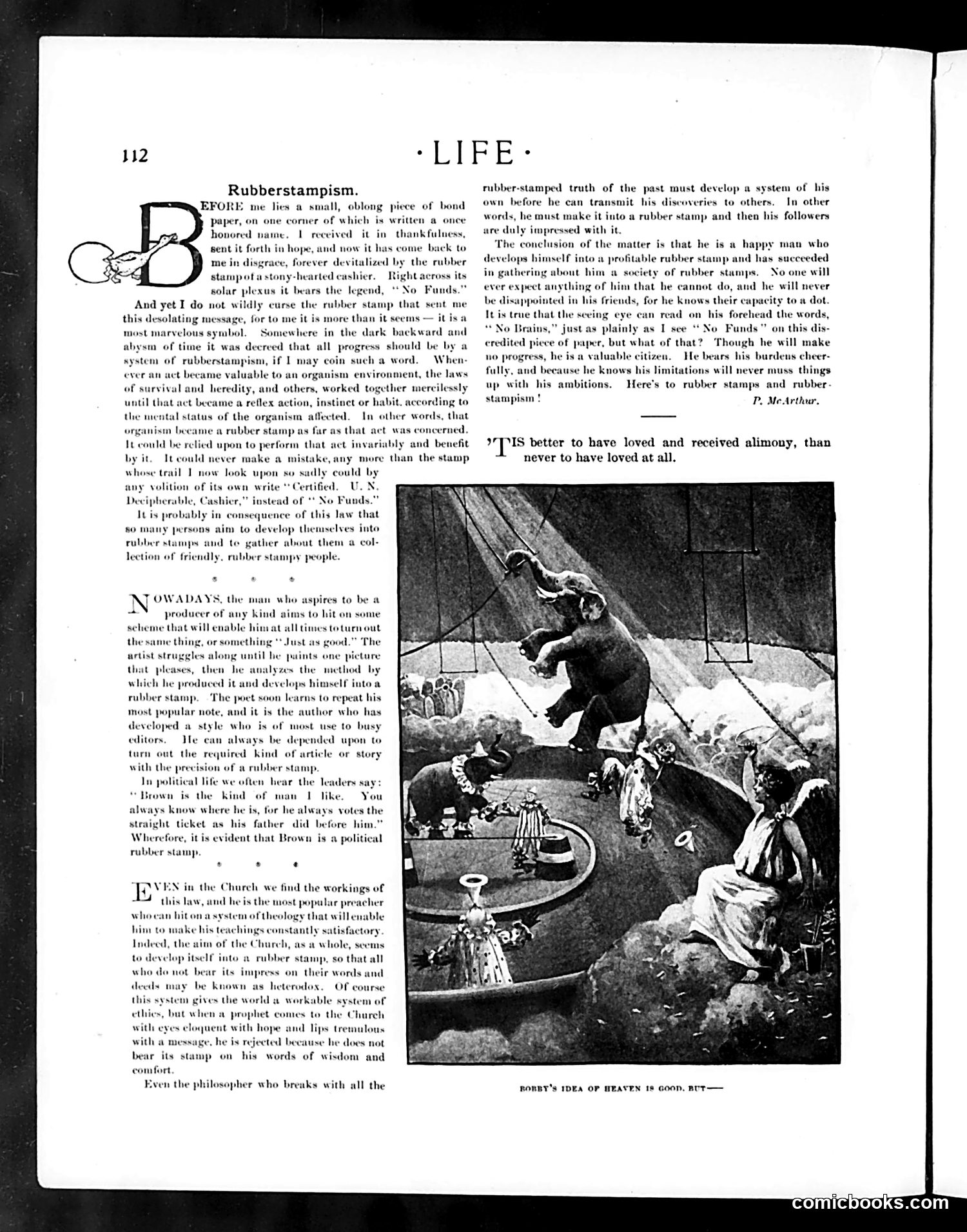
This editorial page critiques leaders who blindly adopt ideas without independent thought—the "rubber stamp" metaphor. The text argues that progress requires individuals to develop their own informed positions rather than mechanically repeating doctrine. The accompanying illustration depicts a figure suspended over turbulent waters (likely representing danger or chaos), appearing to dangle precariously. The caption reads "Bobby's Idea of Beasts is Good, But—" suggesting someone (possibly a political figure named Bobby) has the right general concept but lacks the nuance or strength to execute it properly. The satire targets political and institutional leaders—in church, government, and society—who adopt popular positions superficially without genuine conviction or the courage to adapt them meaningfully. The piece advocates for authentic leadership over empty conformity.
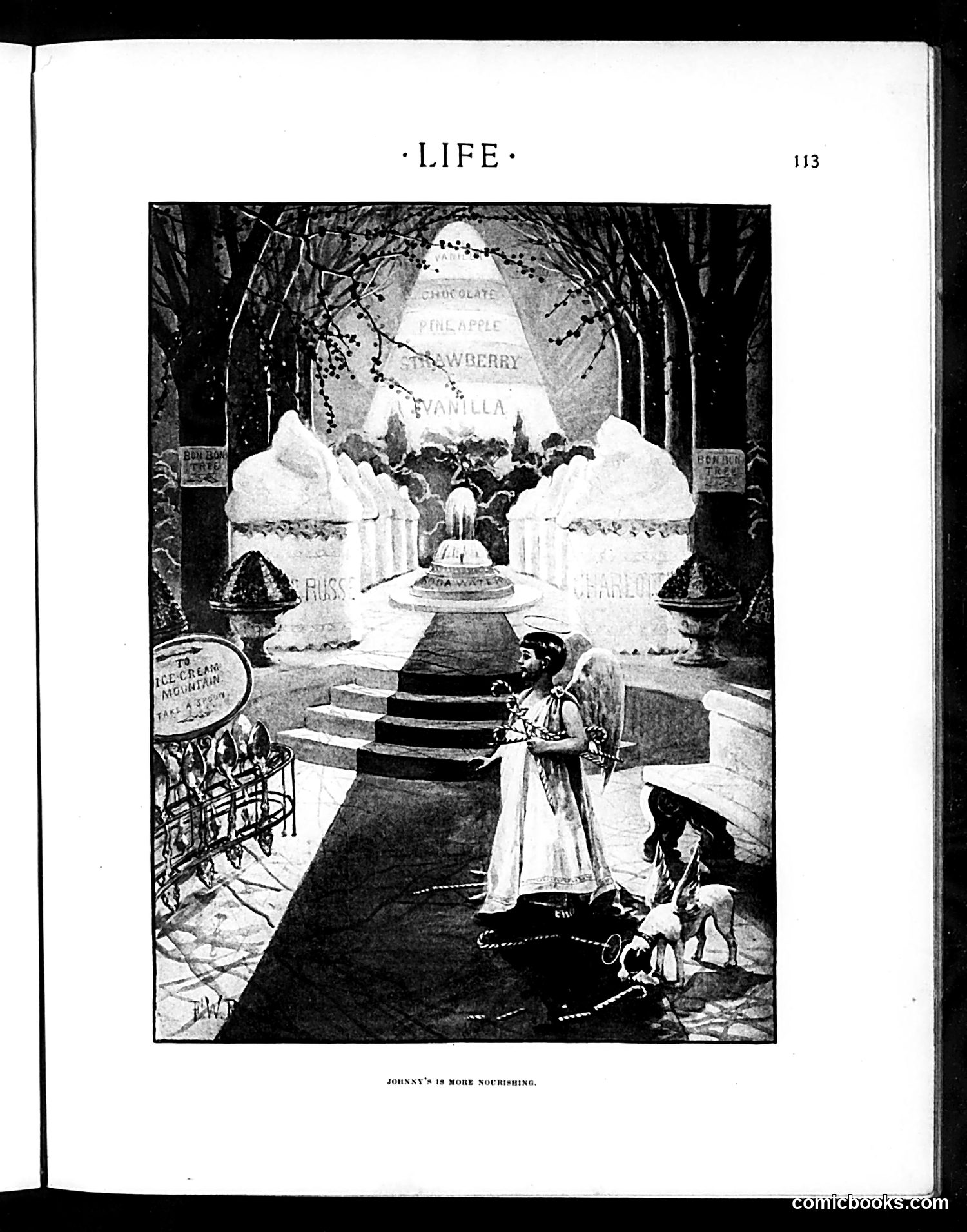
This appears to be an advertisement or satirical comparison for "Johnny's" ice cream or confectionery product. The image depicts an idealized, fantastical ice cream parlor or dessert establishment with elaborate architectural elements—towering ice cream cones, a central fountain, and forest-like surroundings with formal pathways. Two children are shown in the foreground, one appearing to choose or reach toward the Johnny's product. Visible product names include "Chocolate," "Pineapple," "Strawberry," and "Vanilla," suggesting these are flavor offerings. The satire likely mocks competing brands by presenting Johnny's as a superior, almost magical destination—implying that other ice creams pale in comparison to this brand's supposed nutritional value and appeal. The exaggerated, dreamlike presentation serves as tongue-in-cheek advertising humor typical of early Life magazine advertisements.
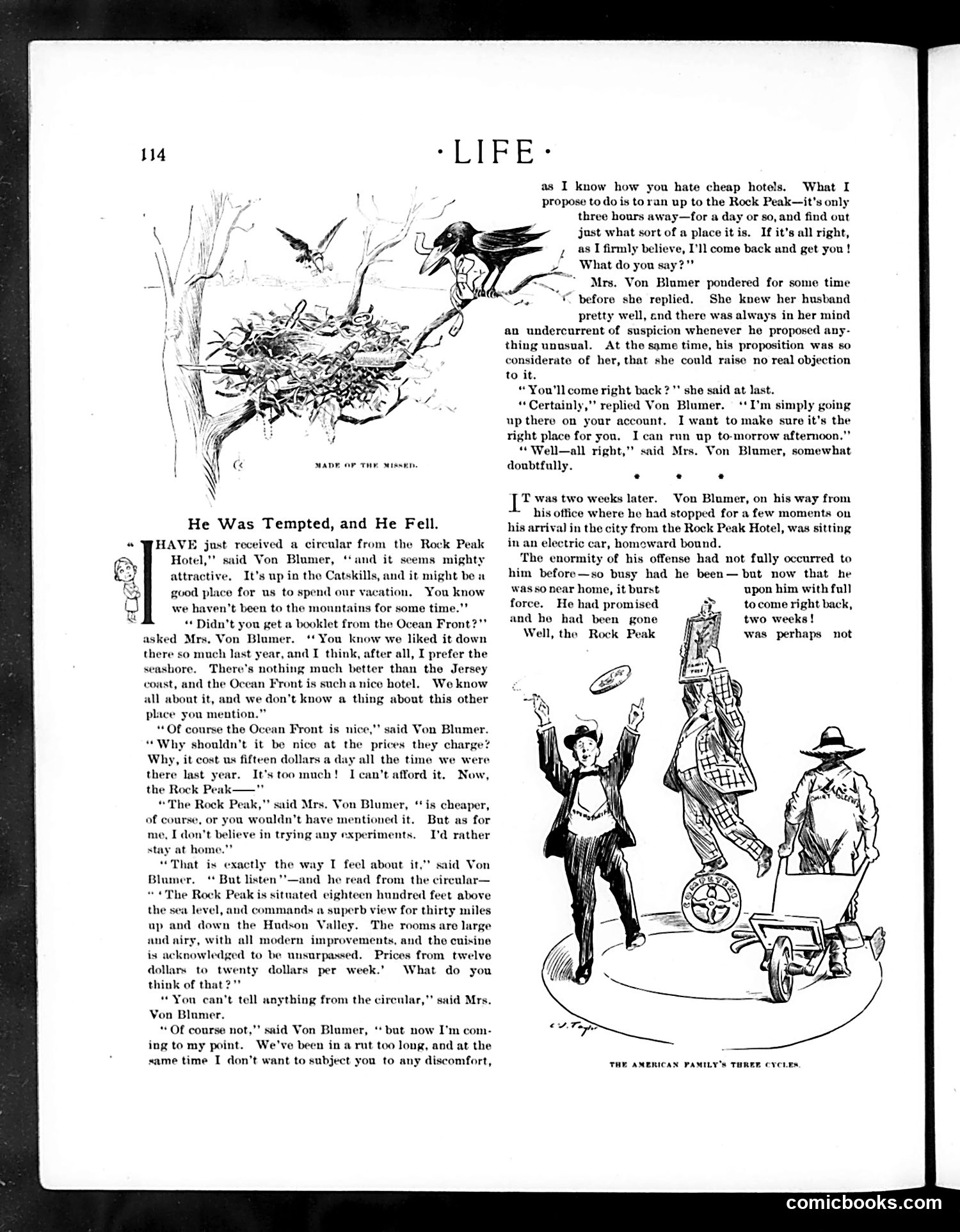
This is a domestic humor story about marital deception. Von Blumer proposes a brief reconnaissance trip to the budget-friendly Rock Peak Hotel (to avoid his wife's preference for the expensive Ocean Front). Mrs. Von Blumer agrees reluctantly, expecting him to return the next afternoon. The joke's punch line: he stayed two weeks instead, only now realizing his transgression as he rides home. The satire targets **early 20th-century male irresponsibility**—a husband's casual dishonesty about vacation plans and his obliviousness to broken promises. The biblical allusion in the title ("tempted and fell") inflates this trivial domestic transgression into mock-tragic language, creating gentle comedy through exaggeration. The accompanying cartoon ("The American Family's Three Cycles") appears to illustrate family leisure activities, reinforcing the vacation/leisure theme. The humor assumes a middle-class readership familiar with hotel choices and domestic tensions over spending.
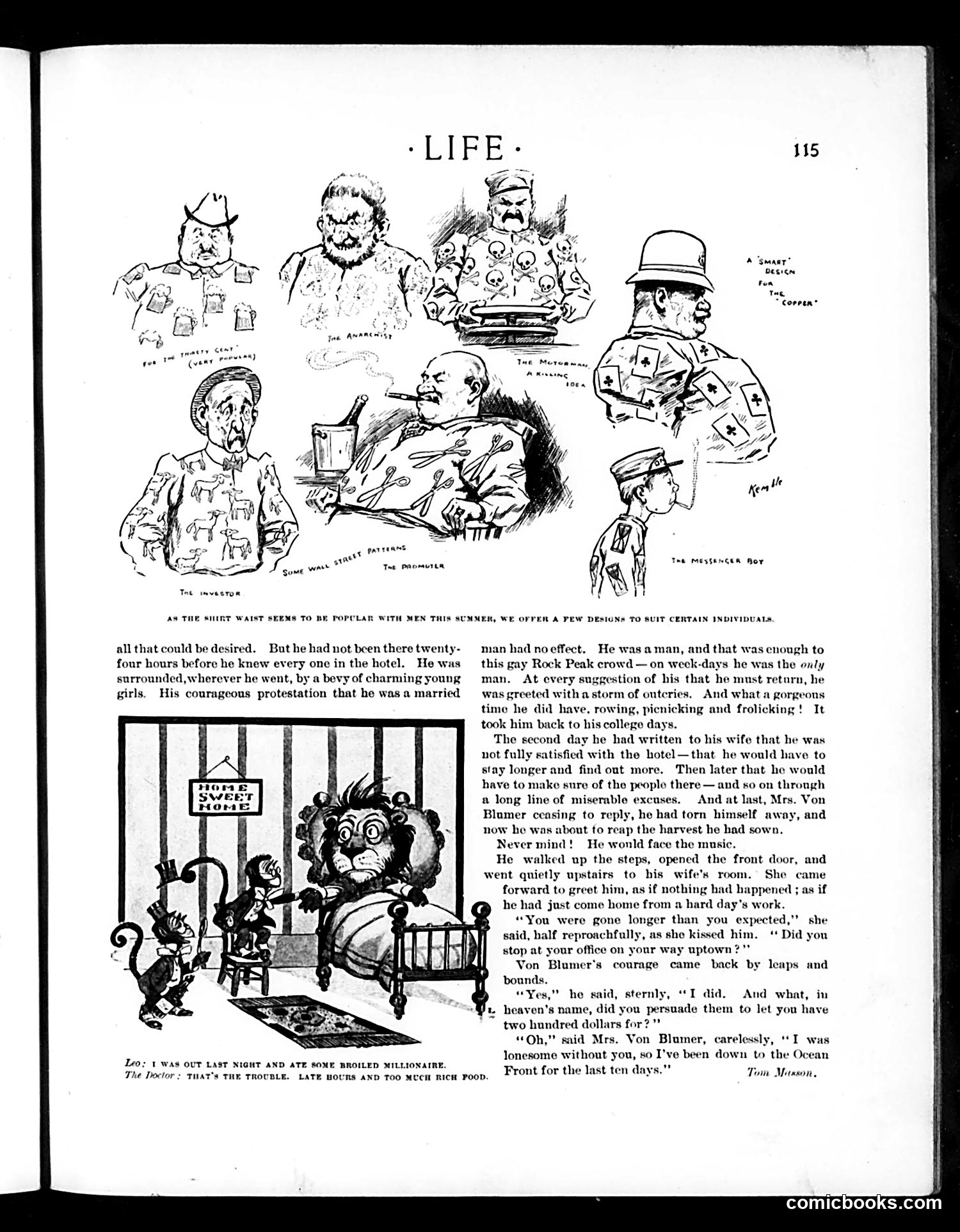
This page satirizes the "shirt waist" fashion trend of the era through caricatured male types (an investor, doctor, messenger boy, and others) shown wearing decorative shirt waists—typically women's garments. The humor mocks men adopting this style. The main narrative cartoon depicts a husband, Von Blumer, who extends his hotel stay with increasingly thin excuses to his wife while enjoying himself at "Rock Peak." When he finally returns home, preparing for confrontation, his wife casually reveals she spent two hundred dollars vacationing at the Ocean Front—matching his own misbehavior. The joke reverses his expected guilt: both have been unfaithful to their plans, and his stern accusation is undercut by her equal transgression. The caption's ironic tone ("The Doctor: that's the trouble. Late hours and too much rich food") suggests the moral compromise is mutual and amusing.
This page is primarily **text and advertisements** rather than political cartoons. The content consists of: **Humorous anecdotes and verse:** - A poem about summer's annoyances (Washington Star) - British working-class humor about a butcher and poor woman haggling over meat scraps - A quote from humorist Bill Nye endorsing life insurance with characteristic wit - A toast by lawyer Joseph Choate celebrating Pilgrim Mothers - A story by "Sam Elder" about doctors (incomplete on this page) **Advertisements:** - Wilson Whiskey (established 1823) - Hunter Baltimore Rye whiskey - Ruinart Champagne - Spalding St. Lawrence Boat Company canoe The page reflects *Life* magazine's satirical approach through humor about everyday social situations (summer discomforts, class economics, professional pretension) rather than explicit political commentary. The tone is genteel, middle-class oriented satire typical of early 20th-century American humor magazines.
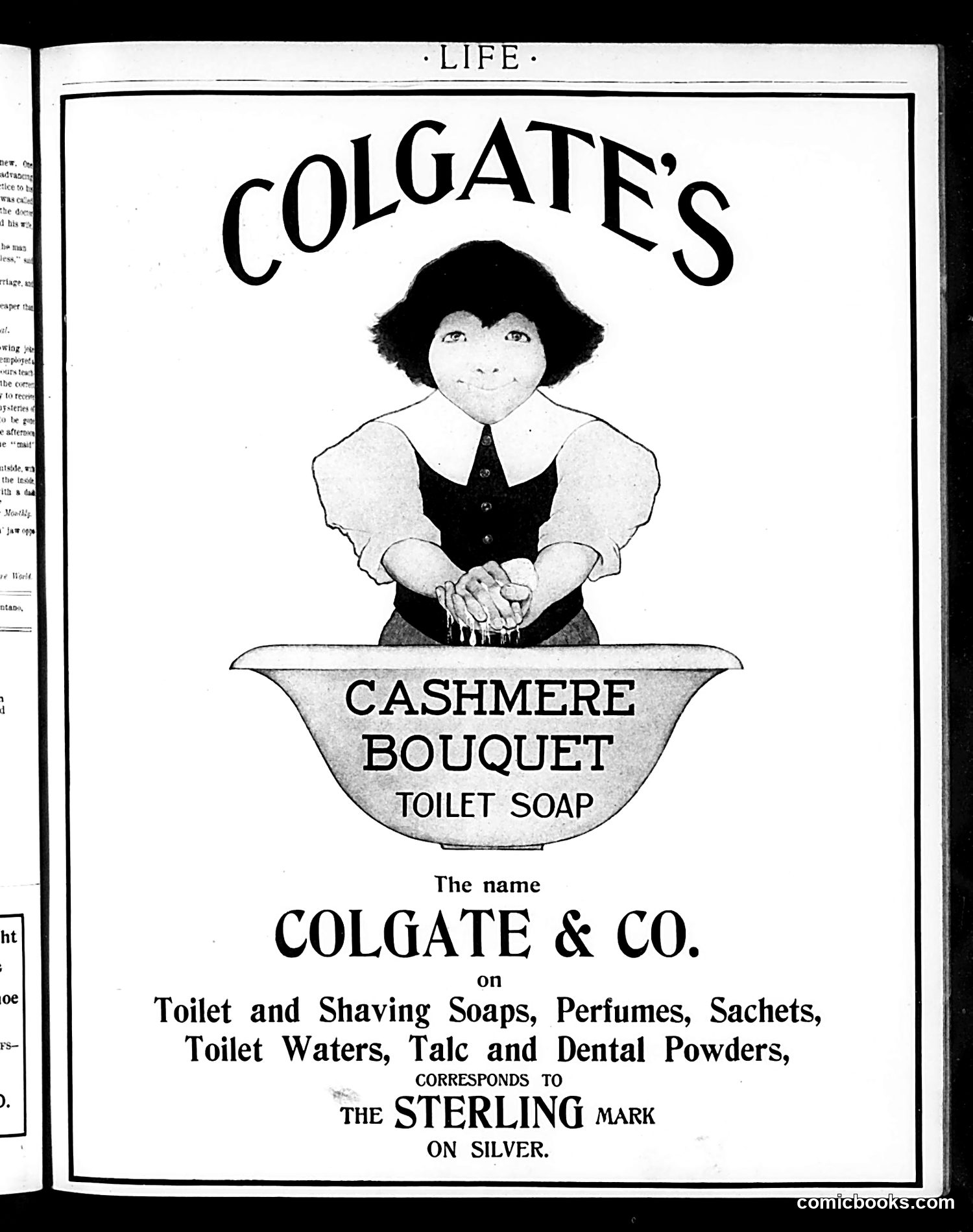
This is a **Colgate & Co. advertisement** from Life magazine, not a political cartoon. It promotes "Cashmere Bouquet" toilet soap and other personal care products. The ad uses a stylized illustration of a woman's face and upper body emerging from or presented within a decorative bowl shape—likely meant to evoke luxury and refinement. The "Cashmere Bouquet" name suggests softness and elegance. The advertising copy equates the Colgate brand name with "the Sterling mark on silver"—a hallmark of quality and purity. This comparison suggests that just as sterling silver's mark guarantees authenticity, the Colgate name guarantees superior quality in toiletries. This appears to be a straightforward commercial advertisement rather than satire, typical of early-to-mid 20th century product marketing in magazines.
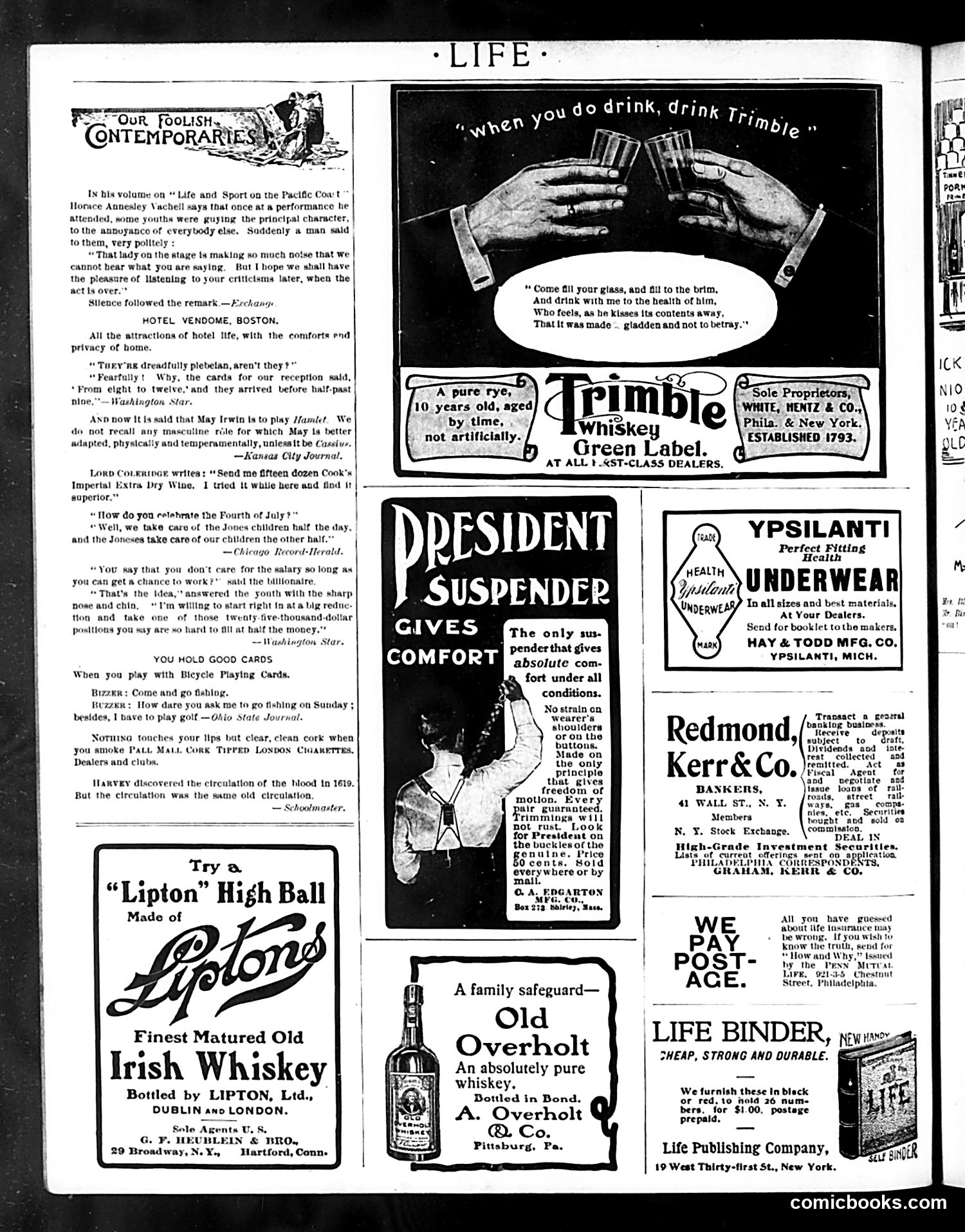
This page is primarily advertising rather than political cartoon content. The main satirical element is a brief section titled "Our Foolish Contemporaries," which collects humorous anecdotes and jokes mocking social pretension and human behavior—including comments on theater audiences, hotel manners, and class aspirations. The bulk of the page comprises advertisements for period products: whiskeys (Trimble, Lipton, Old Overholt), men's clothing (Ypsilanti Underwear, President Suspenders), financial services (Redmond, Kerr & Co. Bankers), and other goods. The President Suspender ad includes an illustration of its comfort mechanism. These ads reflect early 1900s commercial culture and marketing strategies. The humor is social satire directed at everyday pretentiousness rather than political commentary.
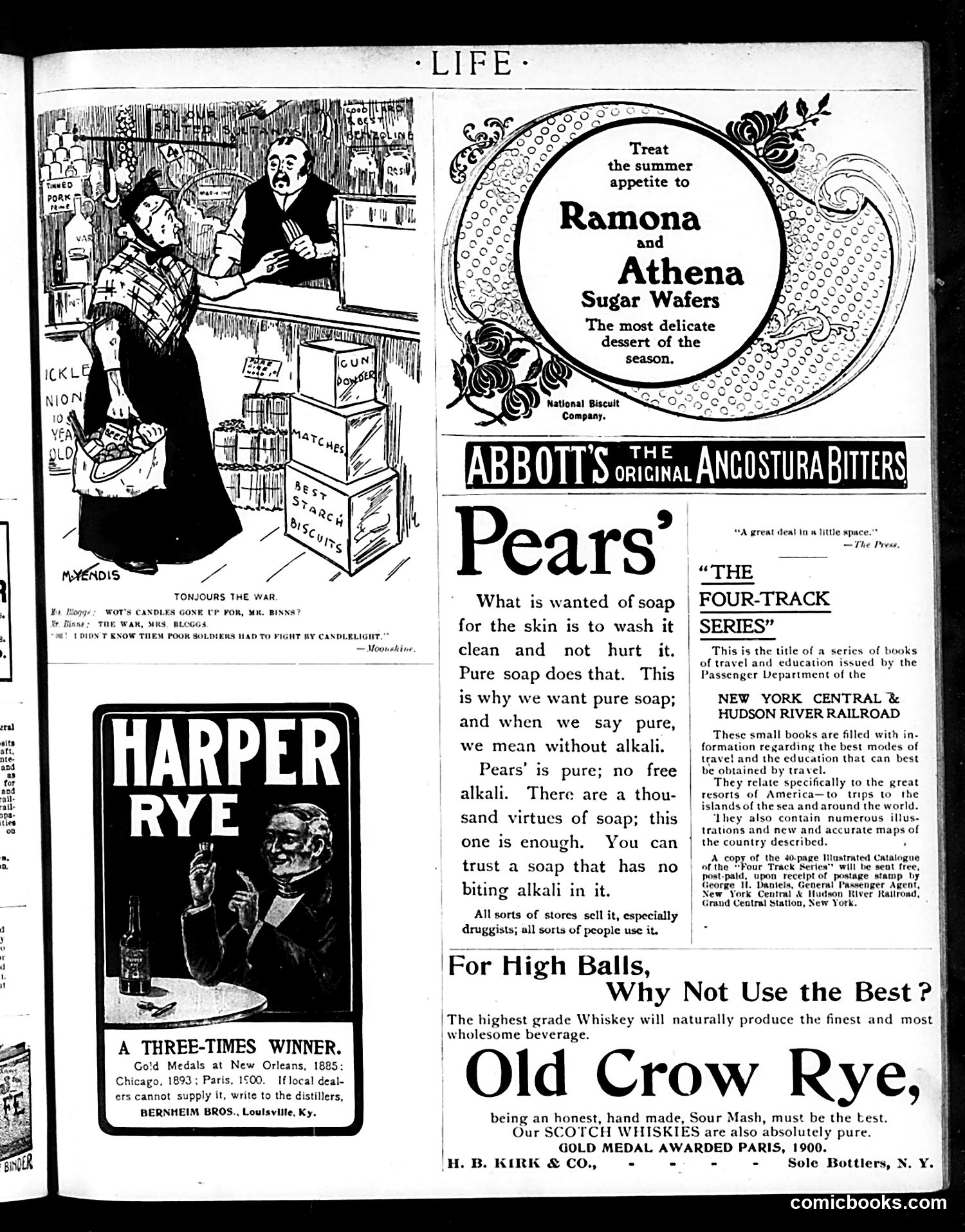
The cartoon's caption references the French phrase "always the war," depicting a wartime conversation between two working-class British figures—Mr. Binns and Mrs. Bloggs—at what appears to be a shop counter. Mrs. Bloggs asks why candle prices have risen; Mr. Binns blames "the war." The satirical point, attributed to *Moonshine* magazine, critiques the public's acceptance of wartime inflation and scarcity. The joke's dark humor lies in Mrs. Bloggs's innocent misunderstanding: she sympathizes with soldiers forced to "fight by candlelight"—apparently unaware that candle shortages stem from broader wartime resource demands, not literal battlefield conditions. This likely references World War I (given the publication era and rationing context), mocking how civilians rationalize everyday hardships as necessary war sacrifices while missing the actual economic mechanisms at play. The page itself is primarily advertising—sugar wafers, soap, whiskey, and railroad travel guides—typical of *Life* magazine's mixed editorial-commercial format.
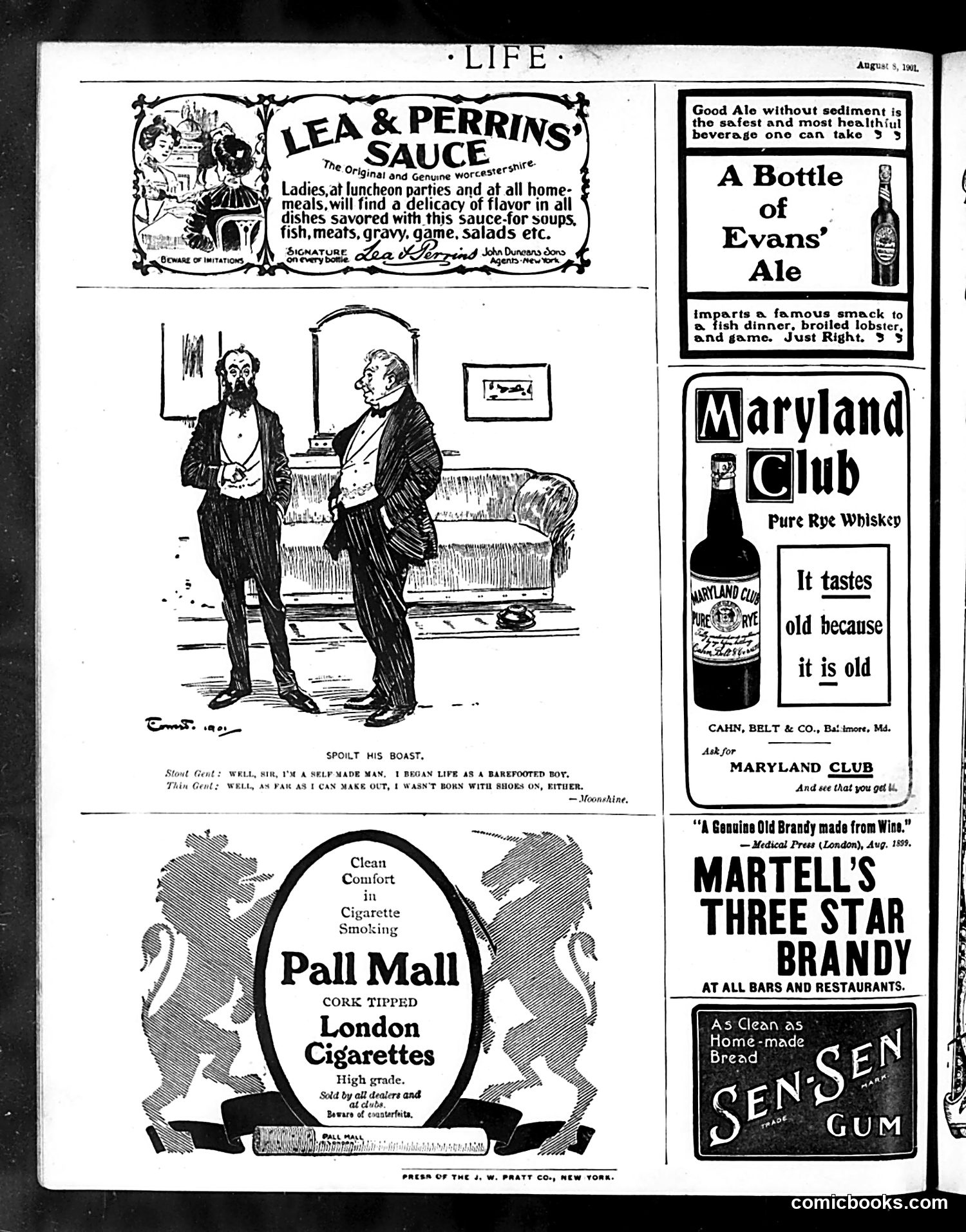
The main cartoon, titled "Spoilt His Boast," depicts two well-dressed gentlemen in formal attire. The caption reveals a satirical exchange about self-made success: one man boasts of being "a self-made man, I began life as a barefooted boy," to which the other replies he "wasn't born with shoes on, either." The joke targets the popular Victorian trope of the "self-made man"—a common boast among wealthy businessmen claiming to have risen from poverty through personal merit alone. The cartoon mocks this by suggesting such claims are hollow; everyone starts poor, making the boast meaningless and pretentious. The surrounding content is primarily product advertising (Lea & Perrins sauce, ales, whiskey, cigarettes, brandy), typical of Life's revenue model at this era.