
Life, 1901-08-08 · page 4 of 20
Life — August 8, 1901 — page 4: what you’re looking at
What you’re looking at
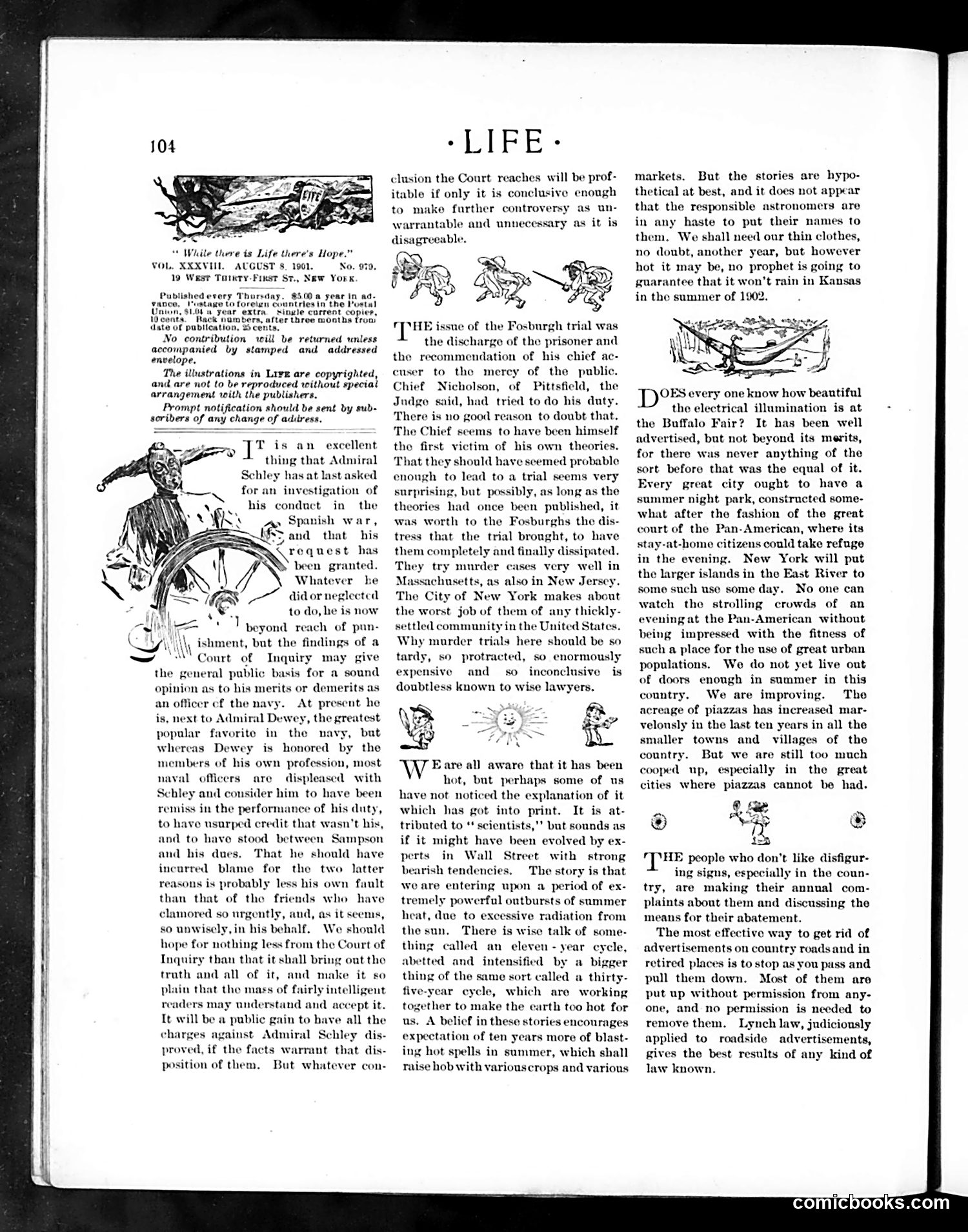
The page contains editorial commentary on several topics rather than a focused political cartoon. The main illustration shows a figure on a bicycle, likely satirizing Admiral Dewey (referenced in text as "the greatest popular favorite in the navy"), who appears to be the subject of commentary about his conduct or reliability. The text discusses the Fosburgh trial's discharge and critiques Chief Justice Nicholson's handling of it. It also addresses summer heat patterns, the "Buffalo Fair," and urban amenities like pizzerias in American cities. The bicycle illustration seems to mock Dewey's balance or stability—perhaps his political positioning or recent decisions—though the exact satirical point remains somewhat unclear without additional historical context about the Admiral's contemporary controversies.
📄 Transcribed text from this page (OCR, searchable)
Machine-transcribed from the original scan — historical spelling and the odd misread are preserved.
While there is Life there's Hope.” Vill. AUGUST 8. 1901. No. 979. 19 West Totwty-Finst St., New York 00 a year in ad. resin the Postal wle current copier, {ter three months frow a No contribution will be returned unless accompanied by stamped and addressed envelope. The illustrations in Live are copyrighted, and are not to be reproduced without special arrangement with the publishers. Prompt notification should be sent by sub- soribers of any change of address. _ TT is an excellent v I thing that Admi Schley has at for an investig his conduct in » Spanish war, cs and that his . \request has SS been granted. Whatever he didorneglected to do, he is now TV peyond reach of pun- ishment, but the findings of a of Inquiry may give the general public basis for a sound opinion as to his merits or demerits as an officer cf the navy. At present he is, next to Admiral Dewey, the greatest popular favorite in the navy, but whereas Dewey is honored by the members of his own profession, most naval officers are displeased with Schley and consider him to have been remiss in the performance of his duty, to have usurped credit that wasn’t his, and to have stood between Sampson and his dues. That he should have incurred blame for the two latter reasons is probably less his own fault than that of the friends who have clamored s ntly, and, as itseems, so unwisely, We should hope for nothing less from the Court of Inquiry than that it shall bring out tho truth and all of it, and m it so plain that the mass of fairly intelligent readers may understand and accept it. [t will be a public gain to have all the charges against Admiral Schley proved, if the facts warrant that di: position of them. But whatever con- “LIFE - clusion the Court reaches will be prof- itable if only it is conclusive enough to make further controversy as un- warrantable and unnecessary as it is disagreeable. ee A. ~ Psp v TP HE issue of the Fosburgh trial was the discharge of the prisoner and the recommendation of his chief ac- cuser to the mercy of the public. Chief Nicholson, of Pittsfield, the Judge said, had tried to do his duty. There is no good reason to doubt that. The Chief seems to have been himself tho first victim of his own theories. That th hould have seemed probable enough to lead to a trial seems very surprising, but possibly, as long as the theories had once been published, it worth to the Fosburghs the di: tress that the trial brought, to have them completely and finally dissipated. try murder cases very well in ssachusetts, as als e The City of New York makes about the worst job of them of any thickly- settled community in the United States. Why murder trials here should be so so protracted, so enormously expensive and so inconclusive is doubtless known to wise lawyers. B V Eare all awaro that it has been hot, but perhaps some of us have not noticed the explanation of it which has got into print. It is at- tributed to * scientists,” but sounds as if it might have been evolved by ex- perts in Wall Street with strong bearish tendencies. The story is that we are entering upon a period of ex- tremely powerful outbursts of summer heat, due to excessive radiation from the sun, There is wise talk of some- thing called an eleven -) abetted and intensified by thing of the same sort called a thirty- le, which are working together to make the carth too hot for us. A belief in these stories encourages expectation of ten years more of blast- ing hot spells in summer, which shall raise hob with variouscrops and various markets. But the stories are hypo- thetical at best, and it does not appear that the responsible astronomers are in any haste to put their names to them. We shall need our thin clothes, no doubt, another year, but however hot it may be, no prophet is going to guarantee that it won't rain in Kansas in the summer of 1902. Des every one know how beautiful the electrical illumination is at the Buffalo Fair? It has been well advertised, but not beyond its merits, for there was never anything of the sort before that was the equal of it. Every great city ought to have a summer night park, constructed some- what after the fashion of the great court of the Pan-American, where its stay-at-home citizens could take refuge in the evening. New York will put the larger islands in the East River to some such use some day. No one can watch the strolling crowds of an eveningat the Pan-American without. being impressed with the fitness of such a place for the use of great urban populations. We do not yet live out of doors enough in summer in this country. We are improving. The acreage of piazzas has increased mar- velonsly in the last ten years in all the smaller towns and villages of the country. But we are still too much cooped up, especially in the great ‘ities where piazzas cannot be had. § Se Ae & 2 [HE people who don’t like disfigur- ing signs, especially in the coun- try, are making their annual com- plaints about them and discussing the means for their abatement. The most effective way to get rid of advertisements on country roads and in retired places is to stop as you pass and pull them down. Most of them aro put up without permission from any- one, and no permission is needed to remove them. Lynch law, judiciously applied to roadside advertisements, gives the best results of any kind of law known. Psy ® comicbooks.com