
A complete issue · 22 pages · 1901
Life — May 16, 1901
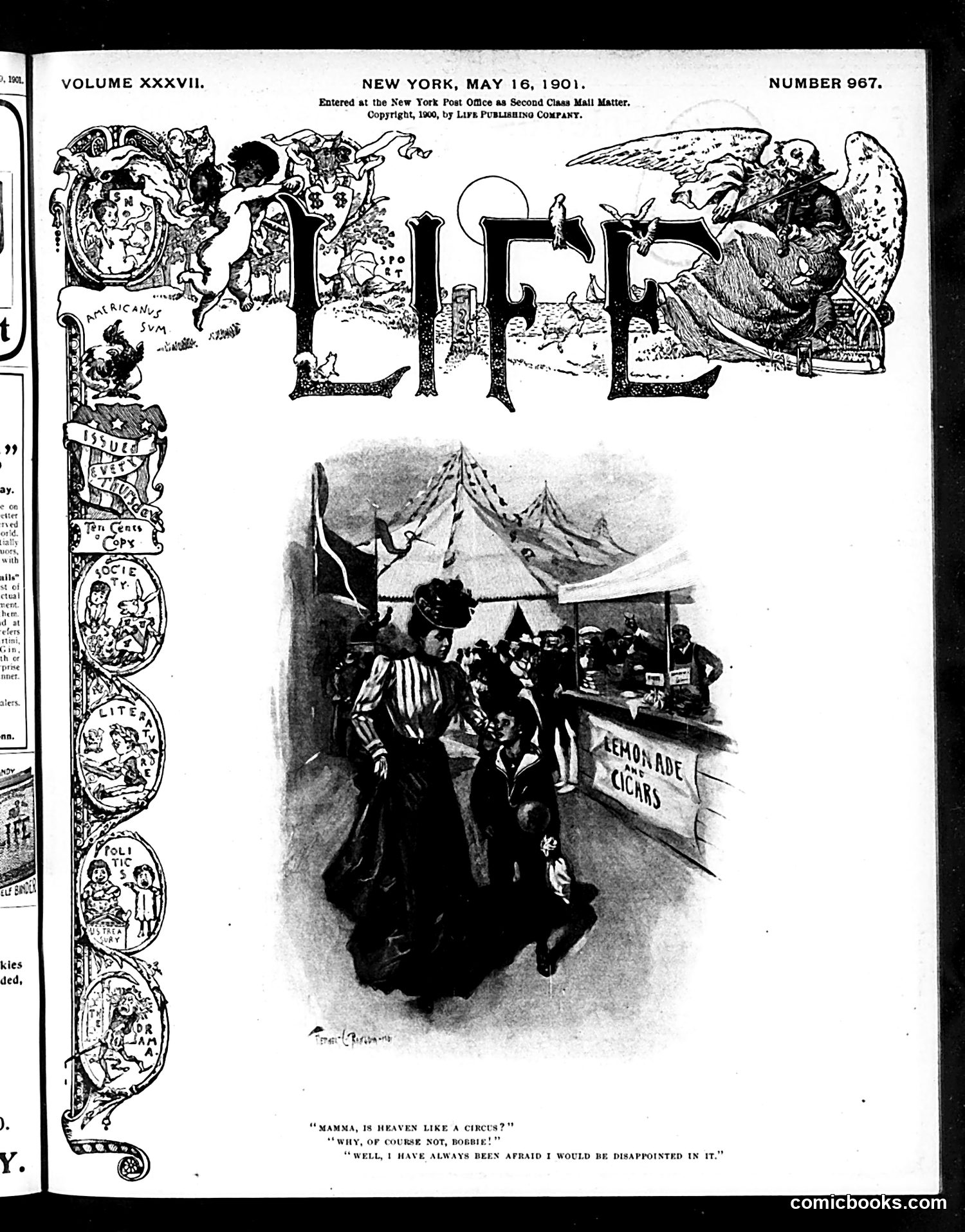
This page features a satirical illustration showing a well-dressed woman at what appears to be a circus or fair lemonade stand. The dialogue suggests a child (Bobbie) asking their mother if heaven is like a circus, with the mother expressing concern about disappointment. The humor seems to target middle-class anxieties about commercial entertainment and children's expectations. The elaborate decorative border on the left (showing various classical and allegorical scenes) contrasts with the mundane commercial scene, suggesting satire about the gap between elevated cultural ideals and everyday American consumer culture. The "Lemonade & Cigars" stand detail appears to mock the commercialization of entertainment venues. Without identifying specific individuals, the cartoon critiques how modern amusements shape children's worldviews.
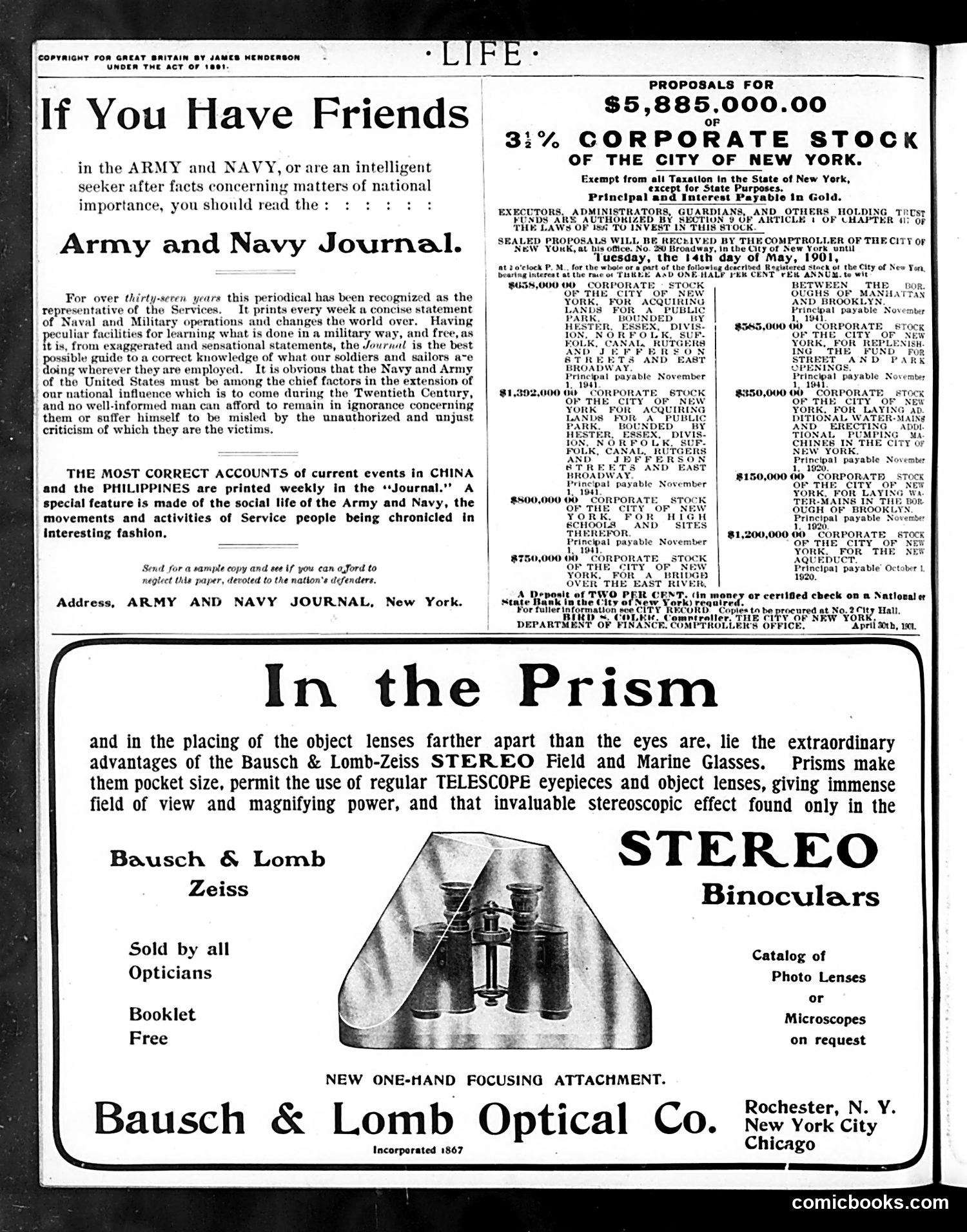
This page contains **no cartoon or satirical content**. Instead, it features: 1. **Left side**: Advertisement for the *Army and Navy Journal*, a military periodical, targeting readers interested in national defense and military operations during the early 1900s. 2. **Right side**: Financial notices for New York City corporate stock proposals totaling over $5.8 million, with various denominations and payment terms listed—standard municipal finance announcements. 3. **Bottom**: Advertisement for Bausch & Lomb Zeiss stereo binoculars, highlighting their optical advantages with a product image and promoting free booklets available through opticians. The page is primarily **commercial and informational** rather than satirical, typical of *Life* magazine's mixed-content format during this era.
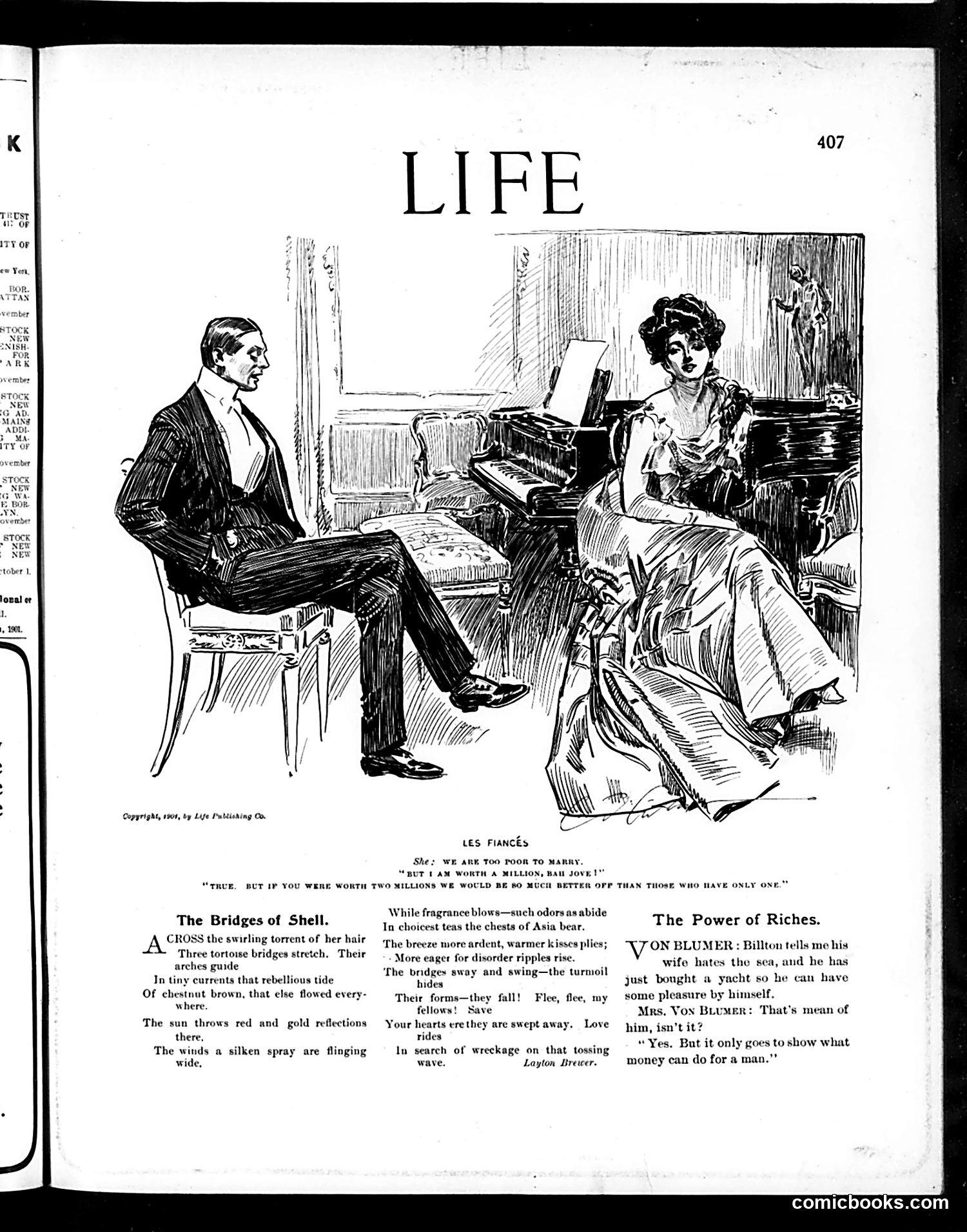
The main illustration, titled "Les Fiancés" (The Engaged Couple), depicts a woman at a piano and a man seated nearby, with dialogue about marriage and money. The caption quotes the woman saying "We are too poor to marry" while the man responds "But I am worth a million, bad joke!"—highlighting the satirical point that wealth alone doesn't guarantee marital happiness or compatibility. Below are two poems: "The Bridges of Shell" and "The Power of Riches." The latter includes dialogue between characters discussing how a wealthy husband bought a yacht for pleasure, with Mrs. Vox Blumer commenting that money can only show "what money can do for a man"—suggesting wealth's limitations in creating genuine fulfillment or character. The satire targets the era's materialism and class anxieties surrounding marriage.
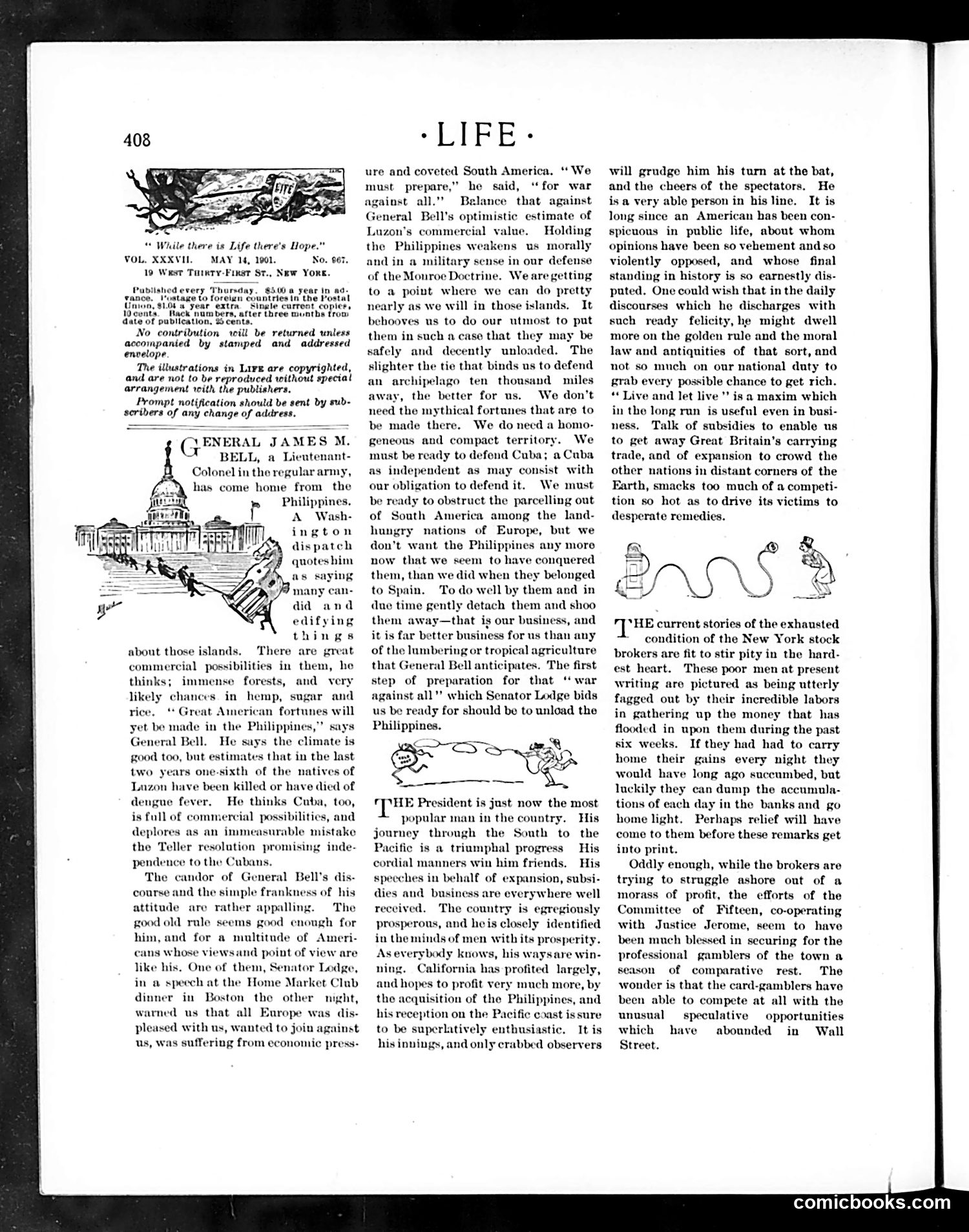
The page features an editorial about General James M. Bell's return from the Philippines, with an illustration of the Capitol building. The text discusses American military expansion and colonial policy in the Philippines, debating whether the U.S. should defend these newly-acquired territories against European competition. The cartoon appears to show a figure at the Capitol, likely representing political debate over imperial ambitions. The satire targets America's colonial expansion and the contradictions in justifying occupation of the Philippines—balancing commercial interests against defensive obligations. A secondary item discusses President Roosevelt's popularity and stock market recovery, with subtle criticism of Wall Street speculators profiting from war and expansion. The overall thrust satirizes American imperialism and financial opportunism during the post-Spanish-American War period.
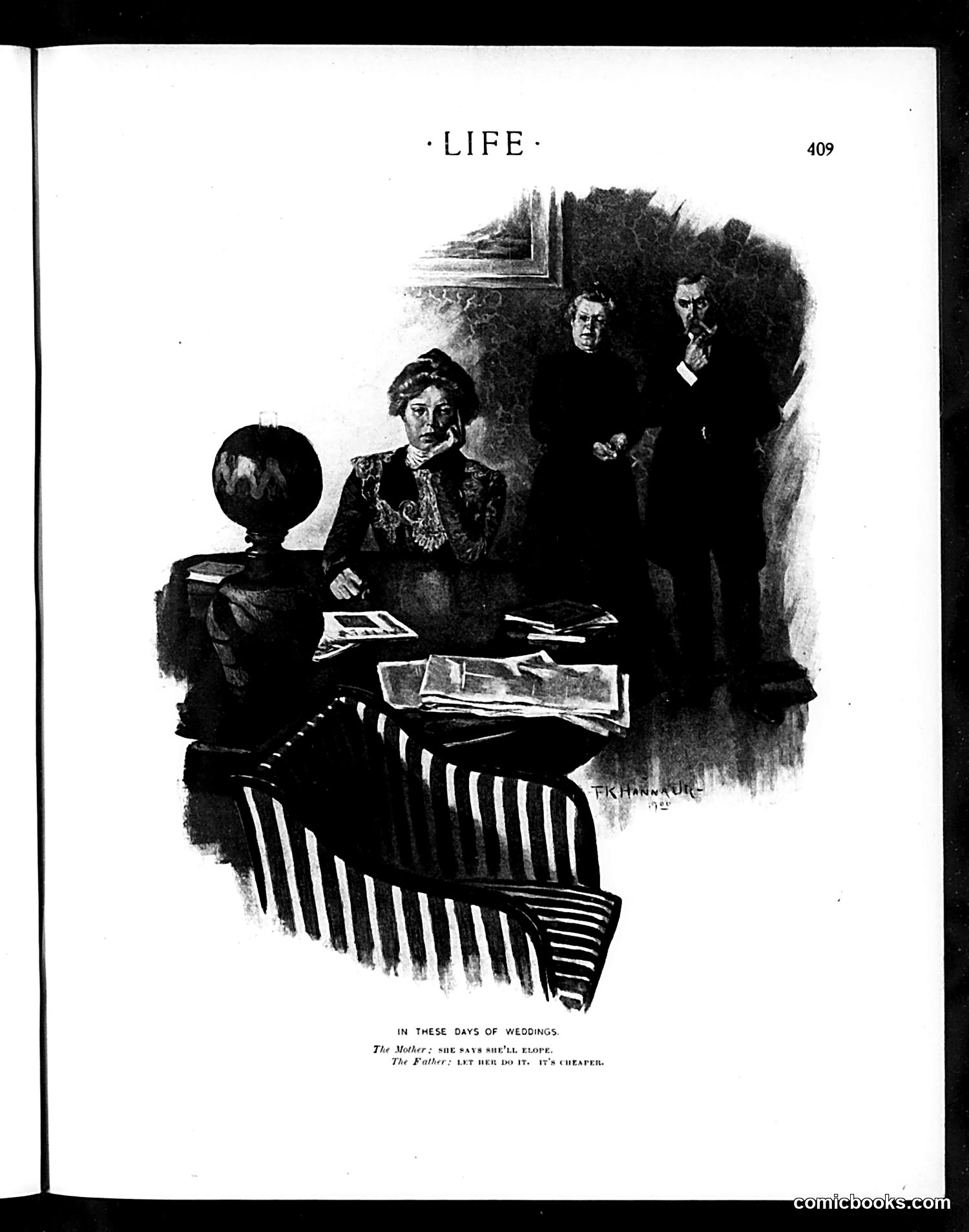
This satirical cartoon titled "In These Days of Weddings" comments on marriage costs and parental attitudes. The scene shows a seated woman (likely the bride or her mother) reviewing wedding expenses/documents with three men standing behind her—probably representing the father, a vendor, or wedding planner. The caption's joke contrasts parental perspectives: the mother says "she'll elope," while the father responds "let her do it. it's cheaper"—mocking how expensive weddings have become. The ornate chair and papers suggest discussion of substantial financial obligations. The cartoon satirizes early 20th-century anxieties about wedding inflation and the economic burden on families, particularly fathers expected to finance elaborate ceremonies. It's humorous commentary on the tension between social expectations and financial reality.
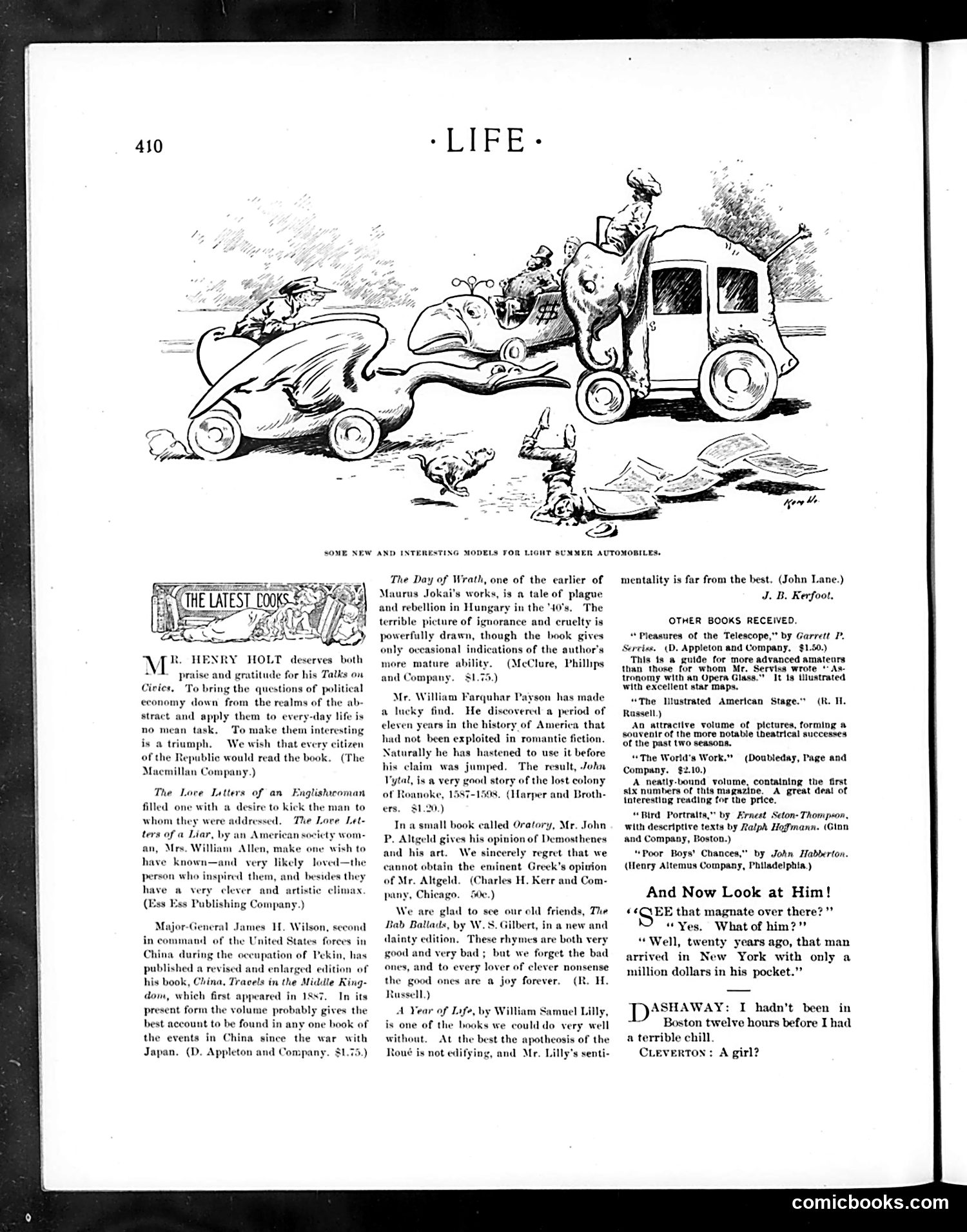
This cartoon satirizes early automobile design through exaggerated, whimsical vehicle forms. The left car appears as a stylized fish or sea creature on wheels, while the right resembles a grotesque beast or animal hybrid. Both carry passengers who seem oblivious to the absurdity. The satire likely mocks the rapid proliferation of automobile designs in the 1910s-1920s, when manufacturers experimented wildly with body shapes and forms before standardization. The cartoon suggests that some designers prioritized novelty and bizarre aesthetics over practical engineering. The accompanying text discusses various books, including works on China and literary collections, unrelated to the automotive humor above.
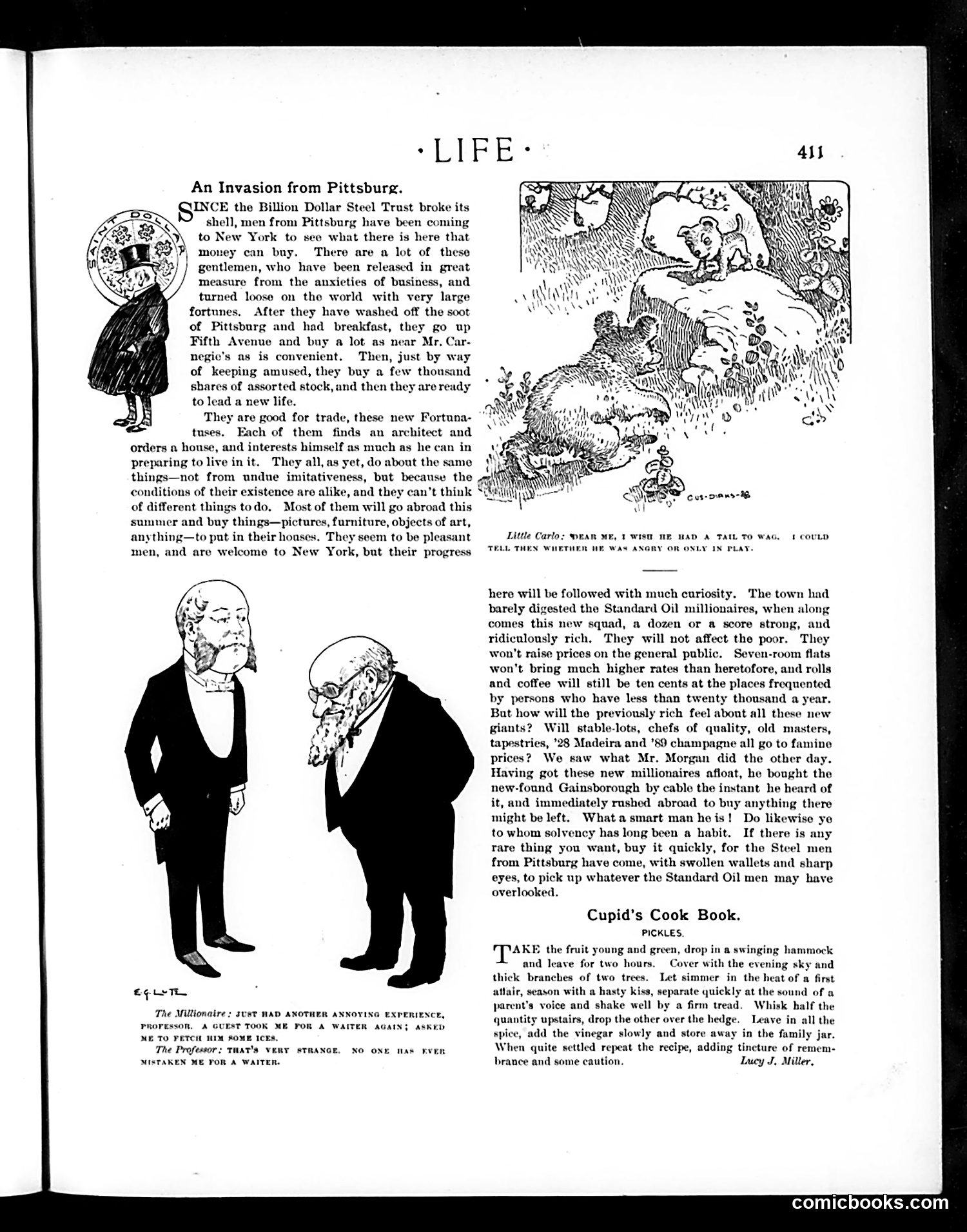
This satirical article mocks newly wealthy industrialists from Pittsburgh (likely steel magnates following the dissolution of the Billion Dollar Steel Trust) who are arriving in New York City. The text jokes that these nouveau-riche businessmen, having made sudden fortunes, predictably behave as stereotypical wealthy people: they buy stocks, hire architects, furnish grand houses on Fifth Avenue, and plan to purchase art and luxury goods abroad. The cartoon below depicts two wealthy men in formal dress—caricatured with exaggerated facial features typical of period satire—representing these Pittsburgh millionaires. The caption humorously notes one asking a waiter to return, suggesting they're unfamiliar with proper etiquette. The satire targets both their lack of refinement and their presumed ability to disrupt New York's existing social order.
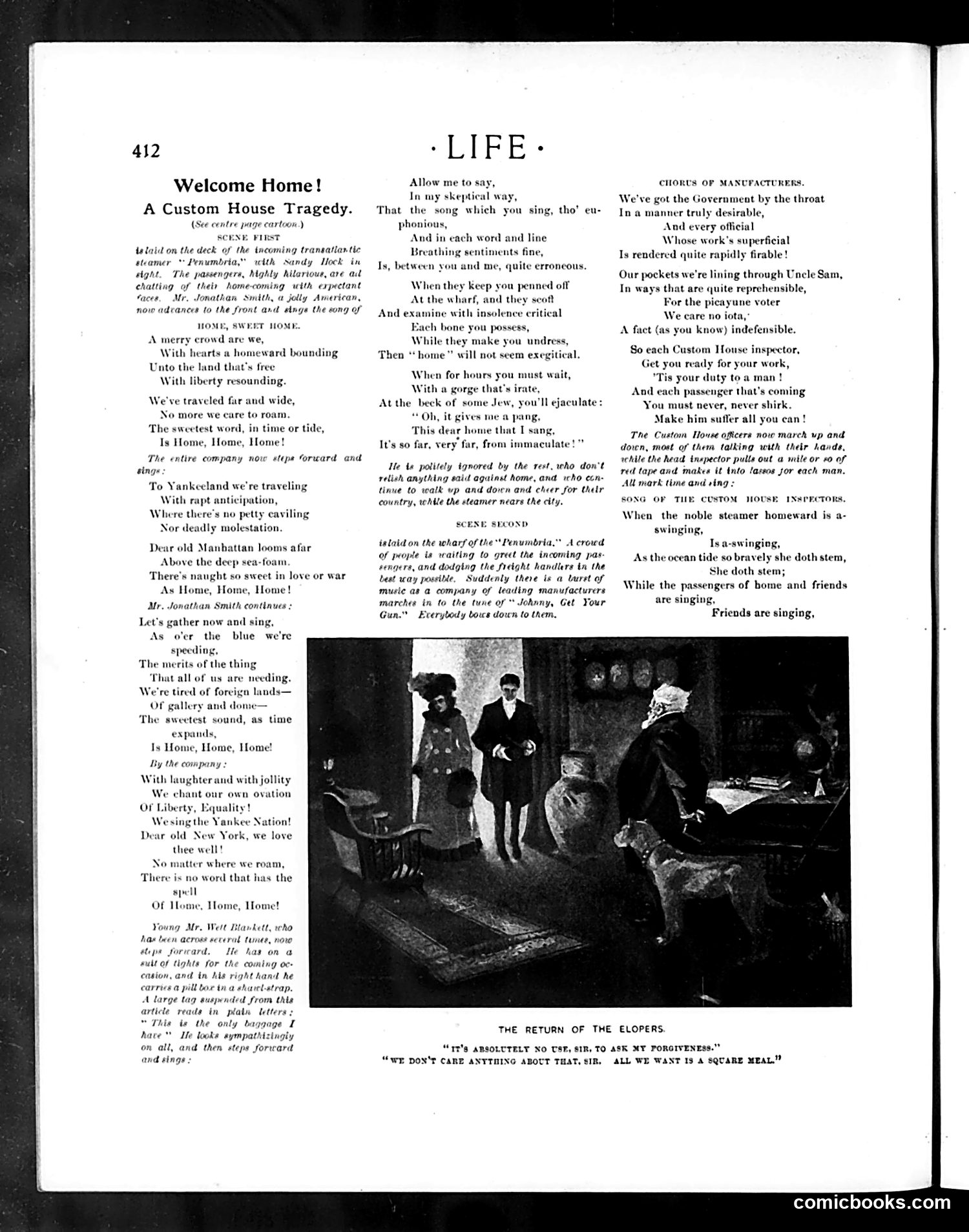
This page satirizes the "Custom House Tragedy," a domestic scandal involving infidelity and elopement. The photograph captioned "The Return of the Elopers" shows a couple's awkward homecoming, where family members wait to receive them back. The accompanying song lyrics mock the situation with dark humor. Lines like "It's so for, very far, homecoming!" suggest the couple has returned after running away together. References to "Uncle Sam" and "Custom House Inspectors" indicate the scandal involved government officials, likely exposing hypocrisy among those in authority. The satire targets both the scandalous behavior and society's prudish response to it, using the couple's humiliating return as commentary on marriage, morality, and social expectations of the era.
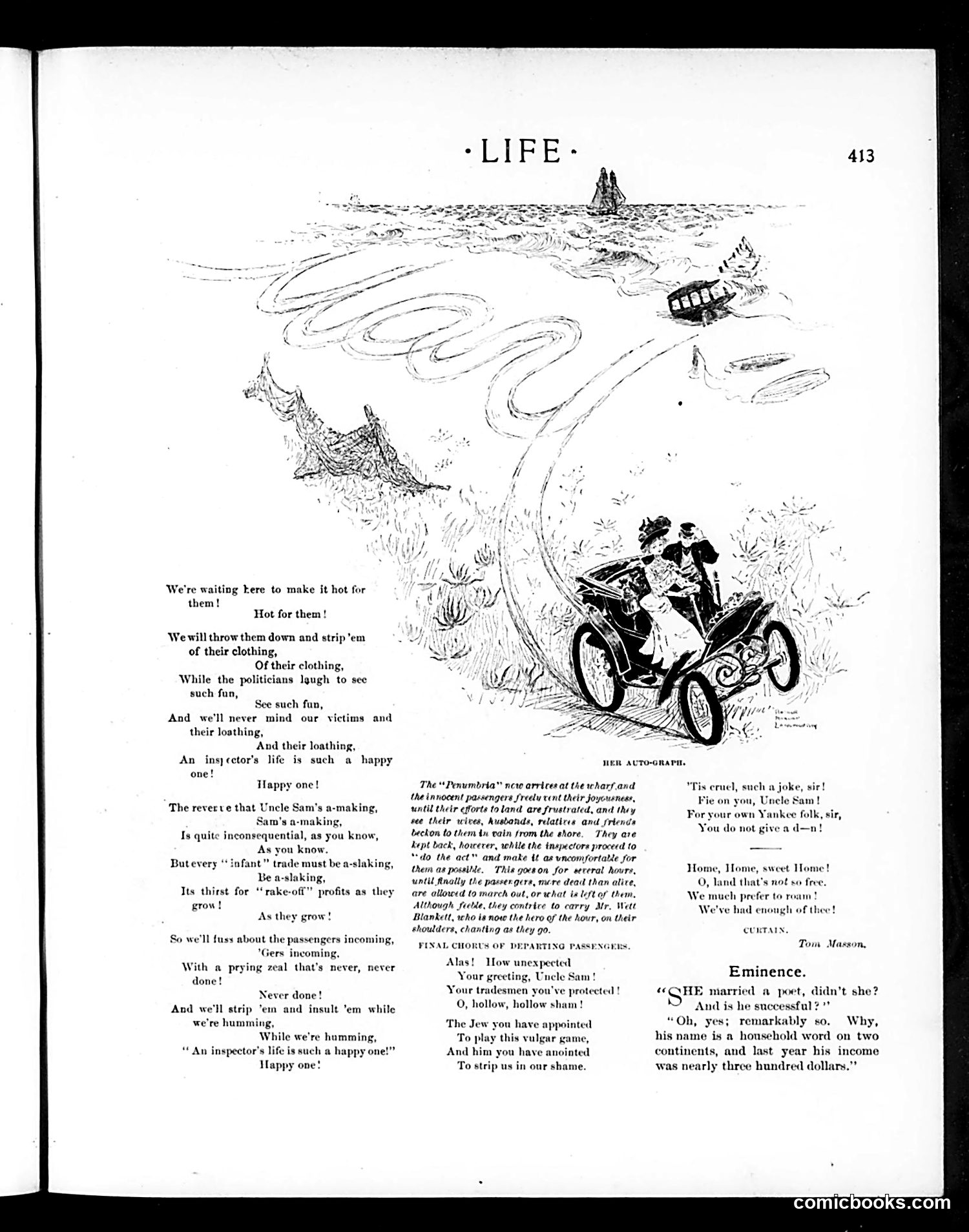
This page contains two distinct satirical pieces: **Upper cartoon**: "Her Auto-graph" depicts an early automobile with two men confronting what appears to be a street inspector or official. The accompanying verse mocks inspectors' power, depicting them as predatory officials who strip citizens of possessions under the guise of authority. The poem celebrates an inspector's "happy" life of intimidation and extortion. **Lower section**: "Eminence" is a brief joke about a poet who married successfully—his household name is apparently worth nearly three hundred dollars annually (likely mocking both poets' poverty and the commercialization of fame). Both pieces reflect early 20th-century American skepticism toward government officials and satirize social pretensions. The automobile reference dates this to the automobile era's early decades.
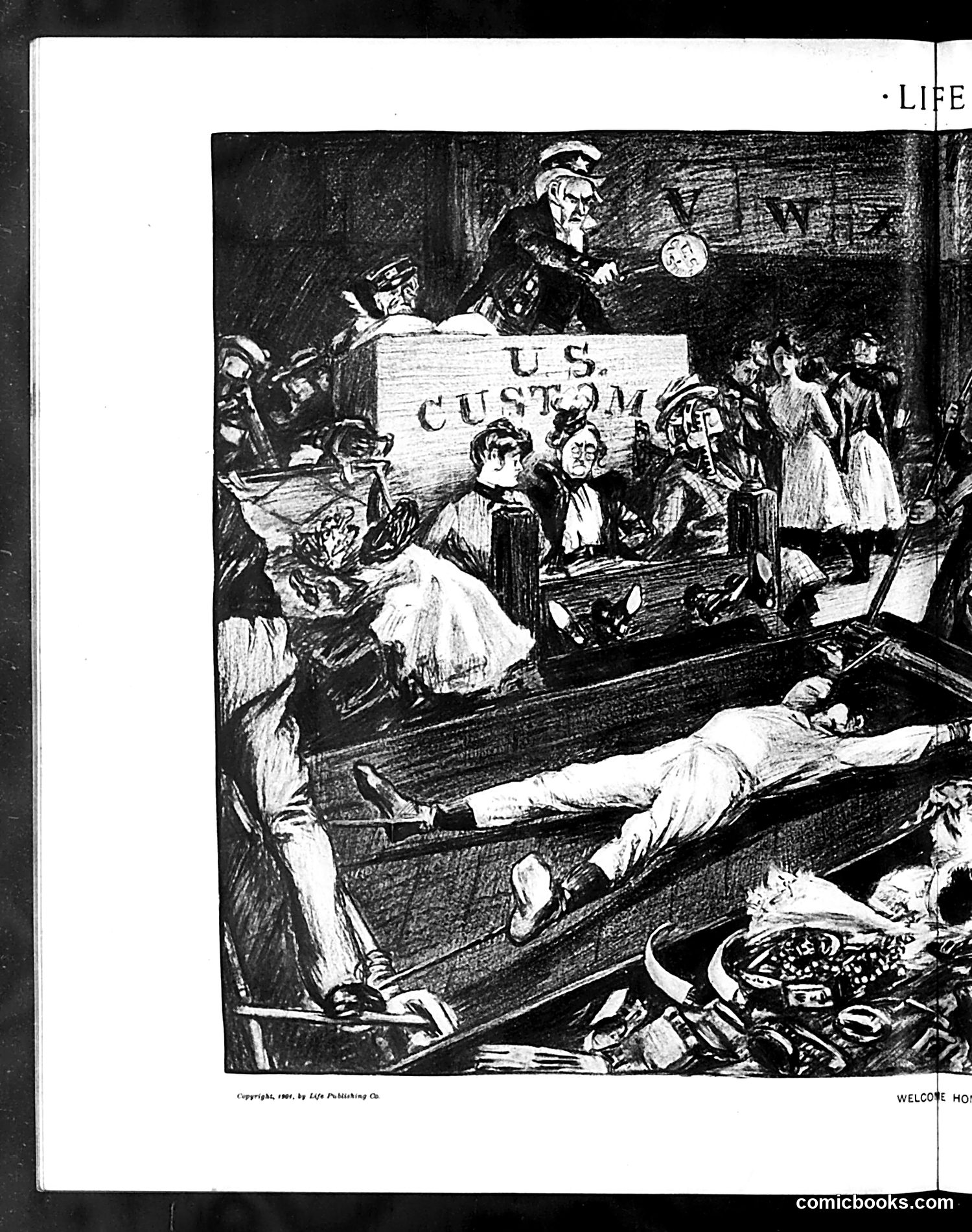
This satirical illustration depicts a U.S. Customs inspection scene. The central image shows customs officials examining arriving immigrants or travelers at what appears to be a port of entry. A "U.S. CUSTOMS" sign is visible above the inspection station. The scene illustrates the processing and scrutiny of new arrivals to America, likely satirizing either the bureaucratic inefficiency of customs procedures or anxieties about immigration control during the early 20th century. The crowded conditions and formal inspections suggest commentary on how immigrants were treated upon arrival. The magazine's placement under "LIFE" indicates this was humorous social commentary typical of Life magazine's satirical coverage of American institutions and contemporary issues.
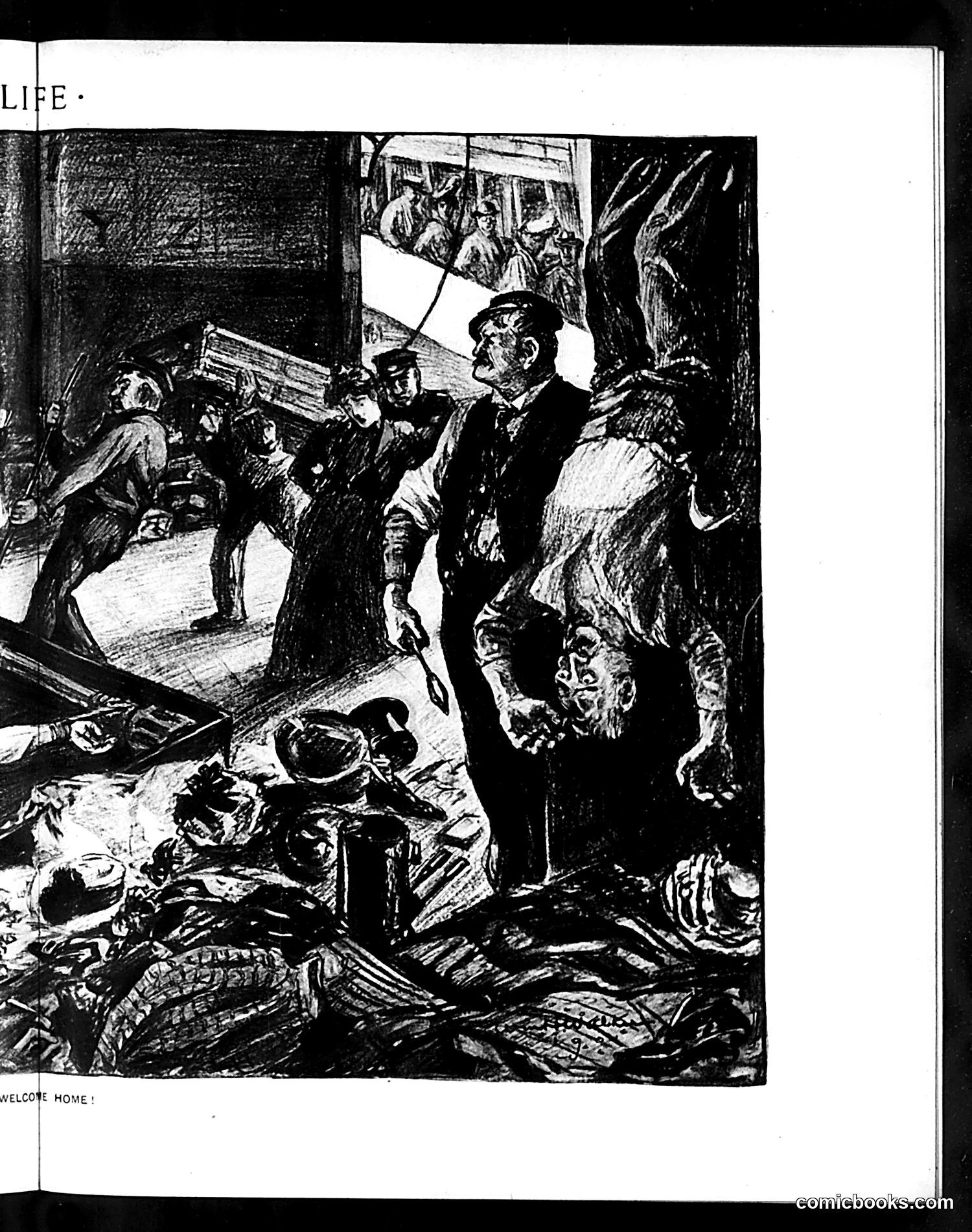
This satirical cartoon depicts the return of soldiers from World War I. The central figures appear to be military officers or dignitaries greeting returning servicemen, with what looks like a dock or port setting in the background. The title "Welcome Home!" suggests irony—the contrast between the soldiers' heroic service and their actual homecoming experience. The cluttered, chaotic foreground with debris and disorder may represent the difficult realities awaiting veterans: unemployment, housing shortages, or social displacement following the war's end. The detailed crosshatching and dramatic composition emphasize the tension between official celebration and the harsh conditions many WWI veterans actually faced upon returning to civilian life in the 1920s.
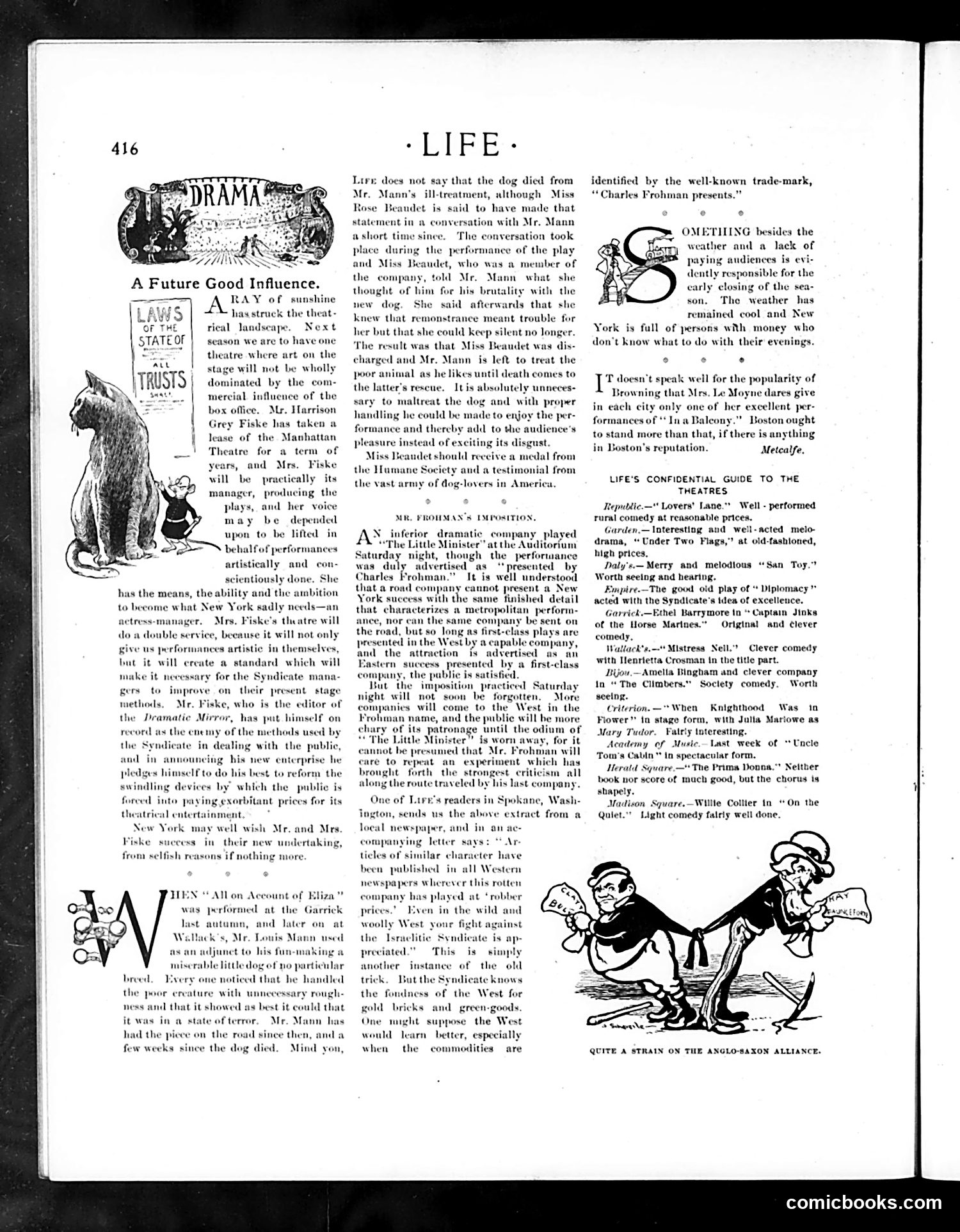
This page contains theater reviews and commentary. The main illustration at bottom shows a caricatured figure labeled "QUITE A STRAIN ON THE ANGLO-SAXON ALLIANCE"—appearing to depict tensions between British and American interests, likely related to trade or diplomatic relations. The text discusses various theatrical performances and includes criticism of the "Syndicate" (a theatrical booking monopoly). There's commentary about how established theater companies advertise plays as "presented by Charles Frohman" regardless of actual involvement—satirizing false marketing claims. The page critiques both theatrical monopolies and Western business practices, including mention of a disreputable company touring the West under false pretenses. The overall tone suggests early 20th-century concerns about corporate consolidation and commercial dishonesty in American entertainment.
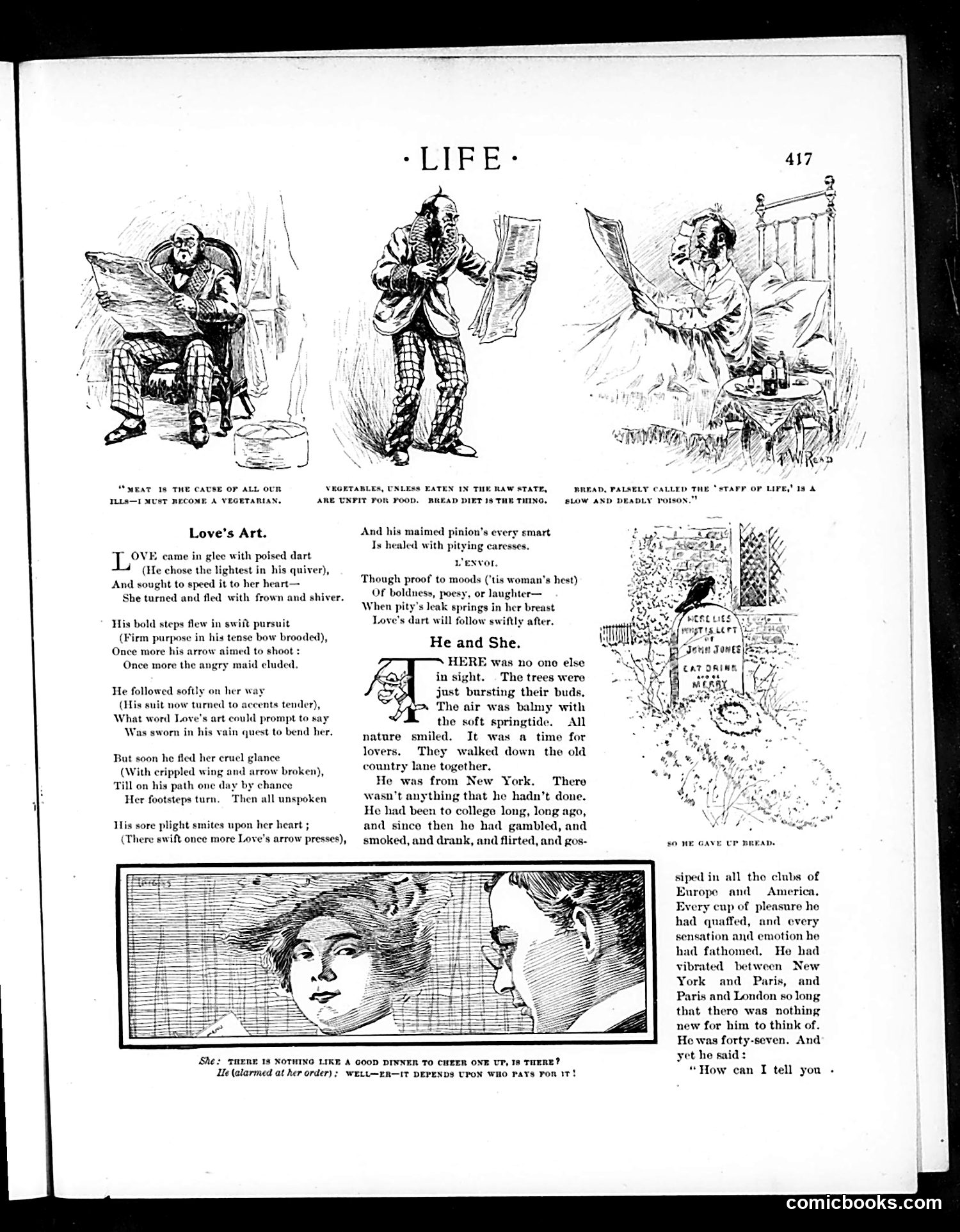
This page contains three separate humorous pieces typical of Life magazine's satirical style: **"Love's Art"** (top left): A poem illustrated with sketches depicting Cupid's pursuit of a reluctant woman—showing the conventional romantic narrative where persistence eventually wins her over through pity. **Top cartoons**: Three satirical vignettes mocking health fads—a man declaring he'll become vegetarian, someone promoting raw vegetables and bread as cure-alls, and a woman wielding bread like a weapon. This appears to satirize contemporary dietary crazes and wellness movements popular among urban Americans. **"He and She"** (main narrative): A romantic story about a jaded, worldly 47-year-old New York man meeting a woman on a country lane. The humor culminates in the final cartoon where she enthusiastically orders an expensive dinner, and he's horrified—satirizing both female materialism and male anxiety about dating costs. The caption "so we gave up bread" suggests the couple abandoned their romantic pretense. The page primarily mocks romantic conventions, health faddism, and gender dynamics of the era.
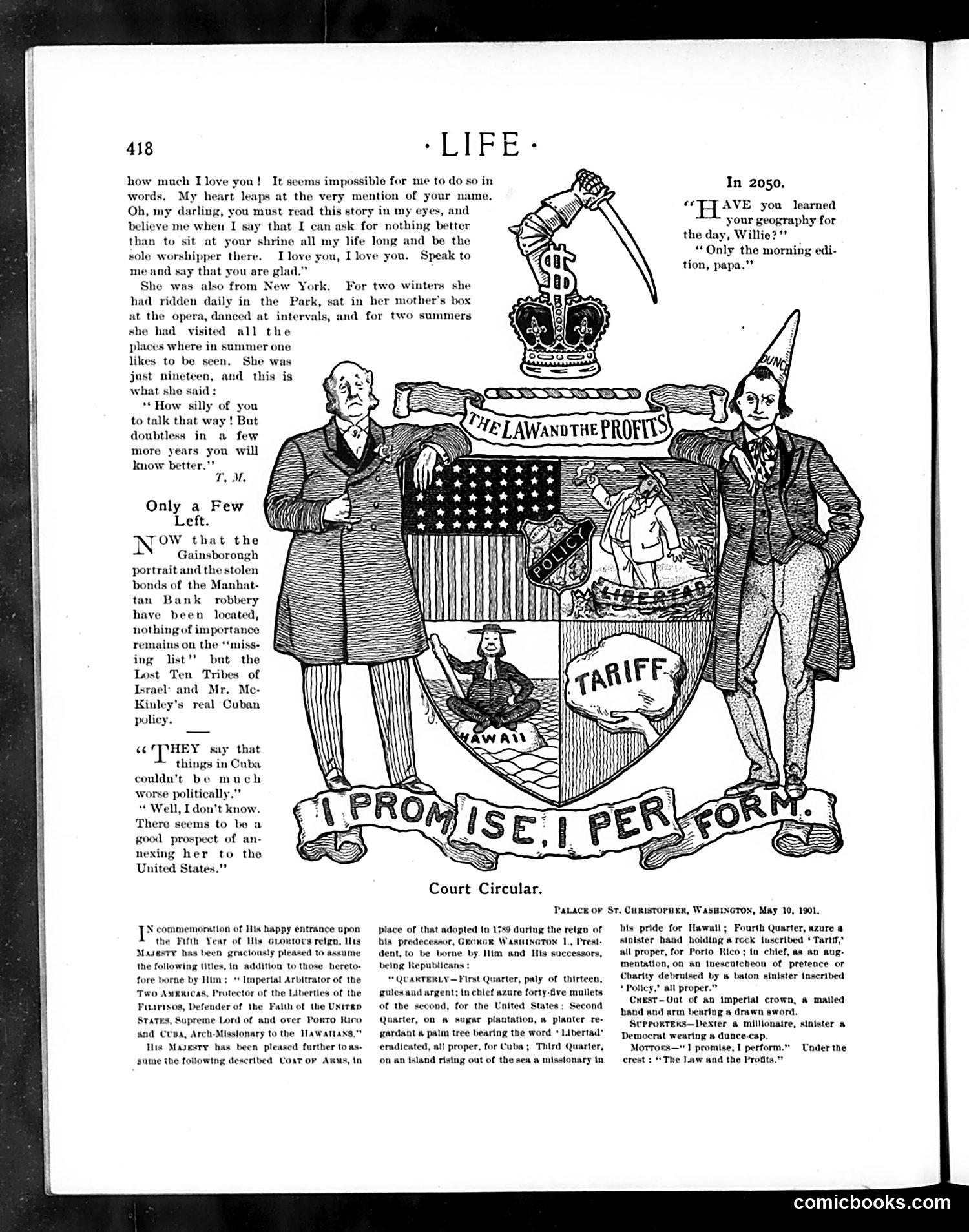
This is a satirical "Court Circular" mocking President Theodore Roosevelt's imperial ambitions following the Spanish-American War. The elaborate heraldic coat of arms depicts Roosevelt as a monarch, sarcastically granting himself new titles: "Imperial Arbitrator of the Two Americas," "Supreme Lord of Porto Rico and Cuba," and "Arch-Missionary to the Hawaiians." The cartoon critiques American expansionism and Roosevelt's interventionist foreign policy. Key visual elements include: - **Sugar plantation imagery** (Cuba reference) - **"Tariff" shield** (economic exploitation) - **Missionary symbol** (religious justification for imperialism) - **Two supporting figures** representing a millionaire and a Democrat wearing a dunce cap (partisan mockery) The motto "I Promise, I Perform" with crest reading "The Law and the Profits" explicitly satirizes the profit-driven motives behind American territorial expansion disguised as civilizing missions. The 1901 date places this during Roosevelt's early presidency, when Cuba and Puerto Rico were recent acquisitions.
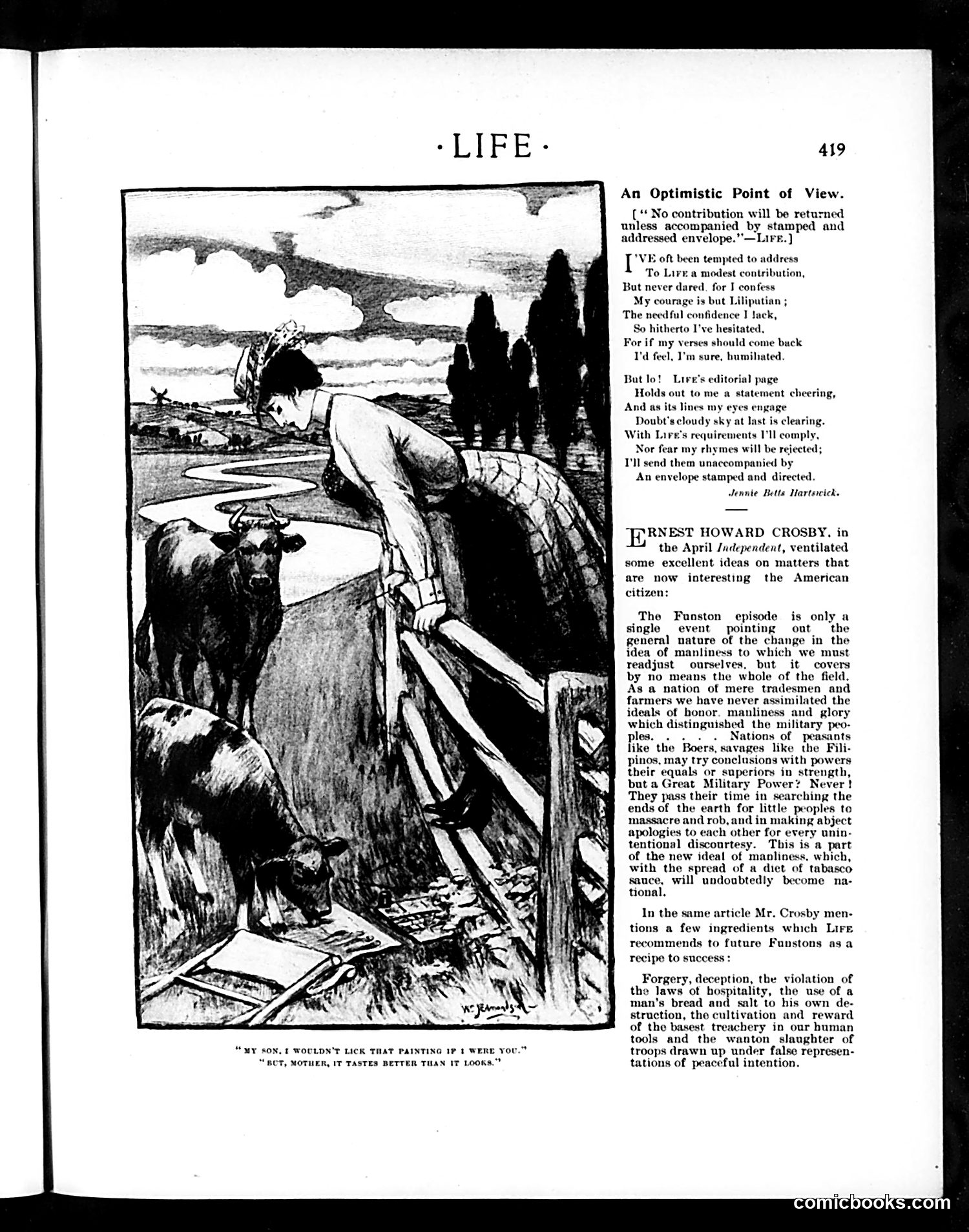
This page combines humor about magazine submissions with political critique of American imperialism. The **cartoon** (top) shows a mother rejecting her son's artwork as unpalatable—a visual joke about Life's policy requiring stamped return envelopes for rejected contributions. The accompanying verse humorously expresses a reader's newfound confidence in submitting work, now that Life won't return it without postage. The **main text** critiques **General Frederick Funston**, a controversial military figure involved in the Philippine-American War. Ernest Howard Crosby's article (reprinted from *The Independent*) sardonically attacks what he sees as America's new definition of "manliness"—abandoning honor for imperial conquest and deception. Crosby condemns U.S. tactics: massacring indigenous peoples, forgery, treachery, and exploiting hospitality under false pretenses. The satire's target is American military expansion and the moral compromise Crosby believes it represents, positioning the Philippines conflict as dishonorable despite being framed as civilizing or honorable.
This page contains two distinct pieces: **"Red, White and Blue" (top):** A brief humorous poem about a bride following the traditional wedding superstition of wearing something old, new, borrowed, and blue. The joke: she's marrying an old man ("The groom was old and she was blue"), making the superstition grimly literal—she gets her "old" requirement from the groom himself, and she's sad ("blue") about it. **"Vim Scissors at Nullus" (main story):** A longer anecdote about a French diplomat, Mr. Volsson, presenting himself to the King of Burma in traditional silk wrappings instead of a Western suit. The humor derives from his garment coming undone during the formal ceremony—a slapstick situation where he must maintain composure and etiquette while literally falling apart, terrified of breaching court protocol by acknowledging the problem. The page is primarily advertising below these stories, featuring whiskey and other product advertisements typical of the era.
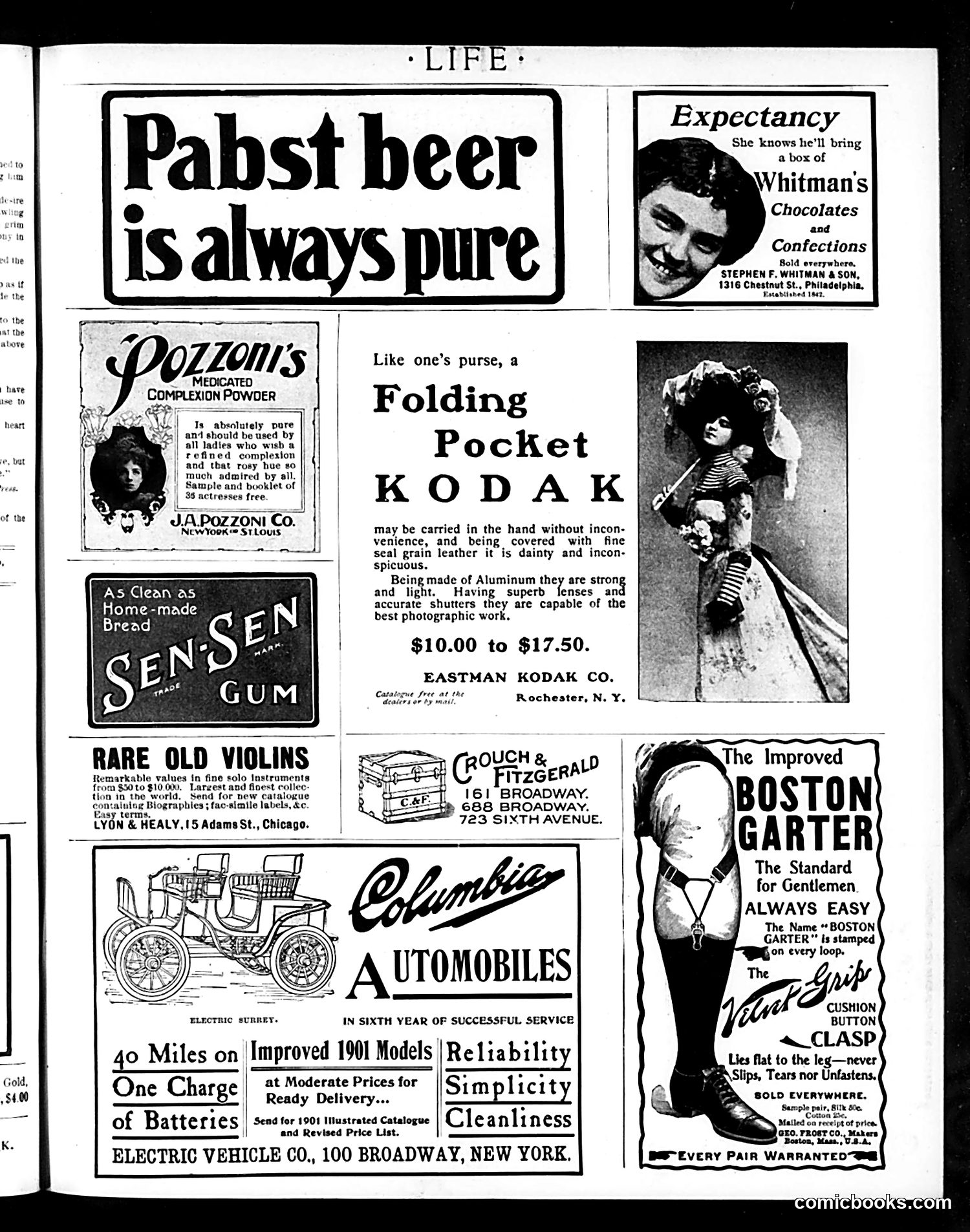
This is primarily an **advertising page** from Life magazine, circa 1901, containing no political cartoons or satire requiring historical context. The ads reflect turn-of-the-century consumer products and emerging technologies: - **Pabst Beer** emphasizes purity—a selling point during food safety concerns of the era - **Kodak's "Folding Pocket" camera** represents the democratization of photography; portable cameras were revolutionary luxury items - **Columbia and Electric Vehicle Company automobiles** showcase competing early automotive technologies, with electric vehicles still viable before gasoline dominance - **Whitman's Chocolates and Boston Garters** represent genteel courtship rituals (chocolate as romantic gift, garters as intimate apparel) - **Pozzoni's Complexion Powder** and similar beauty products reflect early 20th-century cosmetics marketing The ads collectively reveal what affluent readers valued: modernity, leisure, romance, and conspicuous consumption. No satire is evident; these are straightforward period advertisements.
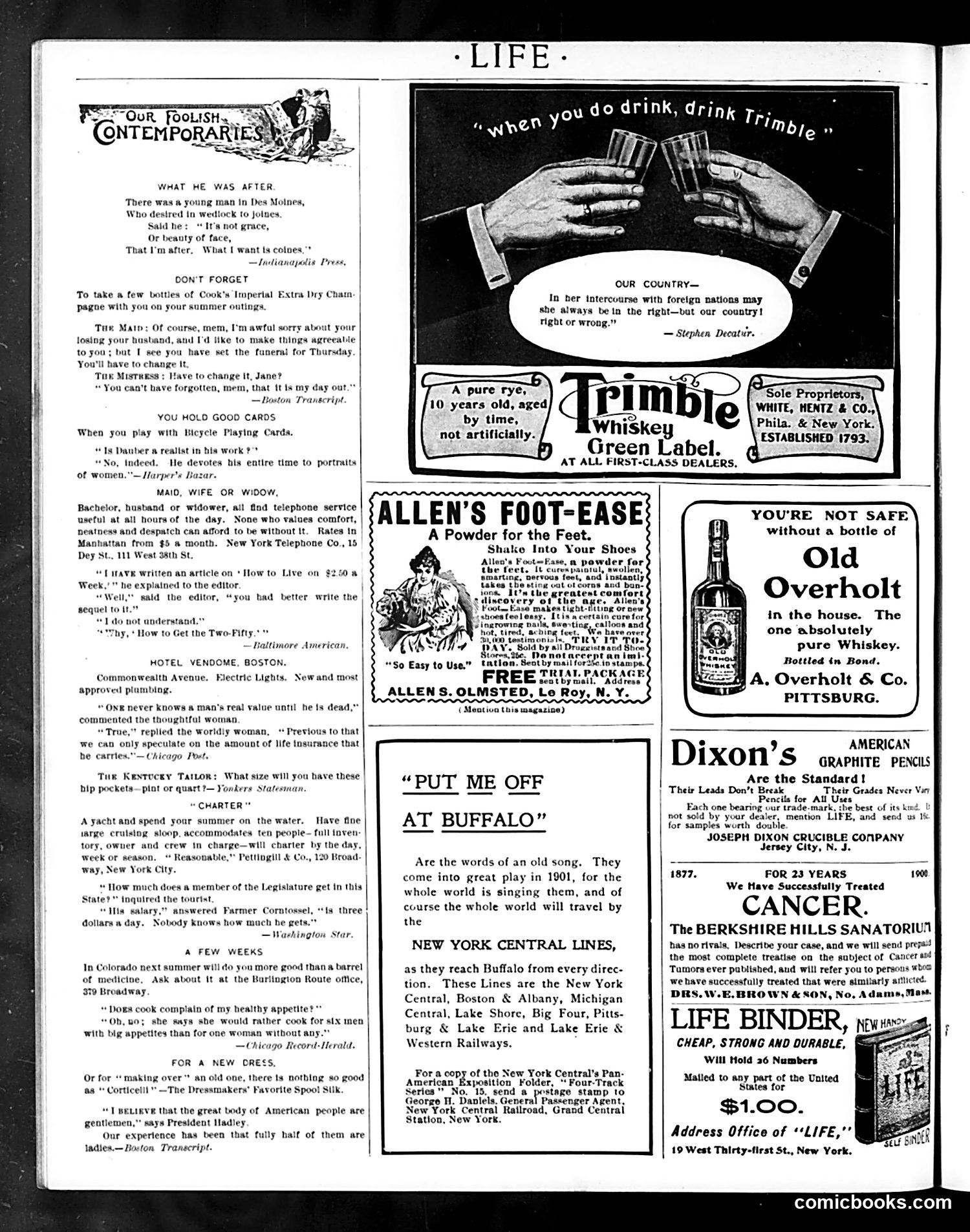
This page from *Life* magazine (early 1900s) is primarily **advertising mixed with satirical humor columns**, not a unified political cartoon. The satirical content mocks contemporary social attitudes: **"Our Foolish Contemporaries"** section ridicules a young man in Des Moines who wants marriage for financial reasons ("colors"/money) rather than love—satirizing mercenary attitudes toward matrimony. Other jokes target: - **Servant/employer class dynamics** (the maid requesting her day off during the funeral) - **Gender and marriage** (portraits of women as artists' subjects; wives valuing husbands primarily for life insurance) - **Political/social hierarchies** (legislators' true income sources unclear) - **Consumer culture** (advertisements for whiskey, foot powder, pencils, and telephone service) The **Trimble Whiskey ad** includes a patriotic Stephen Decatur quote ("my country, right or wrong"), which appears tongue-in-cheek given whiskey's association with excess. The page reflects early 1900s upper-middle-class anxieties: money, marriage, servants, and modern conveniences—all delivered through genteel mockery rather than sharp political satire.
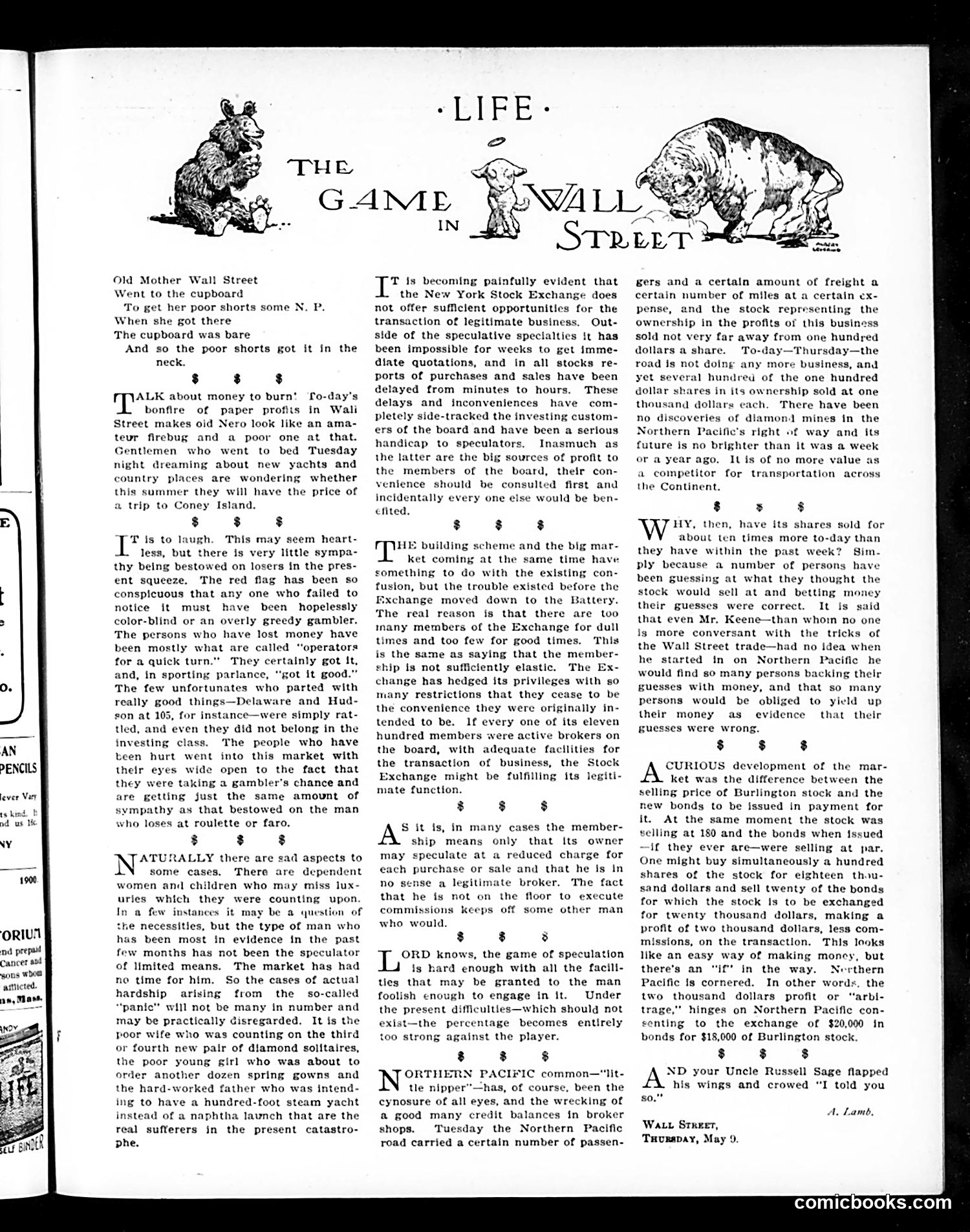
This page satirizes the 1907 stock market panic and its victims. The opening nursery rhyme parodies ("Old Mother Wall Street") mocks speculators who lost fortunes overnight. The article's central point: **speculators deserve no sympathy**. The author argues that those who lost money were greedy "operators" taking gambling chances with eyes wide open. True hardship is minimal—real suffering affects only dependent families, while the actual victims are the wives expecting diamond solitaires and daughters planning new gowns. The satire is caustic: the piece dismisses Wall Street's self-inflicted losses as entertainment, comparing it to roulette. It also critiques the Stock Exchange itself—overcrowded with 1,100 members creating delays that hamper legitimate investing while prioritizing speculators' convenience. The illustration (animals gambling) reinforces the careless, animalistic nature of market speculation. **Context**: This reflects post-1907 panic attitudes blaming speculators rather than systemic failures, while revealing class anxieties about wealth and consumption.
This is a book advertisement, not a cartoon. It announces the publication of Alfred Henry Lewis's biography of Richard Croker, the powerful boss of Tammany Hall (New York's Democratic political machine). The ad emphasizes that a major New York municipal election is imminent and positions the biography as essential reading for understanding Croker and the political machinery he controls. For modern readers: Croker was a controversial figure—a notorious political boss associated with corruption and backroom dealing. The ad's claim that Lewis provides both flattering and critical portrayals suggests the biography aimed for credibility despite Croker's questionable reputation. The urgency ("constantly in the public eye") reflects the high stakes of New York politics during the Progressive Era, when machine politics faced growing scrutiny.
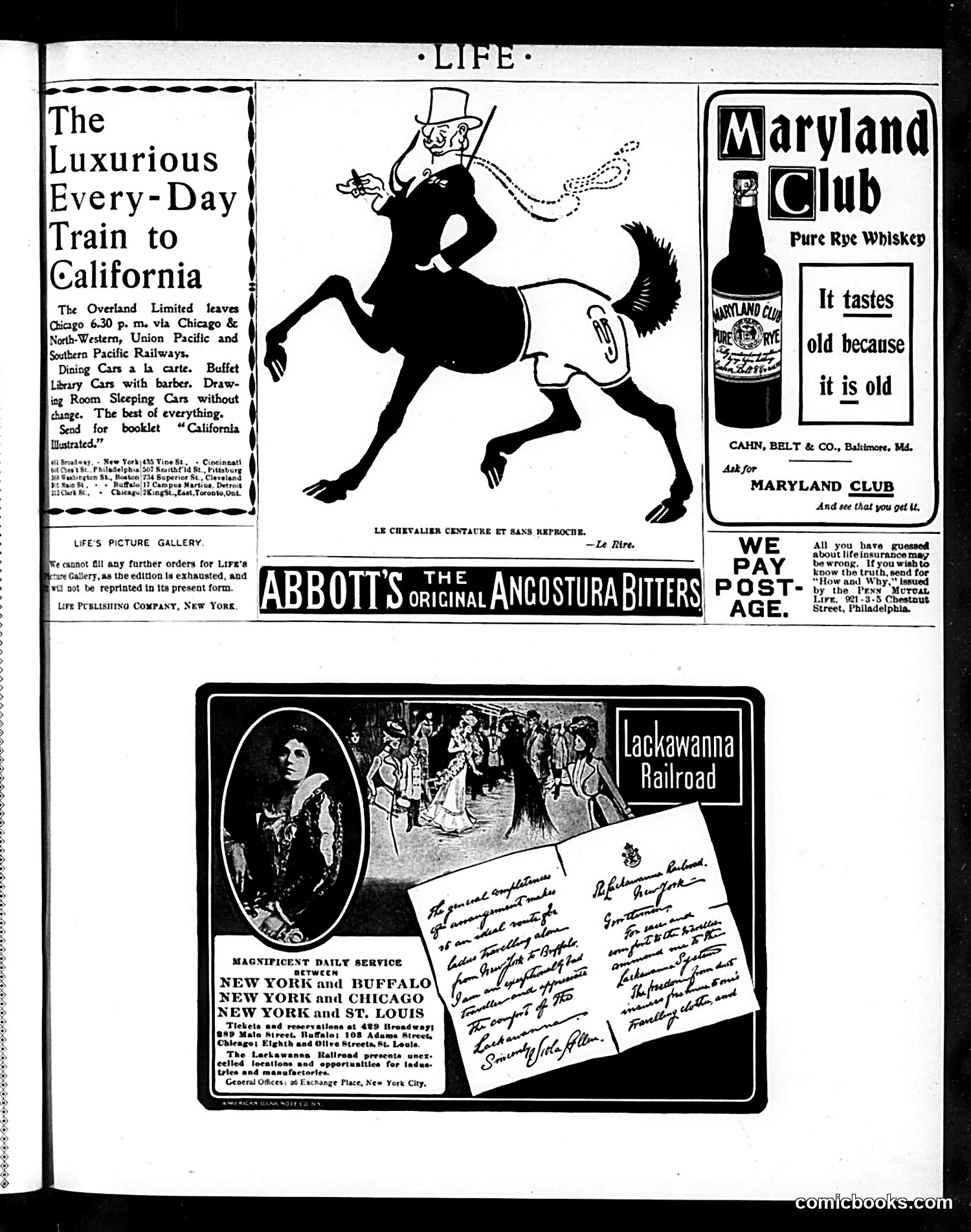
This page is primarily **advertising content** rather than editorial satire. The main elements are: 1. **Top section**: Train and whiskey ads—the Overland Limited luxury rail service to California, and Maryland Club Pure Rye Whiskey (marketed as "old" as a virtue). 2. **Central image**: A French-captioned cartoon ("Le Chevalier Centaure et Sans Reproche"—"The Knight Centaur Without Reproach") showing a playful centaur figure. This appears to be decorative rather than satirical—likely a classical artistic reference with no apparent political message. 3. **Bottom section**: Lackawanna Railroad advertisement featuring what appears to be a glamorous woman and handwritten letters promoting rail service between major cities (New York, Buffalo, Chicago, St. Louis). The page reflects early 20th-century advertising aesthetics emphasizing luxury travel and leisure. There is **no identifiable political cartoon or satire here**—it's a commercial page typical of Life's revenue model.
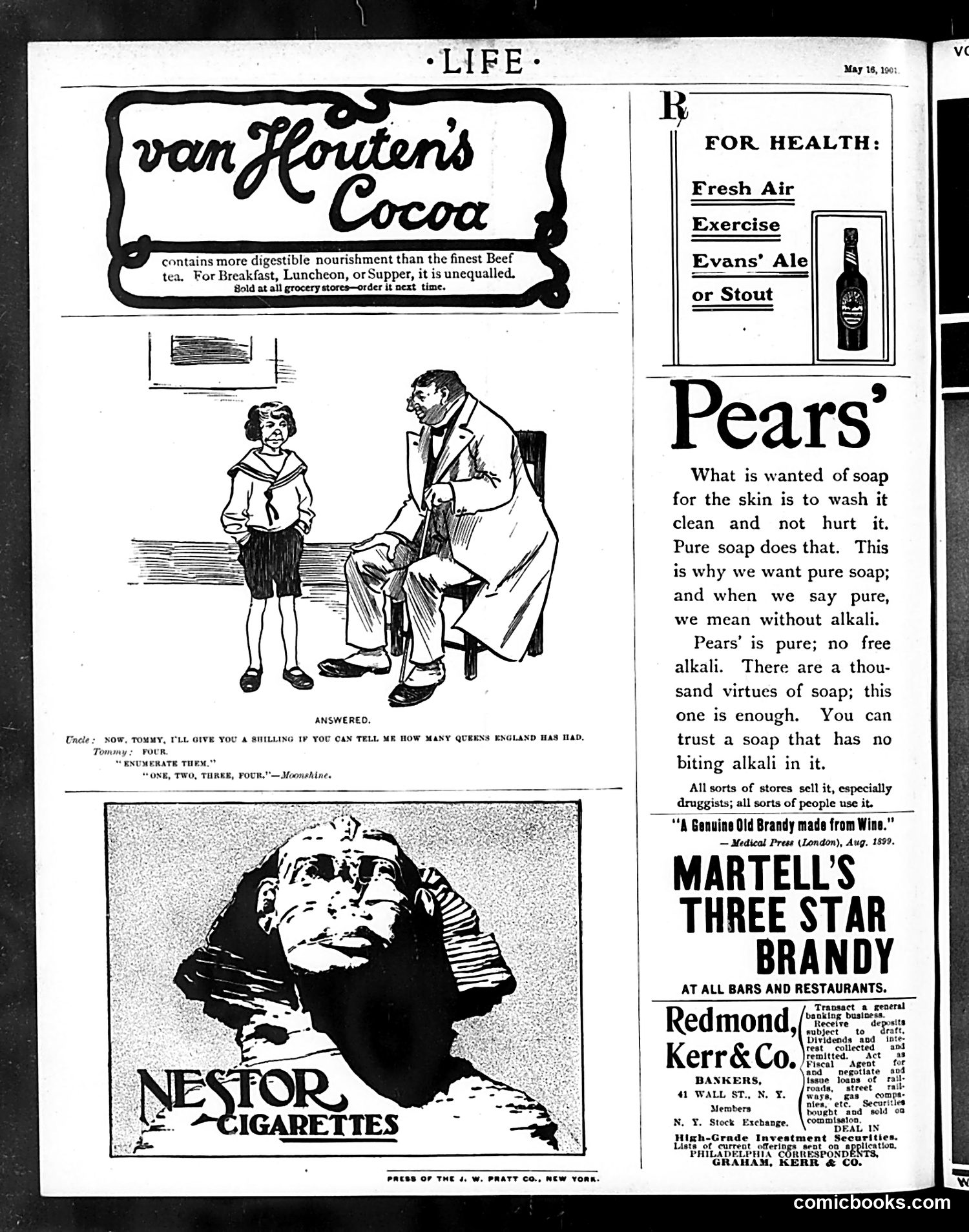
This is primarily an **advertising page** with one small cartoon. The main content consists of product ads for Van Houten's Cocoa, Evans' Ale, Pears' Soap, Nestor Cigarettes, and Martell's Brandy. The single cartoon shows an **Uncle quizzing his nephew Tommy** on English history. Tommy attempts to count "one, two, three, four" when asked how many queens England has had—a children's joke playing on the double meaning of "queens" (monarchs vs. the word "four" sounding like "queer"). The humor is innocent wordplay typical of early 1900s family magazines. The page reflects the era's advertising approach: health products (cocoa, ale, exercise) marketed alongside luxury goods (brandy, cigarettes, soap), with medicinal and nutritional claims now considered dubious or illegal.