
Life, 1901-05-16 · page 6 of 22
Life — May 16, 1901 — page 6: what you’re looking at
What you’re looking at
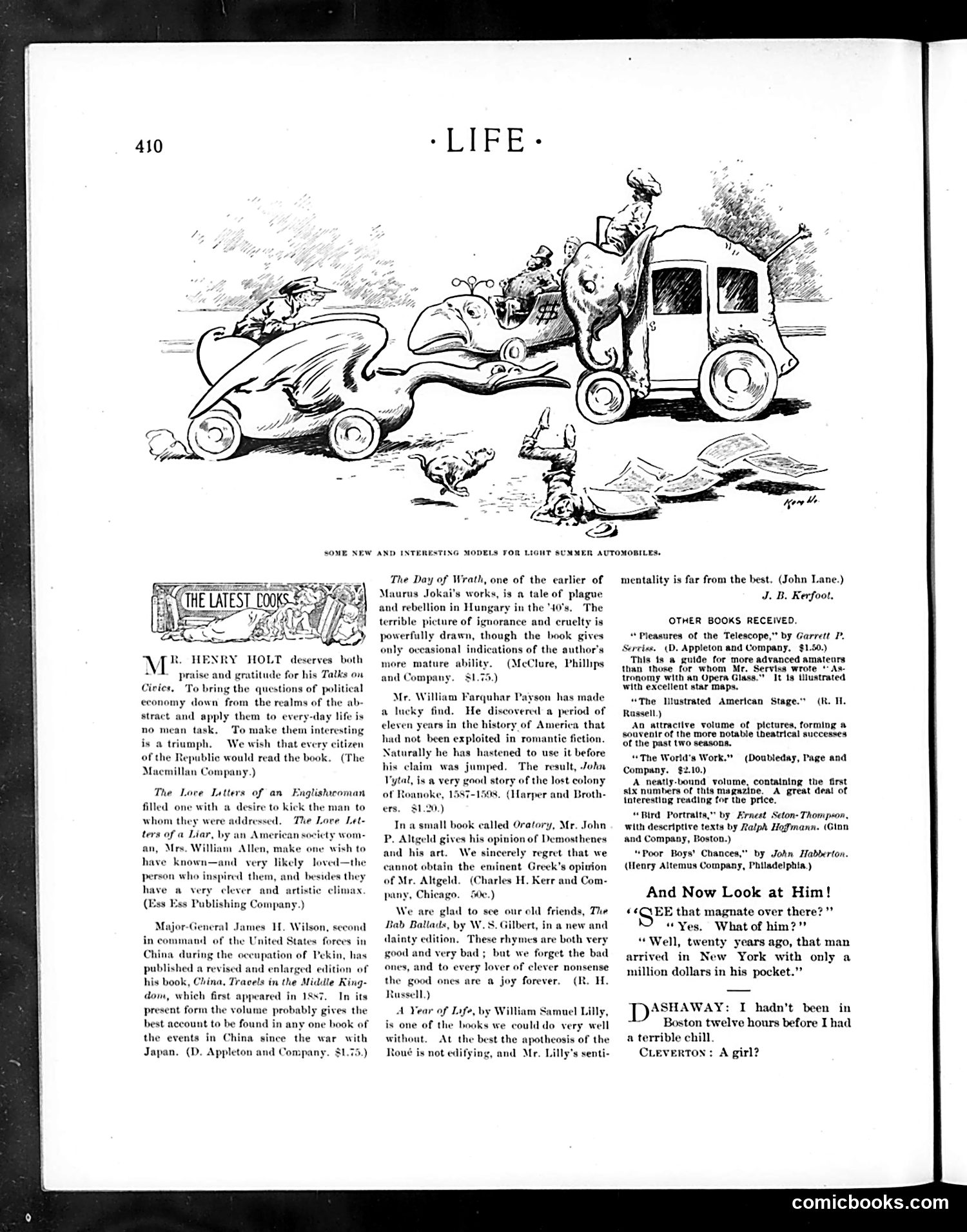
This cartoon satirizes early automobile design through exaggerated, whimsical vehicle forms. The left car appears as a stylized fish or sea creature on wheels, while the right resembles a grotesque beast or animal hybrid. Both carry passengers who seem oblivious to the absurdity. The satire likely mocks the rapid proliferation of automobile designs in the 1910s-1920s, when manufacturers experimented wildly with body shapes and forms before standardization. The cartoon suggests that some designers prioritized novelty and bizarre aesthetics over practical engineering. The accompanying text discusses various books, including works on China and literary collections, unrelated to the automotive humor above.
📄 Transcribed text from this page (OCR, searchable)
Machine-transcribed from the original scan — historical spelling and the odd misread are preserved.
HENRY HOLT deserves both for his Tat To bring the questions of pol economy down from the realms of the ab- stract and apply them to every-day lif no w sk. To make them inte: is a triumph. We wish that ev of the Republic would read the book. Macmillan Company.) The Love Iatters of an Englishwoman with a desire to kick the man to were addressed. The Love Let- ters of a Liar, by an American society wom- an, Mrs. William Allen, make one wish to have known—and very likely loved—the person who inspired them, and besides they have a very clever and artistic (Ess Ess Publishing Company.) Major-General in command « nes IL. Wilson, second f the United States forces in China during the oceupation of Pekin, published a revised and enlarged ¢ his book, China, Travels in the Middle King- dom, which first appeared in 1887. In its present form the volume probably gives the best account to be found in any one book of the events in China since the war with Japan. (D. Appleton and Company. Bs SOME NEW AND INTERESTING MODELS TOR LIGHT SUMMER AUTOMOBILES. The Day of Wrath, one of the earlier of Maurus Jokai's works, is a tale of plague and rebellion in Hungary in the ‘40's, The terrible picture of ignorance and cruelty is powerfully drawn, though the book gives only occasional indications of the author's more mature ability. (McClure, Phillips and Company. $1.75.) Mr. William Farquhar Payson has made a lucky find. He discovered a period of eleven years in the history of America that had not been exploited in romantic fiction. Naturally he has hastened to use it before his claim was jumped. The result, John Vytal, is a very good story of the lost colony of Roanoke, 15 Os. (Harper and Broth- ers. $1.20.) Ina small book called Oratory, Mr. John P. Altgeld gives his opinion of Demosthenes and his art. We sincerely regret that we cannot obtain the eminent Greek’s opinion of Mr. Altgeld. (Charles H. Kerr and Com- pany, Chic We.) We are glad to sce our old friends, The Rab Ballads, by W.S. Gilbert, in a new and dainty edition. These rhymes are both very good and very bad ; but we forget the bad d to every lover of clever nonsense pod ones are a joy forever. (IR. H. Russell.) A Year of Life, by William Samuel Lilly, is one of the books we could do very well without. At the best the apotheosis of th Roué is not edifying, and Mr. Lilly's senti- go. mentality is far from the best. (John Lane.) J. B. Kerfoot, OTHER BOOKS RECEIVED. “Pleasures of the Telescope,” by Garrett P. (D. Appleton and Company, $1.50.) ‘This 1s a guide for more advanced amateurs than those for whom Mr. rviss wrote * As- tronomy with an Opera Gh It 18 tlustrated with excellent star maps, “The Ilustrated American Stage.” Rassell.) An attractive volume of pictures, forming @ souvenir of the more notable theatrical successes of the past two seasons. “The World's Work.” Company. $2.10.) A heatly-bound volume, containing the first six numbers of this magazine. A great dea! of loteresting reading for the price. “Bird Portratta,” by Ernest Seton- Thompson, with descriptive texts by Ralph Hofmann. (Gton and Company, Boston.) “Poor Boys’ Chances,” by John Habberton. (Henry Altemus Company, Philadelphia.) Serciss. (ke (Doubleday, Page and And Now Look at Him! «¢Q\EE that magnate over there? ’’ “Yes. What of him?’ “Well, twenty years ago, that man arrived in New York with only a million dollars in his pocket.”” [)AsBA Was: I hadn't been in Boston twelve hours before I had a terrible chill. CLeverton: A girl? comicbooks.com