
A complete issue · 20 pages · 1901
Life — March 7, 1901
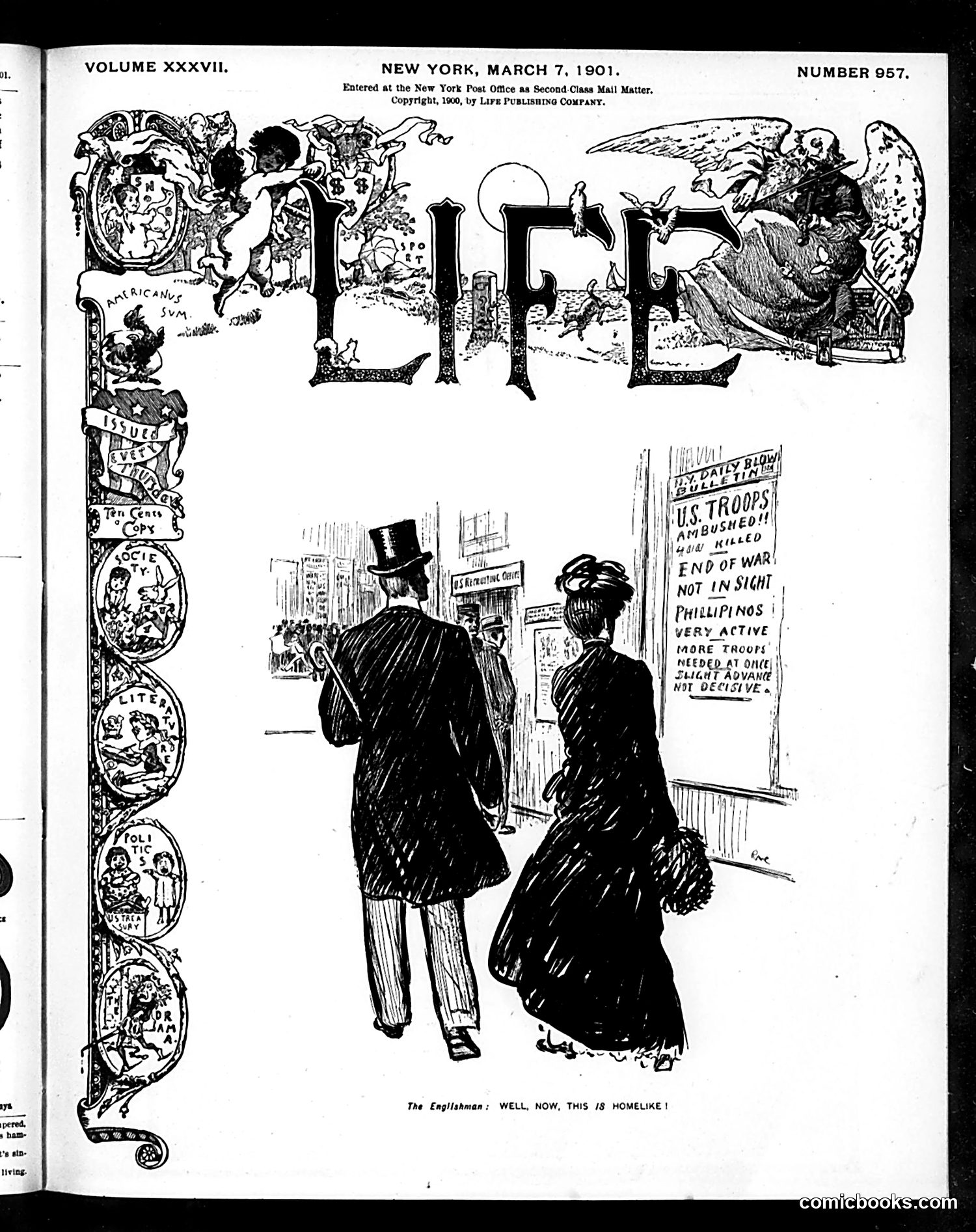
This page features a cartoon titled "The Englishman: 'Well, Now, This Is Homelike!'" showing two figures reading newspaper headlines about the Philippine-American War. The visible headlines reference U.S. troops being ambushed, the war's continuation despite hopes for peace, and Philippine forces remaining active. The satire appears to mock British observers finding the ongoing American military struggle in the Philippines grimly familiar—comparing it to Britain's own difficult Boer War (1899-1902), which was then still ongoing in South Africa. The cartoon suggests the English found bitter irony in America's entanglement in a colonial conflict, having recently faced similar guerrilla warfare challenges themselves. The decorative left border and ornate "LIFE" masthead are typical period design elements.
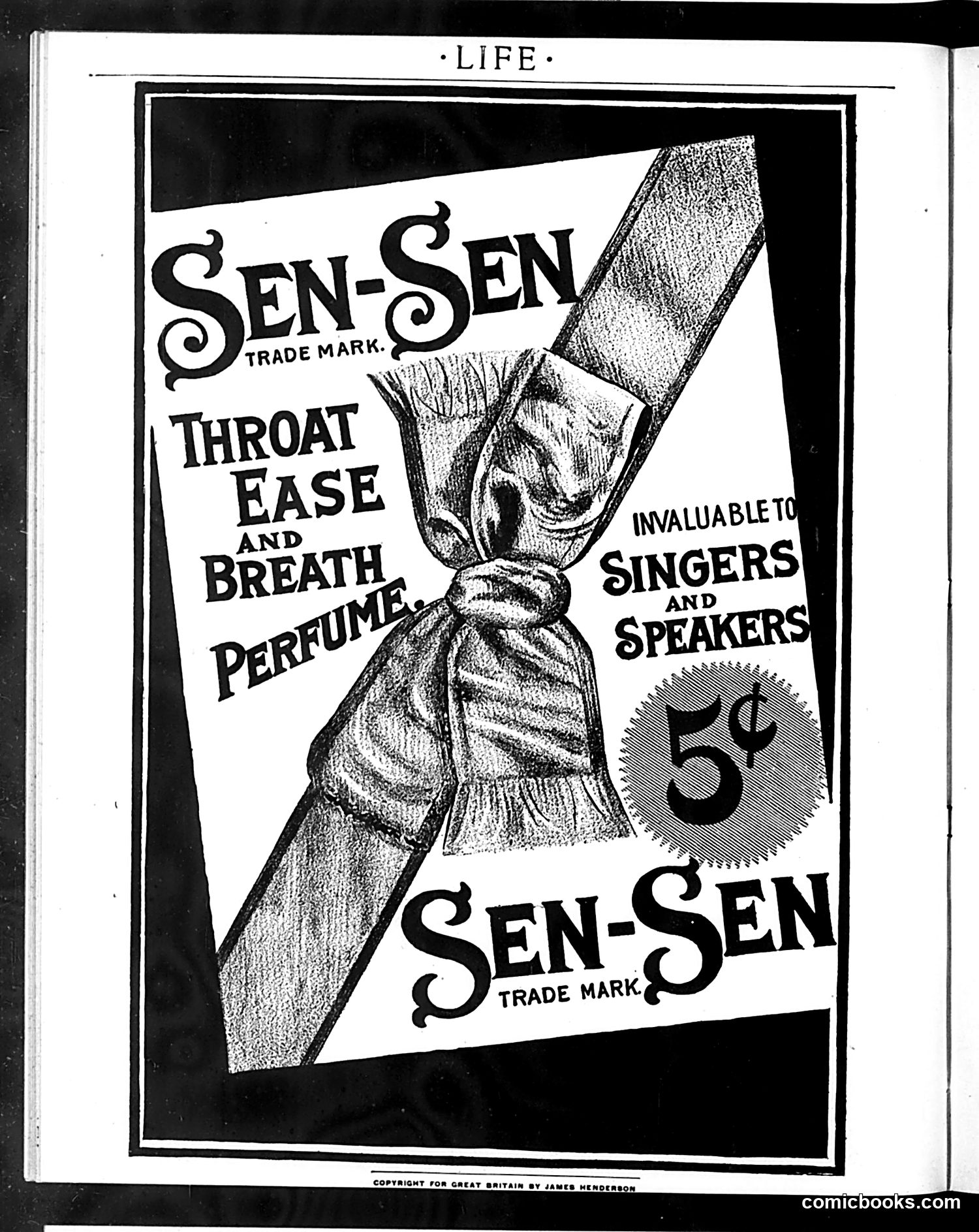
This is a **product advertisement**, not political satire. It promotes Sen-Sen, a breath perfume/lozenge product marketed as a "Throat Ease and Breath Perfume" for 5 cents. The ad's appeal targets **singers and speakers** — professionals who needed fresh breath and throat comfort for vocal performance. The illustration shows a stylized throat and neck area, emphasizing the product's function for vocal professionals. The design uses Art Nouveau–style typography with decorative flourishes typical of early 20th-century advertising. There is **no political content or satirical message** — this is straightforward commercial advertising appearing in *Life* magazine, leveraging the publication's readership to reach consumers seeking health and hygiene products.
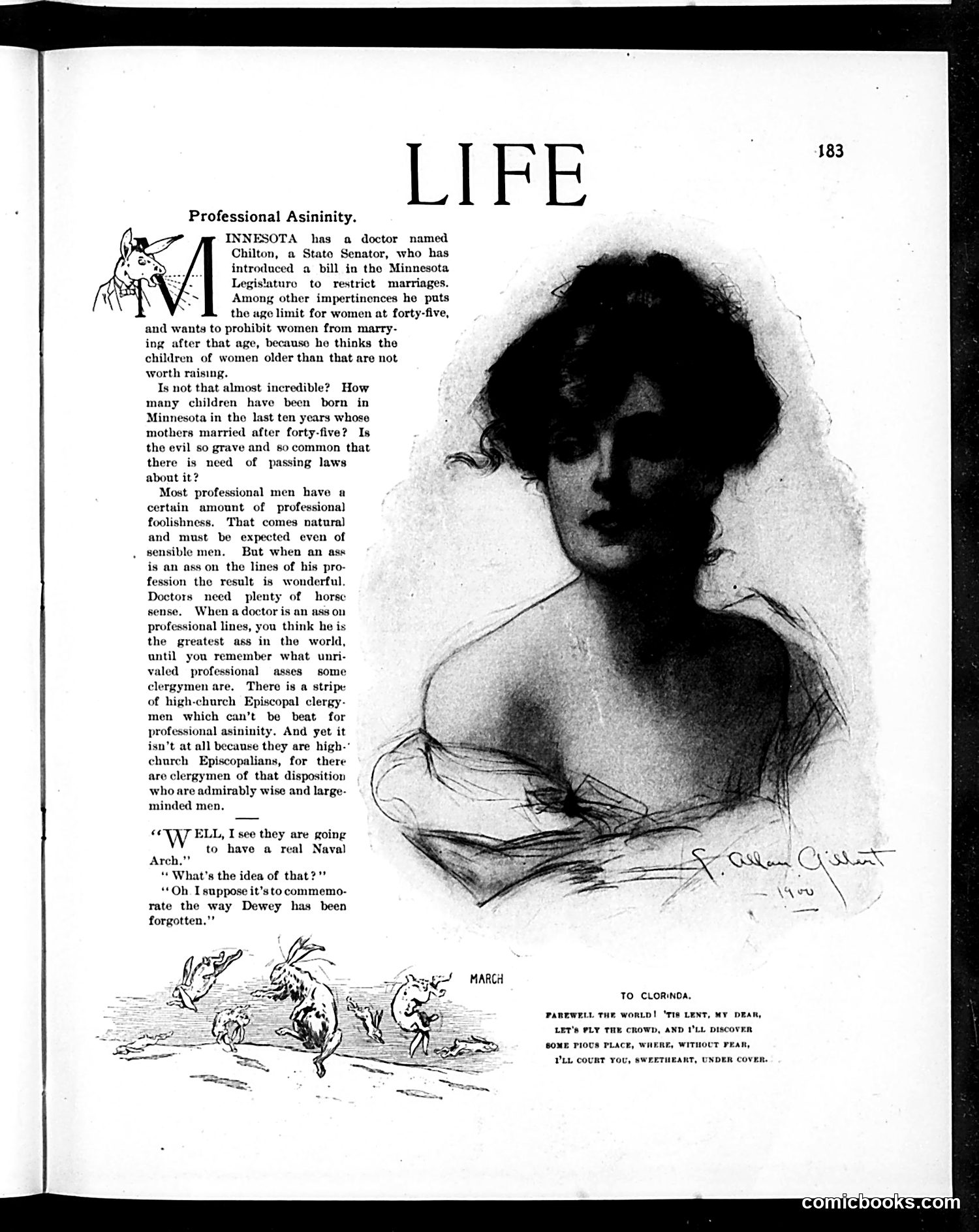
This page satirizes Dr. Chilton, a Minnesota State Senator who proposed legislation restricting women's marriage rights—specifically banning women over forty-five from marrying and prohibiting marriage after that age, based on his belief that children of older mothers aren't "worth raising." The article mocks his proposal as absurdly presumptuous. It argues that while professionals naturally possess some foolishness, this particular position represents extreme professional arrogance. The satire notes that even high-church Episcopal clergy—traditionally criticized for snobbery—aren't this unreasonable. The cartoon illustrates the piece's contempt for such legislative overreach into personal reproductive decisions, positioning Chilton's proposal as laughably misguided paternalism masked as public policy.
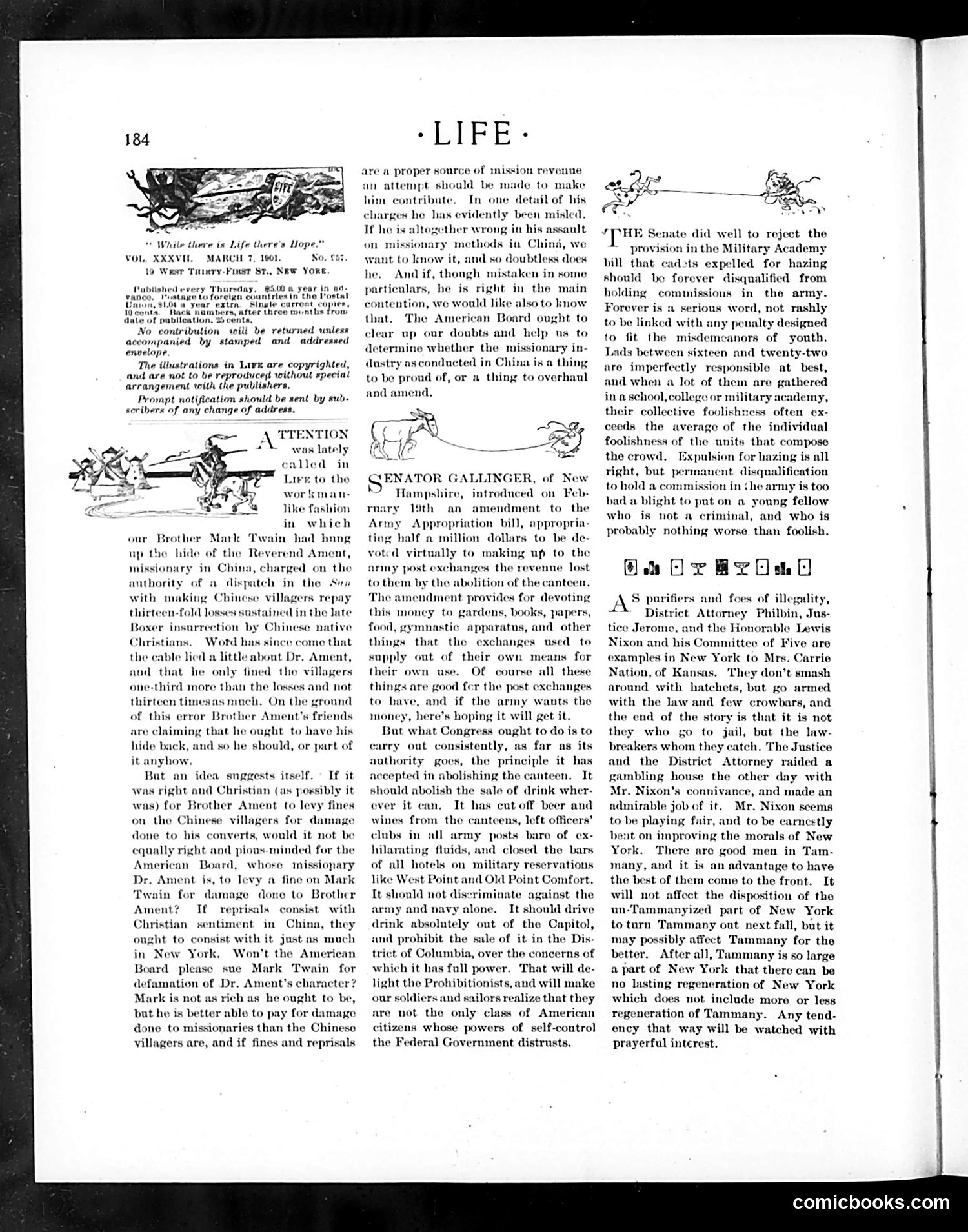
The page contains two distinct political commentaries: **Left section:** A cartoon criticizing Dr. Ament, a missionary in China involved in the Boxer Rebellion aftermath. The text discusses whether Ament should compensate Chinese villagers for damages, satirizing American missionary conduct and the question of whether mission work justifies property destruction. The cartoon appears to mock Ament's defensive position. **Right section:** Commentary on Senator Gallinger's amendment to an Army Appropriation bill, proposing funds for post exchanges. The text debates whether army canteens should be abolished—a temperance/reform issue. The satirical point critiques Congress's inconsistency: they should either consistently support or oppose the exchanges, rather than selectively funding them while claiming prohibition principles. Both pieces exemplify Life's style of mocking political hypocrisy and moral inconsistency.
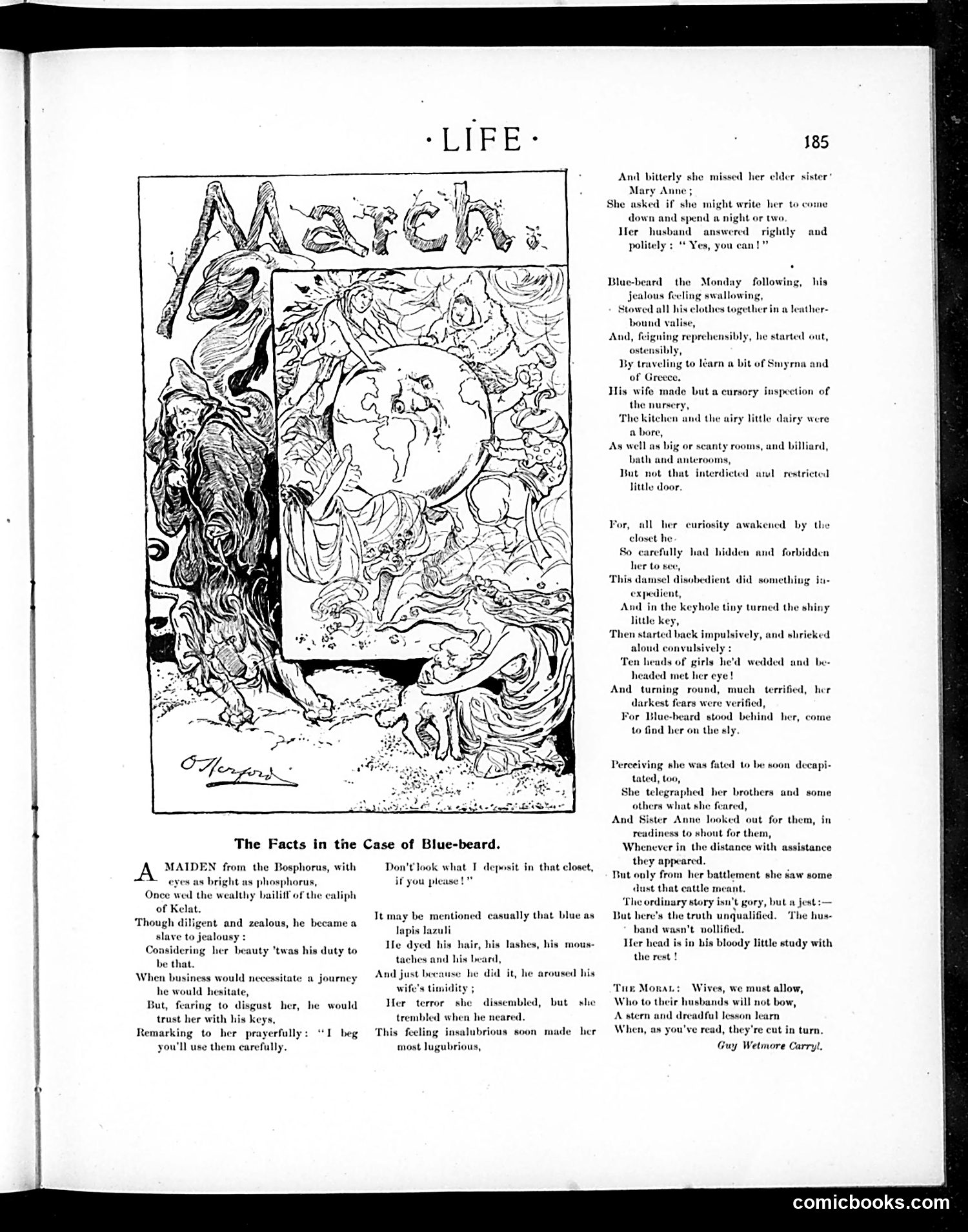
This page illustrates a satirical retelling of the classic "Bluebeard" fairy tale. The elaborate decorative illustration shows the forbidden closet's grotesque contents—the previous wives' heads and bodies—rendered in Art Nouveau style. The accompanying text presents the story as social commentary on marriage, with a moral explicitly stated at bottom: "Wives, we must allow, / Who to their husbands will not bow, / A stern and dreadful lesson learn." The satire critiques both the husband's tyranny and the wife's disobedience, using the Gothic horror tale to mock Victorian marriage dynamics. The final attribution to "Guy Wetmore Carryl" suggests this is a humorous poetic reinterpretation rather than literal endorsement of spousal submission—likely ironic commentary on restrictive marital conventions of the era.
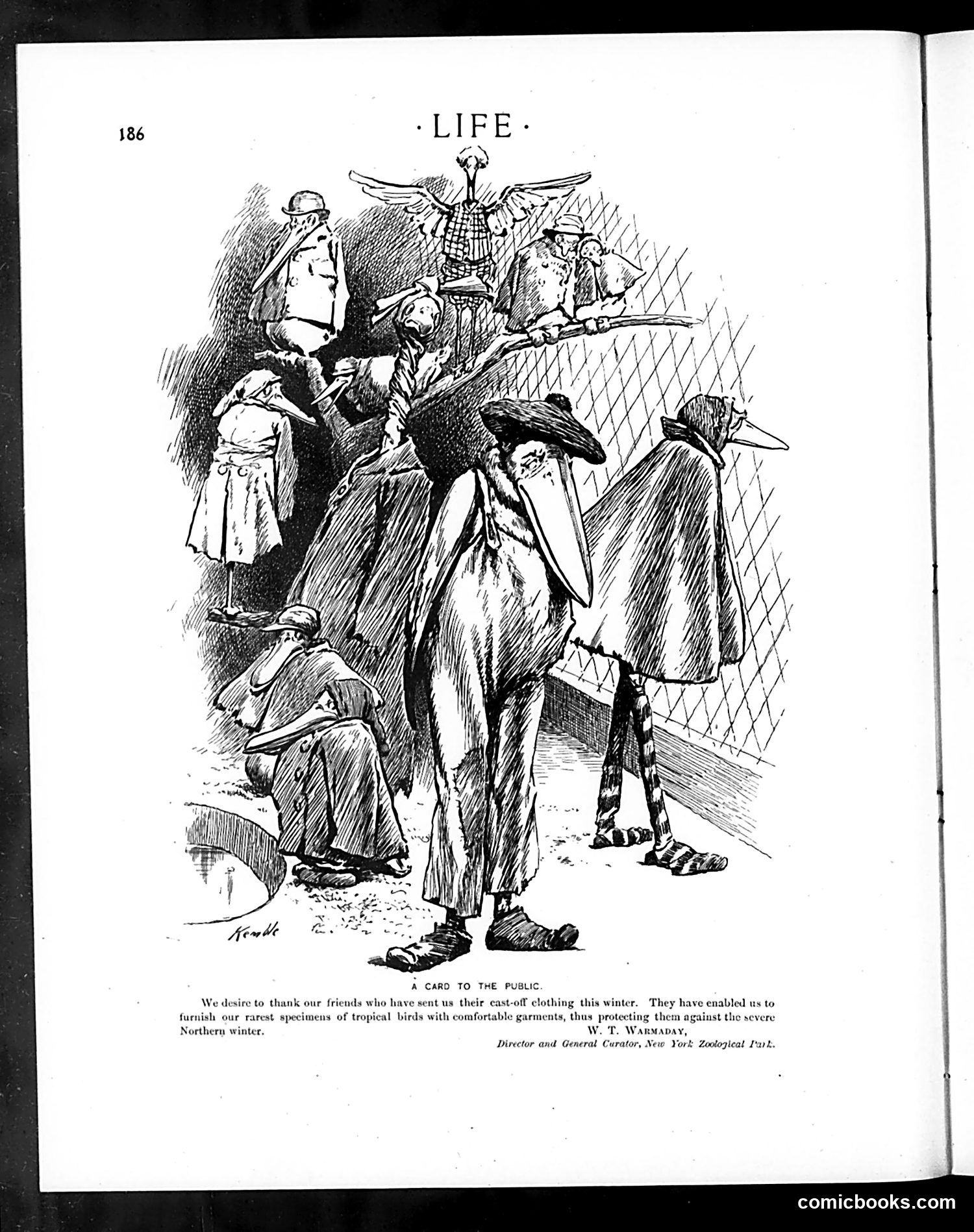
This is a charitable appeal illustrated by artist Kemble, credited to W.T. Hornaday, Director and General Curator of the New York Zoological Park. The cartoon depicts figures dressed in cast-off winter clothing distributed to tropical birds at the zoo. The satire is straightforward: it humorously personifies the birds as human characters wearing oversized, ill-fitting donated garments—apparently the comic point is visualizing birds in human clothes. However, the underlying message is sincere: Hornaday is thanking the public for donating used winter clothing that the zoo repurposes to protect tropical birds from harsh Northern winters, keeping rare specimens comfortable during cold months. The humor serves the charitable cause.
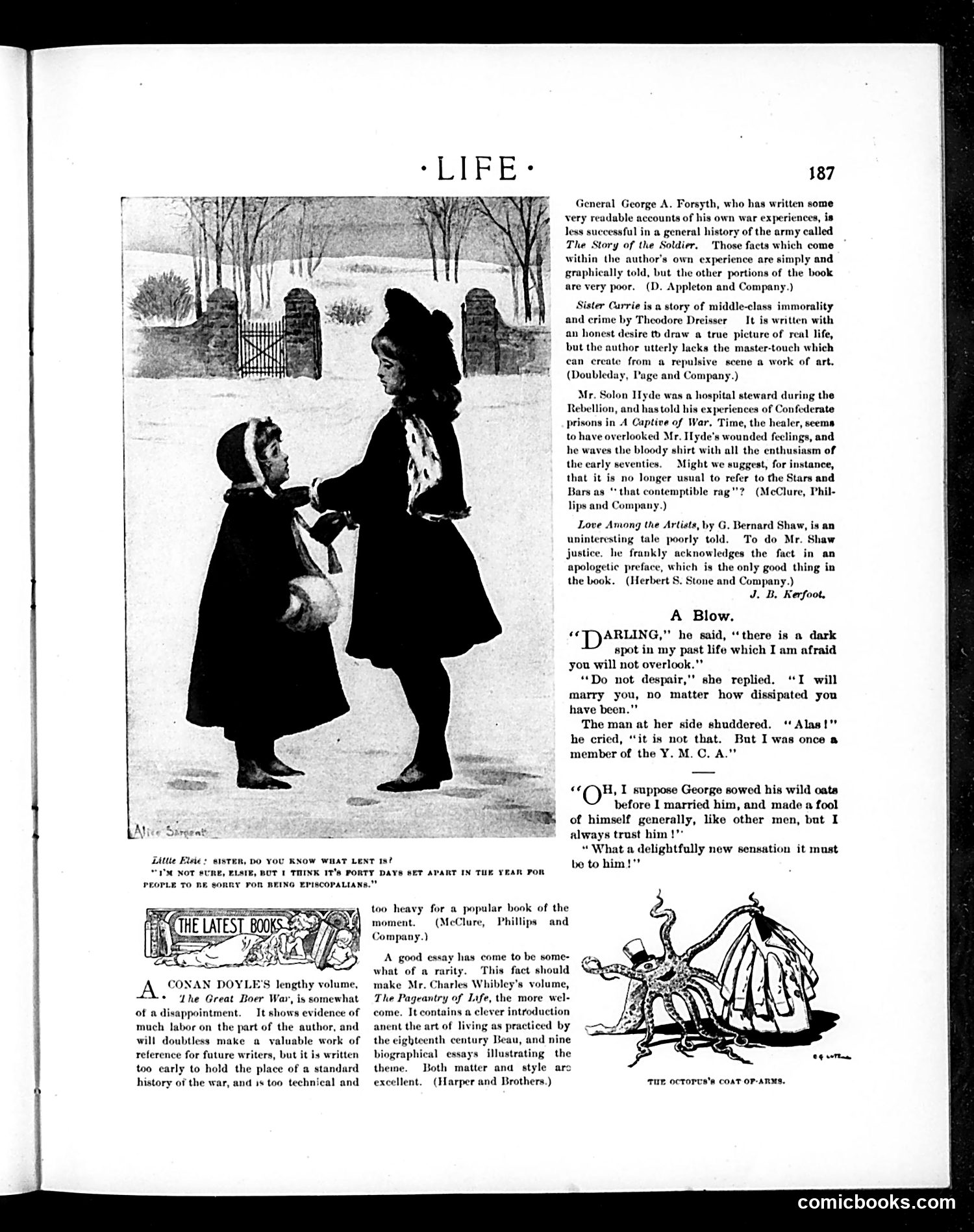
**Main Illustration & Story "A Blow":** The large illustration shows two figures in winter clothing having an emotional conversation. The caption quotes a woman telling a man she will marry him despite his "dark spot" in his past—specifically that he was "once a member of the Y.M.C.A." (Young Men's Christian Association). The satire mocks Victorian-era social anxiety about respectability. The Y.M.C.A. membership, typically associated with moral improvement, is treated as scandalous. This inverts expectations: the joke is that even wholesome activities were viewed suspiciously in high society, or that the man's redemption through this organization is somehow compromising rather than virtuous. The surrounding text reviews contemporary books on middle-class morality and war experiences, reinforcing themes of propriety and social judgment.
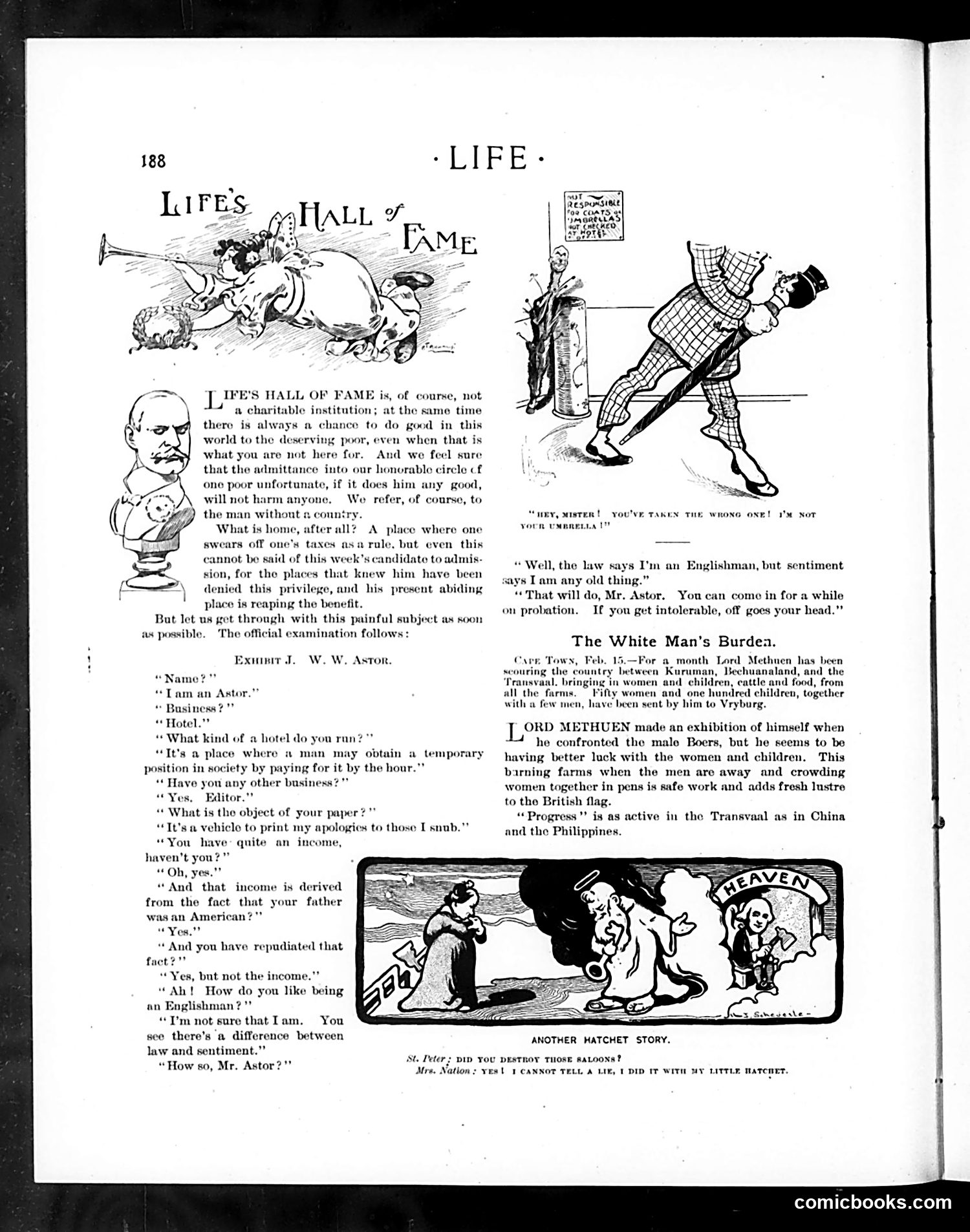
The page satirizes British imperialism, specifically Lord Methuen's conduct during the Boer War in South Africa. "The White Man's Burden" section mocks the colonial justification for empire-building—the notion that Western powers had a moral duty to "civilize" other lands. The main cartoon shows a figure (likely representing an English colonial administrator) being confronted about taking the "wrong umbrella," a visual pun on property theft and imperial appropriation. The dialogue with "Mr. Astor" (a wealthy figure) ridicules the hypocrisy of English gentlemen claiming moral superiority while deriving wealth from colonial exploitation. The satirical Q&A exposes how inherited money contradicts claims of ethical conduct. The "hatchet story" cartoon at bottom further mocks colonial violence and its rationalization.
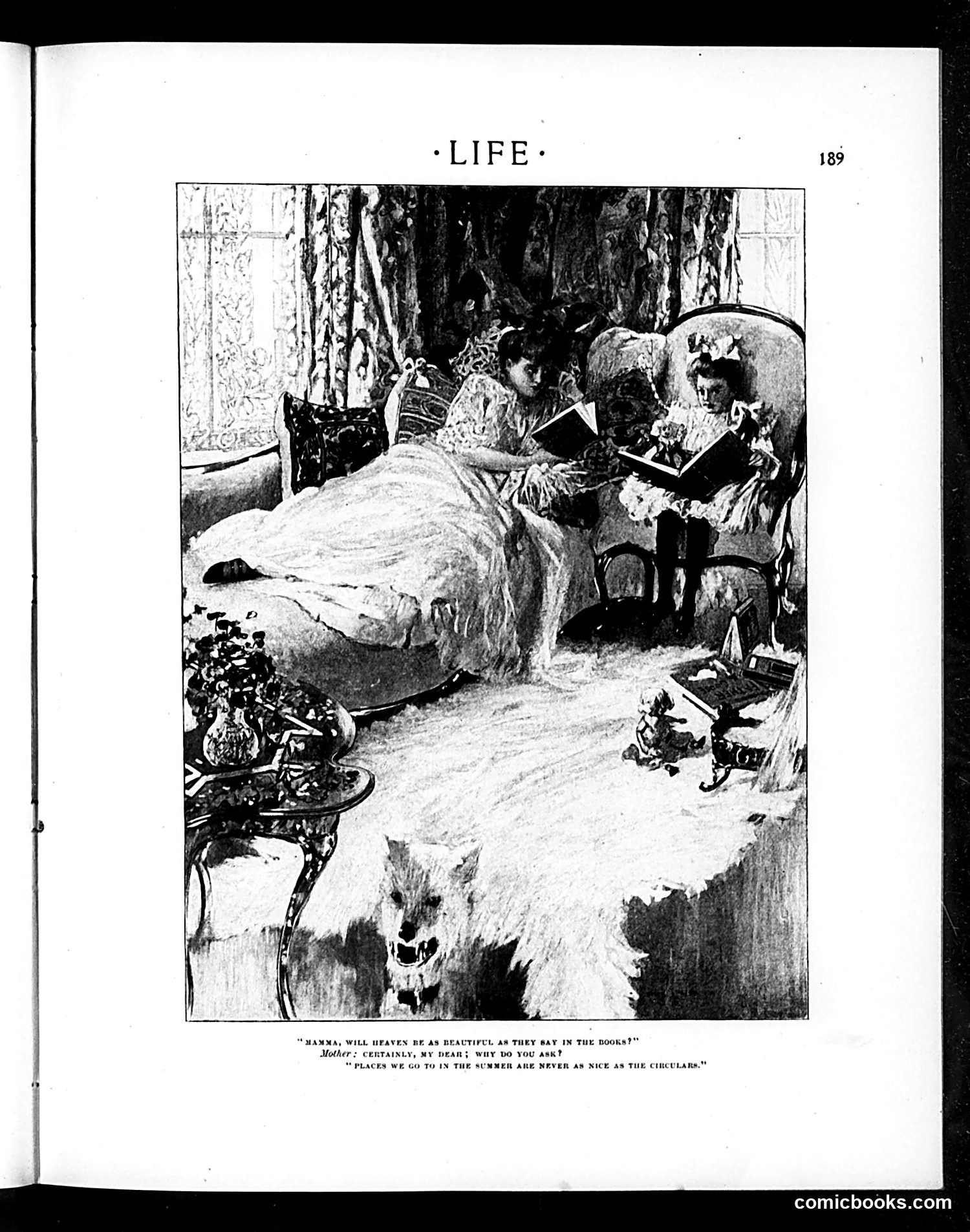
This page from *Life* magazine (page 189) depicts a domestic interior scene featuring a woman reclining on a bed while reading, attended by servants. A black cat sits in the foreground, and ornate furniture and decorative objects are visible. The dialogue quoted below the image reads: "Mamma, will heavens be as beautiful as they say in the books?" with the Mother's response about summer places and circuses. This appears to be **satirical commentary on wealth and leisure-class pretensions**. The joke targets how affluent mothers expose children to elevated ideals (heavenly beauty, literature) while their actual lives revolve around luxury vacations and entertainment. The visual abundance—servants, fine furnishings, idle repose—contrasts with supposedly refined cultural values, mocking the hypocrisy of wealthy families who claim intellectual or spiritual standards while living hedonistically.
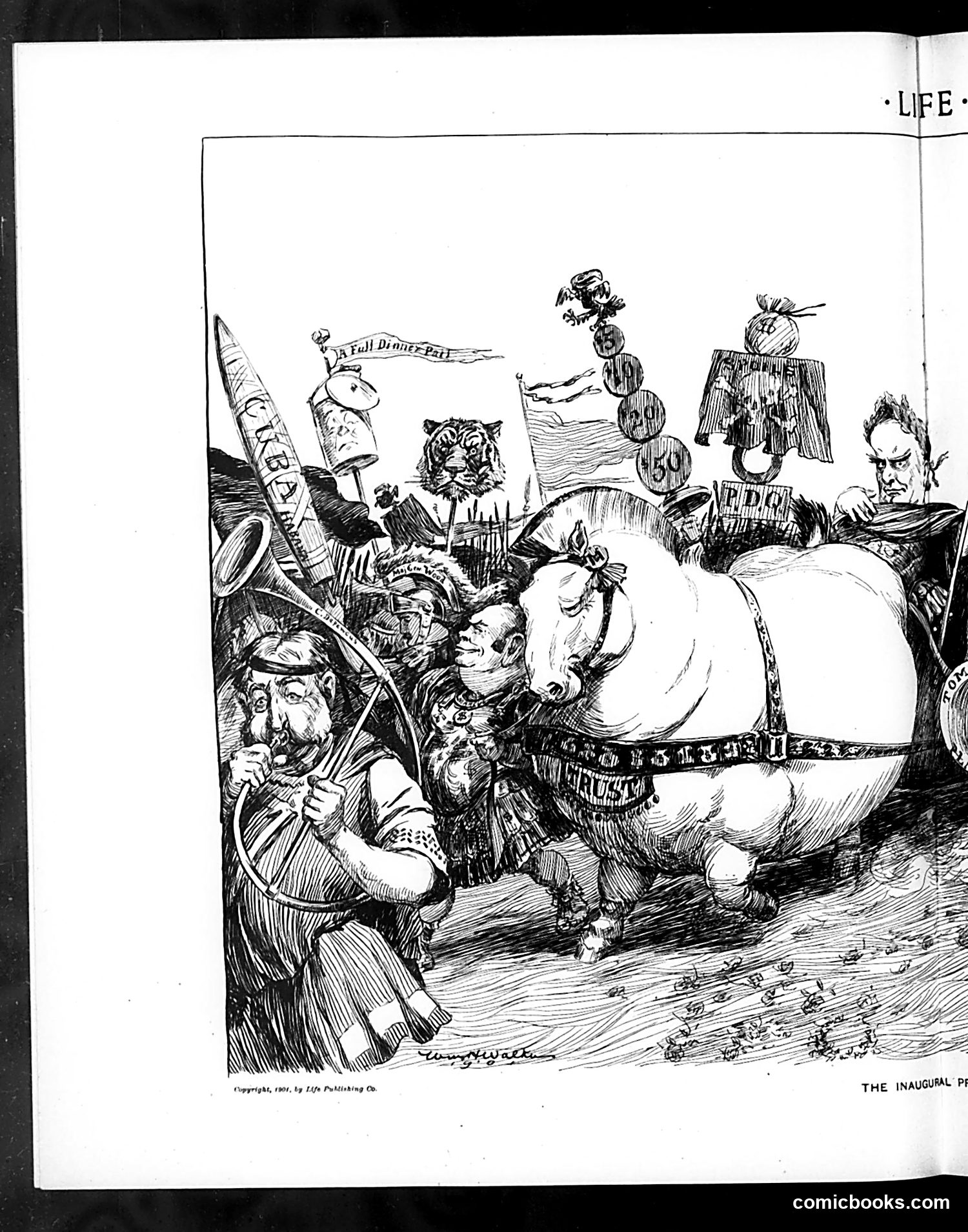
This is a satirical cartoon from Life magazine depicting "The Inaugural P[arade]" (text cut off). The image shows military/political figures with exaggerated caricatured features, including soldiers with weapons and what appears to be a prominent hippopotamus or large animal in the center of a procession. The cartoon satirizes a presidential inauguration parade, likely mocking militarism, imperial pretension, or political pomposity of the era. The grotesque animal figure may represent a political figure or symbolize the absurdity of the proceedings. The soldiers and elaborate military display suggest criticism of excessive military pageantry or warmongering. Without the complete date or additional context visible on this page, the specific political target remains unclear, though the style suggests early-to-mid 20th century American political commentary.
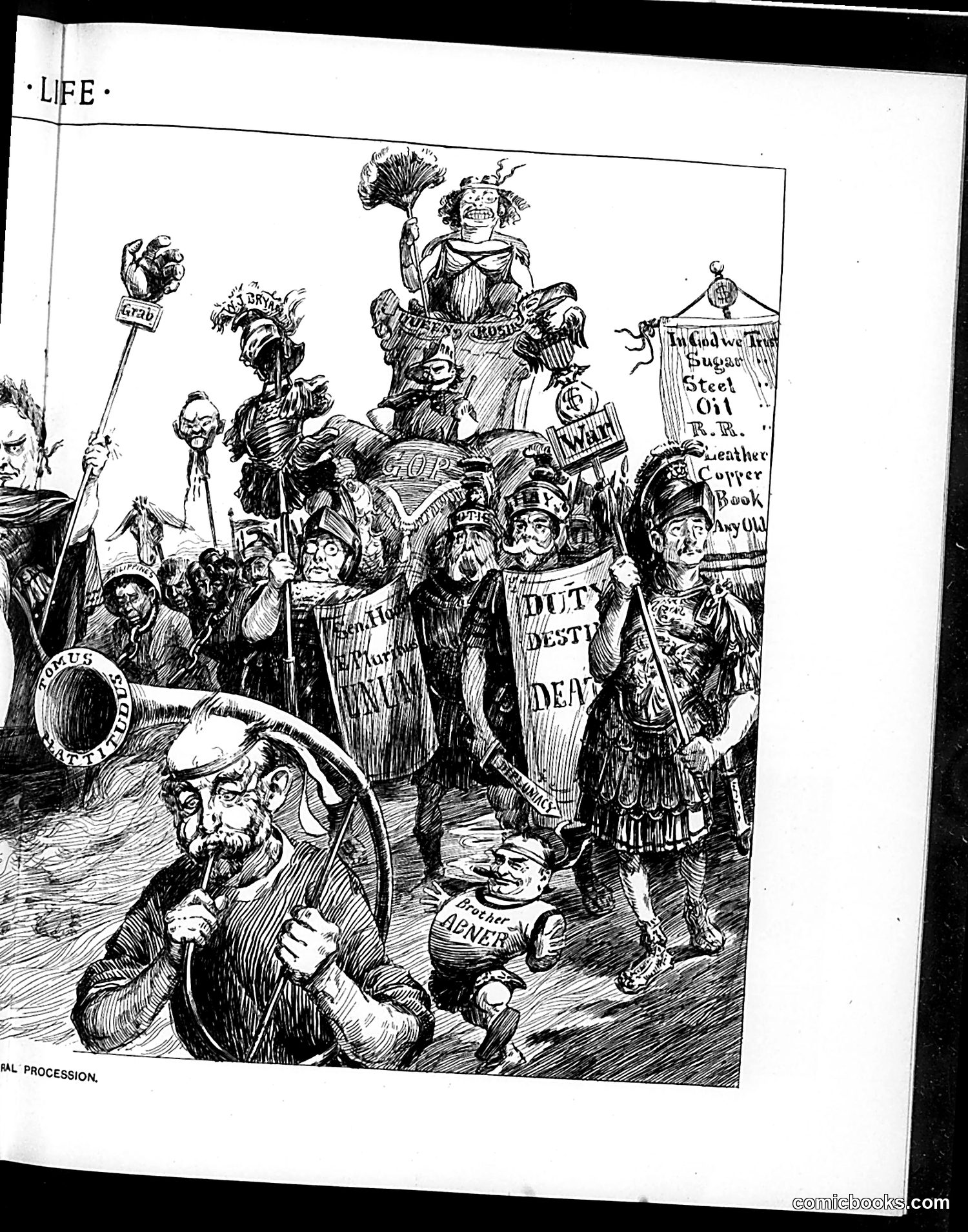
This satirical cartoon depicts a procession of figures labeled with commercial products and brand names, suggesting a critique of American consumerism or commercial culture. The central elevated figure appears to be a deity or authority presiding over the parade. Various participants carry banners and signs referencing products like "Oil," "Leather," "Copper," "Book," and what appears to be consumer goods. The foreground shows a kneeling or prostrate figure, implying worship or submission to commercial interests. The overall composition suggests the cartoon satirizes how American society has become dominated by commercial enterprise and product consumption—treating corporations and commodities as objects of religious reverence. The title "LIFE" and the procession format parody religious or civic ceremonies, mocking the elevation of commercial interests above traditional values.
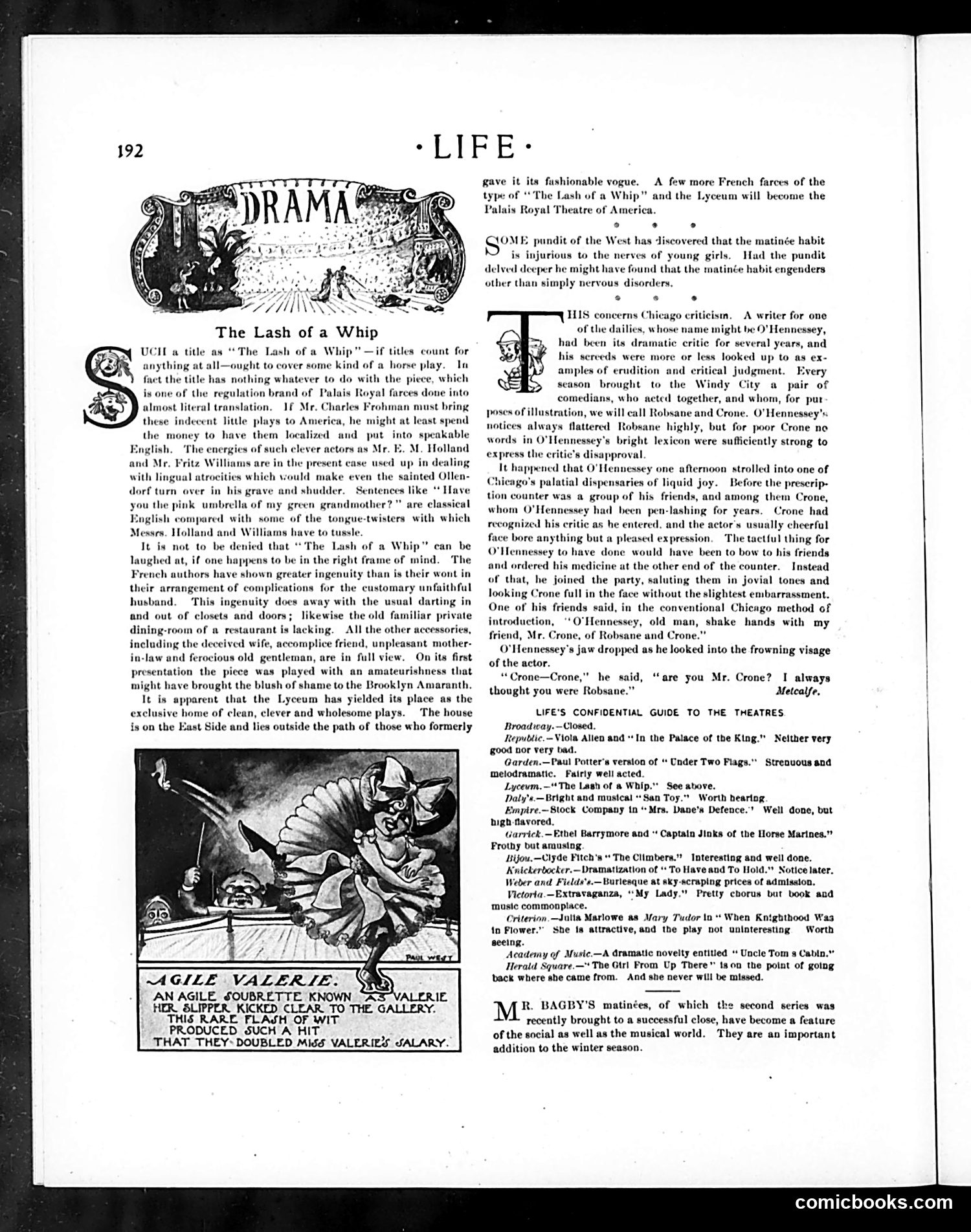
This page reviews a theatrical production called "The Lash of a Whip," which Life describes as a typical "horse play" farce in the Palais Royal style—lightweight French comedy designed for entertainment rather than artistic merit. The main cartoon depicts a scene from the play, showing slapstick action. The caption below indicates it's from "Agile Valerie," another production, advertising that this show doubled the actress Valerie's salary. The review is somewhat dismissive of both the play's quality and Chicago's theater critics. Life mocks a critic named O'Hennessey for his inconsistent judgments, suggesting theatrical farces like these lack serious merit but provide popular entertainment. The page treats stage productions with gentle satire typical of Life's drama coverage.
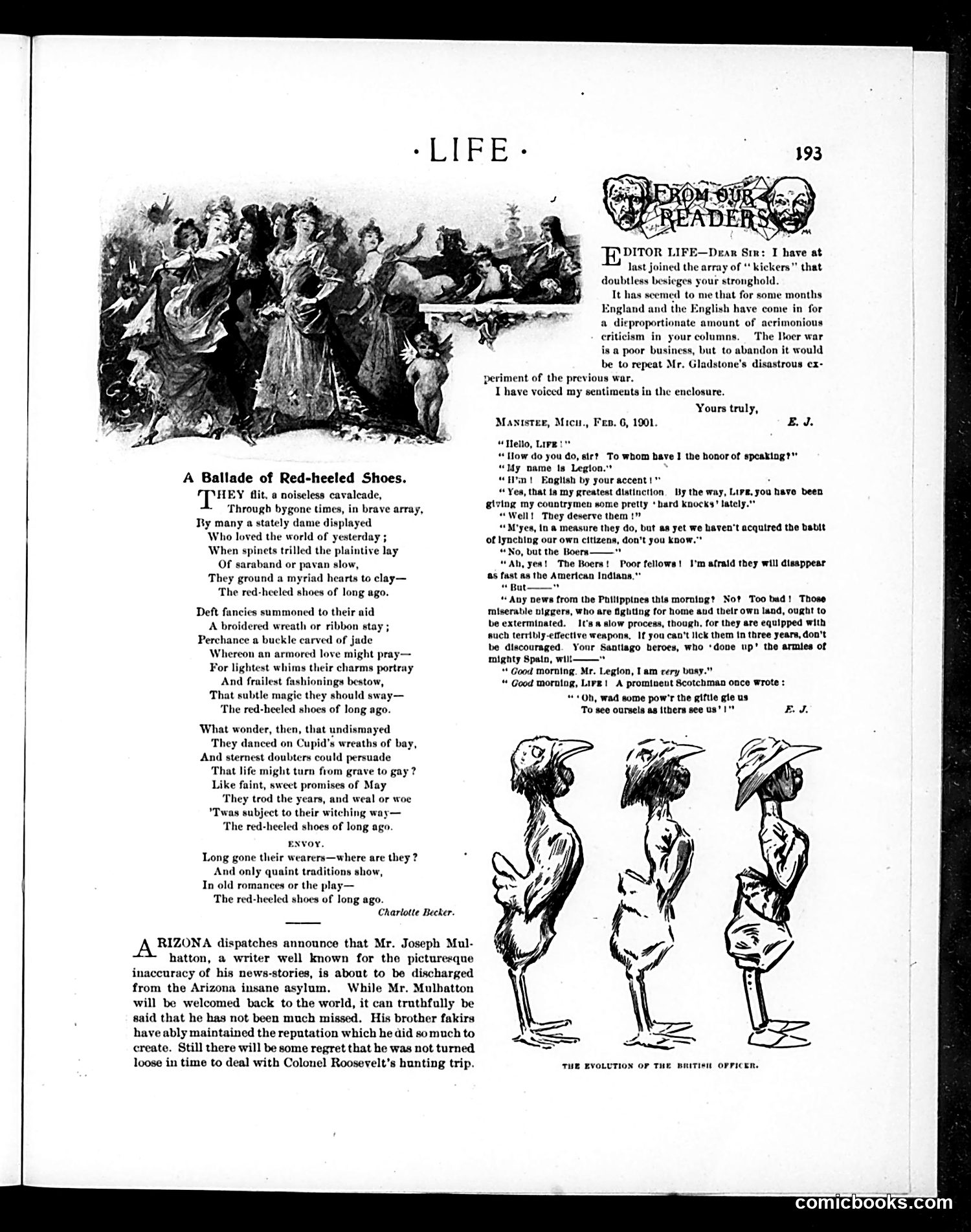
This page contains a nostalgic poem about red-heeled shoes, a brief news item mocking an unreliable Arizona journalist, and a satirical dialogue cartoon. The main satire is the conversation between "Life" (the magazine personified) and "Legion" (representing England). Legion defends England against Life's recent criticism of British conduct in the Boer War, while hypocritically condemning American actions in the Philippines and toward Native Americans. The joke targets British moral superiority: Legion objects to Life's "hard knocks" against England while endorsing American extermination of indigenous peoples and Filipino independence fighters as "niggers" who "ought to be exterminated." The three sketches below titled "The Evolution of the British Officer" likely show exaggerated depictions of British military figures, though their specific meaning is unclear. The satire exposes perceived British hypocrisy regarding imperialism and racial attitudes during the colonial period.
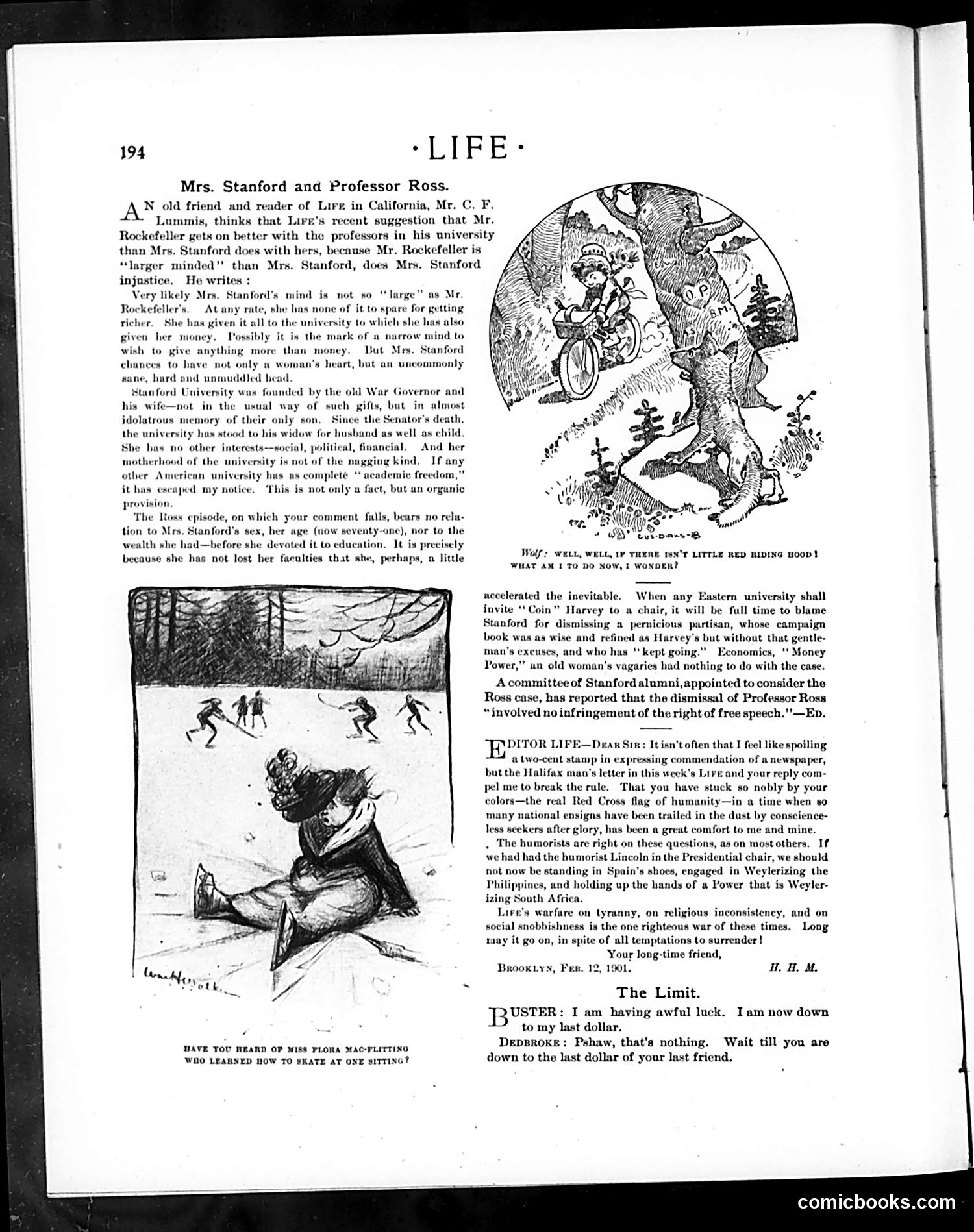
This *Life* magazine page (1901) centers on the dismissal of Professor Edward Ross from Stanford University by Jane Stanford, widow of railroad magnate Leland Stanford. **The Main Article** defends Mrs. Stanford against criticism that she lacks "largeness of mind" compared to Rockefeller. The writer argues her "narrow" thinking is actually principled—she donated her entire fortune to the university, which she now manages maternally. The critique isn't about her gender or age, but her governance decisions. **The Cartoons** satirize this conflict: one shows a woman (Mrs. Stanford) learning to ice skate, captioned as "Miss Flora Mac-Flitting"—likely mocking her control of university affairs. Another depicts Red Riding Hood, suggesting vulnerability or danger. **The Editor's Letter** praises *Life* for defending "free speech" against Stanford's dismissal of Ross (a economist fired for his progressive political views), comparing her actions to Spanish colonial brutality in the Philippines. The satire criticizes both Mrs. Stanford's authoritarianism and American imperial overreach. **"The Limit"** is an unrelated joke about poverty escalation.
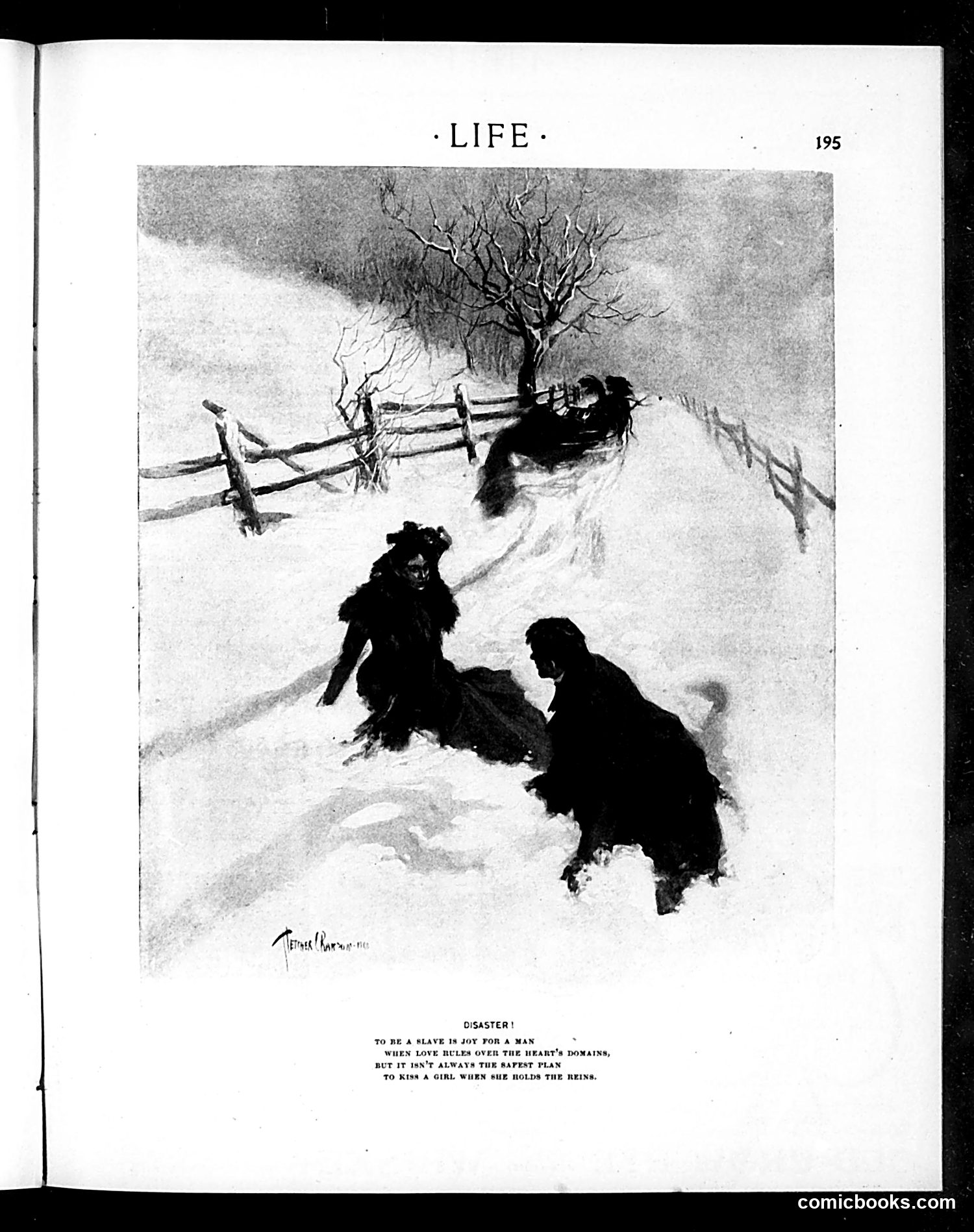
This illustration depicts a winter scene with two figures in snow near a bare tree and fence. The artwork shows what appears to be a comedic romantic mishap: a man attempting to kiss a woman who is holding sledge reins while sledding or sliding down a snowy slope. The accompanying verse uses romantic language ("love rules over the heart's domains") to set up a practical joke: the supposed "disaster" is that kissing a woman while she controls a speeding sled is unwise—she'll lose control of the vehicle. The satire plays on the tension between romantic impulse and practical common sense, suggesting that even in moments of passion, a man should consider the actual circumstances before acting. It's light-hearted social commentary on courtship and male foolishness.
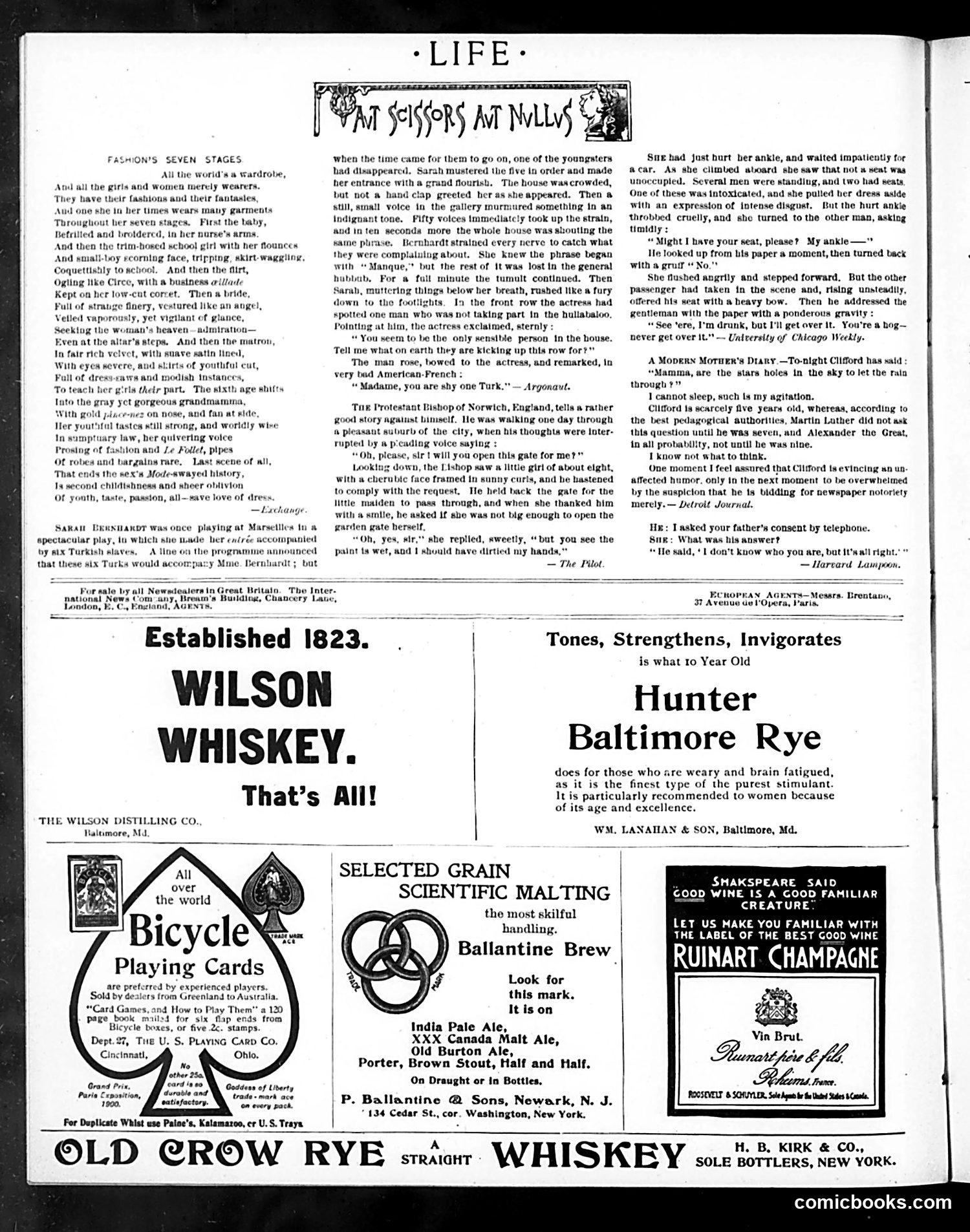
This page primarily contains **humorous anecdotes and advertising** rather than political cartoons. The main content is "Fashion's Seven Stages"—a parody of Shakespeare's "Seven Ages of Man" that satirizes women's relationship to fashion throughout their lives, from baby to elderly widow. The joke is that women's identities and social roles are entirely defined by what they wear at each life stage. Below are three brief humorous stories: one about Sarah Bernhardt performing with missing actors; another about a Bishop tricked by a clever girl avoiding mud; and a third about a woman on a streetcar dealing with an intoxicated man. The page is dominated by **period advertisements** (Wilson Whiskey, Hunter Baltimore Rye, Bicycle Playing Cards, Ruinart Champagne, and Ballantine beer), which was typical of Life's revenue model. No clear political satire is present—the humor is social observation and personal anecdotes rather than commentary on politics or current events.
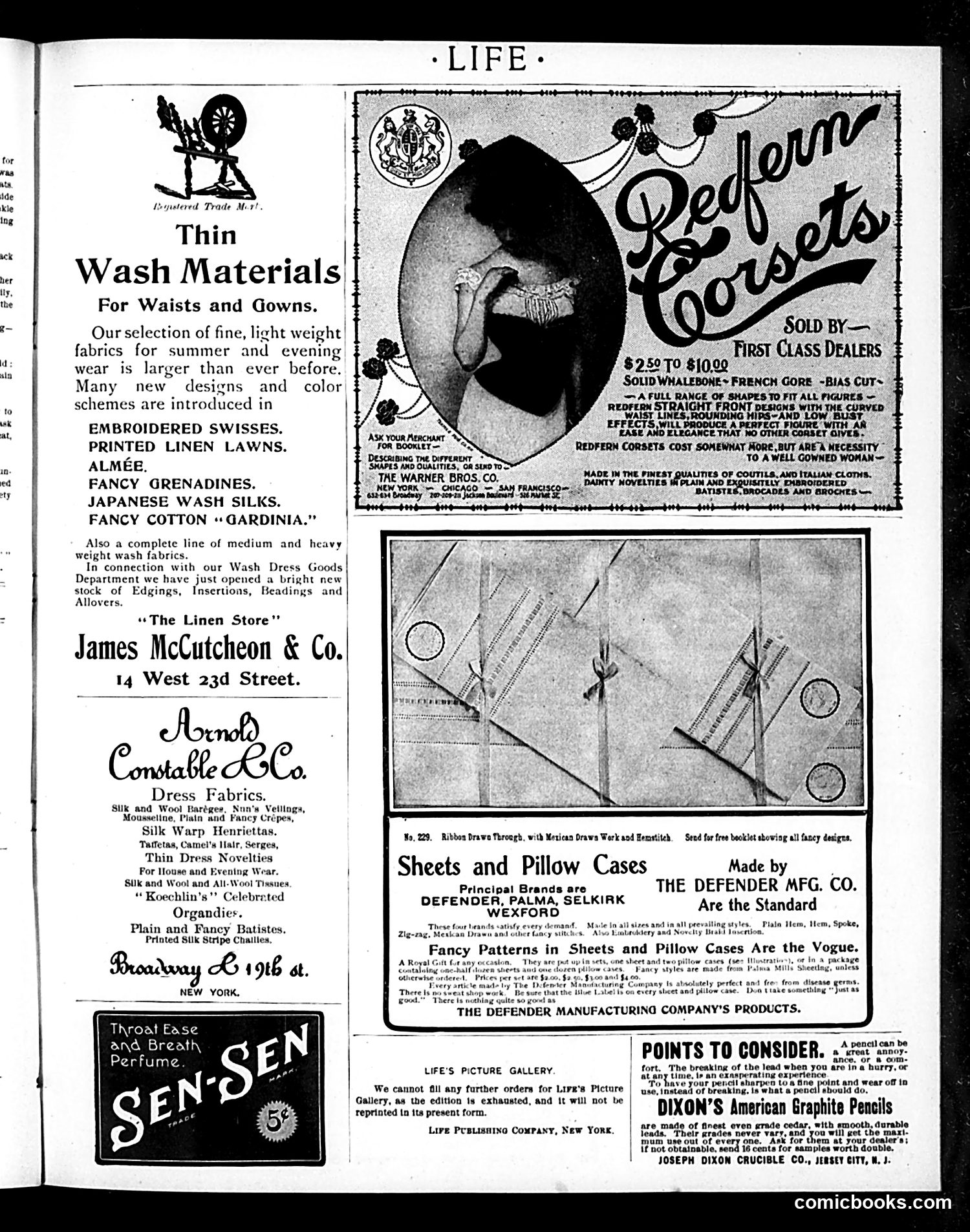
This page is primarily **advertisements**, not satirical content. It's from an early 20th-century issue of Life magazine. The main visual element is a **Redfern Corsets advertisement** featuring a woman in profile wearing a corset, emphasizing the fashionable silhouette of the era. The ad promotes the "straight front" corset design ($2.50-$10.00), claiming it produces "a perfect figure" and "elegance that no other corset gives." For modern readers, this illustrates the extreme body-shaping standards of the period—corsets were considered essential for "well-gowned women." The explicit promise to reshape the body would be considered problematic today. Surrounding ads promote **washable dress fabrics** (from James McCutcheon & Co.), **bed linens** (Defender Manufacturing), and **pencils** (Dixon's). The SenSen perfume ad addresses social anxiety about breath. There is **no political satire** on this page—it's a straightforward commercial publication showcasing consumer goods targeted at affluent women concerned with fashion, household goods, and personal hygiene.
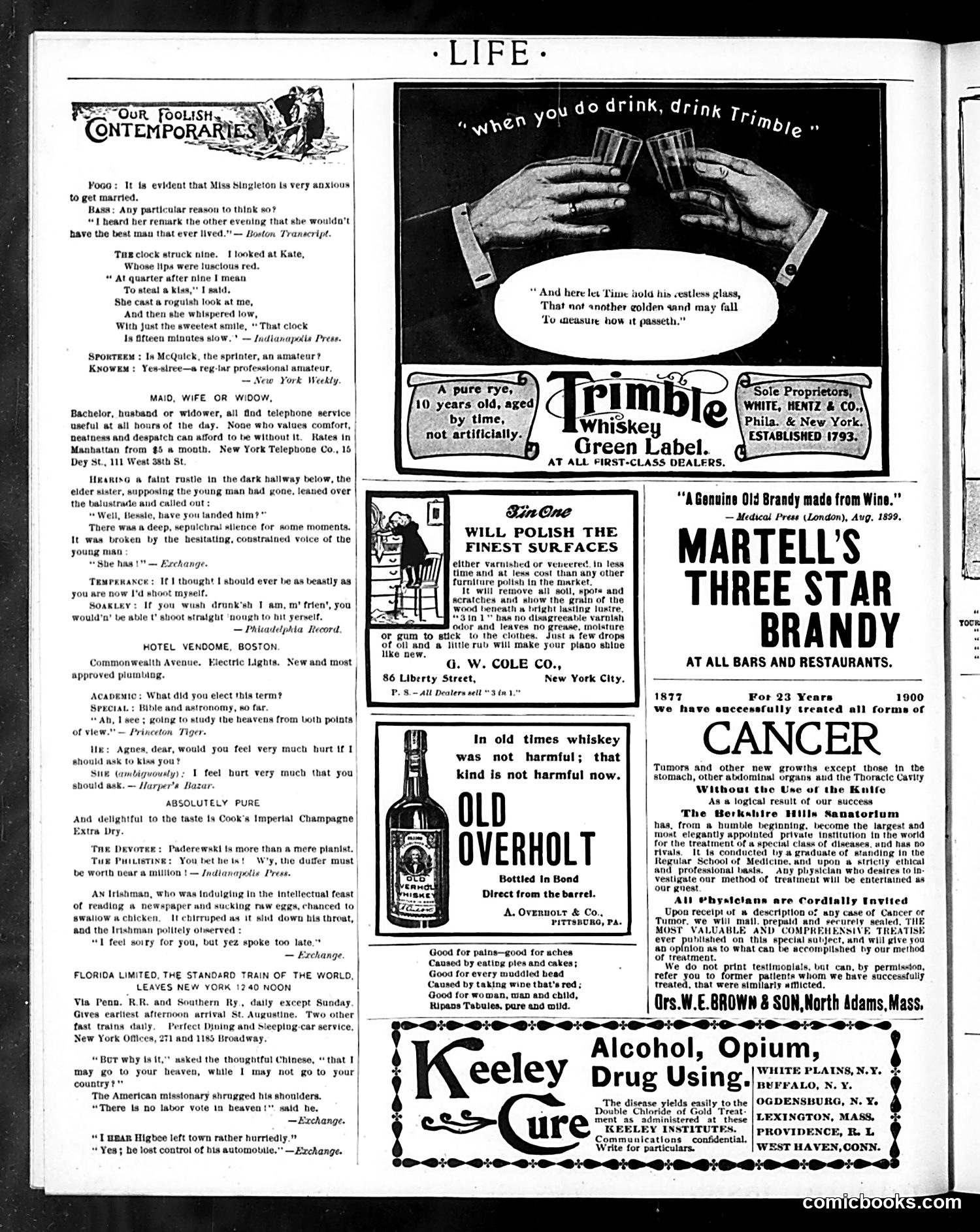
This page features *Life* magazine's signature satirical column mocking contemporary social behavior and attitudes. The cartoons and jokes target: **Main Satire Targets:** - **Romance/courtship etiquette**: Jokes about women's marriage anxieties, men stealing kisses, and the awkwardness of romantic pursuit - **Class pretension**: A "professional amateur" sprinter—mocking those who claim amateur status while behaving professionally - **Drunkenness**: A temperance joke where a drunk man ironically claims sobriety while unable to shoot straight - **Labor politics**: A Chinese immigrant questions America's openness while facing immigration restrictions—highlighting hypocrisy about "freedom" versus exclusionary labor policies **Advertising Context:** Heavy alcohol advertising (Trimble Whiskey, Martell's Brandy, Old Overholt) sits alongside a "Keeley Cure" advertisement for treating alcoholism—a darkly ironic juxtaposition reflecting period contradictions about drinking. **Overall Point**: The page satirizes contemporary American social pretense, romantic fumbling, and moral inconsistencies through brief, witty anecdotes typical of *Life*'s humor.
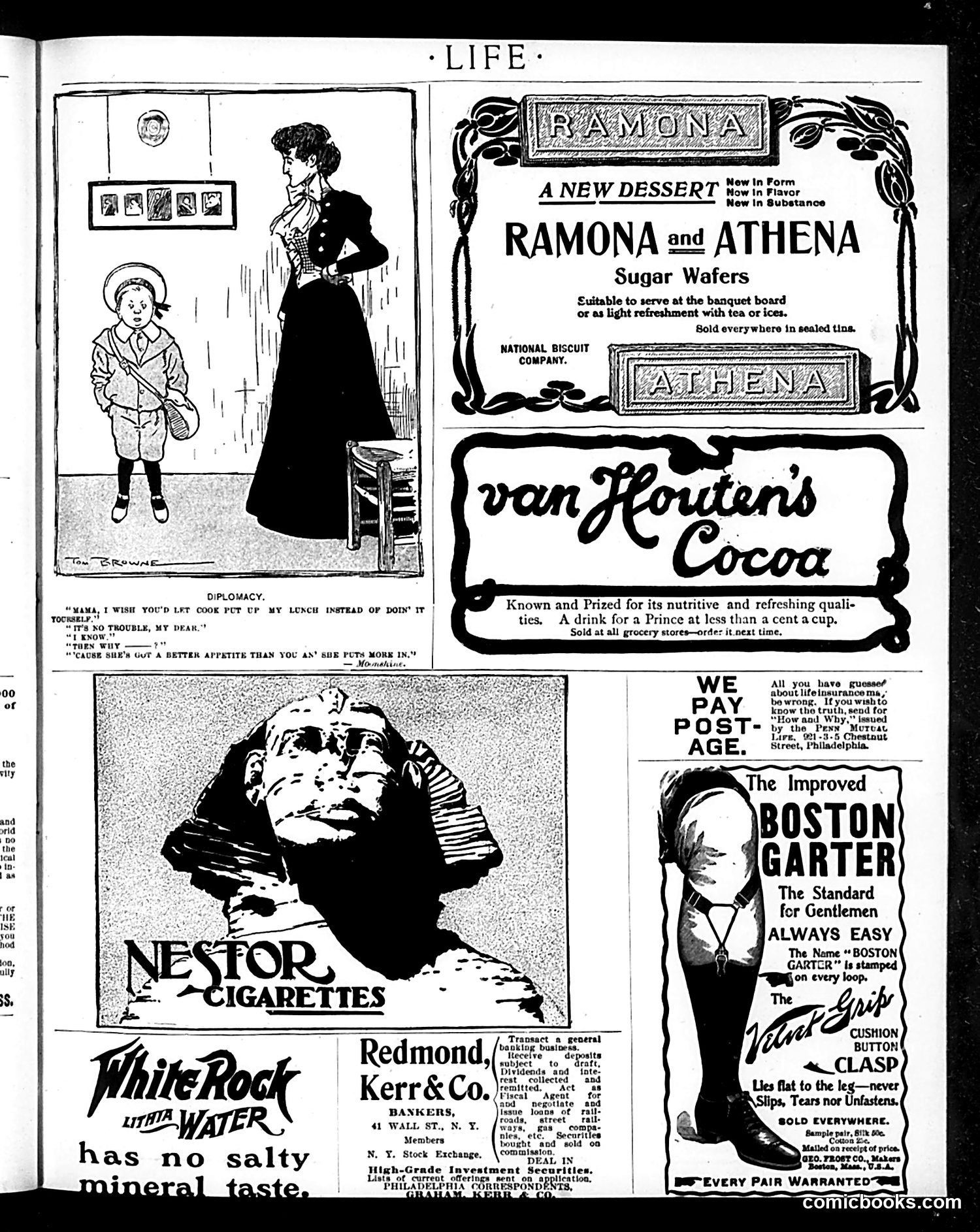
The main cartoon depicts a domestic scene satirizing gender roles and appetite. A well-dressed woman stands while a young boy sits; the caption shows the mother wishing the cook would prepare her lunch "instead of doing" housework. The boy responds that the cook shouldn't change because "she's got a better appetite than you and she puts more in." The satire targets early 1900s assumptions about women: the mother is portrayed as having less appetite and being less practical than both the cook (a working-class woman) and even the child. It mocks upper-class femininity as delicate or weak compared to working-class women's robustness. The page is primarily **advertisements**—Ramona and Athena sugar wafers, Nestór cigarettes, van Houten's cocoa, White Rock water, Boston garters, and investment services. These ads reflect consumer culture of the period.
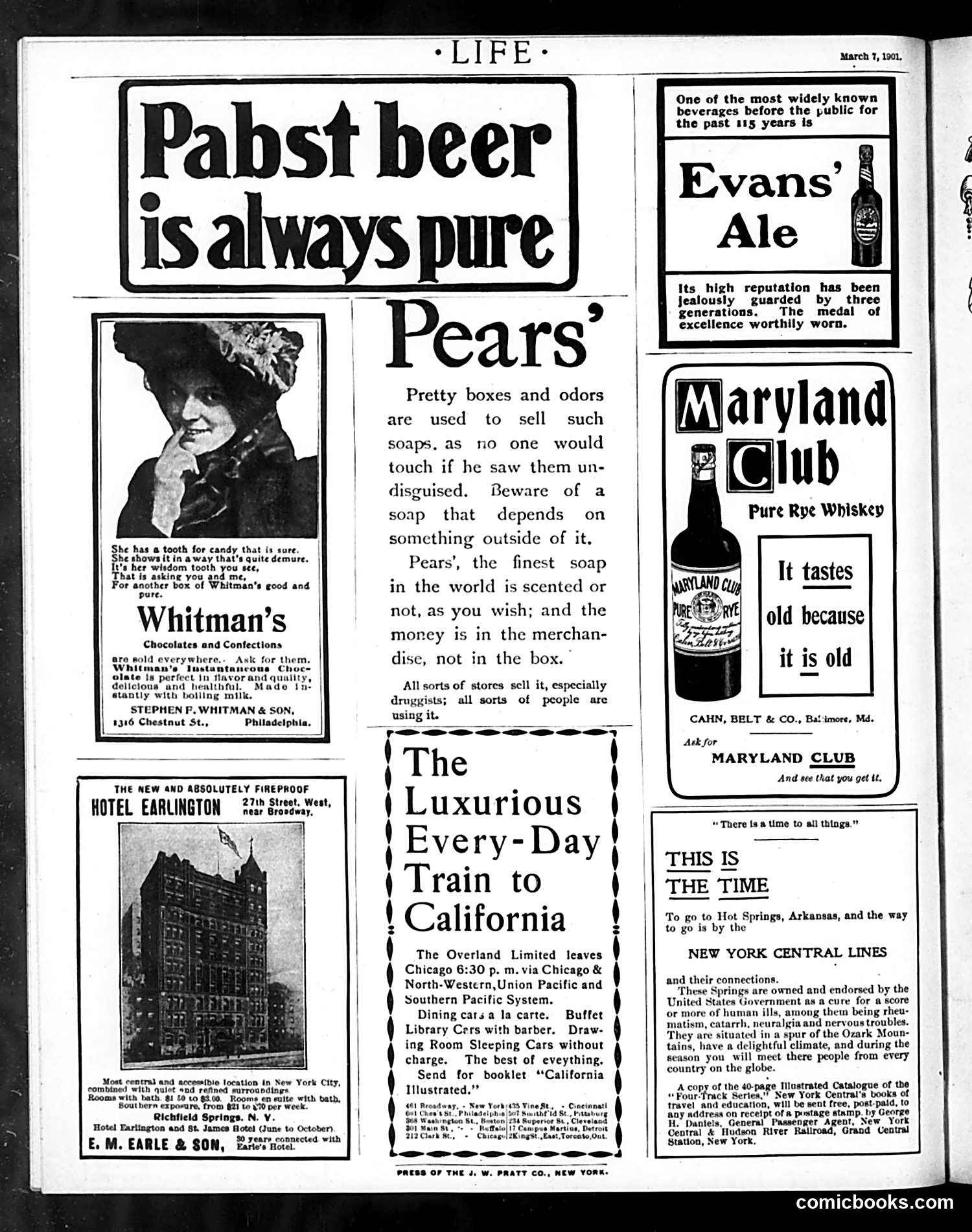
This is primarily a **advertising page**, not political satire. It contains several product advertisements typical of early 1900s magazines: **Notable ads include:** - **Pabst Beer** and **Evans' Ale**: Standard beverage advertisements - **Whitman's Chocolates**: Features a woman's face with copy about her having "a tooth for candy" - **Pears' Soap**: Includes satirical copy mocking soap marketing, claiming pretty boxes and odors disguise inferior products—the actual satire here is *within the ad itself*, critiquing deceptive advertising practices - **Maryland Club Whiskey**: "It tastes old because it is old" - **Hotel Earlington**: A New York hotel advertisement - **The Overland Limited**: A luxury train to California The only genuinely satirical element is the **Pears' Soap ad**, which ironically criticizes the very marketing tactics used in surrounding advertisements—a meta-commentary on product packaging versus substance that would resonate with Life magazine's satirical mission.