
Life, 1901-03-07 · page 4 of 20
Life — March 7, 1901 — page 4: what you’re looking at
What you’re looking at
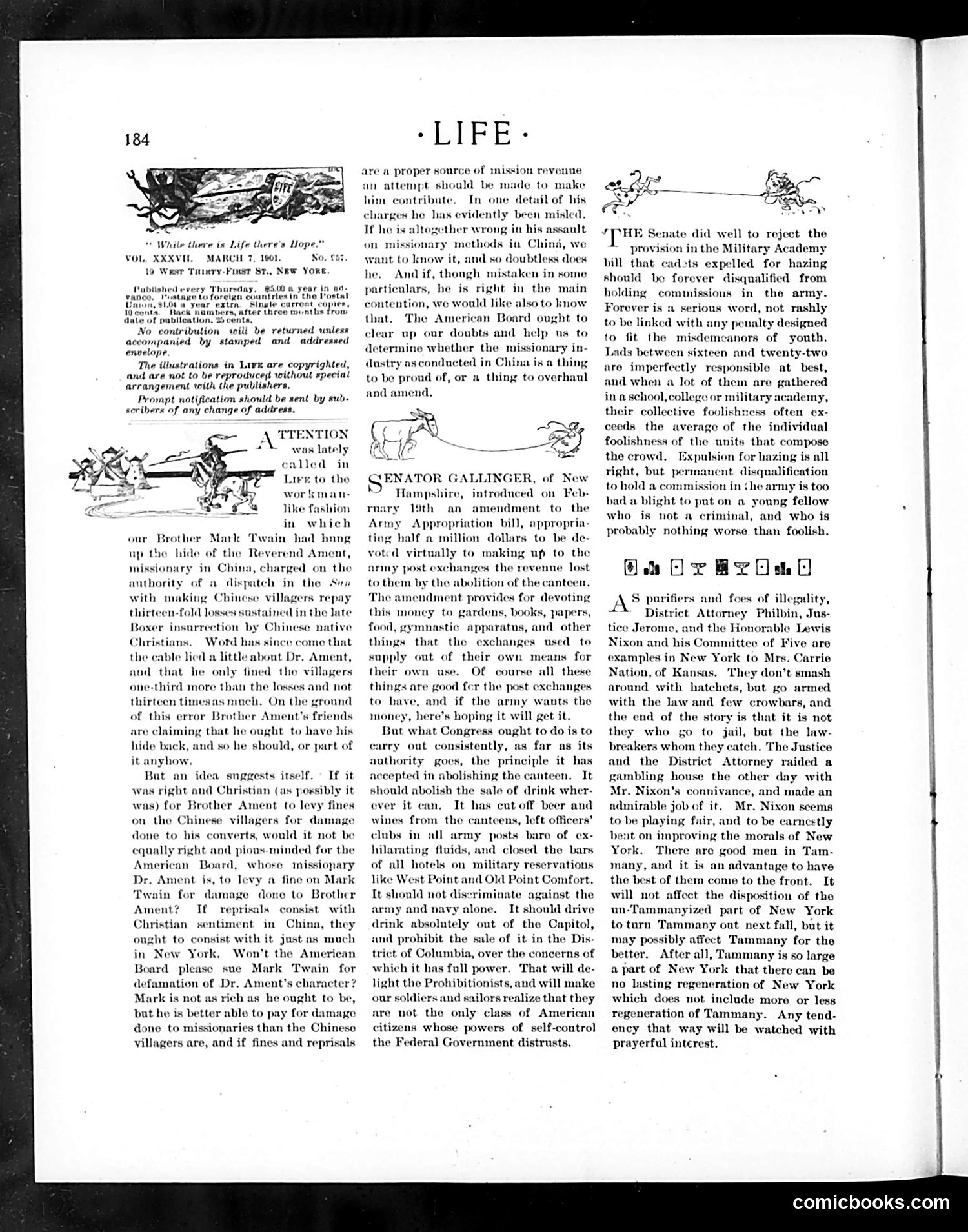
The page contains two distinct political commentaries: **Left section:** A cartoon criticizing Dr. Ament, a missionary in China involved in the Boxer Rebellion aftermath. The text discusses whether Ament should compensate Chinese villagers for damages, satirizing American missionary conduct and the question of whether mission work justifies property destruction. The cartoon appears to mock Ament's defensive position. **Right section:** Commentary on Senator Gallinger's amendment to an Army Appropriation bill, proposing funds for post exchanges. The text debates whether army canteens should be abolished—a temperance/reform issue. The satirical point critiques Congress's inconsistency: they should either consistently support or oppose the exchanges, rather than selectively funding them while claiming prohibition principles. Both pieces exemplify Life's style of mocking political hypocrisy and moral inconsistency.
📄 Transcribed text from this page (OCR, searchable)
Machine-transcribed from the original scan — historical spelling and the odd misread are preserved.
there is Life there's Hope.” XXXVI. MARCH 7, 1901. 19 West THinry-Finst St., NRW Yous. vou. Thursday. $500 4 year ries in the ¢ returned unless accompanied by stamped and addressed envelope. The illustrations in Live are copyrighted, and are not to be reproduced without special arrangement with the publishers. Prompt notification should be sent by sub- seribers of any change of address. AN called in like fashion in which wain had hung up the hide of the Reverend Ament, missiot in China, charged on the authority of a dispatch in the with making Chinese villagers repay thirteen-fold losses sustained in the late Boxer insurrection by Chir native Christians. Wotd has since come that the cable lied a little about Dr. Ament, and that he only fined the villagers one-third more than the loss nd not thirteen timesas mach, On the ground of this error Brother Ament’s friends are claiming that he ought to have his hide back, and so he should, or part of it anyhow. But an idea suggests itself. If it was right and Christian (as possibly it was) for Brother Ament to levy fines on the Chinese villagers for damage done to his converts, would it not be equally right and pious-minded for the American Board, whore missiopary Dr. Ament is, to levy a fine on Mark Twain for damage done to Brother Ament? If reprisals consist with Christian sentiment in China, they ought to consist with it just as much in New York. Won't the American Board please sue Mark Twain for defamation of Dr. Ament’s character? Mark is not as rich as he ought to be, but he is better able to pay for damage done to missionaries than the Chinese agers are, and if fines and reprisals our Brother Mark T Sun LIFE are a proper source of mission revenue an attempt should be made to make him contribute. In one detail of his n misled, ther wrong in his assault ary methods in China, we ow it, and so doubtless does And if, though mistaken in some rs, he is right in the main » we would like also to know The American Board ought to clear up our doubts and help us to determine whether the missionary in- dustry asconducted in Chin: charges he has evidently be If he is alte a thing to be proud of, or a thing to overhaul and amend, er, 4) GENATOR GALLING Hampshire ZR, of New troduced on Fe rnary 19th an amendment to the Army Appropriation bill, appropria- ting half a million dollars to be de- voted virtually to making up to the army post exchanges the revenue lost to them by the abolition of the canteen. The amendment provides for devoting this money to gardens, books, papers, food, gymnastic apparatus, and other things that the exchanges used to supply out of their own means for their own use. Of course all these things are good fer the post to have, and if the army money, here's hoping it will get it. But what Congress ought to do is to carry out consistently, as far as its authority goes, the principle it has epted in abolishing the canteen. It should abolish the sale of drink wher- ever it can, It has cut off beer and wines from the canteens, left officers’ clubs in all army posts bare of ex- hilarating fluids, and closed the bars of all hotels on military reservations like West Point and Old Point Comfort. It should not discriminate against the army and navy alone. It should drive drink absolutely out of the Capitol, and prohibit the sale of it in the Dis- trict of Columbia, over the concerns of. which it has fall power. That will de- light the Prohibitionists, and will make our soldiers and sailors realize that they ac are not the only class of American citizens whose powers of self-control *ederal Government distrusts. the ‘THE Senate did well to reject the provision in the Military Academy Dill that cadots expelled for hazing should bo forever disqualified from holding commissions in the army. Forever is a serious word, not rashly to be linked with any penalty designed to fit the misdemeanors of youth. Lads between sixteen and twenty-two aro imperfectly responsible at best, and when a lot of them are gathered ina school,college or military academy, their collective foolishness often ex- ceeds the average of the individual foolishness of the units that compose the crowd. Expulsion for hazing is all right, but permanent disqualification to hold a commission in (he army is too bad a blight to put on a young fellow who is not a criminal, and who is probably nothing worse than foolish. Or a2 GO A\S purifiers and foes of iMegality, * District Attorney Philbin, Jus- tice Jerome, and the Honorable Lewis. Nixon and his Committee of Five are examples in New York to Mrs. Carrie Nation, of Kansas. They don’t smash around with hatchets, but go armed with the law and few crowbars, and the end of the story is that it is not they who go to jail, but the law- breakers whom they catch, The Justice and the District Attorney raided a gambling house the other day with Mr. Nixon’s connivance, and made an admirable job of it. Mr. Nixon seems to be playing fair, and to be carnestly bent on improving the morals of New York. There are good men in Tam- many, and it is an advantage to have the best of them come to the front. It will not affect the disposition of the un-Tammanyized part of New York to turn Tammany ont next fall, but it may possibly affect Tammany for the better. After all, Tammany is so large a part of New York that there can be no lasting regeneration of New York which does not include more or less regencration of Tammany. Any tend- ency that way will be watched with prayerful interest. comicbooks.com