
A complete issue · 20 pages · 1900
Life — February 8, 1900
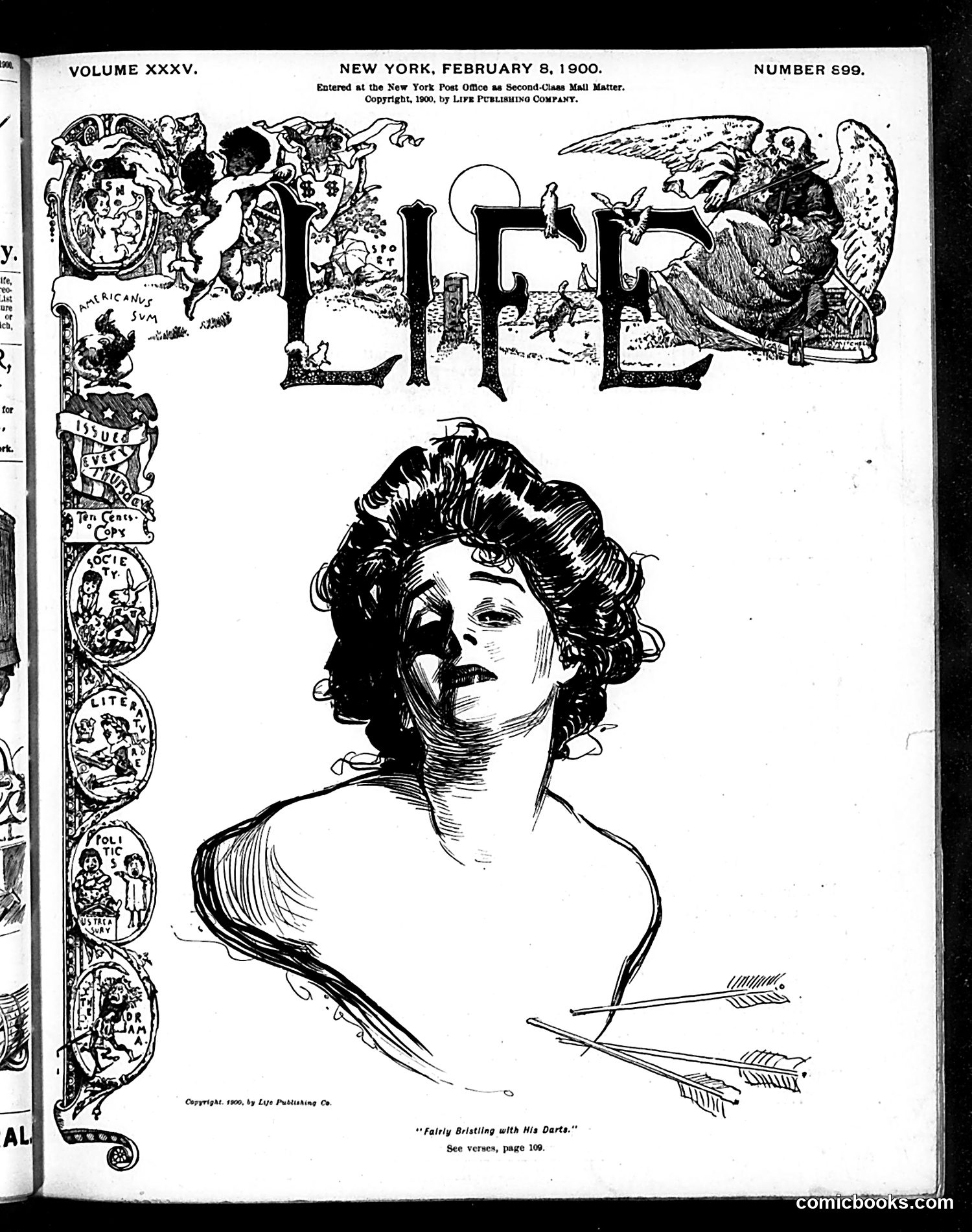
This is the cover of *Life* magazine (Volume XXXV, Number 699). The main illustration shows a woman's portrait in profile, drawn in an elegant pen-and-ink style typical of turn-of-the-century magazine covers. The figure has styled dark hair and is depicted with classical grace. The caption reads "Fairly Bristling with His Darts" with a reference to "See verses, page 100," indicating accompanying satirical verse inside the magazine. The ornate decorative border on the left side contains small vignettes representing different sections (*American Sum*, *Society*, *Literary*, etc.), typical of *Life*'s format. Without access to the full text on page 100, the specific satirical target remains unclear, though the "darts" reference suggests commentary on romantic or social affairs.
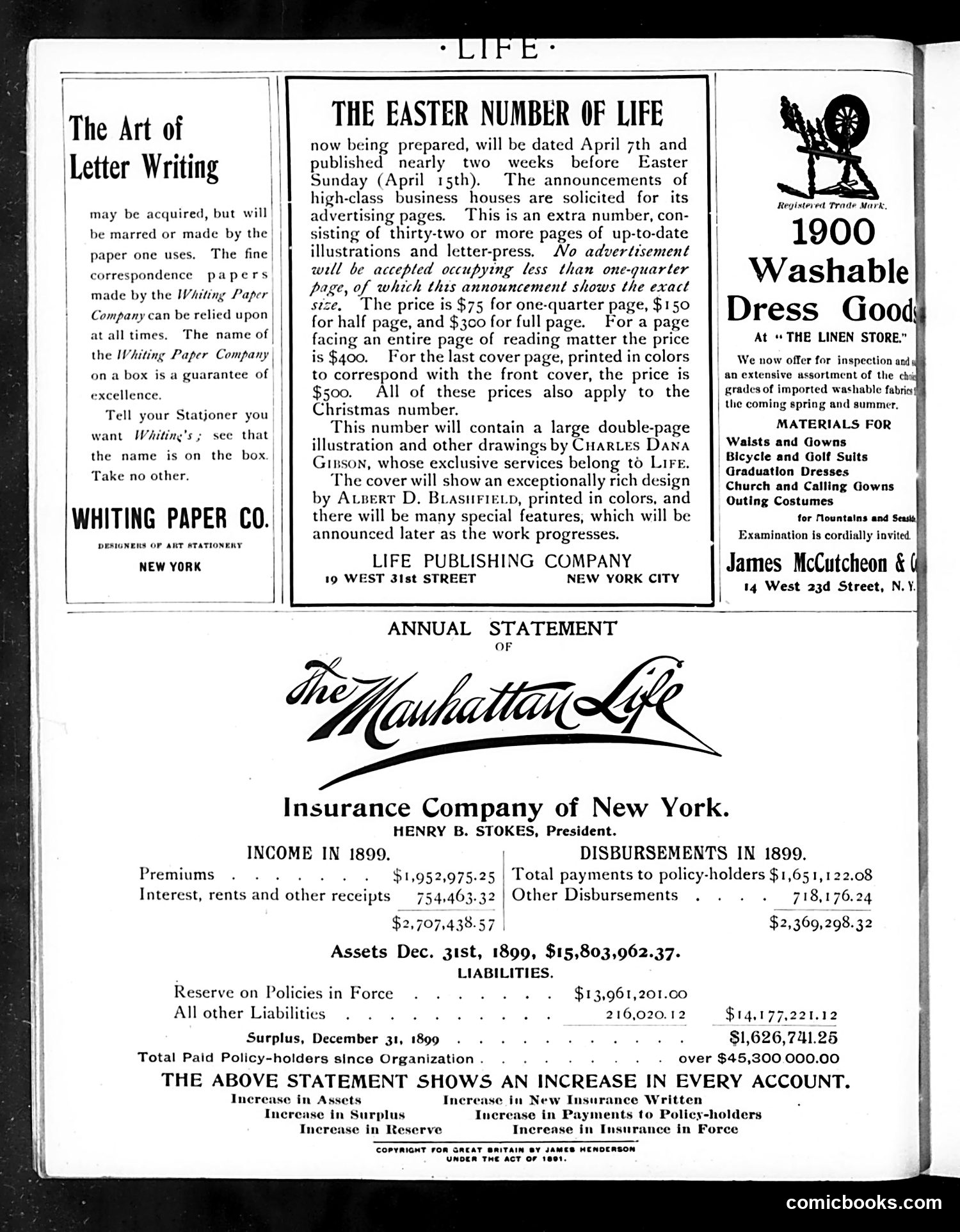
This page is **primarily advertising and business notices**, not satirical content. It contains: 1. **Three advertisements** (left to right): Whiting Paper Company stationery, Life Publishing Company's Easter issue announcement, and James McCutcheon & Co. dress goods. 2. **One substantial business document**: An annual financial statement from The Manhattan Life Insurance Company of New York, detailing 1899 income, disbursements, assets, and liabilities. The statement emphasizes growth across all accounts. The page lacks political cartoons or satirical commentary. It reflects turn-of-the-century American commercial life—insurance company transparency, fashion retail, and publishing announcements—rather than social satire typical of Life magazine's editorial content.
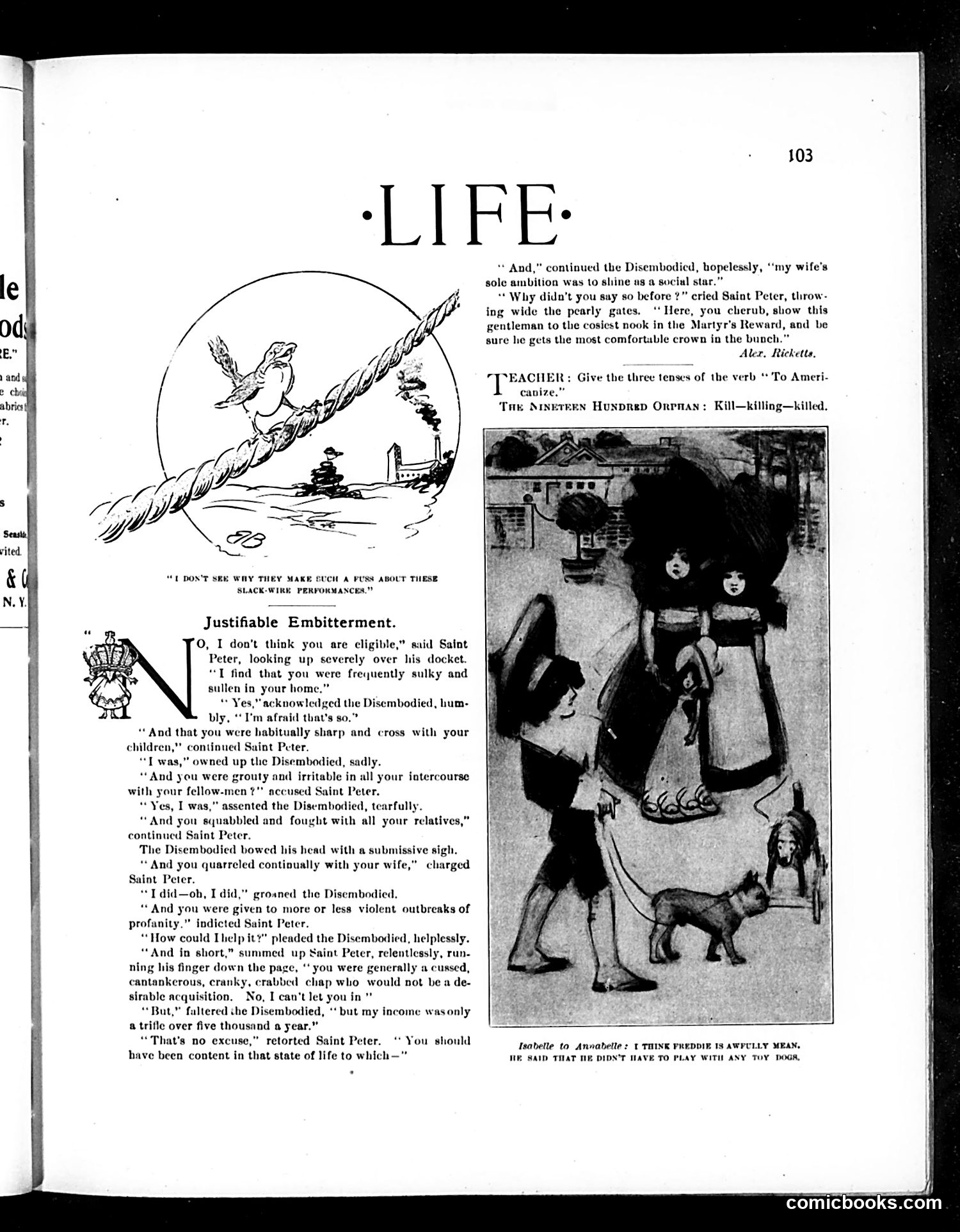
This page contains two distinct pieces: **Top cartoon**: "I Don't See Why They Make Such a Fuss About These Slack-Wire Performances" depicts angels on a tightrope above a cityscape. This appears to be satirizing either circus/vaudeville entertainment or possibly commentary on risky public spectacles of the era. **"Justifiable Embitterment" story**: A dialogue between Saint Peter and a "Disembodied" soul (deceased person) being judged at heaven's gates. Saint Peter catalogs the man's earthly faults—being sulky, quarrelsome with family, and generally disagreeable—while the man protests poverty excuses his behavior. The satire mocks both self-justification for moral failings and the notion that poverty absolves personal responsibility. **Right image**: Appears to show dolls or figures, with caption about "Freddie" being unwilling to play with toys, likely humorous domestic commentary.
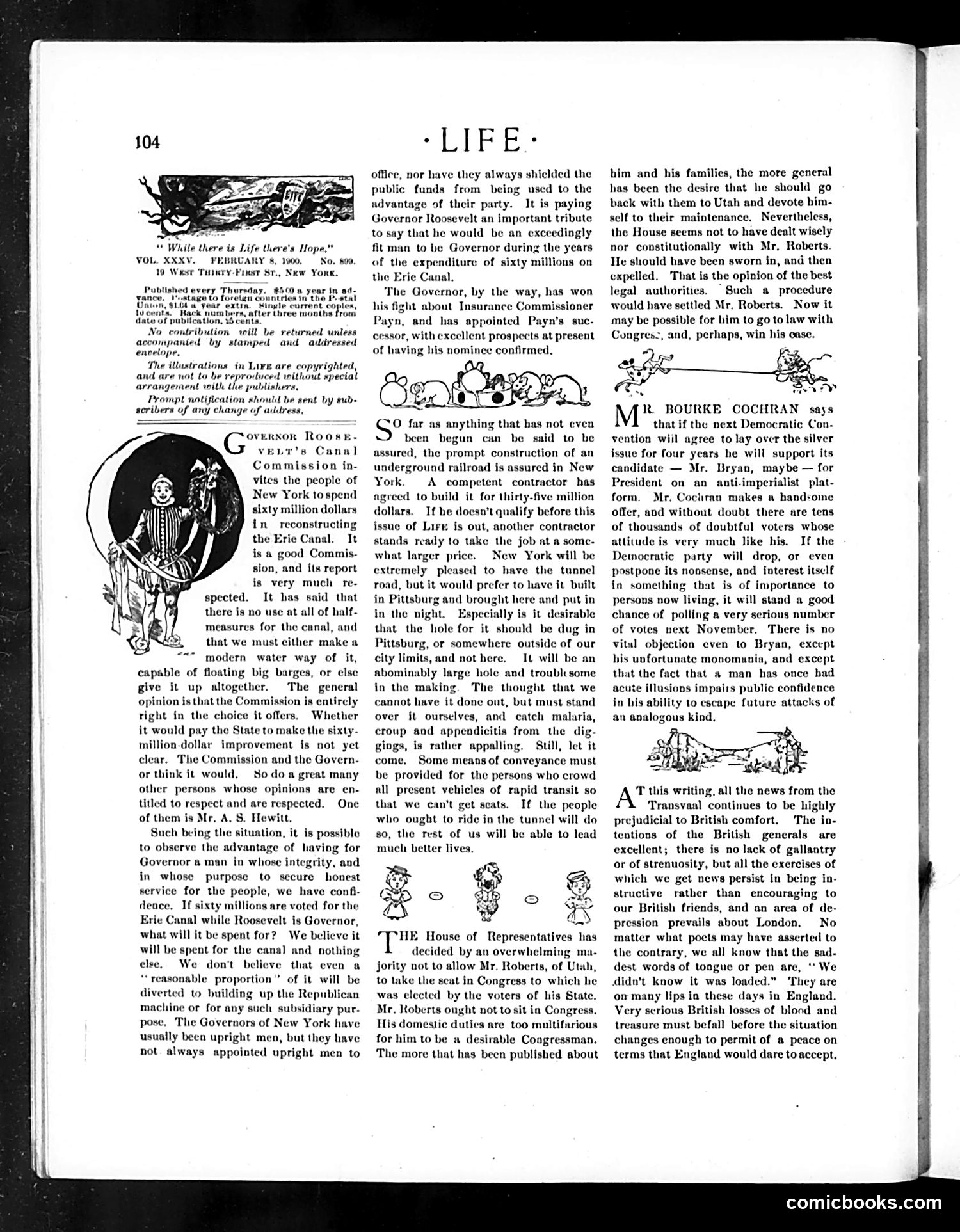
The main illustration depicts **Governor Roosevelt's Canal Commission**, shown as a rotund figure in formal dress. The text discusses the Erie Canal improvement project—a sixty-million-dollar proposal Roosevelt championed. The satire targets the **political patronage system**: the article notes the Commission hasn't shielded public funds from partisan advantage, and questions whether Roosevelt will truly pursue impartial governance or reward political allies. It mentions **Mr. Hewitt** and debates whether appointing upright men is possible given New York's political culture. A secondary section discusses **Mr. Roberts of Utah** and Congressional representation—apparently criticizing his election while suggesting his domestic duties make him unsuitable for Congress. The overall tone is skeptical of progressive reform promises versus political reality.
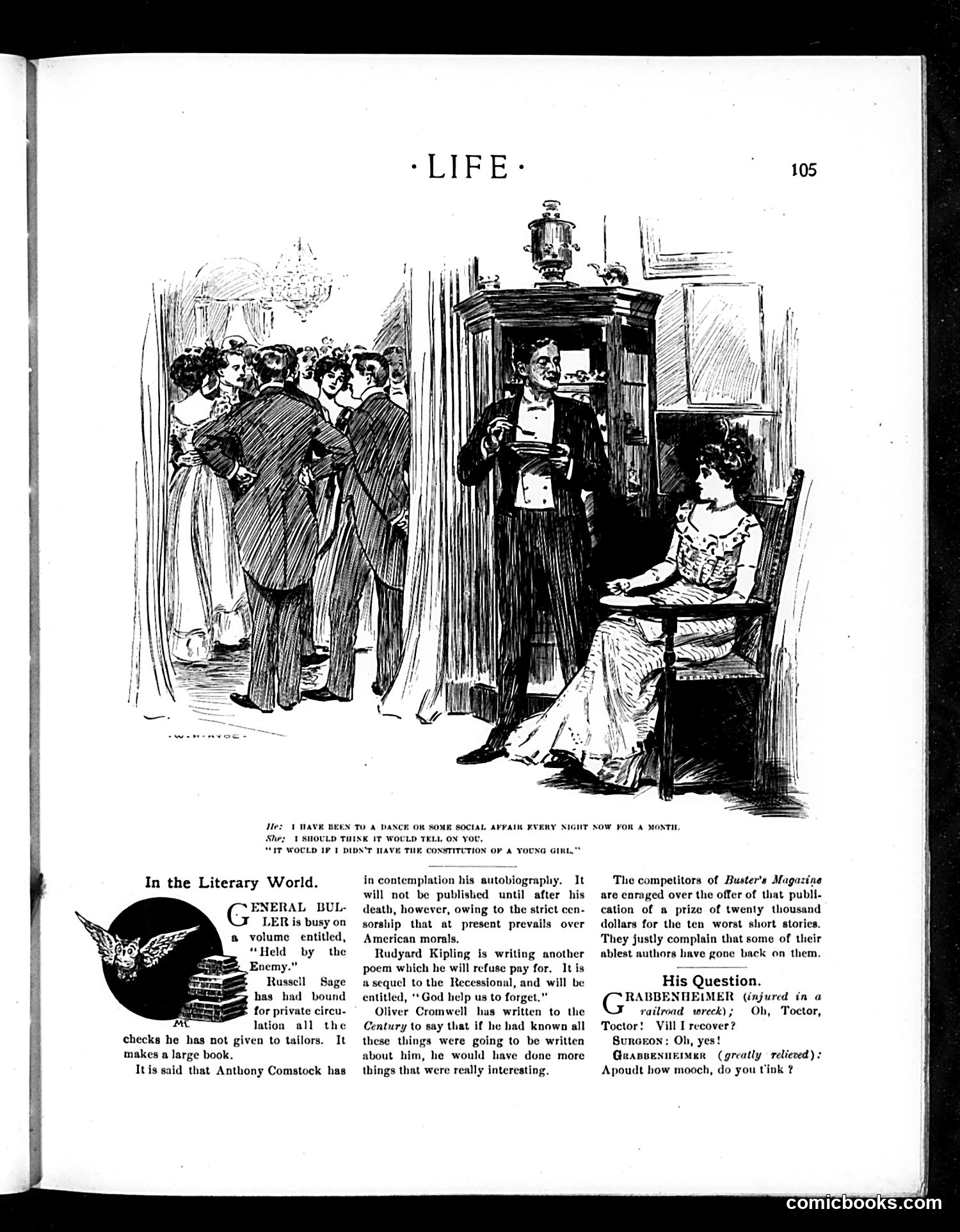
**Main Cartoon:** The illustration depicts a social gathering where a man in formal attire stands in a doorway addressing a seated woman, while fashionable guests converse in the background. The caption reads: "He: I have been to a dance or some social affair every night now for a month. She: I should think it would tell on you. 'If I didn't have the constitution of a young girl.'" **The Satire:** This is a genteel domestic humor piece mocking upper-class social excess. The joke plays on the man's boastful claim that constant nightlife hasn't exhausted him because he possesses youthful vigor—an absurd and vain statement meant to amuse readers familiar with such pretentious social circles. **Literary Section:** Below discusses contemporary authors including General Buller, Rudyard Kipling, Russell Sage, Oliver Cromwell, and Anthony Comstock, covering their recent publications and biographical matters.
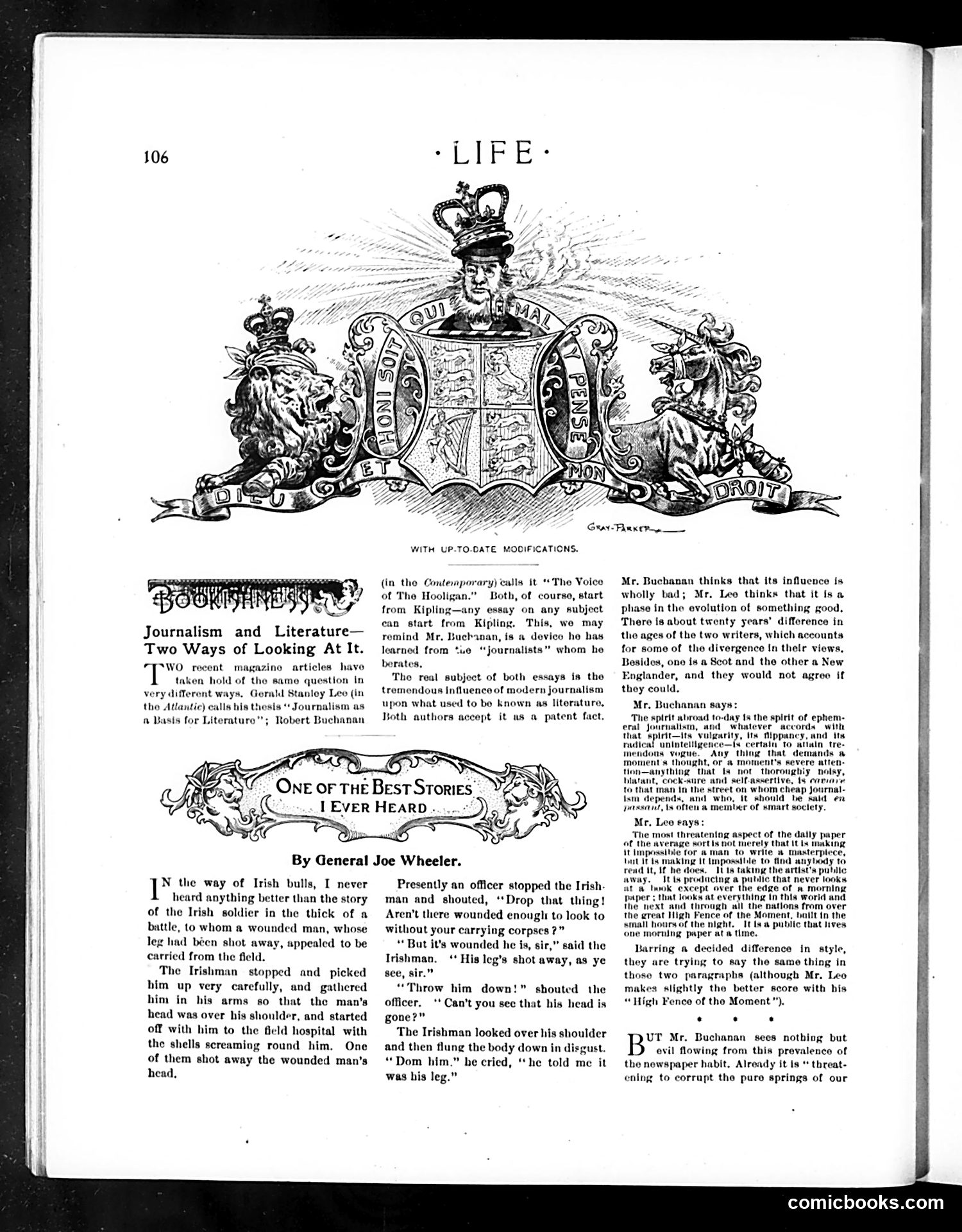
The main content discusses journalism's influence on literature, with essays by Robert Buchanan and presumably another critic debating whether modern journalism corrupts literary quality. Buchanan argues journalism harms literature through its "vulgarity" and "radical unintelligence," while his opponent (likely W.E. Henley, though unclear) defends the form. Below is "One of the Best Stories I Ever Heard" by General Joe Wheeler, featuring an anecdote about Irish soldiers during what appears to be a military campaign. An Irish soldier carries a wounded comrade from battle, but when ordered to drop the body, he refuses—leading to dark humor about the soldier being shot and his leg blown off. The heraldic masthead emphasizes Life's prestigious editorial stance on cultural matters.
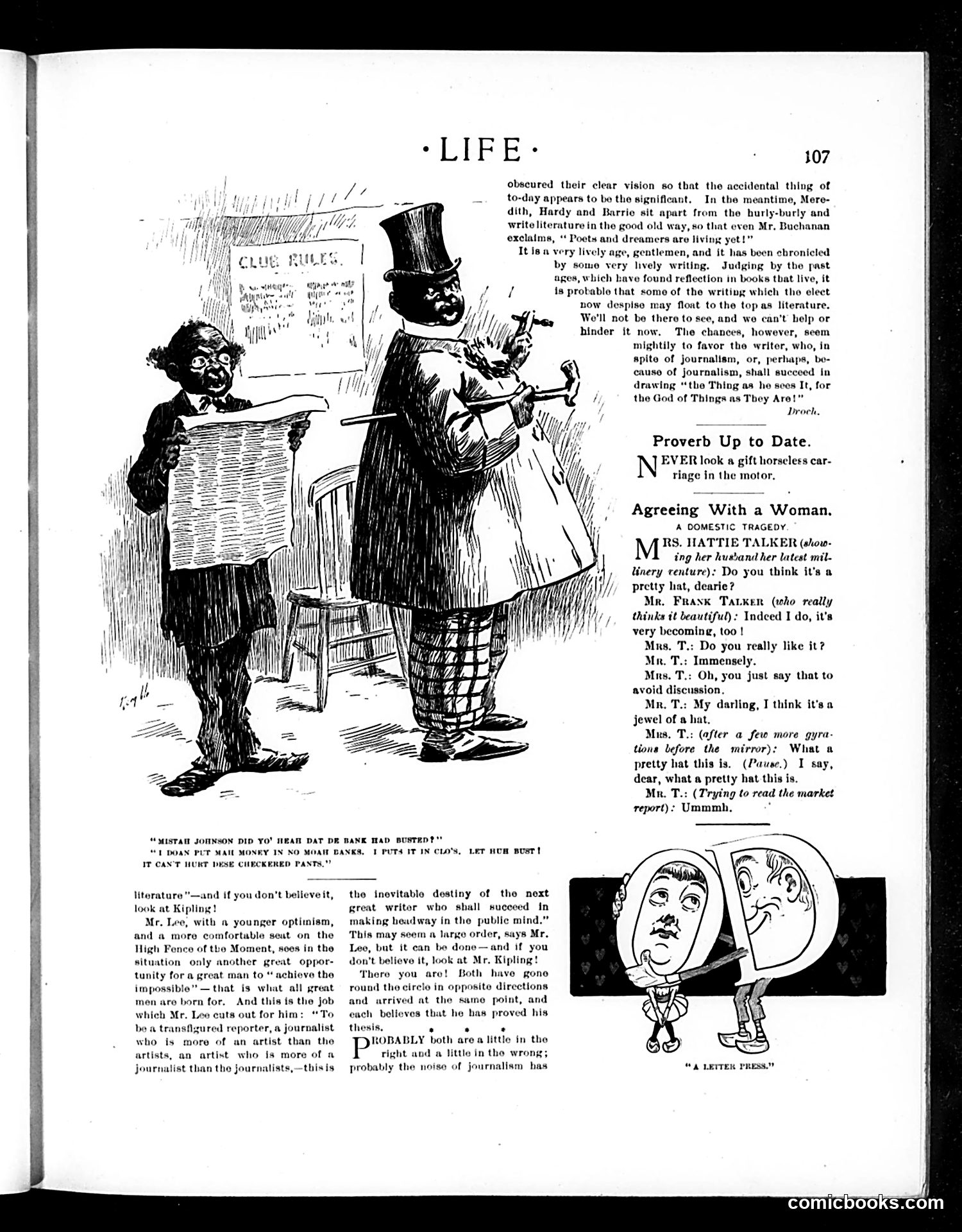
**Main Cartoon (top):** Shows a man in a top hat reading "CLUB RULES" while a woman holds a newspaper. The caption references "Hibtah Johnson" and "Dum" discussing whether something "suits" or "fits in clo'" (fits in clothes). This appears to be satirizing social club membership rules and class distinctions, likely mocking pretentious gentlemen's clubs of the era. **"Agreeing With a Woman" (dialogue piece):** A husband and wife discuss a hat, with the woman praising it while the man reluctantly agrees. This domestically-focused satire humorously depicts marital dynamics—the husband avoiding argument by accepting his wife's fashion judgment. **Bottom cartoon:** "A Letter Press" shows two faces in magnifying glasses, likely satirizing how newspapers distort or exaggerate their subjects through selective reporting. The page satirizes class pretension, marital compromise, and journalistic bias.
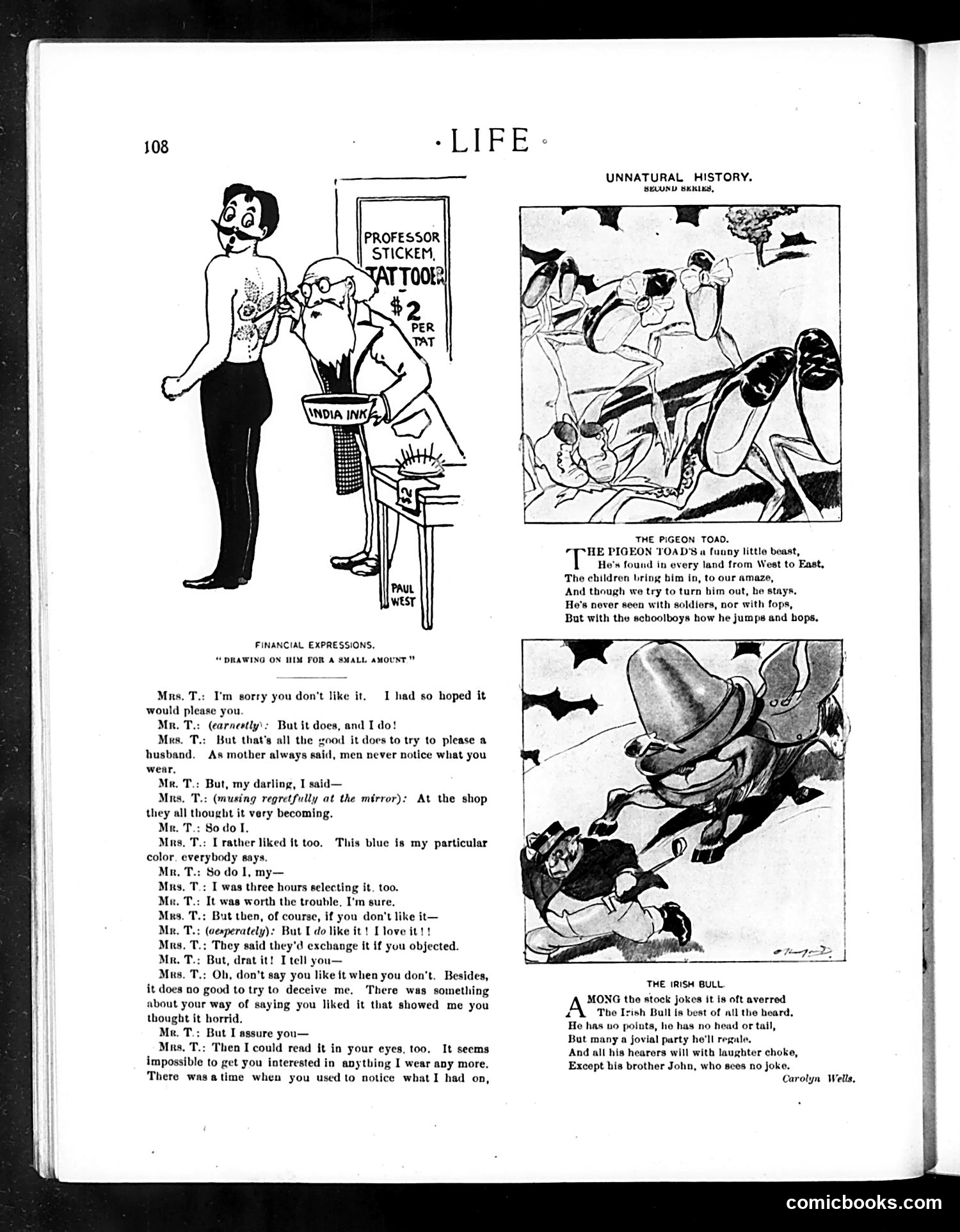
**"Financial Expressions"** (left cartoon): A man shows a tattoo artist his back covered in tattoos while a sign reads "Professor Stickem, Tattoo Artist, $2 per tat, India Ink." The dialogue satirizes marital conflict—the wife dislikes his new tattoo, but he defends it as fashionable. The joke centers on masculine stubbornness in personal grooming choices despite spousal disapproval. **"Unnatural History"** (right section): Two illustrated poems with accompanying cartoons. "The Pigeon Toad" depicts schoolboys playing roughly with a creature. "The Irish Bull" by Carolyn Wells parodies Irish dialect humor, a common period stereotype, using an exaggerated tall-tale format about a bull. These appear to be humorous verse commentary on children's behavior and ethnic stereotypes typical of early-20th-century American humor.
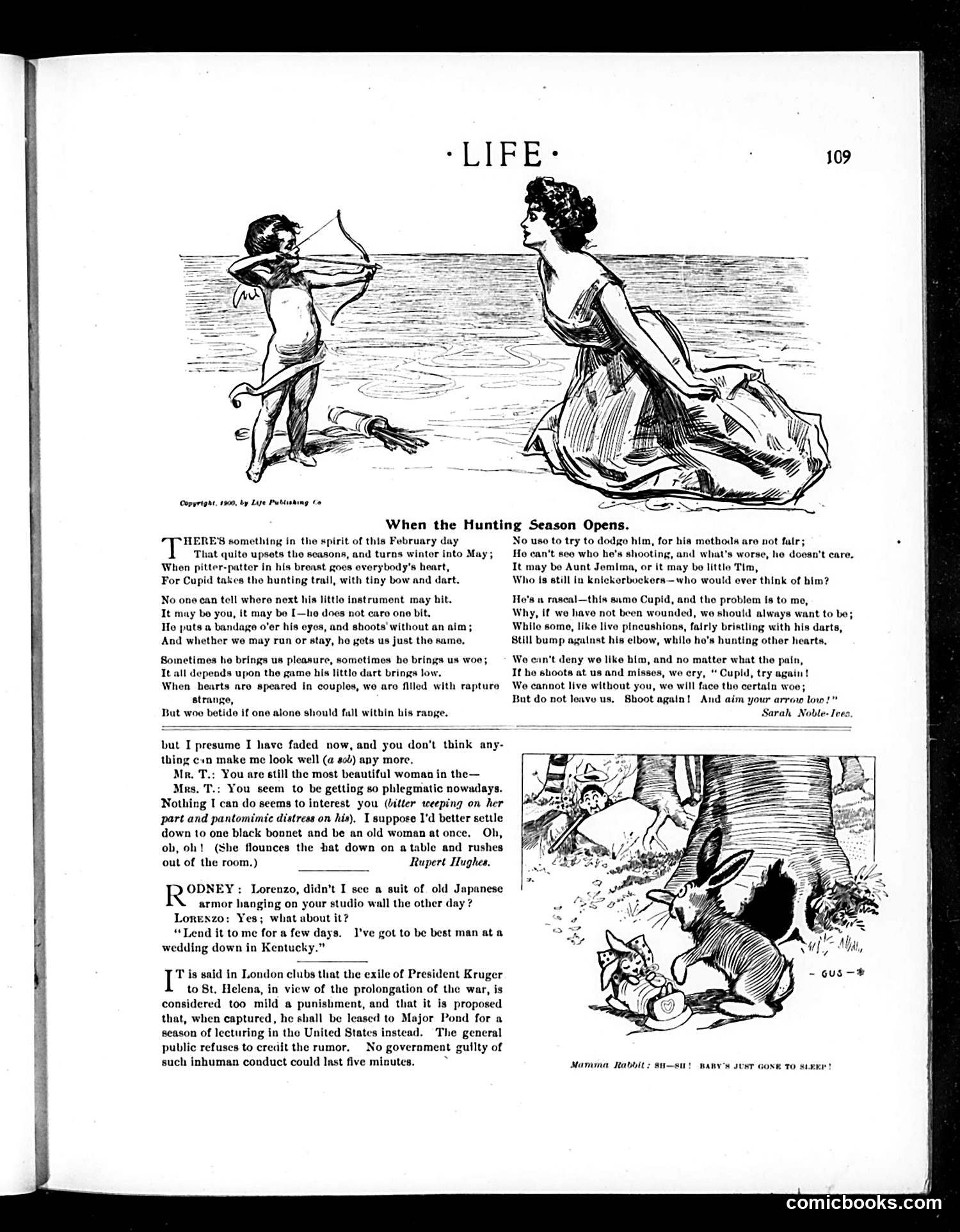
The top illustration depicts Cupid (a cherub with bow and arrow) as game being hunted by a woman in classical dress. The accompanying poem satirizes romantic pursuit—specifically mocking men's predictable behavior when courting ("No use to try to dodge him, for his methods are not fair"). The bottom section contains brief satirical prose items, including a joke about borrowed Japanese armor and a piece mocking President Kruger's exile to St. Helena, suggesting he should be "leased to Major Pond for a season of lecturing in the United States instead." The page appears to be from an early 1900s *Life* magazine issue. The Cupid cartoon uses hunting metaphors to satirize romantic courtship conventions, while the prose items mock contemporary political and social figures through humor.
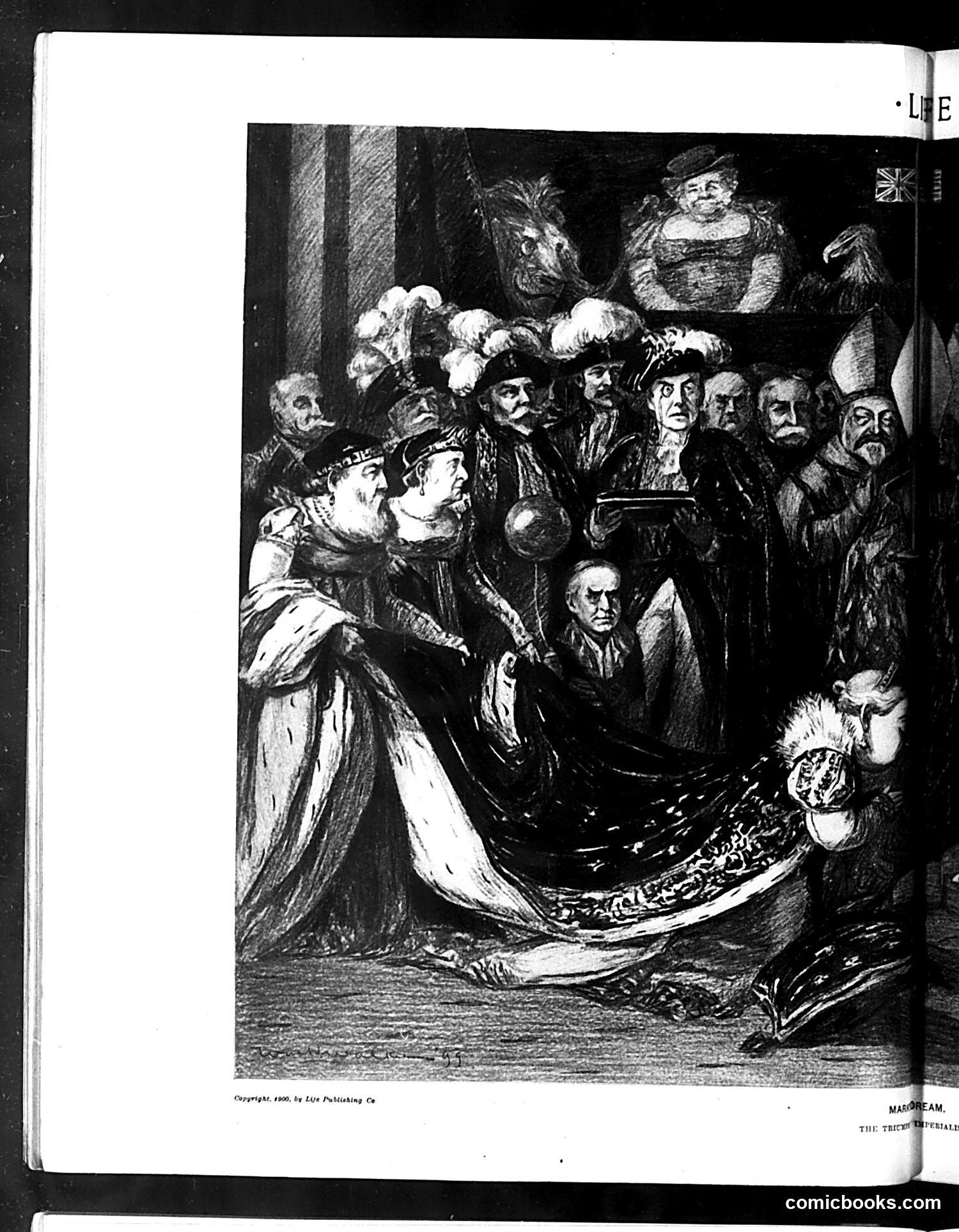
This appears to be a satirical engraving depicting a royal or noble court scene. A richly dressed woman with an elaborate train dominates the left foreground, while a crowd of courtiers surrounds what seems to be a display or presentation of emeralds (visible as objects in the center). The figures wear period costume suggesting 16th or 17th century dress. The satire likely mocks court extravagance, greed, or the corrupting influence of wealth and jewels on nobility. The "tribe" reference suggests commentary on a particular royal family or court faction. The crowded, chaotic composition emphasizes the unseemly scramble for valuable stones, critiquing aristocratic materialism. Without clearer context or visible publication details beyond "Life" and the copyright mark, the specific historical target remains unclear.
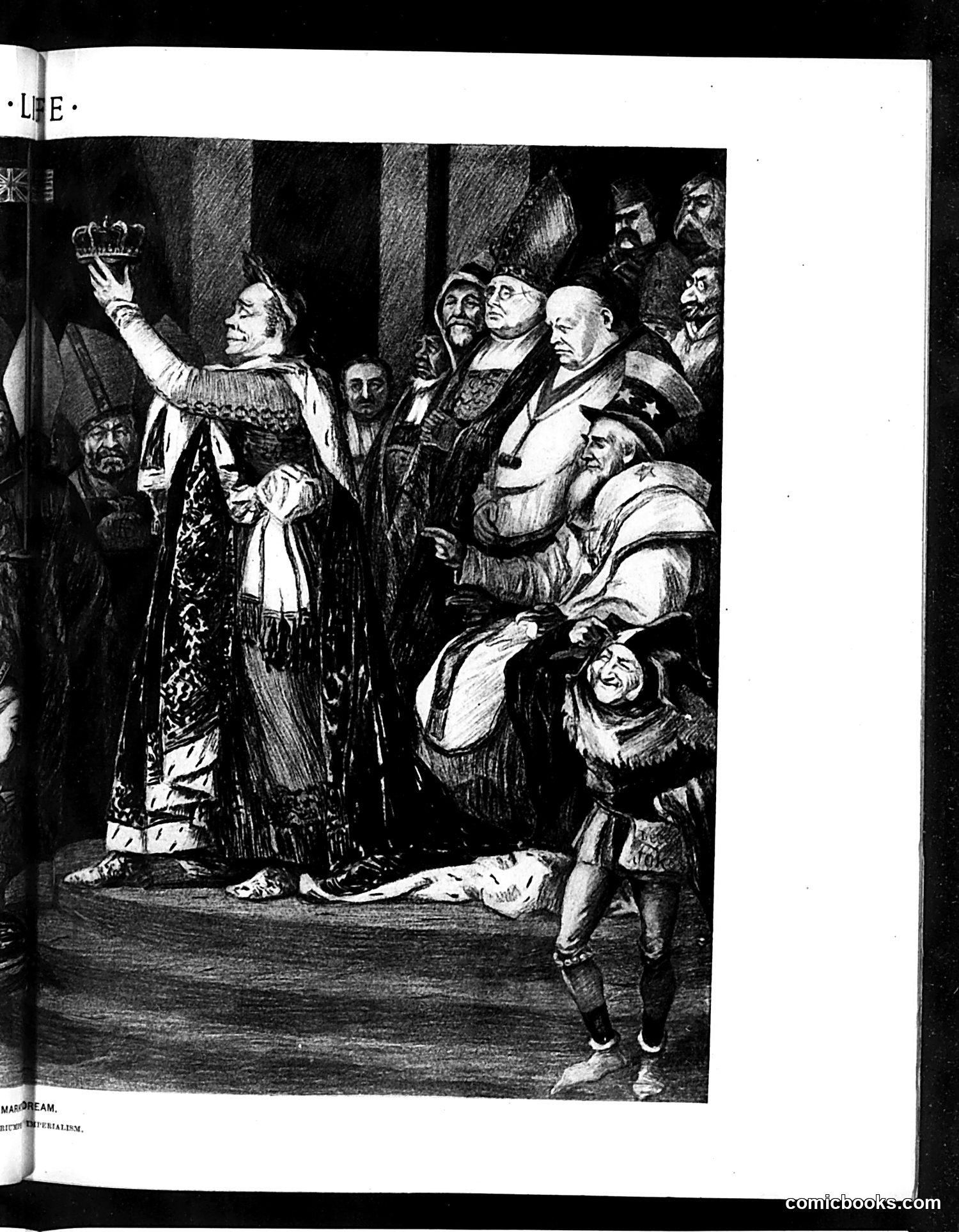
This appears to be a historical satirical engraving depicting a formal court or imperial scene. A robed figure on the left, wearing ornate clothing and a crown or headdress, raises an object (possibly a crown or scepter) while addressing a group of assembled men. The gathered figures display varied expressions—some attentive, others skeptical or concerned. The style and composition suggest this is commenting on power, authority, or succession. The caricatured faces and exaggerated features typical of 19th-century satirical art indicate mockery of the proceedings or the figures involved. However, without additional visible text identifying specific historical figures or events, the exact political reference remains unclear. The engraving's subject matter appears to involve questions of legitimacy or imperial/royal authority.
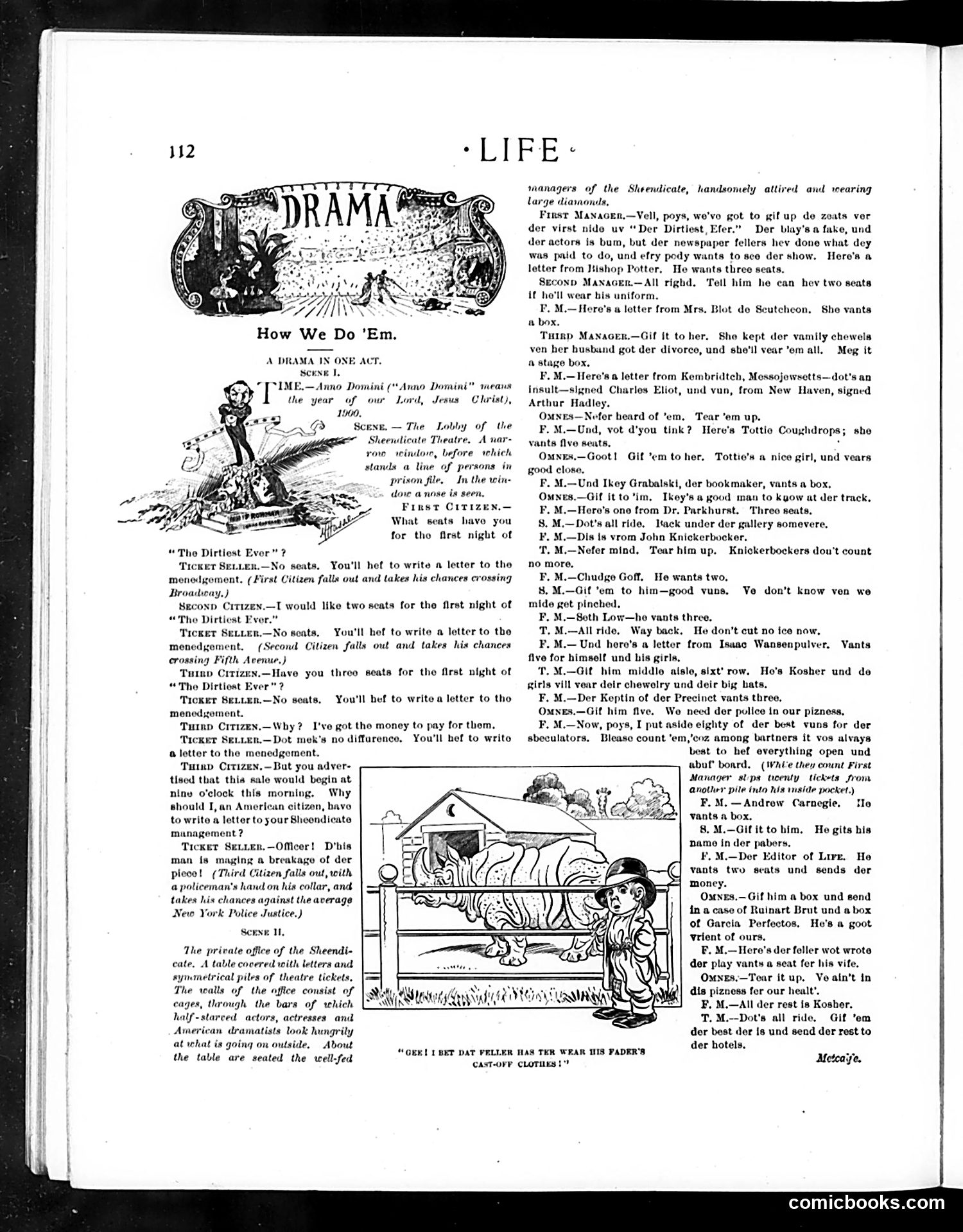
This is a satirical sketch about theater box-office management during the production of "The Dirtiest Ever," apparently a contemporary theatrical production. The humor centers on the absurd letters and requests flooding the box office from various New Yorkers seeking free or discounted seats. The satire mocks both: 1. **The theater's desperation** - they'll accept any excuse to fill seats 2. **The public's shamelessness** - people invent elaborate sob stories (divorces, medical needs, book deals) to score free tickets The illustration shows a crowded tenement building where residents are literally stacked in windows, suggesting the overwhelming volume of requests. The caption "GEE! I BET DAT FELLER HAS TER WEAR HIS FADER'S CAST-OFF CLOTHES!" adds class-consciousness humor about poverty-stricken theater-goers. This satirizes both Gilded Age theater economics and public entitlement.
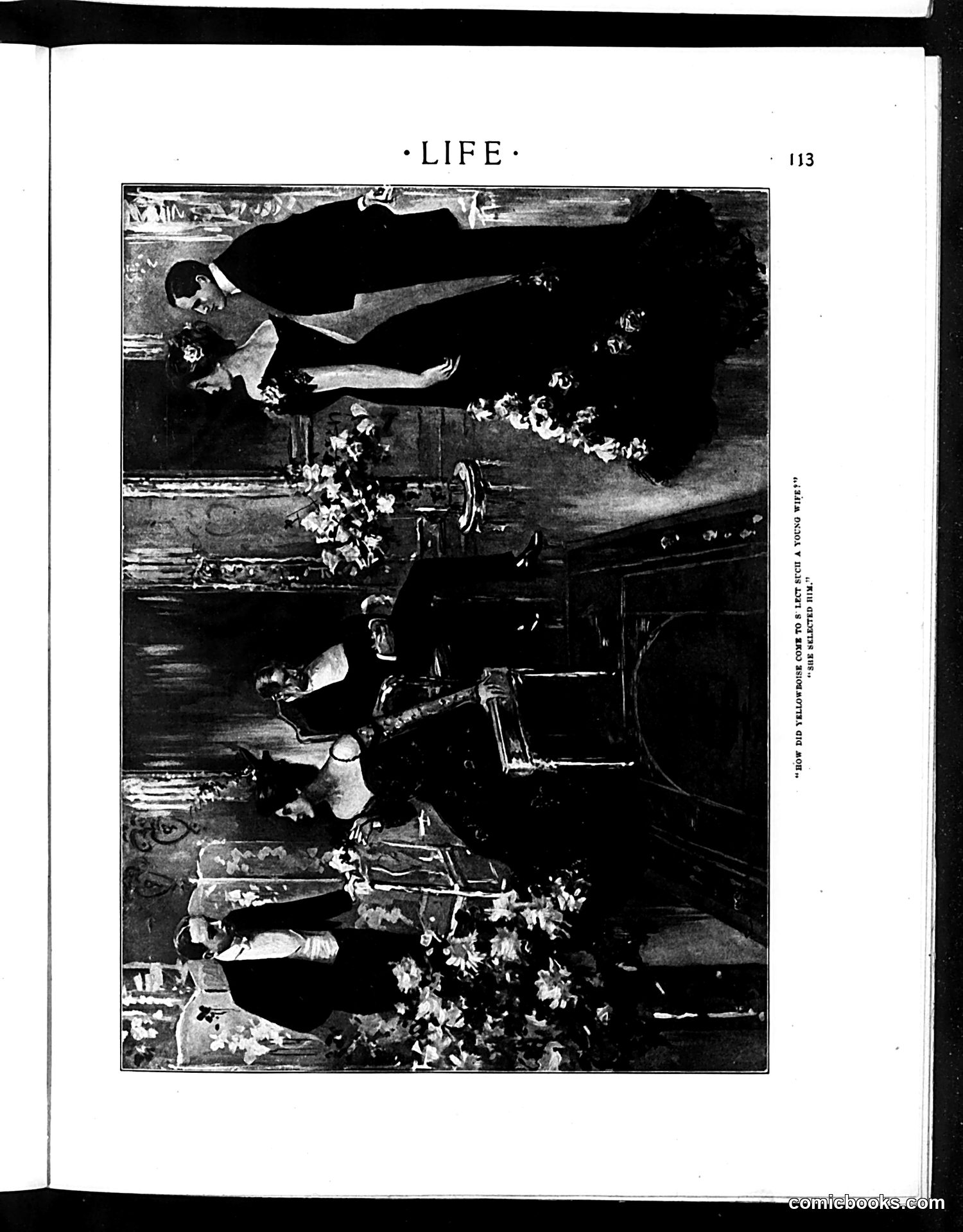
This page from *Life* magazine (page 113) contains a black-and-white photograph that appears to be rotated 90 degrees, showing what looks like an interior scene with multiple figures and decorative floral elements. The OCR text is fragmentary and unclear—"HOW DID YELLOWBOISE COME TO 8" appears incomplete. Without readable caption text or clearer context, I cannot definitively identify the specific political or social satire this image represents. The photograph's formal composition and the mention of "Yellowboise" (possibly a misspelling or satirical name) suggest this may be political commentary, but I cannot accurately explain the joke or identify specific figures without more legible text or additional context.
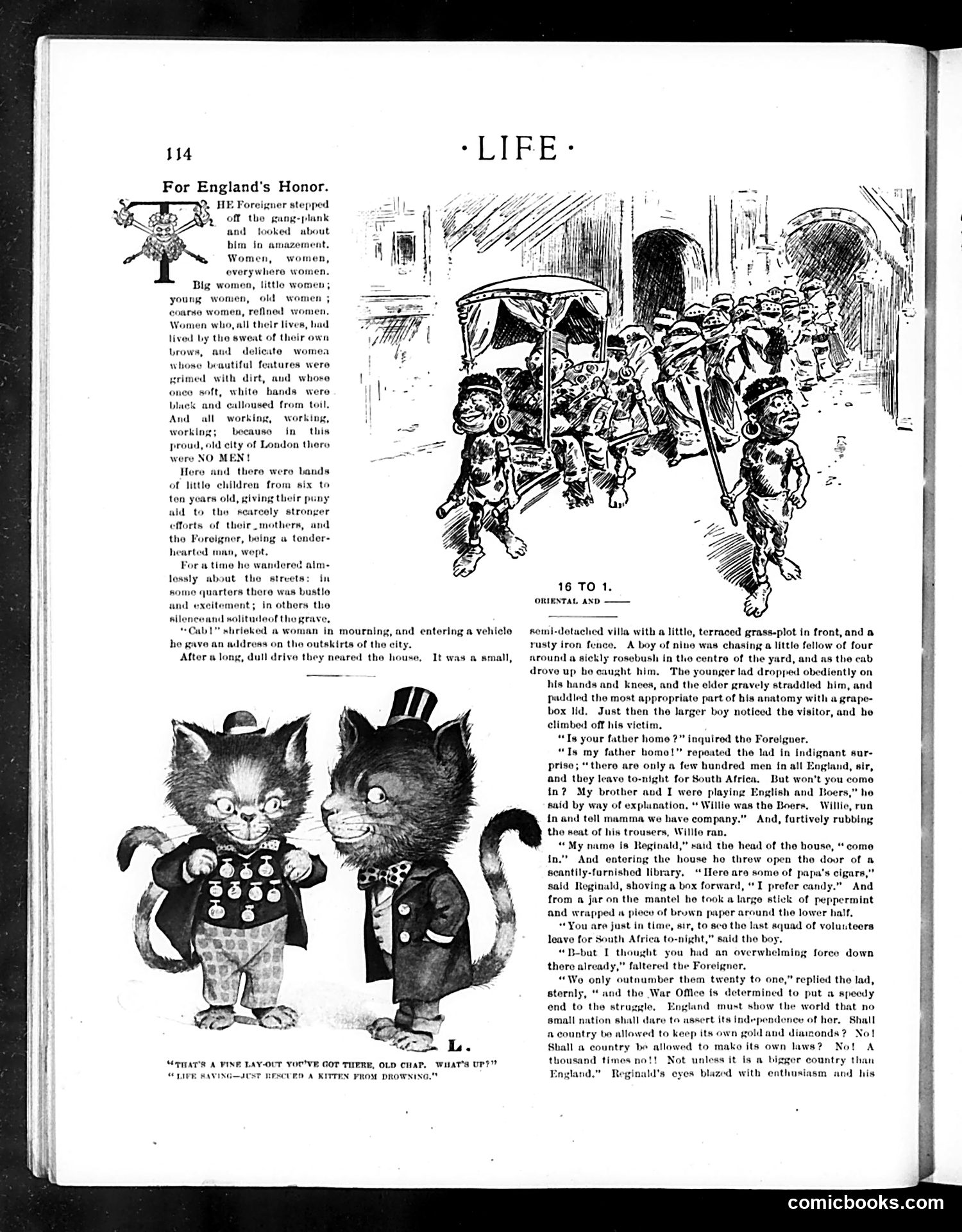
This satirical piece critiques British imperialism during the Second Boer War (1899-1902). The story follows a Foreign visitor observing England, where he encounters children playing "English and Boers"—mimicking the actual war in South Africa. The satire's target is British jingoism: young Reginald, a nine-year-old boy, articulates aggressive imperial ideology with fervent nationalism. He defends England's military dominance, declaring that no smaller nation should be "allowed" independence, control of resources (gold and diamonds), or self-governance. His certainty that Britain must crush the Boers—outnumbering them "twenty to one"—reflects contemporary British confidence in military superiority. The cartoon's lower panel shows caricatured figures (labeled "16 to 1," suggesting the numerical advantage) representing the conflict's power imbalance. The satire's point: British imperial attitudes have so thoroughly indoctrinated even children that they casually justify imperial conquest and deny smaller nations sovereignty. The Foreigner's perspective makes this ideology visible as absurd and troubling.
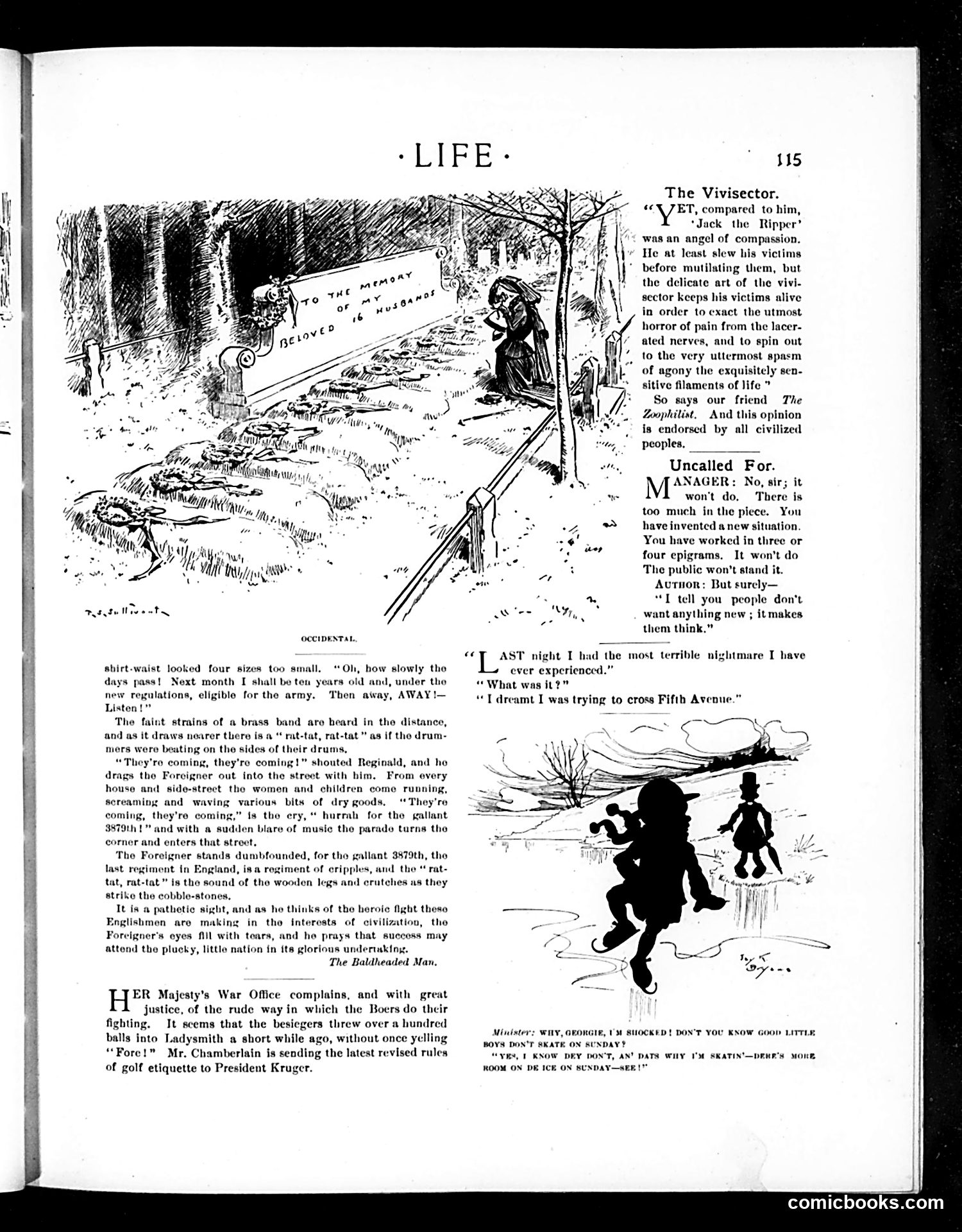
This page contains three distinct satirical pieces: **"The Vivisector"** (top): A critique of animal experimentation. The text compares vivisectionists unfavorably to Jack the Ripper, arguing that live animal dissection inflicts prolonged suffering. This reflects late 19th/early 20th-century animal welfare activism endorsed by *The Zoophilist* publication. **"Uncalled For"** (middle): A comic exchange between a theater Manager and Author about artistic innovation. The Manager rejects new material because audiences "don't want anything new; it makes them think"—satirizing both theatrical conservatism and public apathy toward intellectual challenge. **"The Baldheaded Man"** (bottom): Two separate cartoons. One depicts a nightmare about crossing Fifth Avenue (likely satirizing NYC traffic dangers). The other comments on the Boer War, showing British officers applying "golf etiquette" rules to warfare—mocking the genteel assumptions of British military culture when facing the Boers' unconventional tactics. All three pieces employ satire to critique social institutions: animal abuse, artistic stagnation, and imperial warfare assumptions.
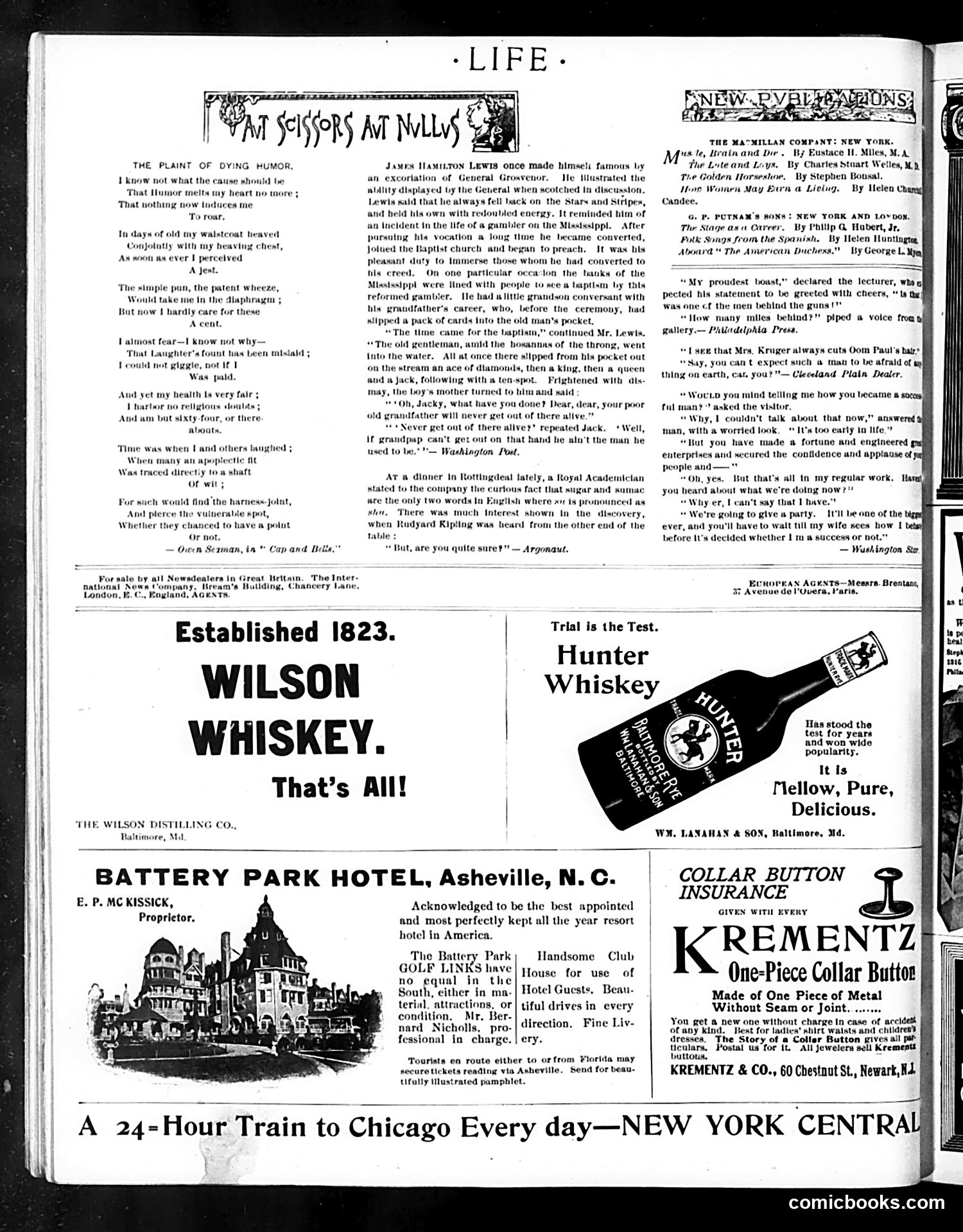
This page features a humorous essay titled "The Plaint of Dying Humor" by Owen Seaman, lamenting the decline of wit and satire in modern times. The author nostalgically recalls when clever wordplay and pointed humor could reliably provoke laughter, but now finds the public's appetite for such comedy diminished. The piece includes two anecdotes illustrating lost comic sensibilities: one about John Hamilton Lewis's exaggerated oratory about a converted gambler whose grandson plants playing cards in his pocket during baptism, and another about Rudyard Kipling's quip regarding pronunciation of "sugar" and "sumac." The cartoon's title "At Scissors at Nully" remains unclear from the visible text, though it appears part of this broader meditation on comedy's perceived deterioration in the early 20th century. The surrounding advertisements (Wilson Whiskey, Battery Park Hotel, etc.) are standard period commercial content.
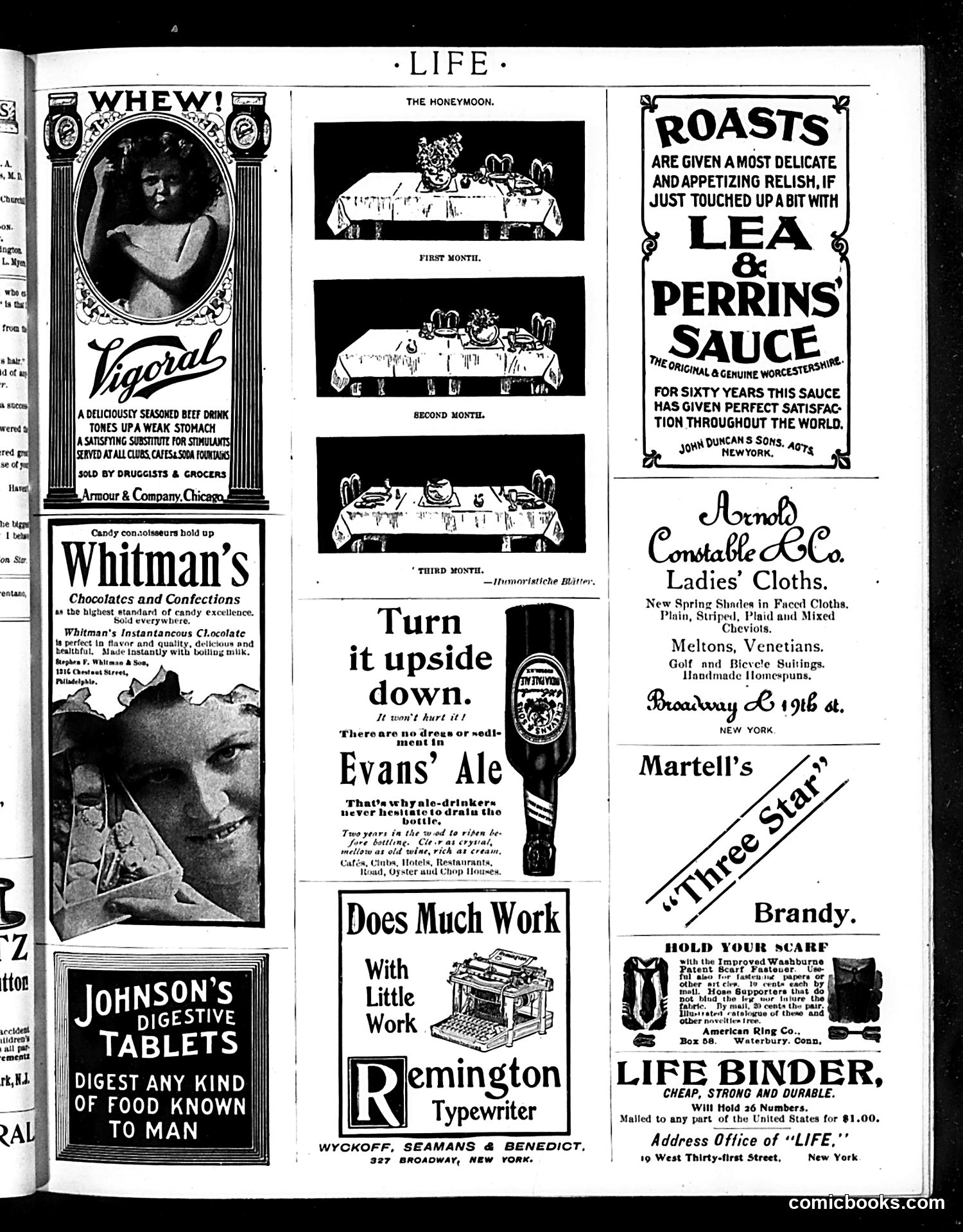
This is primarily an **advertising page** from Life magazine, not a satirical cartoon section. The page contains multiple product advertisements from the early 20th century, including: - **Vigoral** (a beef drink tonic) - **Whitman's Chocolates** - **Johnson's Digestive Tablets** - **Evans' Ale** - **Remington Typewriter** - **Lea & Perrins Sauce** - **Arnold Condell & Co. fabric goods** - **Martell Brandy** - **Life Binder** (for binding magazine issues) The center includes "The Honeymoon" section with three illustrated panels about newlywed life. There is **no political satire** on this page—it's a commercial section showcasing consumer products typical of Life's revenue model, targeting middle-class American readers.
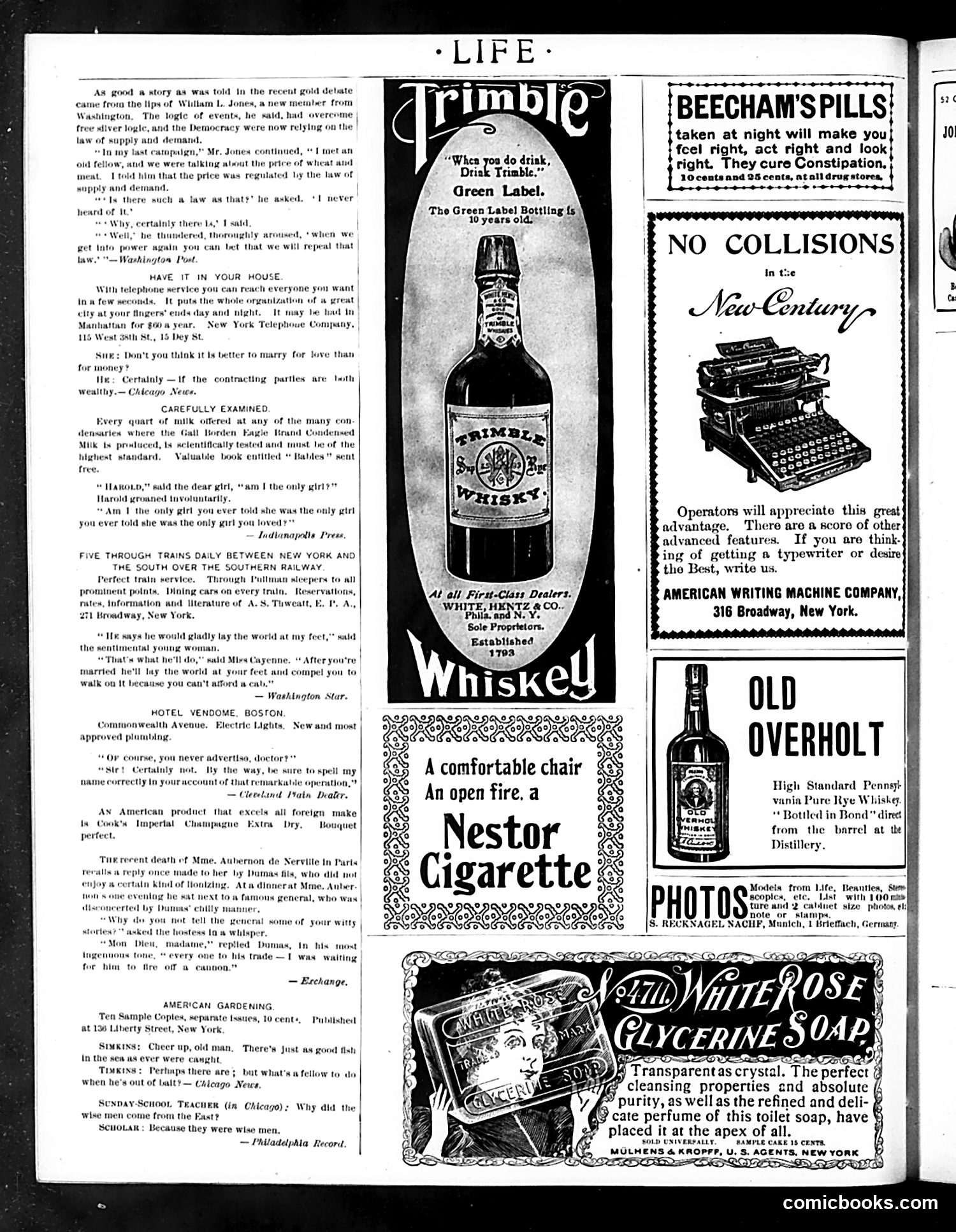
This page is primarily **advertising**, not political cartoons. It contains commercial advertisements interspersed with brief humorous anecdotes and jokes typical of early 1900s Life magazine. The advertisements include: - **Trimble Whiskey** ("When you do drink, Drink Trimble") - **Beecham's Pills** (a patent medicine for constipation) - **New Century typewriter** (emphasizing "no collisions") - **Nestor Cigarettes** - **Old Overholt whiskey** - **White Rose Glycerine Soap** The text includes short joke excerpts from newspapers like the *Washington Post* and *Chicago News*, discussing topics like telephone service, marriage for love versus money, and milk quality standards. There are no identifiable political cartoons or caricatures on this page. It represents the typical late 19th/early 20th-century magazine format mixing editorial content with product advertising.
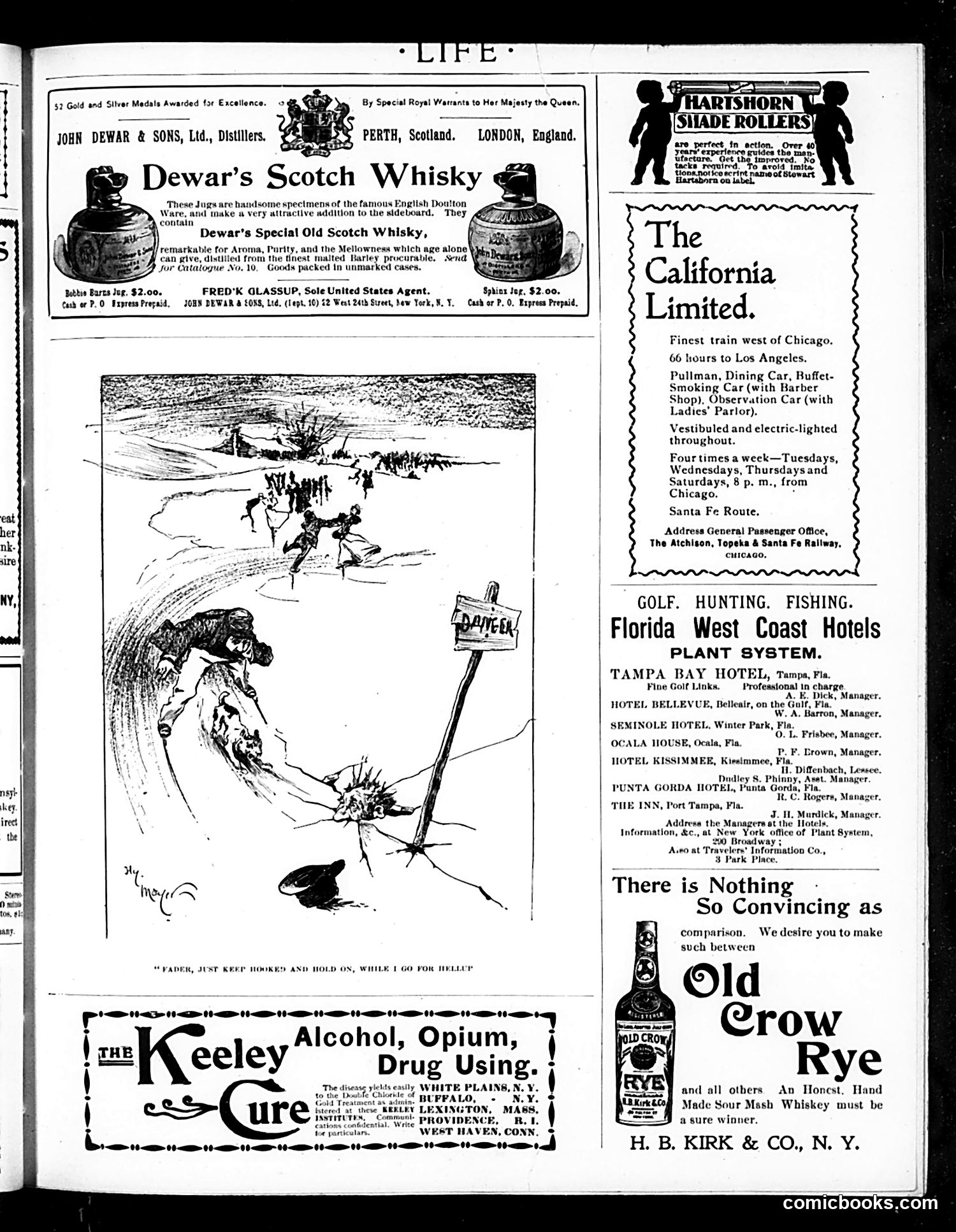
This page is primarily **advertising**, not political satire. The main cartoon depicts a fishing scene with the caption "Fader, just keep hooked and hold on, while I go forHellet" — a visual pun playing on "fader" (likely "father") and the fishing metaphor of being "hooked." The page features whiskey and spirits advertisements (Dewar's, Old Crow Rye), along with ads for luxury travel (The California Limited train) and Florida hotels. One notable ad for "The Keeley Cure" advertises treatment for "Alcohol, Opium, Drug Using," creating an ironic juxtaposition—the page simultaneously promotes alcoholic beverages while advertising addiction treatment. This reflects early 20th-century American attitudes toward substance abuse, when such cures were heavily marketed alongside the substances themselves. The page reflects period consumer culture and commercial advertising practices rather than political commentary.
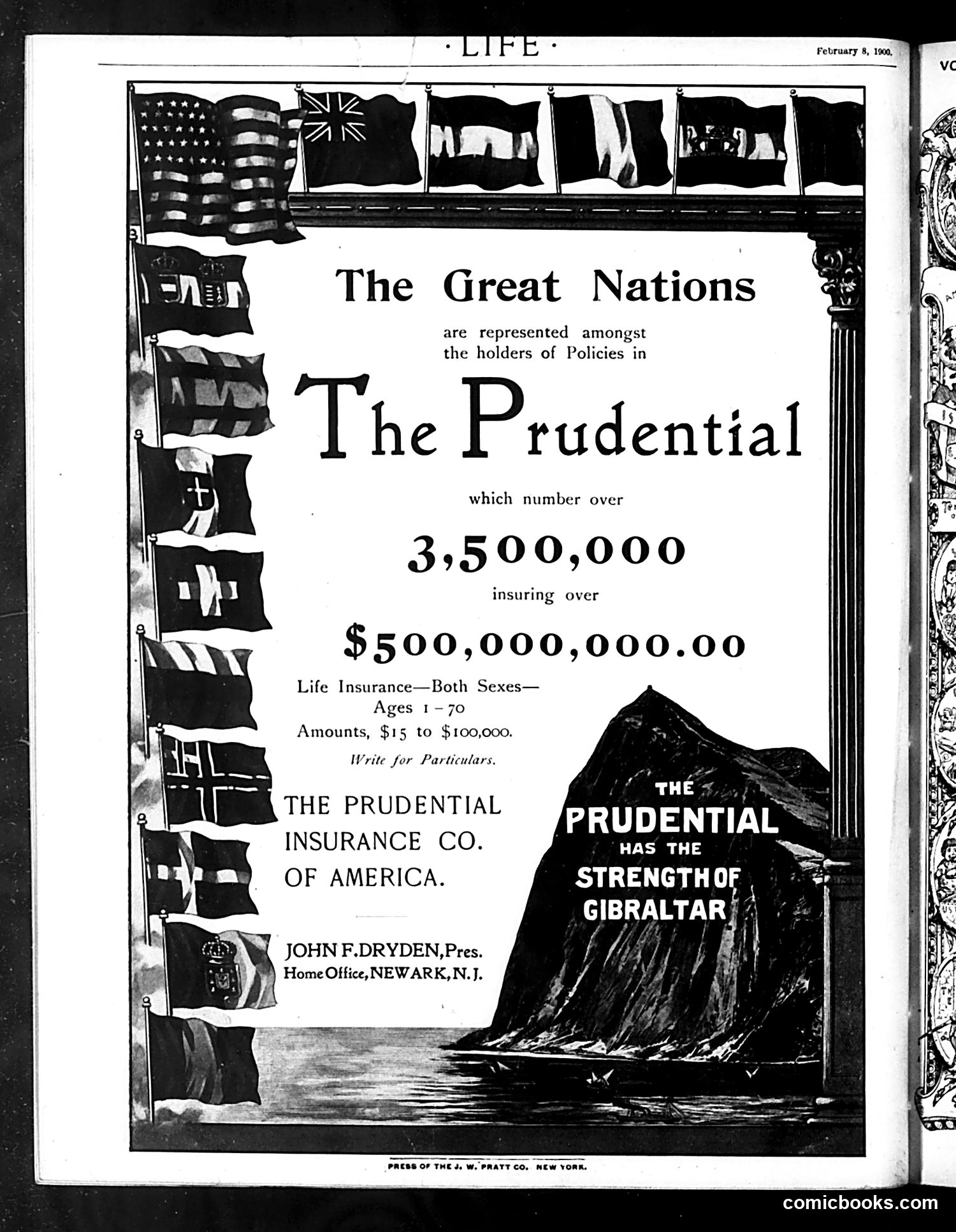
This is primarily a **corporate advertisement**, not satirical content. It promotes The Prudential Insurance Company of America, emphasizing their global reach and financial strength. **Key elements:** - **The flags** (left margin) represent "Great Nations" with policies held by Prudential—a visual claim of worldwide importance and trustworthiness - **The Gibraltar image** (right) illustrates their slogan: "The Prudential Has the Strength of Gibraltar"—a metaphor for unshakable stability and permanence - **The numbers** ($500 million in coverage, 3.5 million policyholders) establish market dominance - **John F. Dryden** (President, listed at bottom) was Prudential's actual founder The advertisement targets middle-class Americans by suggesting that insuring with Prudential aligns one with international respectability and geological permanence. The patriotic flag imagery and insurance offerings suggest security and trustworthiness during an era (early 1900s) when life insurance was still relatively new and required confidence-building marketing.