
Life, 1900-02-08 · page 6 of 20
Life — February 8, 1900 — page 6: what you’re looking at
What you’re looking at
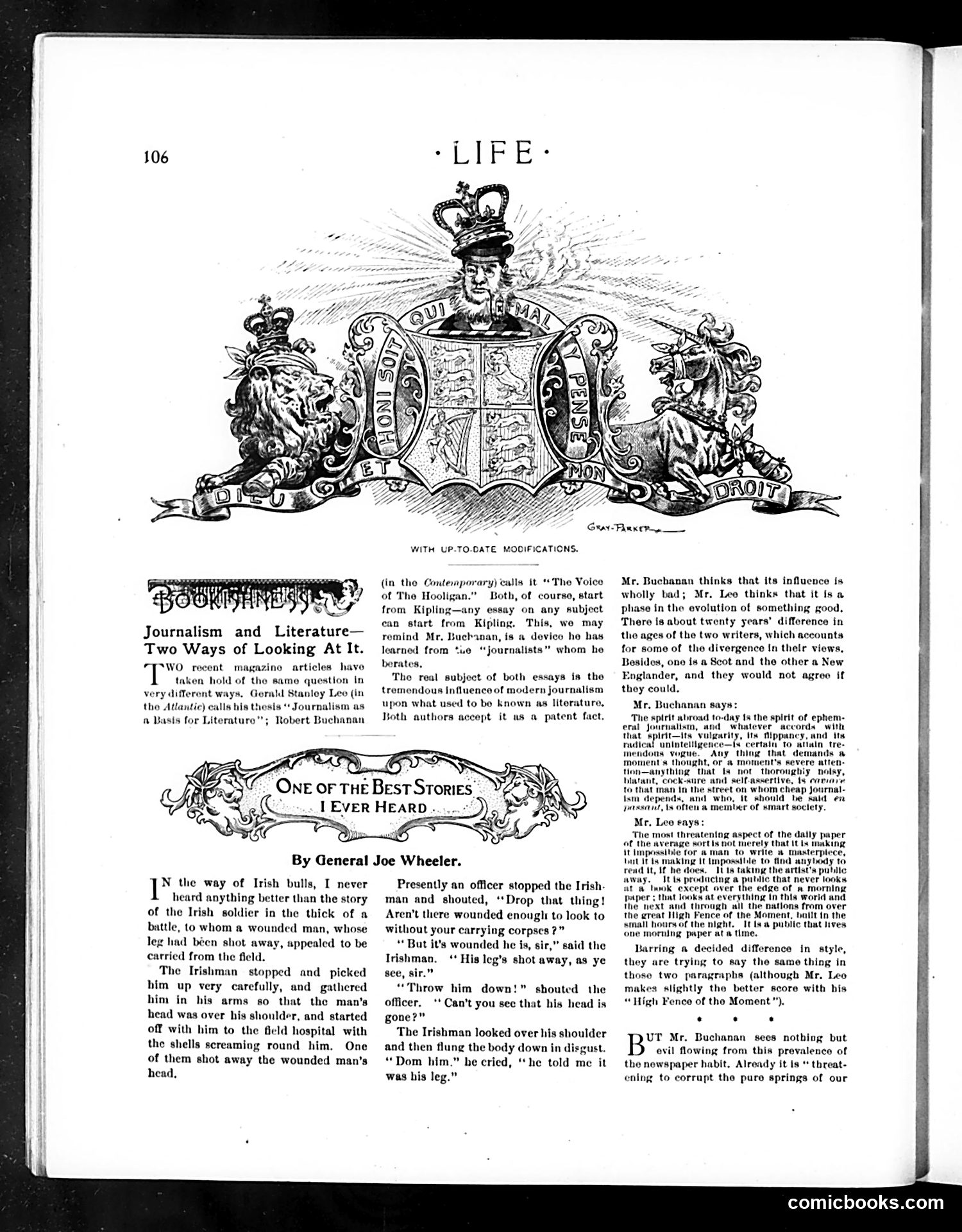
The main content discusses journalism's influence on literature, with essays by Robert Buchanan and presumably another critic debating whether modern journalism corrupts literary quality. Buchanan argues journalism harms literature through its "vulgarity" and "radical unintelligence," while his opponent (likely W.E. Henley, though unclear) defends the form. Below is "One of the Best Stories I Ever Heard" by General Joe Wheeler, featuring an anecdote about Irish soldiers during what appears to be a military campaign. An Irish soldier carries a wounded comrade from battle, but when ordered to drop the body, he refuses—leading to dark humor about the soldier being shot and his leg blown off. The heraldic masthead emphasizes Life's prestigious editorial stance on cultural matters.
📄 Transcribed text from this page (OCR, searchable)
Machine-transcribed from the original scan — historical spelling and the odd misread are preserved.
Journalism and Literature— Two Ways of Looking At It. TT recent magazine articles have taken hold of the same question In very different ways. Gerald Stanloy Leo (in tho Atlantic) calls his thesis “Journalism as a Basis for Literature”; Robert Buchanan WITH UP-TO-DATE MODIFICATIONS. {in tho Contemporary) culls it The Voice of Tho Hooligan.” Both, of course, start from Kipling—any essay on any subject can start from Kipling, This, we may romind Mr. Buchanan, is a devico he bas learned from tue “journalists” whom he borates, The real subject of both essays is tho tremendous Influencoof modern journalism upon what used to bo known as literature, Both authors accept it us a patent fact, One oF THE Best Stories: : 1 EVER HEARD . By General Vy the way of Irish bulls, I never heard anything better than the story of the Irish soldier in the thick of a battle, to whom a wounded man, whose leg had bécn shot away, appealed to be carried from the field. The Irishman stopped and picked him up very carefully, and gathered him in his arms so that the man’s head was over his shoulder, and started off with him to the fleld hospital with the shells screaming round him. One of them shot away the wounded man's head, Joe Wheeler. Presently an officer stopped the Irish. man and shouted, ‘Drop that thing! Aren't there wounded enough to look to without your carrying corpses ?” “ But it’s wounded he fs, sir,” said the Irishman. “ His leg’s shot away, as ye see, sir. “Throw him down!” officer, gone?” The Irishman looked over his shoulder and then flung the body down in disgust. “Dom him.” he cried, he told me it was his leg.” shouted the “Can't you see that his head is Mr. Buchanan thinks that its influence is wholly bad; Mr. Leo thinks that it is a phase in the evolution of something good, There is about twenty years’ difference in the ages of the two writers, which accounts for somo of tho divergence In thelr views, Besides, ono 14 a Scot and the other a New Englander, and they would not agreo if they could. Mr. Buchanan says: ‘The spirit abroad to-day 1s the spirit of ephem- eral Journalisin, and) whatever accords with that spirits vulgarity, It Mippancy, and tte nudical unintelligence—{s certain to atiain tre. mendons vogue. Any thing that demands a moment's kevere atten- not thoroughiy nolsy, self-assertive, is canare ton whom cheap Journal- it xhonld be sald en jer of amart soctety. ‘The most threatening aspect of the dally paper of the average sortts not merely that It lx making it impossible for a man to write & masterplece, Dut It is making ICimpossitile to find anybody to. rend it, If he does. Its taking the artist's public away.” It ts producing a public that never looks ut & book except over the edge of a morning pa nat looks At everything tn this world and and through all the nations from over re High Fence of the Moment, batit in the nall hours of the night. It isa pubilc that lives: one morning paper ata time, Barring a decided difference in style, they are trying to say the same thing in those two paragraphs (although Mr. Leo makes slightly the better score with his “High Fence of tho Moment”). . . . UT Mr. Buchanan sees nothing but evil flowing from this provalenco of the newspaper habit, Already it Is * threat- ening to corrupt tho puro springs of our comicbooks.com